-
A glooming peace this morning with it brings / 26 Jan 2023

Post-plow mess in Madbury (trekking pole 4’3″ long) I woke yesterday to what had become the unaccustomed sound of silence from our propane-guzzling generator, which had been running non-stop from 4-something am Monday morning until 2 .07 am Wednesday morning, powering enough circuits to keep heat on and water flowing throughout the most recent if long delayed snow storm of the season. How very unfortunate that power and other lines were never buried when first installed in heavily forested New Hampshire! For a time in the last couple of days, I’ve been without landline, cell service, or internet, cut off from all the “modern conveniences” save for the most helpful if noisy and stinky generator which also kept my groceries from spoiling—unlike the local Market Basket, where after more than 48 hours without refrigeration, perishables could no longer be sold. I shudder to think of all the good food that has gone to waste.
The Year of the Rabbit had gotten off to a fine start on Saturday, 21 January, the lunar new year’s eve when I once again had the privilege of enjoying a dumpling dinner and lively conversation with long-time friends Shiao-Ping and Brian and newer acquaintances Fran and Phil.
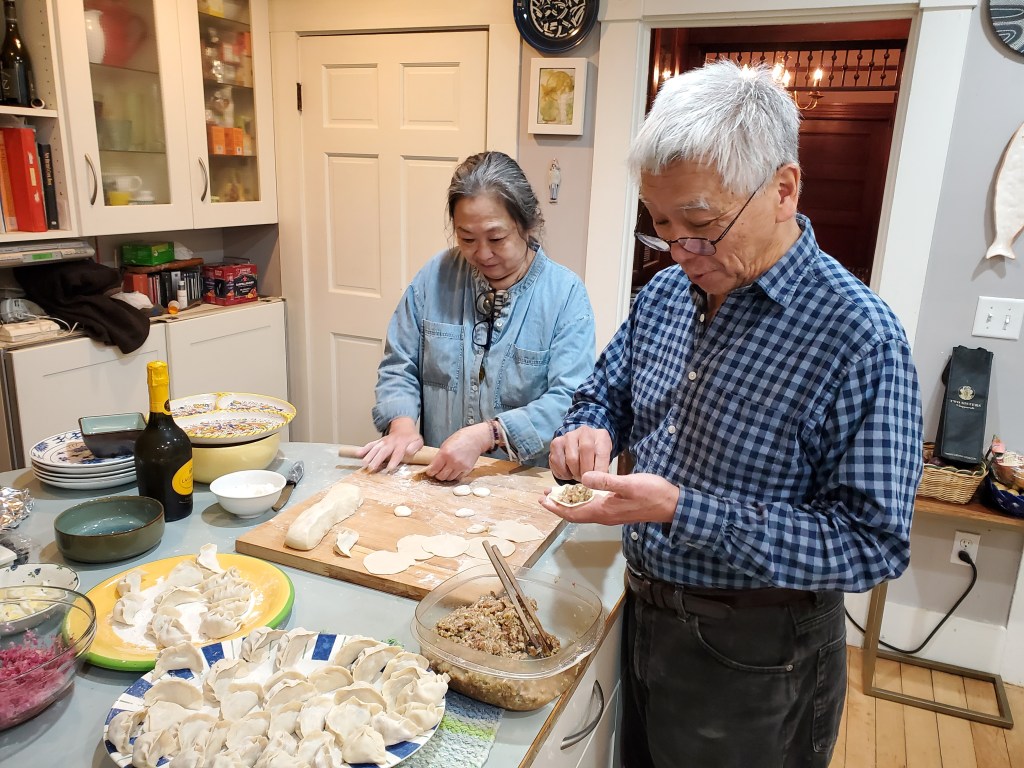
Shiao-Ping and Brian make dumplings for new year’s dinner 
“Soup of the evening, beautiful Soup!” Then on Sunday, I was equally privileged to attend the Emerson Quartet’s final performance in Boston’s Jordan Hall, an ambitious program that included two pieces played by the three original Quartet’s members Eugene Drucker (violin), Philip Setzer (violin), and Lawrence Dutton (viola) in 1976 when they were just, as Setzer said, “a baby quartet”: Bartόk’s String Quartet No. 2 and Beethoven’s String Quartet No. 8 in E minor, Op. 59, no. 2 “Razumovsky.” Cellist Paul Watkins joined the Emerson in 2013, himself now a veteran of a decade’s playing together.
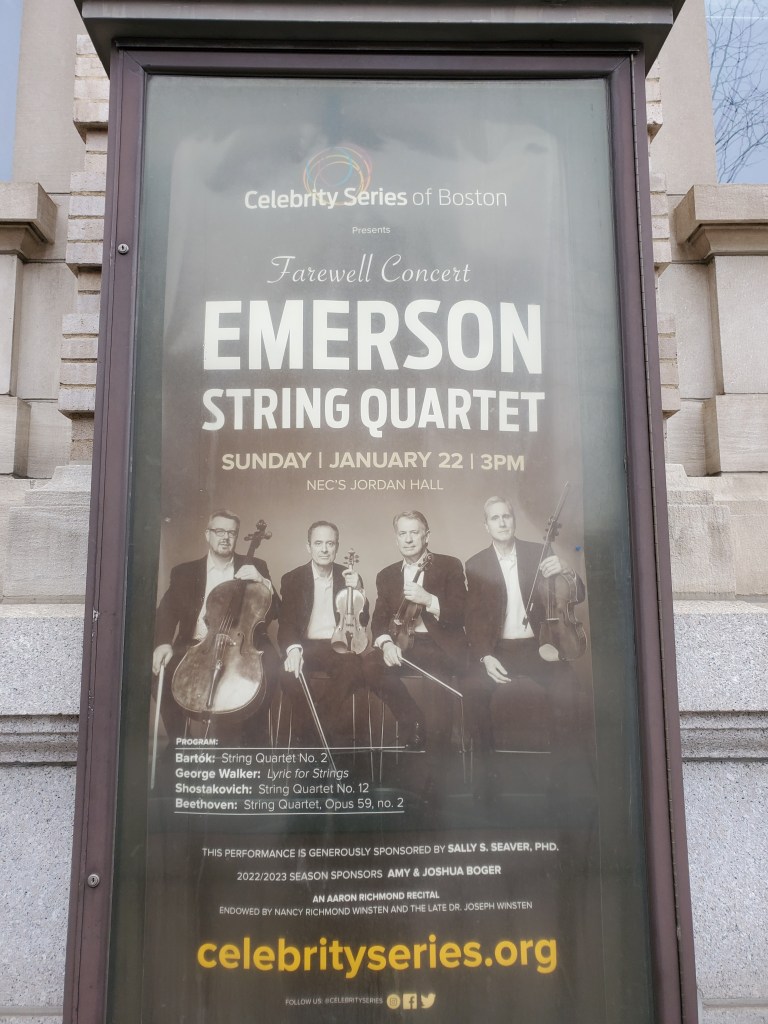
The afternoon was understandably nostalgic, as the Quartet will give its final performance together in New York City in October 2023, and their Jordan Hall appearance—the 27th—was their last in Boston. Violinist Drucker’s notes on the first movement of the Bartόk capture the mood: “There are many forceful, defiant moments, alternating with phrases of bittersweet tenderness, but something has happened to the flow of the music. It stops and starts, changes tempo and character often without a feeling of transition or resolution. These fragments are sometimes simplified, sometimes exaggerated, sometimes grotesque—they point in many different directions but don’t really go anywhere. Together they form a mosaic of nostalgia and despair.” Also on the program: George Walker’s Lyric for Strings, a brief piece ending “in serene resignation” (Susan Halpern) and Shostakovich’s String Quartet No. 12 in D-flat Major, Op. 133, also “full of despair” (Halpern). The slow movement of the Beethoven Op. 59, no. 2, Molto adagio, Beethoven said, is to be played “with much sentiment,” adding to the bittersweet resonances of a performance completed with Dvořák’s wistful Cypresses No. 7.
Ay, me. Even my favorite parking venue serving the New England Conservatory and Symphony Hall, the Midtown hotel, is (according to friendly desk clerk Mark) slated to be razed to make way for a new apartment complex. And by the time I pulled out onto Huntington Avenue, the snow had begun.

The Emerson Quartet, Final Performance in Jordan Hall, Boston
22 Jan 2023
(photo by Robert Torres)I just barely beat home that Sunday snowstorm, and by early Monday morning, power and landlines were down in New Hampshire. Even the day was dark. My friend Diane, saddened by her father’s recent passing, emailed right before I lost internet service that she can for now continue her break from chemotherapy, her good news mixed with sad.
Then post-storm on Tuesday I visited briefly with my friend Jack down the street, who had just that day begun hospice care. Himself a surgeon, Jack is a wry stoic and seems somewhat bemused by the complexities of 21st century dying, complaining without rancor that it seemed an awfully elaborate business. “The Eskimos had the right idea,” he said, and quipped that the installation of a chair lift in their home’s staircase constitutes the most expensive travel he’s ever undertaken given the duration of the trip. Ours was a calm, gratifying, and plain-dealing conversation even as Jack’s harried wife negotiated calls about medications with only spotty cell service, the land line down and power still out, conditions of course augmenting her anxiety. I reported to Jack the success of my recent Mohs surgery, and voiced my own practical concerns about being mortal: who will look after all of us boomers, the “pig in the python” generation, arriving more or less simultaneously at the terminus? Who can say?
Returning home to the roar of our generator, I decided to seek distraction elsewhere, though my choice of diversion could hardly lift one’s spirits. It didn’t. The film Women Talking is based on the 2018 novel of the same name by Miriam Toews, in turn inspired by real-life events that occurred at the ultraconservative Mennonite Mantiba Colony in Bolivia, where between 2005 and 2009 more than 100 girls and women were raped at night in their homes by a group of colony men who sedated them with animal anesthetic. The youngest victim was three years old, and the oldest was 65. The newly released 2022 American film written and directed by Sarah Polley reimagines a group of colony women, all kept uneducated without schooling and illiterate, gathering secretly to discuss the nighttime attacks they have suffered, and to decide on a course of action. The cast (most notably Claire Foy, Jessie Buckley, and Ben Whishaw, with Frances McDormand, also a producer, in a lesser role) give extraordinary, haunting performances of Polley’s remarkable screenplay, a horrifying, unforgettable story ultimately a paean to female strength and solidarity. With its very limited run at the local Regal Cinema complex, and preceded by appallingly crass trailers of loud, candy-colored, violent, BORING Marvel Universe films and also-ran so-called “blockbuster” movies, Women Talking felt all the more extraordinary and important, finally disturbing and inspiring in equal measure.

By 2.07 am Wednesday morning, the power was back on here in Madbury and quotidian life resumed despite a second though not so wet and heavy snowfall.
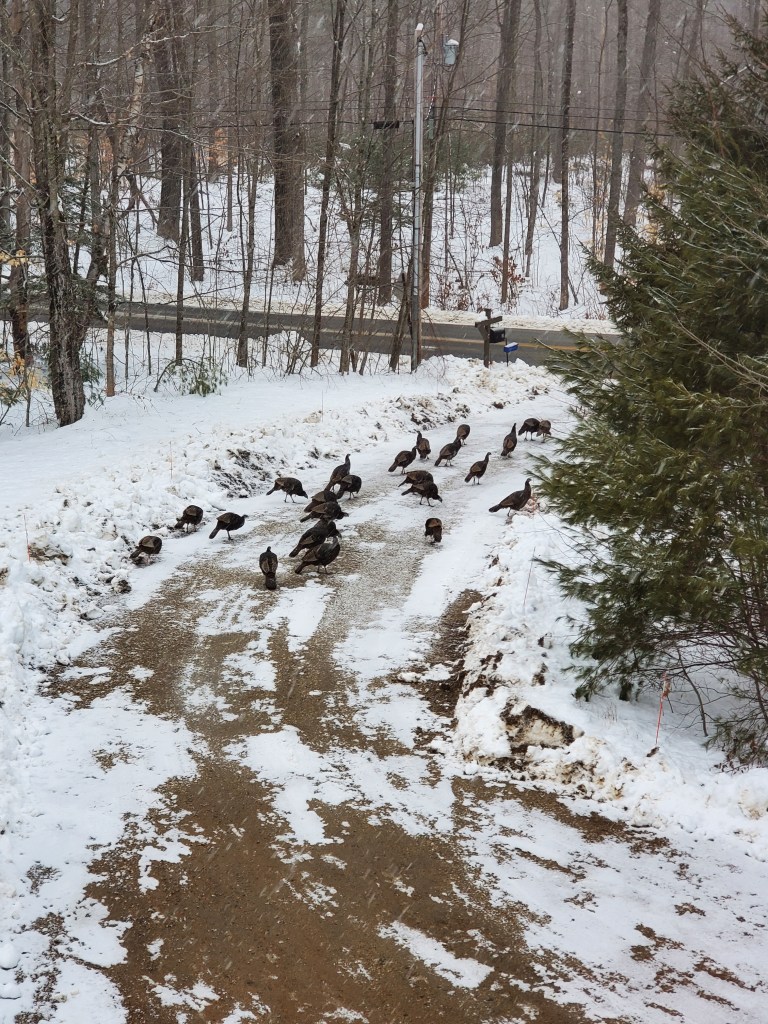
A rafter of turkey hens post storm . . . 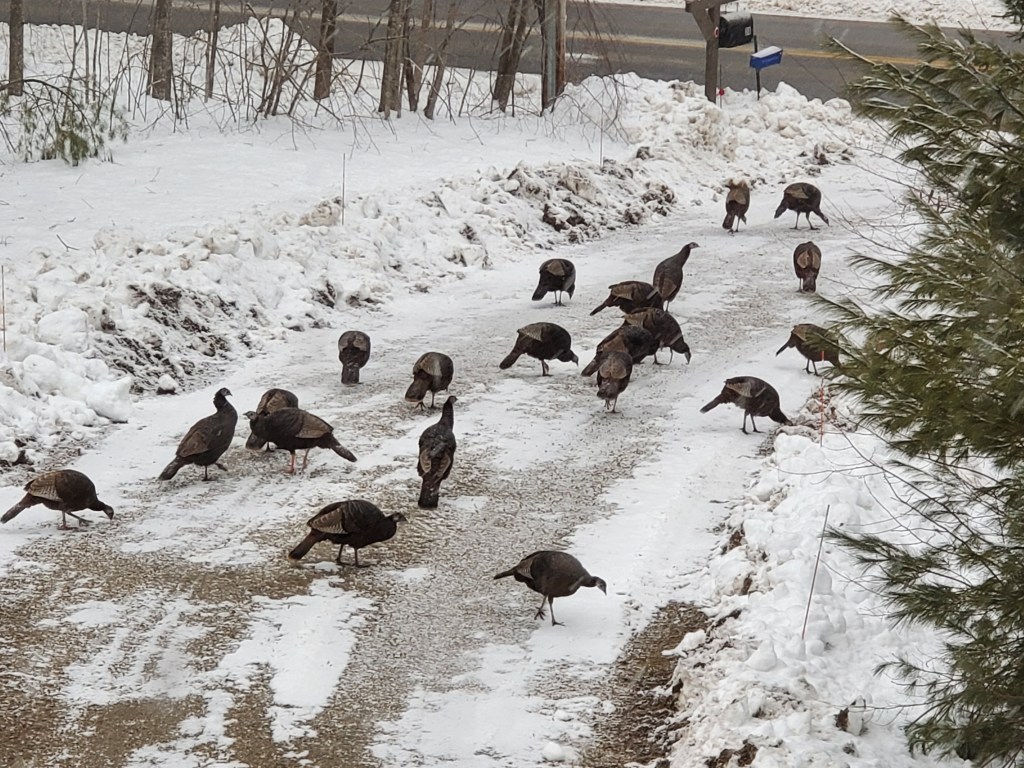
or would “coven” be the better word? I took up routine again–not, however, unaltered by re-acquaintance with Ultimate Things, my recent experience shaped by consummate artistry and the courage of friends.
-
Submechaniphobia 15 January 2023
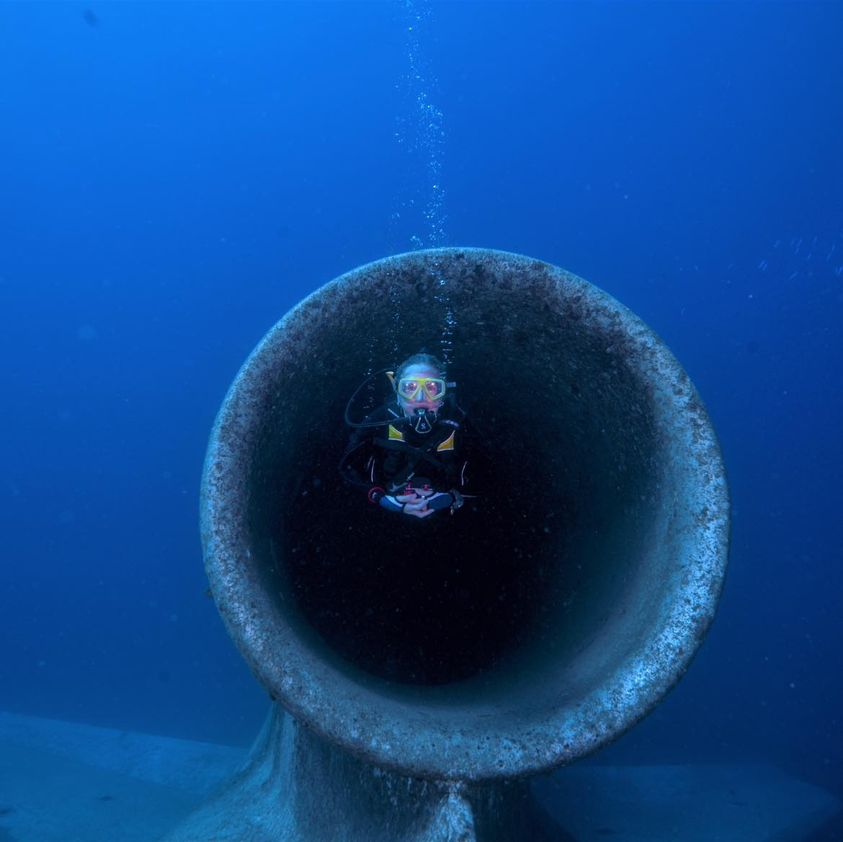
Wendy, submerged in a plane in Jordan–yikes! My friend Wendy is a fearless adventurer, downhill skier, and scuba aficionado, in addition to her many other accomplished roles including art historian, curator, and first-class cook. I already knew that when yesterday this photo showed up in my email linked to a Facebook post she had made: Wendy inside a Lockheed L1011 air intake on the sea floor in Jordan.
This image terrifies on so many levels—some more obvious than others. Airplanes should be either in the air or on the ground, not under water. And as for posing while scuba diving inside a sunken plane’s air intake: that’s pushing the “air intake” metaphor to its literal limit in my book. Just the thought of scuba makes me claustrophobic. If you want a safe but heightened taste of that phobia, watch Ron Howard’s excellent 2022 film Thirteen Lives, based on the true story of the 2018 mission to rescue 12 boys and their soccer coach from Thailand’s flooded Tham Luang Nang Non cave system. Holy cow.
For me, Wendy’s photo also rhymes experientially with two other direct encounters of the scarifying sublime. Looking down into a Hoover Dam spillway on one of our many visits to the desert southwest really gave me the willies. And artist Nari Ward’s Nu Colossus (2011), part of Ward’s “Sub Mirage Lignum” installation at MASS MoCA (2 April 2011-4 March 2012) had an awful allure.

Hoover Dam spillway 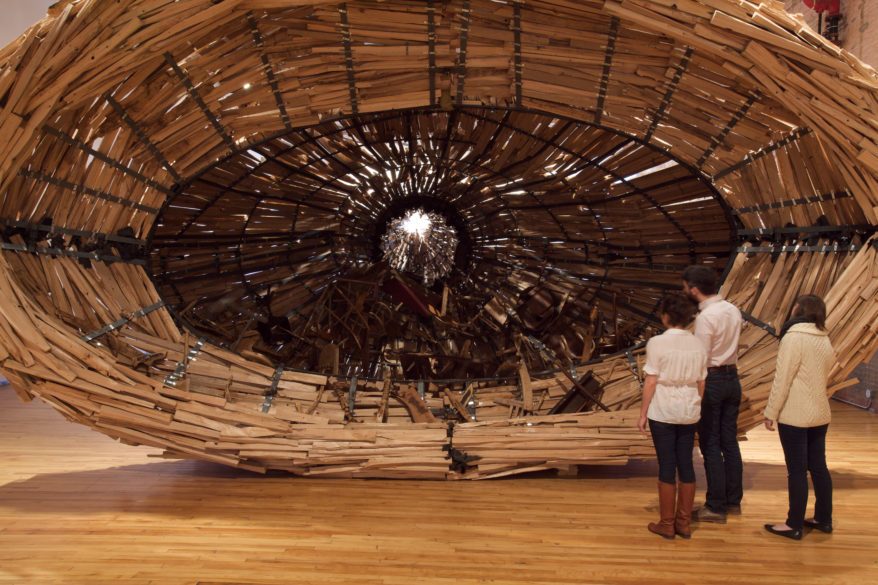
Nari Ward’s Nu Colossus (2011), MASS MoCa The form of Nu Colossus came from the small conical basket-woven fish traps used in Ward’s native Jamaica; fish are lured into these traps only to get ensnared once inside. Ward’s leviathan 60-foot long sculpture, a whirlwind on its side, appears to have sucked in random bits of weathered furniture—and threatens the viewer in much the same uncanny way.
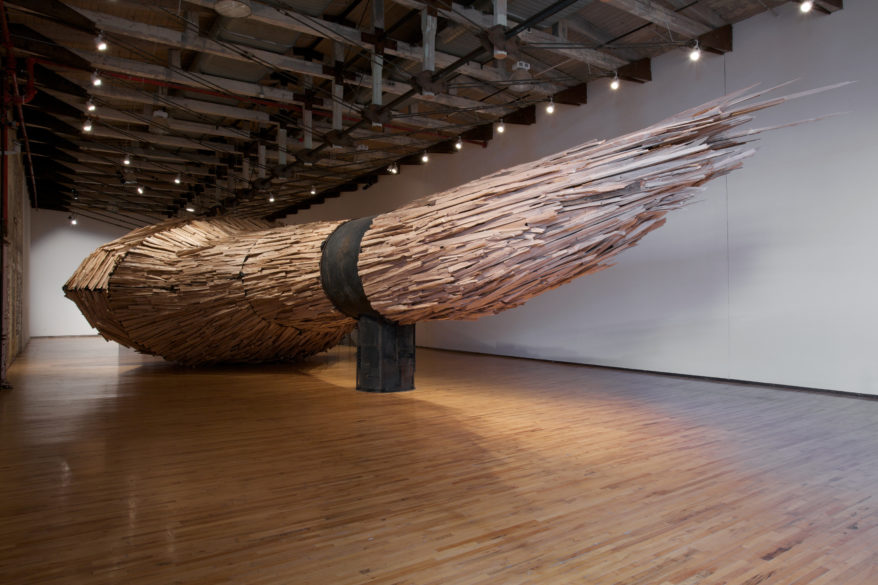
Ward’s Nu Colossus from behind As for the Hoover Dam spillway, a terrestrial undertow that so creeped me out that I vividly recall its alarming gravitational pull decades later, it took my searching the Internet for a picture of it to discover that there’s a Reddit community devoted to sharing images prompting “the fear of partially or fully submerged man-made objects.” Ah, so! There’s a word for the sensation Wendy’s dive, the Hoover dam spillway, and Ward’s Colossus all evoke in me: submechaniphobia! And it’s curious how absent the “man-made” aspect, approaching the lower depths does NOT scare me, not even the 755-foot descent into Carlsbad Caverns that my husband and I managed to hike back in March of 2016. What’s the deal with that?

Entrance to Carlsbad Caverns, New Mexico 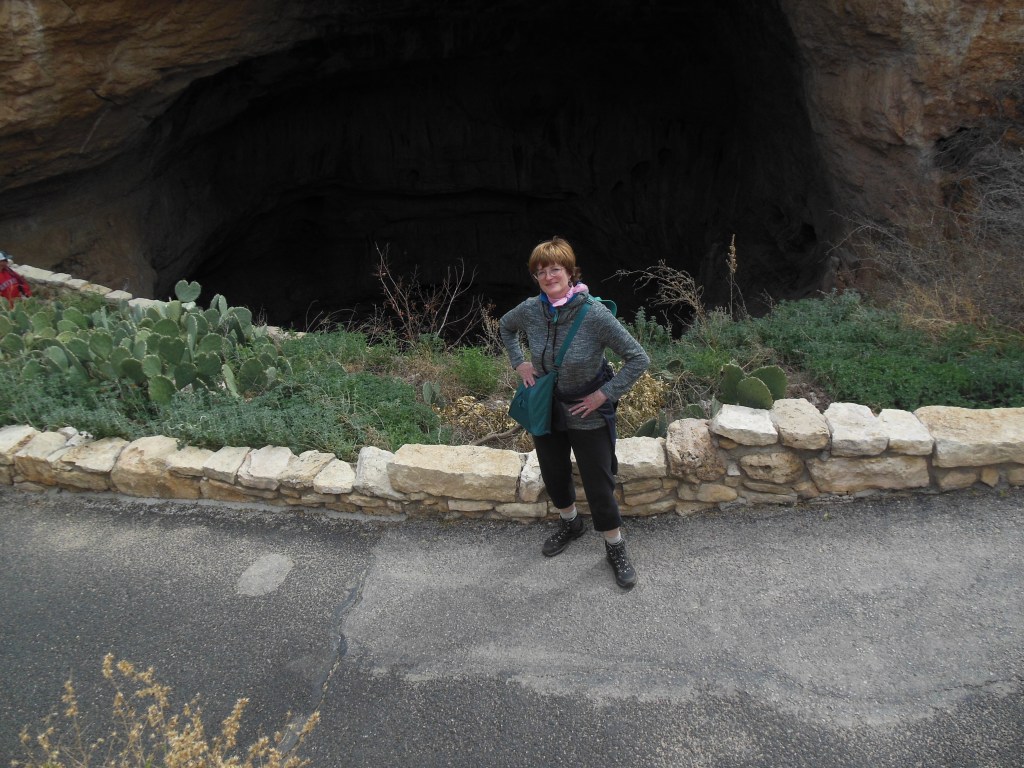
Intrepid Spelunker, 14 March 2016 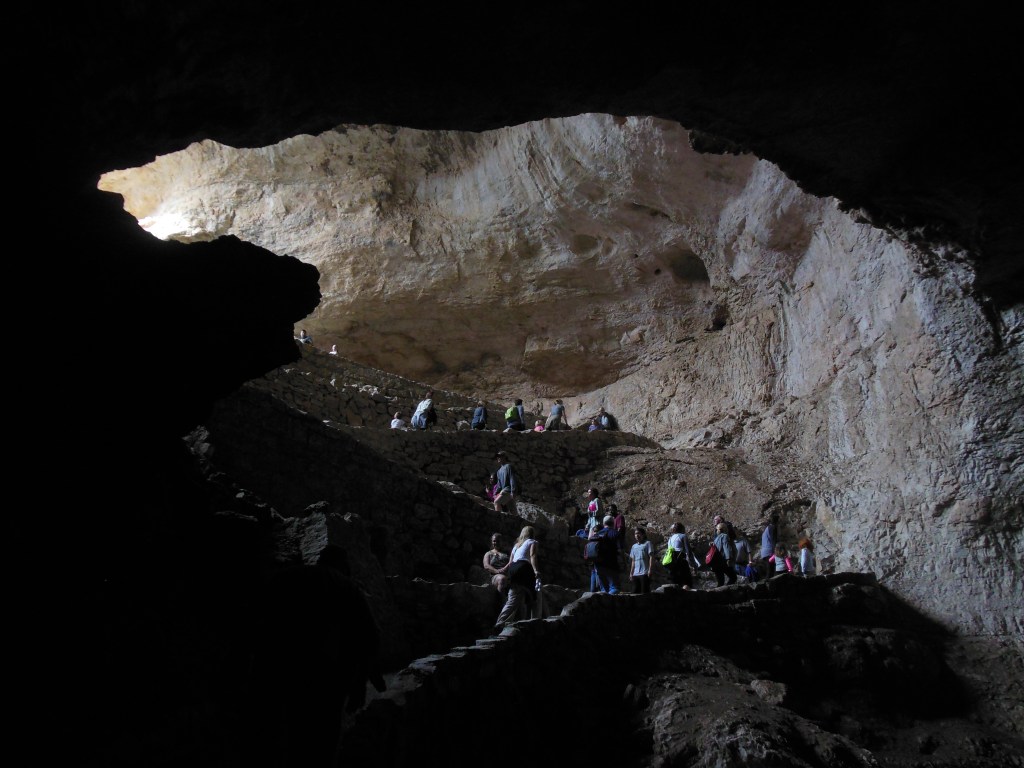
Emerging from Carlsbad Cavern (or Dante’s Inferno?) I’m wondering, too, how much agency versus being pulled against one’s will into the vortex has to do with this phobia. At 70, the allegorical vortex I fear is the Charybdis of dementia, the slow sucking away of cognition. I feel its tug when I think of a thing and cannot come up with the word for it. Most recently, that was the “abacus” that appeared in an early morning dream. Why an abacus? And why couldn’t I think of that word until later that day? Even in the dream I was struggling to name what I saw before me, an oblong frame with rows of wires along which counting beads are slid. Dreaming is a favorite hobby these days: I’m fascinated by the self-generated stories that retirement affords me the leisure to enjoy, however much they sometimes disturb.
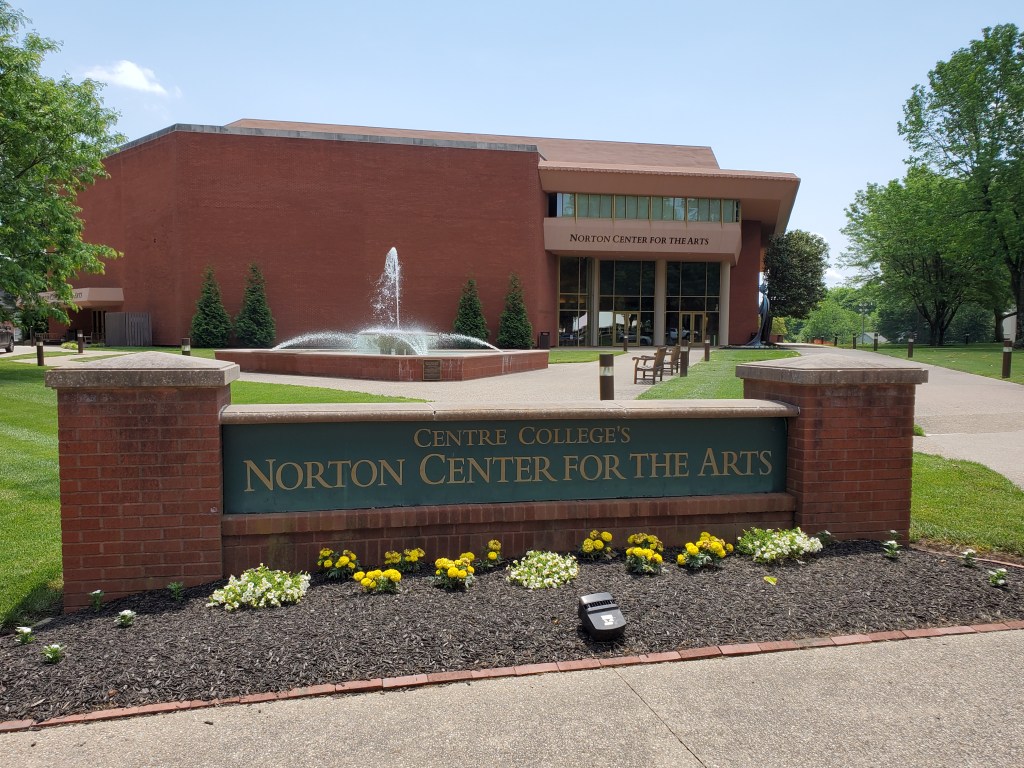
This morning I awoke in a coil (Ah! There’s that sucking circle again!) about someone’s taking over my Centre College office in the Norton Center for the Arts back in Danville, Kentucky, an office I left voluntarily almost 28 years ago. I had loved that nicely appointed peach-colored space with its Taliesen floor-to-ceiling one-way glass window, a far cry from the bull pen stall afforded Tulane teaching assistants from which I had graduated. Coming back to the comfortable present after that dreamed distress took quite a bit of calming concentration. I certainly had agency back then, but I reckon the sense of loss remains.
Then, too, I think this morning I was still under the influence of A Man Called Otto, the new Tom Hanks film I saw last night with its moving and rather-too-recognizable portrait of a bereaved husband so eager to join the spouse he lost that only his new neighbor (played for maximum warmth by Mariana Treviño) can pull him back into living life. Or again, maybe my dream was the spell cast by the imminent 65th birthday of my “baby” sister, the occasion sucking me back into the past.
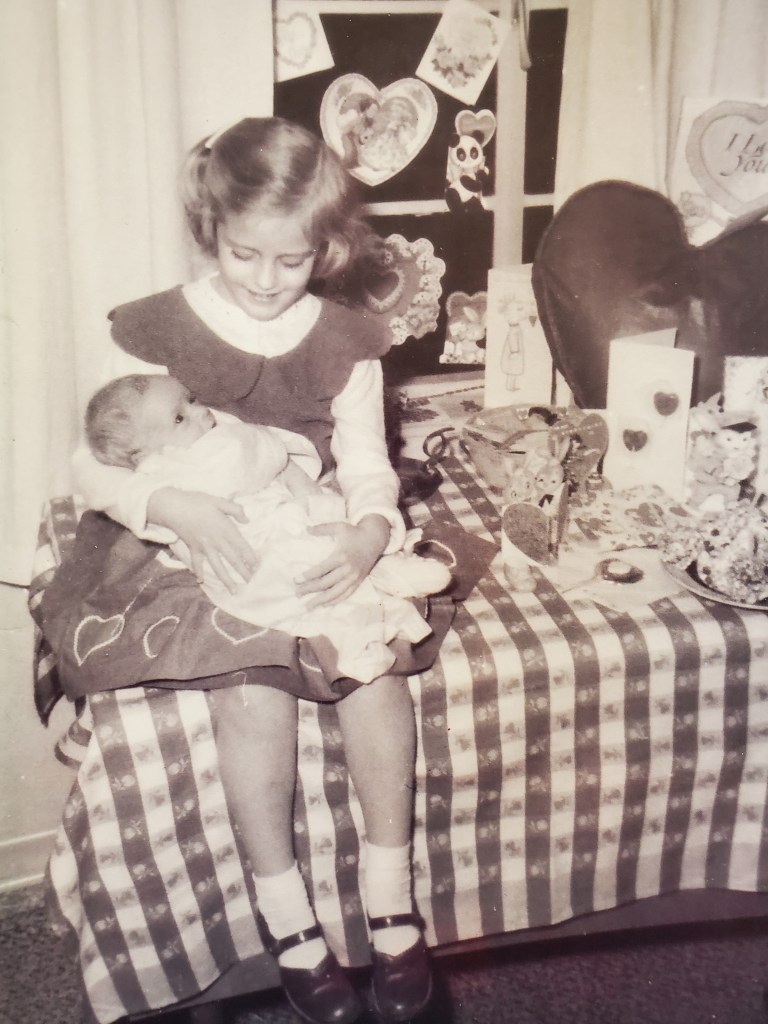
Valentine’s Day 1958, Georgy (5) and Baby Jane (3 weeks) Still, the trigger could even be the box of past vacation folders I am slowly sorting and mostly discarding, activity simultaneously pulling me back in time and making me chary of what lies ahead.
But really: submechaniphobia? Bah! As the Irishman I once stopped on the road to Kinsale to ask directions replied, “You’re here now, right?”
Indeed. And here now is just fine.
-
Twelfth Night January 6, 2023
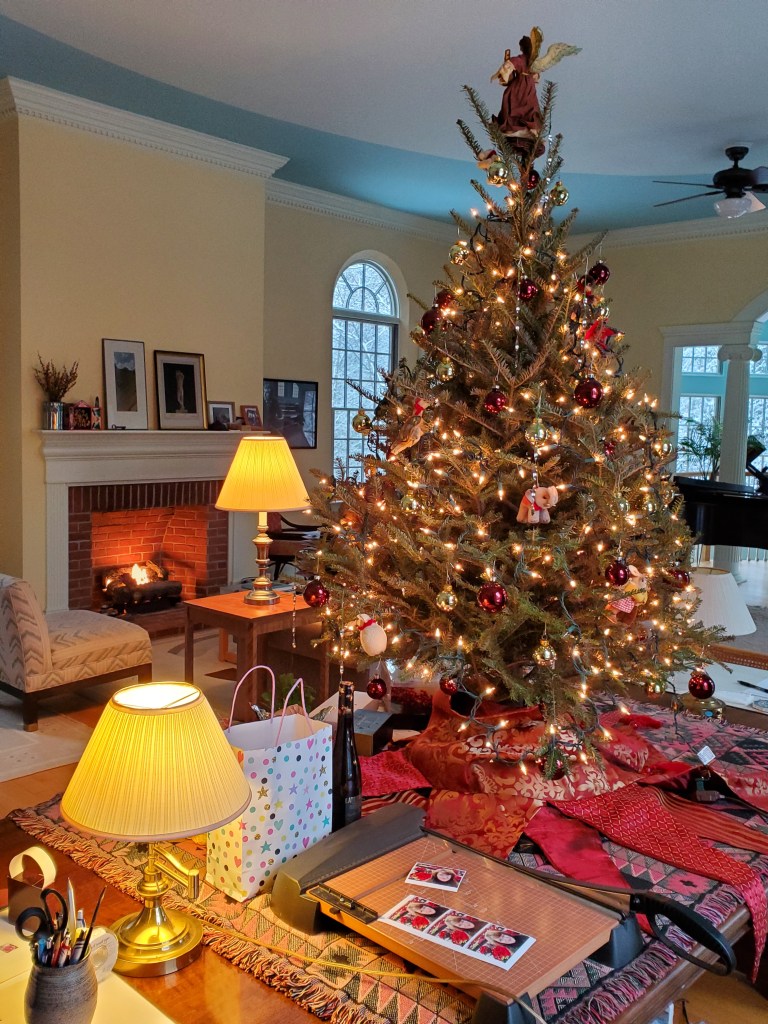
Last stand for the 2022 Christmas tree In the past, Epiphany has evoked for me many things beyond the charming tale of the three wise men (the assistant magus, the associate magus, and the full magus as Garrison Keillor once told the story) paying homage to the newborn king of the Jews. As an English major, I was taught to associate an epiphany with James Joyce, but came also to celebrate it as the birthday of two close friends, Sandy in Virginia and Marianne in Munich, as well as the beginning of Carnival season in New Orleans with its traditional weekly round of king cakes. And, of course, one of Shakespeare’s sweetest, funniest, most poignant plays about (among other things) patient, devoted, selfless love finally rewarded: Twelfth Night.
In the past two years, however, Twelfth Night has conjured not the Christmas revels of happy times, but the January 6 insurrection, the domestic equivalent of 9/11, a shameful, painful day on which our hard-won democracy nearly toppled. And now, this 6 January, that date evokes a tale of TWO insurrections, this one internal and conducted by the wing nut Republicans on a 4th day of the House’s failure to elect a speaker and begin conducting the nation’s business. As I type this the House has just completed its 13th ballot, with McCarthy falling three votes short of the gavel. I quail at the concessions he has made to the lunatic fringe of his party. Of the 147 Republicans who initially voted to overturn the 2020 presidential election results, many remain in the House divided, including Kevin McCarthy, himself an election denier. So, McCarthy’s humiliating struggle to become Speaker grows less and less reason for schadenfreude as he moves closer and closer to attaining his goal.
There is, however, an enjoyable, almost Dante-esque contrapasso in the current proceedings, with this sinner’s crime against elections earning him an equal and fitting punishment. As Jon Stewart apparently tweeted this morning, this is CNN’s Best Season Ever!
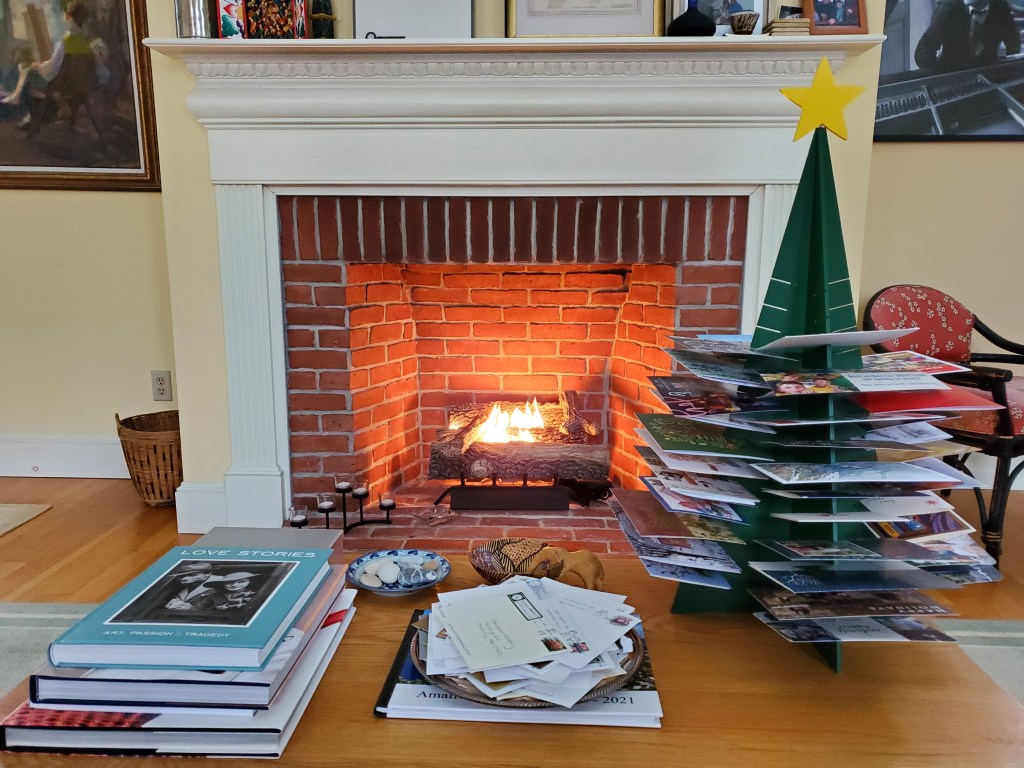
Me, I’ll be enjoying the last night of our library illuminated by 2022’s Christmas trees, one decorated with ornaments collected over many years and one with cards from friends far and near. And, perhaps, I’ll have that last piece of Danish kringle from Wisconsin as a special, celebratory dispensation from new year’s resolutions on this snowy Twelfth Night.

A bit of Florida inside 
A white Twelfth Night outside -
Remembering Virginia
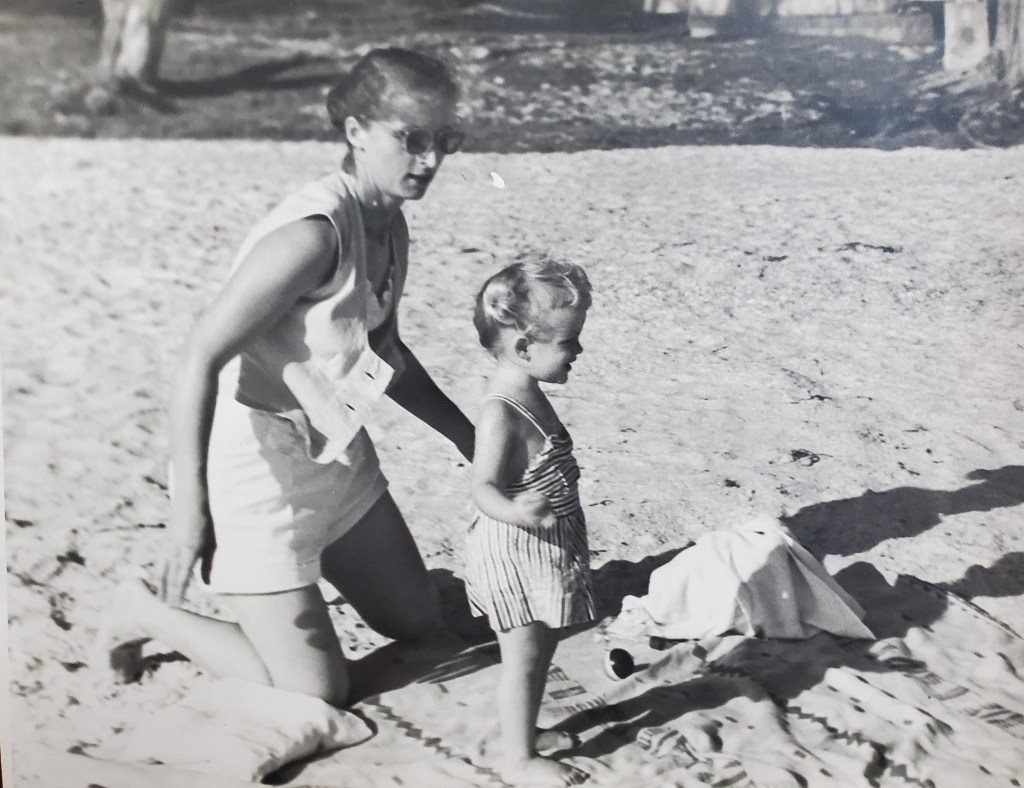
Virginia, 31, at the beach with Georgy, 19 months, June 1954 At 5.15 on the evening of 2 January 2008, my mother, Virginia Ruth Senseman Murphy, departed this dimension six months shy of her 85th birthday. On this evening almost exactly 15 years later, I am missing her, but recalling lines from Will It Be Okay?, Crescent Dragonwagon’s 1977 picture book classic in which a worried young daughter’s questions are answered by her wise mother. Recently published in a new edition illustrated by Jessica Love, those characters’ ultimate exchange in their loving catechism comes to mind.
The fearful child asks:
“What if you die?”
Her mother answers:
“My loving doesn’t die. It stays with you, as warm as two pairs of mittens, one pair on top of the other. When you remember you and me, you say: What can I do with so much love? I will have to give some away.”
How fortunate to have so wise a mother!
I did. I do.
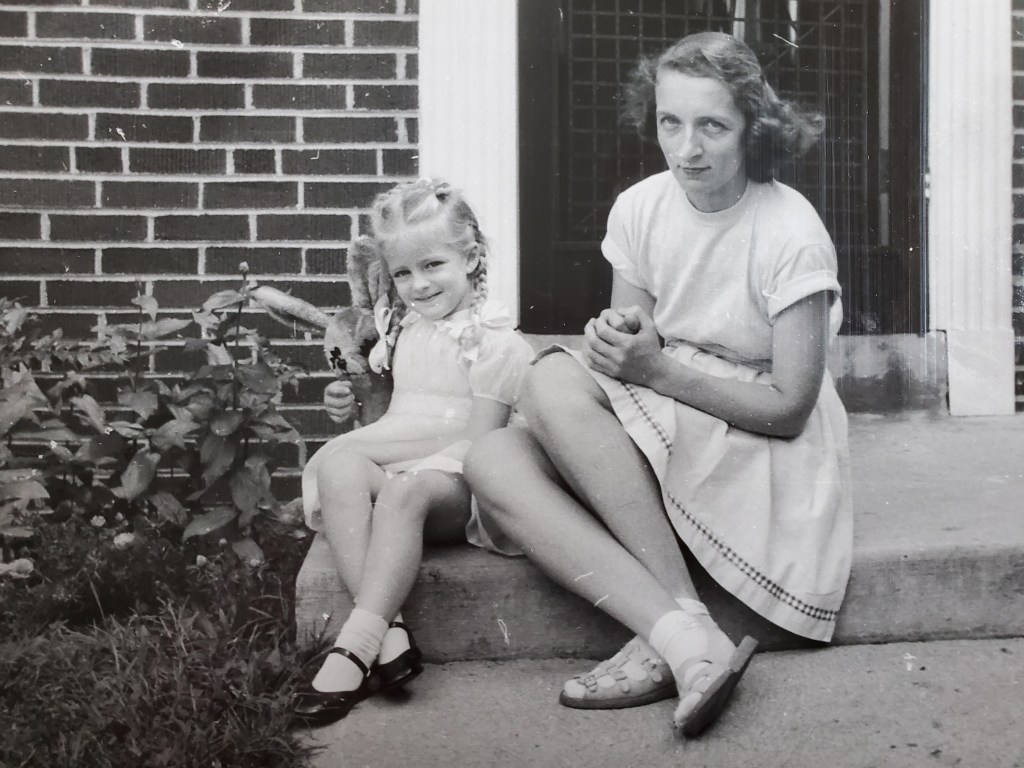
Georgy and Virginia, c. 1957 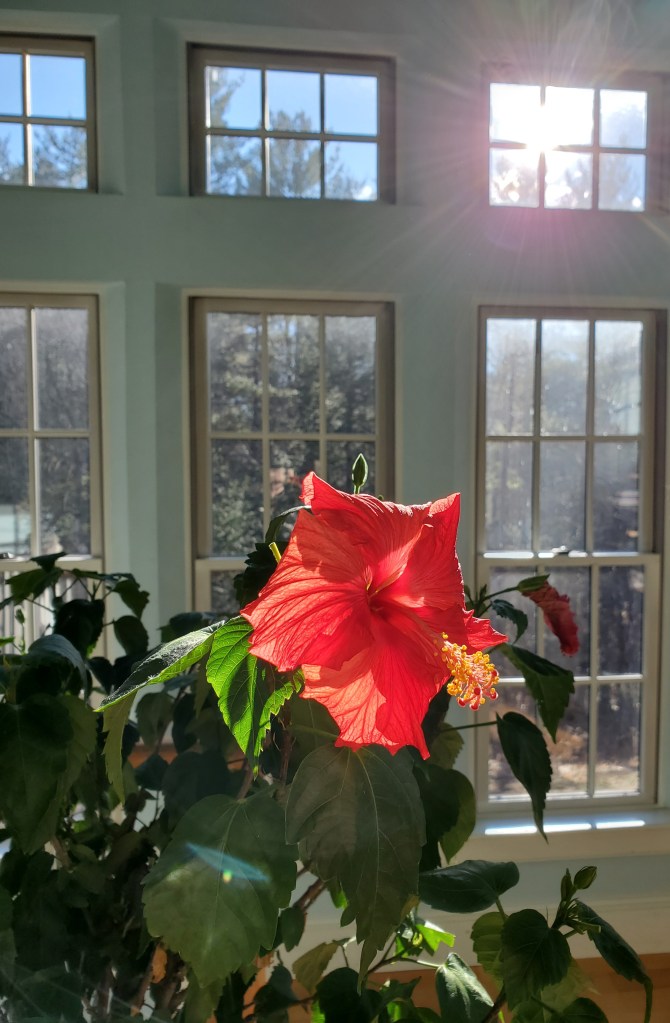
Hibiscus blooming in New Hampshire, 2 January 2023 -
Richard Parker, Ritual, and the Salutary Power of Story, 31 Dec 2022
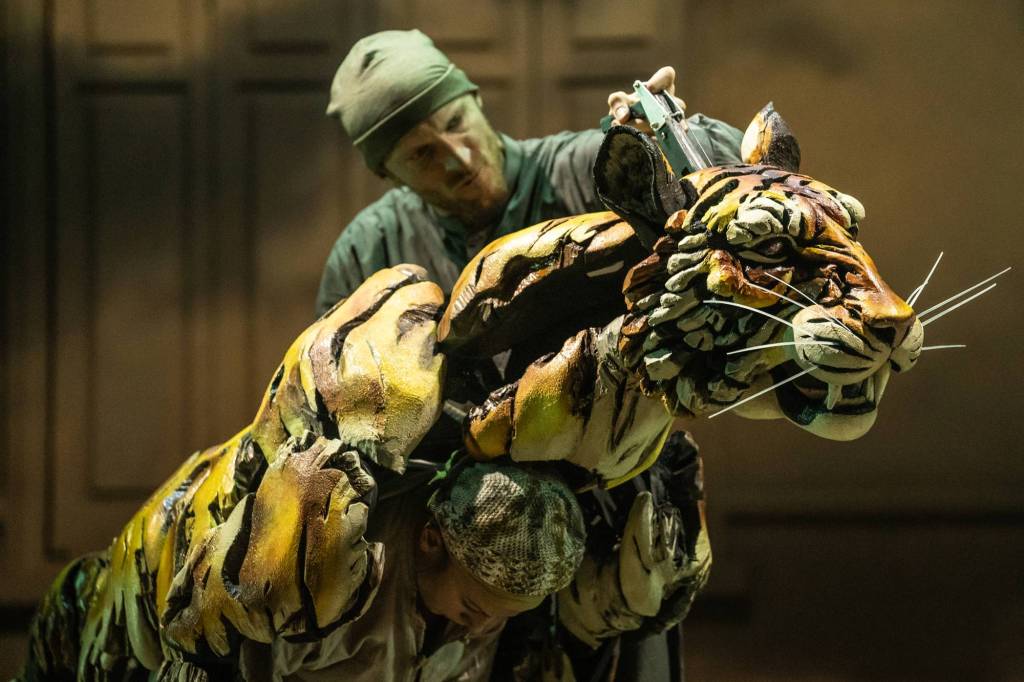
Life of Pi Production Photo Rowan Magee, Celia Mei Rubin, and Nikki Calonge (“Richard Parker”) in Life of Pi. Photo:
Matthew Murphy and Evan Zimmerman for MurphyMadeTerrestrial icebergs line my Madbury driveway this last day of 2022, plow- and weather-sculpted remnants of the one seasonal snowfall we had before the high winds and warm rain of Winter Storm Elliott’s bomb cyclone melted all the other snow and ushered in this dull, overcast, 53o last day of 2022.

Last days always seem as significant as first days, and the year’s end brings no shortage of opinion synthesizing events of the past year. Today I’m certainly thinking of endings—Judy Woodruff has made her final appearance as anchor of the PBS Evening News. Barbara Walters and Pope Benedict XVI now belong to the ages. Trump’s tax returns are at last public. The House Select Committee on January 6 has concluded its work and presented its recommendations, leaving me an unlikely fan of Liz Cheney, and Putin’s war on Ukraine grinds on as the comedian turned wartime president Volodymyr Zelenskyy, a latter-day Churchill, heroically, fearlessly leads his devastated country and is named Time’s Person of the Year, reminding our demoralized democracy of what we used to—and still might again—believe.
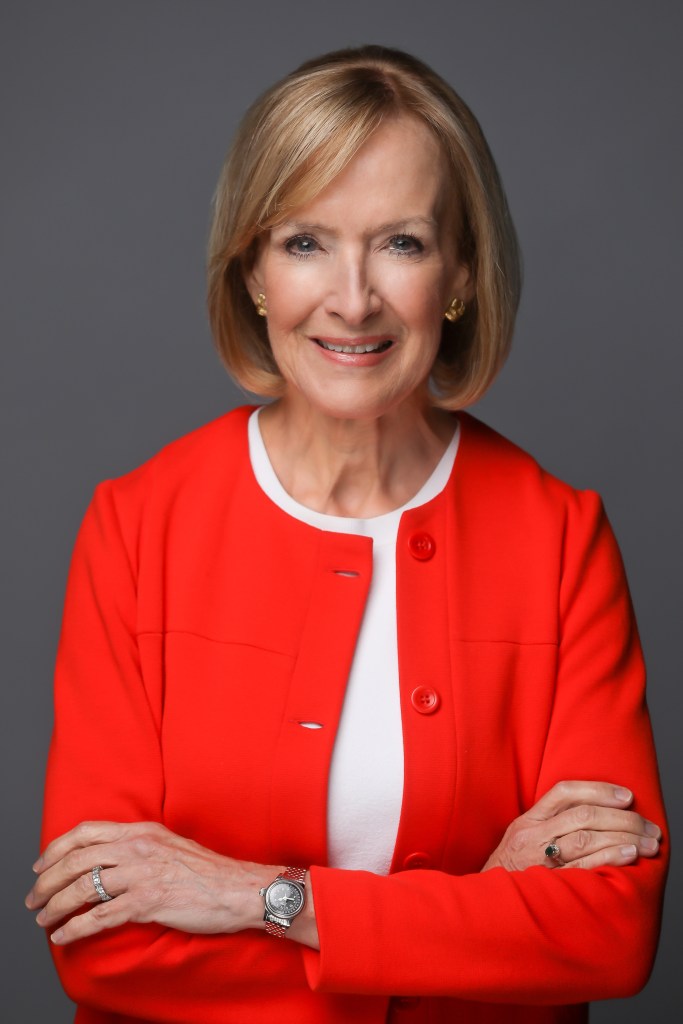
The incomparable Judy Woodruff
Photo © Tony Powell. PBS NewsHour Portraits. September 12, 2018
President Zelenskyy with Ukrainian military in Bakhrut, 20 Dec 2022 My run-up to the holidays has included two completely absorbing productions, one theatrical, one choral; Mohs surgery that has rid me of melanoma (yay!) and, at least for now, disfigured my visage (boo!); and trying to make sense both of all that’s past and all that lies ahead. I’ve been observing my annual ritual of the calendar, transcribing into my 2023 (??!!) Letts pocket diary significant happenings from previous years, most often to the accompaniment of whatever’s on NPR. As chance would have it, what I heard on Shankar Vedantam’s Hidden Brain series was an episode about rituals, why we have them, of what use they are, and the empirical research validating them (the episode’s title suggests) as “An Ancient Solution to Modern Problems.” In this broadcast, UConn’s anthropologist Dimitris Xygalatas explains the research most recently published in his 2022 book, Ritual: How Seemingly Senseless Acts Make Life Worth Living, offering me a timely epiphany about my own responses to the play and the choral performance that so impressed me in Cambridge and Newburyport within the last fortnight.
A summary of Xygalatas’s findings as elicited by Vedantam:
- The paradox: People often claim that the ritual they perform is the most important thing they do, but they can’t say why.
- Rituals and ceremonial activities unify members of a group into a single organism, not only sharing focus but even synchronizing heart rates among the participants.
- Rituals “hack into our inner world,” helping us cope with anxiety and grief precisely because they are performed together.
- Our physical brains evolved to recognize the necessity of cooperation and membership in a group, but our brains have not yet evolved to address modern problems. Stress as a response to fleeing a tiger is good, but our stressors are not tigers. Our environment has changed, but not our brains.
- Vedantam’s analogy: rituals are like a software patch that bridges this gap for our computer-like, predictive brains.
- When we cannot be certain of what an outcome will be, ritual helps because we CAN control the ritual, which is always repetitive, rigid (always done the same way), and redundant (that is, going beyond what the situation actually requires; the “causal opacity” of the ritual—the fact that repeated actions of a ritual are seemingly unrelated to the goal or outcome sought–is part of their salutary effect).
- In clinical studies, inducing anxiety produces ritualized behavior, a “mental technology” that demonstrably enhances performance.
- Doing things in synchrony with others makes us feel more similar, elevates endorphins, and enhances trust. Think of how many rituals involved dancing and singing.
- “High arousal” rituals—rituals that appeal to ALL the senses, performed collectively–make us feel like brothers, and add to the authority of the one leading the ritual.
- Rituals transform the everyday into the symbolic.
- Participation in a ritual propels the individual into a flow state, lifting a cloud of distraction and inducing a focusing jolt of exhilaration that allows for the impossible (like walking on hot coals without being burned) and extends long past the ritual action.
Although Xygalatas and Vedantam did not make the specific connection to the performing arts, this research into ritual went a long way to explaining the extraordinary effect on me of two performances I attended in the week leading up to Christmas. Of course the Western theatre traditions I taught for decades began in religious ritual—twice, first in Greece’s theatre festivals honoring Dionysus, and again in the Christian liturgical tropes of the early 10th century. The complete engagement of audience and performers when a theatrical piece is really working is an exhilarating drug—a “high arousal ritual” in Xygalatas’s phrase—that dispels all distractions and distills focus in performer and audience alike.
And that’s what I experienced, but had been attributing to the coincidence of two narratives, each capable of moving by words alone, transformed into affecting performance pieces, one by adding music and live performance eliciting both grief and joy, and the other with the full monty of theatrical effects that periodically astonished me into leaving my COVID-masked, surgically compromised jaw agape. First came A Christmas Carol, the so-familiar tale abridged and edited by choral group Skylark’s Matthew Guard from Dickens’s 30,000 words to 5,000, then woven by composer Benedict Sheehan, who with Guard selected, re-arranged, and re-imagined traditional carols, including many unfamiliar ones and folksongs, into a continuous “story score” with incidental music Sheehan composed that with few exceptions accompanied Dickens’s narrative, spoken with measured precision by storyteller Sarah Walker.

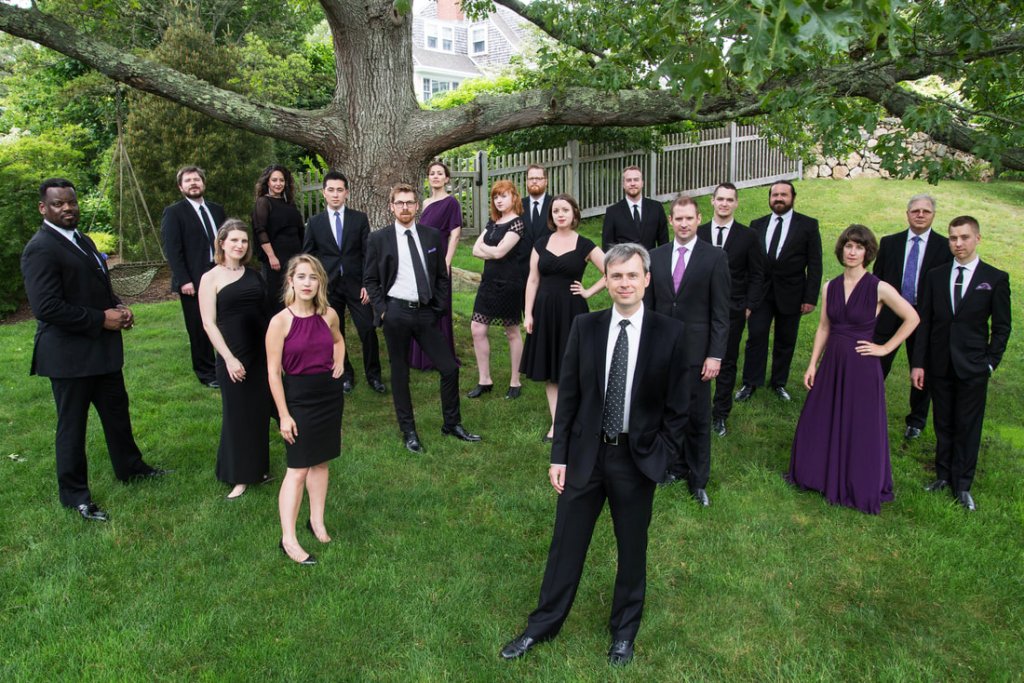
Skylark with Matthew Guard The result, performed in Newburyport’s Belleville Church on Saturday, 17 December 2022, was spellbinding and at times heart-breaking. The mezzo soprano’s lament portraying Mrs. Cratchit’s grief at the loss of Tiny Tim, that excruciatingly sad scene the Ghost of Christmas Yet to Come offers Ebenezer Scrooge, did in fact elicit tears, making Scrooge’s giddy conversion to humanity all the more joyful at the story’s end. Matthew Guard did a thorough pre-concert exposition of how this sublime transformation of story to Skylark’s now signature “story concert” happened, the work of 19 consummate artists collaborating. Informative and fascinating, that. But it’s the salutary benefits of ritual I now realize that explain for me what this group—and we in the audience—finally experienced.
Ditto Lolita Chakrabarti’s adaptation of Yann Martel’s novel, Life of Pi, into the stage play currently appearing at the A.R.T. in Cambridge, directed by Max Webster in collaboration with scenic and costume designer Tim Hatley, puppetry and movement direction by Finn Caldwell, in tandem with puppet design by Caldwell and Nick Barnes.
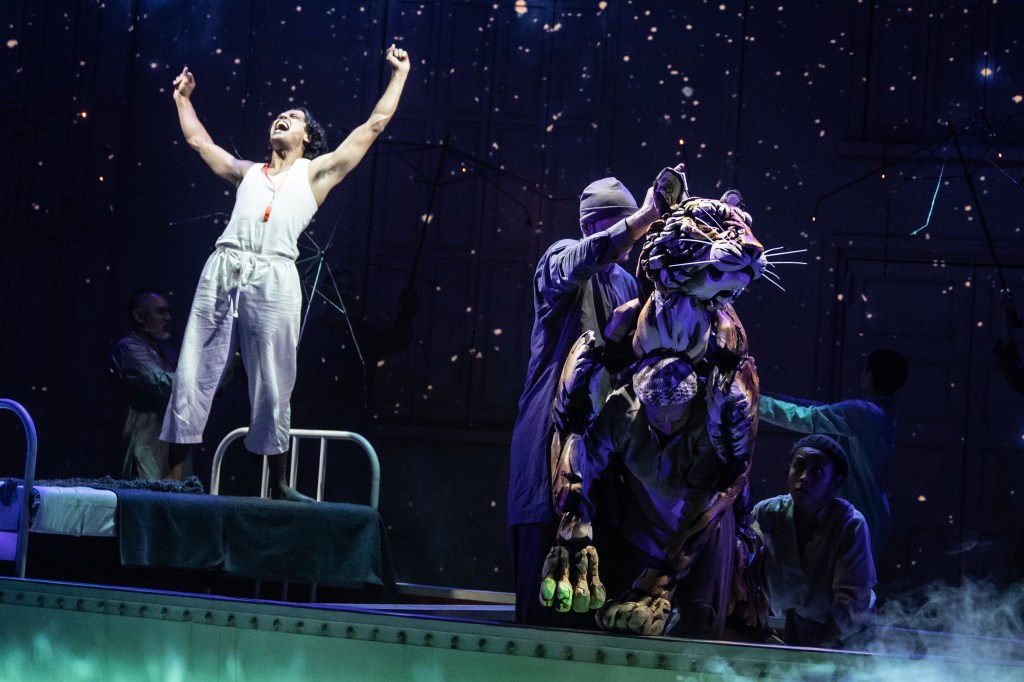
Life of Pi Production Photo Adi Dixit (“Pi”), Rowan Magee, Celia Mei Rubin, and Nikki Calonge (“Richard Parker”) in Life of Pi. Photo:
Matthew Murphy and Evan Zimmerman for MurphyMadeAnyone who saw Ang Lee’s 2012 film version of Martel’s novel has to be curious about how so fantastic a narrative could be transposed for the theatre. Well, having seen the resulting production, which in April 2022 won five Olivier Awards at London’s Royal Albert Hall, including Best New Play, Best Scenic and Lighting Design, and the Best Supporting Actor Award shared by the seven puppeteers who play the tiger “Richard Parker,” I found my expectations quite marvelously exceeded.
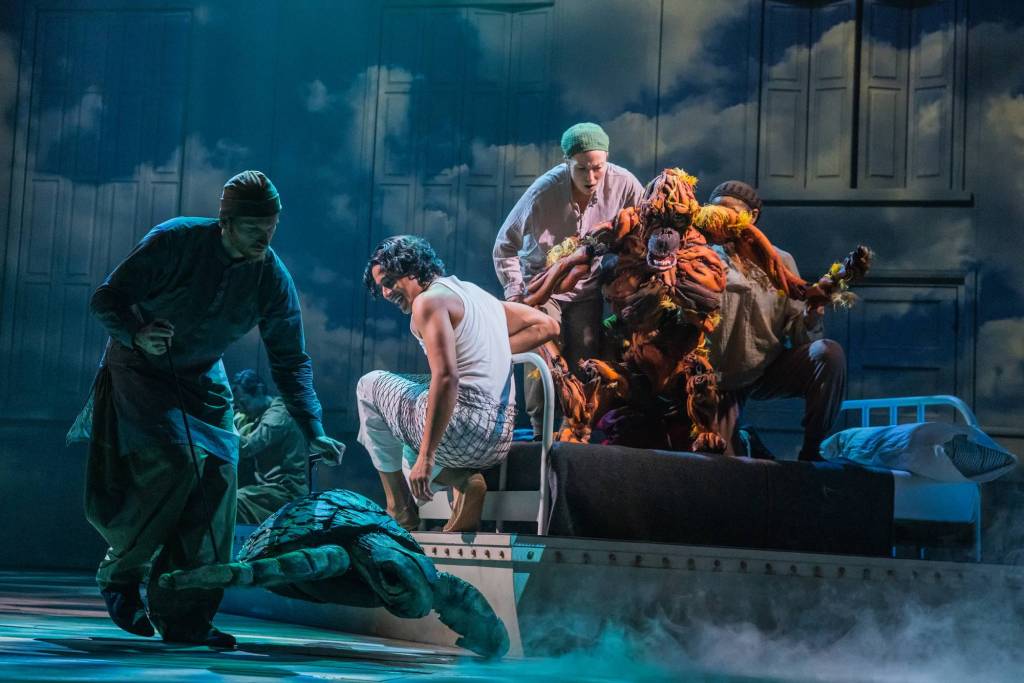
Life of Pi Production Photo Rowan Magee (Sea Turtle), Jonathan David Martin (Puppeteer), Adi Dixit (“Pi”), Celia Mei Rubin, Mahira Kakkar, and Nikki Calonge (“Orange Juice”) in Life of Pi. Photo:
Matthew Murphy and Evan Zimmerman for MurphyMadeA story finally about the transformative power of the story brought home to me how powerful theatrical ritual is, and the afterglow of exhilaration and community lasted long past the long, dark, detouring drive back to Madbury from Cambridge. This extraordinary show stays in Cambridge till the end of January 2023 and heads to Broadway in March, so no further spoilers here.
Takeaways re tigers and tales turned ritual: narrative re-imagined as theatrical performance certainly owes its power to the artful synaesthesia converting words to sensual experience, but the real clout comes from the purposeful assembly essential to ritual, in which the whole community participates—and at least for a while, bonds and heals. I will take that lesson with me into the new year.
Happy 2023!
-
Christmas Day at Wallis Sands

Frozen Marsh along the NH coastline, 25 Dec 2022 Though I have lived in New Hampshire since 1995, the beach in winter has not yet lost its novelty for this Florida cracker, remaining for me an exotic inversion of the warm Gulf beaches of my youth in St. Petersburg: white sand and palm trees replaced by rocks and sea ice. Finding myself solo this Christmas Day and the sun shining after so luckily dodging the damage Winter Storm Elliott’s bomb cyclone might have brought, I slept late, had a fine breakfast of Quiche Lorraine and pears, and headed to Wallis Sands for a stroll.
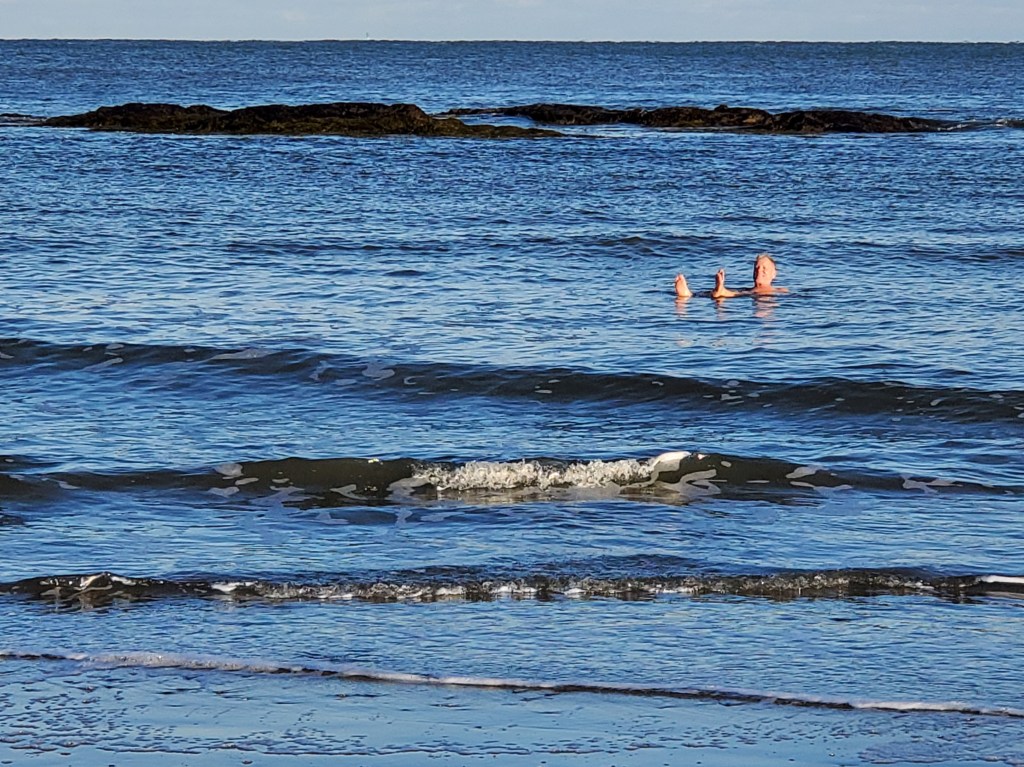
There I was met by many delights: a sky so clear that the Isles of Shoals seemed near, bundled-up pleasant company wishing me Merry Christmas and spotting me as I unsteadily negotiated the granite rock barrier that separates the public from the private beach, and a man pretending to be a polar bear by braving the 26o air temperature (plus a stiff, cold ocean wind) to the vastly amused disbelief of onlookers.

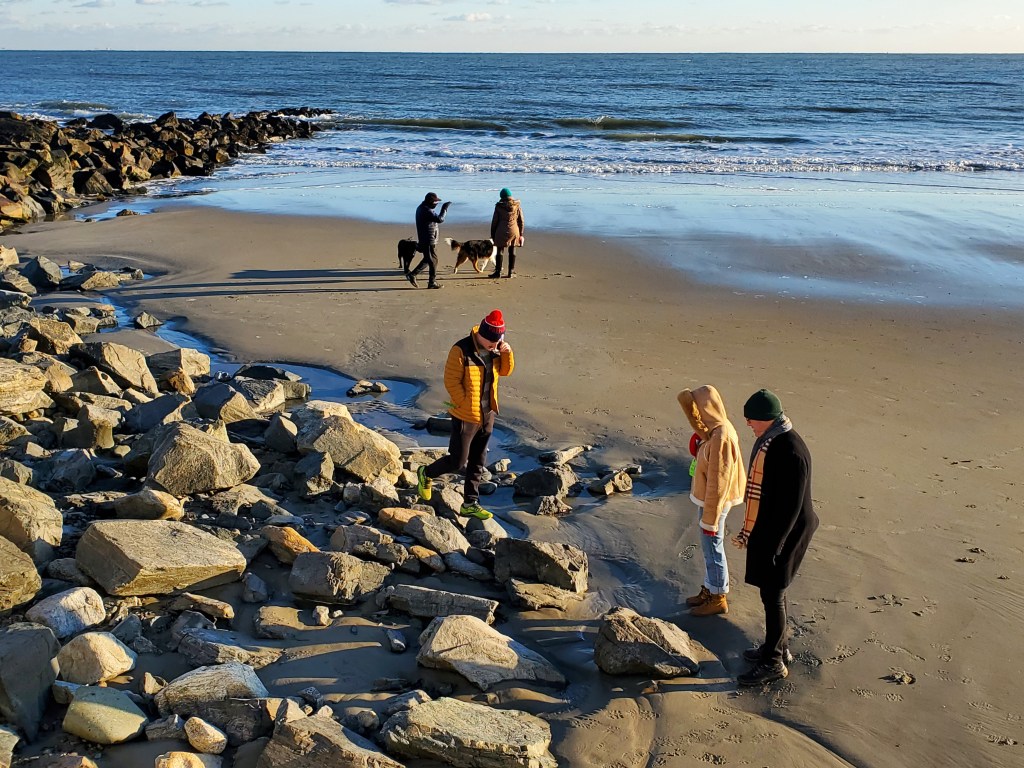


Not for me “the eternal note of sadness”! The “tremulous cadence slow” of lapping waves that depressed Matthew Arnold has always been for me a comfort, recalling long beach walks with my loving dad and later my wonderful ex-Navy brother-in-law Neil, who never tired of strolling the beach at Naval Air Station North Island, Coronado (also home of the Del Coronado, aka “The Del,” the historic 1888 beach resort, a San Diego icon that played the role of the Seminole Ritz in the 1959 film Some Like it Hot—which streams in every room on a continuous loop, another delightful memory).




I returned home to a warm fire, some carefully selected presents to open, and an excellent Christmas dinner completed with a slice of the fruitcake I baked from Neil’s beloved Liz’s gift, a gorgeously extravagant platter of dried California fruit.
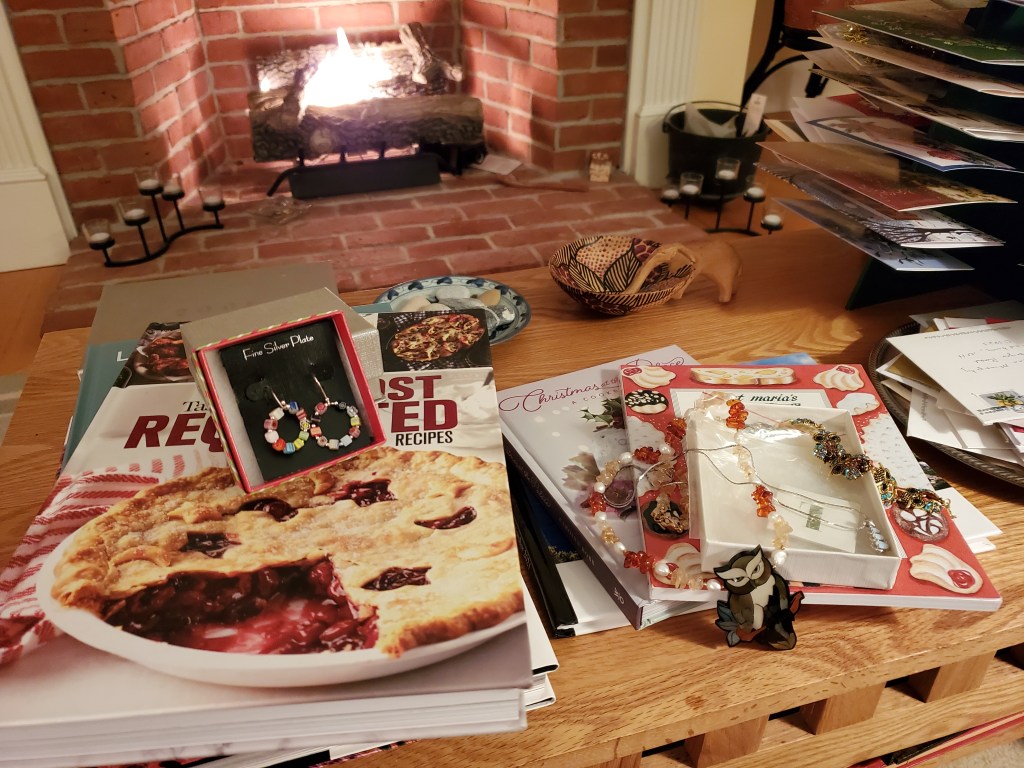

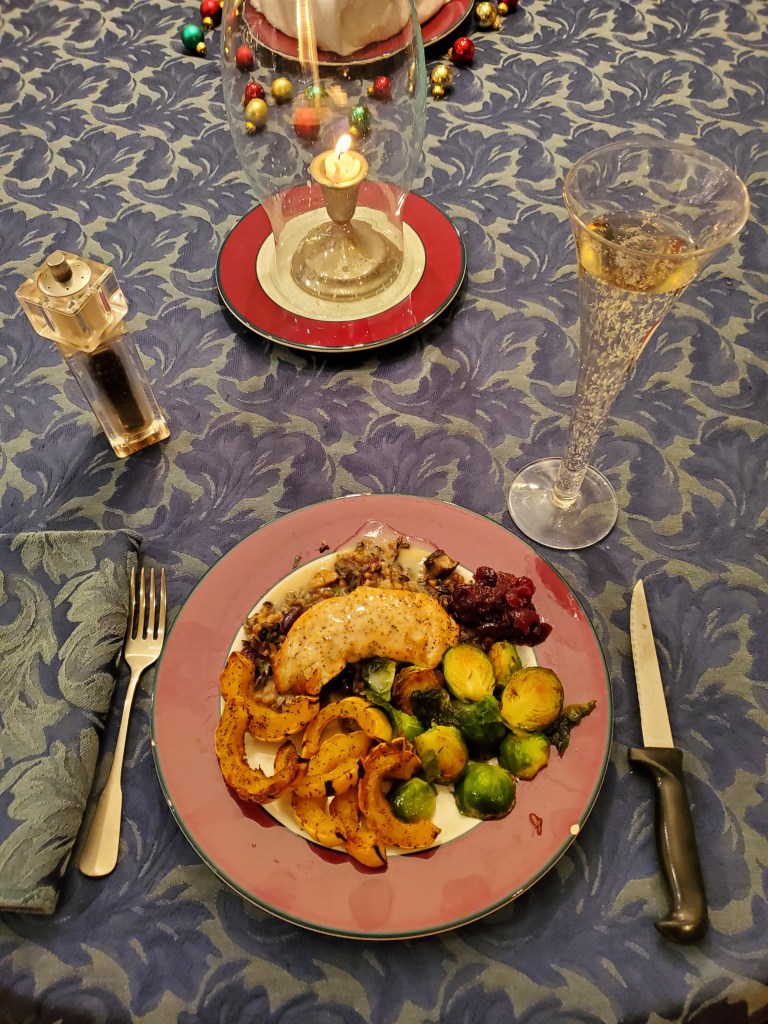

Much virtue in a day at the beach, whatever the season.
Happy Holidays! Happy New Year to come!
-
Only Connect: Friends, Art, and Film 10 December 2022
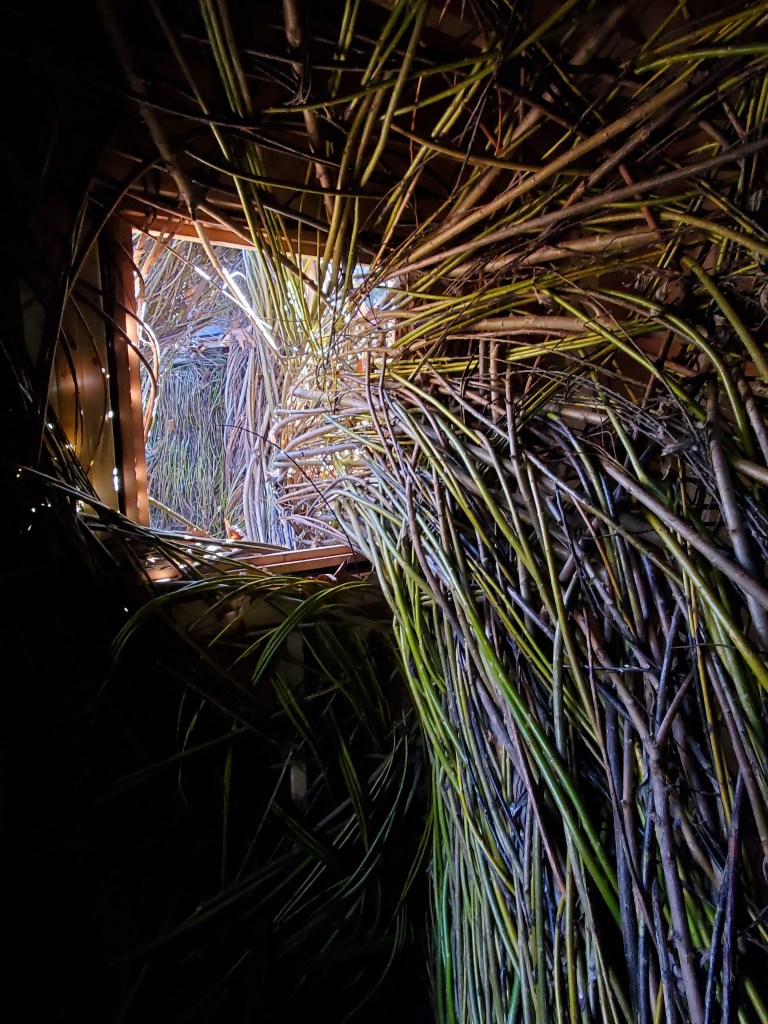
Inside THE JEALOUS WALL, Patrick Dougherty, 2022 at Alnoba Recent days have been unusually crowded with incident, all of it good, beginning on Friday, 2 December with a visit to the Portland Museum of Art (PMA) accompanied by three artist friends, Julee, Shiao-Ping, and Brian, and continuing in good company ever since: serving tea to Jennifer and Linda on Saturday; dinner to Vicky on Sunday; visiting Alnoba’s sculpture park with Phyllis, Cathy, and Jennifer on Monday; enjoying a fireside glass of wine with musicians Mathilde and Edward on Tuesday; taking in the grotesque pleasures of Mark Mylod’s satirical film The Menu on Wednesday; and meeting fellow Madbury Friends of the Library (including two other English majors!) on Thursday. Having now also enjoyed my weekly Friday check-in with Greensboro friend, Cameron, I’m reviewing the many novel connections of the week past, inspired by juxtaposed art and friends, and still rather stunned by all this good company after the isolation imposed by coincident widowhood, COVID sequestering, and retirement.
The PMA, it turns out, is free late Friday afternoons, and is even better visited in the company of three artists, two painters and a photographer.
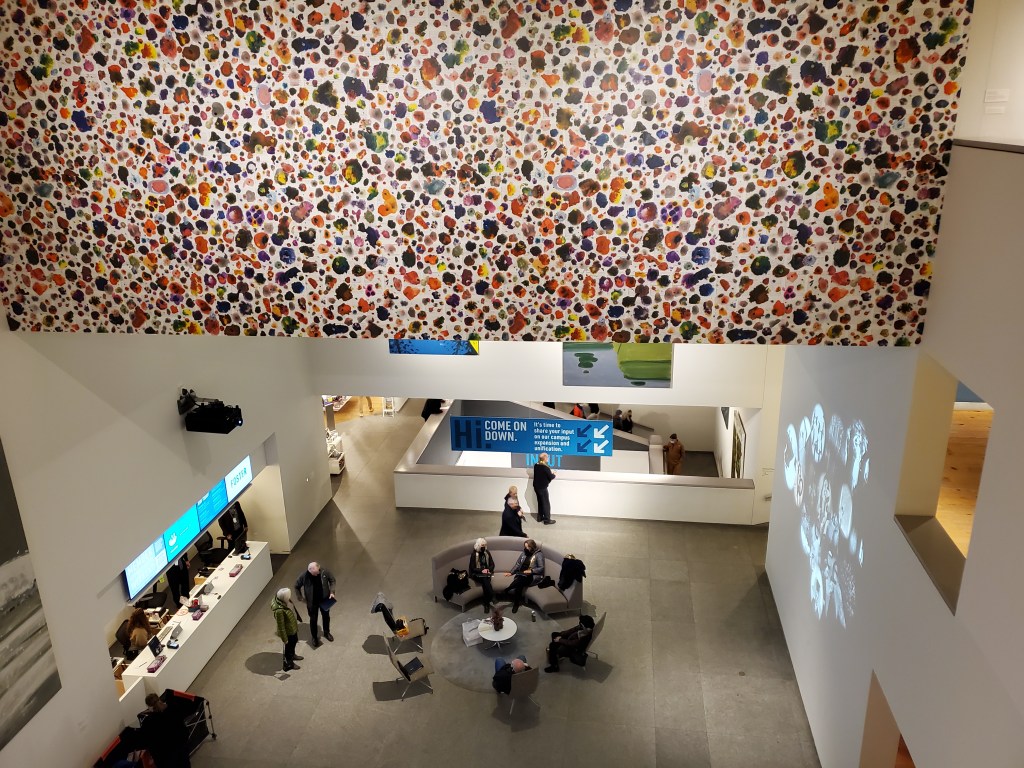
Portland Museum of Art, Portland ME The current big show is the extraordinary bequest of Judy Glickman Lauder, whose photography collection is one gangbuster image after another. From Dorothea Lange’s iconic Migrant Mother, to the painfully moving shot of hope in an old woman’s face as she looks up to RFK, to the whimsical juxtaposition of a llama riding in a car through Times Square, this show fascinates—and suggests, as Brian pointed out, the clarity of an earlier era’s vision, devoid of the ambiguity and irony more currently prized.
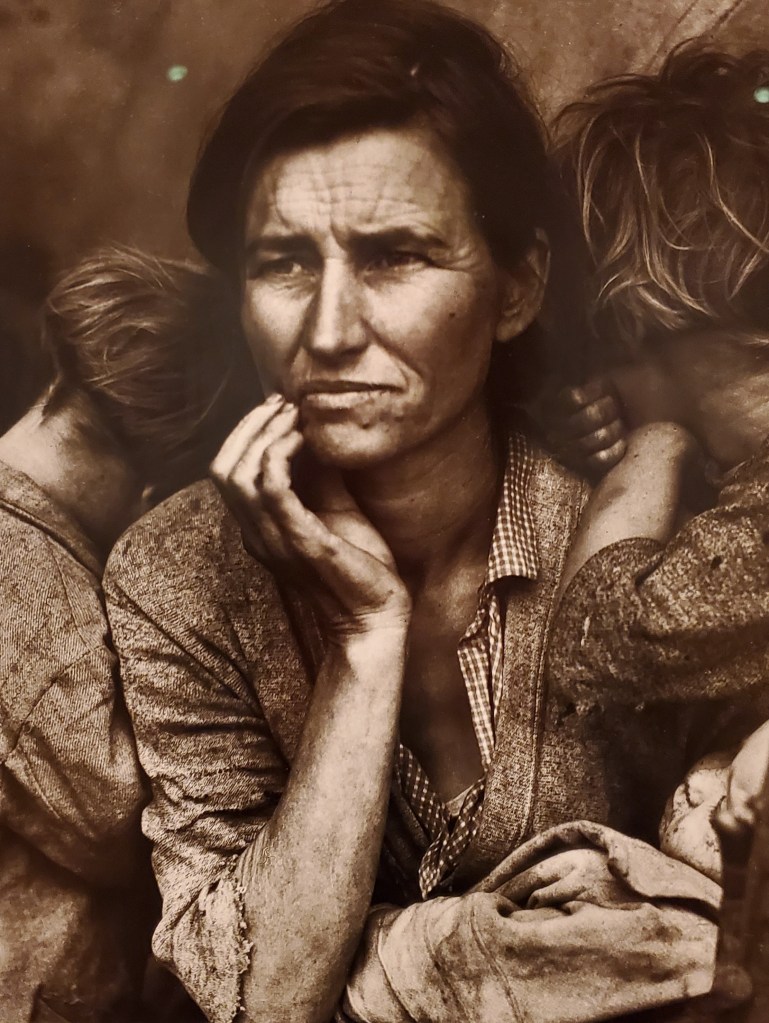
MIGRANT MOTHER, NIPOMO CA, Dorothea Lange, 1936 
ROBERT F KENNEDY CAMPAIGN, NY, Steve Schapiro, 1965 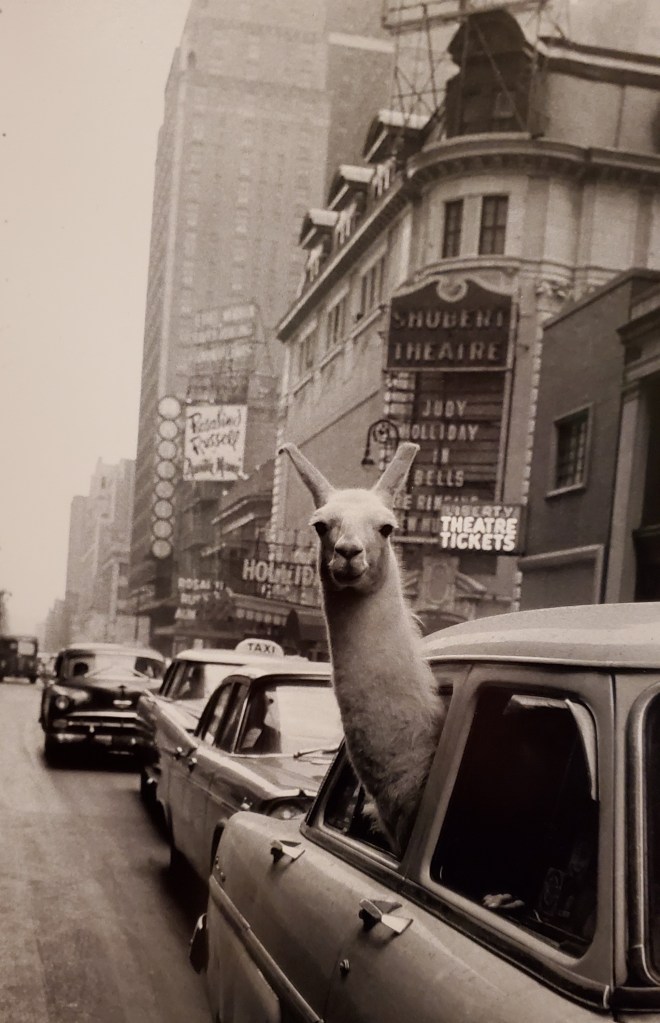
A LLAMA IN TIMES SQUARE, NYC, Inge Morath, 1957 We got to talking about how the art scene has evolved, at times distorted into something so far out, so intellectual, and so precious, requiring so much contextual glossing as to invite laughter from both the uninitiated and the skeptical. Such pretentiousness was totally absent from “Presence,” this Lauder collection currently on view.
Brian’s assessment seemed to me spot on, and so did his recommending The Menu, a film he thinks nails such absurd affectation (a paraphrase of Brian on The Menu: “You could substitute ‘art’ for ‘cuisine’ in that film and the satire would still apply”). He made me suddenly aware of accommodations, both good and ridiculous, that the modern museum must make. One of the good ones: PMA’s juxtaposing a tidal marsh painting by Hudson River school artist Martin Johnson Heade with a display case of exquisite Native American baskets, linked by a label inviting the viewer to consider simultaneously both Heade’s and the anonymous basket weaver’s vastly different perspectives on sawgrass.

NEWBURYPORT MEADOWS, Martin Johnson Heade, c. 1876 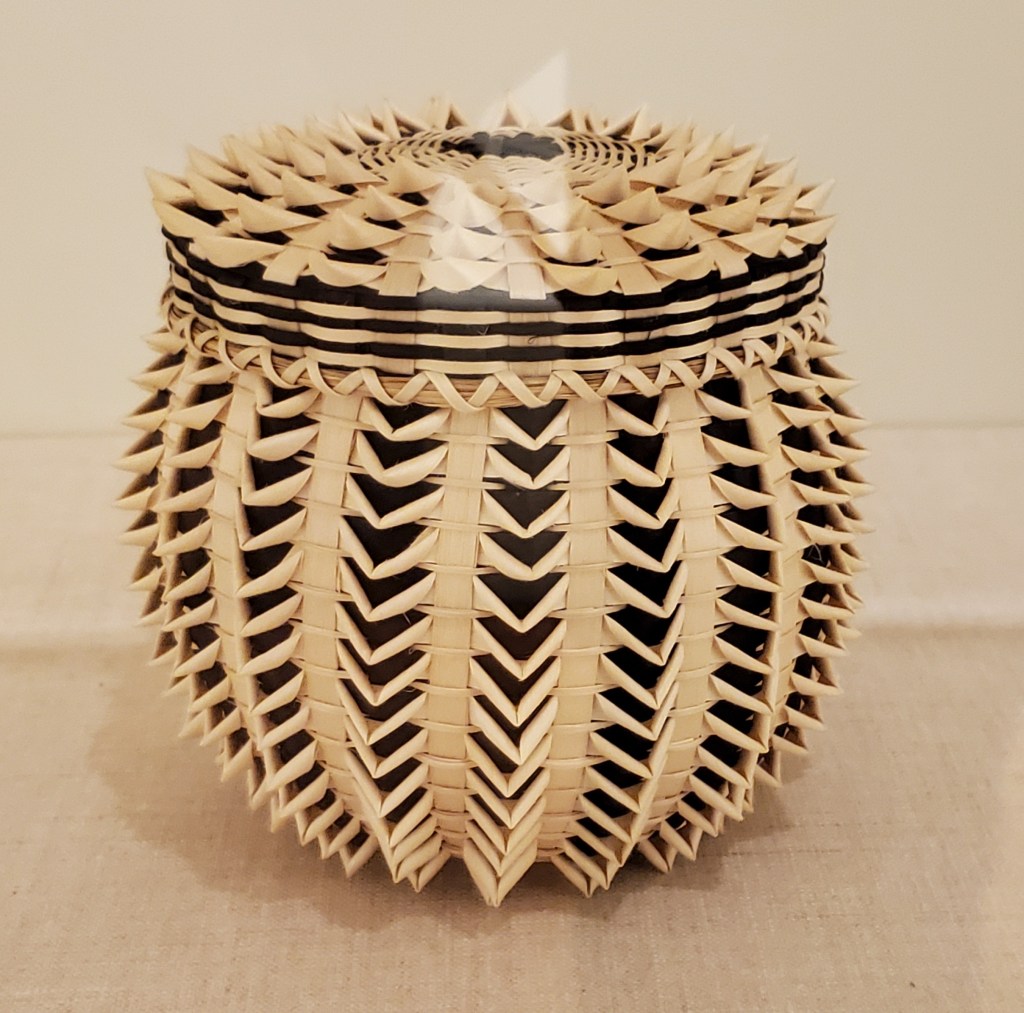
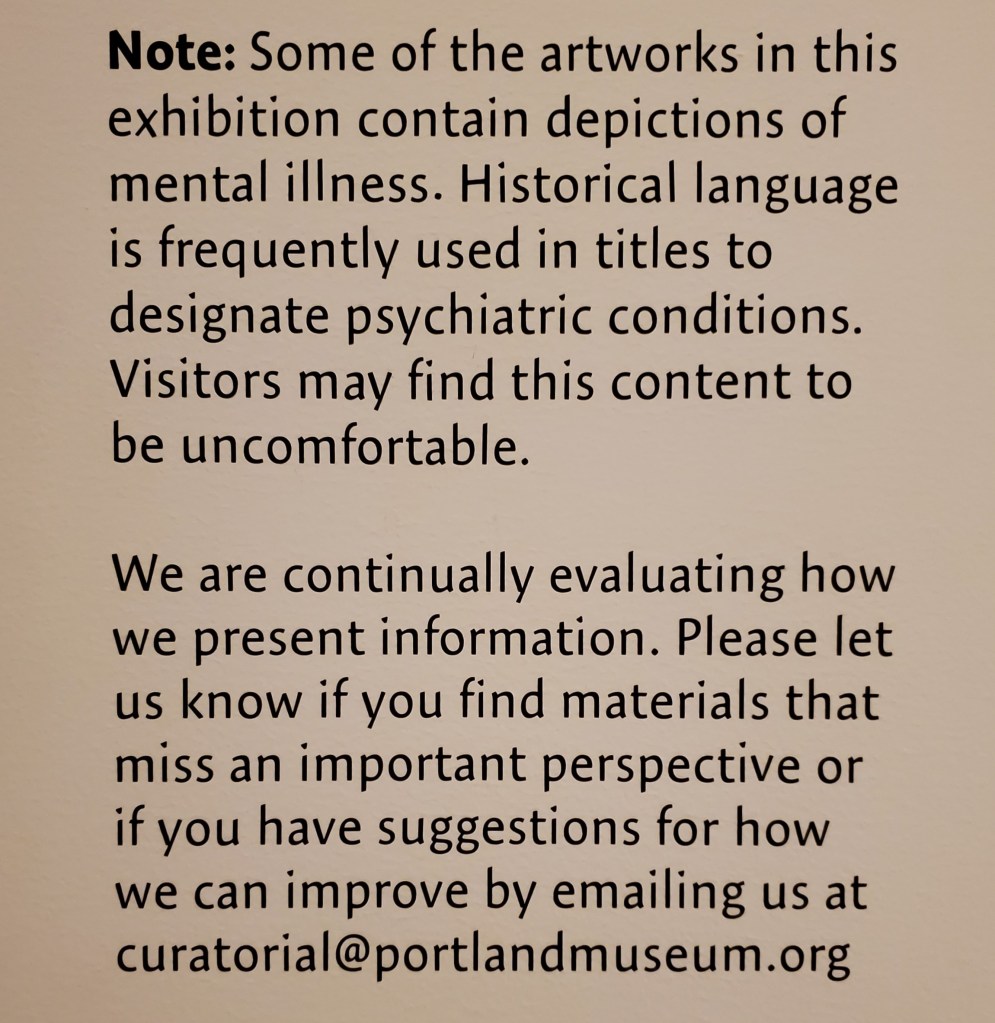
Sawgrass Basket, Native American Perhaps a less successful accommodation: the trigger warning message the PMA thought necessary to post to protect patrons’ delicate sensibilities.
Portland’s Congress Street was bustling with artisans hawking their wares as we strolled through the early dark illuminated by Christmas lights to dinner on Monument Square. Such fun.
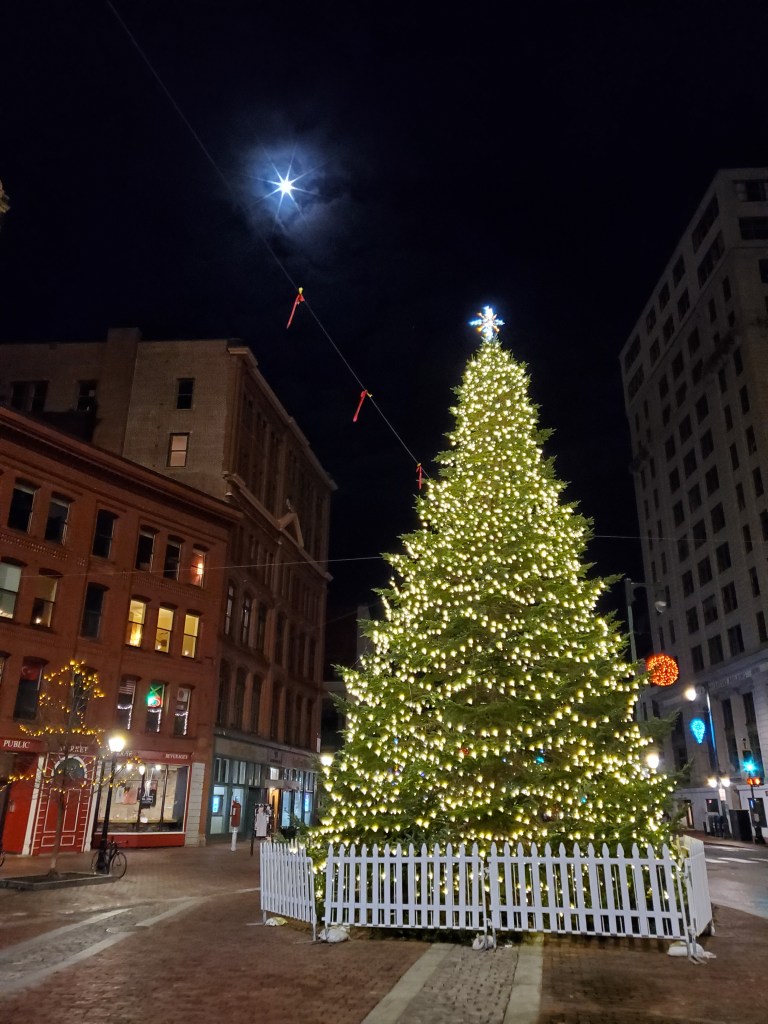

Julee, Brian, Georgeann, and Shiao-Ping Selfie on Monument Square, Portland Still under the spell of those PMA images, I went on Monday for a stroll (by invitation only) through the woodlands of Alnoba in Kensington NH, “a destination for retreats, leadership, and wellness” conference center with a remarkable collection of sculptures placed throughout the property. This was my first two hours of negotiating a trail covered by slippery leaves since breaking my ankle at the end of October, but hiking stick in hand, this proved do-able, and the works were intriguing—especially the ones that invite you inside them.
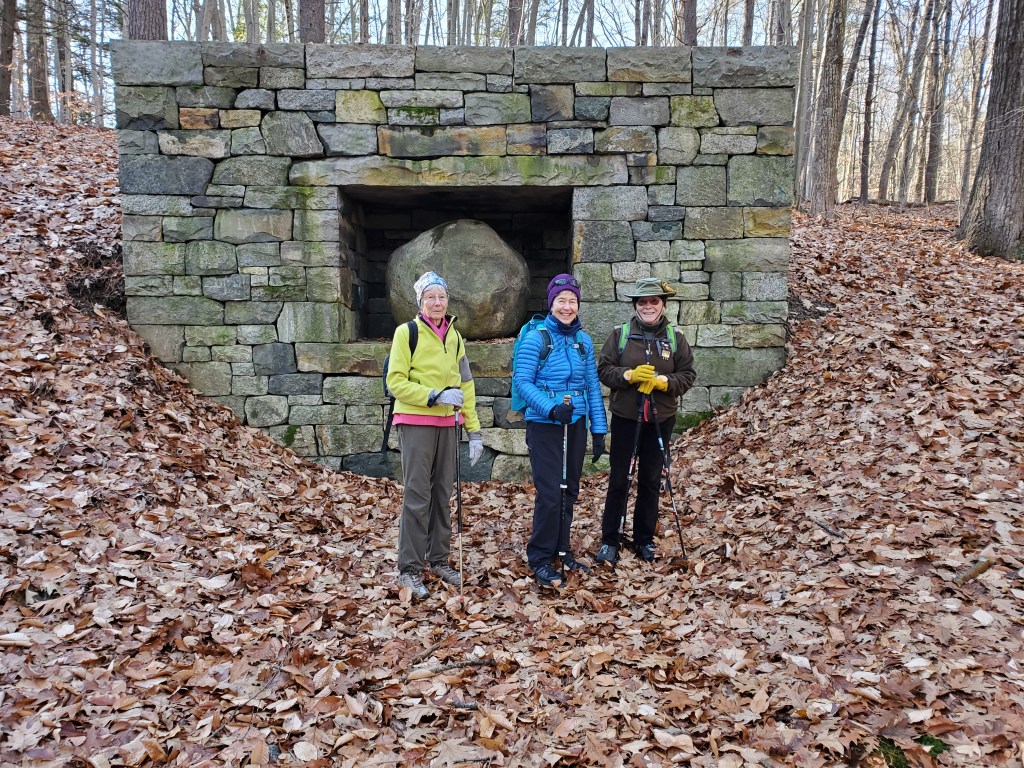
Jennifer, Cathy, and Phyllis at WATERSHED BOULDER, Andy Goldsworthy, 2015-16 
WILDWOOD, Patrick Dougherty, 2019 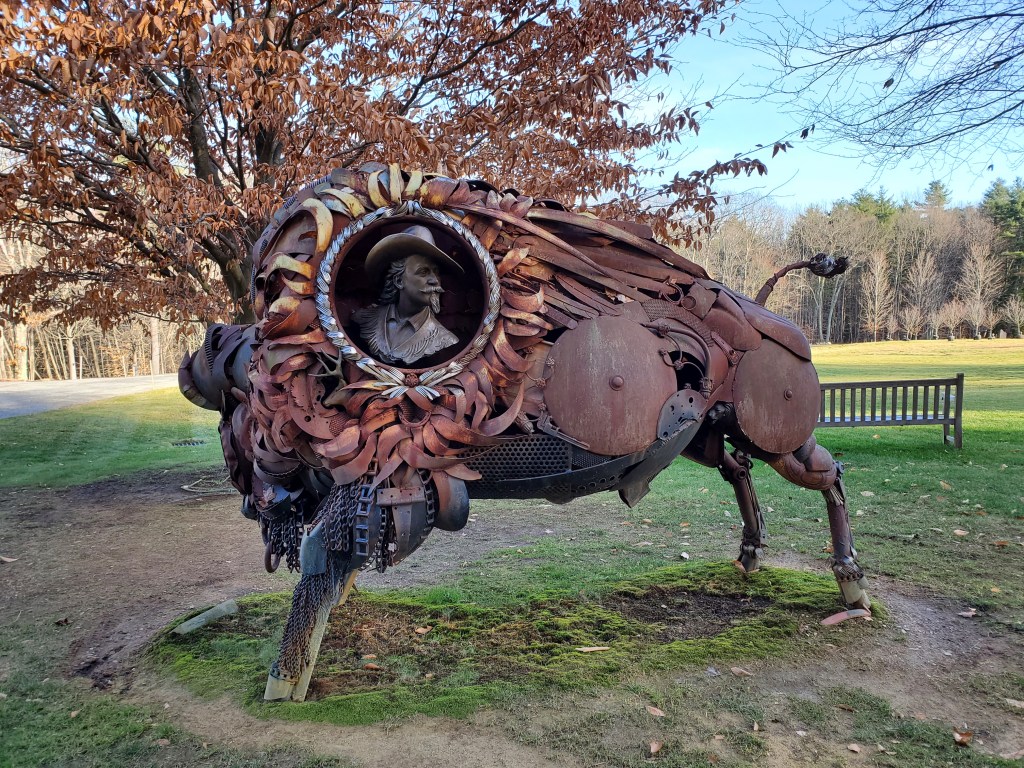
WILD WEST BUFFALO, John Lopez, 2013 “Alnoba” is an endonym of the Abenaki tribe, their name for themselves in their own language, originally meaning “person,” but post colonization meaning specifically Native American. It’s a lovely word, those open vowels conjuring noblility, respect, and concern for the earth—at least to us, the colonizers who’ve appropriated the word. On reflection, I feel some discomfort in the association of Abenaki identify with high end corporate retreats complete with a ropes course and seminars in “wellness.” But the place and the art are wonderful, no disrespect intended. Here again is the problematic cultural moment that surfaced in the Portland Museum—easily got past in good company with lobster salad for refreshment and sculpture inviting consideration, both of which were in plentiful supply.
The next evening I spent a delightful couple of hours fireside with a nice old vines Zinfandel and two young and very accomplished musicians, Mathilde, who had earlier graced my 70th birthday with such a winning recital, and her husband Edward, who on that same October day was playing cello with Yo-Yo Ma at a Richmond VA concert. We got to talking about how the music world may be the last bastion of memorization, a skill so readily dismissed in recent years that I regularly taught students who thought it impossible that 18th century actors could know the long, formal speeches of neoclassical texts by heart. Mathilde was justly proud of convincing an older piano student of hers to memorize a substantial and difficult piece, and I (quite unoriginally) credited Abraham Lincoln’s extraordinary rhetorical skill with his having much of the King James Bible and Shakespeare by heart, informing his choices and making his words worthy of being inscribed in marble for future generations (and visitors from other galaxies, like Klatu in The Day the Earth Stood Still) to read and admire. Actually, the Lincoln Memorial in D.C. gives new meaning to the “memory palace,” the method of loci, a mnemonic device adopted in ancient Greek and Roman rhetorical treatises. I confessed to using it when I gave my brief birthday speech in our library: each bookcase under my gaze was a prompt to a different segment of my talk. In the case of the Lincoln Memorial, the architecture literally has Lincoln’s writing on the walls.
So. In summary: I’m FOR memorization, sharing art with friends and talking about it, and against the excesses of political correctness and préciosité. The best art—like an extraordinary massage, which thanks to my wonderful neighbor Anne, who is currently learning that particular art with me recruited as an eager practice client—takes you OUT of yourself, affording you ecstasy in the literal sense of that word, removing your mind or body or both from their usual place of function. Such total involvement with an object of interest is not an ordinary experience, and you return from that journey changed in some fundamental way. Just as memorizing literally changes your brain, so does that extraordinary engagement with something outside the self. Such a tonic vacation from ego, that.
But! Art so refined and intellectualized and inaccessible to all but the pampered elite, art all too often prized by them only as status symbol or financial investment, has lost its way. And that’s the point of director Mark Mylod’s delicious black comedy/thriller satire of haute cuisine, The Menu.
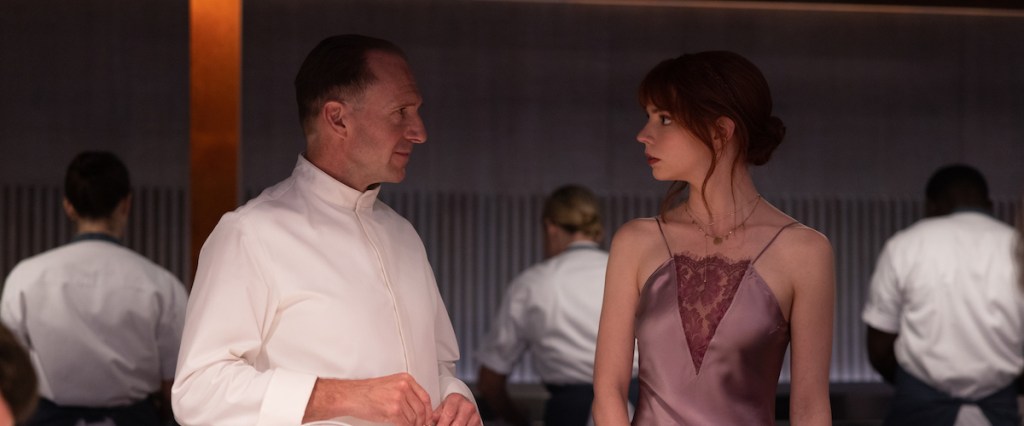
Chef Slowik (Ralph Fiennes) confronts Margot (Anya Taylor-Joy) in Mark Mylod’s THE MENU, 2022 Seeing that film after my week of art and wonderful conversations about art meant I was really ready to be entertained and enlightened. And I was! A perfectly conceived and acted allegory of art gone wrong, The Menu is a very stylish and satisfying Gilligan’s Island of reprehensible cultural stereotypes and artists driven mad in service to them. Only one character, there by chance, refuses to play along in the thorny charade that is dining in the obscenely expensive and precious restaurant of the film, Hawthorne, and only she (spoiler alert), the raisonneur Margot/Erin, a high-end escort/prostitute with a taste for cheeseburgers, survives. It’s a wonderful film: smart, gorgeous, shocking, hilarious, and on reflection, quite illuminating. And sooo much fun to talk about with friends!
A note to the interested: Rubin Östlund’s 2017 film The Square, now on Amazon Prime for only 9 more days, is another dark satire of our times: an art museum curator with a life out of control prepares for a controversial new exhibition. Recommended complementary viewing!
-
Hinge Moments: The Orchard and The Crown / 20 Nov 2022
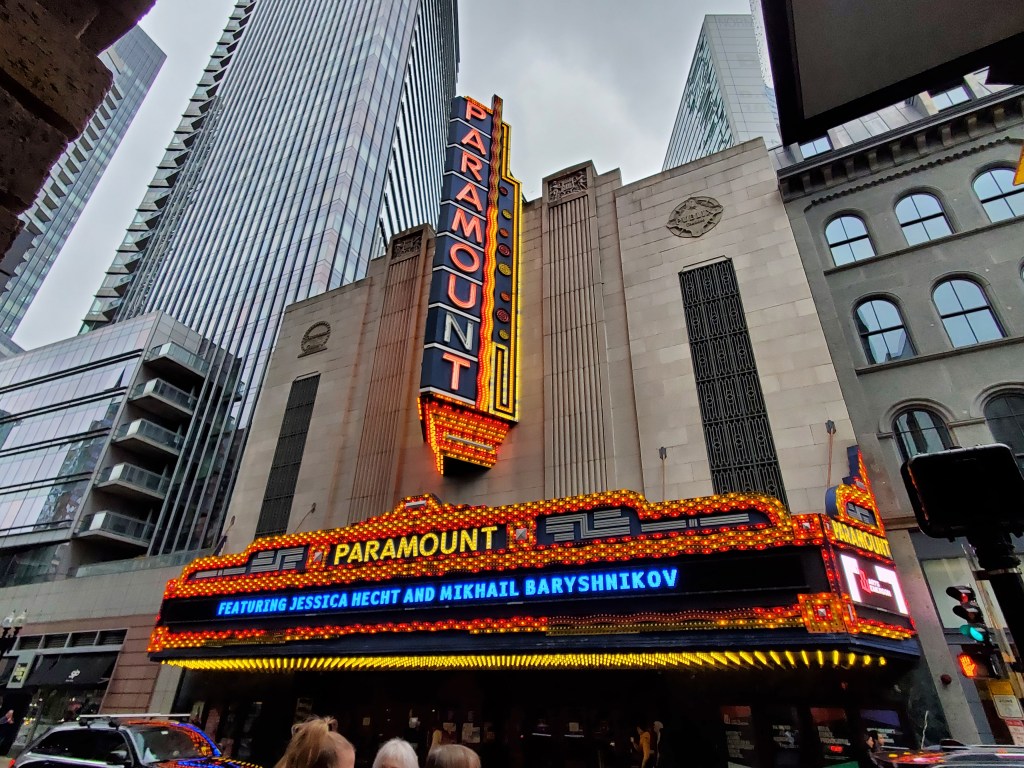
Paramount Pictures’ 1932 theatre, now part of the Emerson College Performance Development Center, restored to its original Art Deco glory and re-opened in 2010 Ever since Daylight Saving Time ended two weeks after I broke my ankle in an earlier careless misstep, I’ve mostly wanted only to eat and to sleep, especially in the mornings when REM time offers the most interesting, sometimes fantastical, sometimes illuminating dreams. I really enjoy what I’ve come to call this recreational sleep, perhaps the best perk of retirement, liberated from the tyrannical alarm clock. I’ve been wondering what cues our local bears, storing calories for hibernation, can take from recent days of 77o temperatures suddenly dipping to more seasonally appropriate lows. Unlike the bears, however, I don’t stop eating after trying out the next interesting recipe from Melissa Clark or Sam Sifton, so currently unable to walk for exercise until my fibula mends, weight gain threatens. I’ve therefore gotten very particular about what and when I eat, and perhaps also benefit from sleeping longer—and two floors away from the kitchen downstairs. Getting up from a warm flannel-sheeted bed always trumps hunger.
Last Sunday I did, however, rouse myself early enough to attend the final performance of Ukrainian-born director Igor Golyak’s hybrid production (simultaneously live and virtual) of The Orchard at the Paramount Theatre in Boston. I saw only the live production, though it was watching Golyak’s 2020 inspired-but-bare-bones virtual production, The State vs. Natasha Banina, that first roused my interest in Golyak, founder and producing artistic director of the Arlekin Players Theatre & the Zero Gravity (zero-G) Virtual Theater Lab. Banina dropped in the very early days of the pandemic and starred Darya Denisova, an actor with the Arlekin Players of Neeham MA and Golyak’s wife; that production’s success excited my anticipation of what Golyak would do with Chekhov’s The Cherry Orchard. I wasn’t alone in appreciating the necessity-as-the-mother-of-invention creative finesse of Banina: acclaimed in multiple New York Times Critic’s Picks and streamed world-wide, Banina also caught actors Jessica Hecht’s and Mikhail Baryshnikov’s attention, spawning their participation in Golyak’s Chekhov adaptation, which first played off-Broadway at The Baryshnikov Art Center before arriving in Boston.
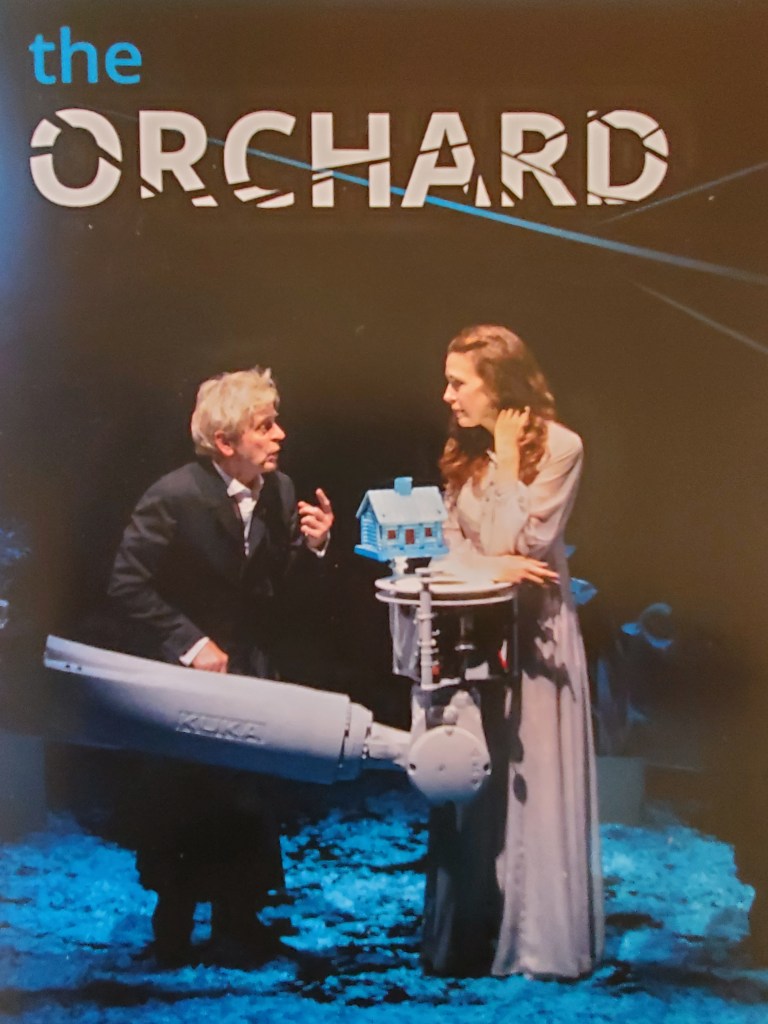
STAGELIGHT program cover Experiencing Golyak’s production in person felt rather disturbingly akin to my personal Eastern Standard Time recreation: dreaming. Lighting Designer Yuki Nakase Link bathed the action in cold, blue light and projections of swirling precipitation. Falling snow? Cherry blossoms? Both? Neither? You decide. The projections became physical on the stage floor, littered with a snow/blossom cover through which the old servant Firs (Baryshnikov) made his first shuffling entrance. A scrim filled the proscenium arch of the Paramount stage, separating the audience from the live action (except for one alarming entrance and the curtain call), and distancing it in time and space. Projections on the scrim sometimes frustratingly obscured the live action on stage, but perhaps deliberately so, in the way the action of a dream is obscured in waking memory. Sometimes bits of Chekhov’s script, including stage directions, appeared on the scrim, suggesting a script from the turn of the 20th century now hard to follow (and for the audience, hard to see clearly?) well into some future time. The irresponsibly child-like but charming Ranevskaya and her sentimental, loquacious brother Gaev in the script’s opening scene have just returned to their estate after fleeing Paris, and are adrift (literally in drifts of snow/blossoms) in what seems an apocalyptic future. An alienating robotic arm center stage in their former nursery puts us, the audience, in their position, trying to accommodate the discrepancy between a play about a hinge moment in 1904 and characters who cannot adapt to current realities, even as we live through our own era’s estranging novelties and anxiety-provoking changes. Like the feckless siblings clad in Oana Botez’s fur-trimmed quasi-period dress, we in the audience have trouble seeing clearly what is going on as our world becomes increasingly technological and less human. Live actors on stage along with the serviceable (sometimes seemingly sentient) robotic arm seen only through the intervening scrim seem more like apparitions than flesh and blood—like the bending tree in the orchard Ranevskaya initially mistakes for her mother. The setting puts us in the audience in the same liminal position as Chekhov’s characters.
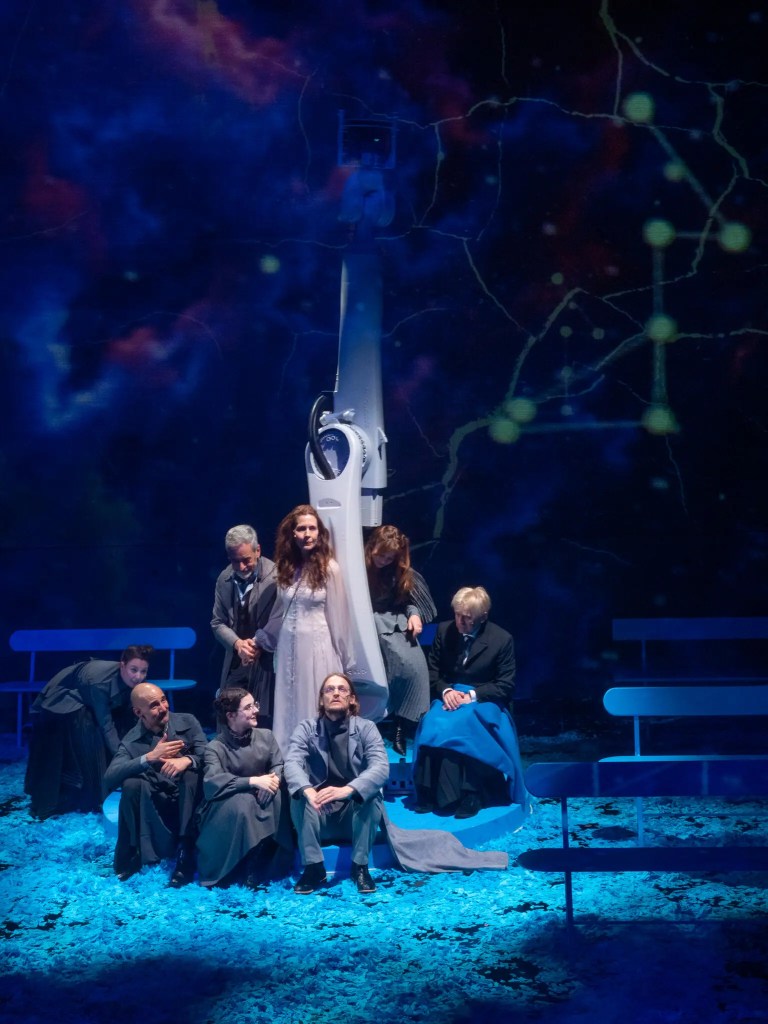
Clockwise from top center: Jessica Hecht, Juliet Brett, Mikhail Baryshnikov, John McGinty, Elise Kibler, Nael Nacer, Darya Denisova and Mark Nelson in “The Orchard,” Igor Golyak’s high-tech adaptation of Chekhov’s “The Cherry Orchard.” NYT Credit…Pavel Antonov As in a dream, truth in The Orchard is only obliquely suggested: robots replace humans in 2022 just as Lopakhin’s awkward but upwardly mobile capitalism replaced the ruling class of 1904 Russia. The robotic arm, like the robotic dog, even has a discomfiting personality, sometimes photographing the characters, seeming to be listening attentively while recording through the “face” of a ring-lit lens, sometimes serving coffee or a small toy house, the venerable but abandoned estate reduced to plaything. The arm even sweeps the floor, as Firs does. But Firs is mortal; both he and his memories of a past when cherries from the orchard were valuable, like the recipe that once made them profitable, will be forgotten.
The look of this post-apocalyptic dystopia makes us queasy. The robot dog, clearly valued by Charlotta and Firs, who strokes it at one point, is still a robot. Perhaps that’s why my favorite line, a non sequitur from the governess Charlotta, was cut: “My dog also eats nuts!”
Golyak’s adapted script sometimes required translation: Trofimov’s key speech about all Russia being our orchard was delivered in American Sign Language. Some large chunks of dialog, in Russian or French, got no translation at all, especially baffling to those audience members who did not already know the play. Was this a metaphor for how even the characters on stage do not listen with understanding to each other?
Nor was there much comedy to elicit Chekhovian painful laughter. Real menace entered the play as the original script’s passing hiker became in Golyak’s Orchard a soldier who arrived in front of the scrim and close to the audience, his combat uniform and kit as well as his aggressive delivery shockingly contemporary and quite intimidating, evoking both Golyak’s Ukrainian roots (he was born in Kyiv, with, in his words, “an affinity for the Russian culture”) and the experience of the Arlekin players as Russian-speaking immigrants from the former Soviet Union. In Golyak’s own words, quoted in Elisabeth Vincentelli’s NYT review of 3 June 2022: “The idea in The Cherry Orchard is the loss of a world, loss of connection, loss of each other, loss of this family. It’s a story where a human being is forgotten—Firs is forgotten. And right now human being is forgotten.”
Jessica Hecht’s Ranevskaya recalled a Blanche DuBois wanting magic, not reality, longing for connection even as she irresponsibly flees it. As for Mikhail Baryshnikov, critic Laura Collins-Hughes nailed his “ineffable magnetism and captivating grace that have always made him a riveting performer, and that now make him the quietly scene-stealing anchor of this ambitious and cluttered production” (NYT, 16 June 2022). The literal winds of metaphoric change that several times mimetically buffet the actors on stage Baryshnikov as Firs not surprisingly renders with virtuosic moves that make the choreographed action both beautiful and convincingly real, an early coup de théâtre for a production that begins—and movingly ends—with Firs.
Endings have been much in evidence of late. I returned from the The Orchard matinee in Boston to watch later that night another episode of The Crown’s season 5, chronicling the 1990’s increasingly out-of-touch reign of Queen Elizabeth II. In that episode, young William apprises his grandmother the Queen that satellite television could offer her many more viewing choices, including the racing coverage which she of course eagerly embraces. But later, surfing through the hundreds of channels now available to her, each offering something more trashy and banal than the other (one clip is Beavis and Butthead), the Queen herself pronounces that there in Buckingham Palace “even television is a metaphor.”
Certainly the real Queen’s passing this fall has felt like an end time to me. And now at 70, I spend a fair portion of each day fretting about what to do with all the many books two academics can collect over their lifetimes, and the extensive trove of obsolete but carefully preserved technology: vinyl; tapes, both cassettes and VHS; cds; dvds; analog cameras; a multitude of carefully organized and filed 35 mm slides in purpose-built cabinets.
Gaev’s famous apostrophe to the 100-year-old bookcase in the nursery therefore hits rather too close to home—much like grief for the end of the second Elizabethan era, the passing of “the greatest generation,” and the values the Queen herself represented so dutifully throughout her long life.
In the S5 E2 of The Crown, Prince Philip (Jonathan Pryce) tries to comfort a grieving young mother, Penelope Knatchbull, Countess Mountbatten (Natascha McElhone), and speaks of losing his favorite sister to an airplane crash:
“I learnt then what grief was. True grief. How it moves through the body. How it inhabits it. How it becomes part of your skin. Your cells. And it makes a home there. A permanent home. But you learn to live with it. And you will be happy again. Though never in the same way as before. And that’s the point. To keep finding new ways.”
Loss and grief are inevitable. Here’s to finding new ways.

Deco Details above the Paramount’s Proscenium Arch, restored to formed glory 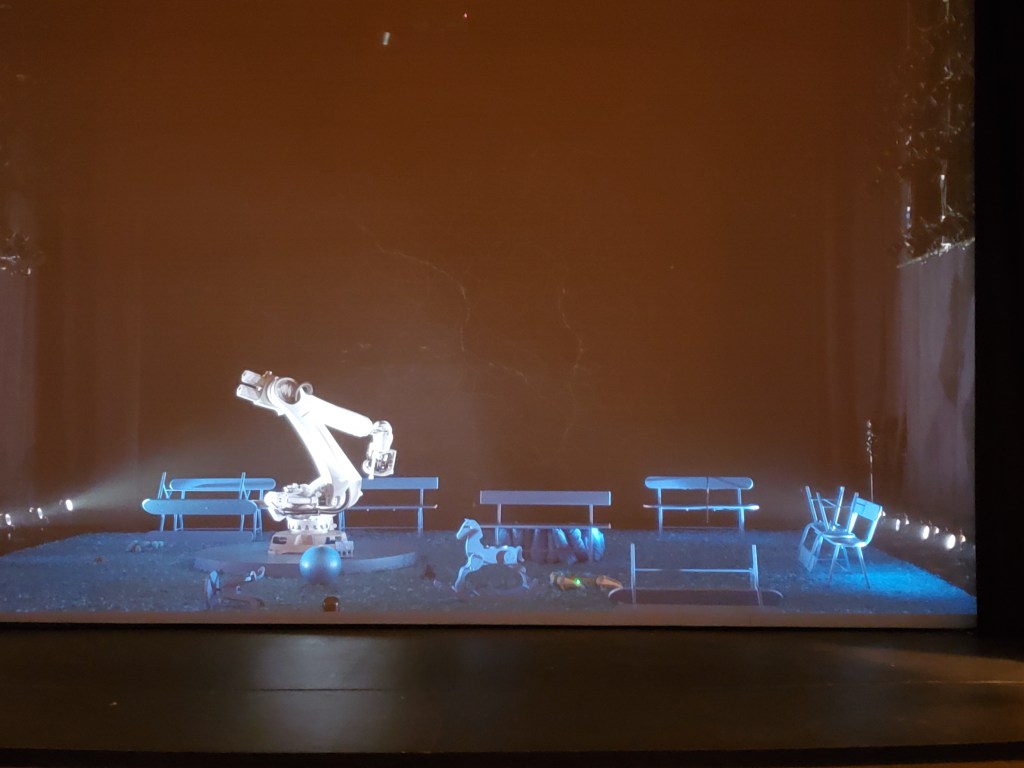
Designer Anna Fedorova’s Tech Noir set below the Deco proscenium -
Fall 2022

Wagon Hill, Durham NH, Sunday, 23 October 2022 (the day before the fall) Ten days ago I was having a fairly productive day, having gotten up early (8:00 is early for this retiree) and marched through my to do list while Sarah, my house cleaner of many years, worked her magic. Shortly after she left in the early afternoon, I was coming downstairs in my clogs carrying the laundry basket (Monday is laundry day, a tradition from my New Orleans red-beans-and-rice days), misjudged my progress to the main floor, and stepped out into thin air rather than onto the tile floor where I thought I was. The laundry basket went flying and I made a hard landing on all fours. Even now, recalling hitting that floor prompts both fear and horror at the thought of what I might have done. I rolled onto my back, shocked into stasis for a few minutes before I began to test the damage. The clogs had fallen off of course. I could rotate both wrists without pain. Good. Some pain resulted from rotating my left ankle, but not bad. Also good. But the right ankle was a different story, and the swelling had already begun.
How to get up? Could I get up? Flashes of the senior dilemma: I’ve fallen and I can’t get up! I crawled back to the stairs, and holding onto the balusters pulled myself up to sit on the penultimate step—my inadvertent launching pad moments earlier. I’d badly sprained my right ankle back in 2002 attempting to ice skate on our beaver pond (hubris on the part of a native Floridian), and the pain there now did not seem as acute as the pain then. So, calculating how best to deploy the RICE protocol—Rest, Ice, Compression, and Elevation—I ever so slowly proceeded to assemble ice packs and an Ace bandage and stayed off my feet as much as possible, finally deciding against calling for help. After all, it wasn’t so bad to be forced to sit still and read, and I was already doing what could be done to treat a sprain. Besides, driving to urgent care seemed unnecessary because coincidentally, in fewer than 48 hours I had an already- scheduled appointment with my orthopedist in Concord, a follow-up check on a knee problem now resolved.
That visit to Concord revealed more than a sprain; I had indeed fractured my right fibula, but not so badly that Dr. Burns thought surgery would be required. Phew. Since then, a second x-ray has confirmed that initial opinion, and I continue to manage, getting around in my Ankle Stabilizing Orthosis (ASO) brace, popping naproxen sodium twice daily.
Oh, so grateful I didn’t do much worse damage, I find the fall and the necessary accommodations of same since then have imposed a new perspective on this first month of my 70’s, the realization of how fast everything can change, how problematic the 38 stair steps that connect our three stories can be, and how limiting the progress of aging will likely become. Must ALWAYS hold on when descending stairs! Must stop wearing clogs! Considering what lies ahead, and what a fall can mean, is top of mind.

Oyster River emptying into Great Bay, Durham NH But not the only thing. The Fall, as recounted by John Milton, also comes to mind, and with it the memory of a moment early in the get-to-know me phase of falling in love with the man who would five years later become my husband. We were both teaching at Regent’s College in London, sitting in a pub in Hampstead. One of my courses was that formidable staple of the English major, Brit Lit Survey, Part 1, Beowulf through Paradise Lost. I had just been teaching the latter, and was telling David how moving I found Adam’s immediate response on hearing Eve tell of her transgression:
How art thou lost, how on a sudden lost,
Defac’t, deflow’r’d, and now to Death devote?
Rather how hast thou yielded to transgress
The strict forbiddance, how to violate
The sacred Fruit forbidd’n! some cursed fraud
Of Enemy hath beguild’d thee, yet unkown,
And mee with thee hath ruin’d, for with thee
Certain my resolution is to Die;
How can I live without thee, how forgo
Thy sweet Converse and Love so dearly join’d,
To live again in these wild Woods forlorn? (PL, Book IX, 900-910)
“He cannot live without her.” My heart broke a little as I said that, and David noticed; the tears that came to my eyes then fall freely now.

Wagon Hill inlet A fall, The Fall, falling in love. Here on 2 November, All Souls, less than a week from the mid-term election, the fall I fear is the decline and fall of American democracy. The great American experiment from the first depended on the honor of its leaders and an educated populace, however many were first excluded from that education and the opportunity to lead. Now truth and election results are discounted by so many; the dearth of empathy and understanding is general. I profited enormously from a good primary and secondary public school education; too many fellow citizens have not—like the furnace repair guy who arrived in September to do the necessary annual maintenance, so eager to convince me, a teacher, that because he himself had no children, he should not have to support public schools. The Capitol is stormed and desecrated by citizens who seem to believe themselves patriots. A man attacks another man, 82 years old, with a hammer because he’s married to the woman second in line to assume the presidency. A mother takes a photo of her three children before sending them off to school each morning in case she has to identify them by what they were wearing on the last day of their lives.

Milkweed, Wagon Hill This evening I will spend some time beside the Norway Spruce just east of our driveway, remembering the souls most dear to me whose ashes its roots has by now absorbed, wondering about the undiscovered country from whose bourn no traveler returns, and what the country I now inhabit will become before I join them.
-
Halloween 2022

Cemetery at Wagon Hill, Durham NH My Grandpa Cecil—Zeke to his friends—was born on Halloween 1897, and today would be his 125th birthday. A true American success story, Cecil Calvert Senseman was the eldest child of Ohio farmer Ed Senseman and his wife Bertha, who died in 1912 when Cecil was 15. Their mother’s death separated Bertha’s children; Cecil, his younger brother Vercil, and little sister Ruby were sent to be raised by relatives in three different homes. Cecil, the eldest, was apprenticed to a toolmaker by day, finishing his high school education at night, and learning his trade (and business practice) so well that ultimately he owned Dayton Tool and Die, the company he once worked for.
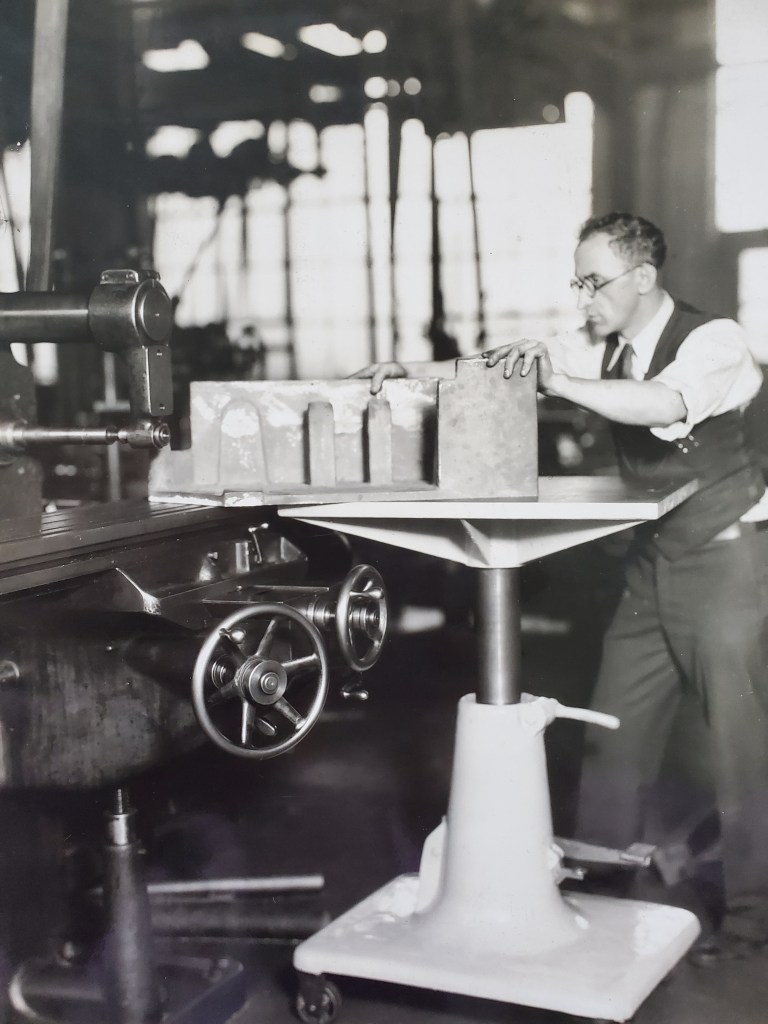
Young C. C. Senseman at Dayton Tool and Die Encouraged by the business success of his younger brother Vercil, who did well in the Florida land boom of the 1920’s and came to own a fine home in Ft. Myers, Florida flanked by neighbors Henry Ford and Thomas Edison, Cecil and his wife Clara Florence Beaver sold the tool business and moved south, like Vercil, to invest in Florida real estate.
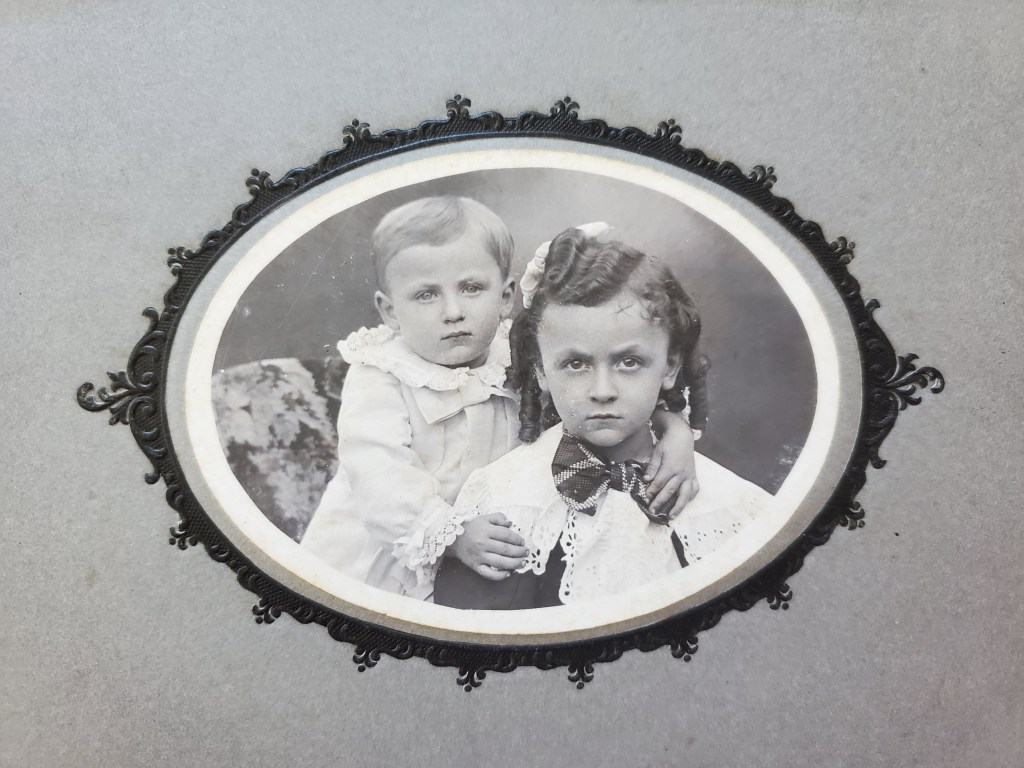
Vercil, age 2 and Cecil, age 5 in 1902 Starting with a fishing camp business in Bonita Springs, Cecil, like his little brother, finally bought a fine house at 3005 Broadway in Ft. Myers, the Senseman home I came to know on weekend visits from the Murphy home in St. Petersburg. In fact, it’s unlikely I would have been born in Florida if not for Grandpa Cecil’s move there from Ohio.
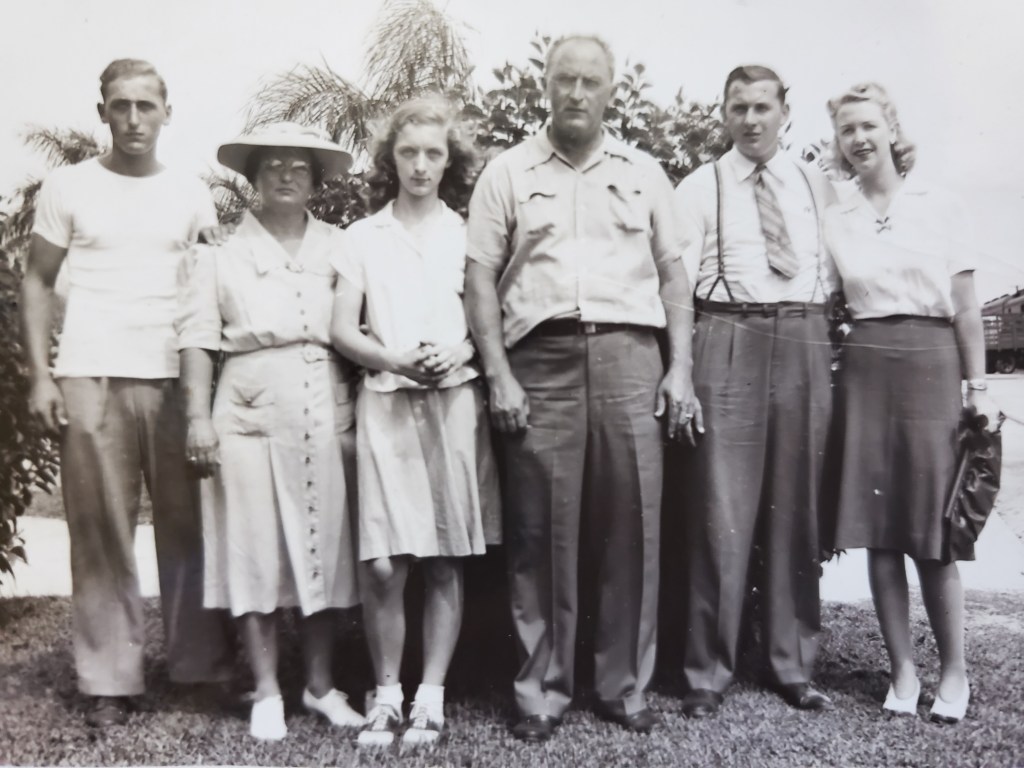
l to r: Uncle Cal, Grandma Clara, my mom Virginia, Grandpa Cecil, Uncle Kenny, and Aunt Martha in Florida c. 1940 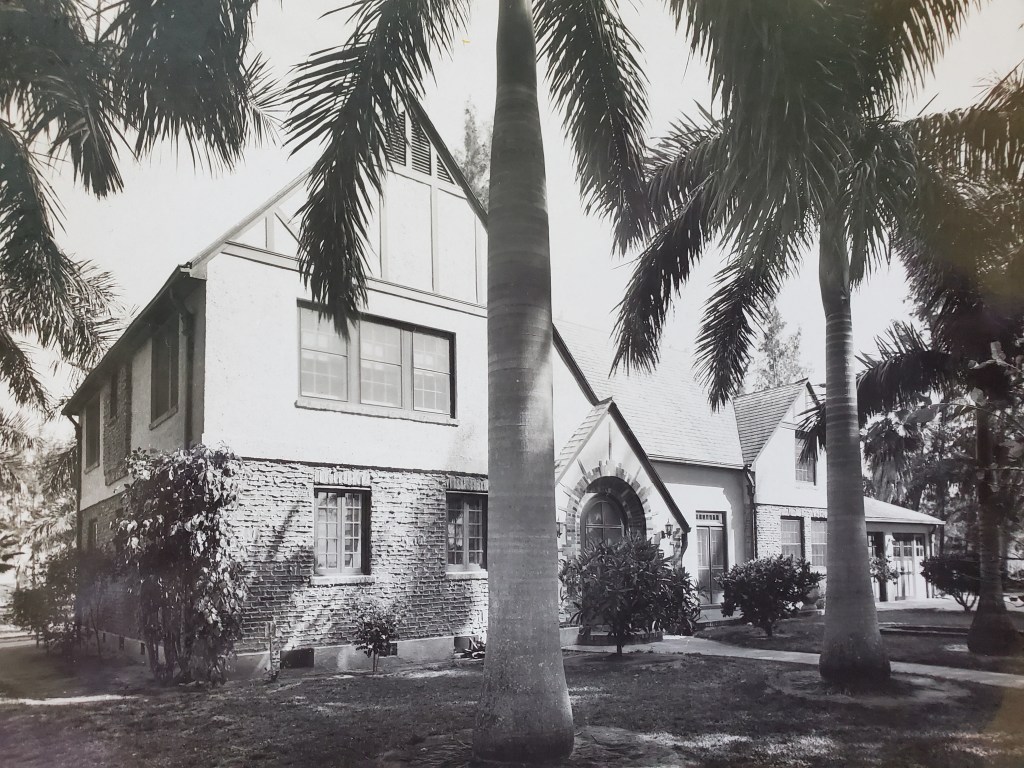
3005 Broadway, Ft. Myers, Florida I found any house that was not, like our home, a slab ranch, exotic, so the two-story Tudor revival Senseman home with its porches, fish ponds, high ceilings, and maid’s apartment just up the steep staircase off the kitchen was magical.

My mom Virginia, me, and dad George, c. 1955, posing in our Seminole outfits, sitting by one of the Senseman fish ponds. I loved feeding the fish dough balls of Wonder bread. Grandpa Cecil was a natural whiz at math (a talent my mother Virginia inherited), and today the dining table where he would help me with my algebra homework continues his tradition of hospitality in my New Hampshire home. As soon as I could read, Grandpa gave me a subscription to the National Geographic along with a savings bond, gifts renewed each birthday, and encouraged me to collect silver dollars as an investment.
Cecil was a good grandpa and a good husband to his wife, my Grandma Clara. My dad George always admired his father-in-law’s devoted care of Clara, who had suffered a paralyzing stroke on hearing that her youngest son Calvin, a Marine gunner on the New Mexico, had been mortally wounded by a kamikaze pilot, another young man who died for his country. That was on Mother’s Day 1945, so very close to the War’s end. Clara was a good grandparent, too, and picked out for me and my little sister new matching fancy dresses as we outgrew them. Once she gave me pretty pillowcases she’d embroidered with her left hand, her right hand permanently disabled by that stroke. A fine, strong woman.
Grandma Clara died in the spring of 1970, my senior year of high school, the first significant, and therefore terrible, loss of my young life. Grandpa Cecil died five years later in 1975, but not before living up to his promise to buy me my first car when I graduated from college in 1974, a two-tone, tan-and-ivory AMC Hornet with cloth houndstooth seats that I drove until I finished grad school and got my tenure-track job in 1984. My namesake Grandpa George Anthony Murphy died in 1977, and Grandma Mel (Imelda) Murphy in 1982. Only years later did I realize how lucky I was to have had all four adoring grandparents in my life for my first seventeen years.
So, on this All Hallow’s Eve, I fondly remember, miss, and honor all of those who loved and cared for me, now gone before. For me, they are ALL hallowed.
And I think Zeke would like entering cyberspace on this blog; he was ever an enthusiastic early adopter of new technology, and had the very first Xerox machine (nearly the size of a VW Beetle) I ever saw. He would clip articles from the newspaper just to Xerox them and send the copies to me.
Happy Birthday 125, Grandpa Cecil!
Happy Halloween, All!
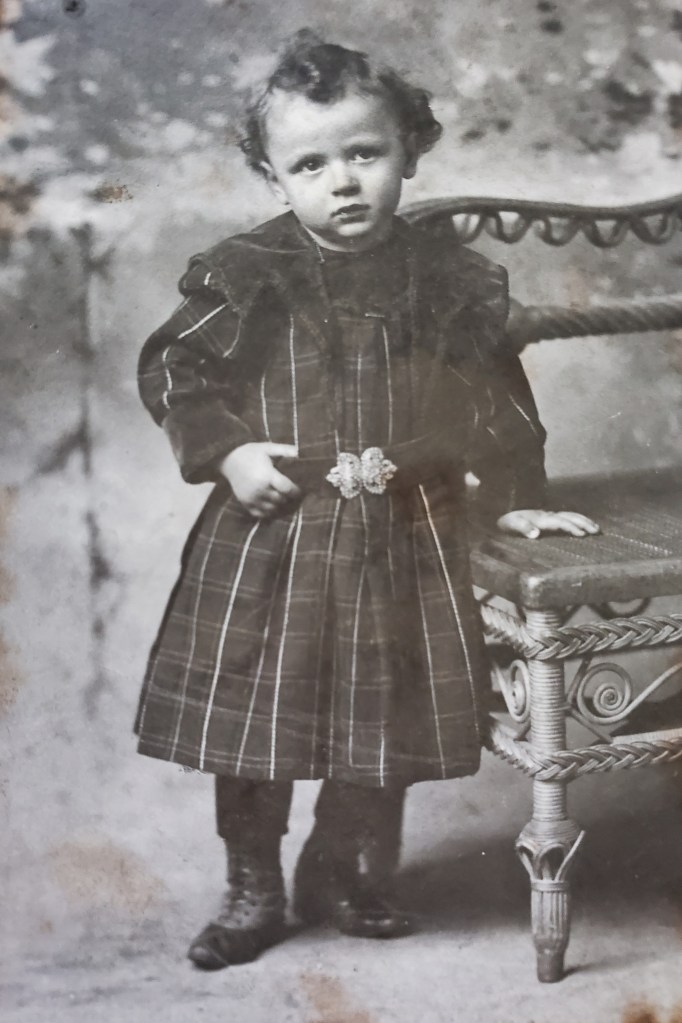
Cecil Calvert Senseman, age 2 years 2 months
-
Subscribe
Subscribed
Already have a WordPress.com account? Log in now.
 Georgeann Murphy