-
Intersection
17 February 2026
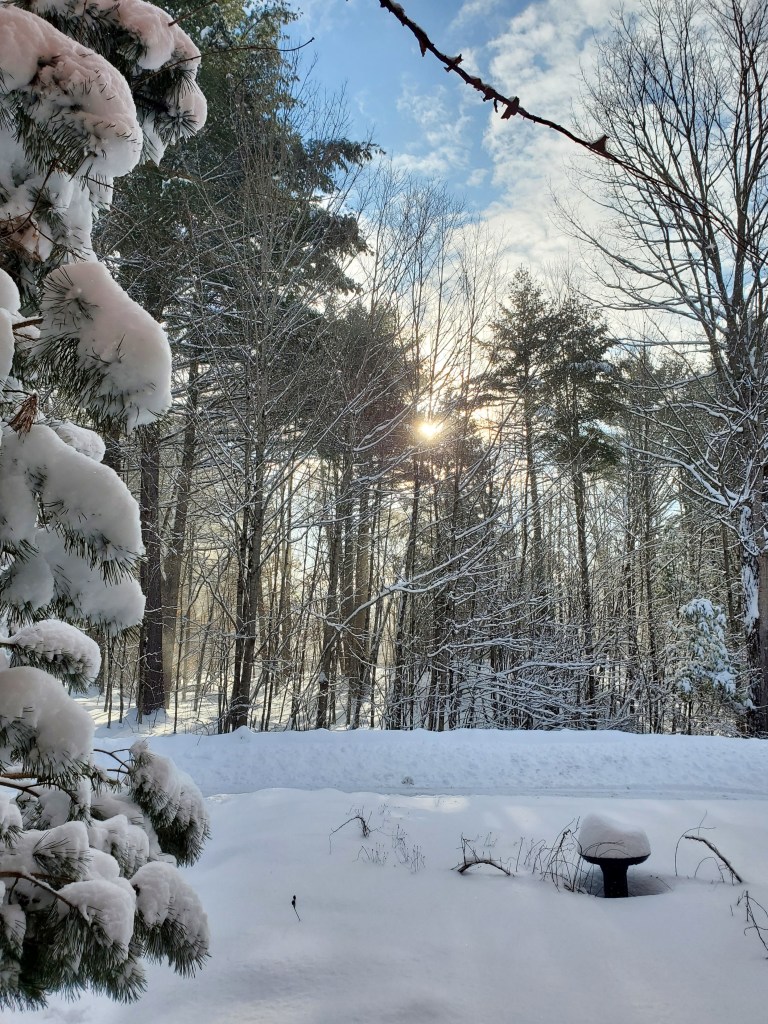
Morning snow, 11 February 2026 Today, Tuesday, 17 February 2026, marks the beginning of Ramadan, the celebration of Mardi Gras, and the Lunar New Year of the Horse, as well as the second anniversary of my sister Jane’s passing, and the birth of our twin granddaughters, now 24 years old. Is’t possible? What to make of such intersections, global and personal, past and present—especially given my shaken and stirred response to my car’s being totaled at the busy intersection of Madbury Road and Route 4 in Durham, NH a week ago Sunday? Dear Reader, that is the question. Seeing Hamnet for the second time one week post crash afforded me opportunity for a really good cry, but that has not settled the unsettled.

Accident scene, 8 Feb 2026 I’m off to a yoga class soon, to be followed by two different book club discussions later on, one on Shakespeare’s early play Two Gentlemen of Verona, exploring and exploding past comic conventions, and the other on Kiran Desai’s epic novel, The Inheritance of Loss, rendering the collision of private lives and public events arising from the effects of colonialism on those who leave India and those who remain. I’m grateful for such salutary distractions, physical and intellectual, and for the insights art affords. I’m grateful for the restorative company of dear friends joining over a delightful meal to speak, deeply, of all manner of things, celebrate Valentine’s Day, and toast our host’s cozy new home together. And I’m grateful that no one was seriously hurt when my car was hit, that emergency services and insurance company have been so helpful, and that the hours of daylight grow appreciably longer with each passing day. But what’s to come?
My friend SP, student of lunar cycles, has declared this Year of the Horse marks the beginning of a new one. Could be worse, could be better, but it will be different. I’m choosing to think things will get better, that perhaps the U.S. has reached a tipping point, that we’re finally waking up to take action against oppression and the psychic damage wrought by epistemic uncertainty.
I’ve certainly found myself in a new personal era of late, noticing more and more signs that I’m neither ascending nor even maintaining level flight, but am rather on the glide path down. I’m spending a lot of time—perhaps too much—thinking about offloading stuff and attending Death Cafés. What am I contributing? WordPress, host of this blog, reports my site had 442 visitors in January, so Dear Reader, I’m wondering what YOU are thinking? Have these messages in a bottle reached you? Do you also find yourself at the intersection of hüzün, the Turkish word I’ve just learned signifying melancholy and longing/spiritual yearning, and hope? I recently noticed that some Google bot describes this blog as “witty, entertaining, and thoroughly engaged with all manner of subjects . . . .” What does one make of a such a snippet, a compliment manufactured by an A.I. algorithm?
I don’t know. But I do remain curious. And I propose reviving a 16th century word now largely obsolete but I think useful in this new cycle: “respair,” meaning the return of hope after a period of despair, from the Latin respirare, to breathe again. Deep breath, Everyone! And like Jess Jackson, who departed this dimension earlier this morning, Keep Hope Alive!
Happy new year!

I am curious Squirrel, peeping into the bathroom, 15 Feb 2026 -
Distraction Confounded
29 January 2026

The Oyster River, seen from the Durham NH landing As the snow storm approached last Saturday, 24 January, I found myself in a rare if brief mood, focused and pleasantly anticipating both the coming snow and a lovely little tea party in New Castle to honor two friends with January birthdays, one 87 and one 89. Humans are hard-wired for certainty, leaping to embrace it, and even foolishly creating it when obscured by ambiguity or complexity. As I once heard Senator Ted Kennedy say: “For every complex problem there’s a simple solution. And it’s wrong!”
Winter Storm Fern was certainly coming; I saw it on the radar. And Walker Percy’s “hurricane theory” would, I knew, obtain. Disasters replace abstract anxiety with immediate purpose: survival and community solidarity. We feel alive and connected, no longer passive participants in daily routine. The unusually cold temperatures—it was 3o that morning, -16o with wind chill—meant the wetlands trail bordering our property would be frozen solid, with insulating snow keeping it perfect for snowshoeing later on. And the birthday party, laid on by a designer with exquisite taste, would, I knew, be lovely. The humiliation and frustration I had felt on Wednesday morning on hearing the inane, self-aggrandizing, and insulting ramblings of our Felon-in-Chief (FIC) addressing global leaders at the World Economic Forum temporarily ceded mental space to hospitality and gemütlichkeit (I recall the FIC telling this august group assembled in Davos, Switzerland that but for the U.S., they’d all be speaking German. This to a highly educated audience in Switzerland). Our New Castle hostess had suggested we keep politics out of her house, and we complied, even though we’d heard there’d been yet another shooting in Minneapolis.
And then I came home and watched the videos of an ICU nurse for the Veteran’s Administration help shield a fellow protestor when an ICE agent pushed her to the ground. For his brave compassion, true to his training and ethical service as a nurse, he was then surrounded by ICE agents, pushed face down to the ground, and summarily executed, his last act to help the helpless. Yet more blood on the hands of our abominable leader. A tipping point? I am not sanguine. I write to my representatives and senators and I protest, but I’m more scared than optimistic.
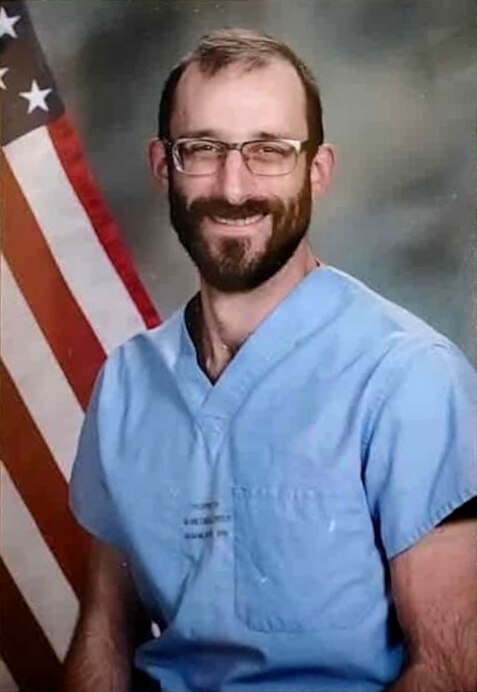
Alex Pretti, RN official portrait by US Dept. of Veterans Affairs Vladimir Iliyich Lenin is rumored (incorrectly) to have said “There are decades where nothing happens, and there are weeks where decades happen.” January has felt like that, and it’s taking a toll on my emotional equilibrium: tears sprang to my eyes on hearing the calm and reassuring baritone of Robert Redford in a broadcast clip explaining why he created the Sundance Film Festival, first established by him in Salt Lake City in 1978 as the Utah/US Film Festival. Redford, Sundance himself, is gone, and his festival is leaving Park City, Utah for Boulder, Colorado next year, having outgrown its home for the past 45 years. I miss Robert Redford. I miss talent, generosity, and decency.
I try to stay in motion, seeking solace and direction in art, and certainly I’m not alone. The Winslow Homer exhibition at Boston’s MFA was mobbed on the Monday morning I joined the claustrophobic crush of mostly seniors (too many taking pictures) crowding the exhibition “Of Light and Air,” its title taken from Henry James’s review: “Mr. Homer has the great merit that he naturally sees everything at one with its envelope of light and air. He sees not in lines, but masses. Things come already modeled to his eye.”
Homer’s famously luminous but delicate watercolors with their all-too-fugitive colors were well served by the MFA (if not the online images I reproduce here); a video featuring artist James Prosek attempting to duplicate Homer’s technique and conservator Judith C. Walsh guiding Prosek and us through Homer’s studio on Prouts Neck in Scarborough, Maine (now managed by the Portland Museum of Art) provided helpful insight into Homer’s artistry.

Leaping Trout, Winslow Homer (1889) 
The Blue Boat, Winslow Homer (1892) All museums are suffering in our unenlightened era, however, and the MFA, confronting a widening structural deficit, has announced it will lay off 6.3% of its staff as part of a sweeping restructuring plan. So, I suppose we must forgive both the congestion of the Homer show and the commodification of his work.
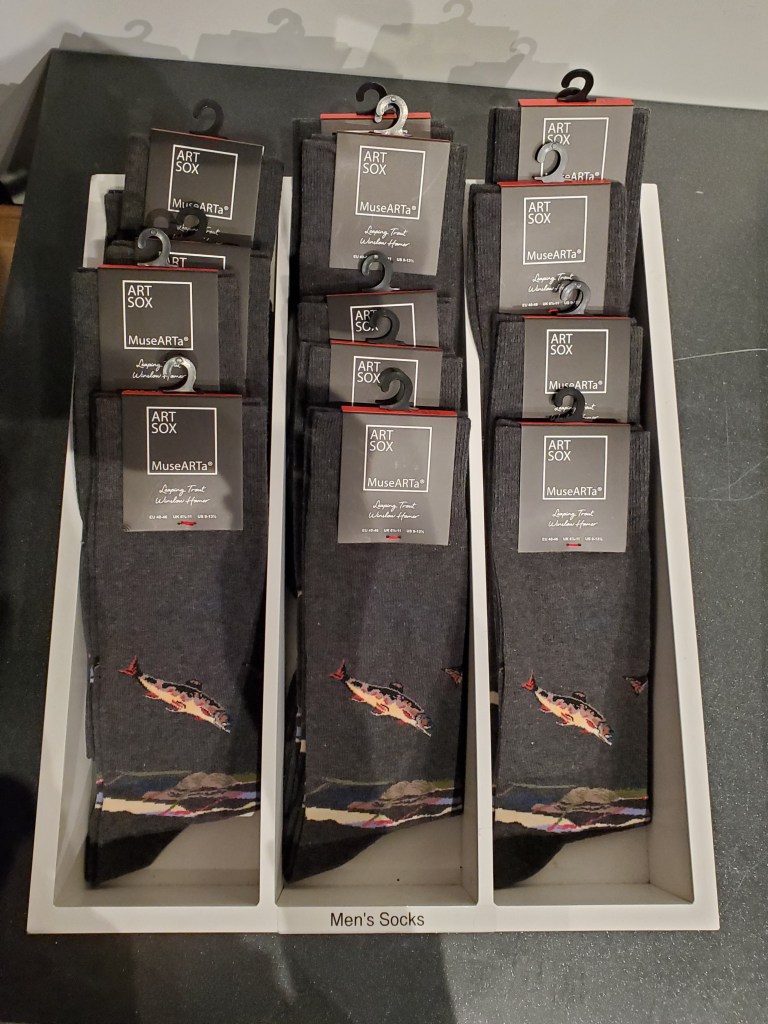
Leaping Trout as Art Sox 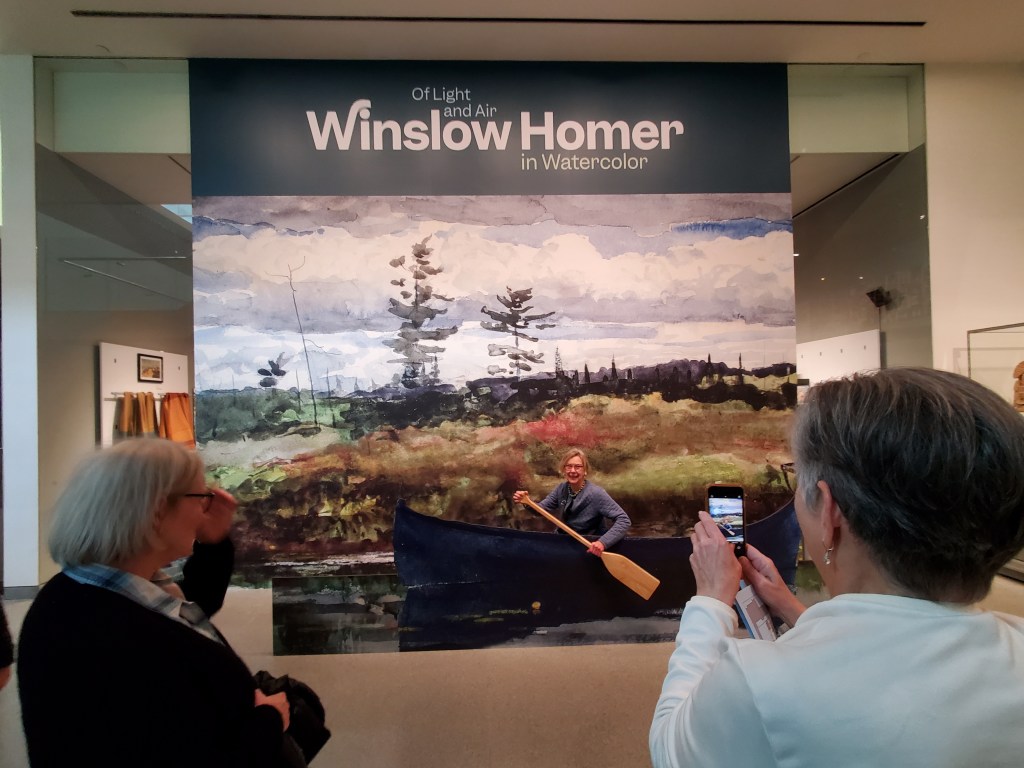
The Blue Boat as photo op From the Homer show, I made my way through the MFA to the Lynch and Servison galleries and the “Boston on the Eve of Revolution and the New Nation” show, and found myself once again sadly misty-eyed. What, I wondered, would Thomas Jefferson make of us now? What has become of the sacred honor those Founders pledged along with their land and their lives in this the 250th anniversary of their great experiment?
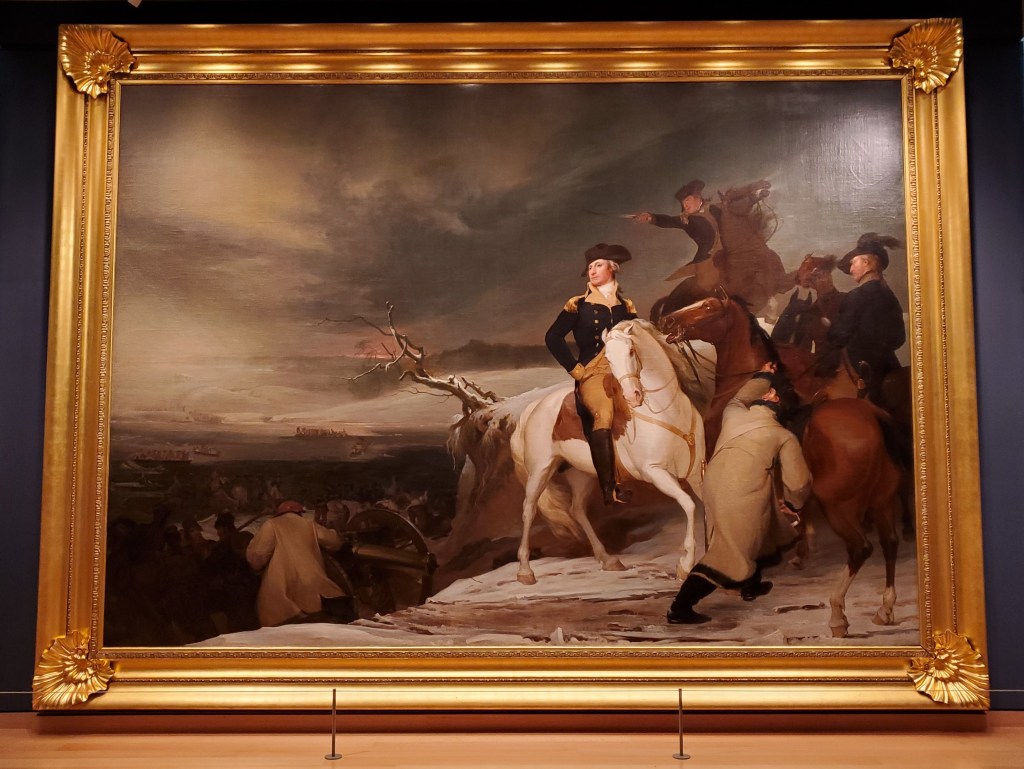
Thomas Sully’s monumental oil (12 x 17 feet) The Passage of the Delaware (1819) 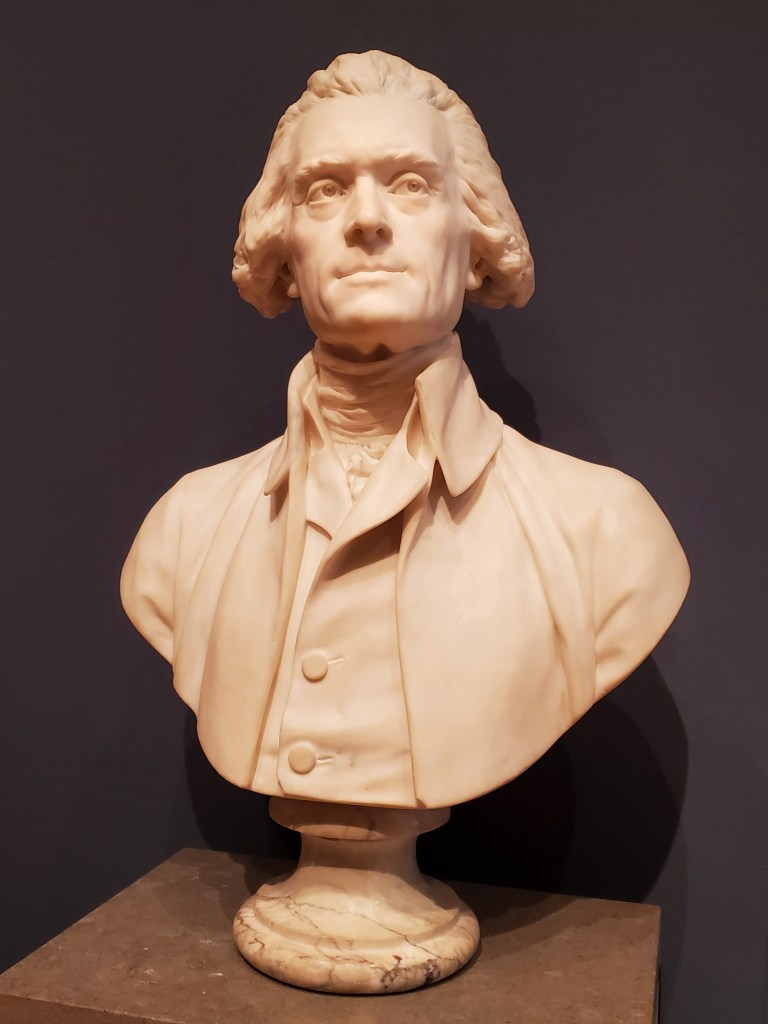
Thomas Jefferson (age 46), Jean-Antoine Houdon (1789) So I beat on, a boat against the current, borne back ceaselessly into the past.
The personal past exerts a gravitational force, too, even as I pursue distraction. Case in point: I saw The Last Class, Elliott Kirschner’s 2025 documentary about Robert Reich’s final semester at UC Berkeley teaching his “Wealth and Poverty” class and so ending his 42-year teaching career while wrestling with his own aging and his students inheriting a world out of balance. Over my own 43 years in college and university classrooms, I certainly witnessed many of the changes Reich did, and worried as much about the morphing “idea of a university,” the title of a humanities course team-taught by my late husband. The next morning I dreamed I was part of a protest on the Berkeley campus while wearing a clown costume (!) and digging in my bag for makeup to refresh my red, white, and blue face paint (!), being late for class, and then sitting in a little school desk to take my GRE exam, from which I was summarily expelled as a protestor (!!!). I awoke worried that I had no cold cream to take off my grease paint.
Another attempt at salutary distraction was confounded by the final (and superb) 18 January performance of Tina Satter’s play Is This A Room by the Apollinaire Theatre Company at Chelsea Theatre Works just outside Boston, a thrilling verbatim transcription of the FBI’s interrogation of young Air Force linguist Reality Winner in June 2017.
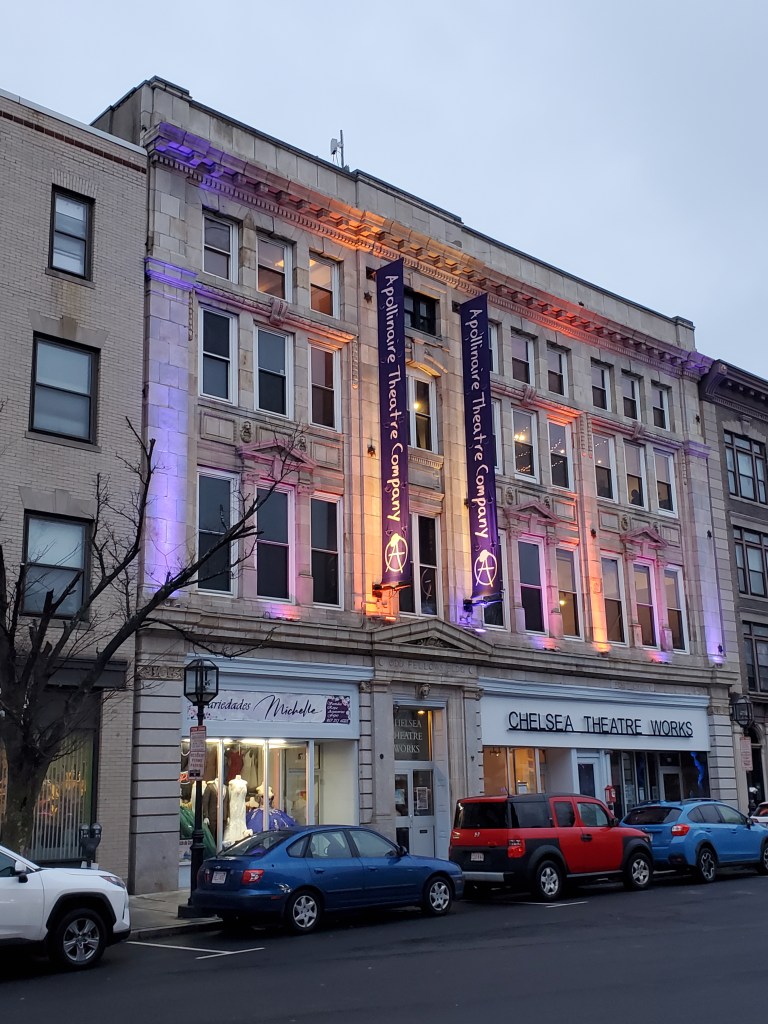

In May 2017, Winner printed and mailed a classified NSA report to the news outlet The Intercept, which published the document. The report described efforts of Russian military intelligence to interfere with US election systems in 2016. Winner was subsequently arrested the same day she was interrogated and denied bail while awaiting trial. In 2018, she accepted a plea agreement and received a 63-month federal sentence, at the time the longest sentence ever imposed for leaks to the media. In 2021, Winner began three years of supervised release. The transcript/play, with Parker Jennings so engagingly portraying Winner, includes Winner’s confessing that having Fox News playing 24/7 in her workspace helped prompt her action.
Yesterday, 28 January, the FBI raided the Fulton County, Georgia Election Office, seizing original 2020 voting records, authorized by the Felon-in-Chief’s Justice Department to continue investigating his false claims of election fraud. And CNN reports that Minnesota Secretary of State, Steve Simon, has declined to hand over voter data demanded by Attorney General Pam Bondi because doing so would violate state and federal privacy laws. “Literally hours after the second, let’s not forget second, killing of an American citizen in the city of Minneapolis by ICE agents … there’s this term sheet,” he said, “this ransom note” (https://www.cnn.com/2026/01/27/politics/pam-bondi-voter-rolls-minnesota-ice). Extortion replaces the law of the land.
Even my two book clubs have inadvertently conspired to keep the roiling of our republic top of mind. Our Madbury Public Library group tackled Maggie O’Farrell’s Hamnet as well as Chloé Zhao’s film last week, and the Shakespeare discussion at the Portsmouth Public Library took up Hamlet the following Tuesday. O’Farrell’s novel is an almost too evocative representation of grief and Hamlet a tale of revenge in a poisonous court ruled by a murderous, fatally obsessed king. Oh, NO KINGS, please!
Where, oh where lies relief? Well, there is Canadian Prime Minister Mark Carney’s principled and pragmatic speech to the World Economic Forum in Davos on 20 January. The date recalls not only a painful inauguration day (and by association the FIC’s attack on the Capitol), but also the loss of my sister Jane, born on 20 January in 1958. But Carney’s rational erudition (he quotes Thucydides, not Hannibal Lecter) and pellucid, persuasive rhetoric are a balm of reason. I recommend you read his plea for middle powers to “live in truth.” And then take peaceful political action. And make plans to go spend money in Canada, as I have.
Also, get a few bulbs growing indoors.
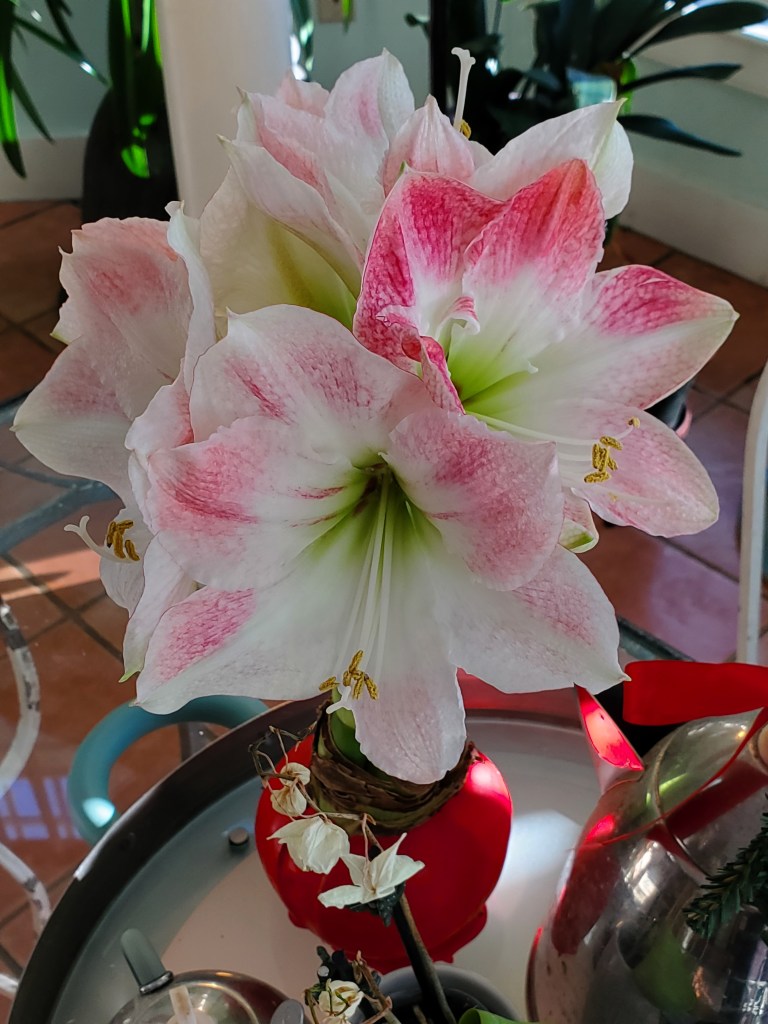
One wax-coated amaryllis bulb produces 2 buds, one with 6 blossoms and another on the way: “the force that through the green fuse drives the flower” And then, go spend some time outside, however cold it might be.
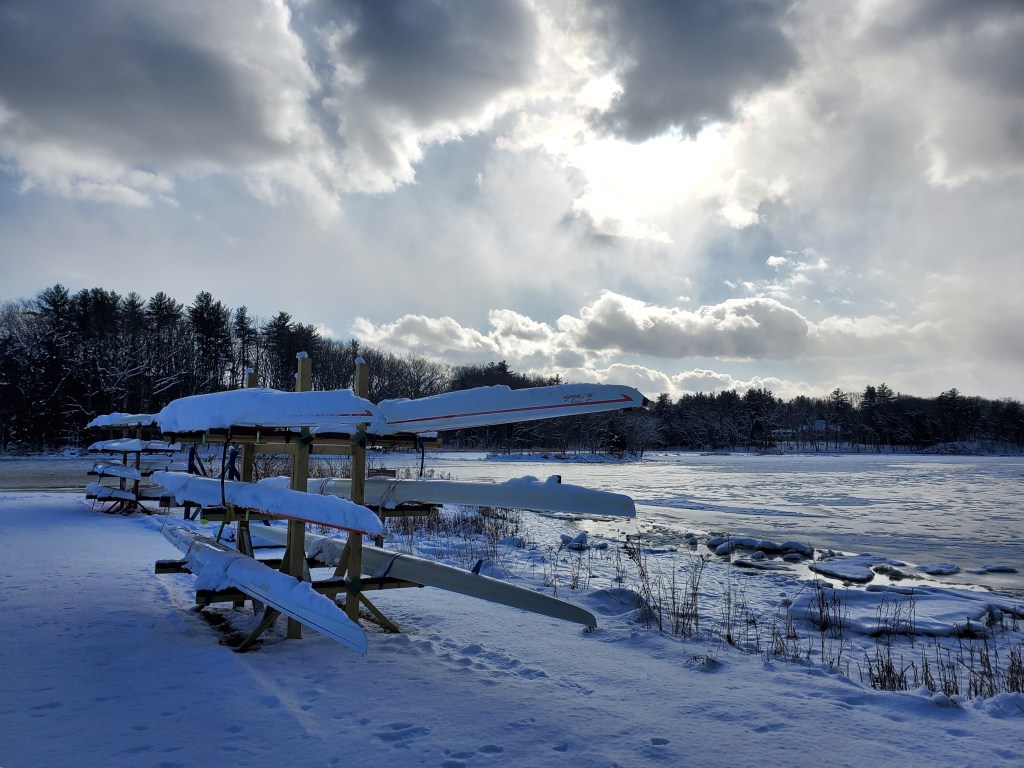
Sculler’s Shells at the Durham landing Nature helps us live in truth, as Duke Senior, in exile in the Forest of Arden knows:
. . . Are not these woods
More free from peril than the envious court?
Here feel we not the penalty of Adam,
The seasons’ difference, as the icy fang
And churlish chiding of the winter’s wind,
Which when it bites and blows upon my body
Even till I shrink with cold, I smile and say,
“This is no flattery; these are counselors
That feelingly persuade me what I am.” (As You Like It, 2.1.3-11)
As the historical sign at the Durham landing suggests, this, too, will pass.
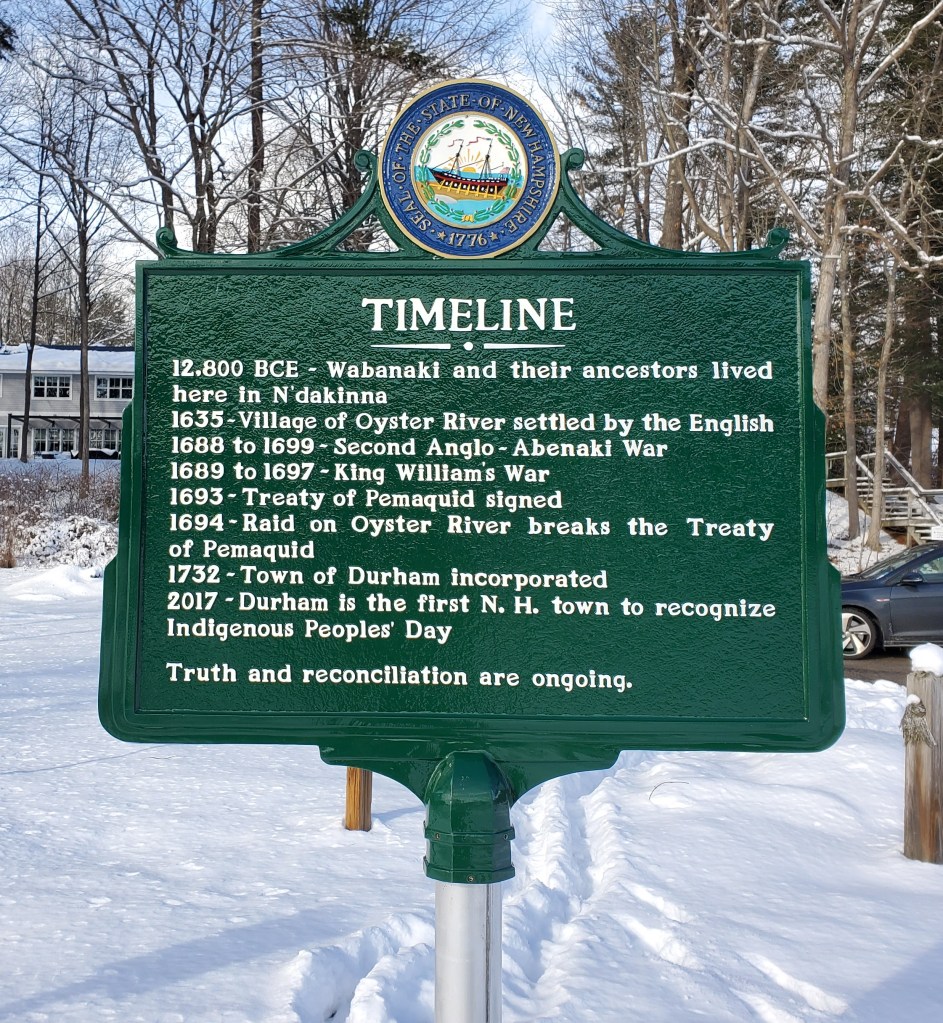
Truth and reconciliation are ongoing. -
January Blues
11 January 2026
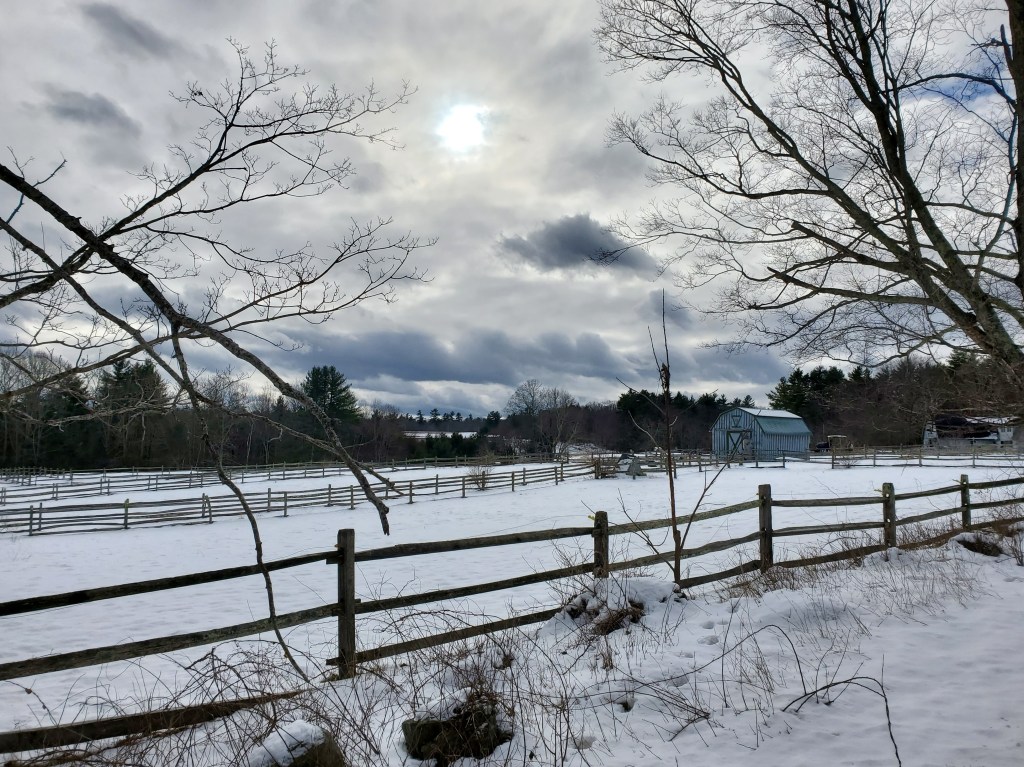
Capstone Farm, Hayes Road, Madbury NH As we head into mid-January, I’m finding myself uncomfortably empathizing with our volatile weather, alternating heavy rain warm enough to melt much of what had been a lovely (and brightening) snow cover with dropping temperatures that freeze my sloping backwards question mark of a driveway into a contorted luge course, making me even more chary than usual of a fall. In our crippled democracy, the horror hits just keep on coming, the latest the Minneapolis murder of Renee Good. My friend Carol was part of the protest in Dover yesterday, a photo of her and her sign (“COURAGE IS CONTAGIOUS! STAND UP NOW OR BOW DOWN LATER”) made USA Today. I, on the other hand, worrying about ice on the road as well as trigger happy ICE agents, went to Portsmouth not to protest but to see Ethan Hawke’s remarkable performance in Blue Moon. Wonderful script, acting, direction; devastatingly heartbreaking. Perhaps not the best choice to experience on a dark, cold day as I struggle with death cleaning resolutions and the ever more noticeable drag of aging.
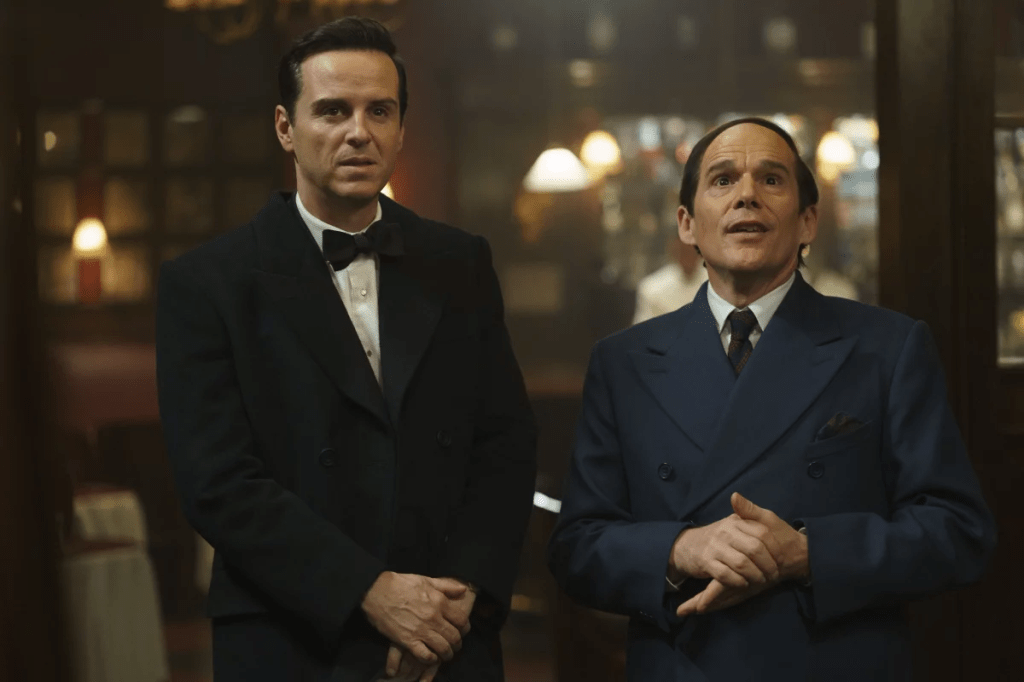
Andrew Scott as Richard Rodgers and Ethan Hawke as Lorenz Hart in Richard Linklater’s Blue Moon (Sabrina Lantos/ Sony Pictures Classics) Today I went to a new year’s luncheon with many of my fellow Seacoast Village Project members, all of us hoping to be able to “age in place.” The noise of so many simultaneous conversations was deafening and defeating, especially for our hearing-impaired cohort. Missing one couple, fellow retired UNH academics I was looking forward to seeing, I learned the husband has been metaphorically kneecapped by sudden onset memory loss so aggressive that the couple has decamped to Connecticut to be closer to children. There was much talk of “being on the list” of our local continuing care facility, Riverwoods, awarded the sobriquet of “Neverwoods” by one fellow Villager, cleverly summing up what seemed to be the prevailing attitude. I count myself one determined never to leave our home, but staying here will take a LOT of finessing. And what if I’m on the short list for losing MY marbles? My lunch companion, a former dean at Syracuse whose expertise in the intersection of business and technology wafted him and his wife to a teaching gig in Switzerland for 22 years (The Beauty! The Wealth! The Social Services!) finds promise in a remarkable mobility device (see revimo.care) that can lift you up, move you around, and basically take the place of a strong human orderly. Provided, of course, that you keep enough marbles to be able to drive it.

The ReviMo Niko: the future? In the coming week I am at last cleared to return to the yoga classes I’ve been missing since the hernia repair that sidelined me at the beginning of last month. I’m hoping they will help alleviate the stiffness that sets in when I’m less mobile, and dispel some of the gloom attending my death cleaning, which arrived in earnest when I began the long-avoided task of sorting my late husband’s papers, beginning with a stack of personal emails he printed out and kept from the time we moved into our home in 2001 until he was overtaken by the debilitating anxiety that so altered both our lives beginning in 2006. A couple days ago I heard on NPR a report about a woman, age 102, whose children had unearthed in a storage space a trove of letters to their mother from her fiancé who died in WW2. She had put them away, married a different husband, had and raised their children, and never looked back at the letters until those children brought them to her. At which point she read them, and fell in love with her long-dead fiancé all over again.
This is both heartwarming—the heart IS a resilient muscle—and heartbreaking, and best describes what it’s been like to find my David, once again his full, remarkable self, in his lengthy correspondence with his brothers, his friends, his daughter. Witty, entertaining, and thoroughly engaged with all manner of subjects—music, movies, art, politics, the family romance, the woes of academia, astronomy, cars—they bring him back to life for me to adore and mourn afresh. Many of the correspondents are, like David, gone now. Some live on, and in a few cases when I think that person might like to have that letter, I’ve put it aside to pass along. Other letters that describe in detail one of the Andrew Murphy Commonwealth’s many adventures—some of which I had forgotten—I’ve kept for myself to re-read when I want to, or simply need reminding of just how much extraordinary fun we had together. The rest go to the silence of recycling.

Marcescence: the Beech in Winter Meanwhile I still await the new computer system that will replace the only sporadically working laptop I’m using to tap this out. Even it has little epiphanies to offer by way of the scenic views that thanks to Windows Spotlight show up on the lock screen after the Dell logo. The other day it was Delicate Arch outside of Moab, Utah, where we hiked so boldly at least twice, the first time in 1993 when we took the decidedly not marked path back to the parking lot by directly descending the steep sides of the red rock bowl below the looming Arch. And then the very next time I turned on the laptop, the scene was the naturally terraced travertine pools of Pamukkale, the “cotton castle” atop which the ancient city of Hierapolis, founded as a thermal spa in the second century BCE, sits. We were there together in 2013. We had a wonderful life.
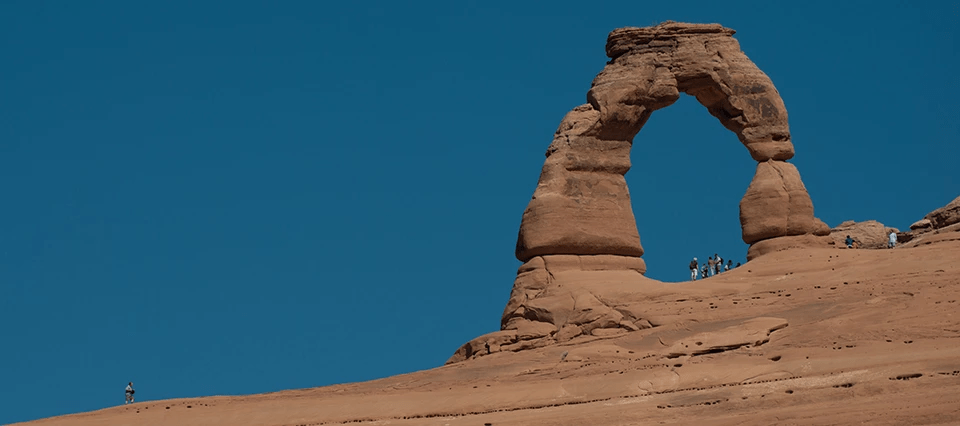
Delicate Arch from the perilous perspective we shared in 1993 
The pools of Pamukkale, Turkey So on we go. I’ll continue salving my nostalgia with art: tomorrow the Winslow Homer watercolor show at Boston’s MFA, next Saturday the documentary film of Robert Reich’s Last Class, next Sunday a well-reviewed production of Is This a Room? at Chelsea Theatre Works, Tina Satter’s true-life psychological thriller, a verbatim FBI transcript of the interrogation of Reality Winner, a young Air Force linguist accused of leaking a classified document about Russian interference the 2016 U.S. elections. And George Saunders has a new novel coming out on the 27th. In the meantime, I’ll keep watching re-runs of The West Wing on Netflix, a vision of what it would be like to have super intelligent, ethical, heroic political operatives running things. I’ve made it to Season Three, gobsmacked by the topical prescience of the first two seasons, 1999-2001, which inversely, sadly illuminate the world we live in a quarter century on. What’s to come is still unsure; I think it will get worse before it gets better. But on we go.
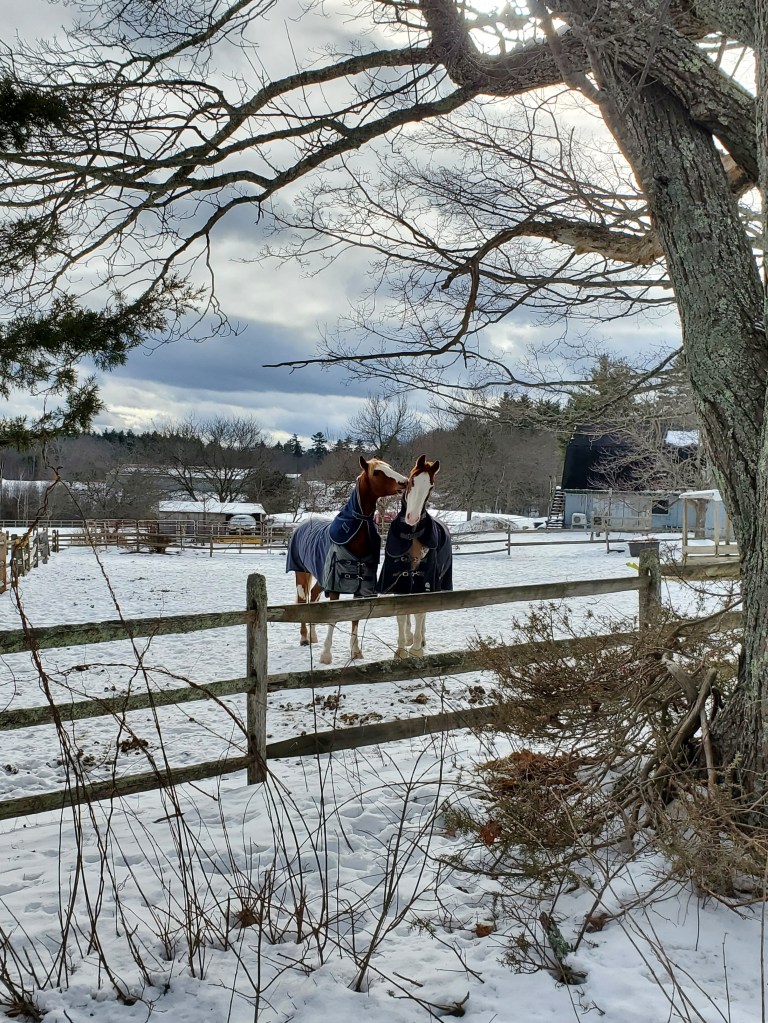
Winter companions at Capstone Farm -
Transition
20 December 2025
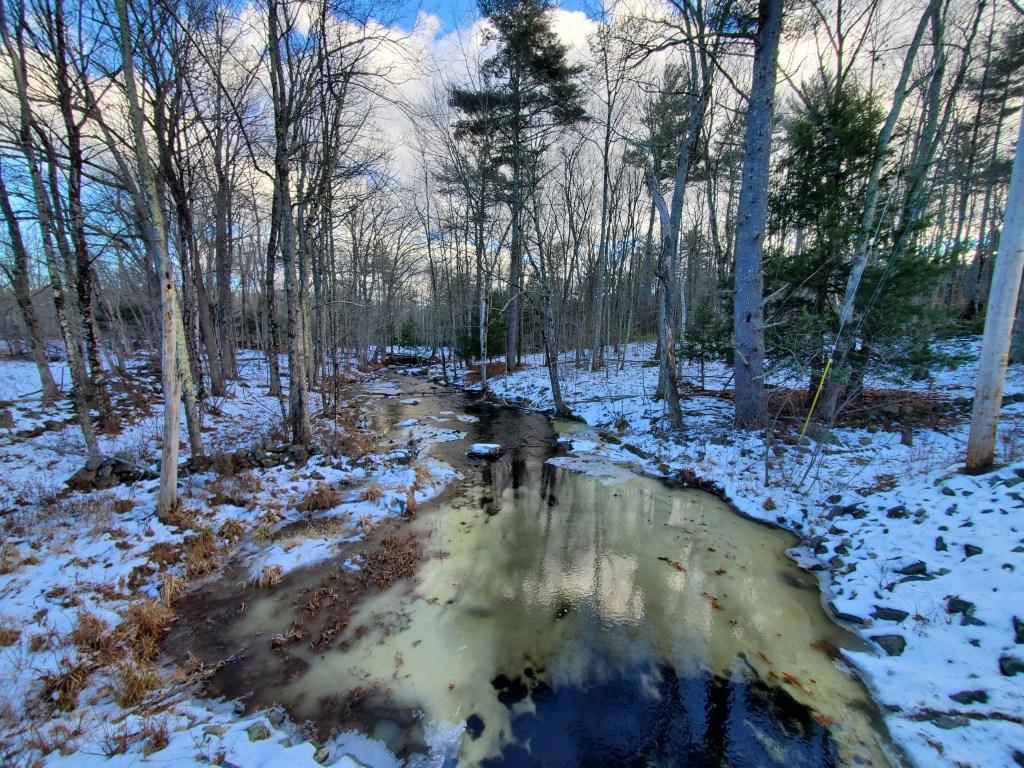
The Bellamy River toggles between temperature swings, topping ice and snow with flowing surface water Koyaanisquatsi, Dear Reader, is a Hopi word that translates to “life out of balance” or “a state of living that calls for another way of living.” Koyaanisquatsi is also the title of 1982’s wordless documentary directed by Godfrey Reggio with music by Philip Glass and cinematography by Ron Fricke. That film made a big impression on me—and on my late mother Virginia, who had my husband David spell it out on the chalkboard she kept in her Clearwater apartment so she could put a name to how she experienced life much of the time. So, on this Saturday night, it’s not surprising that the past week’s events have repeatedly brought both film and term to mind, even as I so clumsily tap this out on my laptop keyboard, accustomed as I am to the much more familiar setup of remote keyboard and mouse disrupted last week by a Microsoft update that rendered that arrangement unusable until tech support can arrive come Monday. Oy.
The times are out of joint. The season’s prompts to comfort and joy repeatedly collapse into horror and outrage. First last Saturday came the all-too-common report of yet another school shooting, this time during a final exam at Brown. Then on Sunday, another mass shooting, this time on a Sydney beach during a Hanukkah celebration. And then most terribly, perhaps because the victims were so well known and loved by so many, sometime in between those horrors came the savage murder of Rob and Michele Reiner, apparently at the hands of their middle child, Nick, news made even worse by the appalling, deranged response of that loathsome troll, our Felon-in-Chief, the leader of the free world Koyaanisquatsi indeed.

Open water now on the Madbury reservoir after last week’s warm rain Inevitably, even horror and disgust temper in the course of a week’s passing. But tomorrow at 10.03 am, the winter solstice arrives in Madbury, New Hampshire, along with the shortest day of the year. The light will return. But what of hope? Mike “Meathead” Stivic, the character Rob Reiner played in Norman Lear’s breakthrough comedy, All in the Family, consistently countered his father-in-law’s ignorant, racist, misogynist, anti-Semitic rants with rational counter-arguments, but also with enough empathy that he could speculate about what might have shaped Archie Bunker into the bigot he became. Praise be to such enlightened comedy. Our current late-night comedians also comfort as they mock the inhumanity of Donald J. Trump and lament the corrosion of what on his last broadcast of the year Jimmy Kimmel, his voice husky with tears withheld, called Superman’s credo of truth, justice, and the American way. Indeed. I am, for the first time in my life, ashamed to be American. And of the many retorts to the President’s nauseating response to the Reiner family tragedy, Seth Myers’s was the most eloquent, a heartfelt tribute to a great-souled artist and an excoriation of the banal evil of Trump. Watch it if you haven’t.
So. There’s the double-edged sword of technology that can connect and comfort as well as stoke hatred and, at the least, baffle (as was the case with my recent computer cockup, leading to repeated conversations with a Dell technician in New Delhi who was rather less than deft with small talk as he waited for uploads (“And do you live alone or with a family? Do you have pets? Often people who live alone have pets”). Comedians reinforce our recognition of norms now exploded, and art can unite a room full of strangers experiencing together the pain of and consolation for unspeakable grief, as it did in the movie theatre where I watched Chloé Zhao’s extraordinary rendering of Maggie O’Farrell’s Hamnet, so Shakespearean, as James Shapiro pointed out, in its evocation of the green world and the artistry necessary to re-work old material into compellingly relevant experience. Rob Reiner’s art endures, too: go watch Stand By Me again, or A Few Good Men.
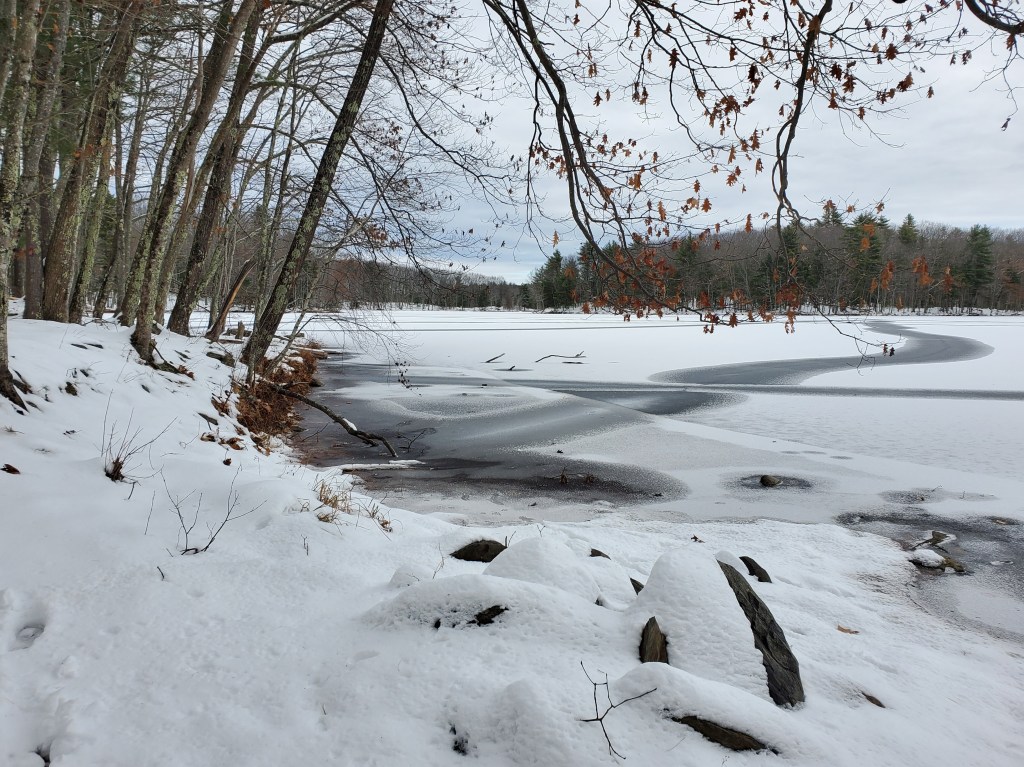
Madbury Reservoir before the warm rain Does the longevity of art counterbalance all the losses of late? Getting old is famously not for sissies, and balance can be a literal and figurative casualty of aging. I’m certainly aware of diminishing capability, and trying to balance that recognition with a plan for action has me attending death cafés and finding inspiration in the Peacock series The Gentle Art of Swedish Death Cleaning. But there’s consolation, too, in understanding why we’re in the mess that we’re in. Anna Lembke, Professor and Director of Addiction Medicine at Stanford University’s School of Medicine, posits an explanation for a culture out of balance in her 2021 book, Dopamine Nation, and on successive episodes of the Hidden Brain podcast, “The Paradox of Pleasure” and “The Path to Enough.” Using her own embarrassing personal experience of addiction to raunchy romance novels, Lembke quite compellingly explains how our modern world of overconsumption (of drugs, food, shopping, media, etc.) leads to anxiety and unhappiness. Arguing that the relentless pursuit of pleasure, so easily accessible online, creates a dopamine deficit, our brains’ attempt to restore chemical homeostasis that ultimately spirals into anxiety and depression, Lembke proposes solutions to reset our reward pathways and restore a healthy balance of the brain chemistry attending our experience of pleasure and pain. She’s made me examine not only my own habits, but also suggested some insight into what drives our chronically over-indulged ruling class, especially a “leader” so wretchedly hollow that he can only find pleasure and self-worth in demeaning others. Of course he wants to shut down any person or medium capable of inspiring insight. Defund PBS! Mock the murdered Reiners! Censor anyone who fails to lavish praise! And make sure your name precedes that of a fallen president on the nation’s performing arts center. Pathetic.
I’m writing this on solstice eve: after tomorrow, the light begins to return. I’ve resolved to put into practice the methods of the Swedish death cleaners: discard what distracts and burdens. And I remain grateful for the many helpers in my life: my neighbor, who lifts the KitchenAid mixer too heavy for a recent hernia repair; the house painters who honored me as a favorite client by inviting me to their annual company dinner; my friend who every week shares an hour’s account of the ups and downs of negotiating this moment in our lives; my fellow book lovers who convene monthly to talk about how what we read illuminates our world and our place in it. So what if the mail brings mostly glossy booklets advertising expensive cruises, expensive retirement communities, and expensive hearing aids? It also brings Christmas cards with news and good wishes for the coming year. So what if a shopping quest for a simple cake plate leads to a queasy disgust at the amount of crap we are encouraged to buy? It also stiffens my resolve to cast off and lighten my load. And you, Dear Reader: you’re out there, too, receiving, considering, and, I hope, getting something out of this desultory philippic. Here’s to you.
And here’s to the light. As the carolers sing: Let nothing you dismay.
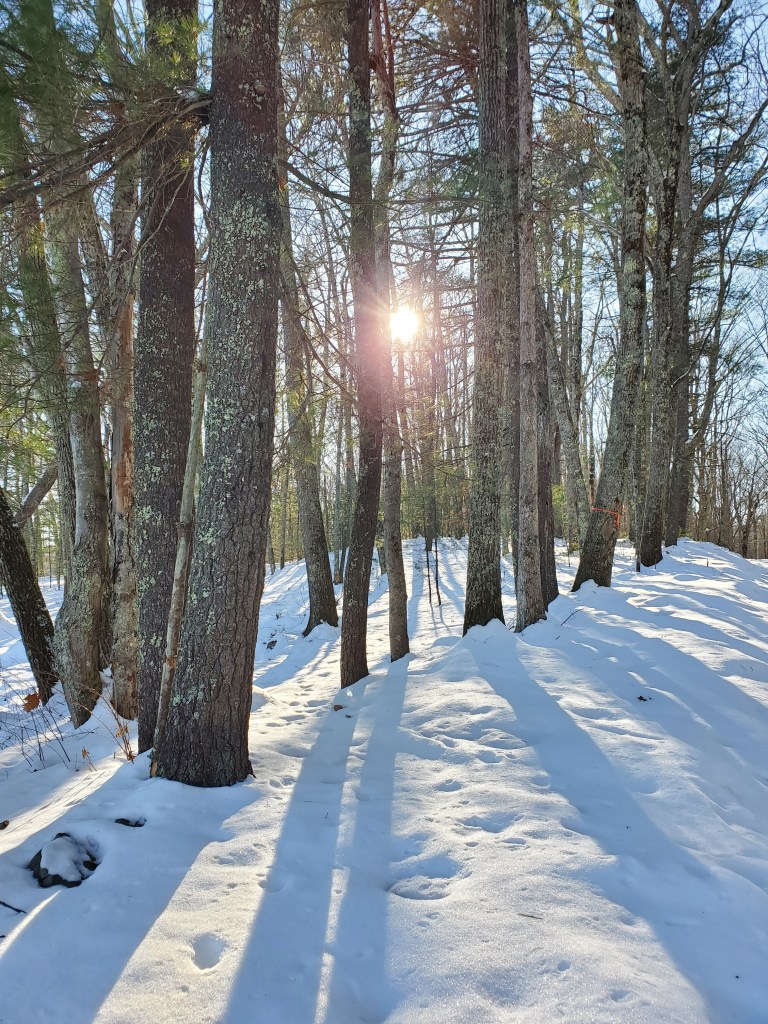
-
Savannah
5-8 November 2025
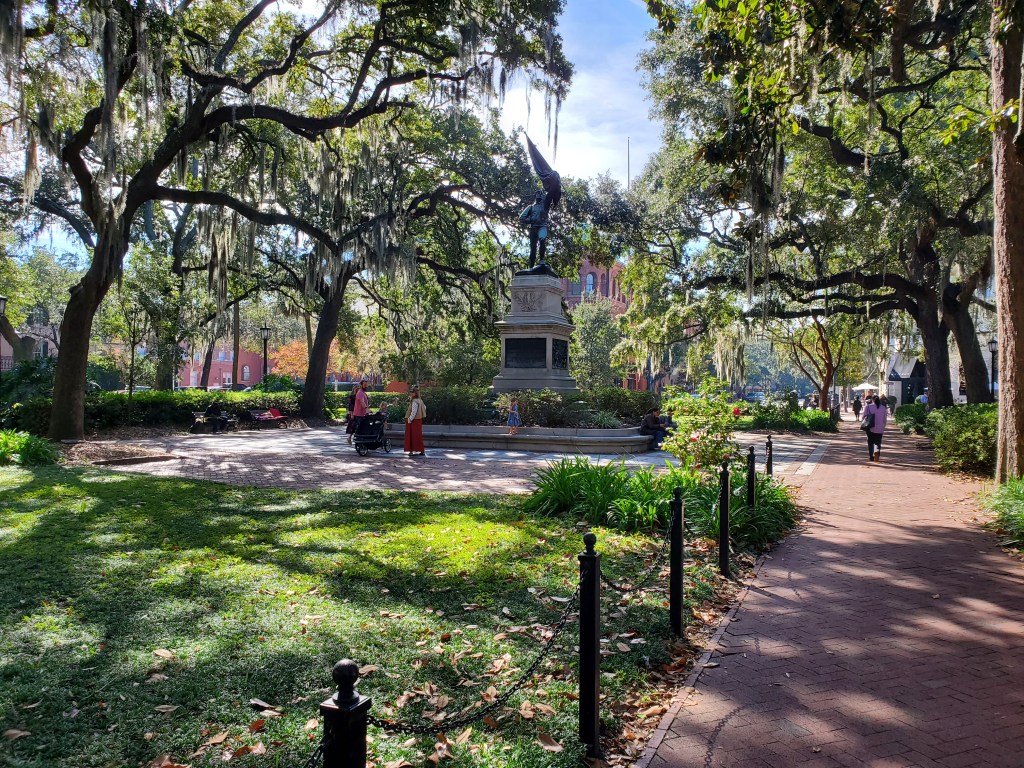
Lovely Madison Square, one of Savannah’s 22 squares, this one memorializing Sgt. William Jasper, who saved his regiment’s flag though mortally wounded in the Revolutionary War’s Siege of Savannah, 1779 Here on the last day of November, a month crowded with incident, I again pick up an account of my earlier travels south to Savannah, affording escape from a dark-by-4.30, so dreary and wet New Hampshire, while anticipating our first snow storm of the season coming soon.
Reader, we are transported back to Georgia on Guy Fawkes day, the fifth of November. Having driven my enormous rented Chrysler Pacifica (the “manager’s special”) back from Hilton Head to the Savannah airport (when only one person emerged from that beast, the Dollar agent was sore amazed: “Only ONE of you?”), I was Ubered to the Embassy Suites in downtown Savannah by Stanley, humorously dressed as Santa, and on arrival was favorably impressed both by the lobby and the attentive service, offering me a lovely corner room on the fifth floor with a fine view of the Eugene Talmadge Memorial Bridge spanning the Savannah River.
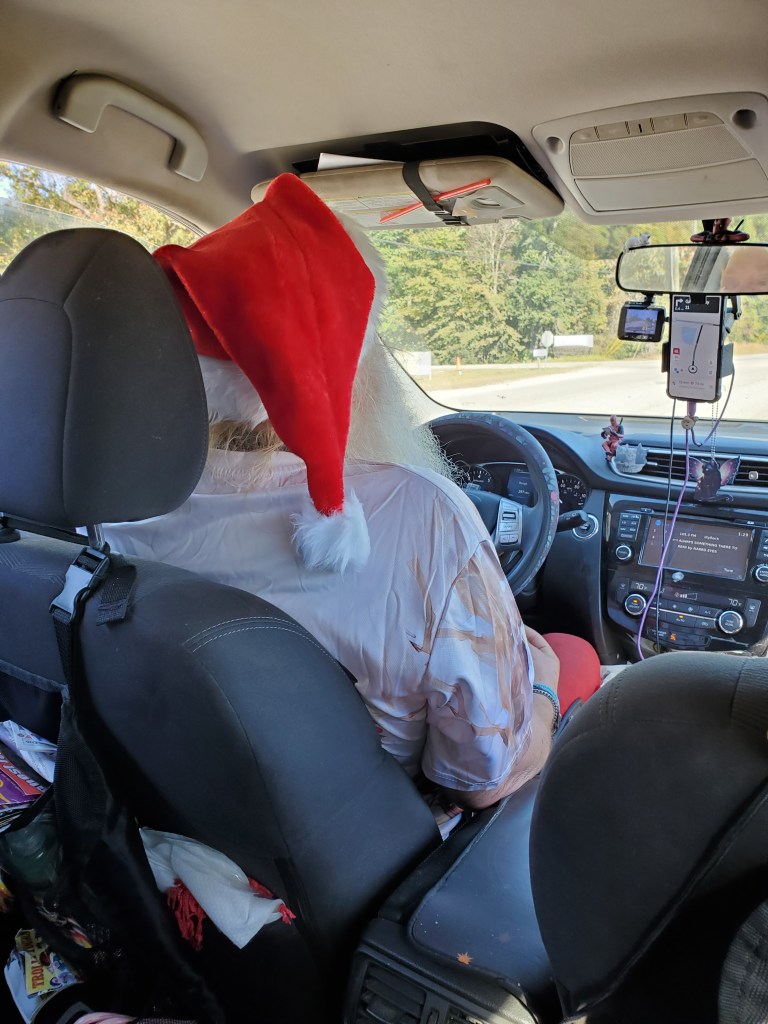
Uber Santa Stanley 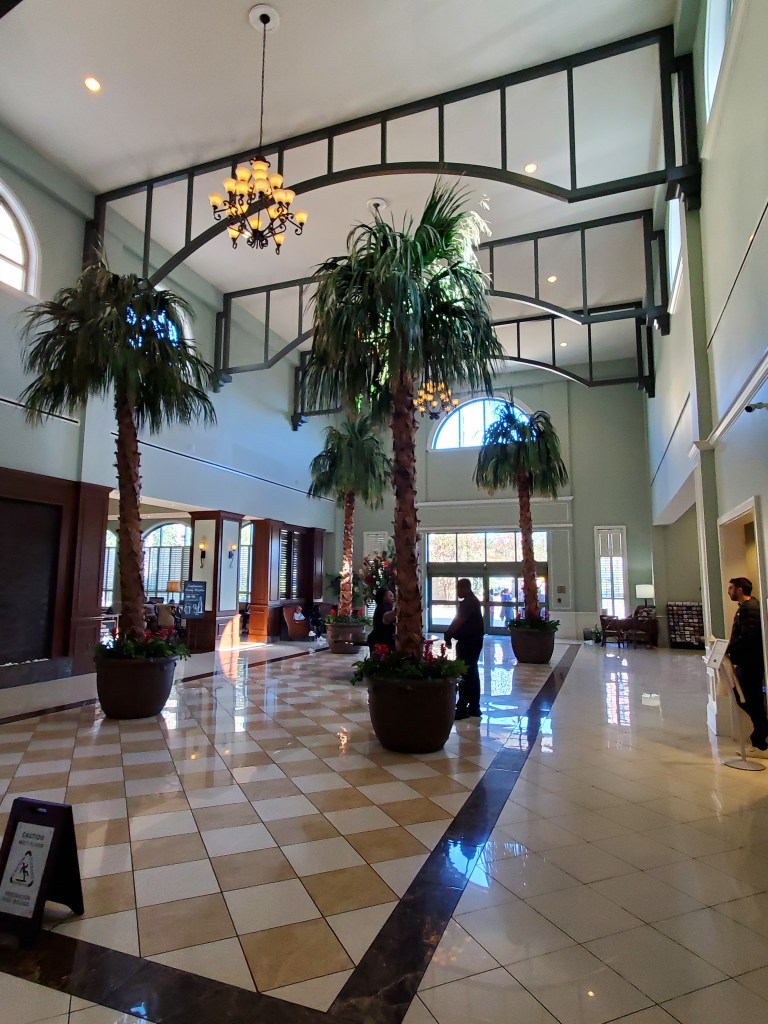
The Embassy Suites’ imposing lobby in downtown Savannah Brother-in-law Richard and nephew Daniel arrived soon after, and together we navigated our way to the Mercer-Williams House just in time for a tour of the place first made famous by the 1994 non-fiction novel by John Berendt, and then by the even more famous 1997 Clint Eastwood film, Midnight in the Garden of Good and Evil, starring John Cusack, Kevin Spacey, and a very young Jude Law as well as several memorable actual Savannahians like the late, great Lady Chablis. The handsome Renaissance Revival house on Monterey Square was designed by New York architect John S. Norris for General Hugh Mercer, great grandfather of songwriter Johnny Mercer, its construction in 1860 interrupted by the Civil War, after which Mercer sold the unfinished structure to John Wilder, who completed it in 1868.
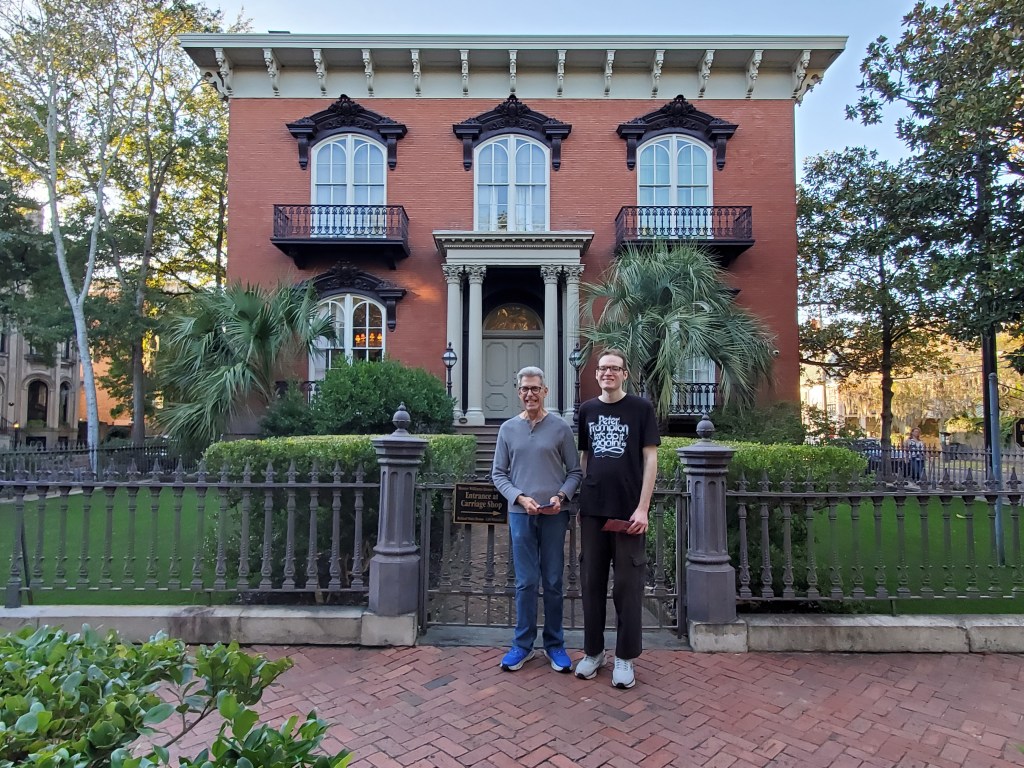
Richard and Daniel at the Mercer-Williams House When it was purchased in 1969 by antiques dealer and master preservationist Jim Williams, the house had been vacant and neglected for almost a decade. His painstaking restoration lasted two years, and was then grandly furnished with Williams’s private collection. Scandal and its representation in art, however, keeps the Mercer-Williams House such a popular tourist attraction, for Williams, thanks to a combination of cultivated hospitality and shoddy police work, notoriously got away with the murder of his gay lover, only to die in his handsome home less than a year after he was acquitted. Actor Kevin Spacey’s uncanny resemblance to Williams no doubt helps keep fascination with the Mercer-Williams house alive. The Williams family still own the property, maintained as a museum open to the public to benefit local historic and charitable organizations.
After an informative tour (but no interior photos allowed), we made our way back to our hotel to change for dinner, perhaps still under the spell of a more gracious era than our own.
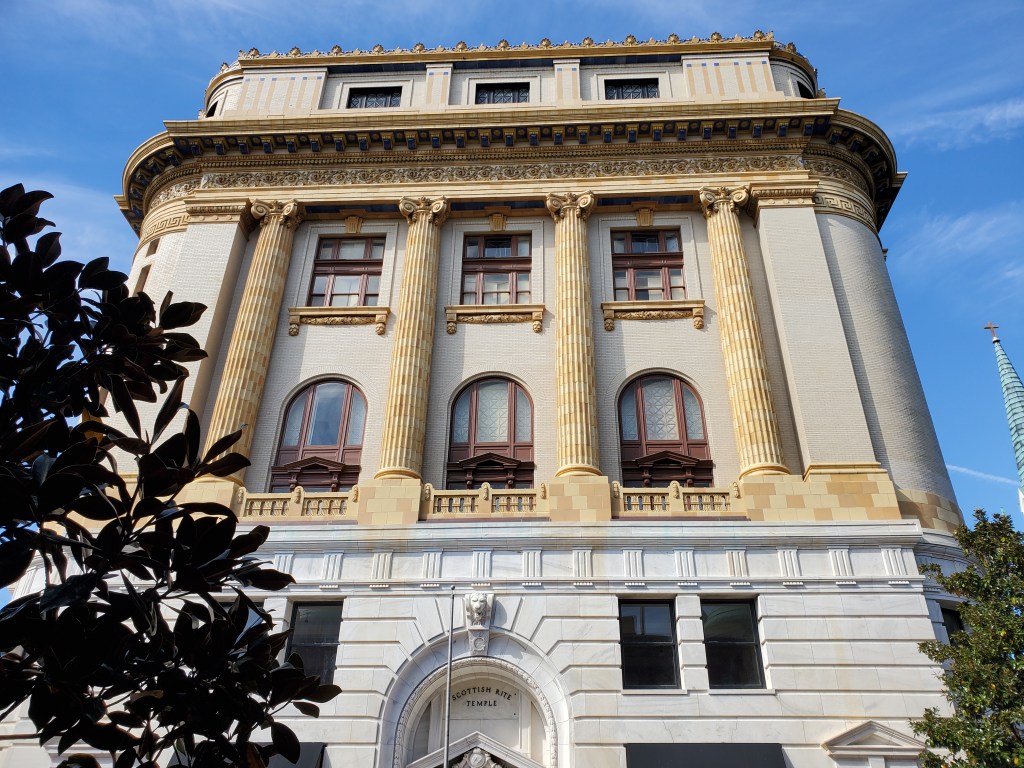
Architect Hyman Wallace Witcover’s magnificent Scottish Rite Temple (1912-23) on Bull Street, now owned by SCAD and home to the Gryphon Tea Room Dressing for dinner, however, proved a thoroughly unnecessary gesture, as we were the sole guests at the 22 Square restaurant, where I nevertheless enjoyed my very tasty shrimp & grits and Daniel had his first gumbo mac & cheese. We noted the Peach Cobbler Factory on Barnard for future reference, as well as how very much the city was coming to life after 9 pm. Wearied by a day’s travel, we, however, retired to our suites.
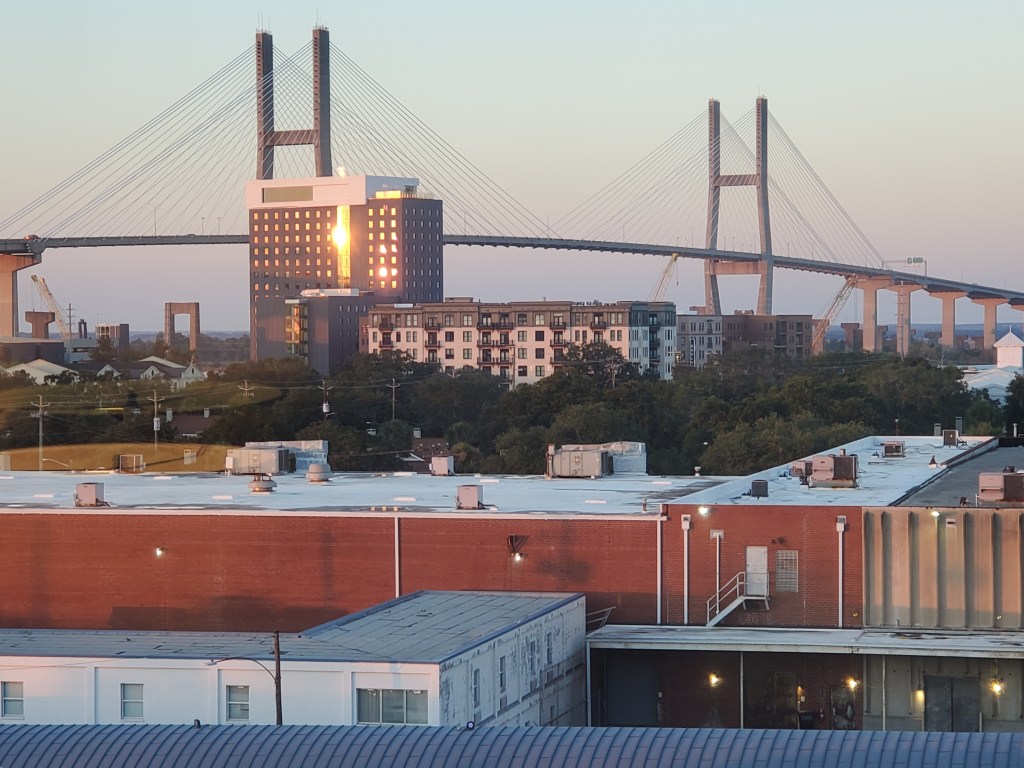
The Eugene Talmadge Memorial Bridge (1991) seen from the Embassy Suites Next morning we met our Genteel & Bard guide, Julianna from Savannah, at the corner of Bull and Oglethorpe, for a most informative walking tour. Julianna knows her history, is an accomplished storyteller and Savannah College of Art and Design (SCAD) grad, and gave us a great 2-hour walkabout, finishing at the Basilica Cathedral of St. John the Baptist.
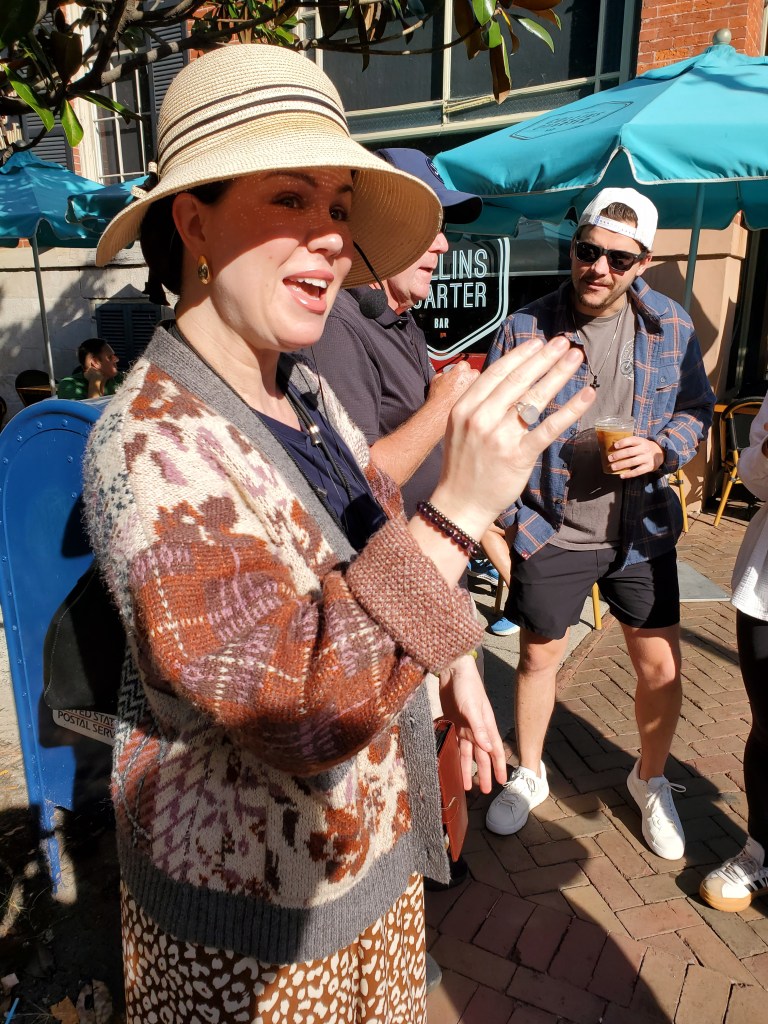
Julianna from Savannah 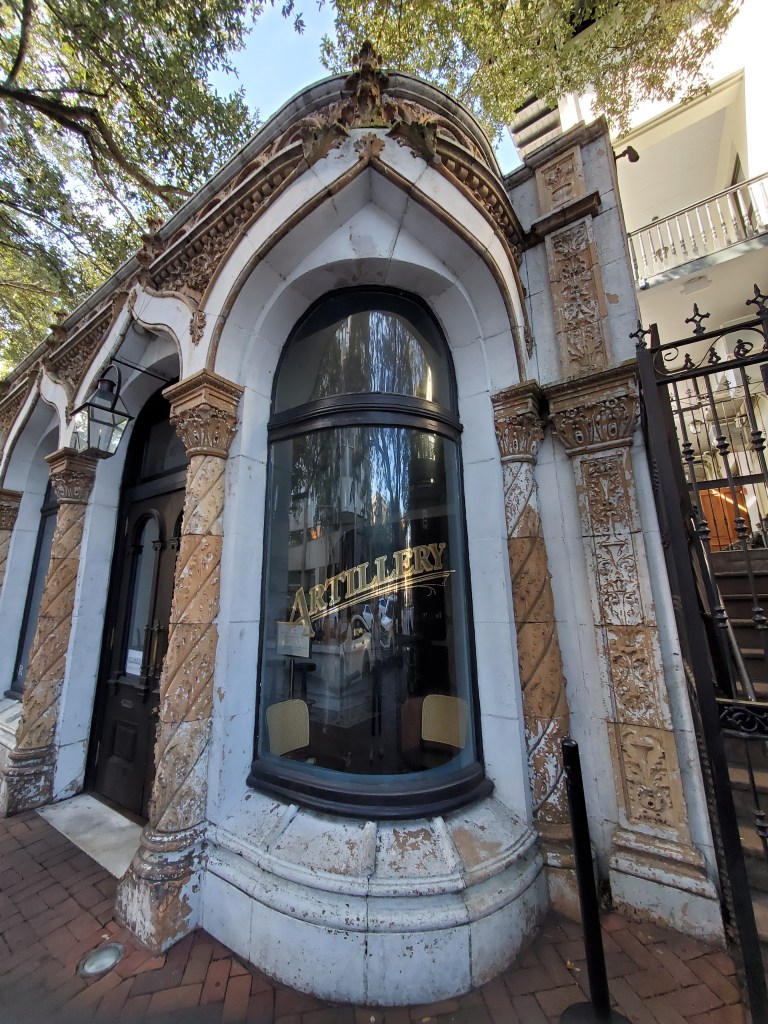
The Moorish/Gothic/Classical façade of the Artillery Bar, built for the Georgia Hussars in 1897—Arabian architecture for Arabian horses?—home of the potent Artillery Punch 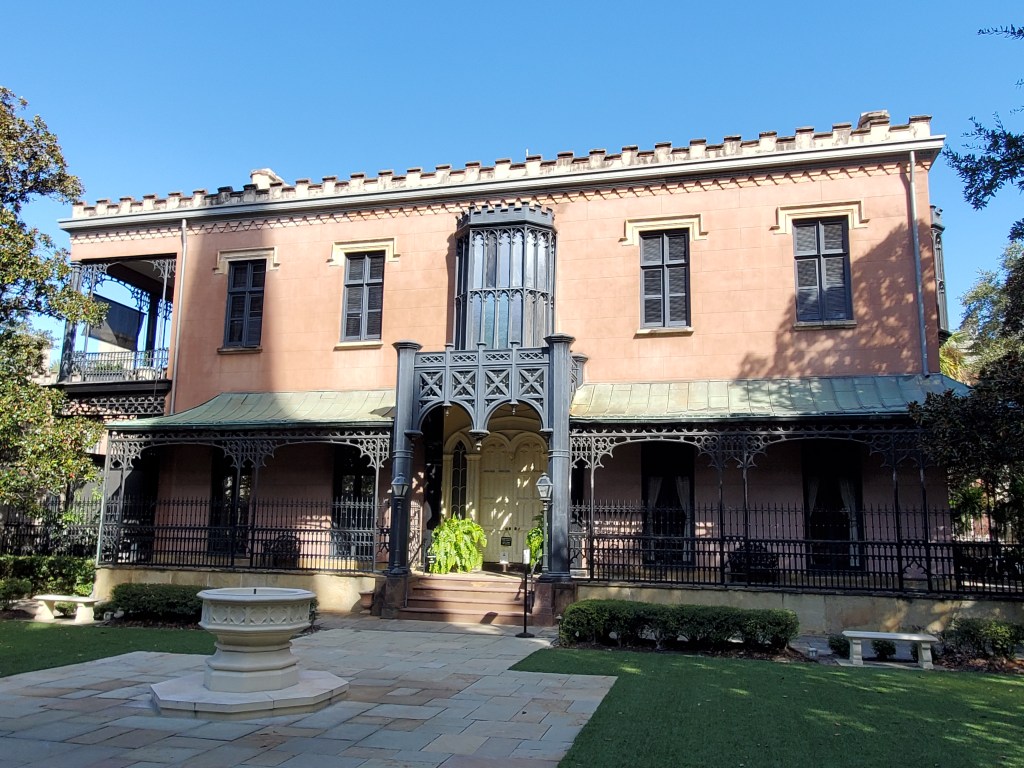
The Green-Meldrim Mansion by architect John S. Norris (1850), and Sherman’s Savannah Headquarters. Did Southern Hospitality save Savannah and this Gothic Revival treasure from Atlanta’s fate? Perhaps. 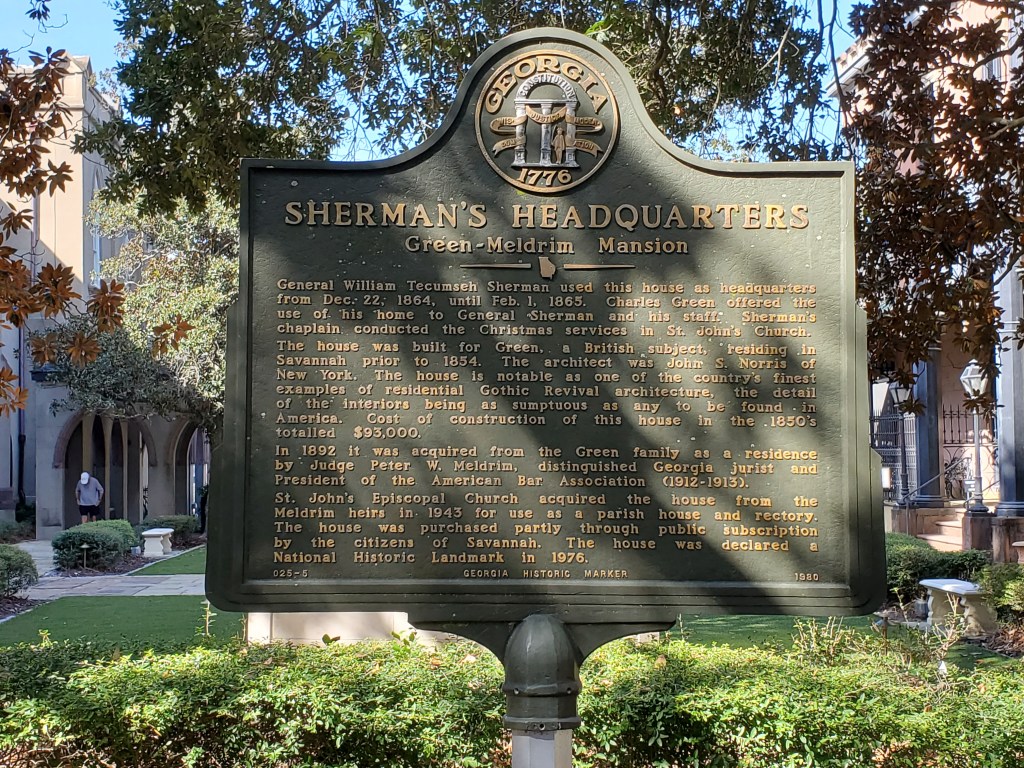
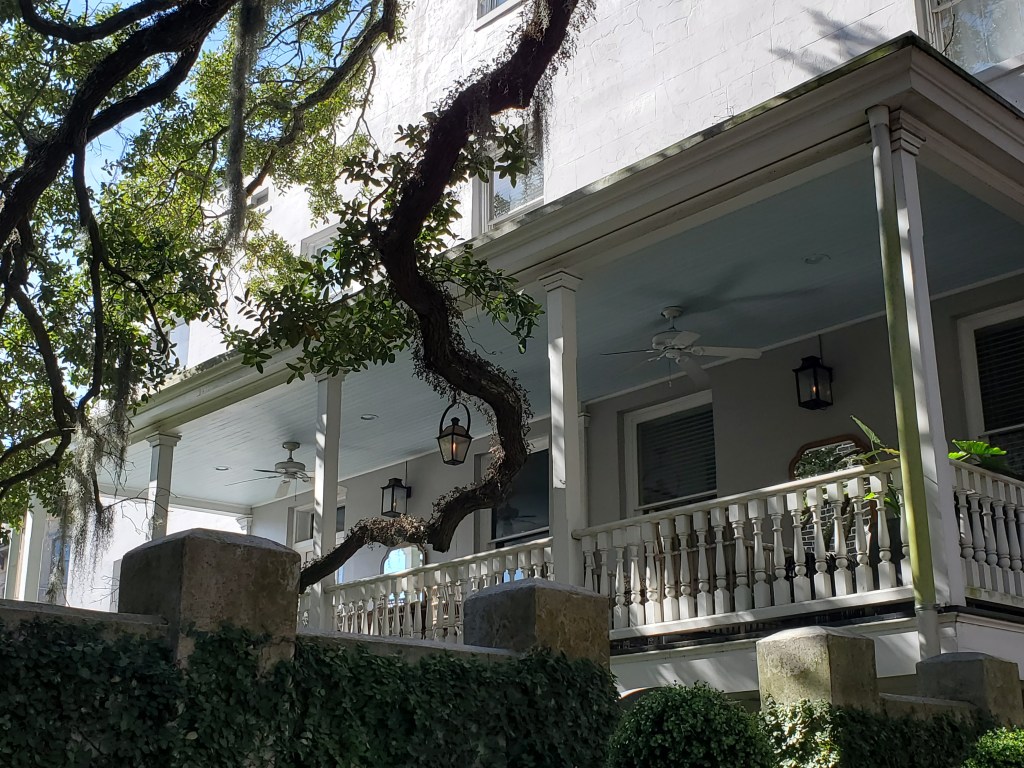
An inviting porch with haint painted ceiling on live oak-canopied Jones Street 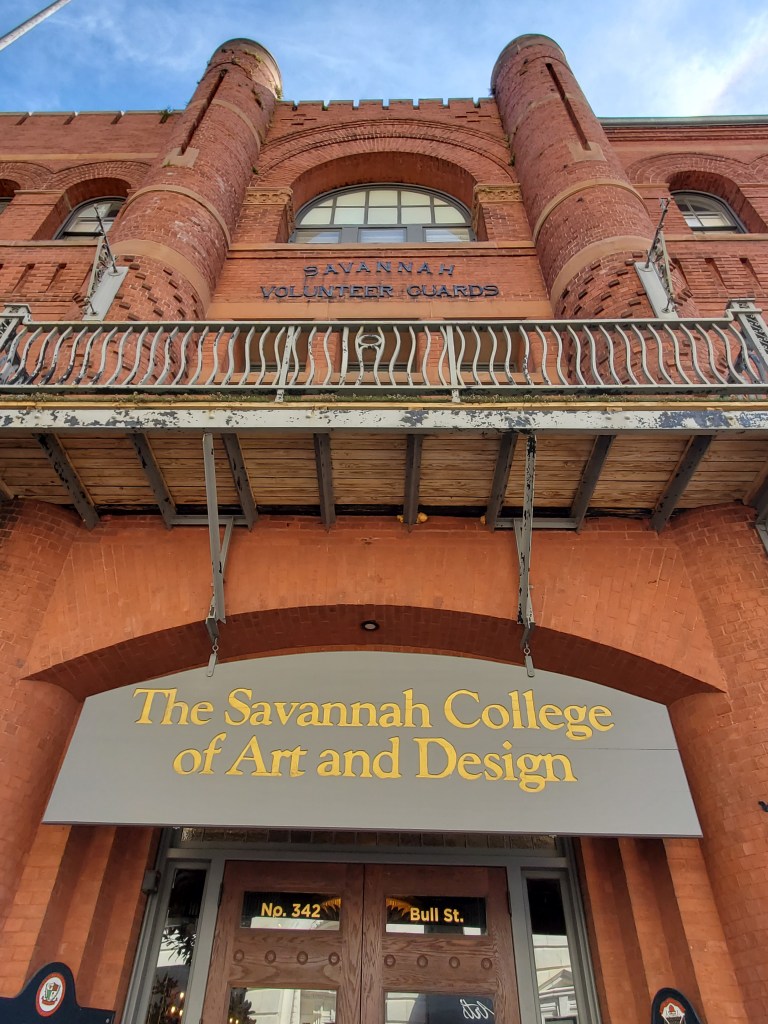
SCAD properties abound in Savannah 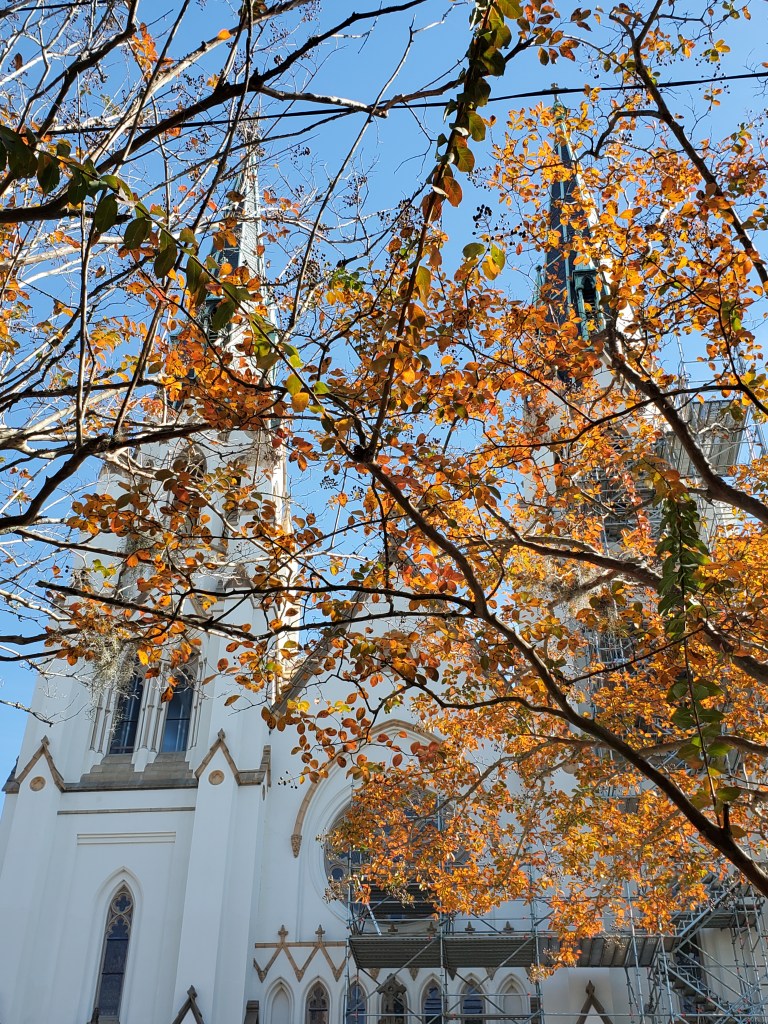
The twin spires of the Cathedral Basilica of St. John, 1873 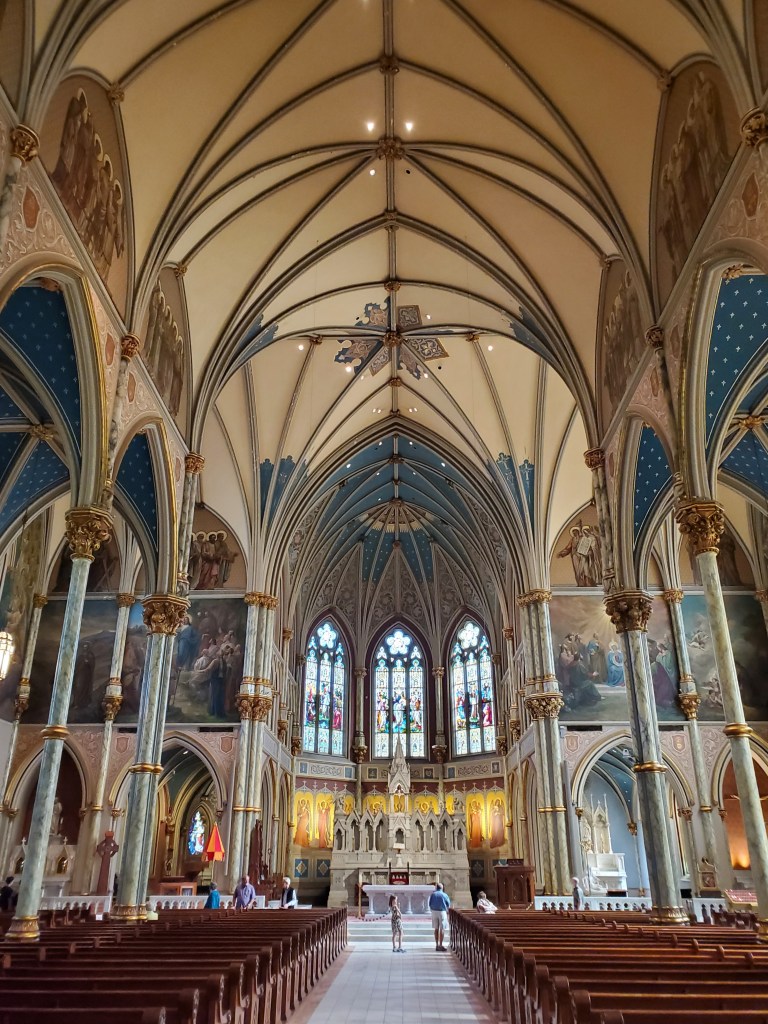
After some excellent grilled cheese at Mirabelle Savannah, the little coffee shop across the street, we made our way north on Abercorn to the Owens-Thomas House and Slave Quarters, a Greek Revival beauty designed by 20-year-old English architect William Jay for Richard Richardson, built from 1816-19, and in 1825 honored with a visit from the Marquis de Lafayette.
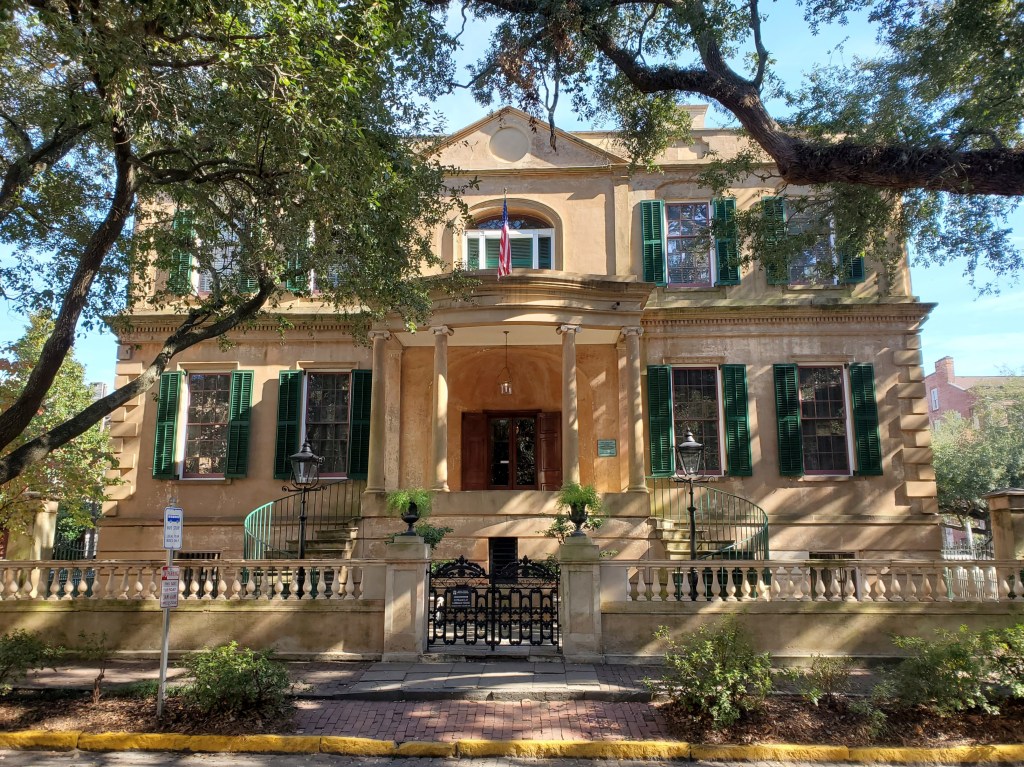
The Owens-Thomas House, architect William Jay, 1816-19 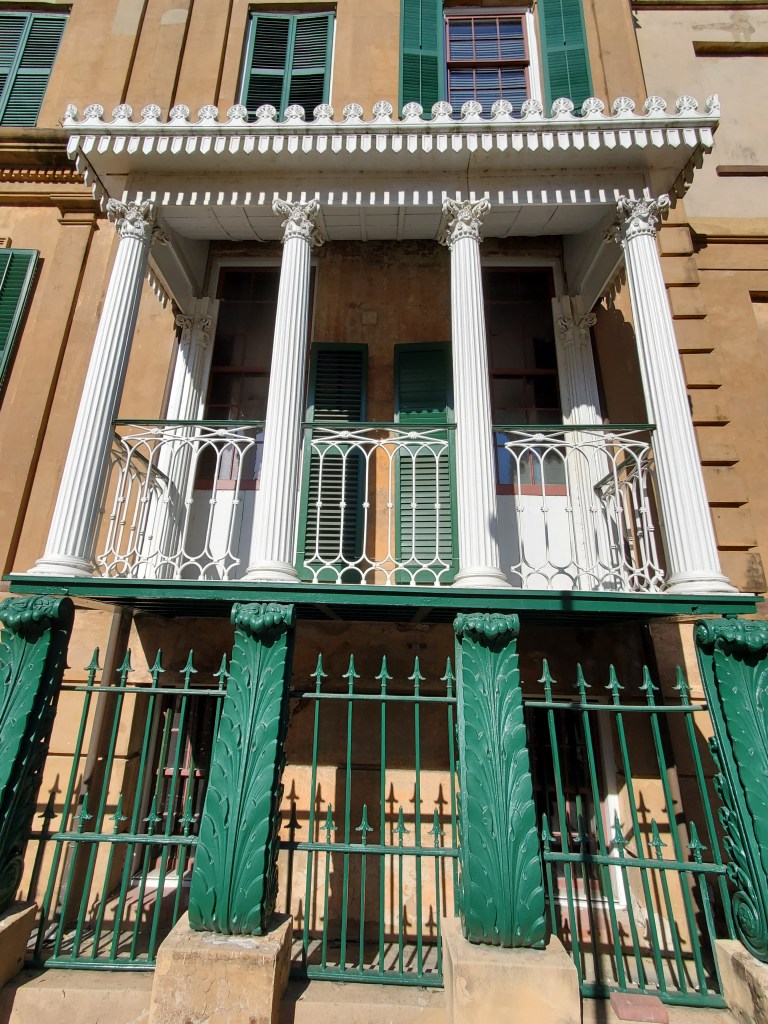
The porch from which Gen Lafayette spoke, 1825 
Owens-Thomas Garden Façade 
Slave quarters room in the carriage house 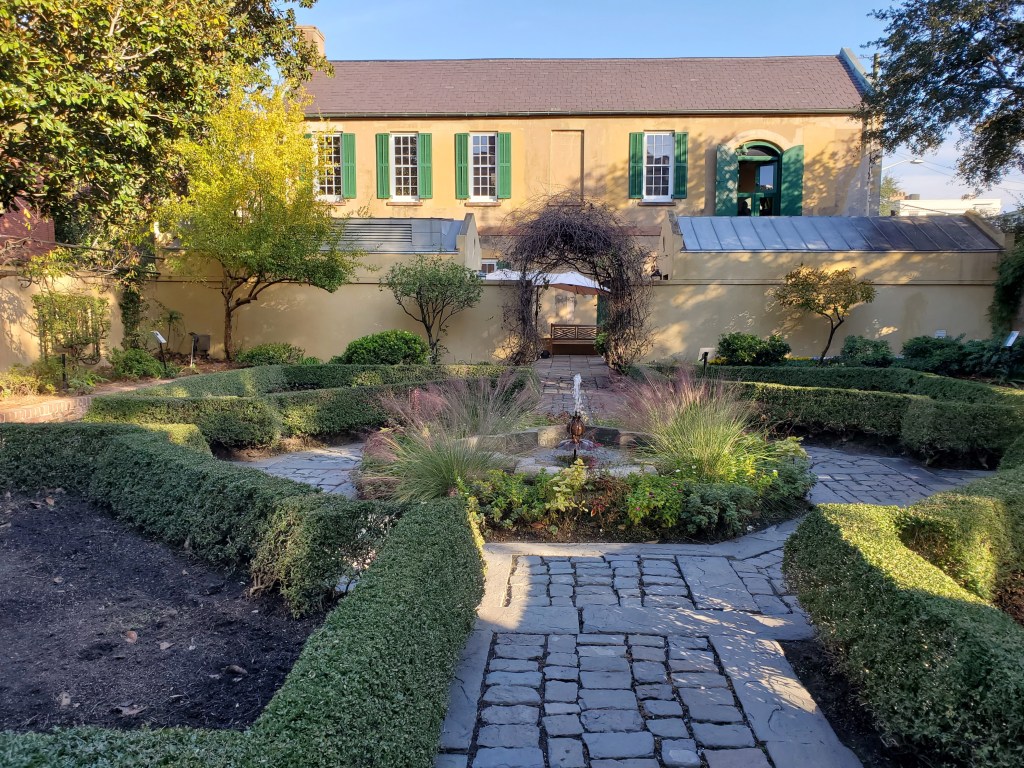
Carriage House with Slave Quarters Our knowledgeable guide Jason confirmed the fun fact about porch ceiling paint Julianna had shared the day before: “haint blue” was a color that warded off ghosts and evil spirits, at least according to the Gullah, the once-enslaved African-Americans of the low country and sea islands of coastal South Carolina and northern Georgia. That belief came with practical value, however, as the paint’s mixture of lime, buttermilk, and indigo naturally created lye, a known insect repellent and deterrent salutary in a malarial climate. The house tour lived up to its reputation as both informative and evocative, and admission includes access to both the Telfair Academy and the Jepson Center.

Guide Jason explains how symmetry requires the blind window above him 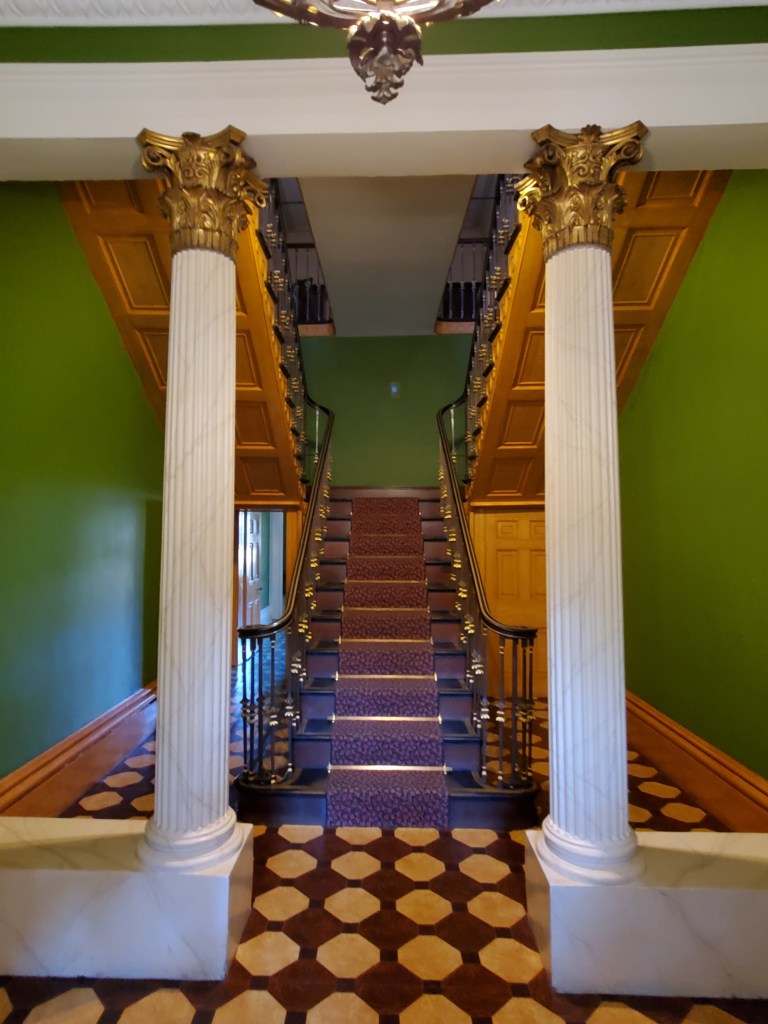
Owens-Thomas formal entrance . . . 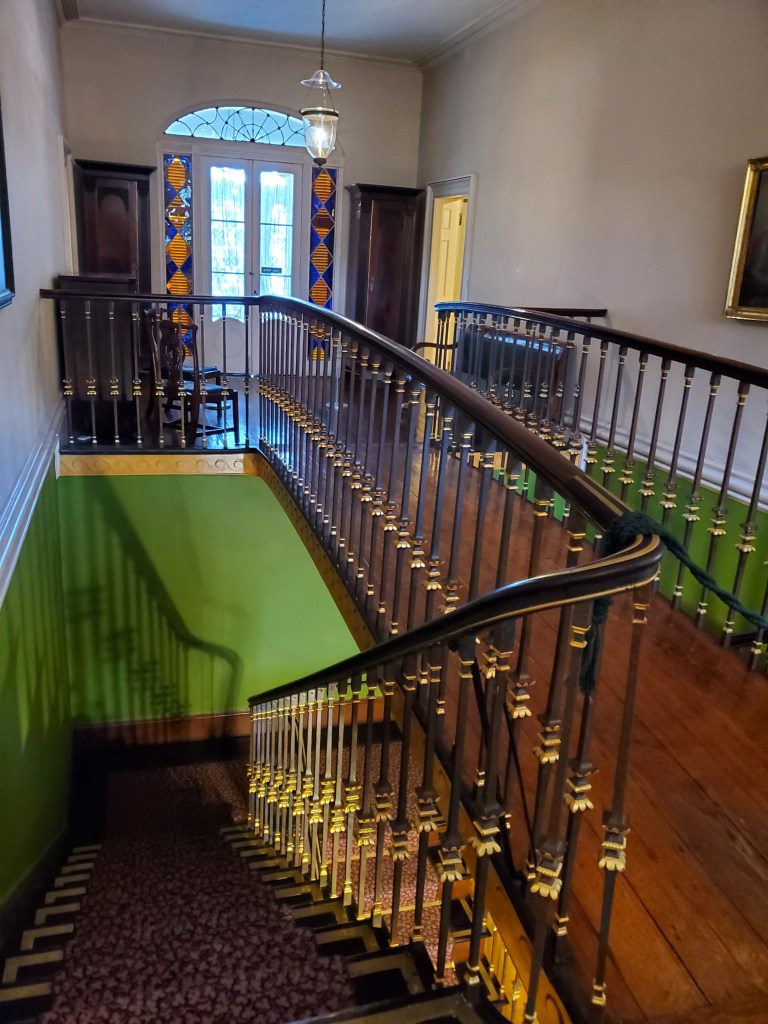
. . . and upstairs landing bridge After a day on foot, we opted for an Uber ride to the delightfully funky Treylor Park restaurant on Bay Street, followed by a stroll past City Hall and down (take the elevator between the Hyatt and City Hall) to River Street’s tourist shops and arcades for some ice cream, an encounter with Zoltan, and another Uber back to our Hilton home.

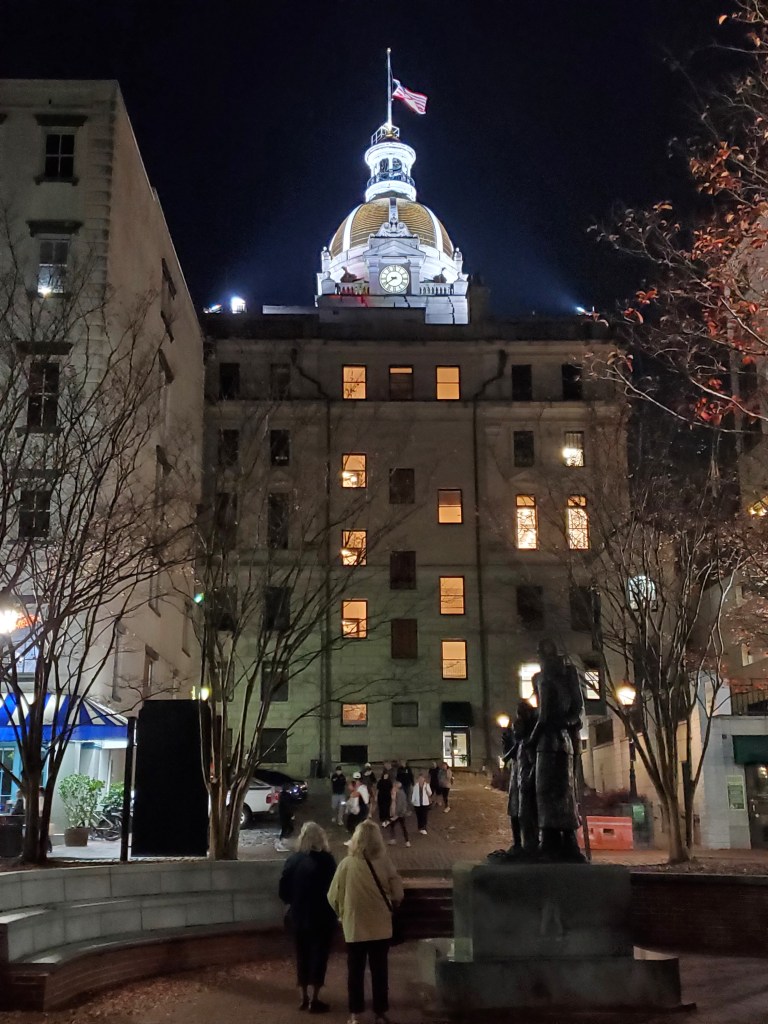
City Hall, Renaissance Revival by architect Hyman Wallace Witcover, 1904-05 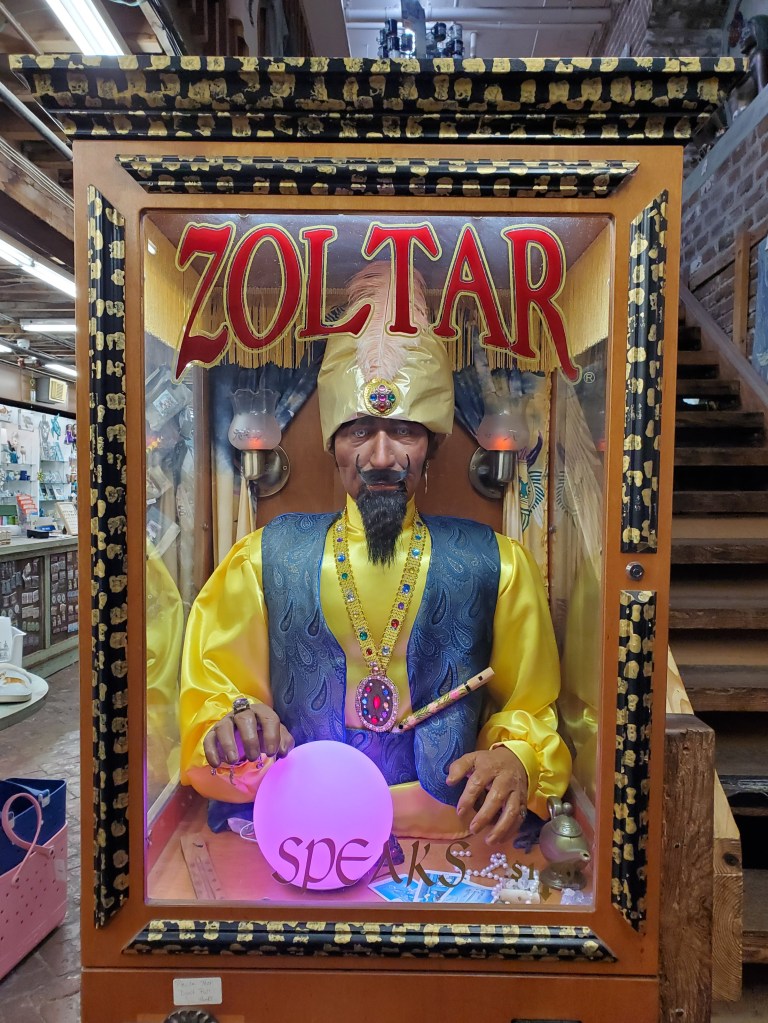
Zoltar prognosticates on River Street Our last full day together we drove along the causeway flanked by Spartina marsh grass to the Tybee Island Light Station and Museum for a (to me) challenging climb up the 178 steps to take in the view from the oldest and tallest (145 feet) lighthouse in Georgia, as well as a visit to the Head Keeper’s Cottage, built in 1881 and lovingly restored to the last lighthouse keeper George Jackson’s era, 1920-1940, with some of the family’s original belongings.
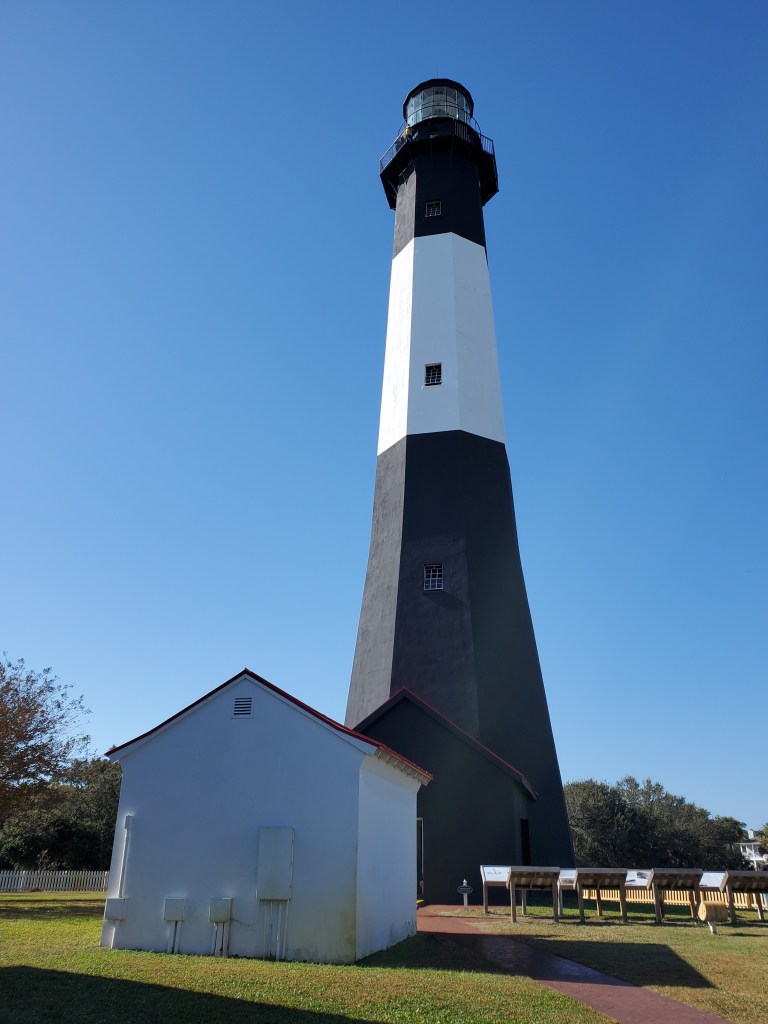
Tybee Lighthouse, 1773, rebuilt 1867 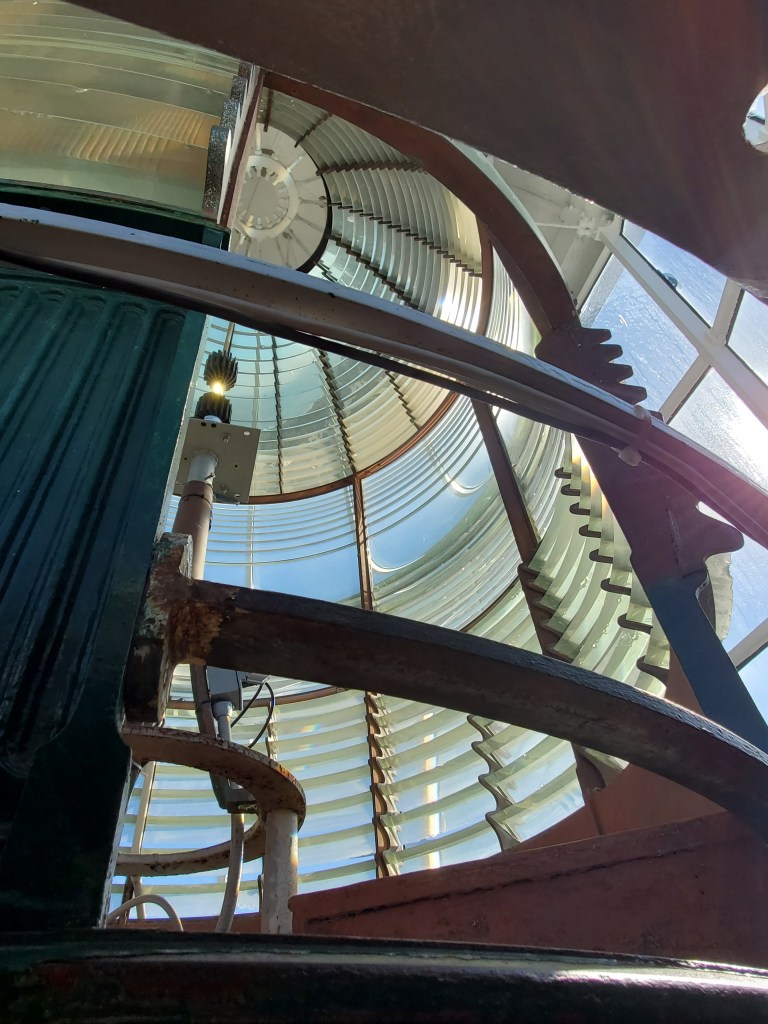
Tybee’s 1st order Fresnel lens and light pattern 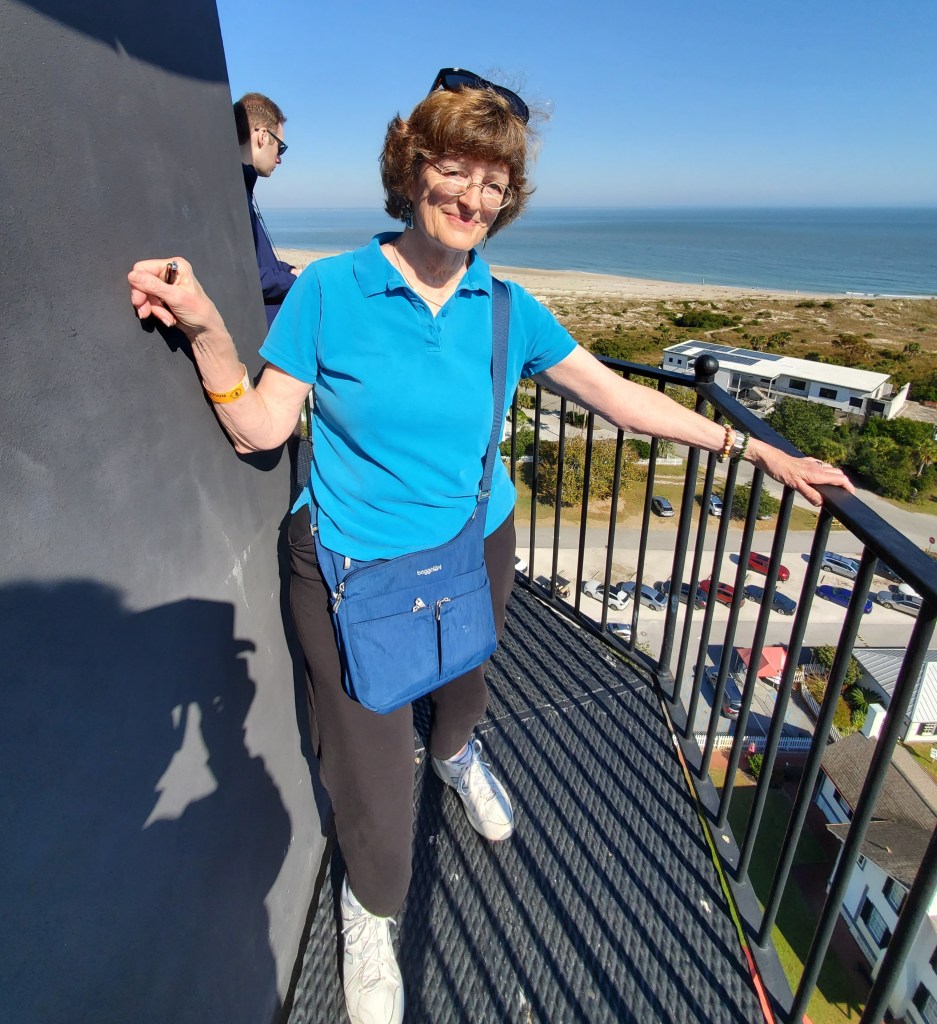
The author “conquers” acrophobia 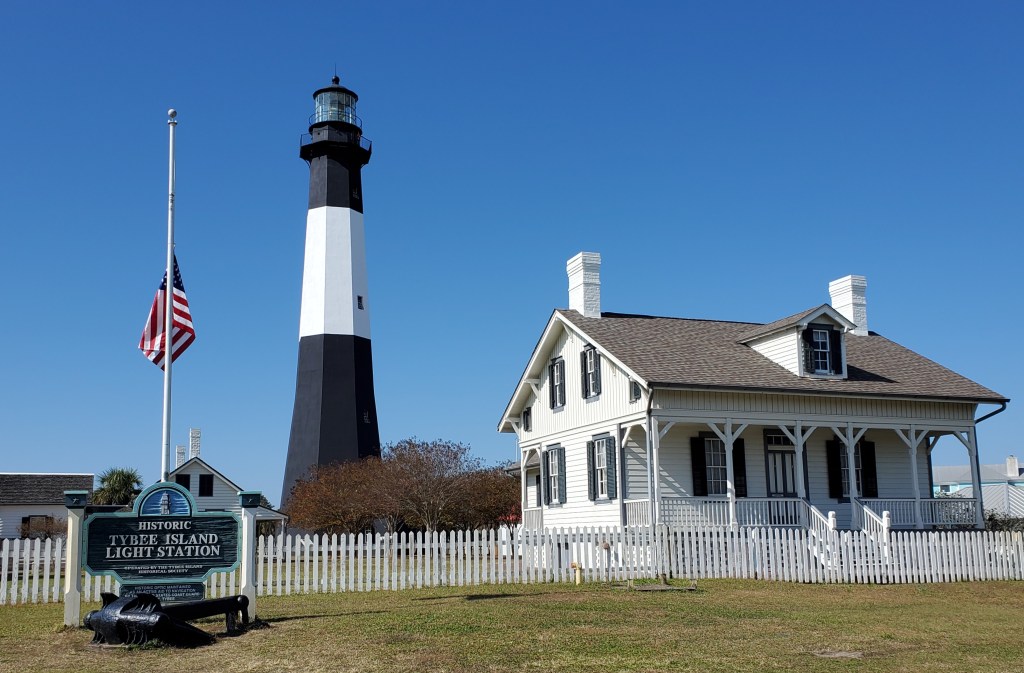
Keeper’s Cottage with flag at half-staff for V.P. Dick Cheney Across the street in Fort Screven, a battery that was part of the U.S. Coastal Defense System until it was decommissioned in 1945, the kindly volunteer docent kept a record of all visitor’s home states, and gave us a good tip about where to have lunch: right next door at the North Beach Bar & Grill.
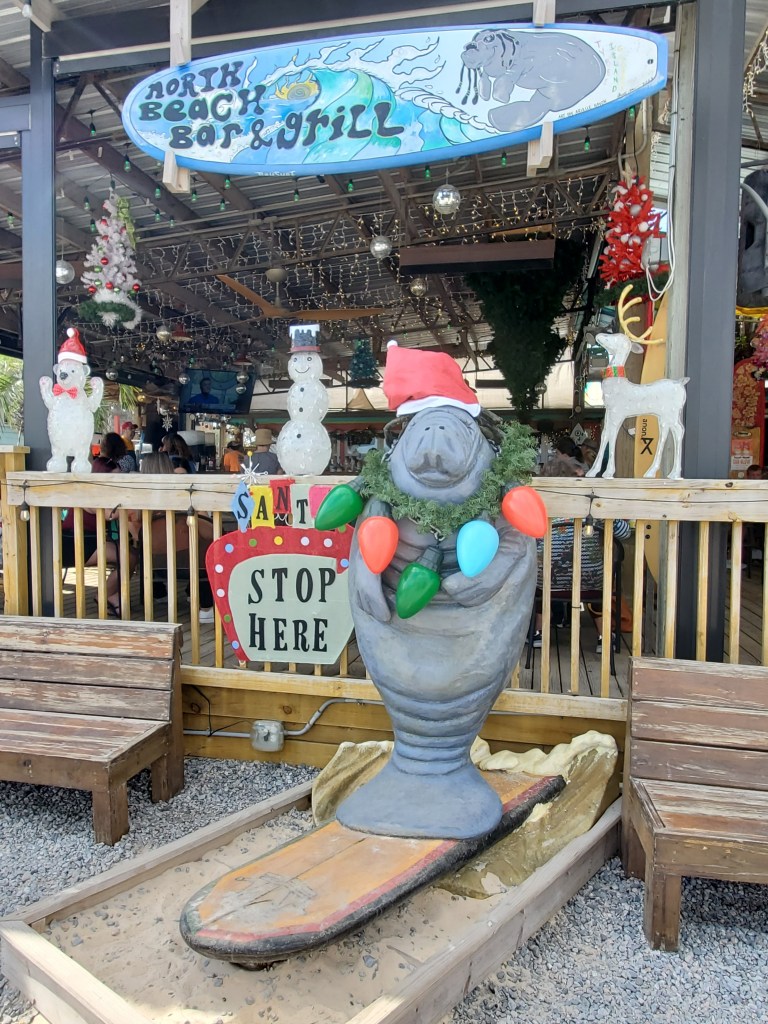

Happy Richard and Daniel enjoy the funk We giggled over Tybee Island’s reputation as the Redneck Riviera/Truck Stop-by-the Sea; monikers I think now rendered obsolete by gentrification.
That left us just enough time to drive back to Thunderbolt, Georgia for a guided tour of the storied Bonaventure Cemetery led by raconteur and historian Steven, a consummate performer and purveyor of dad jokes.
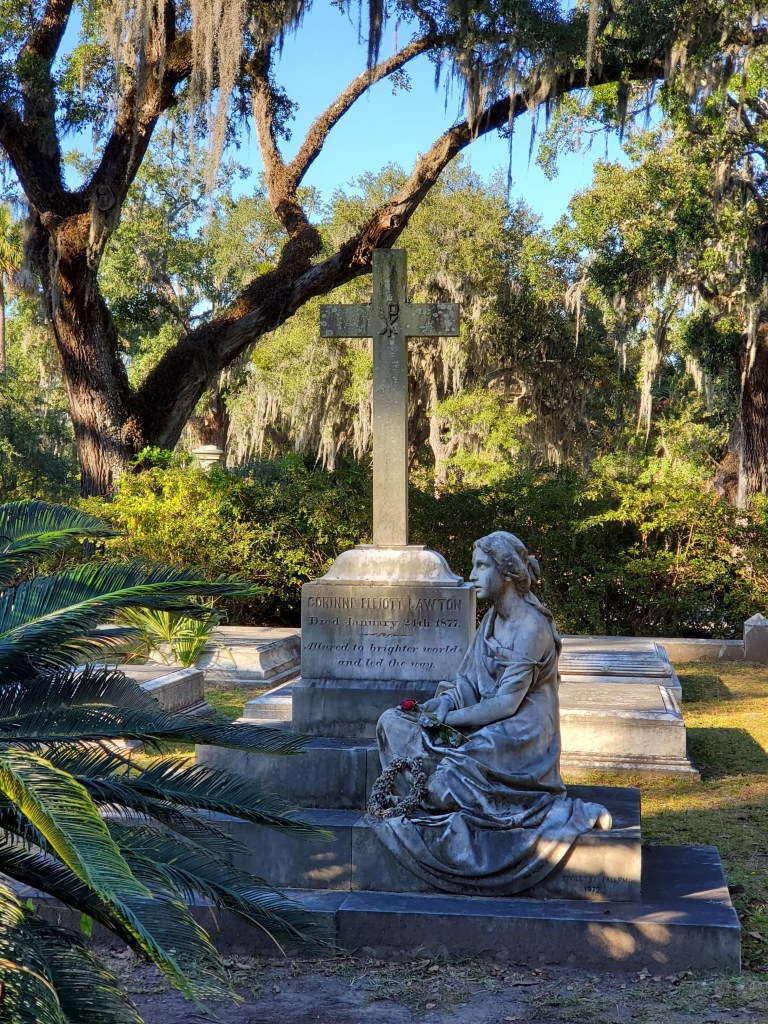
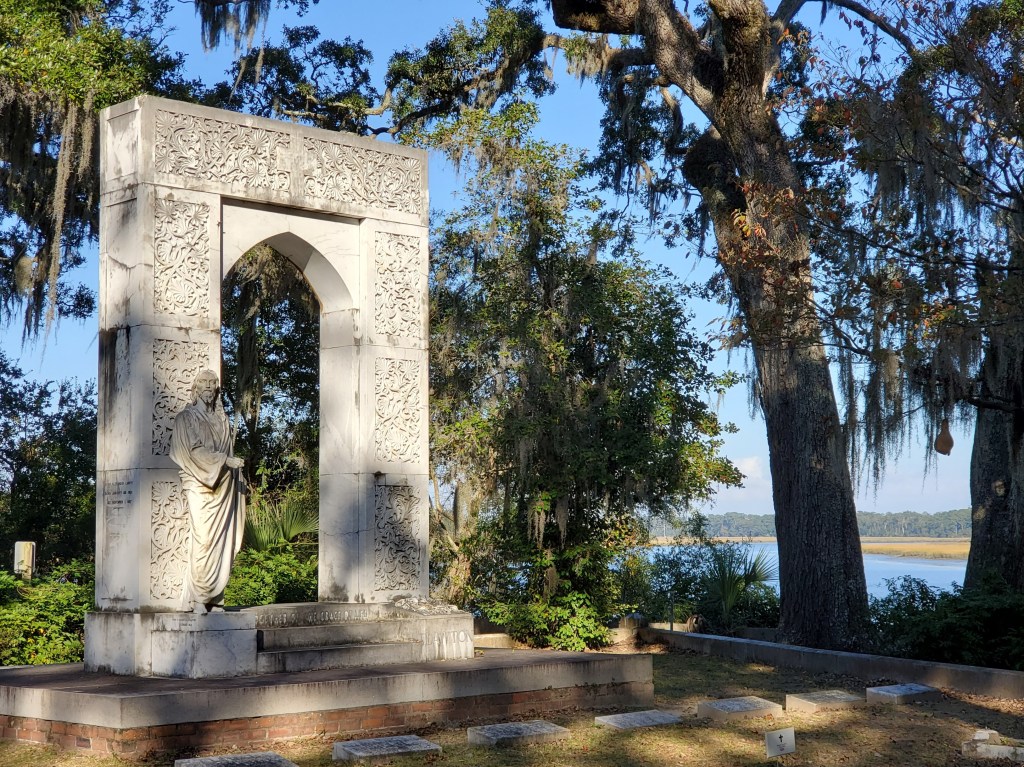
A tomb with a view 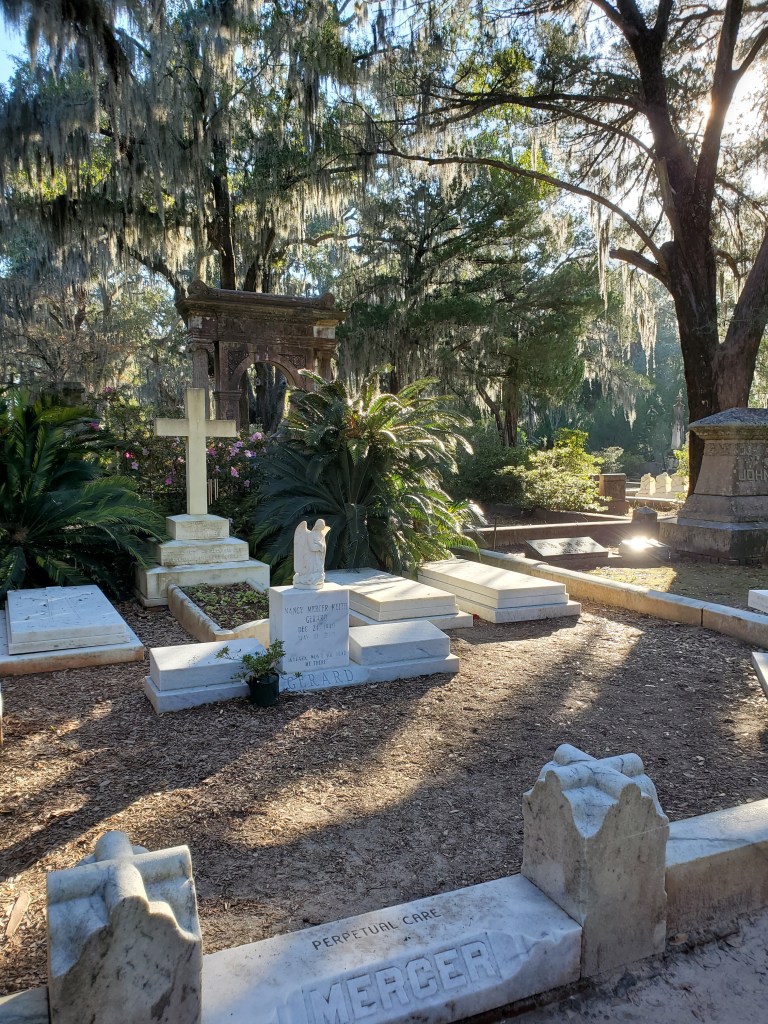
The Mercer family plot Steven let us know that the Bird Girl once among the cemetery statuary had been so threatened by the fame attending its appearance in Midnight in the Garden of Good and Evil that she’s now housed in the Telfair Academy for safekeeping—with replicas available for sale in the gift shop.
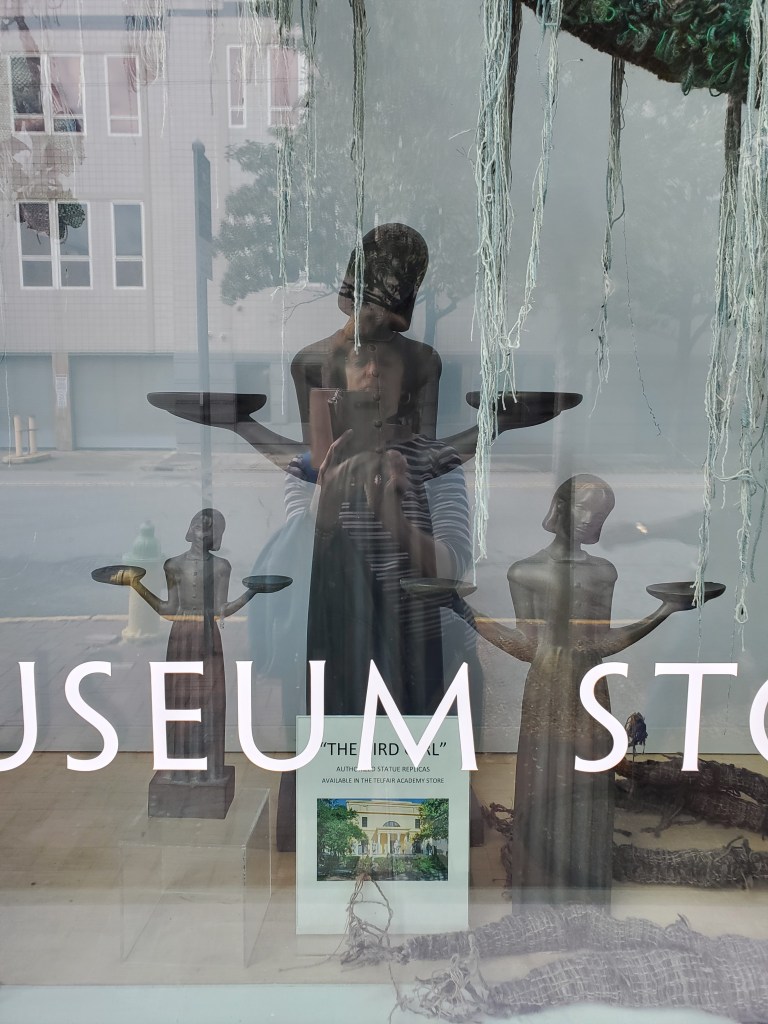
A notorious murder monetized at the Telfair Once again pleasantly pooped after hours of walking, on returning to our hotel we decided to Uber to a dinner of some really excellent pizza at Vinnie Van Go Go’s (watch that pizza dough fly!), and then passed the time awaiting seats at the bar by cruising the lively City Market, home of Byrd’s Famous Cookies. We passed on the cookies, but enjoyed cobbler back on Barnard before returning to our home-away-from-home for one more night.
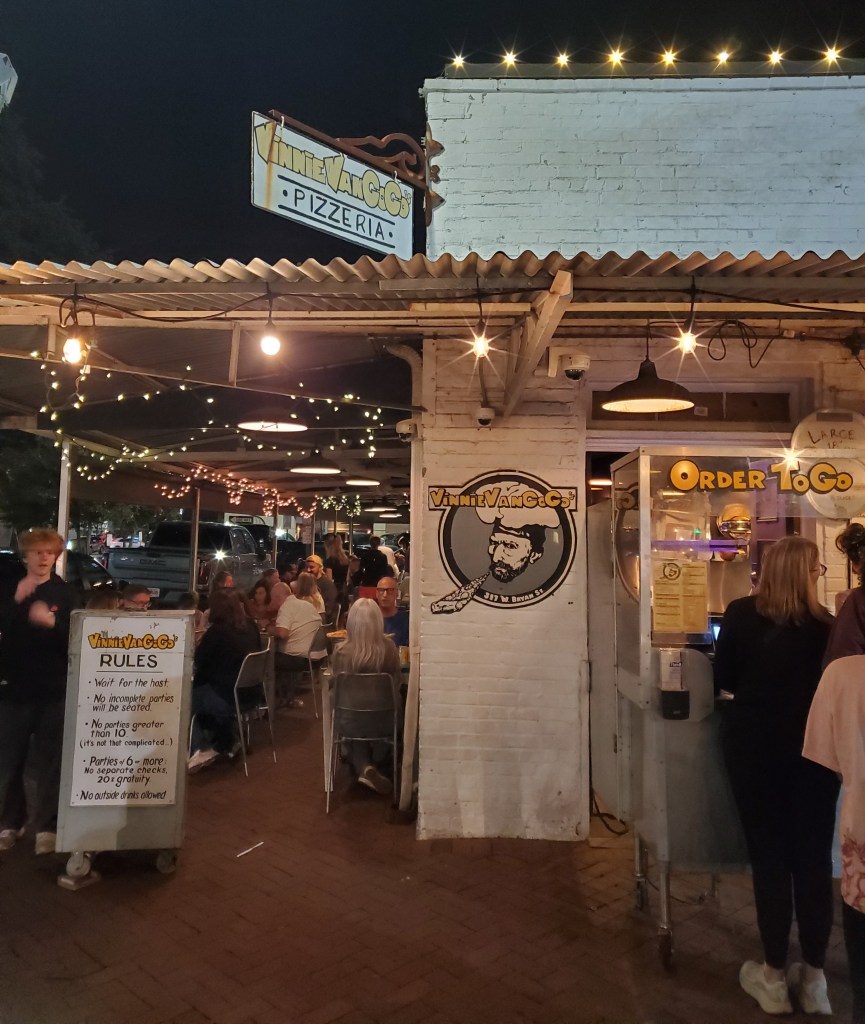
Queuing for pizza at Vinnie Van Go Go’s Richard and Daniel drove back to Safety Harbor the next morning after breakfast, and I took my time packing up for my afternoon flight back to Boston, routinely checking flight status until I learned of my original flight’s cancellation: the Federal shutdown took its toll. That proved a perk, however, as I was able to stow my luggage and stroll to the Jepson Center for a good long look around, including a close examination of highlights from the Glenn Close costume collection on display there: amazing artistry (and for such a tiny waist!).
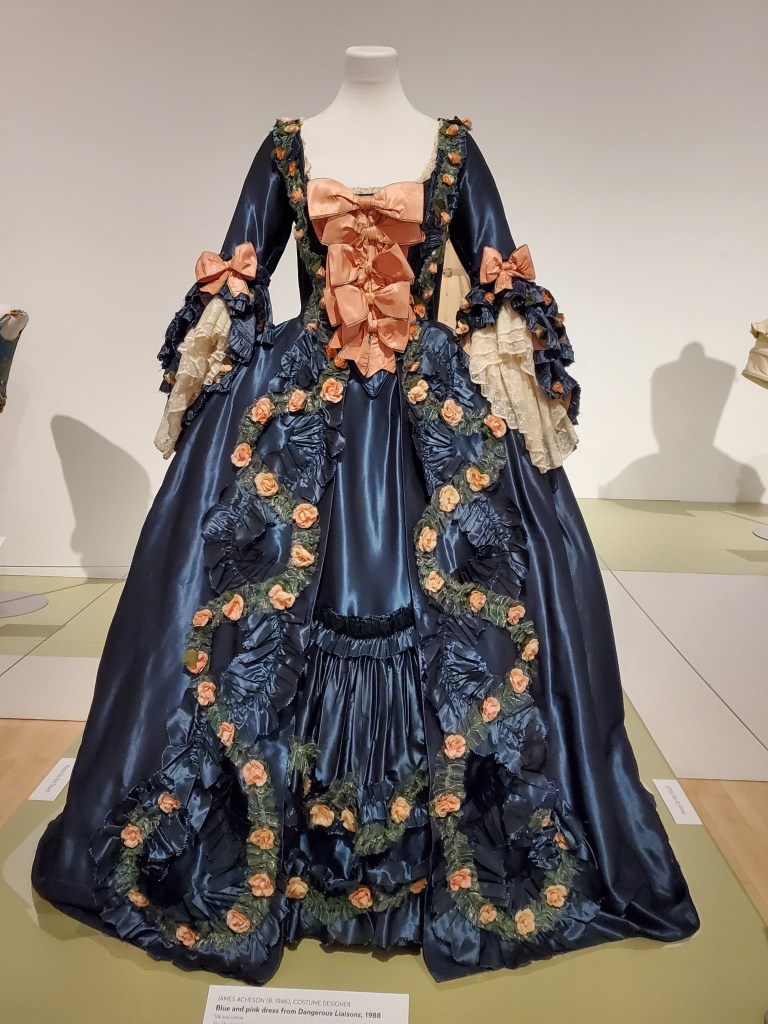
A Close costume from Dangerous Liaisons 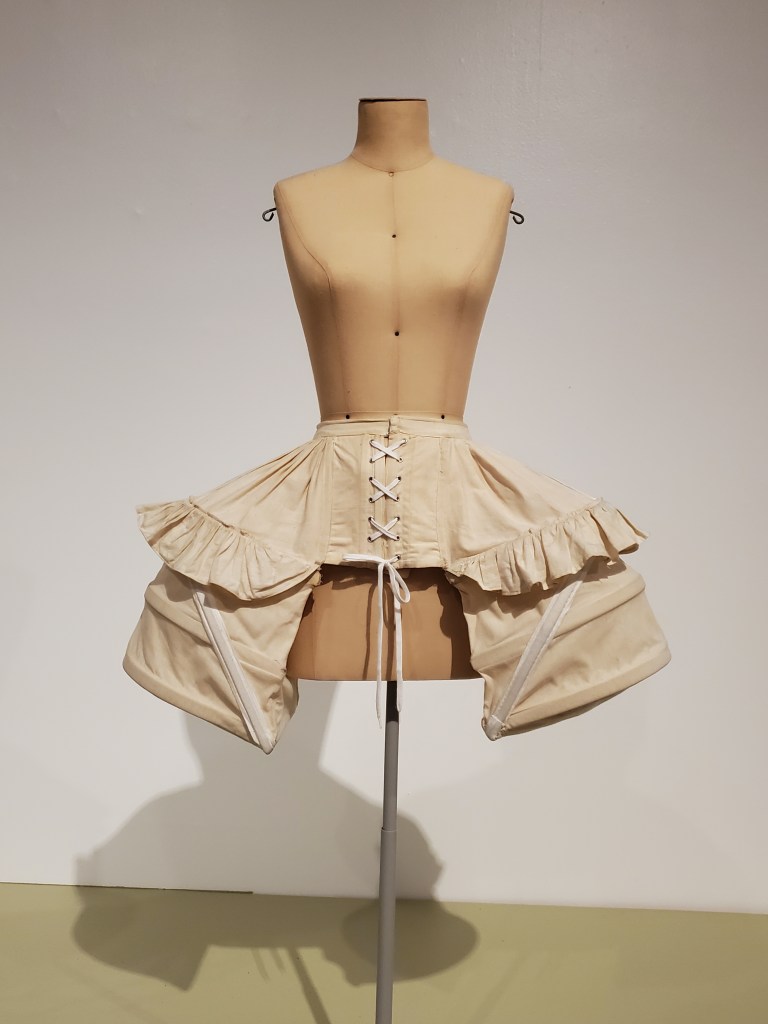
. . . and the pannier under it 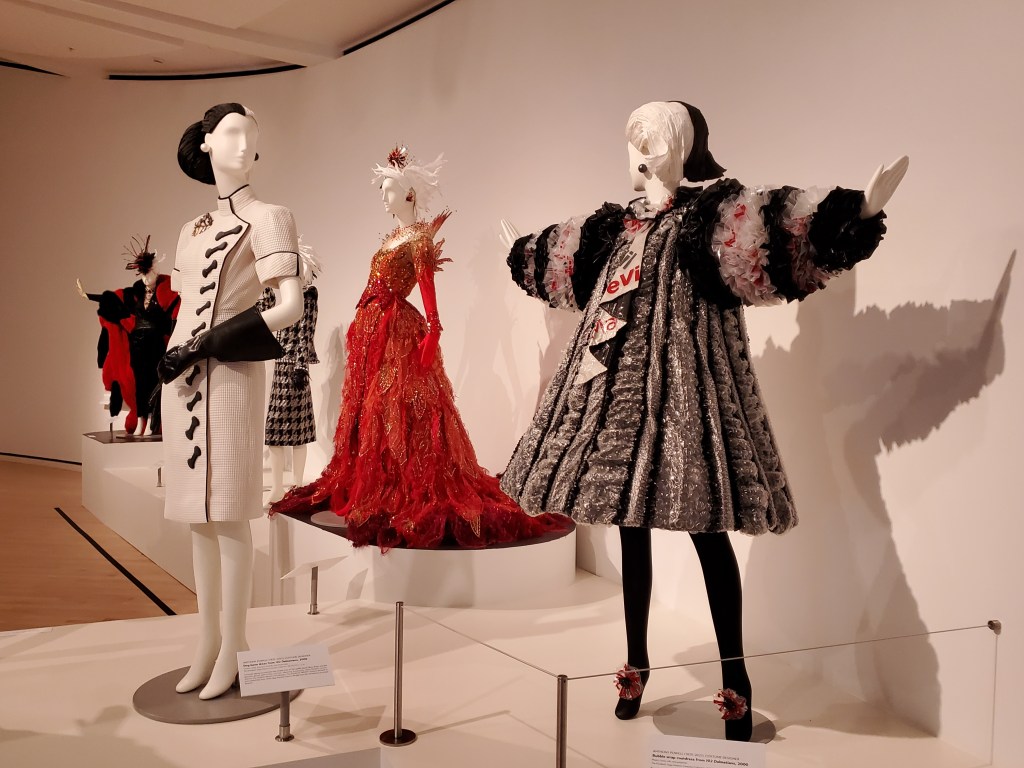
More glamour for Glenn Close 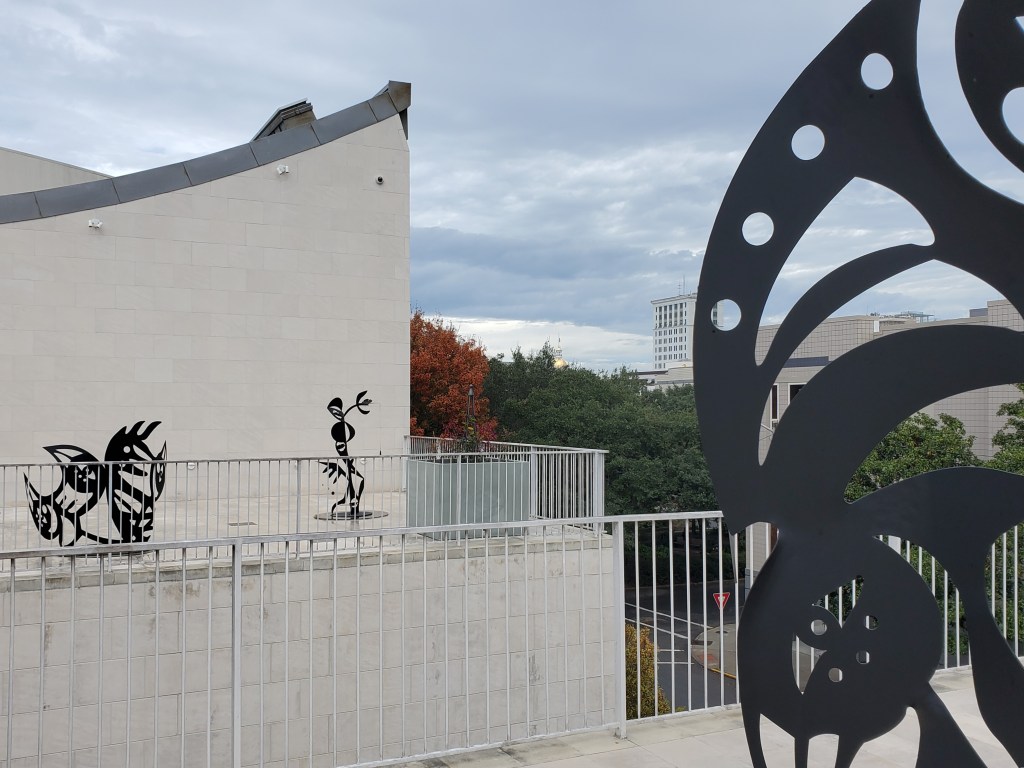
Rooftop sculpture at the Jepson Center 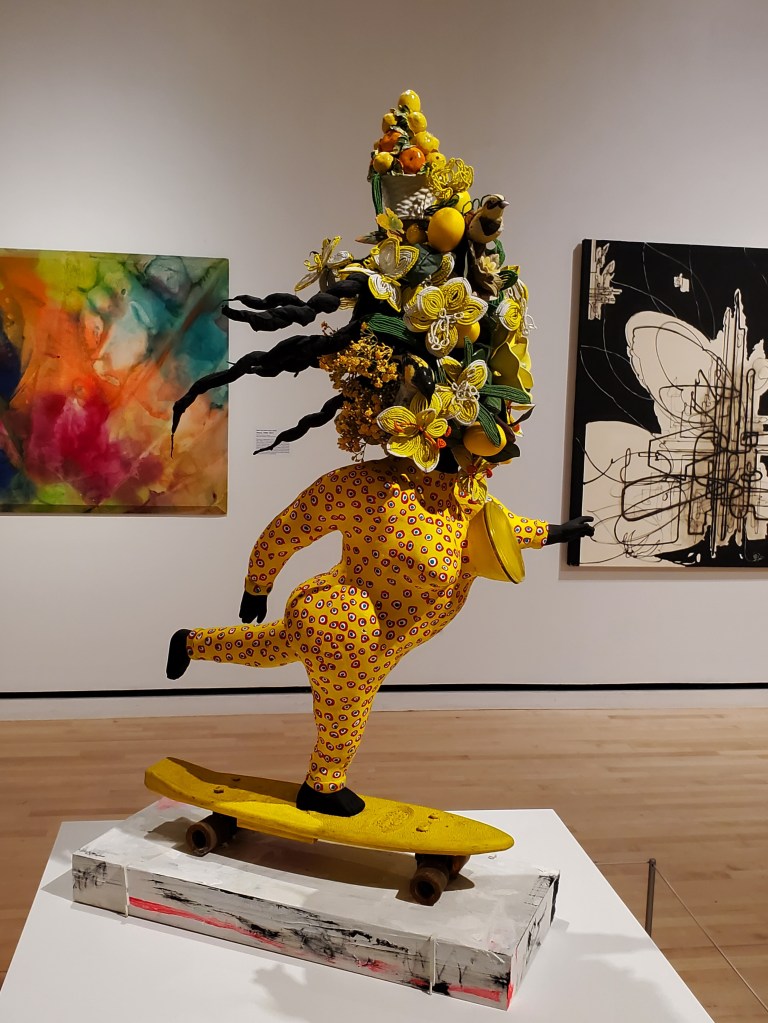
Black Girl on Skateboard . . . (Vanessa German, 2022): my favorite piece on display What followed was less fun: another delayed-ultimately-cancelled flight out, a night spent at an airport hotel, an early flight the next morning and a l-o-n-g layover in Baltimore before arrival in Boston 28 hours after originally planned. ‘Twas a good, rich trip nonetheless. I’m already keen to return to Savannah.
But Madbury also has its charms—and charming visitors, too. This young fellow appeared just outside my kitchen window the day after Thanksgiving, and we locked eyes for so long I wondered at a possible visitation. Well, snow coming tomorrow. Time to settle in. Home sweet home.

Have we met before? 28 Nov 2025 Artillery Bar, Bonaventure Cemetery, Embassy Suites Savannah, Genteel and Bard tours, Green-Meldrim Mansion, Julianna from Savannah, Mercer-Williams House, Owen-Thomas House, savannah, Savannah College of Art and Design (SCAD), Scottish Rite Masonic Temple, Talmadge Bridge Savannah, Tybee Island Lighthouse -
Commonwealth Utopia
22 November 2025

Symphony Hall, Boston, 21 November 2025: Yo-Yo Ma implores our humanity Last night Yo-Yo Ma brought his Bach Project home to Boston for a sold-out Celebrity Series concert in Symphony Hall that was for the first time simulcast to over 20 venues across the Commonwealth. In a 19 November interview on Boston Public Radio, Ma, who has since 2018 toured six continents performing Bach’s Six Suites for Unaccompanied Cello, explained that “there’s something special about this music”; he practices not to play perfectly, but “to serve a need that is somewhere out there.” Describing his Bach Project as a listening tour wherever he went to play, Ma asked who was using culture to strengthen the fabric of their community, and learned from the answers that there talented, intelligent, and kind people everywhere.
That message informed what amounted to an astonishing, moving, herculean performance. For nearly three hours without intermission and only a few remarks in between the first four suites, Ma played all six complex movements of all six complex suites, initially joking that we would know when we were approaching the end of each because all ended with a gigue, and then mouthing “gigue” as he began to play it. Even disregarding the skill, artistry, concentration, and a lifetime’s dedication required to perform such demanding works all from memory, the physical stamina demanded is gob smacking. The program itself made clear that because there would be no intermission, audience members were welcome to enter and exit the hall quietly as needed, and when after Suite 4 ended well past 10 o’clock with two more suites to go, and some people, however sheepishly, made their ways to the doors, Ma concurred: “I know it’s a LOT of cello, but it’s all I got!”
Of course it’s NOT all he’s got. The program was preceded by a video of Ma taking questions from people around the world, answering each with such animated delight, and, for example, demonstrating whale song on his cello, that I said to my friend Vicky, “He’d make a great grandpa.” Well, he IS one, four times over, and those grandchildren and the legacy our generation will leave them were clearly on his mind throughout the performance. Ma turned 70 on 7 October (I was delighted to note my proximate birthday on 8 October, though Ma is three years younger) and proudly declared his performance a birthday present to himself. Never losing sight of serving the community, he explained that the little cards we found in our programs were actions to be taken. Before playing Suite 2, which he described as fertile ground for imagination, Ma invited us to let our dream for our communities in 2050 come to us. That dream we were to record on the card (my modest one: a full-time librarian and affordable housing). Then, offering Suite 3, music for taking action, he instructed us to swap cards with a stranger in the audience, who should take it home and plant it: there are perennial seeds embedded in the paper. Let the dream take root and grow.


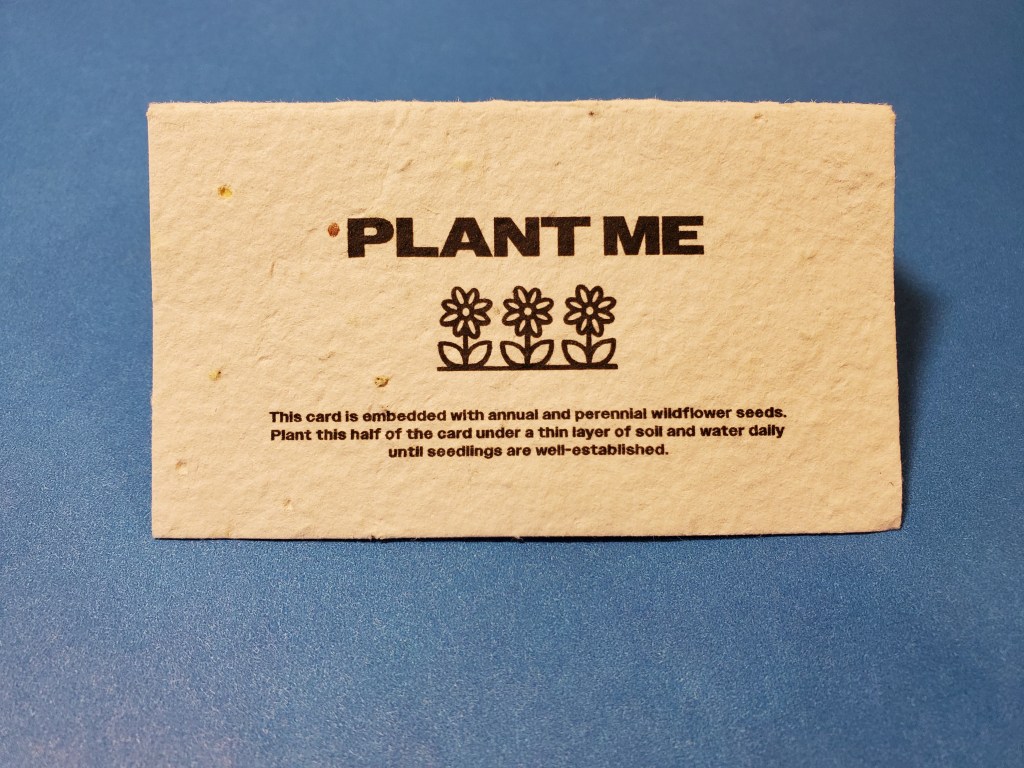
Introducing Suite 4, Ma explained that in writing his first three suites, Bach had set out to learn everything about what the cello could do. Having done that, in Suite 4, he discovered he could multiply the voices only four strings could play by having the audience’s memory and association, providing harmonies not actually played, perform as well as the musician. Then came the somber Suite 5, dedicated to all those who have lost something—health, love, purpose—but especially those who had lost their (emphasis on the word) dignity. Finally, with only the slightest pause, uninterrupted by applause, Ma proceeded through Suite 6, finishing that final gigue with a flourish that brought all to their feet, cheering.
No one at that point expected an encore, but after a second bow, suddenly stagehands were pushing a shiny Steinway D on to the stage, and Ma was telling us that as an old guy, he thought it very important to introduce young talent. That talent proved to be Boston Mayor Michelle Wu.

Yo-Yo Ma and Mayor Michelle Wu play Schumann, Symphony Hall, 21 Nov 2025
In the words of Lin-Manuel Miranda, “Immigrants! We get the job done!”The hall exploded with delight, and well into the third hour of performance, Ma and Wu performed Schumann’s Ave Maria. At the finale, more cheers and stamping. Wu congratulated Ma, who flashed several heart hands to the crowd, embraced Wu, and exited stage left.
For a time, we all shared Yo-Yo Ma’s passion and generosity. As we made our way through the scrum exiting onto Mass Ave well past 11 pm, I saw a young boy of perhaps 8 posing for his mom with a huge grin on his face in front of the Yo-Yo Ma poster twice his size. There, I thought, is our future.
Thank you, Yo-Yo Ma, for reminding us of our common humanity, and of what is possible if we share and act on our dreams.
-
Hilton Head Reunion
2-5 November 2025

Beach access from the Monarch resort, Sea Pines, Hilton Head SC Last week I made my first visit to Hilton Head, where my college suitemate Karen, with Pete, my acting teacher and Karen’s late husband of 50+ years, often spent their holidays. My trip began smoothly enough with another first, a chauffeured drive to Logan airport and a non-stop flight to Savannah.
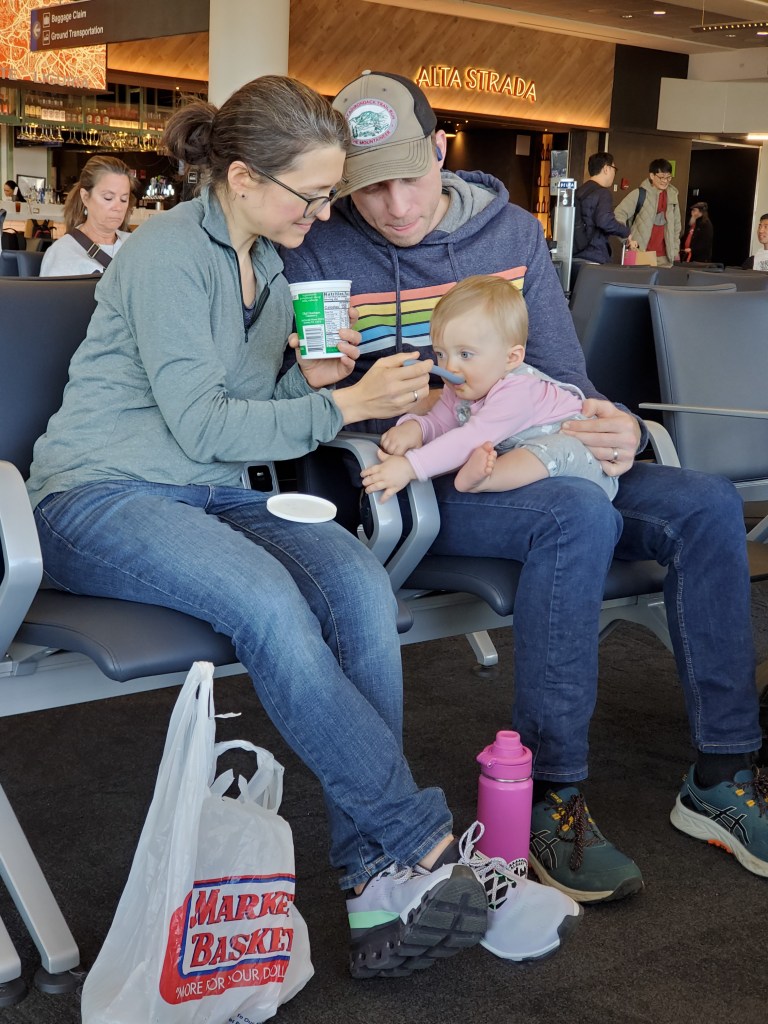
A cute family waiting at the Logan gate 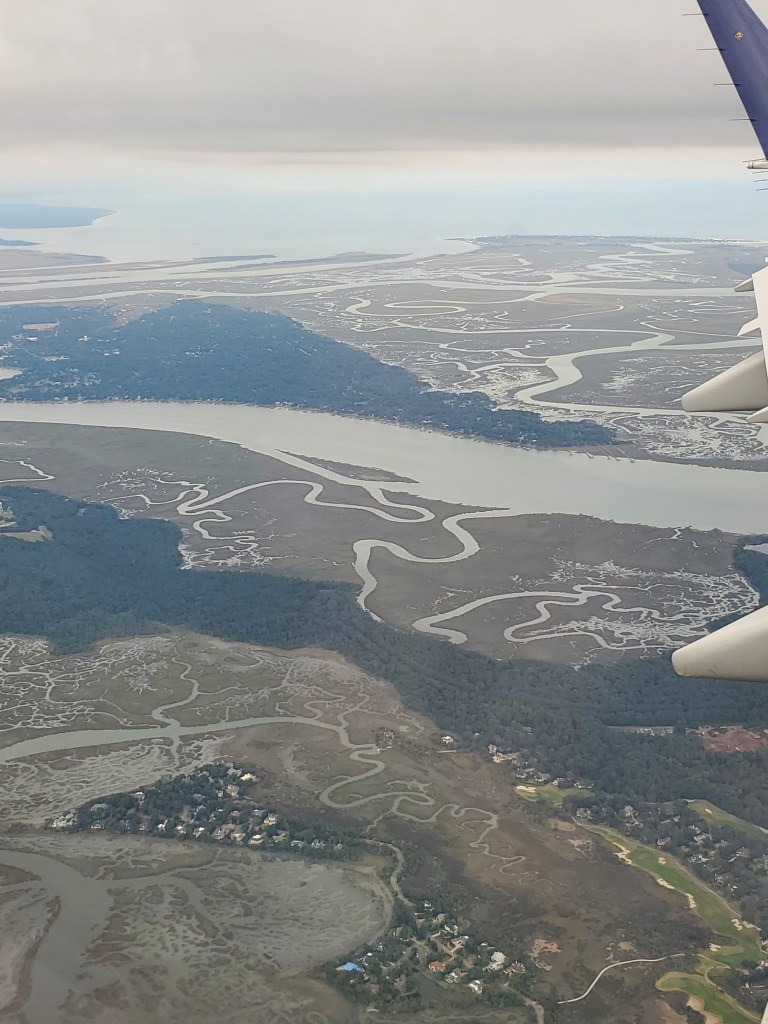
Savannah approach: the marshland crazy quilt There at the SAV baggage claim I met up with Karen, her bereavement still sadly raw, just arrived from her home in Chattanooga, and in an absurdly large Chrysler Pacifica (the Manager’s Special) drove to Karen and Pete’s gated getaway within the Marriott Monarch complex on Hilton Head. Located inside yet another gated community, Sea Pines makes up the southern “toe” of the foot-shaped island, where rigorously enforced HOA restrictions ensure a pleasingly tasteful uniformity of custom architecture and a color palette complementing the island’s natural beauty. Even the McDonald’s blends right in; no garish golden arches here. Our handsome two-bedroom, two-bathroom villa is lovely, but given it was the first day of the dreary return to Eastern Standard Time, we were barely able to check in, drop our luggage, and scamper to the Coast restaurant next door before the sun set to enjoy a cocktail and light dinner of tortilla soup, crab cake, and salad at a combo firepit/table whose warmth was welcome in November, even 11 degrees of latitude further south from my New Hampshire home. I augmented my cocktail cognizance by observing Karen enjoying a mango margarita with a Grand Marnier “floater,” a vacation in a glass. After supper, reruns of The Diplomat, conjured by my fortunately remembering how to log on to my Netflix account, put us happily to bed.

Our handsome Monarch villa 
Our flaming table at Coast restaurant Still on ATT (Anxious Travel Time), I woke early the next morning from a nightmare about an imagined English Department faux pas (I recall my dad saying when he dreamed of his work life he was “always in trouble”). But the serene beauty of the tastefully landscaped Monarch quickly dispelled the dream hangover, and while Karen slept, I made my way through the carefully landscaped courtyard, speaking along the way to a woman memorizing the names of butterflies displayed on a helpful sign the better to impress her soon-to-be visiting granddaughter.
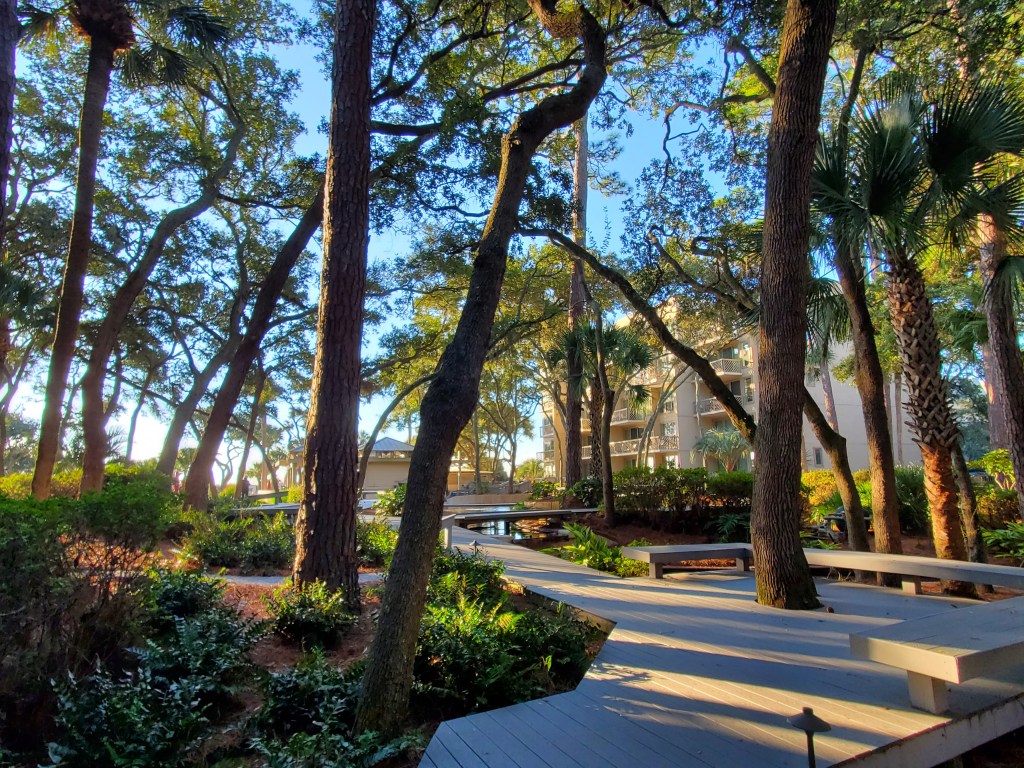
The Monarch courtyard with boardwalk over koi pools 
The Monarch gazebo 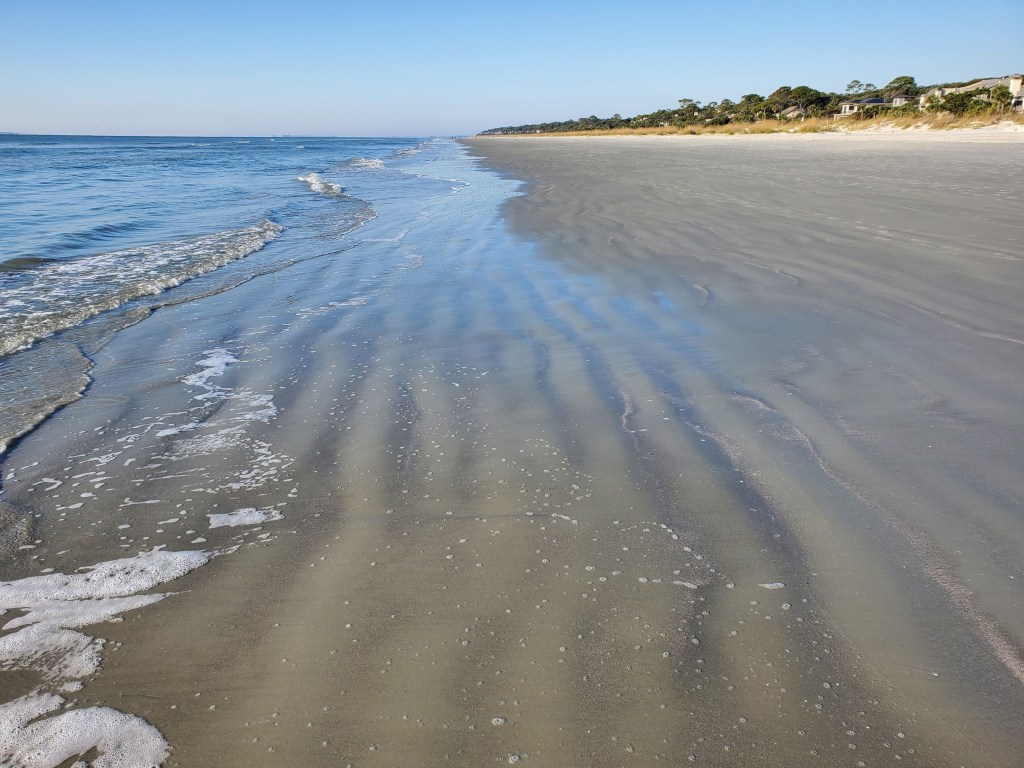
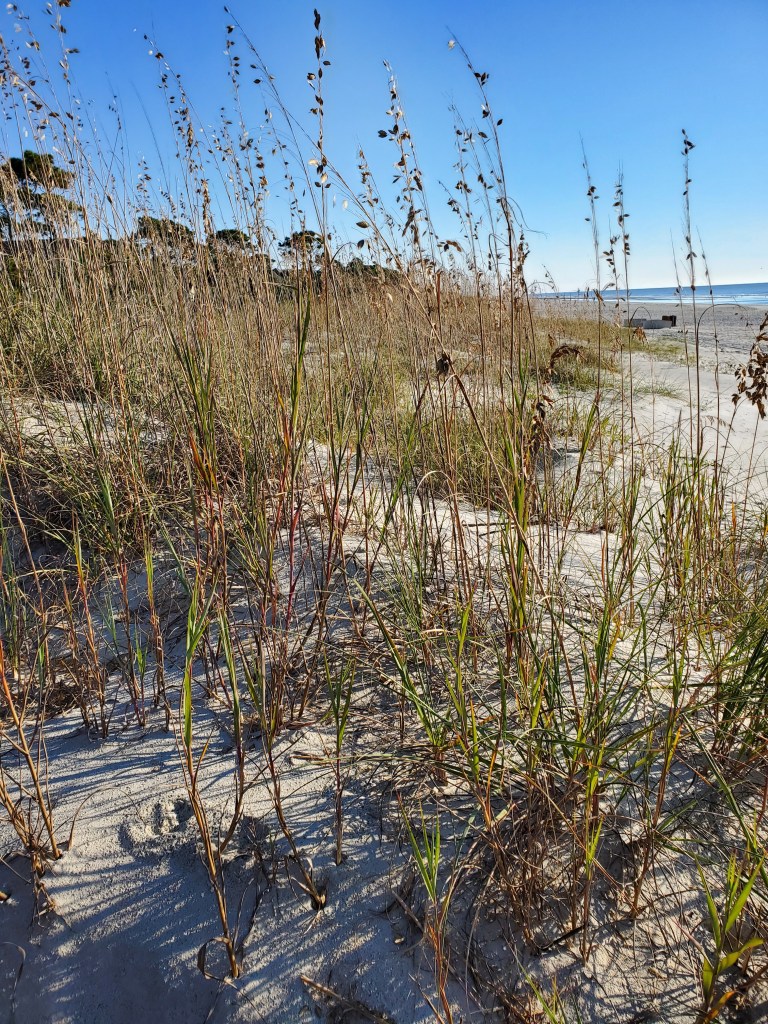
The beach at Sea Pines is broad and beautiful, the sand as fine and white as that of my hometown St. Pete, and, like that beach of my youth, adorned with sea oats.
After a quick stroll, I returned to the villa to find my friend ready for the breakfast I suggested we enjoy at the Harbour Town Bakery, located under a live oak like all others on the island dripping with Spanish Moss (“neither Spanish nor moss”) inside the former lighthouse keeper’s cottage (1880), the perfect venue for an avocado toast and very well-heeled company.
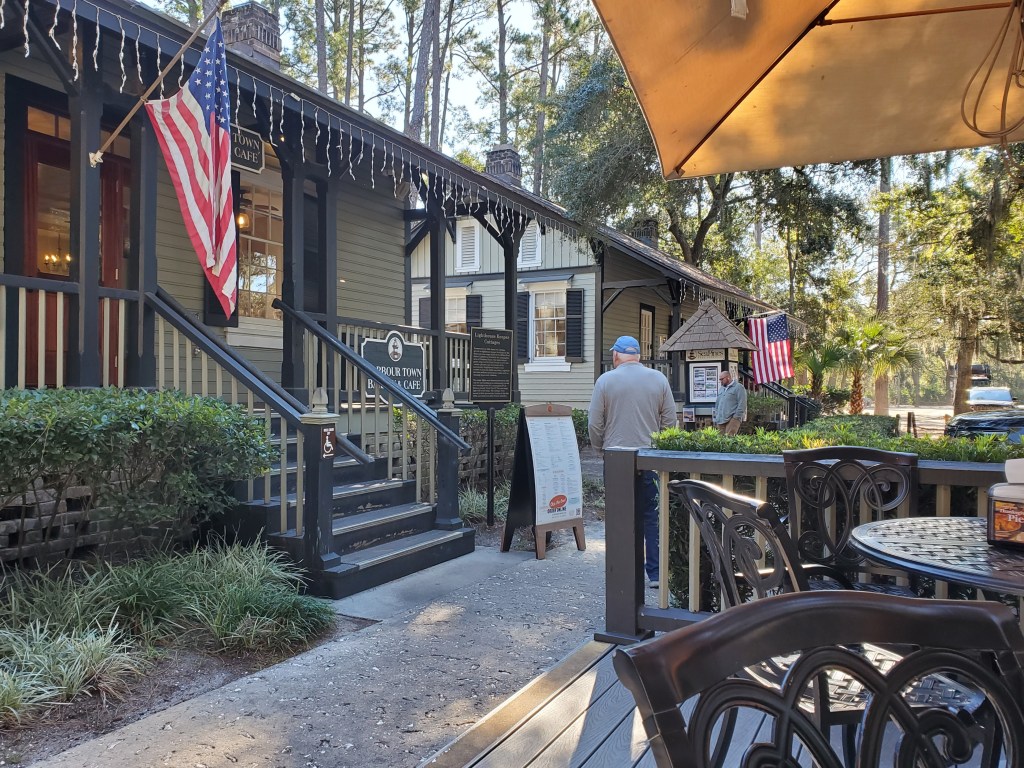
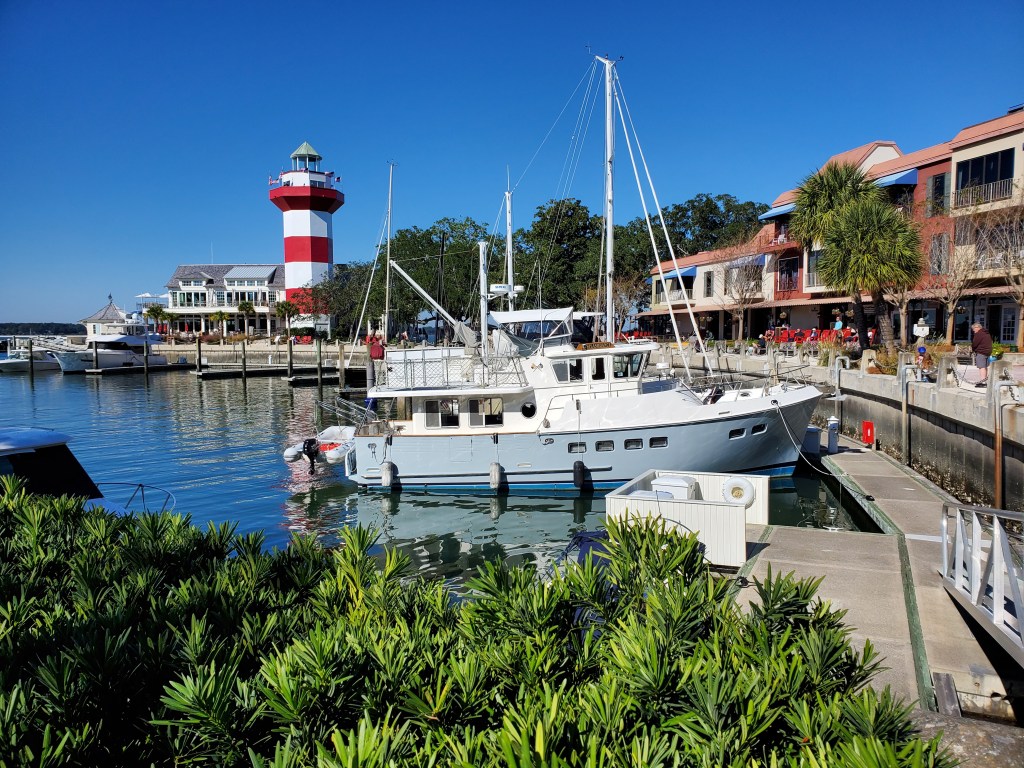
Harbour Town Bakery and Cafe The day was perfect, so we took strolled to the nearby Hilton Head lighthouse, its octagonal tower privately built from 1969-70, aiding navigation to a marina predictably full of handsome crafts.
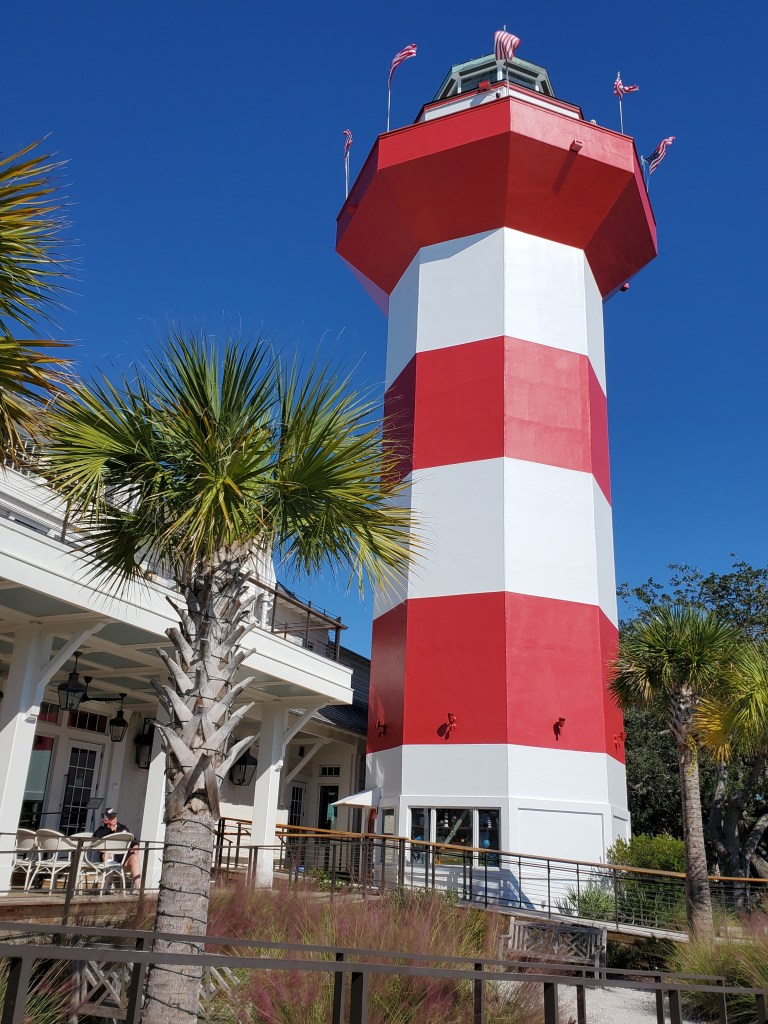
Hilton Head Lighthouse As my dad questioned every time we walked by the marina in St. Pete, “Where do these people get all this money??!! Adjacent shops clearly profited from plenty of discretionary spending (no cash, only credit): lots of nautical leisure wear and appealing tchotchkes, as well as more than one pedigreed, though artificial pooch, abound. The rich ARE different.

Beachwear for a dandy, complete with oyster shell bibelot 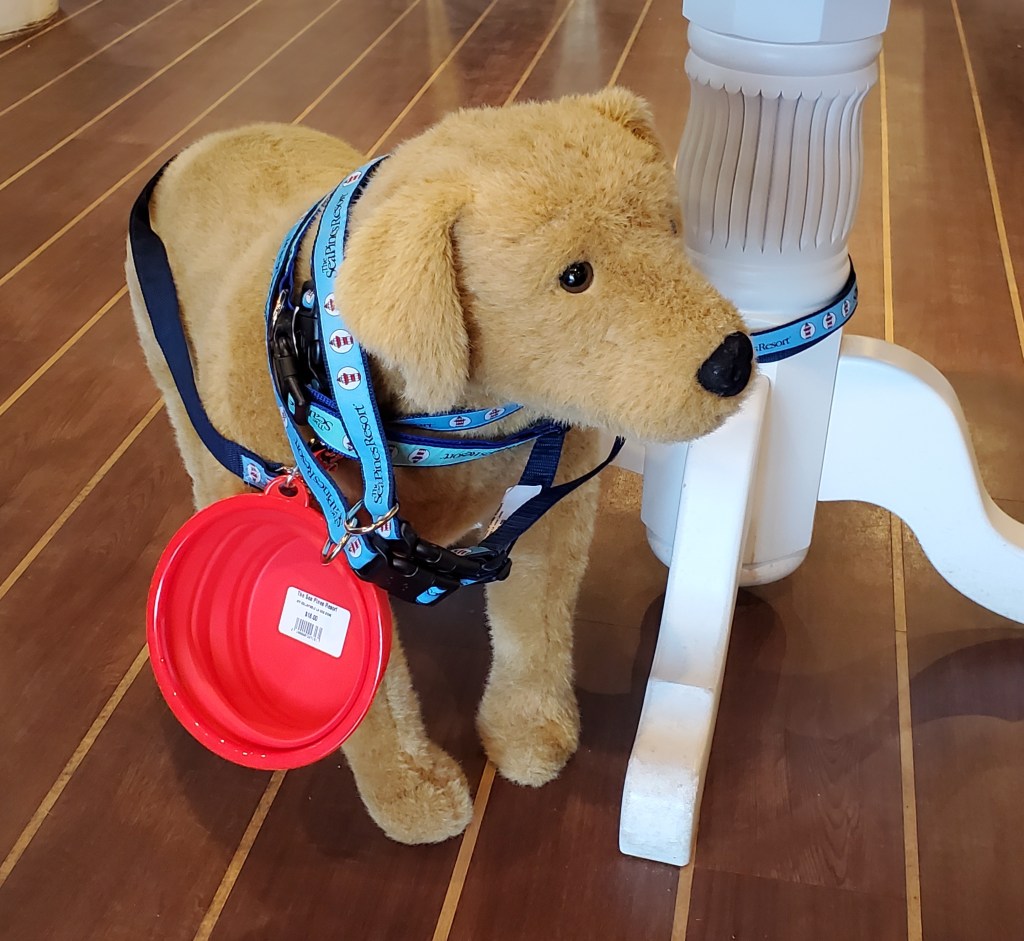
The well-accoutered, if artificial, companion 
From there we drove to the nearby Stoney-Baynard ruins. Originally built by Revolutionary War hero Cpt. Jack Stoney in 1793 of tabby plastered over and scored to resemble masonry, and later acquired by William Baynard in 1840, perhaps as a result of Cpt. Stoney’s bad poker hand, the Baynard house was once a grand antebellum plantation overlooking the Calibogue Sound. When Union forces invaded Hilton Head Island in 1861, the Baynards evacuated the property; the residence was raided and served as Union headquarters before being burned. The distance from the main house to the kitchen and slave quarters intimates the suffering that war was meant to address. Given the division that currently roils our country, gazing at the romantic ruins brings “Ozymandias” to mind: “Look on my works, ye Mighty, and despair.”

Stoney-Baynard Ruins, 1793 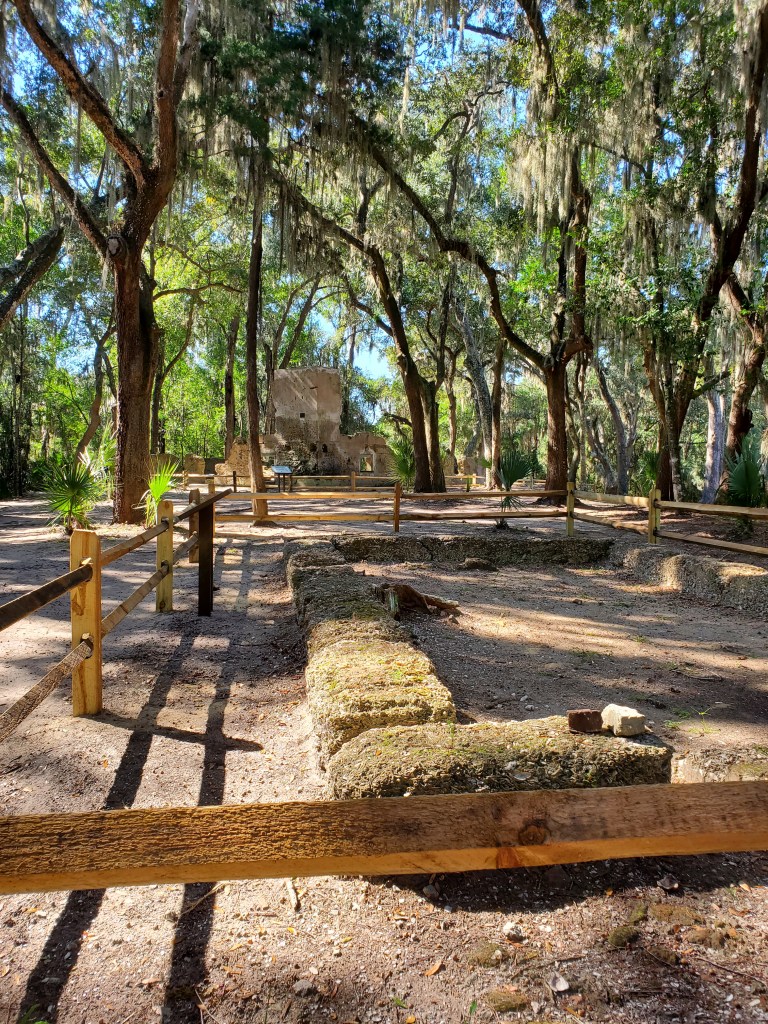
Remains of the slave quarters 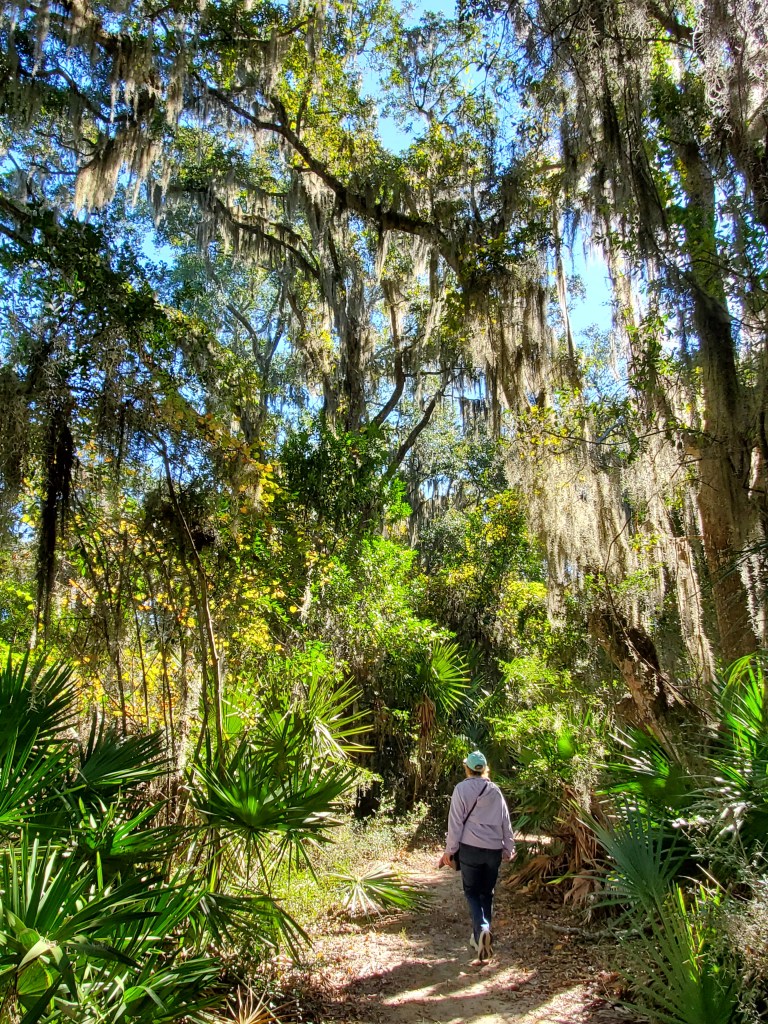
Karen strolls the former plantation Heading back to the Monarch, we made some provisioning stops, first at a gorgeous Fresh Market, where an elderly woman at the coffee bean grinding station wondered aloud if Fresh Market would mind if she ground her own beans there, a dilemma of privilege I nevertheless understood: one might thriftily travel with one’s own coffee beans, but who travels with a grinder? At the CVS, I spotted the first Black face I’d seen since arriving on the Island: Black Santa, accompanied by Mrs. Black Claus. What might the Stoney-Baynard slaves make of THAT, I wondered?
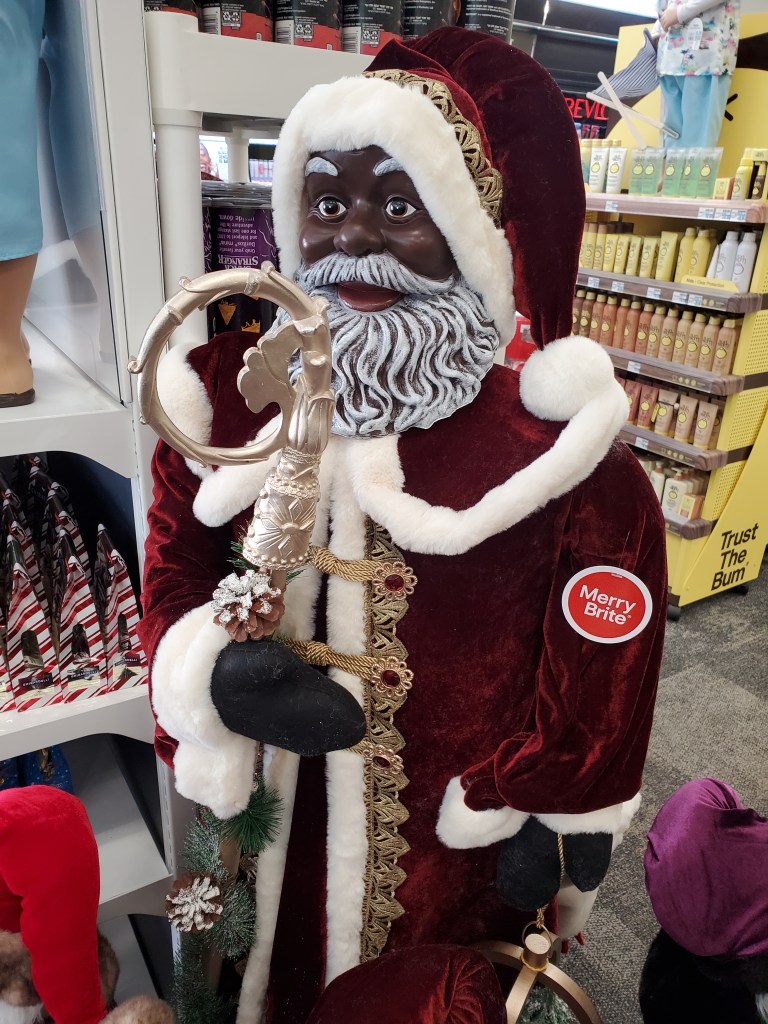
Diversity on Hilton Head But a lovely dinner awaited me that night: Karen treated me to the chef’s table at the Smith’s favorite restaurant, The Sage Room, where Chef Martini and colleagues delighted us with excellent Chilean sea bass and almond crusted tuna, preceded by a witty, delicious, and CHEAP (at $2!) appetizer: the Snow Pea Martini with pineapple soy reduction and Dijon aioli.
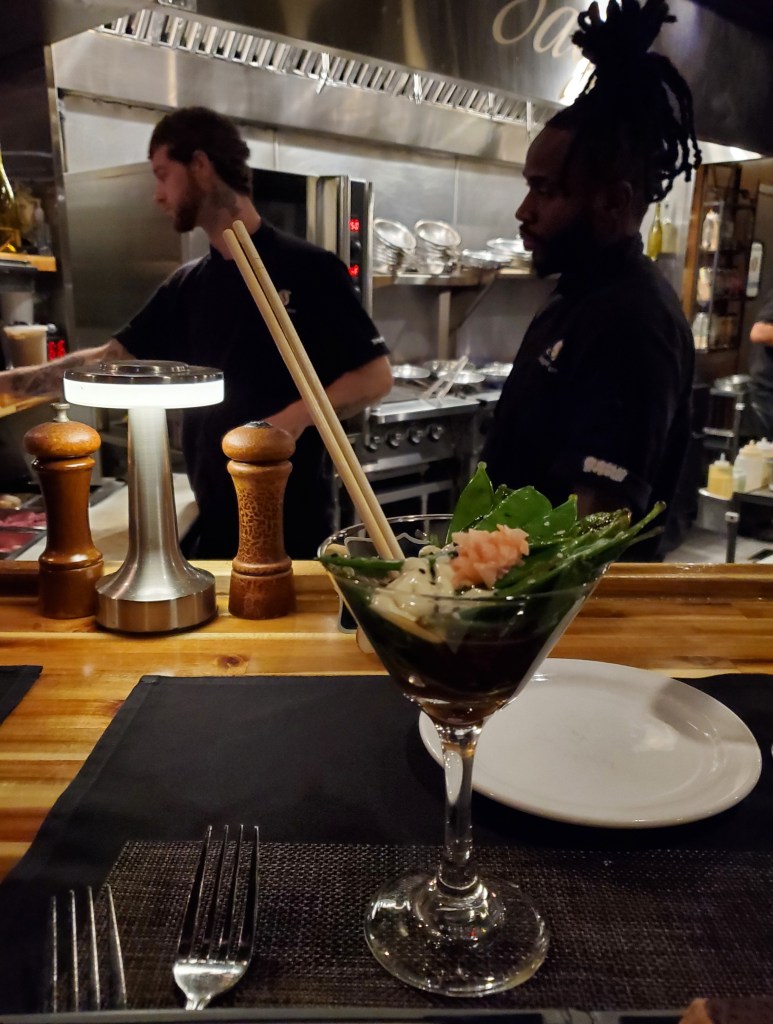
Sage’s snowpea martini, served with chop sticks After another nightcap of The Diplomat reruns, we went to bed happy.
The next morning we had breakfast on our porch of inviting prospect, and then set out for the Shelter Cove sculpture trail, an alluring boardwalk augmented with art and poetry that runs along Broad Creek, with informative signs about flora and fauna, decorative purple Muhly grass (Muhlenbergia sericea), and fine views of marsh grass (Spartina alterniflora) burnished by autumn, the liminal territory so important to the coast, providing critical habitats and food for wildlife, filtering and cleaning the brackish water, and protecting the coastline from storms and erosion, the grassland ecosystem that gives Savannah its name.
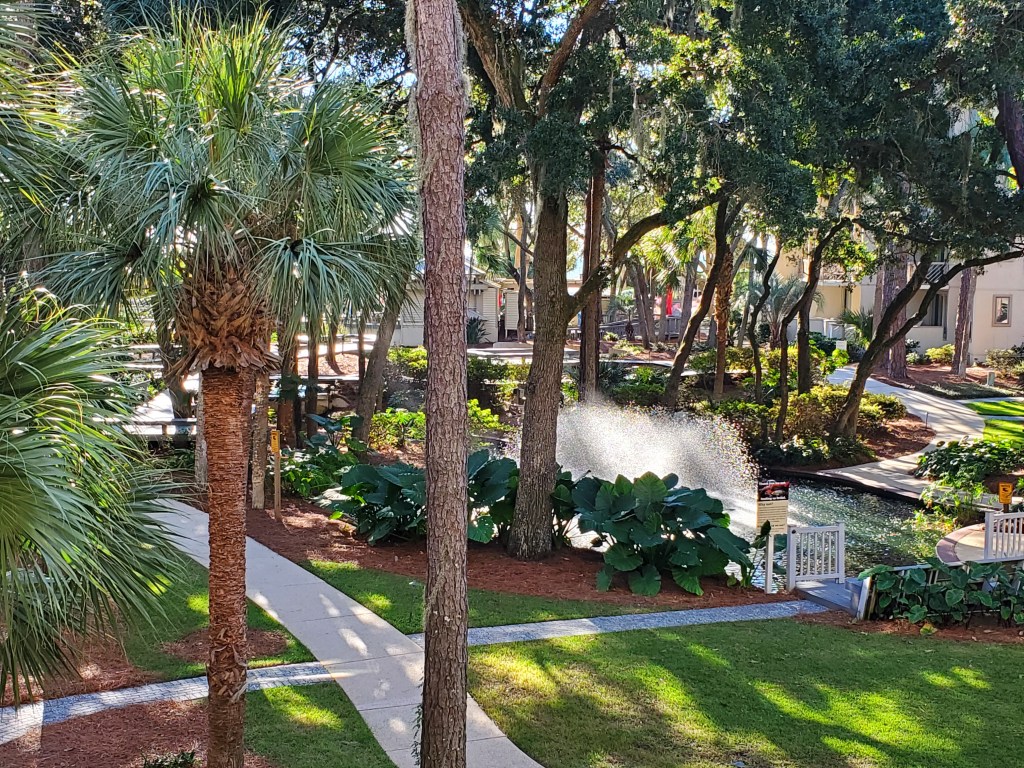
Breakfast view from the porch 
Shelter Cove sculpture trail along Broad Creek 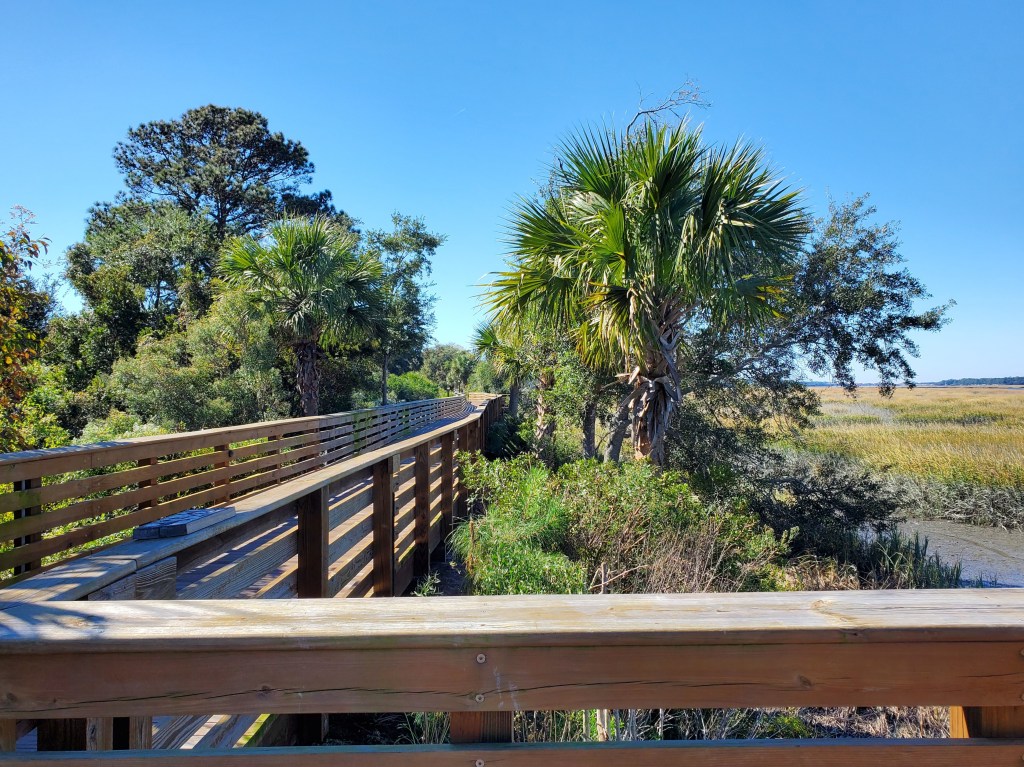

Purple Muhly Grass (Muhlenbergia sericea) There’s a fine Veteran’s Memorial at the end of the trail, and two handsome apartment complexes, WaterWalk at Shelter Cove, overlooking the well-maintained path and the creek beyond.
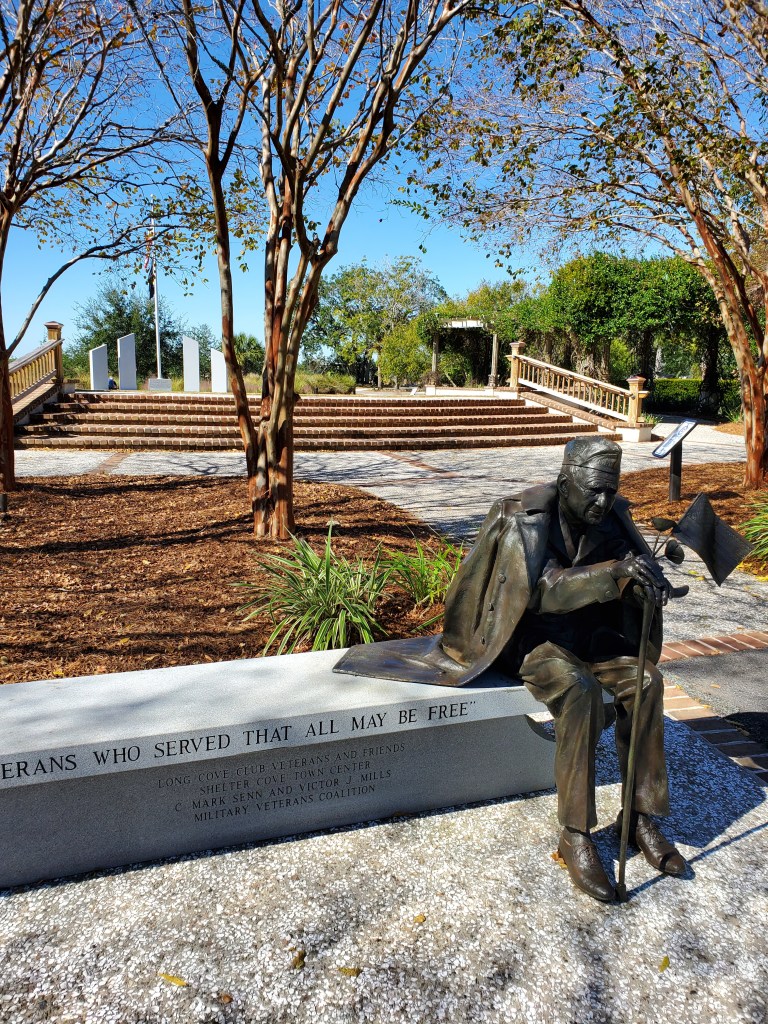
Shelter Cove Veteran’s Memorial We took advantage of proximity to take a tour of WaterWalk, including a sumptuously decorated beach-themed apartment, with appropriately high-end swag available: small free bottles of prosecco, cork screws, bottle insulators, and tote bags. Lovely to think of living there, though the width of the hallways (and the age of the well-heeled residents) were reminiscent of assisted living facilities, and the monthly rent of $3500 + utilities only confirms the dearth of affordable housing—not just on the island, but across the nation. (My Greensboro friend subsequently confirmed that $2300-$3500/ month is the going rate for apartments in her North Carolina neighborhood.) But what does one expect where the public bathrooms include sunscreen dispensers?

From WaterWalk we made our way to SurfWatch, another Marriott property where Karen and Pete have stayed, this one at the northern heel of Hilton Head. SurfWatch boasts more appealing boardwalks and Spartina, the natural world beautifully integrated into the complex, with an inviting beach-side pool flanked by private cabanas and another gorgeously wide beach.
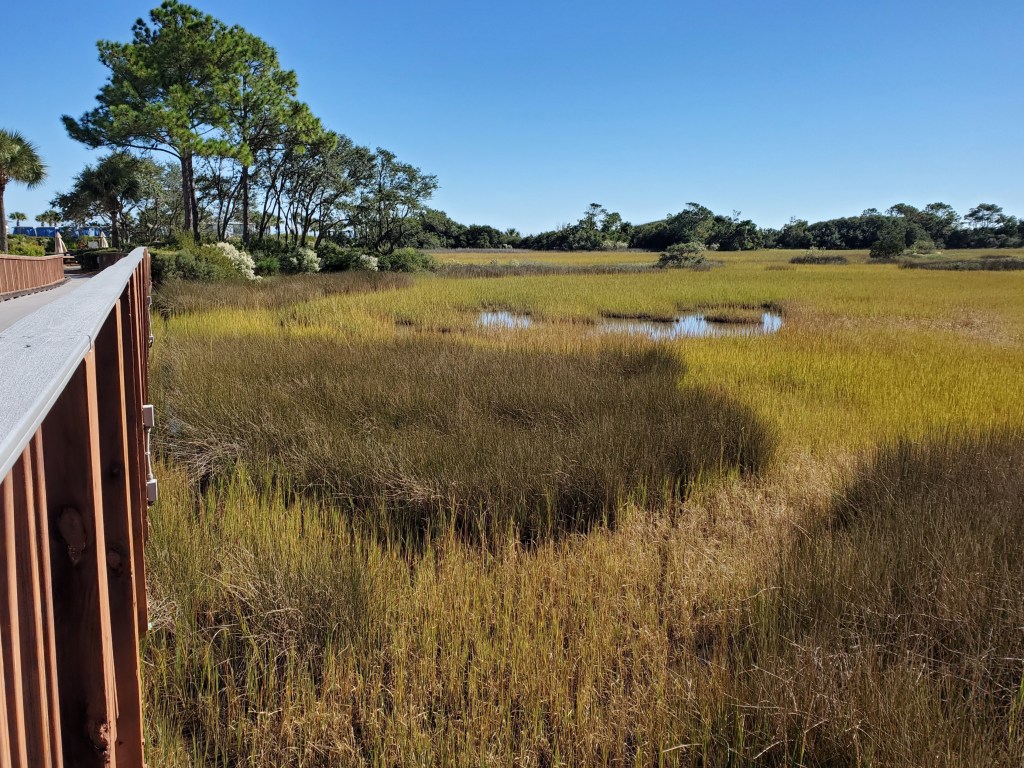
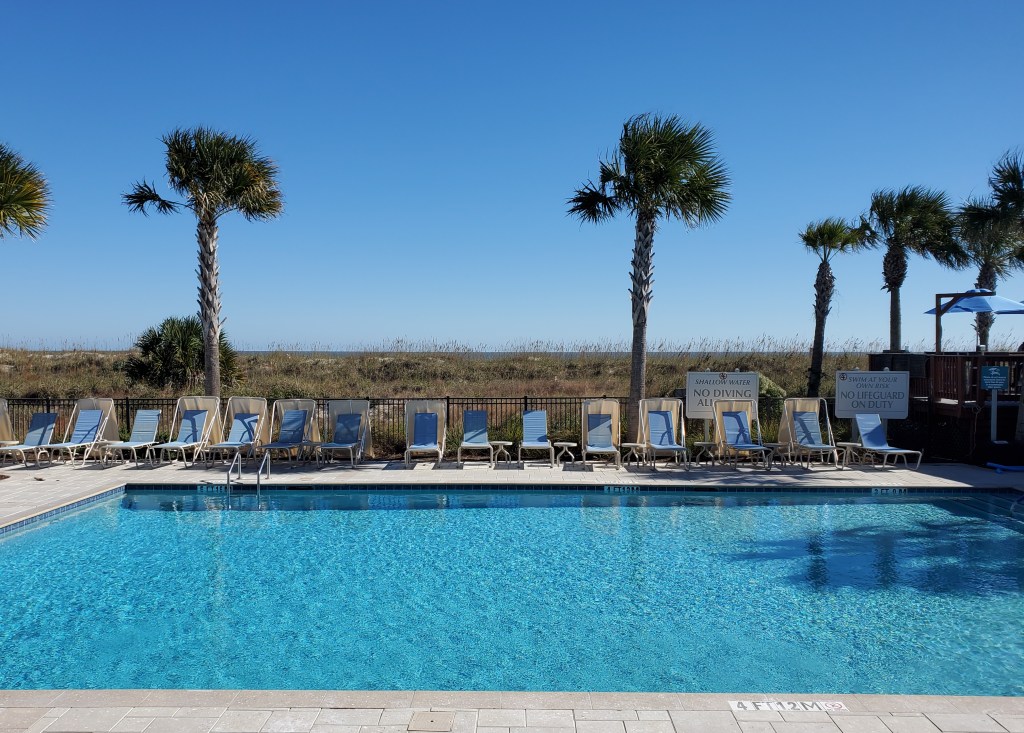
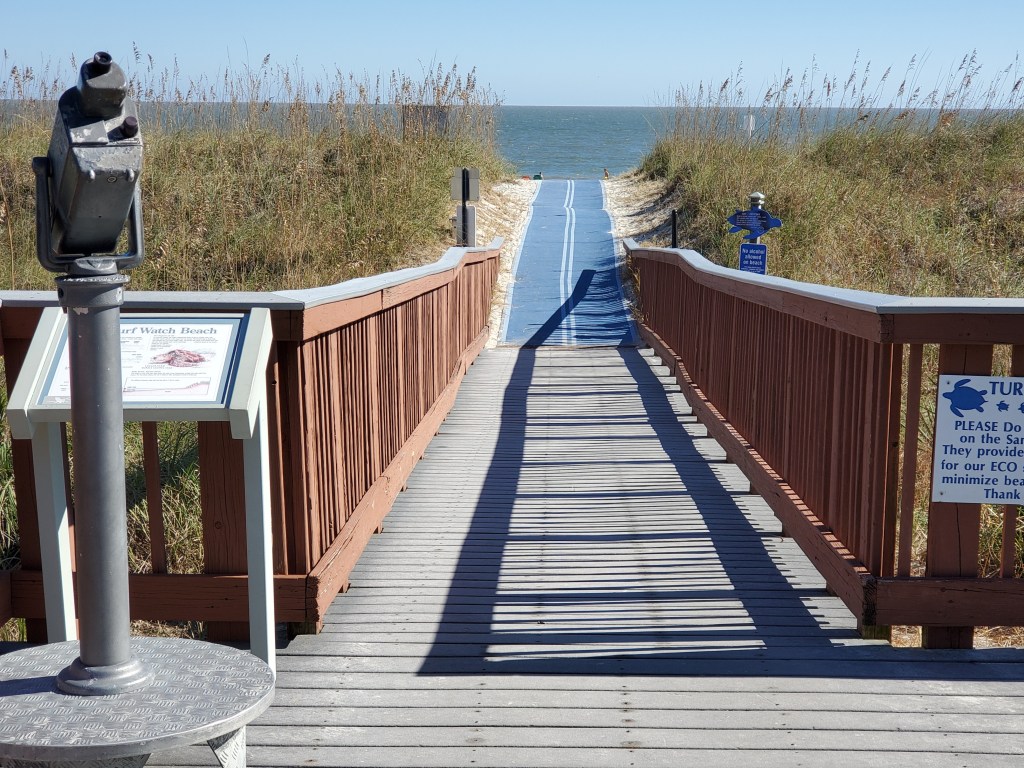
We stopped at the beach bar for a snack of pita, spreads, and an uplifting margarita, and then, as the sun dipped, made our way to Mitchelville, founded by the formerly enslaved, and the first self-governing town for African Americans in the U.S. The beach was handsome here, but wilder (as the sign warned), and the beach-side accommodations more modest.
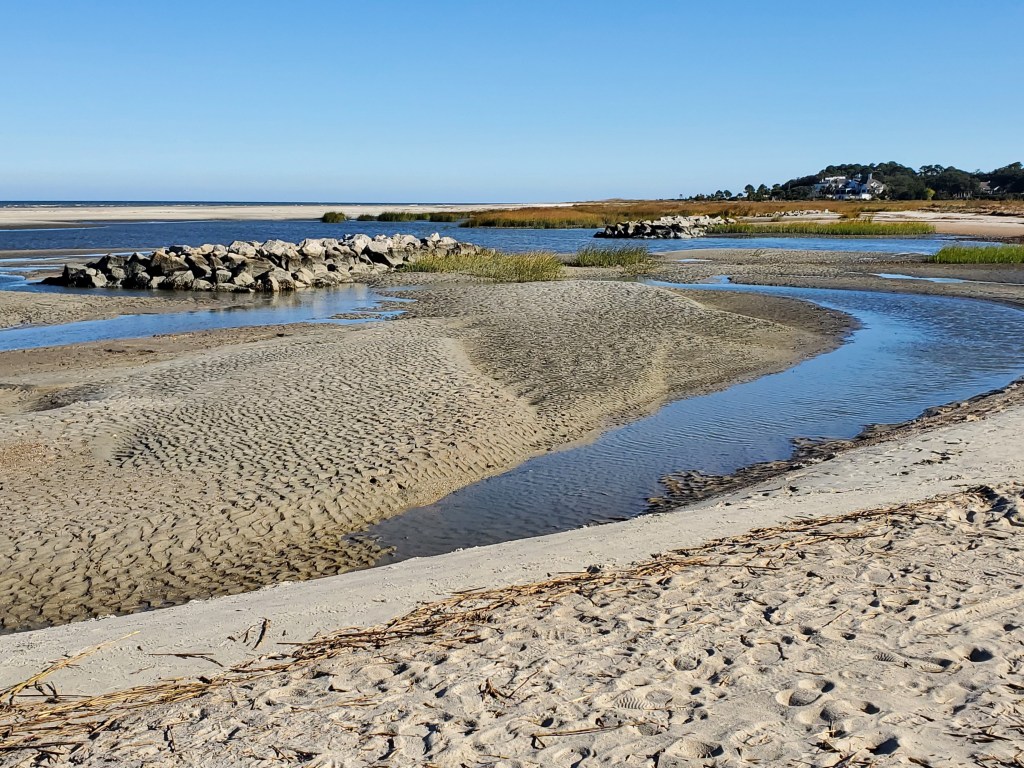
Mitchelville coastline 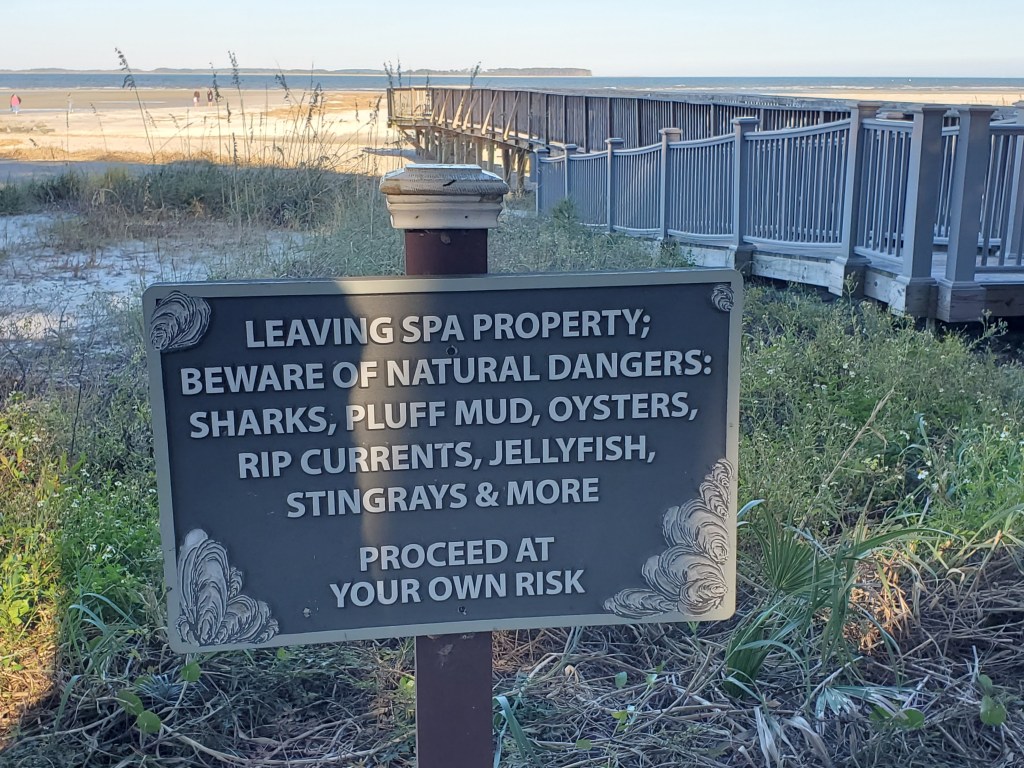
We ran out of light before we could see the town, but enjoyed a very tasty pizza dinner at Michael Anthony’s pizzeria market café before returning to the solace of our beautiful villa and more Diplomat reruns.

Old friends’ pre-pizza toast I packed up that night, and next morning after breakfast, made my way back to the Savannah airport to return the behemoth Chrysler Pacifica, musing all the while about the 51 years since Karen, as Cecily Cardew, and I, as Lady Bracknell, acted together in Furman’s production of The Importance of Being Earnest—some of the most fun ever, that play.
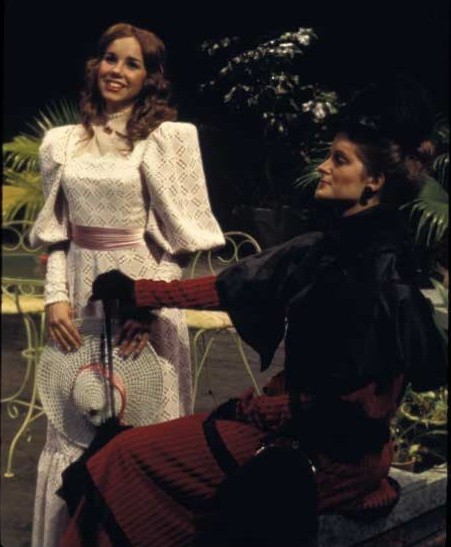
Cecily and Lady Bracknell in 1974 Our lives certainly diverged after graduation, but this reunion of two now-widowed old friends was just as certainly tonic for me, and I hope for my beautiful, grieving friend.
-
Good / Bad / Good News
26 October 2025

No Kings rally at Weeks Crossing, Dover NH, 18 Oct 2025 Last night I watched Rachel Maddow’s extended coverage of last weekend’s No Kings rallies, seven million Americans protesting across all 50 states in multiple venues, cities large and small. The Weeks Crossing rally in Dover, New Hampshire (my 6th protest of the Felon-in-Chief) was the largest of the those I’ve attended, coupled with the least number of middle finger salutes from passersby. Progress! As Maddow opined: think how many more would have protested had the Mango Man not waited till after the demonstrations to desecrate and demolish the East Wing of the White House, the in-your-face epitome of his contempt for the People’s House, Democracy, and the Constitution. “I can do what I want,” he crows, which includes broadcasting his puerile, scatological AI-generated video of King Don dumping excrement on the peacefully protesting citizens he swore, hand on bible, to serve. Is disgust with the Notorious P.I.G. gaining momentum? I think so. As Martha Stewart would say, that’s a good thing.
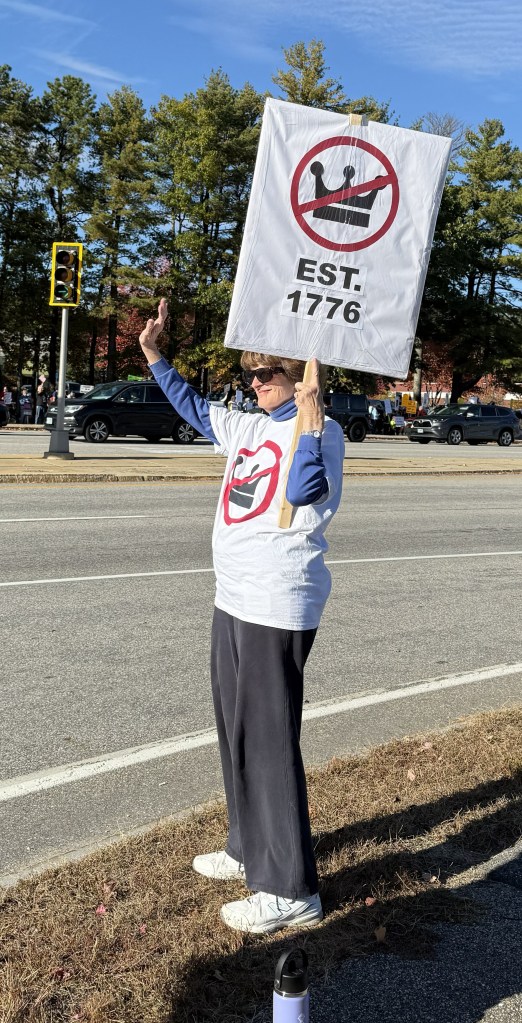
Protest # 6 for yours truly Clearly, however, the Mango Mussolini believes in literal enshittification—the term Cory Doctorow coined to describe the decline of technological products and services over time. That’s bad news in both senses of the term. I had my latest encounter with tech enshittification last week, trying to announce my on-time arrival for a flu shot appointment at the local Walgreens, a simple check-in made nearly impossible by the “time-saving” QR code we were to scan, which (slowly, because of bad wi-fi) took me to a multitude of screens with questions I’d already answered online, but had to answer again lest my presence not be announced. So, I scrolled and scrolled, giving new meaning to doom scrolling because this took about six minutes until my phone screen froze, my having arrived still not on anyone’s radar. The pharmacist then had to come find me and ask me all the same questions a third time, this time in person. Administering the shot then took all of 6 seconds.
Deciding to counter this frustration with a humble treat, I then went to McDonald’s to console myself with a “big breakfast”—something I would occasionally do in grad school days (when it did not cost over $11!). I’d not been in a McDonald’s for about a decade, and so was unprepared for the unmanned order counter, now replaced by large screens where customers are supposed to figure out how to place their own orders. An associate finally saw my distress and came out to help me, confessing that when she tried to take her granddaughter out for lunch the previous week, she only succeeded in ordering 3 Cokes. She took my order, but when I went to acknowledge that I was willing to “round up” my tab for charity, the credit card screen would not acknowledge my touch—nor that of the associate helping me, nor that of the manager, who repeatedly banged on the screen until the charge went through—without rounding up. A nice metaphor for what handing our lives over to tech is doing to us. More bad news.
Meanwhile, the drought in NH continues: glorious weather, but for all those depending on wells for their water supply, the low buzz of anxiety about another thing we can’t control is ongoing.
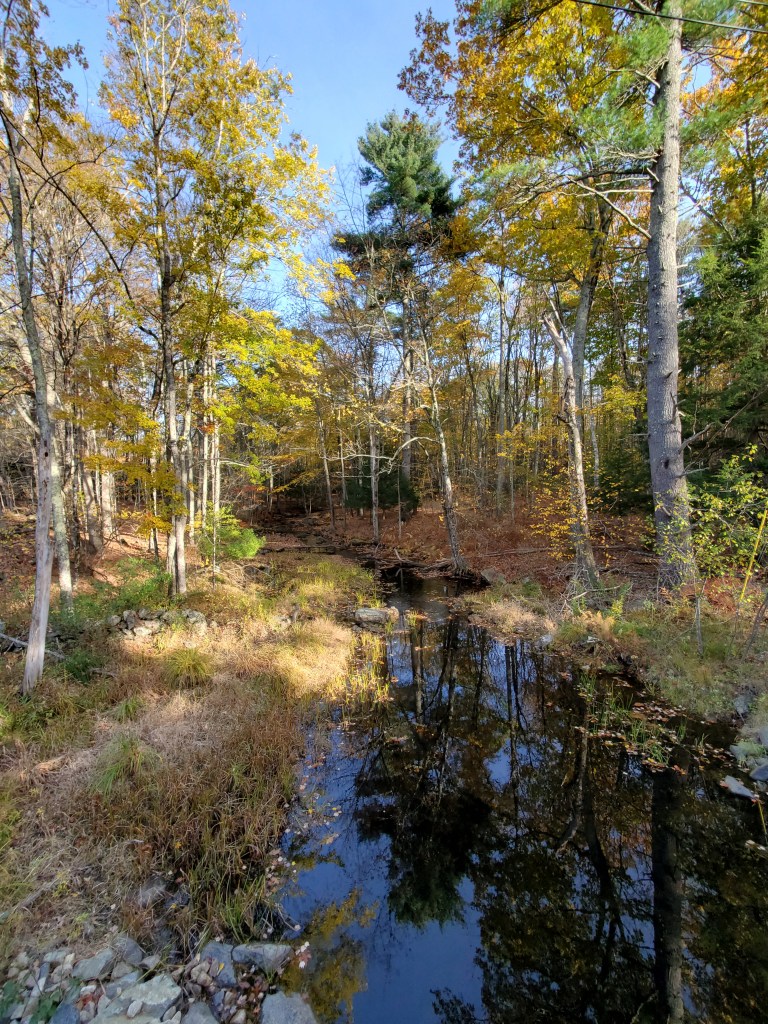
Bellamy River or Trickle? 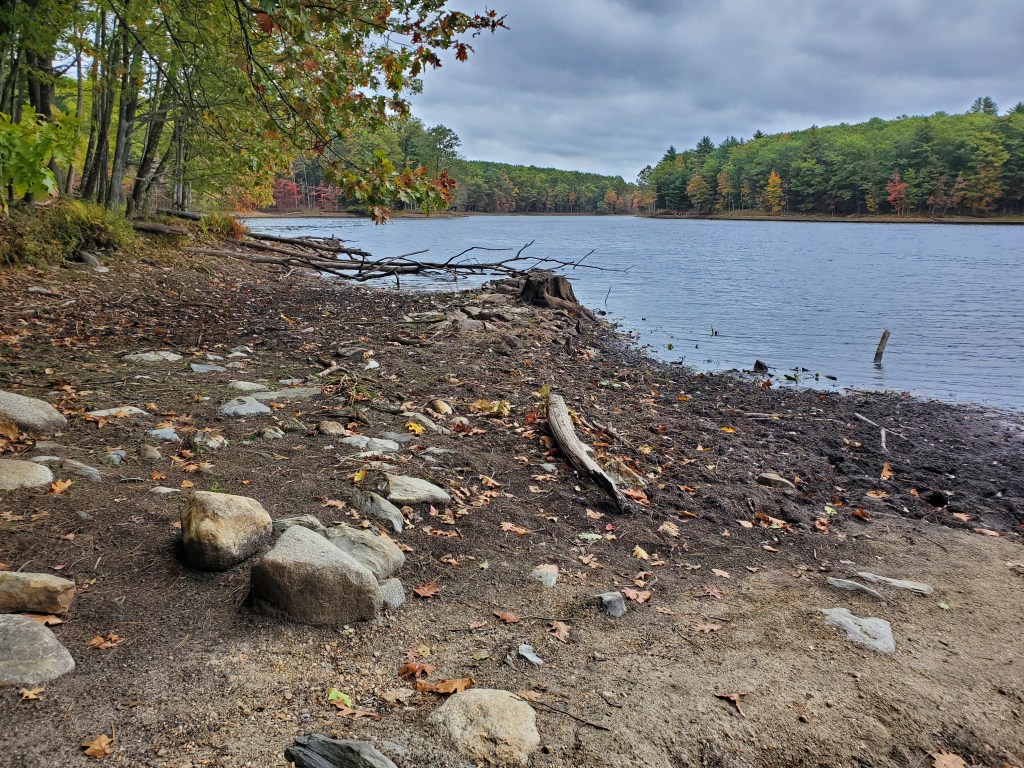
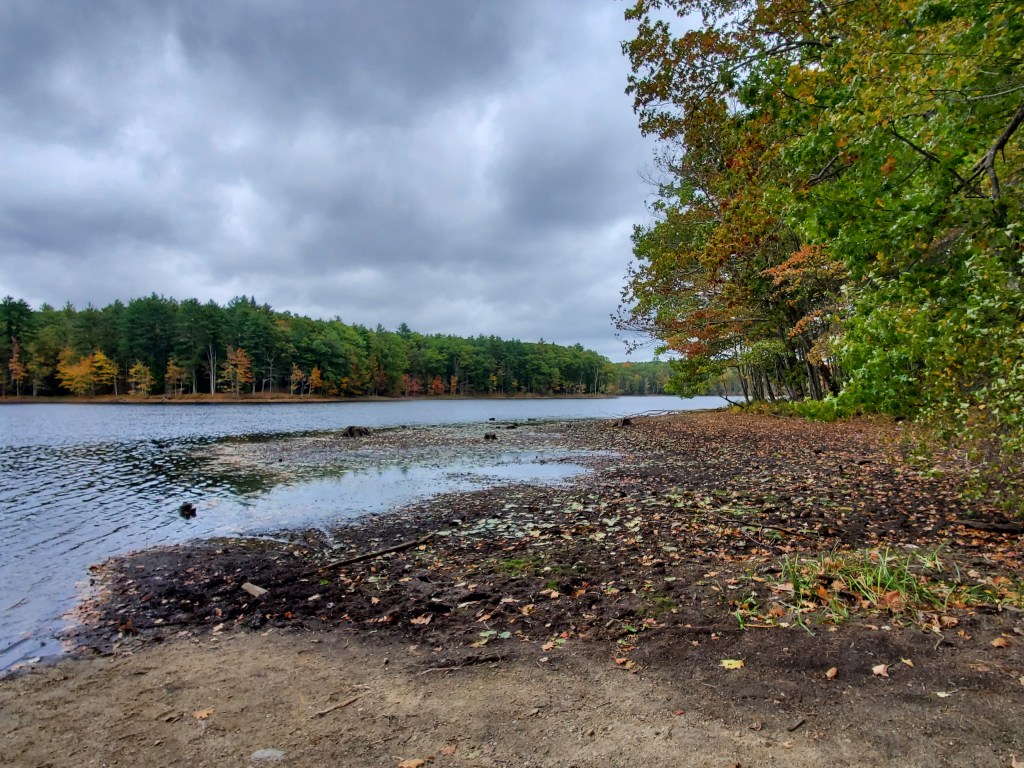
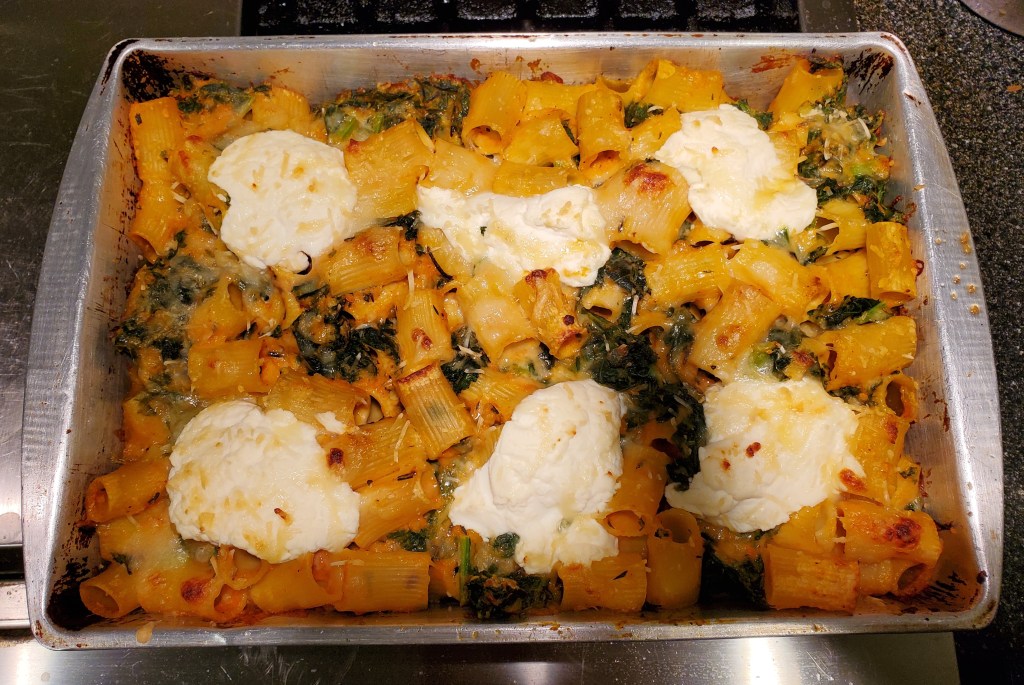
Madbury reservoir levels way down But, it IS beautiful out. And the New York Times recipe for cheesy pumpkin pasta with kale turned out well.
And yesterday’s regional meeting of the New Hampshire Library Trustees Association in the lovely, new, light-filled Barrington Public Library once again affirmed that there are lots of smart, committed people quietly, successfully keeping truth free and accessible to all.
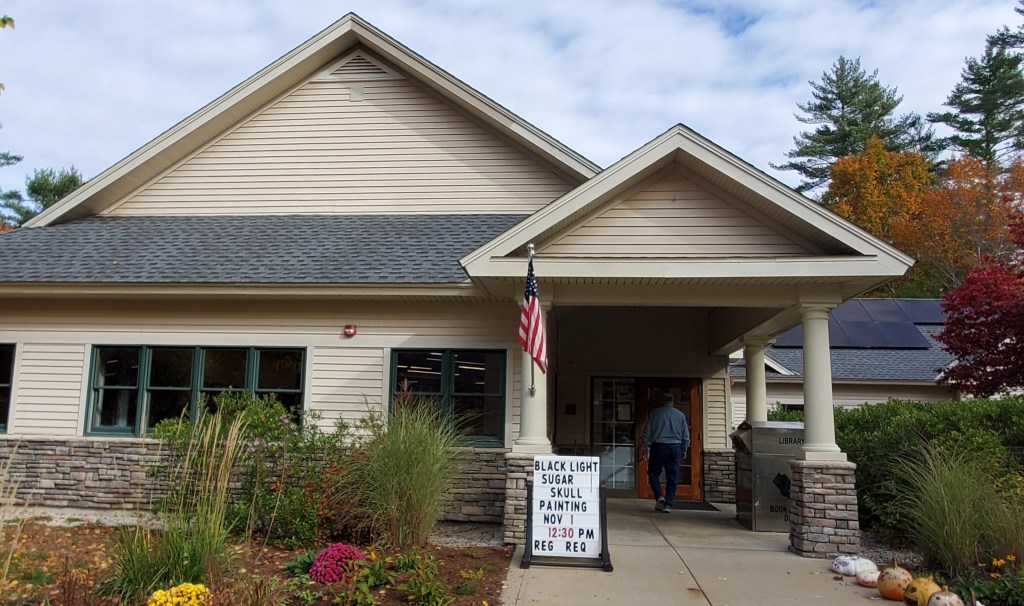
Barrington Public Library And best of all, young Eric Lu, 27-year-old classical pianist from Massachusetts whom I had the pleasure to hear play back in 2016 at UNH when he wowed the audience in the Johnson theatre and kindly autographed my copy of his 2-cd recording of Chopin’s 24 Preludes, on Monday, 20 October, beat out over 180 competitors from all over the world to win the Olympics of the piano world, the International Chopin Piano Competition in Warsaw.
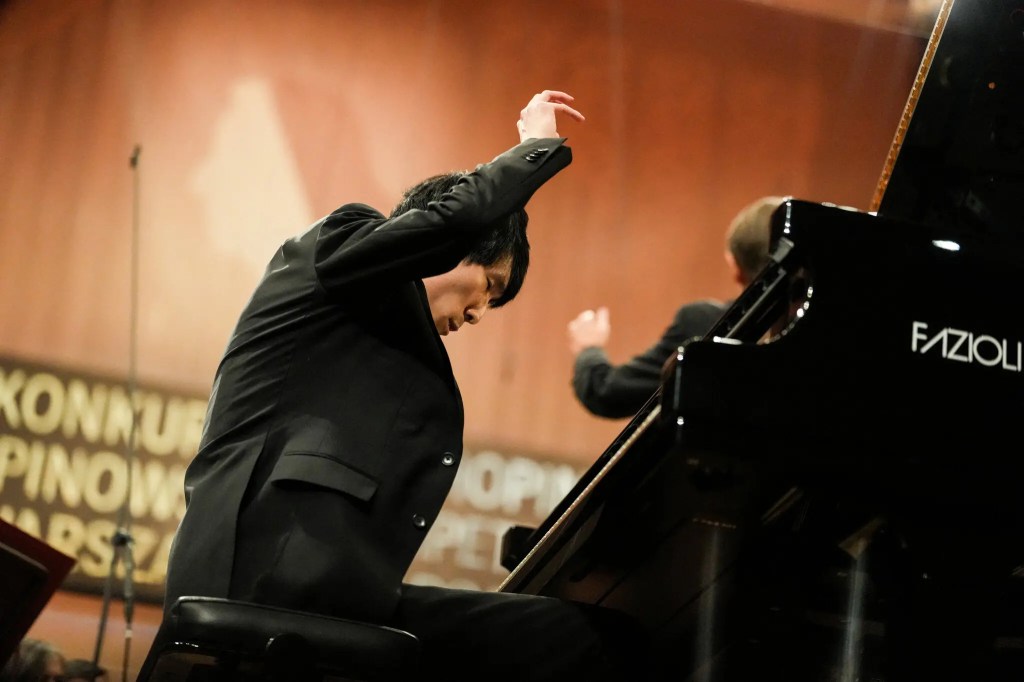
Eric Lu in Warsaw, photo by Aleksandra Szmigiel / Reuters He had placed fourth in the competition at age 17 in 2015, and returned ten years later to take home the gold and 60,000 euros. Dear Reader, watch his performance in the final round of the competition on YouTube if you are in need of some uplifting good news.
May the good prevail.
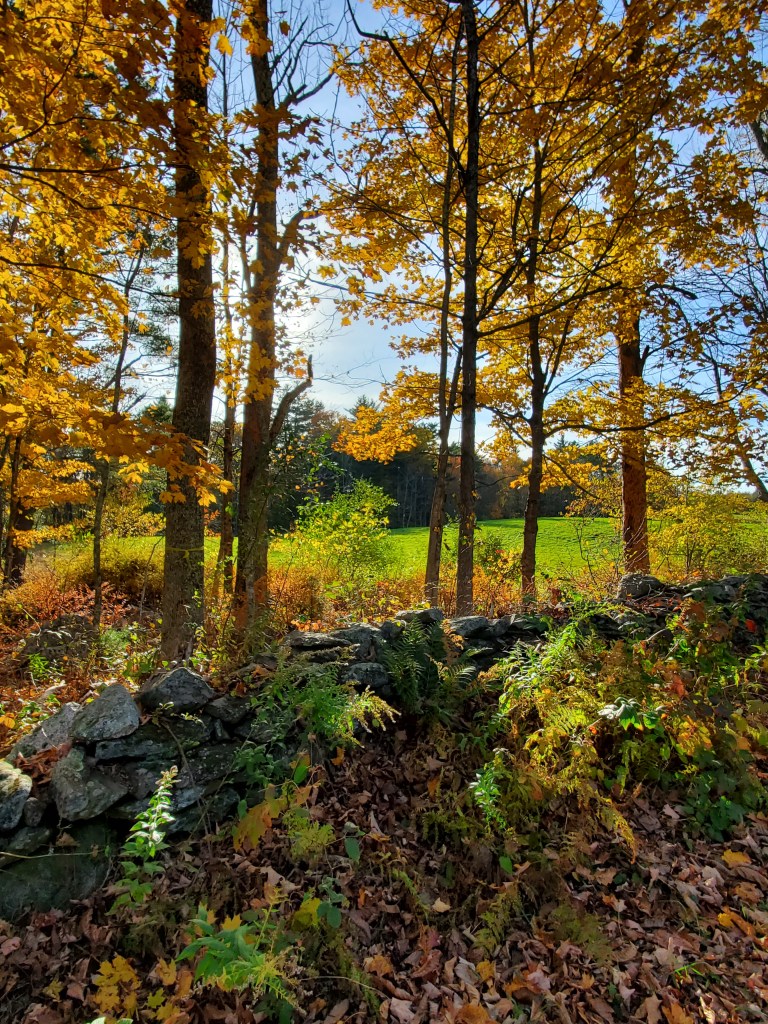
Nute Road pasture, 19 Oct 2025 -
Flower Power
13 October 2025

Mums at the Wentworth Nursery, Rollinsford NH, 12 Oct 2025 The grey morning of 8 October, my birthday and day 5 of a frustrating case of laryngitis, did not begin auspiciously. I woke from some sad dream morbidly wondering who would, when the time came, take on the task of spreading my ashes around the flower beds of my home, joining those of my father, mother, sister, and husband among the daffodils. Then I knocked over my bedside water glass and had to scramble to clean up the spill that immediately seeped under the glass topping the dresser stacked with books, partially read New Yorkers, and a daunting array of supplements.

Birthday bouquet from Jennifer First order of business: hydrate (the better to prep for an IV insertion) and get to a medical appointment. But traffic was stalled just before the General Sullivan Bridge, the only way across Little Bay to my Portsmouth destination. An earlier accident was the cause, I later learned, one I happily was NOT involved in, despite the symmetrical allure of ending my earthly voyage on the very day it began.
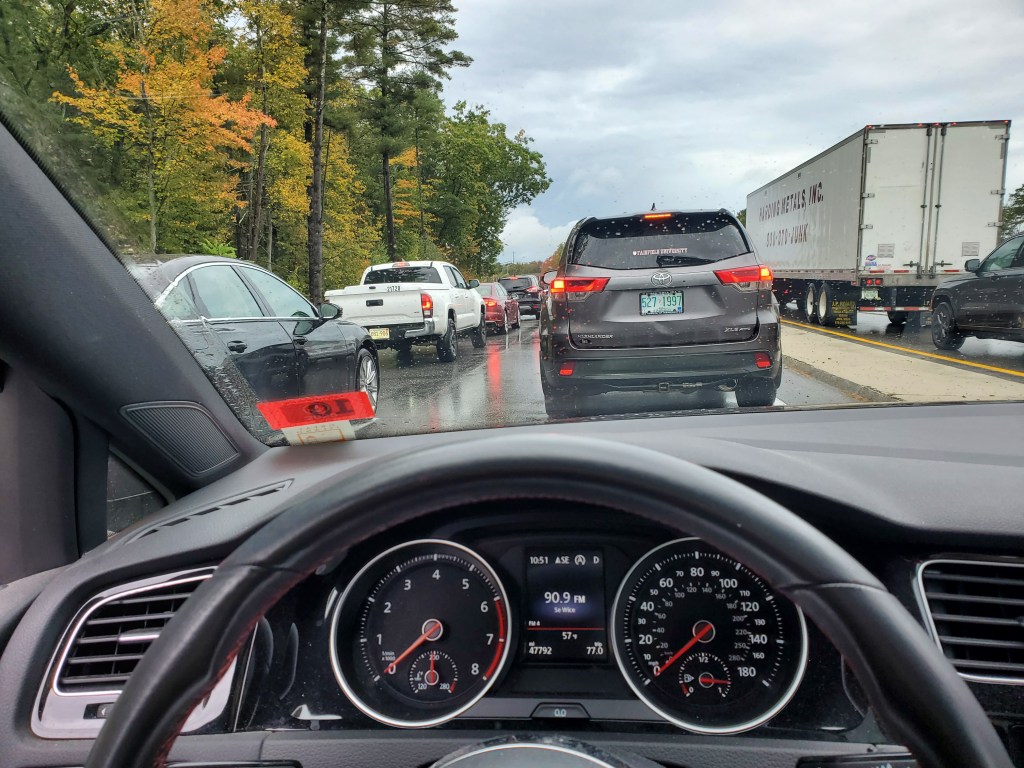
Traffic at a standstill on the Spaulding I nevertheless made it to my long-scheduled CT scan at Mass General Brigham’s Pease facility in good time to “enjoy” my barium sulfate smoothie and the tender ministrations of Megan and Christine, who guided me into the high-tech donut hole with minimal discomfort. Welcome to septuagenarian birthday celebrations.

Birthday breakfast of champions 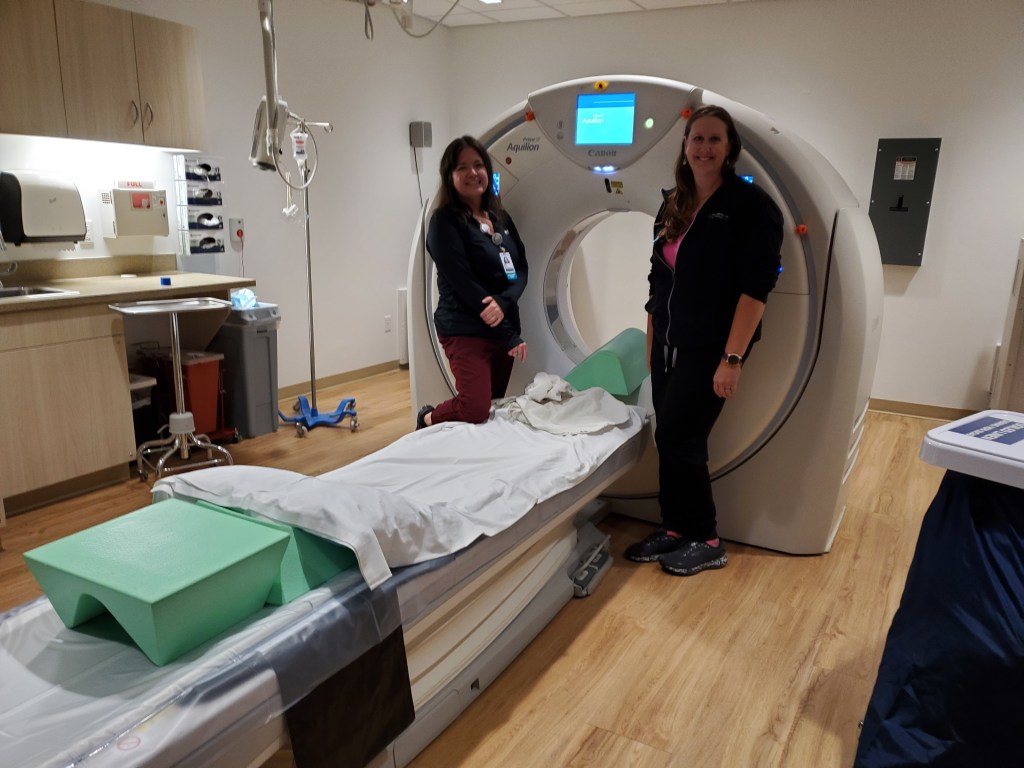
Megan and Christine cheerfully assist The MGB facility on the former SAC base is nicely landscaped and quite handsome, however, and though rueful about the clinical start to my birthday, I was grateful for the health care out-of-reach for many of my fellow citizens, a situation that on day 8 of the Federal shutdown is only likely to get worse.
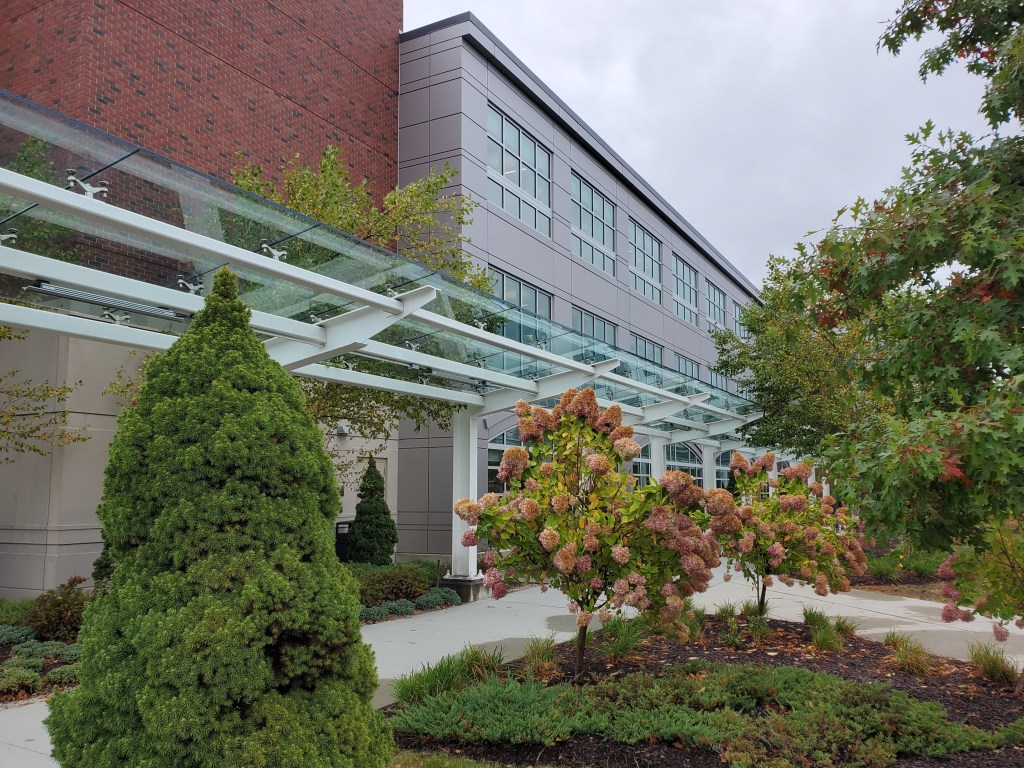
Mass General Brigham Health Center, Portsmouth NH Trying to avoid mental doomscrolling about the State of the Nation, I rewarded myself with a breakfast bialy at Kittery’s Beach Pea bakery, where I also picked up my birthday cake, and then drove on to New Castle, stopping first at the Riverside Cemetery, established in 1868 and affording all its residents some pretty enviable views.
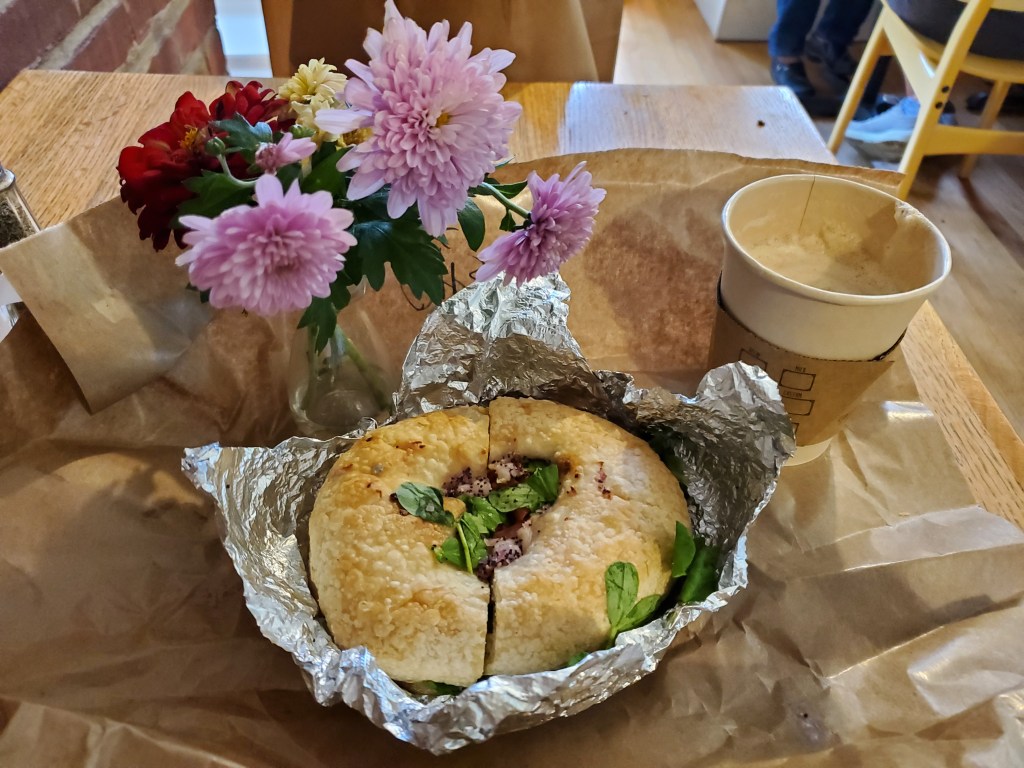
Birthday breakfast #2: Bialy at Beach Pea Bakery 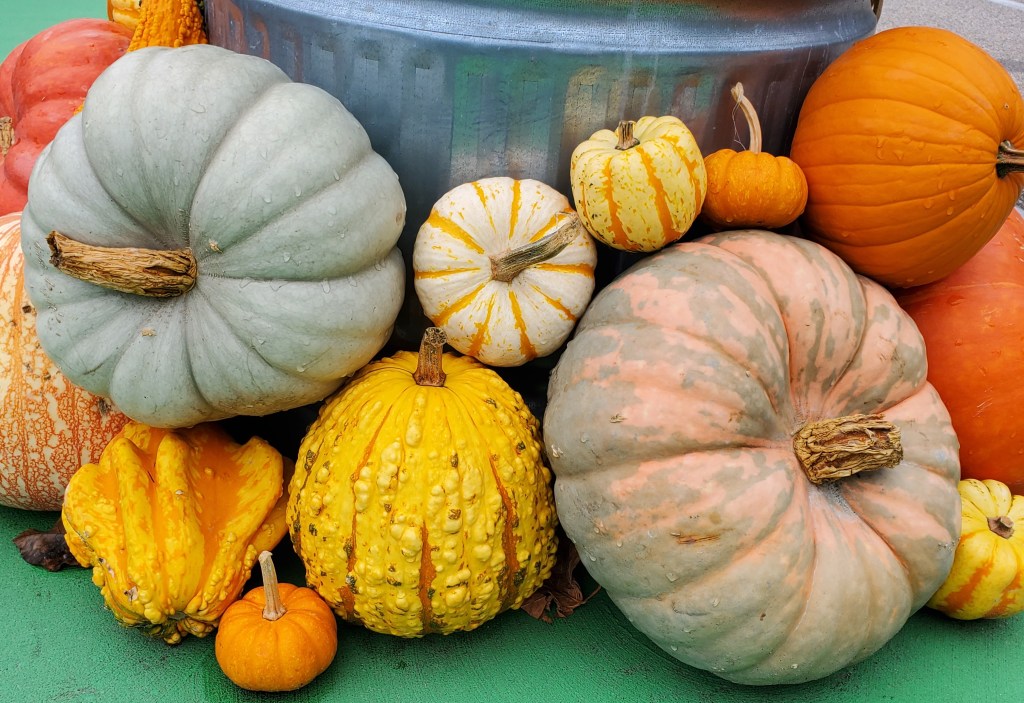
Autumn display at Kittery’s Golden Harvest grocery 
Riverside Cemetery, est. 1868, New Castle NH The overcast skies proved appropriate for the spooky season. Later walking the beach at Great Island Common, I felt no urge to immerse myself in the between-the-rocks plunging place that had so delighted me throughout the sunny summer: fall has indeed arrived. Instead, I admired the finesse of the three Moran tugs guiding a freighter into the mouth of the Piscataqua, and snapped a few photos of the sea grasses attired for autumn.
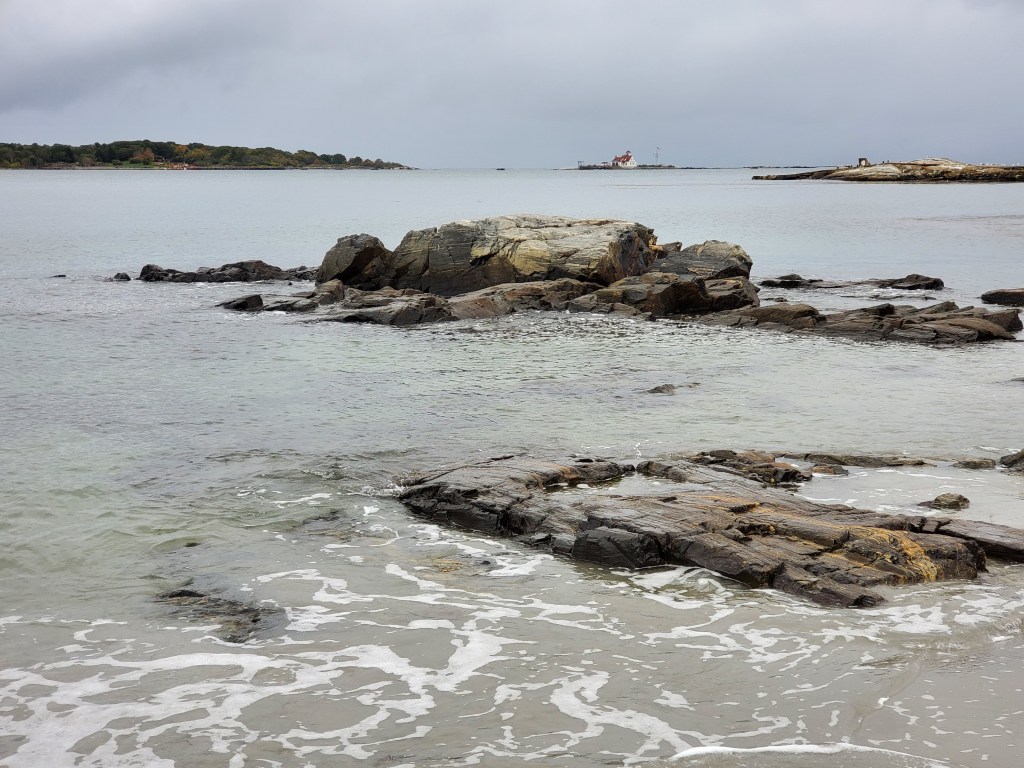
My summer swimmin’ hole: not so inviting in October 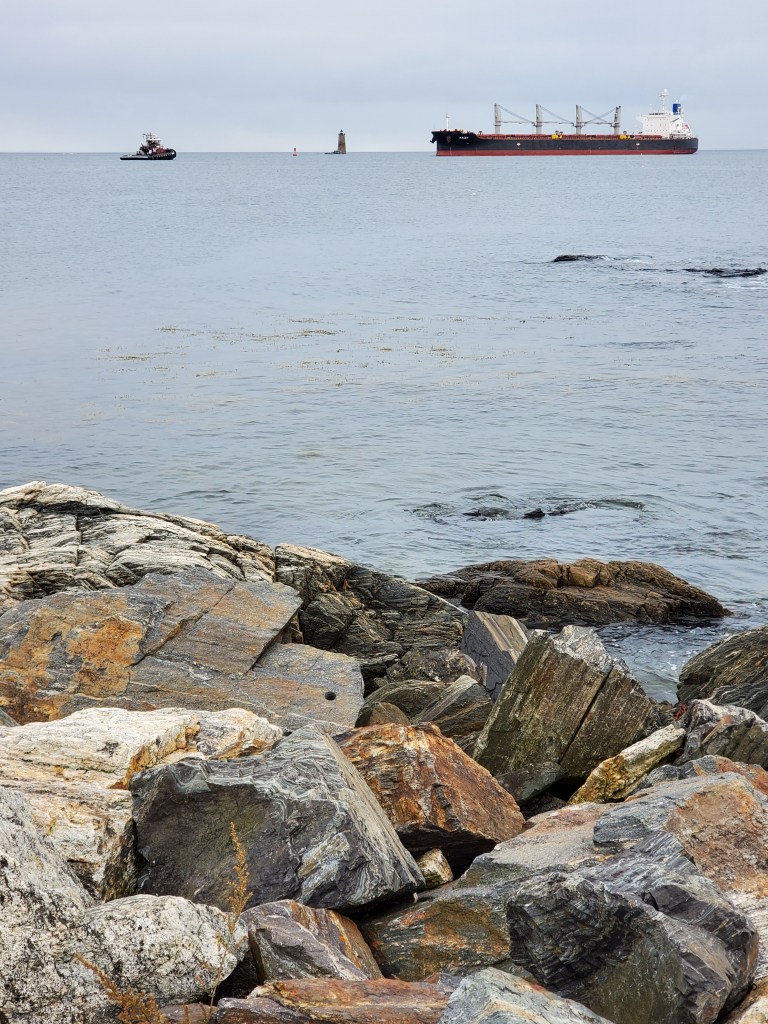
A Moran tug approaches its freighter, Whaleback Lighthouse in between 
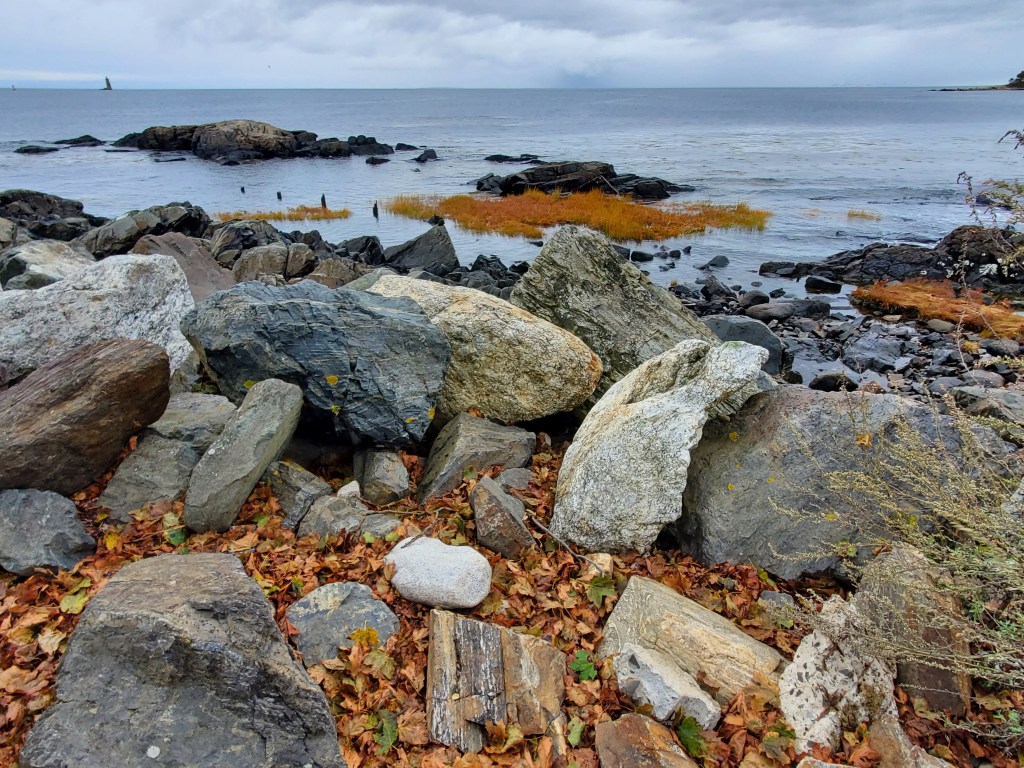
Great Island Common in October En route home, I stopped at Emery Farms for some decorative pumpkins, admired the foliage on Hayes Road, and planted the next 10 daffodil bulbs of this fall’s campaign; there will be 100 newcomers flanking the garden steps come April.
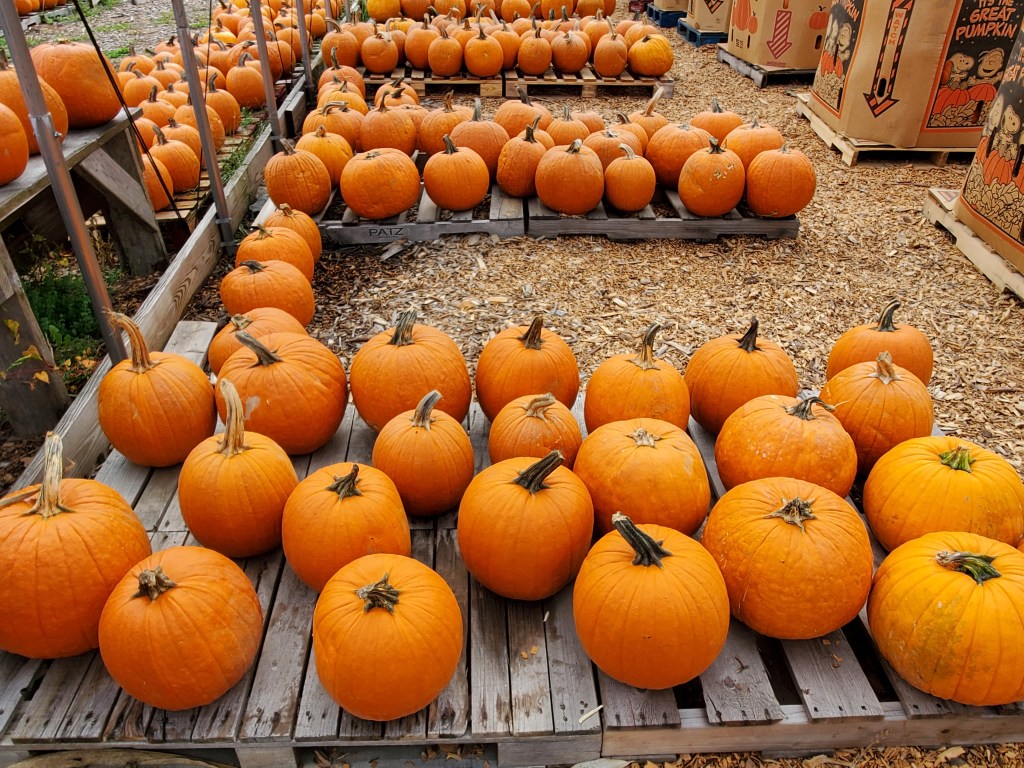
Emery Farm pumpkins: weighed and sold on the honors system. Yay! 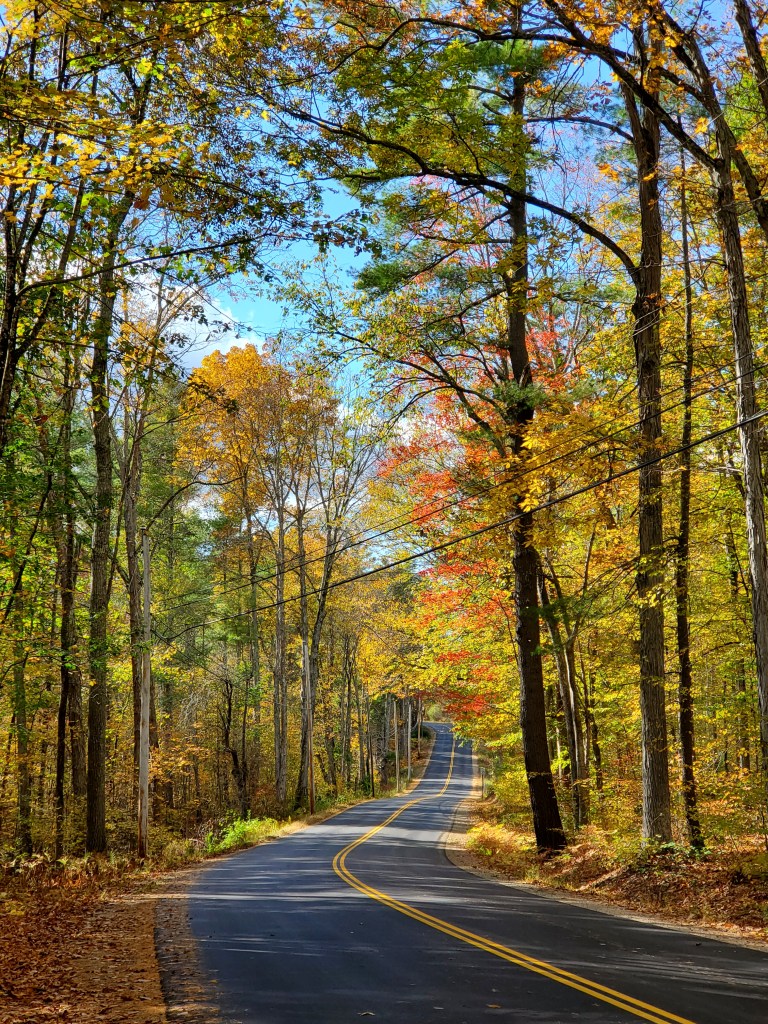
The sun comes out on Hayes Road, Madbury NH Then it was off to the guaranteed physical and spiritual uplift of Ruth Abelmann’s yoga class, followed by my usual Wednesday night pasta dinner at home, this time completed with a slice of Beach Pea chocolate/raspberry cake, and finally the latest dropped episode of Slow Horses.
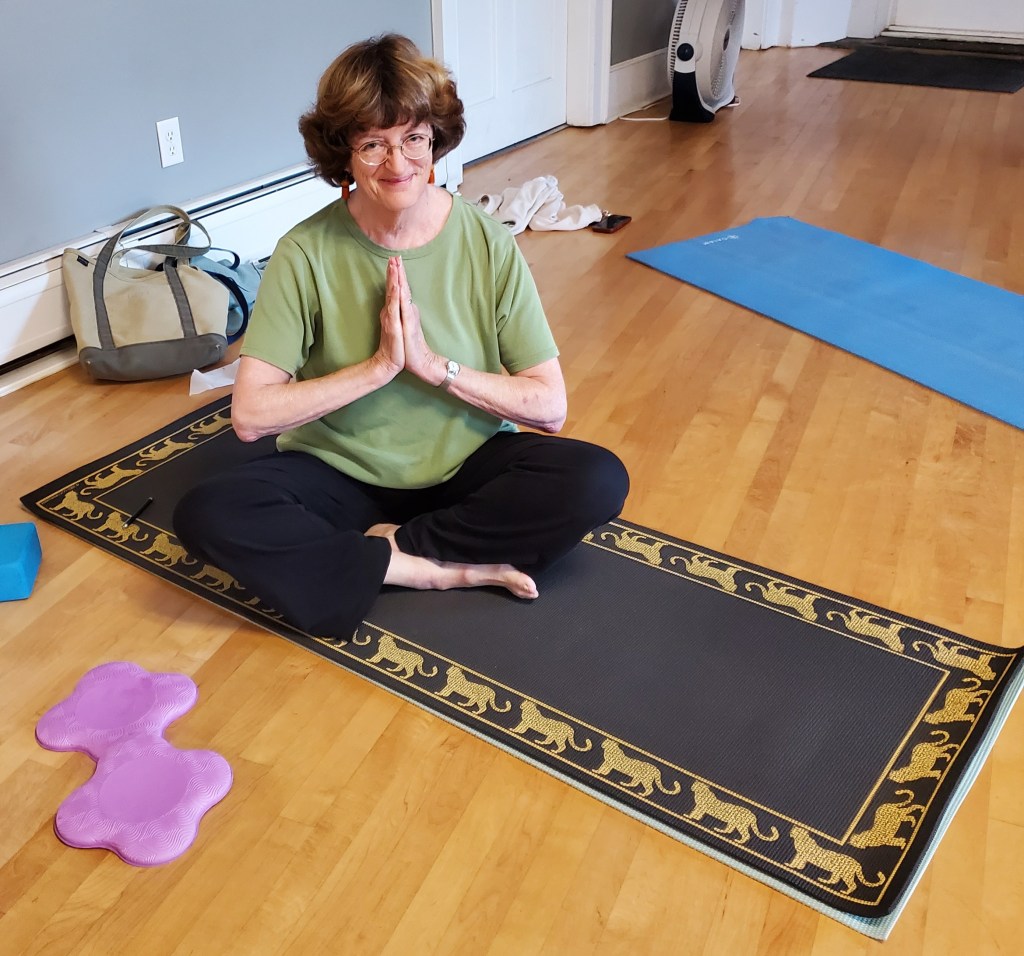
Namaste (photo by adjacent yogi Claire) 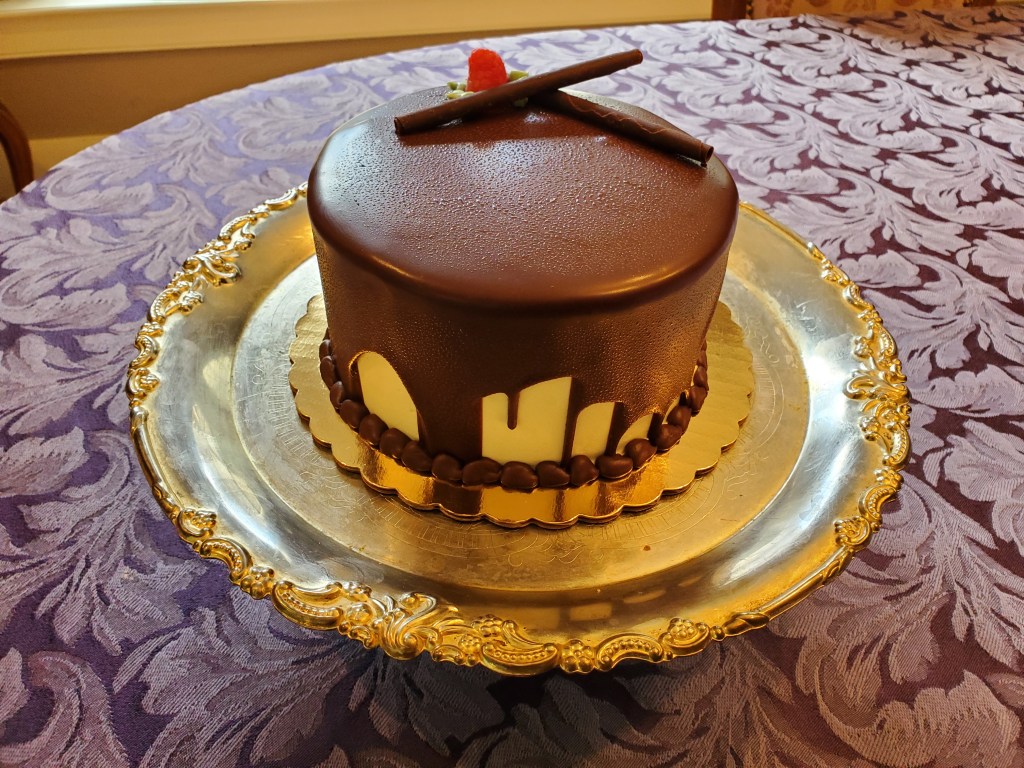
Beach Pea Chocolate/Raspberry Cake I take it as a birthday treat that this episode 3, “Tall Tales,” was my favorite of all 5 seasons so far: Jackson Lamb, deliciously profane, witty, and squalid as played by Gary Oldman, so cleverly spins a spy tale of STASI interrogation that he both distracts the Dogs keeping the Slough House team in lock down and prompts his “joes” to perform the coordinated assault that frees them. I’ve watched that delightful scene three times now, and may yet watch it again—despite the uncomfortably recognizable “destabilization strategy” at the heart of Season 5, “London Rules,” based on Mick Herron’s 2018 novel of the same name. How do you create widespread chaos and division in five easy steps?
- Compromise an agent (seduce one of the good guys into inadvertently helping the bad guys)
- Attack the village (evoke terror with random violence that harms civilians)
- Disrupt transport (keep people from traveling freely)
- Seize the media (create a viral media distraction, diverting the public and news outlets from a larger, more sinister plot—aka “flood the zone”)
- Assassinate a populist leader (a politically motivated assassination maximizes chaos and further destabilizes the government)
Yikes. Sounds all too familiar. No wonder I’ve inadvertently memorized the “Strange Game” lyrics Mick Jagger so memorably recorded for this series. Life in these Un-tied States has indeed become a strange game.
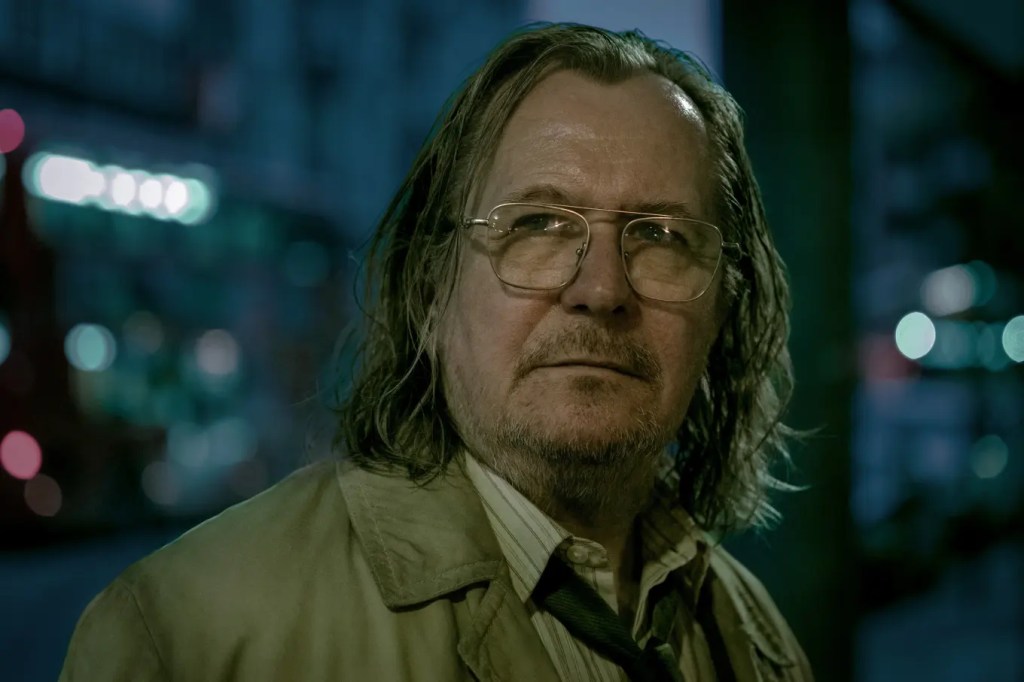
The brilliant Gary Oldman as down-on-his-luck spook Jackson Lamb in Apple’s Slow Horses But the next day, following up a tip from Ruth about a dahlia display in Newmarket, I discovered a compensatory counterbalance to the gloom of dispiriting news and a lingering virus. Estate gardener Spencer Scott maintains a spectacular garden of 250 dahlia varieties in a waste space adjacent to a Newmarket parking lot on Bay Road.
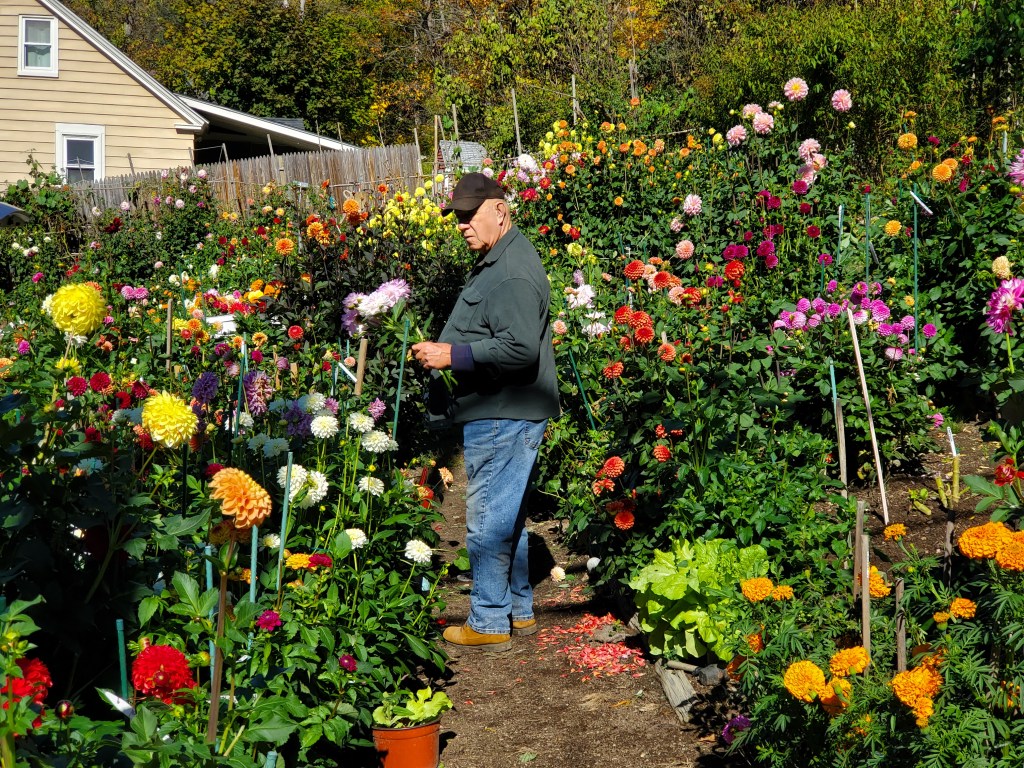
Estate Gardner Spencer Scott among his beauties, 9 Oct 2025, Newmarket NH That night would bring our first frost of the season, so he was on site to offer bouquets of the bounty that would not last the night, and to answer any questions. Spencer’s love of his garden was evident as he detailed how he cares for his plants, harvesting seaweed and grinding it with a mower to enrich the soil, feeding and watering each plant directly to its root system, experiencing two hours of such care “as no more than 5 minutes,” and turning bleak to beauty.

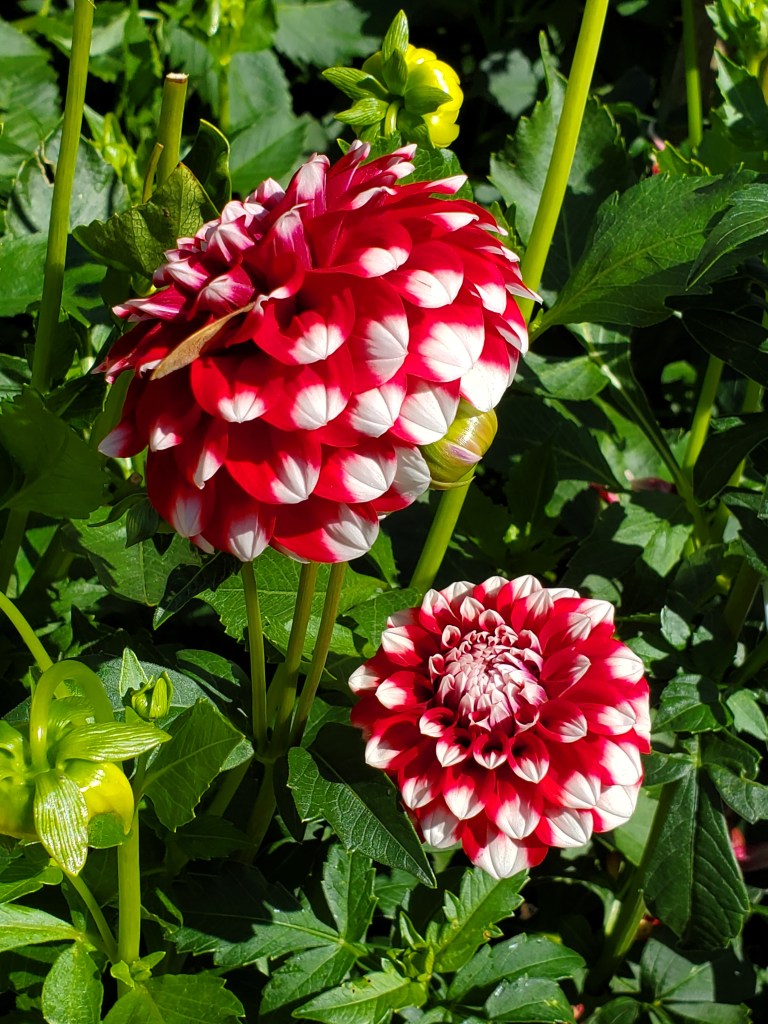
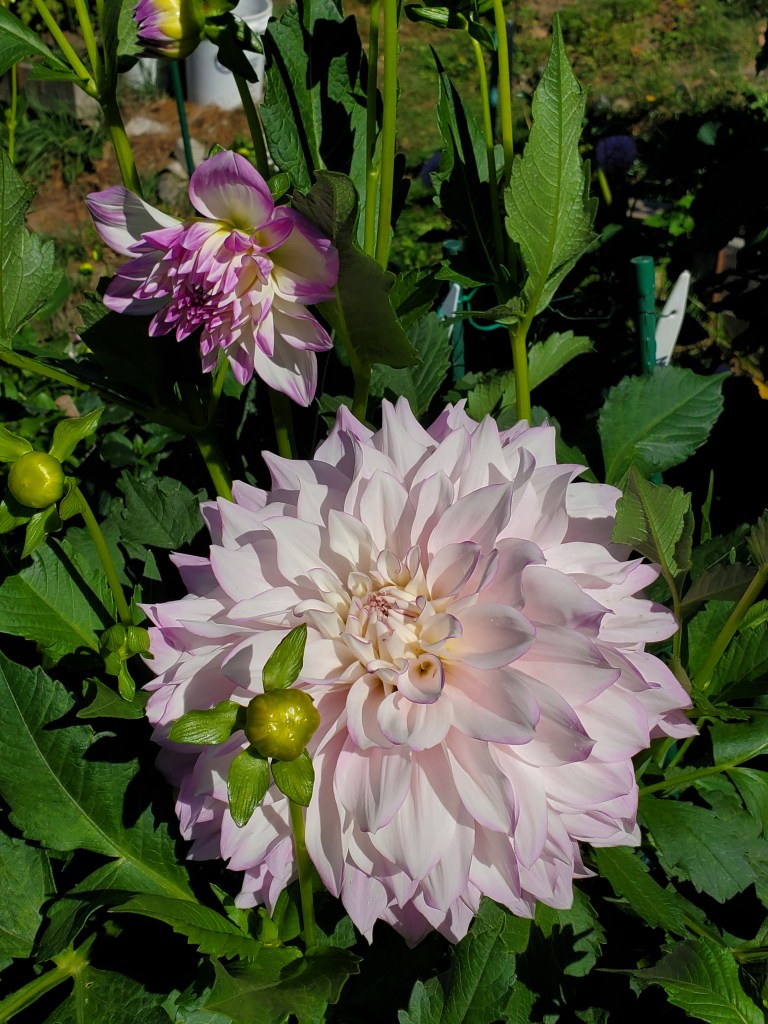
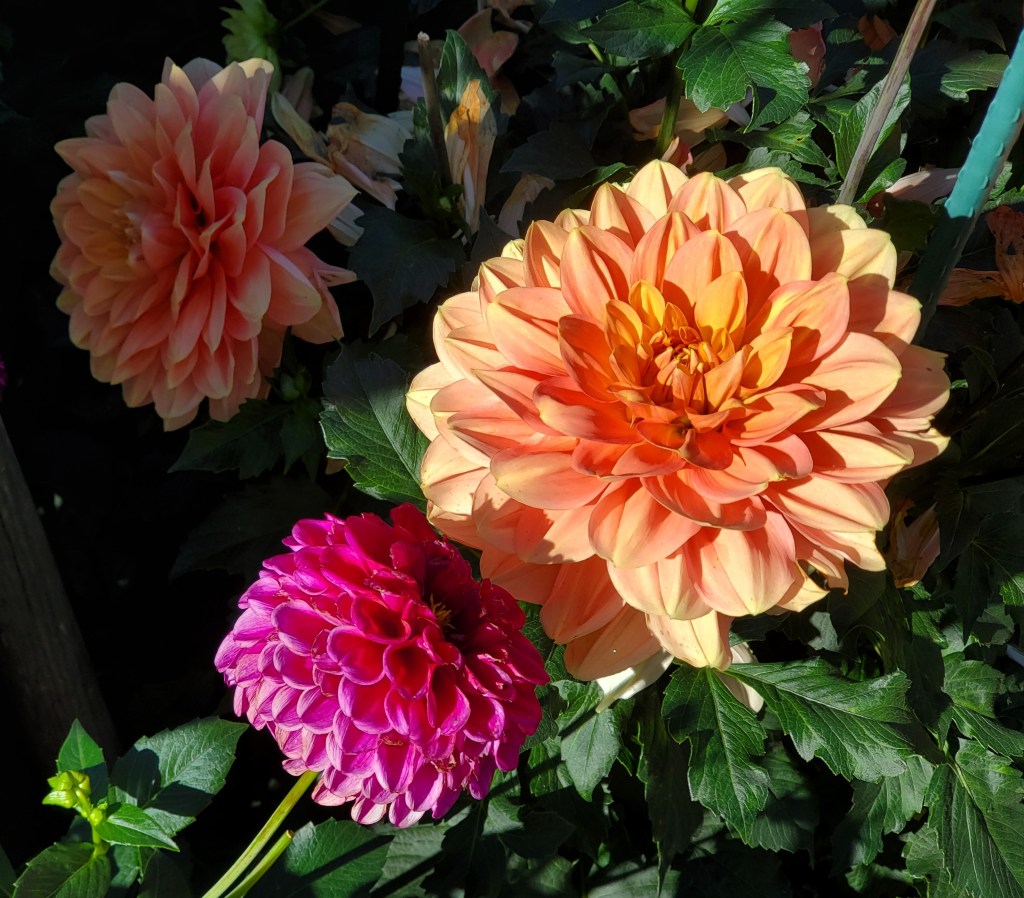
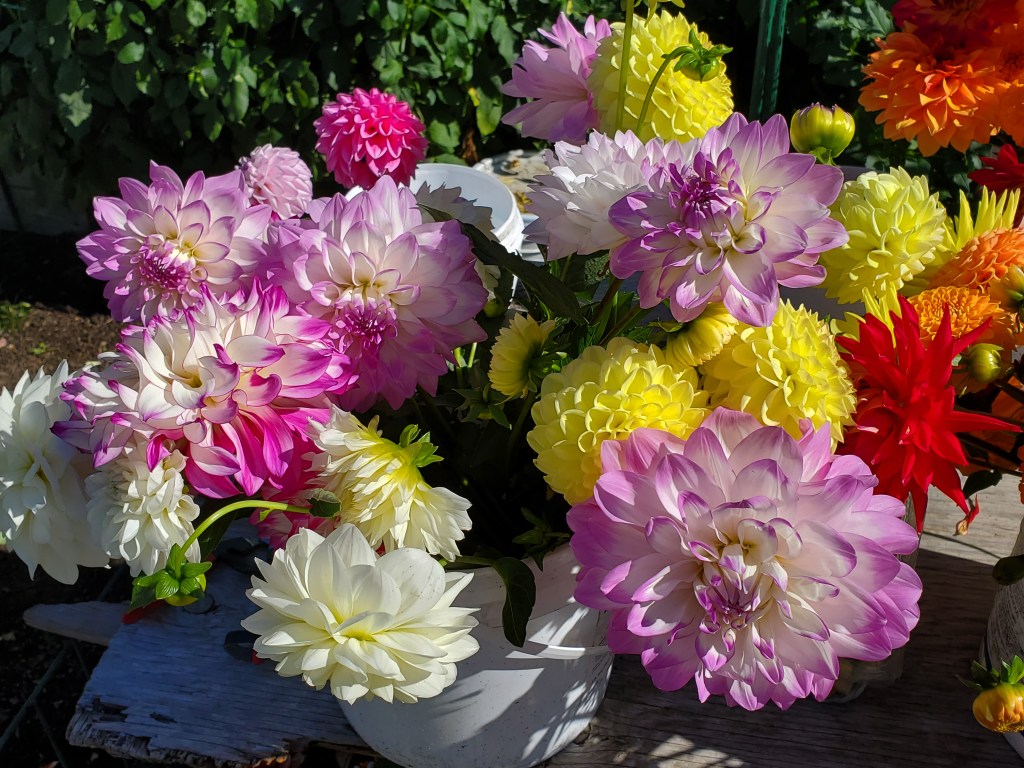
Flower power: it cast a spell, a tonic reminder of goodness in the world, and a most welcome start to my 73rd year.
-
October Accounting
4 October 2025

Wild grasses at Gnawwood Here it is, Dear Reader, nearly two months since my last post, well into my birth month, and I’m struggling to account for all that has transpired since last I addressed you.. What’s been happening? My last hummingbird deserted the feeder outside my kitchen window over a week ago, no doubt bound for warmer climes to the south, and the house now makes the snap, crackle, and pop sounds that I long ago learned signify lower humidity, not some intruder. Autumn has arrived after the driest summer on record in New Hampshire. The leaves are turning early and dropping fast.
I did at last finish painting the deck railing with penetrating oil, readying it for winter. Oh, the MANY surfaces of a Chippendale pattern! And 100 more daffodil bulbs await planting—for the first time ever assisted by an auger bit, once I locate the 20V cordless drill necessary to twirl it. I’ve made little progress in discarding—another planned summer project—though half our LP collection has now found another home to make way for the 28 Murphy Family photo albums my late mother so carefully kept and my brother-in-law so kindly sent me. I also spent WAY too much time preparing last Monday’s book talk for the Madbury Library on “Will to Live: How and Why My Book Came to Be,” both a lamentation about the demise of Shakespeare requirements in a culture with too few common denominators, and a reminder of just how much effort and energy a well-crafted lecture requires. Thank goodness I’m retired.
Vetting applicants hoping to become our new Madbury Library Director helps to fill my most recent days, along with two book groups, some volunteer driving, and the ever-increasing demands of an aging home and body, punctuated by correspondence with peers fighting the same geriatric battles. Tai chi and yoga classes help, as do walks in the glorious New England fall. These sustain.
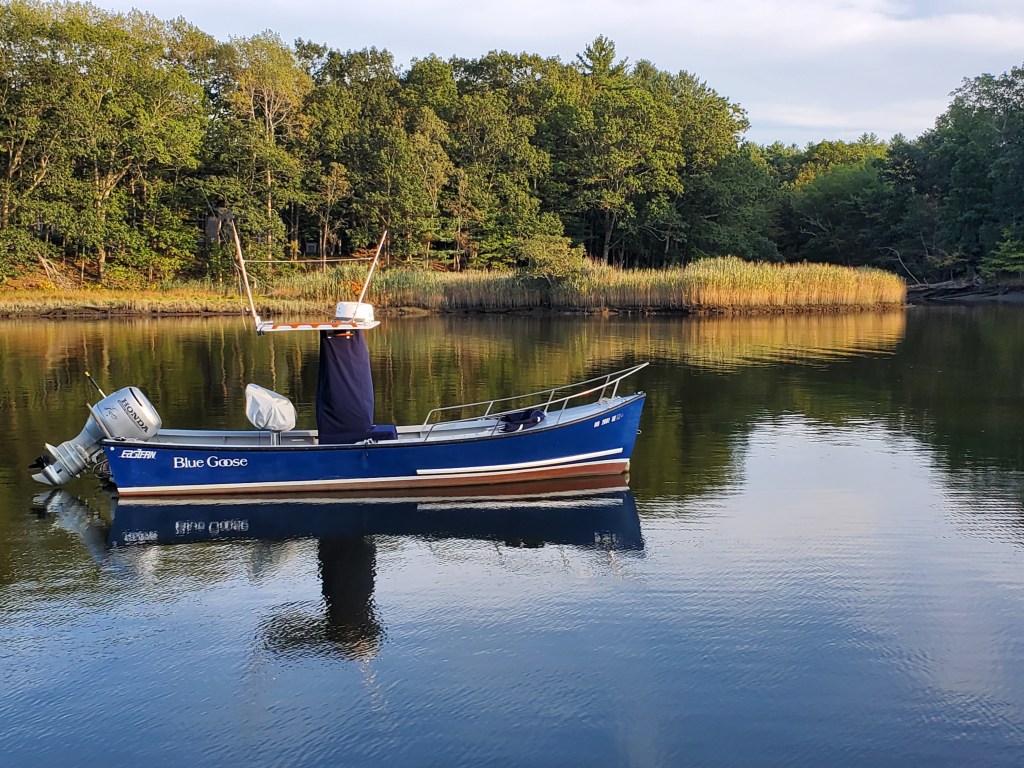
Durham Town Landing on the Oyster River But there have also been losses beyond remedy: the unexpected passing of my acting professor and friend of 52 years, Pete Smith, who first gave me the courage to step onstage. Pete became the devoted husband of my college suitemate, Karen, and the beloved founder of both the Warehouse Theatre in Greenville, South Carolina and the Theatre Department at Sewanee’s University of the South with its very fine Tennessee Williams Center. Pete leaves a lasting legacy in the generations of students he trained and inspired, but will be much missed.
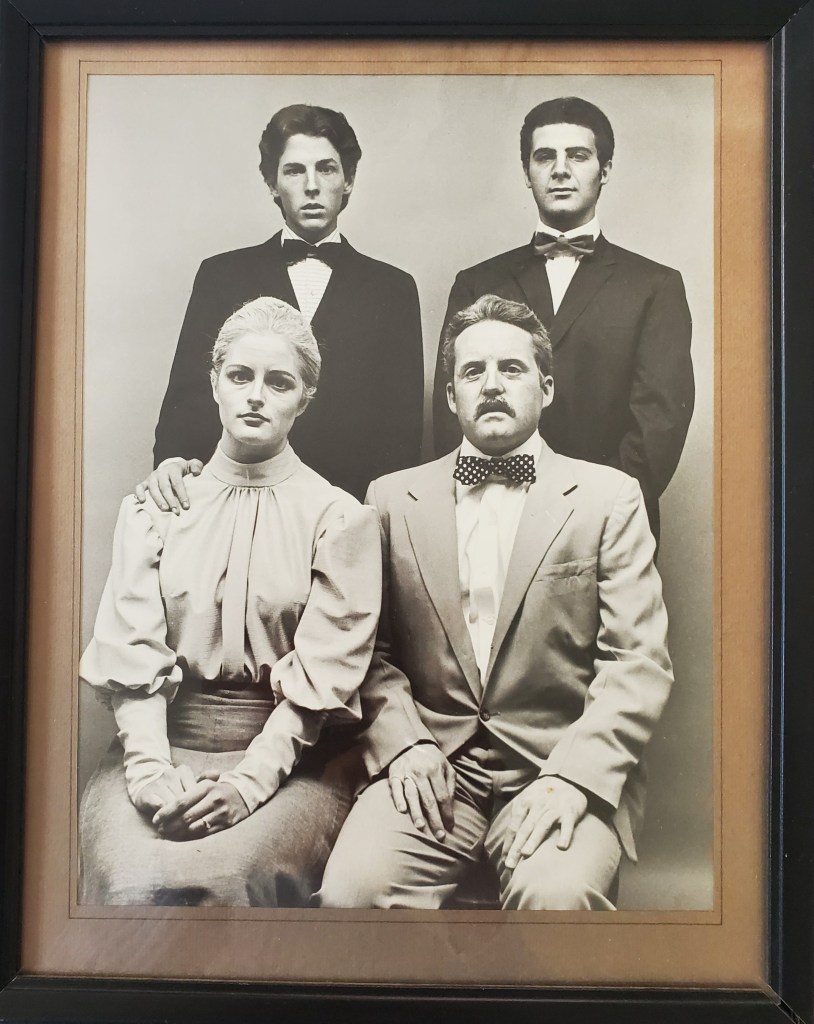
Furman U’s 1974 production of O’Neill’s Long Day’s Journey Into Night, with Pete Smith as James Tyrone, me as Mary, Dean Coe as Edmund, and Bill Iannone as Jamie Closer to home—literally just up the street—a shocking murder/suicide in August left a family of five suddenly, horribly reduced to a single surviving three-year-old, a baffling tragedy that has rocked our little town, reminding us of how little we know the lives of others in our digitally connected and yet dangerously isolated world. The daily, nearly hourly assaults on democracy of the Felon-in-Chief continue to confound and depress. Jimmy Kimmel’s muzzling proved temporary, but Colbert’s has not, and today marks day four of a government shutdown irresponsibly, perfidiously blamed on racist lies about funding healthcare for illegals. And we’ve lost that talented artist and humanitarian Robert Redford. I’ve been mourning him by streaming films he either acted in or directed that I’d not seen before, including two from 1992, Sneakers (fun with an amazing cast!) and A River Runs Through It, starring the young, luminously gorgeous Brad Pitt. The scripted line describing Pitt’s character, Paul Maclean, just as aptly described his director, Redford: “He was beautiful.” In every way.
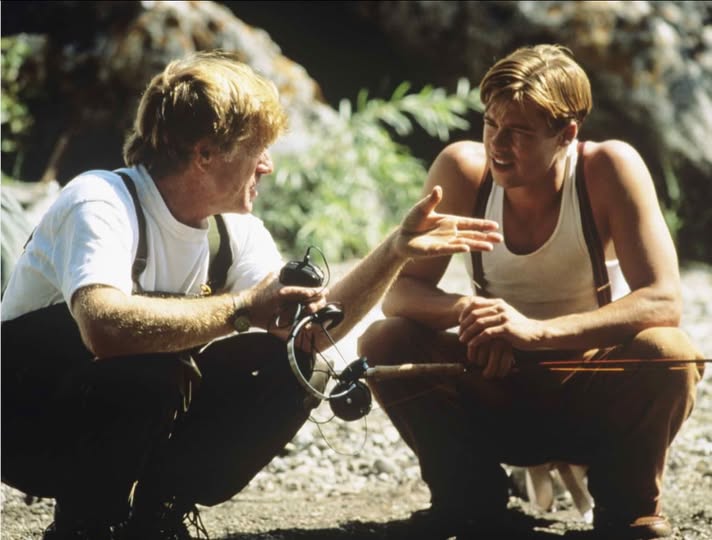
Redford directs Pitt in 1992’s A River Runs Through It My privileged life nevertheless affords me the leisure to buffer horrors in the micro- and macrocosm. Reading the role of Nancy Sandberg in David Moore’s scripted version of his 2018 history, Small Town, Big Oil, the tale of how three Durham women bested Aristotle Onassis’s plan to build an oil refinery on Great Bay, gave me a first-ever chance to play someone who was also watching from the audience.
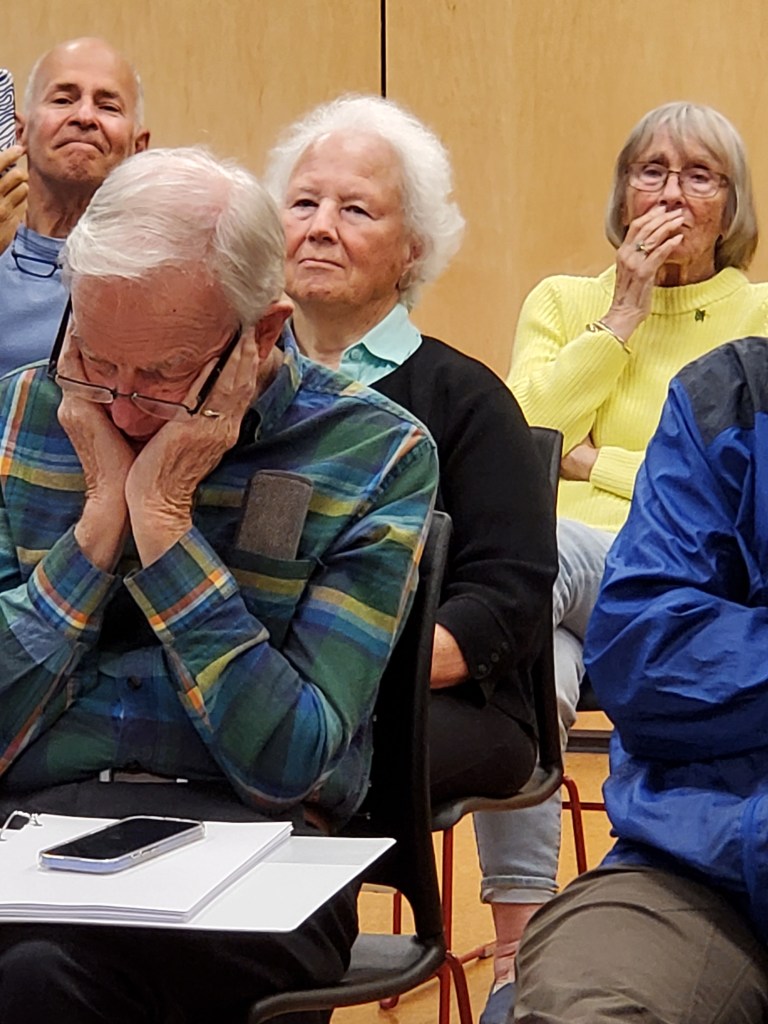
Playwright David Moore on book with the heroic duo Nancy Sandberg behind him, and Dudley Dudley behind her 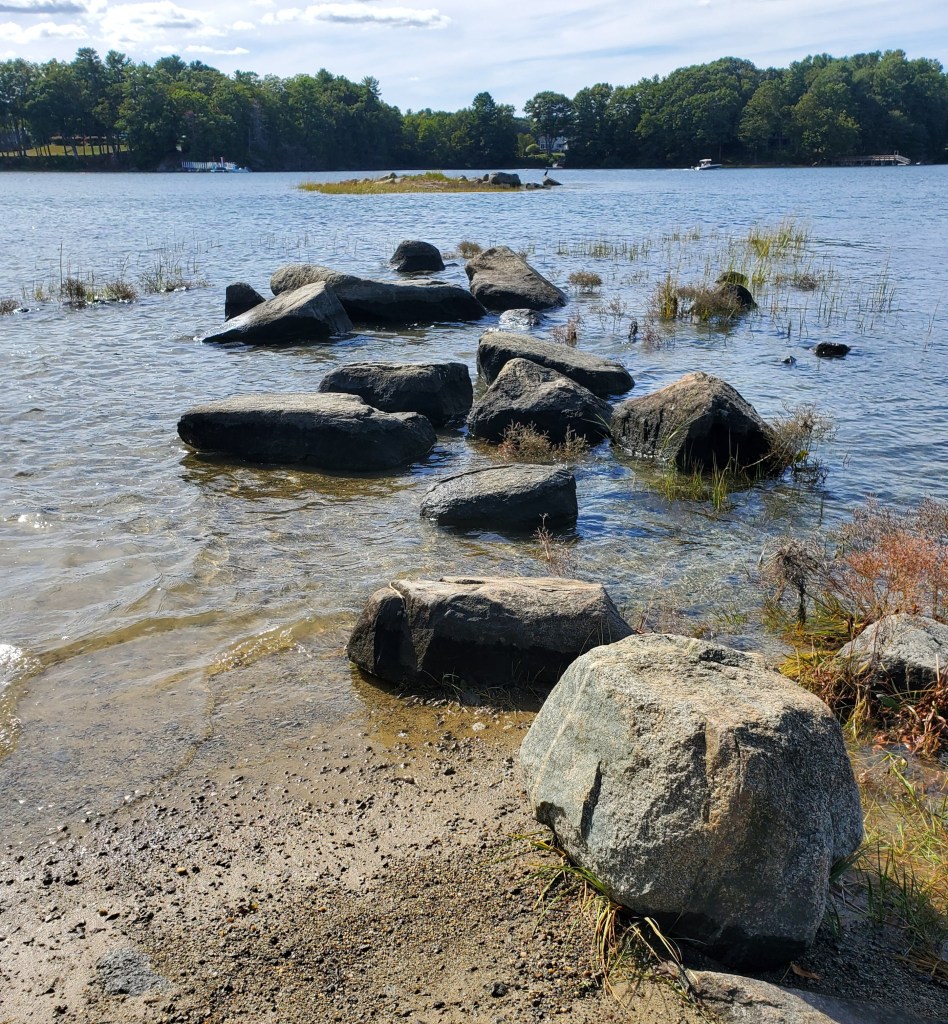
The Bay that Sandberg, Dudley, and Bennett saved 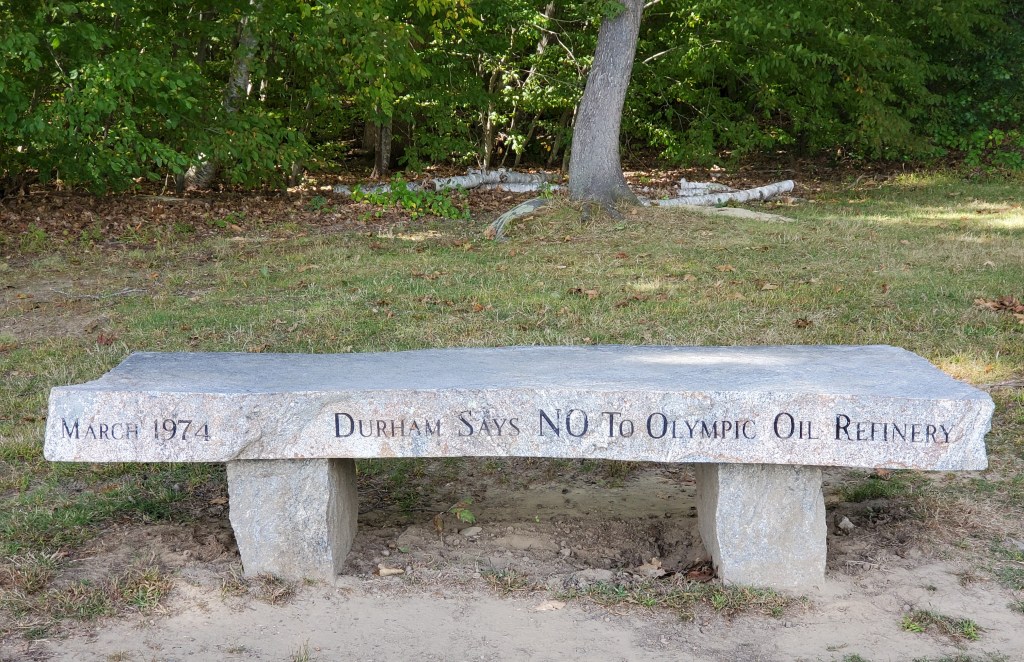
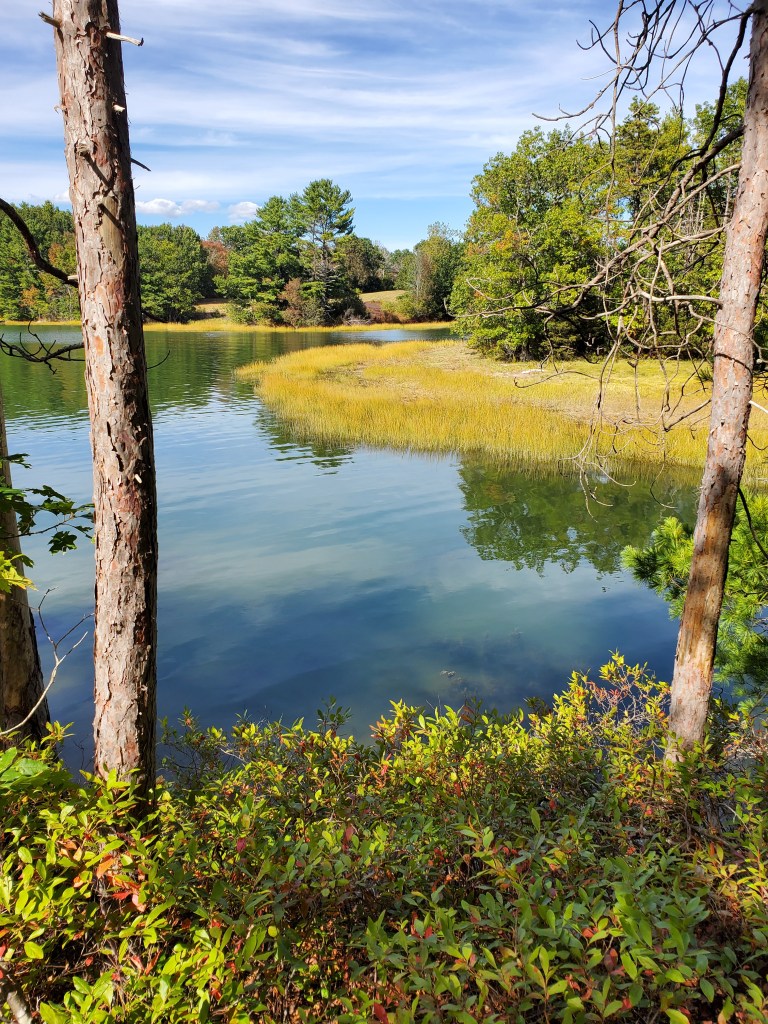
What MIGHT have been a refinery, now preserved as Wagon Hill Farm 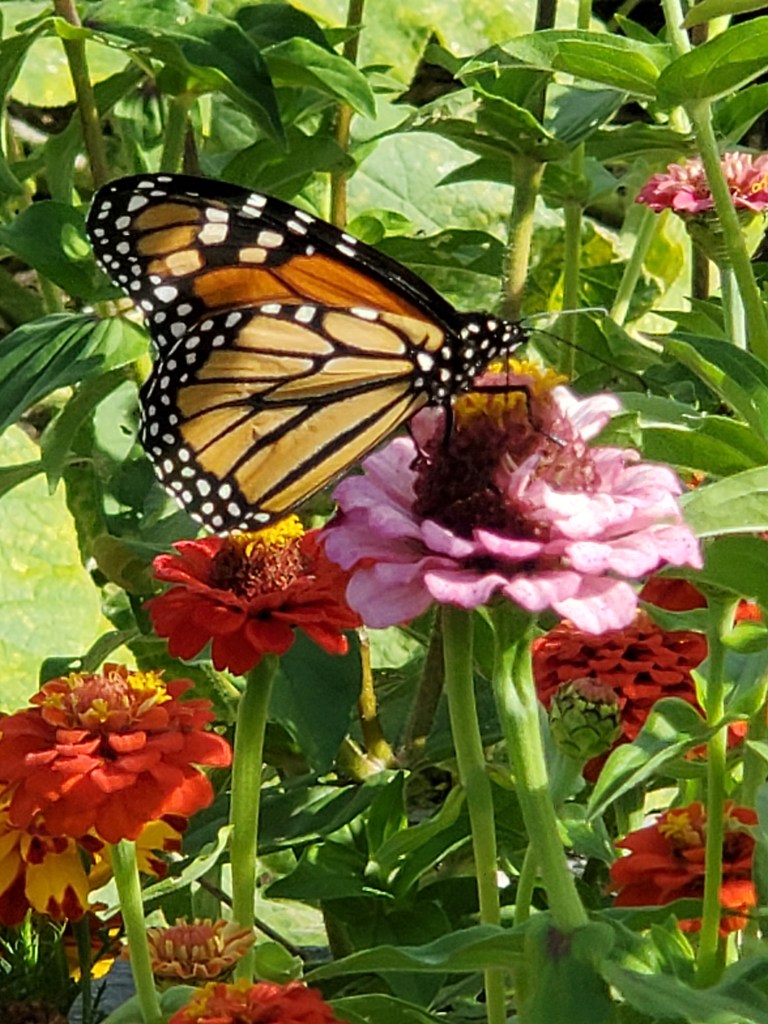
Monarch still in residence at the Wagon Hill Farm Community Garden And returning to the refurbished Huntington Theatre in Boston as the new season began with Jez Butterworth’s play The Hills of California, something of a British mashup of Gypsy and Crimes of the Heart, brought me all the reassurance of purposeful assembly in a sacred place, which is what the theatre has long meant to me.
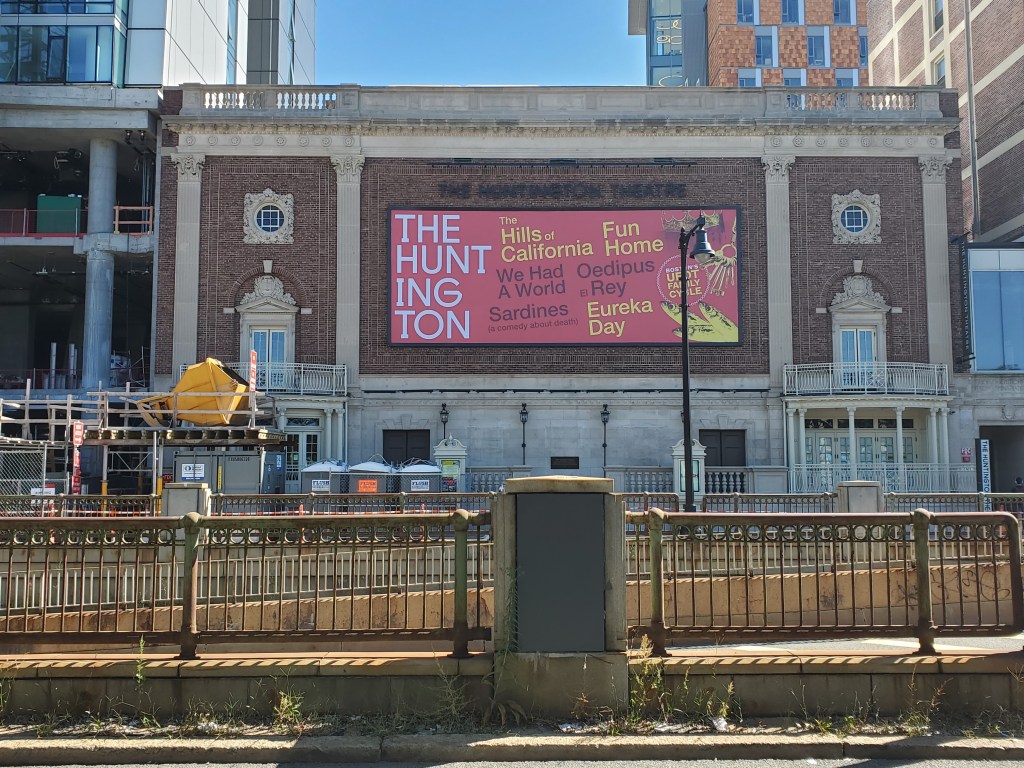
The Huntington Theatre, Boston More “No Kings” protests loom.

Cataract Ave Bridge Protest, Dover NH, 1 Sept 2025 So does Halloween: this year the seasonal decorations that appeared in the Home Depot by early September are more grandly animated (and expensive!) than ever. What does THAT say about our cultural moment I wonder?

Horrors at the Home Depot Me, I continue to commune with the wild birds, the rafter of turkeys devouring (even more, I hope) ticks, and the deer who’ve decimated hostas and hydrangeas but still manage to spark joy. Change is in the air.
We prepare for the worst, hope for the better.

Reflections at Wagon Hill: Nature’s Impressionism
-
Subscribe
Subscribed
Already have a WordPress.com account? Log in now.
 Georgeann Murphy