-
Close Encounter of the Feathered Kind
12 October 2023

Owl as Narcissus, courtesy of Jay Richard Last night I was out on our deck having my usual evening chat with my late husband David, my habitual practice ever since he left this dimension some four plus years ago. I sit and look at the stars and report out loud how I spent the day—both a good test of memory and a way to keep track of all that can too easily slip away without my noticing; I’ve learned this is a hazard of a retiree’s less structured time. Just a few moments into this outdoor recital, I heard a scratching on the deck railing less than a yard in front of me as I sat in the deck’s southwest corner sunk in my Adirondack chair. I snapped my head around at the noise and yelped, so startled was I. I then saw only a flash of feathers as who or what had tried to perch there took off away from me, sailing in low flight down the hill to the south.
Methinks my visitor was likely an owl, to whom I then apologized for my less than welcoming response. Wish I hadn’t made a noise; I would have loved a closer look. But I was so taken by surprise that any bird or beast would come so close while I was speaking. I always associate our barred owls with my late father George. Back in April 2002, I was awakened by a sadly expected early morning call from my mom telling me Daddy had just died. I was in bed with David. When I hung up the phone he asked if I was all right. I answered yes. And then, just moments later, we heard the owl’s “Who cooks for you?” cry just outside the bedroom window. “George?” we both said, hoping perhaps that was George Murphy’s parting adieu as he made his way out of this world.

The Barred Owl And then there was that time at the Grand Canyon. After a day of sightseeing, David and I returned to an overlook toting fixings for Canyon Cocktails to enjoy while watching the sun set. We lingered there appreciating the view until it was quite dark. Then, on the way back to the car just a few feet behind us, I heard and felt on my cheek the whoosh of a wing sweeping by me at very close range. I’ve learned from my photographer friend Jay (who sent me the stunning shot you see above last Halloween; see https://www.jayhawkphotography.com/ for other remarkable photographs) that owls are specially adapted for near silent night flight. According to the Cornell Lab Bird Academy, their large, broad wings let them stay aloft at a slower, and therefore quieter, pace. Specialized feathers take soundproofing a step further, and comb-like serrations on the leading edge of wing feathers and fringes on trailing edges reduce air turbulence and the noise they make as they fly. Another marvel of the natural world.
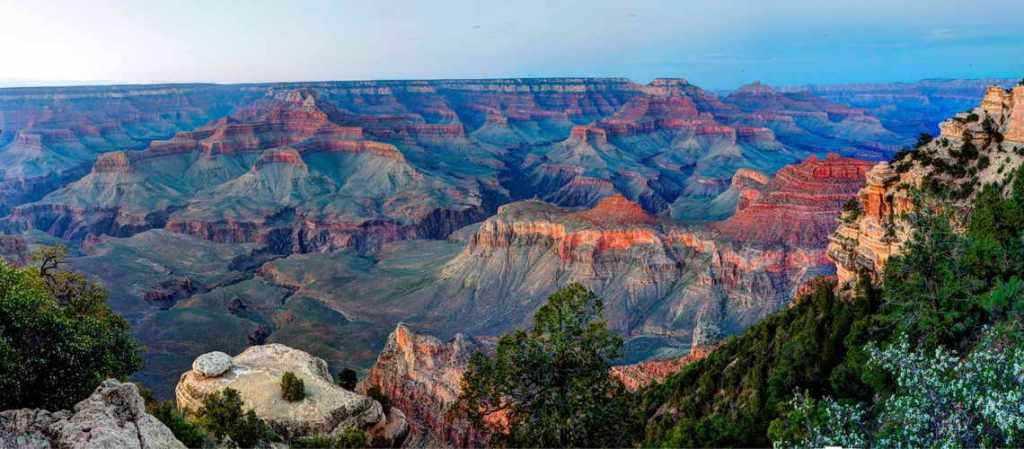
The Grand Canyon at Sunset I’m especially grateful for last night’s close encounter because this past week, my birthday week, while graced with a visit from my dear nephew and niece, has been full of overwhelmingly awful news. Aside from our unbelievably broken Congress and the appalling criminality of our ex-president (not to mention the absurdly egregious behavior of George Santos with his grifting lies, Bob Menendez with his gold bars, and Clarence Thomas’s complete disregard of judicial ethics), the war in Ukraine rages on even as Hamas militants let slip the dogs of war on Israel. My poor sister, herself having the fight of her life with cancer, was reduced to tears by the televised carnage; just the audio NPR coverage is enough to lay me low. The day before my very dear friend Diane endured 14 hours of surgery. And today I heard from my friend Trish in New Orleans, who writes that a “saltwater wedge” is moving up the Mississippi River; she worries that it will damage the NOLA water pipes. Both the City and Jefferson Parish are putting in pipelines to get fresh water from Kenner. To quote Jack Boyle in O’Casey’s Juno and the Paycock, “The world’s in a terrible state of chassis.”
So, Dear Readers, I have decided to focus these next few posts by taking advice from Mr. Roger’s mother, and “look for the helpers.” I know they are out there. I had a brush with one just last night.
And guess what? Immediately after I typed that last line, I went downstairs to make my weekly call to another dear friend, Cameron in North Carolina. And as we spoke, George returned just outside, where s/he surely heard my voice as clearly as s/he had last night on the deck. I discovered I can both talk and snap photos on my Samsung Galaxy S10 at the same time.

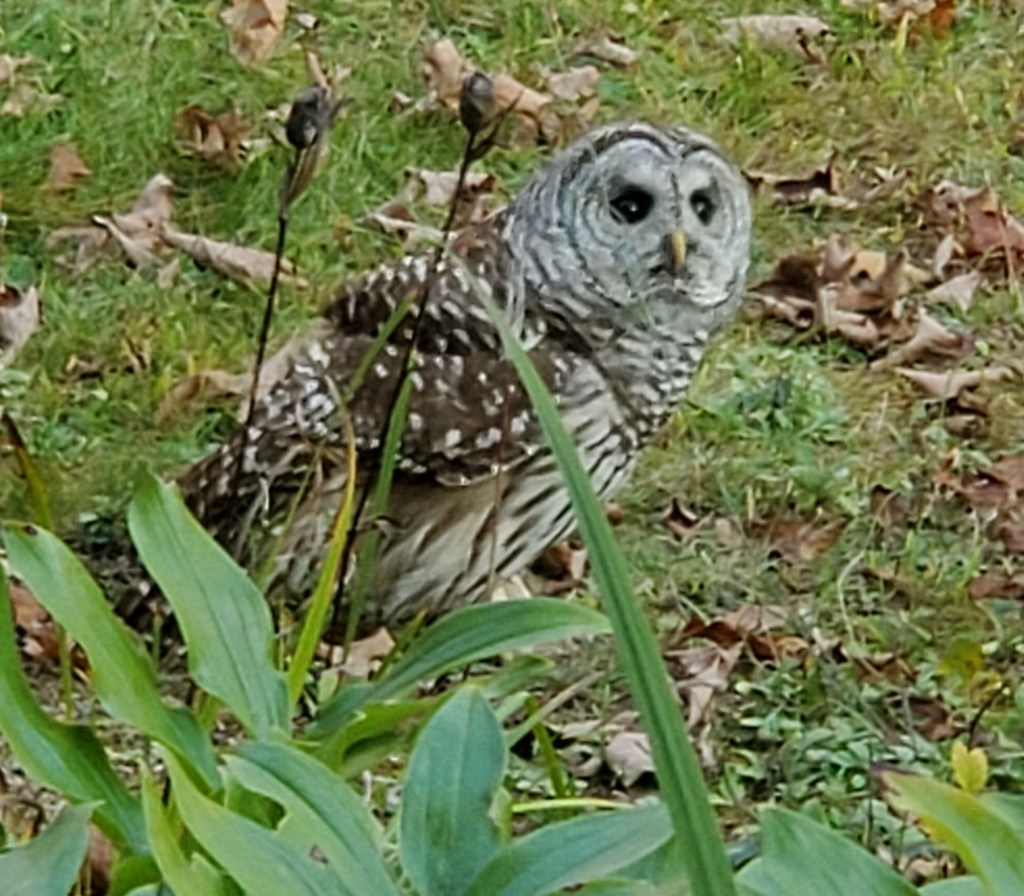
Owl encounter? Or Visitation? I’m happy to embrace the mystery.
And grateful.
-
Telluride by the Sea
23 October 2023

Lining up for the first of seven films On this Saturday, the grey first day of autumn, the last rose of summer blooms on my kitchen window sill and I am for the fifth straight day under the weather, still reacting to the RSV vaccination I got last Monday afternoon. I’ve not had a bad cold for so long I’d forgotten how annoying and debilitating colds can be. If I’m suffering only a minor response to the Respiratory Syncytial Virus, I shudder to think what the unprotected might endure. The struggle to breathe certainly gets your attention.
Moved by an approaching birthday, I’ve finally begun my self-publishing journey with a mixture of elation, anxiety, and a fit of pique over my Amazon project manager’s skipping our first scheduled meeting, belatedly getting his assistant to call me and only further testing my patience. Clearly not at home with English, the assistant’s abominable grammar and limited understanding did NOT inspire confidence. But I’m carrying on, having sent on my completed manuscript and some suggested cover designs while trying to rise above what will undoubtedly prove a series of frustrating complications. Gentle Reader, we’ll see. Stay tuned for the progress of Will to Live: Learning from Shakespeare How to Be—and NOT to Be on its brave progress to the Amazon catalog.
The combination of pre-publication angst and really annoying congestion accounts for my week’s delay in addressing last weekend’s delightful Telluride by the Sea film festival in Portsmouth’s historic Music Hall. Seeing seven films over one evening plus two full days put me in an enjoyably altered state: there was really no time to do or think about anything beyond being captivated by the dream world of cinema, reality intruding only long enough to discuss same with my fellow cinephile and good friend, Carol, while stretching our legs with a short walk to Portsmouth’s new Hearth Market to grab a coffee or a bite. Settling in the Hearth’s high-end food court or remarkably quiet and sunny outdoor piazza in the middle of downtown Portsmouth was really pleasant, especially given the anticipated bluster of Hurricane Lee that brought only limited gales and no rain.
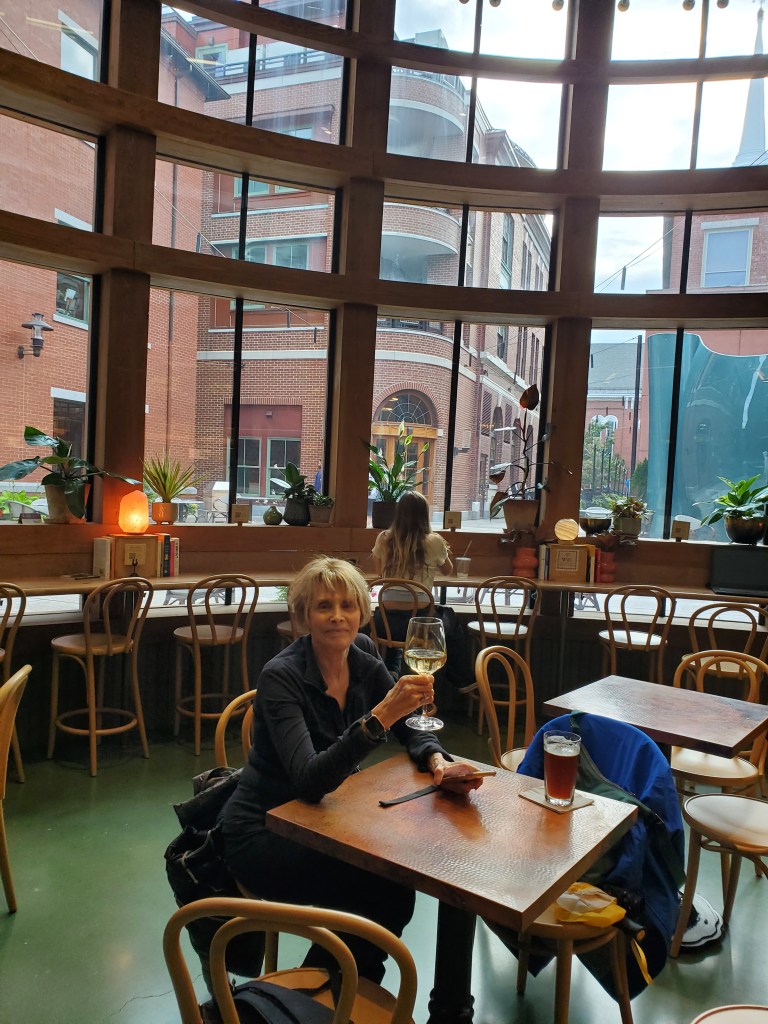
Inside the Hearth 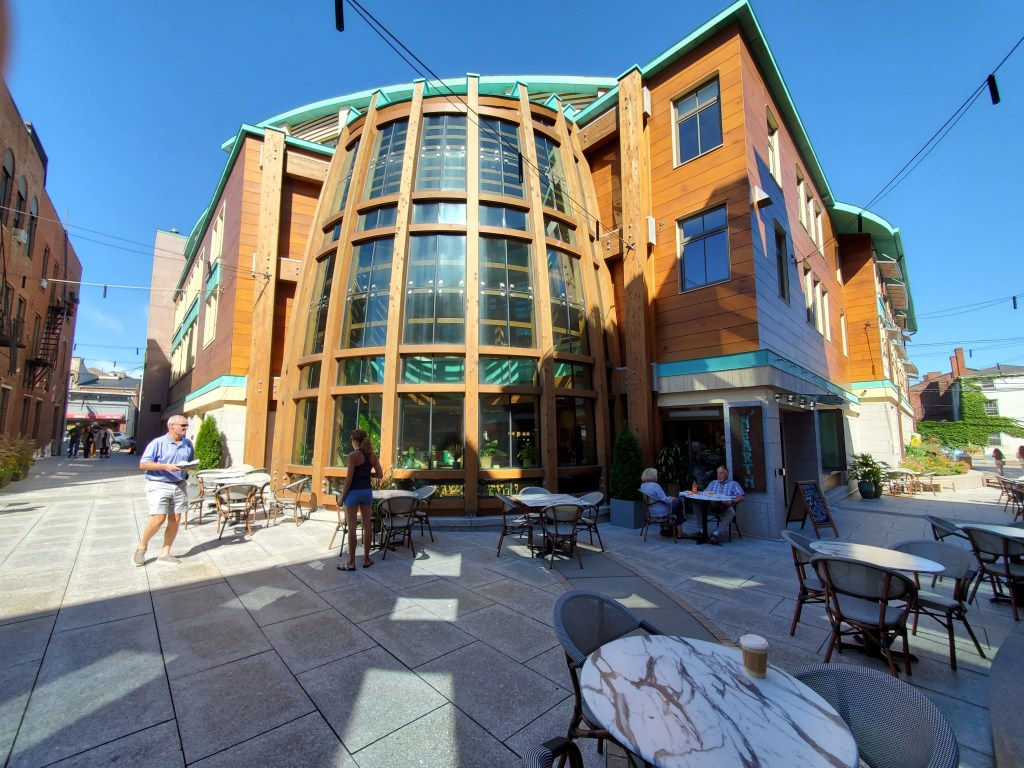
Outside the Hearth: a Portsmouth Piazza Back in the theatre, we enjoyed the Bergsonian (repetition-as-source-of-humor) trial of listening to seven different Music Hall staff members muddle through the same stock introduction to each film, thanking the donors, including the “Big Brains” at UNH—that made us snort—and stumbling over how to pronounce the name of the local river (It’s Pis-CA-ta-qua, not Pis-ca-TA-qua). And please note: The title of that famous upcoming film is The Sound of Music not Sound of the Music. Gosh, but that blunder made me feel old! But Telluride by the Sea founding father, the late Bill Pence, and his wife Stella certainly deserved the seven rounds of applause for what they brought to the New Hampshire seacoast twenty-four years ago.
As luck would have it, the only real disappointment among the seven films was the one most eagerly anticipated, Poor Things, starring the most famous actors: Emma Stone, Willem Dafoe, and Mark Ruffalo in director Yorgos Lanthimos’s retelling of the Frankenstein story. The promise of a “funny, furious, proudly feminist” version of Mary Shelley’s classic was unfulfilled by (we finally agreed) a tedious script that made every obvious point at least three times over, bizarre Jules Vern-ish mise en scène, the occasional repulsive surgical procedure, and LOTS of gratuitous sex as Bella (Stone), the revived corpse of an adult woman given her unborn infant’s brain acquires carnal knowledge in spite of the hypocritical Victorian society she inhabits. Stone’s is a brave performance, but how she transforms from a jerking doll happily stabbing a cadaver’s eyeballs to an intelligent, humanitarian medical student is inexplicable. My take: nothing can redeem a bad script.
On the other hand, I’m hard pressed to rank the other six films shown, each entirely captivating even after a long day of sitting in those less-than-comfortable Music Hall seats (and watch out if you’re stuck next to a man-spreader who commandeers your arm rest and half your leg room). The Friday night film, I suspect, might be everyone’s favorite: The Holdovers, starring Paul Giamatti as an aging classics professor at an elite New England prep school. Set in 1970 and filmed with 1970’s equipment, the plot turns on the relationship of a rigidly uncompromising and unlikeable teacher stuck with babysitting a group of preppies with nowhere to go over Christmas break. I suspect many of the Portsmouth audience could vouch for the veracity of the temporal and local setting—I myself spent a summer teaching at Phillips Exeter—and there were plenty of knowing laughs from the teachers in the audience. Filmed in part at Deerfield Academy in Massachusetts, Giamatti’s character was well matched by the smart, charismatic, but self-destructive Angus played by his young co-star Dominic Sessa, who amazingly won his role in an open audition at Deerfield Academy where he was at the time a student. He more than holds his own again Giamatti’s star turn, and so does Da’Vine Joy Randolph playing the grieving school cook Mary who has lost her son in Viet Nam. If you think you might anticipate each turn of this plot, you’d be wrong, and I expect Giamatti’s earned an Oscar nomination for his performance in Alexander Payne’s fine film.
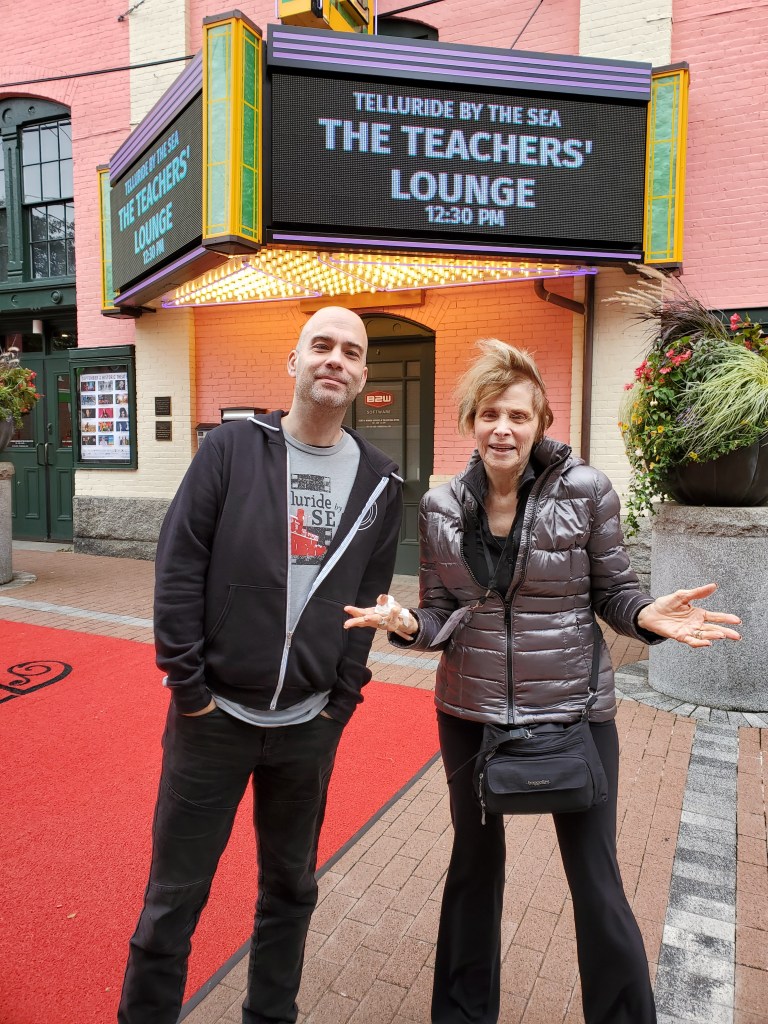
Carol and anonymous crowd wrangler Pedagogy was back on display the next morning with Ilker Ҫatak’s The Teacher’s Lounge. The winner of several German awards, this film’s plot follows a winning new teacher (played by Leonie Benesch) as she tries to navigate a series of increasingly difficult dynamics set in motion by the interrogation of her students over a series of alleged robberies. Initially my heart sank at how well these German sixth-grade students were able to learn challenging mathematics (you can bet none of our U.S. sixth graders could have matched them), but I was quickly was caught up in the dilemmas facing so accomplished and earnest a young teacher as everything and everyone turn against her even as she consistently finds a way to do the right thing. I think this was my favorite of the films, especially because it dovetailed with research of which I’d heard recently on Hidden Brain about how “the jigsaw classroom” consistently outperforms the traditional model of classroom competition when each student vies with all the others for top marks. Psychologist Elliot Aronson’s 1978 research determined that both performance and sociability soared and racism diminished when a group of students were each given only one paragraph of a short essay about Eleanor Roosevelt to learn well enough to explain to the others. They would be tested on the entire essay, and so had to attend to and depend on each other to learn what they needed to know (see the “Outsmarting Yourself” episode of the Hidden Brain podcast). In The Teacher’s Lounge, the script, performances, and ancillary tensions that unfortunately upend contemporary education were brilliantly rendered. All of us teachers were wrung out at the finale.
My other favorite film was the Finish film Fallen Leaves, directed by Aki Kaurismäki, billed as a somber romantic comedy about two marginalized outcasts suffering the indignities and fragile economic status common to laborers and factory workers, a pair who belong together as clearly as Tom Hanks and Meg Ryan did in Nora Ephron’s Sleepless in Seattle but who, like them, repeatedly miss each other via one maddening plot twist after another. Meta about cinema—the couple watch a zombie movie together on their first and likely to be only date—and drolly on point about loneliness and the persistence of desire—this is a hilarious and totally charming picture. And the leading man, Jussi Vatanen, is a dead ringer for a young Jimmy Stewart.
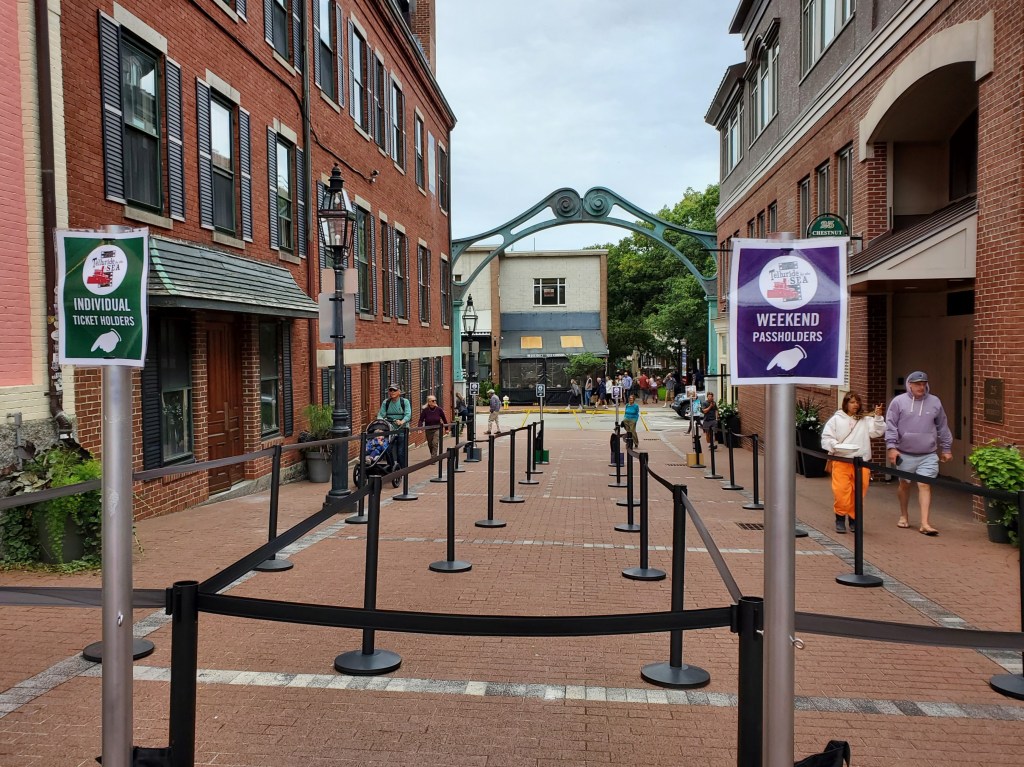
Lines diminish as the weekend rolls on The longest film of the festival at 2 hours 30 minutes was Anatomy of a Fall by French director Justine Triet, but another that held one’s rapt attention throughout as it dissects a marriage through the lens of a whodunit. Billed as a cross between Bergman’s Scenes from a Marriage and Agatha Christie, the script shifts our sympathies from scene to scene following a husband’s fall to his death and his successful novelist wife’s trial for murder as their clever, vision-impaired son grows up suffering their marital storms. Competition, creative drive, resentment, and guilt power a most intelligent, carefully crafted script.
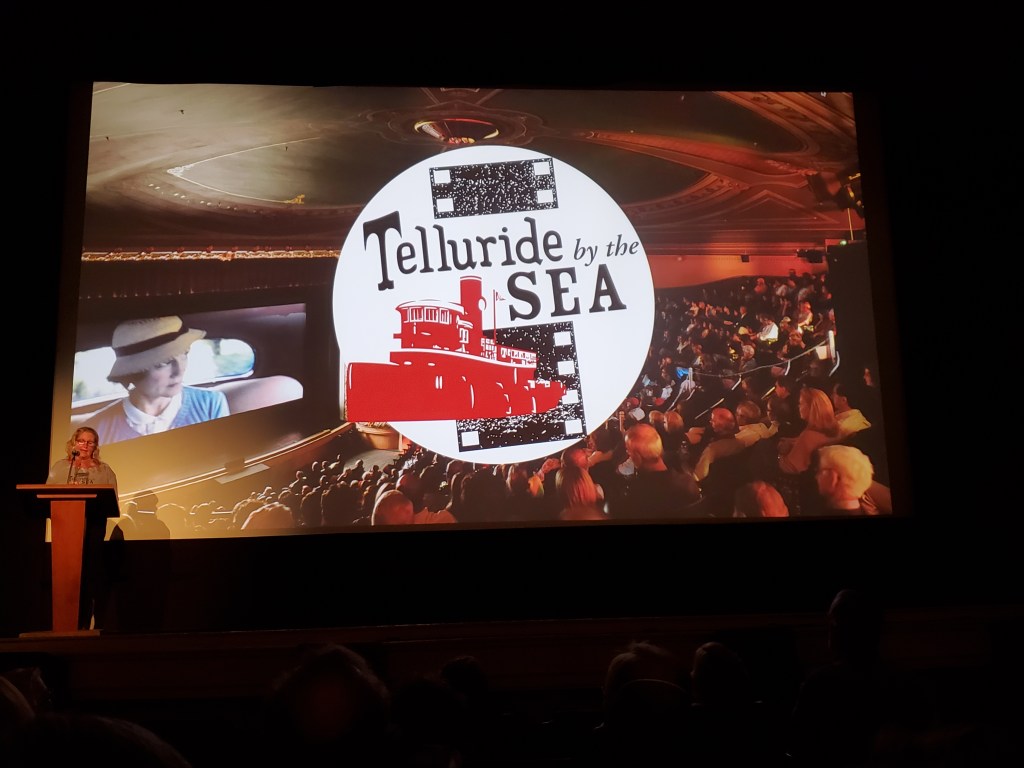
These German, Finish, and French films were my favorites, but two more deserve mention: the gorgeously filmed Danish epic The Promised Land (directed by Nikolaj Arcel), based on the true history of an 18th century Captain who set out to tame in the name of the King the vast, barren Jutland heath despite the resistance of the grotesquely brutal nobleman Schinkel, and the completely different documentary, American Symphony (directed by Matthew Heineman) about an eventful year in the life of musician Jon Batiste as he navigates a career soaring toward the premiere of his ambitious symphony in Carnegie Hall coinciding with the return of his wife writer Suleika Jaouad’s leukemia: a moving portrait of an artist of stupendous talent, stamina, and heart.
So, 6 thumbs up, 1 thumb decidedly down, and a wonderful weekend of Big Time Cinema in our little port town. Now I return to the the day’s tasks bolstered by the creature comfort of Trader Joe’s pumpkin waffles. Happy autumn!
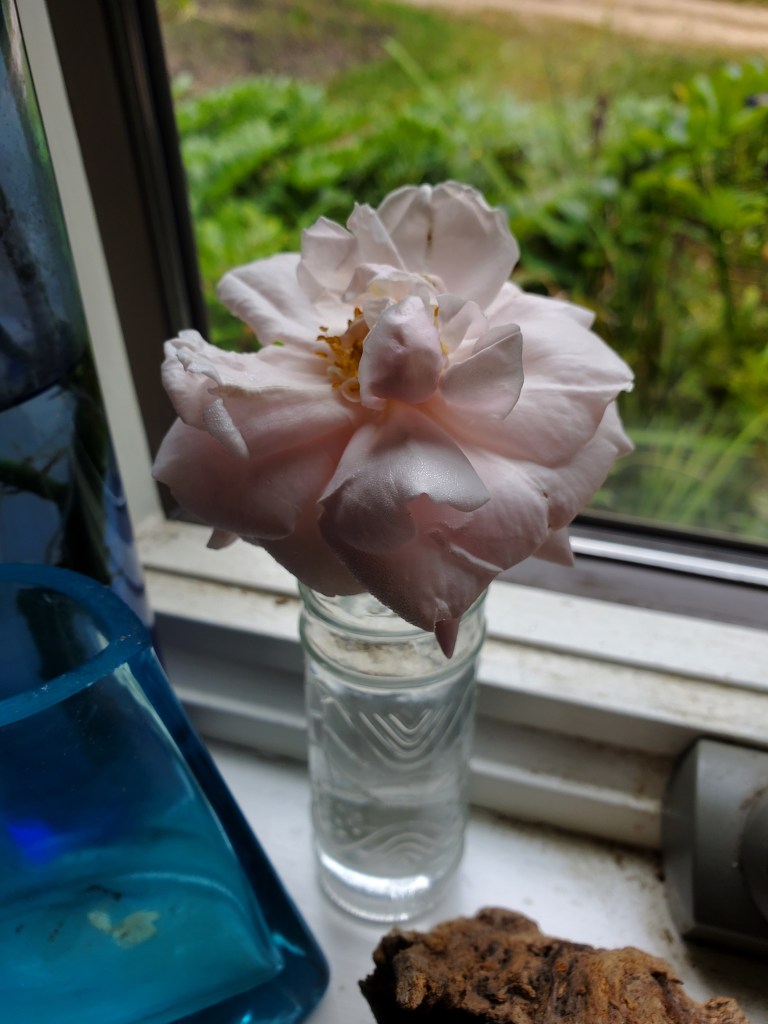
The last rose of summer -
Mills, Massage, and Madbury Day
12 September 2023
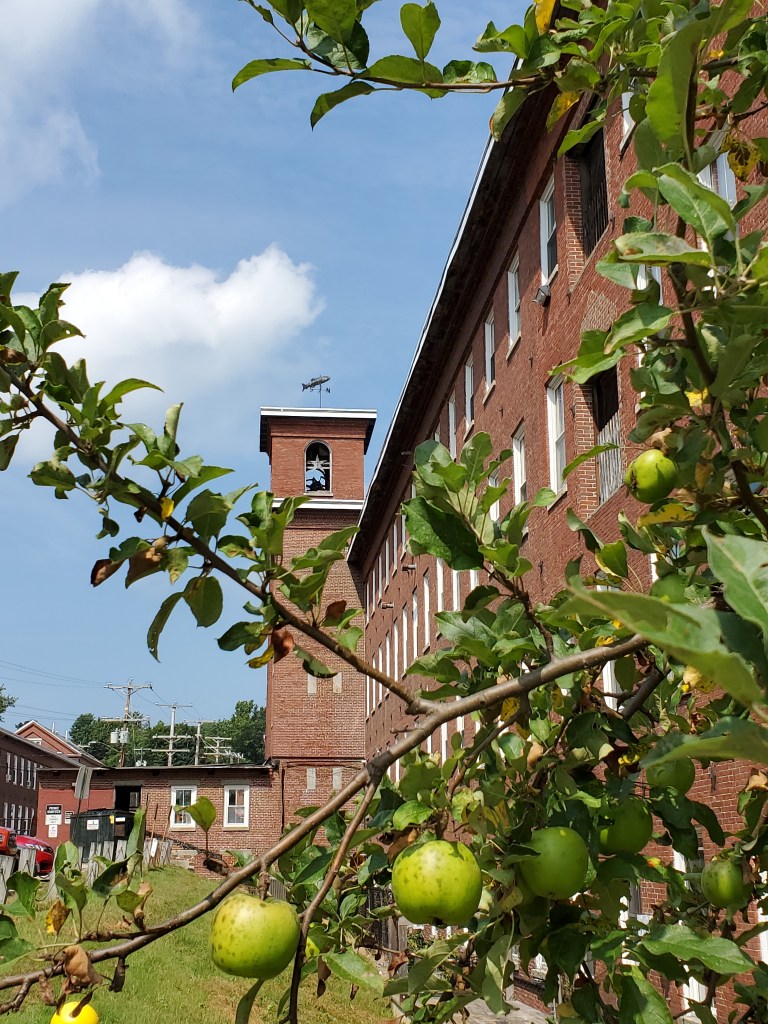
Lower Mill, Salmon Falls River, Rollinsford NH Reading Barbara Kingsolver’s Demon Copperhead after Dickens’s David Copperfield is a déjà vu delight, though one can only hope Kingsolver’s epigraph borrowed from Dickens resonates for readers: “It’s in vain to recall the past, unless it works some influence upon the present.” The present rhyming with the past is right up my street these days, as you, Dear Reader, will have noticed, and is perhaps the inevitable consequence of aging. Boston College historian Heather Cox Richardson’s millions of subscribers to her Letters from an American can perhaps testify to the grounding solace of learning the history behind today’s politics, though perhaps some Stoicism is required when considering how much does not change for the better where human endeavor is concerned.
The juxtaposition of past and present was very much on my mind this past weekend, beginning with my first visit to my wonderful neighbor’s studio in the lower mill building of the Rollinsford NH Historic District. The Salmon Falls River there was first dammed as early as 1623-24 (also the publication year of Shakespeare’s First Folio) to power a sawmill; in 1822, a Portsmouth merchant purchased the water privilege and established a successful woolen mill on the site. That burned in 1834 and was soon replaced by a cotton mill, eventually purchased by Boston textile industrialist Amos Lawrence and eventually incorporated as the Salmon Falls Manufacturing Company. Lawrence built a second mill building, introduced the new turbine technology perfected at Lowell, Massachusetts, and the Industrial Revolution in New Hampshire was underway.
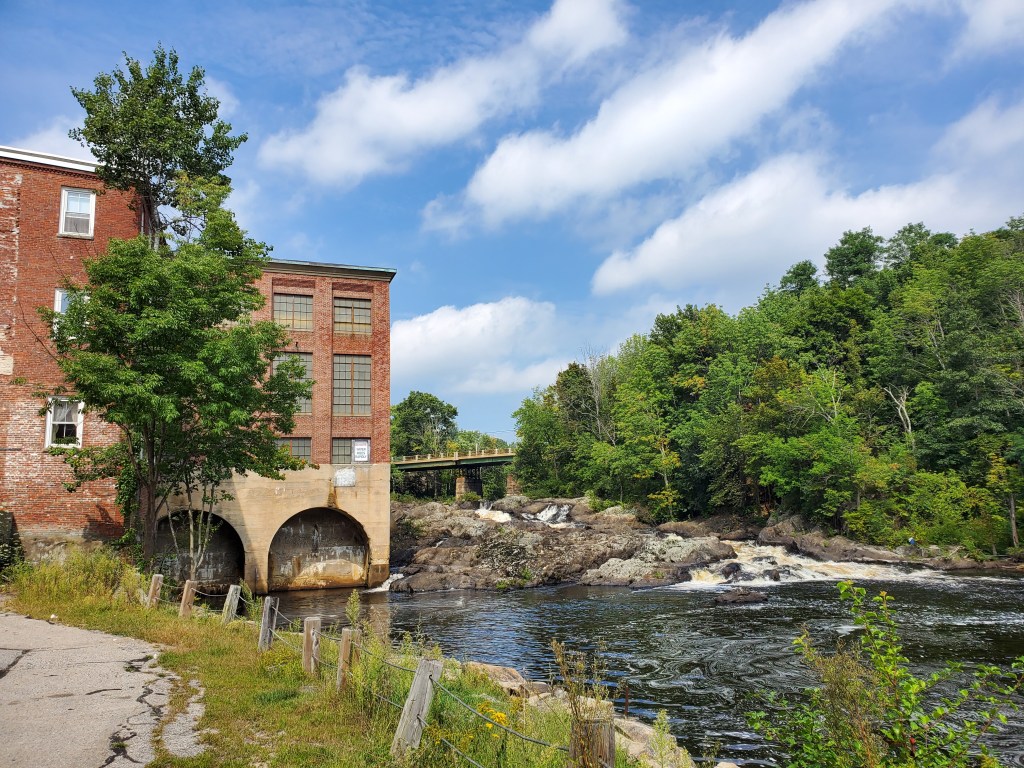
Salmon River Falls and Lower Mill 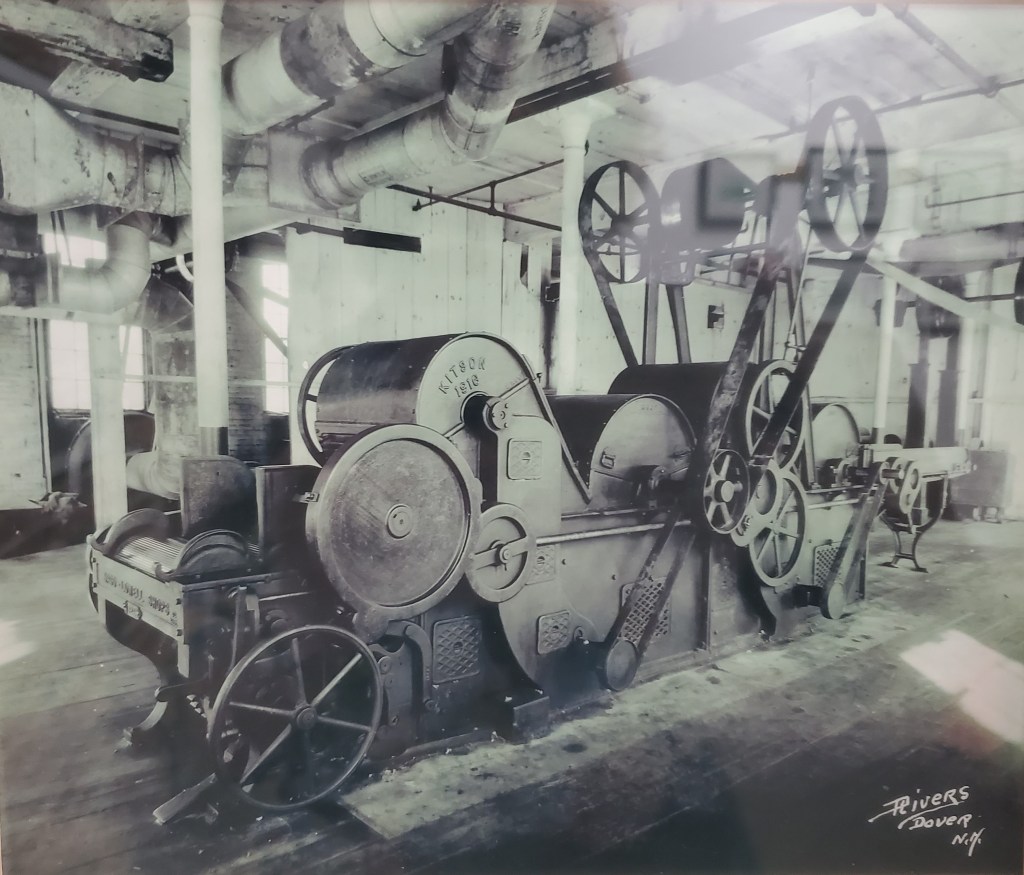
1916 Power Plant 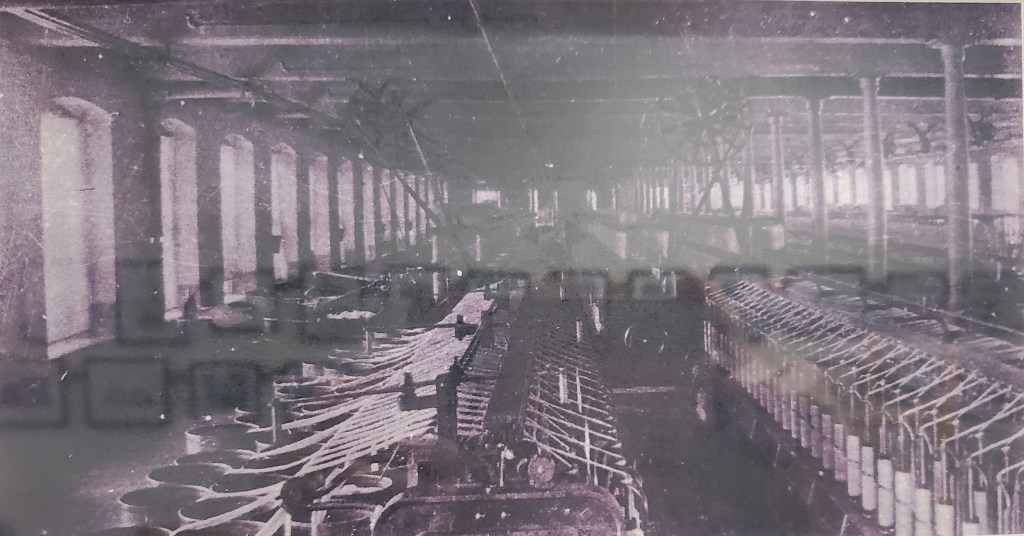
The “Flying Frames” of the Salmon Falls Manufacturing Company in 1888
(Notice: No lighting system of any kind)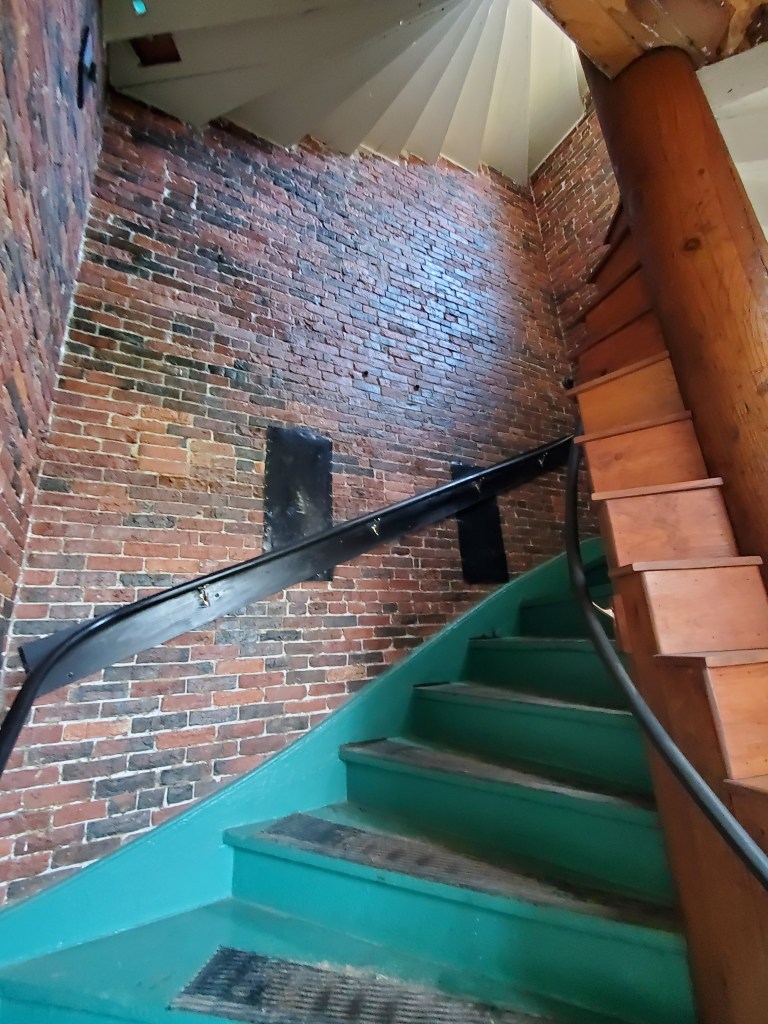
Stairway to Third Floor Studios The Salmon Falls Manufacturing Company ended production in 1927, but the buildings, most structures built of brick in an unusually consistent industrial Italianate style, remain on the National Historic Register, many currently occupied by over 100 artists, along with local businesses, the Rollinsford Public Library, and the new studio of my accomplished friend and next-door neighbor, Anne Marple, LMT (https://www.annemarple.com).
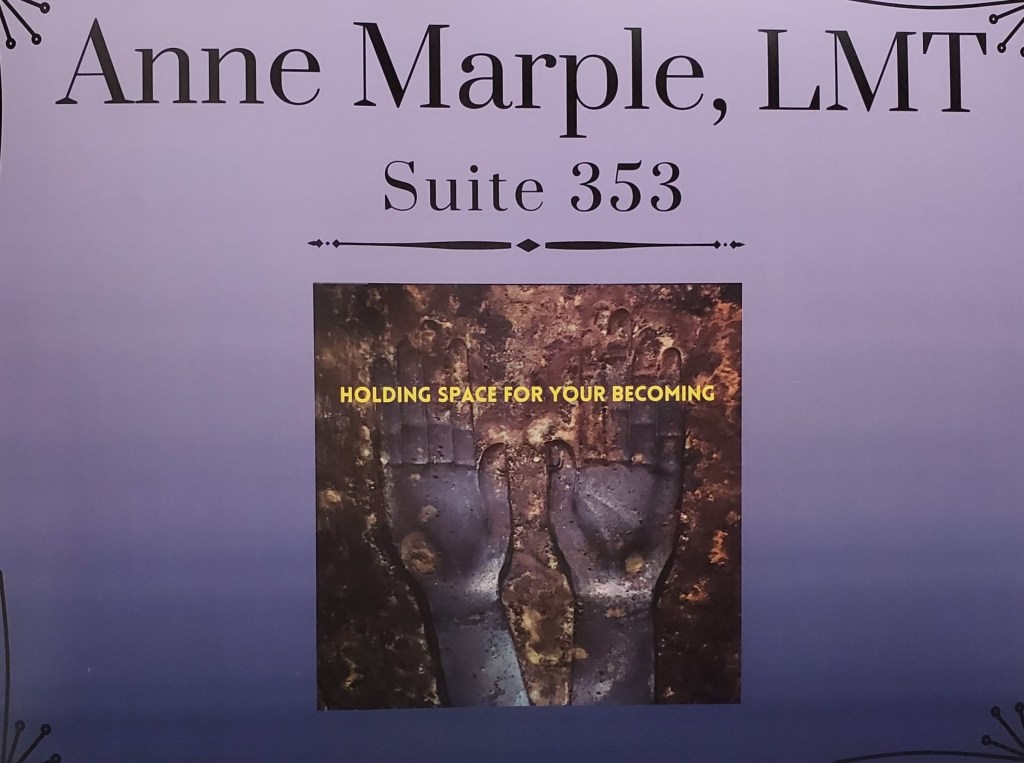
Last winter, I was several times, right in my own home, the beneficiary of Anne’s practice as she pursued her Licensed Massage Therapist credentials. Having eagerly volunteered to play the role of client, I enjoyed Anne’s ministrations while listening to morning ragas, comfortably settled on the massage table she set up in front of the fireplace. The rich are different (thank you, Scott Fitzgerald), and with Anne’s help, I could pretend I was—just like the Meryl Streep character in the Roy Scheider/Streep vehicle, Still of the Night (1982). Bliss.
Having now earned her LMT and opened her Salmon Falls studio, Anne trained in an earlier chapter of her life as a professional aerial artist, working as a performer and coach for over a decade, and so learning about movement and how to use stretches and exercises to support a healthy body. Also a certified Reiki practitioner, Anne complements her physical work with training in the Myrrophore tradition of healers and a background in etheric work, using a blend of Myofascial release, Swedish massage, and reflexology—among other practices well beyond my ken: if some of those terms sent you to Google, I’m right there with you. But this I can avow: a Marple massage is transcendently different from and superior to the few I’ve had before, and highly recommended.

Suite 353 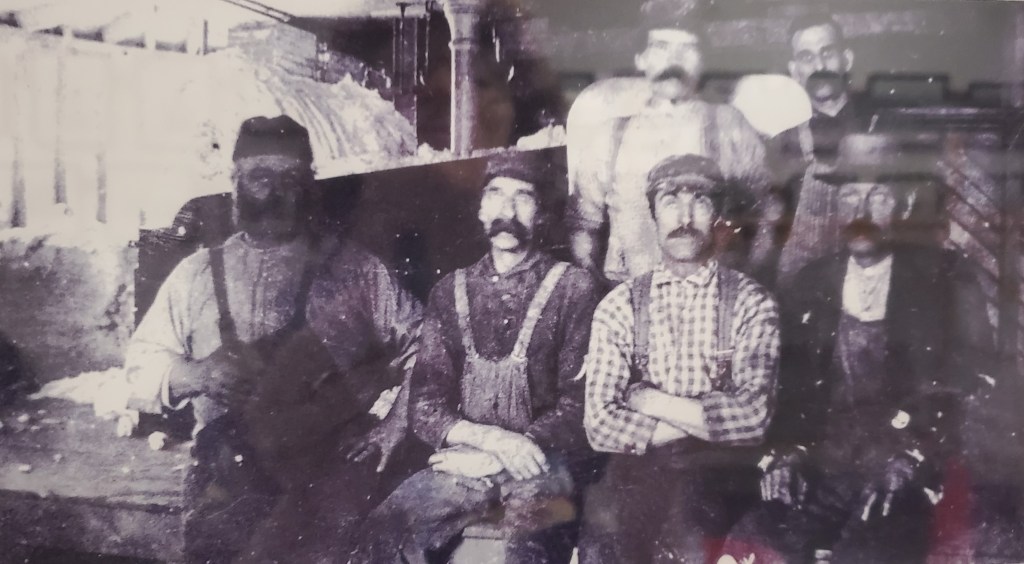
Salmon Falls employees in the picking room, 1888 Still, on Friday I could not help but remark the disjunction between what once went on in those mill spaces and what goes on there now; having so incongruously pierced the veil of history I associate with such a setting, I felt pretty otherworldly for the remains of the day. Only as I write this do so many other Dickensian associations with “dark Satanic mills” (thank you, William Blake) return to mind. Aside from Dickens, there’s the brief film UNH Master of Arts of Liberal Studies candidate Brenda Whitmore made in 2002 as her final MALS project, The Lighting Up, examining the untenable conditions in textile factories that led to the Mill Women’s Strike in Dover NH in December 1828, the first labor strike by women in the United States.
And then, too, I recall the 2004 visit David and I made to Heywood in the metropolitan borough of Rochdale, part of greater Manchester, England, to see the town in which David’s great (or great great?) grandfather Frederick Chadwick Andrew was born in 1820, and from which he emigrated to Salt Lake City, where he died in 1878, part of a substantial British immigration to Utah in 1850-70; from 1860-1880, 22% of the total Utah population and 67% of those foreign born were from Britain (see “Imperial Zion: The British Occupation of Utah” by Frederick S. Buchanan in The Peoples of Utah, 1976, pp. 61-113). The 27 cotton mills operating in Heywood by 1833 are shuttered now, but seeing the smoke stacks and imagining the air quality when they were all in business was not hard, and informative signs posted about the town made clear the diminished quality of life those 19th-century mill workers suffered. The Latter-day Saints’ promise of Zion in the New World—as well as the sanctioned taking of a second wife along with the first—must have been irresistible.
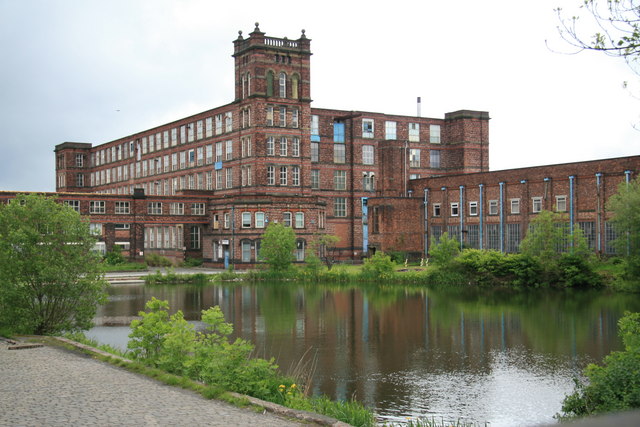
One of Heywood’s 27 Cotton Mills What would Grandfather Andrew have made of the repurposed mills of Salmon Falls, I wonder? Far less removed in time from big cultural changes within my own lifespan, I still struggle to adapt, and with A.I.’s burgeoning presence, I expect what’s to come while I’m still around will be well beyond my imagination.
So, on Saturday morning, Madbury Day, it was a comfort to see how much pleasure the Madbury Library’s book sale brought to me as well as to them who donated books and them who carried them away.
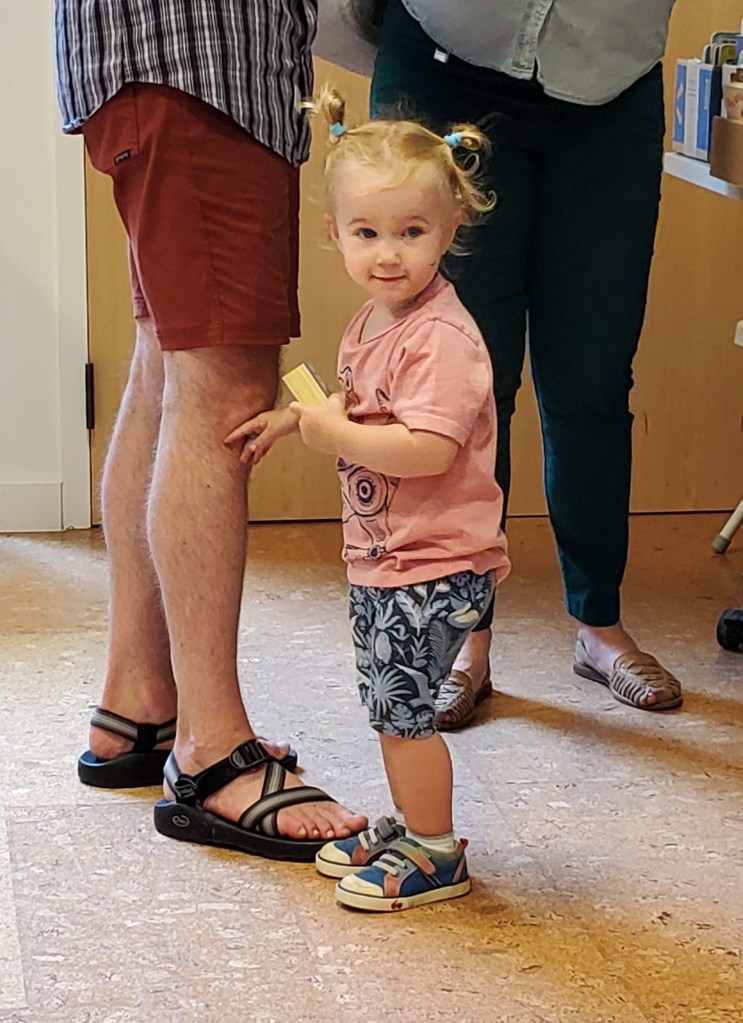
Young library patron pleased with her new board book Little Madbury, with a population of only 1,931 according to the 2021 Census, could easily be mistaken for Thornton Wilder’s Our Town, yet well past that play’s 1901-1913 setting, a substantial number of its citizens still read and value BOOKS! I felt more proud than silly marching in the skimpy Madbury Day parade behind two illustrious Friends of the Madbury Public Library: Anne, not only purveyor of excellent massage therapy but also chair of the Friends, and long-time Friend and library advocate, Joan, CEO of book sales.
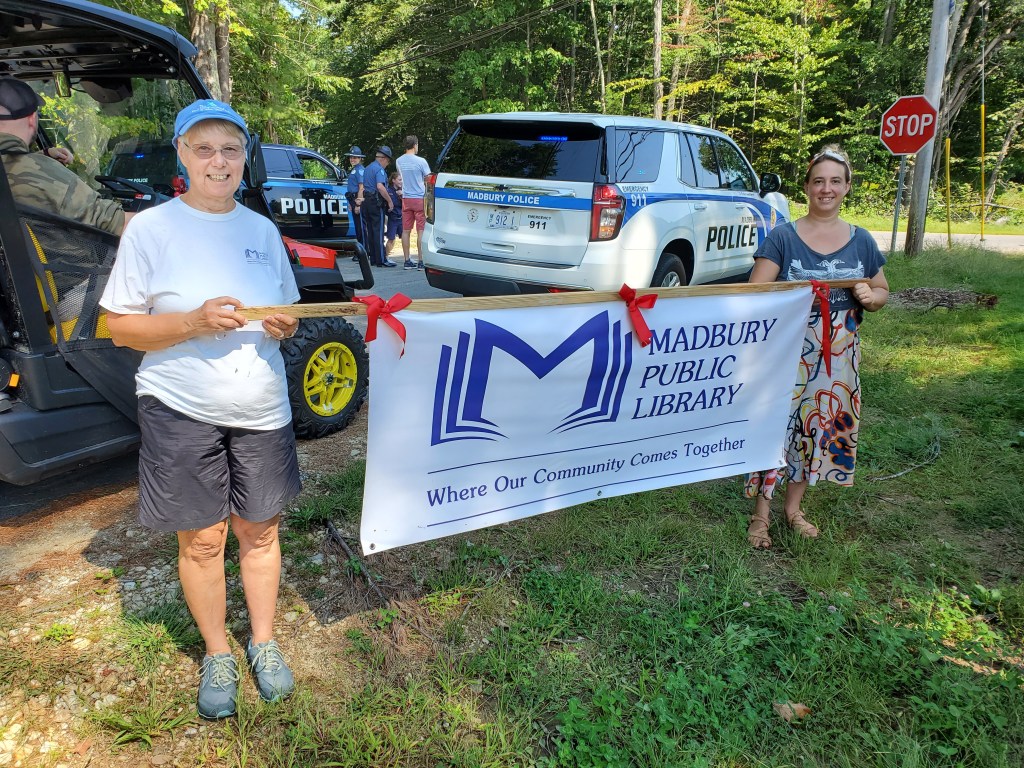
Friends of the MPL Joan and Anne 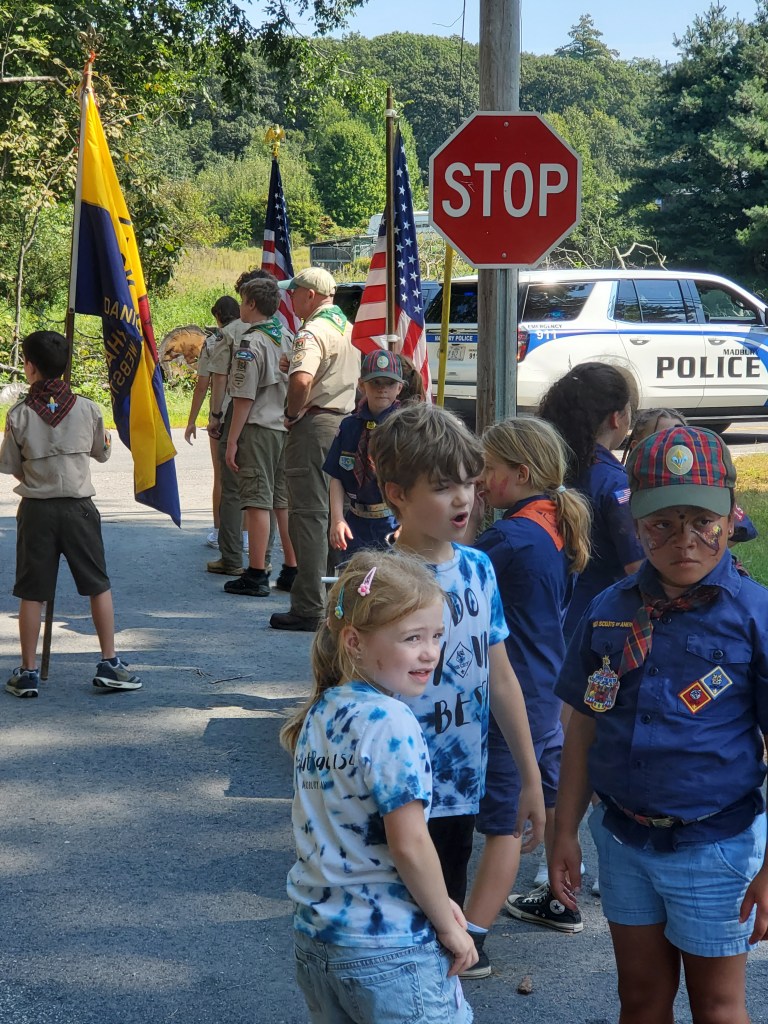
Parade forming at Cherry Lane 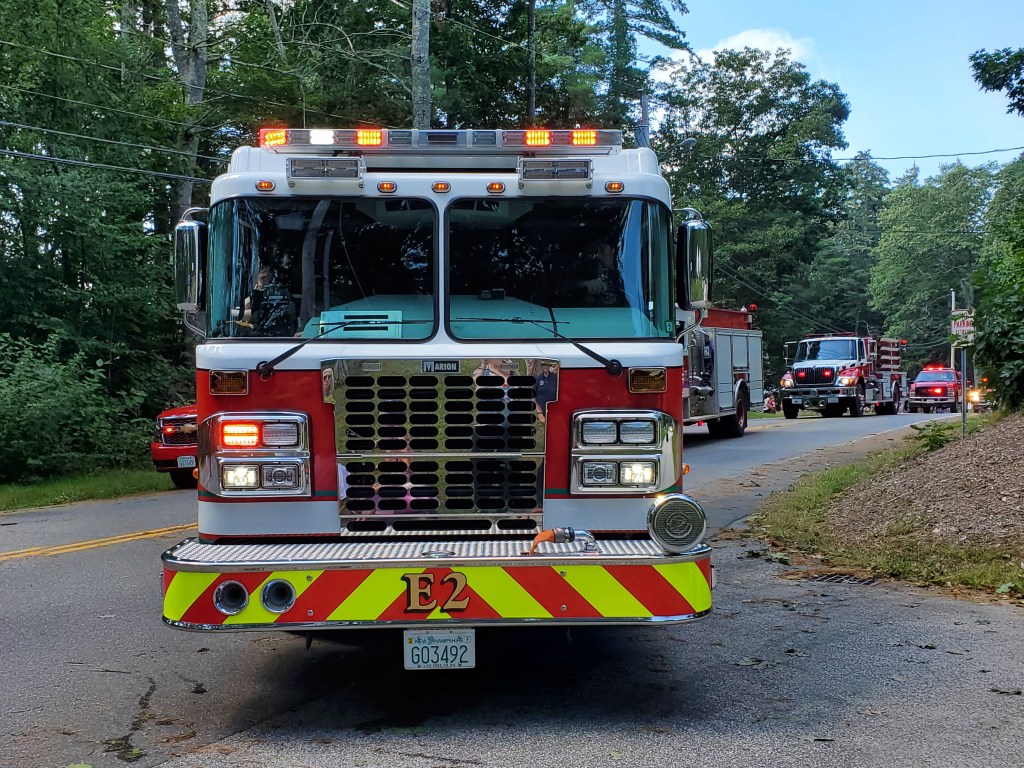
Madbury’s Finest Fire Fighters The size of the appreciative crowd was underwhelming, surely. But the books that changed hands on Saturday do inspire some optimism, as did the folks who came to the library for the first time and shared their delight in the lovely space. Here’s to more such connective tissue for the body politic— and the creative repurposing of old institutions for new times.
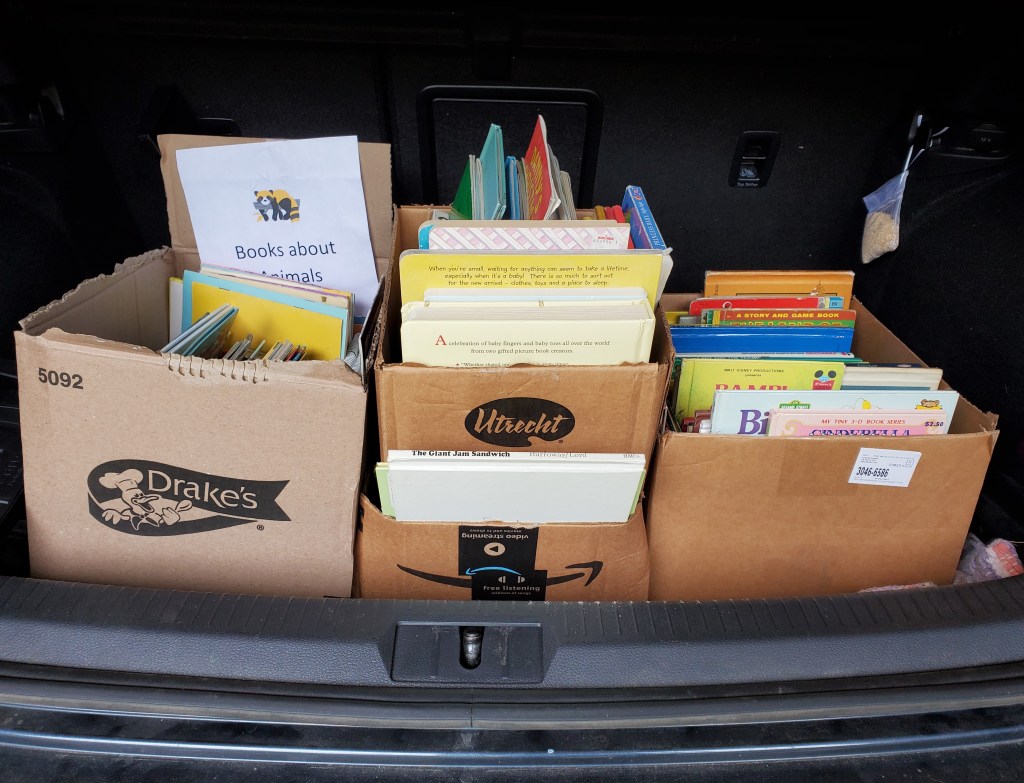
Books in the Boot, headed for readers new -
Labor Day Weekend: Return to Hamilton House, Chores, and a VERY Good Read
7 September 2023
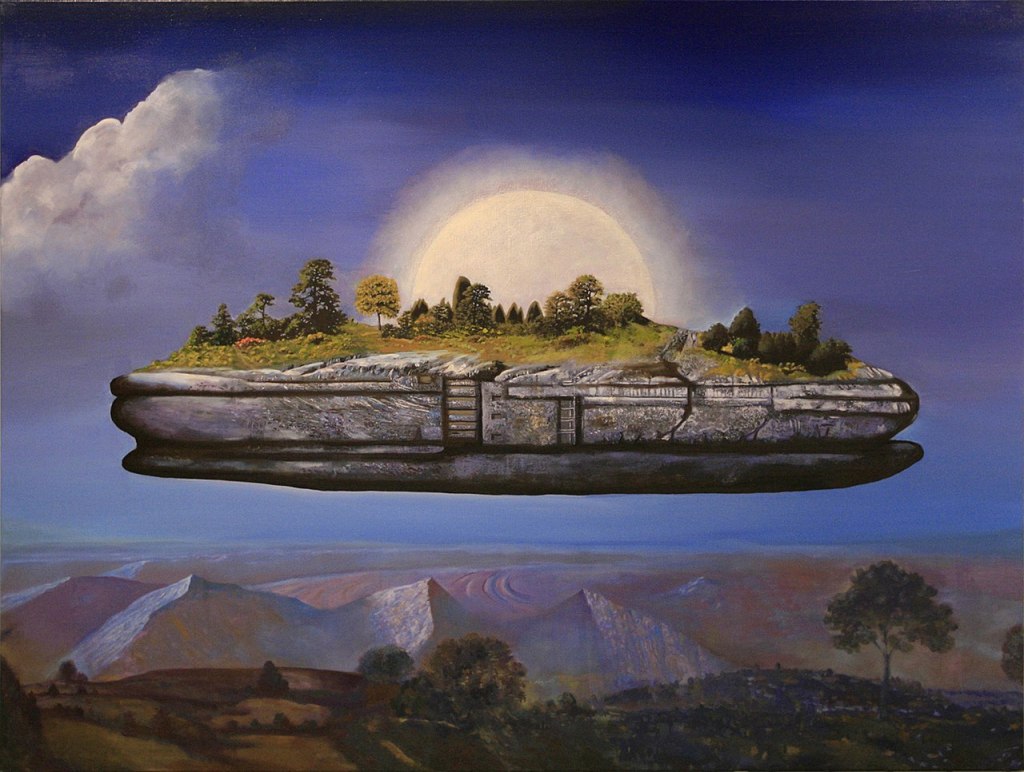
Makis E. Warlamis, Utopien 04, 2007.01.05, Daskunstmuseum Labor Day may mark the unofficial end of summer, but the weather in New Hampshire today begs to differ: the actual temperature outside is 90o, the heat index 99o, and here in my un-air-conditioned study it is 86o. My sister Jane in Florida and I have been texting back and forth, recalling and wondering at our ability to survive our public school education in St. Petersburg in schools with no ac. I recall the unnatural contortions of my right arm as I struggled to find a way to keep my sweating hand off the test paper I was trying to complete, and the exquisite joy of being allowed at recess to buy a 10¢ waxed paper carton of thirst-slaking, ice-cold orange juice from a hall vending machine. Many schools in New England are still not air-conditioned, and in this “heat emergency,” some have closed for the rest of this week. In Jane’s and my day, we hoped for hurricanes to delay the start of school, and fairly often got our wish. Perspectives change with responsibility and property; I’m very grateful Hurricane Idalia missed Jane there in Safety Harbor, and hope Hurricane Lee still brewing in the Atlantic will keep its distance.
Despite my status as a retiree, I did my best to substitute pleasure for workaday chores over the holiday weekend, discovering that Lexie’s at the Great Bay Marina (with excellent fish tacos) is staying open on weekends through September this year—a perk of climate change?
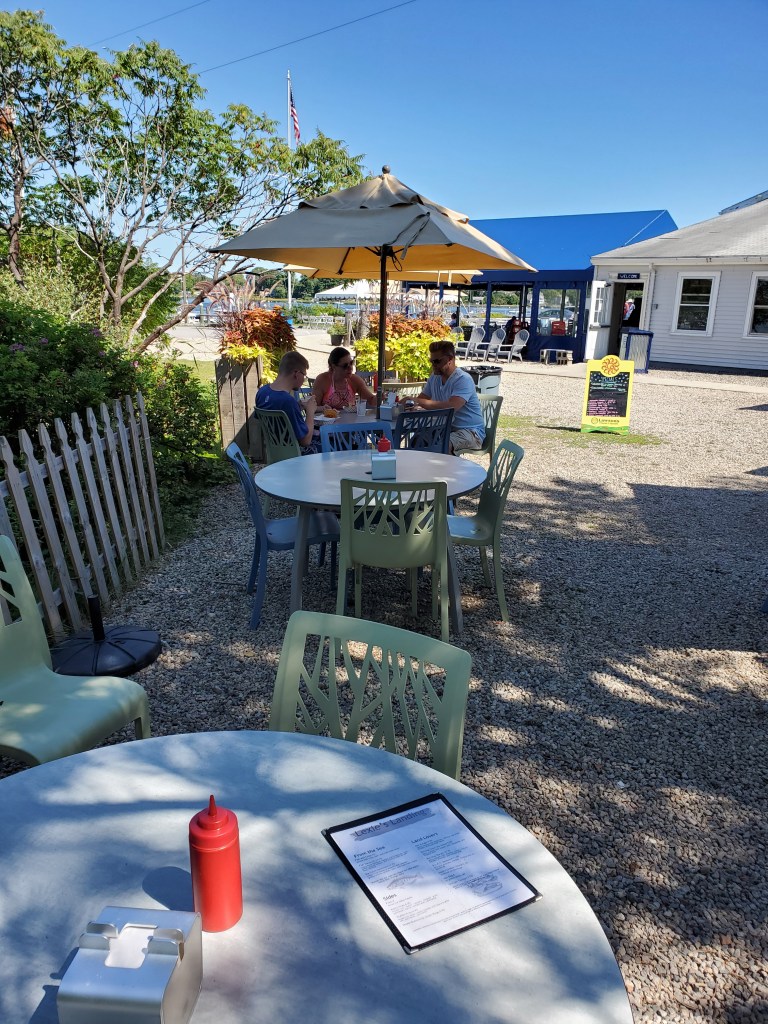
Lexie’s Landing at the Great Bay Marina, Newington NH 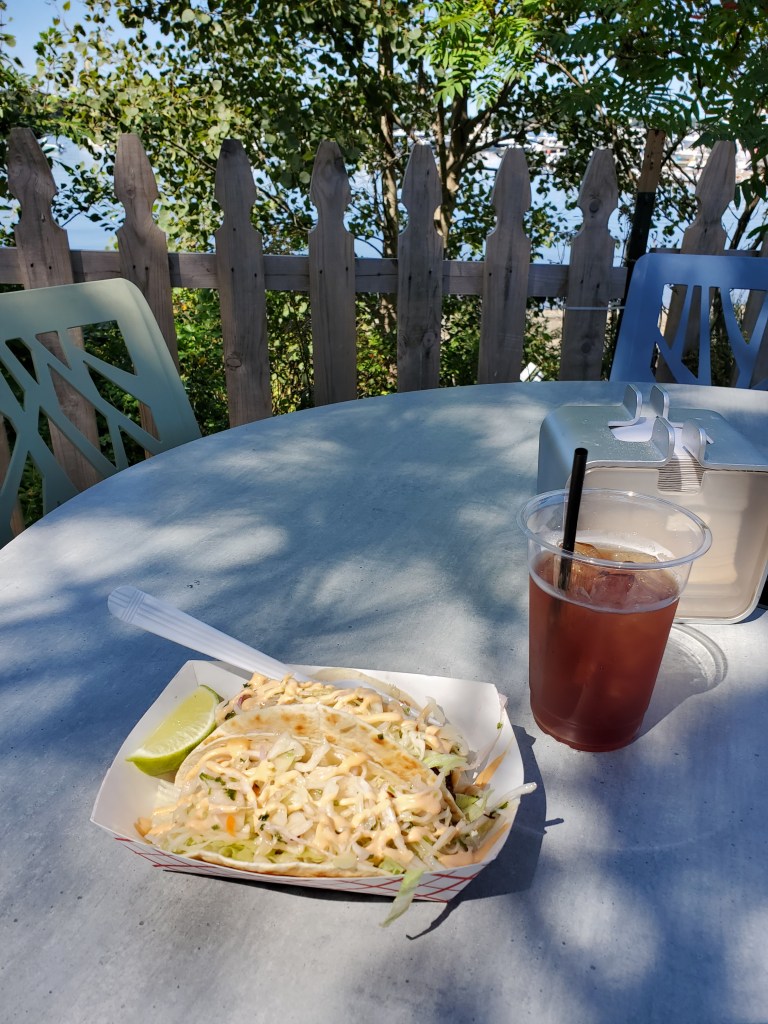
Fish taco by the Bay 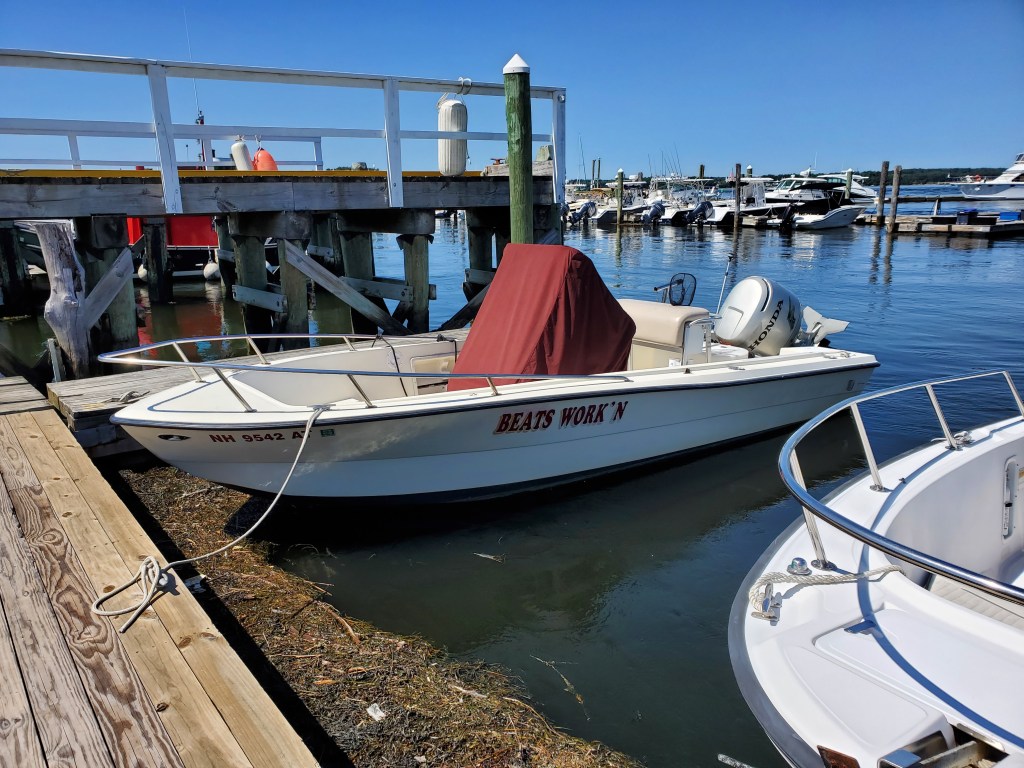
AKA “Disposable Income” 
R U a robot? How many modes of transportation do you see? And I was pleased to find I could still hike from shipping merchant Jonathan Hamilton’s striking Georgian mansion (c. 1785) picturesquely sited on a bluff overlooking the Salmon Falls River into Vaughn Woods State Park, navigate the ups and downs and trip-threatening roots of the River Run trail, and return on the more level bridle path to a perch in the Hamilton House garden where I caught the cooling breeze from the river below. Most gratifying.
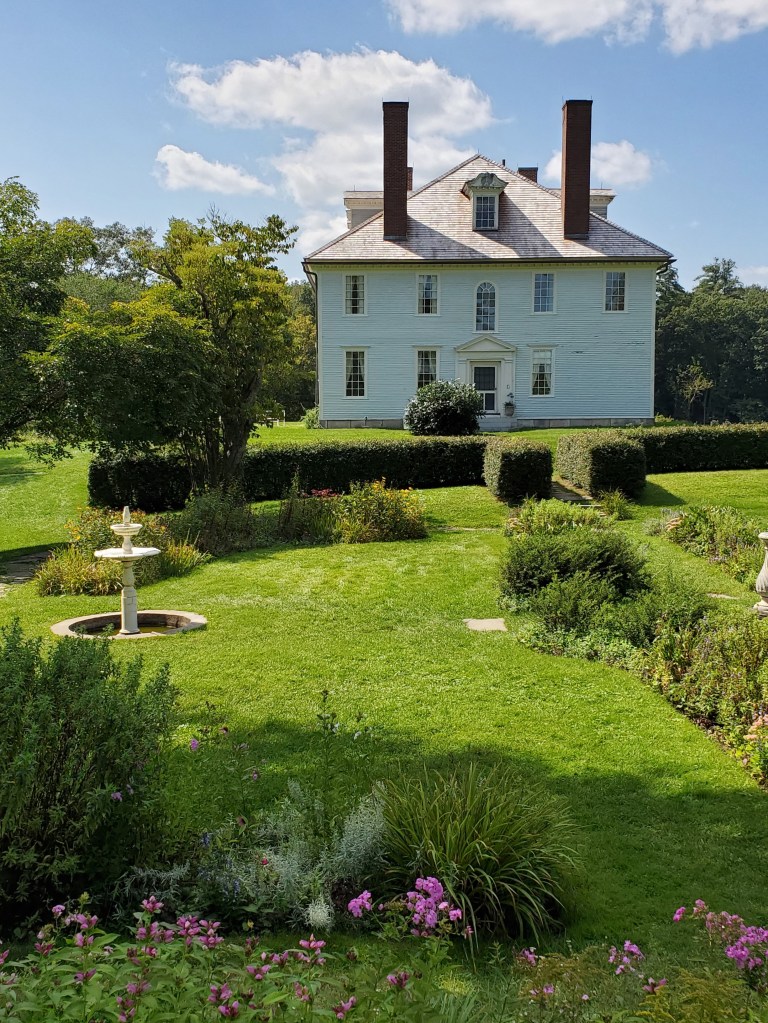
Hamilton House, c. 1785, South Berwick ME 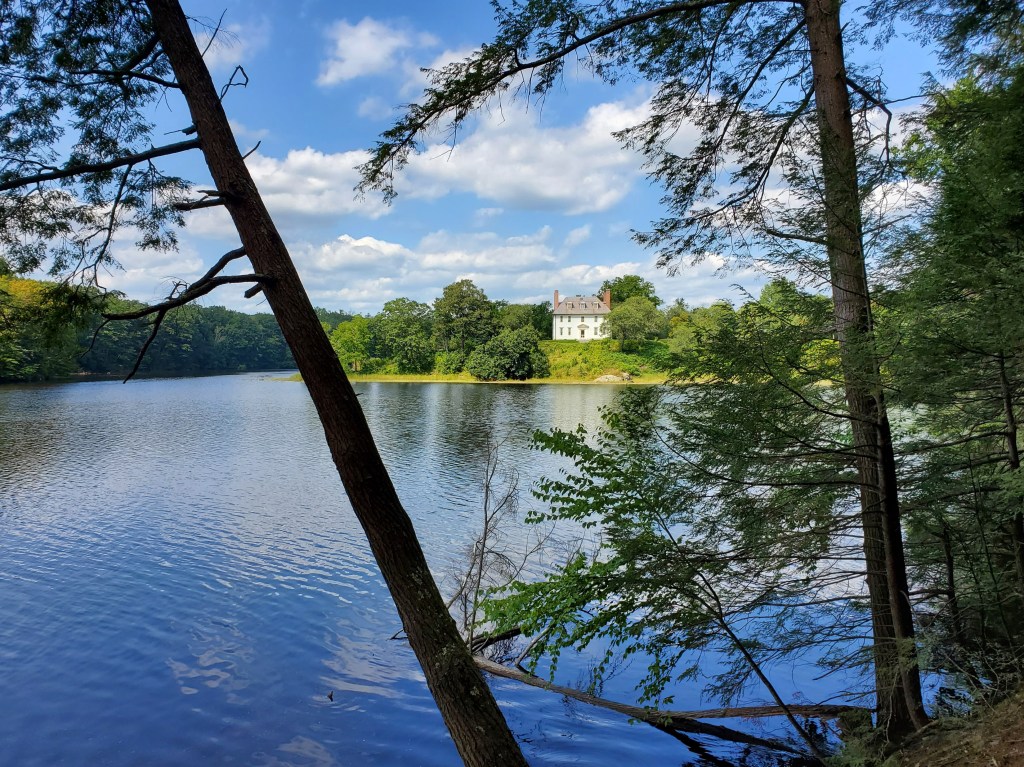
Salmon Falls River and Hamilton House from the Vaughn Woods River Run Trail 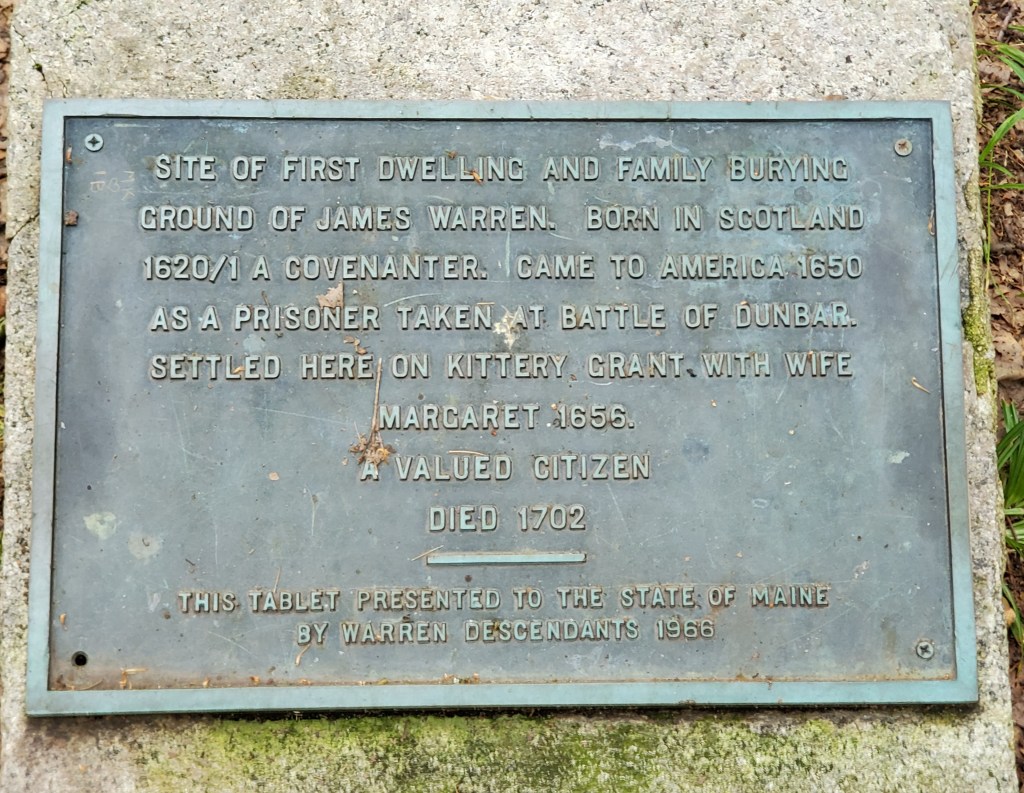
The Warren Homestead Site along the Bridle Path 
Hamilton House Garden Facade Even with such holiday embellishments, I still managed to get a few things accomplished at home: the deck railing is now once again shining with the penetrating oil that should protect it through the coming winter; the Behr brand I once had to smuggle in from Canada is now once again available at Home Depot, illustrating the vicissitudes of earlier environmental regulations.

And I managed to get all the mowing done without again suffering the consequences of disturbing a cicada killer wasp nest that I’d earlier mistaken for a more harmless groundhog excavation. I do like mowing, especially since switching to a quiet, lightweight, electric machine that doesn’t turn gas into stink and noise: the benefits are good exercise, money saved, a sense of accomplishment, and a chance to commune with my late father George, who did all the sweaty work of maintaining the lawn and landscaping of the Murphy home in St. Pete.
Best of all, I finished Anthony Doerr’s hefty 2021 novel, Cloud Cuckoo Land, a paean to texts and those who preserve them.

Initially challenged by the fragmented narrative weaving together lives lived in the 15th, mid-20th, early 21st, and mid-22th centuries, I was nevertheless drawn into following with increasing urgency the seemingly unrelated breadcrumbs finally integrated into a central action: the compulsion of such very different souls alive in such very different times to preserve an ancient but timeless story. Dedicated by Doerr “to librarians then, now, and to come,” the novel
“is an epic of the quietest kind, whispering across 600 years in a voice no louder than a librarian’s. It is a book about books, a story about stories. It is tragedy and comedy and myth and fable and a warning and a comfort all at the same time. It says, Life is hard. Everyone believes the world is ending all the time. But so far, all of them have been wrong.
It says that if stories can survive, maybe we can, too.”
(Jason Sheehan, NPR book review, 28 September 2021)
Given the state of textual expurgation in my home state of Florida (censoring Romeo & Juliet??! Jesus, Mary, and Joseph!), the words of Licinius, the eldest of Doerr’s characters, a dying Greek tutor to rich children in Constantinople, take on new resonance:
“A text—a book—is a resting place for the memories of people who have lived before. A way for the memory to stay fixed after the soul has traveled on.”
His eyes open very widely then, as though he peers into a great darkness.
“But books, like people, die. They die in fires or floods or in the mouths of worms or at the whims of tyrants. If they are not safe-guarded, they go out of the world. And when a book goes out of the world, the memory dies a second death.” (Cloud Cuckoo Land, 51)
Have we in our current fit of “alternative facts” and ignorant censorship entered “a great darkness”? Certainly the daily news suggests the answer is yes. But then, there’s this:
“Sometimes the things we think are lost are only hidden, waiting to be discovered.” (408, 474).
So here’s to those who labor to discover and preserve. As the heroic character Zeno Ninis, once a midwestern POW in Korea captured along with English classicist Rex, remembers:
“Of all the mad things we humans do, Rex once told him, there might be nothing more humbling, or more noble, than trying to translate the dead languages. We don’t know how the old Greeks sounded when they spoke; we can scarcely map their words onto ours; from the very start, we’re doomed to fail. But in the attempt, Rex said, in trying to drag something across the river from the murk of history into our time, into our language: that was, he said, the best kind of fool’s errand.” (462)
A Labor Day Salute to those who keep stories alive -
Janus: Looking back, Looking Ahead
30 August 2023

The Madbury Reservoir starting to look autumnal The last humanities course I taught at UNH in the spring of 2020—which with the arrival of COVID at mid-semester unexpectedly became the last semester in my 43 years of teaching—was HUMA 513, an interdisciplinary introduction to the modern world. As the HUMA team prof covering the literary beat, I referred repeatedly to the Roman deity Janus, the god with two faces, one looking forward and one looking backward, my attempt at a mnemonic device to help students both think back to historical precursors shaping the arrival of modern drama, poetry, and the novel, and also think ahead to what these (to the students, “ancient”) texts would lead. We went from Wycherley’s 1675 The Country Wife to Sheridan’s 1777 School for Scandal, from Wordsworth and Coleridge’s 1798 Lyrical Ballads to Shelley’s 1818 Frankenstein, finally arriving at Ibsen’s 1879 A Doll’s House. Saying when, exactly, the modern world materialized is, of course, an academic debate shifting over time. When I was in graduate school in the late 1970’s/early 1980’s, the historical period in which I specialized was mostly known as the Renaissance, a label looking backward to the “rebirth” and influence of the re-discovered classical world. The Renaissance was, however, soon re-branded as “early modern,” looking forward from those early texts toward what was to come.

Goldenrod and grasses at Gnawwood Having slipped the surly bonds of academia, I’ve been feeling pretty Janus-faced myself of late. Partly I’ve been looking forward, among other things, to the new cultural season approaching; I’ve gotten my 2024 calendars and filled in dates to avoid double-booking upcoming performances in Boston and environs. I‘ve counted down the payments left before our home’s mortgage is paid off, and renewed my driver’s license for another five years. But looking forward also means thinking about the “mort” in mortgage, lists of things to do, and some things one must do, while there is still time. My new driver’s license will expire in 2028, though because I renewed online, the photo on it remains, Dorian Gray-like, the same. What’s my expiry date, I wonder? Tonight is the first super blue moon since 2009, and the next won’t occur until 2037. Actuarial tables suggest I’ll still be around in 14 more years, but in what condition? I’ve come a long way from What Color is Your Parachute; now the parachute I most often contemplate has a lot more to do with being mortal, and bailing out when the time is right.

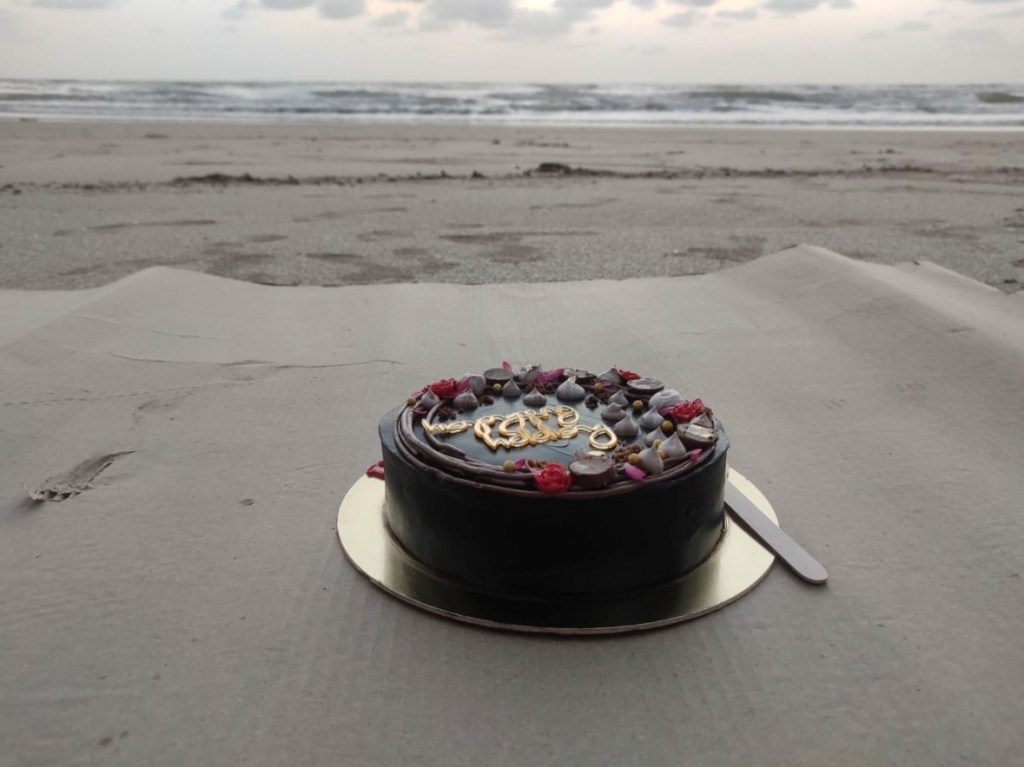
Hope to view a super blue moon like this tonight Still, this day has given me reason to be less morbid. My house cleaner Sarah called this morning to say that her truly malevolent landlord has been bested by the redoubtable former NH district court judge Atty. Bill Shaheen, who took her case and stood up for Sarah pro bono. Bobbie at Regan Electric called to let me know I could pick up the ginger jar lamp I’d had since 1974, now endowed with a new switch; I wouldn’t have to discard it for lack of anyone still willing to make that simple repair (thank you, Charlie, who rescued me from the much less accommodating Rockingham Electric). My ailing sister and her family in Safety Harbor suffered no harm from Hurricane Idalia, which last night seemed so threatening. And my former International Research Opportunities Program student, Procheta, responded to my happy birthday wishes from the beaches at Harihareshwar and Aravi in Maharashtra, India with both photos of him and his wife Sugandha on holiday at the shore and a shot of the birthday cake with which Sugandha surprised the birthday boy sitting improbably on the dunes. Procheta’s delight, shared simultaneously with me via WhatsApp (which Procheta taught me to use back when I attended their Bengaluru wedding in 2019), brought back the enormous joy I felt then, a gift of his family’s extraordinary hospitality as I visited beautiful Karnataka on my solo passage to and from India.

Sugandha and Procheta’s wedding, Bengaluru, 22 Dec 2019 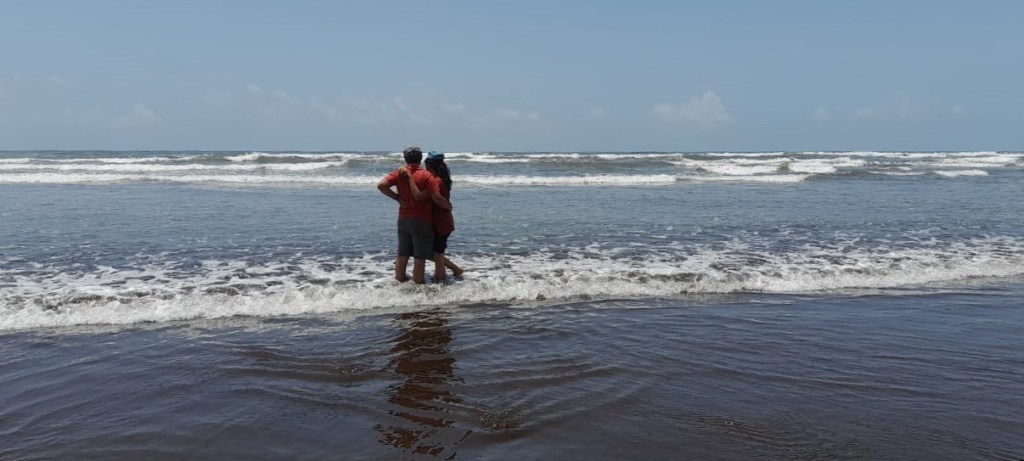
Birthday Boy Procheta and Sugandha visit the Indian shore, 30 August 2023 Still weirdly attached to Tom Hanks thanks to my recent absurdly blissful dream about him, I’ve been working my way through his extensive filmography these past few nights: Philadelphia, Captain Phillips, and, last night, Cast Away. I’d forgotten that the film is NOT titled Castaway, and so missed the enormous importance of that caesura. The Hanks character was indeed cast away, but finally did NOT despair, but rather made the best use of what WAS cast away (ice skates, the memorable Wilson, and the love of his life), including the angel-winged package that “saved his life” and led him to the hopeful crossroad in the last frame of the film. See this film, Dear Reader. Well worth re-visiting.
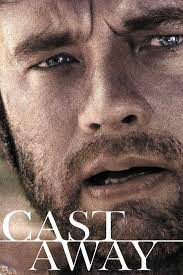
Hanks as Chuck Noland in the 2000 Zemeckis film In my darker mood earlier in the week, I’d been thinking of another script, Tennessee Williams’s 1961 play Night of the Iguana and the 1964 film John Huston made of it, most specifically the poem it contains that I was surprised to discover I had mostly memorized:
How calmly does the olive branch
Observe the sky begin to blanch
Without a cry, without a prayer
With no betrayal of despairSome time while light obscures the tree
The zenith of its life will be
Gone past forever
And from thence
A second history will commenceA chronicle no longer gold
A bargaining with mist and mold
And finally the broken stem
The plummeting to earth, and thenAn intercourse not well designed
For beings of a golden kind
Whose native green must arch above
The earth’s obscene corrupting loveAnd still the ripe fruit and the branch
Observe the sky begin to blanch
Without a cry, without a prayer
With no betrayal of despairOh courage! Could you not as well
Select a second place to dwell
Not only in that golden tree
But in the frightened heart of me?Yes, the darkness falls earlier now as we reach September, and what’s to come is still unsure. But there’s great pleasure both in looking back and looking forward—to the ties that bind over time and distance, and to the coming beauty of another New England autumn.
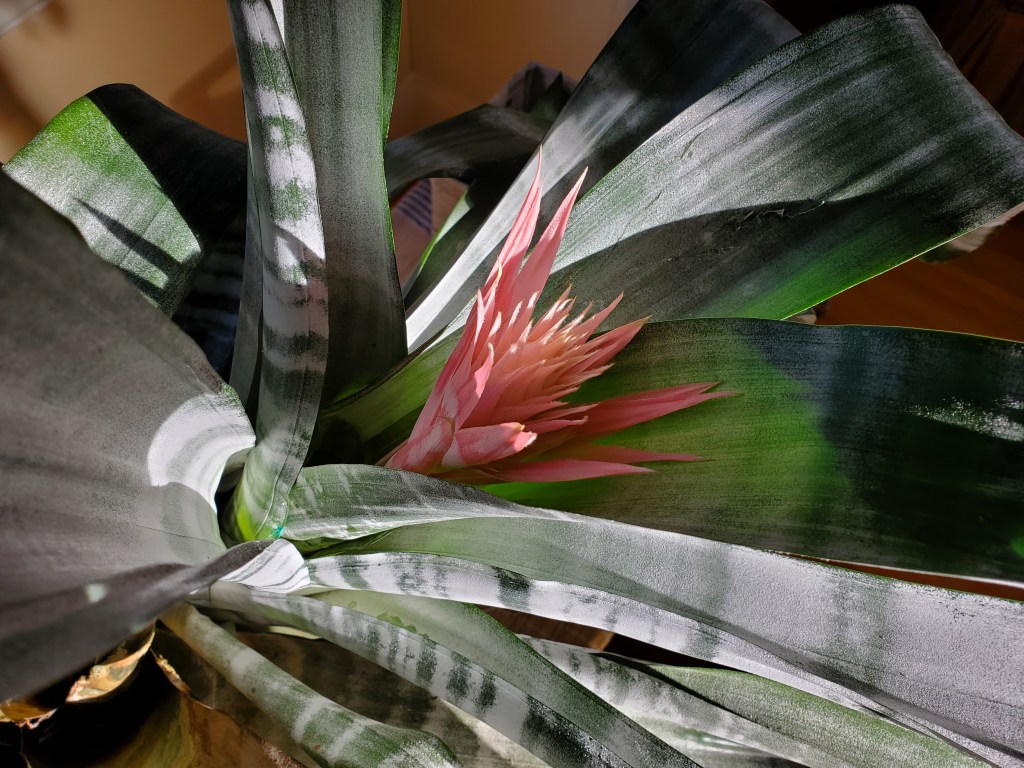
The other day I discovered that my Silver Brocade bromeliad, which last bloomed at David’s memorial in October 2019, had found a reason to bloom again. No betrayal of despair there. Carpe diem.
Happy Birthday, Procheta! -
Birthday Party
21 August 2023
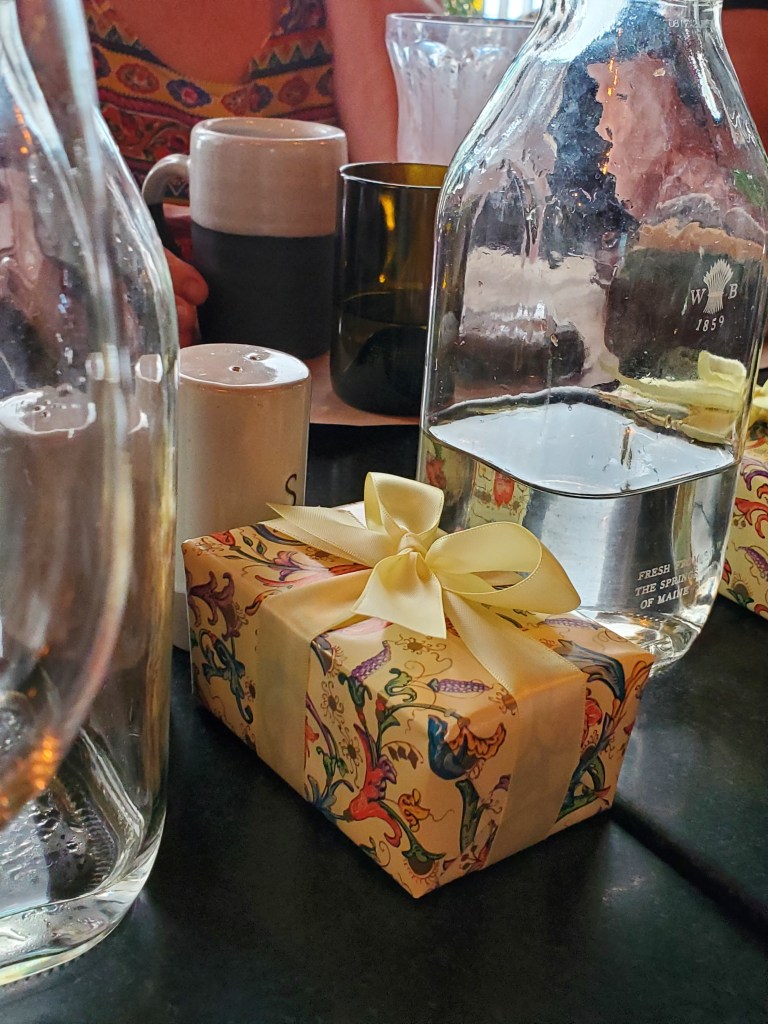
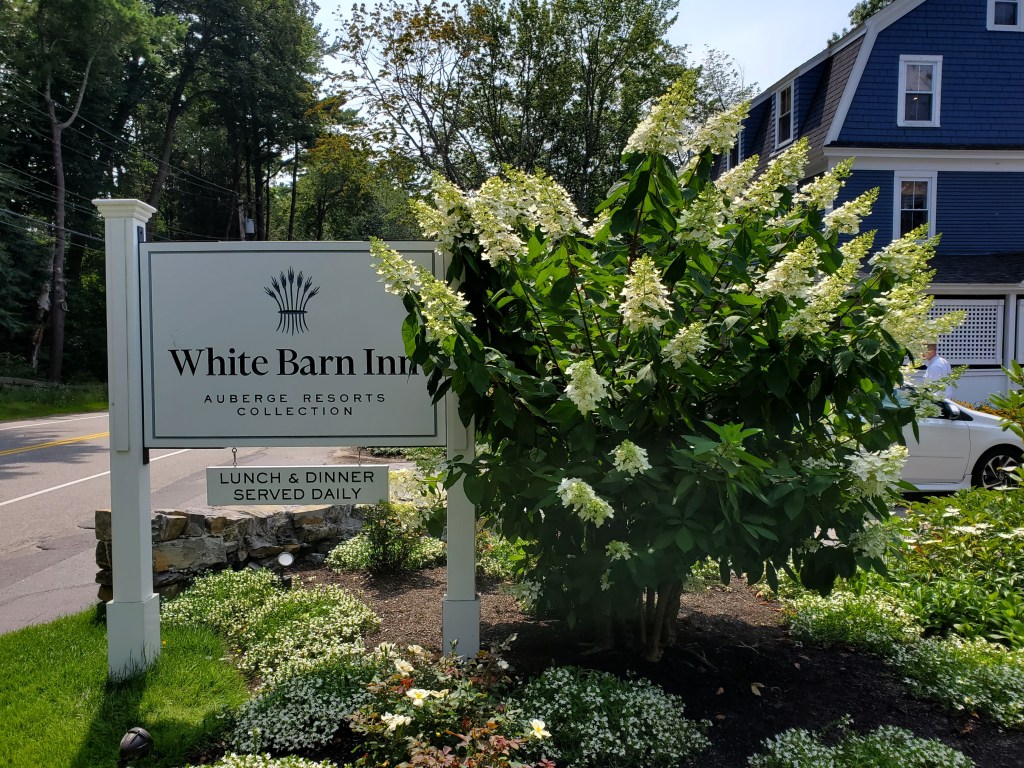
My friend Stephanie’s idea of a birthday party: give gifts of Byrne and Carlson chocolate to her guests For a decade now, I’ve been the happy beneficiary of my friend and former colleague in the UNH English department Stephanie’s penchant for celebrating her birthday in generous high style. Over these many years, Steph has introduced me to some of Maine’s finest summer retreats, and this time it was the White Barn Inn in Kennebunk.
Among the many delights of the occasion was the chance to meet new folks and share their insights, with Stephanie hospitably guiding conversation. This year she proposed a round table sharing of lessons learned in the past year, with her leading off: the value of NOT pushing through when one is really tired. Friend Susan provided the corollary: the mistakes one makes when one attempts to carry on while exhausted create many more problems than simply deferring a task until rest “knits the raveled sleeve of care” (that’s Macbeth, not Sue, but you get the picture).
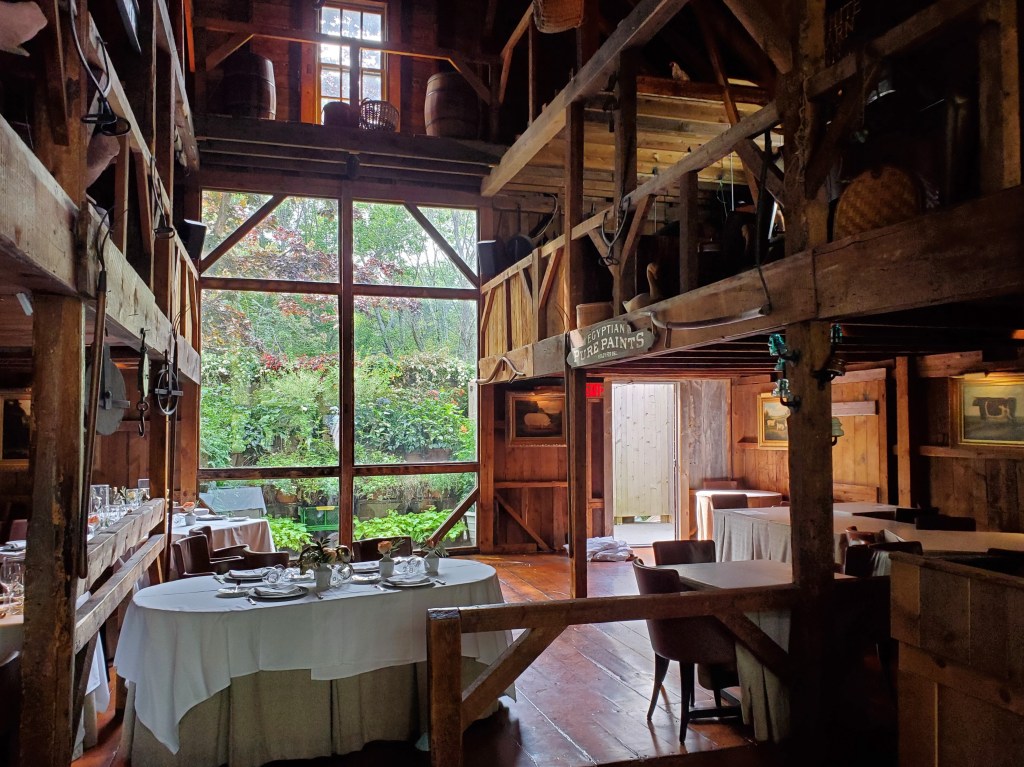
The seasonally planted picture window view at the White Barn Steph proposed that students don’t mind waiting another day for return of their papers; Sue pointed out that NOT running over a wheel stop in a parking lot is a course preferable to driving on when too tired.
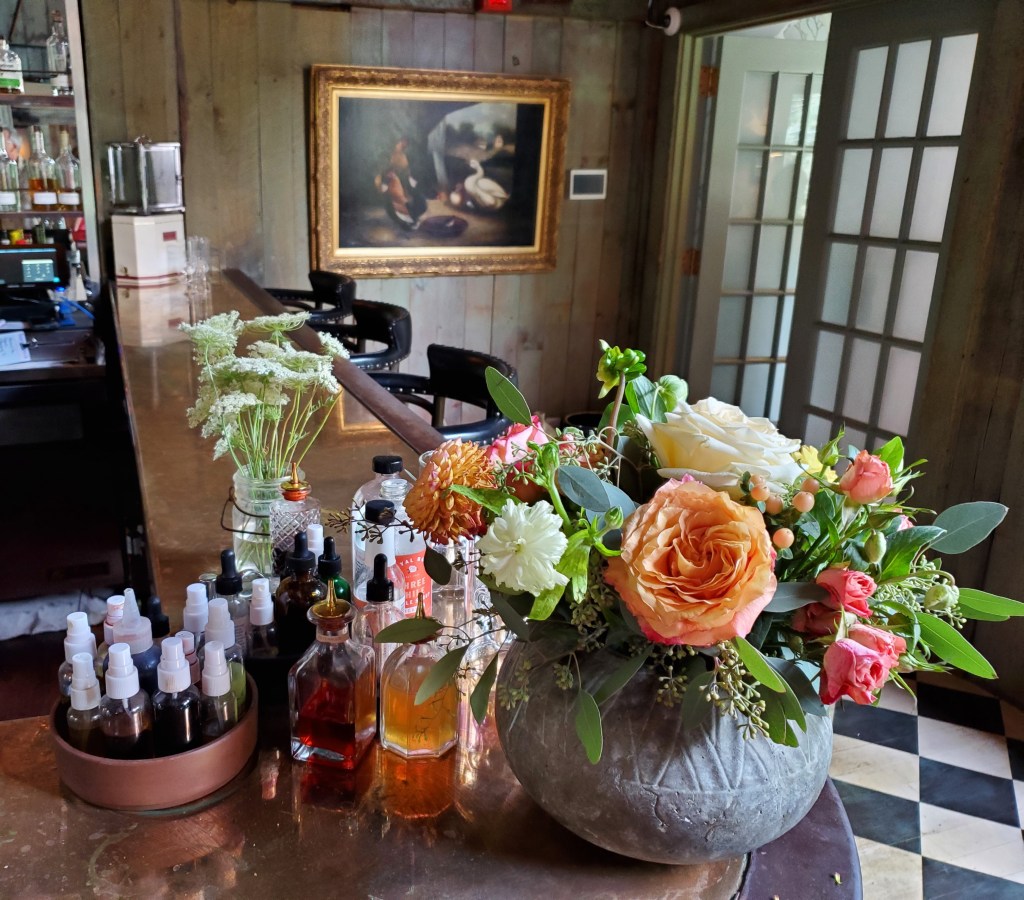
White Barn Bar Still Life I suspect I would not have left the bathtub telephone shower head in the “on” position–and thus treating the library below to a cascade that threatened the Steinway and called for major ceiling and wall restoration–had I not tried to pursue chores on the morning after a compromised sleep. BTW, kudos to AAA insurance and the team that promptly set that stupid mistake right.
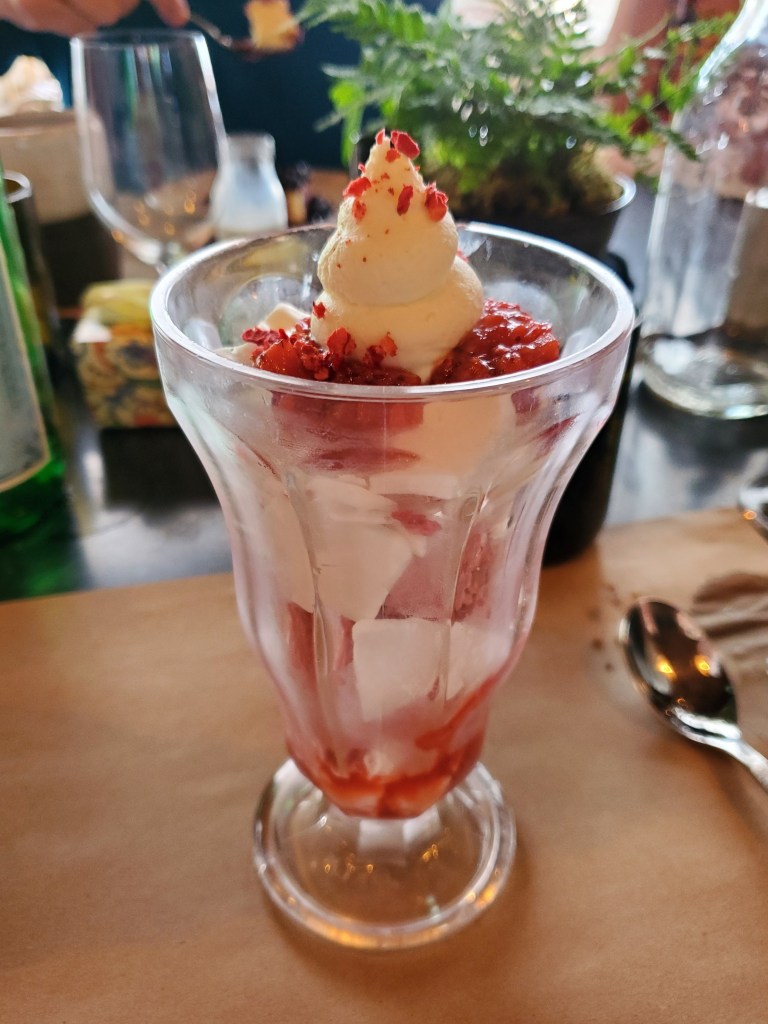
Favorite dish: Strawberry Pavlova Sundae I learned from Rebecca that it’s wise to keep checking the Portsmouth Music Hall site even when an event is sold out, as sometimes tickets are returned (and with this intel I subsequently scored a seat to hear Heather Cox Richardson on 29 September). Rebecca and her mom Marsha also recommended Québec City as a getaway destination only six hours’ drive away. So noted!
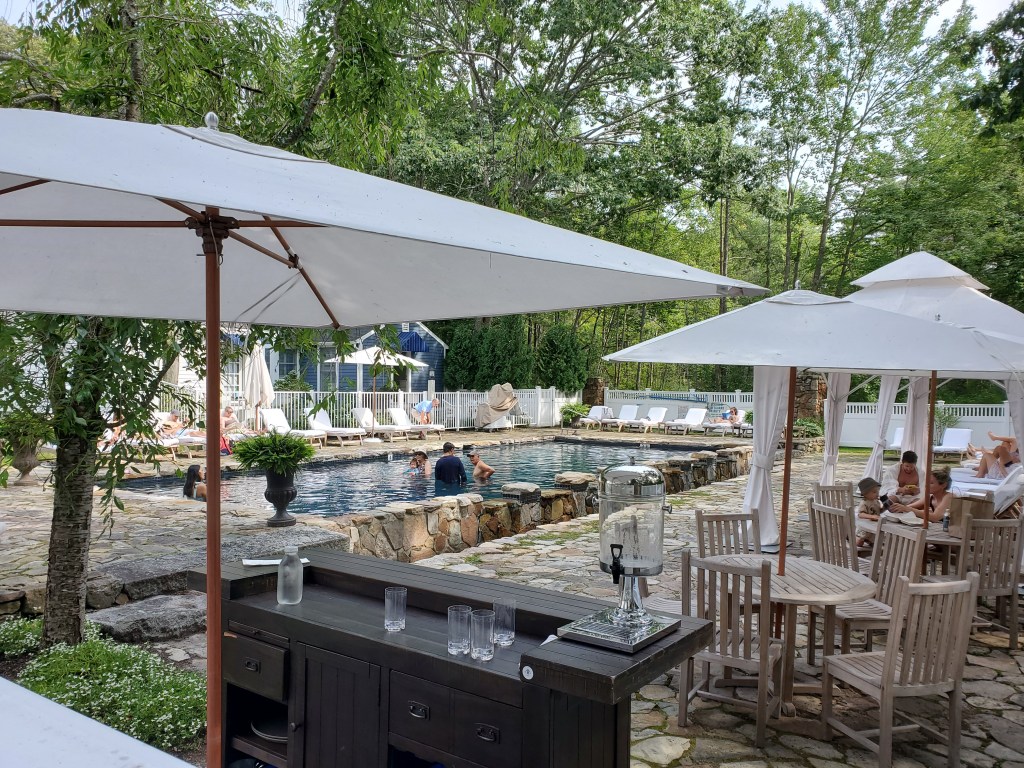
An inviting pool–for guests only 
Mandevillas and hydrangeas abound Most of all, Monday’s gathering reminded me of the joy a blithe spirit like Stephanie’s can spread, a prompt to spend more time in good company.
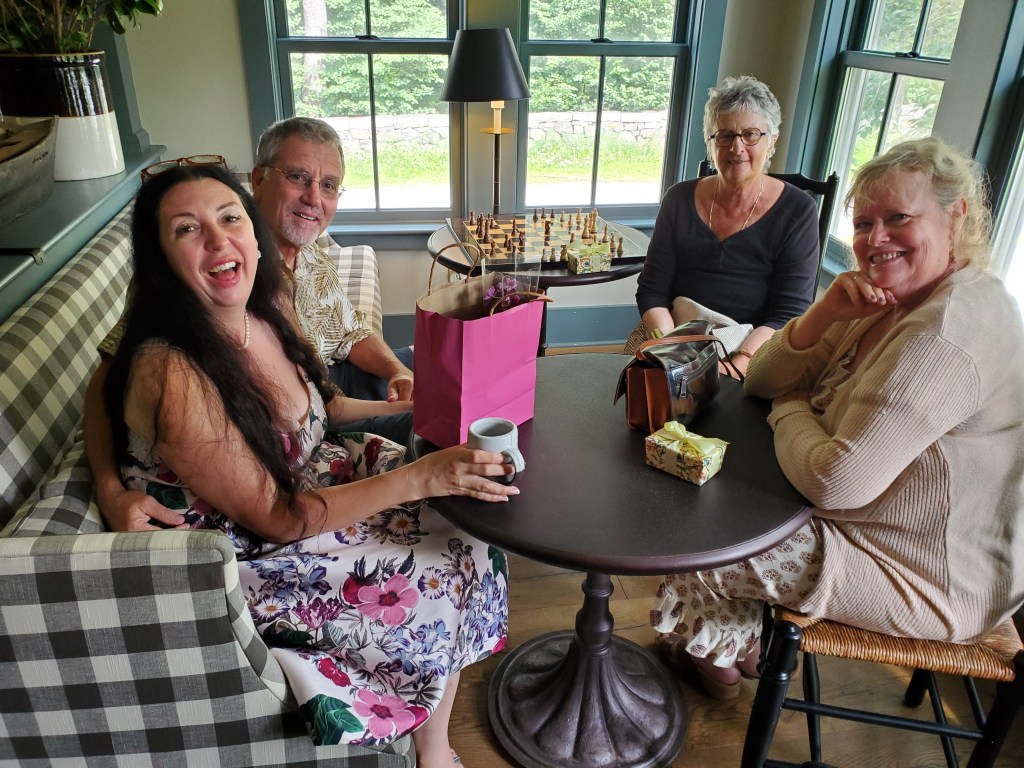
Birthday Girl Stephanie, Ken, Susan, and Linda enjoy the day On the way home, I re-discovered beautiful Parsons Beach just off Route 9; the hike in makes the view worthwhile, though parking is nearly impossible–as perhaps the location of the causeway-side “Suggestion Box” makes clear. Best to wait till off season, I suppose.
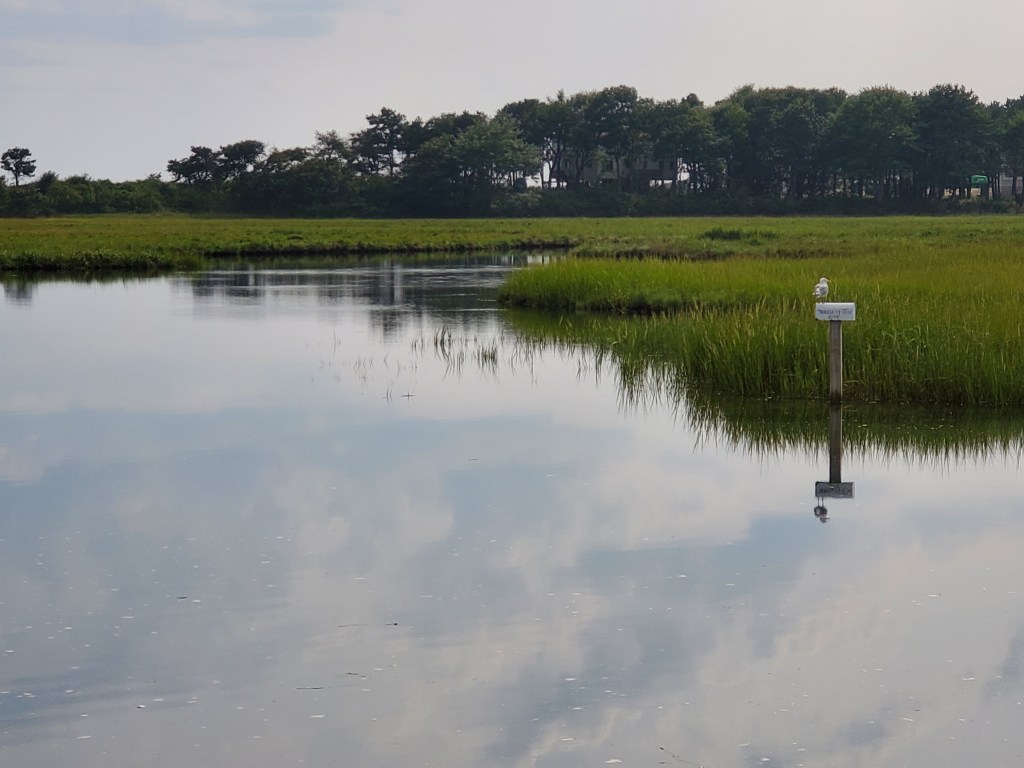
Parson’s Beach Suggestion Box and Attendant Back home, the grass needed mowing, and my bug-proof ensemble seemed to fascinate the dragonfly who hovered momentarily before my nose; trying to figure out the alien being, perhaps?
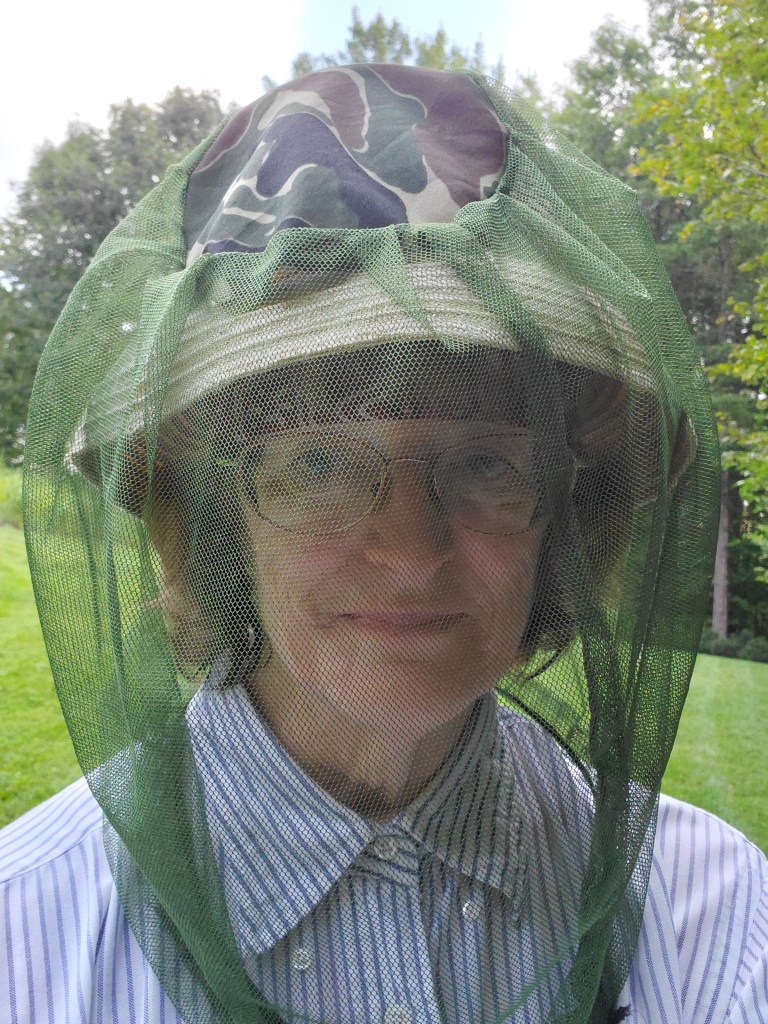
Staying un-bugged That pleasant chore accomplished, I found the gratifying charm of Stephanie’s birthday party lingered on well into the night. Happy New Year, Dear Friend!
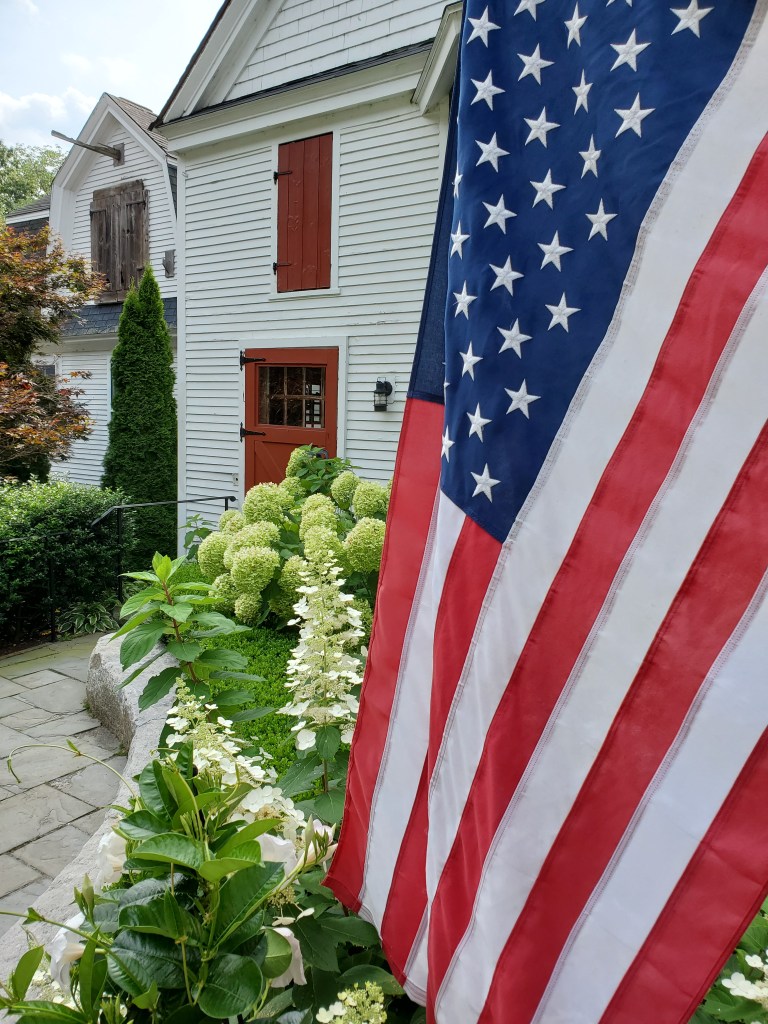
So New England, the White Barn -
Thanks, Mr. Hanks
22 August 2023
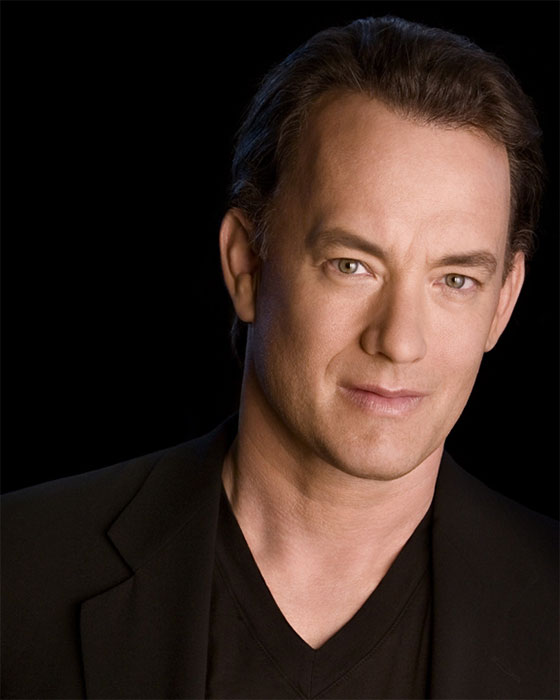
Young Tom Hanks, image from the 2014 Kennedy Center Honors Melissa Kirsch had a nice NYT piece last Saturday morning on “post-vacation clarity,” the fresh perspective one brings home from even a little time away from one’s accustomed place and routine. But I owe the fresh perspective I woke with that morning to Tom Hanks, or at least to the Tom Hanks onto whom I’ve projected another persona, the one who inspired the giddy, “On the Street Where You Live,” I’m-in-love-and-miracle-of-miracles-he’s-in-love-with-me, “corny as Kansas in August” elation I felt for the only time in my life when in the fall of 1990 my then-colleague, later-husband, now four years gone, followed me home from the British Library to sit at the wobbly table in the kitchen of my rented Balcombe Street flat to declare he was helplessly and forever in love with me.
So, what has Tom Hanks to do with this delight redux? Well, I’d just finished reading Hank’s new novel, The Making of Another Major Motion Picture Masterpiece, which is a lot of fun. And—like most people—I’ve always enjoyed Hanks’s performance in all the many films of his I’ve seen. But more importantly, whenever I’ve seen or heard Hanks being Hanks—on Letterman’s show, giving a commencement address, or substituting for Peter Segal on the NPR game show Wait Wait Don’t Tell Me—I’ve not only registered his quick, well spoken, intelligent wit, but a mischievous glint in his hazel eyes that reminds me of my David, a look a mutual friend of ours once described as “good-naturedly diabolical.”
While not fully subscribing to the accuracy of horoscopes, when I first learned that my David’s birthday was 13 July, my only thought was “Oh, oh,” as the only serious boyfriend I’d had before—ever since known as the Bad Boyfriend—was born on 15 July. So I wasn’t surprised when after Saturday morning’s crazy, absurd-but-exhilarating dream, I learned Hanks’s birthday is 9 July. Another Cancer. Check.
Most details of my just-barely asleep fantasy of unexpectedly, impossibly finding true love with Tom Hanks (!) faded soon after waking. But still, till day’s end, the afterglow remained, that tsunami of joy, hope, and gratitude I thought I’d never feel again, the rush of dopamine or oxytocin or whatever hormonal endorphins flood the brain at those few very happiest moments of life. I didn’t know I still had it in me. But Hanks, playing for a limited engagement and a very private audience the role of my darling David, deliriously in love with me, let me know I did, recovering for one happy day that lightning in a bottle the brain, apparently, can retrieve.
The other night I watched Jerry Seinfeld and David Letterman interview each other on an episode of Letterman’s My Next Guest Needs No Introduction. Letterman kept downplaying the worth of what he’d spent his life doing, but Seinfeld wouldn’t let him get away with it. Giving people joy, even for a little while taking them happily out of usual concerns and worries, Seinfeld insisted, is the best gift one can bestow. And I think he’s right.
So. Thanks, Mr. Hanks, for reminding me of the upside of being human, and the imperishable joy of loving and being loved in return.

The gallabia DSA, c. 1993 -
August, Strafford County (and Beyond) 17 August 2023
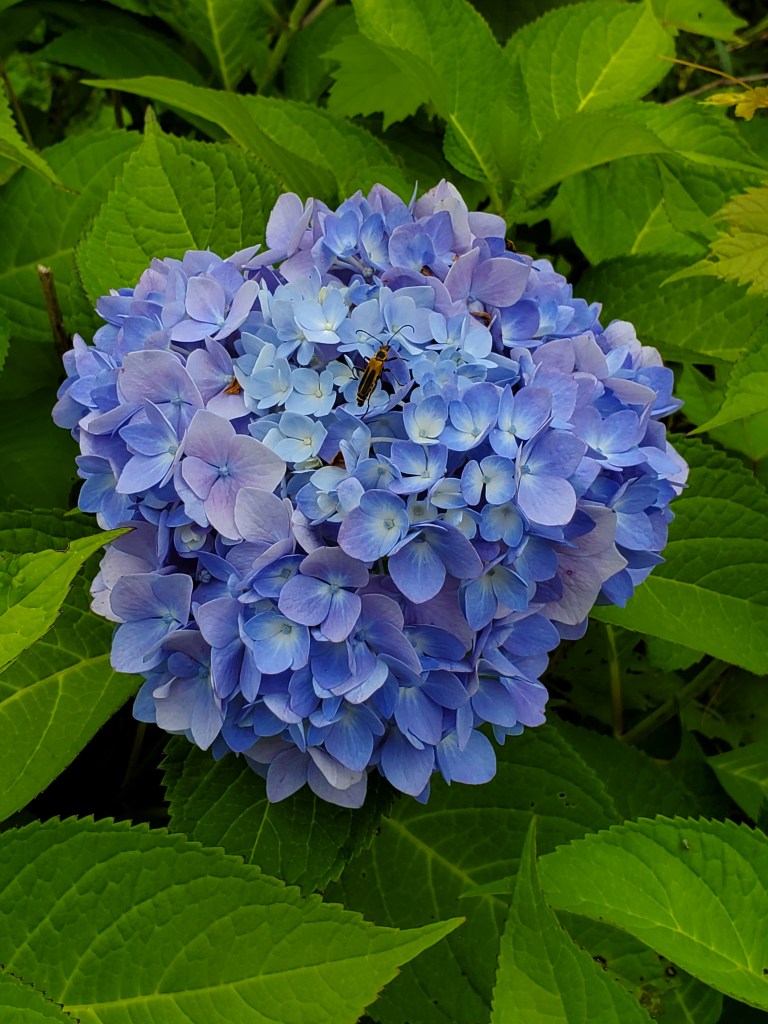
Gnawwood Blue, with lightning bug While swimming laps in UNH’s outdoor pool this morning—my penultimate visit of the season ending tomorrow—I found it (1) boring and (2) hard to keep track of the laps completed. In the early 80’s I swam laps in the Tulane pool because that seemed the only thing that would quiet my mind after hours of cramming for my doctoral orals: my head was stuffed with review of Renaissance (now called Early Modern) English literature, my body cramped from hours of sitting in the Howard-Tilton Memorial Library. (By the way, what does it say about academia that where we once looked back to classical models, we now search earlier literature for intimations of what we have become? Smacks a bit of narcissistic solipsism, don’t it?) The pool was tonic then, as it is now, but for different reasons. Now I go for the exercise, of course, and the delight of watching little kids with their moms, hoping to dispel the quotidian gloom with which I typically awake, especially on yet another of this summer’s too many grey, overcast days.
Since I returned from Wisconsin at the end of July, I’ve been very much aware of summer’s lease expiring. Darkness falls much sooner, the goldenrod is in bloom, and we’re past the Perseids’ annual show. The Lee Market Basket is selling mums now, for Christ’s sake. Too soon, too soon! Summer treats are whizzing by as quickly as those meteors: a lovely seaside picnic to watch the first of August’s two full moons rise over the Atlantic, seeing the Barbie movie, having lunch with a former colleague returned to NH from her condo in The Villages, visiting Tanglewood and enjoying the hospitality of new acquaintance formerly at UNH and now happily retired to the Berkshires.

Full moon over Great Island, New Castle, NH 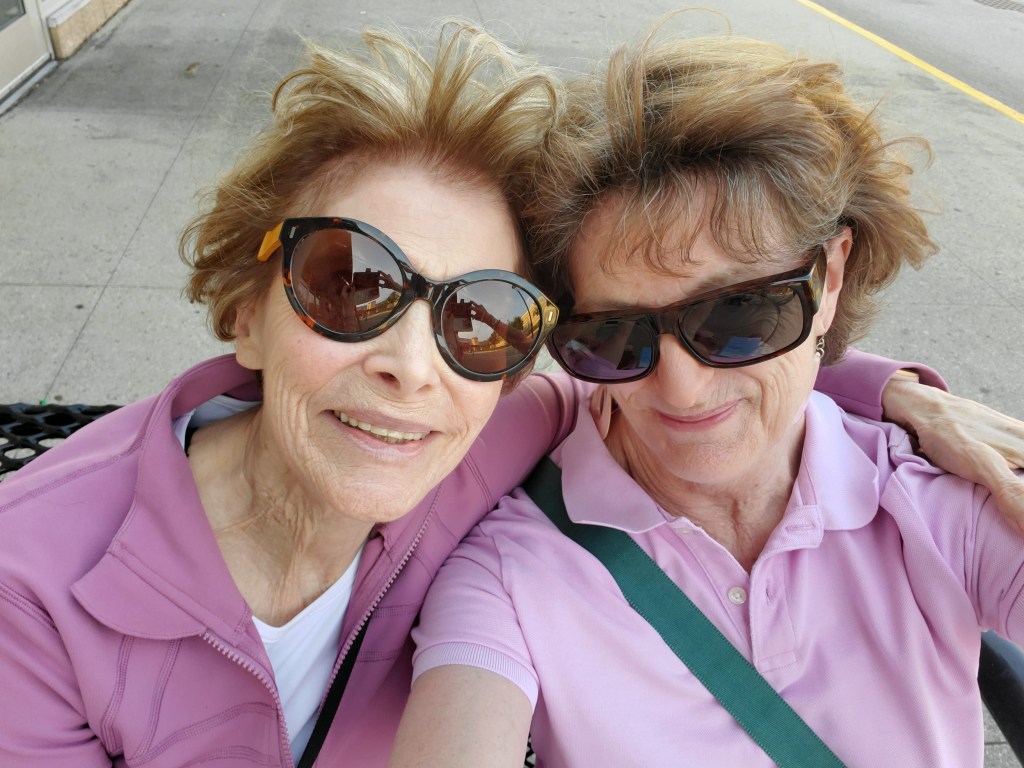
Carol and I as Barbie Girls 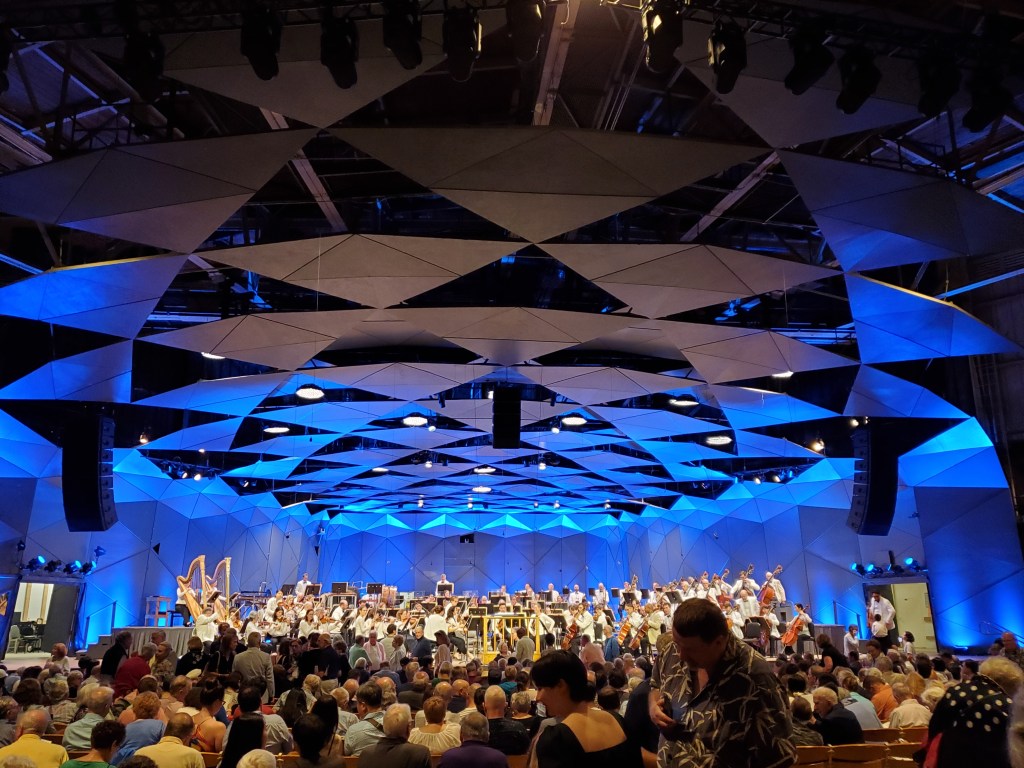
The BSO assembled in the Shed for Stravinsky’s Petrushka (1947 version) 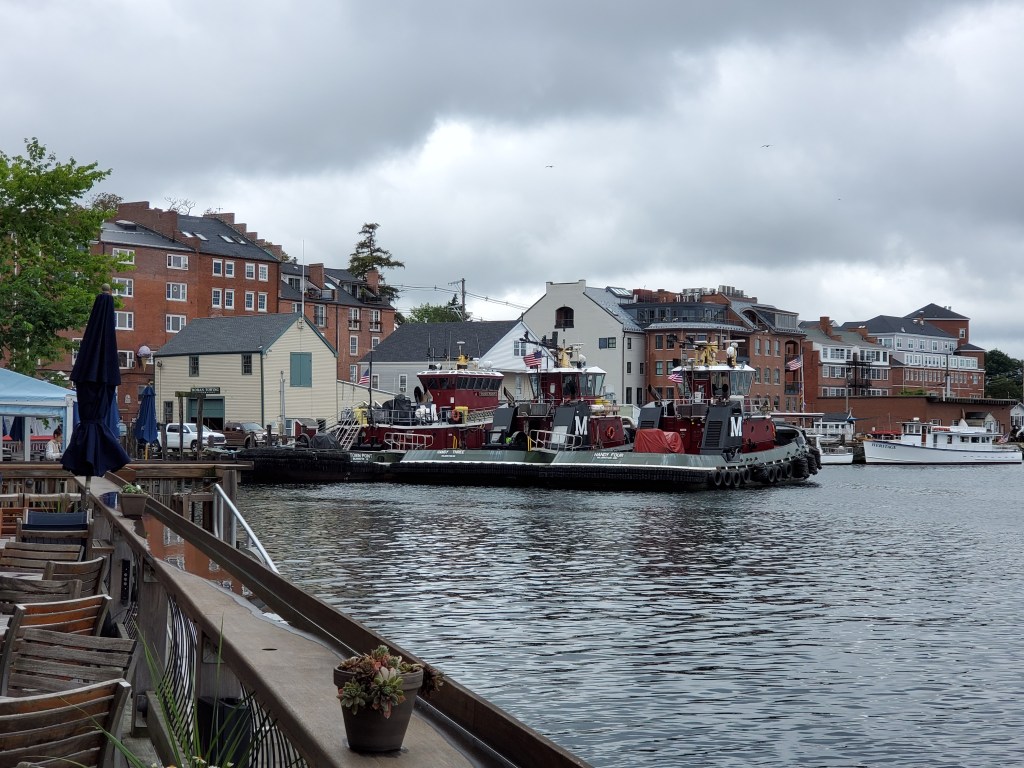
Luncheon view from Martingale’s Wharf, Portsmouth NH None of the big summer projects I meant to tackle are complete, the wet weather less to blame than my own ennui. I worry for my sister Jane, brought low by seven rounds of debilitating chemotherapy, her signature Blonde Wind hair now all but gone. My one remaining London friend—yet another widow—wrote yesterday of an amputation that’s left her unable to stand, let alone walk. And as “back to school” days near, I am both relieved I have no courses to prepare and bereft of purpose. And I miss my darling David. Watching the video he shot for my 40th birthday—clever, bawdy, cute, and dear, filled with joyful anticipation of our life ahead—beggars the life I lead now.
And then there’s the Orange Menace, four indictments in and still leading the party of Lincoln. HOW IS THIS POSSIBLE??!! How could the Founders ever have foreseen such a test of their Great Experiment?
Well, the good news is that Heather Cox Richardson’s coming visit to the Music Hall in Portsmouth where she will flog her new book, Democracy Awakening, sold out as soon as it was announced. And, to avoid a spiraling dive to despair, I’m taking up my friend Carol’s astute conviction voiced as we sat together anticipating the start of Greta Gerwig’s Barbie: that movie’s phenomenal success is a Good Sign.
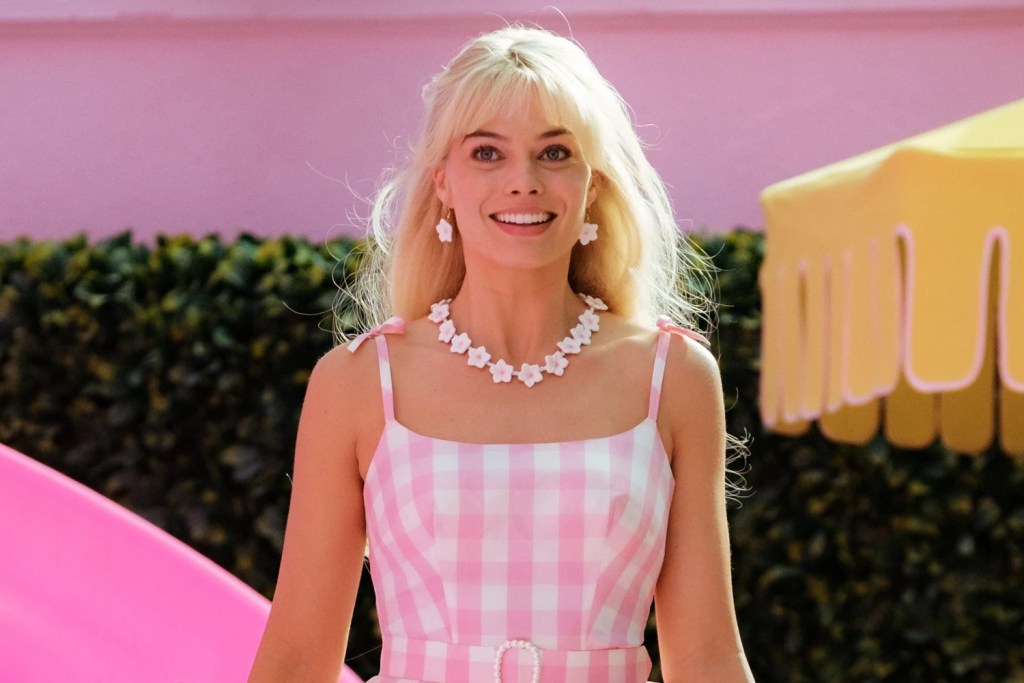
Margot Robbie as Barbie (Warner Bros./Jaap Buitendijk photo) During the past week and a half, Barbie passed the billion-dollar mark at the global box office, and is likely soon to overtake The Super Mario Bros. Movie to become 2023’s highest-grossing movie worldwide. As Kyle Buchanan noted in the New York Times (16 Aug 2023), “no movie directed by a woman has ever topped the yearly box office, and it’s been well over two decades since a live-action film without any significant action elements became the biggest movie of the year.” Carol and I had earlier seen Christopher Nolan’s fine Oppenheimer, and the two films’ simultaneous release begs comparison: the ethically wracked genius become “the destroyer of worlds” (and, as the film reveals, of women, the mistress driven to suicide and the wife to alcohol) vs. the epitome of unattainable perfection doll whose journey outside Barbie Land, where she discovers sexism as Ken discovers the patriarchy, unites an estranged mother and daughter in a quest to make being female possible. Barbie’s early mistaking a billboard of attractive women for the Supreme Court may be a bitter joke in light of the real Court’s overturning of Roe v. Wade, but it is Barbie that has bested Oppenheimer at the box office. As of 13 August, Nolan’s film has grossed a terrific $649 million worldwide, but Barbie has brought in 1.2 billion. And it is Margot Robbie’s (Barbie’s) zinger of a last line that suggests the political power of female anatomy (no spoiler, I) to swing an election. We can only hope. I also predict that the film’s America Ferrera’s (Gloria’s) ferocious feminist philippic on the impossibility of being female will become the most-often rehearsed audition piece for the next year or so. (Google it, Dear Reader.)
And why not? You Go, Girls!
Another iconic woman saved the day last weekend at Tanglewood, when Yo-Yo Ma, scheduled to play the Shostakovich Cello Concerto No. 1, tested positive for COVID. So Renée Fleming stepped in to substitute, singing six Strauss songs with orchestra. She did not disappoint.
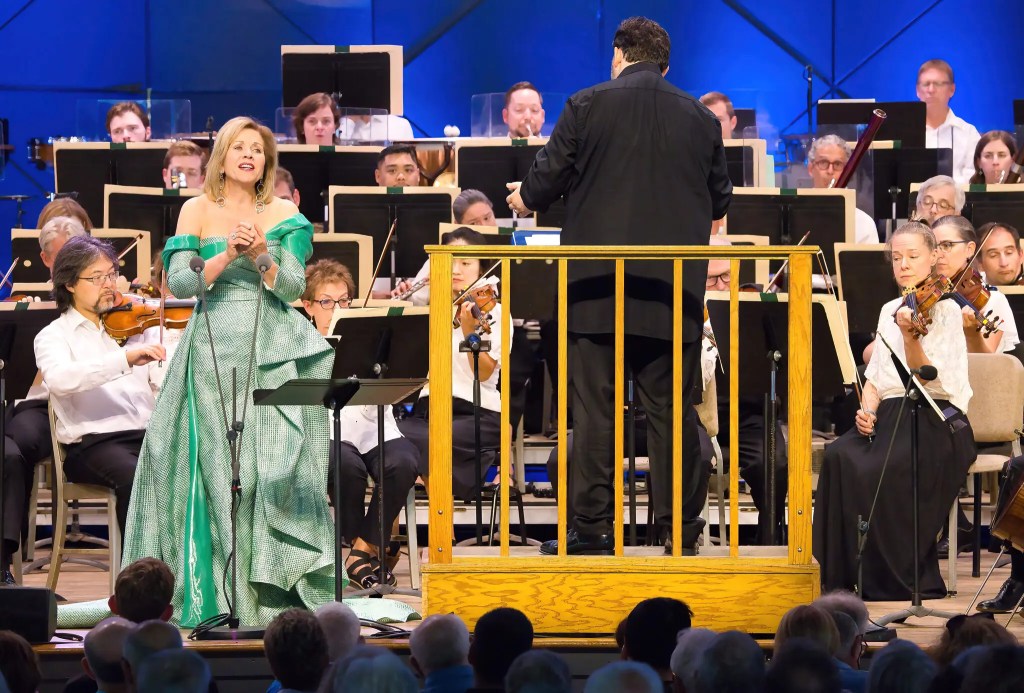
Renée Fleming in the Shed, Andris Nelsons conducting, 13 Aug 2023
(photo by Hilary Scott)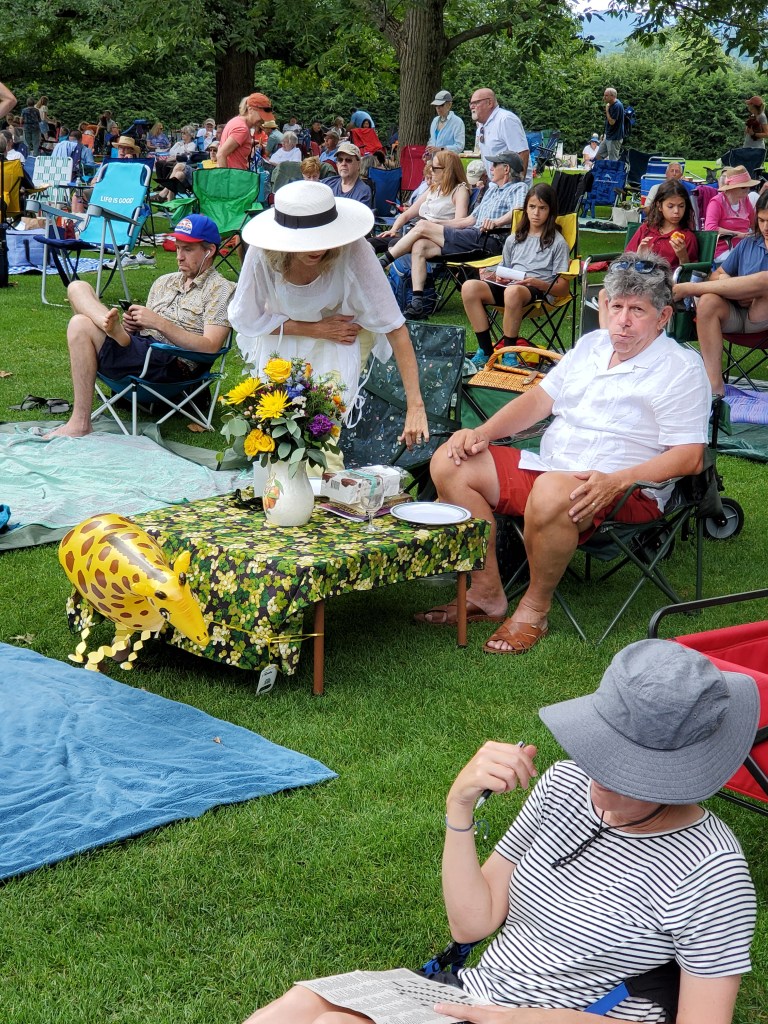
Tanglewood Types Picnic on the lawn Neither did Susanna Mälkki, conducting the BSO on the previous Saturday night, when pianist Seong-Jin Cho first enchanted the audience with Mozart’s Piano Concerto No. 9 in E-flat, K. 271 plus a Chopin encore, and then Mälkki (her assurance at the podium reminiscent of Cate Blanchett’s Tar) absolutely nailed Bartok’s demanding Concerto for Orchestra in a thrilling performance.
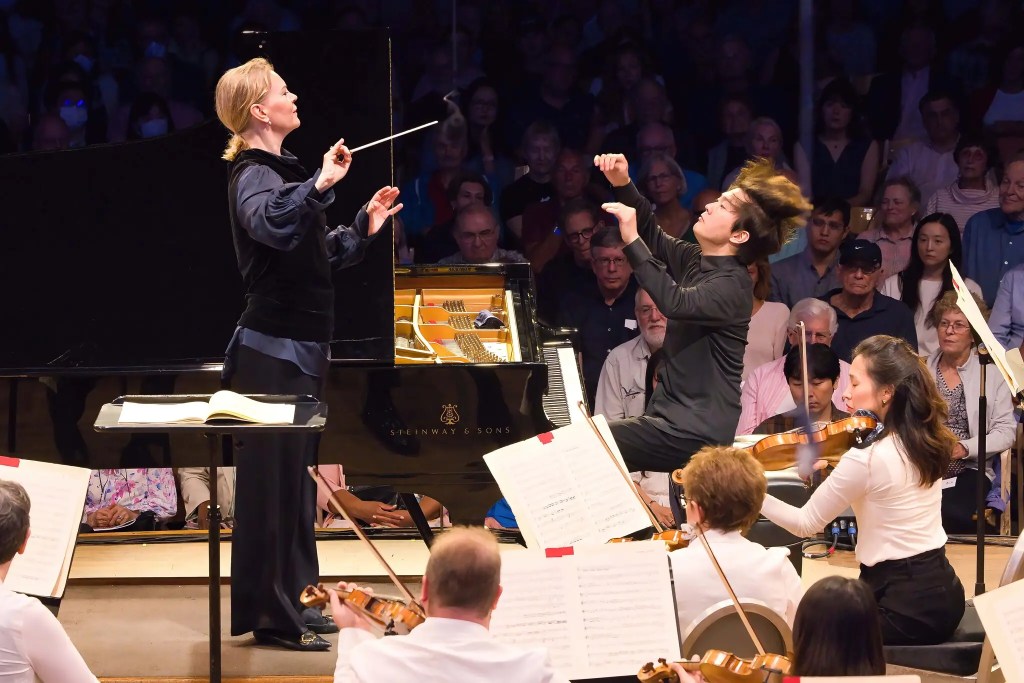
Susanna Mälkki conducting as Seong-Jin Cho plays Mozart, 12 Aug 2023
(phtoto by Hilary Scott)Our generous hosts for the weekend, Gary and Beth, had treated us to a pre-concert stroll through the grounds of Edith Wharton’s mansion, The Mount, with its free display of large-scale sculptures.
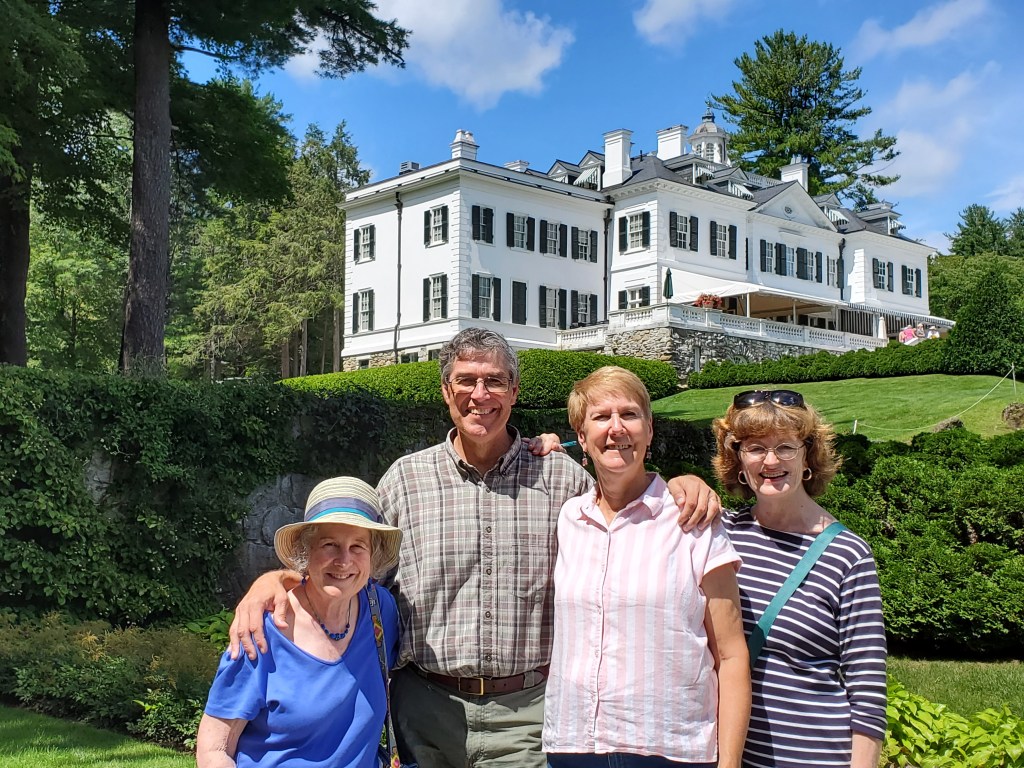
Vicky, Gary, Beth, and Georgeann at The Mount 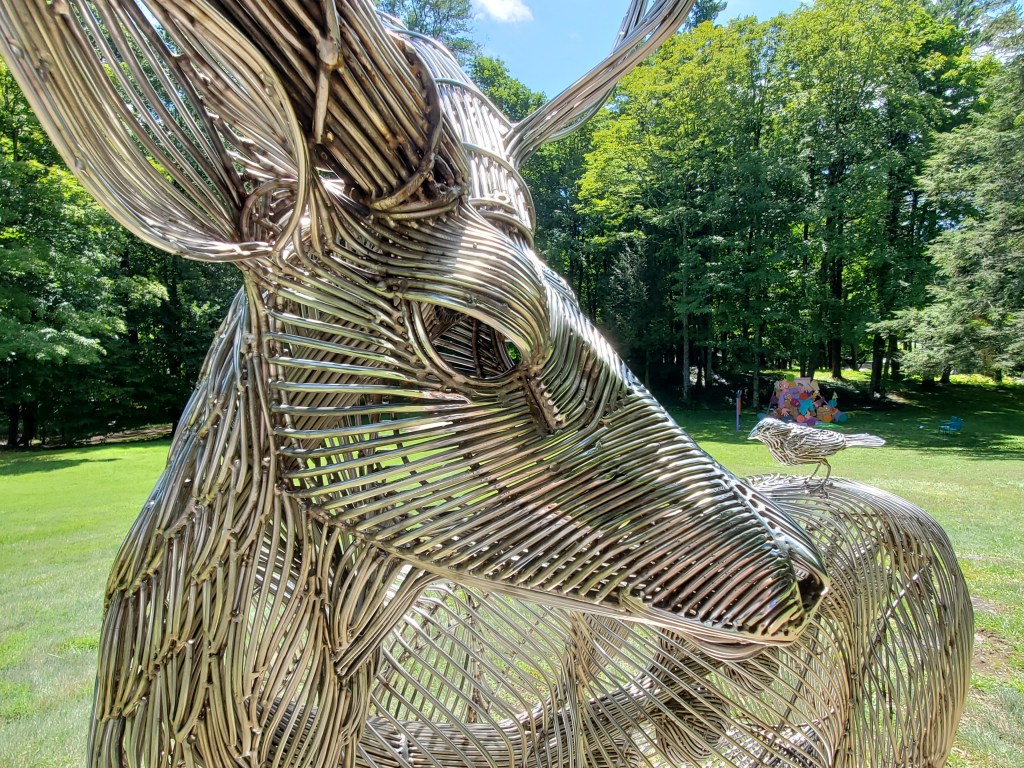
ByeongDoo Moon’s I Have Been Dreaming to Be a Tree, stainless steel wire, for sale at The Mount ($110,000) The success of Wharton’s career evidenced by the opulence of her Gilded Age estate now for me chimes with the theme to which I’m clinging, floating like Kate Winslet on her Titanic door above my end-o’-season blues: the prospective hegemony of females. I’ll even wrap our post-concert stops at the High Lawn Dairy Farm and Olivia’s Overlook into that optimism: those cows make mighty fine ice cream possible, and Olivia’s got a superb view of the Stockbridge Bowl.
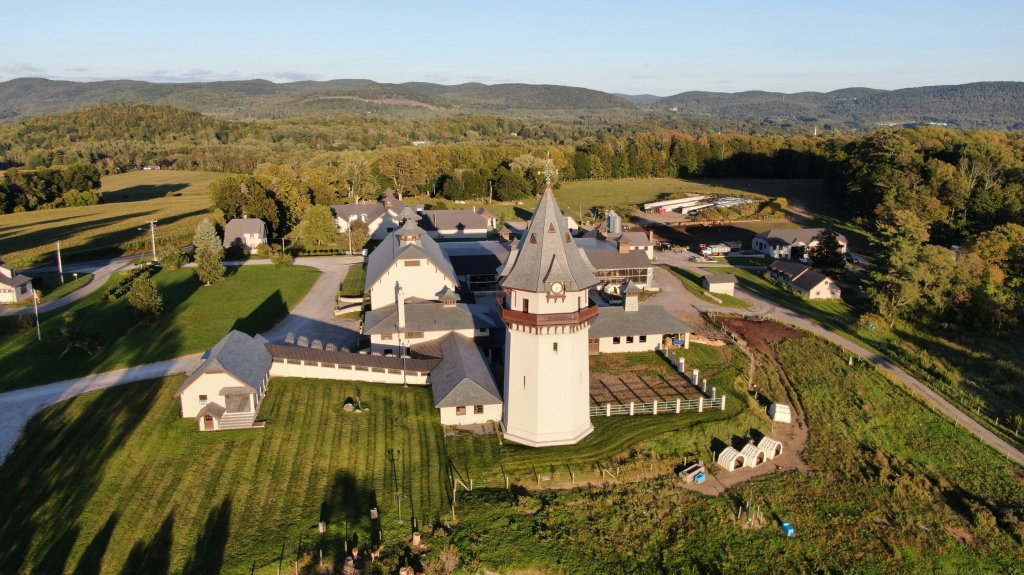
High Lawn Dairy Farm, Lenox MA 
Blackboard sketch of a High Lawn Cow 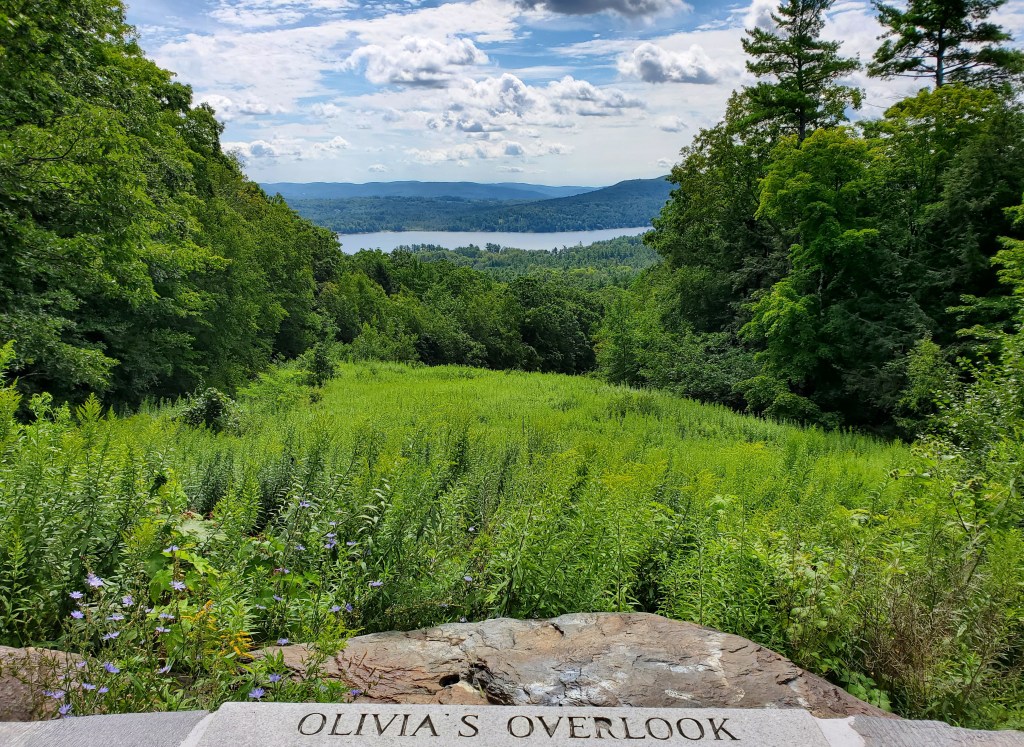
Traffic to and from the Berkshires was heavy and impeded by road work, so much so that sweet baby James Taylor’s “Traffic Jam” kept playing in my mind:
I used to think that I was cool
Driving around on fossil fuel
Then I found what I was doing
Was driving down the road to ruin.
But after such a lovely weekend away, I have much to be grateful for. Even my favorite sculpture at The Mount, ByeongDoo Moon’s I Have Been Dreaming to Be A Tree, found a living, breathing analog to welcome me back to my very own Strafford County estate.
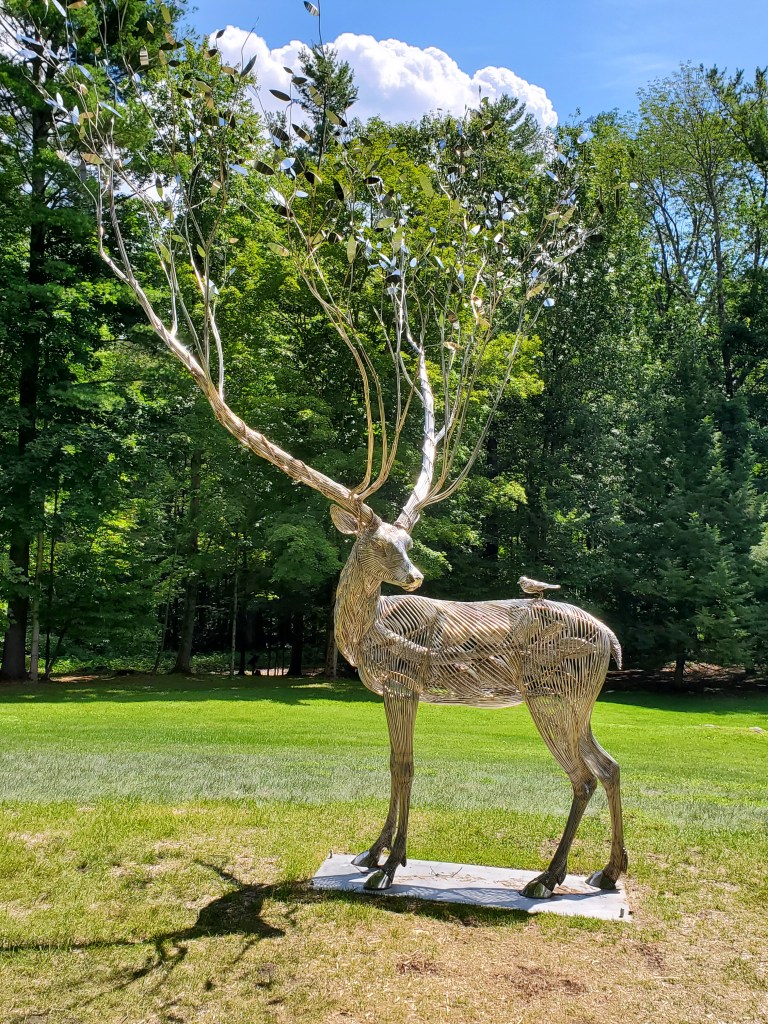

Gnawwood Doe, 14 Aug 2023 It’s good to be home.
-
On Wisconsin, Part 2 4 August 2023
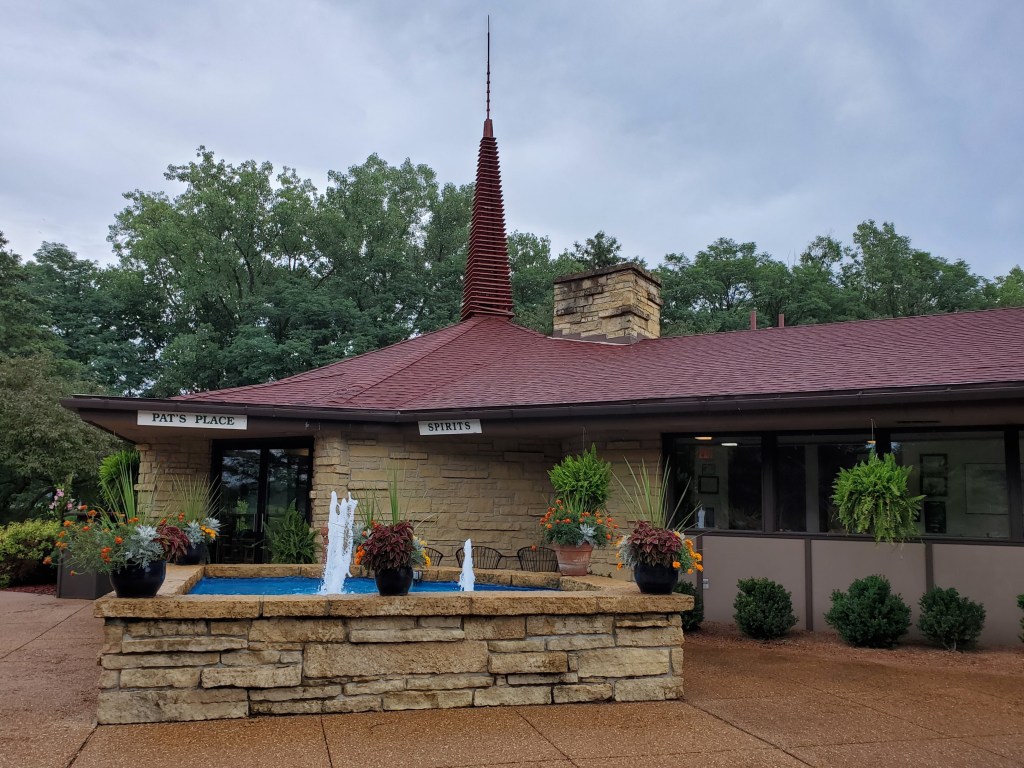
“Pat’s Place” at the Spring Valley Inn near Spring Green WI: pure Taliesin The drive west from Portage to Spring Green, Wisconsin takes about an hour and a quarter, and on Wednesday the 26th, the louring skies made the passing fields look preternaturally green.
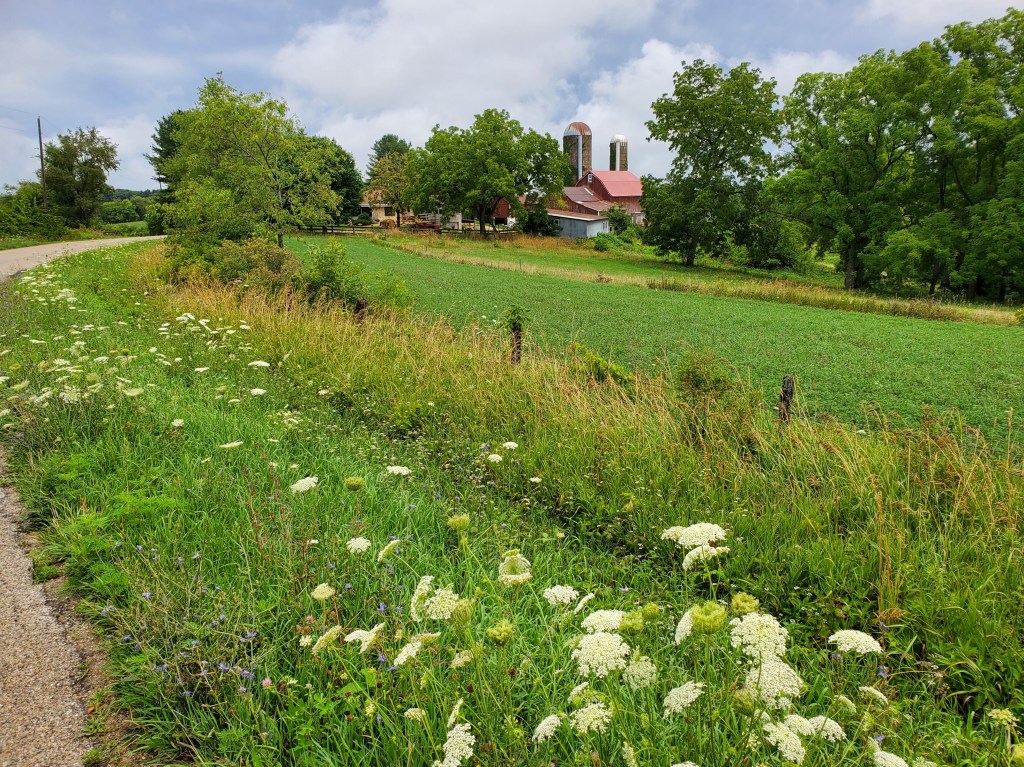
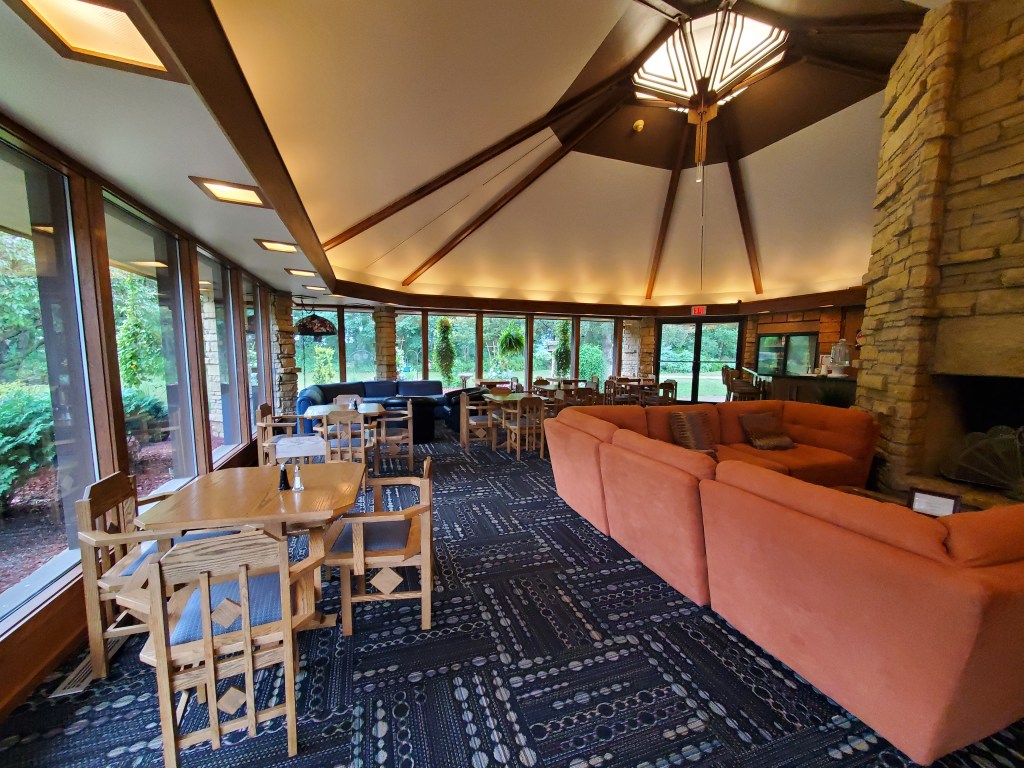
Lower Wisconsin River Valley farmland At noon I reached the Spring Valley Inn, first designed in the early 1990’s by the Taliesin and Frank Lloyd Wright Foundation as a visitor’s center and later purchased by the current owners, John and Patricia Rasmussen, who along with Charles Montooth, apprentice to Wright and member of the Taliesin Associated Architects, turned that visitor’s center into the Inn’s handsome reception area and lounge, constructed the extant 35-room hotel, and in 1994 adding a capacious indoor pool and conference room. All the furniture and appointments were designed by Taliesin architect James Pfefferkorn and built by local Master Craftsman Rick Kraemer. For Wright aficionados, this is certainly the RIGHT place to be.
Spring Valley Inn 
Even the wall-mounted door stops are pure Frank Lloyd Wright After a quick look around, I used the time before check-in to scout out the nearby House on the Rock Resort where we were to have dinner and to locate both the American Players Theatre (APT) and nearby Taliesin East.
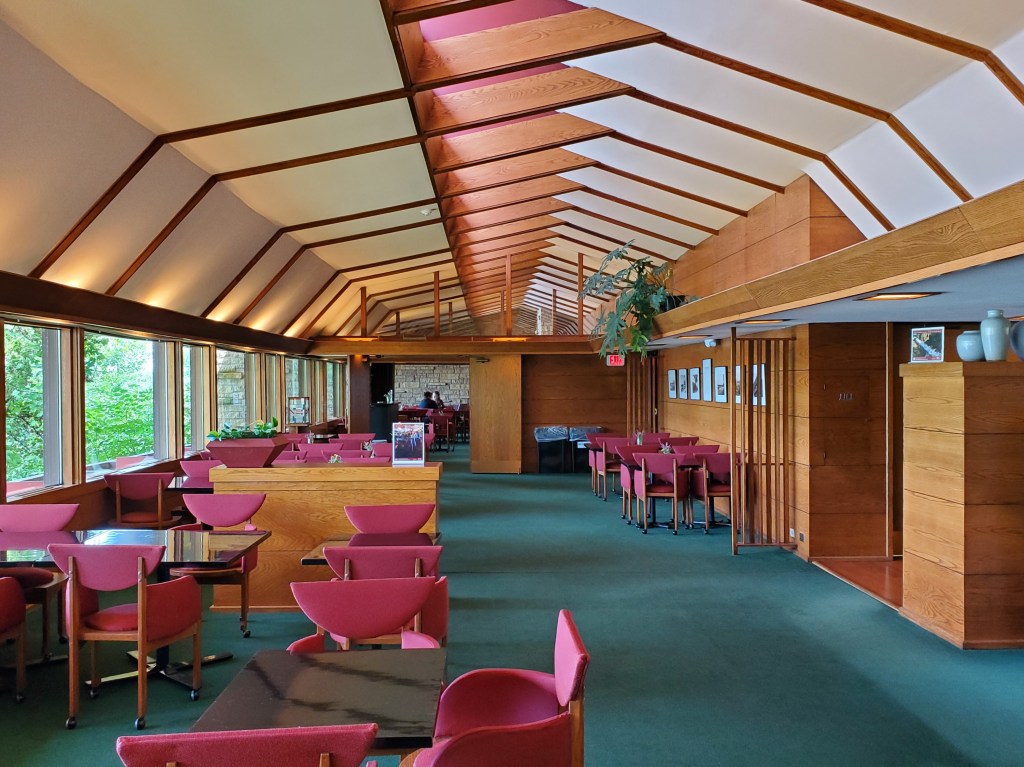
The Visitor Center at Taliesin East . . . 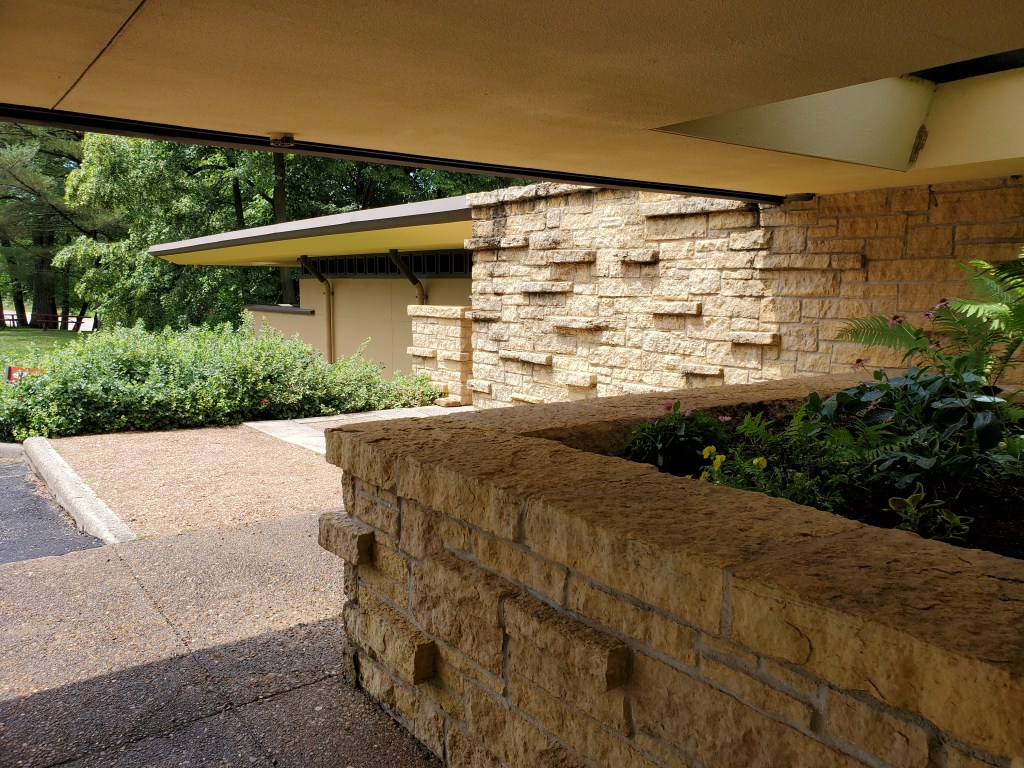
. . . with a characteristically low-ceiling entrance That accomplished, I had a fine lunch at the General Store just off the railroad tracks in Spring Green, a tiny town of some 1500 (even smaller than Madbury’s 1900) where the fire station, bank, and at least one private home were clearly under the FLW influence.

Spring Green residence 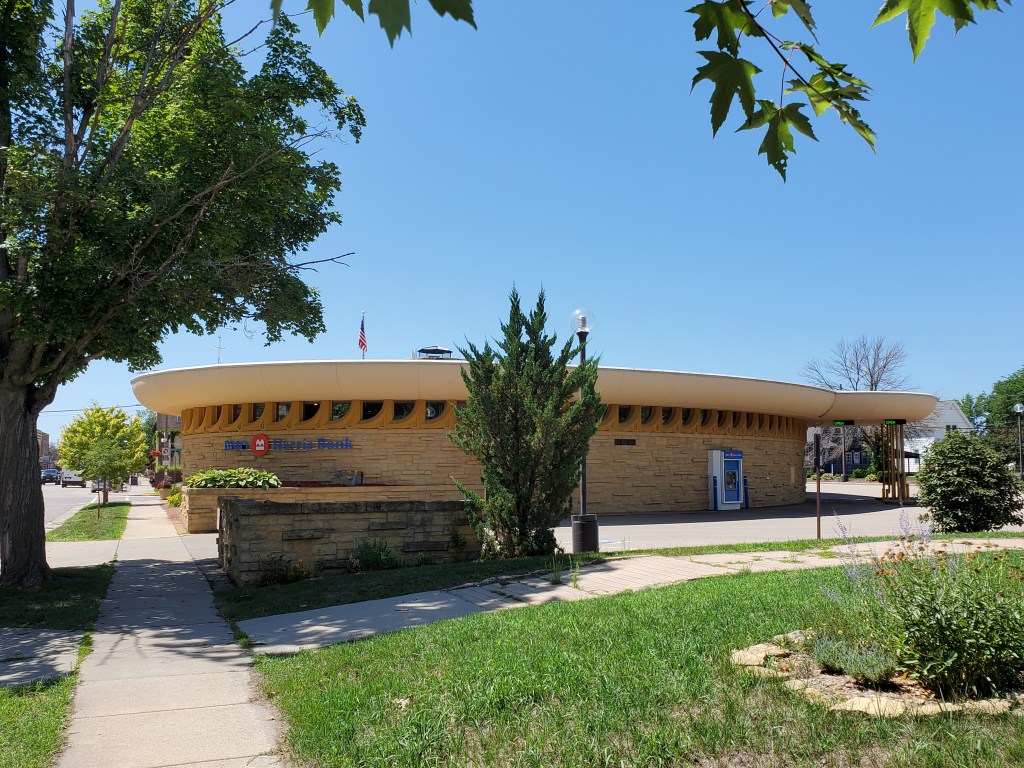
Spring Green’s BMO Harris Bank Once friends Charlotte and Ed arrived at the Inn, we went off to an early dinner at the House on the Rock Resort,
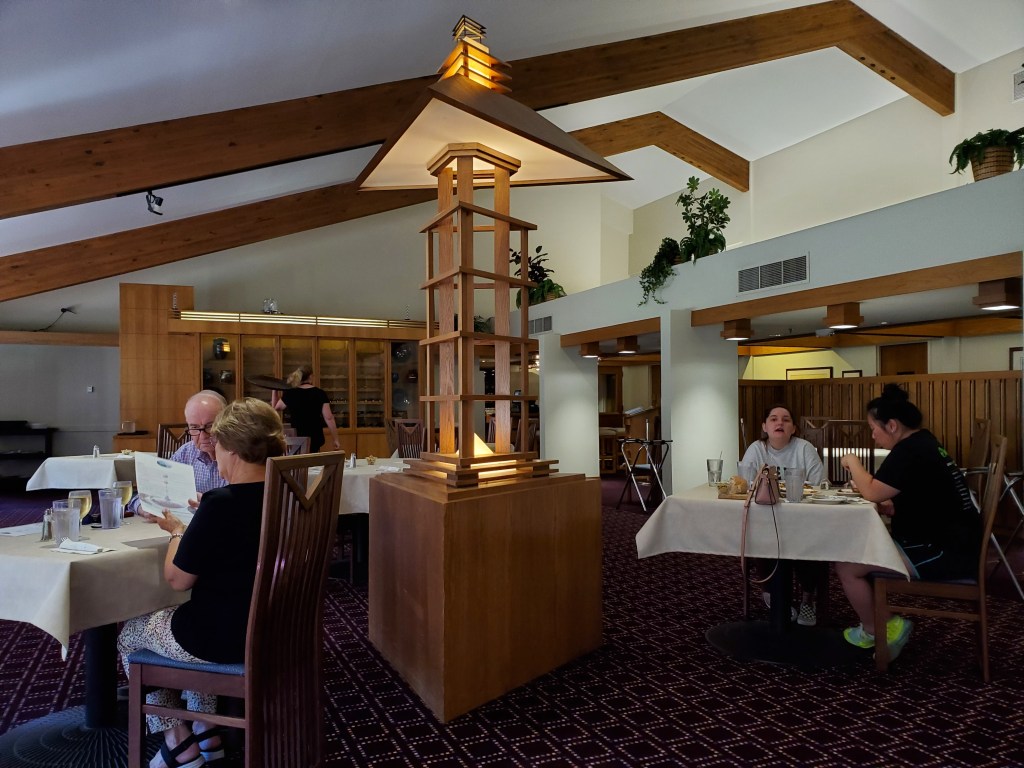
400 Springs Restaurant at the House on the Rock Resort 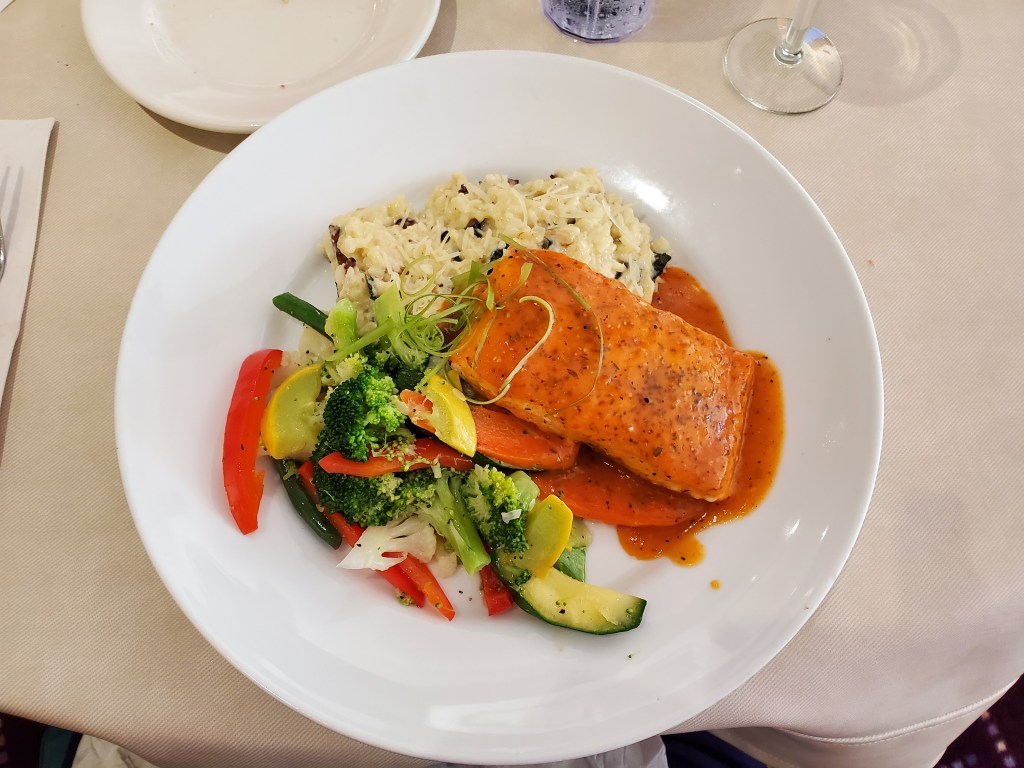
Salmon and a really nice kale risotto and then on to a production of Our Town at the APT’s outdoor Hill Theatre.
Charlotte had never seen Thornton Wilder’s play, and while we all thought this production quite fine, I regret it didn’t come close to the devastating David Cromer production I saw in the 199-seat Barrow Street Theatre in 2009. In fact, even this clip of that show (http://www.barrowstreettheatre.com/about-us/past-productions/our-town) I found online just a few minutes ago still brings tears to my eyes. As my late UNH theatre colleague John Edwards once pointed out, theatre space is everything, and in fact, when I later took my husband David to see the Cromer production then playing in Boston, it did not have the same effect on me or the audience. That night in the West Village just off Washington Square may be the single most powerful performance of anything I have ever seen. With the house lights up throughout, David Cromer, who both directed and played the Stage Manager, was like the rest of the cast within easy reach of the audience; there was no hiding anyone’s emotion on stage or off. The young woman sitting in front of me, seemingly on a date with her equally young escort, was embarrassed by her so-visible tears at the end of act two’s wedding, and no one made it dry-eyed through the final act and Emily’s epiphany inspired by revisiting a single seemingly unimportant morning past, its precious evanescence recaptured and for once observed in perspective by Emily and audience alike. In that production, staged as scripted with minimal set, props, and mimed actions, the curtains at the back of the thrust stage suddenly revealed behind a hitherto unseen proscenium arch a kitchen scene utterly realistically realized by period costumes, lighting, and box set complete with working stove and real bacon sizzling and scenting the theatre air: a real coup de théâtre. Just remembering that darling boy playing Emily’s young brother Wally, dead of an appendix burst on a camping trip, wearing his Boy Scout uniform, sitting in his chair/grave among the dead, moves me to tears even now. No re-living that moment, I guess.
Even so, I think it a better play than my friends do, and we had a jolly argument about its themes the next morning at breakfast, all of us grumpy from a less than satisfying sleep. How delightful to disagree without rancor among dear friends! Charlotte’s objections forced me to formulate a defense of the script I’d never before thought through: the conversational dialectic at work as it should be. How I wish political divides could be similarly enlightening!
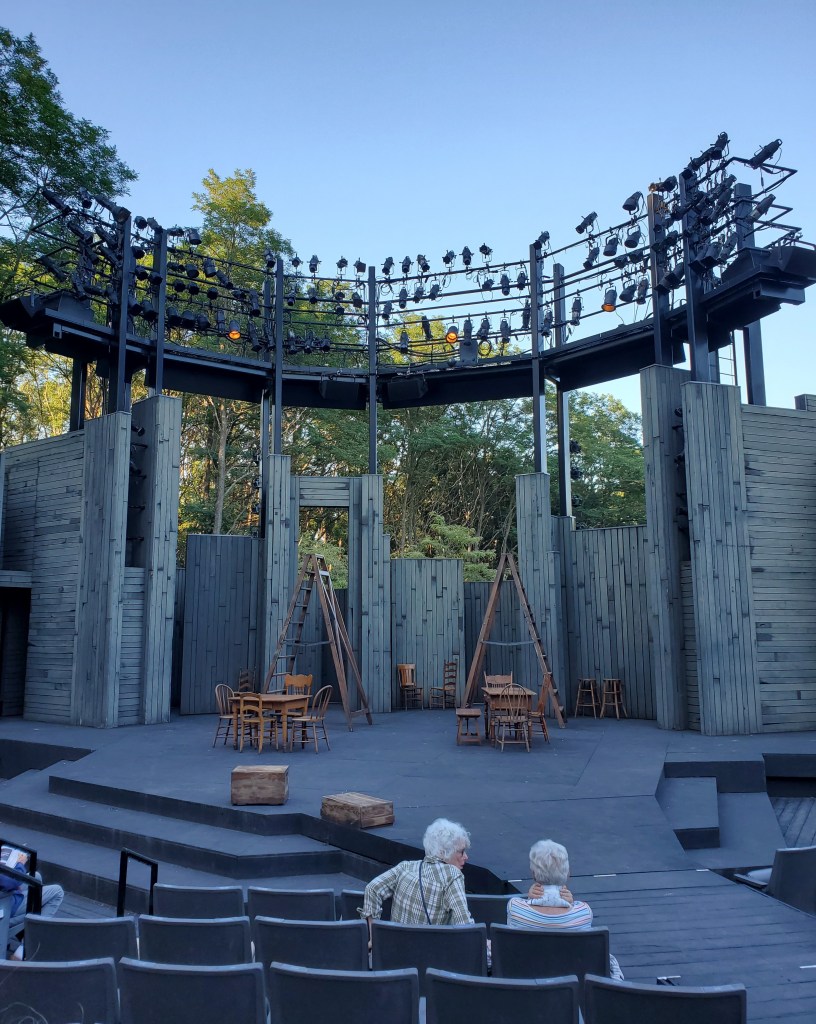
American Players Theatre set for OUR TOWN After breakfast we headed out to Taliesin East for a two-hour tour led by a very well-informed and appealing docent, Ben, a Wisconsin-born farm boy (he reported he’d done his share of tasseling the corn crop) transplanted to NYC. A shuttle bus drove us around the Taliesin property, now a UNESCO World Heritage Site, and Ben led us through both the Hillside Studio and Taliesin itself.
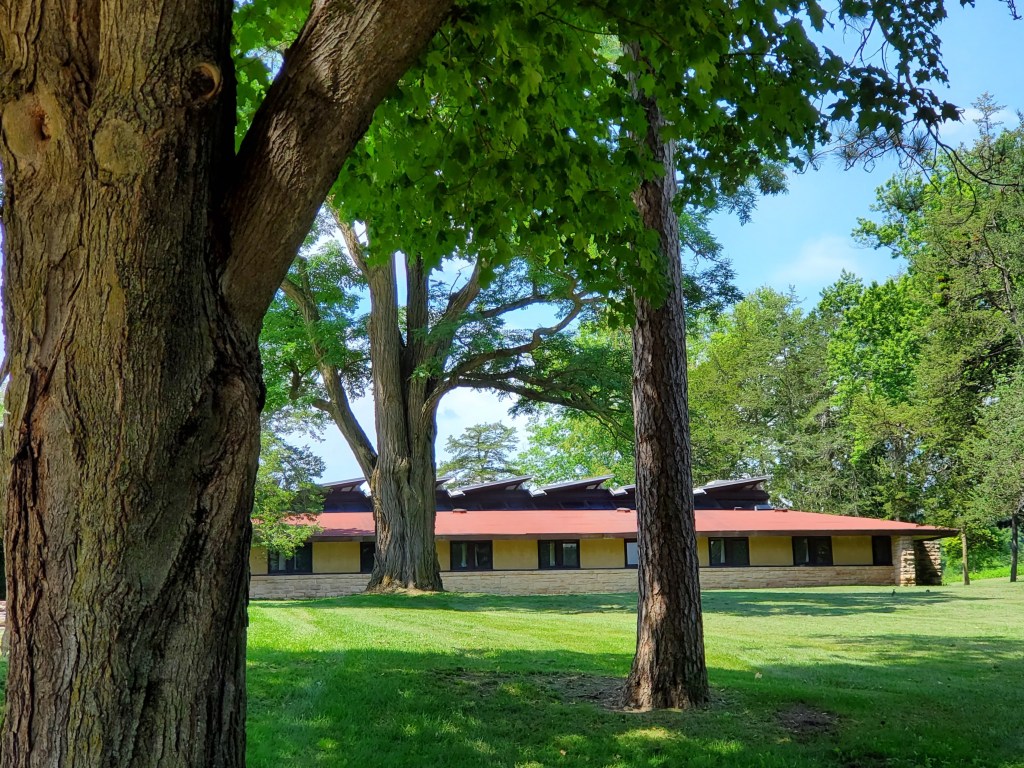
Hillside Studio at Taliesin East 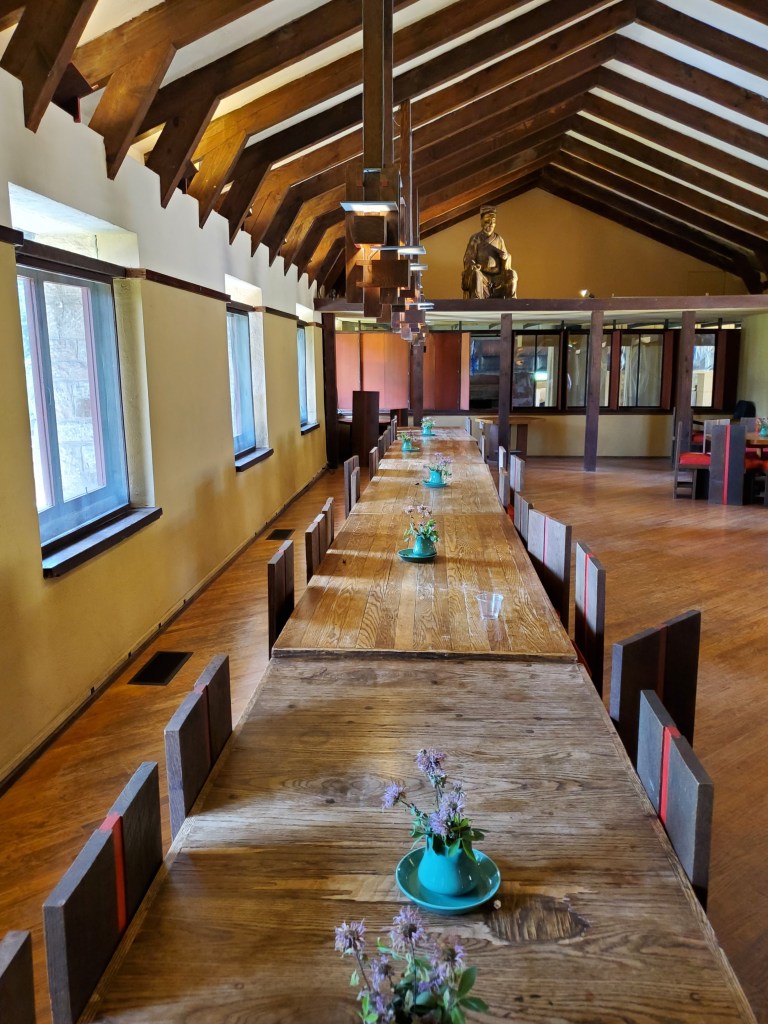
Dining room at Hillside Studio, with lighting fixtures designed by Taliesin apprentices 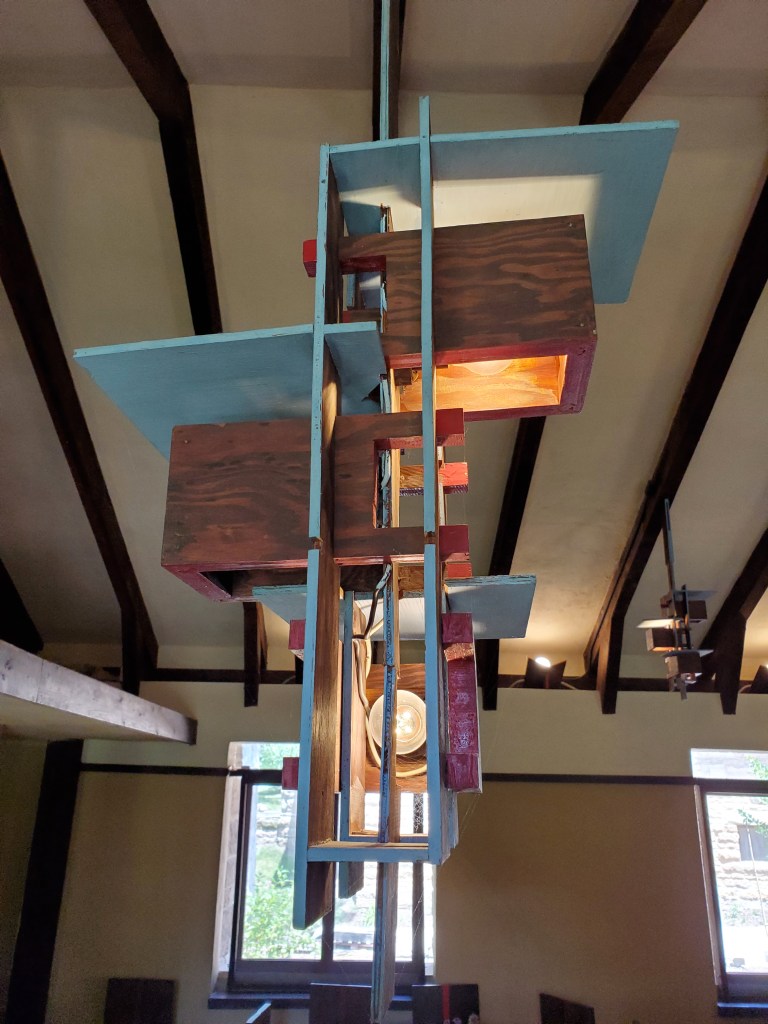
The tour group was a singularly knowledgeable one, too, which was great: one young woman was clearly a Wright scholar, and another older woman was coincidentally not only from New Hampshire, but a docent at the Zimmerman home, one of Wright’s Usonian houses now owned by the Currier Museum in Manchester.
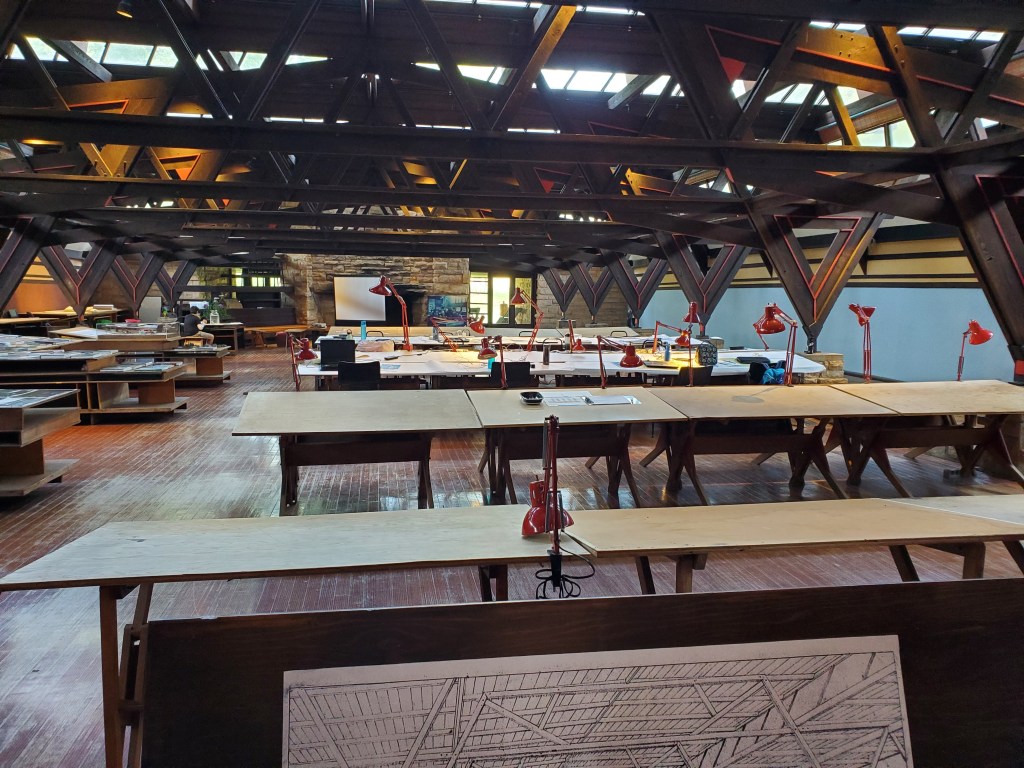
The “abstract forest” of the Hillside drafting studio I’d prepared for the tour by reading T. Coraghessan Boyle’s historical novel The Women about the four most important women in FLW’s life, his three wives—Catherine (Kitty) Tobin, Maude Miriam Noel, and Olgivanna Lazovich Milanoff—and his mistress, Mamah Borthwick Cheney, infamously murdered at Taliesin along with her children and four others when servant Julian Carlton set the place on fire in 1914 and dispatched its occupants with an ax as they fled the burning structure. The rest of my knowledge of FLW came by way of my late husband, architectural historian David Andrew, an authority on FLW’s first employer, the equally renowned Louis “form follows function” Sullivan. So, this tour was both of great interest to me and somewhat haunted.
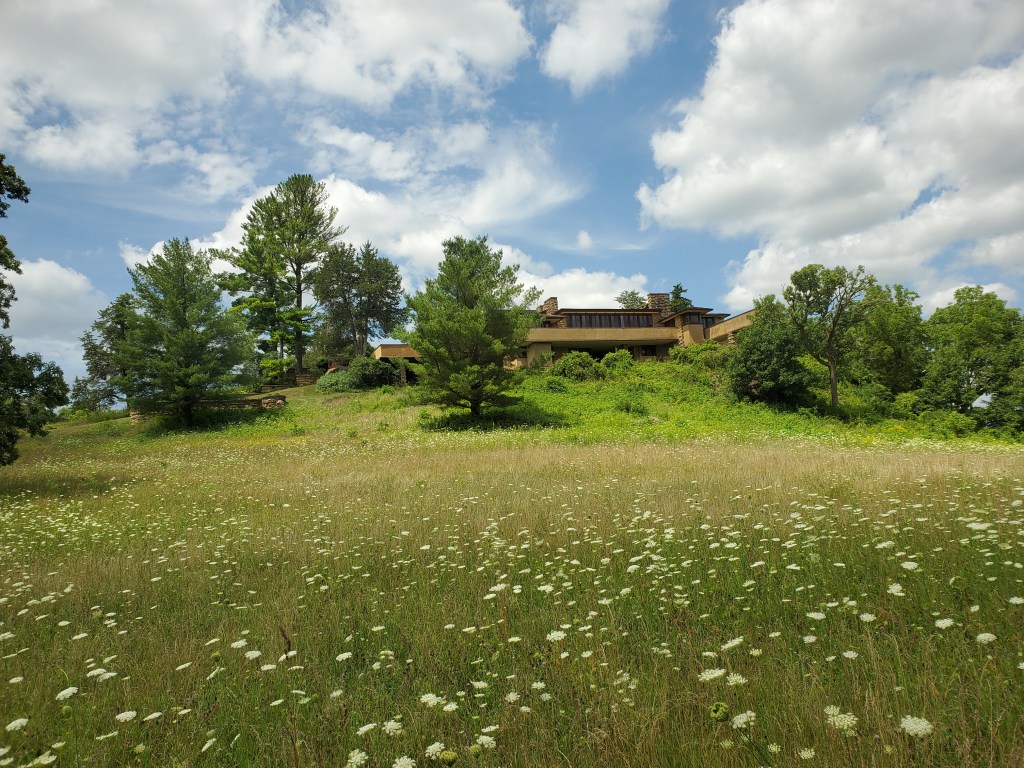
Approach to Taliesin, the “Shining Brow” on the hill 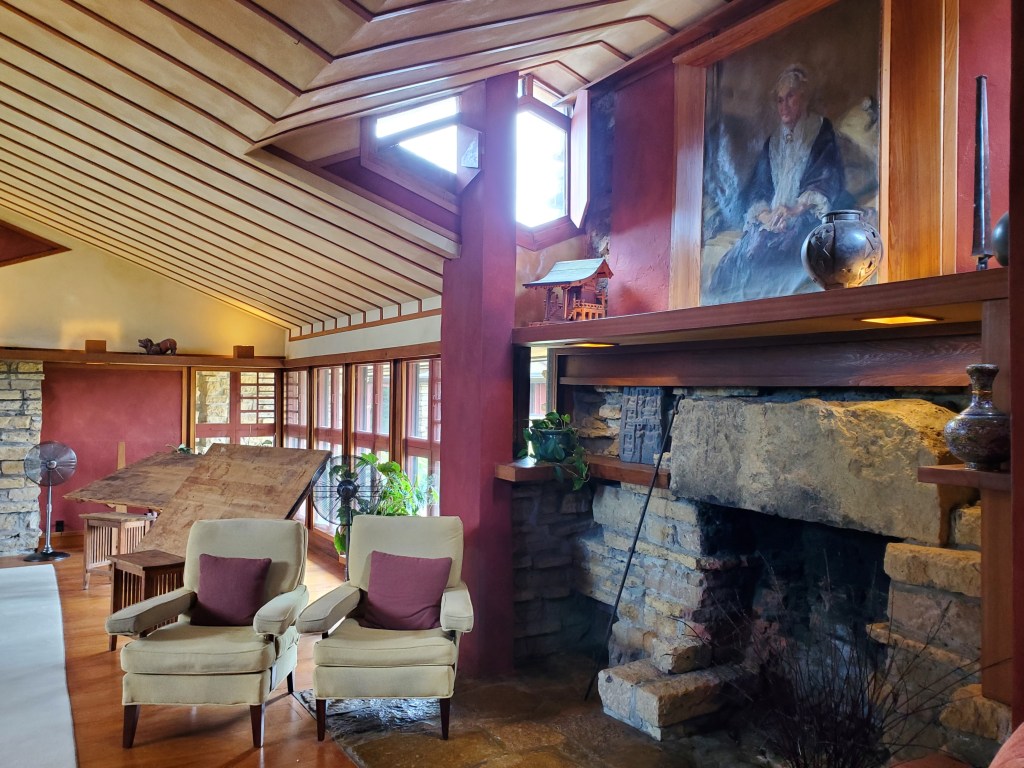
The hearth at Taliesin, with portrait of FLW’s mother, Anna Lloyd Jones Wright 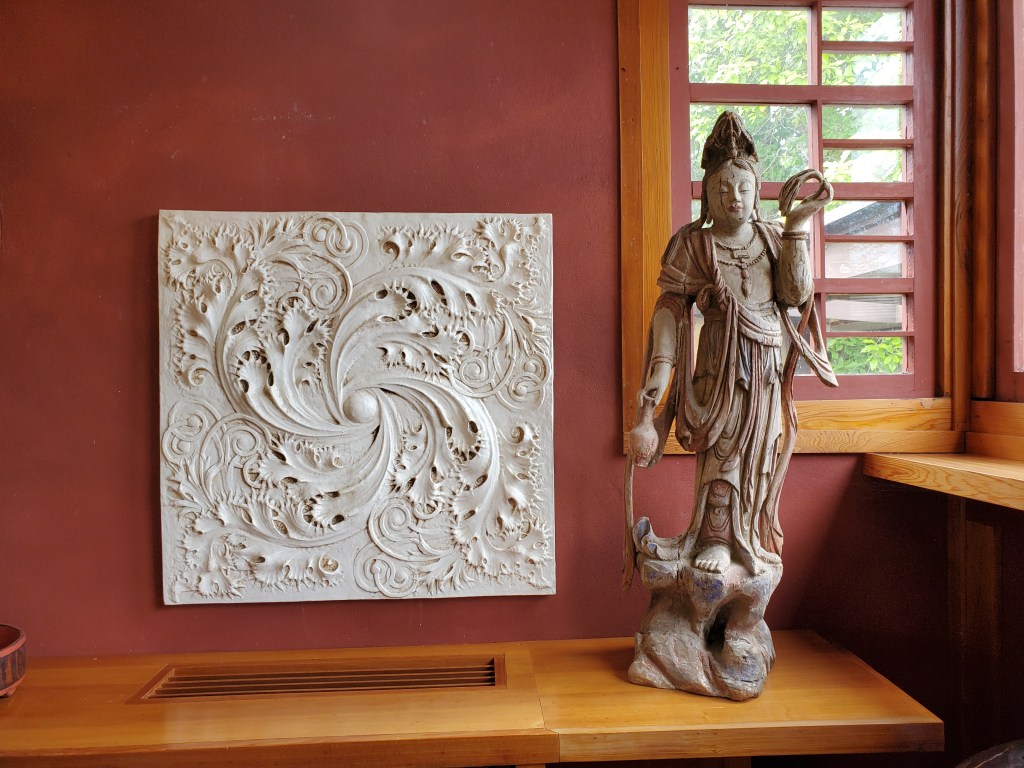
A gift from Louis Sullivan, a tile like a “delirious tossed salad” (Andrew) 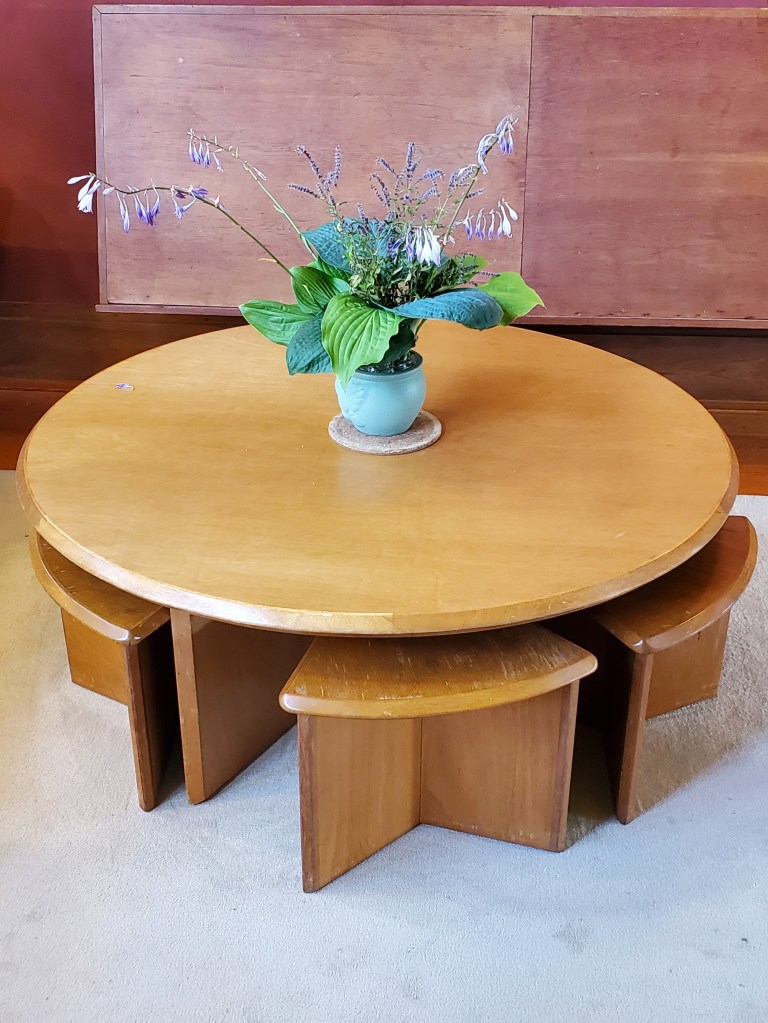
Living room table 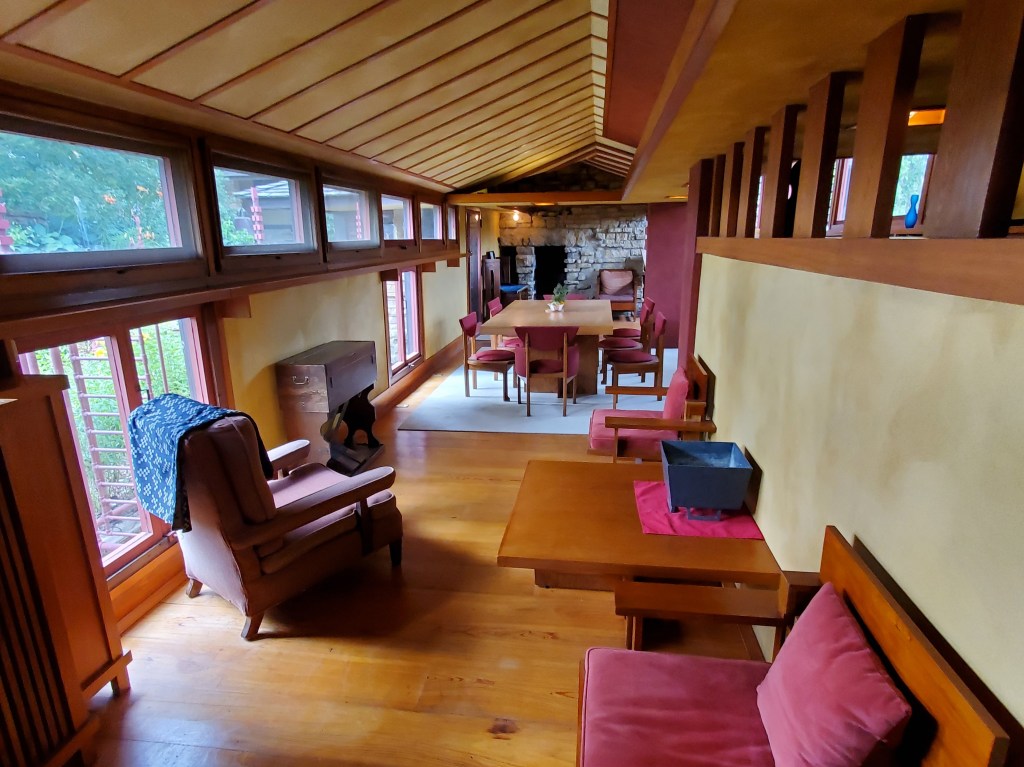
Taliesin corridor 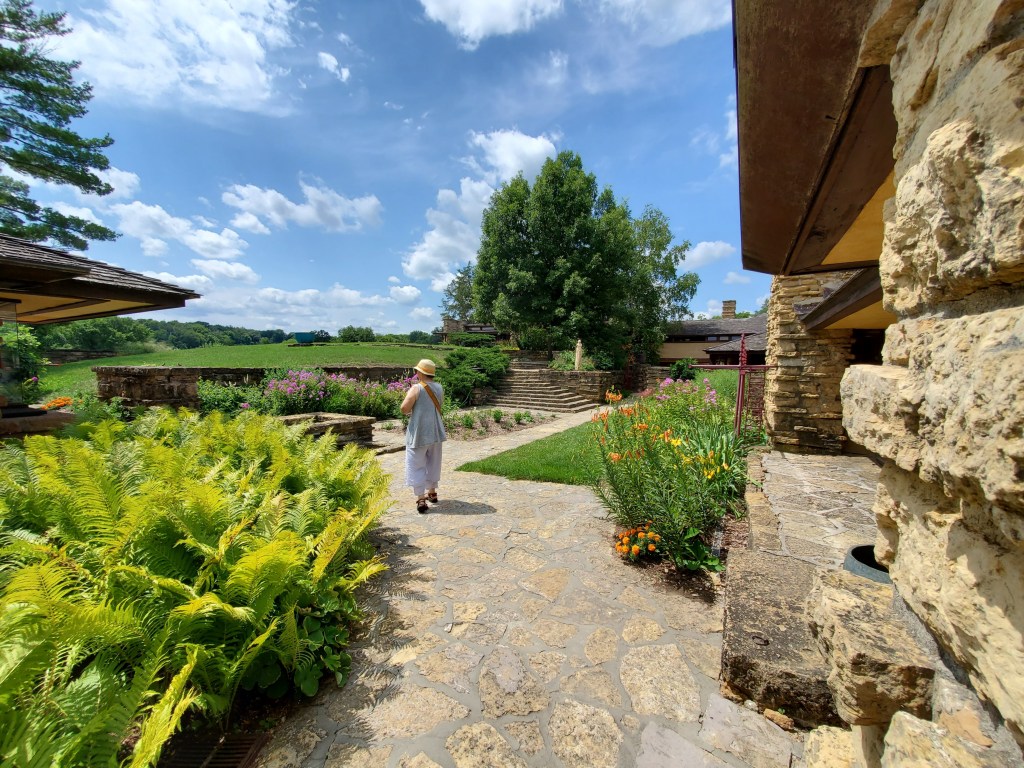
Charlotte in the garden 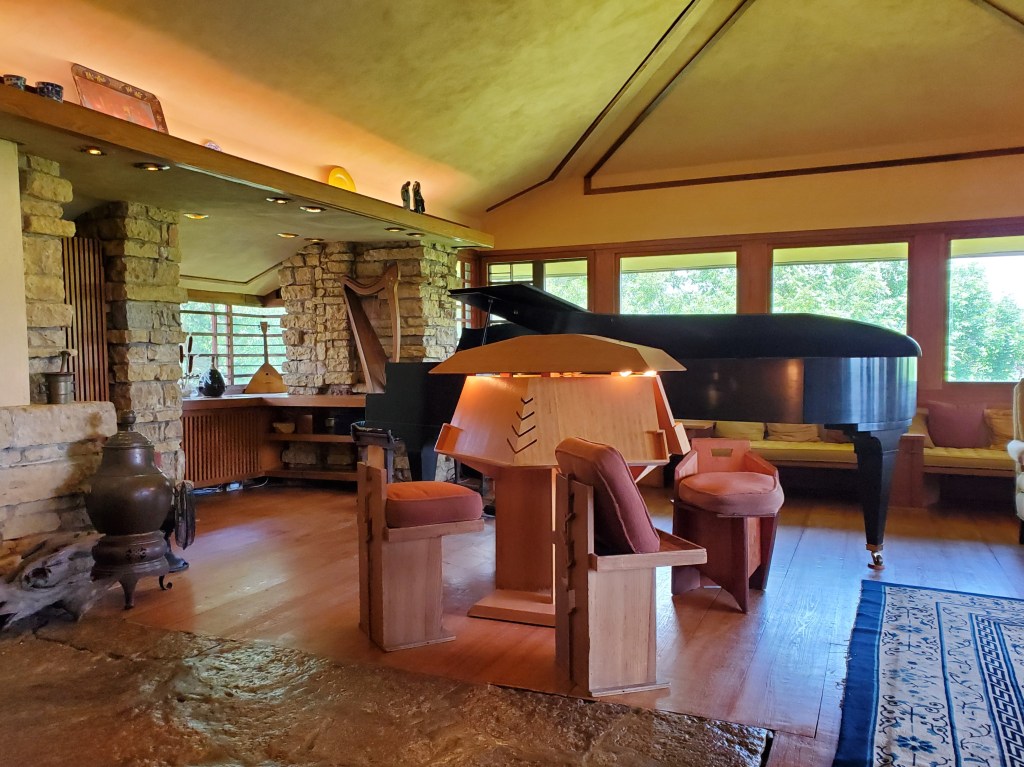
Music room–with music stand impossible to use 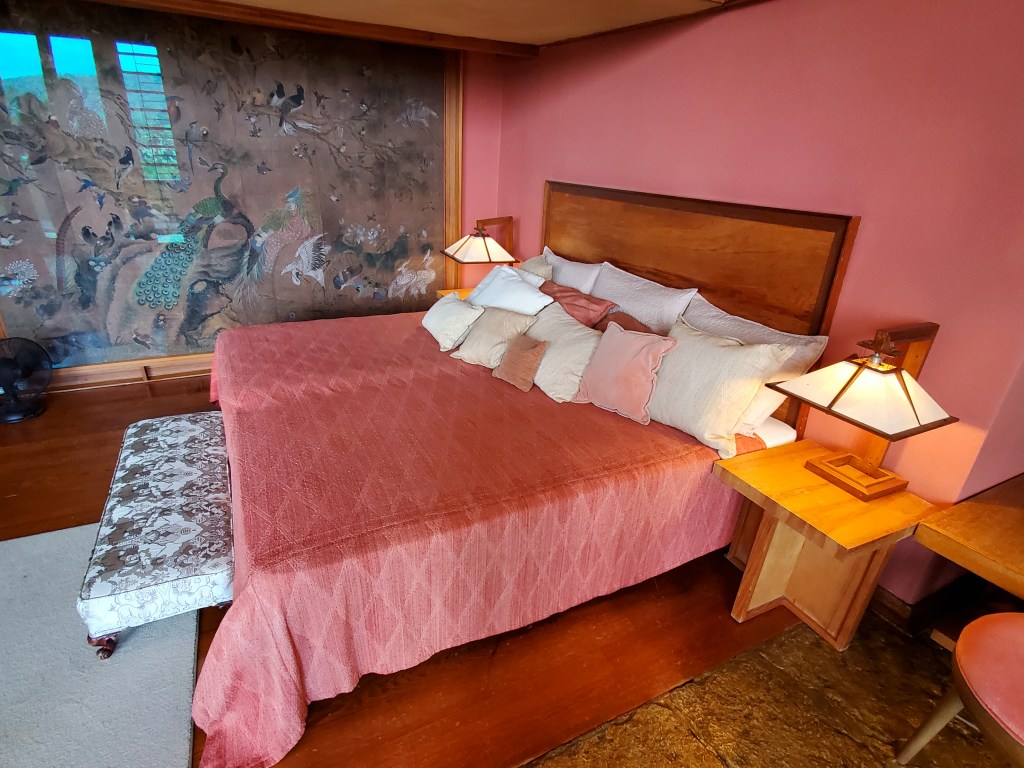
The last Mrs. Wright’s bedroom My conclusion: FLW was indeed a talented visionary, as well as a supreme narcissist; standing only 5’6,” the architect placed many ceilings at Taliesin at so low an elevation that even I (5’8”) felt compelled to stoop. My David always said “his mother loved him,” and that set him up to believe himself a Great Man well before he established for himself such a reputation. “Early in life,” he said, “I had to choose between honest arrogance and hypocritical humility. I chose the former and have seen no reason to change.”
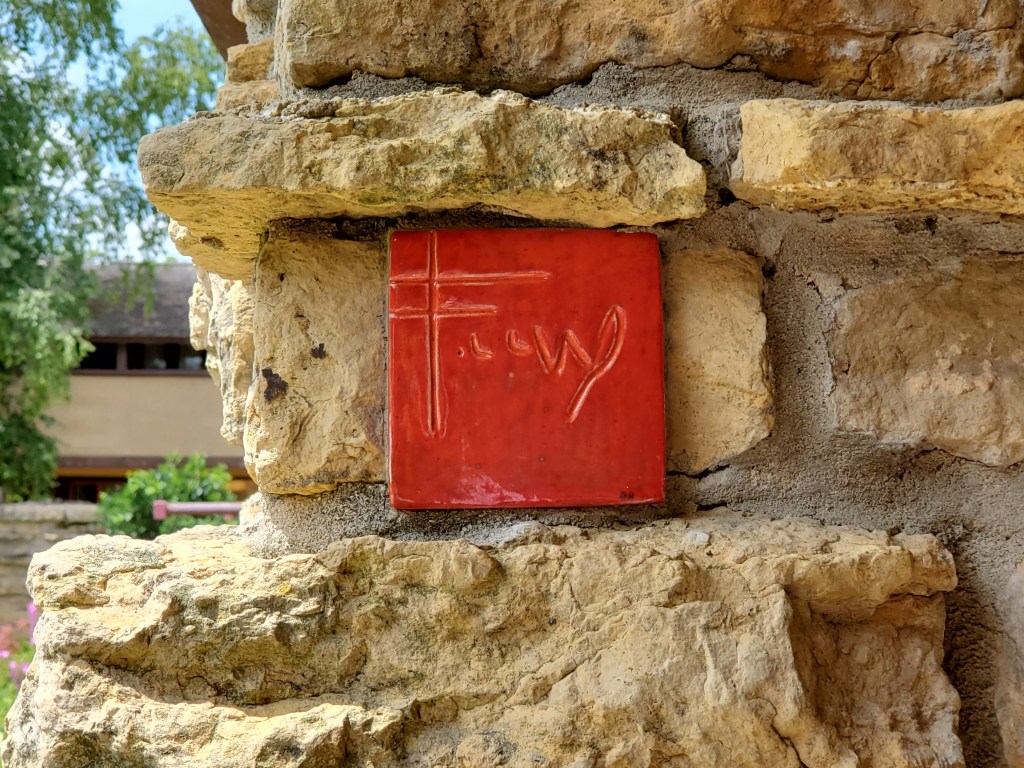
FLW’s signature tile at Taliesin David and I once spent the night in upstate New York’s 19th-century experimental utopian community, Oneida, where John Humphrey Noyes (1811-1886) and his followers pursued his radical notions of perfectionism, including free love, then regarded with the same suspicion and disdain the local Spring Green populace later felt for the adulterous relationship of Mamah Cheney (1869-1914) and Frank Lloyd Wright (1967-1959). The structures we saw on the tour dated from 1902, 1911, 1932, and 1952, so my experience of Taliesin and Boyle’s well-researched novel together brought to mind not only Oneida and the social experiments of the early twentieth-century, but also the 1960’s and our own current culture wars. Historical perspective: another perk of travel.
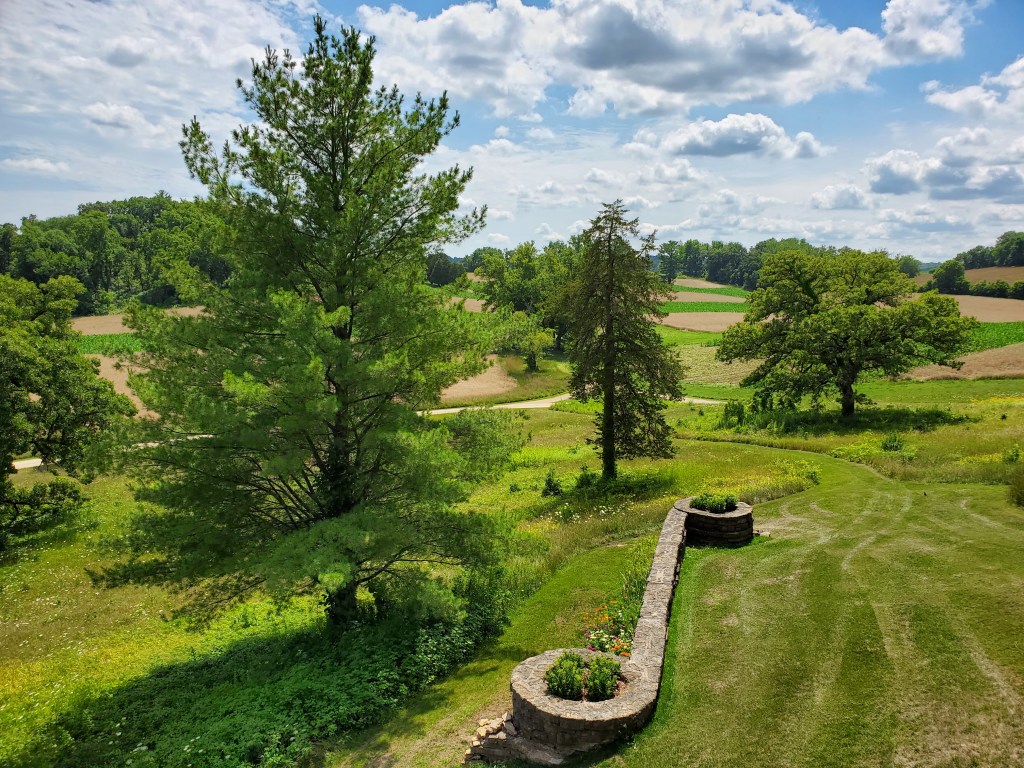
Wright’s beautiful view 
After a refreshing swim in the Inn’s lovely pool while my friends explored Spring Green’s amenities, we all returned to the American Players Theatre with a pre-performance picnic (from Wander Provisions in Spring Green) to enjoy on theatre grounds amply furnished with sheltered picnic tables and piped-in classical music.
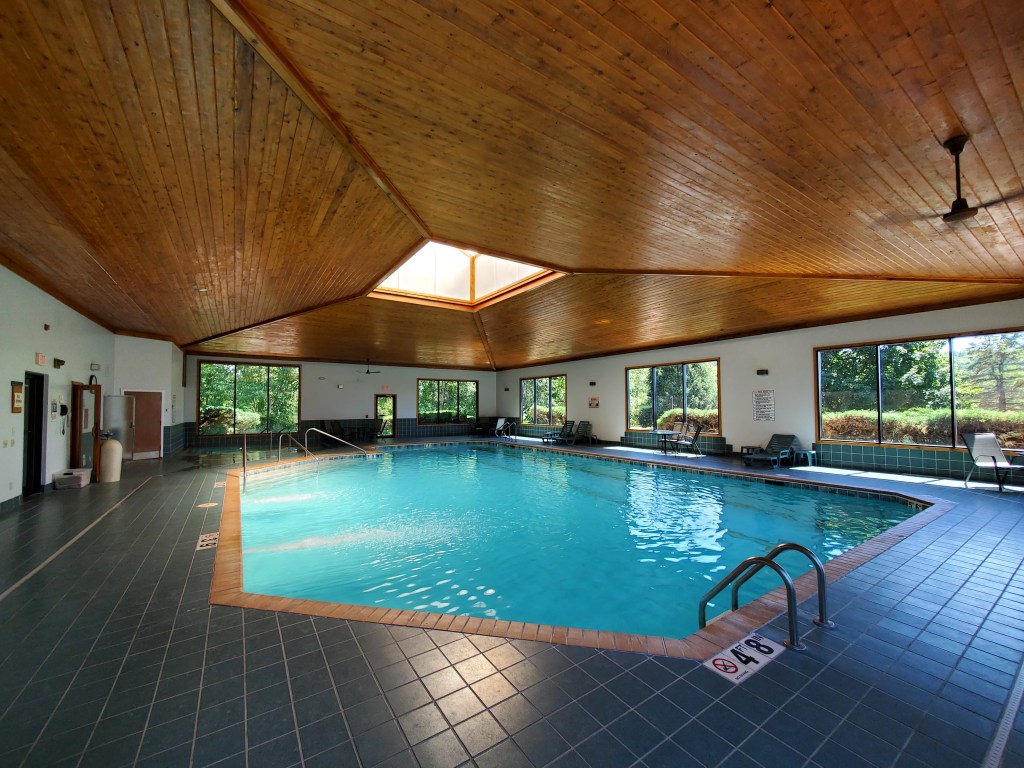
The pool at the Spring Valley Inn 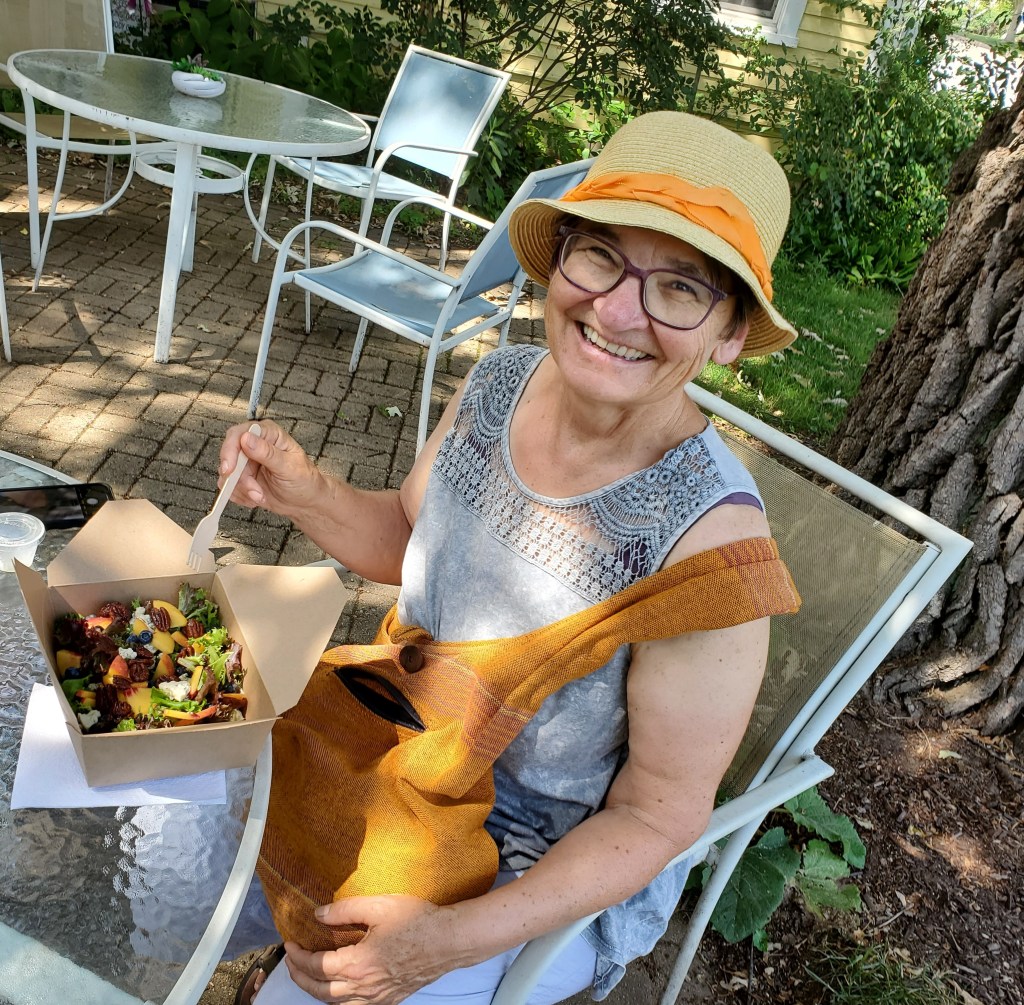
Charlotte happy with her salad from Wander Provisions 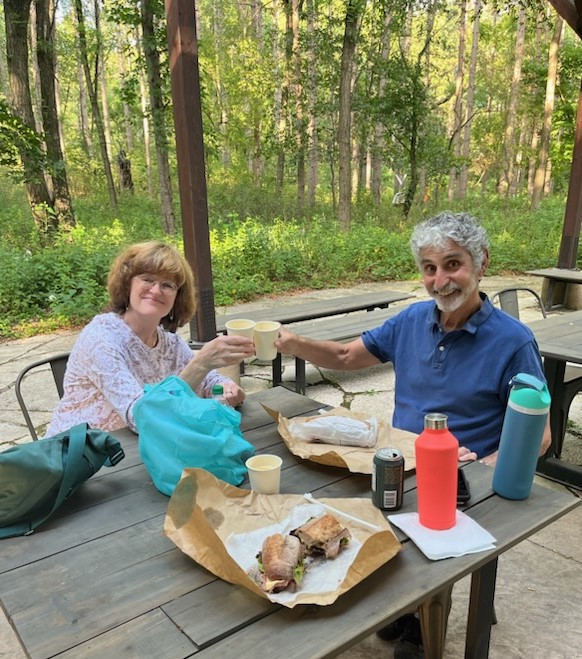
Picnic at the APT with Ed The Merry Wives of Windsor, one Shakespeare play I’d never seen played (and, frankly, didn’t think much of) was brilliantly, hilariously produced. How the actors in their elaborate costumes (Falstaff in a fat suit, no doubt) kept from fainting as they bustled about in the 93o heat, I can’t imagine, but the play was fantastic, rollicking fun: just the ticket after the beautiful, sober modernity of Taliesin.
Next morning my friends headed back to Iowa City and I drove east to Milwaukee, with a brief stop in Madison to visit the U of Wisconsin’s fine Chazen art museum and remark on the symbolic layout alumnus Ed had made clear to me: The Capitol on unimpeded axis with the central University campus: learning and government on equal footing. Would that balancing act still obtained across our nation.
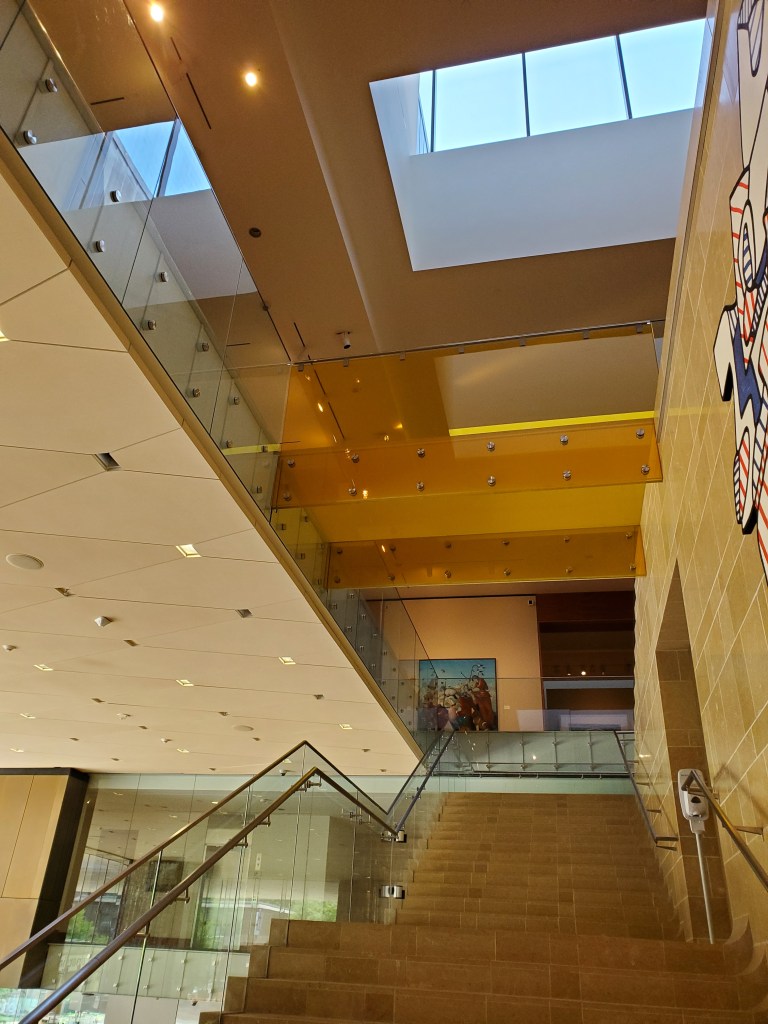
Chazen Museum of Art at the University of Wisconsin-Madison 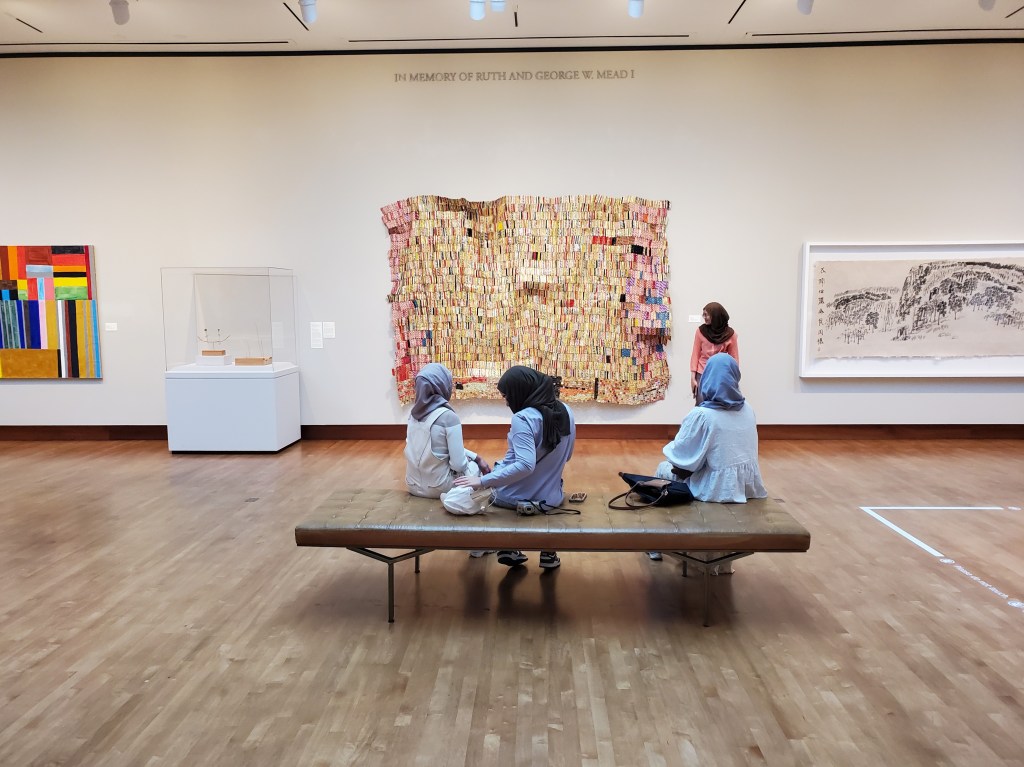
Wall hanging by El Anatsui (Danu, 2006), made of aluminum cans and copper wire 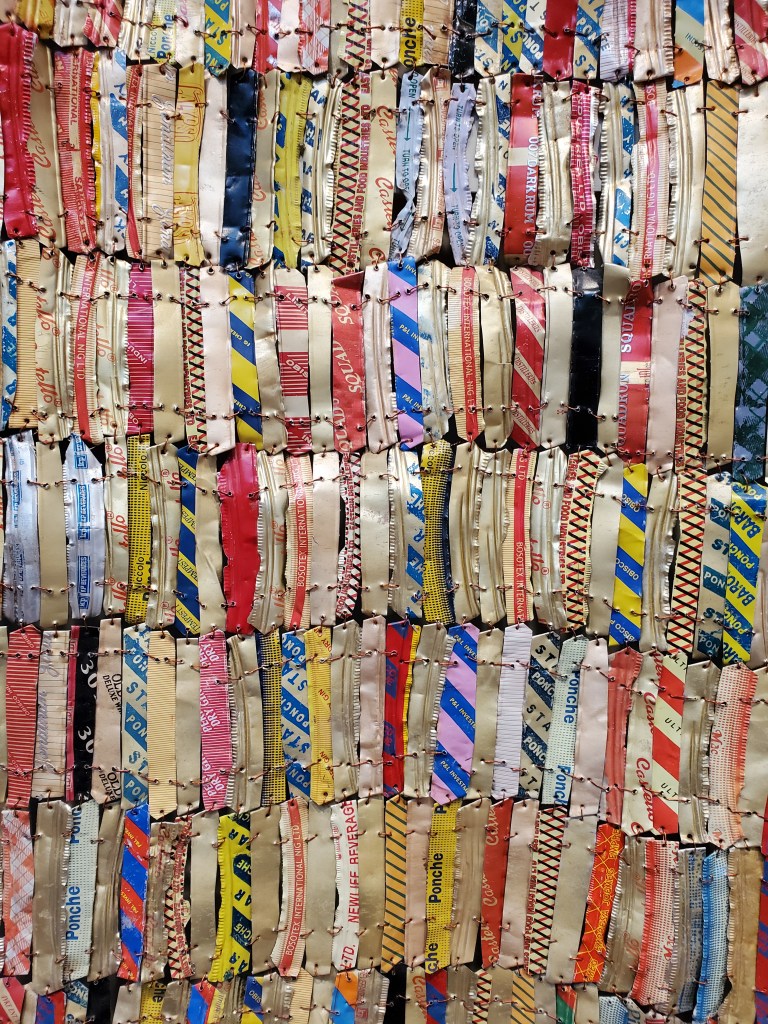
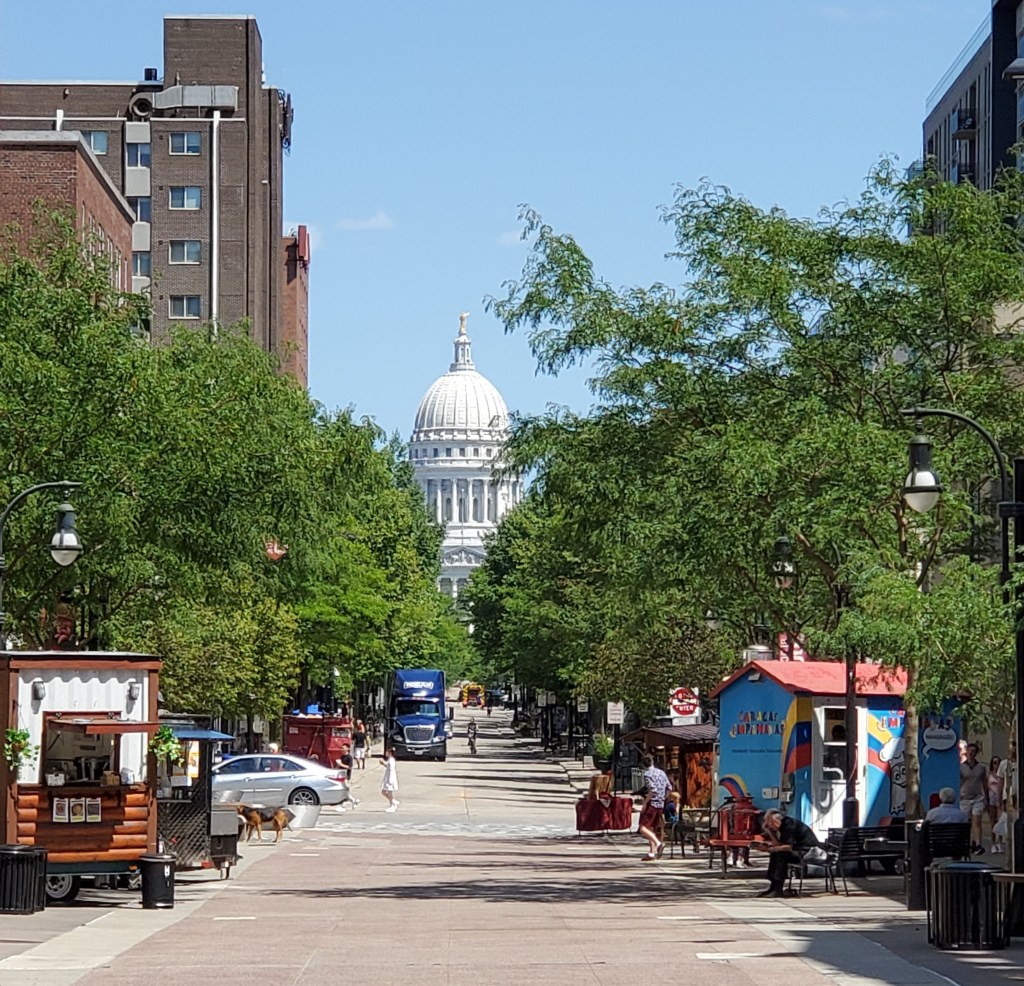
Capitol connection with Wisconsin campus A big storm arrived at my airport Hyatt shortly after I’d cozily settled in there, and the next morning my flight took off right on time, delivered me to Orlando for a layover long enough to have a leisurely dinner and finish the Boyle novel before finally arriving back in Manchester around 1 am Sunday morning.
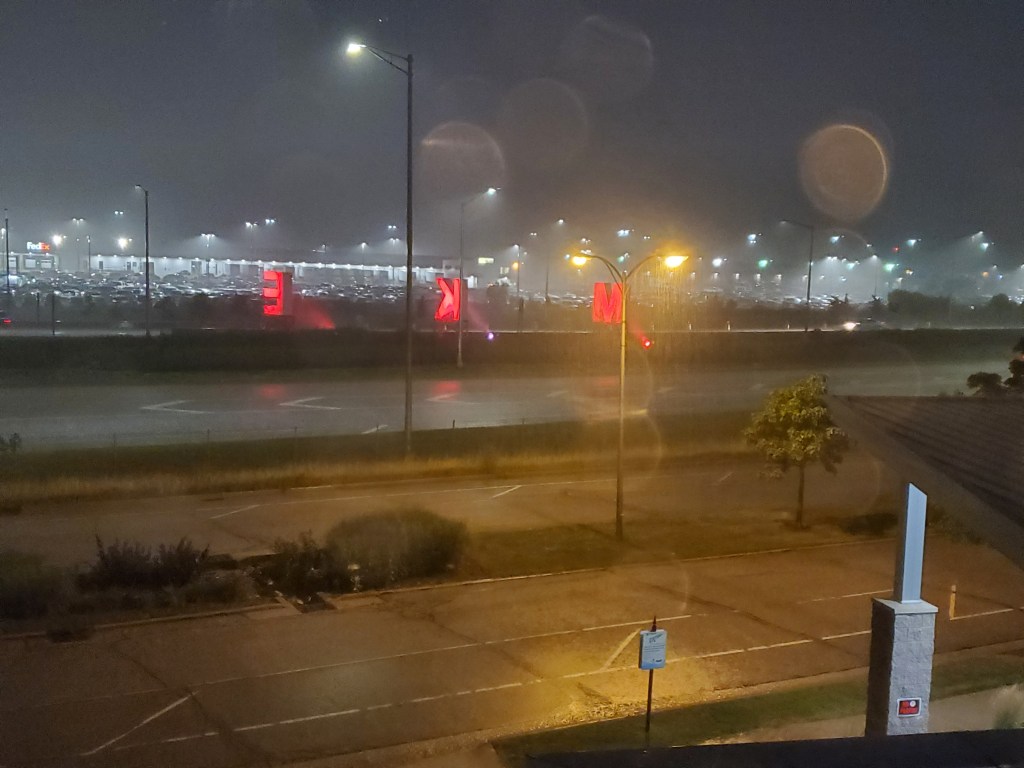
MKE airport in the rain from the Airport Hyatt As I finally climbed gratefully into my own Madbury bed, I thought how fortunate my travels had been, and how lucky I am to have such family and friends. As always after a journey away, I recognized that truly there’s no place like home.
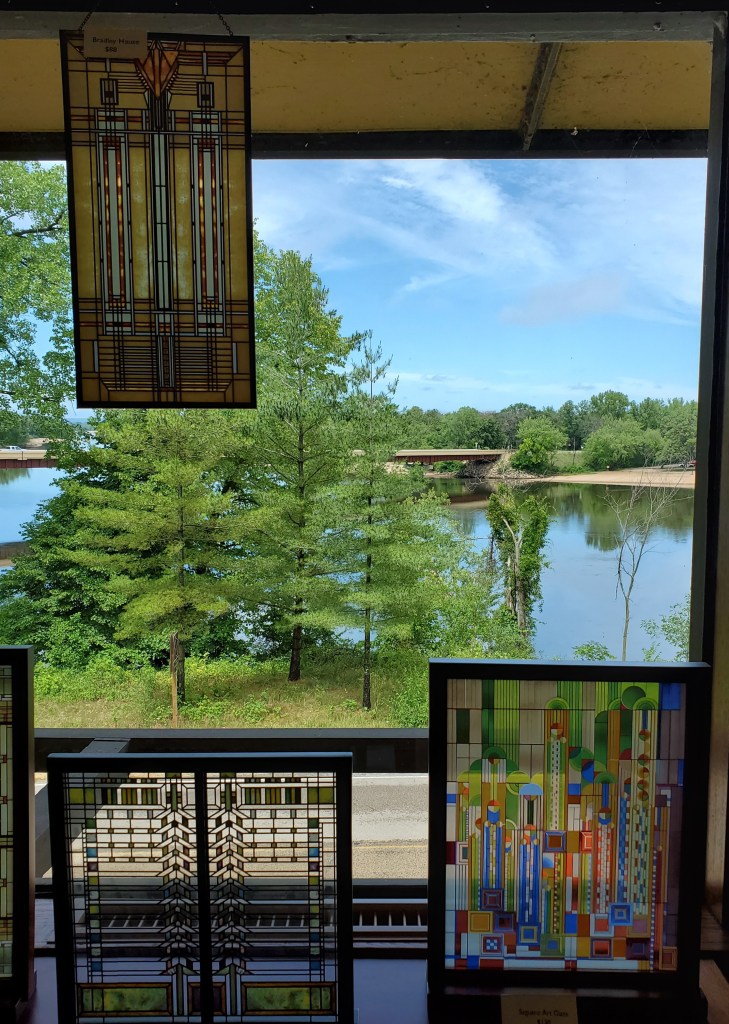
The Wisconsin River, seen from the Taliesin gift shop, just keeps rollin’ along -
On Wisconsin, Part 1, 2 August 2023
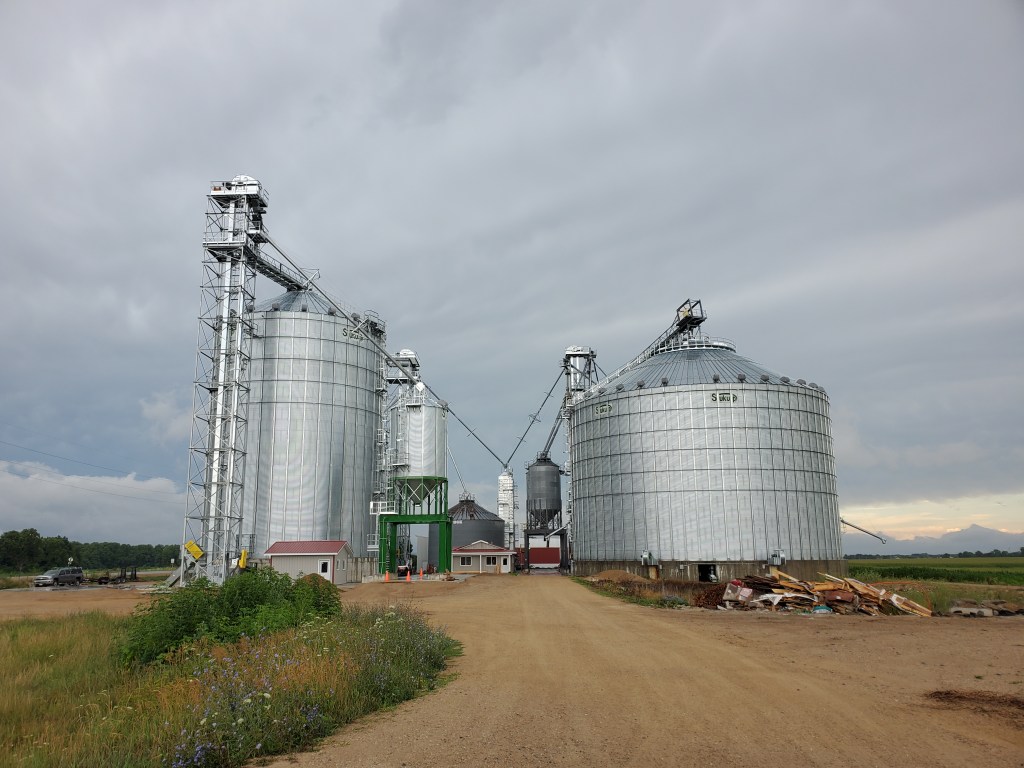
Wisconsin storage for those amber waves of grain I returned from my Wisconsin visit to family and friends very early last Sunday morning after a too-long layover in Orlando (consider the carbon footprint of getting from Milwaukee to Manchester NH via Orlando!) and a flight delayed by thunderstorms up and down the east coast. When I woke later that morning and parted the bedroom curtains to peer out on the deck below, I found our resident groundhog sitting in my Adirondack chair enjoying the view, lacking only a cigar to complete the anthropomorphic vision of nature reclaiming her own. I’d been gone only a week, but clearly the groundhog had already staked his proprietary claim.
I was congratulating myself on once again successfully negotiating the challenges of solo travel, making only minor mistakes. Mistake #1: I lost a corkscrew to TSA at the Milwaukee airport, having forgotten I had zipped it into one of my Baggallini’s pockets as a possible necessity for the previous Thursday’s pre-theatre picnic at the American Players Theatre in Spring Green. Rendered superfluous by a screw-top, this potential weapon unfortunately remained in my purse, and proved hard to find: it took three passes through the x-ray machine and two agents to locate exactly in which of the bag’s many pockets it was hiding. (Unsurprising, since I have had similar issues with this designated travel purse.) Mistake #2: I temporarily confused the Madison parking garage ticket in my wallet with the Manchester parking garage ticket; at that point, I’d been traveling for fourteen hours and it was 1 AM, so I give myself a pass on that one, too. It wasn’t till the next day when I read the emailed Dollar rental car receipt that I spied the more expensive error: I’d forgotten to gas up the Nissan before I returned it, a pricey error at $10.66/gallon. Oops. Well, it’s only money.
All in all, I grant myself a passing grade—an evaluative process I never thought necessary before I turned 70. Now, I’m constantly assessing slippage, both cognitive and physical (and the combination of both, as in paying no attention while walking downstairs wearing clogs and carrying a laundry basket, mistaking the penultimate for the ultimate step and consequently breaking an ankle). The takeaway: I won’t make THAT (fill in most recent) mistake again.

The Saddle Ridge Marina, Portage WI On my last year’s visit to Reed and Jan in Portage WI I’d not rented a car, but relied instead on the largesse of my nephew Rob’s driving service. Maybe because I chatting more than observing last year, I was at the time less impressed by the expansive beauty of Wisconsin’s farmland, so very different from New Hampshire vistas narrowed by road-encroaching forests.
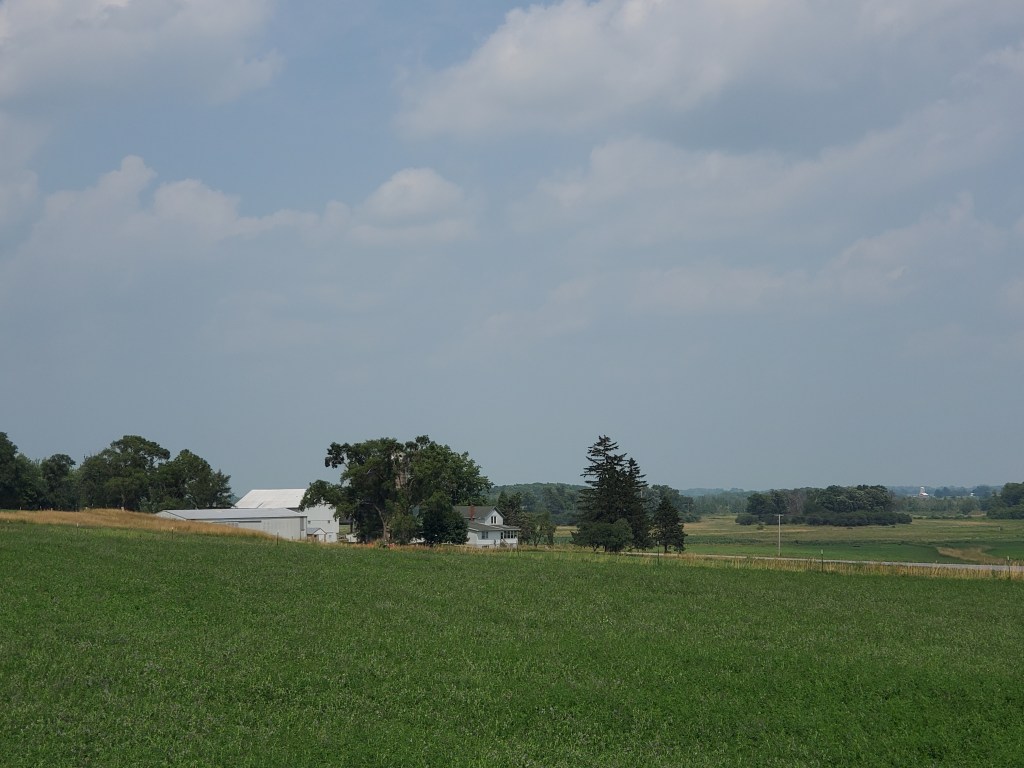
Wide-open space and big sky A year’s passing did not, however, lessen my in-laws’ generous hospitality: Reed and Jan’s welcome was warm as ever, and visiting niece and nephew Pam and Rob made conditions ripe for family stories and a wealth of dad jokes, one of Reed’s specialties. I was happy to have one to contribute: the Wisconsin license plate slogan that didn’t make it to the plate: “Smell My Dairy Air.”

A slogan that DID make it to TM 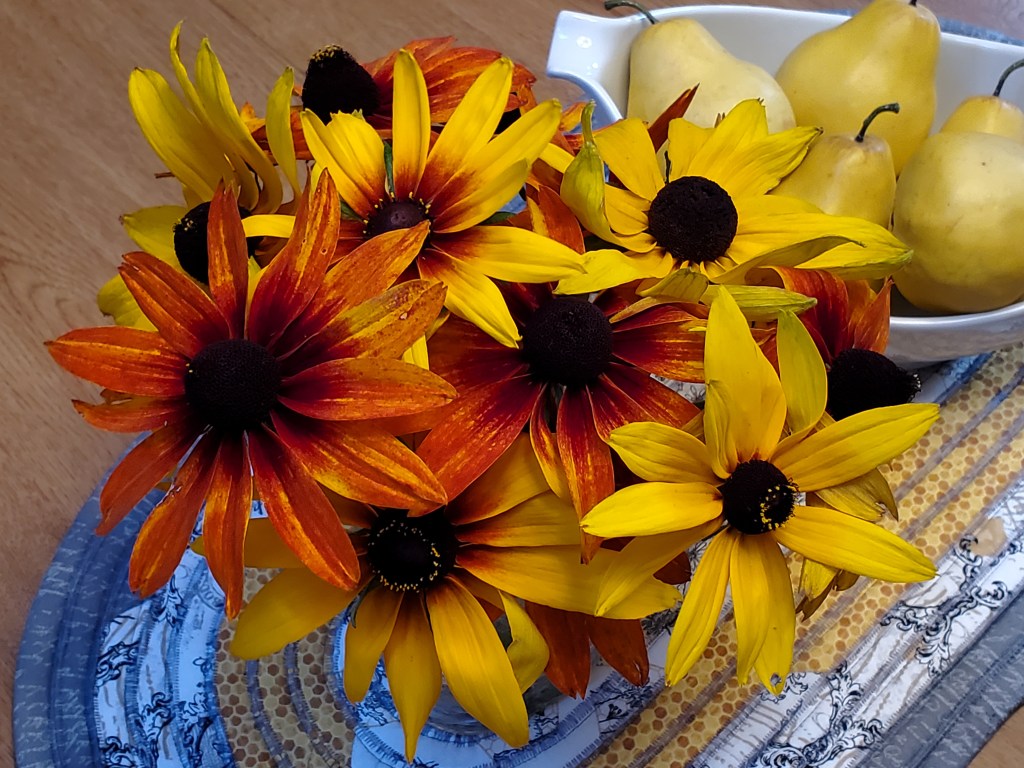
Jan’s Rudbeckia on the dining table Staying in someone’s home for three days (testing the Ben Franklin-suggested limit comparing fish with guests) means 24/7 proximity that can, in odd moments, produce surprising results. On this visit I was particularly aware of tech-enhanced connections; we were all often on our devices, and just as often sharing what we found there.
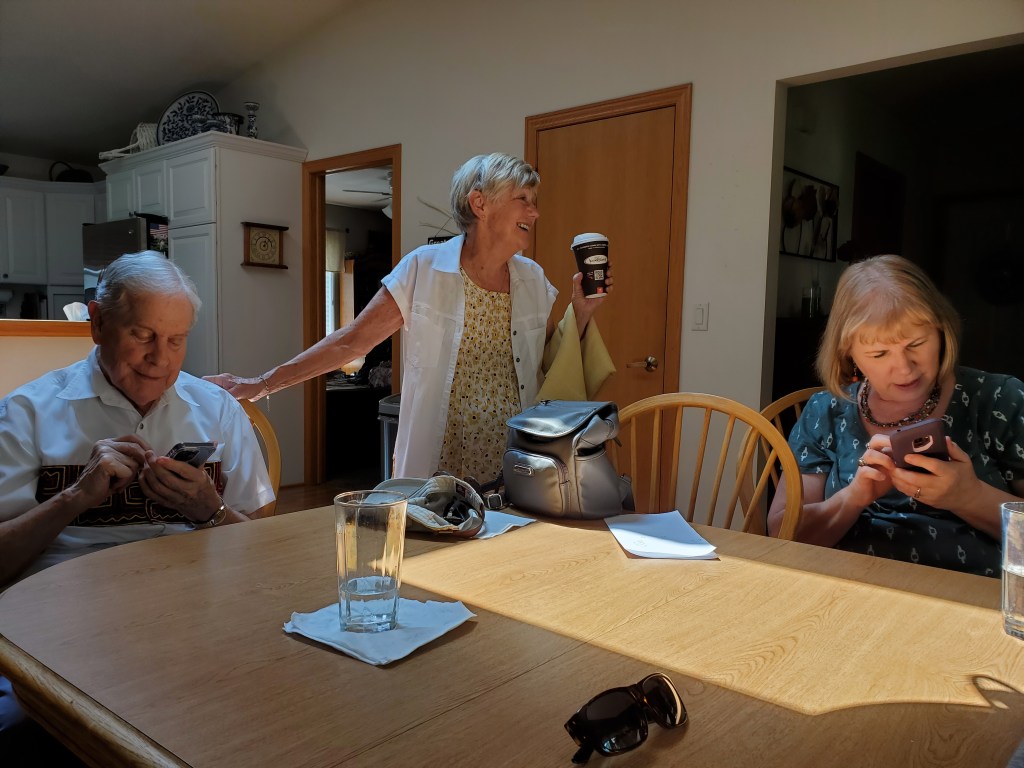
Reed, Jan, and Pam Rob, entertaining us with top ten pop hits from 1967 played on his phone, inspired me to (shamelessly) sing along, rather amazing myself that I effortlessly remembered the words to every single song, definitely revealing my vintage. Best of all, nephew Rob and his nephew in New Zealand, Rudyard, respectively turned 56 and 38 at the same time—despite their birthdays being one day apart. Thank you, international date line.
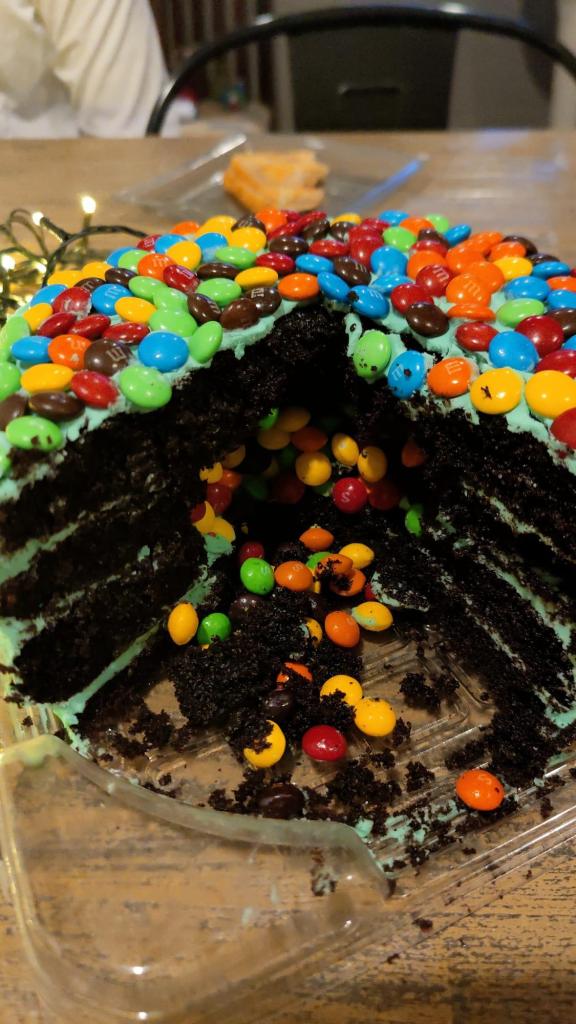
Rudyard’s birthday cake, baked by his kids: M&Ms on top and
Skittles in the middleThe magic of a video call linking time zones meant that I could also sing happy birthday to my great nephew in New Zealand—and realize that I was, in fact, Great Aunt Georgy. How august! (And how reminiscent of Aunt Augusta, Lady Bracknell of Wilde’s inimitable Importance of Being Earnest). That group chat was great fun. Cleaning up dishes with sister-in-law Jan and niece Pam introduced me to the wonders of Norwex cleaning cloths, and all the family persuaded me, decidedly NOT a card player, to learn and enjoy a couple games of Sequence. We made a pilgrimage to the Sassy Cow for signature tomato soup, grilled cheese, and ice cream.


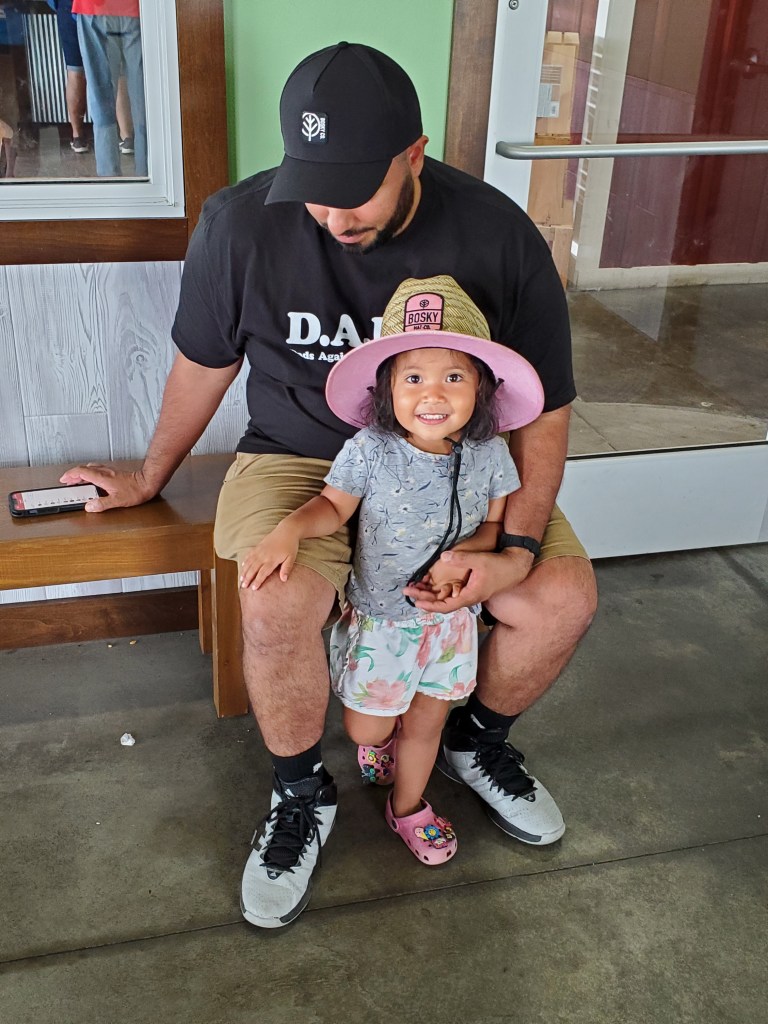
Fellow ice cream aficionada at the Sassy Cow Jan’s flowers delighted, . . .

Jan’s zinnias, a personal favorite . . . the Sandhill cranes made their customarily terrifying Velociraptor calls,
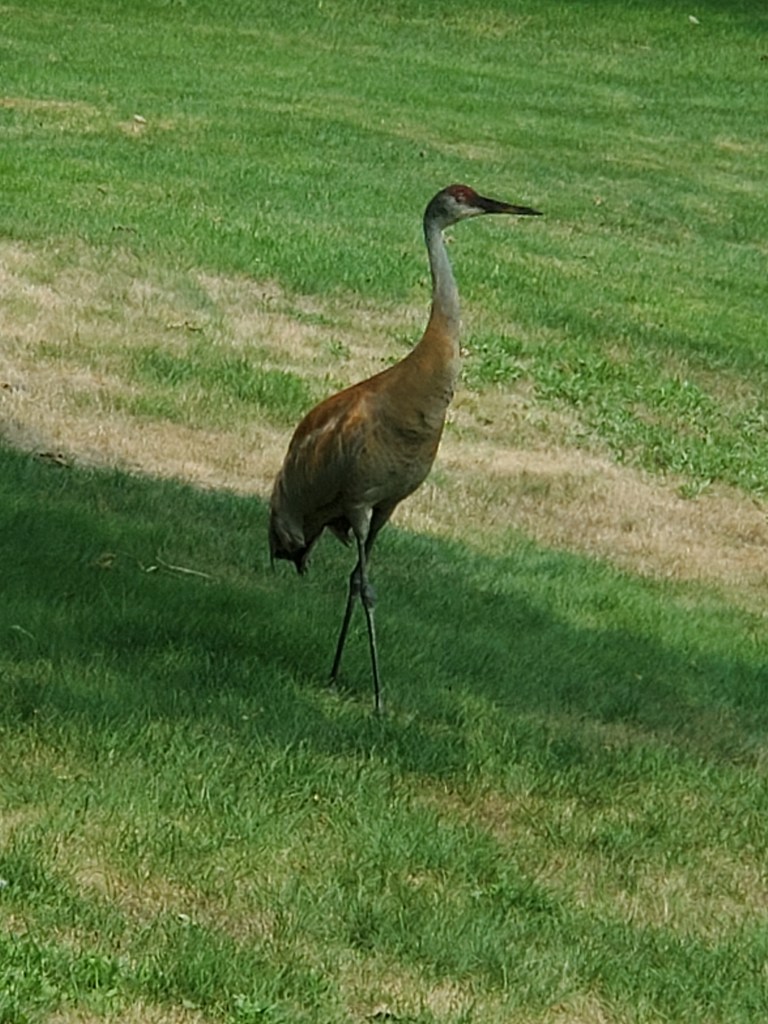
No mistaking this crane’s dinosaur provenance . . . and I got a ride in Rob’s hot Mustang—as well as an inscribed copy of his book, A Life of Service to the United States of America, an oral history of his foreign service assignments in Mexico, Russia, Costa Rica, and Sweden.
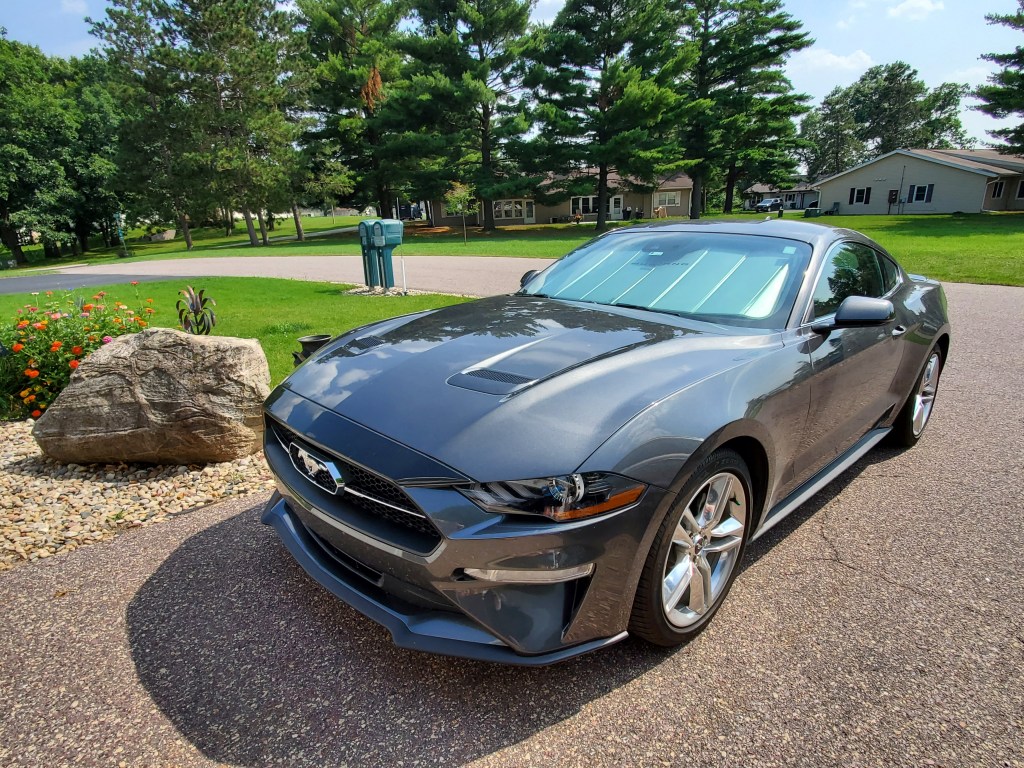
Andrew hot wheels: no cooked food allowed inside to preserve
that new car smellI first met Rob in London in 1991 when he was on leave from his combat tour in the Gulf War, and since his retirement from diplomatic service, he’s been teaching foreign policy at the University of Oklahoma. Getting a briefing from Rob on China, Russia, and the war in Ukraine over breakfast with the family made my last morning in Portage especially memorable. I was happy to hear Rob’s take on Volodymyr Zelenskyy: “A cross between George Washington and Winston Churchill.”

My Andrew family, Rob, Reed, Jan, and Pam 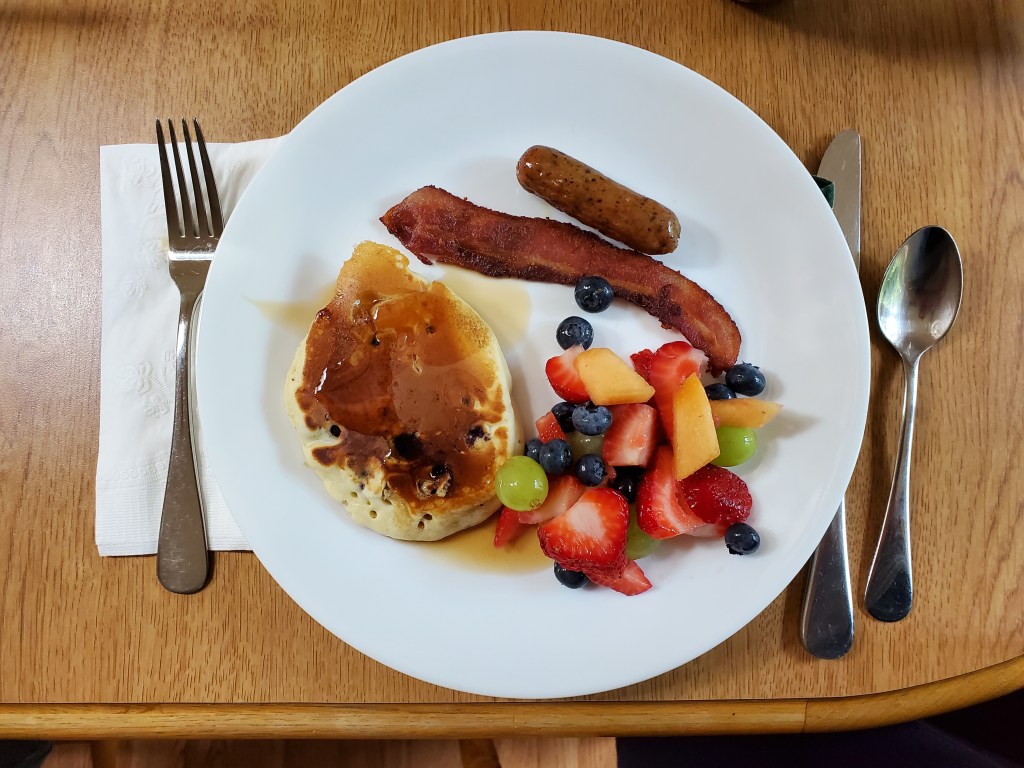
Special departure breakfast prepared by Brother Reed Well loved and well fed, I departed Portage and set out for Spring Green, a reunion with dear friends from my days at Centre College, the American Players Theatre, and Frank Lloyd Wright’s Taliesin East. More adventures to come!
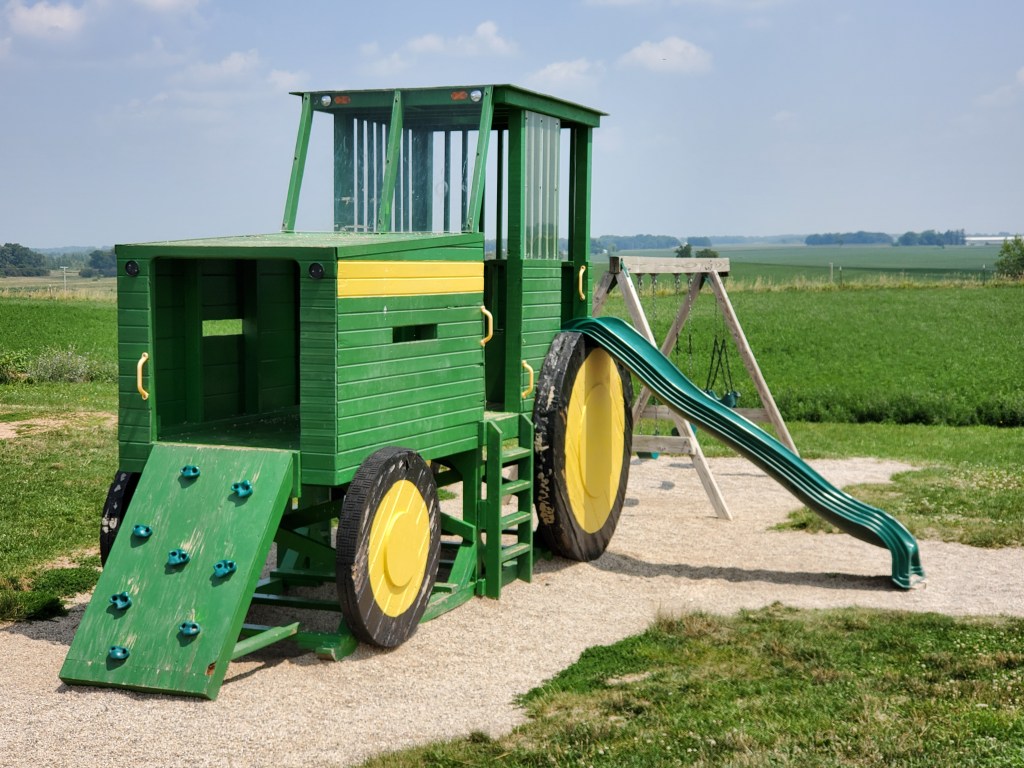
John Deere as play structure: sweet!
-
Subscribe
Subscribed
Already have a WordPress.com account? Log in now.
 Georgeann Murphy