-
BIRTHDAY No. 70
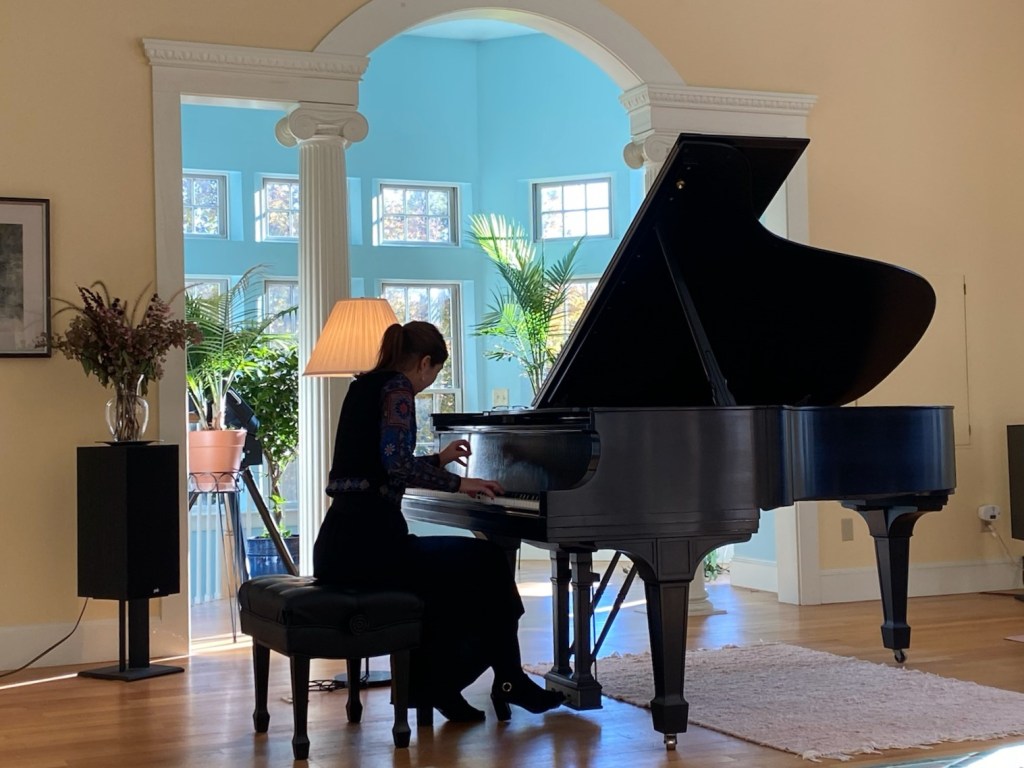
Mathilde Handelsman performs at my birthday salon, 8 October 2022
(photo by Carol Aronson-Shore)Today is another glorious autumn afternoon in Madbury NH, a fortnight past celebrating my 70th birthday with good friends on an equally fine day, fall color ablaze outdoors, afternoon light raking through the west windows as supremely talented Parisienne pianist Mathilde Handelsman played a program of Schumann, Chopin, Rachmaninoff, Debussy, and Gershwin, ending with a hilarious rendition of variations on “Happy Birthday” first composed and then performed by Cyprien Katsaris at the White House on the occasion of Yehudi Menuhin’s 70th. Prosecco flowed, followed by platters of excellent sushi and the two birthday cakes I had baked, one lemon curd/mascarpone, one orange creamsicle.

The platters from Whole Foods I was having too much fun to photograph 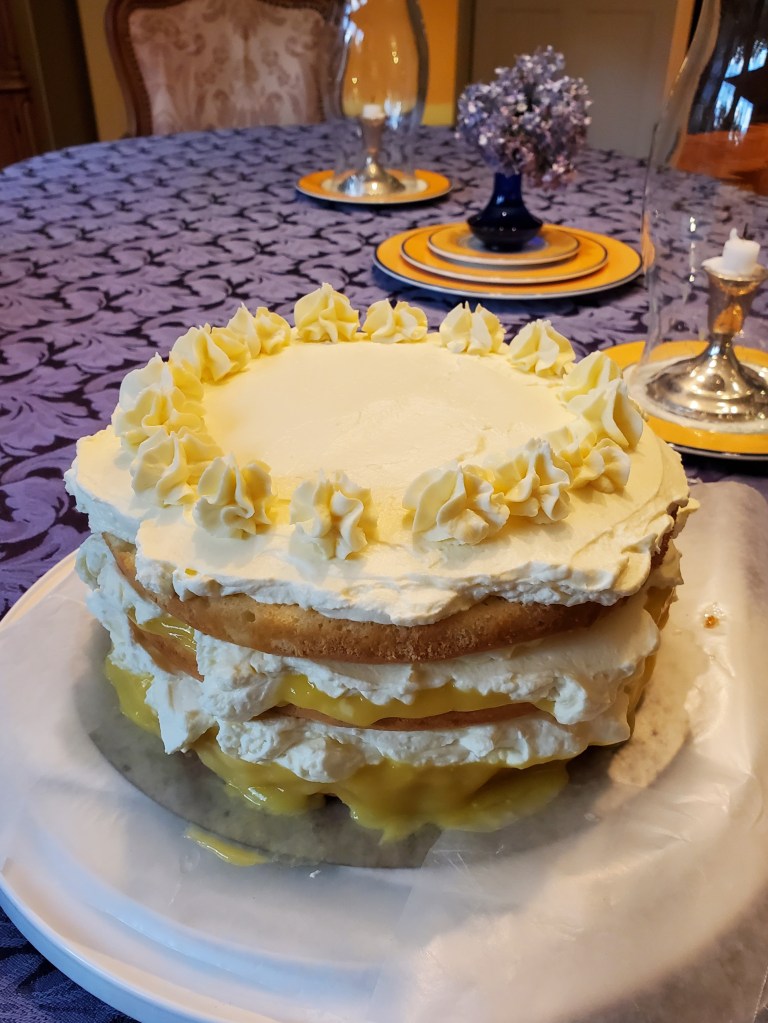
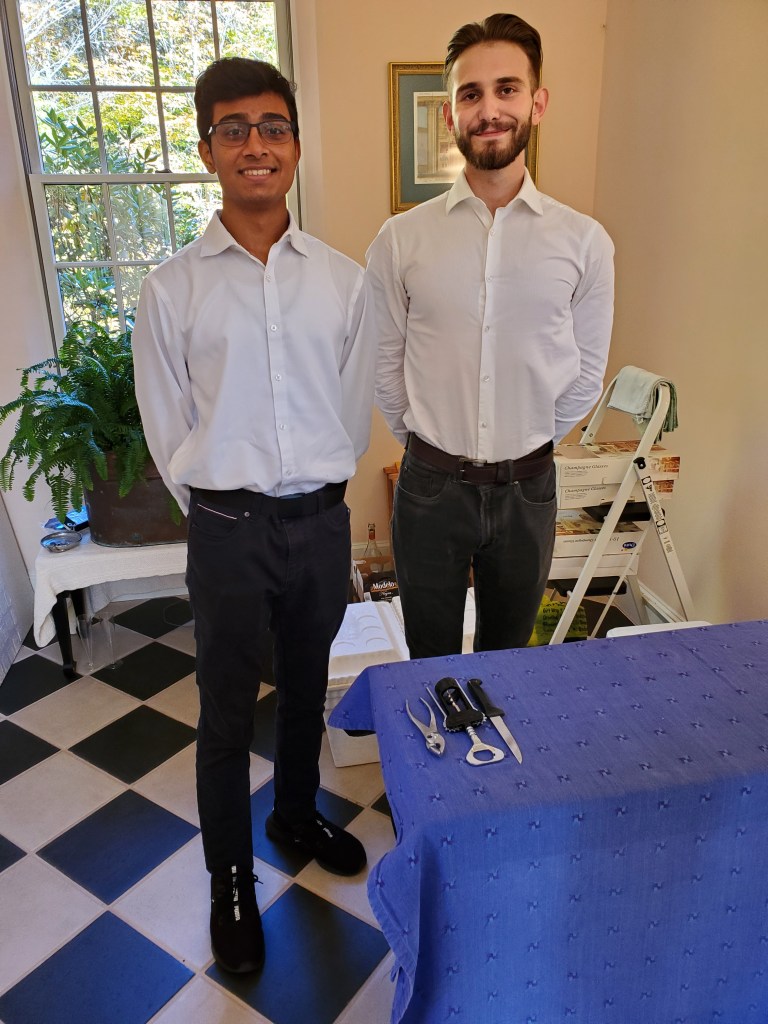
Lemon-Mascarpone Cake just iced So many wonderful conversations finally ended in a talk circle of visual artists, charming Mathilde, and the two Honors students I had hired to help, Ram and Yuri, who, it turned out, were happy to chat about jazz.
My little introductory speech had gone over well—a brief meditation on (1) “how amazingly unlikely” (pace Monty Python’s “Universe Song”) my being 70 was, (2) my up-till-then favorite birthday party (number 9, a pirate party enhanced by my namesake Grandpa George Anthony Murphy, a commercial artist who decorated my treasure chest cake and had once introduced my young father George Edward to fellow Daytonian Orville Wright), AND (3) how amazingly unlikely it was that after surviving a global pandemic and the annus horribilus x 4 that was the Trump administration, 27 lifetimes of choices, accidents, coincidences, and serendipities had all for the moment brought this group together in one home in Madbury NH. All the planning that had occupied me for weeks paid off with an even better celebration than I had imagined, only the second time since my darling David’s death I have felt completely happy. (The other time was standing with the rest of Symphony Hall to applaud the astonishing performance by Emanuel Ax, Yo-Yo Ma, and Leonidas Kavakos of Beethoven’s No. 6, the Pastoral, one giant symphony convincingly, ecstatically rendered by three extraordinary musicians). It was, indeed, a Happy Birthday.

Birthday Girl with Mathilde Handelsman, photo by Julee Holcombe My elevated spirits lasted three days as I slowly put the house back in order and determined to leave the big library table set with birthday cards for the rest of the month.

Birthday Swag And then came, as if by some natural law, the post-party depression: I was OLD, David was gone, my body ached. I actually sprained my left thumb struggling to put on support stockings. Oy. I’d not worked on my Shakespeare book for weeks, and lamented having lived long enough to see even one Shakespeare course dropped as a requirement for English majors. I rehearsed and nursed the various slings and arrows I’d suffered in my 25 years off the tenure track at UNH, grieving the many degradations of a liberal arts education. And that was just MY microcosm! The threat of senseless nuclear war, revived after so many years of détente; global inflation; the January 6 insurrection; a nation seemingly irreparably divided by the lies of self-serving liars; COVID lurking; the second Elizabethan era ended, the Queen seemingly taking with her the values I was raised to believe universally applicable: it was all troppo. I learned from linguist Jennifer Geacone-Cruz on NPR’s Hidden Brain a Japanese phrase that seemed an apt descriptor of my emotional state: mendokusai, meaning “something between ‘I can’t be bothered’ or ‘I don’t want to do it’ or ‘I recognize the incredible effort that goes into something, even though it shouldn’t be so much of an effort.’” I was in what my mother Virginia, famous for her malaprops, would call “the dooldrums.”
What turned that around? People, ideas, art, nature, getting up and doing what needs to be done (pace Garrison Keillor). In short order, I had another of my always novel, always engaging weekly phone conversations with my dear friend Cameron, a baby step toward normal preceded by a lunch date with a new acquaintance, Martha, beginning at her elegant apartment.
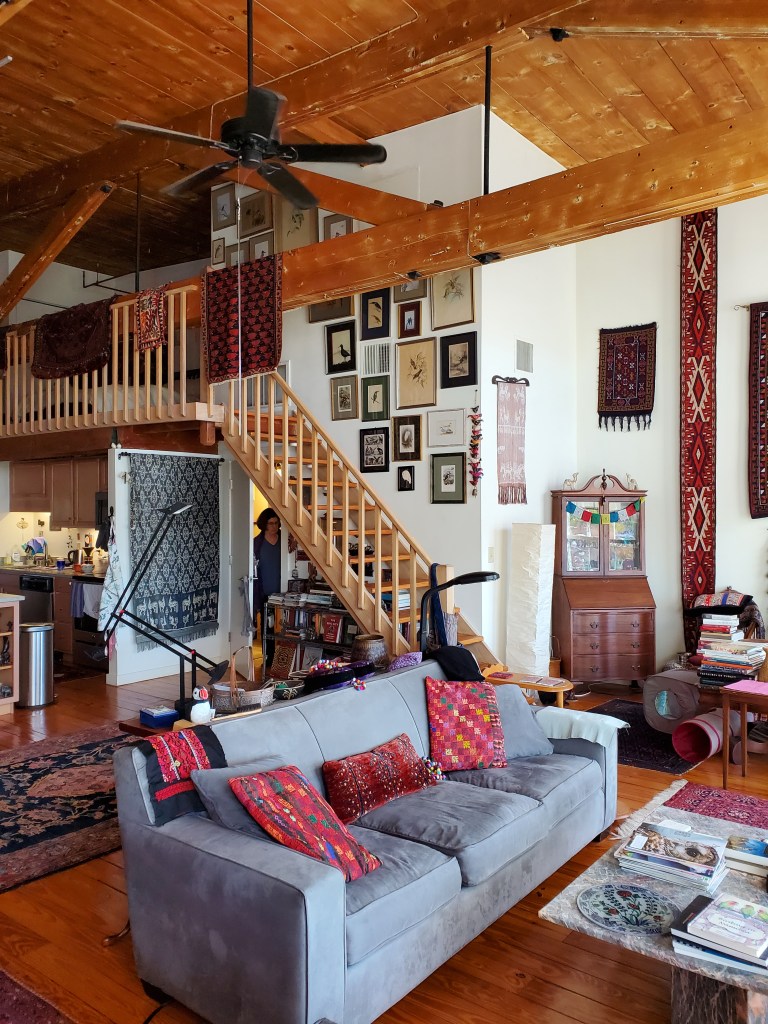
A dramatic, exotically furnished space The lunch that followed at an Indian restaurant in Portsmouth, Taaza, featured delicious Punjabi cuisine and the delightfully philosophical conversation of the owner Waheed and his assistant Omar. I attended an entertaining (if facile) public lecture by Eric Klinenberg (Mr. Social Infrastructure) recapping his book Palaces for the People, the Oyster River Community Read happily discussed the following week by us, four women previously unknown to each other, meeting at the lovely Madbury library, where I could recommend to them an accidentally complementary book, Jenny Odell’s erudite and transformative How to Do Nothing: Resisting the Attention Economy, itself a gift from another good (and erudite!) friend, Michael.
Then came a spur-of-the-moment decision to book a good seat for the closing matinee performance of Boston Ballet’s season-opening program, “My Obsession,” at the Opera House.
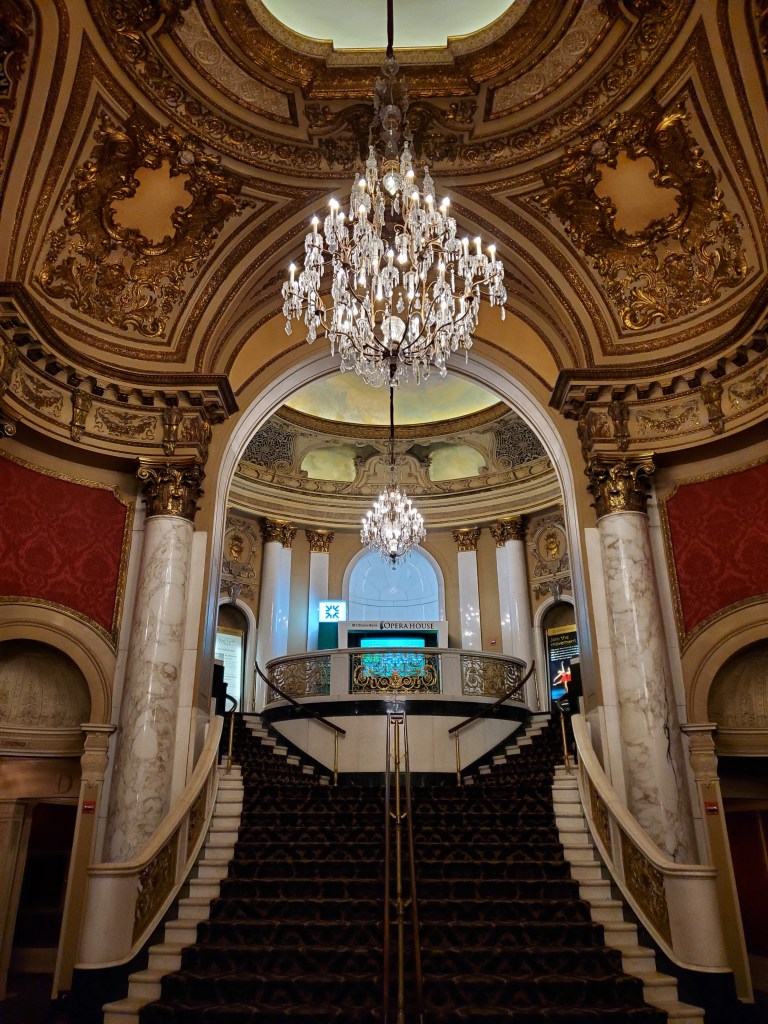
Boston (Citizens Bank) Opera House, designed by Thomas White Lamb supervised by Edward Franklin Albee to memorialize his late partner, Benjamin Franklin Keith. The theatre opened on 29 October 1928. 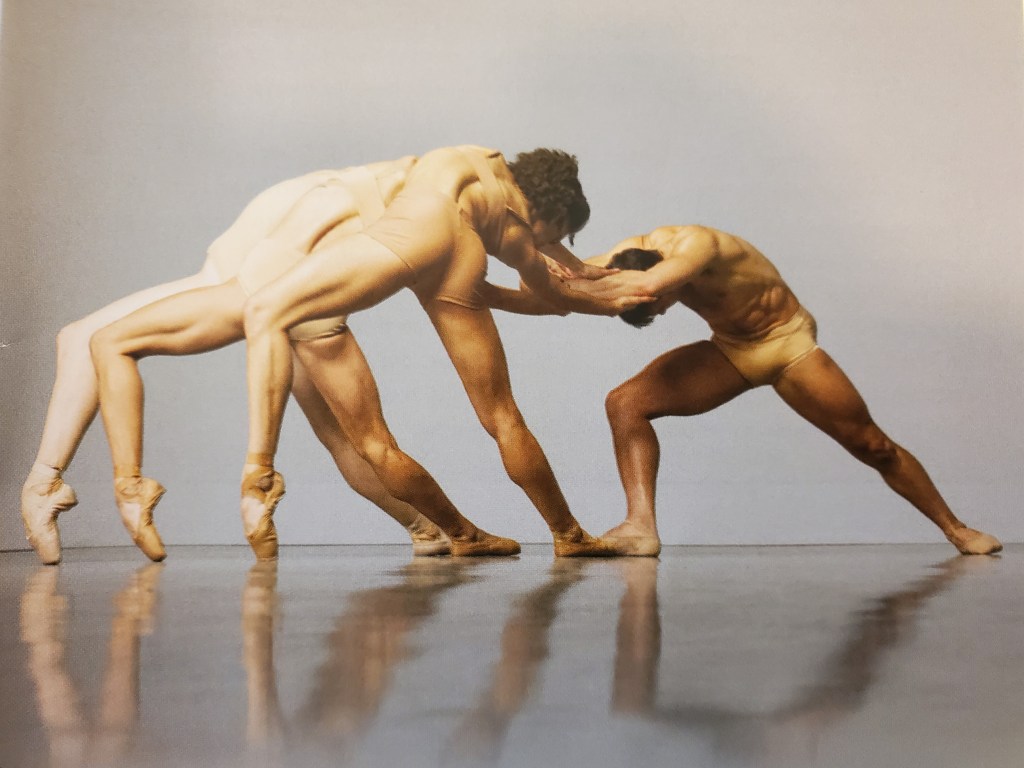
Program photo by Nisian Hughes of Paulo Arrais with Viktorina Kapitonova, Lia Cirio, and Chyrstyn Fentroy dancing Balanchine’s 1928 ballet APOLLO The program included a pas de deux ballet of irresistible attraction, Helen Pickett’s 2009 TSUKIYO, so beautiful it brought me to tears. Just moving through the past two weeks running quotidian errands has meant driving though the stunning October foliage of New England: more beauty!

Foliage along the Madbury Reservoir And then my birthday present to myself arrived: two wrought-iron railings to make accessing our front door’s four granite steps—that passage to the elevated-in-every-sense space of Gnawwood’s piano nobile library—much less hazardous. Welder Bryan and assistant Gary not only prepared the steps for the railings’ final installation post powder coating, but also cheerfully helped me get the 66-pound patio umbrella stand down off the deck, another step in preparing for winter.
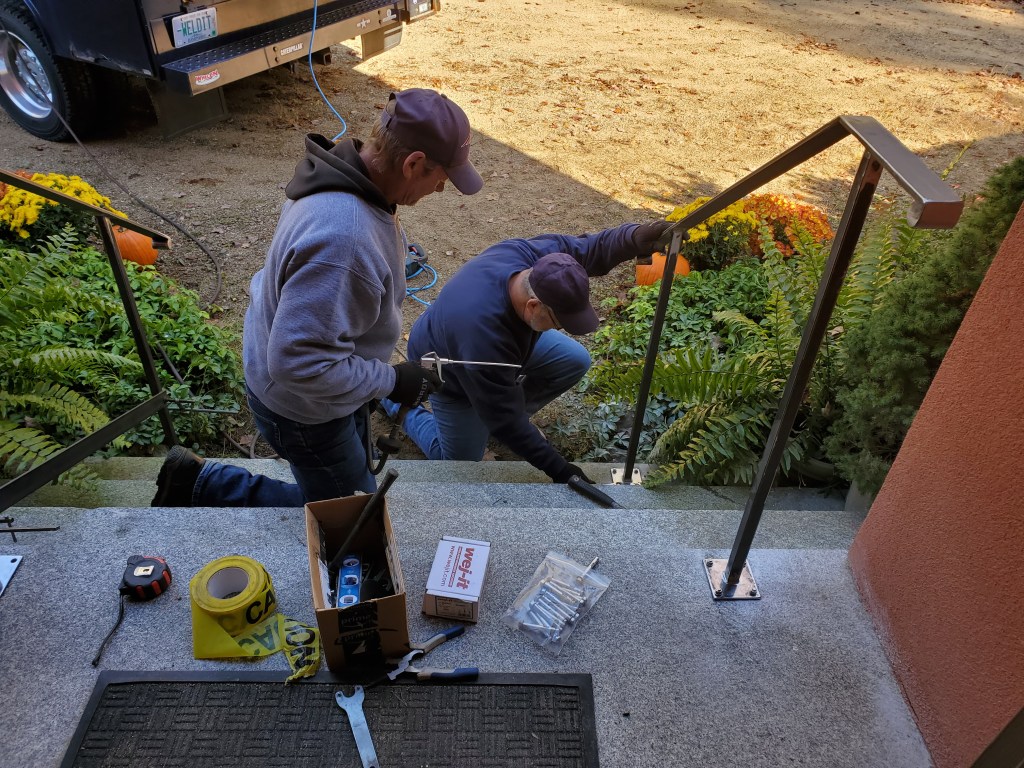
Gary and Bryan place the new front-door railings Then yesterday I successfully navigated the tricky business of painting the south-facing deck railing with penetrating oil, climbing up and down the 10-foot ladder and ambidextrously handling the brush without strain or incident, completing that fall task, and again GETTING SOMETHING DONE: the opposite of mendokusai. With literal railings north and west prepared, I was back ON the rails, not stuck on some metaphorical mendokusai sidetrack.
Yesterday my friend Carol sent me a photo she shot while hiking in Bryce Canyon, both delighting me and renewing my longing for the tonic effects of confronting geological time among the red rocks of Utah David first introduced me to. How can the “problems” of one self-absorbed, privileged person be important when all of human history amounts to a few sedimentary inches on the earth’s crust? Salutary nature bathing: always a good idea.
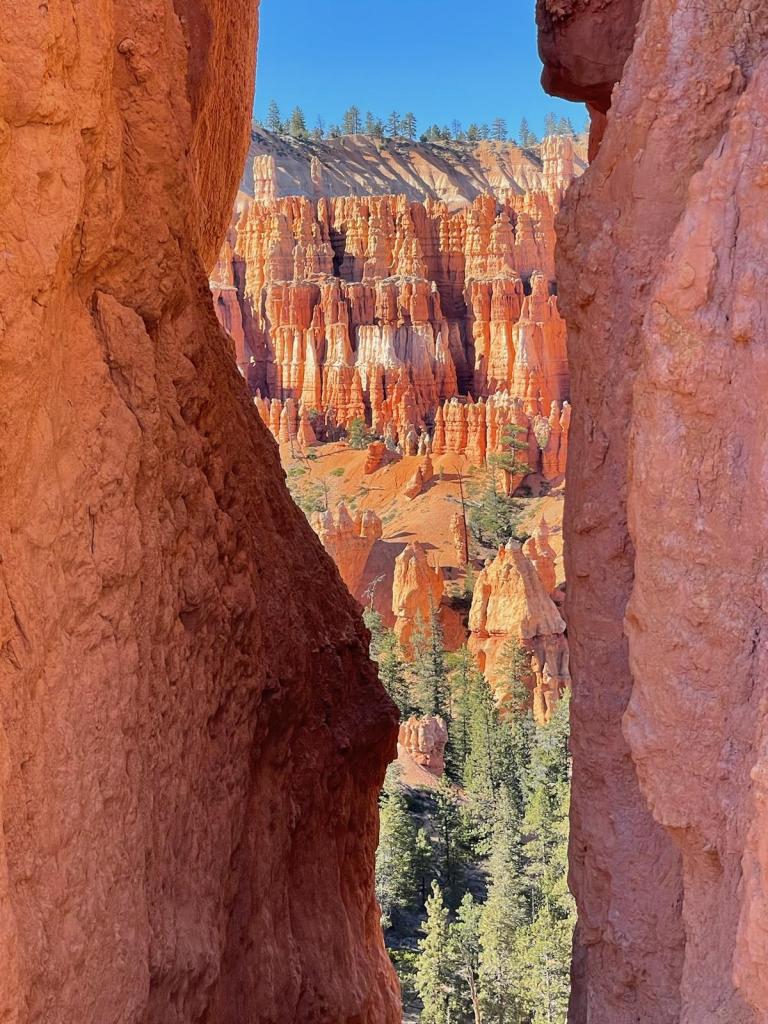
Bryce Canyon hike, photo by Carol Birch. So. I’m back, older but not over. Seventy is not so bad.
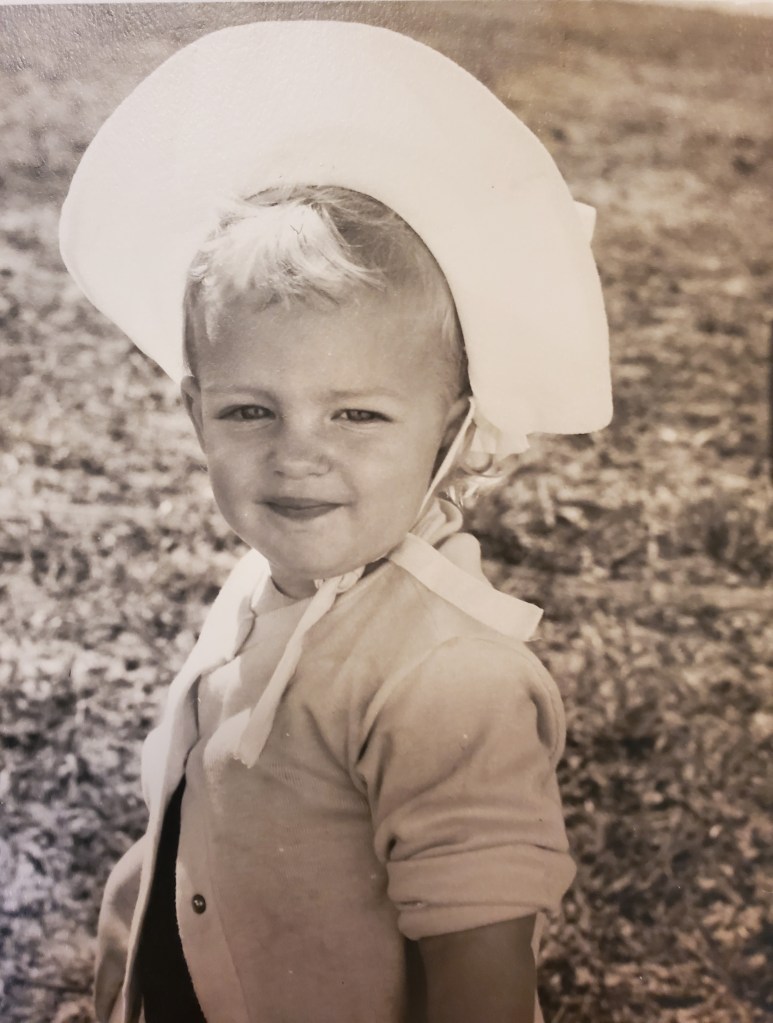
Georgy in 1954 at 16 months -
Reunion in Oxford MS 15-19 Sept 2022
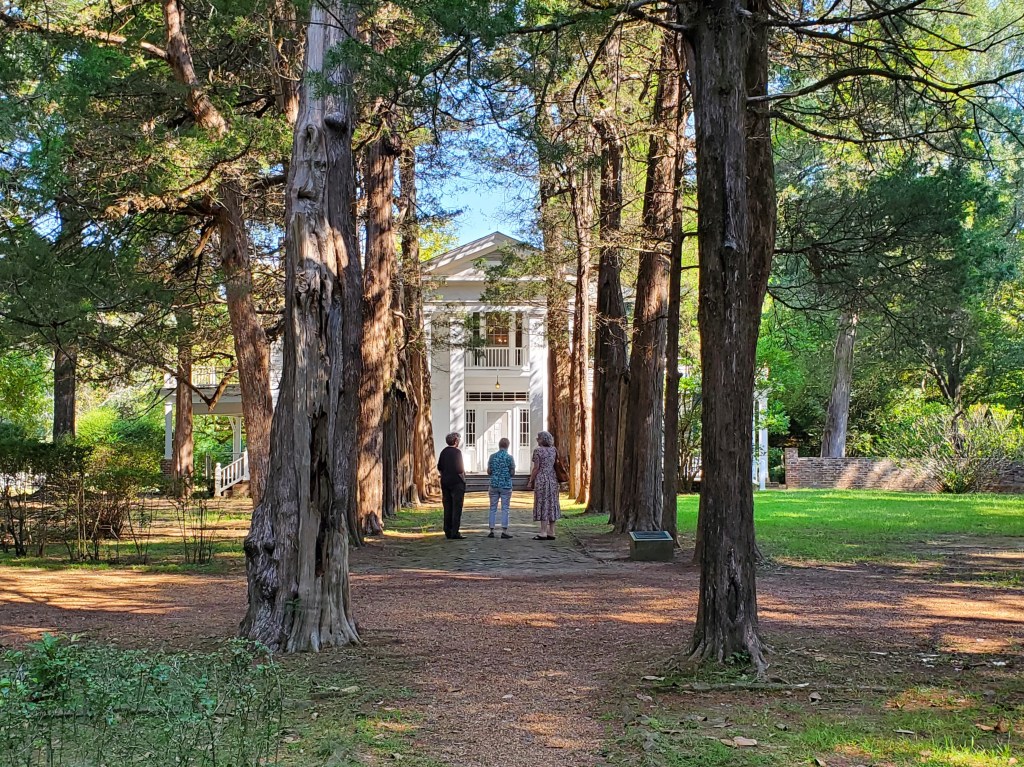
Debra, Susan, and Beth at Rowan Oak, William Faulkner’s home in Oxford MS My long mid-September weekend in Mississippi meant catching up with both friends of my youth and middle age in two charming and completely different houses, a tonic reminder of southern hospitality seasoned with hilarity, immersion in a way of being ever so far removed from my adopted home of New England, and the formal end of the second Elizabethan era as Queen Elizabeth II was laid to rest.
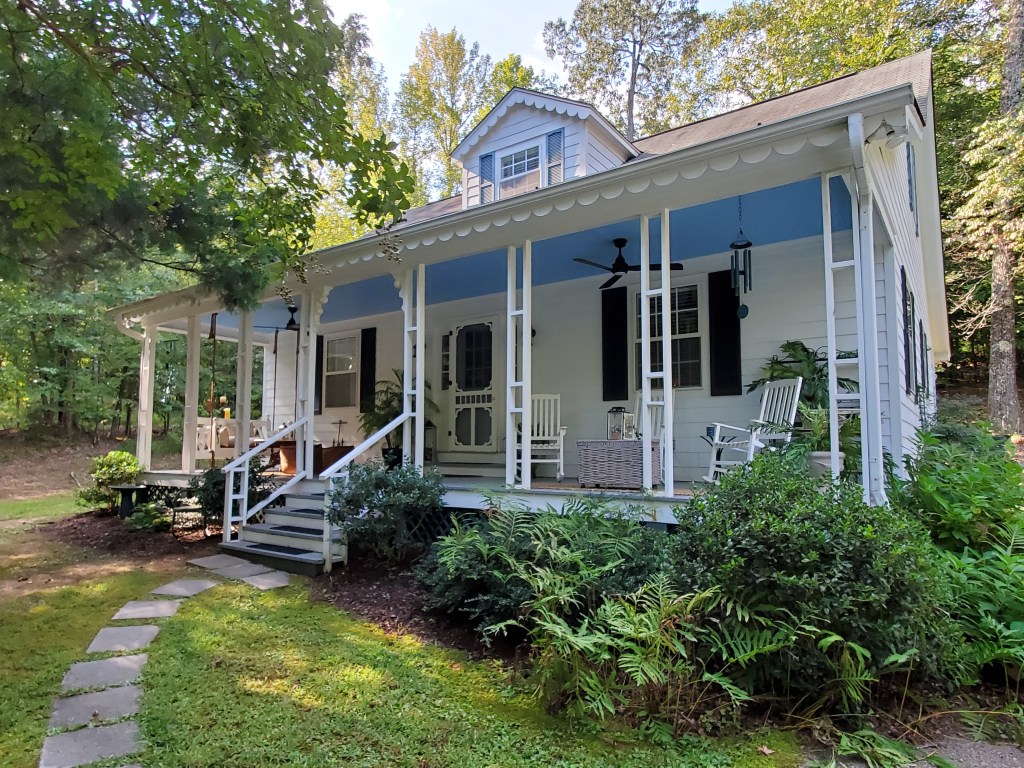
Cindy’s Beautiful Belle Glen Cottage For the second time in as many years, we four members of Women Against Dissertation, triumphant survivors of Tulane’s doctoral program in English (now happily joined by one spouse) reunited, ostensibly to help one member avoid a high school class reunion, but really just to check in and enjoy each other’s company. The eight years we spent together in New Orleans beginning in 1976 was a critical time of negotiating classes and potentially career-ending exams, a bizarre cast of faculty, learning to teach, and moving through our late twenties into professional lives. We all succeeded, against all odds landing good jobs in New Orleans, Youngstown, Albany, and Danville, Kentucky, where each earned tenure and promotions. But once scattered by staggered graduations, we carried on careers and lives at least in my case largely separated by distance in place and time. Re-connecting this year, more-or-less post COVID isolation, for me meant rediscovering just how close we had been–including the astonishing number of intimate details my friends recall–and getting to know each other once more.
Our host, Oxford native Debra, beautifully organized all the logistics, including providing limo service to and from Memphis, the closest airport for the two of us who had to fly in, and arranging with her little sister Cindy–a warm, ebullient, strong, hilarious steel magnolia if ever there was one–for our use of the charming cottage she keeps as a rental property on Pea Ridge Farm, family land close to the handsome retrofitted cabin where Debra lives.
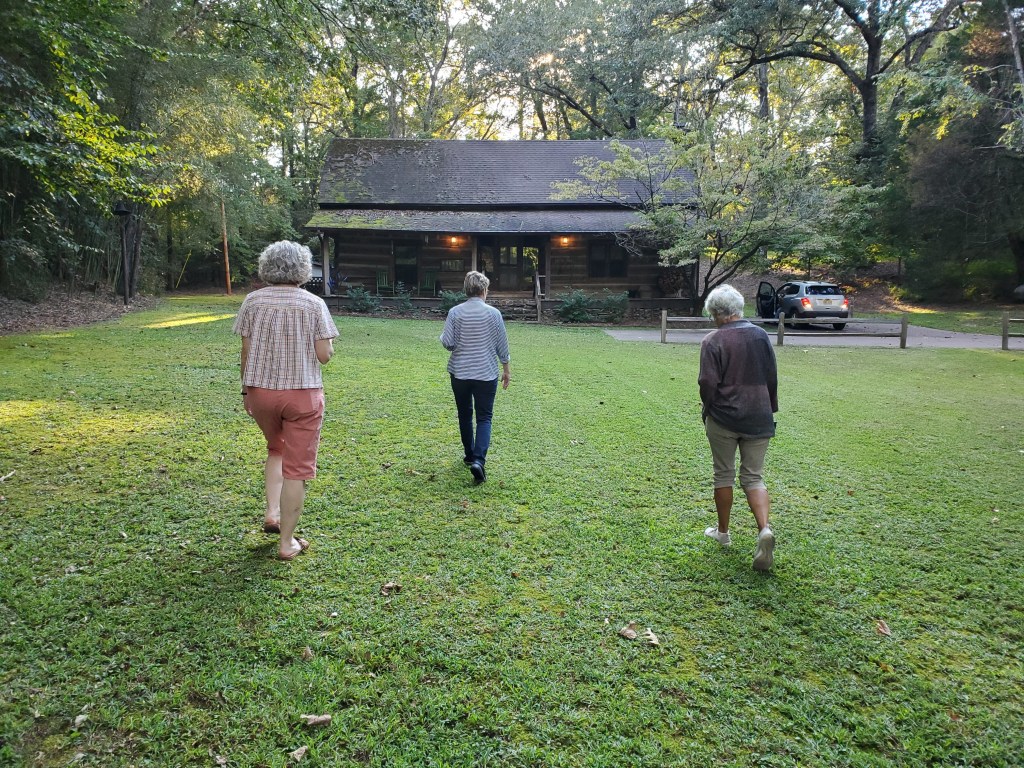
Headed for the cabin, Simple Gifts 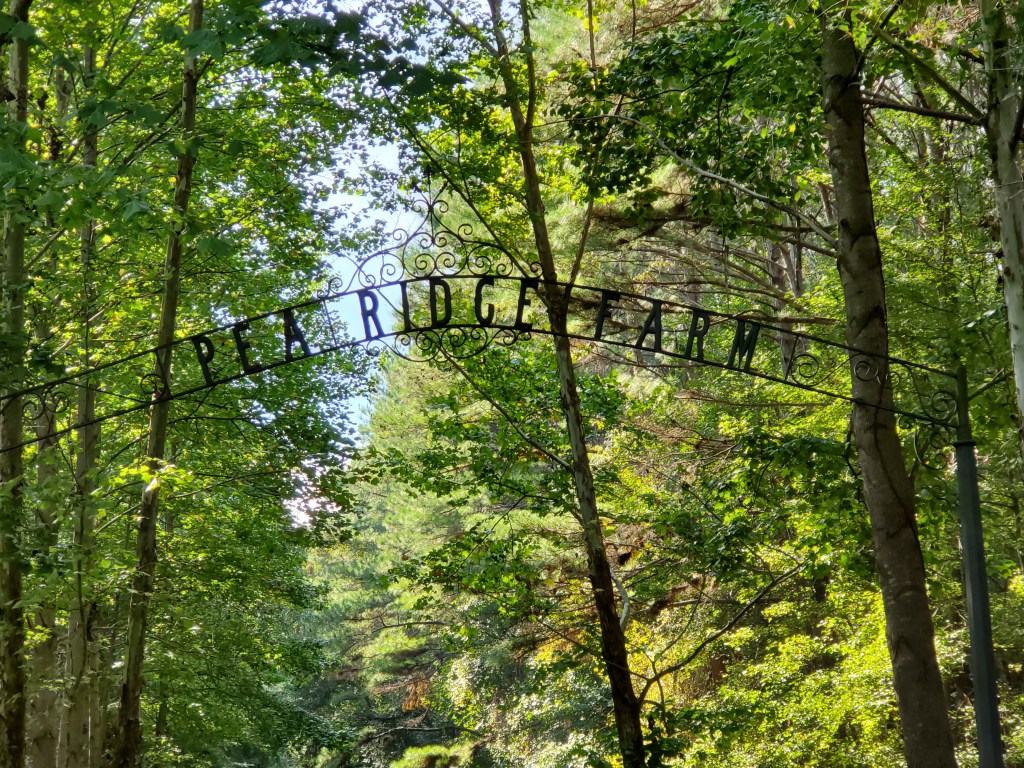
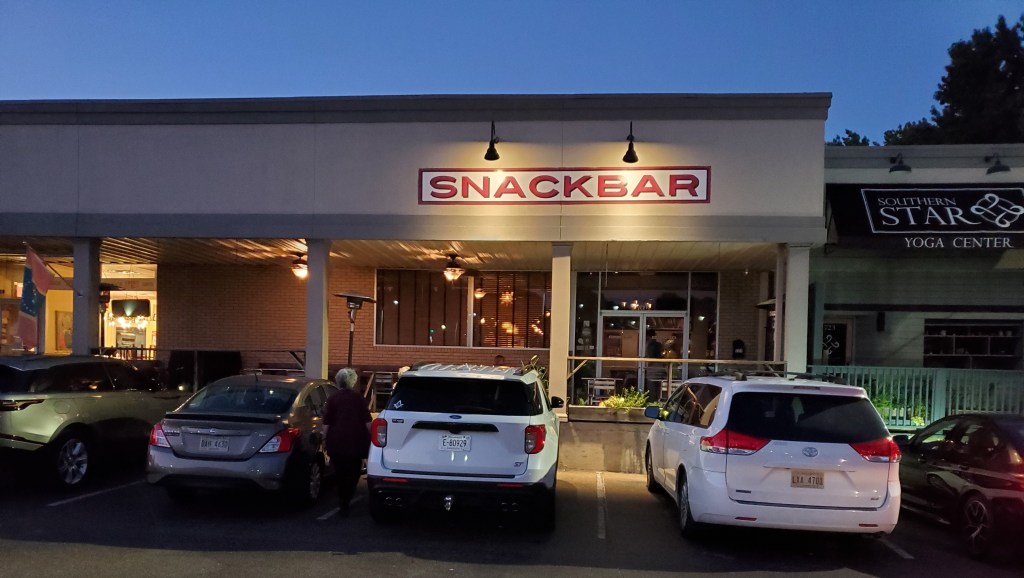
Cindy welcomed us all to Belle Glen by warmly embracing us as family, and Debra’s older sister Leslie later treated us all to lavish appetizers on our one fancy night out at Oxford’s upscale ironically named Snack Bar.
Over the course of our four days’ reunion, I also got to meet up briefly with a former UNH colleague, novelist Margaret-Love Denman; after a Sunday lunch at OPA!, a Greek restaurant off Oxford’s main square, we sat and rocked on Belle Glen’s porch and caught up on mutual life tragedies, leaving me pondering the stratified connections and departures made over the course of one’s life.
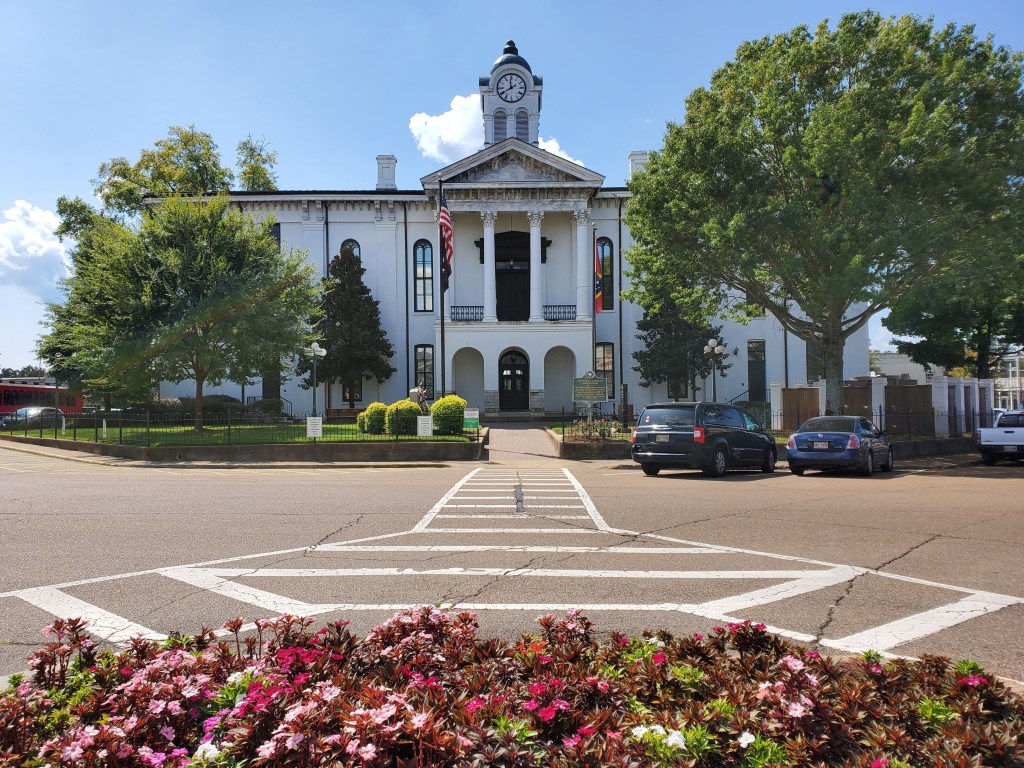
Downtown Oxford 
The peaceful Belle Glen porch Our last morning together, before an Oxford breakfast at First Watch with two other New Orleans friends who happened to be visiting in nearby Water Valley, a quaint and artsy/funky town 25 miles from Oxford, we were absorbed by Queen Elizabeth’s funeral cortege broadcast on the big digital screen at Belle Glen. We were, after all, all English majors, lifelong students and scholars of early English lit, all acknowledging that no one does pageantry as well as the Brits–and all, I think, feeling the end of an era as we prepared to go our separate ways once more.
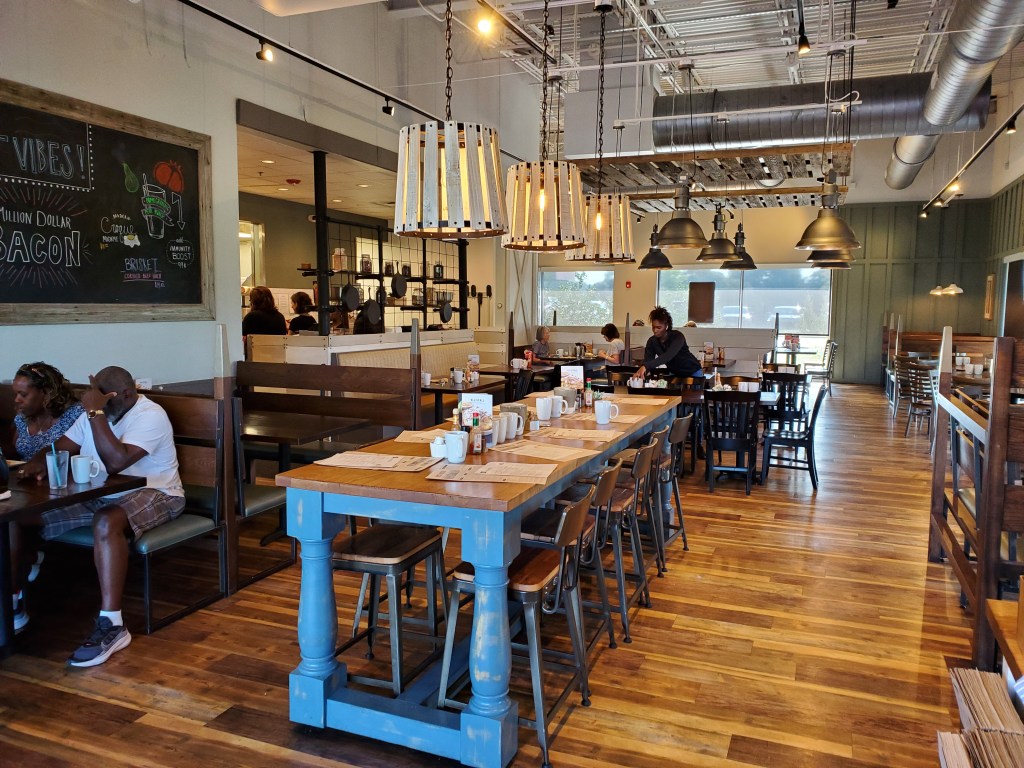
First Watch, excellent breakfast spot in Oxford 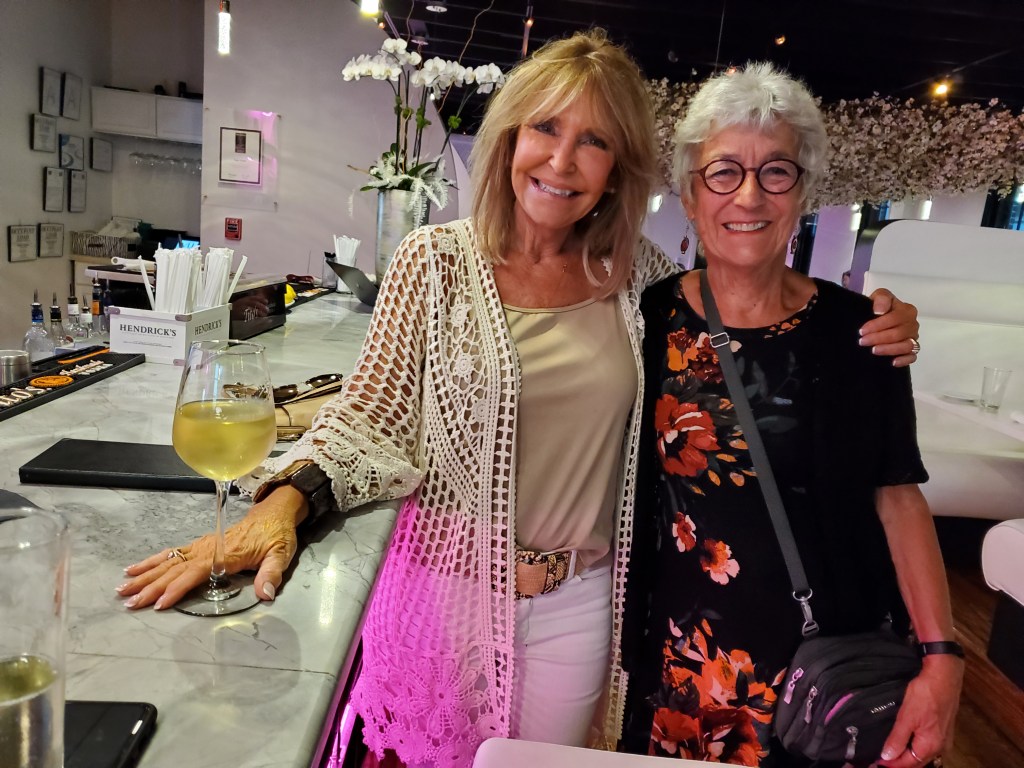
Cindy and Sandy at YUGO, Oxford In between all the reminiscing, porch sitting, imbibing, conversing (never for a moment reaching for the next topic of conversation), we had fine visits to the Delta Blues Museum in Clarksdale MS, and, of course, to Rowan Oak, William Faulkner’s home, now on the National Register of Historic Places.

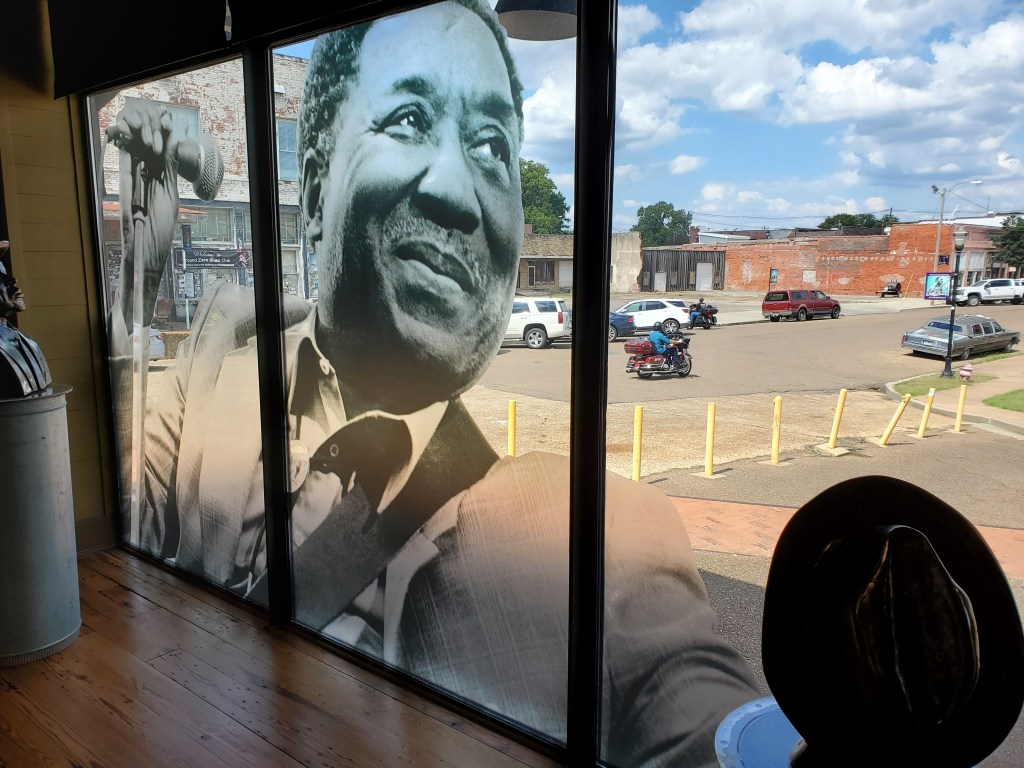
Looking out from the Delta Blues Museum, Clarksdale MS 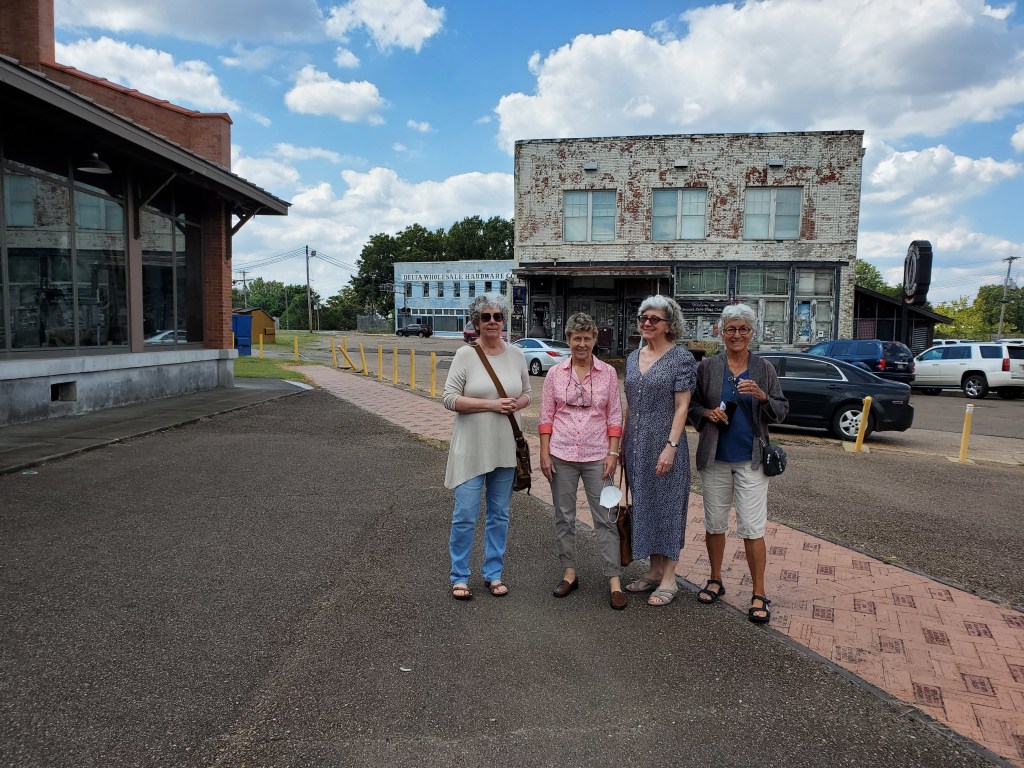
Debra, Susan, Beth, and Sandy post Museum visit in front of Morgan Freeman’s Ground Zero Blues Club 
Lunch at Ground Zero:
fried okra, collard greens, green beans, black-eyed peas, and cornbread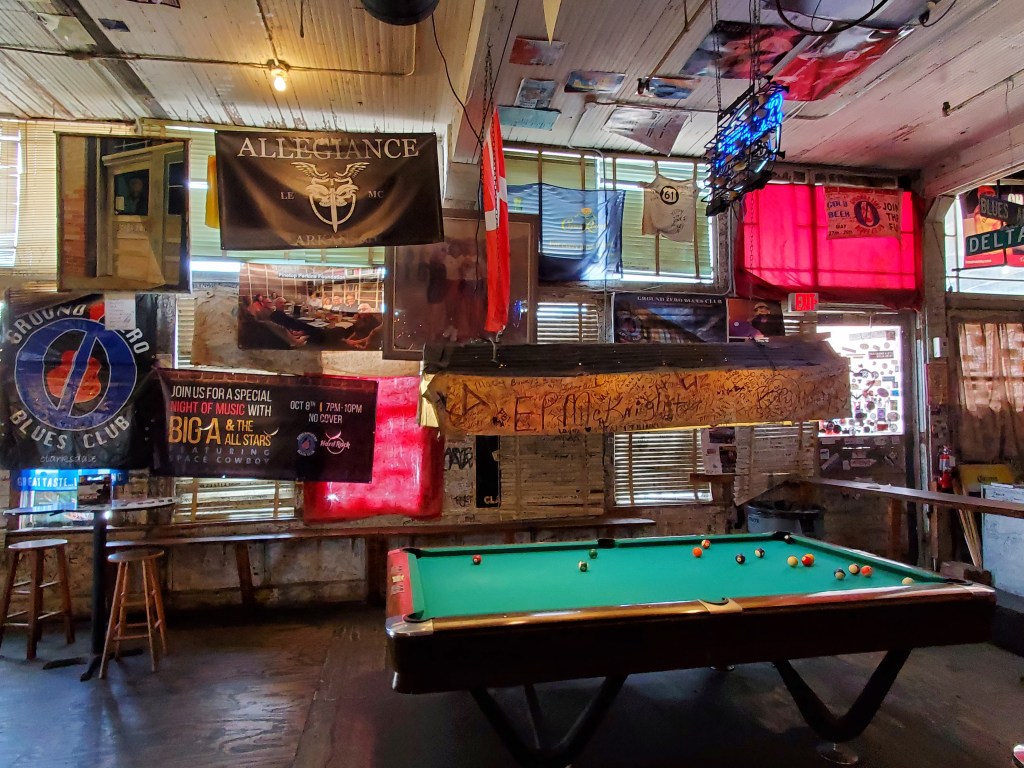
Ground Zero Funk 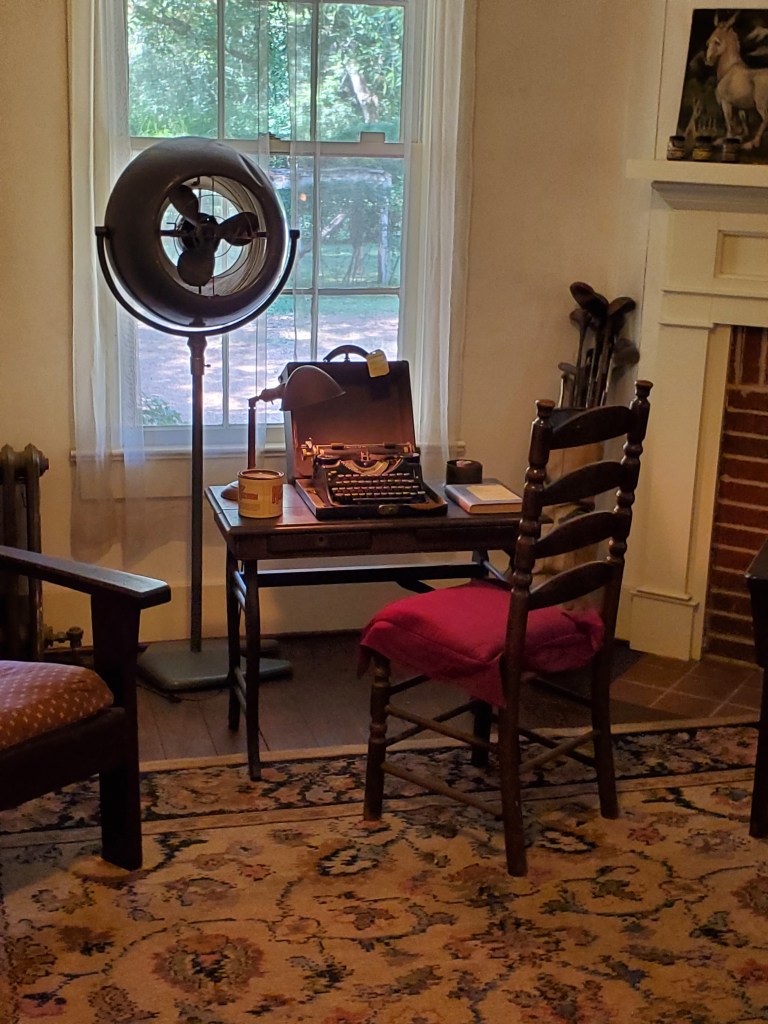
Faulkner’s office/writing room at Rowan Oak 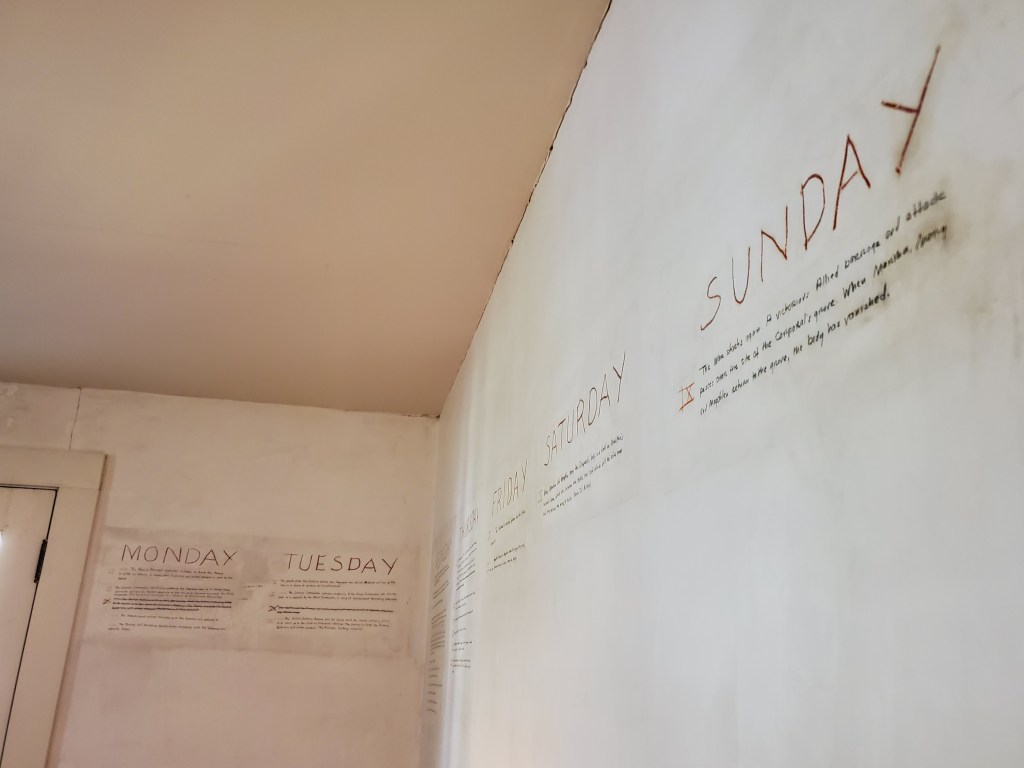
Faulkner’s storyboarding of A FABLE on his office wall The long return to New England—a very late connecting flight at Midway, Chicago and being up early on that Monday to watch the Queen’s funeral procession–meant I arrived home early Tuesday morning, just a few hours shy of a full day’s wakefulness.
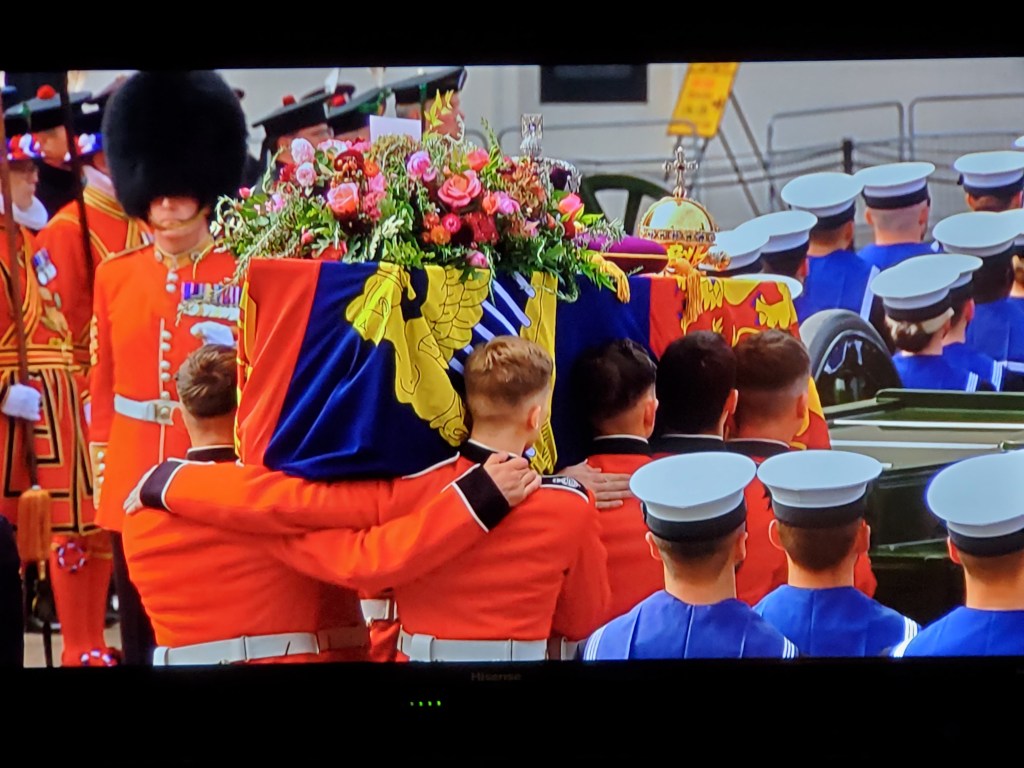
The Queen carried home to rest, 19 September 2022 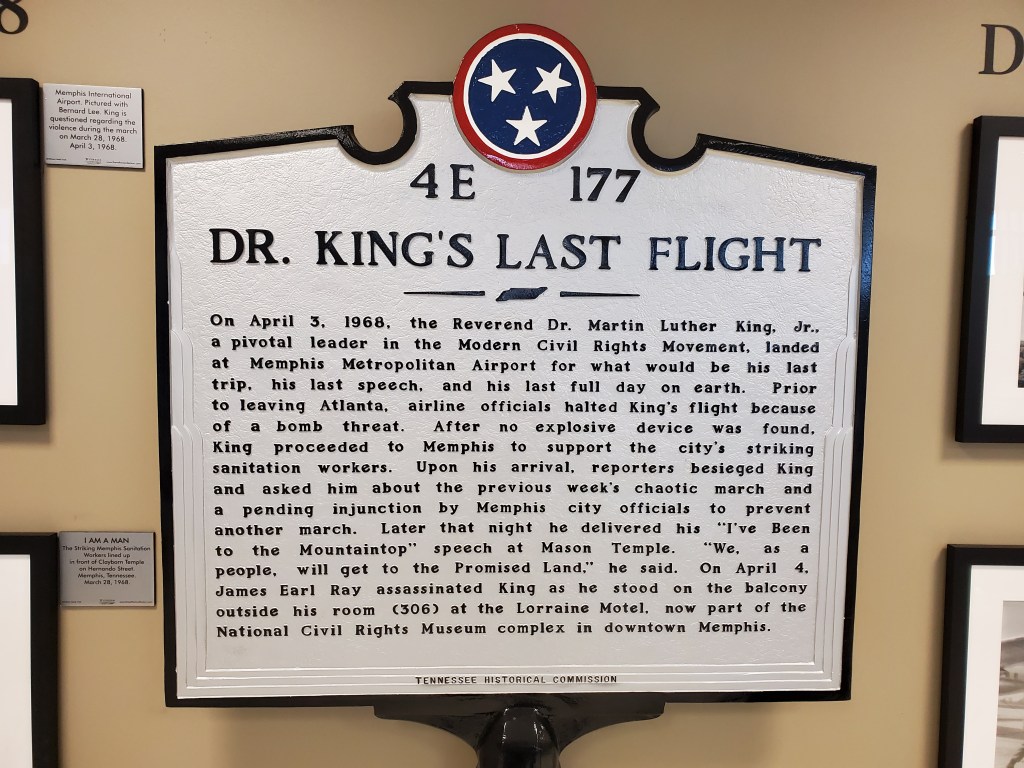
Reminder of another departure–this one from Memphis 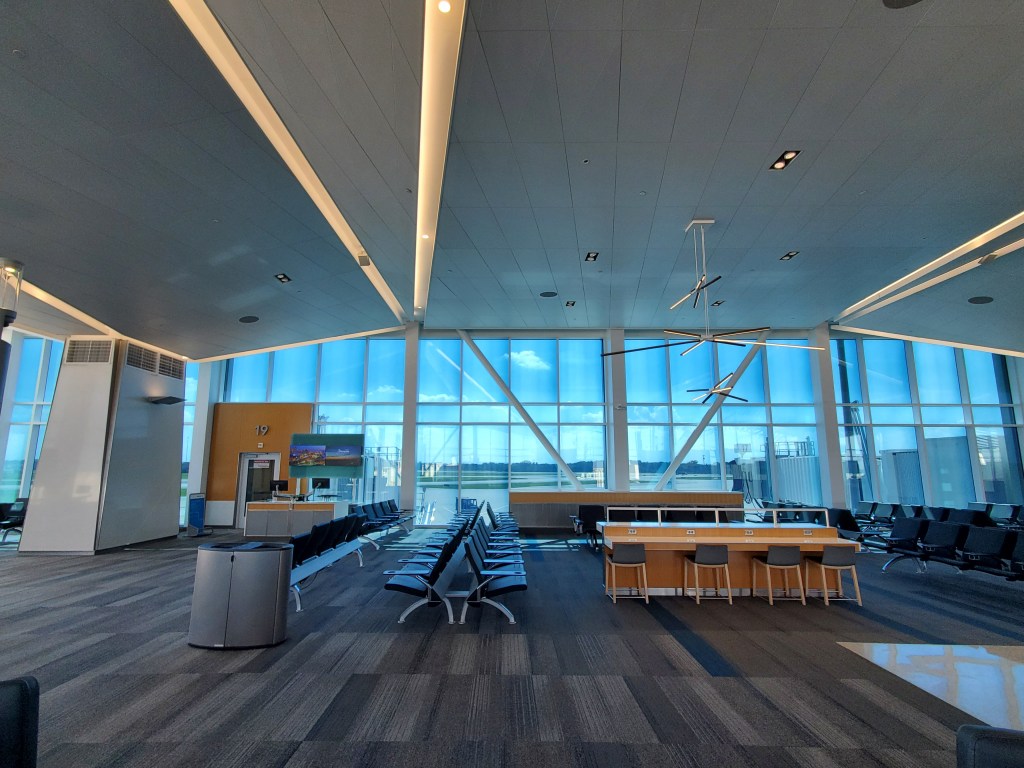
Memphis airport terminal Wonderful trip, wonderful friends, who complicate and challenge as well as complement my understanding of who I once was and now am as I approach my 70th birthday. Our time together was in another country, but Bill Faulkner’s lines obtain:
“The past is never dead. It’s not even past. All of us labor in webs spun long before we were born, webs of heredity and environment, of desire and consequence, of history and eternity. Haunted by wrong turns and roads not taken, we pursue images perceived as new but whose providence dates to the dim dramas of childhood, which are themselves but ripples of consequence echoing down the generations. The quotidian demands of life distract from this resonance of images and events, but some of us feel it always.”
(Requiem for a Nun).
-
Obama portraits postscript: looking back
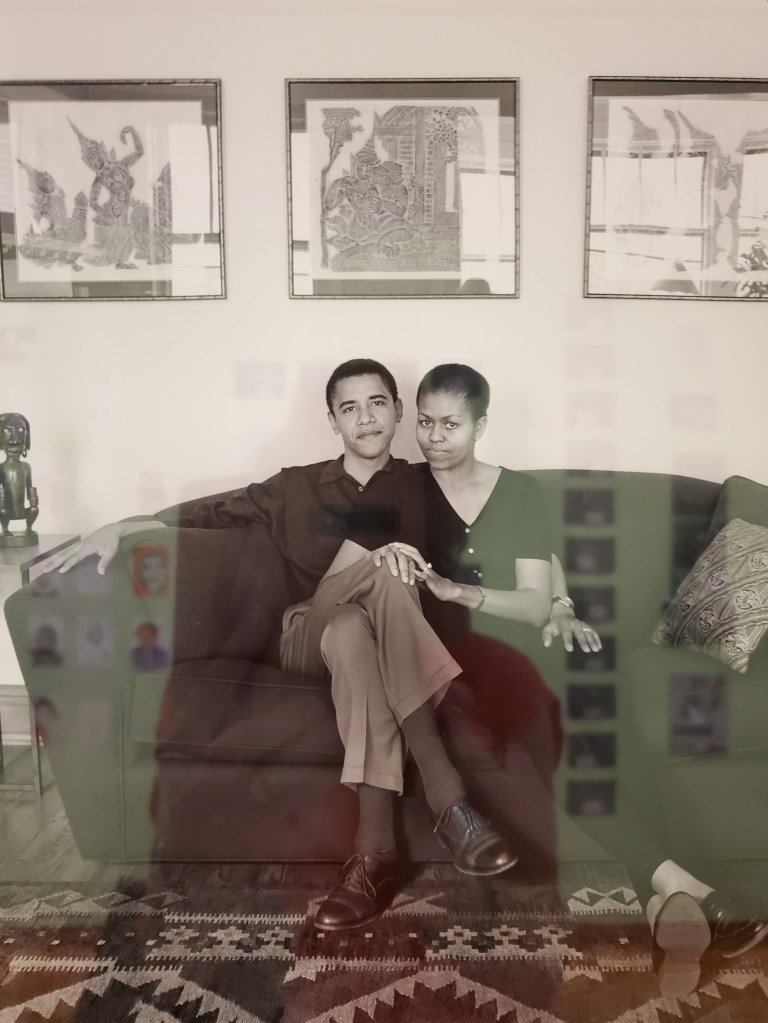
The Obamas in 1996 (photo by Mariana Cook, part of the MFA Lane Collection) I got some reflected double images when I shot this photo with my Samsung Galaxy 10; those ghostly blurs are NOT part of Mariana Cook’s 1996 shot. But they make me wonder: could this accomplished young couple possibly have imagined what lay ahead for them? Gazing back through the years is always a double exposure, isn’t it?
Good thing we can’t see very far ahead, methinks.
-
Old–and REALLY old acquaintance at the MFA, Boston
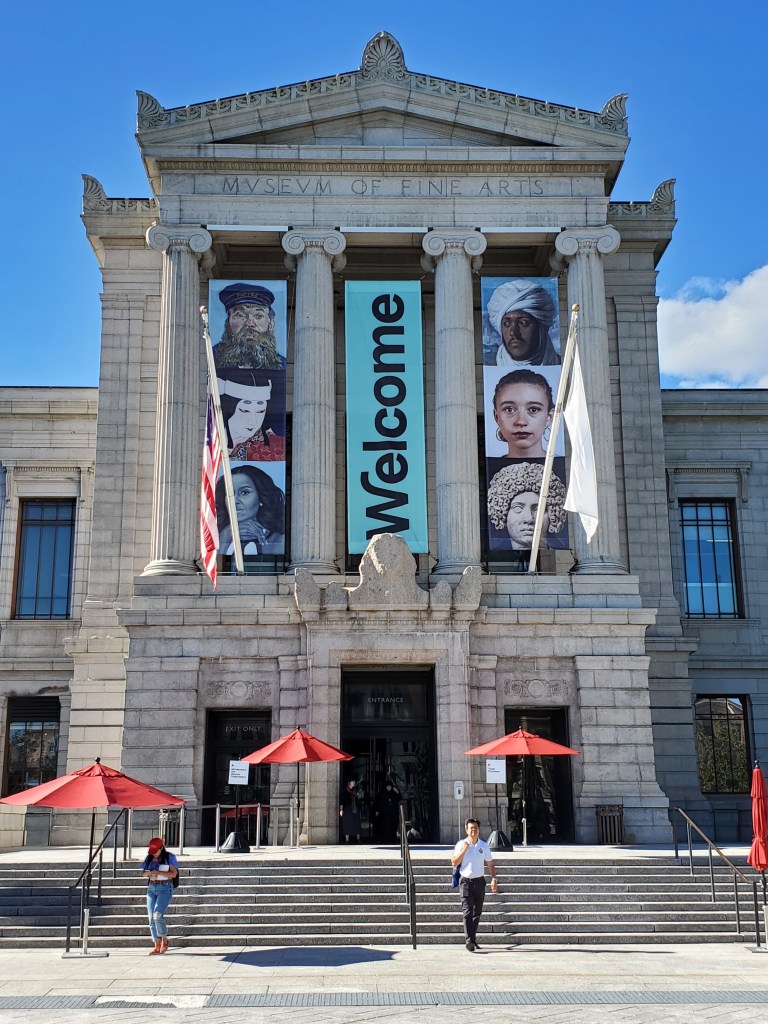
1 September 2022 On the first of September I spent a fine time at the Museum of Fine Arts in Boston on the first day the Obama portraits commissioned by the Smithsonian National Portrait Gallery were on display for members. The portraits have been touring the country, and Boston is their last stop before returning to Washington, D.C. I’d not visited the MFA since two favorite galleries, closed for much of COVID and now handsomely redesigned, had reopened. This meant for renewed acquaintance with portraits old and new, and a fine if extravagant lunch in the MFA Courtyard’s New American Café.
First, the Obama portraits: large, formidable, non-traditional.
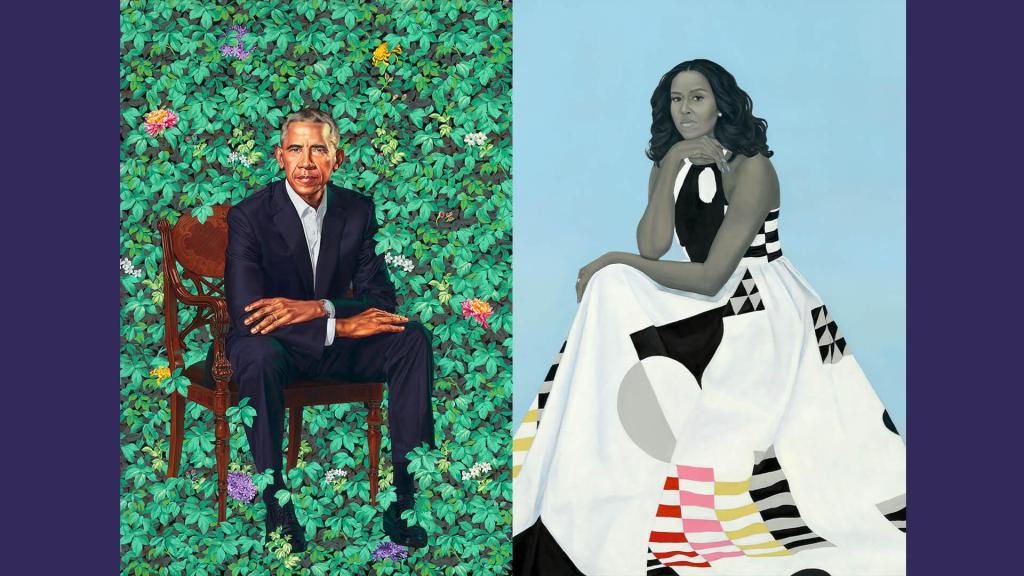
Portraits l. to r. by Kehinde Wiley and Amy Sherald The Barack Obama portrait by Kehinde Wiley pictures the President surrounded by vegetation whose botanical symbolism National Portrait Gallery director Kim Sajet explains: “The purple African lily symbolizes his father’s Kenyan heritage; the white jasmine represents his Hawaiian birthplace and time spent in Indonesia; the multicolored chrysanthemum signifies Chicago, the city where Obama grew up and eventually became a state senator.
Each flower relates to a portion of Obama’s life. Together the lily, jasmine and chrysanthemum—combined with rose buds, the universal symbol for love and courage—provide a metaphor for a well-cultivated, albeit sometimes tangled life full of obstacles and challenges.”
In Kehinde Wiley’s portrait, Obama leans into the viewer’s gaze, giving you his undivided, approachable but discerning attention. I like it very much. Amy Sherald’s pendant portrait of Michele Obama I find less successful, with the dress stealing focus from the sitter’s face. There is no warmth in the skin tones, pose, or expression: her left hand is draped casually across her right knee, supporting her arm and the hand on which she leans her chin, her expression cool, appraising, perhaps a bit judgmental and wary. The gaze is neither welcoming nor warm; she is beautiful and confident. But approachable? Not so much. There is a cartoon-ish quality to the image; somehow it reminds me of the Yellow Submarine Beatles. Maybe it’s the emphasis on lower body, outfits, and tiny heads.
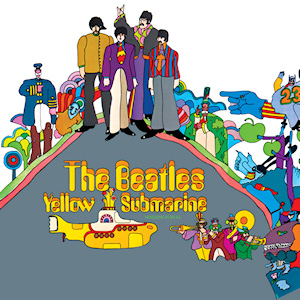
1968 Clearly both portraits exert a magnetic appeal, however, and for me are another reminder of what’s been lost over the last several years, especially under the pall of COVID that seems so much a blur that I’ve come to think of the period from 2020 until now in 2022 as a wrinkle in time (pace Madeline L’Engle). Still, I prefer the official portrait of Michele Obama unveiled only last Wednesday, 7 September 2022, in the East room of the White House, Sharon Sprung’s portrait nine months in the making and kept secret for six years.
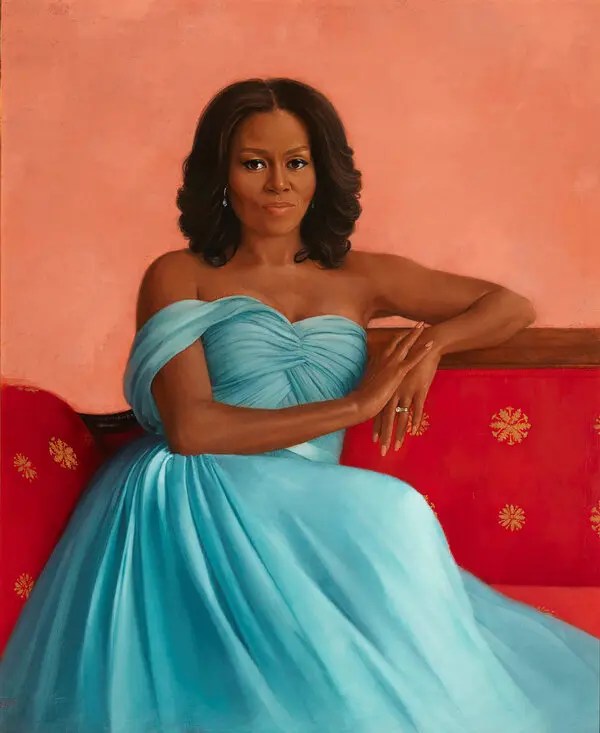
Robin Pogrebin in her 7 September New York Times post, “Official Obama Portraits Are Finally Unveiled at the White House,” explained that former presidents and first ladies for decades had had their official White House portraits (as opposed to the Smithsonian portraits now at the Boston MFA) unveiled by their successors. That did not happen for the portraits of Barack and Michele Obama while Donald J. Trump was in power. You can’t have a White House ceremony without the approval of the sitting president, and of course the sui generis Trump was bound to disrupt so generous a tradition. It took President Biden’s victory and a tamer pandemic to both welcome the Obamas back to the White House and reveal for the first time their White House portraits.
Besides, how could Trump stand comparison with Robert McCurdy’s handsome portrait of the handsome 44th president?
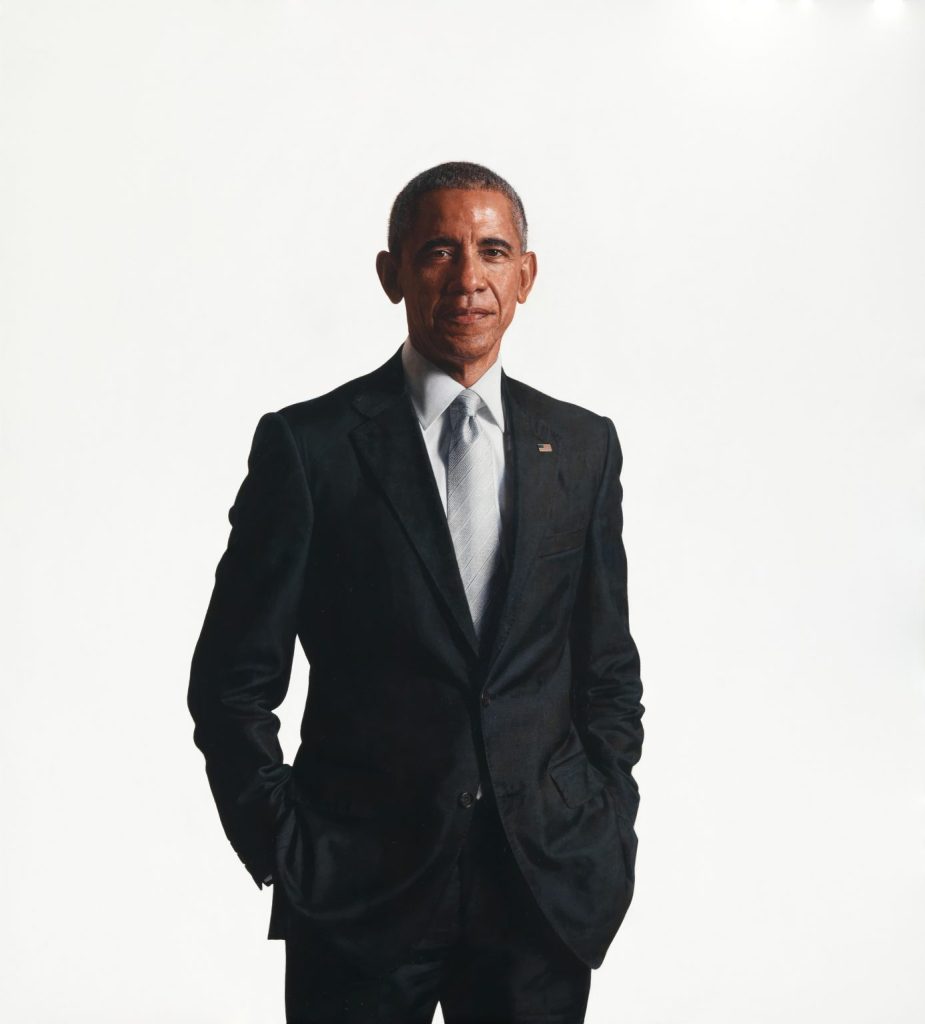
Seeing the Obama portraits evoked in me a painful nostalgia. For solace, I sought lunch (carnitas quesadillas) and a very pricey Stella Artois (Sam Adams was sold out) in the MFA courtyard.
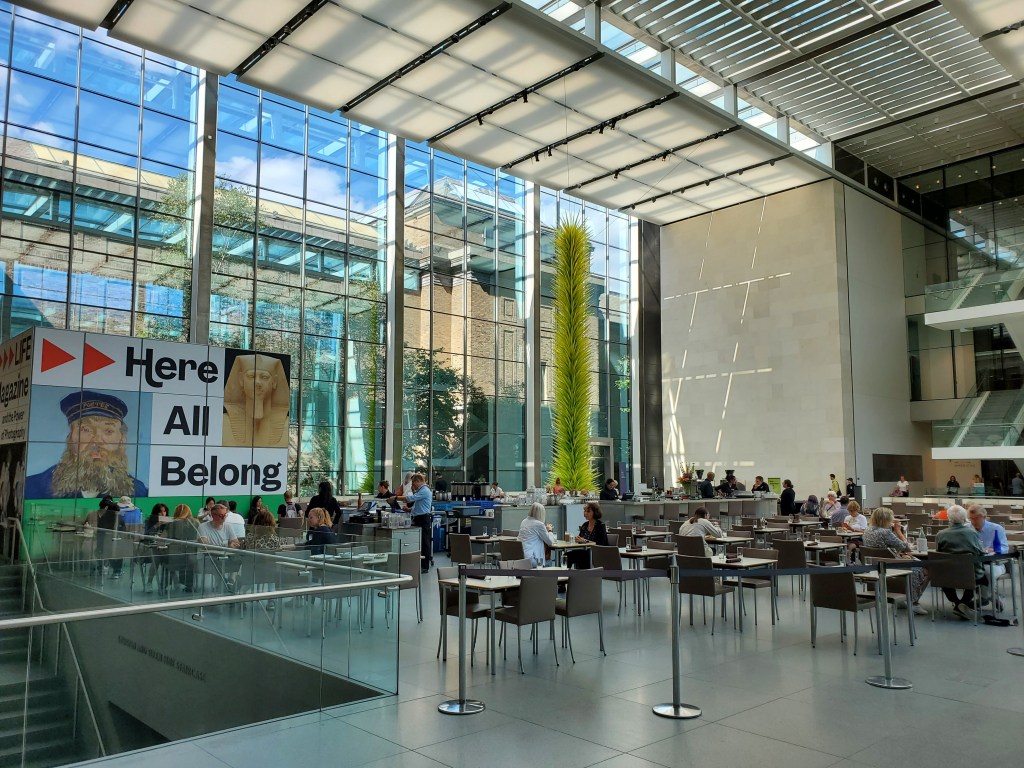
MFA Courtyard with the New American Cafe 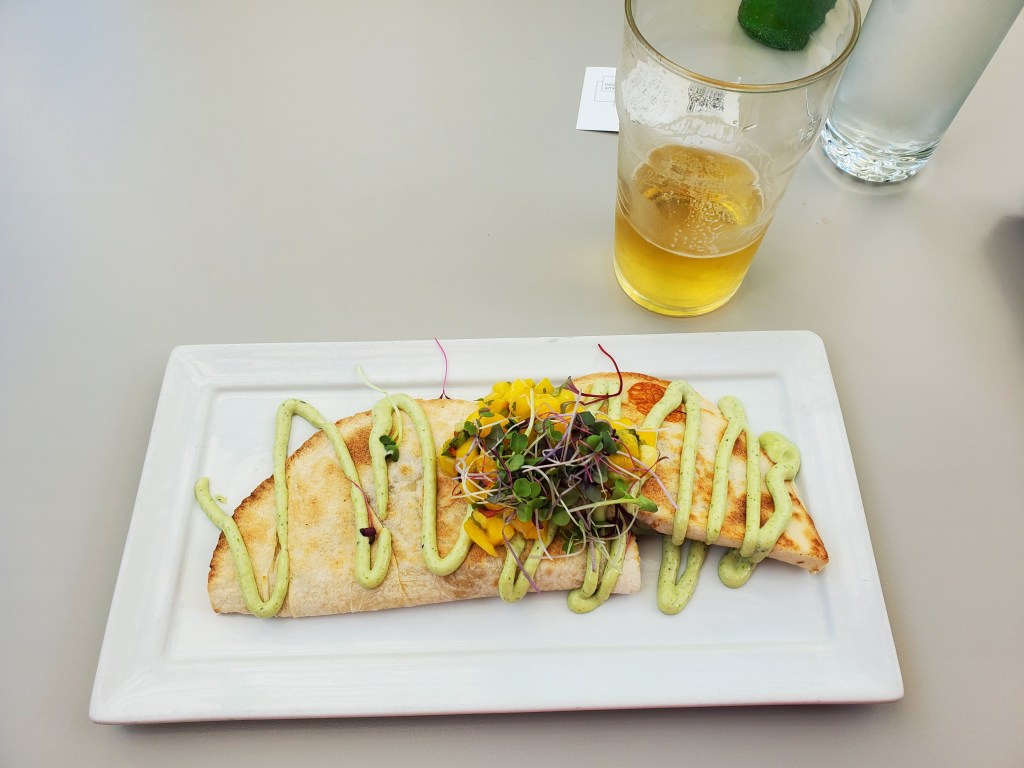
Delicious but pricey lunch Then came a reunion with another ruling couple, King Menkaura and his Queen—perhaps wife, perhaps mother—Old Kingdom portraiture, 2490-2472 BCE. These two were a favorite of my late husband’s, who regularly assigned his art history students to write about them. And in their dramatically re-designed MFA setting, they are all the more compelling.
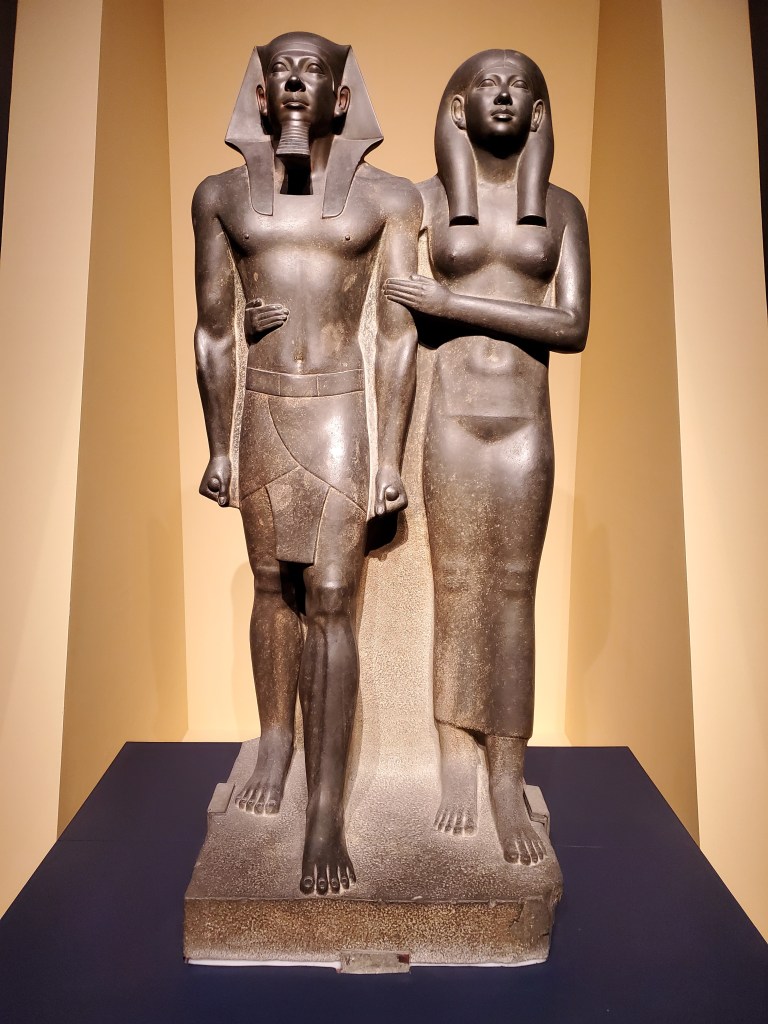
Like Keats’s Grecian urn, these two seem foster children “of silence and slow time,” the queen’s embrace of the king and the pair’s sightless gaze through eternity teases me out of thought of the madding present. For which I am grateful. Thank you, MFA.
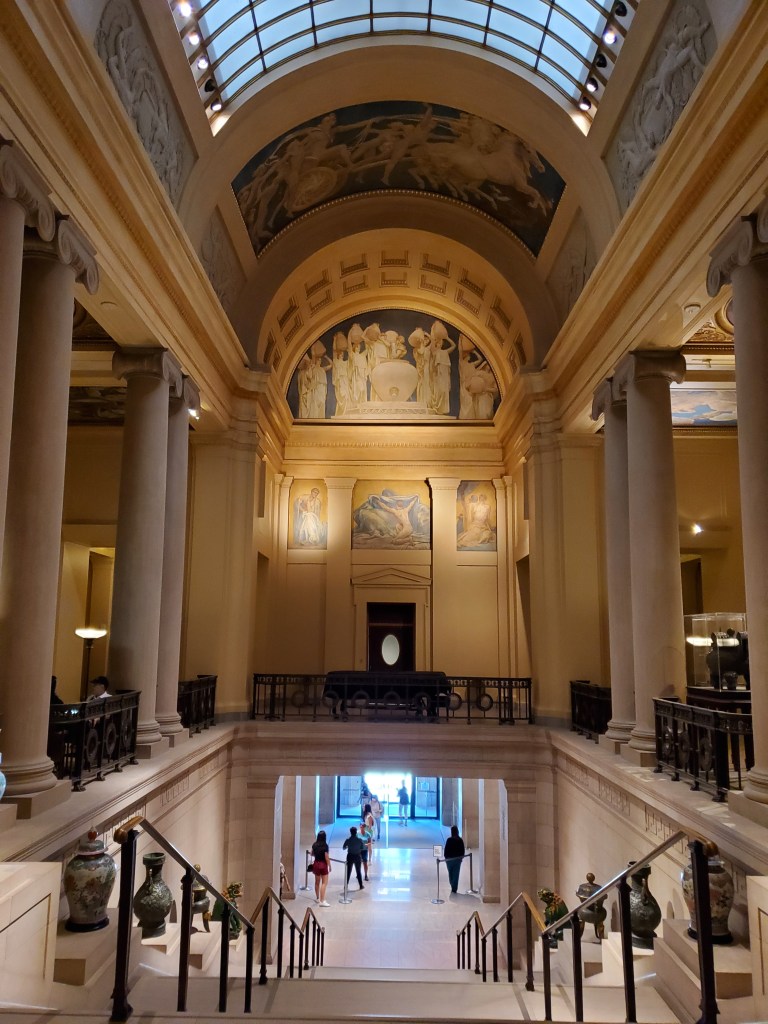
MFA entrance with Sargent Murals 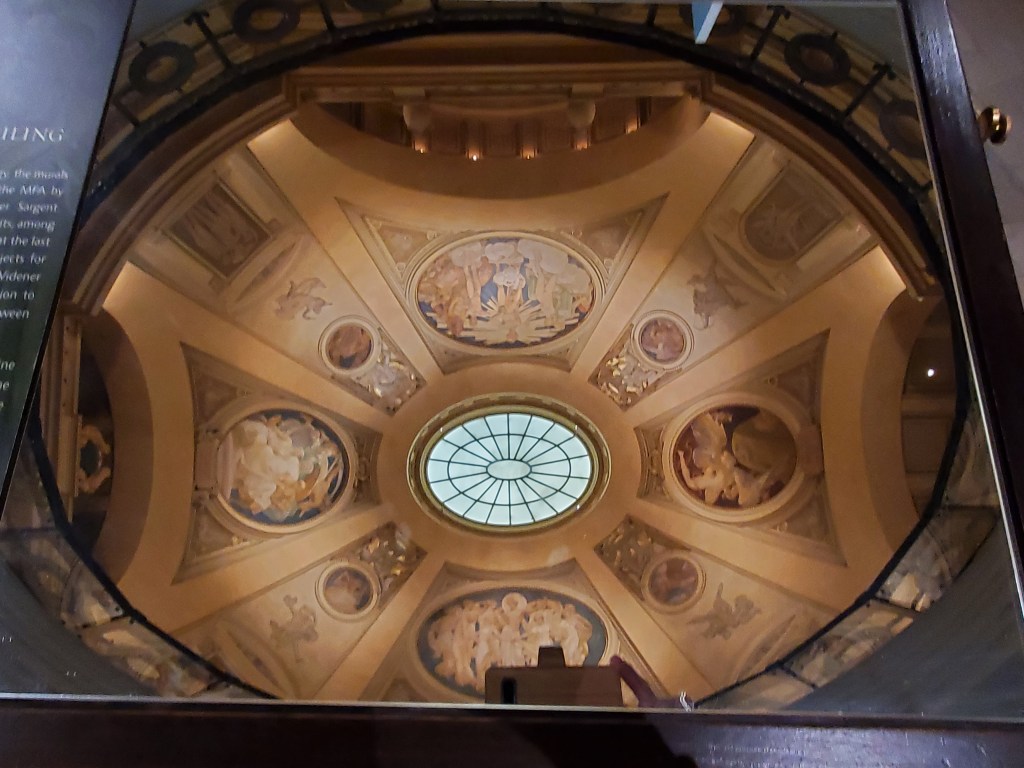
Rotunda ceiling by Sargent, reflected in a helpfully placed mirror As I was transfixed and transported by art, some poor parents were transporting their college kid to school in Boston that first of September afternoon, and fixed/scalped their U-Haul under one of Storrow Drive’s low-clearance bridges. “Getting Storrowed” happens every back-to-school year. Even the traffic tailback did not fluster me, however; I was still under Menkaura’s spell, and ever so grateful to be neither college student nor parent.
Age has its privileges.
-
RIP Queen Elizabeth II
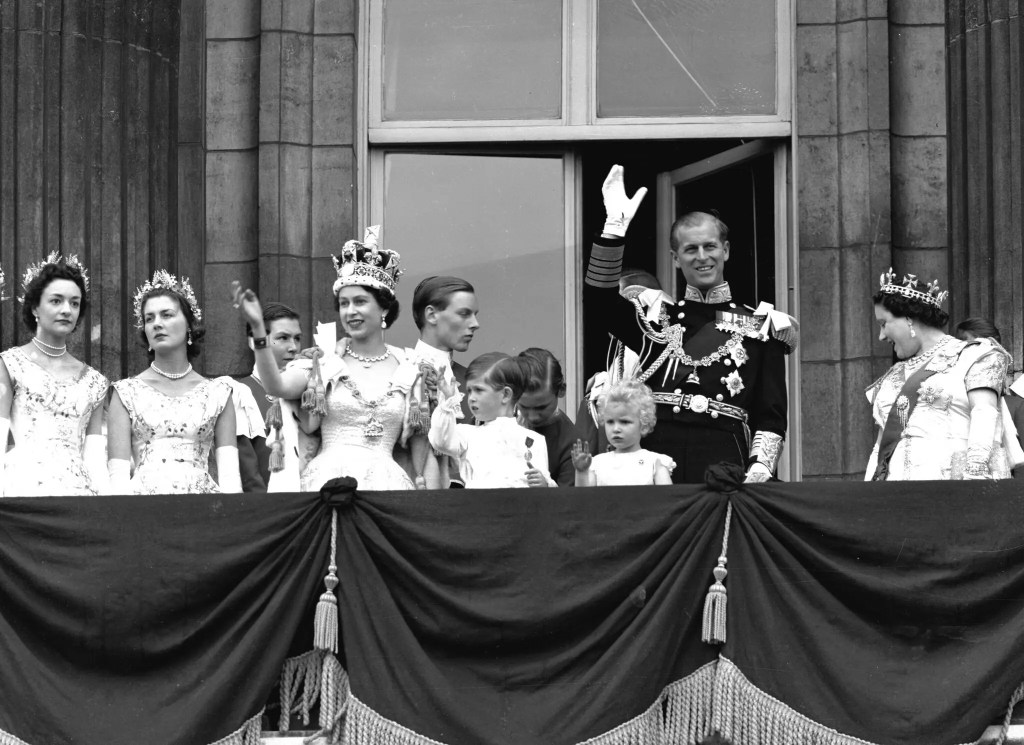
Coronation Day 1953 She led a life of duty, devotion, and dignity. May she rest, at long last, in peace.
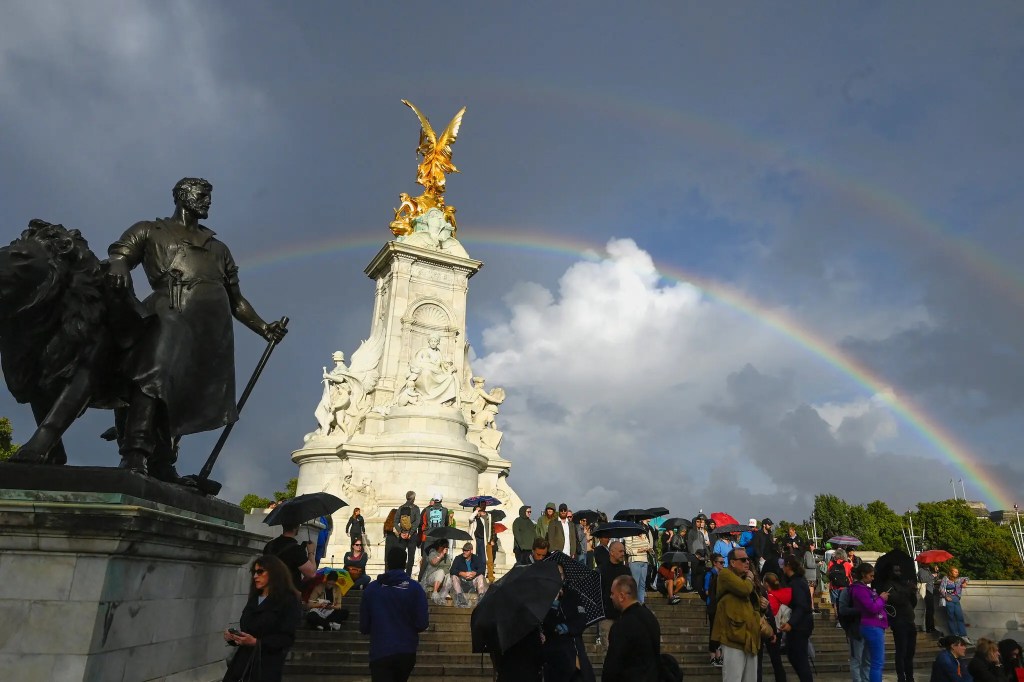
As the queen’s death was announced on Thursday, two rainbows were visible to crowds gathered near the Queen Victoria Memorial outside of Buckingham Palace. 8 September 2022 / Photo by Toby Melville / Reuters -
Labor Day and History, 5 Sept 2022
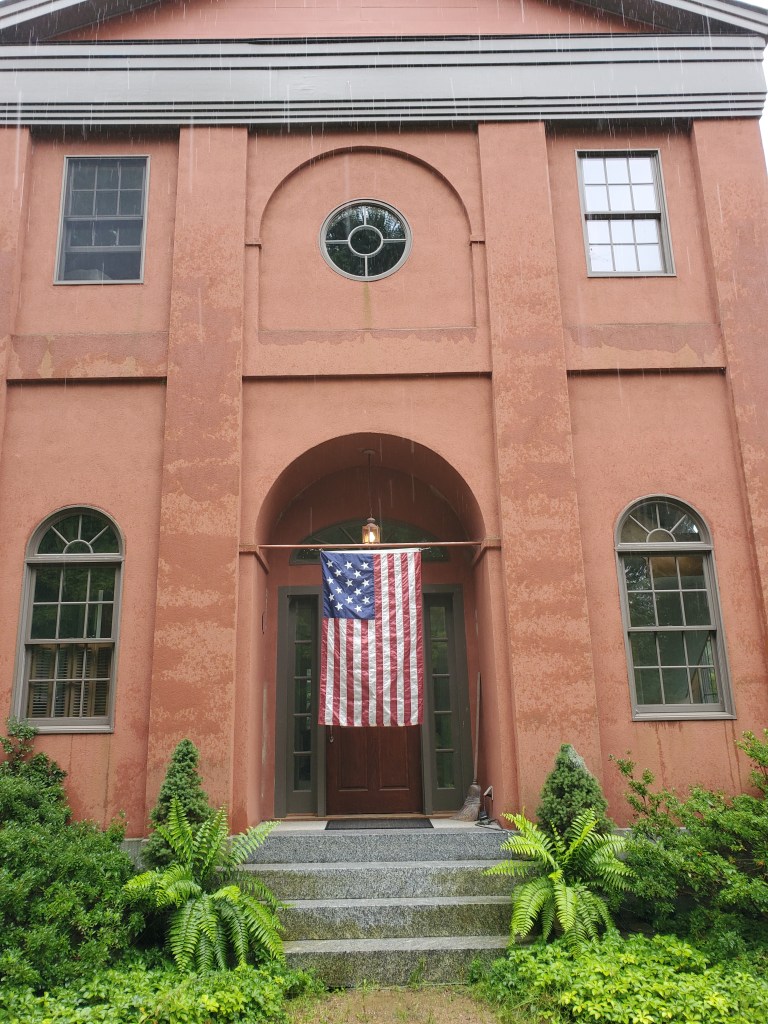
Rainy Labor Day at Gnawwood When Francis Scott Key first saw “by the dawn’s early light” a huge garrison flag, the original star spangled banner, flying over Ft. McHenry in Baltimore, Maryland on 14 September 1814, he knew that the British bombardment of the Fort had failed to prompt an American surrender. The British fleet withdrew, and the successful defense of Baltimore, then America’s third-largest city, marked a turning point in the War of 1812. Three months later, on 24 December 1814, the Treaty of Ghent ended the war. The flag’s 15 stars and 15 stripes represented the 15 states then in the Union, the thirteen original colonies plus Vermont (joined 1791) and Kentucky (1792).
I’ve flown a reproduction of this flag on the porch at Gnawwood today to honor the Federal influence on our home’s architecture and the workers of America—and to celebrate the third fall that this retired prof is NOT returning to the classroom. Time passing and the new school year have made me thoughtful about the many changes in academia observed over my 43 years of teaching. And so I refer you, Dear Reader, to Bret Stephens’s opinion piece published in the New York Times (in print on 31 August, online on 30 August (https://www.nytimes.com/2022/08/30/opinion/history-sweet-aha-academia.html): “This is the Other Way That History Ends.”
Stephens is responding to the backlash unleashed on James H. Sweet, professor of history at the University of Wisconsin, Madison, and president of the American Historical Association, for earlier this month publishing a column in that organization’s news magazine titled “Is History History?” Stephens regrets that the (unmerited in his opinion) brouhaha has obscured important things Sweet had to say. To quote Stephens:
“Sweet was warning that historians risked doing an injustice both to their own profession as well as to the past itself by falling victim to “the allure of political relevance.
. . . . Above all, historians should make us understand the ways in which the past was distinct. This shouldn’t prevent us from making moral judgments about it. But we can make better judgments, informed by the knowledge that our forebears rarely acted with the benefit (or burden) of our assumptions, expectations, experiences and values. There’s a lesson in humility in that, as well as a reminder that we are only actors in time whose most cherished ideas may eventually seem strange, and sometimes abhorrent, to our descendants.
. . . .If people are wondering how history ends, maybe this is how: when a scholarly discipline tries to turn itself into something it isn’t, making itself increasingly irrelevant in its desperate bid for relevancy.”
As someone who has too often heard Shakespeare called to task for living in the late sixteenth and early seventeen centuries, and myself an “actor in time,” I can only agree. Most of us know very little of history, and what we do know is necessarily filtered through our own metamodern perception. Here’s to the corrections Sweet and Stephens offer.
Happy Labor Day.
-
Why I like THE BEAR 31 August 2022
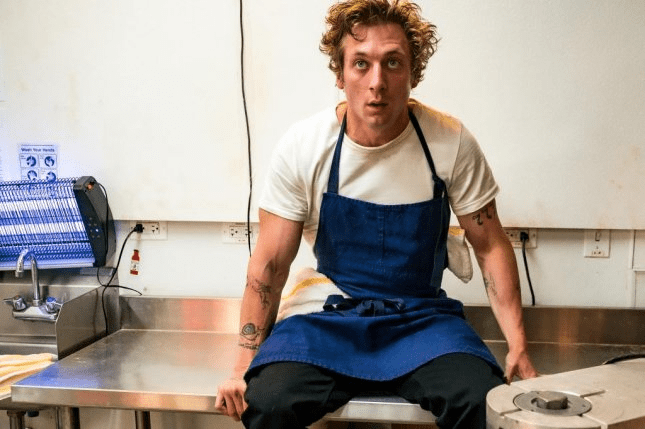
Jeremy Allen White as Carmen “Carmy” Berzatto, Hair on Fire
(photo from upi.com)Having now succumbed to temptation by streaming through all 8 episodes of The Bear for the second time in as many weeks, I’m doing a little self-audit to examine just why I love this series (which I’m happy to note will indeed have a second season).
The first few reasons are quite personal. My working at the New Orleans Hilton’s fine dining restaurant Winston’s in the early 80’s (as I struggled to write my dissertation until my wonderful dad gave me the money to quit waiting tables and just finish the g.d. thing) was a wonderful and complex experience. Front of the house was all show biz, as we worked in “butler & maid” boy/girl teams, right up my alley as a drama and English major—and a professor in training, learning how to read a room, a table, and an individual’s responses and deliver what was wanted: to be left alone (Dick Clark), to be secluded but fawned over (Billy Joel, using the separate wine room’s mirrored table for blow), chatted up, or merely taken good care of (the NOLA fire chief, who smoothly palmed me a C-note with his end-of-meal handshake). The maître d’, a mad Frenchman named Claude de Leon, assigned me the VIP tables, and so ‘twas I who waited on Robert Lawrence Balzer, the first serious wine journalist in the U.S., when he came to dinner representing Travel/Holiday magazine. Though “Bobby” Balzer found our chilled salad forks a “meaningless affectation,” I helped Winston’s earn the extra star we sought that night.
Back of house, however, was the real education, and though I had worked before at a fine dining establishment in Greenville, South Carolina (with a wonderful chef named John L who looked after this neophyte with advice to “put on the chef” whatever went wrong with service, since I was the one working for tips), I’d never before served with an executive chef and CIA-trained (Culinary Art Institute of America) line cooks. As I recall, there were three or four of these young men and a woman as pantry chef or garde manger, plus Big Al, the grill master. I think Bart Shoemaker was sous chef, regretting his surname because the last thing a chef wants to be known as is a shoe maker. The kitchen ran on adrenaline, drama, and sex; I had a brief, happy, and significant fling with one of the line cooks, a flirty Dutchman.
Their work in that kitchen was HARD, hot, fast, demanding performance work—something The Bear’s creator, Christopher Storer clearly understands. The show’s premise is that Carmen “Carmy” Berzatto (the eponymous Bear, played by Jeremy Allen White), a young chef from the world of fine dining, has come home to Chicago to run his family’s Italian beef sandwich shop. His beloved, difficult big brother Michael has taken his own life and left Carmen the restaurant, so in addition to the burden of re-inventing how the shop in shambles works, Carmen and other family members—including the close-knit kitchen crew—are coping with grief. Carmen has one ally in a CIA grad who knows both Carmen’s superior reputation and the Escoffier kitchen brigade system, Sydney Adamu (played by the wonderful Ayo Edebiri). Brilliant ensemble acting and frantic quick-flash editing together with a gang busters premise and narrative arc over 8 episodes really rock, alternately hilarious and deeply moving.
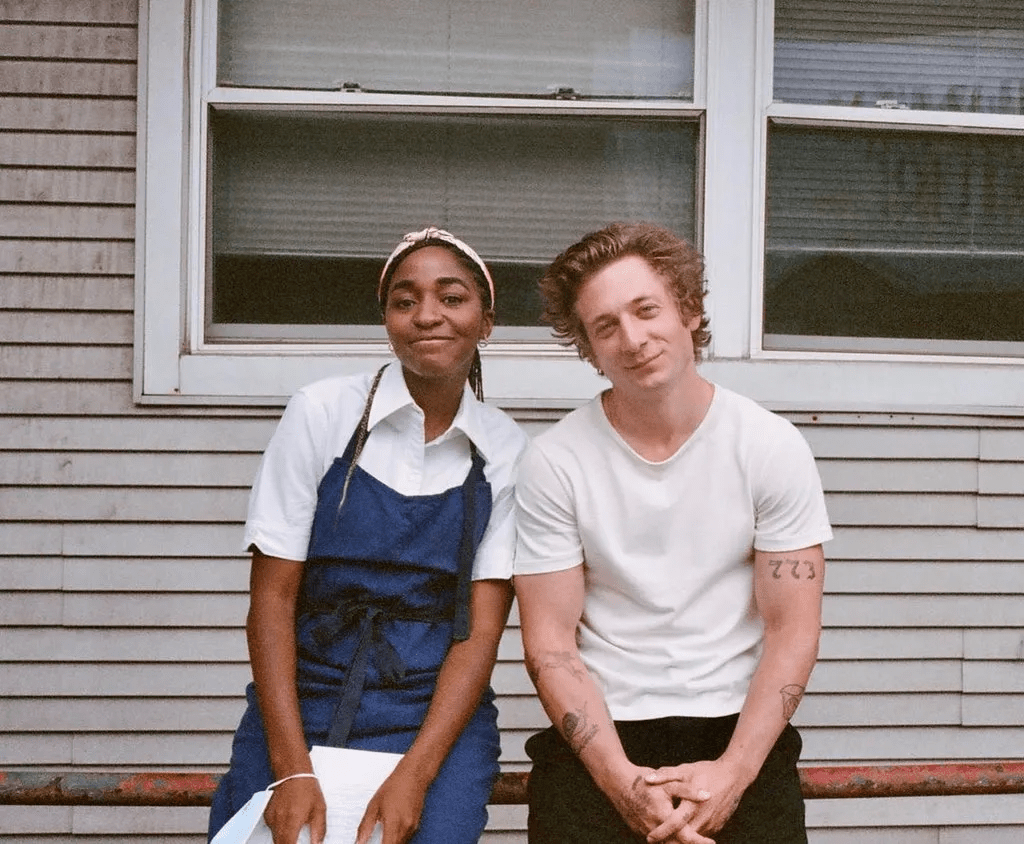
Ayo Edebiri as Sydney Adamu on set with White as “Carmy”
(photo from maxblizz.com)So, aside from the pleasure of re-living part of my young life, why do I love this show? Let me count the ways:
- The “kitchen confidential” (pace Anthony Bourdain) exposé of what goes on back-of-house in a restaurant careening through service at full tilt boogie is thrilling. Carmen’s explaining the man-hours dedicated to producing a single dish at The French Laundry alone is enthralling/appalling.
- Valorizing the sacrifice and commitment of people dedicating themselves to doing something very hard very well, over and over again, is something Americans need to see more of. Hard work in the pursuit of excellence is the opposite of “quiet quitting,” deserving of respect and emulation—especially in a culture that has come to so readily disrespect expertise in any field.
- Respect is what the diverse characters of The Bear earn and practice—another template for our currently fractured and fractious era to consider. This is what hard work for all the right reasons–and true familial devotion—look like.
- The show also does a good job of exposing the damage suicide wreaks on those left behind, another valuable lesson.
- Examining the relation of what one does to one’s identity may currently be unfashionable, on the assumption that the self exists independent of accomplishment. As Garrison Keillor used to point out, in Lake Wobegon “All the children are above average.” But that relationship is real and relevant, and attention must be paid.
When I got my hair cut by my long-term most excellent stylist Terri last week, I asked if she’d seen this show I liked so much, The Bear. She hadn’t, but one of her young associates had. “That food show?” she asked. “It’s great.” I asked her why she liked it. Her reply, “I’ve worked in restaurants. It’s real and relatable.”
She’s right.
See you in September!
-
Thinking Ink: Tutored by Art
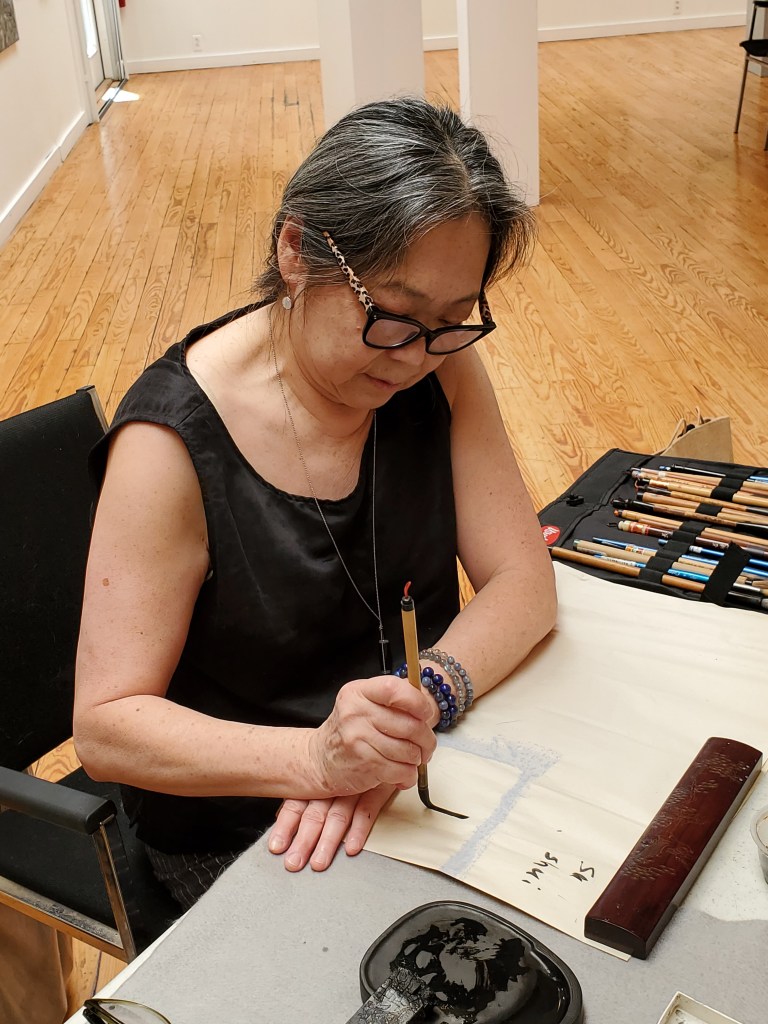
Shiao-Ping Wang demonstrates the traditional art of Chinese ink painting “Tutored by my art” is how Friar Laurence, the herbalist in Romeo and Juliet who compounds a sleeping potion for Juliet, describes his pharmaceutical credentials. In the past few days of editing my chapter on life lessons taught in that play, that phrase has leapt from the page to chime with other activities of the week. I remember from my earlier life the phenomenon of being so immersed in rehearsing a play that no matter what else was going on, everything seemed a reference to, an aspect of the play I was preparing. Of course, the richness of any Shakespearean text almost guarantees relatable correspondences of all sorts, and every fresh encounter with a play by Shakespeare, reading or seeing, reveals something new: the play doesn’t change, but we do, so we recognize things in it we did not before.
So, it’s not surprising that Friar Laurence’s phrase has me thinking about my mid-week experience in a five-hour Chinese ink painting workshop at the Barn Gallery in Ogunquit, Maine, the first time in decades I’ve had an artist’s brush in my hand, and the first time ever I’ve had the pleasure of being taught by my good friend, accomplished artist and educator Shiao-Ping Wang. Earlier this year, I’d been mesmerized by her show at the Buoy Gallery in Kittery, Maine (see Jorge Arango’s illustrated review at https://www.pressherald.com/2022/01/02/art-review-abstract-art-allowed-shiao-ping-wang-to-break-free-from-confines-of-identity/ ), so when another dear friend, artist and former UNH colleague Carol Aronson Shore, invited me to go with her to Shiao-Ping’s workshop, I immediately agreed.
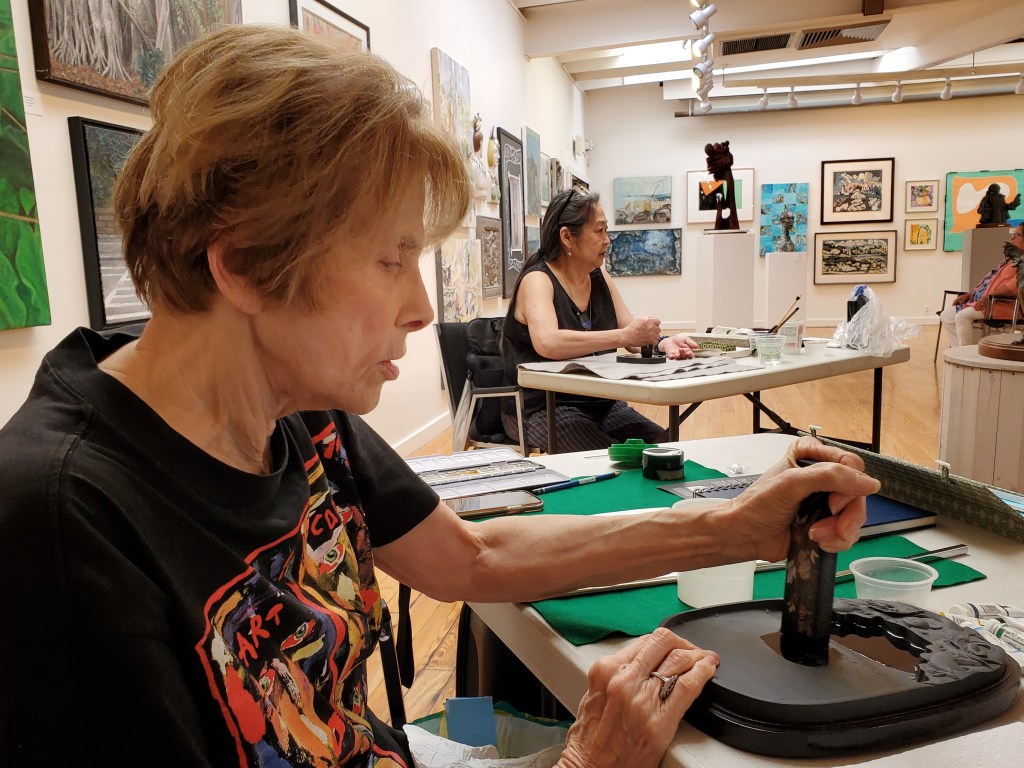
Carol and Shiao-Ping grind ink at the Barn Gallery’s
Chinese Ink Painting Workshop, 24 August 2022A perk of accompanying Carol was her sharing with me her impressive collection of brushes, inksticks, brush stand, and large, decoratively carved inkstone, the mortar for grinding and containing ink, all acquired during her visit to China years earlier, but never before this occasion put to use. Shiao-Ping provided a variety of papers, each with its own qualities: Maobian, the yellowish practice paper, smooth and semi-absorbent; Xuan, white and soft, showing subtle ink gradations; and Mulberry, less absorbent and good for layered and opaque technique.
Brushes for ink painting compose a complete menagerie: white, soft goat brushes; brown, firmer weasel brushes; mountain horse hair brushes mixed with badger, very rough in texture for irregular and expressive effects. Apparently even the location of the hair on the donor animal is a factor: Shiao-Ping alluded to one brush’s having “belly hair.” Such natural and transparent sourcing really appeals to me.
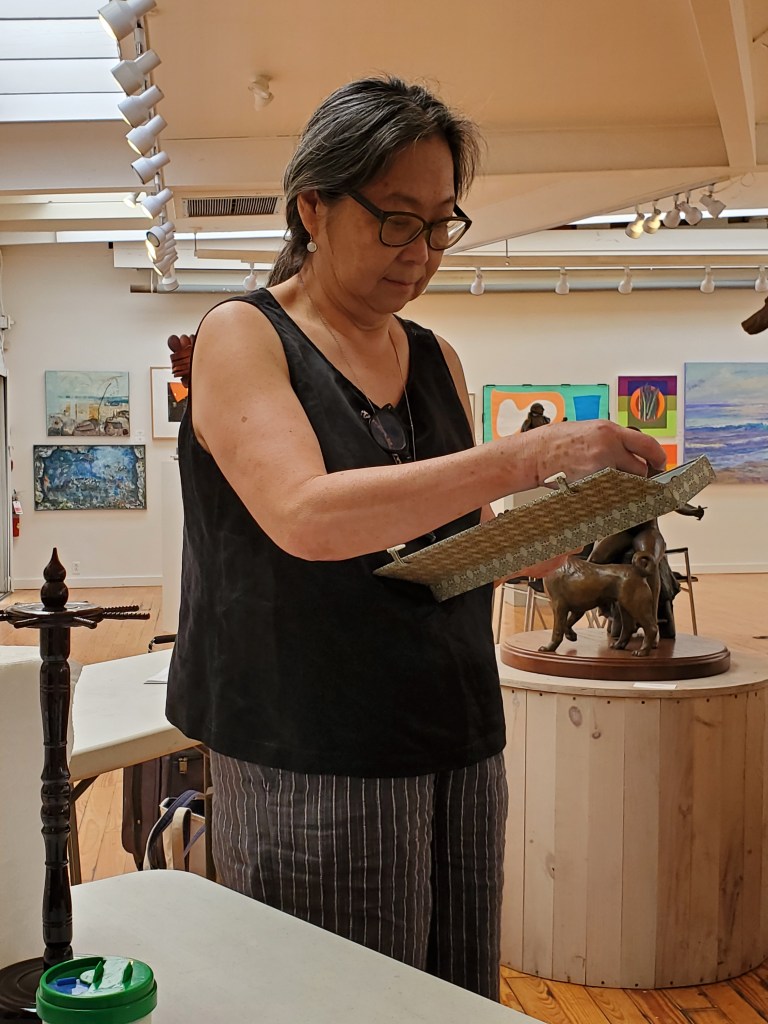
Shiao-Ping inspects Carol’s collection of brushes 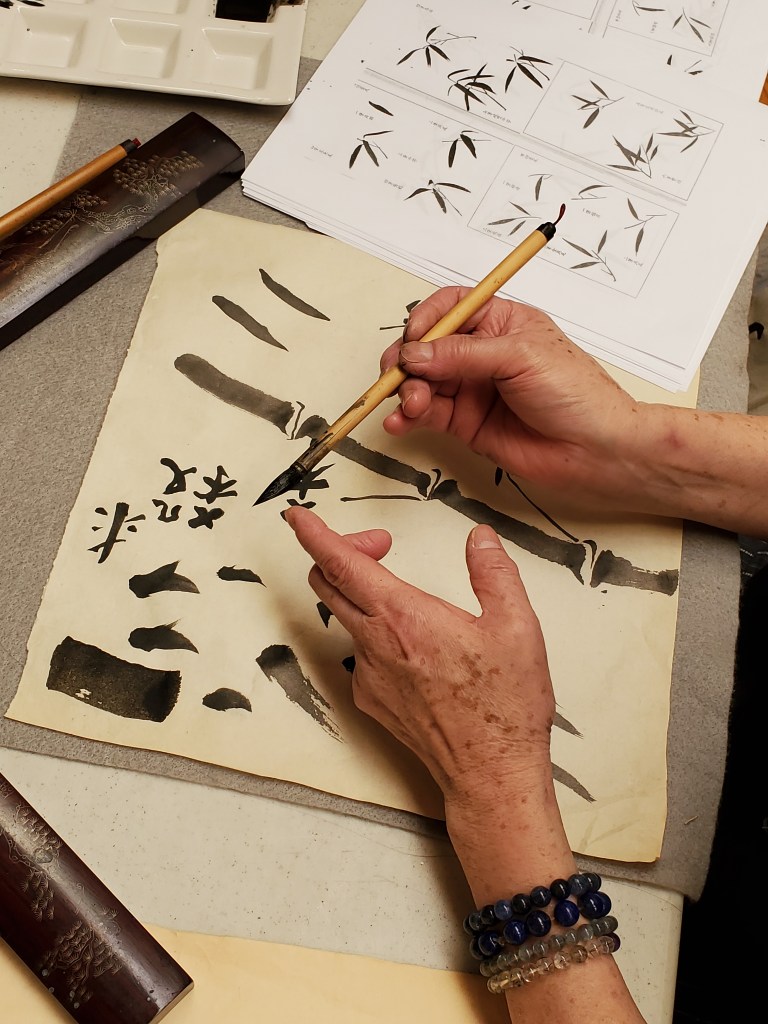
SP’s hands, brush, and how to paint bamboo demo The materials of this art are themselves beautiful, and Shiao-Ping’s easy, self-effacing eloquence in describing not only techniques but the long tradition behind their evolution were as engaging as her demonstrations. Her instruction, I gather, followed a pragmatic and traditional sequence: first grinding the ink and then practicing initial strokes, leading to practicing making the Chinese character or logogram for “tree,” and then copying—or attempting to copy—renderings of first bamboo leaves, then bamboo culms and nodes, then rocks, then landscapes.
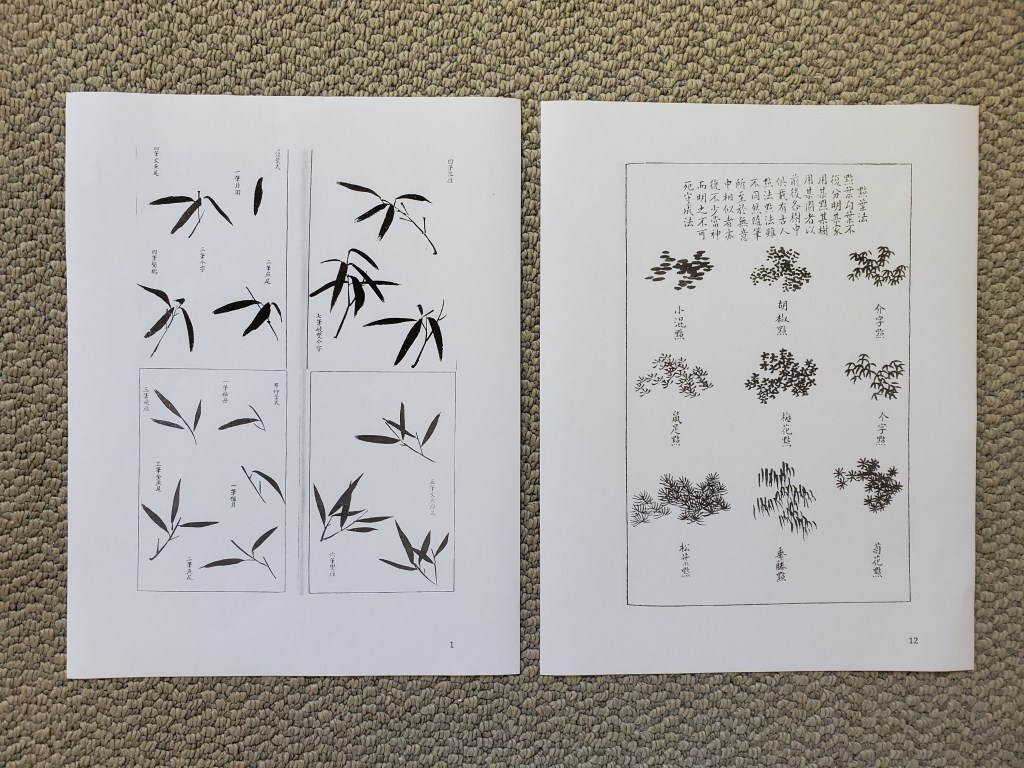
Practice templates All of this was completely absorbing and, because absorbing, refreshing. It’s rare that for so extended a period I’ve focused exclusively on completing a single, simple, repetitive task. The few occasions where a stroke produced the desired effect seemed magical, as if the brush itself, not me guiding it, did the deed. I recalled how when learning to ride, I often found that in the last few minutes of a lesson, by which time I had sweated through my habit, my near-exhaustion finally produced the relaxed command of my mount that allowed us to communicate effectively. Less is more.
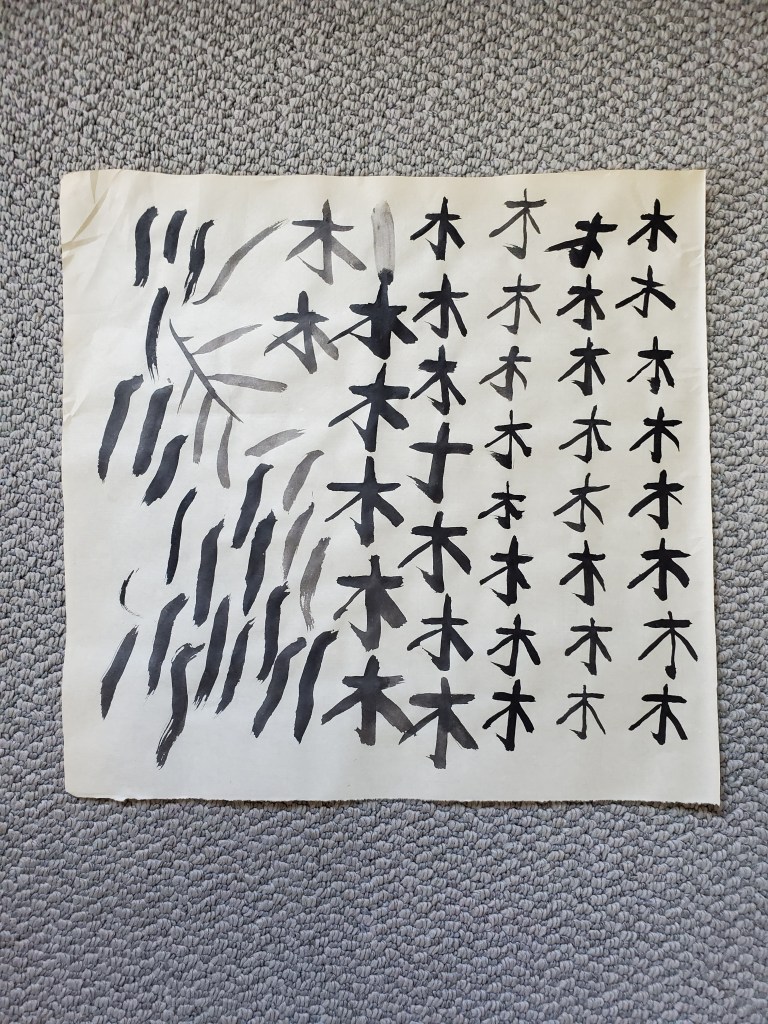
Beginner’s attempts 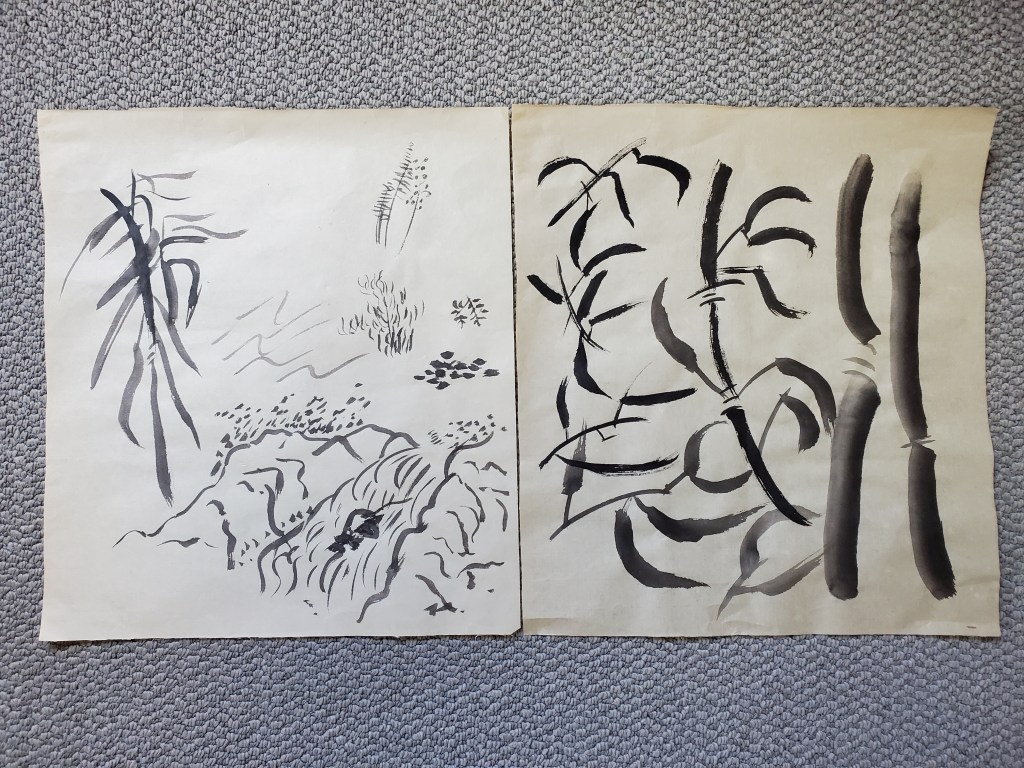
This day of discovering ink painting—tutored by art–was intriguing, reassuring, and restorative, a tonic vacation from the keyboard at which I now sit, typing away. Such hands-on creativity I highly recommend to any novice with access to so gifted a teacher as Shiao-Ping Wang.
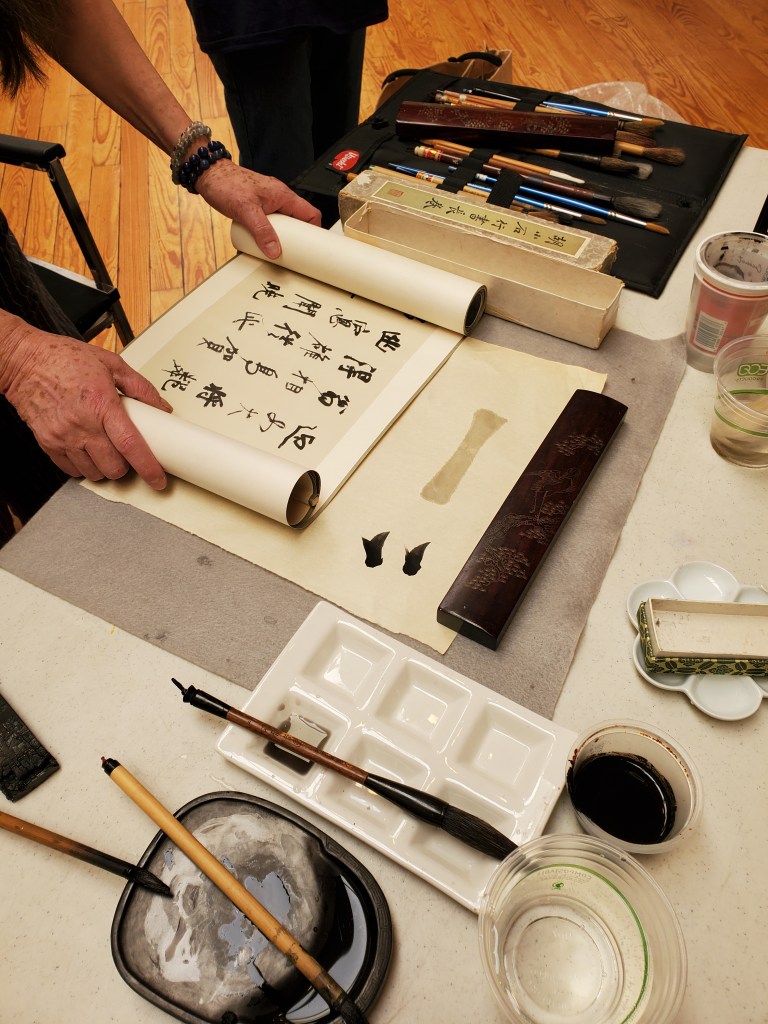
Tradition venerated and preserved -
Summer’s lease hath all too short a date
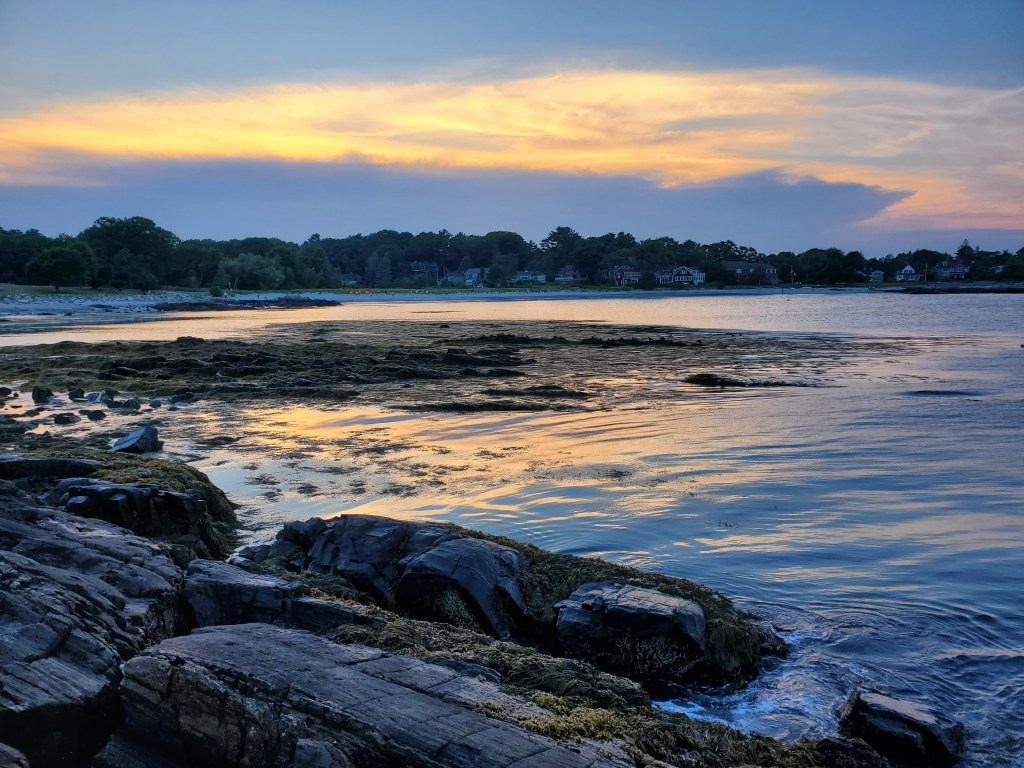
Sunset at New Castle Common While the arrival of pumpkin spice on local menus precociously suggests summer’s end, the autumn equinox is still over a month away. Still, the New Hampshire days grow appreciably shorter, the UNH outdoor pool sends warnings of early closure, and back-to-school anxieties bubble up in my dreams—even as my third fall of retirement signals that care’s end. I reckon a lifetime of worrying about returning to school—kindergarten, six years of elementary, three of middle, three more of high school, four years of college, eight years of graduate school, and eleven years of tenure-track professing, followed by twenty-five more of just-barely-hanging-on adjunct teaching impose patterns two years of retirement cannot erase. Two nights ago I was dreaming/worrying about being back in my lovely Centre College office, explaining to the husband who would be the reason I left that perfect-for-me job that I was concerned about copying my new semester’s syllabi (8-courses-per-year load back then), and woke at 3.40 am in an absolute panic about giving up the nearly impossible-to-get rare tenured associate professor of humanities position I left a quarter century ago. It took quite while to re-situate myself in the present, despite all those troubled waters calmed long ago.
As the summer season winds down, I’m alternately chastising myself for not getting more projects accomplished and making fitful progress on sorting-and-discarding (What to do with old VHS tapes?? How to manage the saudade—that perfect Portuguese word meaning profound longing for what can never be had again—conjured by handling my late husband’s “course packs,” those pre-internet packets of photocopied course materials, along with the handwritten notes and diagrams of flight patterns he made while studying for the instrument rating of which he was so proud. Tucked into one of his pilot’s manuals I found a child’s primer, When I Grow Up, folded to “I want to be a PILOT when I grow up,” with the admonition that pilots need good teeth. And the course pack for the 1982 Humanities 610 course, “New England Culture in Changing Times,” comprises material that would be far beyond most of the undergrads I last taught in 2020. Ay, me.
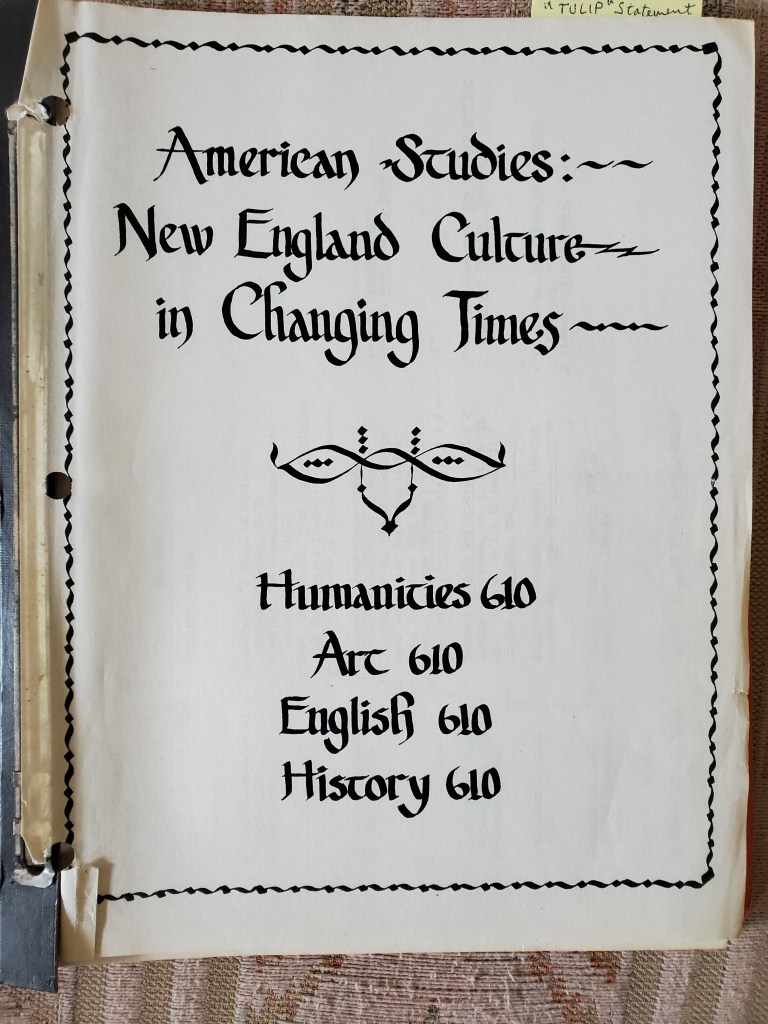
Artifact of another era 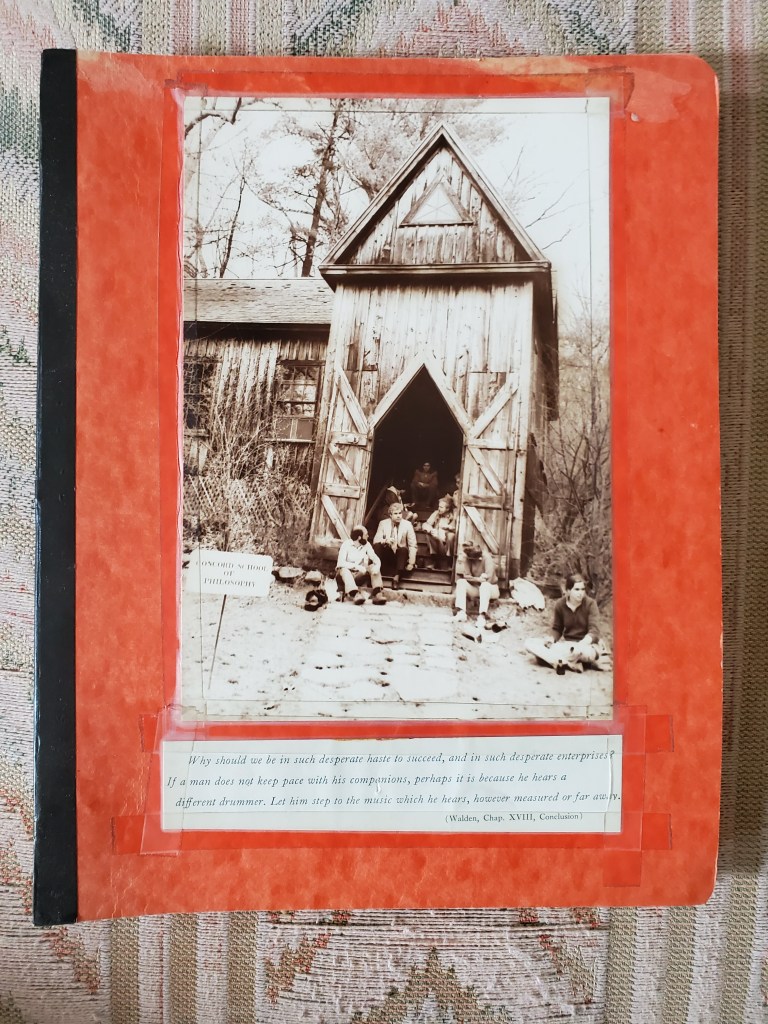
Course pack cover: “The Concord School of Philosophy” with Profs. Watters, Andrew, Clark, and Students 
Want to be a pilot? BRUSH YOUR TEETH! Meanwhile, I hear the charger’s fan cooling the large lithium battery that will power my new electric lawn mower—once I overcome my fear of it blowing up and/or electrocuting me. We do adapt to changing times, right? Evolve or else. At least I need no longer fret over congestion at the xerox machine as I queue to copy syllabi and silently rehearse my opening lectures.
And it has been a fine summer of new and returning pleasures. That swell and meaningful trip to visit family in Wisconsin. Discovering the GBH studio in the Boston Public Library with its cool Newsfeed Café and intrepid Boston Public Radio hosts, Jim Braude and Margery Eagan broadcasting about our end times.
The return of peach season at Union Lake Peach Orchard in Barrington.
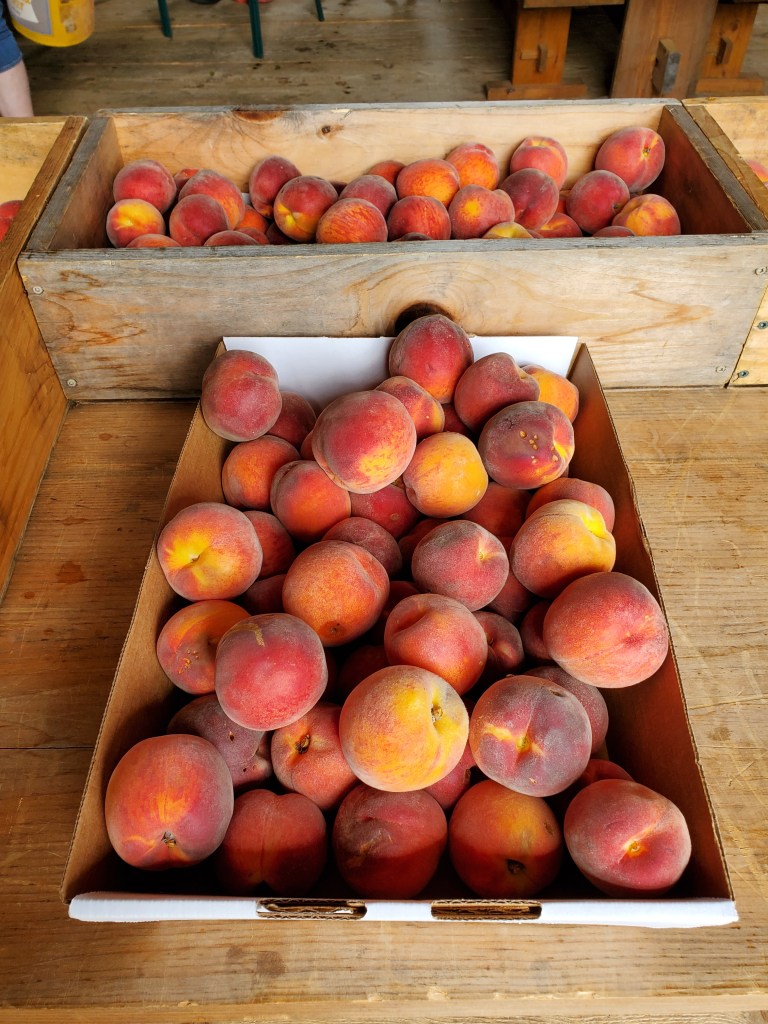
Union Lake Bounty Leisurely meals out with a friend along the Portsmouth waterfront, and an afternoon stroll through Prescott Park.
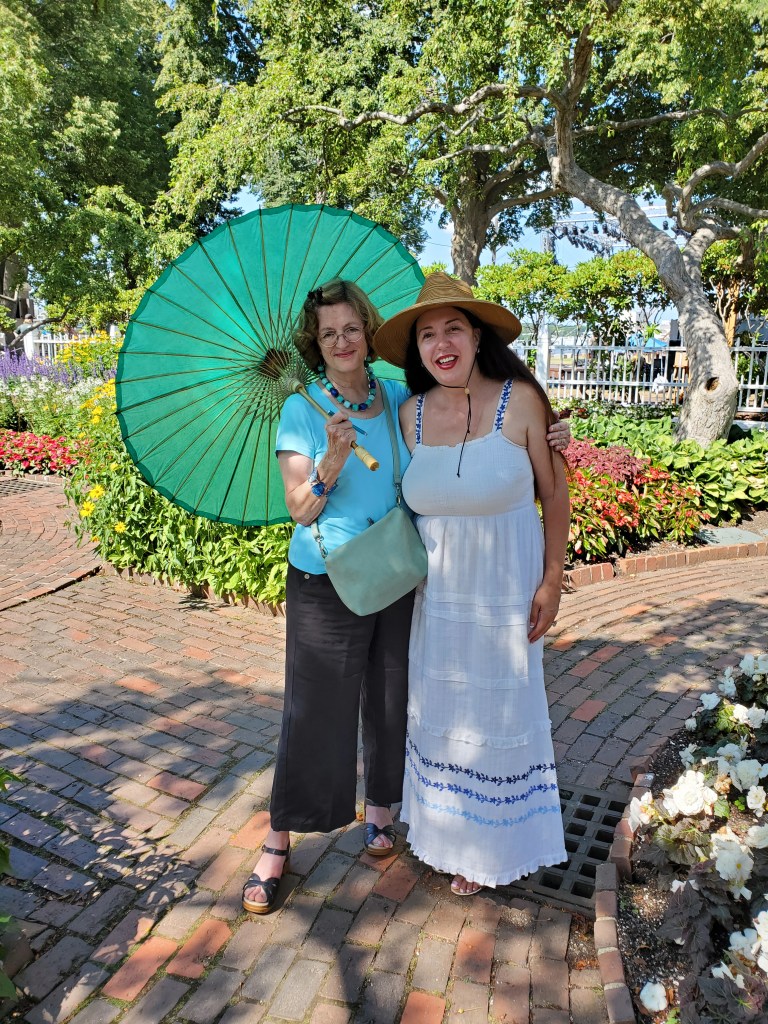
Georgeann and Stephanie’s post-prandial stroll The Portsmouth waterfront and park in full bloom . . .
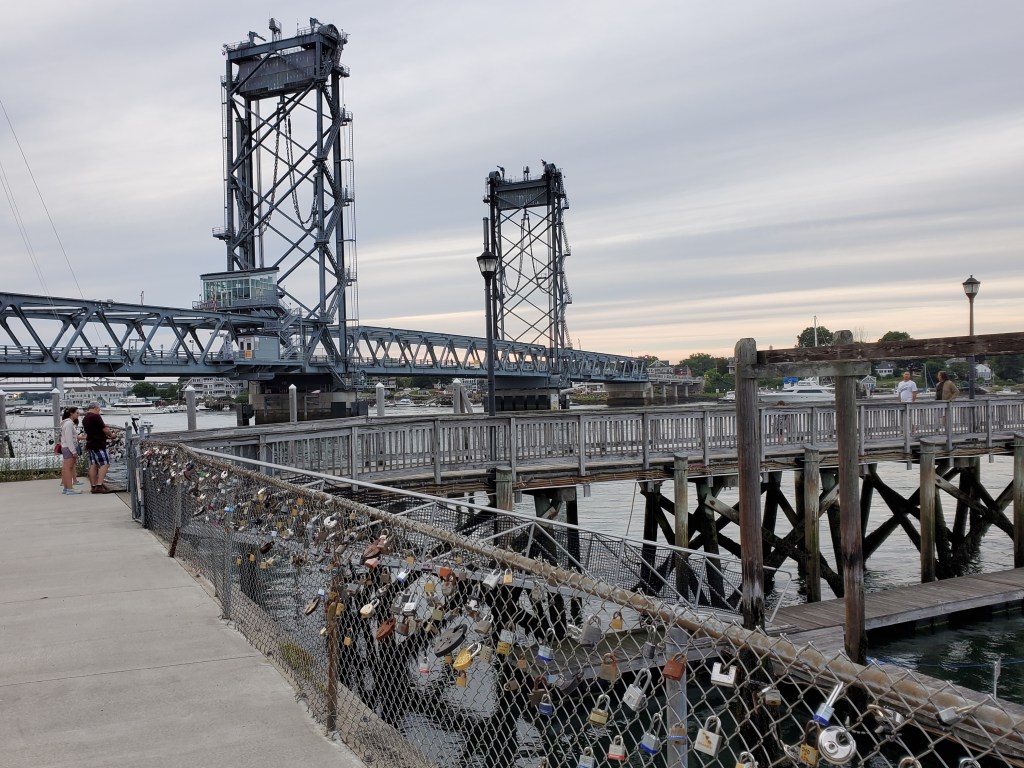
Memorial Bridge, Portsmouth, and love locks 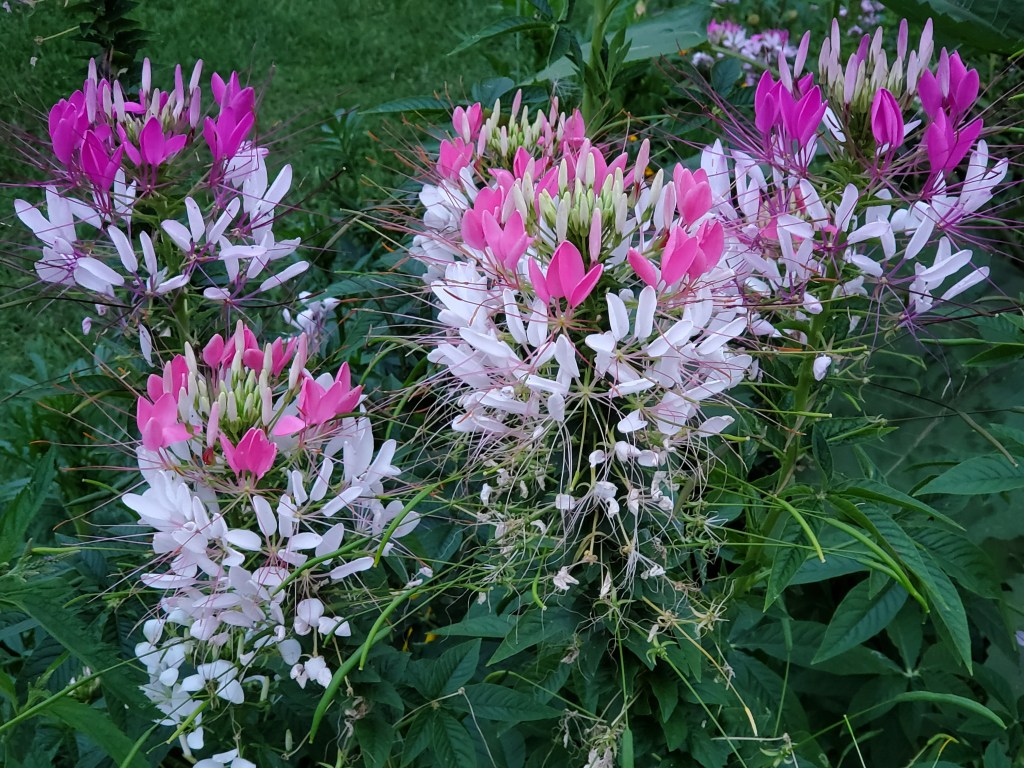
Cleome blooming 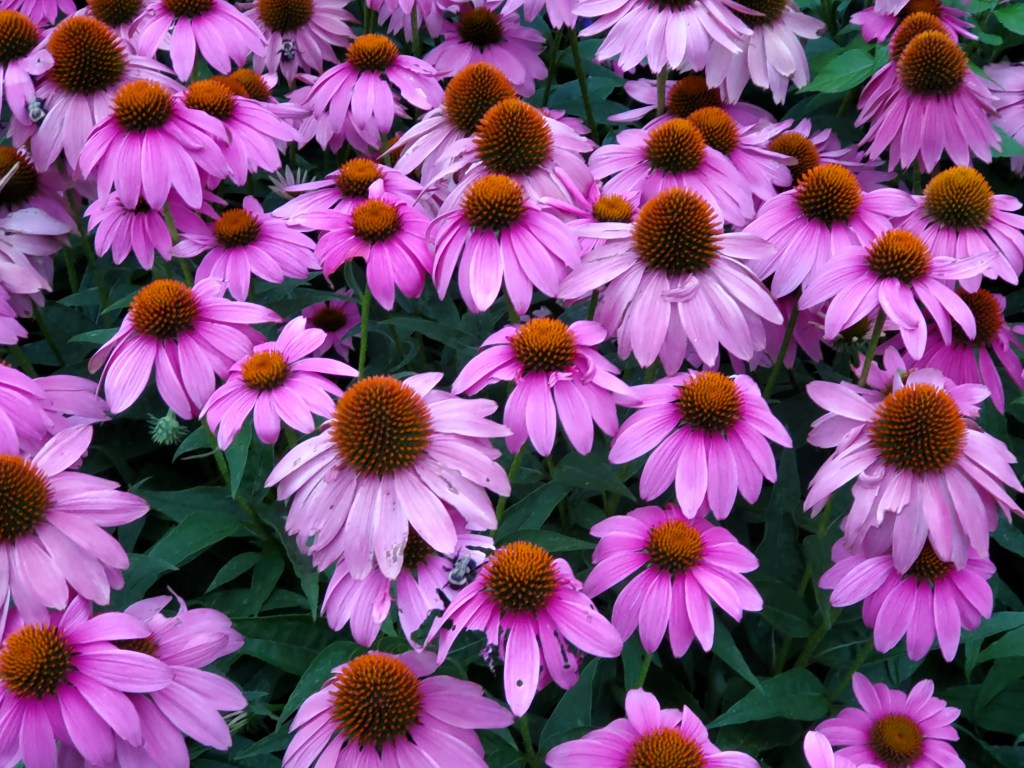
and Echinacea 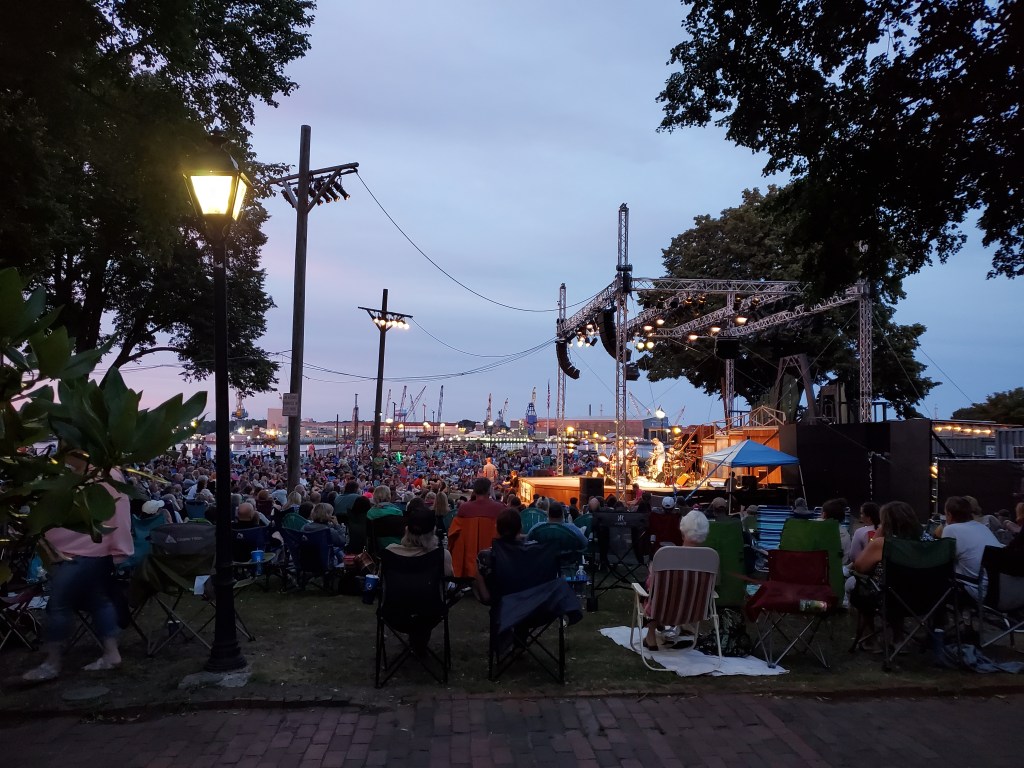
. . . and a Beatles tribute with the Navy Yard aglow across the Piscataqua River, Portsmouth Bringing a lawn chair to Sullivan Square, Berwick, and enjoying the rainstorm that cooled that very hot day, prelude to the performance of my talented aerialist neighbor Anne, in the excellent company of her mom Beth and son Leo.

Anne strikes an attitude 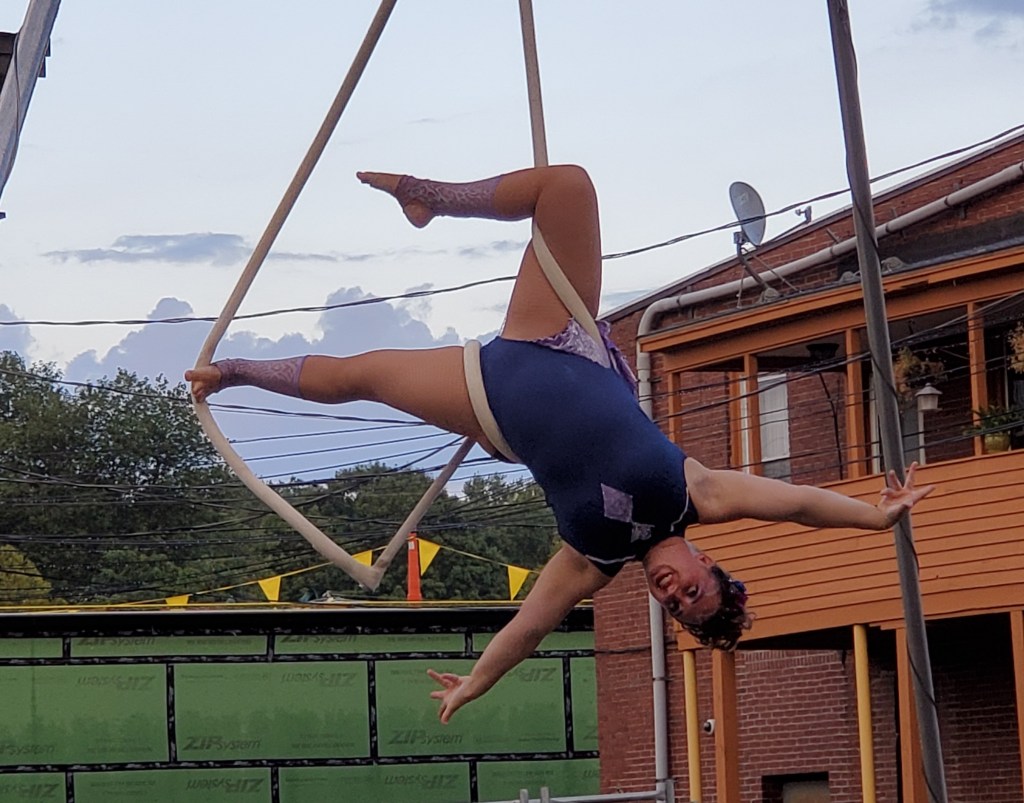
. . . and another, upside down on her trapeze 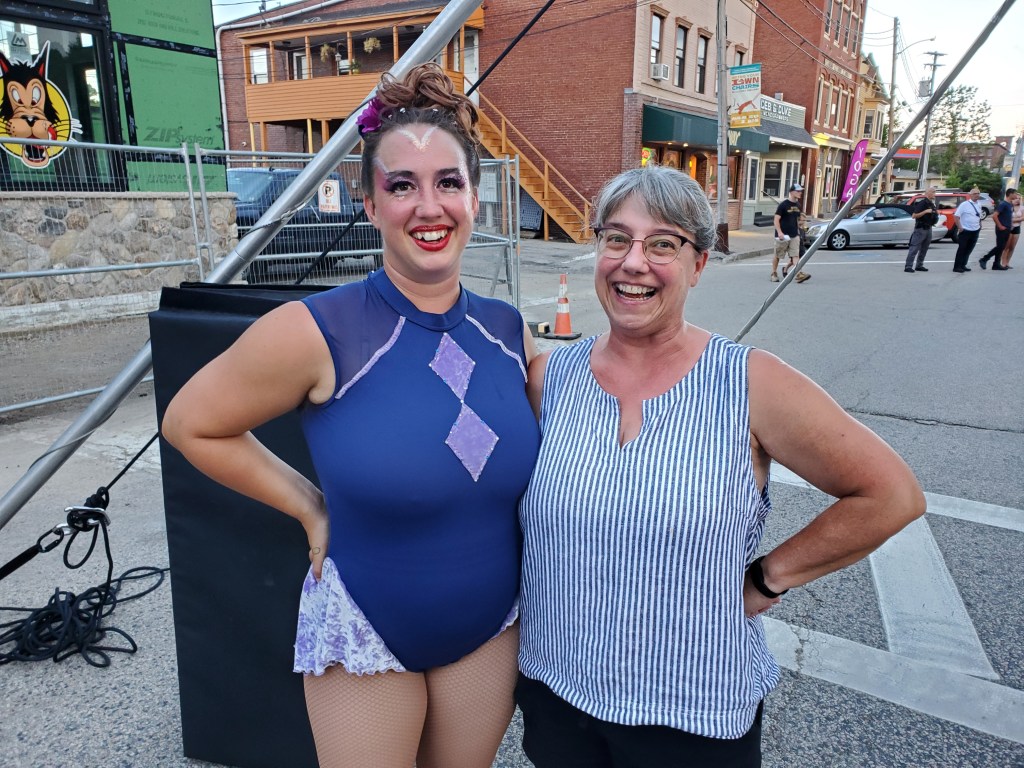
Anne and mom Beth pre-show 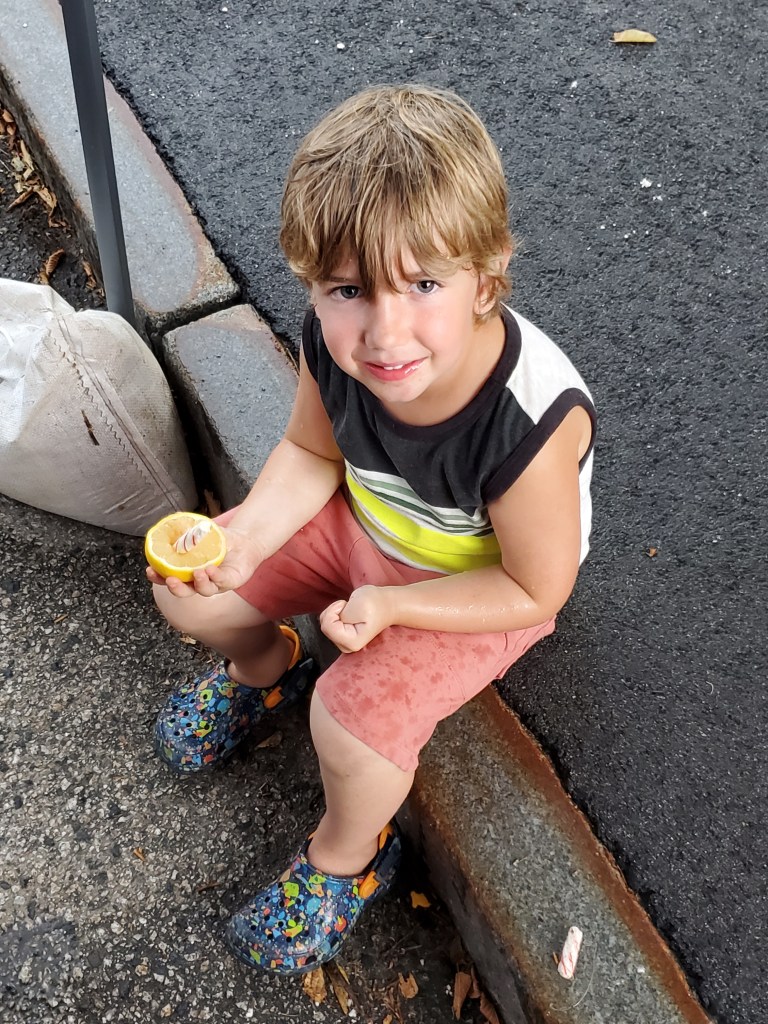
A slightly damp Leo enjoys lemonade via a peppermint stick 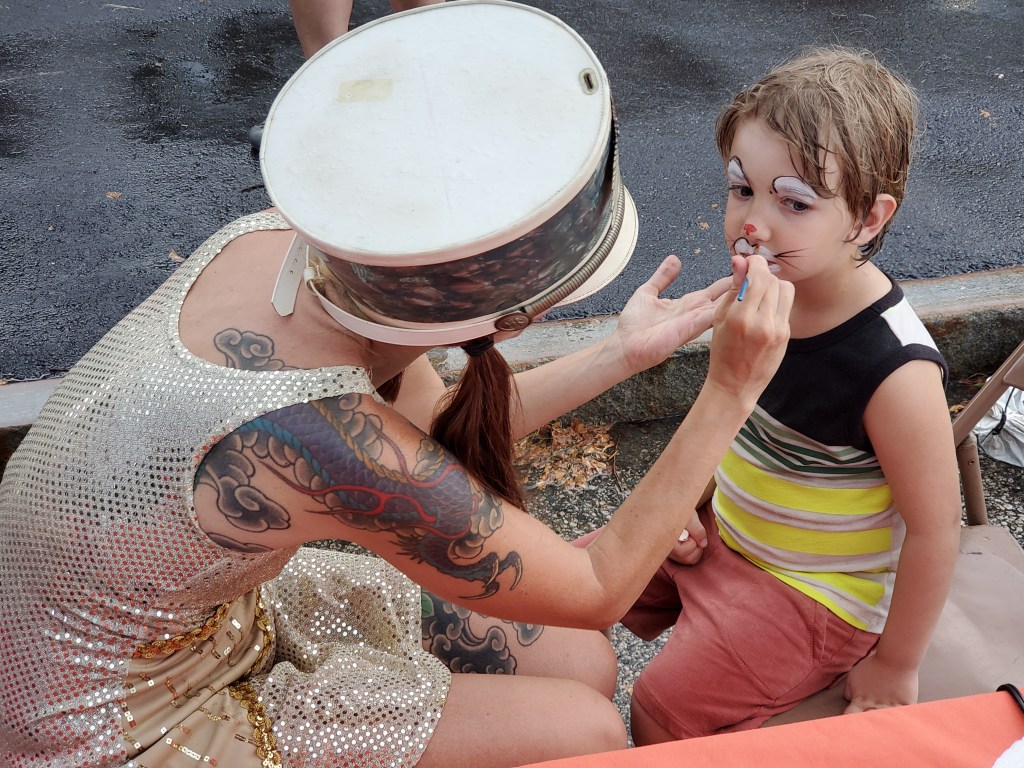
. . . and transforms into a kitty-kat 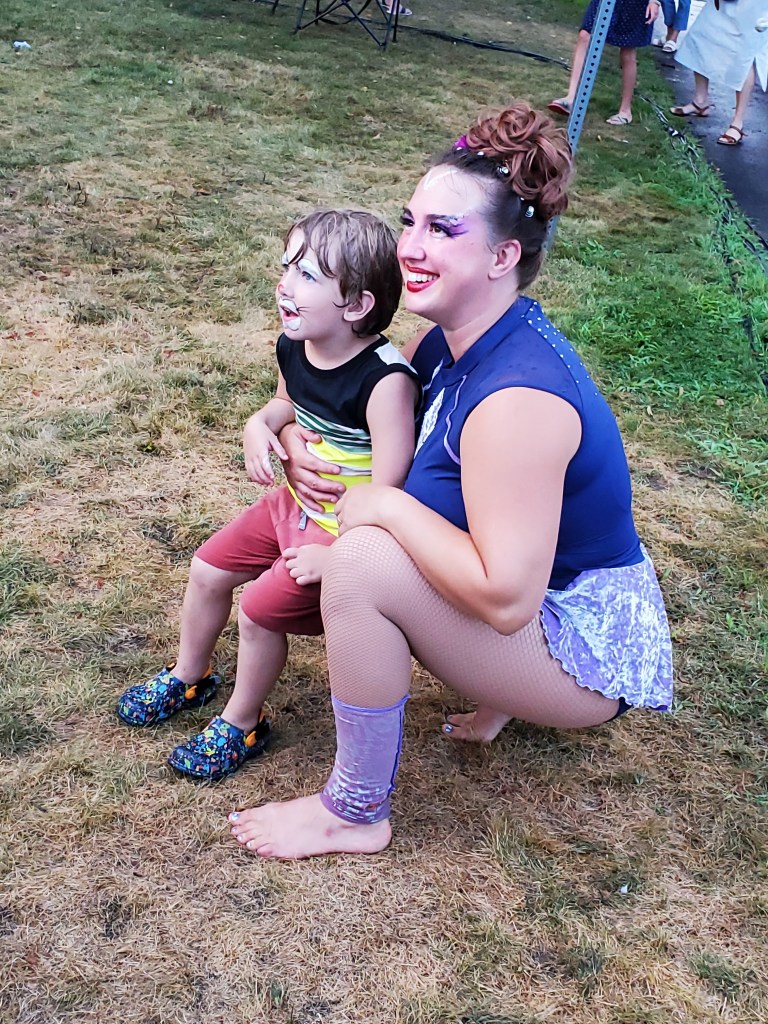
. . . then roars approval of his mom’s performance A first-time-ever swim in the bracingly cold and surprisingly rejuvenating waters of New Castle Common Cove with friend Jennifer, as the local volleyball teams gathered to play on the beach in their fluorescent shirts, composing a novel Bruegel scene.
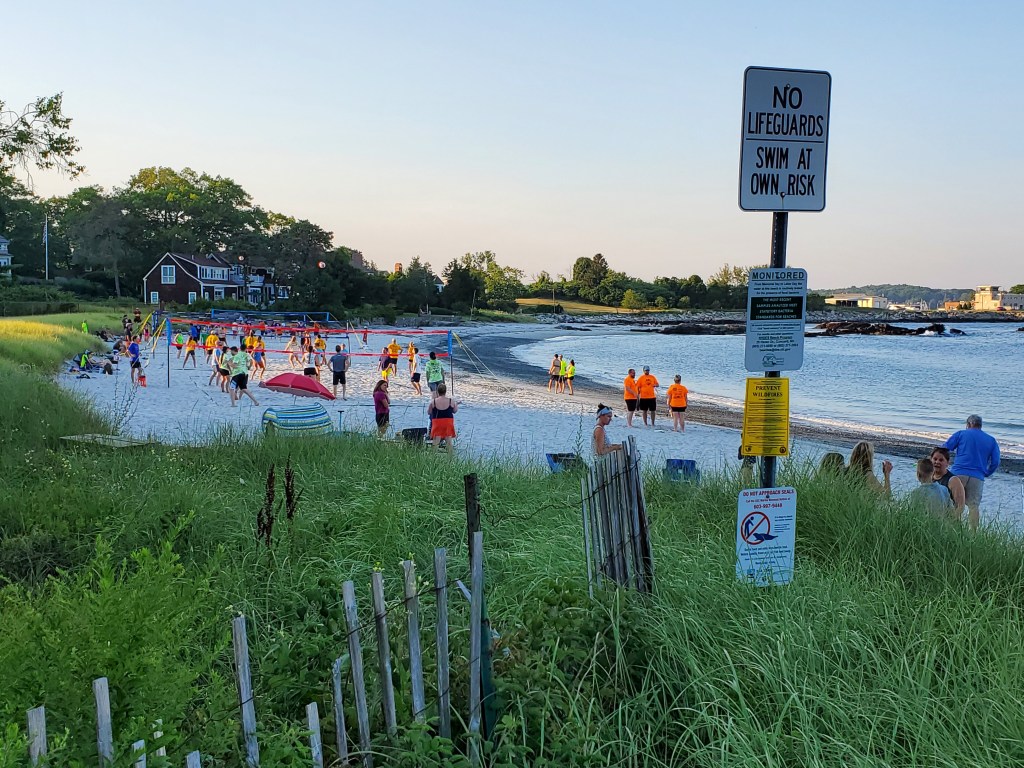
Enjoying sunset from my deck while anticipating the Southern Delta Aquariids meteor shower.
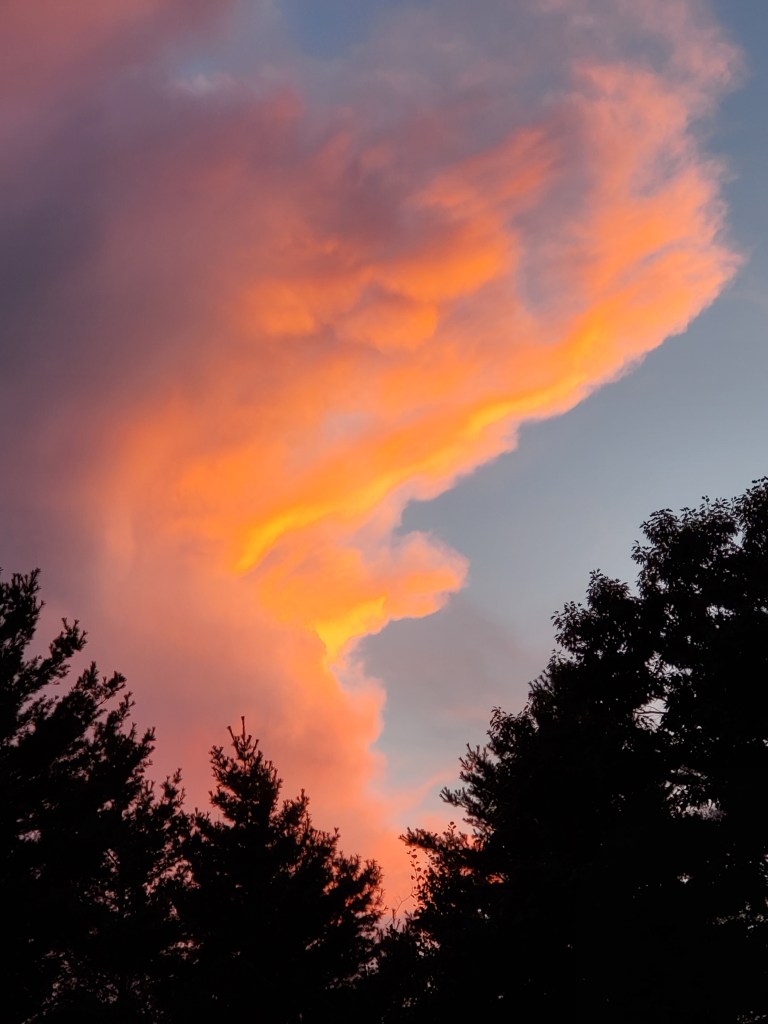
Painterly sunset at Gnawwood More delights to come: three dinner parties in four days—possible again since the worst of COVID seems past. I’ll try my hand at Chinese ink painting next week, and enjoy the silent running of my new lawn mower: with headlights! For now, I’m groovin’ with comedian Tom Papa, whose book title exhorts: You’re Doing Great! . . . and other reasons to stay alive. The macrocosm’s a mess, political divide and social media run amuck. Democracy threatened. Liz Cheney out of office for speaking truth. Human endeavor all vanity.
Yet much of the time, it’s really pretty funny. Carpe diem.
-
Leaving Portage, Going Home
25 July 2022
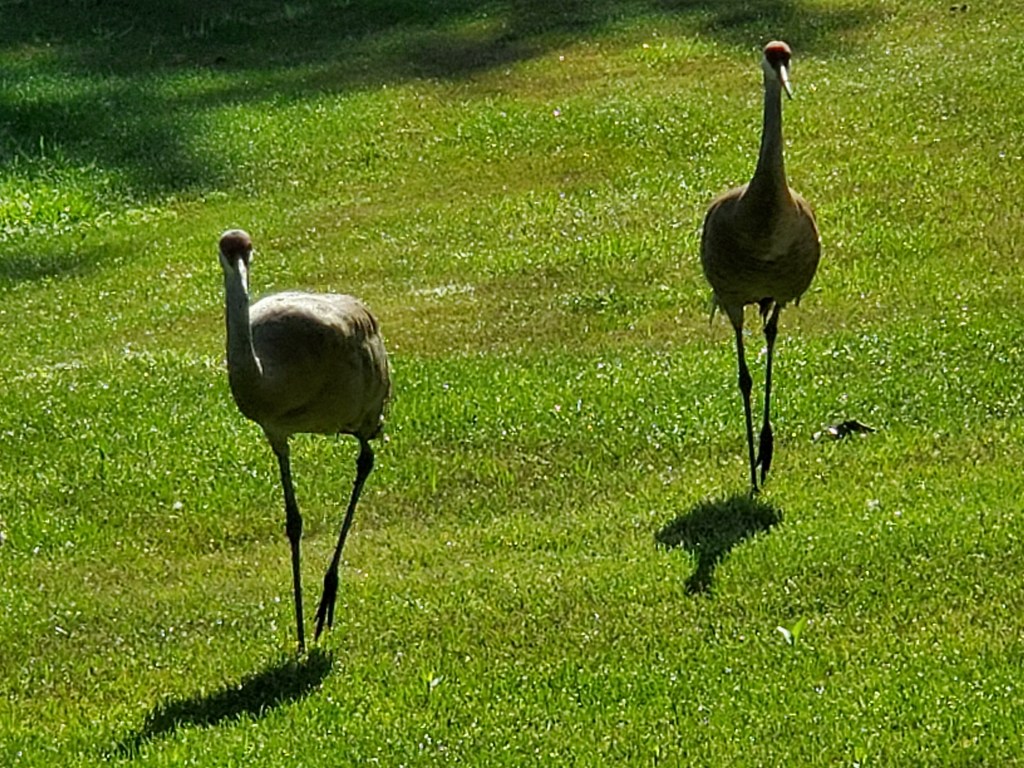
Resident Sandhill Cranes on their way to breakfast in Saddle Ridge On Monday, my last morning in Portage, I for the first time spy the pair of Sandhill Cranes that visit the Andrew home most every morning to enjoy the dried corn left out for them. Seeing them is a timely treat, and racing to the window in my underwear affords the chance to photograph them, if also a brief moment of embarrassment when I realize I am not alone in the room. What follows my partially-clad photo shoot is a welcome breakfast of eggs, bacon, and Chad’s excellent blueberry pancakes, chased with a farewell cup of Pero. I pack up my suitcase and join Rob to take a last walk around the Saddle Ridge neighborhood, golf course, and marina, and on the way catch up on more Andrew family back story. Meanwhile, Jan and Chad mow their lawn.

Saddle Ridge marina populated with pontoon boats One last time we all gather at the dining table to sample and judge some of the root beers and sodas we brought back from the Museum of Root Beer the previous Saturday. The winner: not a root beer, but Caruso’s Dark Cream Italian Style Soda, deliciously rich with vanilla. Leave it to the Italians.

Generous flight of root beers and sodas from the Museum of Root Beer Rob and Pam once more undertake the long drive to return me to the Milwaukee airport, a ride that includes their farewell gift of Whooping Crane earrings, a thoughtful souvenir from the Crane Foundation. My flight is a bit delayed, so I fortify myself for the journey ahead with a pesto chicken flatbread and an IPA for early dinner, and finish the book I’ve brought, Jenny Diski’s Skating to Antarctica, a memoir of travel and dysfunctional family romance. I recognize the phenomenon of travel evoking memory as it did for Diski: strange how new horizons often conjure the familiar, and prove foil to the past, the measure against which we understand the present.
The flight home from Baltimore to Manchester is also delayed, and when I take my place at the Southwest stanchion, Boarding Group A, Position 27, the guy next to me complains he’s been traveling all day, missing connections because of ripple effect delays caused when Dallas Love Field Airport in Texas was locked down earlier that day: a 37-year-old woman had fired several rounds in the ticket counter area before she herself was shot by a police officer “in the lower extremities,” and taken to hospital. Again, an inexplicable shooting. And so it goes.
I finally get home about 2 am, shower, and head straight to my own bed. Only the next morning do I see that my clivia plant, relative of my many amaryllis (all in the family!), has at long last begun to bloom in my absence. That’s a welcome sight. I am home again.
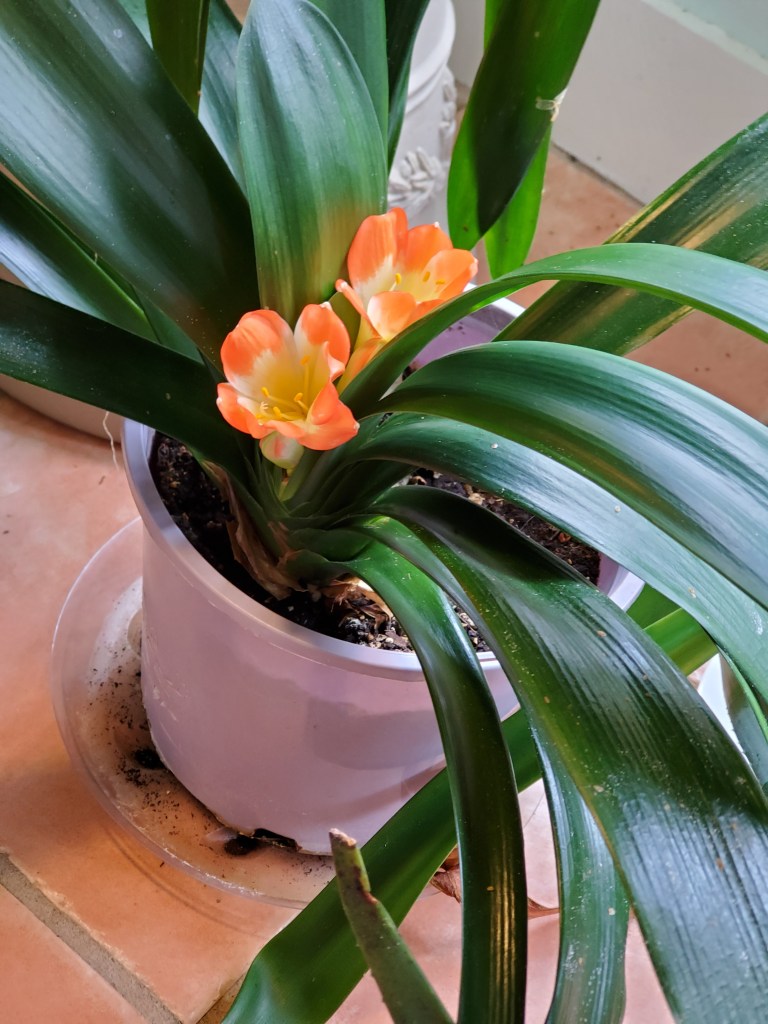
Clivia in bloom at last Today at the Market Basket, the first chrysanthemums are on display. It’s only early August. But fall is on the way. Summer’s lease hath all too short a date.
-
Subscribe
Subscribed
Already have a WordPress.com account? Log in now.
 Georgeann Murphy