-
Home
24 May 2024
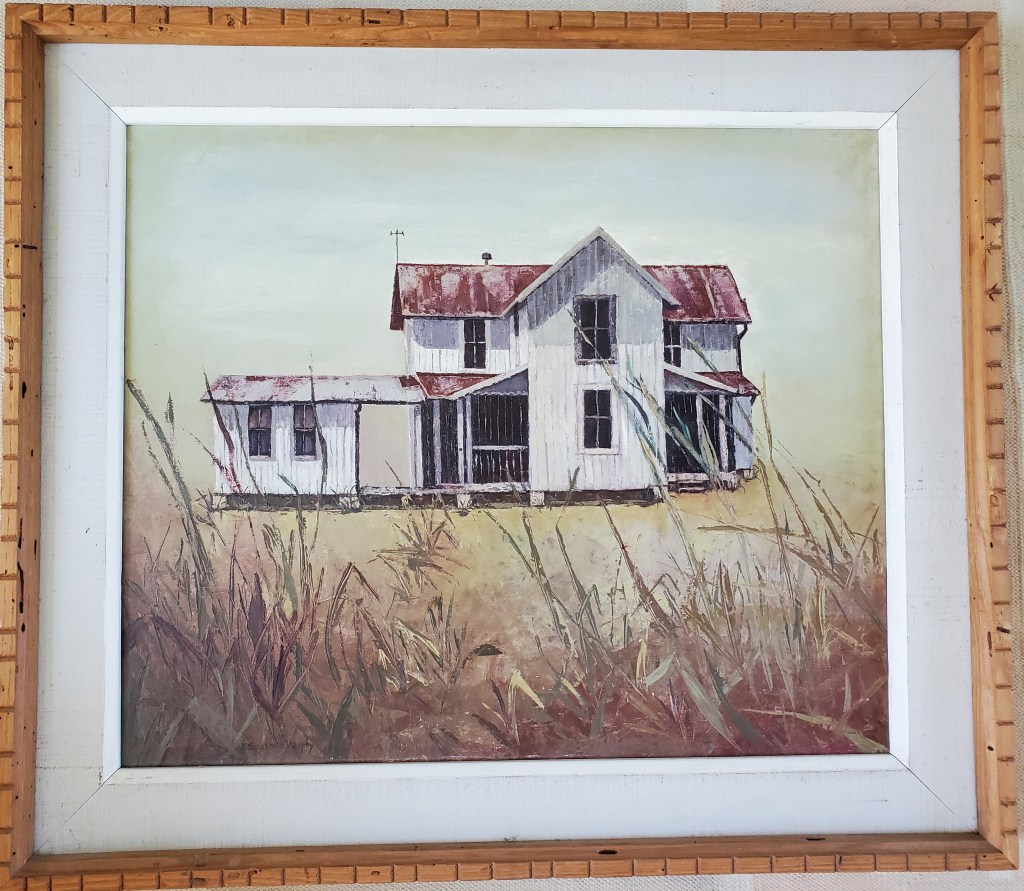
333 Homestead by Virginia Senseman Murphy, oil, 1970 Today, Friday, for the third morning in a row I’ve awakened back in my own bed, and, unlike the previous two mornings, I knew where I was. Last Tuesday I drove the 508 miles to Madbury NH from Buffalo NY in a single long haul, arriving back at Gnawwood just before the thunderstorm that had been chasing me east much of the way.
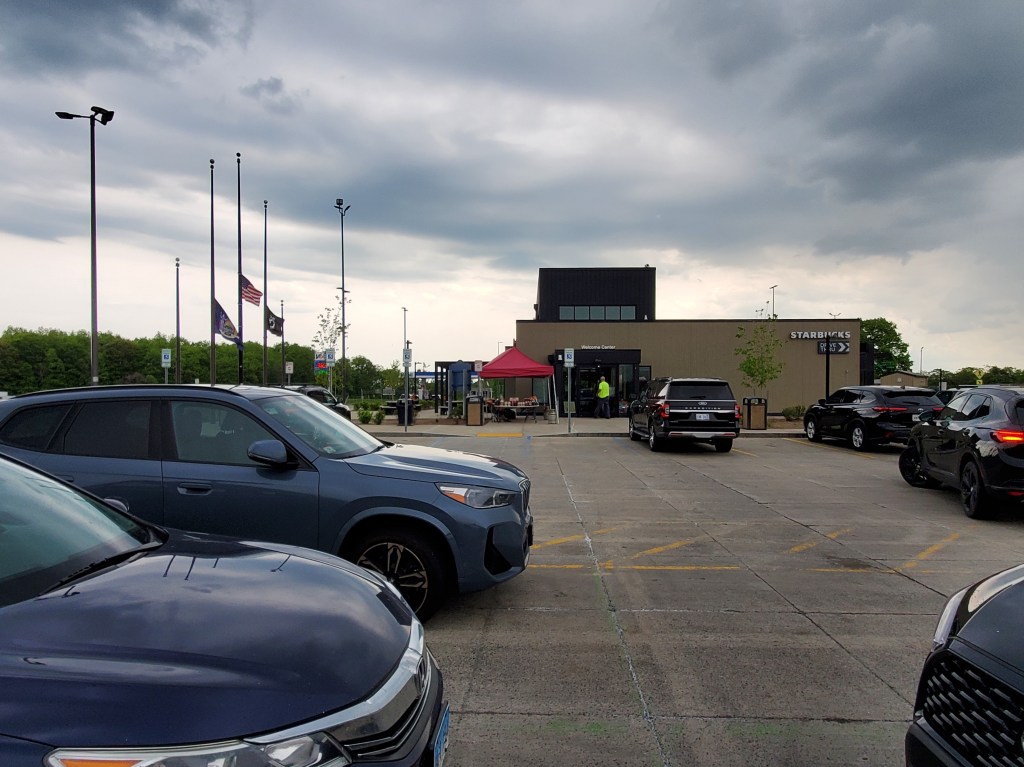
Indian Castle Service Area, New York State Thruway, I-90 Eastbound, mile 210 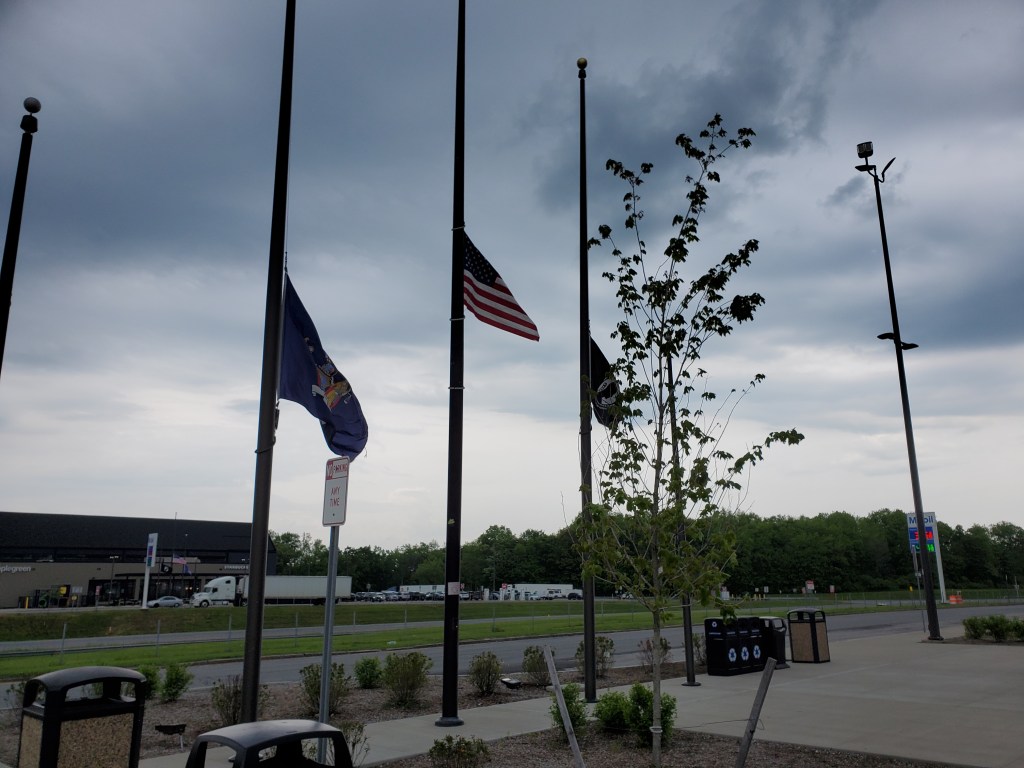
21 May 2024, flags at half-staff by order of Governor Kathy Hochul to Staff Sergeant Benedicto Albizu Jr., a retired member of the New York State Police. On 9 May 2024, Staff Sergeant Albizu died from an illness acquired during his assignment in and around the World Trade Center following the terrorist attack on 11 September 2001. At 5.54 on 21 May, I finally pulled into our driveway, 3440 miles more on the odometer than when I left on 1 May, and found all my daffodils spent, their jaunty trumpets replaced by swollen seed pods. The trees that were still bare when I drove away three weeks ago are now effulgent with their luminous early spring chartreuse. The lilacs and the azaleas—at least the ones beyond the deer’s reach—are in brilliant magenta display. In this order, I (1) unloaded the car, (2) cracked open a “Young Upstart” IPA from Portsmouth’s Liars’ Bench Brewery, (3) walked with it out the east door to survey the Solomon’s Seals, (4) heard and then spied a hummingbird visiting same, (5) immediately came in to fill and hang the hummingbird feeder, and then did the same with the bird feeders that had been secured in the garage away from bears, (6) sat on the deck as a fine mist turned to rain to finish my beer, and (7) made myself an impossible burger. The house was warm and smelled of the newsprint from all the New York Times deliveries that kept coming despite my suspension and repeated complaints, all fortunately collected by my friend Jennifer who generously came round to water the plants.

Gnawwood driveway with azaleas 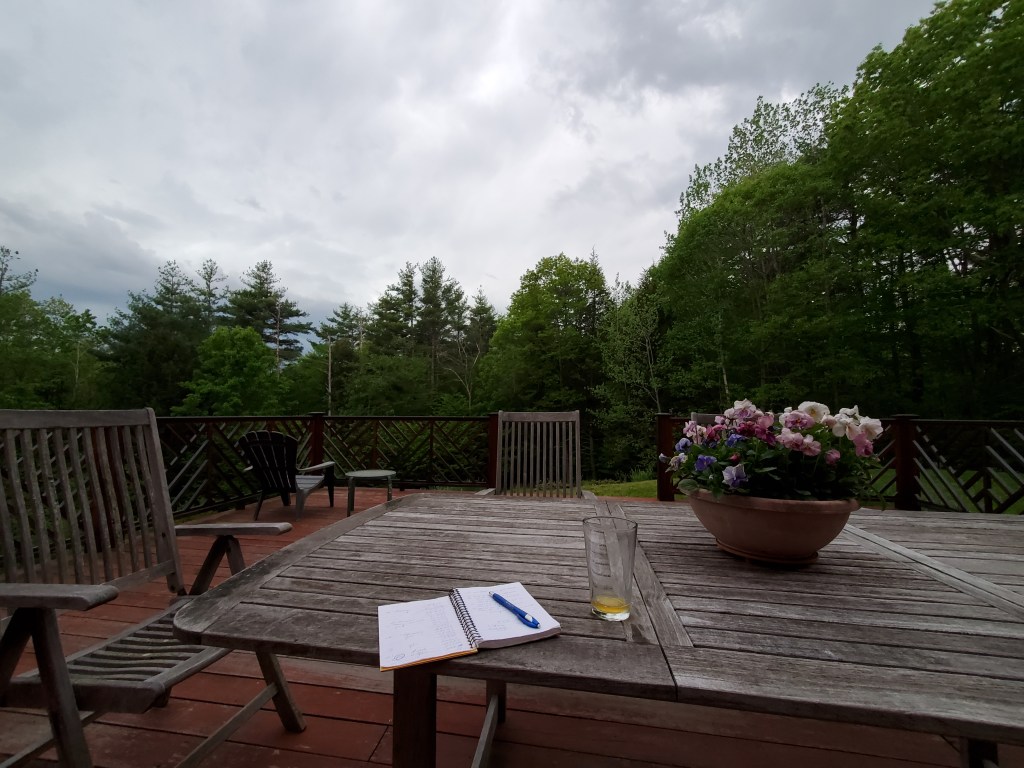
On deck as the thunderstorm approaches from the west,
“Young Upstart” almost goneMadbury was still having frosts when I left, but Tuesday’s stormy welcome brought with it summer heat; the porch thermometer registered 88o yesterday. I eased back into routine on Wednesday, unpacking, getting a haircut, and—hallelujah!—returning to Ruth’s miraculously restorative yoga class, followed by preparing and enjoying my own Wednesday-is-pasta-night dinner: primo, Negroni; secondo, tortellini with peas and prosciutto; contorno, ensalada mista with grapefruit vinaigrette, plus a nice Chianti. Thursday I ordered tickets for Boston’s upcoming Celebrity Series; did laundry; paid bills; had my weekly conversation with Greensboro friend Cameron; prepped for the Madbury Book Club discussion of Percival Everett’s The Trees and enjoyed our two-hour review of that novel, however solemn its initial seductively comic account of a racial reckoning proved; repeated Wednesday night’s dinner offerings; and finished the evening with two episodes of This is Us on Netflix and and the late-night monologists Kimmel, Colbert, and Myers via YouTube.
And then this morning, I awoke grieving. Nearly caught up on sleep and mostly de-stressed after the all-consuming demands of my long road trip, I am thinking less about the complete success of my travels, during which even the setbacks had abundant compensation, and more of all that’s been lost. My friends Barry and Ann are back in Ireland for Barry’s mother’s burial yesterday, and Season 6 Episode 5 of This is Us in which Jack mourns his mother left me crying for Barry’s and my own mom’s loss, and then, in the way of grief, all the other losses. Flinging my sister Jane’s ashes to ride the prevailing winds blowing from Laurel Park’s Jump Off Rock over the Blue Ridge Mountains on Monday, 13 May fulfilled Jane’s wishes and brought us, her family, some peace. But now it’s Memorial Day weekend, twenty-two years since we bid our wonderful dad George adieu on Memorial Day, scattering his ashes at the Bay Pines National Cemetery near St. Petersburg. And five years ago this weekend I brought my darling David home from the hospital, where on 27 May 2019 we sang into the phone Happy Birthday to our Miami friend Carol. Only a few days later sometime during the night of 31 May as I slept on an air mattress at his feet, David passed peacefully away, almost 18 years to the day that we moved into Gnawwood, the home we built together. Memorial Day: it’s a lot.
Last week my loving, grieving brother-in-law Richard drove up from Jane’s and his home in Safety Harbor to meet me in the North Carolina mountains, and kindly brought me the carefully bubble-wrapped oil painting my mother Virginia painted in 1970, 333 Homestead; I think she once exhibited it in a St. Petersburg Art Guild show. This old house was built by Capt. John T. Lowe, who in the 1850’s sailed his schooner along the west coast of Florida from Cedar Key to Key West and Havana, delivering mail. He settled at Anona, a small community on Boca Ciega Bay between Indian Rocks and Belleair. There in 1849 he had a skilled craftsman build him a house “strong as a ship”: big square nails held pitch-filled planks together. The house was purchased in 1950 by Maurice P. Condrick of St. Pete, a man enthralled by history and genealogy. He took the house apart board by board and brought it to St. Petersburg, where he reconstructed it at 800 37th Street, North. When he died in May 1970, his sons agreed to give the house and its furnishings to the St. Pete Historical Society. For a time it seemed that the sturdy old building would be destroyed. But the City Council overruled the City House Moving Board. And so the “old timer” was moved down U.S. 19 to its new home next to the Hass Museum at 3511 Second Ave., S. Oma Cross, curator of the museum at the time, saw to the complete restoration and refurnishing of the house, which was opened to the public six months later.
My mother Virginia recorded all this history on the back of the painting in Magic Marker, along with this note: “Mick [my dad George, so called to distinguish him from his dad George], Jane, and I spent a good part of Saturday (before moving day) looking over old Homestead. A workman was loading old bricks to carry to new site. He said he was to do much of the restoring, too. Wish I would have gotten his name. He seemed to feel pride in his work and in being given task of being a part of old Homestead restoration. Noticed mailbox overgrown with weeds, but number 333 was written on side. VSM”
When I flew with David down to St. Petersburg to meet my parents in 1993—they had all met in London in December 1990, but before David and I were out as a couple—they drove us to see 333 Homestead, simultaneously honoring David’s expertise as an architectural historian and celebrating their daughter’s happiness. Mother, aka the Fox, always said that her painting of 333 should go to me at her death, but as the tremendous work of clearing out the family house at 7101 Date Palm Ave., S. and later Mother’s apartment in Clearwater fell to my sister, the painting remained with Jane until Richard brought it to me when we met last week in North Carolina to honor Jane there in Laurel Park. And now 333 Homestead has made its progress north through Danville KY, Gahanna OH, Buffalo NY, and, at long last, to my own homestead, Gnawwood.
And so, finally, it IS good to be home for Memorial Day. Virginia always exhorted Jane and me to “make some good memories.” We did, we have, and I will continue to do so. There’s no place like home.
More to come, Dear Readers, about my remarkable journey.
-
Message from the Universe, 13 April 2024
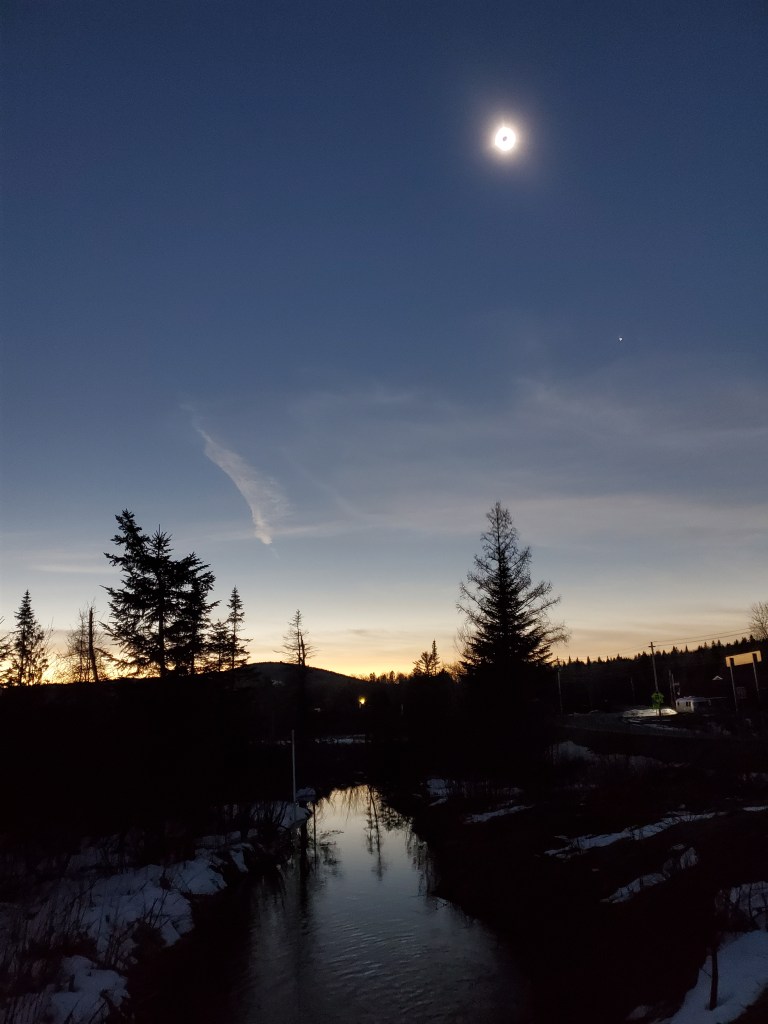
Totality, 14:16:37, Averill VT, 8 April 2024 So much has happened, Dear Readers, since I last posted on the day my sister died, nearly two months ago now. I’ve yet to record the extraordinary confluence of my sister’s final days with my time in Miami Beach over Superbowl weekend, attending (as Jane insisted I do) three days of my friends’ acquaintance’s extravagant celebration of his birthday. Since then my calendar has been filled with the usual busy-ness of a retiree: medical appointments, meetings of the Friends and Trustees of the Madbury Public Library, a couple of plays at Portland Stage, a memorial for a colleague, a Boston performance by the Takács quartet, several lovely dinner parties, updating advance directives, yoga, book club meetings, and a visit from dear friends come north from Kentucky to spend some time with their new grandson and with me.
Earlier this Saturday I spent a rare sunny afternoon clearing winter detritus from some of my flower beds, cheered by the smell of the damp earth and the host of doughty daffodils that have so valiantly braved our two recent snow storms. Time flies, and already the two extraordinary events of earlier in the week recede in the rearview mirror. But both are worth reviewing.

Spring in Madbury NH, 4 April 2024 
Daffs on the way to bouncing back Last Sunday my friend Vicky and I drove north to Averill, Vermont right at the Canadian border to be in the path of the 8 April total eclipse, the first I’ve seen and likely the last I will observe.
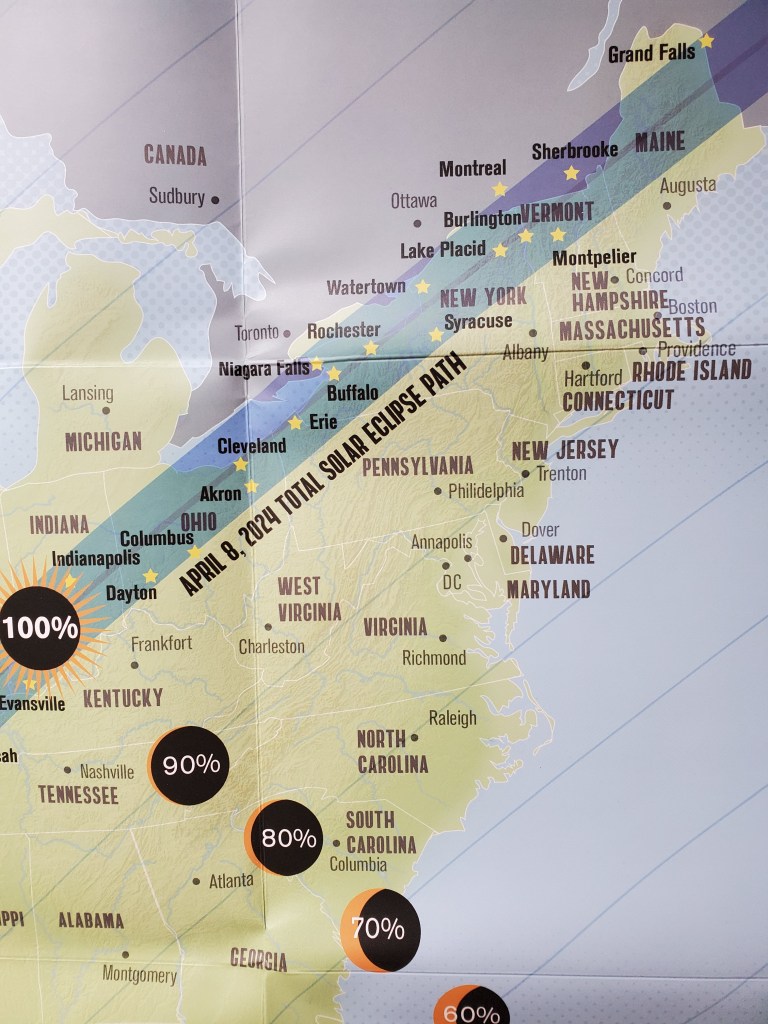
The day was spectacularly clear, and the ride through the White Mountains sublime. We’d rented a modest vacation home for our visit, basically a double-wide trailer, which suited us fine except for the muddy sloped driveway that threatened to get us stuck. It didn’t. I had made dinner reservations at Chez Pidgeon, which online gave the impression of a charming country Quebecois road house. There, alas, we had possibly the worst meal of my life; what I had assumed would be a much-sought-after restaurant where we’d be lucky to get a table turned out to be a place clearly fallen on hard times. I suspect the one waitress was also preparing the meals, which took two and a half hours to arrive, with the seafood sauce still frozen and the filet too tough to cut.
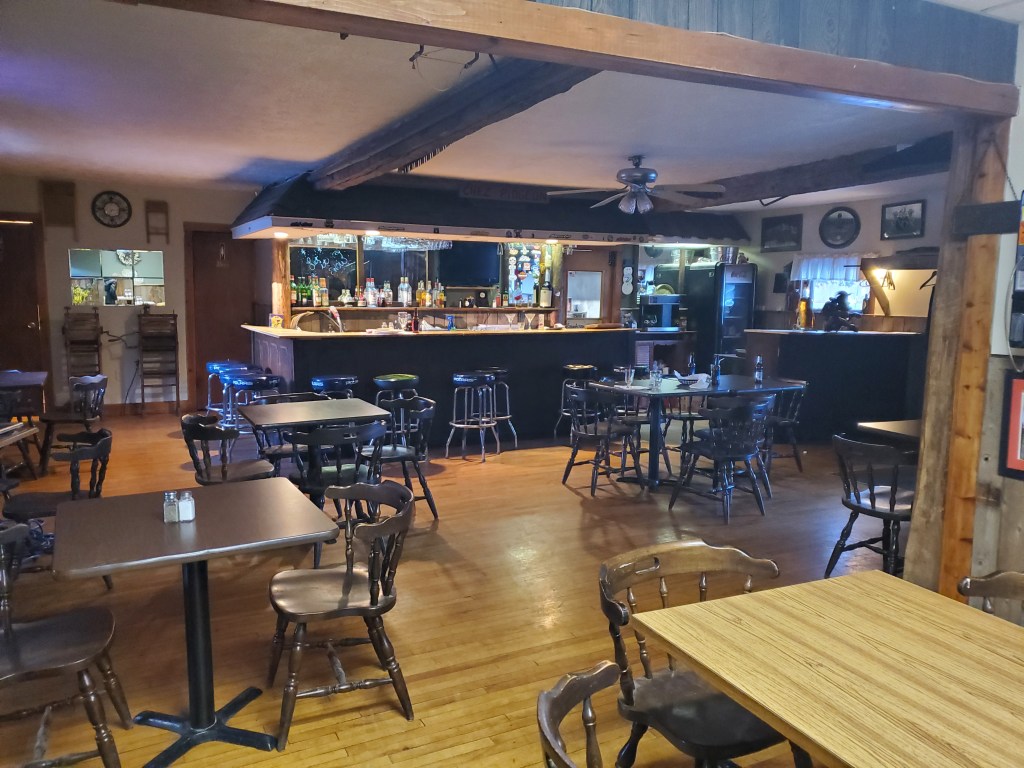
Chez Pidgeon–devoid of patrons for a reason Didn’t matter. The big event next day made up for it. We took a brief walk to Averill Lake on a spectacularly clear, sunny day, perfect for eclipse viewing, passing some other punters set up for enjoying the day and happy for me to photograph them. The holiday mood was general and abundant; I gathered from the flags this group flew we might not agree on much save for our common gratitude that the day was fine.
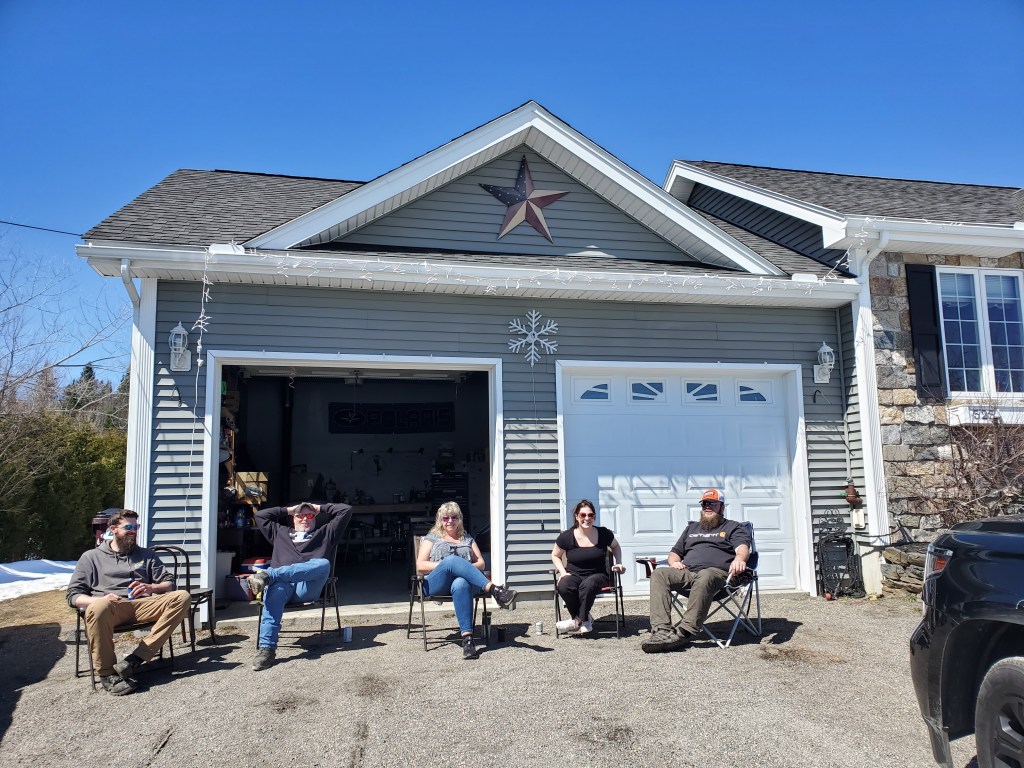
Happy eclipse viewers await the big show, 
. . . and their yellow flag warns not to tread on them. We also greeted two other women of a certain age who let me know that the resort-like building we stood before had been owned by Hortense Quimby, who had managed it and the family resort at the opposite end of the lake as long as she could until 1965, when eight families, including these two women, had pooled their resources to purchase the handsome structure and maintain it as a place for their families to gather each summer for the few weeks when they hired a chef and spent time there together. Each family also bought one of the cottages nearby, formerly part of the Northeast Kingdom Quimby Country Resort that Hortense had managed for 50 years.
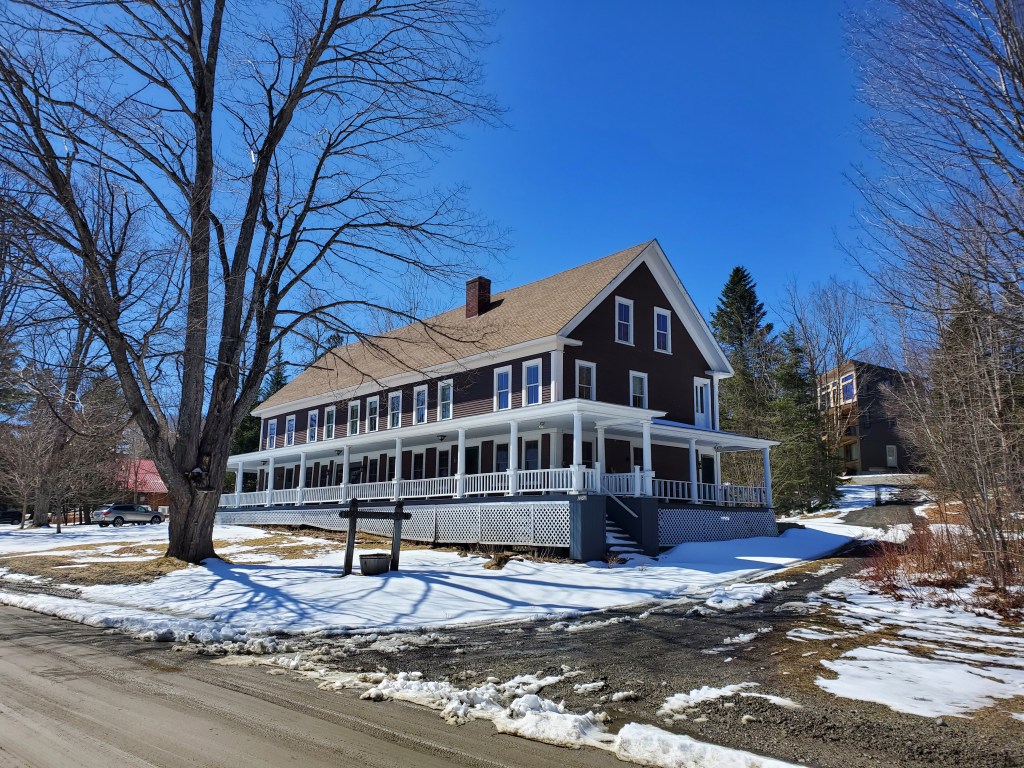
The Quimby Resort I commented to Vicky that here was proof of the good that cooperative enterprise could produce—cooperation so seldom evident in our divided nation. Some Googling has since filled in more of the Quimby history: in 1893, Charles Quimby, a local hardware store owner, took on half-ownership of a fishing camp on Averill Lake in lieu of payment for the material used to build it. Cold Spring Camps, as it was then known, catered almost exclusively to fishermen, attracting anglers from around New England. The earliest guests slept in platform tents; cottages and a series of boardwalks connecting them were added later. This history reminds me of the fishing camp in Bonita Springs, Florida that my grandparents Cecil and Clara Senseman managed at about the same time.
Quimby bought out his partner in 1904. On his passing in 1919, his 29-year-old daughter, Hortense, inherited the property. For nearly half a century, Hortense was the face of “Quimby Country” as she pioneered a new kind of vacation spot for a growing class of Americans who wanted to make more of their leisure time. Hortense grew Quimby from a tiny fishing operation into one of the first family-style resorts in the Northeast well suited to weary city folks who wanted a Vermont getaway.
Hortense’s success and the loyalty she inspired in generations of families resulted in longtime guests—among them the two women we met—purchasing the property when in 1965 Hortense’s failing health prevented her continuing to manage the resort.
On this fine Monday afternoon, buoyed by the sunshine, our pleasant encounters, and the imminent celestial show, Vicky and I packed up the car for a speedy post-eclipse exit, and then planted our lawn chairs across the street from our Vrbo accommodation, enjoying the sound of the plashing water as it flowed from the culvert above which we sat into the adjoining wetland.
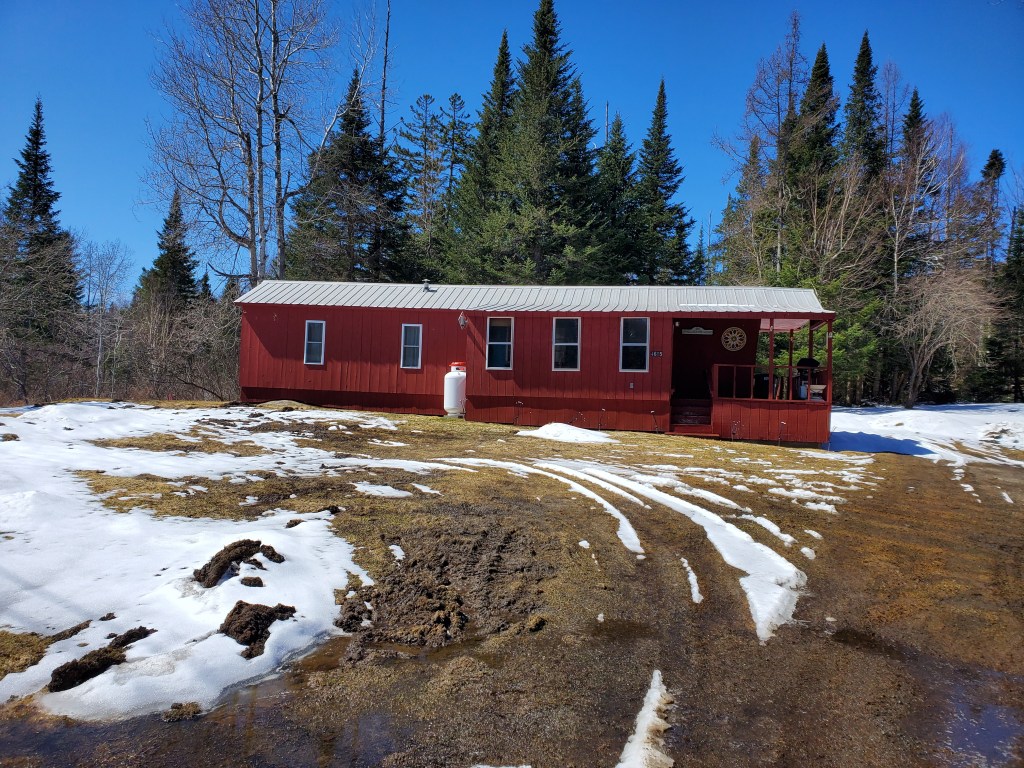
Our Vrbo rental at 4615 VT-114 And then the show commenced. Prepped with our ISO-approved eclipse viewers, we watched as the big event at last began at 2.16 pm. The sky did grow darker as totality approached, though not as dark as I thought it might become. But the ring of fire ‘round the sun was most impressive for all 3 minutes and 18.9 seconds of the moon-sun alignment. Some cheers went up from the folks sitting by the lake, the temperature dropped, and for so brief a time, everyone in the path of totality was absorbed by and marveling at the same natural phenomenon.

Eclipse viewing vista at Averill Lake VT 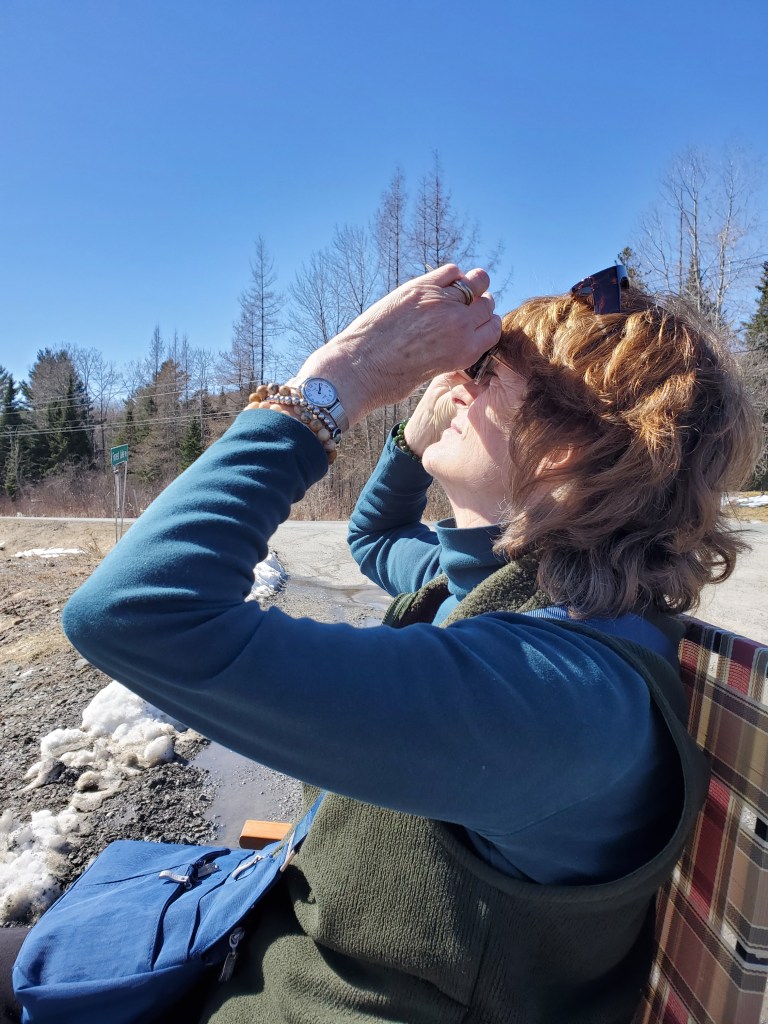
Georgeann’s first totality approaching



Shots taken with a Samsung S10 Galaxy + cheap sun filter We packed up and left Averill just as the eclipse ended, joining shortly after departure the throng migrating south. The caterpillar of red tail lights was initially amusing as we crept along, but much less so once the interstate was too overburdened to accept more cars and Google maps directed us—and everyone else—onto the hilly washboard dirt roads of Vermont’s back country. We’d left at 4.30, but nightfall found us barely moving and still far from the New Hampshire border in the dark, in the woods, on a narrow, ditch-lined road barely wide enough for one car, bumper to bumper. When we finally returned to I-93, we sat ironically still for 20 minutes in the acceleration lane entrance, listening to Terry Gross interview Irish actor Andrew Scott about why he took so many long pauses when acting Hamlet’s most famous soliloquy (answer: Hamlet’s thinking these thoughts for the first time).
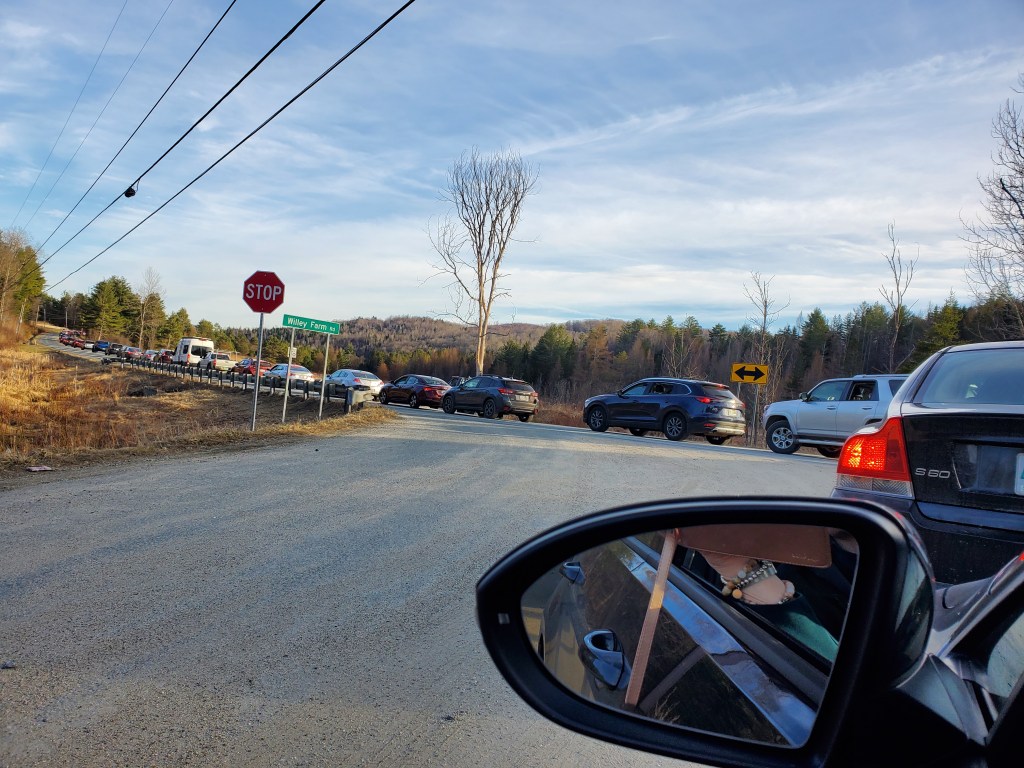
Vermont tailback Twice we tried to stop for food and a bathroom break. The first restaurant offered only a 40-minute wait; the next, a McDonald’s, provided a ladies’ room with a 25-minute waiting line and food available only via app or drive-through. We made do with the provisions we’d brought—crackers, hummus, oatmeal cookies, peanuts—and finally arrived home in Madbury after midnight early Tuesday morning 8.5 hours later. The trip north on Sunday had taken only 3.25 hours.
Still, we DID get safely home, and purposefully so, because the next night we had front-row seats for Yo-Yo Ma and his accompanist Kathy Stott’s playing Symphony Hall in Boston. More driving, yes, but also, once again, a message from the universe, delivered not only by the consummate artistry of the performers in a sold-out house of 2,625 patrons focused intently on every note, but also by Stott’s programming choice of Estonian composer Arvo Pärt’s Spiegel im Spiegel (1978) which opened the second half of the concert. Joking that they were still out of breath after the Shostakovich D minor Cello Sonata, Op. 40 that closed the first half, Stott announced they would “slow things down” a bit.

Symphony Hall, with image of the Kavakos-Ax-Ma performance of Beethoven’s Sixth Symphony that we heard in March 2022 What followed Stott’s brief introduction was Pärt’s rendering of what Yo-Yo Ma called “a portrait of the universe”: a single note beautifully played moving step-wise, usually toward or away from the home note, accompanied only by notes of the triad closest (either above or below) the melodic part. As they played, a screen above Ma and Stott showed a series of phantasmagoric deep space images: galaxies, cloud nebulae, protostars.

Star cluster, courtesy of James Webb At the end of the piece, Ma identified the photographs as taken by the Webb Space Telescope, evidence of “what thousands of people working together can accomplish when they cooperate.” When they cooperate. Yes.
Copy that.
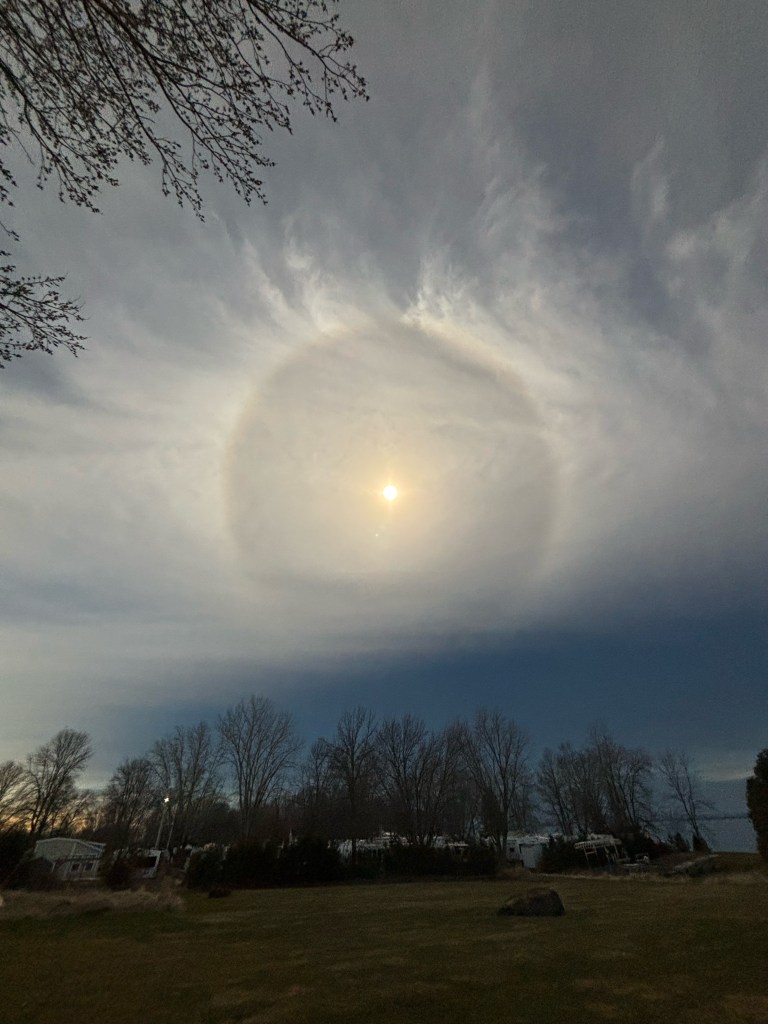
Sun dog eclipse, St. Albans VT on the shores of Lake Champlain,
photo by Anne Marple -
Jane
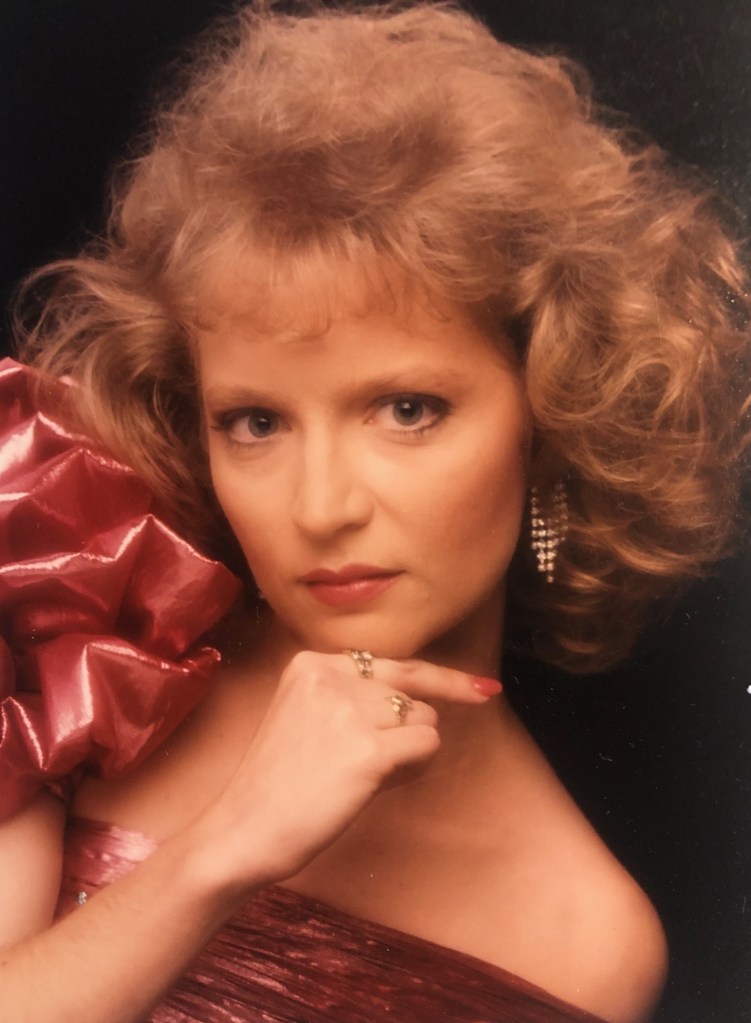
Jane Ellen Murphy Lupi
20 January 1958 – 17 February 2024My baby sister died early this morning, the only person I have ever known for an entire life span, from beginning to end. Her diagnosis of stage 4 cancer last year on 1 April 2023, her and her husband Richard’s 28th anniversary, seemed a cruel April Fool’s joke, but her prognosis then proved accurate: she did not survive a full year longer.
But not for lack of trying. Through all the surgery, chemo, radiation, hospitalizations, and finally hospice, she stayed ferociously strong, even managing with Richard’s and son Daniel’s help to go straight from the hospital to a Judy Collins concert on 18 January, celebrate her 66th birthday on 20 January, and attend Richard’s retirement party on 25 January, only three weeks before her passing.

Judy Collins at the Capitol Theatre, Clearwater FL, 18 January 2024
(photo by Jane Lupi)Generous to a fault, even as she returned to the hospital on 2 February, just two weeks from her last night in this dimension, she insisted that rather than cancel my trip to visit friends in Miami, I should carry on with long-made plans. She even made sure, with Richard’s help, that I had some glamorous new clothes to wear to parties over my long South Beach weekend, in colors she selected to complement a Miami Beach palette. She often said I needed to wear more color.
And now she’s gone. And I can hardly believe it. And I wish I had gone to her side while I still had the chance. Our last exchange was a text, a week ago today. I asked her to save me a place, and she answered “Yes I !”
When I left home for college and the beginning of my adult life in the fall of 1970, Jane was 12, and perhaps for that reason, she exists simultaneously in my memory as both the preternaturally adorable Baby Jane, who hated going to the grocery store with my mother because “the old ladies there bump my head!” and the striking young woman, wife, and mother she became: passionate, perceptive, fiercely loyal, a talented artist with an astounding memory for detail and always a fashionable flair.
Grief moves unpredictably through the mind and body, and though every new loss recalls others past, each is unique. I always thought—hoped—this big sister would be the first to leave. I am not bereaved. I am bereft. Deprived. Lacking. I am now the sole keeper of our family romance.
Our mother Virginia taught us that the dead are never gone so long as we remember them. So now, that’s the job.
Rest in peace, my dearest sister Jane.
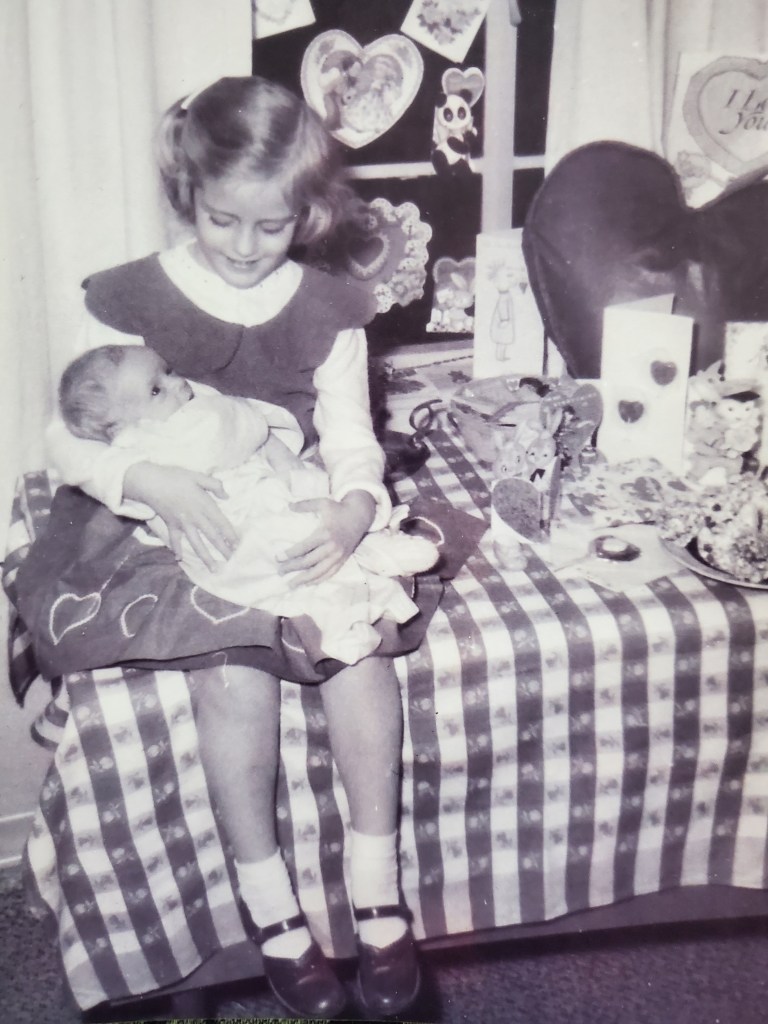
14 February 1958; Jane 3 weeks, Georgeann 5 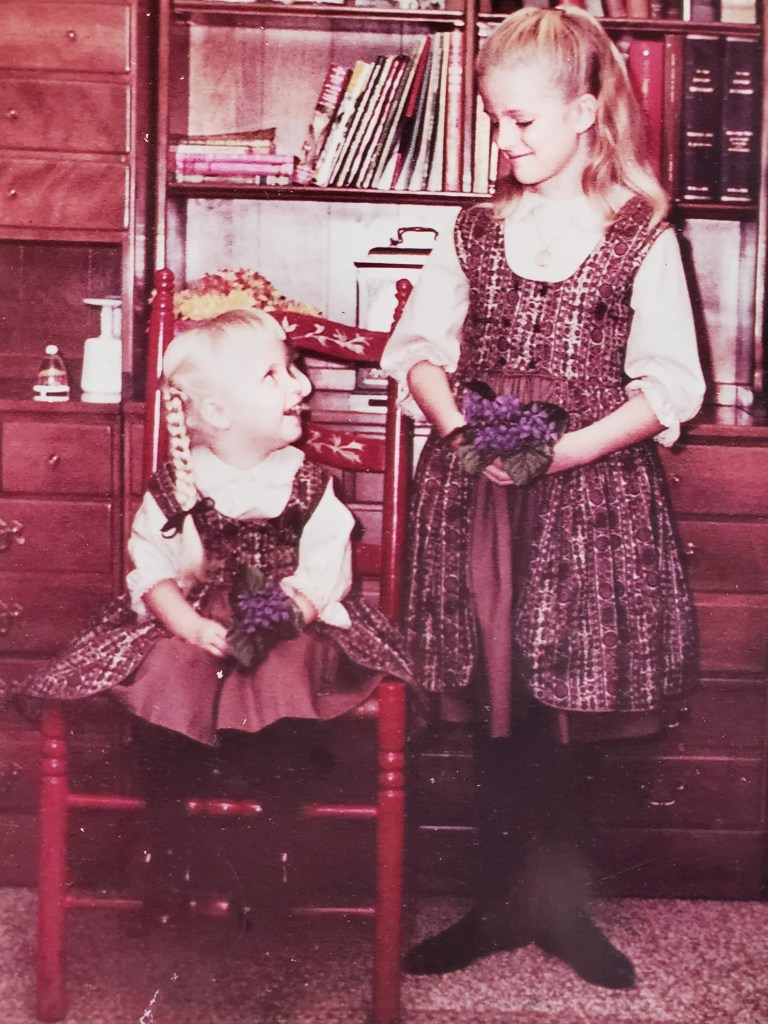
Thanksgiving 1960; Jane 2, Georgeann 8 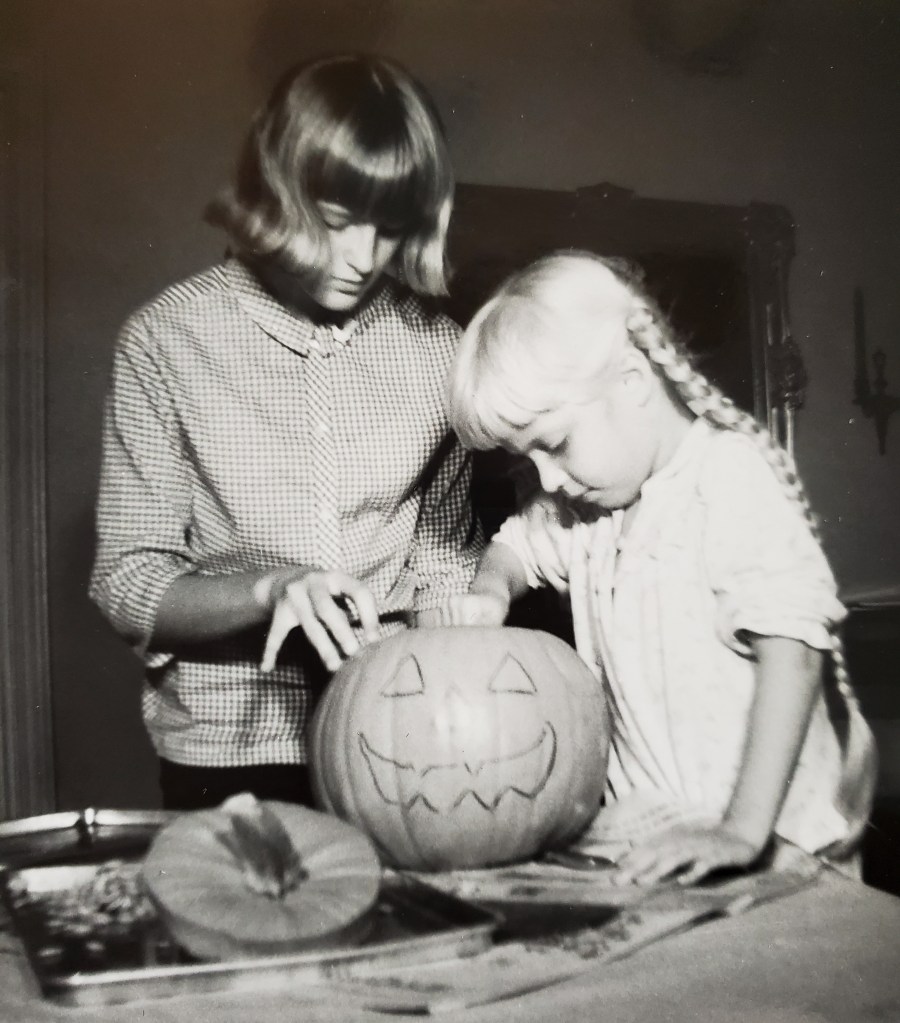
Halloween 1964; Jane 6, Georgeann 13 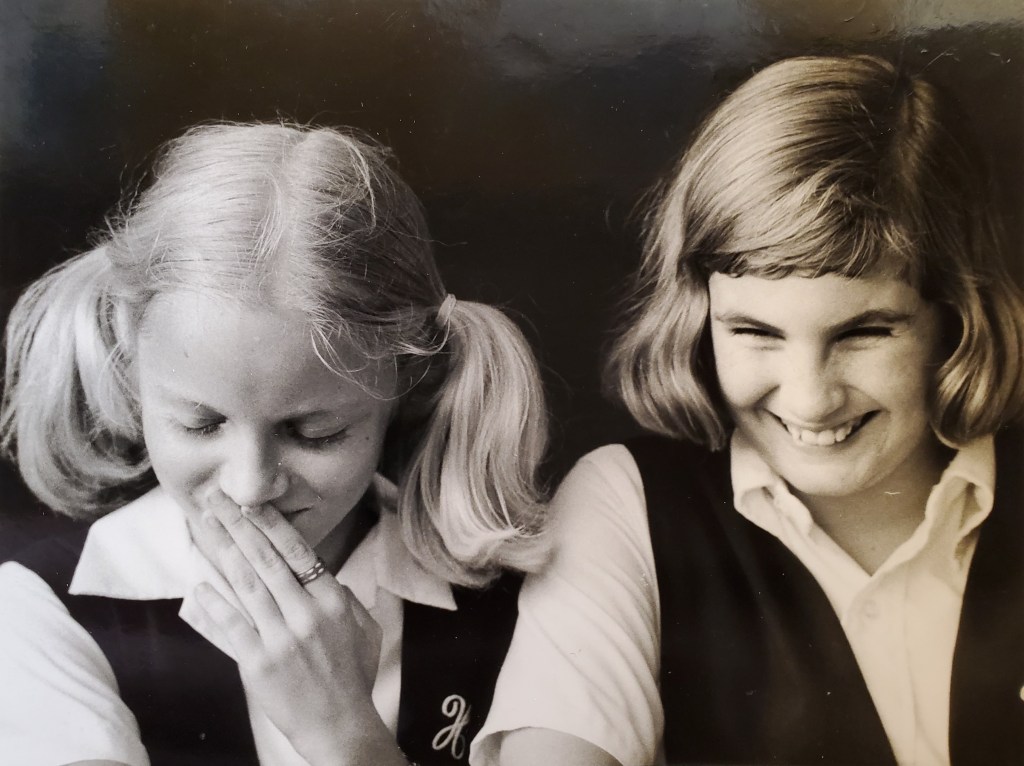
Jane and best friend Cindy at Holy Name, both age 11 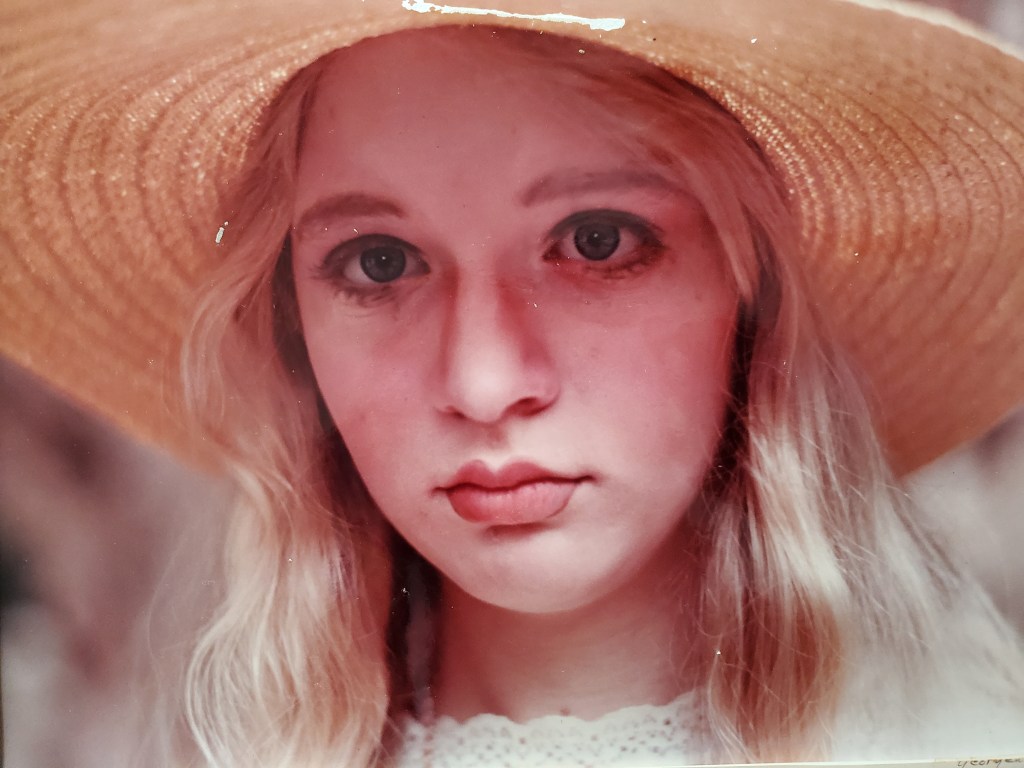
Summer of ’72, Jane 14.5
(makeup and photograph by Georgeann with her first Minolta camera)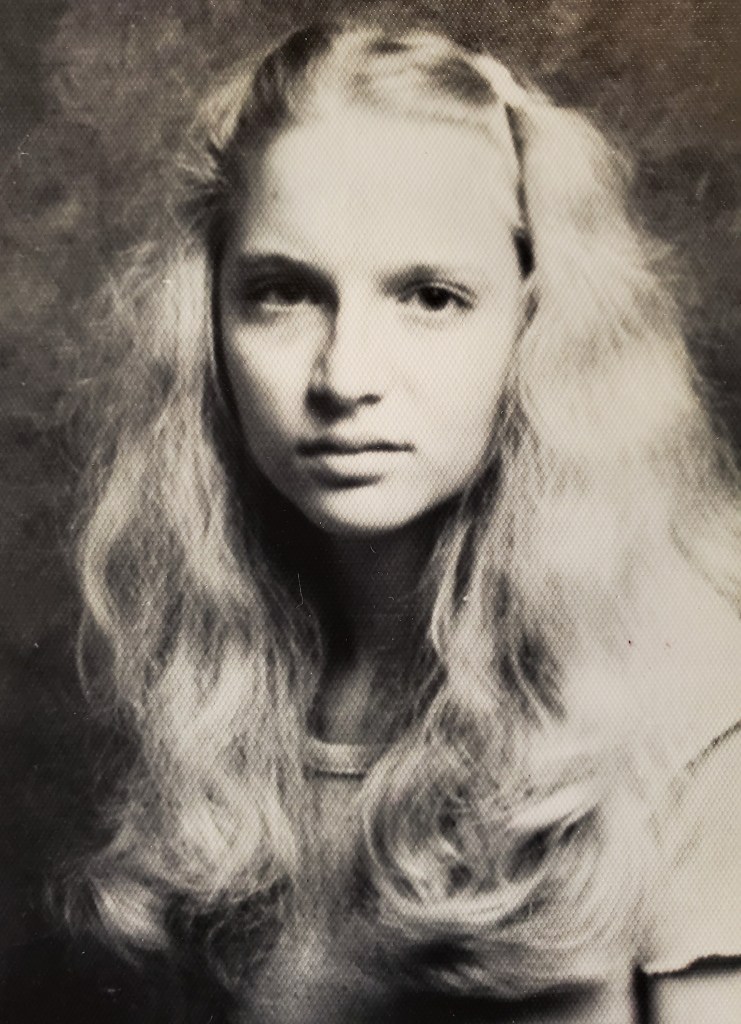
Jane at 17 in 1975 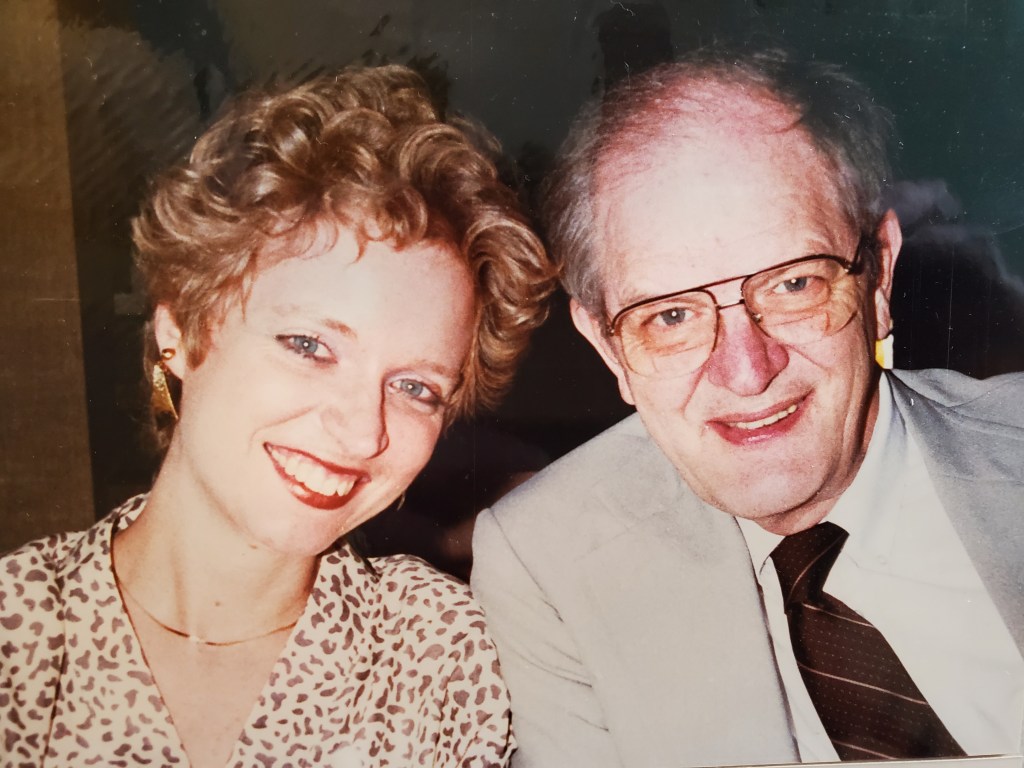
Spring 1987; Jane at 29, dad George at 65 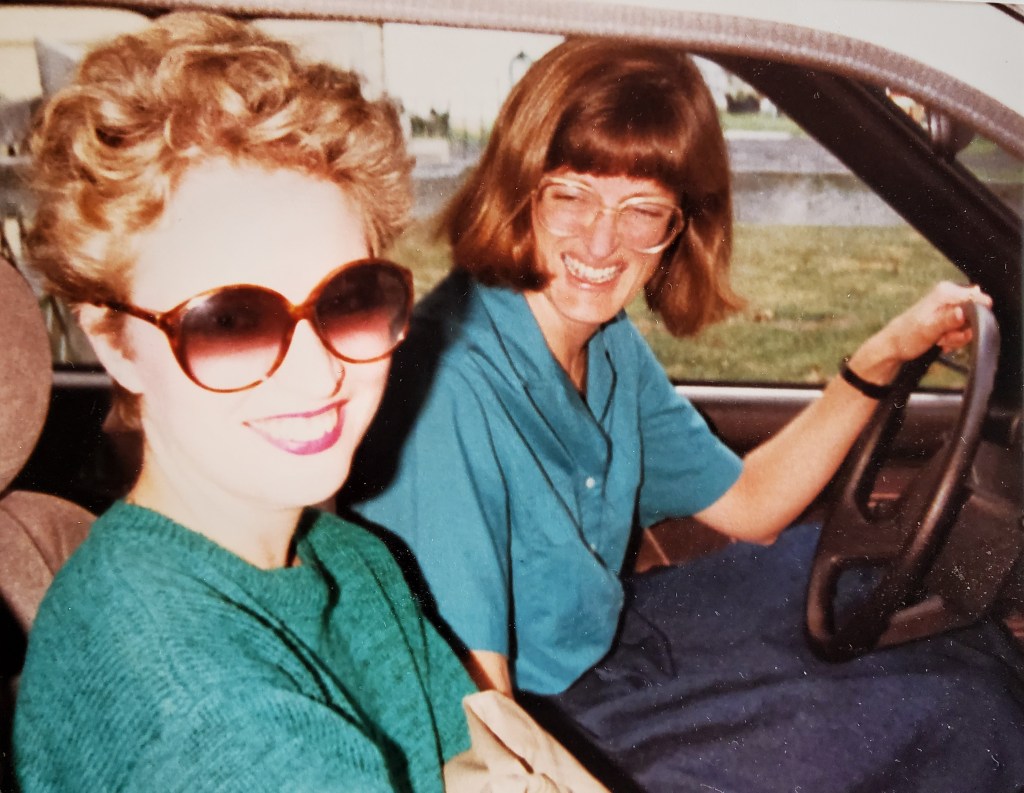
September 1987: off to see Peter Frampton, Jane 29, Georgeann 34 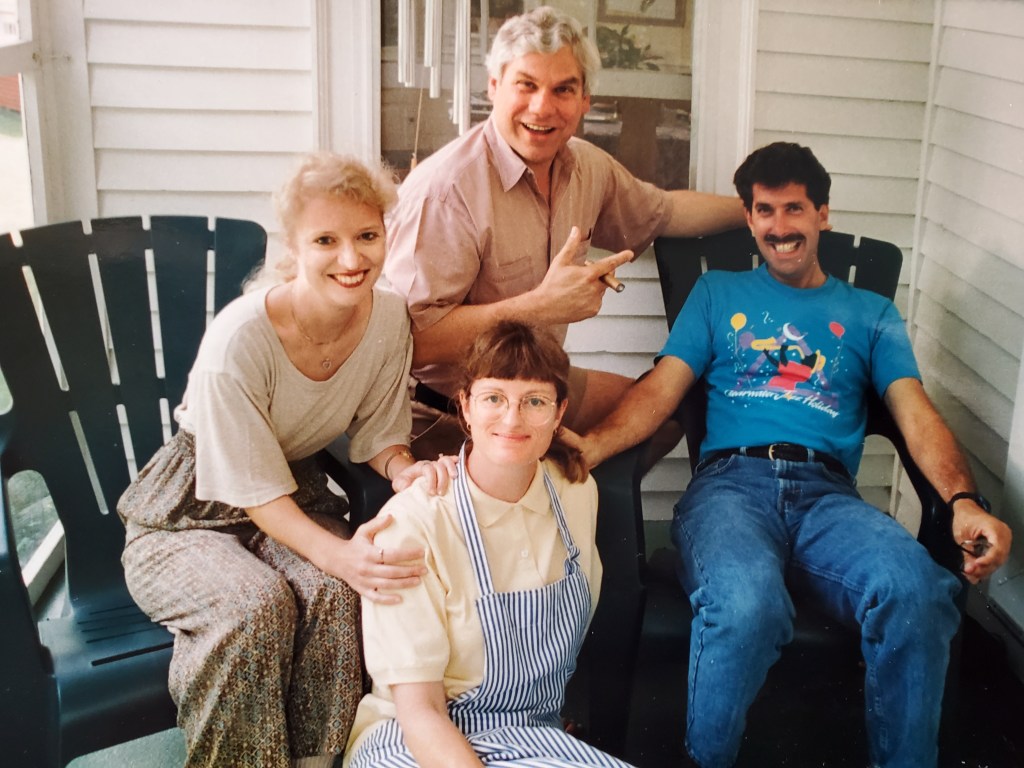
Summer 1994 on Canney Road, Durham NH: Jane 36, Georgeann 41, David 51, Richard 35 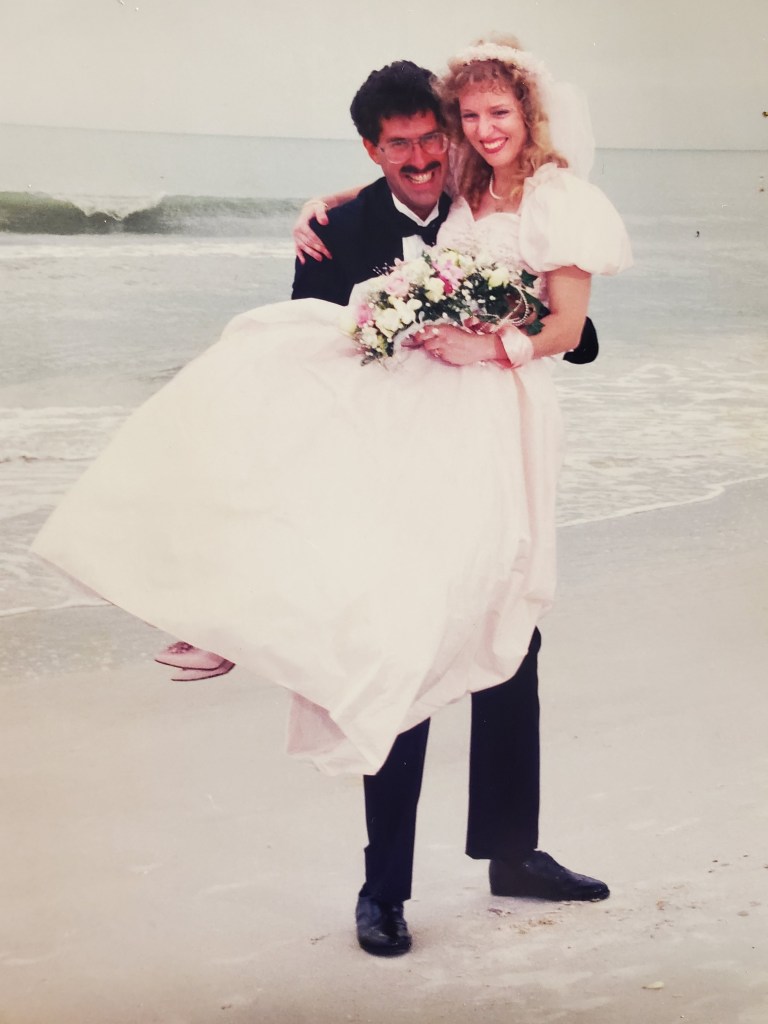
Wedding Day, St. Pete Beach, 1 April 1995; Jane 37, Richard 36 
Birthday Girl, 20 January 2024; Jane 66 -
“Slanders of the Age” and the Write-In Campaign, 1.27.24
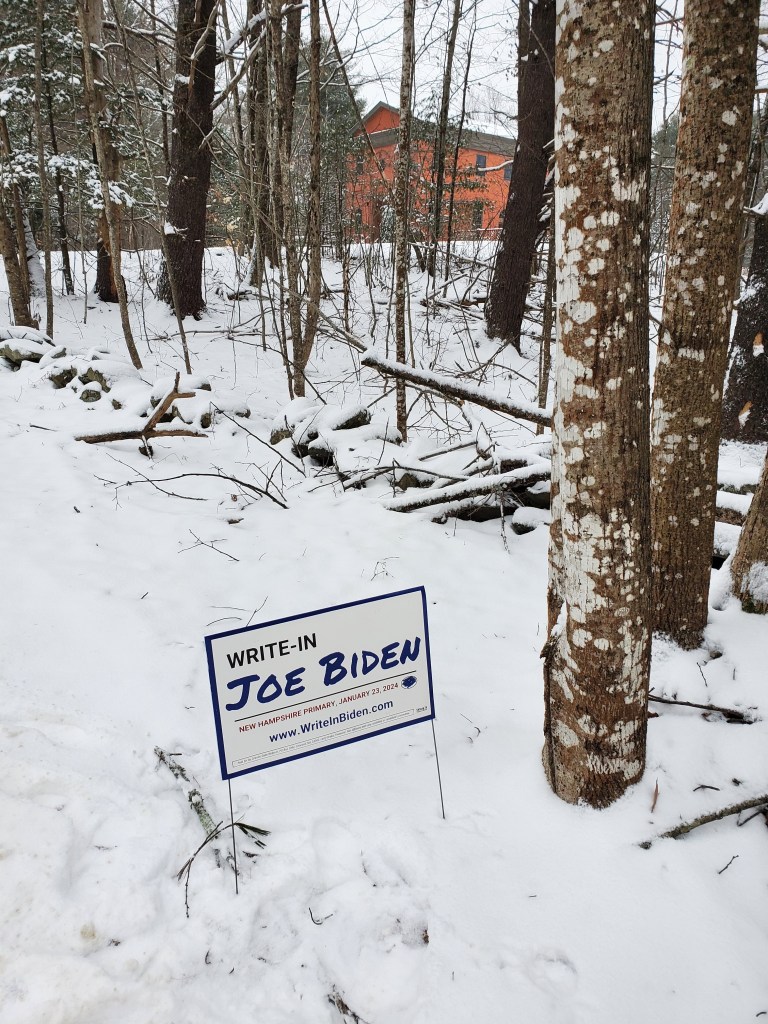
Primary Week in New Hampshire This past week I’ve been consumed by two endeavors, volunteering in the Write-in Biden (WIB) campaign and reviewing my KDP editor’s notes on the Henry V chapter of my forthcoming book, Will to Live: Learning from Shakespeare How to Be—and NOT to Be. Doing both in such proximity reminds me of the curious elision of disparate activities that would predictably take place in my earlier years whenever I was rehearsing a play and opening night approached. No matter my role as actor or director, everything in life that was not the play suddenly began to reflect the play; real life became less real than make believe. And right on schedule after first dress rehearsal, I would start misplacing my keys; keeping track of them was not, after all, part of the script I was laboring to bring to life, and the script superseded reality.
And so it’s been the past week, with parts of my Henry V chapter leaping off the page into my psyche to explain my lived experience. That’s not uncommon with Shakespearean texts; after all, Ben Jonson nailed it when he dubbed Will “not of an age, but for all time.” Still, the immediate relevance of a 425-year-old script caught my attention when one small moment in Act 3 Scene 6 struck me in a way it never had before. Here’s the setup: the feisty Fluellen is a doughty Welsh captain under Henry’s command. Fluellen, well-versed in military history but somewhat limited in perception, has just been reporting to the wiser Captain Gower the brave words that the braggart soldier Pistol proclaimed at the bridge over the Ternoise the English so bravely defended from French forces. Gower, however, knows Pistol, “an arrant counterfeit rascal,” and his aggrandizing lies. He warns Fluellen about the dangers of believing anything such a man says: “You must learn to know the slanders of the age, or else you may be marvelously mistook” (3.6.79-81).
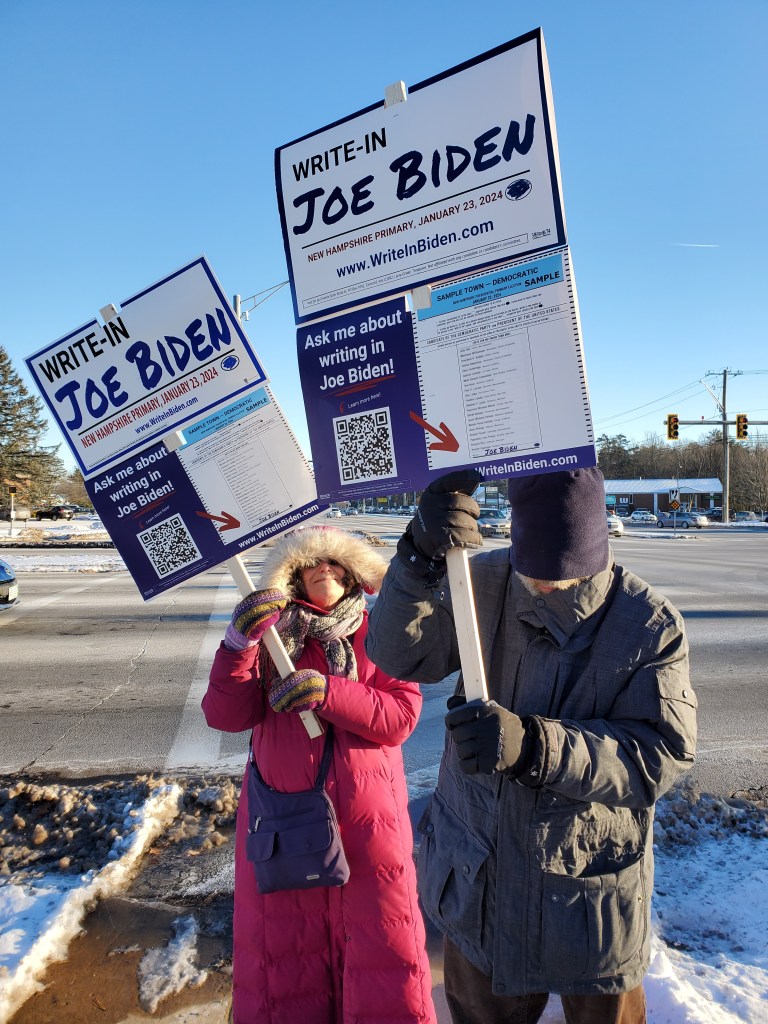
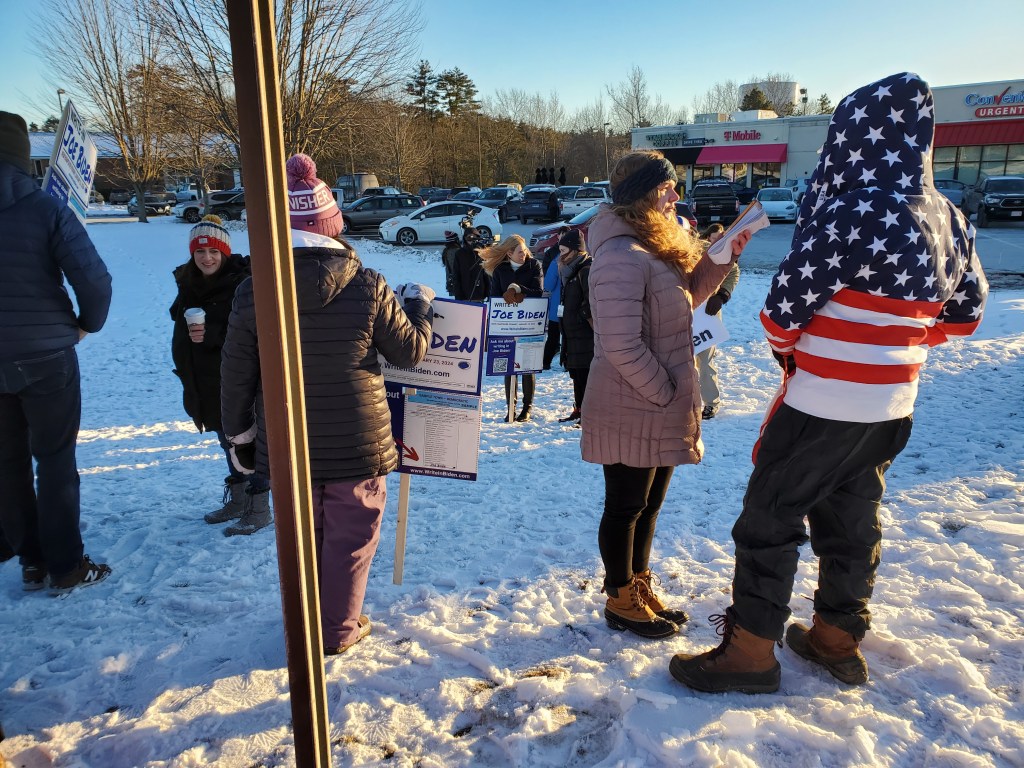
Cold Citizens Susan and David Campaign, 21 January 2024 Last Sunday I stood for a blustery 15o hour plus with my friends the Richmans on the heavily trafficked northeast corner of Weeks Crossing in Dover, New Hampshire, participants in a “visibility” for the Write-In Biden campaign. The New York Times had dubbed us NH Democrats “ornery” because unlike the “nice” Iowan citizens who politely accepted President Biden’s decision to push them back on the presidential nominating calendar, we refused to accept the decision to cede “first primary” status to South Carolina, judging the attention traditionally given the NH Primary too important to ignore. And so there we stood, waving our signs, and enduring “the slanders of the age” shouted at us. A sampling:
“F*** Biden!”
“Biden sucks!”
“Trump in 2024!”
“You’ve GOT to be kidding!” (This from a well-dressed woman in a huge black SUV.)
And my favorite: “Biden’s a Pedophile!”
A few passersby honked in support and gave us a thumbs up, but the MAGA types certainly outnumbered them.
Post “Visablity,” Weeks Crossing, Dover NH, 21 Jan 2024 Discouraged, I faced Tuesday’s Primary morning with alarm, thinking I was in for a long day of abuse as the sole sign waver in front of the Madbury Town Hall. I was, however, pleasantly surprised that my relentlessly cheerful greeting, “Good morning! Thank you for voting!” was generally returned in kind. A few fellow citizens simply avoided my gaze, but most smiled and waved, and some even thanked me for showing up. Encouraged, in the afternoon I returned to my post ten feet away from the Town Hall entrance as election protocol dictates, and was later joined by two fellow Madburians. We stayed until dusk, hearing nary a rude remark. Shortly after the polls closed at 7 pm, both Biden and Nikki Haley were declared winners in Madbury and Durham, my local turf. Then on Thursday, we volunteers got a thank you message from President Biden for handing him a landslide 64% primary win—even without his name appearing on the ballot. And there was praise from the New York Times for our volunteer-driven campaign “infused with the sort of joy found in spirited [ornery!] underdogs.” We’ll have a de-briefing Zoom this Sunday to consider Next Steps.
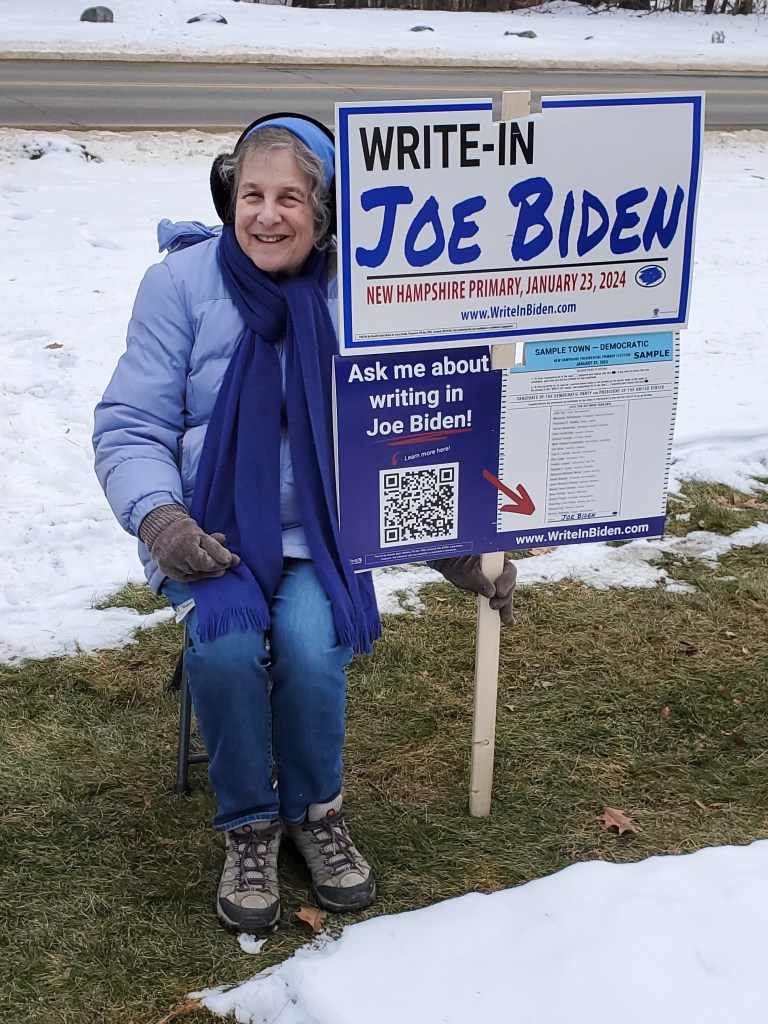
Vicky on Primary Day outside the Madbury Town Hall Since Tuesday, as the blowhard Trump continues to spout his lies and insults and his benighted acolytes proclaim him the messiah (to wax Shakespearean, “Is’t possible?”), my thoughts have often returned to Captain’s Gowers’s warning Fluellen: learn to know the slanders of the age, or be marvelously mistook.

Meanwhile, the cold persists . . . 
. . . and the turkeys trot across Newtown Plains Road So many now are marvelously mistook, and there’s plenty of bad news one must try to rise above, from global horrors in the Red Sea, Gaza, and Ukraine to dispiriting downsizing at the University of New Hampshire that will soon close the University Art Museum, the only art museum on the Seacoast, and this week made 75 employees redundant. While surveying the broccoli at our local Market Basket yesterday afternoon, I was haled by my former English department colleague Monica, who lamented that she’s one of the few tenured professors remaining in a department that when my late husband arrived at UNH in 1976 was the U’s mightiest. Hopes that higher education would rise phoenix-like after COVID are dashed, and I realize daily how lucky I was to be among the last generation to find respectable employment in academia.
What’s to come is still unsure. This NH winter alternates between very cold and creepily warm. My friend Jennifer reports her daffodils have broken ground (in NH in January!), and as I drove home from Durham toward Hick’s Hill yesterday, I spied some willow trees already turned chartreuse.
Too soon for spring. Too late for democracy? I wonder. Yesterday a jury of nine Americans deliberated for less than three hours before it ordered former president Trump to pay writer E. Jean Carroll $83.3 million for defaming her after she accused him in 2019 of raping her in the 1990s. And come 12 February, Jon Stewart, who so successfully weaponized political comedy when he took over The Daily Show in 1999, will return to the show he left in 2015 to appear each Monday through the 2024 election.
Can a comedian help save democracy by inspiring his audience? A certain Ukrainian comedian continues to do just that.
So. Here’s to recognizing the slanders of the age, defeating the liars who spread them, and saving our republic.
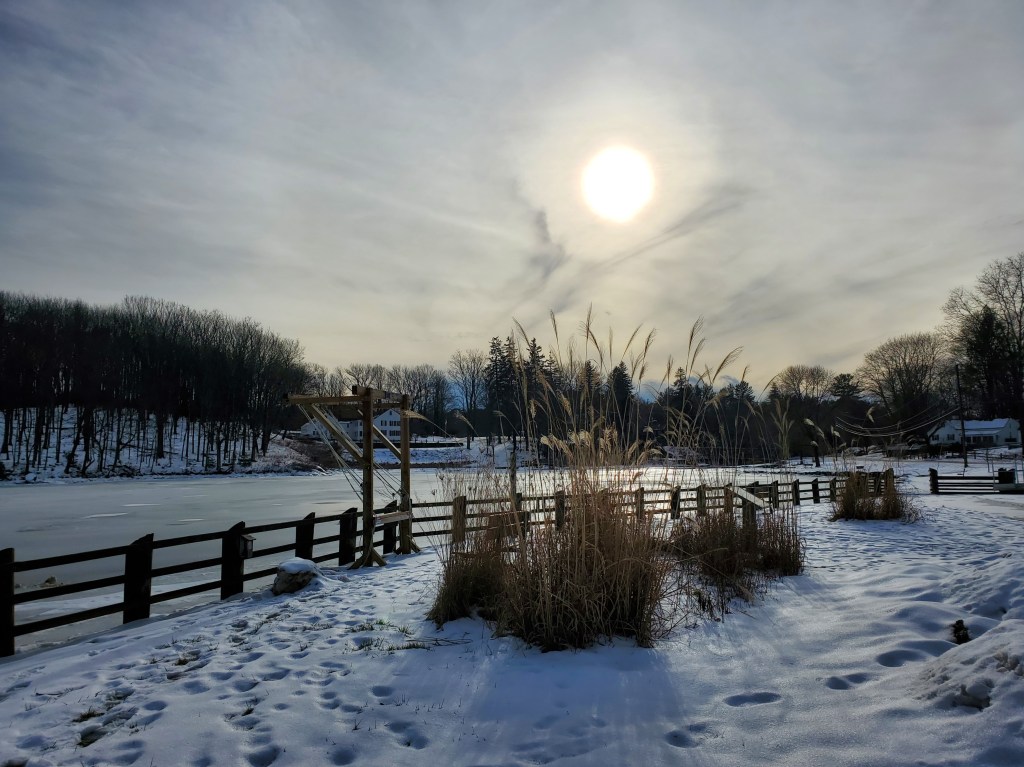
Winter Sun, Durham Town Landing at the Oyster River -
Resolution
10 January 2024

First snow of the season, Oyster River tributary, 7 Jan 2024 The warm, festive glow of my little 2023 Christmas tree is no more now that Twelfth Night has come and gone, and the tree rests, au naturale and snow covered, on the deck. The library sans decoration now seems both larger and more desolate. Some compensatory cheering arrived on Sunday the 7th as we at last got our first sizable snow, and I took advantage of the midday lull between storms to find my snowshoes, suit up, and hit the woods, using the bend of the Oyster River tributary that defines our property to guide me now that the trail David and I blazed so many years ago with chainsaw and loppers (but never since groomed) is largely indistinguishable. The two substantial boulders, Ralph Waldo and Henry David, remain just where the Ice Age left them, of course, durable landmarks however snowcapped. So many large old trees are now down that skirting them requires more going ‘round than stepping over, but proving that I could still enjoy a snowy trek in our woods was both salutary and satisfying. The afterglow made me feel it might be possible to (mostly) maintain my resolution to be more optimistic this year, despite all signs that signal disaster. Last week I watched the new Netflix film Leave the World Behind with Julia Roberts in an uncharacteristically sour role and Ethan Hawke as an all-too-painfully-recognizable NPR-listening dweeb utterly lacking any of the survival skills necessary to cope with all the failing systems the plot offers. A very dark comedy, that. Guess it’s good to laugh at the scenarios I suspect any thinking person contemplates in our near future.
Better comfort came my way on Monday with a lunch for the “Write-In Biden” volunteers held at the Common Man restaurant in Concord with NH Congresswoman Annie Kuster and MD Congressman Jamie Raskin as guest speakers.
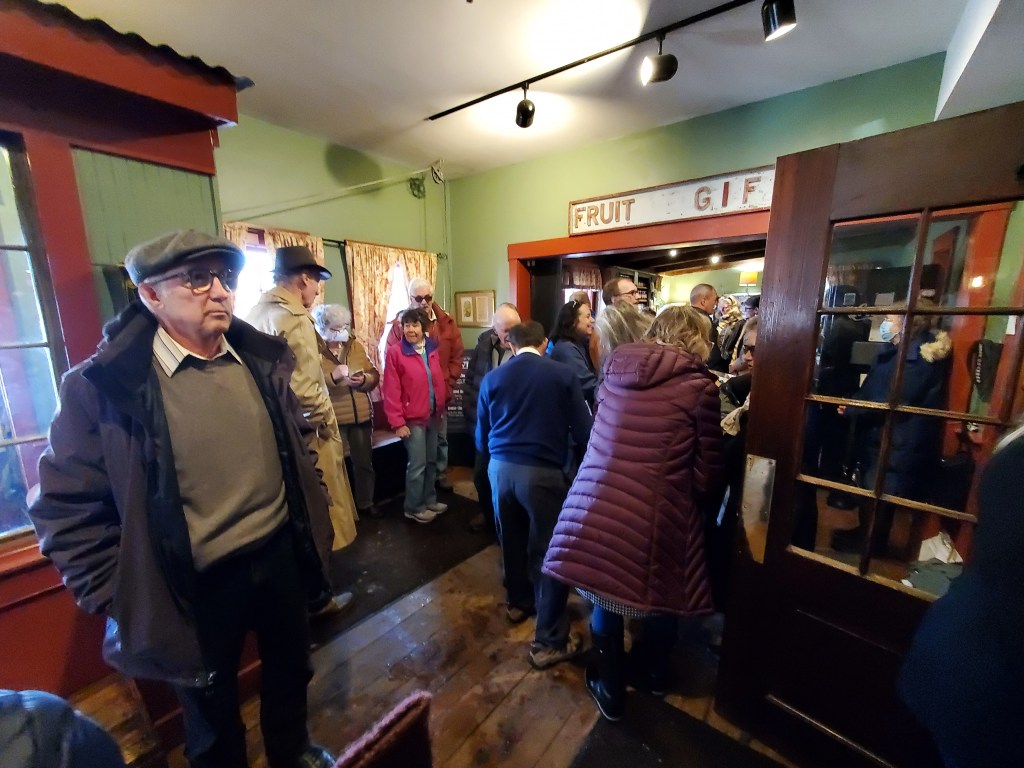
The volunteers gather in the vestibule of The Common Man restaurant,
Concord NH, 8 Jan 2024The gathering was more intimate than I was expecting, and the group was clearly both energized and a little star-struck by Raskin. He went around to each table, and when I told him my little sister, now struggling with stage four cancer, was a Big Fan and would never forgive me if I didn’t get a picture with him, his immediate response was “Get her on the phone. Maybe we can Face Time!” Alas, I couldn’t reach her, but the offer was no less sincere and generous.

Congressman Raskin works the room . . . 
. . . and obliges my request for a photo Introducing Raskin, Kuster told of just-released security footage from the Capitol hallway down which she and other Congress members fled on January 6, 2021, ducking behind a door and locking it less than 30 seconds (the time stamp on the video reveals) before the mob, armed with zip ties, bear spray, and insurrectionist zeal, stormed by. “That’s how close we came!” said Kuster. She praised Liz Cheney for insisting that Congress return to the floor to finish certifying the election results, one of only 10 Republicans to do so. Again, that’s how close we came.
Both Kuster and Congressman Raskin got a standing ovation as Raskin took the floor and so quickly revealed the eloquence, intelligence, and wit that prior to the devastating loss of his son Tommy on New Year’s Eve 2020 tagged Raskin with the epithet “funniest Rep in Congress.” All of the audience knew well that the funeral of Tommy Raskin (named for patriot Thomas Paine) had taken place on 5 January 2021, just a day before the insurgents broke into the Capitol where Raskin was working with his daughter and son-in-law. We all knew, too, of his long but finally successful battles with cancer. But more than his ethos, it was his skill as an inspiring speaker that electrified our group. From wittily calling out Republicans who seem not to know the difference between the adjective “Democratic” and the noun “Democrat” to so movingly quoting Paine’s Common Sense about the worthy struggle of preserving democracy, Raskin ruled the room. See and hear for yourself: https://drive.google.com/file/d/1WIoy-Igy-bAwr177TgEgAb1A5QiMlypV/preview .
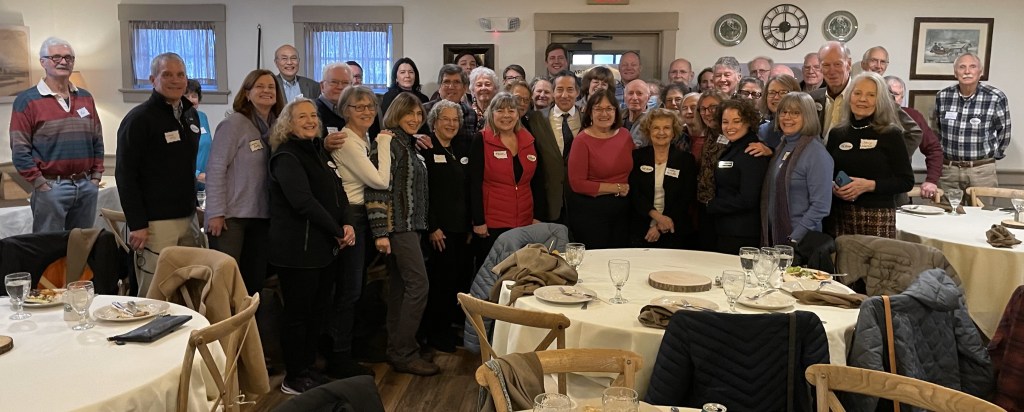
We few, we happy few, we band of brothers (and sisters!) So. I’ve volunteered to wave my “Write-In Biden” sign on New Hampshire Primary Day, and will practice my retorts for any heckling that might elicit. I hope Lee McIntyre’s On Democracy: How to Fight for Truth and Protect Democracy (MIT Press; 2023) will help with that, confrontation not being my forte. The state of our nation (let alone the world) is NOT strong, and the aural doom scrolling of bad news remains a hazardous lure into the Slough of Despond. One day’s announcement of the next school shooting (immediately preceding a report that the stock market is up) is followed by a judge seriously questioning if a former president’s claim of immunity extends to allowing him to authorize with impunity the assassination of a political opponent. How on earth did ALL of our infrastructure–ethical, legal, spiritual, and educational as well as physical–devolve to such an extent? The Earth itself has never seen a hotter year than 2023. And the incandescently stupid support for Trump seems unassailable.
But! There are Raskins, and volunteers who will participate to protect their democracy. Consider Boston Mayor Michelle Wu’s State of the City address on 9 January, which showcases what smart, humanist leadership can accomplish. (Check it out at https://www.youtube.com/watch?v=1H1KQRj0430 .)
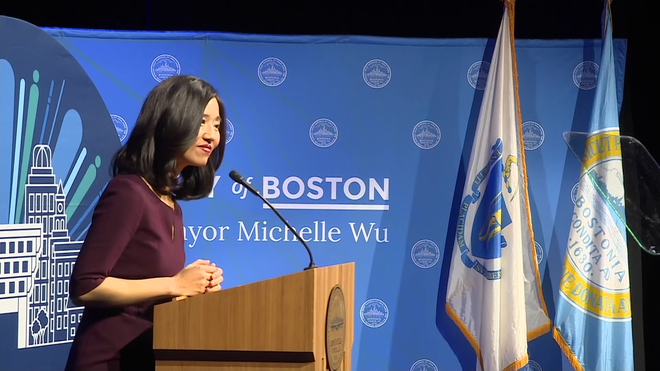
Boston Mayor Wu gives her State of the City address, 9 January 2024 And besides, The New York Times (“Seven Keys to Living Longer and Healthier,” 9 January 2024) exhorts me to “cultivate a positive mind-set.” Top healthy practice: some version of physical activity. And if you can’t do that, “focus on being positive.”
Resolved.
-
Holiday Letter
21 December 2023
The winter solstice arrives today, and I am soon off to my local VW dealer to have my snow tires mounted, however pessimistic I am about having much snow headed our way. In 2022, I got to use my snowshoes (what a delight for this Florida cracker!) only twice. Monday’s big rain and wind storm brought power lines down, a double whammy as the silence immediately following the outage also revealed that my generator serviced only a couple weeks earlier had not, in fact, been repaired. I lost an hour plus yesterday composing an account of that series of missteps: three months, three service calls, and still no functioning machine.
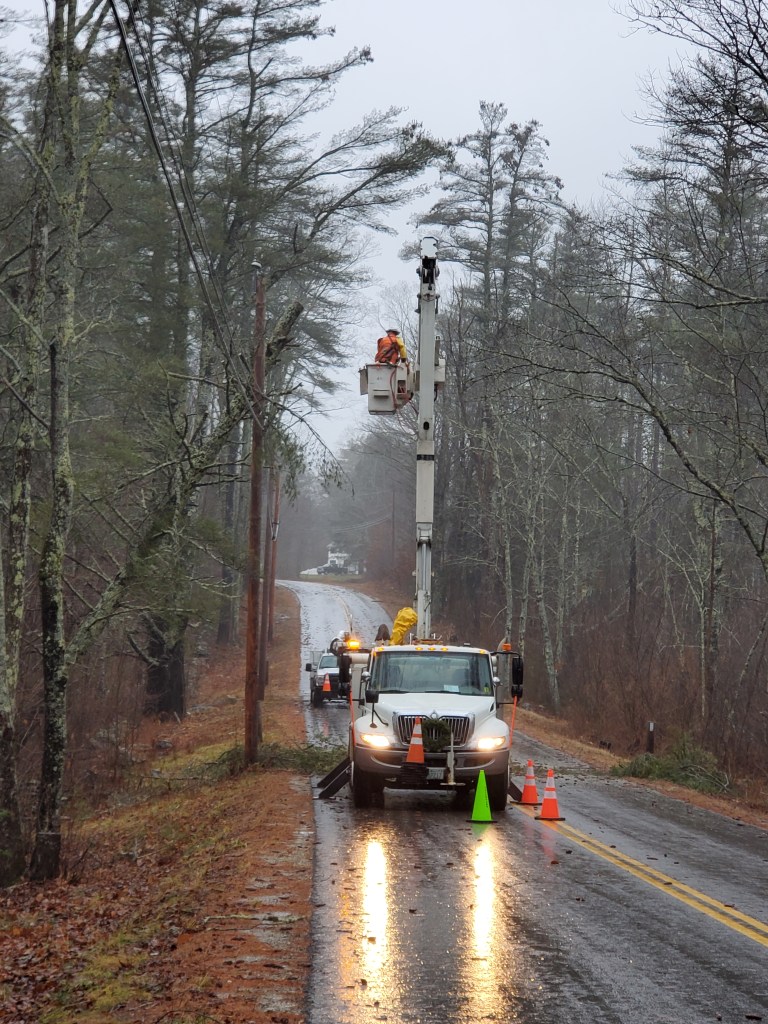
The Eversource guys’ prompt arrival and restoration of power (and so, for me, not only heat and light but also water) lifted my spirits a bit, but the climate crisis that prompts such storms is never far from my mind. My friend Carol S., out walking in Miami Beach when my call reached her on Tuesday, reported that it was unusually cold there for 19 December: 60o; I could only reply that it was unusually warm in New Hampshire: 60o. And I’ve yet to see a single chickadee, those dear, confiding spirits who usually crowd my feeders this time of year, finding only those “bare ruined choirs where late the sweet birds sang.” Shakespeare’s Titania had it right: “we see the seasons alter . . . and the mazèd world now knows not which is which.”
I thought I heard a chickadee late yesterday afternoon, but it made no appearance. Instead, the most notable appearance last Saturday was the Orange Horror who, alas, came to the Whittemore Center at UNH, poisoning the blood (like a martial artist, I redirect his and Hitler’s words against him) of those who attended. I stayed well clear of Durham; I’m afraid of those MAGA-ots. With good reason, as the latest issue of The Atlantic points out.

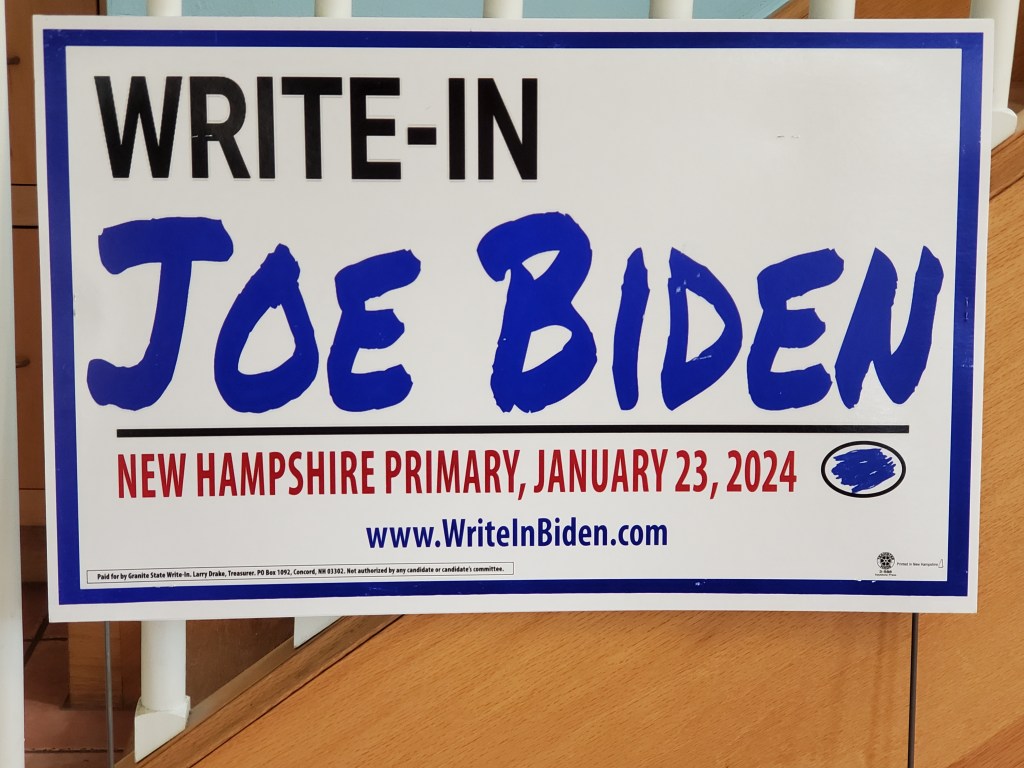
Biden’s not even on the primary ballot in New Hampshire, which I can only think is a political mistake. The Democratic ballot looks like a joke!

I fear voters not apprised of Biden’s honoring South Carolina with the role of “first state on the Democratic primary calendar” will be confused and/or sufficiently disgusted not to vote at all. Well, at least Carol B., who did check out the Durham scene last Saturday, found protestors and a cart hawking MAGA-wear deserted.

Photos by Carol Birch, 16 December 2023, Durham NH 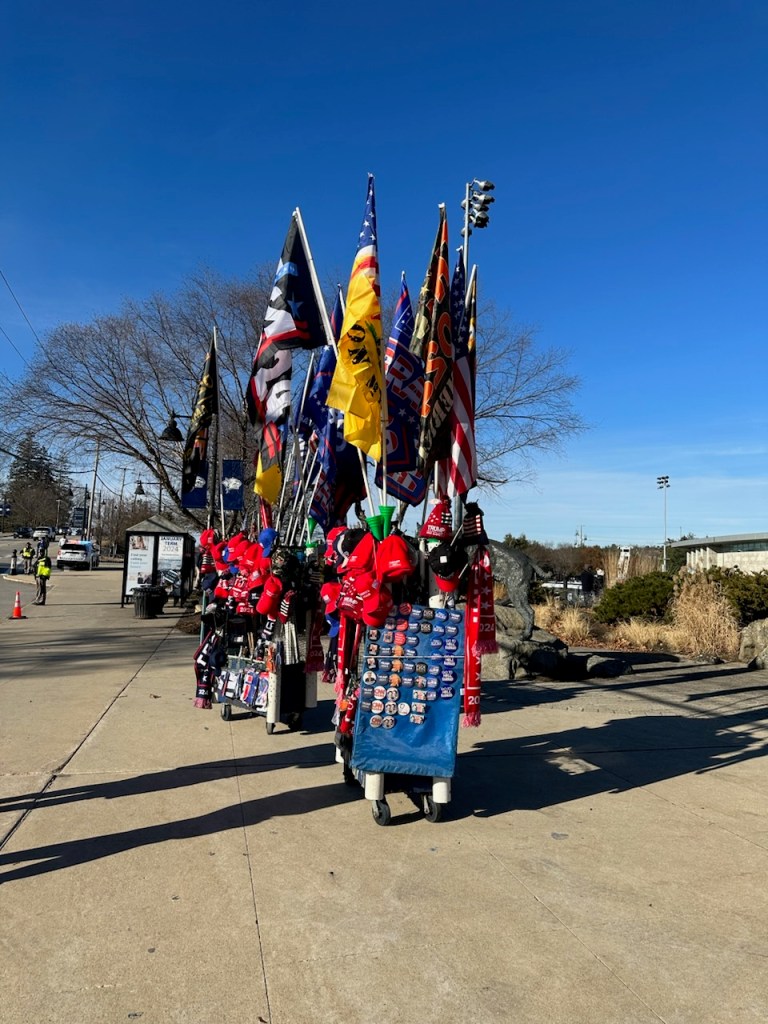
And Colorado has kicked T**** off the primary ballot, perhaps a sign of change for the better. Still, I wish I could see some chickadees.
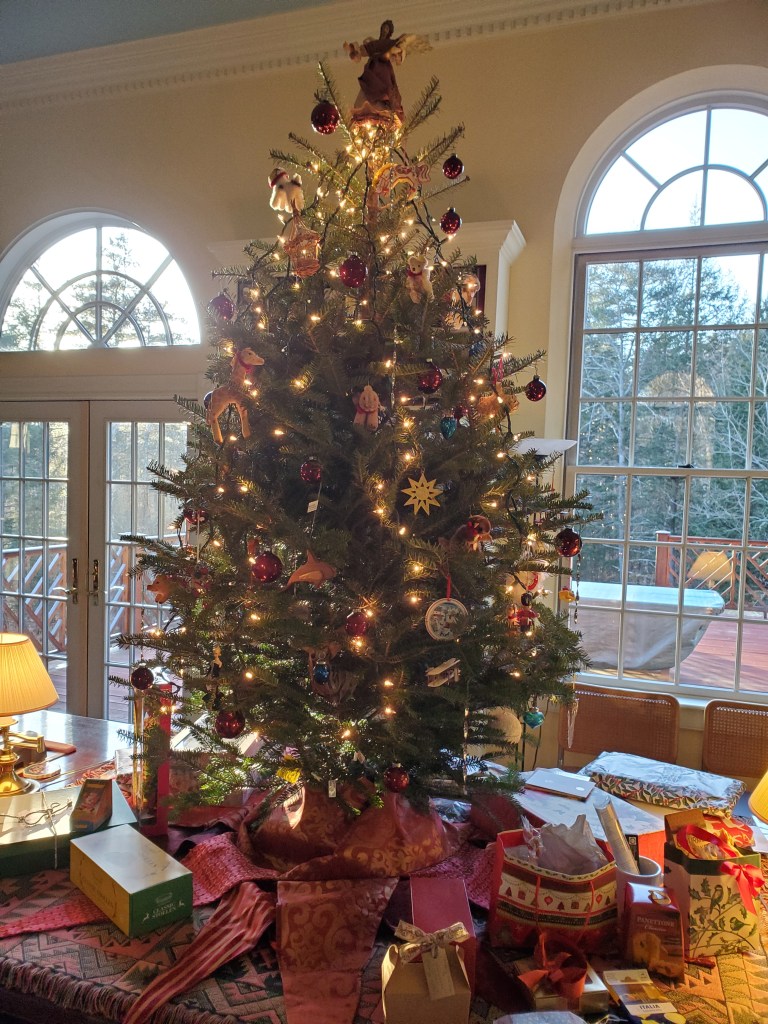
I’ve received fewer holiday cards so far this year; I suspect many on my list are aging out of that tradition. I do enjoy sending them, however, as I also do simultaneously re-reading both David Copperfield and Demon Copperhead to prepare for a new Madbury Public Library book group’s first meeting in late January. Reading by the fire helps with Seasonal Affective Disorder—as does our imminent cruising past the winter solstice on our annual lap ‘round the sun. And I’m making some better progress with KDP Amazon’s formatting my book, Will to Live: Learning from Shakespeare How to Be—and NOT to Be, hoping for a launch in time for Will’s 460th birthday on 23 April 2024. That’s the good news.
And there are joys. Pianist Jeremy Denk’s performance in the gorgeous and still-new-smelling Groton Music Center on 10 December was an uplifting marvel with its program dedicated to women composers and, in the second half, “love letters” to Clara Schumann, including Brahms’s Four Klavierstücke, Op. 119, a favorite that my David practiced and Chris Kies played for his memorial here at home in 2019.
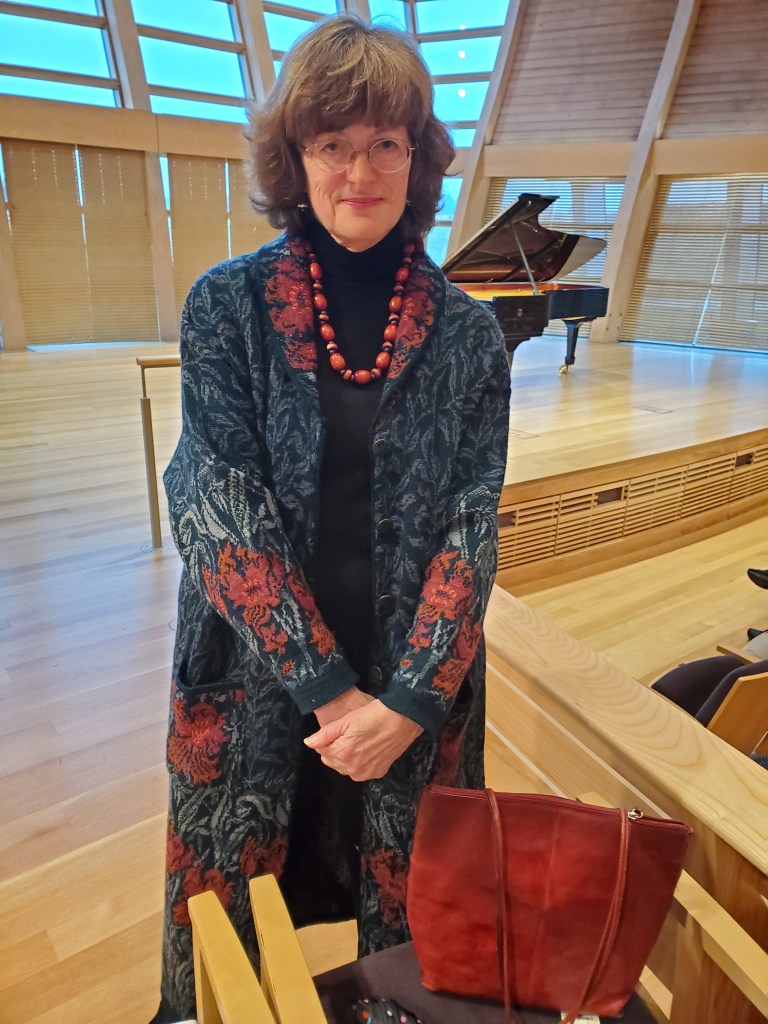
Georgeann anticipates Denk, Groton Music Center, 10 Dec 2023
photo by Jennifer LeeAnd there are delightful gatherings with friends: a wonderful dinner party at Phil and Fran’s with Brian, Shiao-Ping, and Julee (who contributed THE best pumpkin cheesecake EVER: see https://cooking.nytimes.com/recipes/1023580-spiced-pumpkin-cheesecake). All that good food and good cheer!
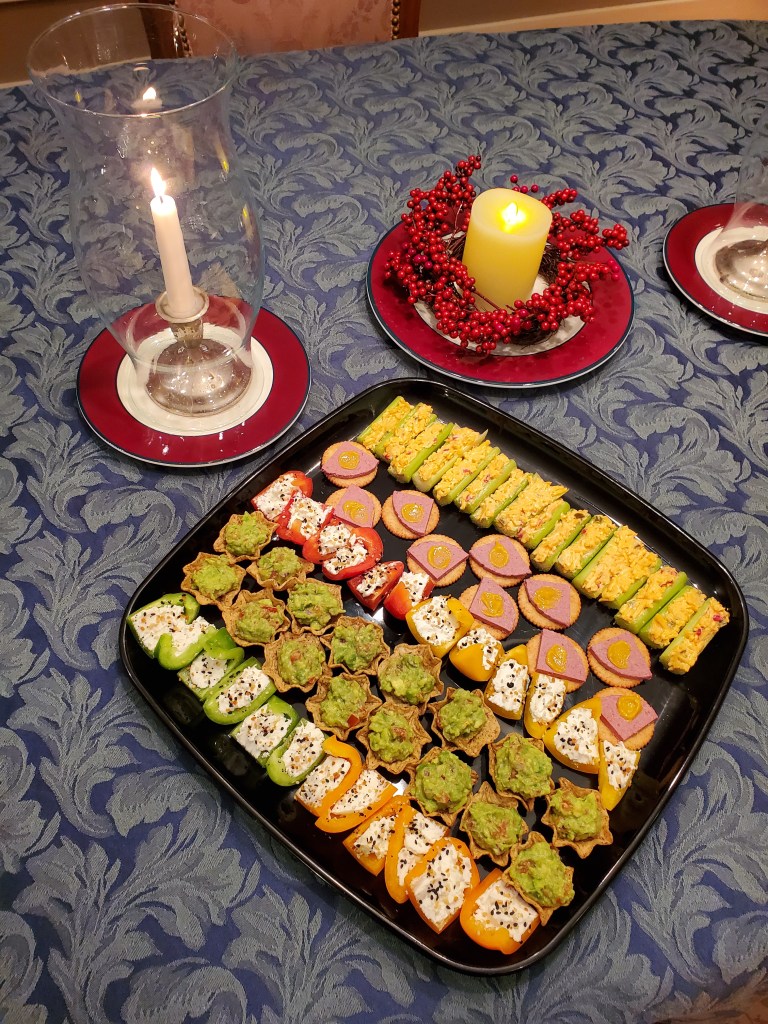
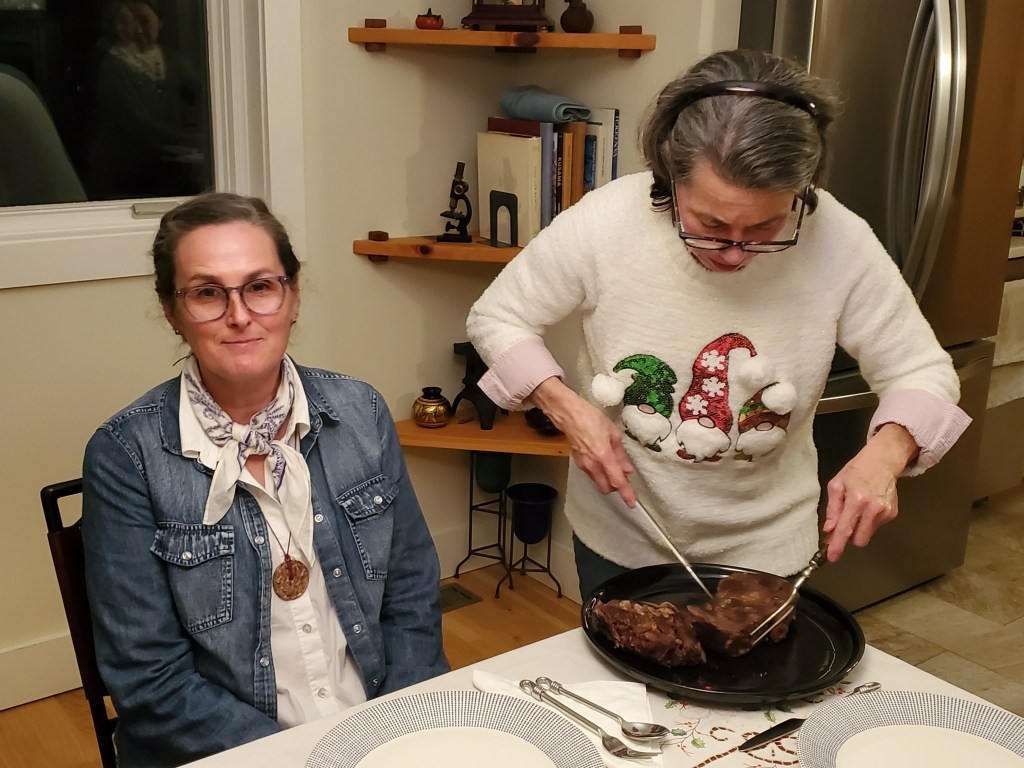
Fran serves Julee delicious pot roast, 16 Dec 2023 And on Tuesday I served a high tea here at home, a more intimate celebration to rival the 250th anniversary celebration of a more famous Tea Party in Boston last Saturday.
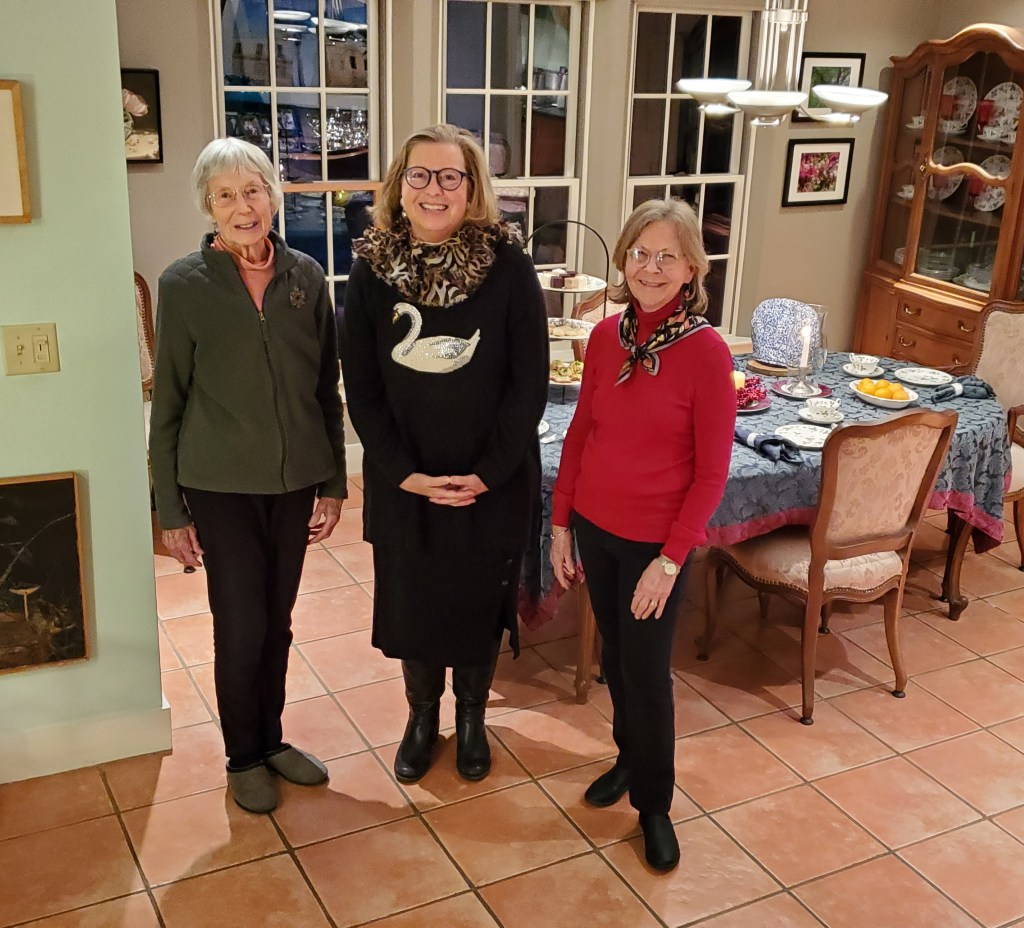
Jennifer, Cathy, and Carolyn come for tea, 19 Dec 2023 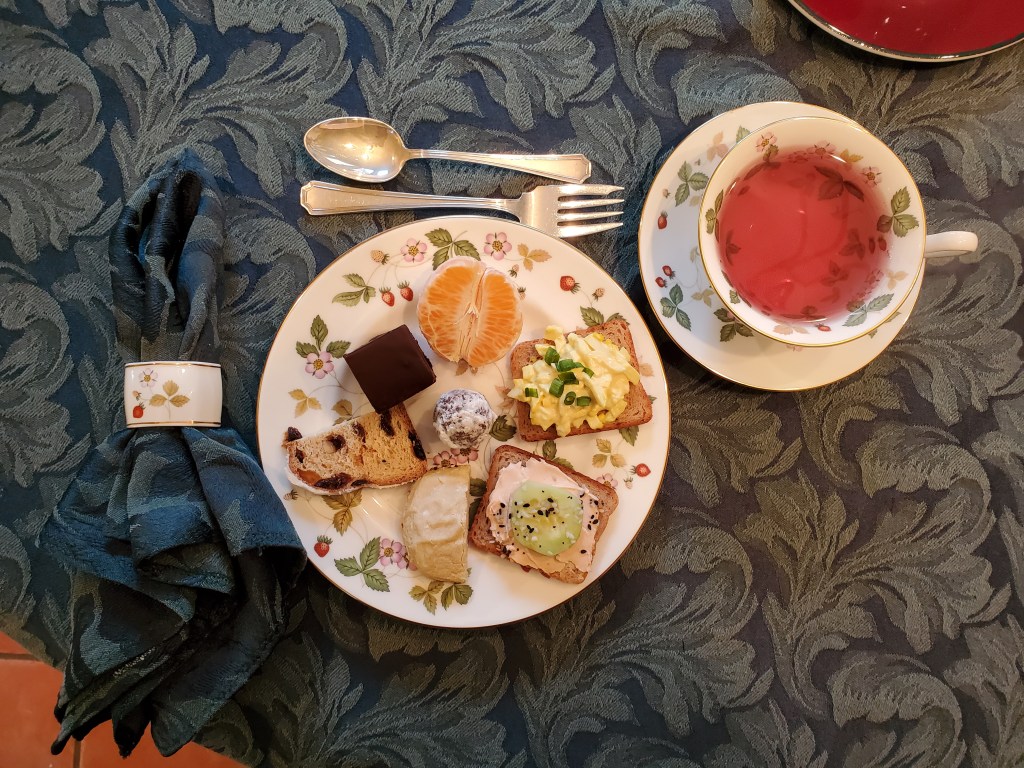
Still, something’s missing—like the baby Jesus absent from my neighbors-down-the-road’s three-quarter size crèche set up in their front yard. Their manger will be empty until Christmas morning, but in the meantime, it’s a creepy sight, as the circular red light set to illuminate where the baby’s head will lie looks in the meantime for all the world like the aftermath of an execution.
As so often happens, however, I am solaced by my NPR pals. Yesterday’s Fresh Air featured Terry Gross’s interview with David Byrne and his unusual, almost-never-heard Christmas play list. Gross concluded the interview by introducing Byrne to a new favorite of her own, jazz singer Samara Joy singing with her father Antonia McLendon “O Holy Night.” Sublime. You can find it on YouTube (https://www.youtube.com/watch?v=CoEwU-35sng ), but I recommend you don’t watch.
Dear Readers: Just listen.
Dona Nobis Pacem.
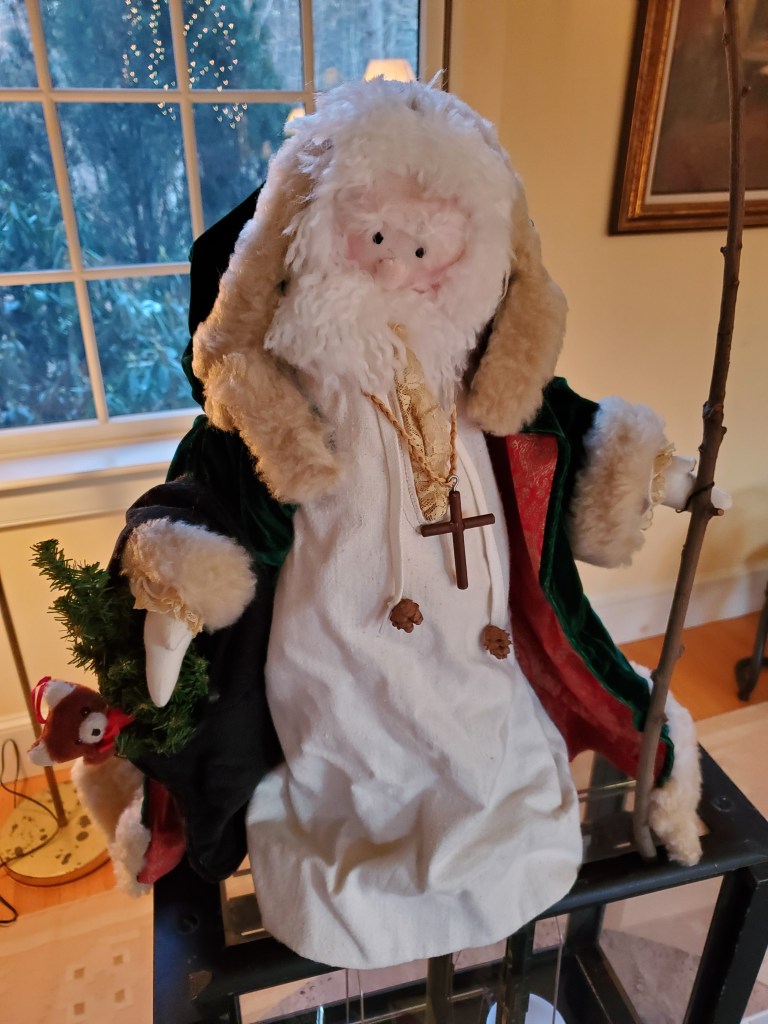
St. Nicholas, soft sculpture by Virginia Senseman Murphy -
Reinforcements
Sunday, 3 December 2023
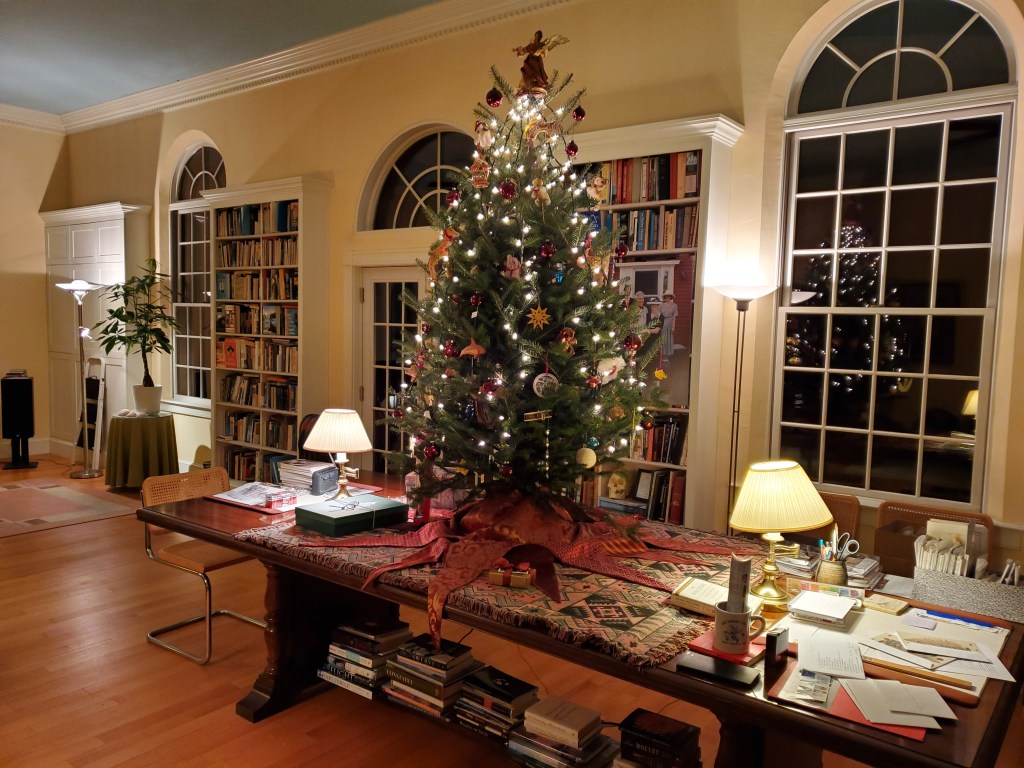
Home for the Holidays A “Canyon Country” wall calendar hangs to my left as I type this. By December, the weight of eleven months past is redistributed from January’s heavy-on-the-bottom half of the calendar to the top half, where previously flipped pages one atop the other push on the last page turned until the nail holding it up rips through the small hole at the top. Yielding to gravity, what should be another spectacular photo from Utah’s Canyonlands looming above the grid of December dates falls back down, covering those dates and turning back the month to November. Progress forward would be impossible save for the inexpensive but remarkably effective stationery innovation of an earlier age: the reinforcement. Once requiring a lick to stick on notebook pages ripping from a three-ring binder but now “Permanent Self-Adhesive,” these small but mighty white lifesavers, suggesting both candy and nautical mishap, keep December visibly in place—if carefully applied. And so the new year approaches, just as inevitably prompting thoughts of auld lang syne and inexorable endings.
I’ve been thinking about reinforcements, time passing, and cadences, those moments of reflection briefly surfacing in the current of quotidian affairs, and the pleasure of bringing things to an organized pause. There’s the cadence following all the cleaning and preparation just before dinner party guests arrive when, with all in order, you await what’s next. And the moment when the flight attendant announces the doors are shut and you relax because you know what happens next is out of your hands. And then there’s that ultimate resolving cadence. Recently promoting her new book Stories of Women and Men on NPR’s Weekend Edition (11 Nov 2023), author Claire Keegan remarked on that final conclusion: “mortality does make sense of our lives; we all know that our time is finite, and someday there won’t be a full day or a full night to pass, and nobody knows when or where or why that will happen. So it’s an extraordinary thing that we go along as we do with this knowledge, this common knowledge.”
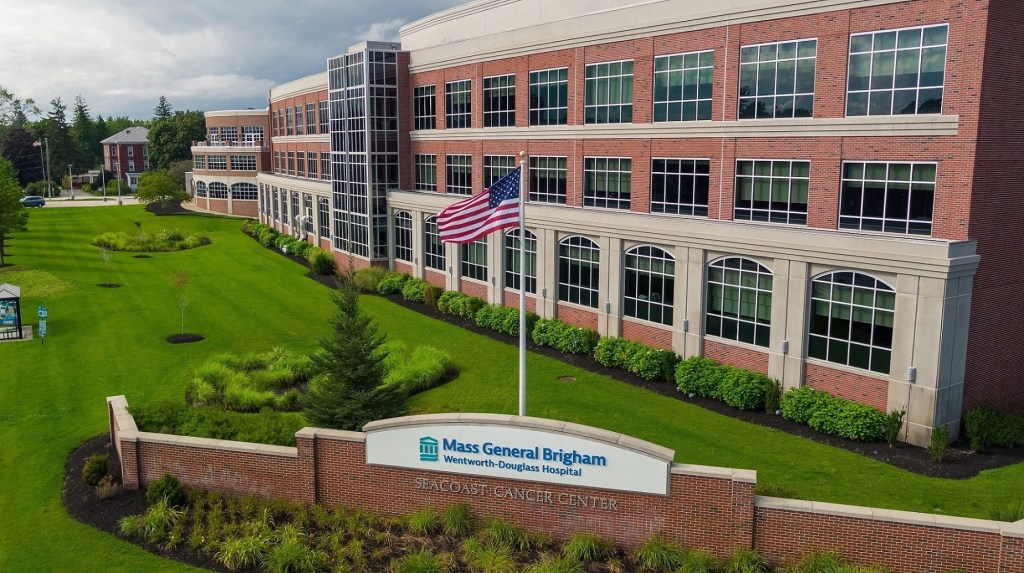
Wentworth-Douglass Hospital, Dover NH Nothing like a trip to the hospital to remind one of mortality. When I came up out of the Propofol-induced sleep following a much-deferred colonoscopy last Friday, I thought I was at home and the attending nurse had somehow, Star Trek-like, materialized from my computer. That confusion quickly dispersed, however, and I felt uncommonly rested and reset, certainly relieved the procedure (with its much worse prep), was done. I was purged, literally and metaphorically, and reinforced with a new lease on life—a phrase I somehow associate with a TV commercial from the past.
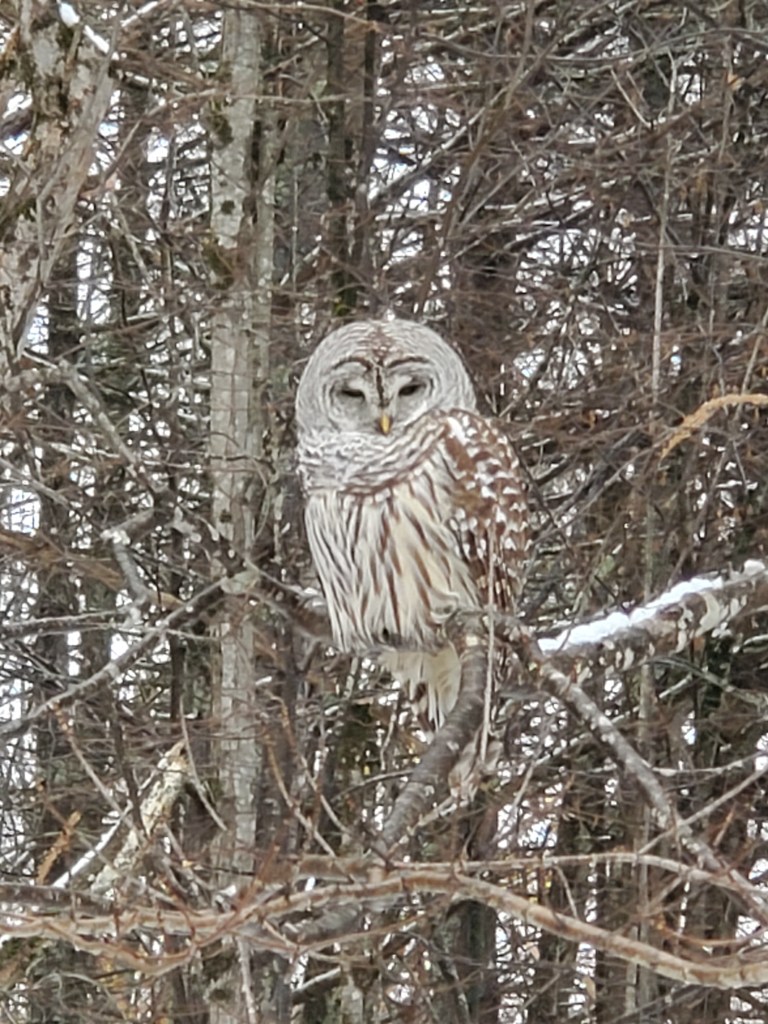
Sleepy George The path to this cadence had been less than enjoyable. After a rather miserable previous day of forcing fluids and being hungry (an ever-so-slight reminder of a chronic condition the less privileged suffer), followed by a night of intermittent waking and jet-propelled expulsions, the first thing I saw on parting the bedroom curtains at dawn was my resident barred owl, George, perched sleepily on a low branch of the fir opposite. As I’ve mentioned before, a barred owl’s “who cooks for you” cry in April 2002 had followed hard on my mother’s early morning phone call reporting news of my dad’s passing; all owls have been George ever since. So this glimpse of George I construed as a reinforcingly good omen as I faced a morning at the hospital.
And so it was. Contemporary medicine is extraordinary, and the endoscopy team at Wentworth-Douglass in Dover are a well-rehearsed cast of professionals, armed with expertise, empathy, and warmed blankets. My surgeon was a slight young woman named Sukeerti Kesar, and my anesthesiologist a handsome, quick-witted bearded man named Aamir Abbas, who posed the oft-repeated (because redundancy is standard operating procedure) question: did I have any metal in my body? When the attending nurse (Lucretia! Another good omen for a Shakespearean!) verified my two replacement hip joints, I quipped “I never leave home without ‘em.” To which Dr. Abbas added (to everyone’s delight): “You wouldn’t get far.” How very far medicine has come from the late 1950’s! My childhood tonsillectomy left me nauseated from the ether, throwing up blood on the white hospital ward sheets, and weakly calling with my sore throat for a nurse. How remarkable the current comfortable care and efficiency I was privileged to enjoy!

Virginia? Having generously driven me to the hospital and kept me company while awaiting the Main Event, my friend Jennifer then drove me home, where I went back to bed. An hour later, rising once again to peer out the window, I saw an oval of red fir in the mulched west-facing flower bed. Grabbing the binoculars I keep handy on the sill, I saw the red fir stir and reveal a fox was napping there, its bushy tail wrapped around its body. I opened the window ever so quietly to get a photo, and took several shots with my phone before my toe bumped the baseboard heater cover and made enough noise to prompt the fox to look my way, stand, stretch, and head for the woods at a leisurely trot.
How remarkable, having this totem animal of my mother Virginia, long ago nicknamed the Fox because of her penetrating gaze and uncanny ability to see through any ruse her children might construct to fool her, visit on the same day as my dad George’s owl and my hospital visit. Surely this was more reinforcement that all was well, at least where I was concerned. Three hours from arrival to departure from the hospital, I was back home, where a detailed account of the procedure, complete with photographs (!!) was already waiting for me in the Mass General portal. And on reflection, having Drs. Sukeerti Kesar and Aamir Abbas coordinate my care made me a bit less pessimistic about the capacity of differing ethnicities to share space and work together for a common compassionate good.

President Biden’s Thanksgiving Read by Heather Cox Richardson (photo by Brendan Smialowski) The balm of optimism continued to soothe as I went downstairs to cook a late Friday morning breakfast, grateful for my first solid food since Wednesday night, only to have my elevated spirits reinforced by Heather Cox Richardson, currently America’s most-read historian, being interviewed on Boston Public Radio by Jim Braude and Margery Eagan. Again expounding on her book Democracy Awakening’s themes of “how democracies can be destroyed by an authoritarian through the specific use of language and a false history, . . . how one turns the destruction of democracy into an authoritarian movement, and then, . . . crucially, how you can recapture language and history to re-establish a democracy” (HCR on BPR, 1 Dec 2023), Prof. Richardson reminds her vast audience of authoritarian challenges in the 1860’s and 1890’s when citizens nevertheless reached back to our democracy’s “true history,” the Founder’s belief, however aspirational, that in a democracy everyone has equal treatment before the law and a say in government. Listen to https://www.npr.org/podcasts/517752705/boston-public-radio to hear HCR’s account of how the 1880’s election of Garfield rebuked the Democrats’ then-racist Southern wing in favor of concentration on civil rights and eventually led to the election of FDR. Get, as self-proclaimed eternal pessimist and BPR host Jim Braude calls it, “a Garfield high.” Another reinforcement.
The rest of my post-op Friday was devoted to trimming my small table-top tree, each ornament a link to a happy time past.
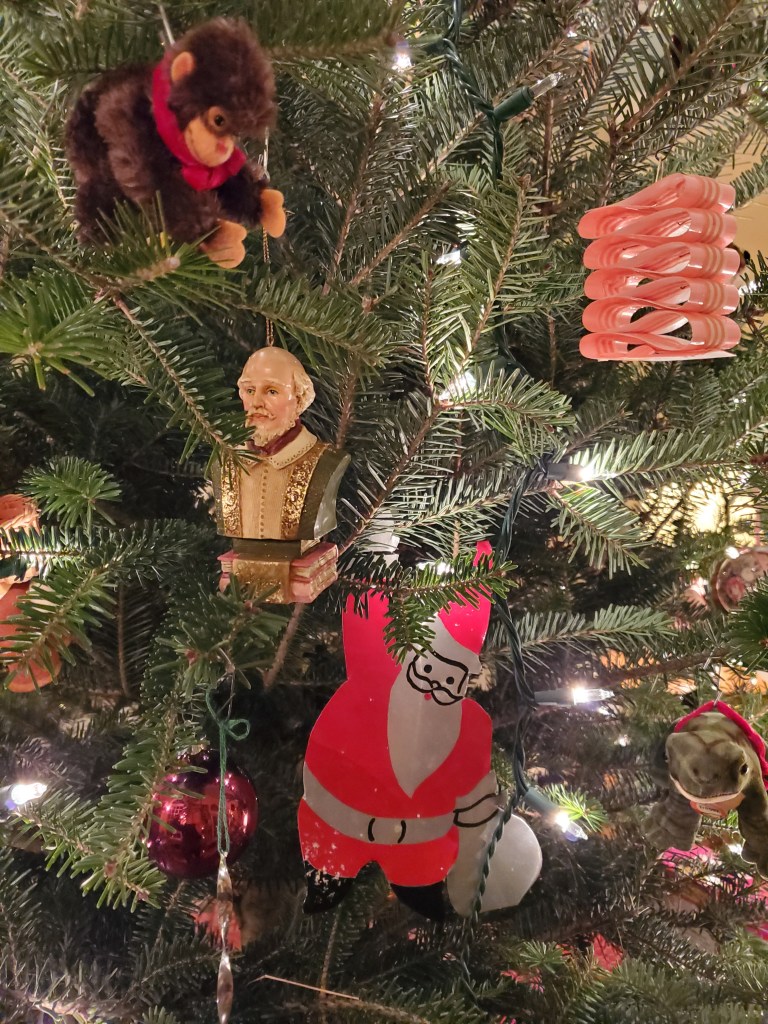
Santa, 1955, aluminum crafted by Dr. George Murphy After a good night’s rest and another fine breakfast, Saturday brought a run to a crowded Trader Joe’s filled with good-humored holiday shoppers; encouraging that atmosphere however busy the store seems a trademark policy effected by upbeat associates.
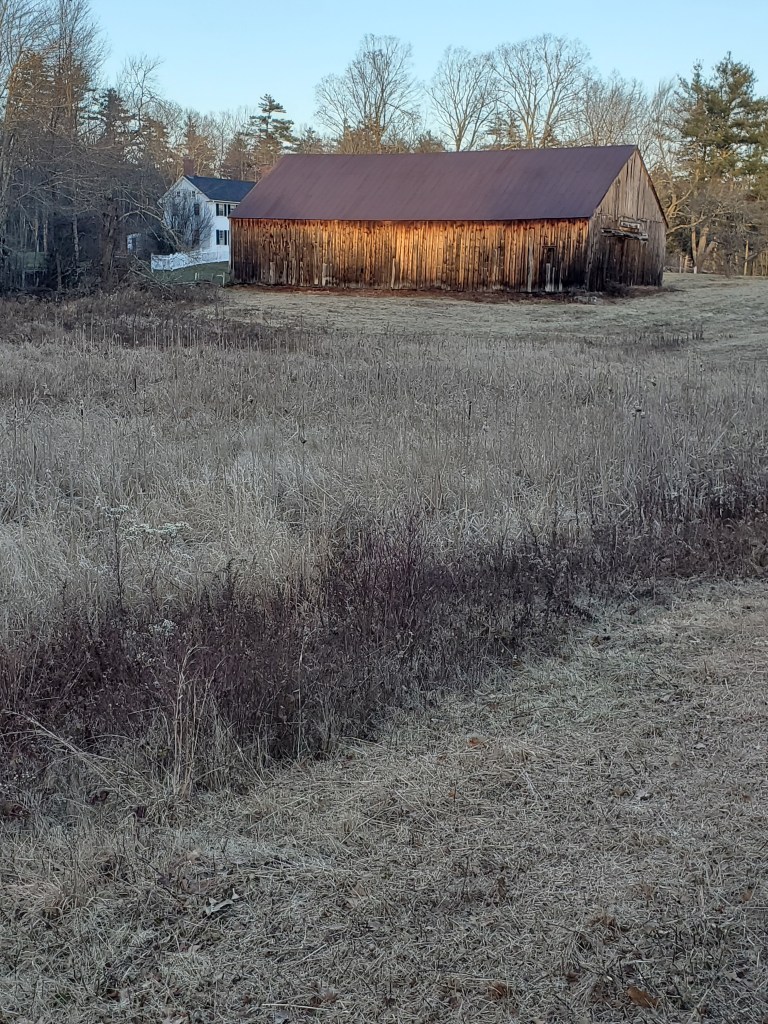
Pinehurst Farm Barn, Hayes Road, Madbury NH Then came a walk up and down Hayes Road on an uncommonly warm December day, followed by my evening’s introduction to the exceptional talent of Seacoast singer/guitarist Susie Burke and the fine musicians completing her trio, Kent Allyn and Steve Rob at the Durham United Universalist Fellowship. The set was a remarkable hybrid of witty holiday music, both comic and poignant, and folk favorites, including some terrible puns and Allyn’s hilarious Jimi Hendrix/Vince Guaraldi wa-wa reverb mash-up of “Christmas Time is Here.” Obviously deeply grieving the loss of her partner David Surette in December 2021, Burke’s performance frequently evoked her David’s presence by name, his music, and a performance by one of his students. The Gemütlichkeit in the wood-warm round of the church’s community room was palpable in the audience’s ready, easy, and occasionally funny response to the familiar and so-talented performers. My hosts Ed and Maria secured the good feeling afterward with a delicate peach galette and some superior Vin Santo. Another reinforcingly good day.
Susie Burke So. Time passes and so do we. But there are reinforcements along the way—mementos of joys past, happily anticipated meetings, and visitations—and not just from the local wildlife. The day after a fine Thanksgiving dinner with my neighbors, my 5-year-old friend next door walked through the woods between our homes to personally deliver a letter to me, stamped and sweetly addressed not to me, the recipient, but to the bearer who is just learning his alphabet. (Good choice, my wee lad, as I quite vividly recall the difficulty of spelling GEORGEANN.)

This message of joy hand-delivered by my youngest friend makes my heart sing. As did Susie Burke last night, singing “we only have now.” Why waste it?
For now can be wonderful. And sometimes, with reinforcements, quite enough.
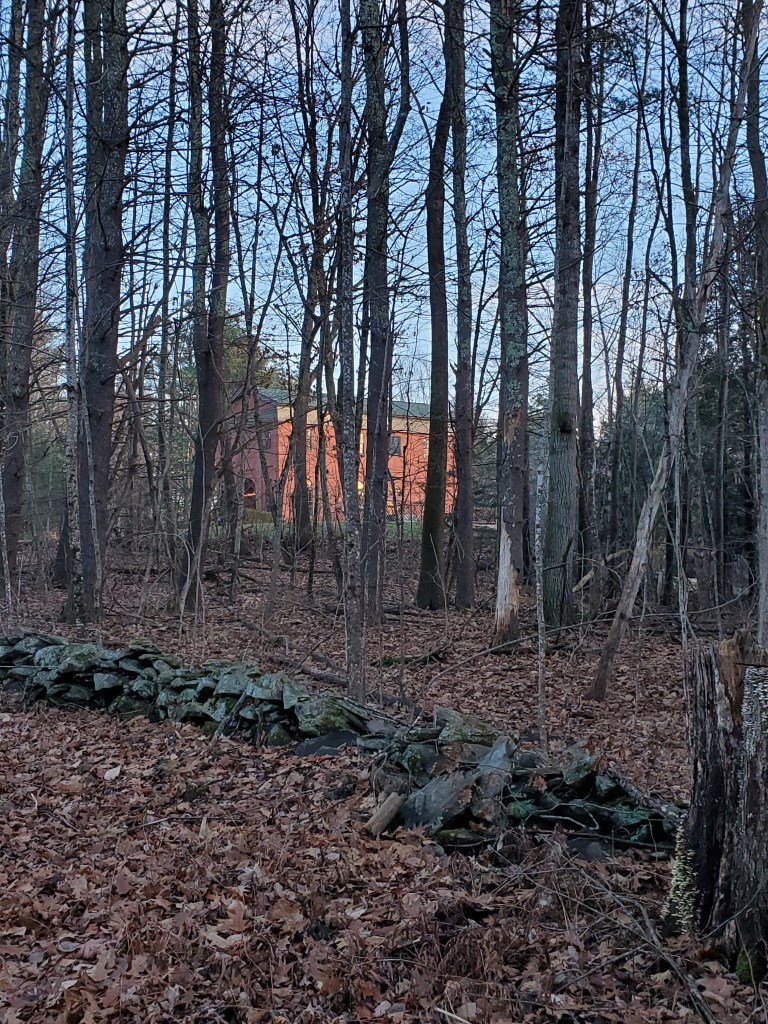
Home Sweet Home -
Dreadnaught: Holiday Edition
21 November 2023
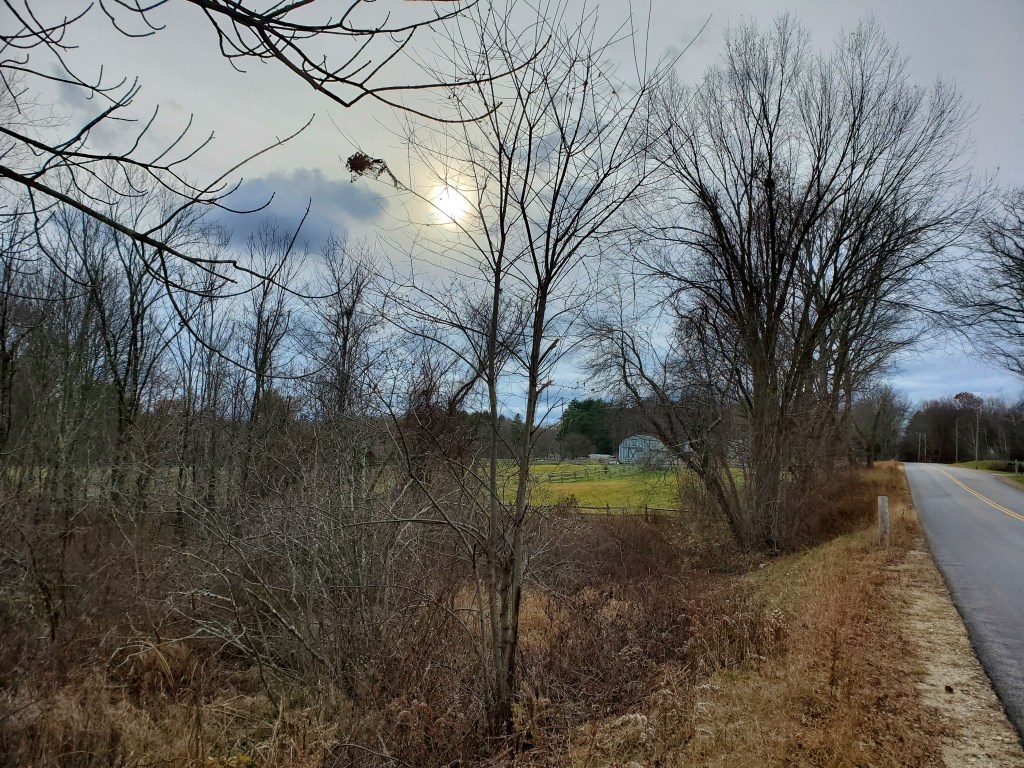
Hayes Road, 21 Nov 2023 Ah, the quick vacillating moods of the holiday season! After a pleasingly productive day yesterday, when I ticked through my to-do list with efficient aplomb, I woke this morning thinking of last night’s Netflix movie, Nyad, a film about 64-year-old Diana Nyad’s finally successful swim 111 miles across the Florida Straits from Havana to Key West. The film should have been inspirational, and certainly was graced with the world-class acting of Annette Bening and Jodie Foster. But the glancing subplot of Nyad’s pedophiliac swim coach’s assault left its disheartening stain, so much so that instead of getting out of bed at an appropriate time, I went back to sleep for another sleep cycle, which dispelled my Nyad-induced misanthropy but left me feeling guilty about wasting the morning and filled with the generalized dread that too often clouds my first waking moments
I settled at my desk rehearsing the four tenets of Stoicism I’ve been trying to practice since acquiring my copy of The Daily Stoic:
- Accept only what is true.
- Work for the common good.
- Match needs and desires with what is in your control.
- Embrace what nature has in store.
That’s when my sister Jane called to talk about her latest cancer meds, loss of appetite, and happy/sad recollections of Thanksgivings past that of course made both of us struggle with loss and, yes, more dread of what lies ahead. We did our best to keep from sinking into the slough of despond. But just after her call, I found a NYT “Best of Late Night” email directing me to Colbert’s welcoming David Letterman back to the Ed Sullivan Theatre. That sent me to You Tube to watch the whole interview: a time-wasting no no, that: day watching. When seeing Dave reclaim his Late Show desk made me cry, I knew it was time for action: oatmeal followed by a brisk walk up and down Hayes Road.

Letterman reclaims his desk from Colbert, 20 Nov 2023 And, indeed, the dependable endorphins kicked in, despite the challenge of every experience prompting comparison with the past: a Piper Warrior turning gas into noise overhead recalling our adventurous flying days, the stone wall to the west reminding me of videoing David pulling down the “For Sale” sign on the property we’d just bought. And then, so many significantly wonderful Thanksgivings came to mind: my mother’s milk glass on the table when I first returned home from college with my typewriter in my suitcase because I had a paper to finish; entertaining all the Americans abroad in London after marching across Regents Park to fetch some oysters in the shell; forming a “bucket brigade” line from the dumb waiter to our big library table the year we had 16 over for a dinner of everything except the two farm-fresh turkeys I’d bought because the ice storm brought the power lines down and the oven was out of commission.
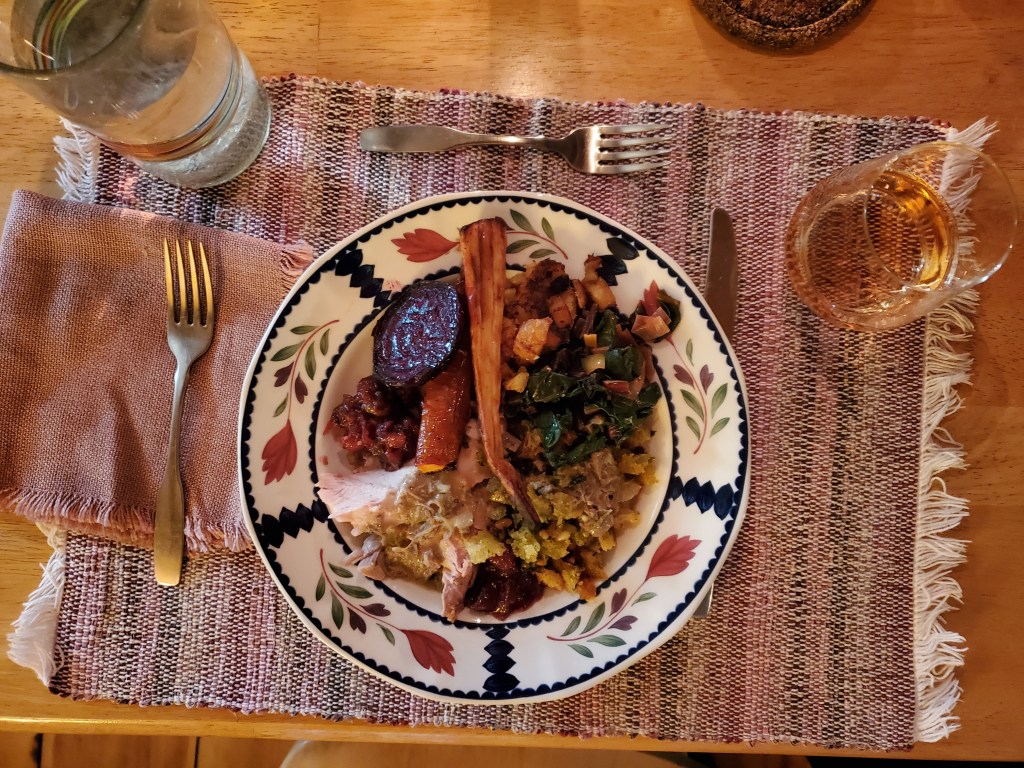
Thanksgiving bounty 2022 courtesy of Michael and Susan Of course, recent days have brought pleasures great and small. Marianne and Otto, dear friends of 30+ years, came to visit from Munich; we had a lovely time at the Portland Symphony, catching up on a familiar stroll ‘round Wagon Hill, and sharing the great pleasure of putting old and newer friends together over cocktails.
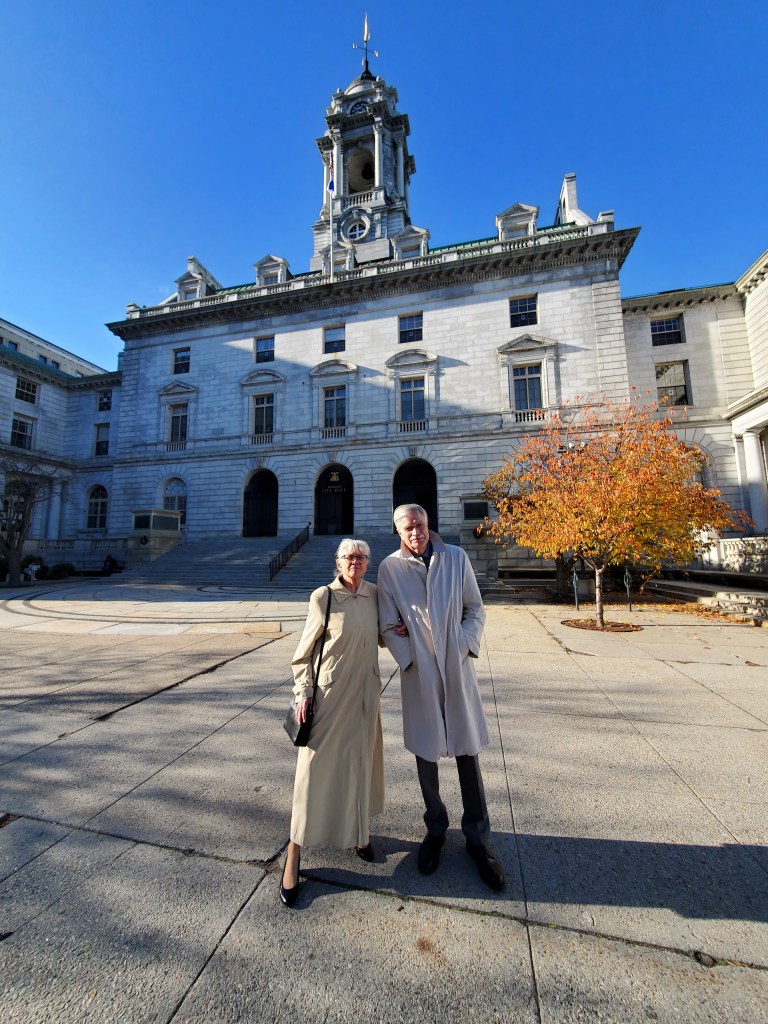
Marianne & Otto at Portland City Hall, built 1909-1912 
Visiting Wagon Hill, Durham NH 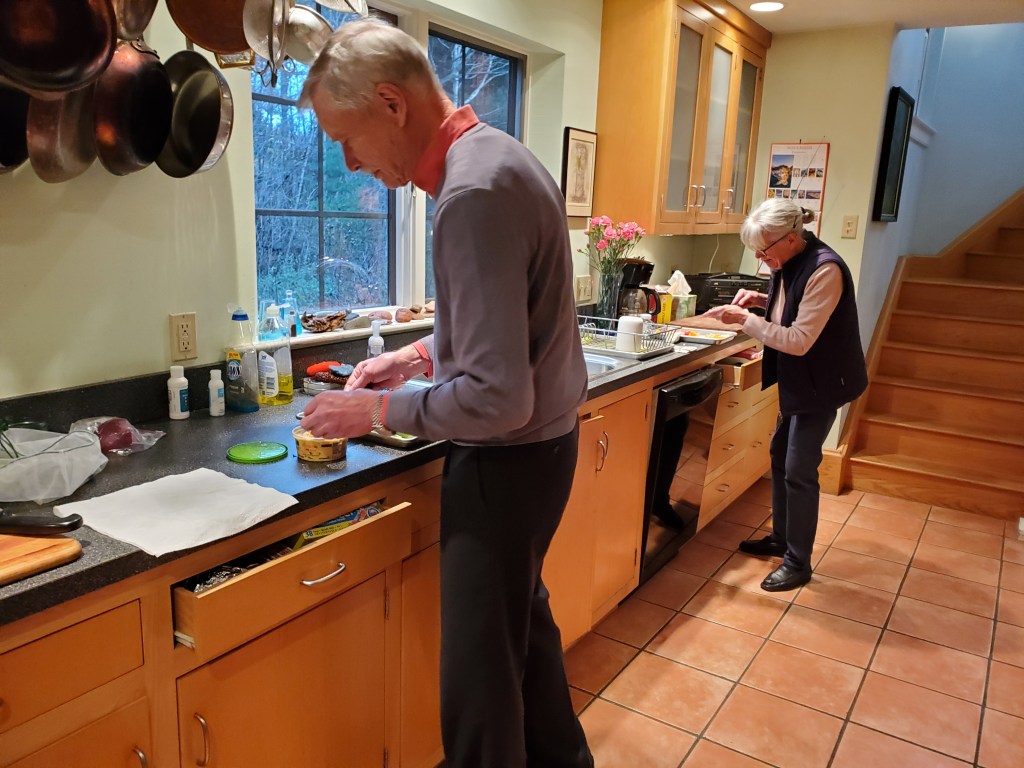
Deploying Gastarbeiter 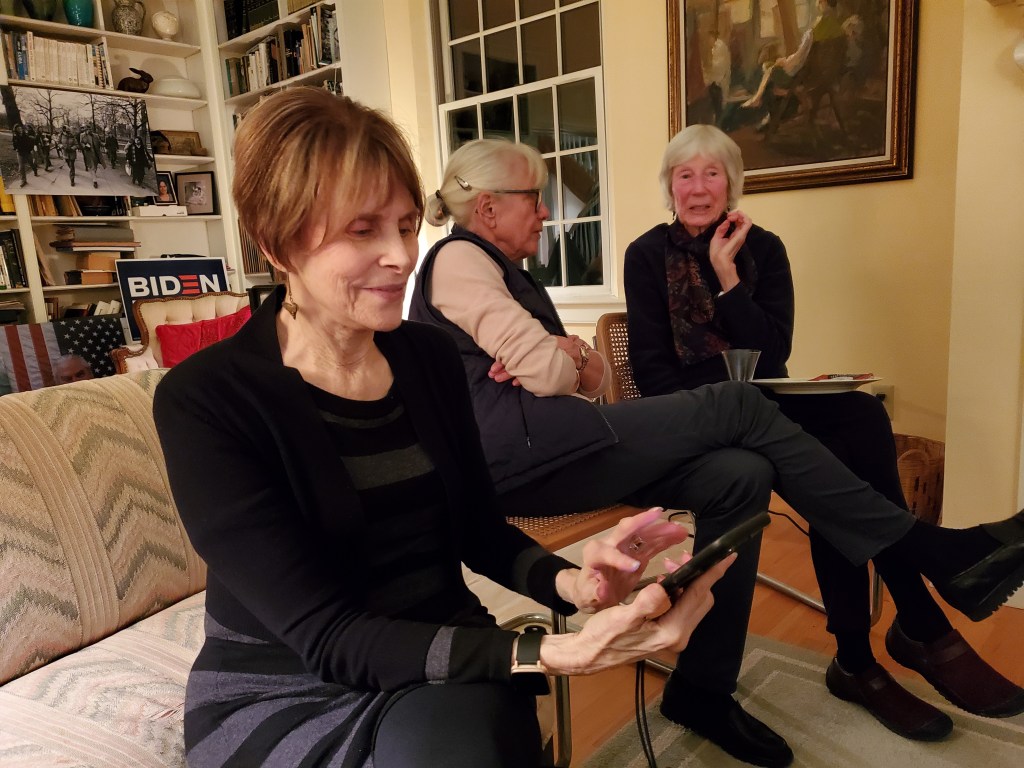
Carol, Marianne, and Jennifer . . . 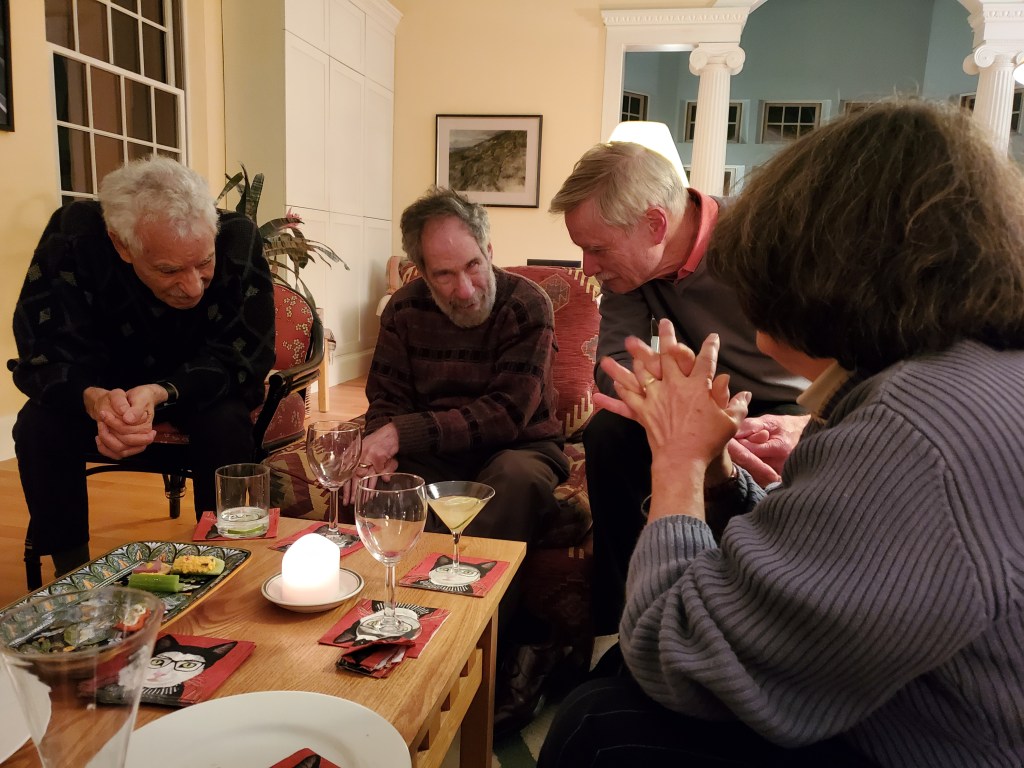
Barry, David, Otto, and Susan: Old and New World Friends Strangers, too, seemed to embrace a holiday kindness—at the E-Z Pass service center, of all places, no one complained of the wait and folks in line smiled at each other; a couple even started a conversation and discovered mutual acquaintances. When I bumped into and spilled a bowl of Market Basket chocolate chip cookies, a fellow Thanksgiving-scrum shopper immediately helped me pick them up—and even offered my embarrassed self absolution: “Everyone makes mistakes!” And a couple of days back, my blowing leaves into our woods led to my recovering the bird feeder a bear had absconded with early last summer, unbroken save for a missing perch. When I told the Wild Birds shop owner of my happy discovery, he gave me the very part I needed to replace free of charge. And I got a lovely message from my long-time friend Ann now teaching in Toyko. Email from abroad still strikes me as delightfully rare and strange, a happy techno miracle.
So. I’ll overlook the theft of my recycle garbage can last Friday; guess that gives new meaning to recycling. I’ll try my best to comfort my sister. And I’ll remember that the presidential election is still a year away and endeavor to ignore the polls that put that unspeakable candidate ahead of birthday boy Biden. There is cranberry chutney to make for Thanksgiving dinner at my wonderful neighbors’ home come Thursday, Christmas cards to begin addressing, and much to be thankful for, past and present. A scroll through the past year’s photos on my phone provides tonic ocular proof.
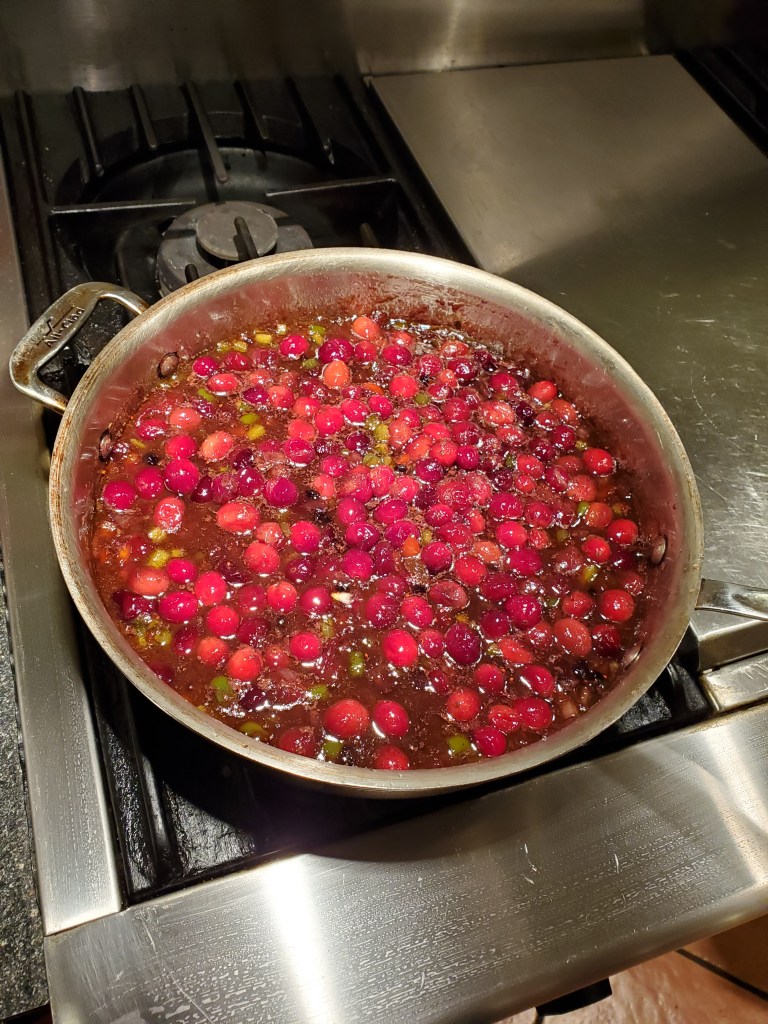
Chutney prep “Dreadnought,” I find, can be a battleship (after the 1906 HMS Dreadnought), an acoustic guitar body, a warm coat, and a fearless person. But it’s also good advice: Dread naught, Dear Readers, and seize the day of giving thanks.

My favorite Thanksgiving guest, George
-
Fall Back
4 November 2023

OMG. Already? At 2 pm yesterday GBH newscaster Henry Santoro reminded listeners that we return to Standard Time tonight, “moving from sunshine and happiness to darkness and misery.” As I type this at 6.20 pm, I’m hearing some fireworks—early Guy Fawkes reveling? Or just someone protesting this tipping of too-delicately-balanced psyches toward Seasonal Affective Disorder? Tomorrow night, 5 November, the sun will set in Madbury NH at 4.31. Oy.
I’m wondering if you, Dear Readers, also find this time of year a trial. The news remains debilitatingly oppressive, and since I last posted about “the helpers” on whom I try to focus, Robert Card killed 18 people in Lewiston, Maine and then himself, despite repeated alerts from all who knew him that he was mentally unstable, armed, and dangerous. The morning after he was discovered dead but before I’d heard the news that he’d been found, the first thing I saw out my bedroom window was a man in camouflage holding a rifle walking along the edge of our woods to the west. It took a skipped heartbeat before I recalled it was hunting season. And ever since, I’ve tried to avoid too much news of children in Gaza writing their names on their arms so that they can be identified, and local moms taking photos of their kids each morning before school to record what they are wearing—just in case.
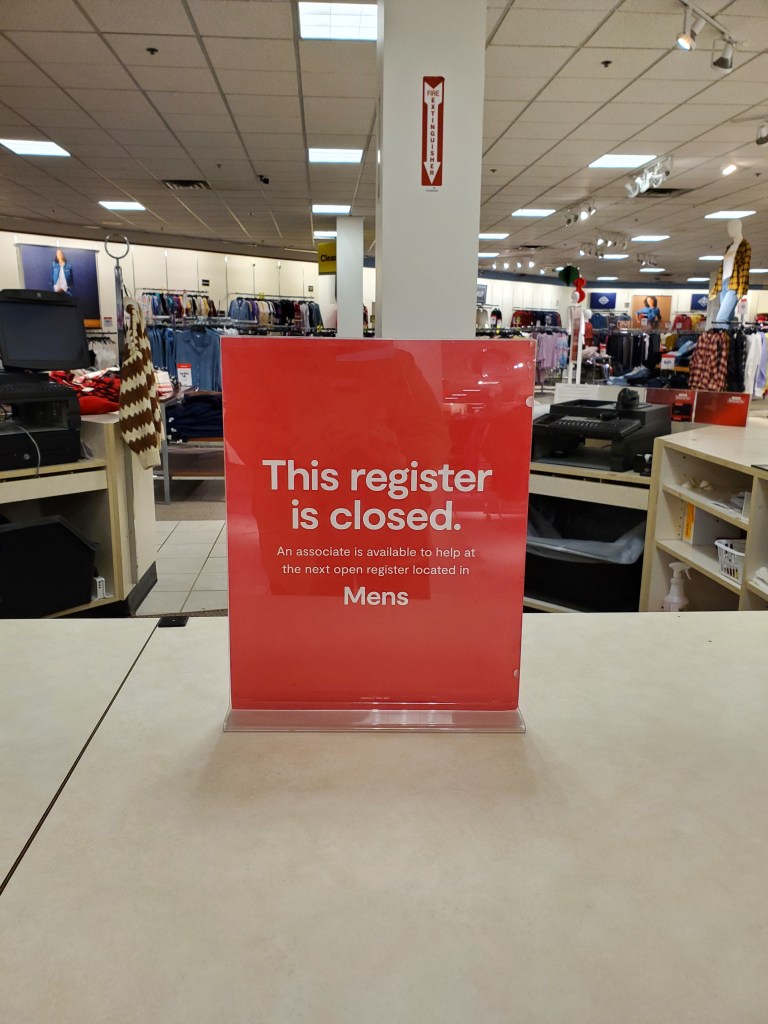
Down and Out at the Fox Run Mall And then yesterday I went to the Fox Run Mall in Newington NH for the first time in years, pursuing a futile quest for martini glasses to replace my chipped ones. Even though I find my constitution no longer up to any but the teeniest of martinis, guests are coming soon who are, I suspect, heartier than I am. Sears, one of the Mall’s anchor stores, closed there in 2019 about the time that original big box store declared bankruptcy after 130 years in business, and the Mall now is a mostly deserted, depressing husk of its former self evidencing another retail era gone by.
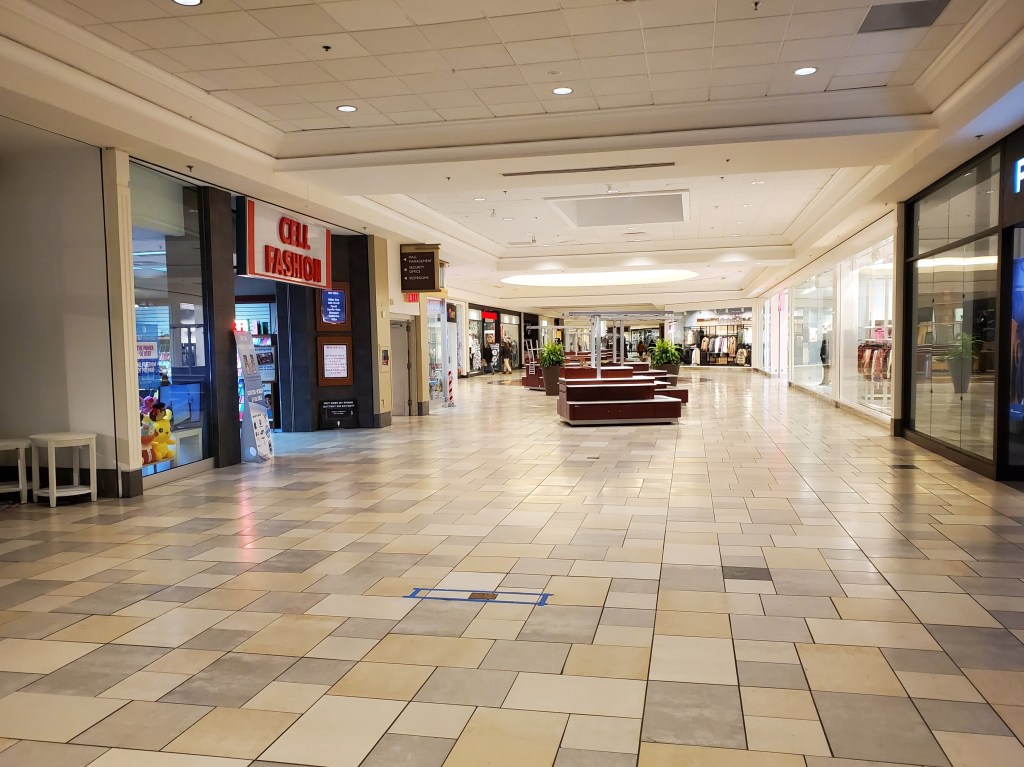
The Big Empty When I was a child in the late ‘50’s and early 60’s, my mother and I dressed up (crinolines and gloves!) to go to downtown St. Petersburg’s Maas Brothers, or, when visiting the grandparents in Ohio, downtown Dayton’s Rike’s, where she had once frugally, piece-by-piece, purchased with her IBM secretarial salary her 1947 trousseau. My off-to-college clothes in 1970 all came from either J. C. Penney’s or Sears, which I then thought a significant step up from anything my mother had sewn for me. But Penney’s and Sears’s much ritzier relatives, the grand emporia established at the end of the 19th century, even then could not long endure. By the time I got to grad school at Tulane and worked in the summer of 1977 as a waitress at D. H. Holmes in New Orleans, one of the first department stores in the country opened on Canal Street in 1849, that Grand Dame was already in decline. Patrons at the in-store restaurant Potpourri most evenings were widows living in the Quarter taking advantage of wonderful cooking at budget prices. I didn’t make much money there, but boy, did I eat well! I can taste the red beans and rice, bread pudding, and Peacemaker sandwiches (buttered French bread and fried oysters) in my mind’s palate now.
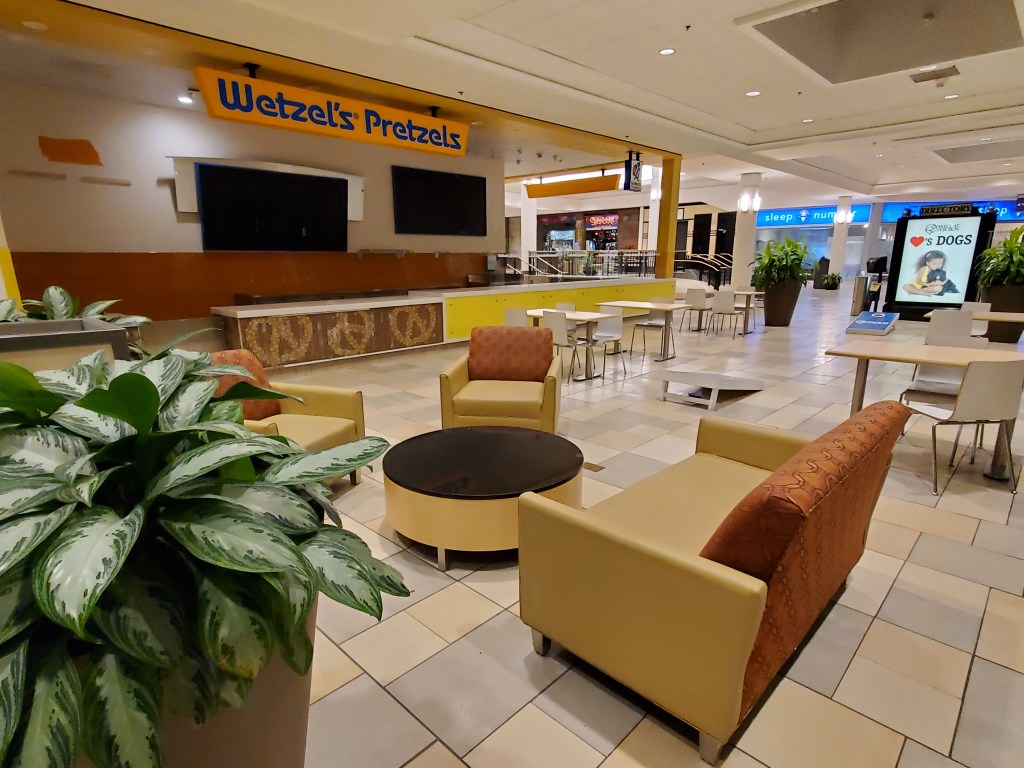
A far cry from Potpourri on Bourbon Street & Canal 
Bargain Fashion? With the passing of the department stores, those magnificent cathedrals of commerce, came the malls. When I taught summer school at Phillips Exeter Academy in Exeter NH in the summer of 1985, I thought Newington’s Fox Run the nonpareil, certainly without rival in my new Kentucky home. Foxy no more, that mall is now a rather creepy ghost of its former self, its affect made all the more grotesque by the early intrusion of Christmas trimmings juxtaposed with marked down Halloween crap.

Where have all the Santas gone? Falling back indeed.
So how is it that in lieu of martini glasses of appropriate proportion (not the impossibly capacious ones that seem to be all that’s on offer these days), finding a clever cabbage-leaf platter for a coming cocktail party marked down at Target from $20 to $2 can, however briefly, lift my spirits?

Prized Purchase Actually, I think it was less that bargain purchase that perked me up than it was the overheard half of a phone conversation entertaining me as I waited in line to pick up my new leaf blower at the Home Depot customer service desk: “You want to return a kitchen? We don’t have $12,000 on hand to refund. Wait, l think I remember you. Let me speak to the manager.” At which point, the HD associate on the phone and I exchanged eye rolls, a shrug, and a silent laugh. Once she hung up, she clued me in: “They came in with credit cards and buckets of cash; he used a card, but she used the cash. I’m really hoping to learn the rest of the story!” Ah, capitalism in these latter days.
Maybe all I need is more such encounters with mysterious absurdities connecting strangers. And that extra hour of sleep.
Set the clocks back and enjoy.
Pleasant dreams!
-
October Miscellany: The Helpers
23 October 2023
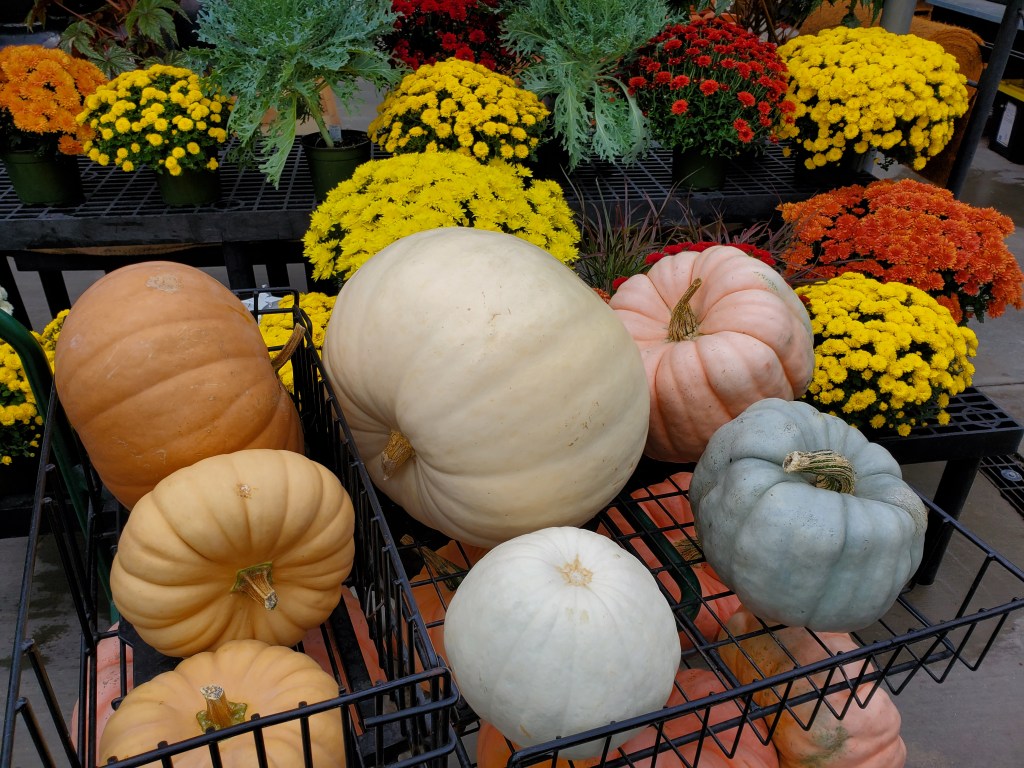
Display at Wentworth Nursery, Rollinsford NH As my birth month draws to a close, I can report I’ve enjoyed weeks crowded with happy personal incident. And so, Dear Readers, as I suggested last post, it’s the helpers I catalog here, turning away quite deliberately from the horrors of the 24-hour news cycle.
Here they are, in chronological order:
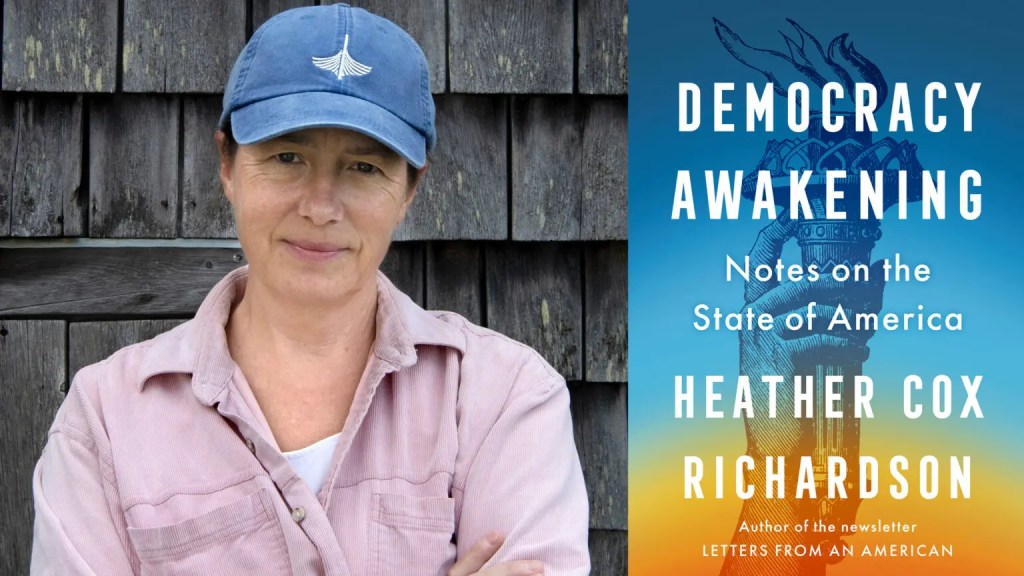
Heather Cox Richardson, whose daily, always grounding posts, “Letters from an American,” both inform and solace with the balm of historical perspective. Her 29 September appearance at the Portsmouth Music Hall’s “Writers on a New England Stage” program, beginning hours behind schedule due to that day’s extraordinary rainfall in NYC, testified to the loyalty of her following. NO one complained; rather, we all waited patiently and gave her a rock star welcome when at last she arrived on stage. As my friend Carol remarked: “That audience would have followed her over a cliff.” Richardson’s account of how our democracy got to where we are now, what has changed, and how we can move forward bear review: https://podcasts.apple.com/us/podcast/heather-cox-richardson-2023/id1709704692?i=1000630049353.
Richardson’s offhand remark about how hard it is for an author to let go of her book also struck a personal bull’s eye with me as I so slowly review my editor’s track changes to my own magnum opus, Will to Live: Learning from Shakespeare How to Be—and NOT to Be (coming asap to Amazon, Dear Readers!). The problem: by the time you finish writing the book, you know more than you did when you began, so the impulse is to go back to the beginning and re-write—a vicious, unending cycle. Richardson’s friend’s advice: when you get to the end of your book, START THE NEXT BOOK! Since Richardson and I are fellow Libras and share a birthday, I am taking that advice as also meant for me. She is, however, a decade younger, and on her birthday this year earned fourth place on the NYT non-fiction bestseller list. Well, you gotta have a dream, right?
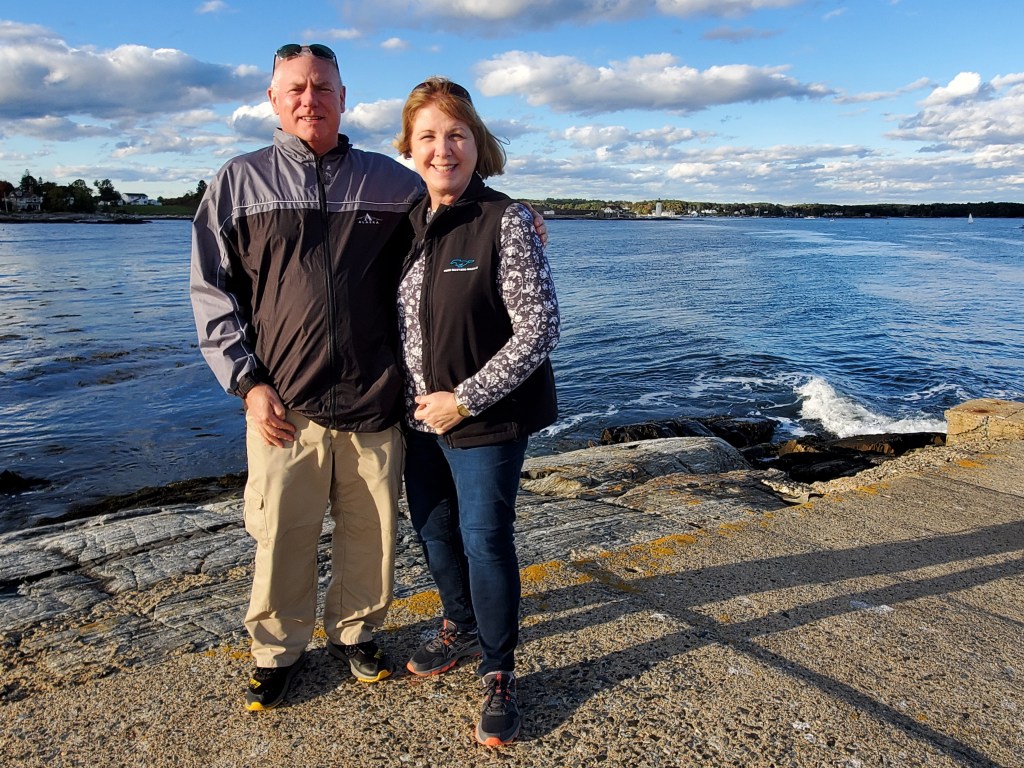
Rob and Pam on the jetty at Great Island Common, New Castle NH 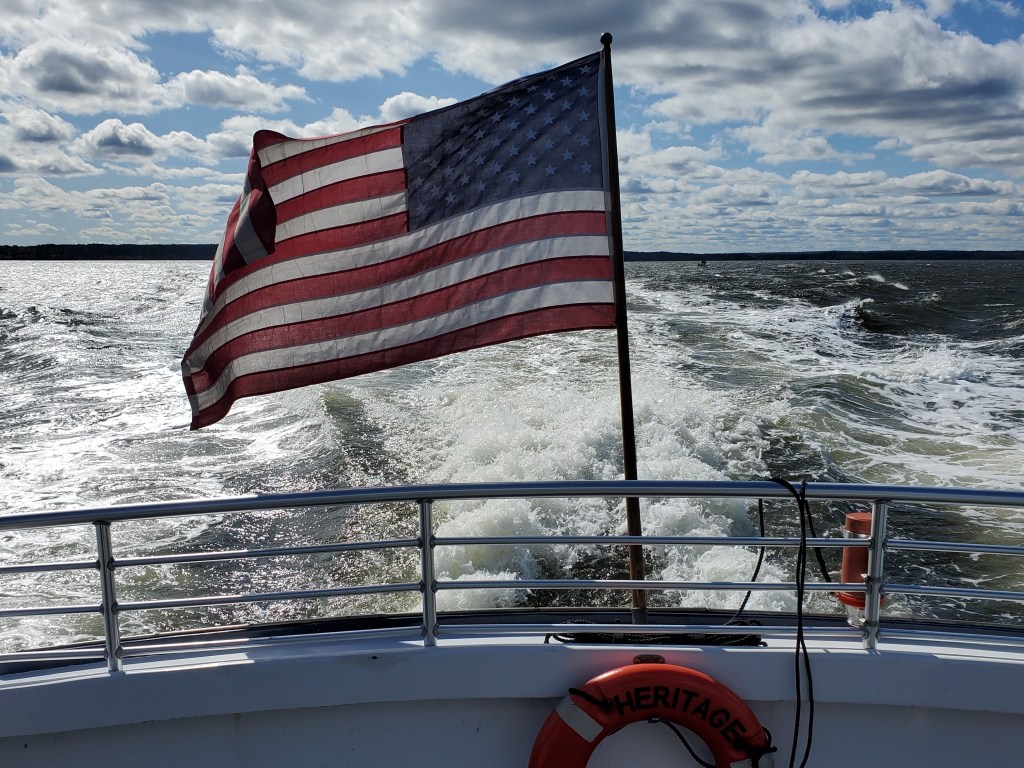
Cruising Great Bay aboard Portsmouth Harbor Cruises vessel Heritage My nephew and niece, Rob and Pam Andrew, visited me from Oklahoma over my birthday weekend and made good on their insistence that I am an important part of their family. Among their thoughtful gifts: a Shutterfly album full of family photographs of my late Andrew parents-in-law, who departed this life before I could ever meet them in person, and a book formative in Rob’s young life so I could “get to know him better.” Also, a fine dinner out, and—best of all—their comfortable, excellent company, which made turning 71 a real pleasure.

Barrier Beach Trail, Laudholm Farm, Wells ME 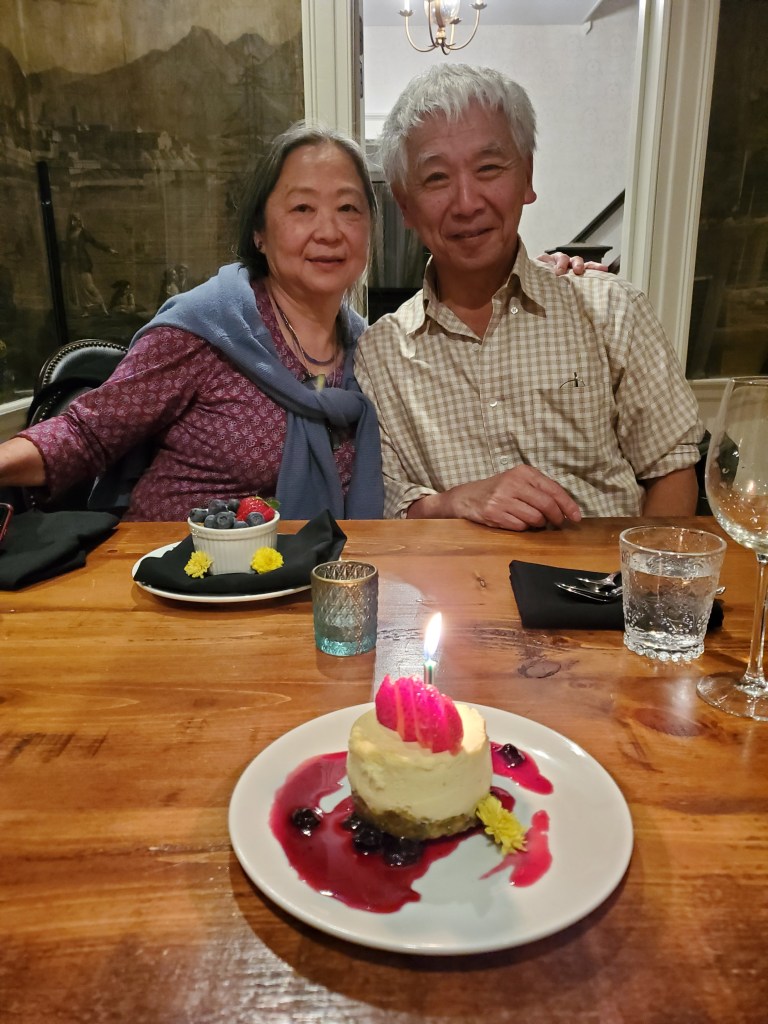
Birthday cheesecake at Dufour’s with SP and Brian The next week Shiao-Ping and Brian made sure the celebrating continued by introducing me to a wonderful, nearly deserted beach, part of the Wells Reserve in Maine, after which we had a fine meal at Dufour in South Berwick, another first for me. That Friday, 13 October marked exactly four years since they and so many other friends and family gathered at Gnawwood to remember my David. Still in the initial throes of grief shortly after David’s death, SP and Brian scooped me up and took me to another beautiful shore, Parsons Beach in Kennebunk, for the salutary balm of a day by the sea. Helpers indeed, those two.
Brian tests the temperature, Laudholm Beach, Wells ME 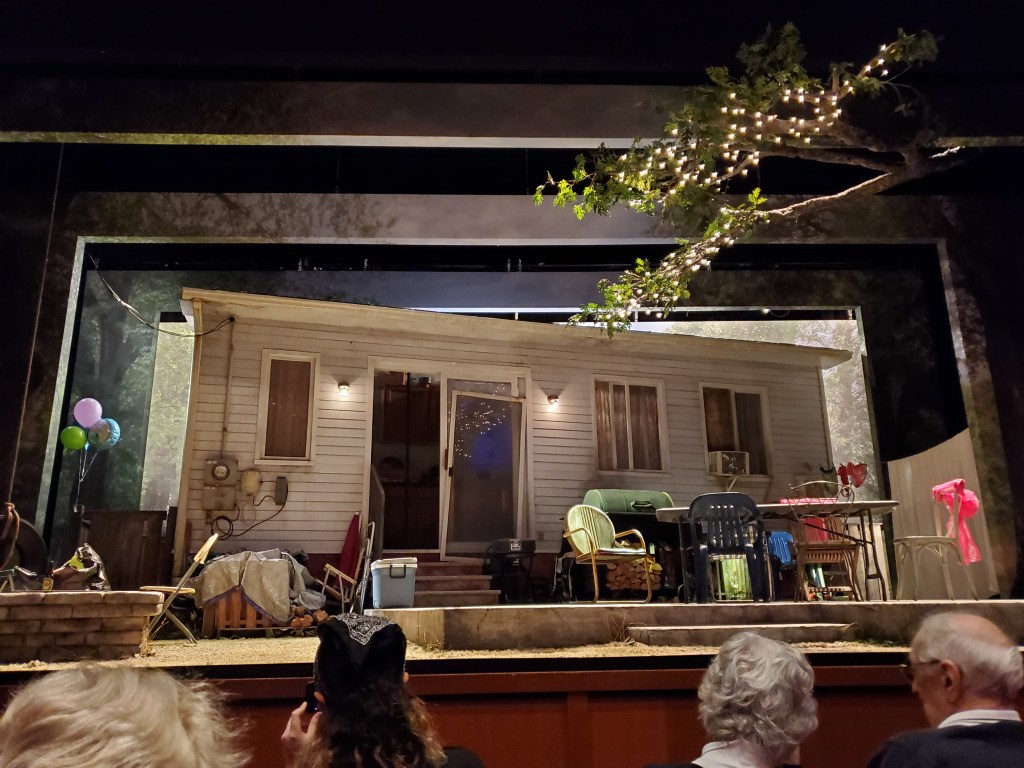
FAT HAM set by Luciana Stecconi The day after our Wells Preserve visit I made my way back down to Boston to see the Huntington’s production of Fat Ham, James Ijames’s reinvention of Hamlet as a comic Southern backyard barbeque and coming-out party. The Wimberly Theatre at the Calderwood/Boston Center for the Arts is an intimate 372-seat space, and I sat in the center of the third row, happily close to the action. Riffs on Hamlet are lots of fun for me, and I always feel right at home in theatres, so while the play itself lacked some of the pizazz I expected, the mise en scène and jolly, OTT performances helped me shuffle off care for a tight 90 minutes.
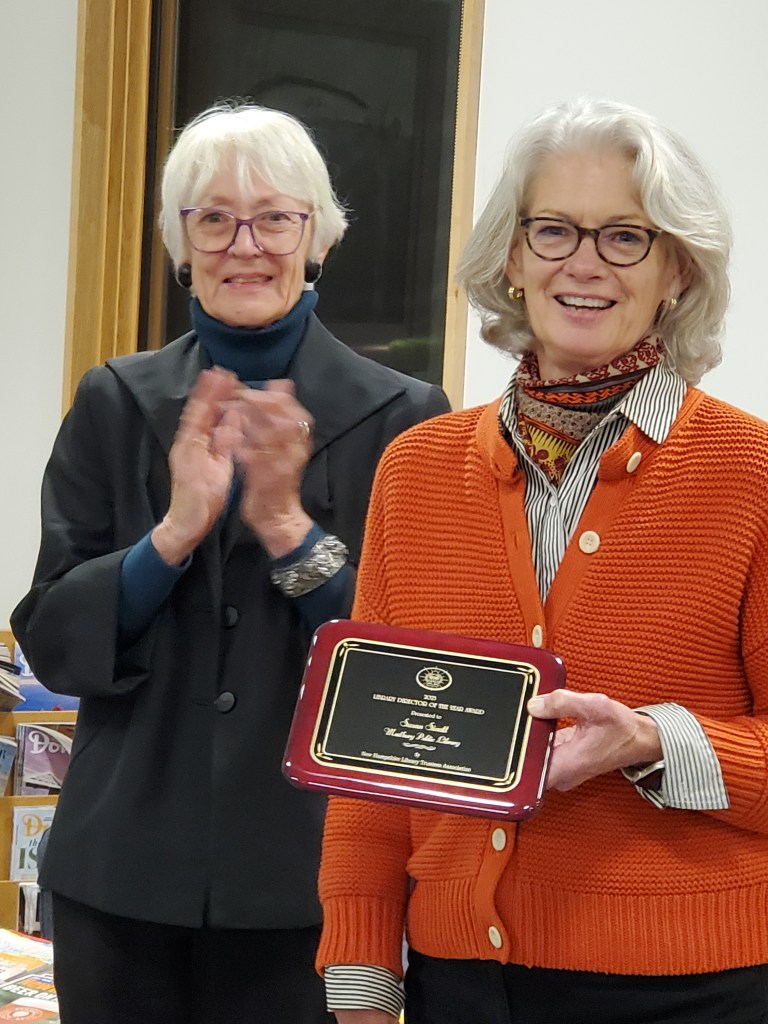
Susan Sinnott, NH Library Director of the Year 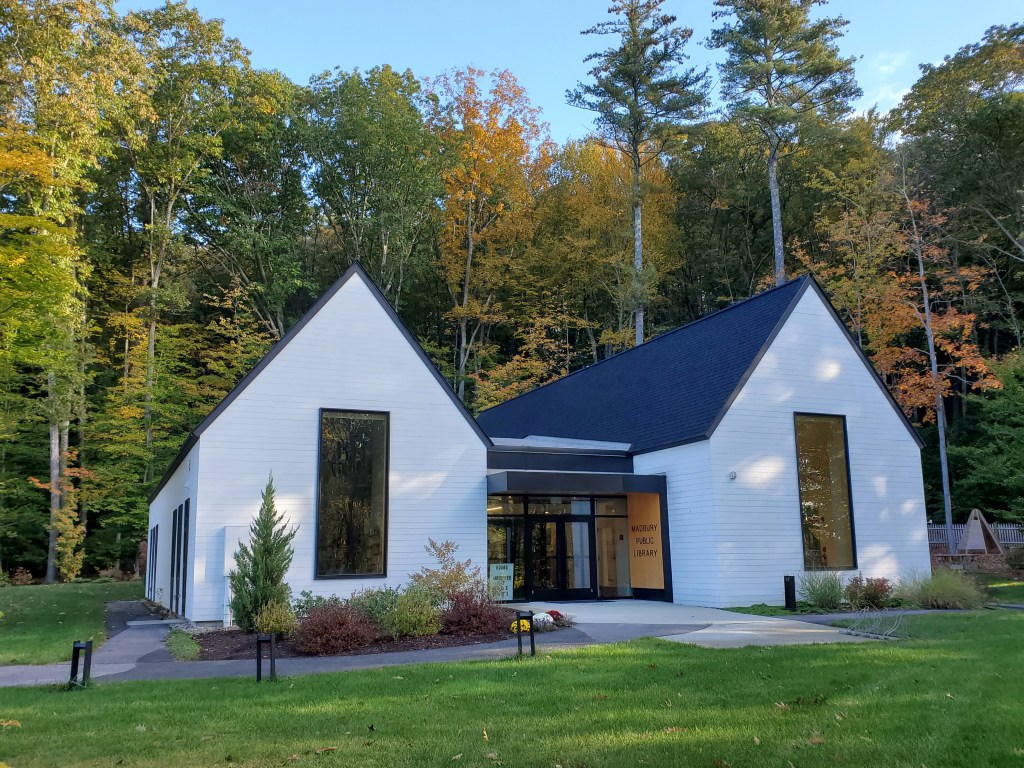
The beautiful Madbury Public Library The next Monday, 16 September, brought a delightful opportunity to celebrate someone else: Susan Sinnott, Director of the Madbury Public Library, where since last April I’ve been serving as an alternate trustee. Nominated by us trustees and now in her 10th year of serving Madbury, since 2019 in the lovely new library she helped establish, Susan won this year’s NH Library Director of the Year award offered by the New Hampshire Library Trustees Association, further distinguishing the MPL among the other 233 NH libraries. So gratifying to see the hard work of a saavy, modest professional appreciated for the talented helper she is.
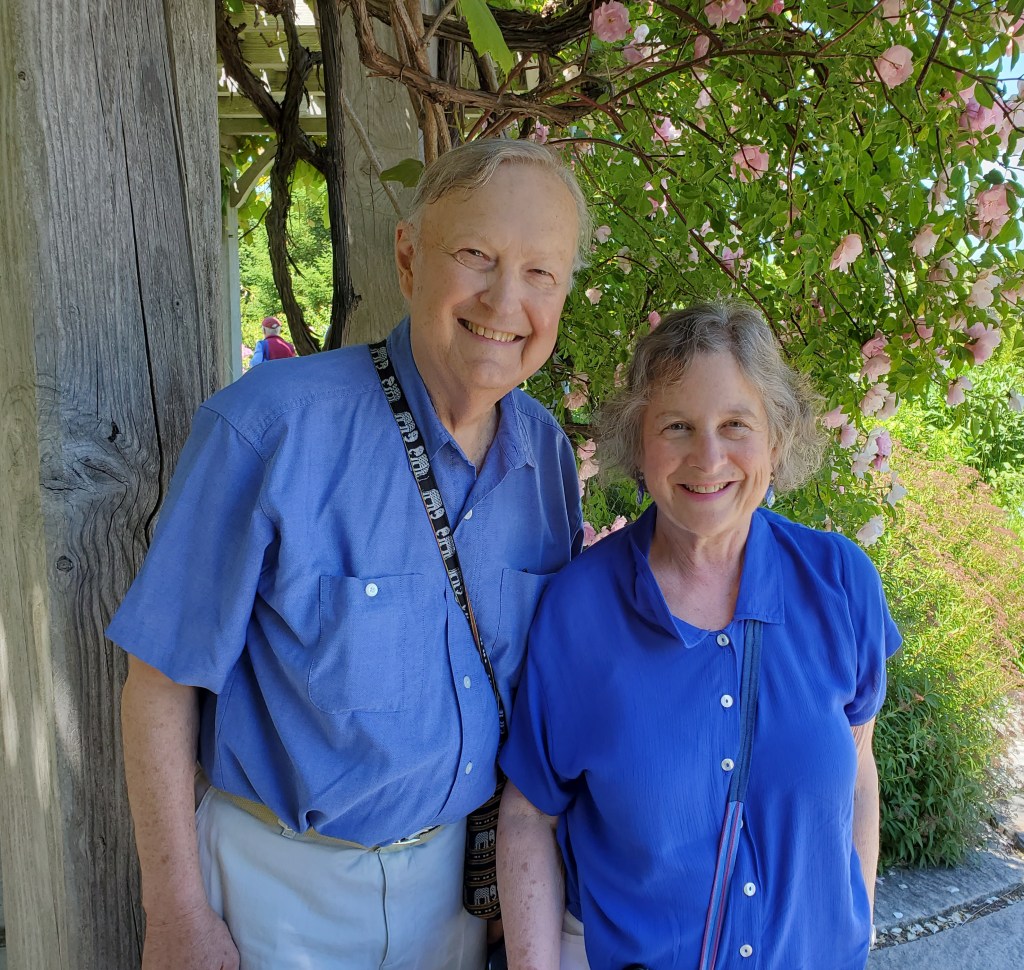
Jack and Vicky Myers at the Coastal Maine Botanical Gardens, 24 June 2021 Then two days ago, an extraordinary helper of another kind, Dr. H. Jack Myers, who passed away last February, was eloquently celebrated by his friends and family in a very well attended and gratifying memorial gathering at the Durham Community Church. Surgeon, pianist/organist, and vocalist with perfect pitch (he and his wife Vicky, also a gifted musician, met in local vocal group Amare Cantare), Jack was clearly adored by patients and fellow medical professionals alike, and with Drs. Sonneborn and Paul co-founded the excellent Seacoast Cancer Center at Wentworth Douglass Hospital in Dover. Vicky and Jack lived just down the road from me for years, though it took my meeting Vicky at a Tai Chi class just a few years ago to introduce me to Jack, who bore his own final illness with humor, fortitude, and grace. Each of the 13 speakers (13!) who shared memories of Jack was succinct, witty, and affecting. A good day, celebrating a good man who touched—and saved!—so many lives.

“Heavenly Blue” morning glories in bloom–in late October??!! And then, there is Public Radio, my constant helper and companion, filling my days with entertainment, enlightenment, and the best company: my Public Radio Pals. Most recently, a re-broadcast of Radiolab’s “The Fellowship of the Tree Rings” (https://www.youtube.com/watch?v=N4e-HMtsdOY) helped me put into context the blooming of my morning glories well into late October (a phenomenon also confirmed by my friends Marianne and Otto in Munich) and brought home once again the importance of the phrase E. M. Forster used as epigraph for his novel, Howards End: “Only connect.” Listen, as I did, to learn how tree rings yield information about hurricanes, shipwrecks, pirates, low solar activity (the Maunder Minimum from 1645-1725), sugar plantations, slavery, and the birth of capitalism. Dendrochronologists and paleoclimatologists unite to reveal how the past predicts the future. Here’s to the scientists and the science they serve.
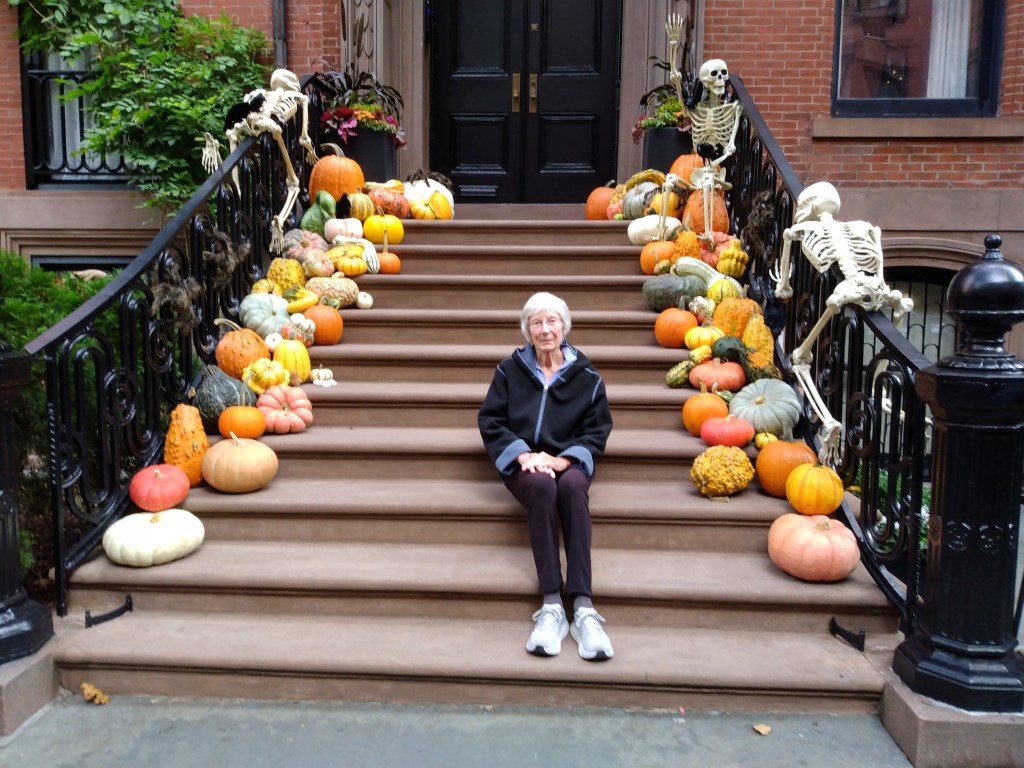
Jennifer and Friends on West 10th Street, NYC Closer to home and Halloween, there’s my good friend Jennifer, enjoying a moment on a West 10th street stoop in NYC, and helping me recall how much I have always loved Halloween.
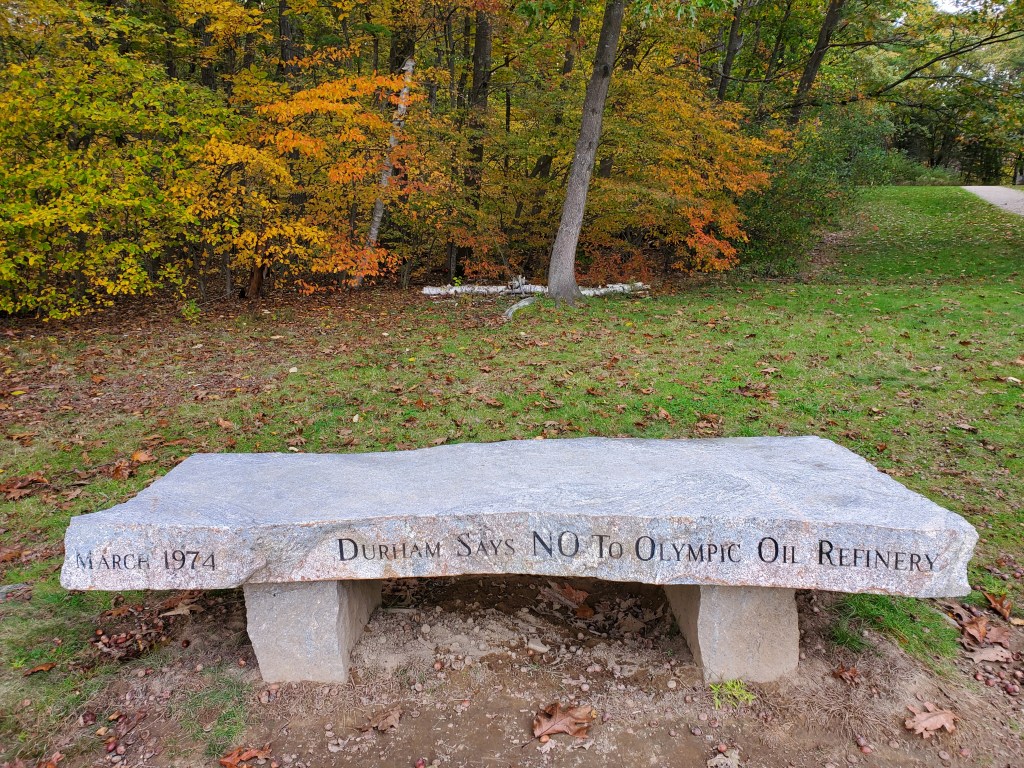
Victory memorialized 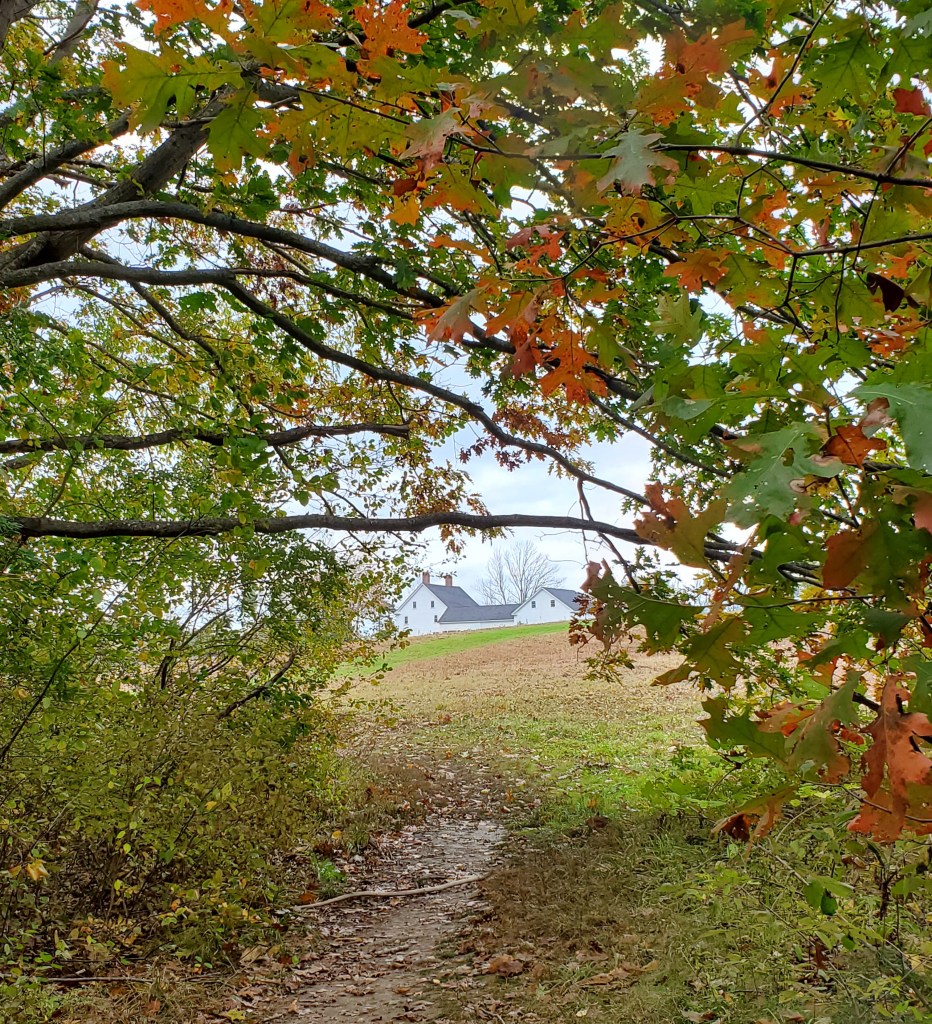
Homestead at Wagon Hill Farm, Durham NH And thanks to the Durham citizens, led by John and Maryanna Hatch, who in 1974 saved Wagon Hill from the oily grasp of Aristotle Onassis, a real David-over-Goliath victory. Because of them we still have preserved in perpetuity some of the most beautiful views on the seacoast.
Helpers all, I salute you!

Madbury reservoir, 23 October 2023
-
Subscribe
Subscribed
Already have a WordPress.com account? Log in now.
 Georgeann Murphy