-
Time passing
17 August 2024
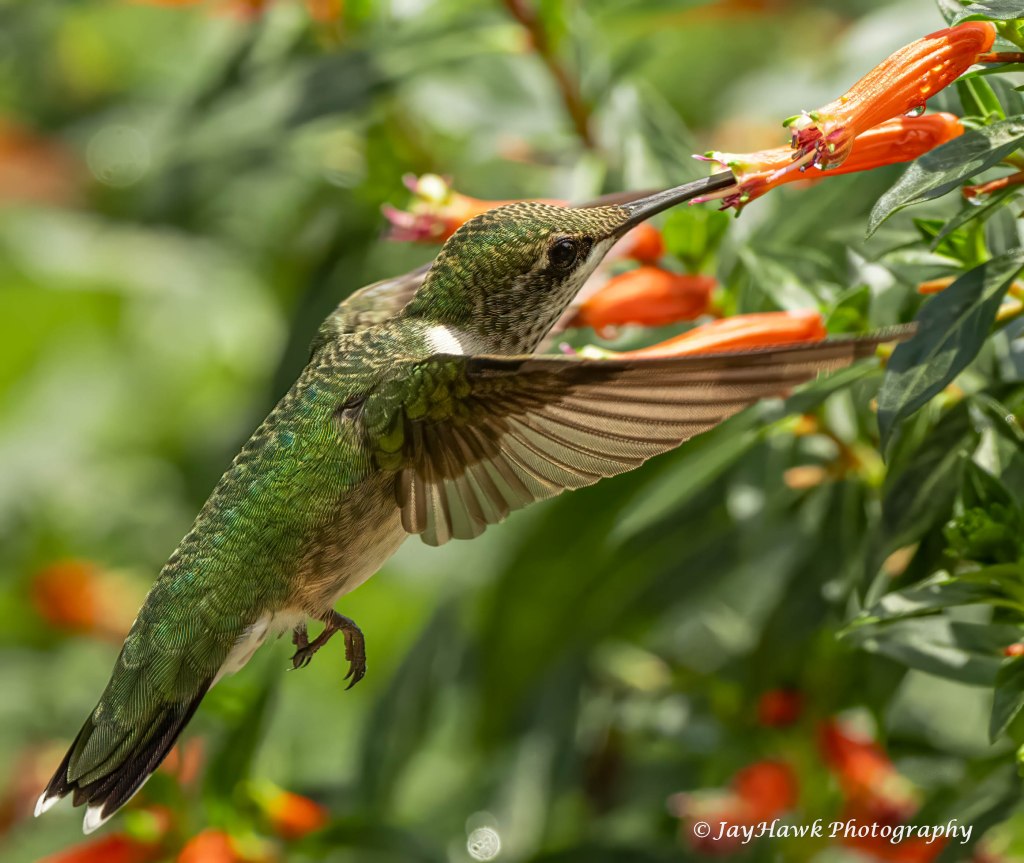
One of the few still-visiting hummers captured by my friend Jay Richard Today, 17 August 2024, marks the six-months anniversary of my sister Jane’s passing, and this morning I learned that my beloved friend and former colleague, Roberta White, died this morning in Danville, Kentucky, where “Bobbie” was and remained my mentor and model as an accomplished scholar; skilled and beloved Centre College professor; fair and efficient administrator; and steadfast, Stoic, witty fellow traveler on life’s journey. My last few days have been dominated by yet one more “final” revision of the book I hope will go to press by month’s end; I learned the sad however expected news of Bobbie’s passing as I was completing those corrections, including the page where I acknowledge Prof. White among the handful of others who supported and encouraged this young professor, tacitly challenging me to live up to the highest standards of teaching and collegiality.
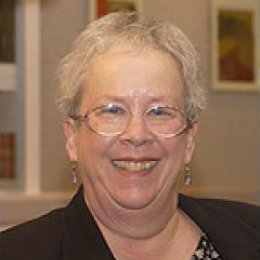
RIP Roberta White 1938-2024 Time is passing. The lion’s share of my days seem spent in body and house maintenance, though this past week brought some happy surprises: a wide bore MRI machine that minimized my claustrophobia with a light and slide show as well as a fan blowing cool air on my face, and a visit from “stucco man” Greg Thulander, who was last here in 2009 when he brought his little girl along to watch his repair work. She’s now a woman with a master’s degree and working for Harvard. I also met some new folks, like me trying on a variety of future plans, helping each other through the Seacoast Village Project and investigating aging in place with support from the Silverstone “At Home by Hunt” program.
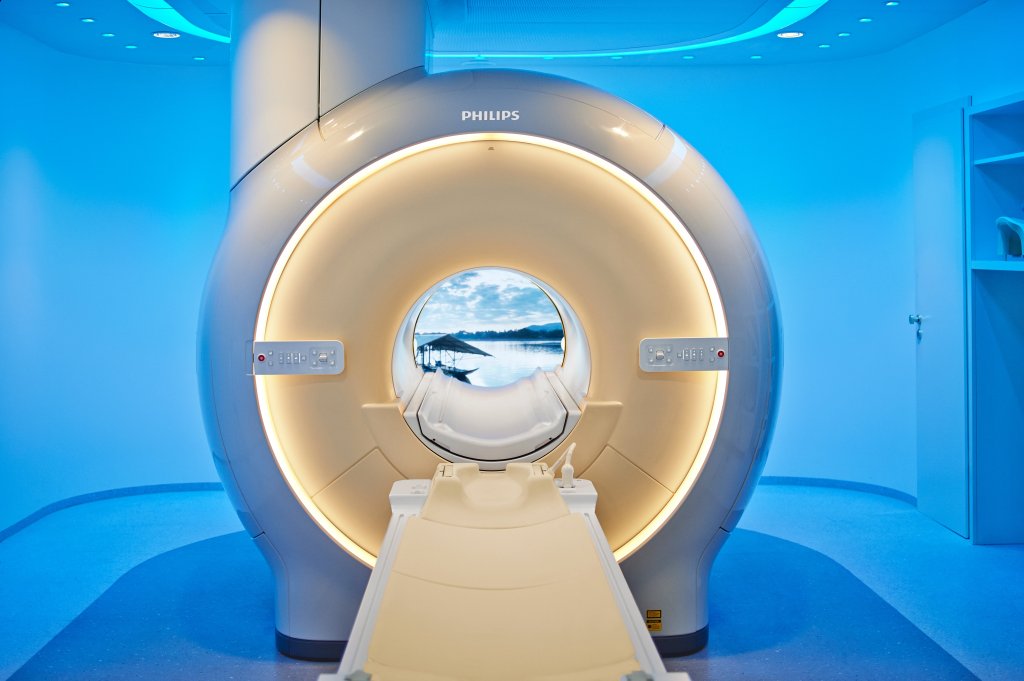
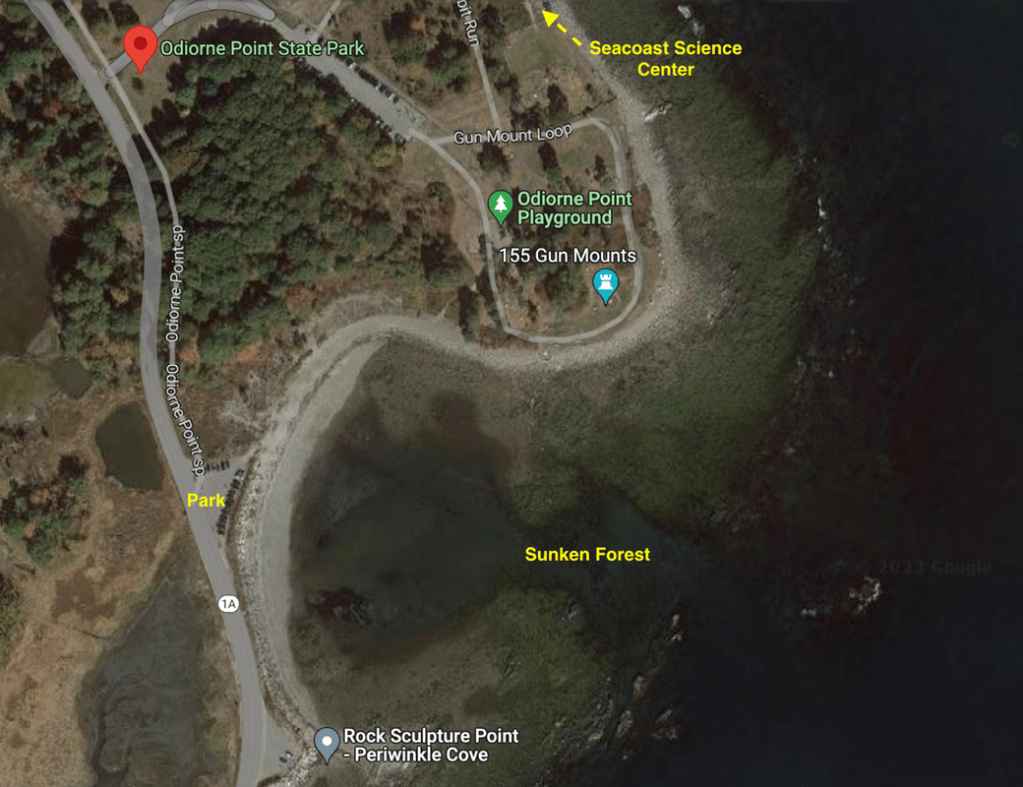
The wide bore MRI. Looks like a set from Kubrick’s 2001: A Space Odyssey Sunset in these latter post-Perseids New England summer days is coming appreciably earlier, and the male hummingbirds have already left for their winter havens to the south; only the females conduct their air battles as they tussle over the feeder ports just outside my kitchen window. I keep thinking about the Katsura tree at Carey Cottage in Portsmouth, a gift of the Japanese ambassador to Arthur and Agnes Carey in appreciation of their hospitality during the 1905 Treaty of Portsmouth negotiations which concluded the Russo-Japanese War. How much human history it has seen! But its century plus witnessing pales beside what I learned about the stumps that appear at low tide in Periwinkle Cove at the south end of Odiorne State Park. They may look as if they were alive a year or two ago, but they’re closer to 4000 years old.
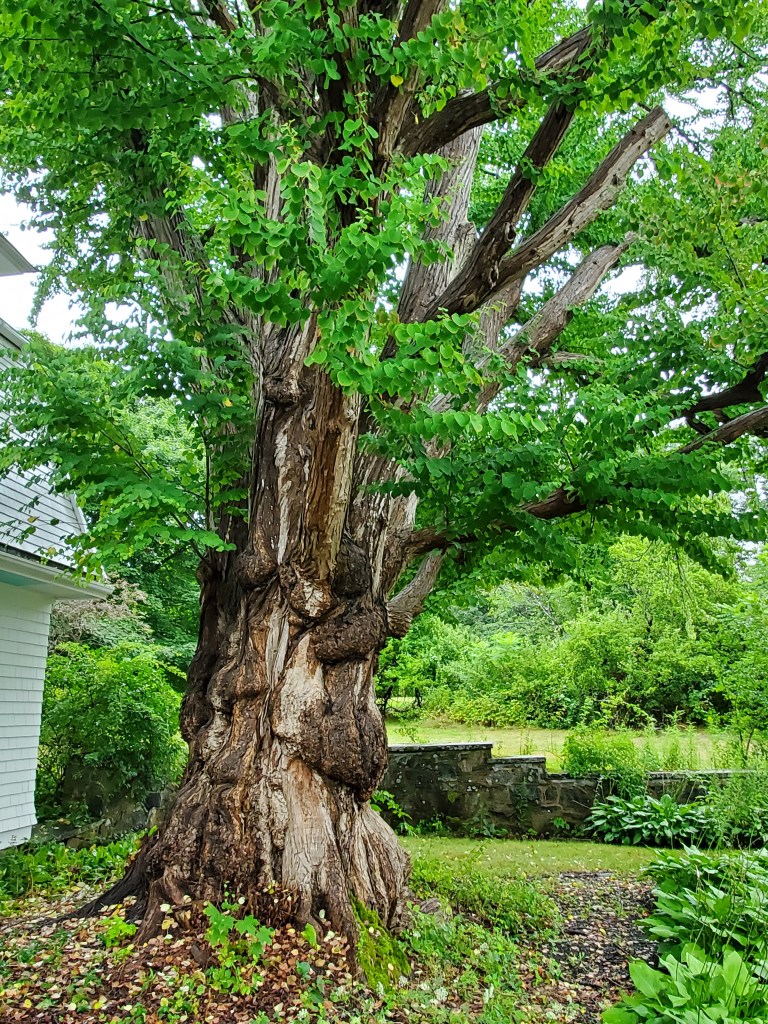
The Carey Cottage Katsura, planted in 1905 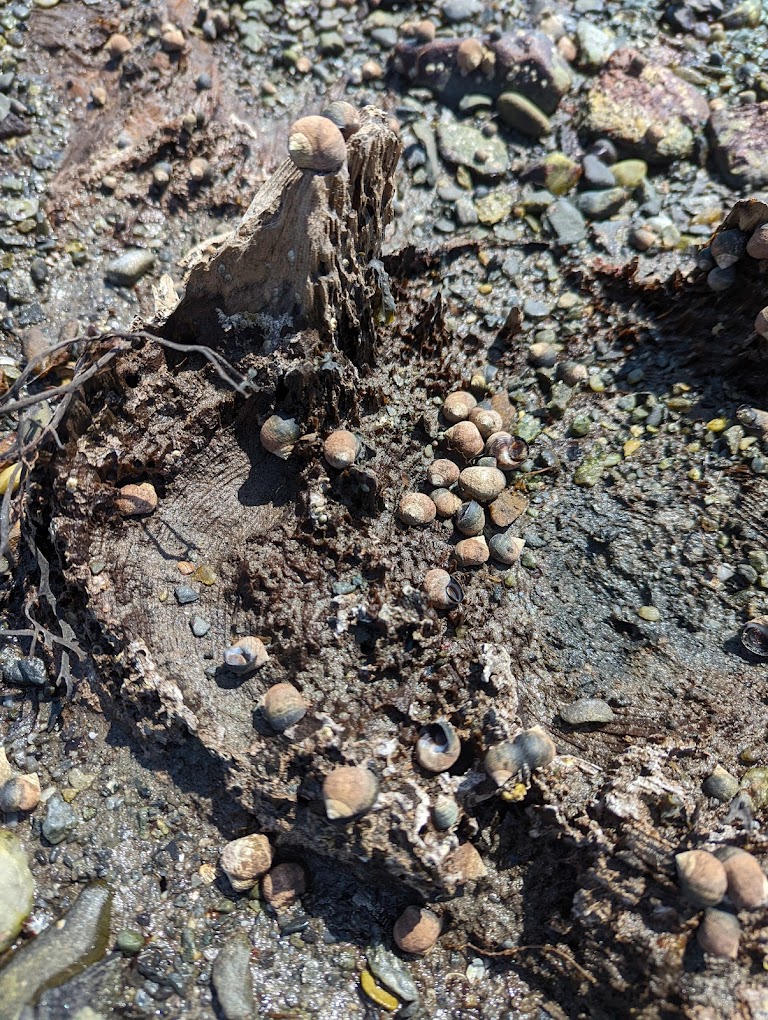
4000-year-old stump at Odiorne New Hampshire’s ancient coastline once sank under the weight of glacial ice; when that ice melted across the Northern Hemisphere, sea levels rose and the Atlantic waters crept inland—as far as present-day Durham and Lee so close to where our house now stands. But relieved of glacial weight, the Earth’s surface rebounded over thousands of years and the land gained elevation: the coastline retreated all the way out to beyond the Isles of Shoals, currently some 6-7 miles off the Portsmouth coast. I’ll be on a yoga retreat there come Labor Day weekend. All this mutability means that for a time, the area where Odiorne Point is now was once a forested coastal wetland. The stumps seen only at low tide in Periwinkle Cove are remnants of an ancient forest of Pine, Hemlock, and Atlantic White Cedar which grew some 4000 years ago until it was drowned again by encroaching salt water.
But wait, there’s more! Fossilized mastodon and wooly mammoth bones reveal that these behemoths roamed Durham and the UNH campus 10,000 years ago. How’s about a wooly mammoth for a mascot?
Although the coastline has always been dynamic, the rate of change is accelerating to the extent that I can observe the changes that have happened over the just 30 years I’ve been here in New Hampshire. I’ll be thinking of that on the rocky shores of Star Island, and of the Wabanaki who fished there as far back as 6000 years ago, long before the European fishermen and Capt. John Smith, who named the islands in 1614.
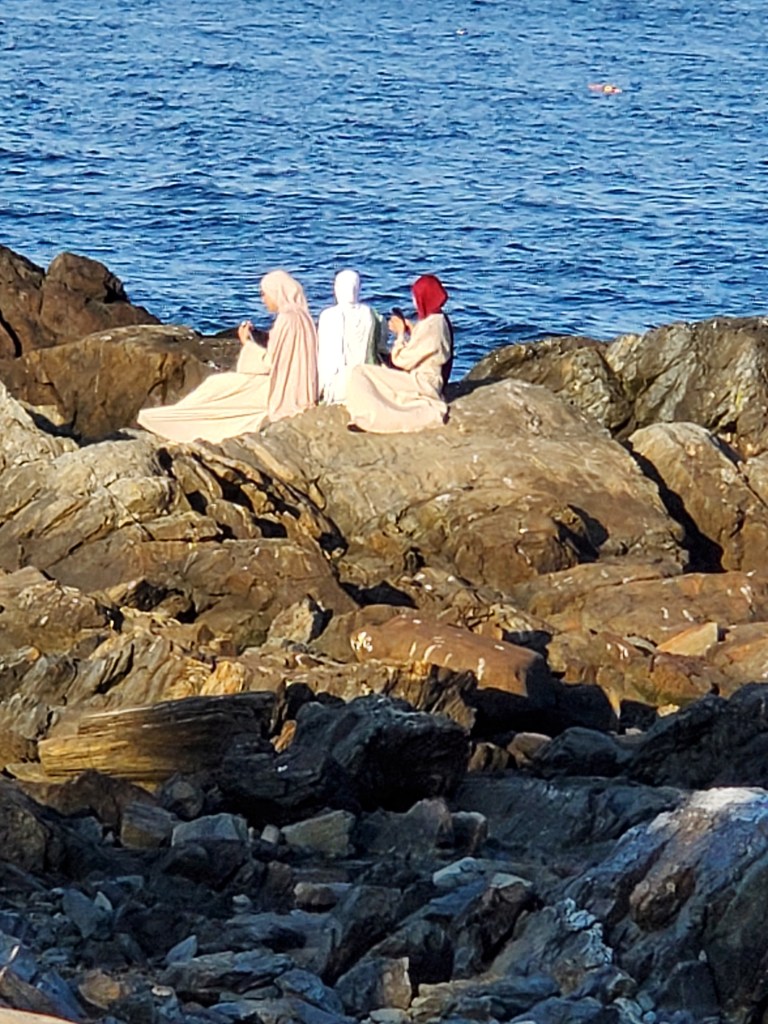
The New Castle Lorelei: past meets present as women in hijabs check their phones I always said of David’s and my trips to our beloved desert Southwest that the geological time so apparent in those eroded red rocks was a comfort, offering a tonic perspective on the relatively miniscule throes of our current season. But the evidence of time passing is much closer at hand. A few traitor trees have already begun their transition from summer to fall. Seasons change, and so do we.
I miss all those dear departed and remember I’ll fly away, too, when my expiry date is up. For now I can only be grateful for the time I’ve had with them, and hope to make the most of the days I have left to savor the memories we made together.
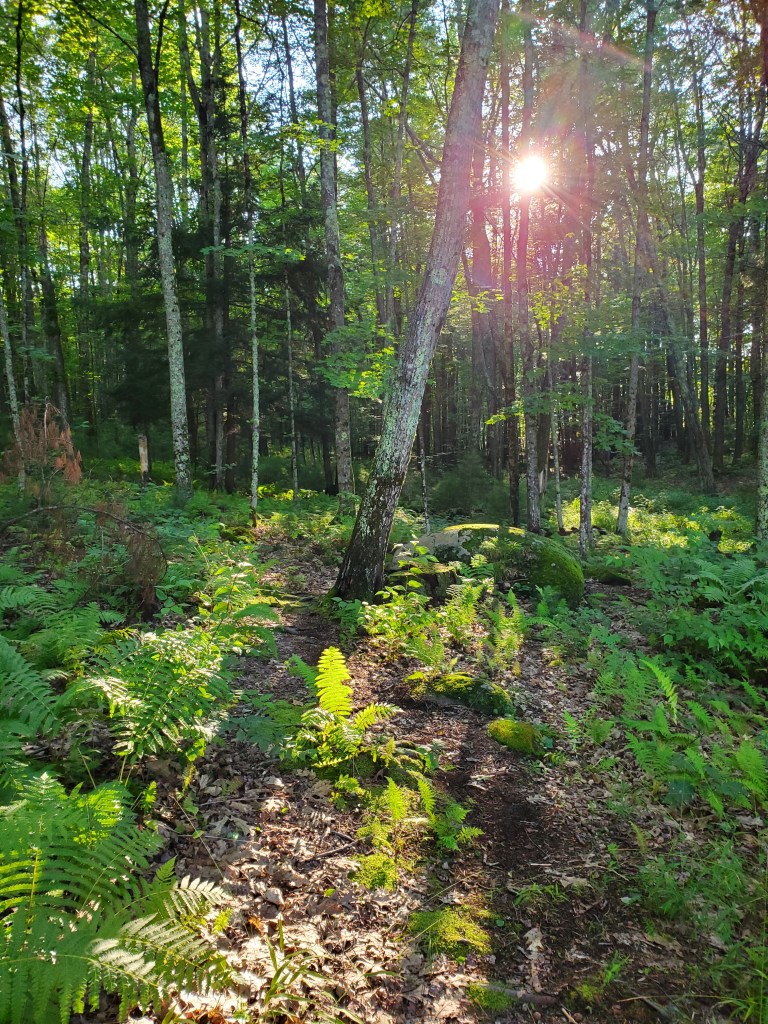
Sunset at the Madbury reservoir 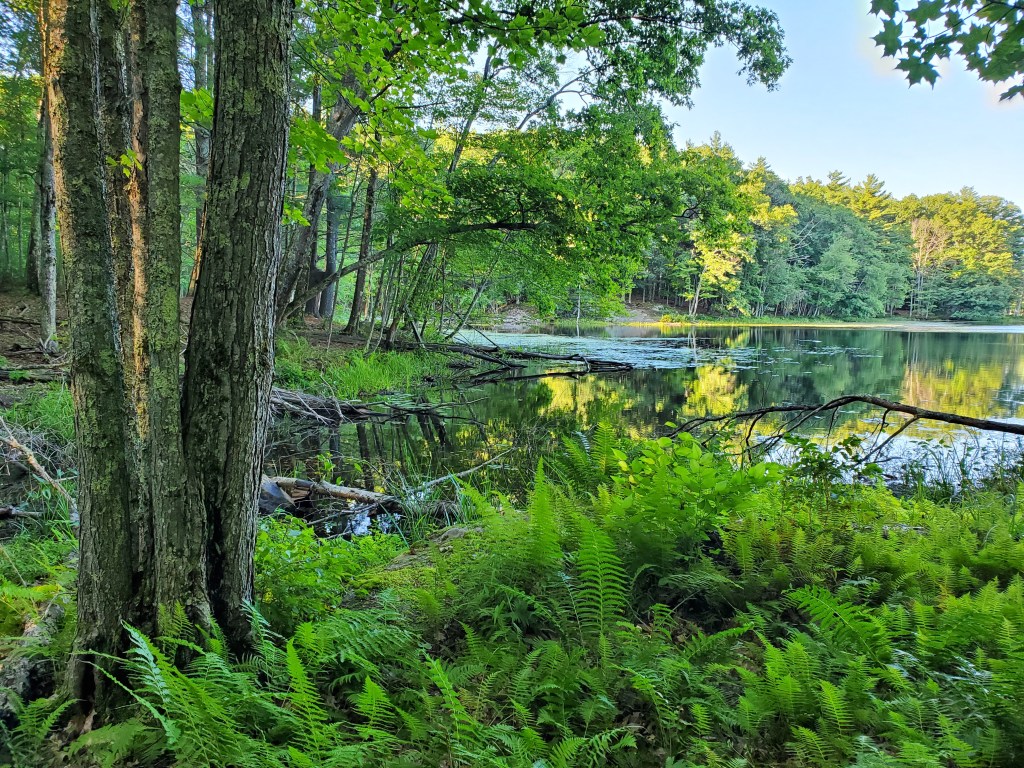
-
Comfort and Joy
1 August 2024
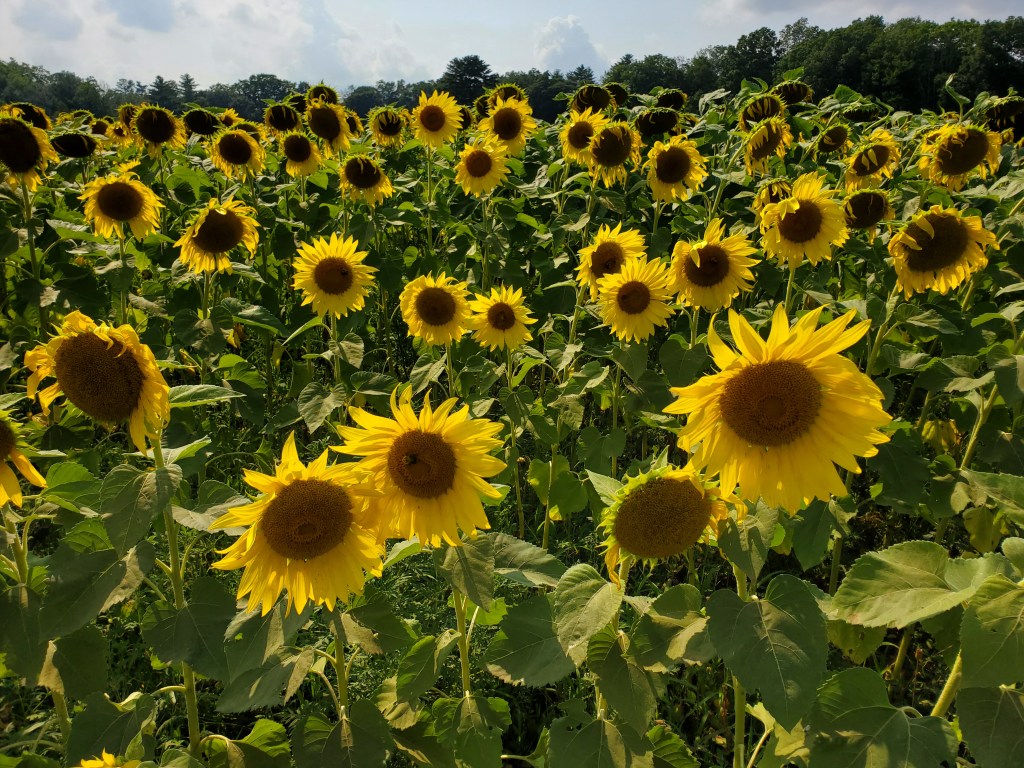
Sunflowers at the Coppal House Farm, Lee NH Yowza. July was the month that was: first the terrible debate fallout, then the attempted assassination, then Democratic despair over Biden’s determination to continue campaigning, and THEN CrowdStrike’s global software meltdown, followed on Sunday, 21 July by President Biden’s astonishingly brave and patriotic announcement that he was standing down, Vice President Harris’s immediately stepping up and securing the Democratic nomination, and a complete reversal of fortune for all of us breaking our hearts over the likelihood of another Trump presidency. Trump’s racist misogyny rolls on, abetted by the opportunist Vance, but Harris continues to vault over his petty ad hominem attacks and performative buffoonery. And speaking of vaults! Check out the gravity-defying Simone Biles, triumphant over the twisties and in confident mental and physical health, soaring through the Parisien air to become the most decorated gymnast of all time. Inspiring.
So, over the past weekend, I took a break from all that’s horrible to enjoy all that’s wonderful about summertime in New Hampshire, and record here in my 105th post some of its many delights, beginning with visits three days in a row to the impossibly twee and charming New Castle, first for the Parade of Sails brunch on Friday, 26 July, a delightful affair offered this newest member of the Seacoast Village Project.
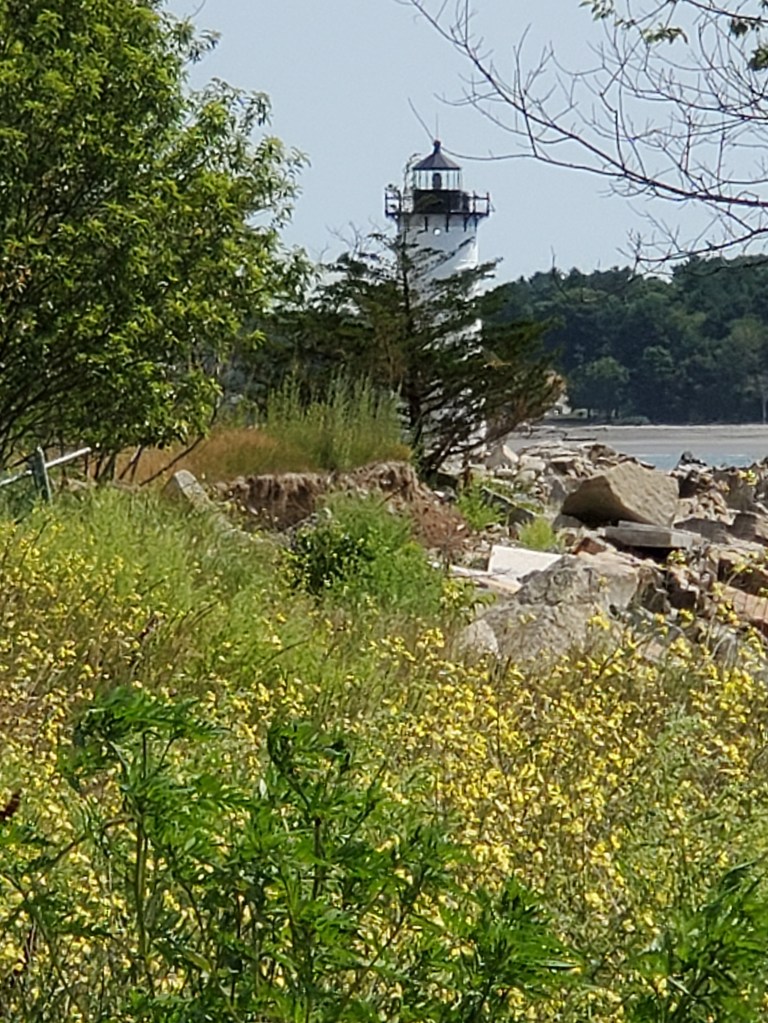
Portsmouth Harbor Lighthouse at the mouth of the Piscataqua River
as seen from New Castle NH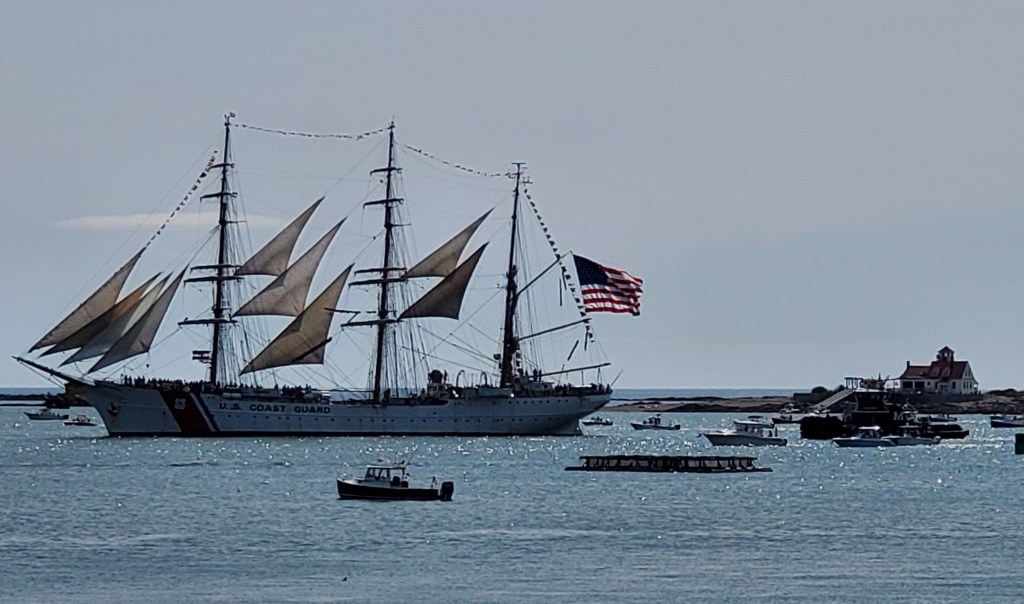
The Eagle heads the Parade of Sails past the Wood Island Lifesaving Station, (1908), Kittery Point ME, 26 July 2024 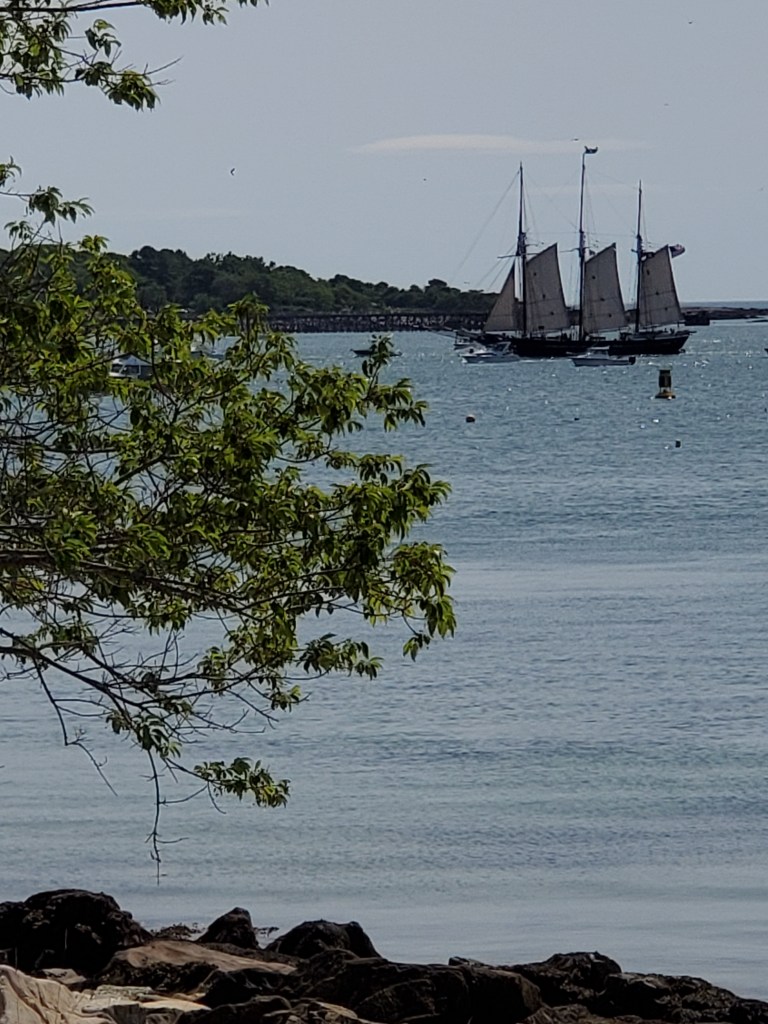
Tall Ship No. 2 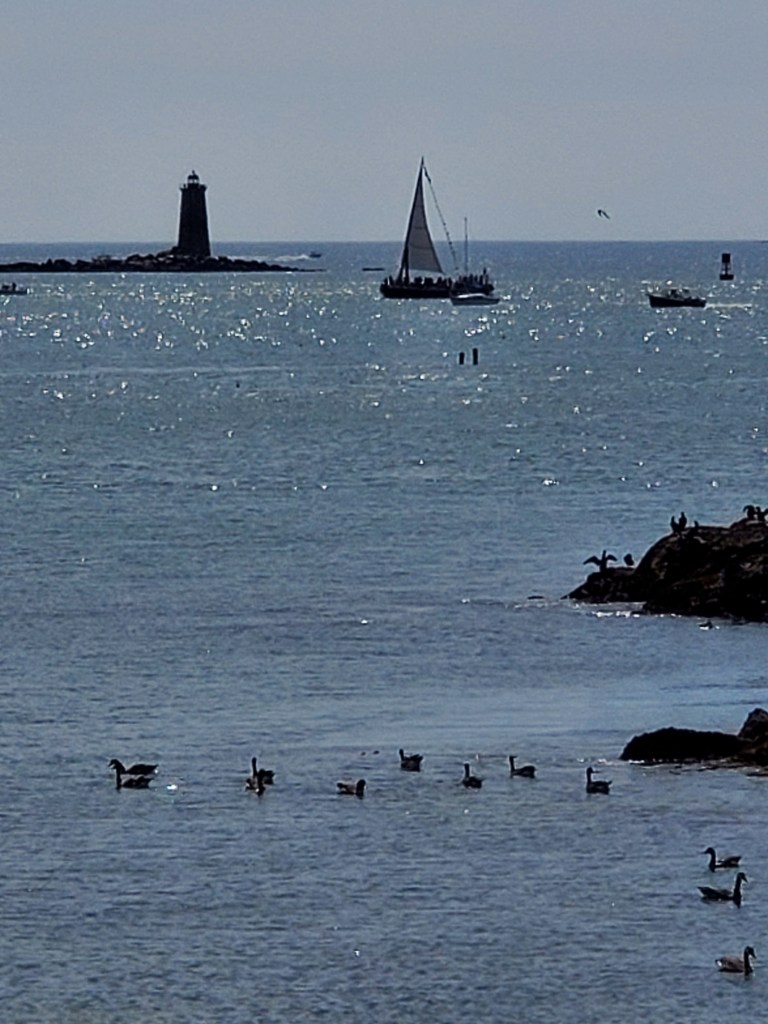
Tall Ship No. 3 approaches the Whaleback Lighthouse Saturday morning’s errands meant a trip to Tuckaway Farm in Lee for tomatoes and eggs (purchased on the honor system, praise be), and a cheery greeting from a progressive carpenter at work there, whose truck caught my attention.

Tuckaway Truck Another interesting automotive sentiment appeared in the parking lot of the Lee Market Basket:
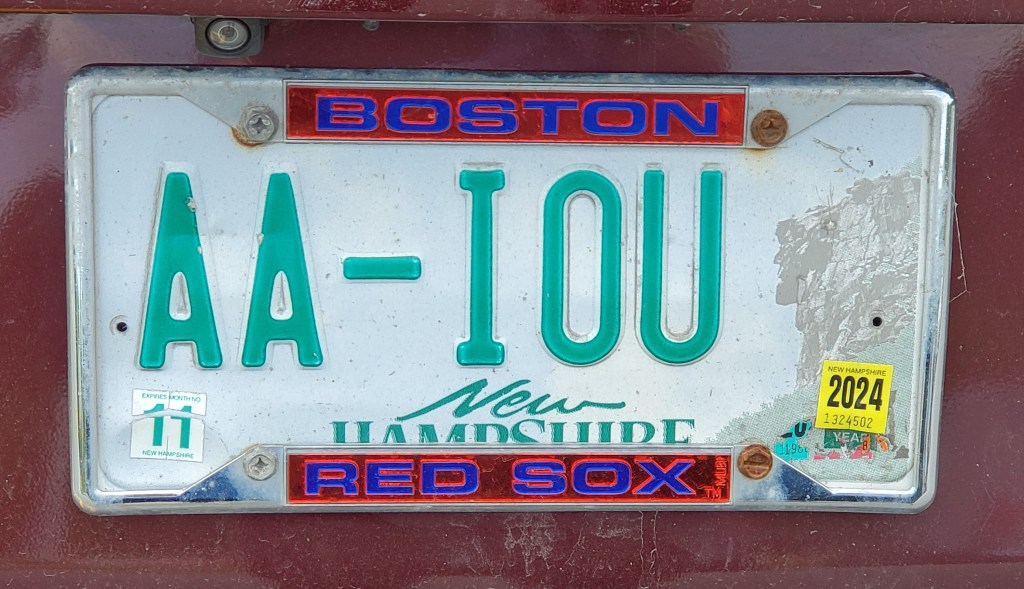
There’s certainly a story there. The final errand: getting peaches from the Union Lake Orchard in Barrington NH, a pleasure delayed by a year due to the killing frost in the spring of 2023 that wiped out crops across NH and MA. The postponed pleasure has been even sweeter as a result.
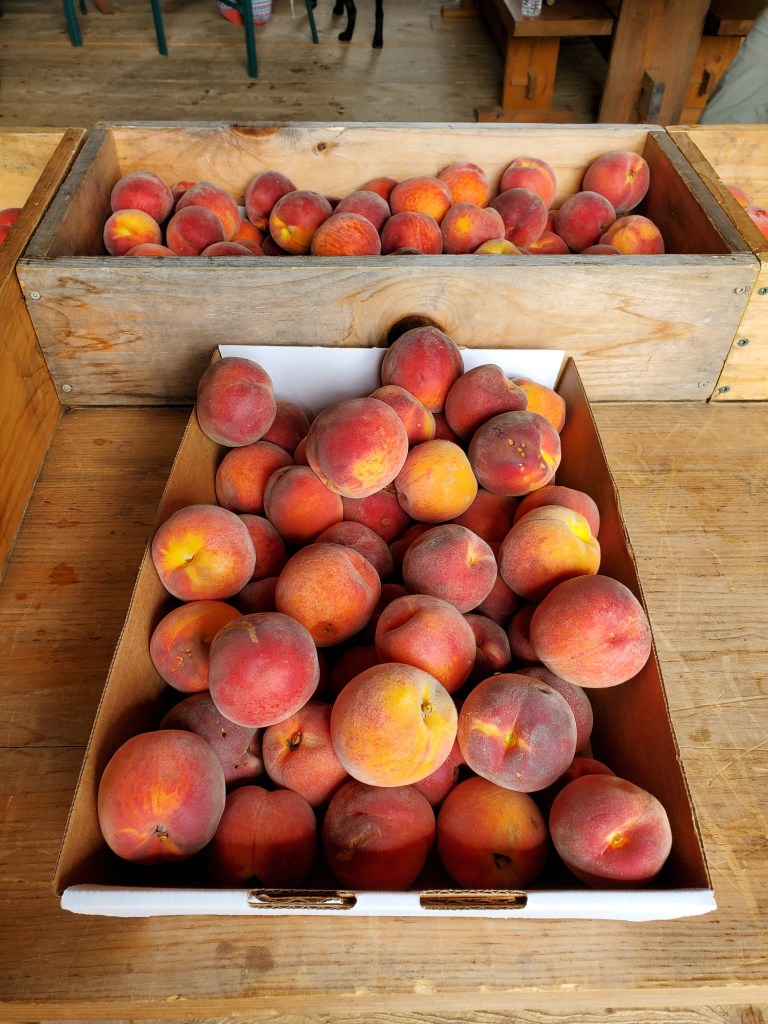
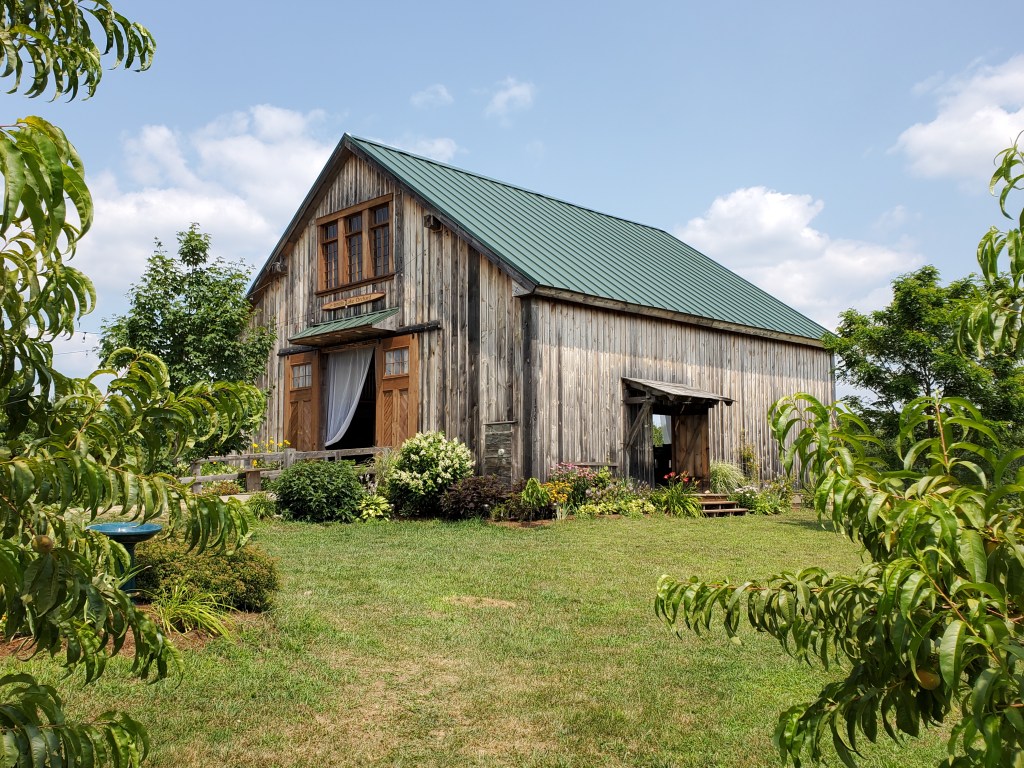
Union Lake Orchard’s Barn-for-Event-Rent All errands run, the afternoon brought a tonic Atlantic dip to welcome the newest member of the Lovely Order of Cold-Water Mermaids club, interior designer Carolyn, into the attitude-adjusting chill of the New Castle cove at high tide (her first pronouncement: “I’m f***ing FREEZING!”), followed by delightfully arranged refreshment on the patio courtesy of New Castle resident, friend, and another accomplished interior designer, Phyllis.
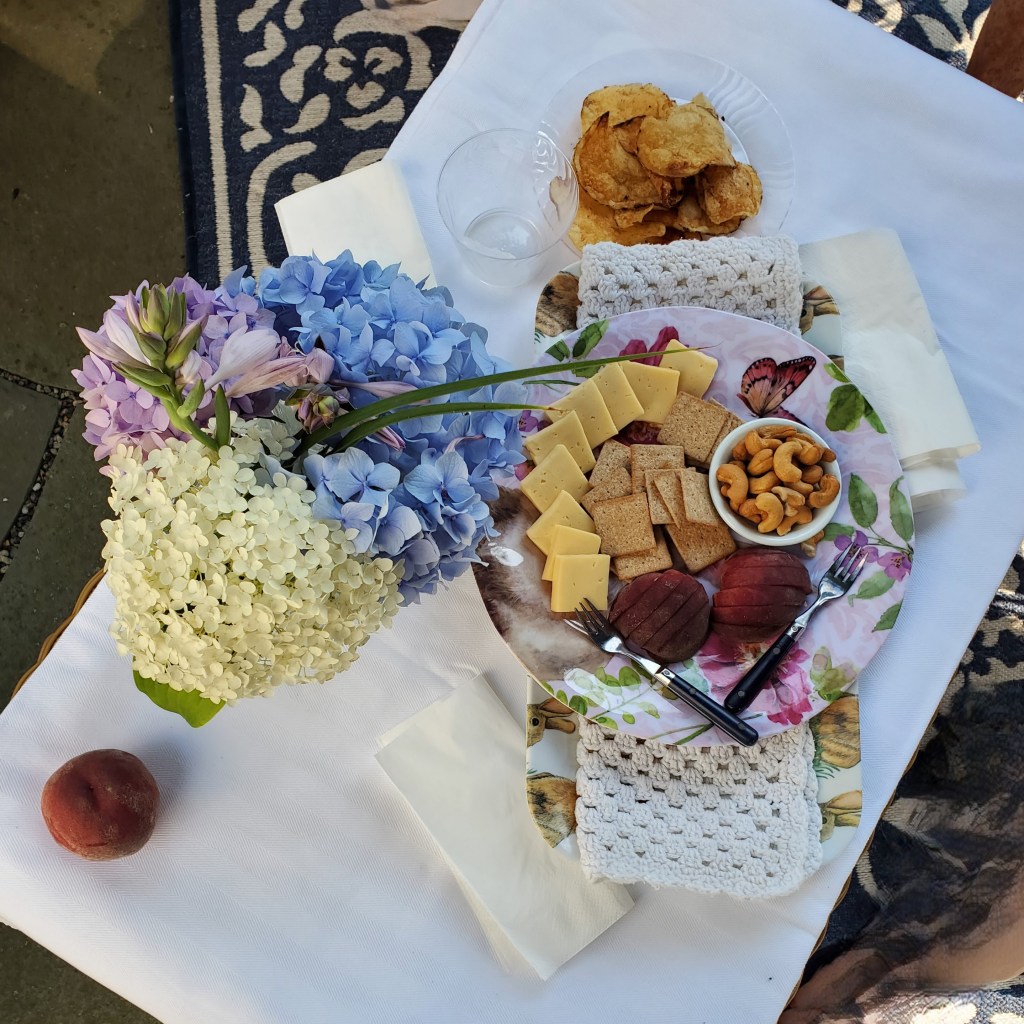
An elegant al fresco repast chez Phyllis . . . 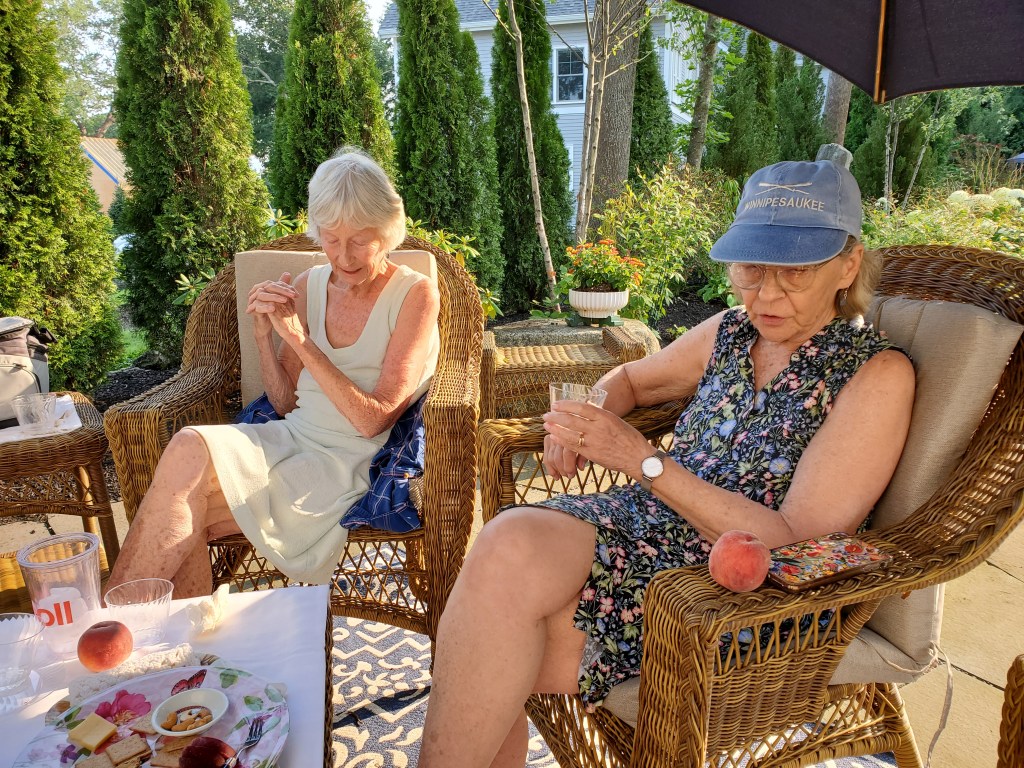
. . . enjoyed by Jennifer and Carolyn 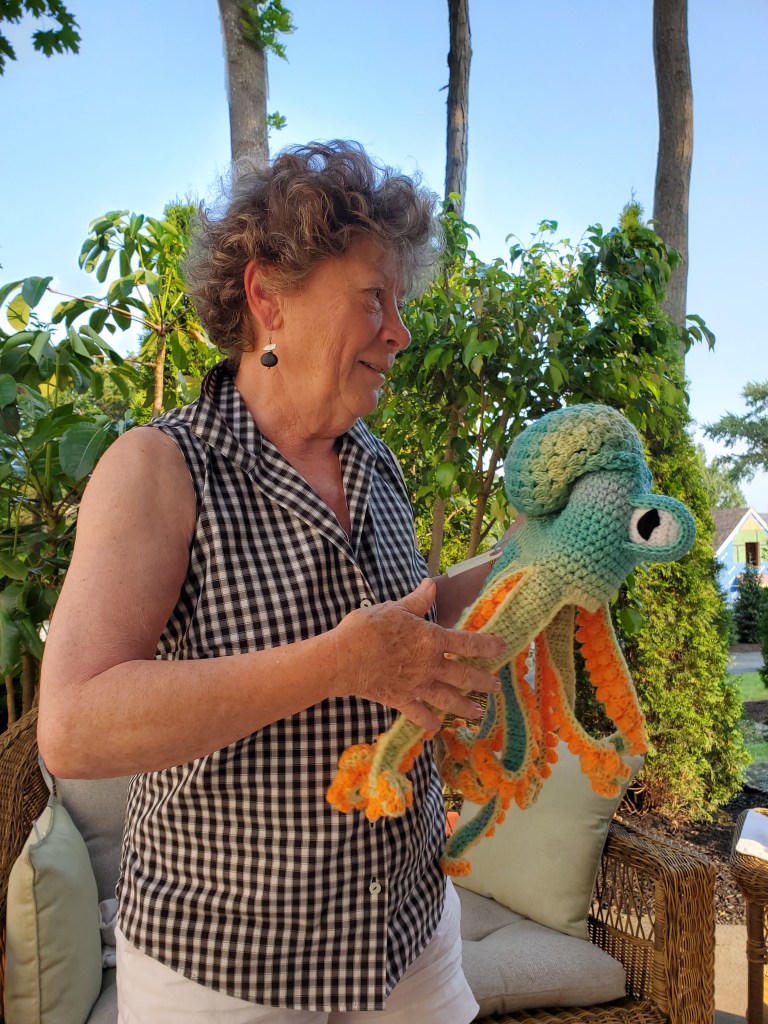
Host Phyllis with a fabulous New Castle Congregational Church Arts & Crafts Fair find The next day, Sunday, brought one more return to New Castle Common for an early evening picnic with friend and former colleague Sheila, newest member of the widows club no one wants to join. A peaceful, beautiful place, that, especially in good company.
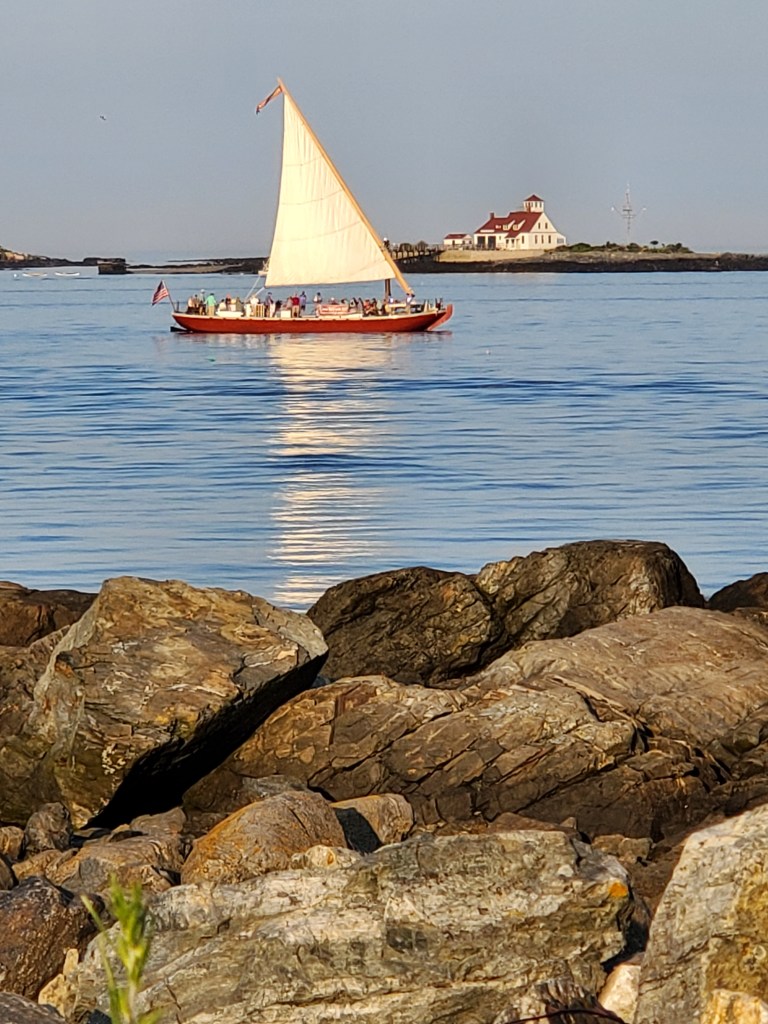
Portsmouth’s gundalow passes Wood Island 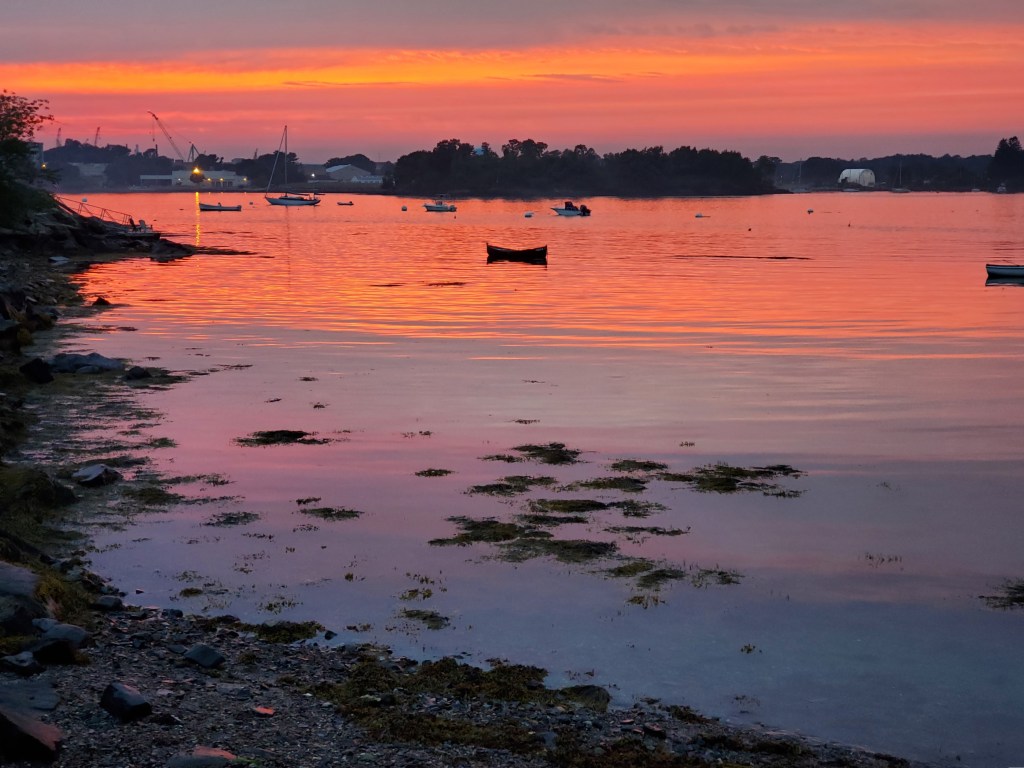
Sunset from the New Castle Yacht Club with view of the Portsmouth Naval Shipyard on Seavey’s Island in Kittery ME Beauty and friendship ARE tonic. And so is my yoga class, the UNH pool pass lent me by friend Carol, the Madbury Public Library Book Club (which just introduced me to writer Dave Eggers), and the sunflowers now blooming in Lee at the Coppal House Farm. It’s a new month. I’ve flipped the calendar and elevated my expectations, volunteering, donating, and once again, HOPING. Hallelujah.

Field of . . . Sunflowers at the Coppal House Farm: if you build it, they will come. 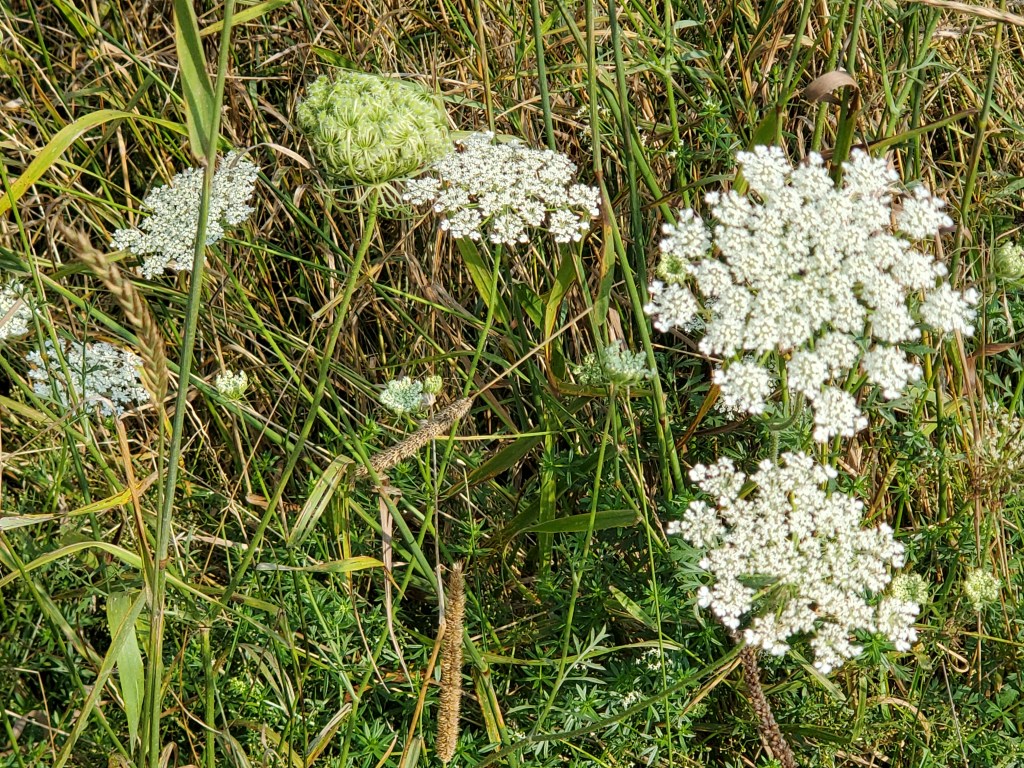
-
Home from Wisconsin
21 July 2024
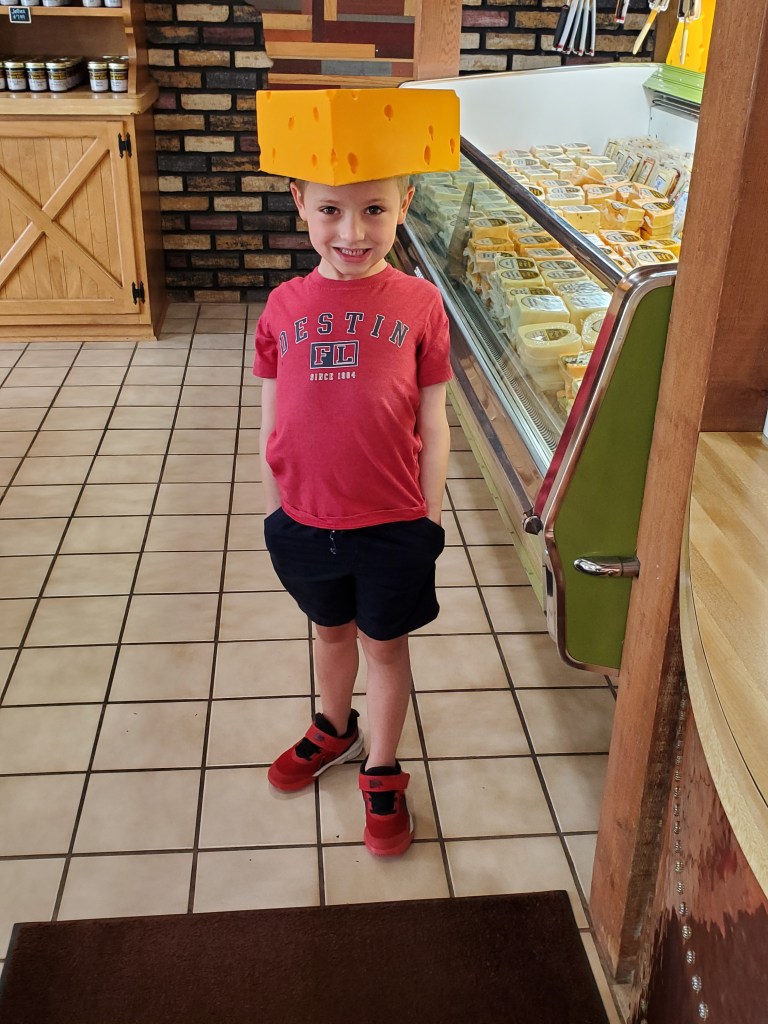
Enthusiastic cheesehead at Ehlenbach’s Cheese Store in DeForest WI The weather in New Hampshire this Sunday morning has finally returned to the celebrated New England summer temperatures this Florida girl once fantasized about when looking at Lands End catalogs: is’t possible to wear shorts AND a crew neck sweater at the same time? When I arrived home last Wednesday from a week in Wisconsin, the temperature in the house was 88, but that night’s storm brought relief. Fortunately I made it back into Manchester airport well before the global CrowdStrike glitch hobbled air travel and everything else, including my Friday PT appointment. Yesterday my bank’s computers were still down, and its ATM gobbling cards.
What a time we’re living through. My brother-in-law’s 90th birthday celebration in the Wisconsin Dells on 13 July coincided with the attempt on former President Trump’s life; when I returned to Milwaukee on Tuesday the 16th to visit the Art Museum before my flight home the next day, there were five armored SUVs—ominous, rugged, all-black vehicles looking like something from a Bond movie—parked outside; a bystander opined that they were Secret Service transport. And yesterday, for the first time ever, I wrote to a sitting president, asking the candidate I’ve been campaigning for since the New Hampshire Primary to step aside.
So, as I negotiate the alphabet soup of tasks that pile up even after only a week away—check-in online for PT, schedule an MRI, consult with JP pest control, confirm AAA auto insurance policy renewal, continue to try to wrangle the complexities of publishing with Amazon KDP—I wonder how much of my recently acquired sense of fragility is the natural accompaniment to aging (pain in the ischial tuberosity, gimpy left leg, long QT syndrome—another g.d. acronym!) and how much is the weight of a world in chaos.
Challenging and at times exhausting, my travel WAS, however, tonic. First came four days wrapped in the embrace of the extended Andrew family, all gathered to celebrate their extraordinary patriarch, my wonderful brother-in-law Reed Chadwick Andrew; followed by two days at the delightful Silver Star Inn near Spring Green with dear old friends from my Kentucky days; and finally several exhilarating solo hours in the extraordinary Milwaukee Art Museum, a salutary break from horrific news and extraordinarily disturbing tv commercials. Having become accustomed to ad-free streaming, I was doubly unprepared for Wisconsin advertisements for, among other things, “survival food kits” available at Costco (see 4Patriots.com). Were these specially timed for the Republican convention I wonder? Or just an over-reaction to the Ethan Hawke/Julia Roberts/Kevin Bacon vehicle Leave the World Behind? Come to think of it, given CrowdStrike’s “accidental” cyber glitch, maybe I should get me one of those kits.
Anyway. It was a good trip. First there was meeting up with my nephew Rob and niece Pam, and Rob’s New Zealand nephew Rudyard and his mom, Carolie, all continuing the first part of Rob’s grandly designed scheme to show the Kiwis much of America, from Washington, D. C. all the way to San Francisco.
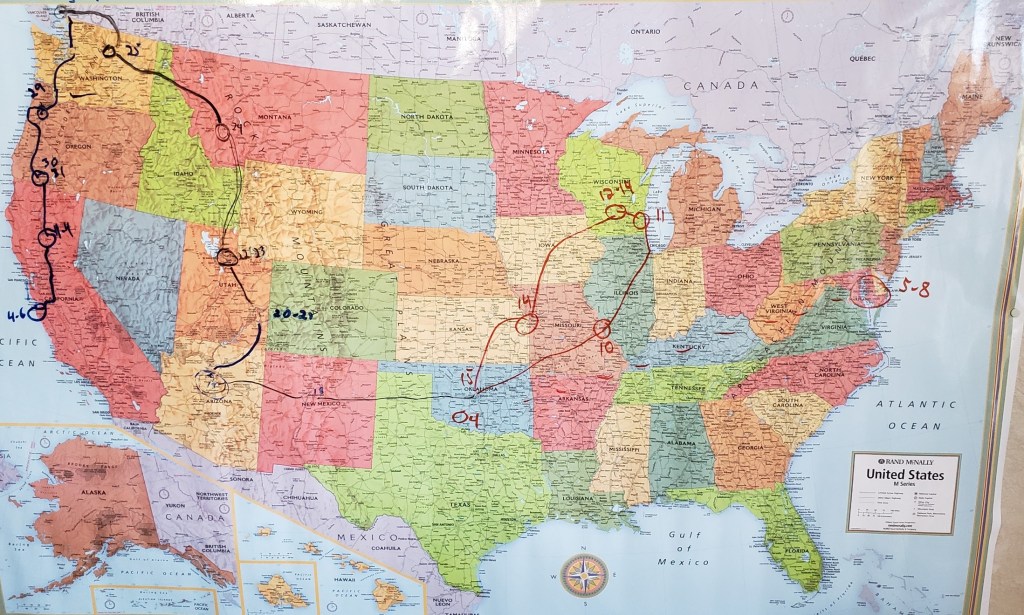
Rob’s plan for the Grand Andrew Tour We met in Milwaukee over dinner at the Plane View bar and grill adjacent to the MKE airport, and spent the next couple of days first visiting Chad and his wife Jan at their Portage home, and then cruising the Wisconsin Dells and Reed Andrew’s Root Beer Museum before joining the 60+ family members gathered to celebrate their dad/ grandpa/uncle/great grandpa over dinner and a cake ablaze with 90 candles.
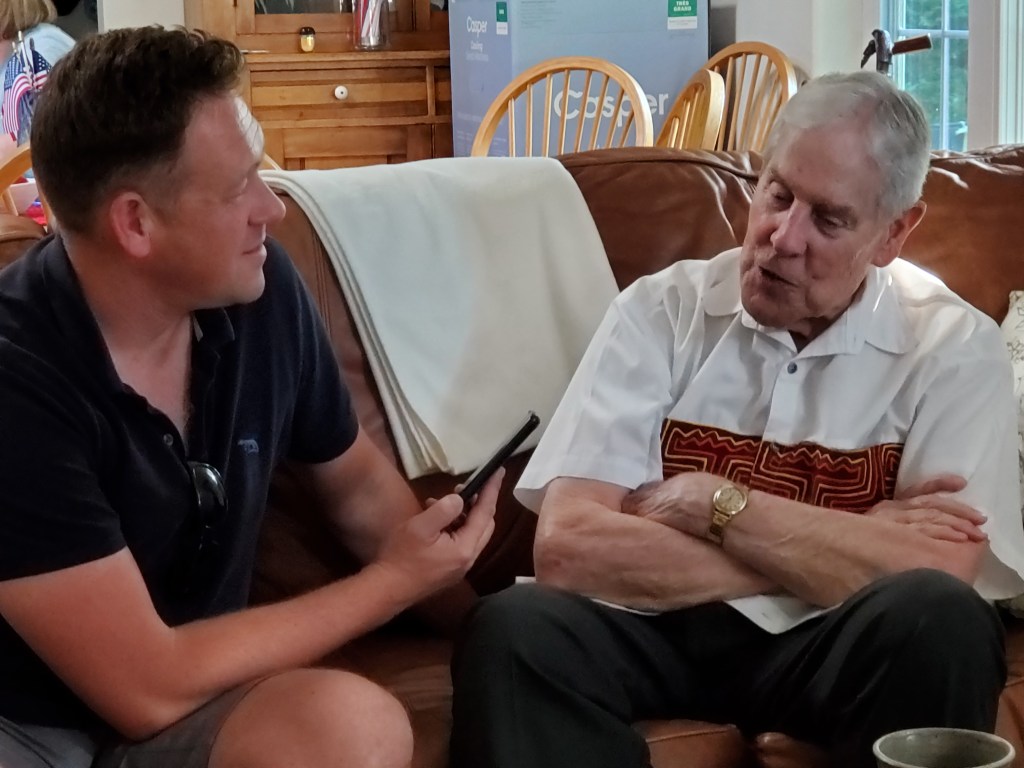
Rudyard records ophthalmologist Chad’s amazing tale of
saving Emma the Elephant’s eye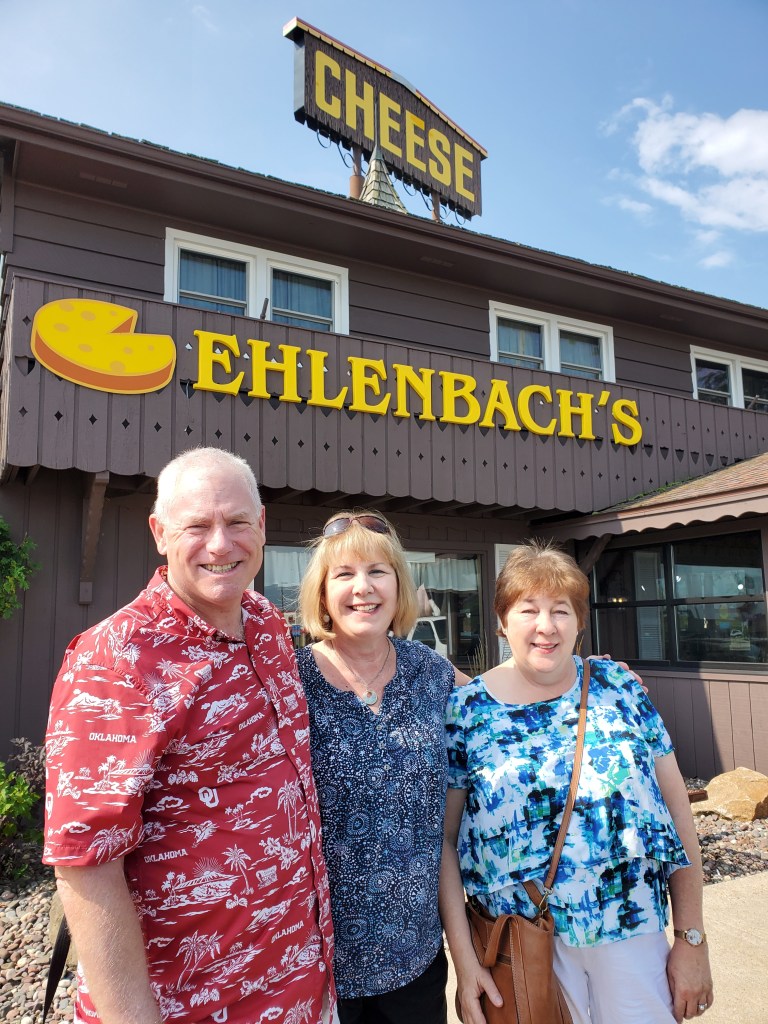
Rob, Pam, and Carolie visit the cheese shop 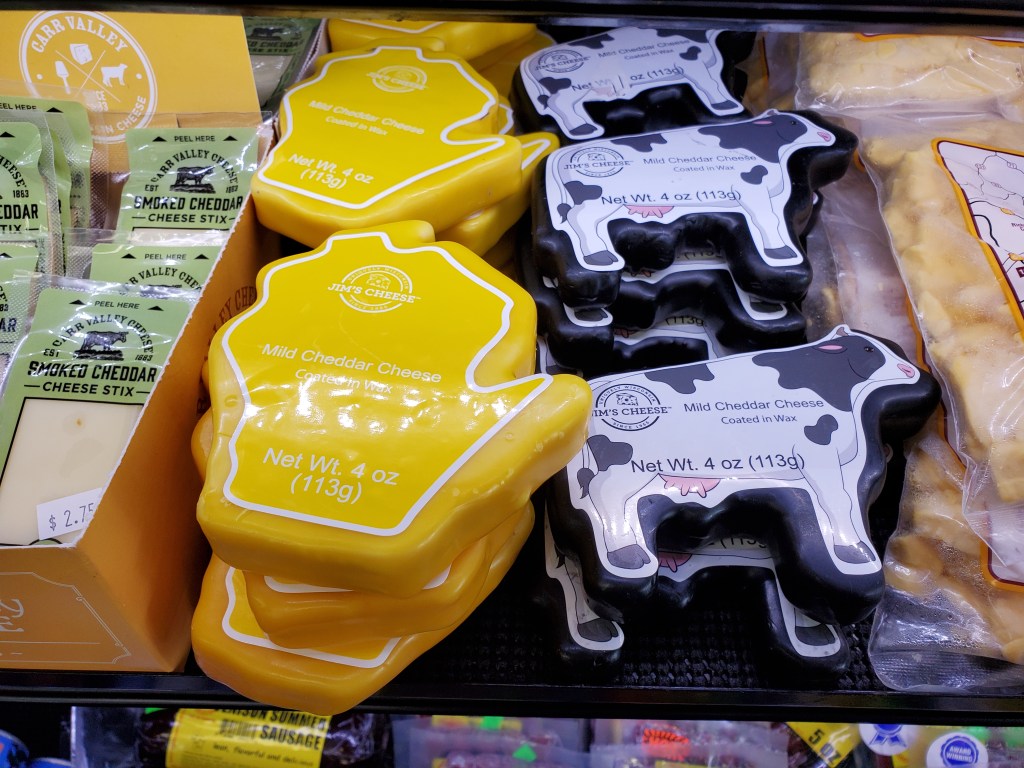
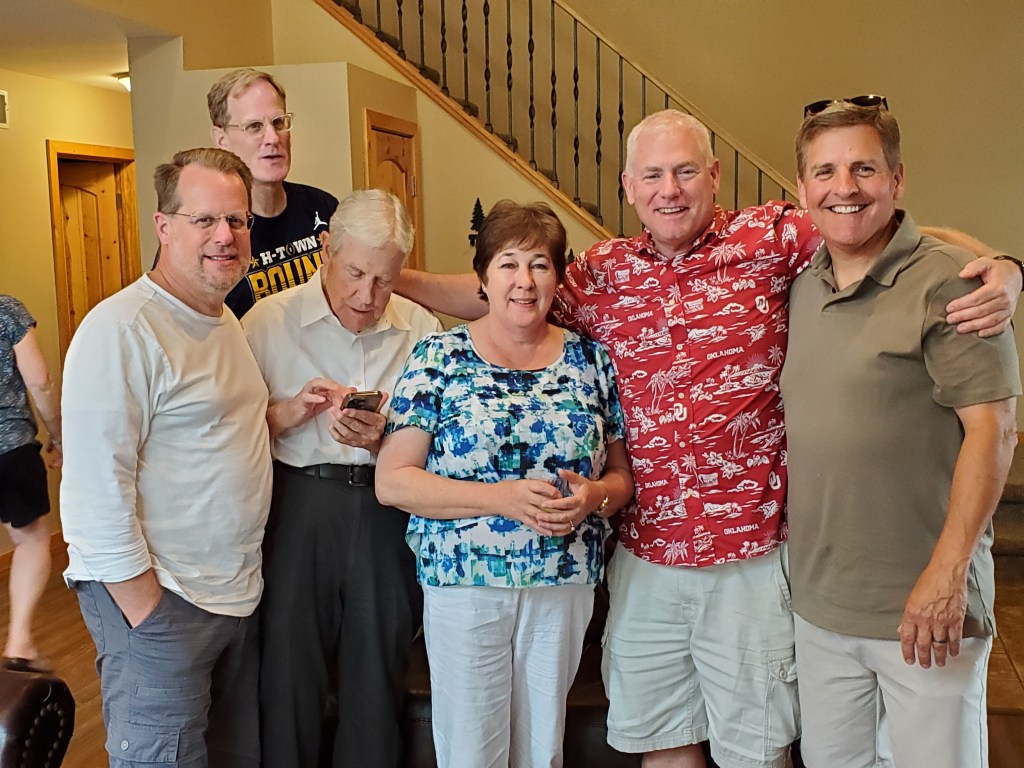
Taylor, Miles, Chad, Carolie, Rob, and Eric Andrew at lunch on Badger Court 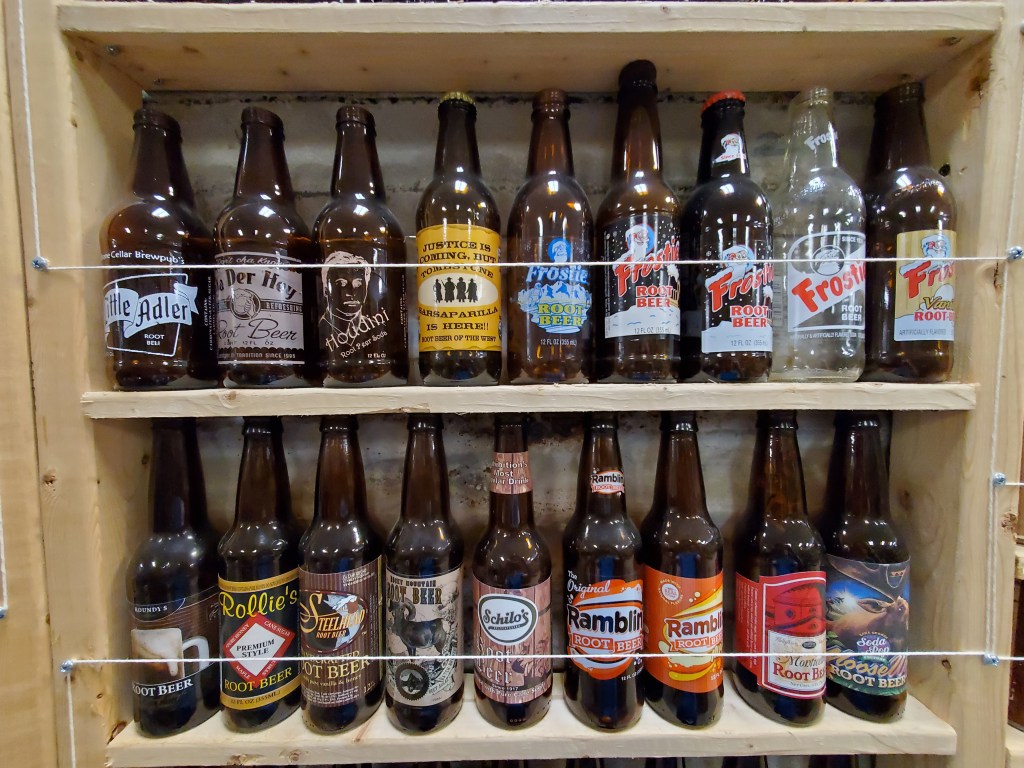
A small sample of the stock at Reed Andrew’s Root Beer Museum in the Dells: taste a flight when you visit 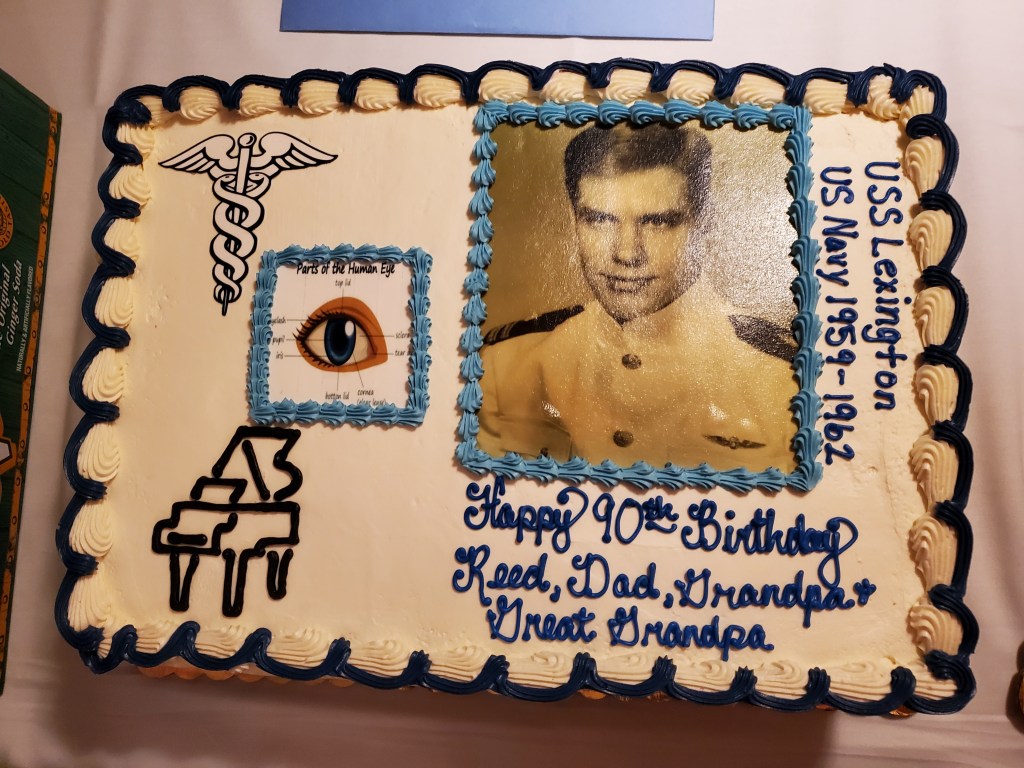
The birthday cake 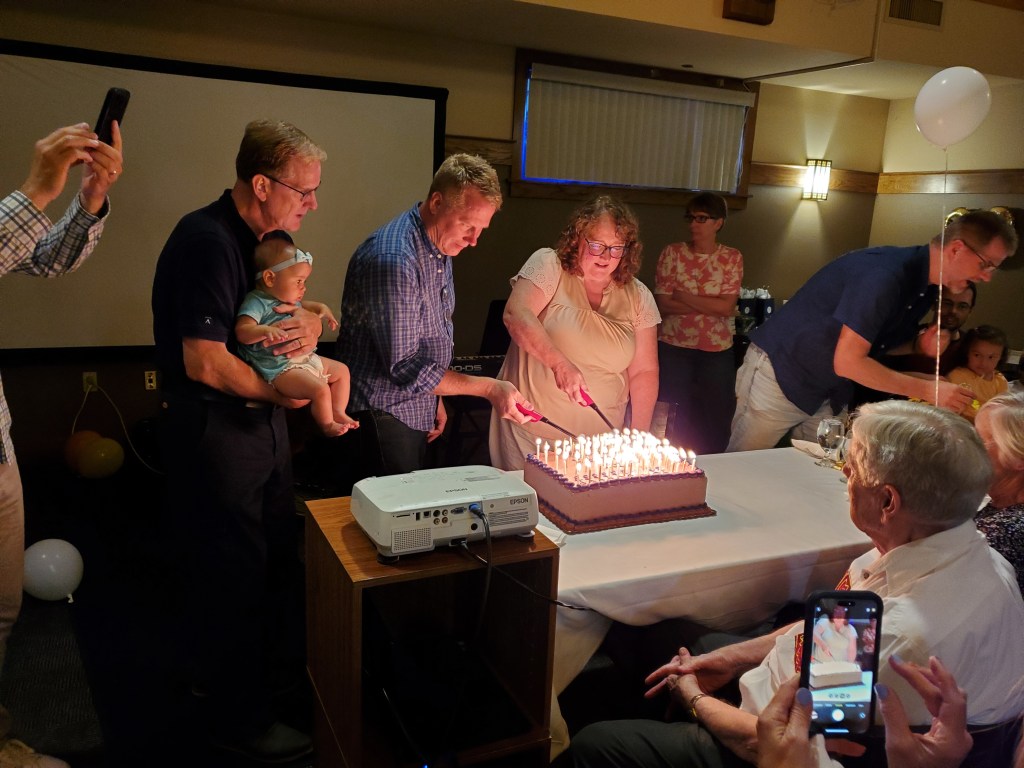
90 candles ablaze as youngest great grandchild watches The next day Chad’s sister-in-law Emy hosted a lovely Sunday morning brunch in her Madison home for Rob, Pam, Rudyard, Carolie; her kids (Sarah, Becky, Miles, and Nathan); my step-daughter Susan; and me, a gathering memorable for all sorts of reasons, including beautiful, sweet pediatrician Sarah’s so remarkably recalling my late sister Jane’s prenatal concerns for her son Daniel, now 26+ years later. And then came the hilarity inspired when Miles’s pause as he said grace over our meal was interrupted by Siri chiming in with “I’m sorry. I don’t understand.” Perhaps not proof that God is female, but certainly a moment worth further exegesis.
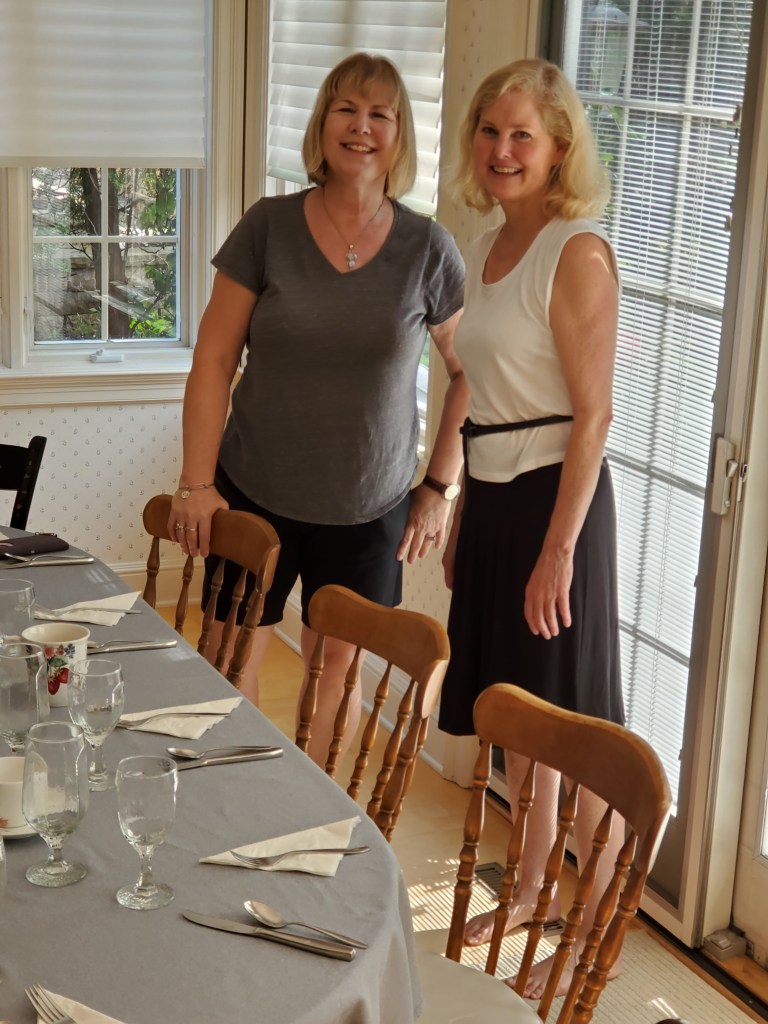
Pam and Sarah at Emy’s lovely brunch From Madison, I drove west to Spring Green and the charming Silver Star Inn so expertly managed by Elise and Kevin Dallman, venue for a reunion with dear friends Ed and Charlotte. We followed a pre-show picnic on the grounds of the American Players Theatre with a gangbusters production of Jean Anouilh’s Ring Round the Moon adapted by Christopher Fry as a frothy combination of Roman Comedy and Shavian social satire. Twice interrupted by a downpour in the arena theatre, this production absolutely rocked, and the drenching was welcome after a sweaty start to the hazy, hot, and humid summer evening.
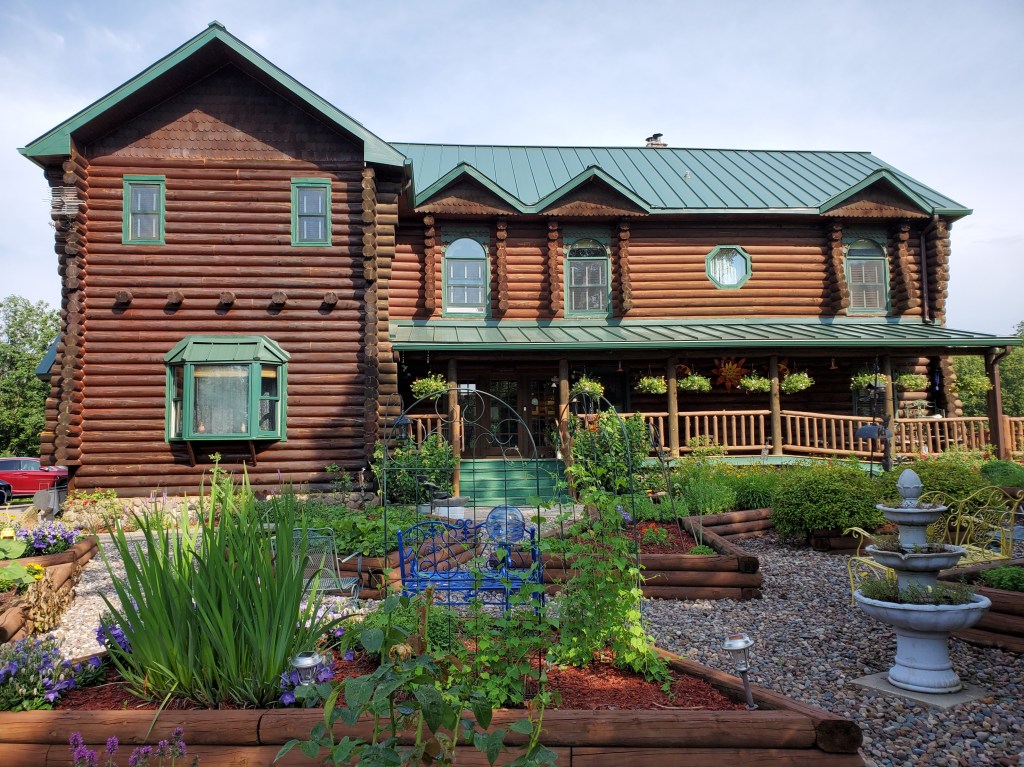
Silver Star Inn, Spring Green WI 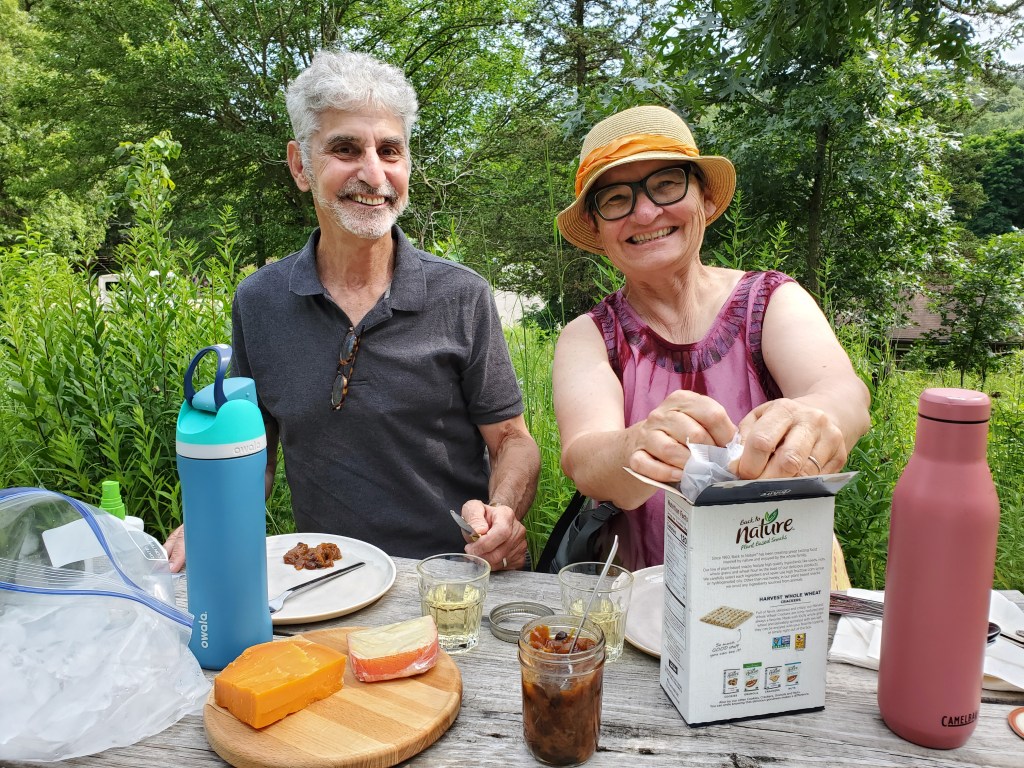
Picnic before Play with Ed and Charlotte, American Players Theatre 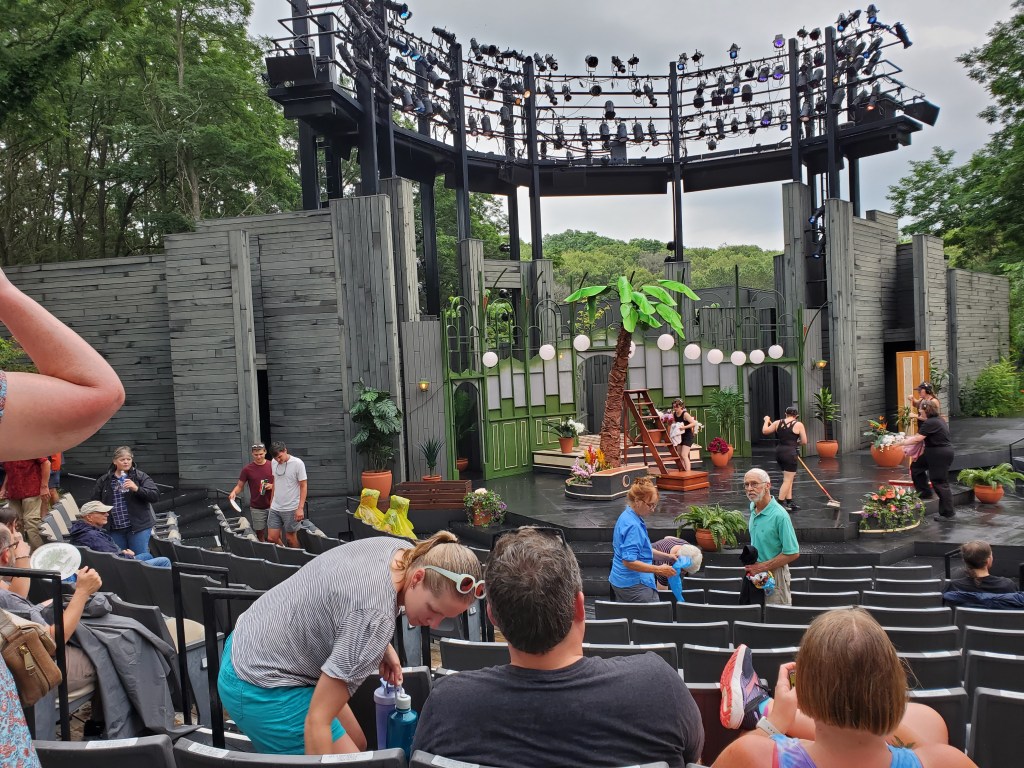
Rain delay at the APT 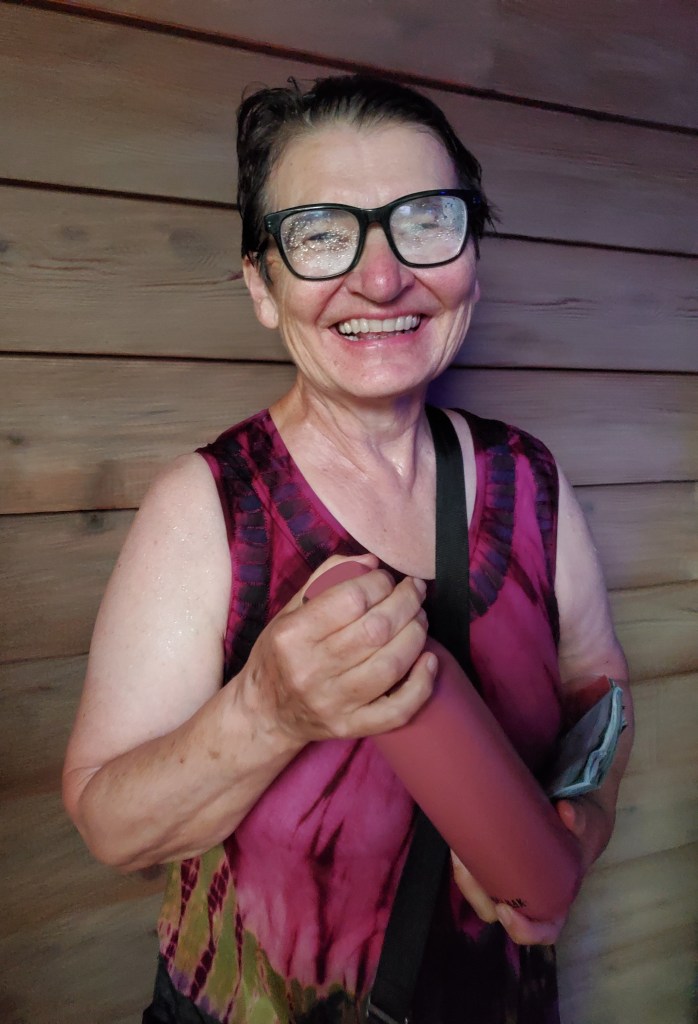
Charlotte tickled by the deluge Monday brought a nostalgia tour back in Madison where Ed wrote his dissertation while Charlotte managed the SPCA, and their daughter Hannah was born. Our tour of their old neighborhoods included lunch with friends of theirs, Russ and Carol—for them, a first-time-in-40-years in-person reunion—as well as a visit to their lakeside Craftsman home in Yahara Place Park, appropriately replete with their own extraordinary craftsmanship. Russ, born in a Colorado internment camp in 1944, is a master of origami, which photographer Carol documents in an amazing series of Christmas cards featuring Russ’s paper masterpieces and her elaborately threaded Temari. Both of them knit teddy bears for African children and practice singing Italian art songs. Quite the Renaissance pair, they: Carol boxes to combat her Parkinson’s and Russ is her cornerman. Russ sent me home with a small gold crane of his, carefully boxed by Carol: both of them and my souvenir were unexpected treasures.
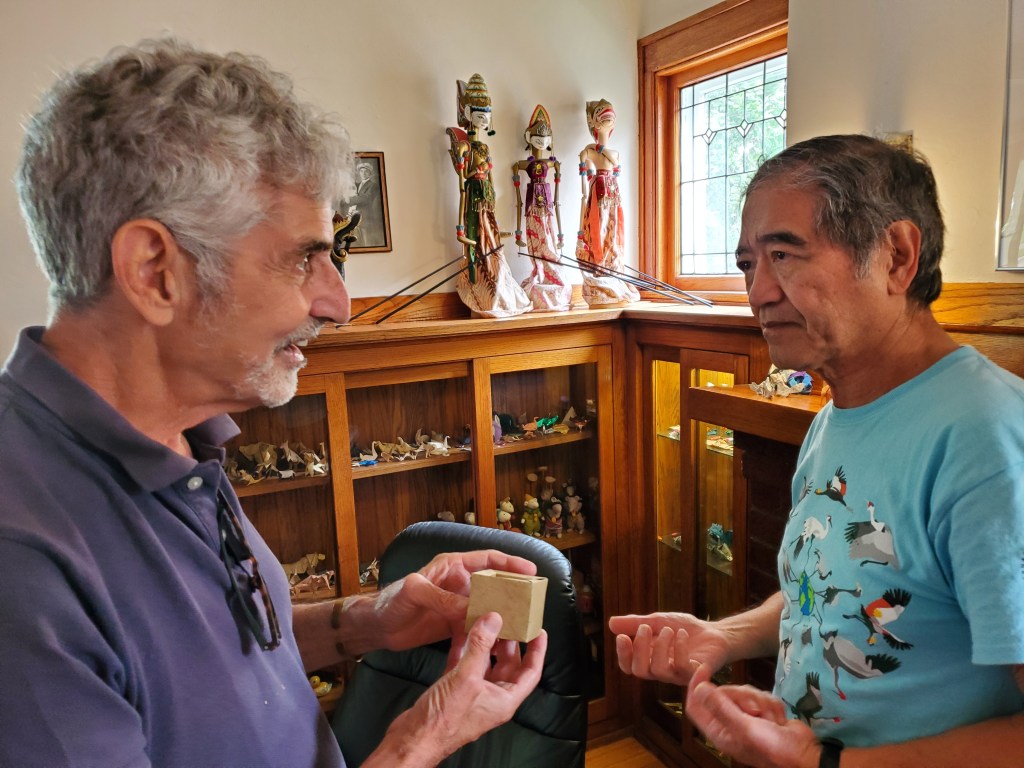
Russ shows Ed how one piece of paper becomes a box 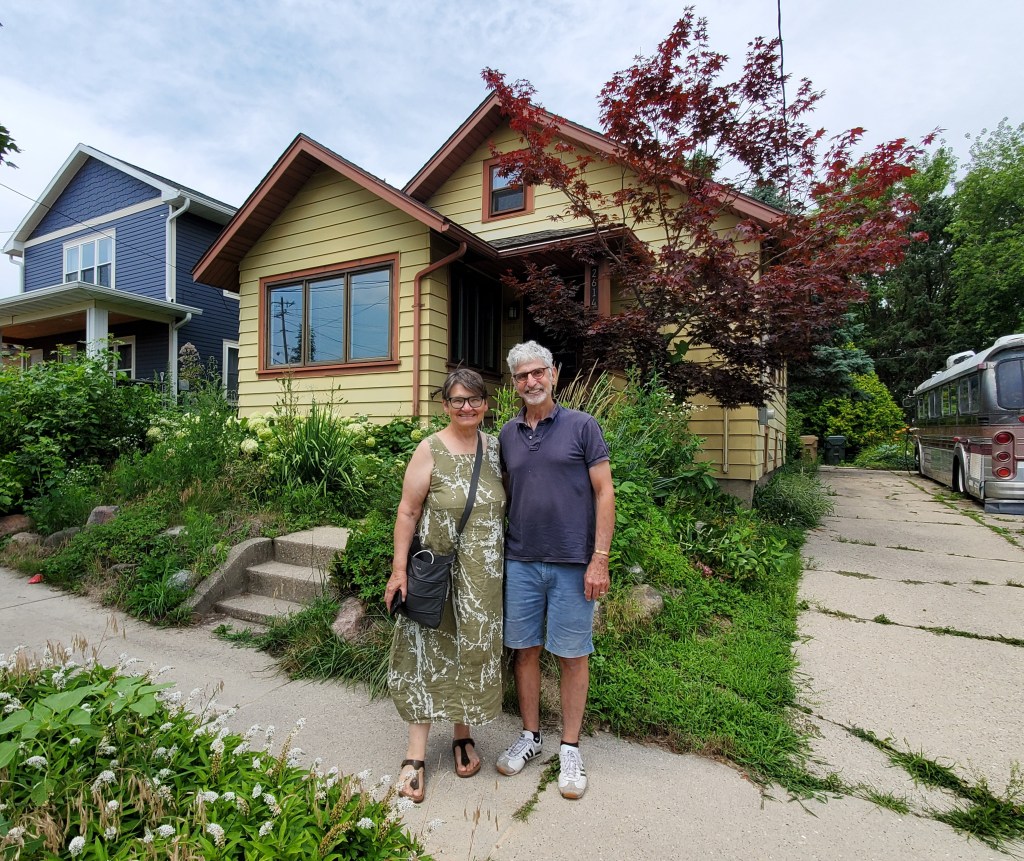
Baby Hannah’s first home in Madison We spent the afternoon on campus at the lakefront, first at the University’s Memorial Union Building for ice cream and then touring the august Wisconsin Historical Society. After an early dinner at Papavero, we drove back to the Silver Star Inn for a final night together, and parted next morning after another delicious and gorgeously plated breakfast.
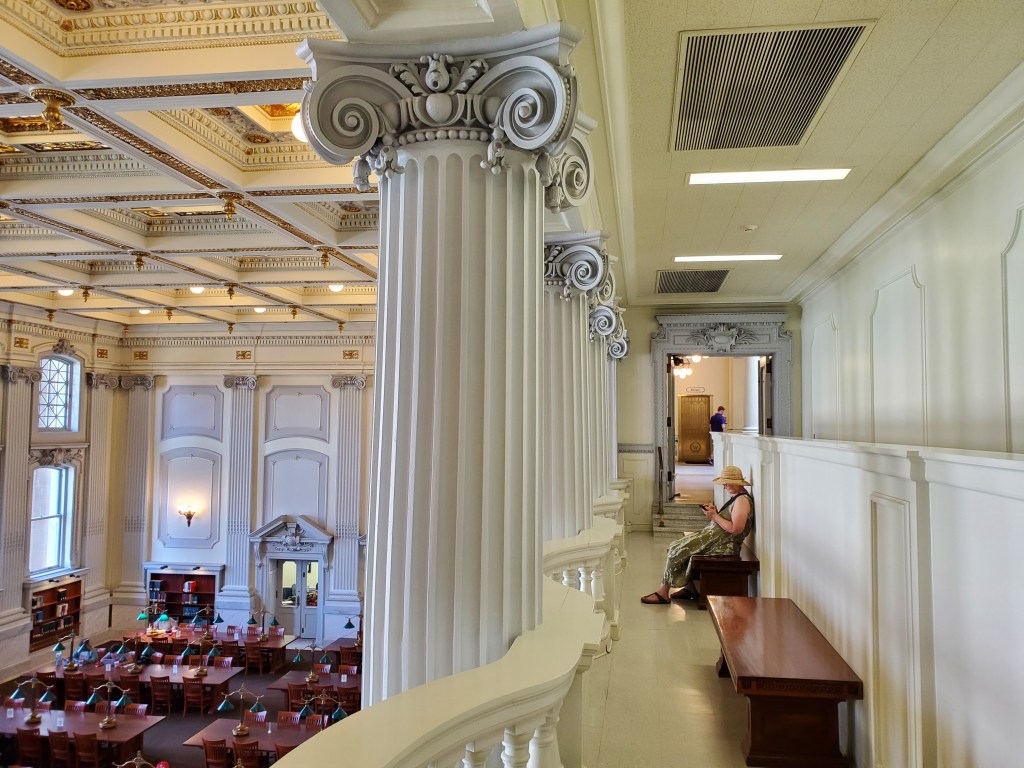
Charlotte in the Historical Society Gallery 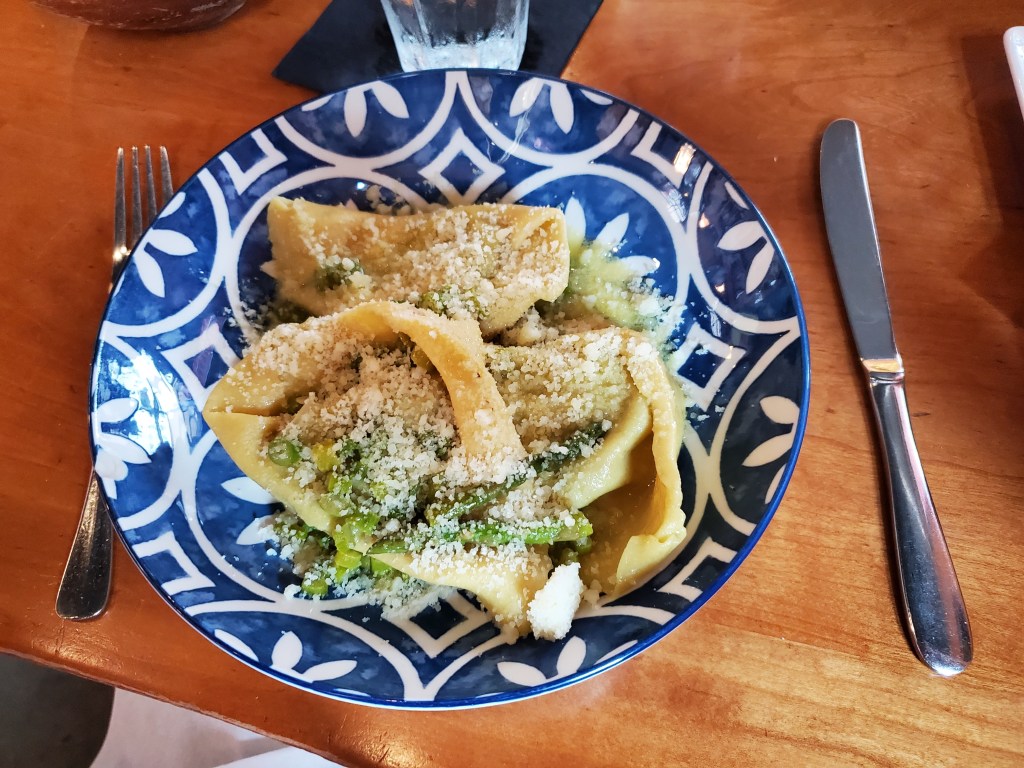
Pasta for dinner at Papavero in Madison 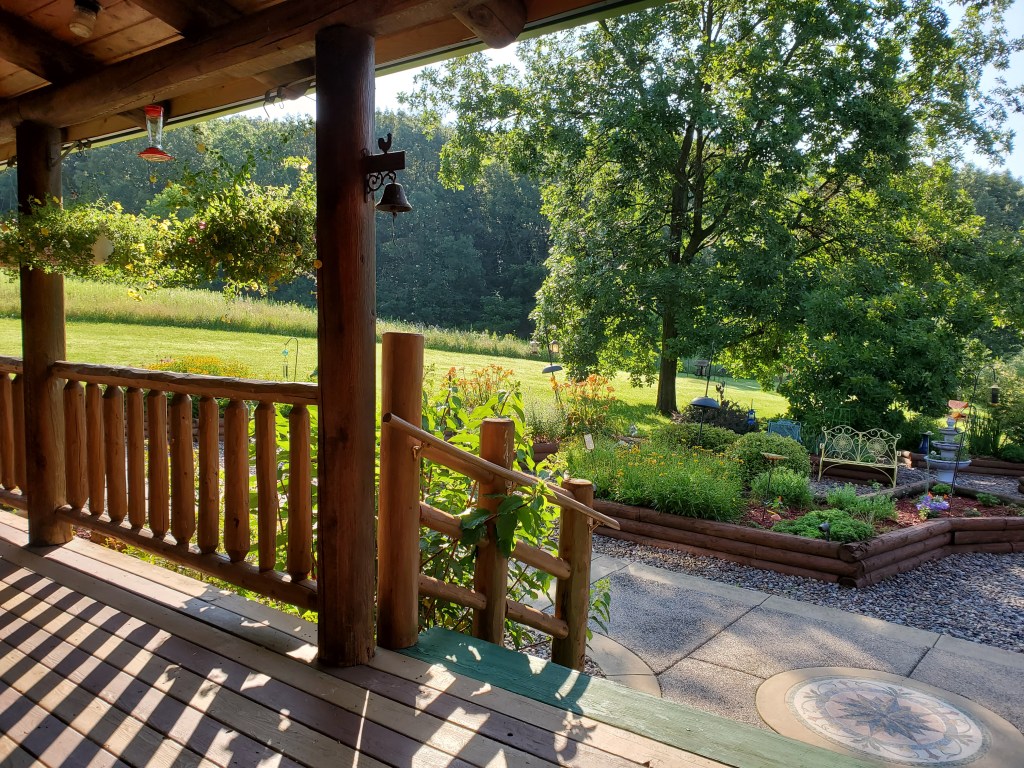
View from the breakfast table 
A last lovely breakfast at the Silver Star Inn The Silver Star’s 11 am checkout left me plenty of time for the drive back to Milwaukee and a leisurely exploration of the Milwaukee Art Museum (MAM) with its iconic Quadracci Pavilion designed by Spanish architect Santiago Calatrava. This three-part marvel at MAM was completed in 2001: the magnificent cathedral-like Windhover Hall has a vaulted glass ceiling 90 feet high; the Burke Brise Soleil, a moveable sunscreen with a 217-foot wingspan, unfolds and folds twice daily; and the Reiman Bridge, a pedestrian suspension bridge, connects the Museum to the city.
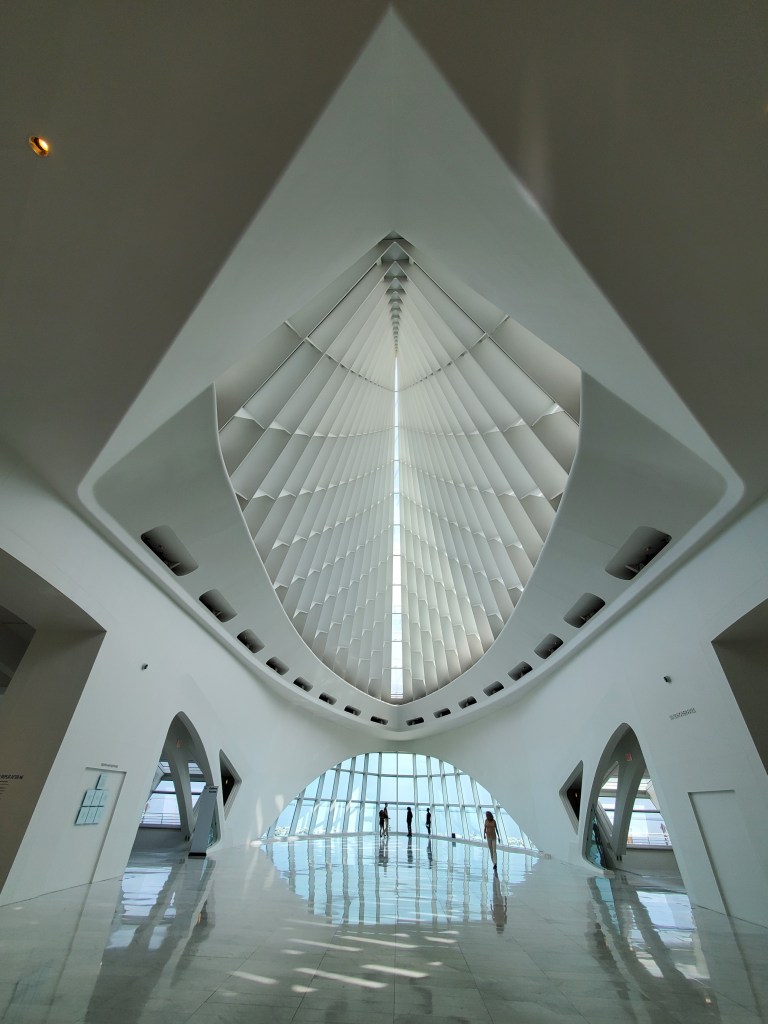
Windhover Hall, MAM 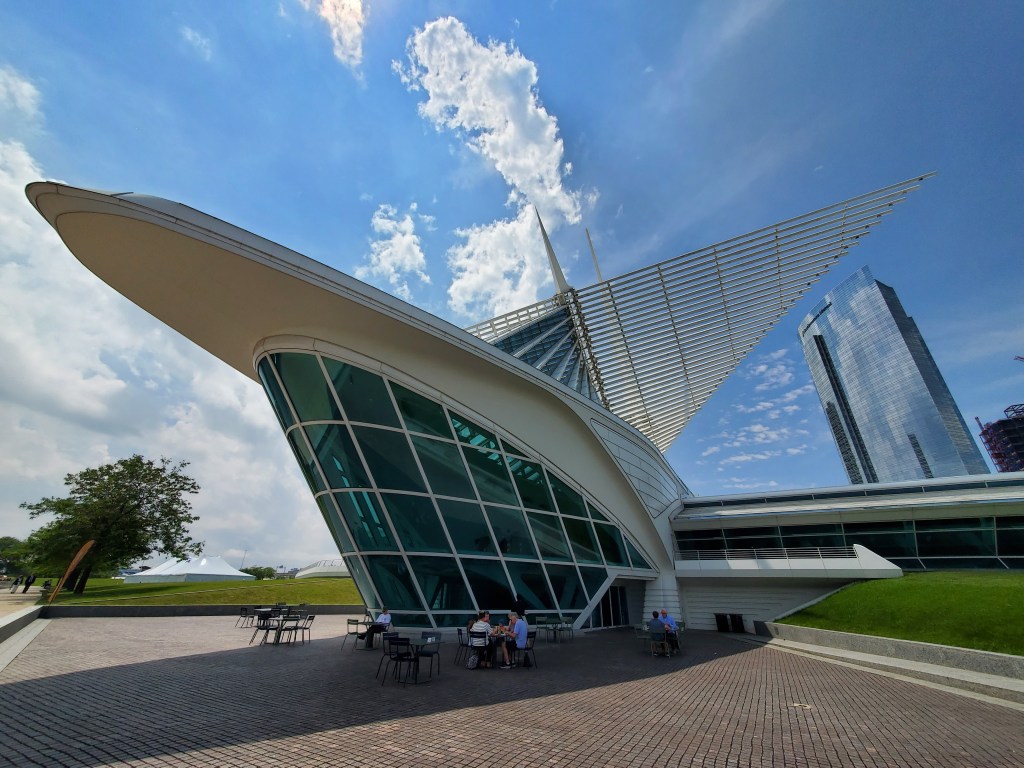
Lakeside café, MAM: great avocado toast 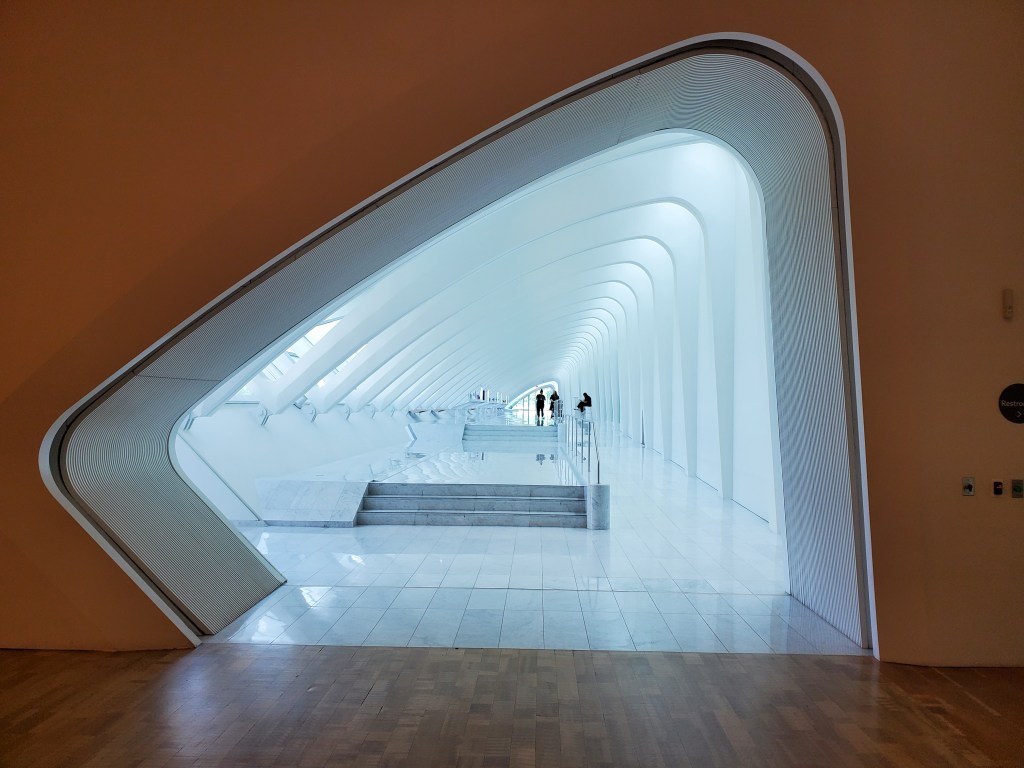
Corridor connecting the Quadracci Pavilion with the earlier
War Memorial Center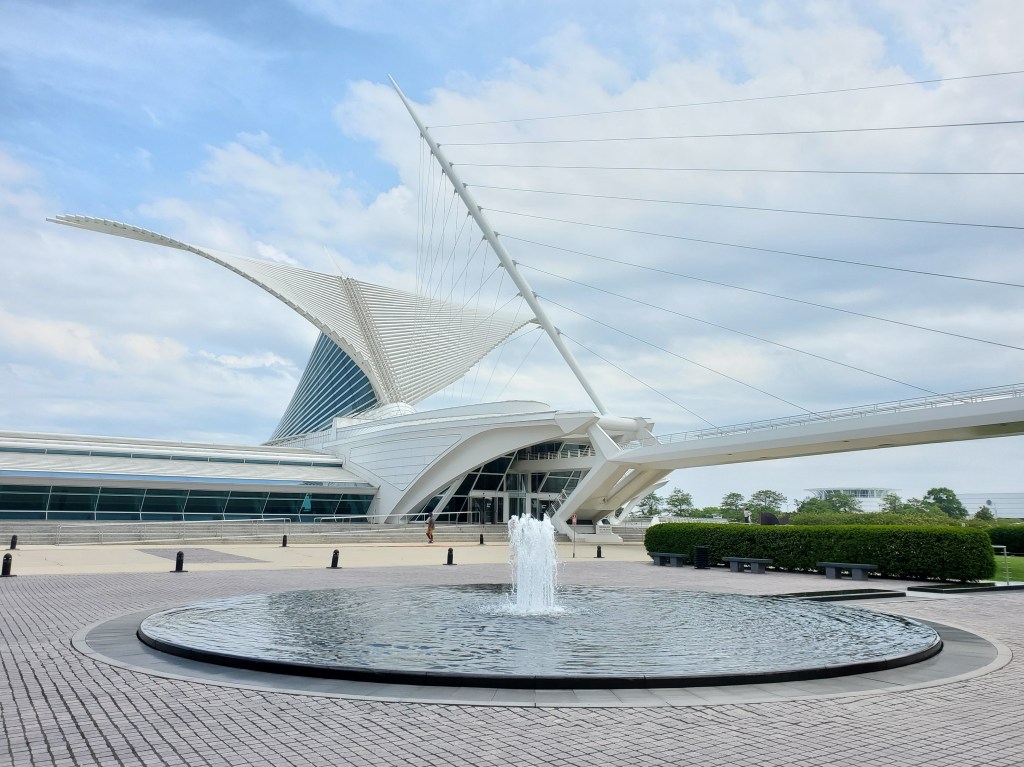
Atrium, wings, and bridge at MAM The Quadracci Pavilion’s design, according to Calatrava, “responds to the culture of the lake: the sailboats, the weather, sense of motion and change.” I found the mashup of white whale, seagull, clipper ship, and Gothic cathedral quite awe inspiring and elevating, much-needed evidence of humanity’s better angels. And for the week I was there, Museum admission was free thanks to Baird financial services—swag for the Republicans, no doubt, though I spotted no MAGA hats in the airy marble halls. I’m grateful to and thankful for Sr. Calatrava, just one year older than I, for that spiritual lift, and for bringing me to a fine and inspiring American collection.

Museum view of the lake from Eero Saarinen’s 1950 War Memorial Center 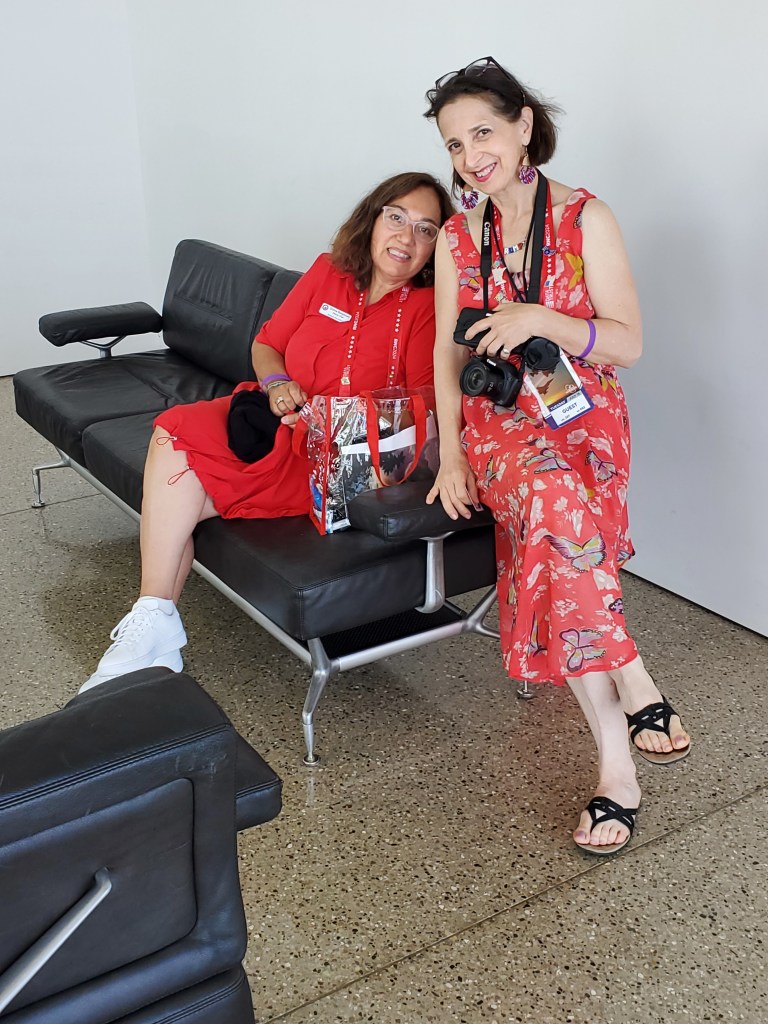
Fellow museum goers and Baggallini enthusiasts enjoying the nearby Chihuly 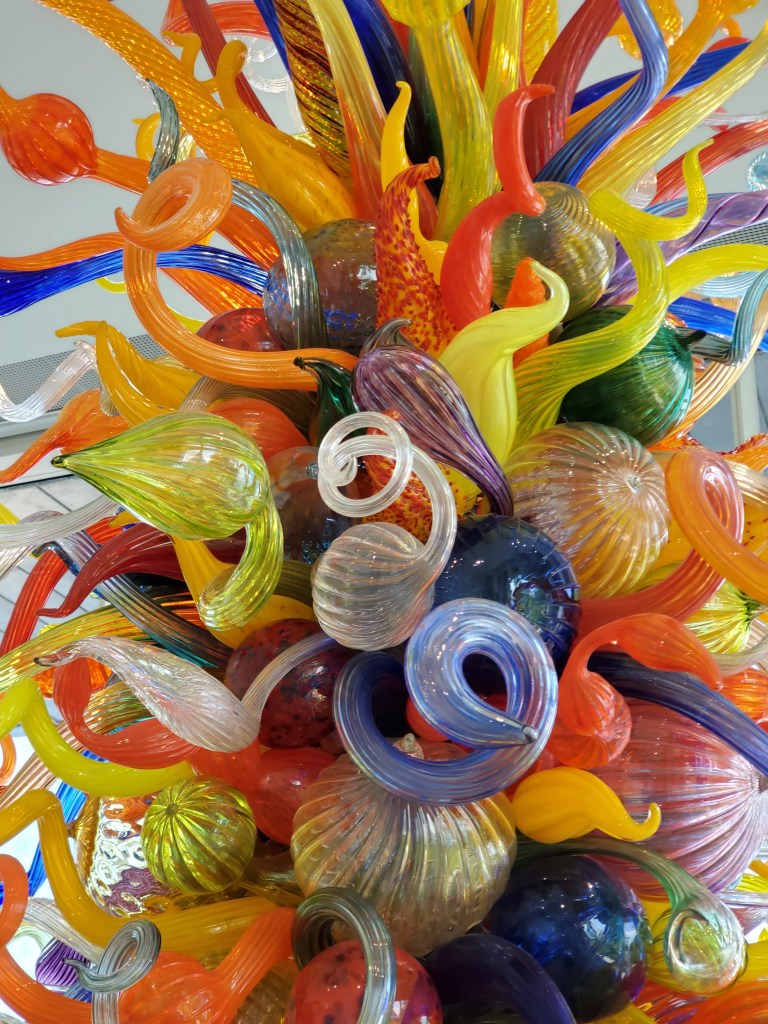
Isola di San Giacomo in Palude Chandelier II, Dale Chihuly, 2000 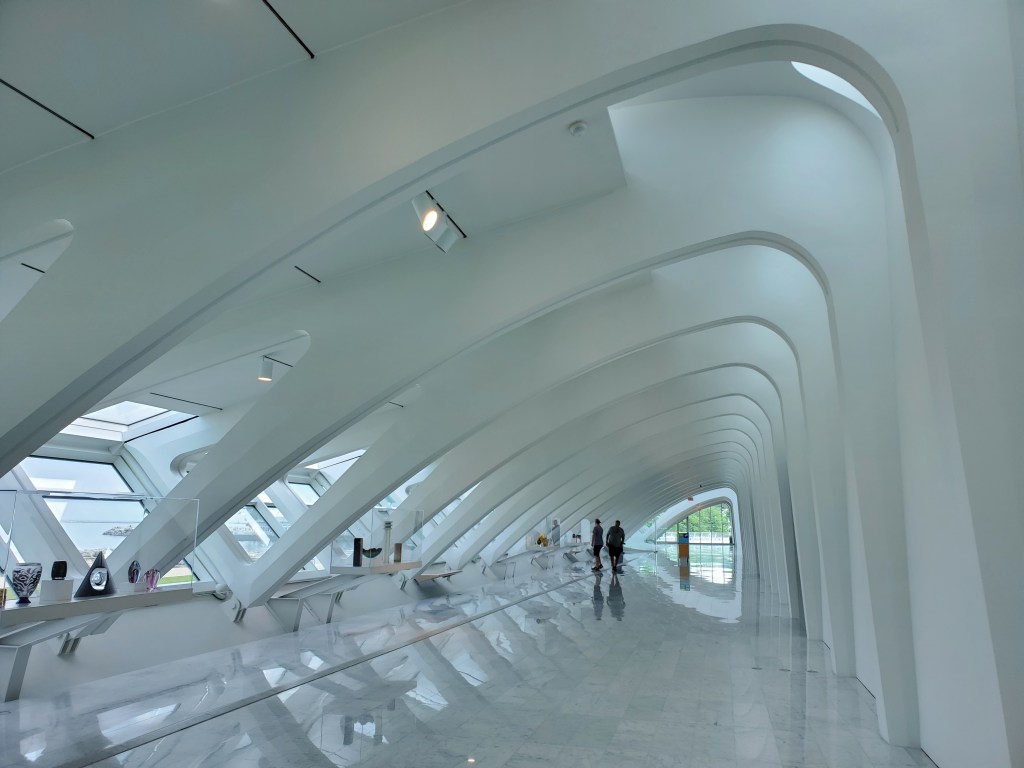
Corridor gallery at MAM ‘Twas a good trip all around. But it’s good to be home again, come what may.

Adieu, Milwaukee -
Revolution 2024
4 July 2024

21st Century Rebels, Durham NH, 15 June 2024 On Saturday, 15 June, Durham NH celebrated—six months early—the sestercentennial (aka 250th anniversary) of some doughty Durham residents’ 1774 raid on the British Fort William and Mary in New Castle, enacting there at the mouth of the Piscataqua River the first major act of colonial rebellion that took place four months before the more famous “shot heard ‘round the world,” the opening volley of the Battles of Lexington and Concord fired on 19 April 1775.
Everett Schermerhorn Stackpole’s History of the Town of Durham, New Hampshire (Oyster River Plantation), published in 1913, offers the backstory. On 12-13 December, 1774, Paul Revere road 66 miles from Boston to Portsmouth with an urgent message: the British were sending two warships, including Marines, to the sparsely defended British Fort William and Mary on the edge of Portsmouth Harbor. Durham resident General John Sullivan received instructions to bring the militia to Portsmouth.
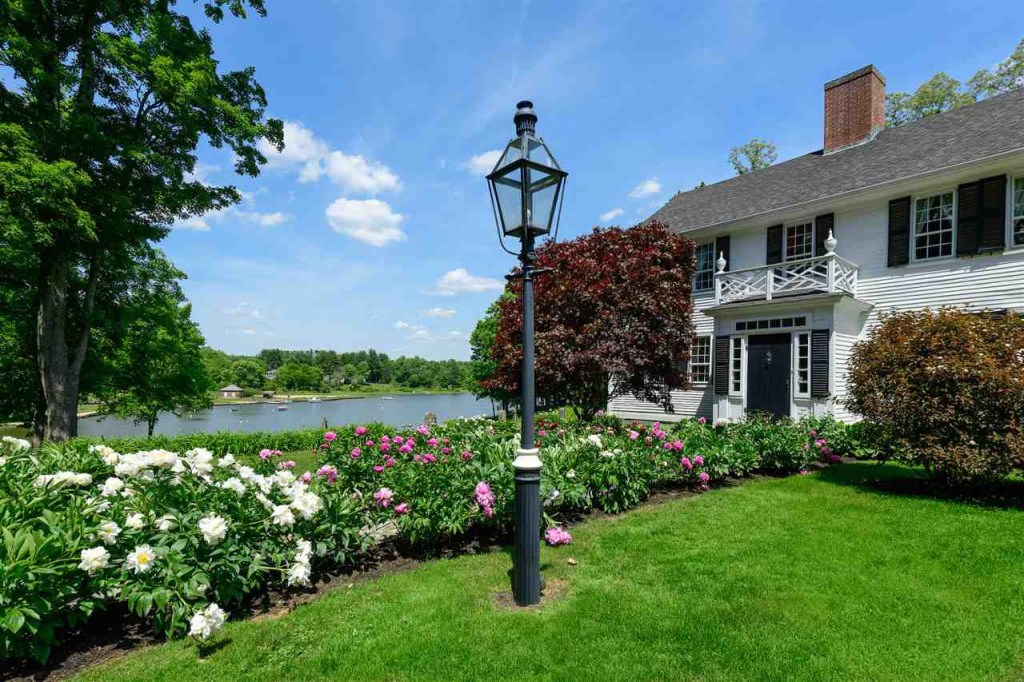
Gen. John Sullivan’s lovely Georgian house, 1740, at the falls of the Oyster River 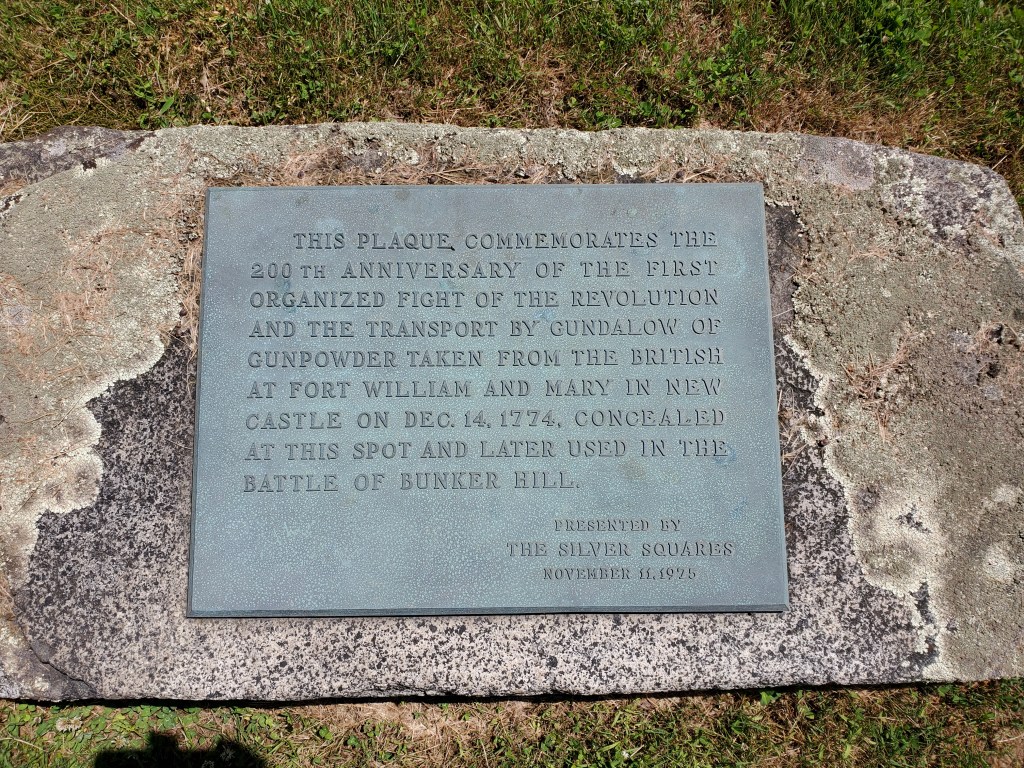
The ensuing assault and raid of 14-15 December 1774 (the second day of which was led by General Sullivan) was arguably the first military action of the American Revolutionary War; shots were fired, and the 400-strong seacoast townspeople “struck the King’s colors,” pulling down the flag flying over the fort. On the first day, they took the province’s 100 barrels of black powder to safety in towns along the Great Bay. On the second day, with help from the Durham militia, they carted off the King’s muskets, cannons, and supplies. Much of the black powder was later used to replenish the colonials after the battle of Breed’s Hill, misnamed Bunker Hill.
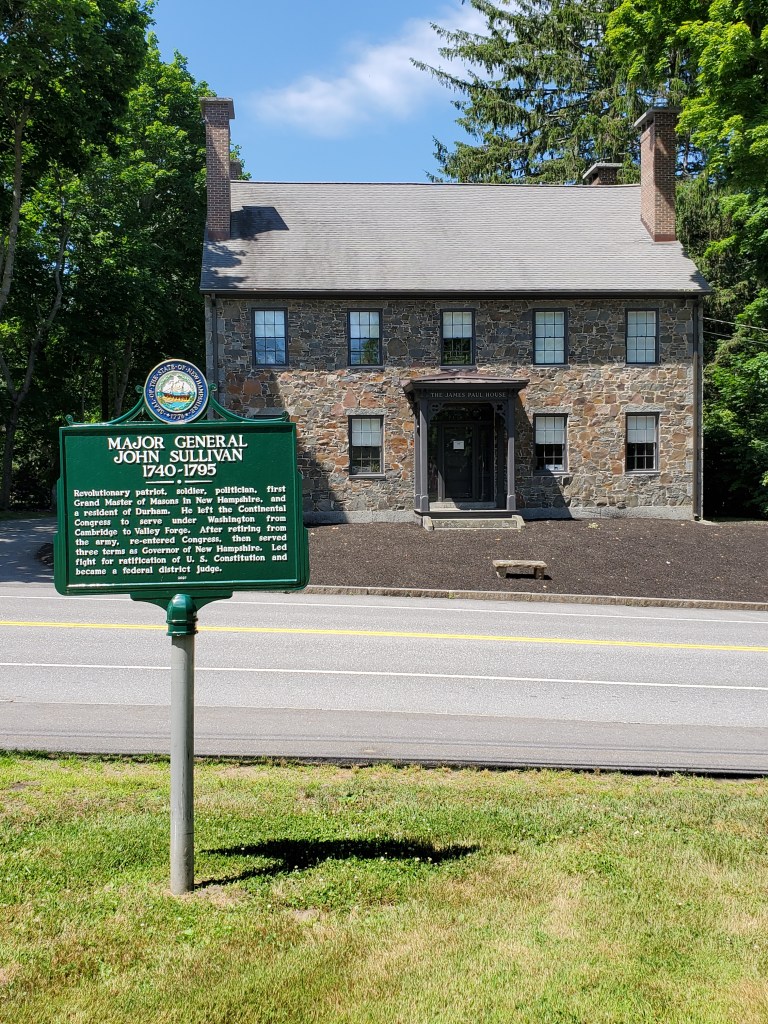
Sullivan’s plaque with the James Paul House, c.1830-40, across Newmarket Road Some of that powder was stored in the barn of John “Powder Major” DeMerritt’s 1723 farmhouse in Madbury, just up Town Hall road from my home, and DeMerritt, who had participated in the daring raid on Fort William and Mary in December 1774, later smuggled 13 of the 97 barrels that were seized to Charlestown MA for use at the Battle of Bunker Hill. Arriving in his ox cart in mid-afternoon of 17 June, 1775, DeMerritt’s supply helped end the danger of a rout and enabled the rebels to hold out until darkness ended the slaughter.
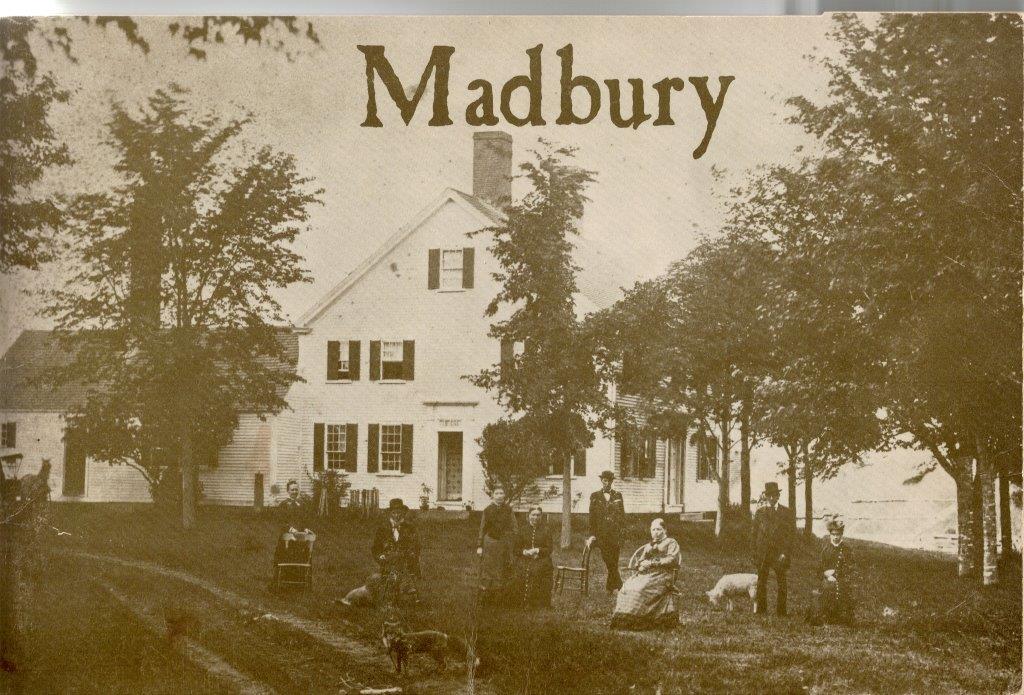
Powder Major’s Farmhouse, built 1723, with later visitors 
15 June 2024, celebrating our earliest patriots Durham’s 2024 celebration boasted a perfect June day at Gen. Sullivan’s house at the falls of the Oyster River, well-informed and costumed reenactors, and a lovely chance to socialize with townsfolk. What was at stake then in 1774 has since been much on my mind in the wake of last Thursday night’s debate debacle and SCOTUS’s subsequently yet again upending settled law in the Chevron deference case, and even more alarmingly reinforcing the immunity and therefore the power of a single presidential executive, undercutting precisely what those colonial rebels we celebrated last June sacrificed their lives to avoid: the unmitigated authority of a king.
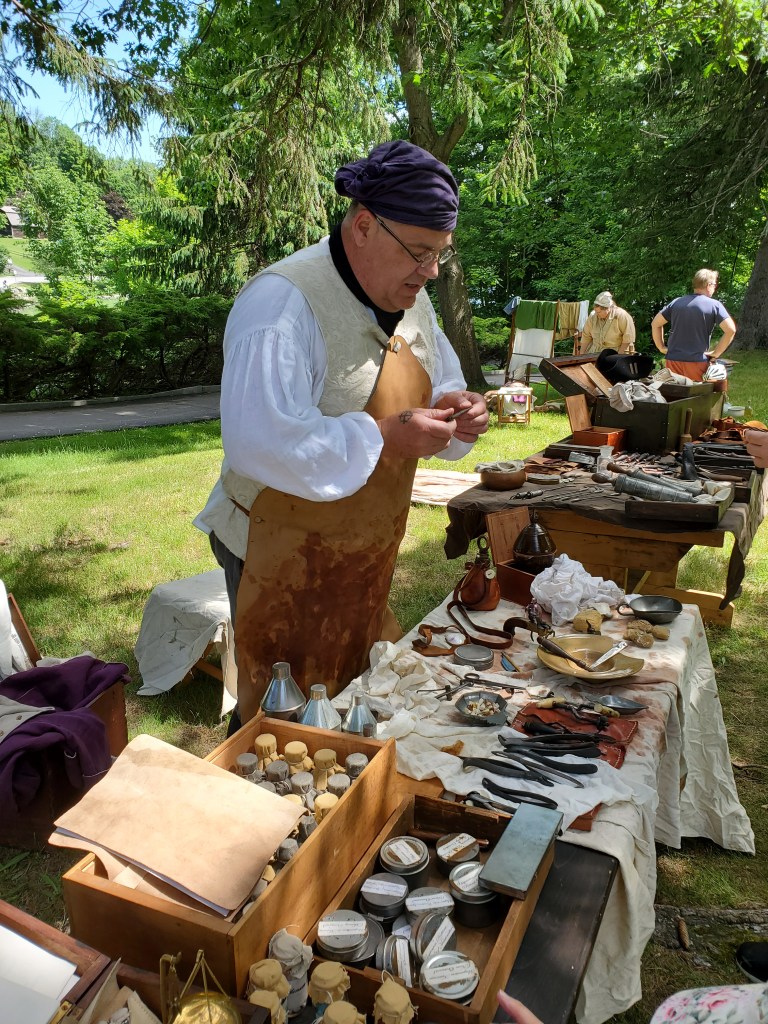
The Apothecary explains his practice 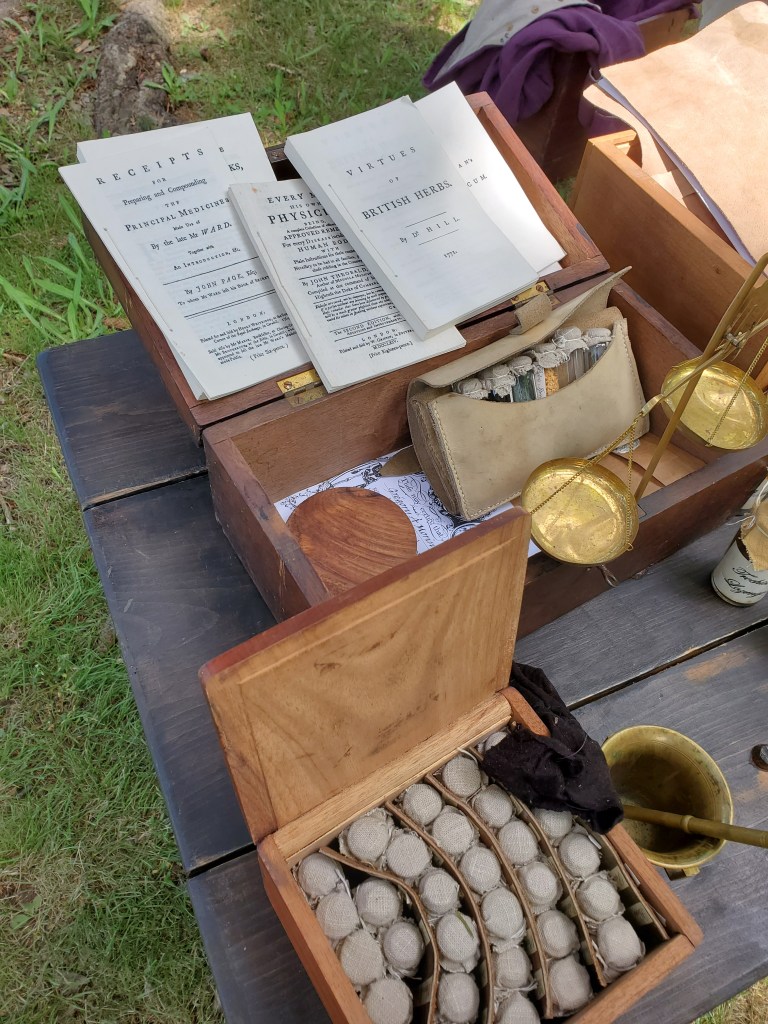
Big Pharma c. 1774 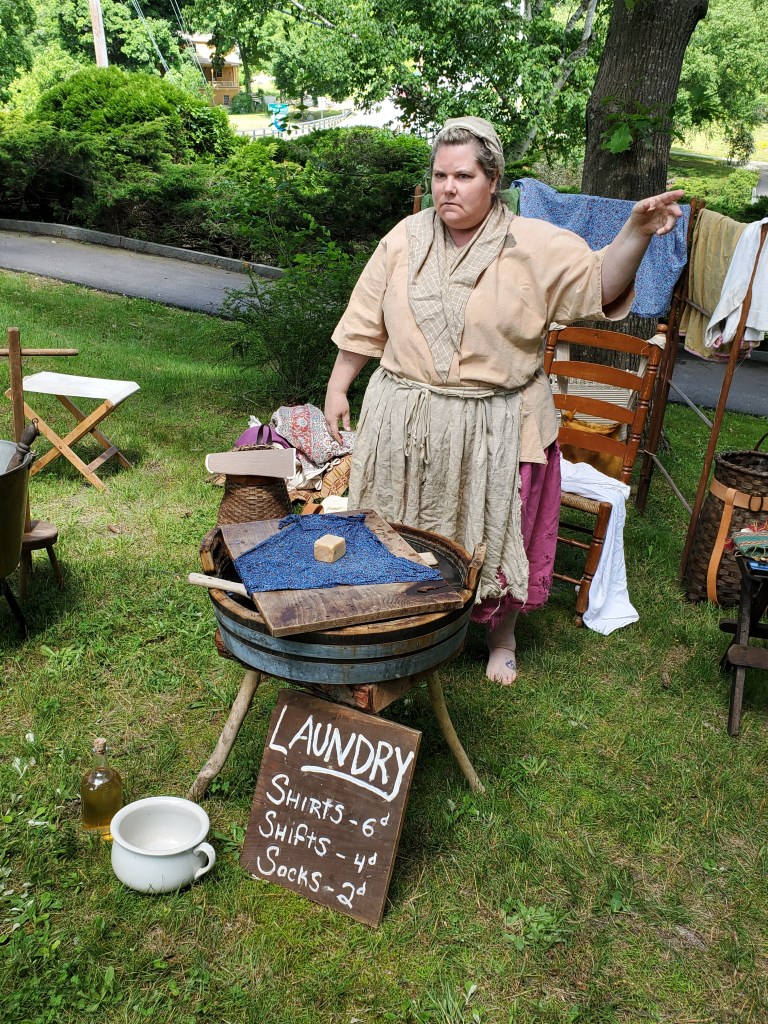
Washer women explains how much less often clothes were washed c. 1774 All this past week such threats to our republic have depressed and discouraged as I negotiate the much less important but more dauntingly personal conundrums in the privileged life of this septuagenarian. But among friends last night in Portsmouth watching an impressive fireworks display over the Mill Pond and again this afternoon at my wonderful neighbors’ happy gathering of younger friends, things seem a lot less dire.
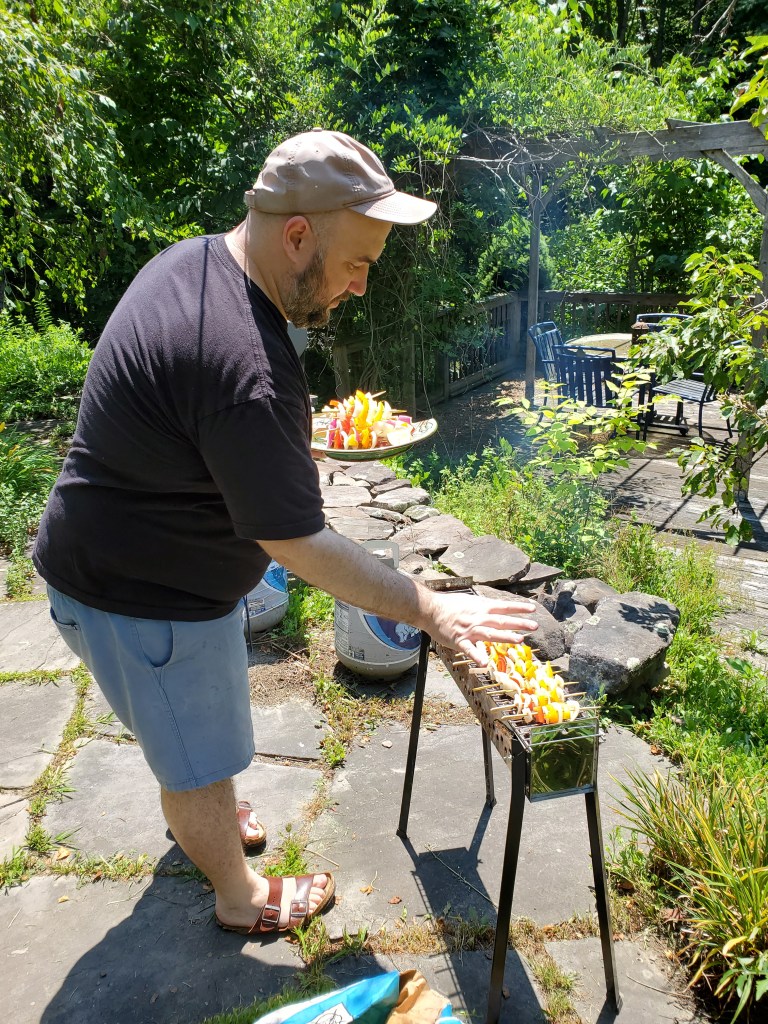
Peter grilling so the rest of us can be chilling, 4 July 2024 So, Happy Birthday, America, and thanks for all the grace you’ve shed on me. Here’s to a new birth of freedom in 2024, preserving what so many gone before have honored and defended. Can we keep our republic? Yes, we can!

The rockets’ red glare over the Portsmouth Mill Pond, 3 July 2024 -
Three Graduations and a Funeral, Part 4, 15-21 May 2024: Old Friends
21 June 2024
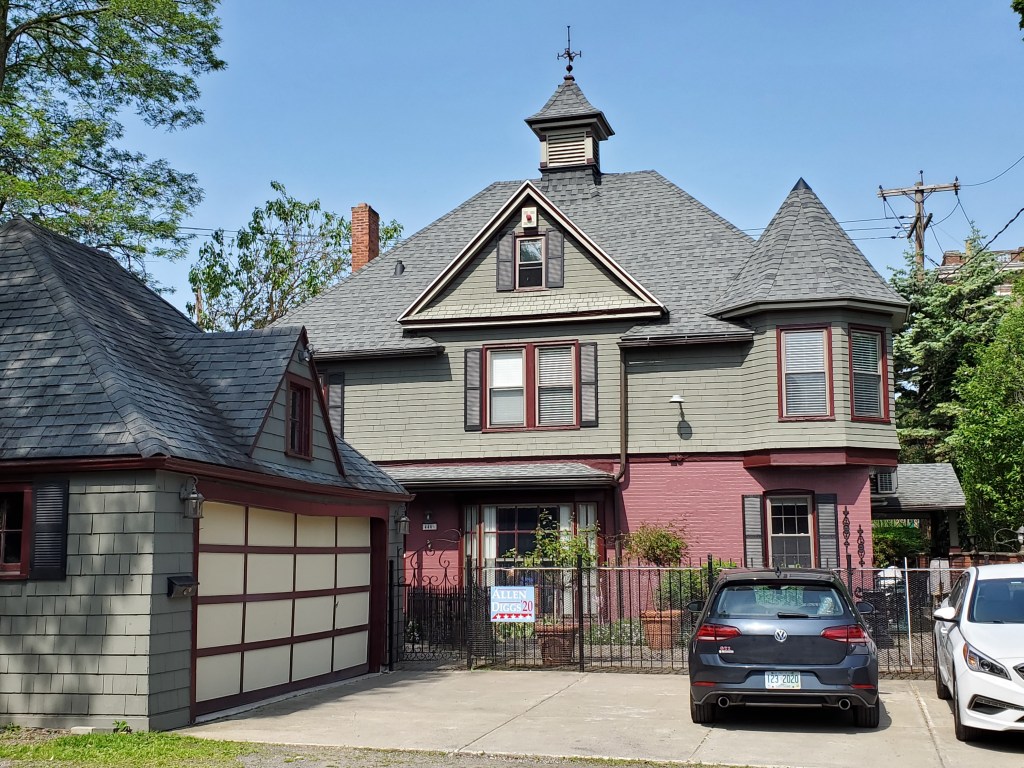
My GTI parked at my last stop: Martha’s carriage house in Buffalo NY In the middle chapter of Eudora Welty’s slim volume, One’s Writer’s Beginnings, she writes of “Learning to See”:
I think now, in looking back on these summer trips—this one and a number later, made in the car and on the train—that another element in them must have been influencing my mind. The trips were wholes unto themselves. They were stories. Not only in form, but in their taking on direction, movement, development, change. They changed something in my life: each trip made its particular revelation, though I could not have found words for it. But with the passage of time, I could look back on them and see them bringing me news, discoveries, premonitions, promises—I still can; they still do. . . . The events in our lives happen in a sequence in time, but in their significance to ourselves they find their own order, a timetable not necessarily—perhaps not possibly—chronological. The time as we know it subjectively is often the chronology that stories and novels follow: it is the continuous thread of revelation.
Today, what would have been David’s and my 29th anniversary, the first full day of summer, marks one month to the day since I got home from my big road trip, and I still feel I’m in transition.
Nel mezzo del cammin di nostra vita
mi ritrovai per una selva oscura,
ché la diritta via era smarrita.Well on my way to age 72, I am hardly, like Dante’s protagonist, halfway along life’s path: to paraphrase Kate Hepburn’s character in On Golden Pond: “We are not middle aged! People don’t live to be 140!” But I do find myself in a dark wood, having lost the straightforward way. The daily dumpster fire of news aside, I’m grieving, and fretting over new symptoms of physical decline as well as a real setback to getting my book into print. I know, however, the way back to the light is action, not stultifying deliberation. And so I look back to last month to conclude this account of my 3G1F trip, revisiting my past even as I move ahead in time, a complex chronology of my own.
On 15 May, brother-in-law Richard, nephew Daniel, and I loaded our cars and left “My Happy Place” cabin in Whittier, NC, all of us now outfitted with gps for the journey ahead. Richard’s new mastery of that technology eased my concern for them; they got safely to Ocala, and I headed to my old Kentucky home in Danville, where I taught at Centre College from 1984-1995. But first, I made a stop along the Blue Ridge Parkway at the Folk Art Center my potter sister Jane and I had once visited, checking out what her colleagues in the Southern Highland Craft Guild had to show. Some of the pots on display were from Jane’s alma mater in Clyde NC, Haywood Technical College (now Haywood Community College); she’d like that. I thought of how much our Blonde Wind loved her time in the mountains, and bought myself a souvenir pair of earrings to mark the visit, as David always had for me.
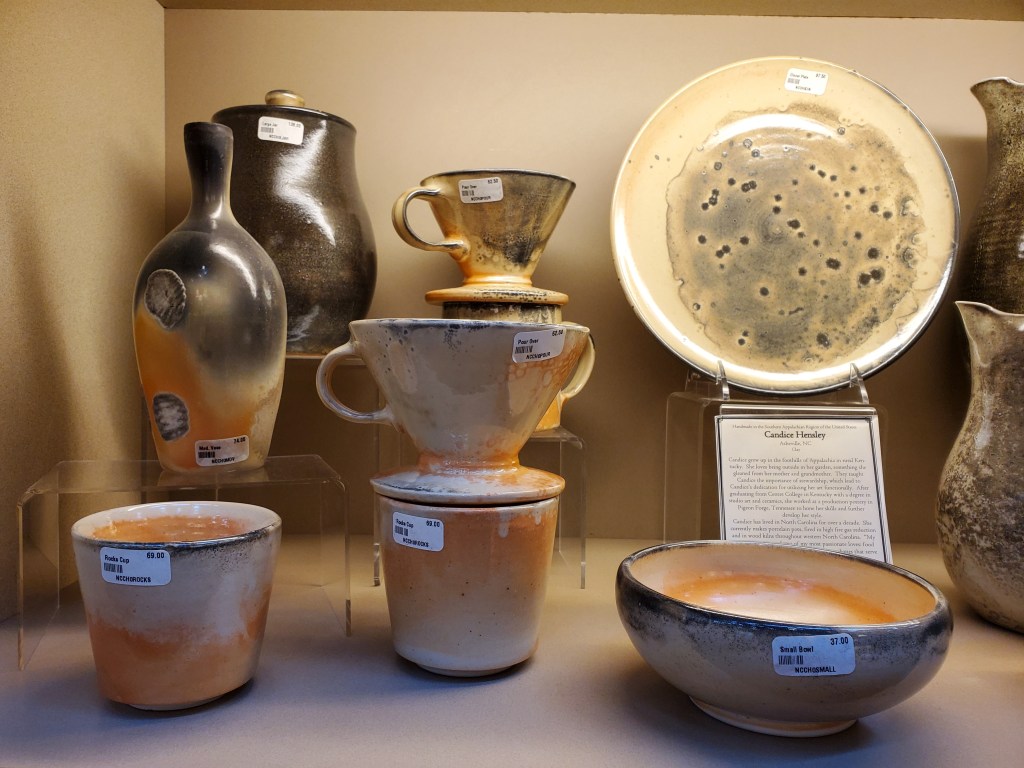
Soon after I left the Center, heavy rain clouds opened up, and I found myself in the kind of downpour even the fastest windshield wiper cannot negotiate. I was in that curvy, over-trafficked part of I-40 that weaves through the mountains on two lanes without shoulders, replete with very large trucks that make pulling over or even slowing down a bit an impossibility. In 1986, on a spring break drive to Chapel Hill to visit my then boyfriend, I’d encountered a sudden snow squall and ice-over of these same roads that caused some of those trucks to jack-knife and block the way forward; I was stranded in my Toyota Corolla overnight in freezing weather sans coat, gloves, or hat. I clearly remember thinking how stupidly I’d set out, unprepared: “This is how people die.” No cell phones back then, only truckers who mercifully prowled through the night making safety checks on us stranded drivers. I had a full tank of gas at least, but dared not leave the car running, heater on, lest snow cover the tailpipe and carbon monoxide fill the cabin. I emptied my carpetbag purse, wore it on my head for warmth, and toughed it out till mid-morning next day when the trucks were finally cleared and the road reopened.
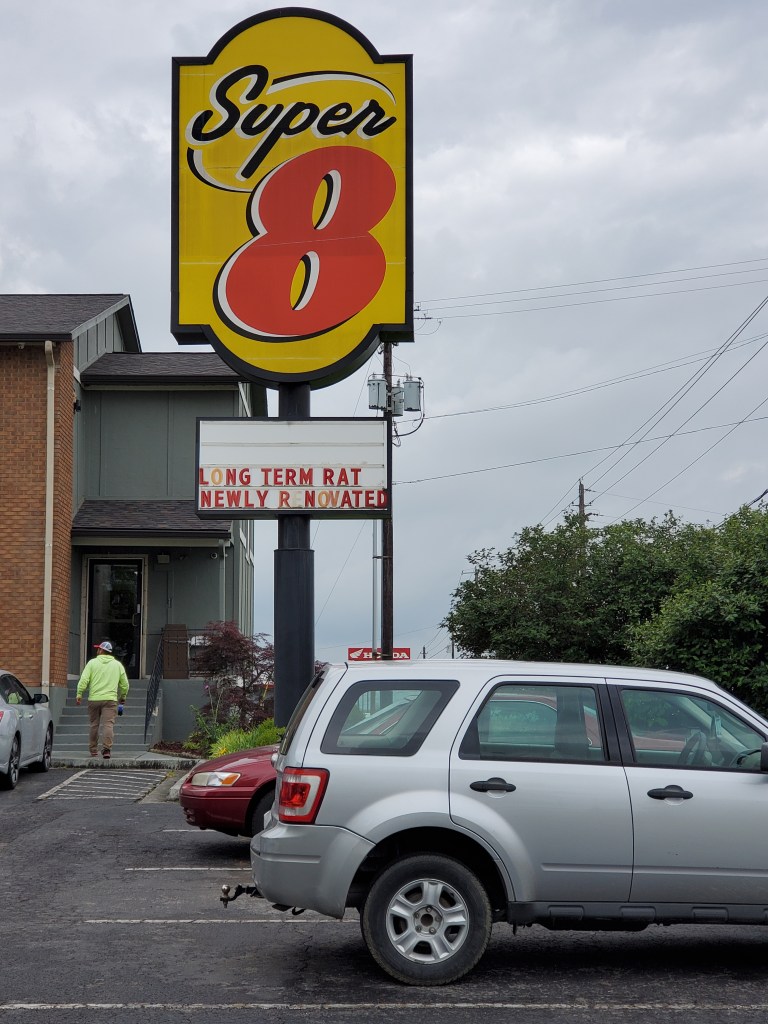
This time I-40 served up a blinding rain storm; again I survived, however exhausted. I stopped at the nearest Arby’s for a jamoca shake to celebrate/wake me up; the girl behind the counter automatically gave me the senior discount, so I’m sure I looked as sorry as I felt. Sleepiness mandated my stopping again in a very hot high school parking lot, but the car was now too packed to allow my seat to recline, so I just had to persevere until I reached Danville and pulled into the Super 8 motel I had reserved. Advertised online as “newly renovated,” that past tense was clearly aspirational. The room I asked to see (a first for me) had a tv with no remote, and the hallways were filled with remodeling detritus. Seeing my expression, the young clerk offered me my pre-paid money back. Only then did I realize that the Wednesday I had arrived in Danville was the Wednesday before Centre’s graduation—the third of my trip—and I feared there would be no rooms available elsewhere. A quick check at the next-door Holiday Inn Express DID oblige, however, and though I didn’t remember to ask for either my AAA or AARP discount, and once in the room discovered I’d left both my umbrella and my beloved L L Bean spreader knife back at My Happy Place, I finally had a place to rest. I then got my money back from the “Long Term Rat” receptionist, who confessed she was embarrassed by the state of her mis-represented workplace. I got a baked potato from the nearby Wendy’s—a frequent practice during my early days in Danville—and at last got a good night’s sleep.
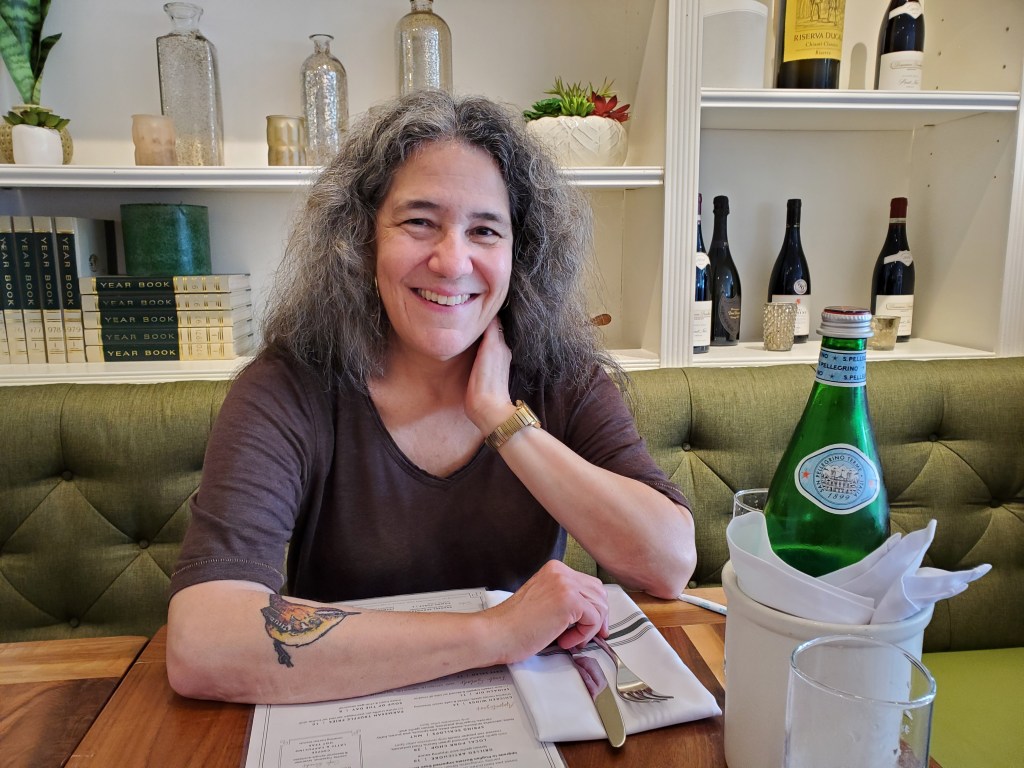
The next five days brought a happy series of reunions with old friends from three different periods in my life. First, it was the Centre College crowd. We were all 30-somethings when we first met; them that are now grandparents were then just beginning their academic careers and their families, and those bonds have stayed strong over these many decades. Back then we often shared meals together, a tradition we’ve maintained. On Thursday the 16th, I drove to Lexington’s charmingly walkable Chevy Chase neighborhood where my classicist friends the Svarliens live. Diane, triumphantly well after years of battling cancer, was her magnificent self throughout our lunch at Bella’s, showing off her new Carolina Wren tattoo.
After lunch and a siesta back in Danville, I was treated to drinks at the Levins’ lovely home on Main Street, viewed Grazia’s collection of artifacts and some travel-inspiring photos from their recent trip to Japan, and enjoyed some really good enchiladas with a rich mole and some brews at Las Margaritas in downtown Danville—a no longer dry Danville, praise be, as it was when I lived there. As ever, our reunion filled me with gratitude for such friends.
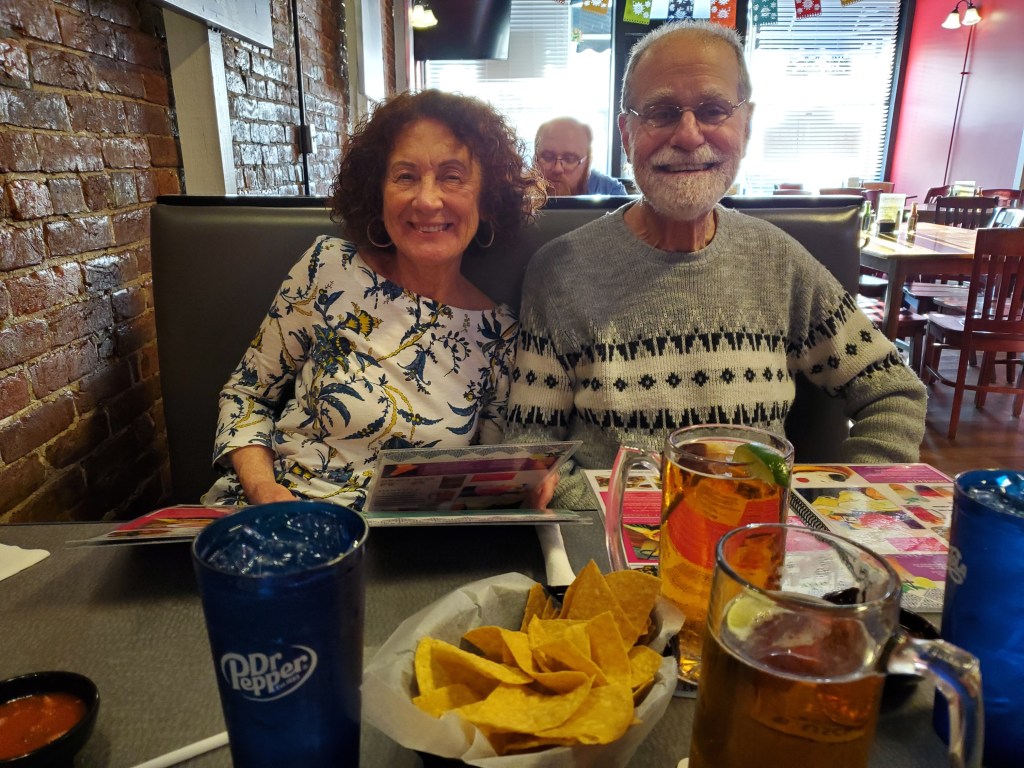
Grazia and Bill . . . 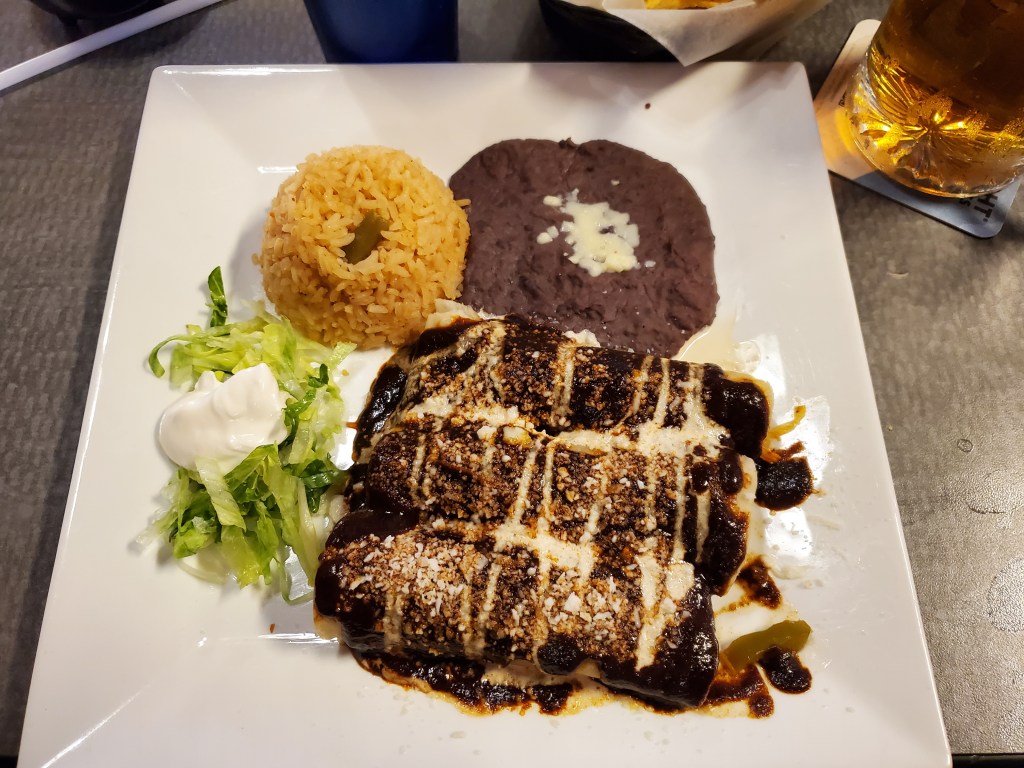
. . . and excellent enchiladas at Las Margaritas, Danville KY On Friday I rearranged my GTI’s contents, anticipating the possible need for a nap during the next day’s drive to the Columbus suburb, Gahanna. I replaced my left-behind umbrella on a trip to Walmart, and then was able to visit with Bobbie White, one of the brace of mentors who befriended and looked after me when I first arrived at Centre. Bobbie modeled so much for me: how to run a program meeting, how to conduct a seminar (we team taught the English senior seminar on comedy), how to brook no nonsense, how to endure and triumph over loss and illness. Stoically confronting and managing a grim cancer diagnosis these several years, Bobbie maintains her evergreen strength of will and sharp wit. How good to speak frankly and openly to such a friend of how important she is to me!
And then it was on to Ann and Sheldon’s, and the deep pleasure of a wonderful dinner in the so welcoming setting of their art-filled home and exquisite garden, catching up with Jane and John, and enjoying how far we’d come together.
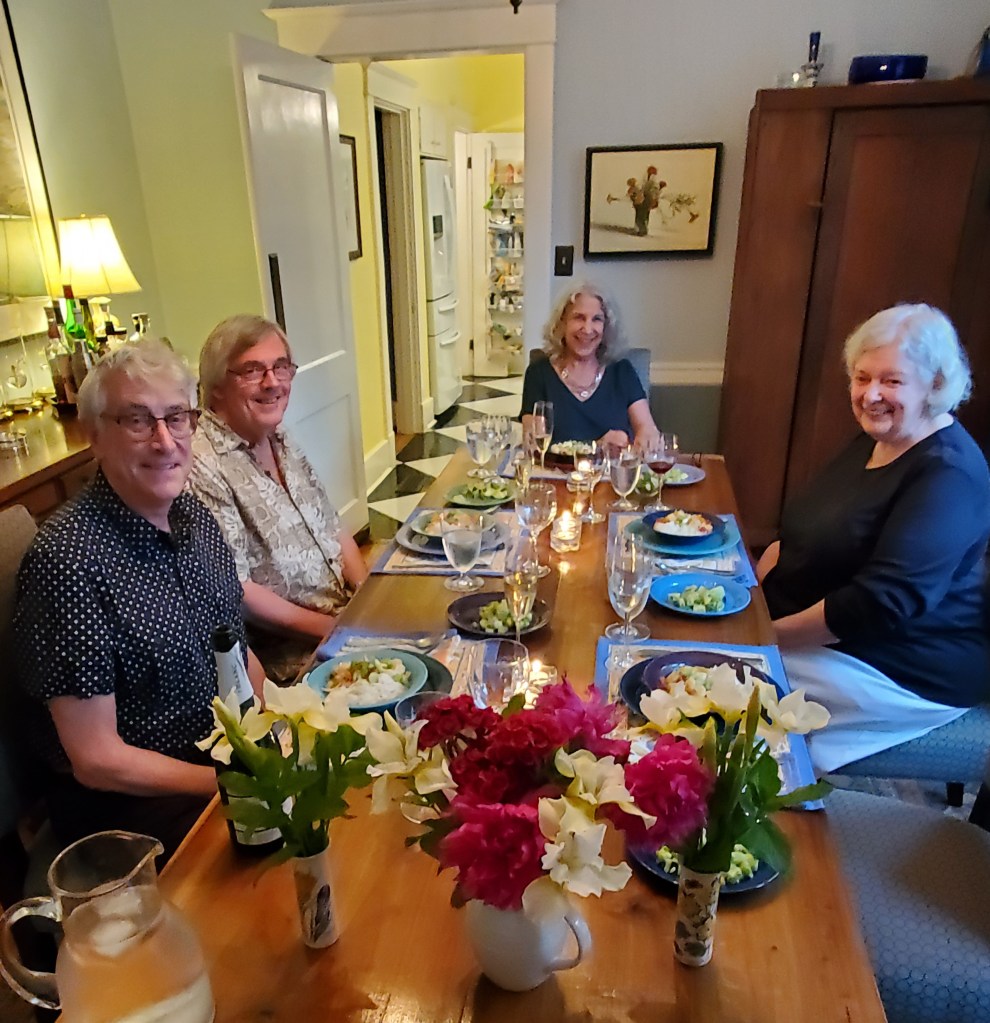
Sheldon, John, Ann, and Jane on St. Mildred’s Court But I had further to go, both in distance and back in time. The next morning began over coffee with Helen, who had joined the Centre faculty after I left. She delighted me with an account of anecdotes she’d shared with the Centre faculty the day before to honor retiring colleague Mark Rasmussen, not knowing that I (with Bobbie) was part of the MLA interview that got him hired, and the host of the Halloween party he attended as a Tri-Delt. Two such happy past points on my personal timeline were also a revelation of where I was now: the young prof I had helped to hire was retiring. Then friends Kathy and Jane joined Helen in seeing me off to revive a much earlier friendship in Ohio.
When I was 2 1/2, my dad George was drafted and posted as a captain to Fort Knox, so my mother and I moved from our new home in St. Petersburg to an apartment in Columbus to be closer to him and the Murphy family.
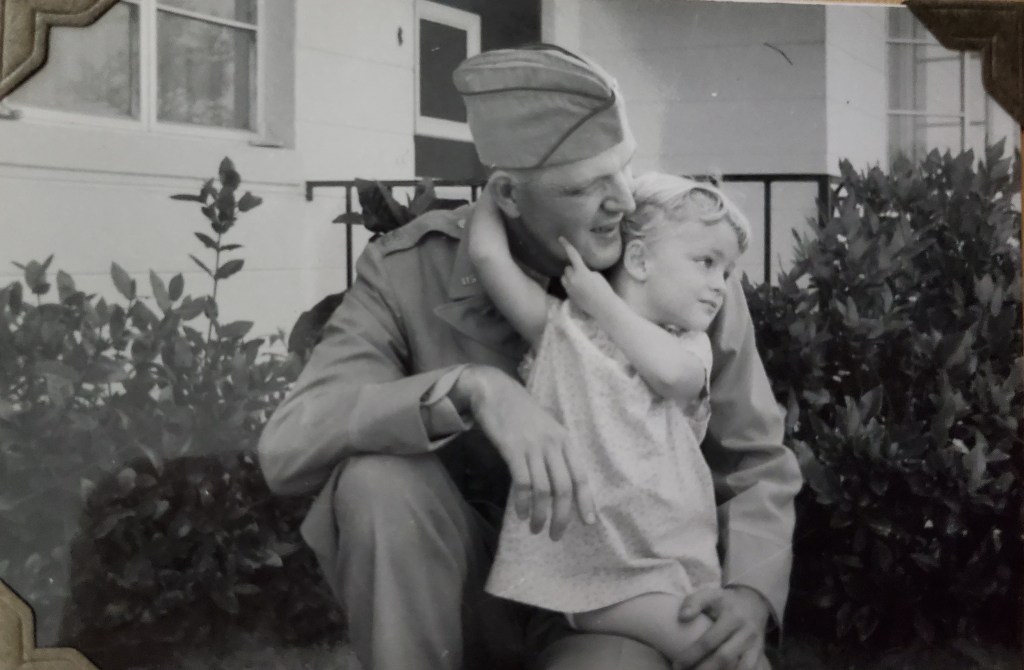
George and Georgy, 1955 My first memories are from that time: being in my crib, the guppies we had, the time my mother fell down the stairs, my baby doll Mark Burns being hidden in an oatmeal box by a mischievous neighbor boy. My mom Virginia started taking basket weaving lessons from a blind man at the Columbus YWCA, and there met another mom, Janet, with another little girl my age, Sandy. Janet and Virginia became life-long friends, and Sandy became my very first friend. It was she I was now, almost 70 years later, going to visit.
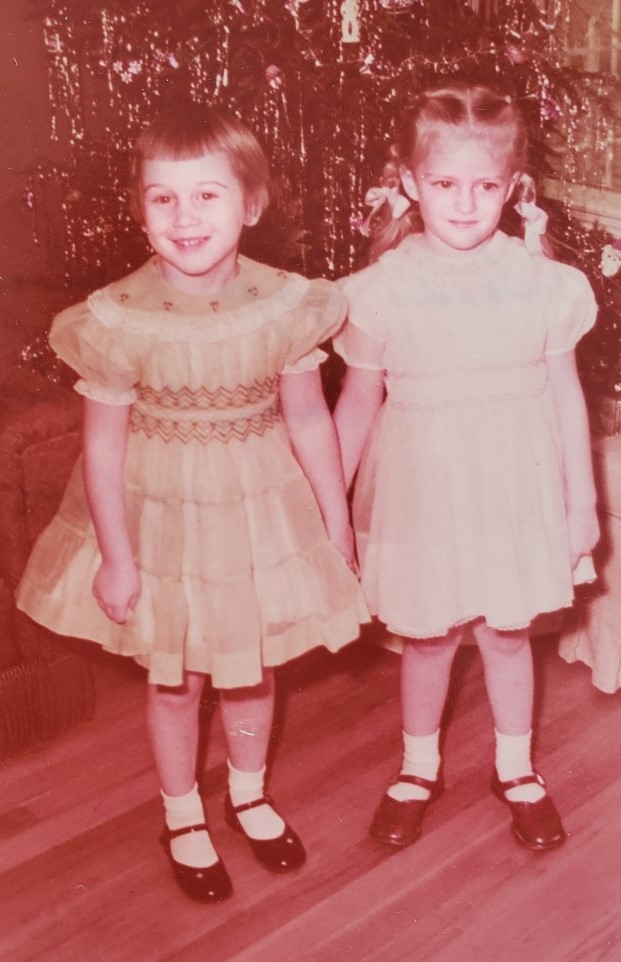
Sandy’s 4th birthday with Georgy, Christmas 1956, Columbus OH My Saturday arrival proved not all that convenient for my hosts, Sandy and her husband Steve: both had multiple duties at their church early the next morning. But they couldn’t have been more welcoming, and I was immediately wrapped in full midwestern hospitality, shown around their charming, craft-filled home and my own guest quarters, briefed on the grandchildren and recent travels, and then taken to dinner at the local Hickory Steakhouse, where I ordered my midwestern favorite, meatloaf.
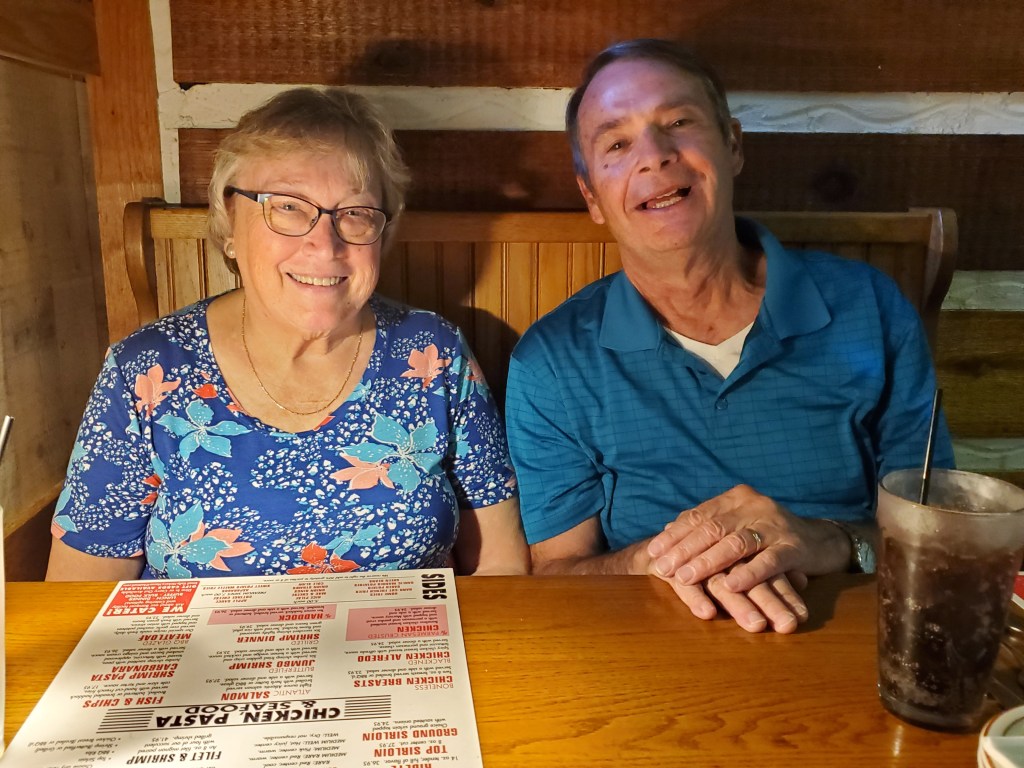
Wonderful hosts Sandy and Steve 
At home in Gahanna We watched tv together, totally at home and relaxed, first the Preakness (my colt, Seize the Gray, won!) and then an old Perry Mason episode about a college president’s past threatening an endowment (Season 5, episode 12, “The Case of the Brazen Bequest”): right up my academic street. I got a great sleep in their beautifully appointed guest room; they were already gone to church by the time I woke, but they’d left breakfast treats for me, some of which I toted to snack on as I drove north to Buffalo and my final visit before returning home.

Note the Ohio-shaped pillow: “Round on the end and hi in the middle” My friend Martha lives in the carriage house of a splendid Queen Anne edifice on Linwood Avenue in Buffalo, a neighborhood of architectural wonders c. 1880-1910 and mature chestnut trees with the coral/pink blossoms I’d not seen since my time at Regents College, London.
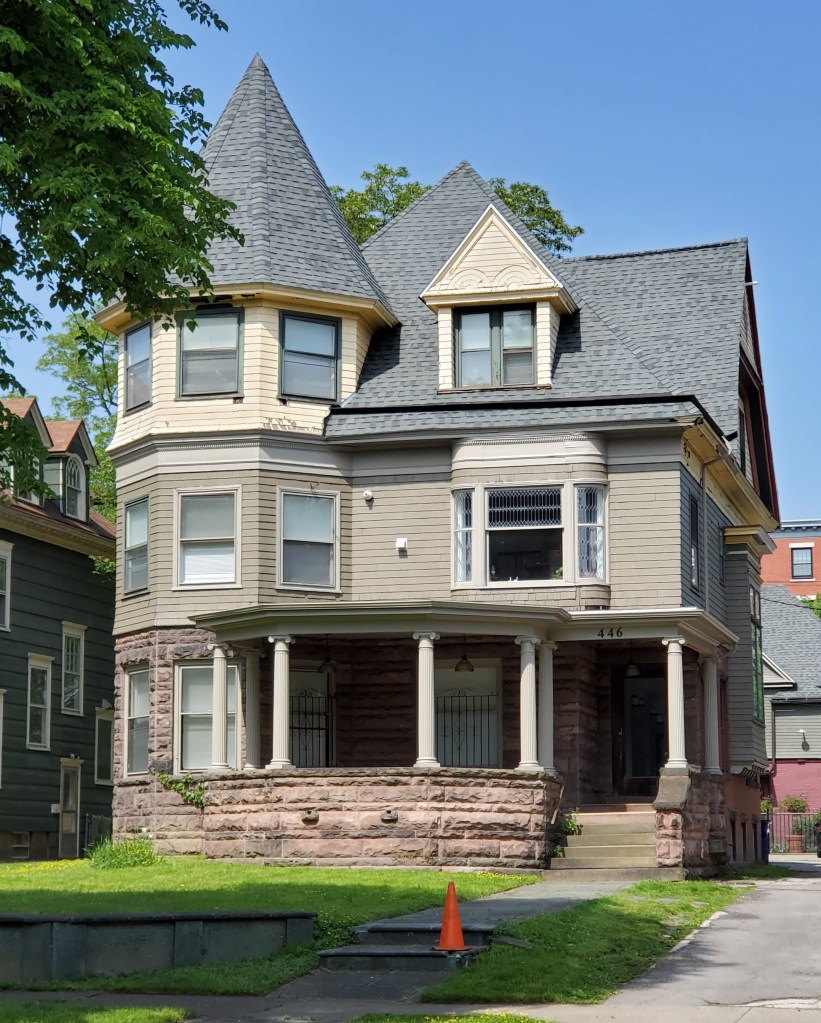
446 Linwood Avenue When I arrived, nearly crippled by the cumulative stiffness of so much driving, I found Martha packing up a complete dinner for us and her family living just down the avenue: son Derek, daughter-in-law April, and boys Sven and Onni. We schlepped the dinner over there and I had the great pleasure of meeting Martha’s family for the first time.
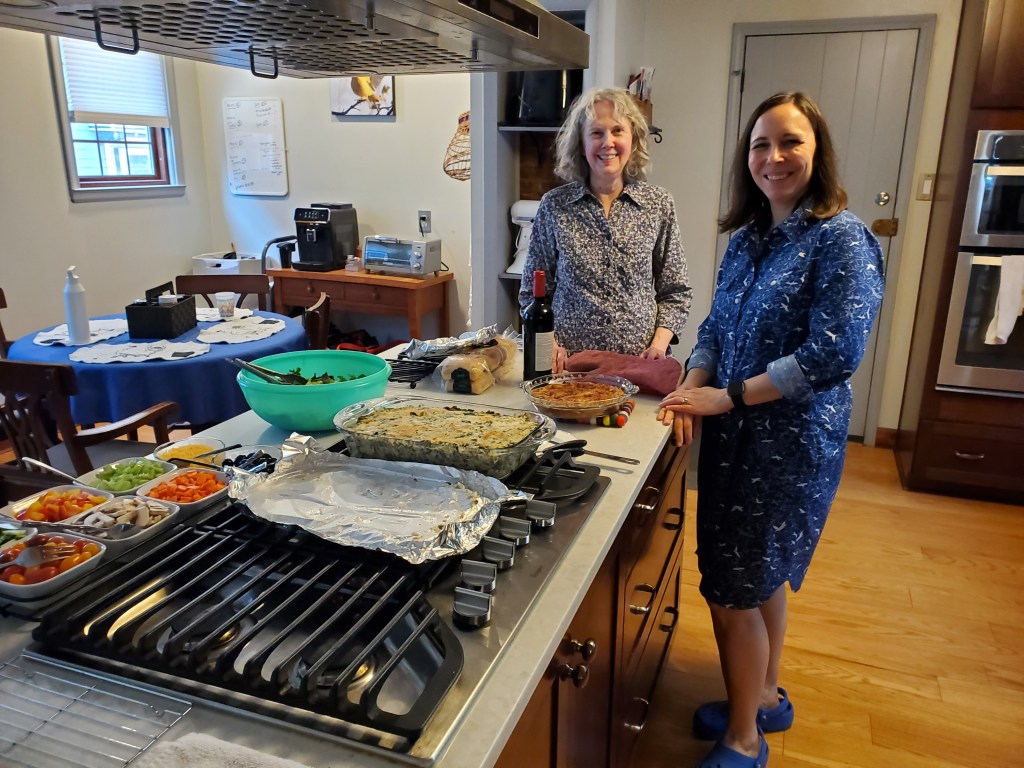
Martha with daughter-in-law April in her kitchen 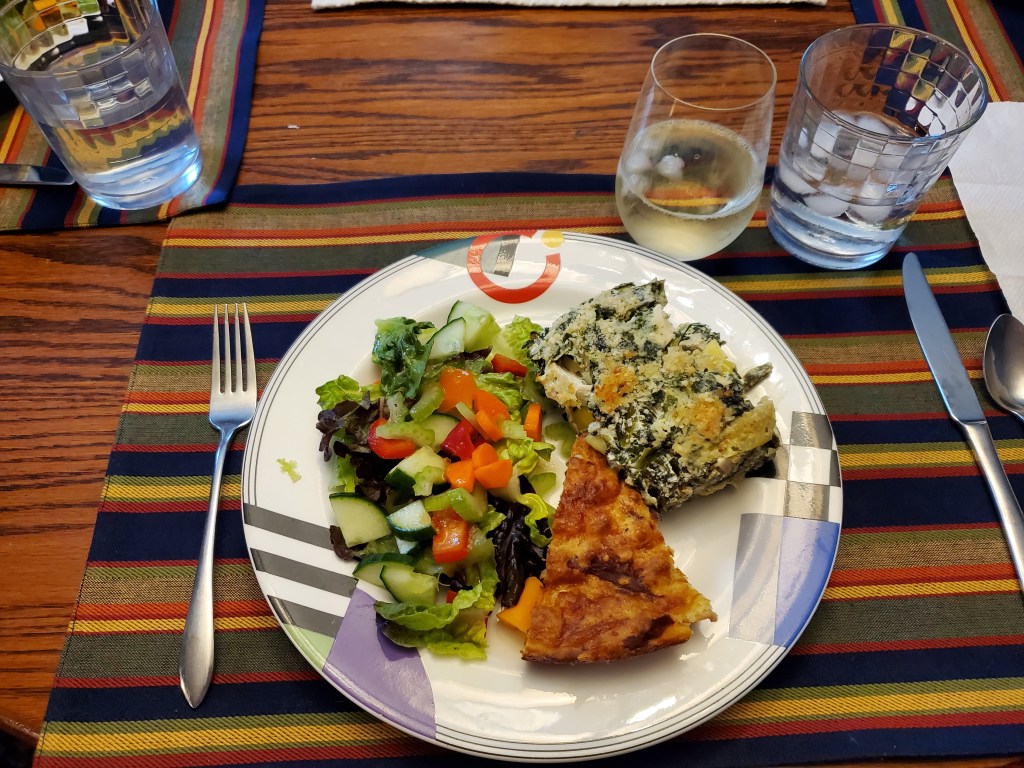
Martha’s (aka Salad Queen’s) movable feast Those clever, well-mannered boys inspired me with hope for the future I’d not felt for quite a while, and their parents made this stranger feel right at home.
As did Martha, who gave me her bedroom for my stay, choosing the couch for herself. I was grateful; so near the end of my trip but still far from home, I’d pretty much depleted my travel reserves. Like Sandy and Steve, Martha, who leads grief counseling at her church, had a busy next day, wrapping up a session and fashioning memorial candles for all the participants. She’d already carefully printed labels for these, but I was too tired to trust myself to cut them. So, after a substantial breakfast at nearby Vasily’s, I helped out by pasting the labels on the candles, a trickier process than you might guess.
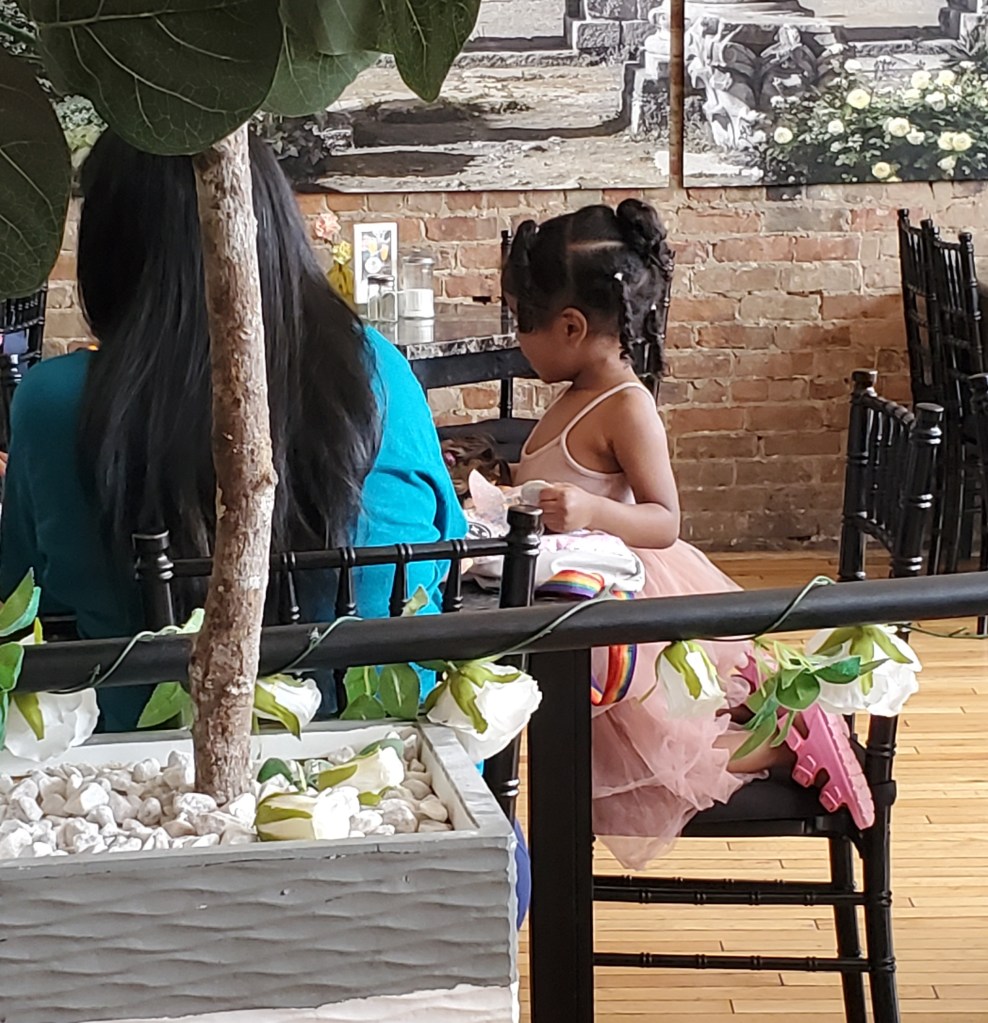
Brunching ballerina at Vasily’s Martha took off to her session’s ending dinner; I took a nap, and then set out for a walk to Elmwood Village, like Chevy Chase in Lexington, a commercial district with shops, galleries, pubs, and restaurants abutting lovely residential neighborhoods.
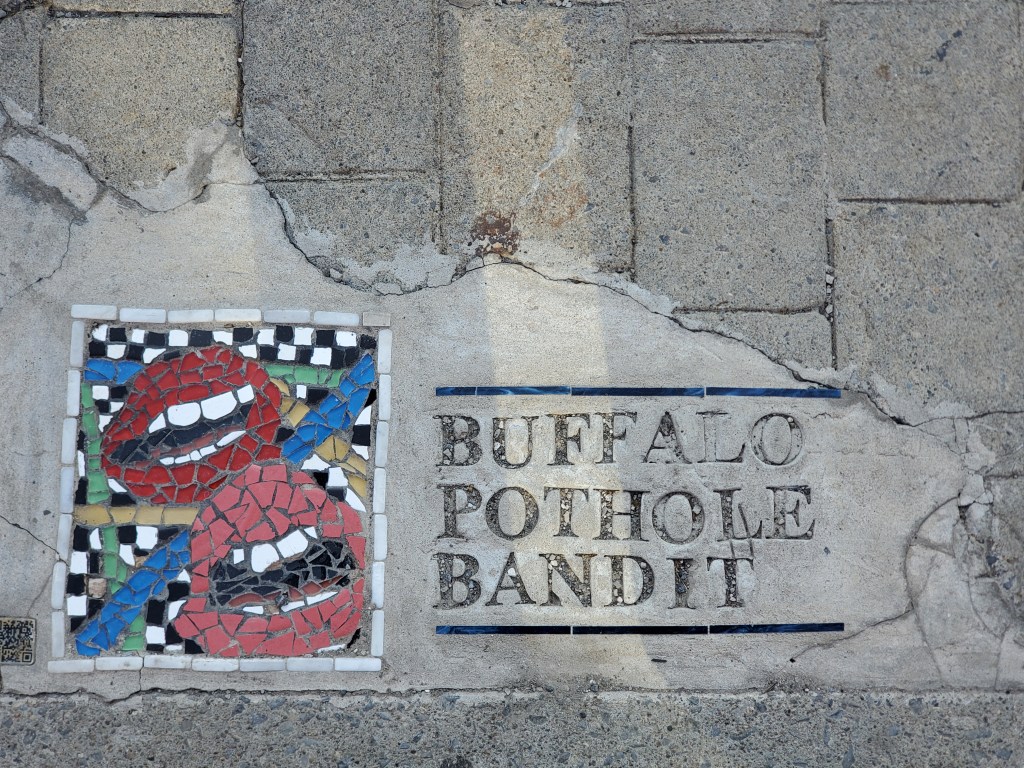
I had a fine dinner with a local Great Lakes beer at Japanese restaurant Sato, and enjoyed the stroll. The public decorum was classic “Midwestern Nice”; passersby smiled at each other, and made way on sidewalks. I remembered NH Office Dexter’s crack about New York (when I replied to his questioning where I was headed, his response was “I should arrest you just for that”), and thought how his opinion of New York certainly did not apply to Buffalo.
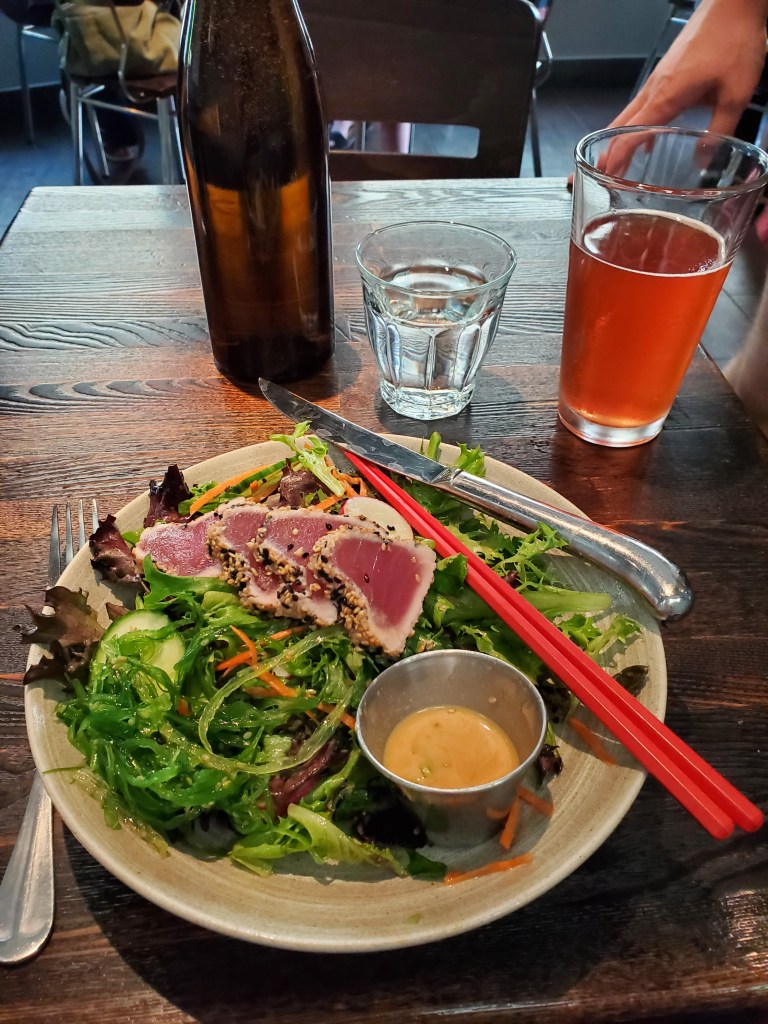
Dinner at Sato, Elmwood Village, Buffalo NY Back at her apartment and waiting for Martha, I figured out how to watch Netflix on my phone, a triumph for this tech-impaired oldster. And when Martha finally got home, she wanted me to walk/talk through with her the whole itinerary of my now concluding three-week tour as she took notes on the manifest I’d sent her, unparalleled evidence of devotion—as if giving up her bed were not enough! Friends since second grade, we parted the next morning with our friendship renewed and deepened.
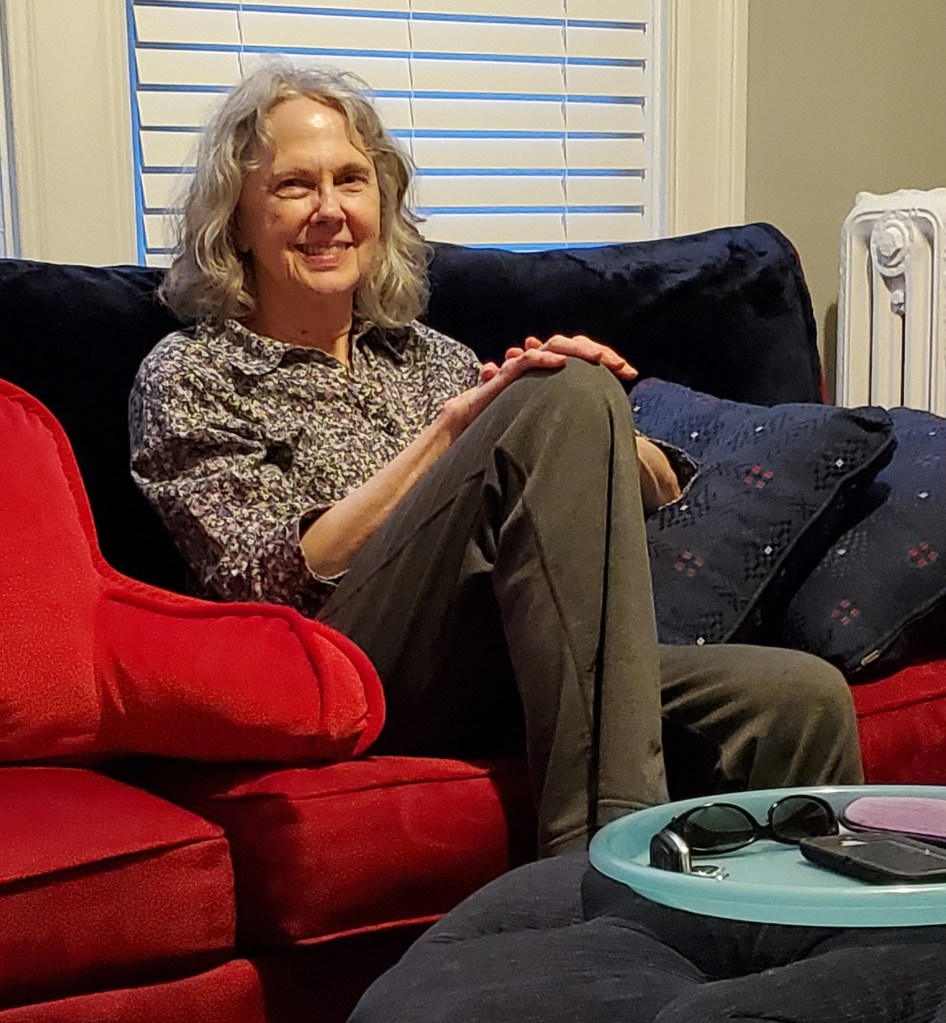
Martha, Forever Friend And then, finally, Dear Reader, I made my way home to New Hampshire and my further progress along the pathway. BTW, on hearing that I had left my cherished L L Bean spreader knife behind at his My Happy Place cabin in Whittier NC, Zach, my host, found it and sent it back to me; it arrived in my mailbox last week. All’s well that ends well.
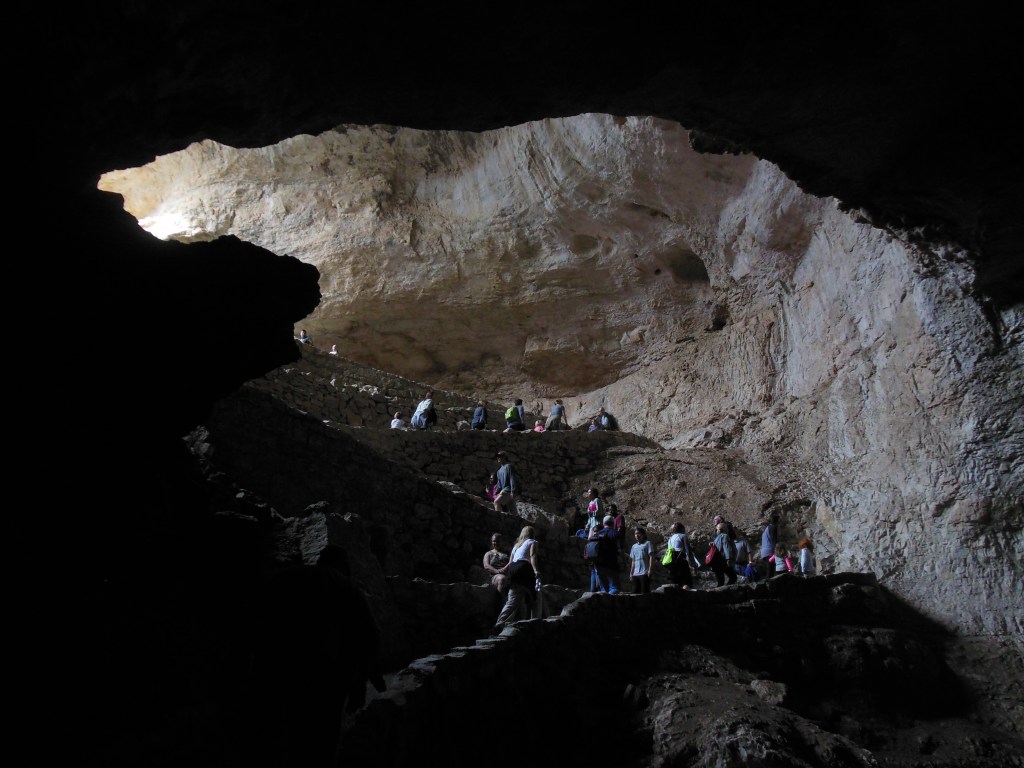
The path to the light, Carlsbad Caverns, 14 March 2016 -
Three Graduations and a Funeral: Part 3, 12-14 May 2024: Blonde Wind
13 June 2024
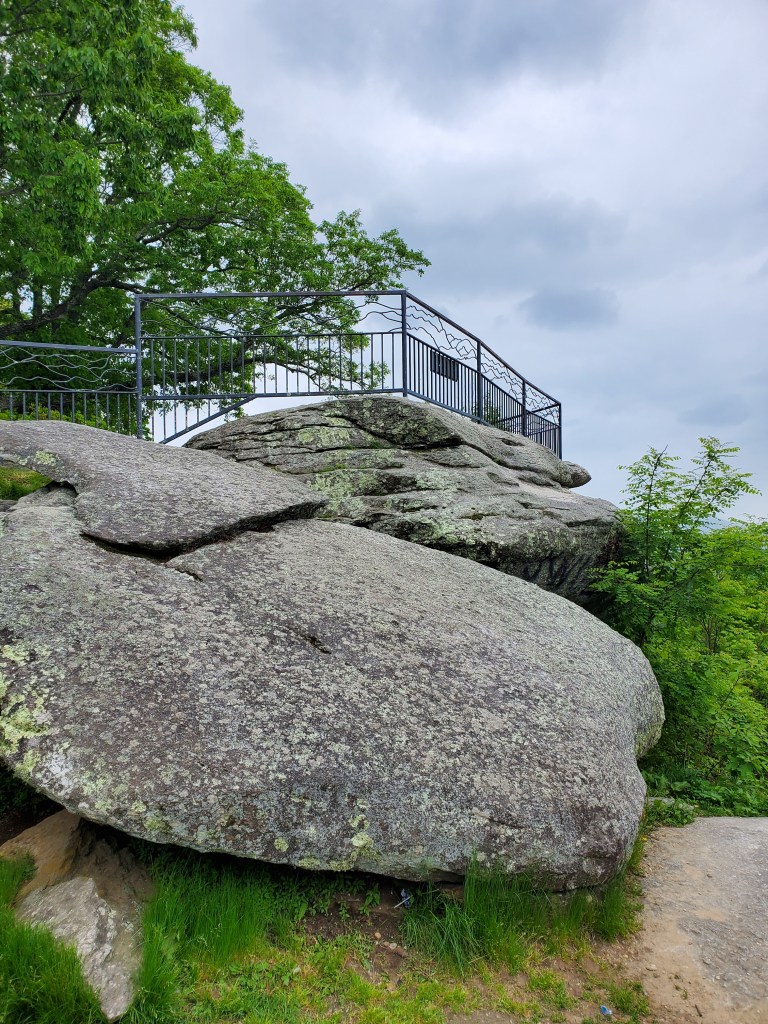
Jump Off Rock, Laurel Park, North Carolina 12 May 2024 began in Whittier NC with my short-term roommate Gina, granddaughter Olivia’s aunt, wishing me a Happy Mother’s Day—a first for me, since I’ve never been a mother; technically a step-grandmother, I found the easy path to grandparenting. Still, that acknowledgment was very sweet, and sustained by that and some avocado toast the Andrew/Steinke team provided, I set off for the next mountain cabin of my Southern Sojourn, an Airbnb in Mill Spring NC called “My Happy Place.” I was, however, too sleepy to drive for long, and got only as far as the Blue Ridge Parkway Visitor Center, where I parked, rearranged my hatch-back GTI so I could recline in the seat, and took a half hour nap.
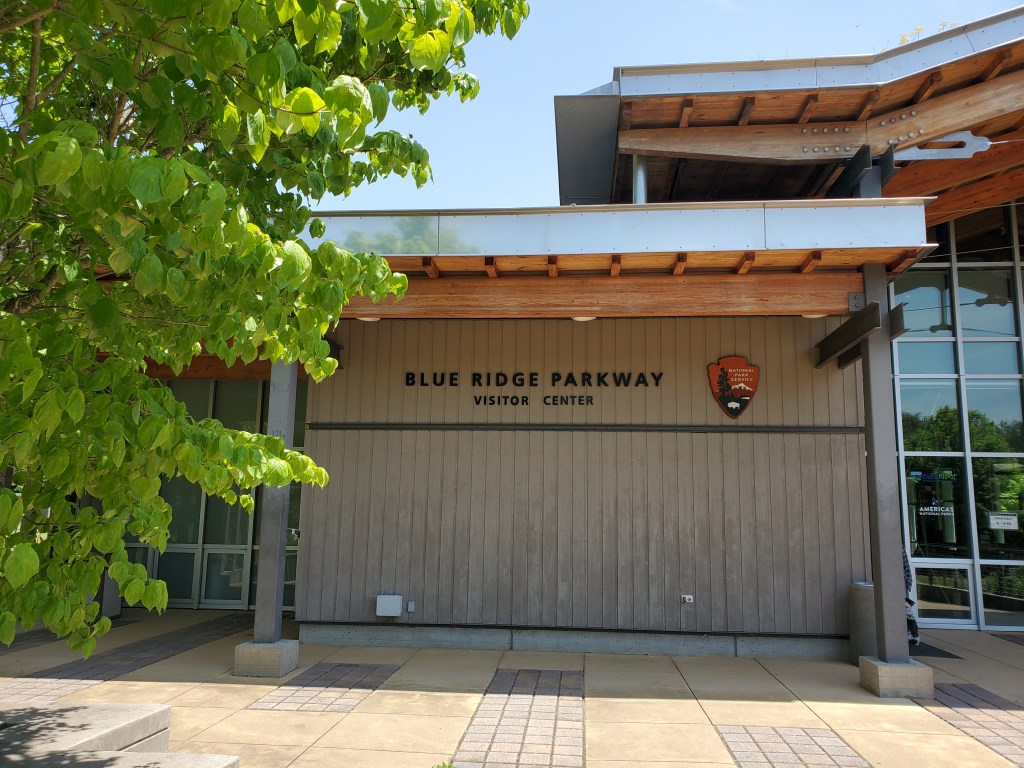
Refreshed by that and the rest of the previous day’s Cuban sandwich I’d brought along, I then took up my next mission: fulfilling my sister Jane’s request to scatter her ashes in the mountains she loved.
Where, exactly, was yet to be determined, so en route to Mill Spring where I was to meet up with Jane’s husband Richard and son Daniel, I was checking out venues. These folks were new to the North Carolina mountains, and the Lupi family was looking to me to find just the right spot. But since the early 90’s, I’d not spent any time in Hendersonville where Jane and our mother once lived; Virginia sold her place at 927 Greenville Highway well before the 21st century arrived, and much had changed since then. In fact, Jane knew that house was no longer maintained as our mother had kept it, and she had been explicit about not leaving her ashes there. So, I was looking for a suitably elevated place with a lovely, peaceful view. Chimney Rock was a possibility right up until I arrived there and discovered what a tourist trap it and nearby Lake Lure had become. Definitely NOT the place for Jane. Disappointed and disconcerted, I also found the drive from there to Mill Spring rather unnerving, as the last stretch of narrow, winding mountain road sans shoulders was unpaved and creepily deserted.
With help from gps, however, I did finally find our rental, a lovely place, and managed to locate the key in the lockbox.
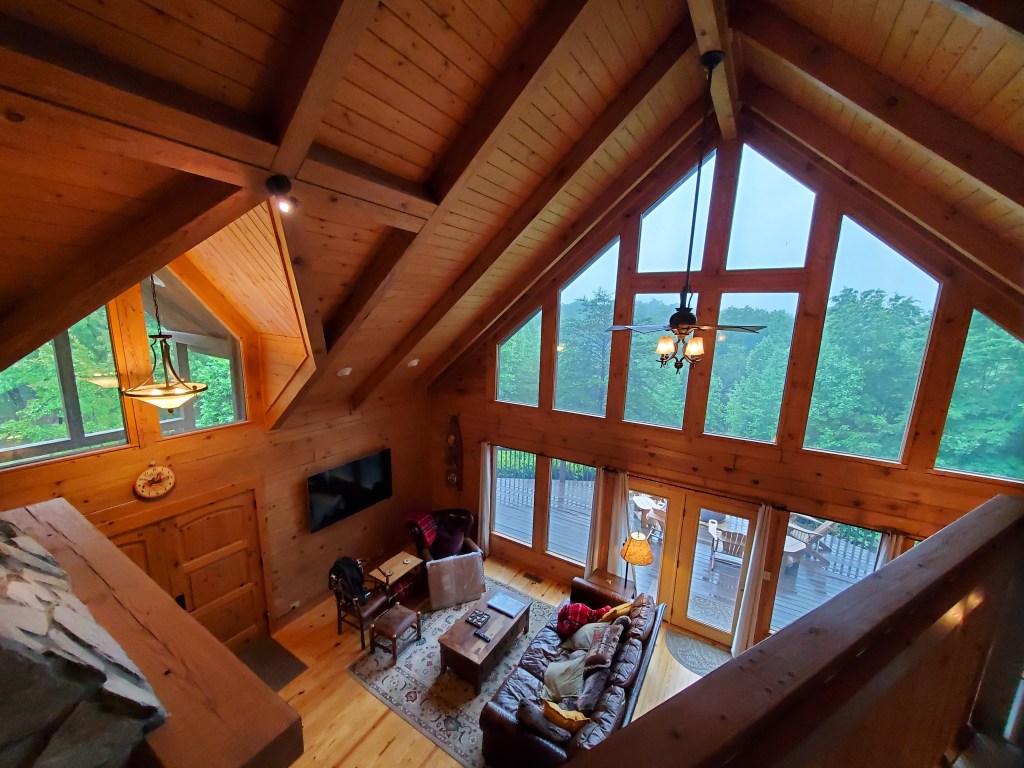
“My Happy Place,” Mill Spring NC I had just settled down to admire the view when I got an anxious call from my brother-in-law, Richard. Lacking the gps so critical to finding this remote place, he was now driving those same narrow, twisting roads without knowing where he was. Happily, he was ultimately able to pull over at the little Midway Baptist Church, which gave me a location to enter into my own gps; they were only 8.7 miles away, and leading them back to our cabin was easy. Truly, Jesus saves.
Once we settled in and calmed down on that Mother’s Day Sunday afternoon, we determined that with a steady rain forecast for Tuesday, our best chance for fulfilling Jane’s wishes would be the very next day, Monday. But where, o where? A phone conversation with our mother’s former tenant and Jane’s friend Carol was at first frustratingly and then comically broken up by her cell phone’s sporadically cutting out and continually interrupting her many questions about where to meet. Carol wanted very much to be present when we said goodbye to Jane, but her knees were not up to much of a walk. We managed a compromise: the next morning Carol would meet us at Carl Sandburg’s one-time home, Connemara, a National Historic Site close to Carol’s own home, where she could help us scatter some of Jane’s ashes. The cremation advantage: those ashes can be divvied up.
That settled, the guys and I made a provisioning trip to Publix in Flat Rock—the grocery reassuringly laid out like the Safety Harbor Publix the Lupis knew in Clearwater—and had a good wood-fired pizza dinner in Flat Rock before returning “home” to Mill Spring.
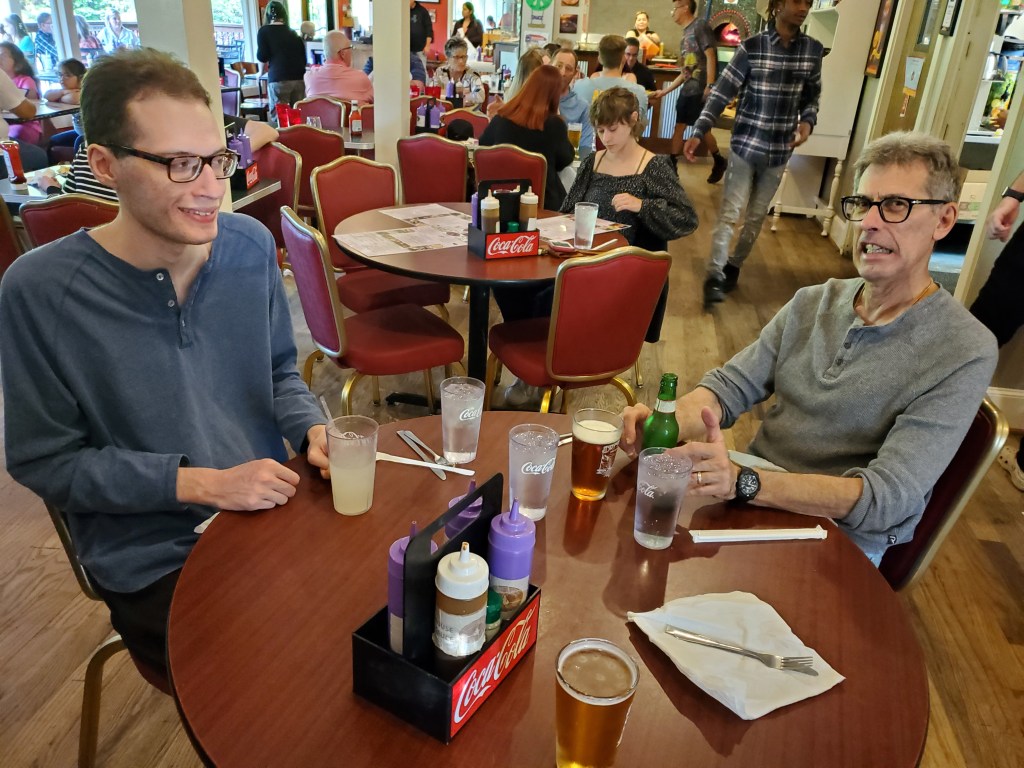
Daniel and Richard ready for pizza at the Flat Rock Wood Room Determined to figure out once and for all Jane’s launching pad—more Lupis would be arriving for an improvised ceremony the next day, and needed to know where to meet us—I sat once more at my laptop hoping for inspiration. It came: I remembered that Jane had mentioned Laurel Park as a possible site, though at the time we spoke, I knew it only as a housing development. A little online search revealed what I needed to know and Jane had meant: there was a lovely little park-with-a-view in Laurel Park. Jump Off Rock was the place. I got to bed late, but fell asleep quickly, calmed by at last having a plan.
The next misty morning, 13 May, I packed a picnic lunch and we drove north to Flat Rock where we met Carol, who arrived with lots of questions, plastic cups, and a bottle of sauvignon blanc, the better to toast Jane as we said our goodbyes. Carol honored the memory of sharing a glass of wine with Jane at the end of their work days back home at 927. Carol’s garrulous energy—there’s a lot of Amanda Wingfield’s gift of gab in Carol—kept sadness at bay with her tales of what Virginia Episcopalians could get away with in the upper gallery of a sanctuary, shoes off and bottle in hand. So glad we connected.
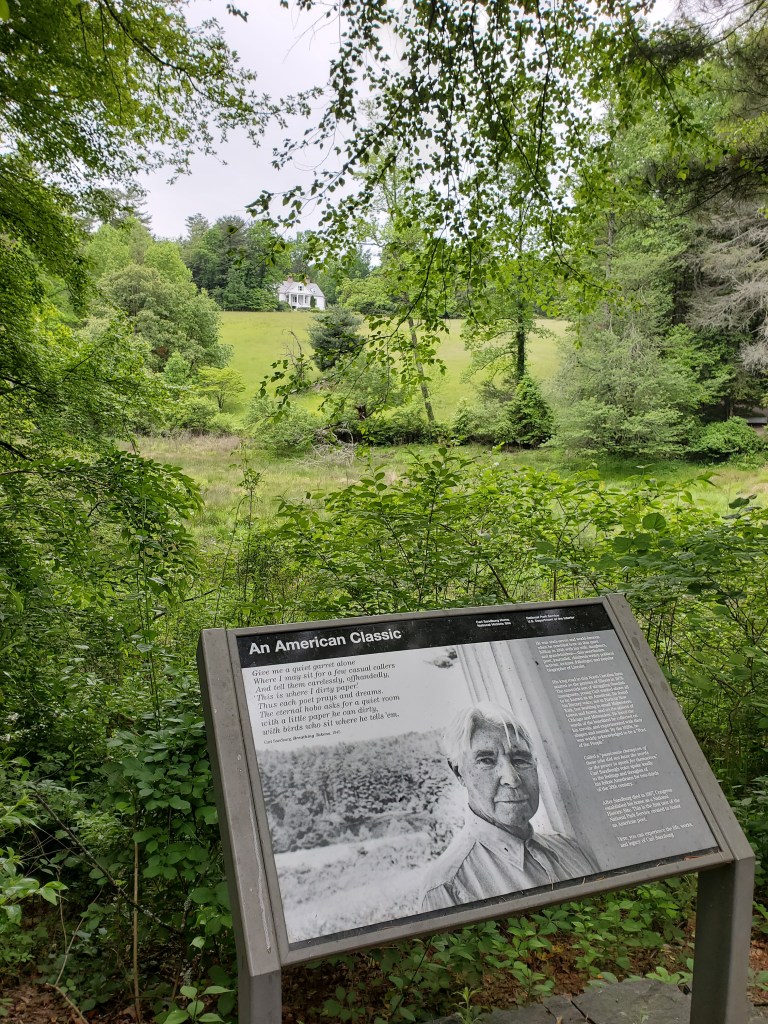
Sandburg’s Connemara in Flat Rock NC From there we went on to Laurel Park and Jump Off Rock where Phil and Gloria Lupi awaited us. A wedding was just finishing up there as the light rain ceased and we could seize the moment and the site to cast our lovely Jane’s ashes to the prevailing wind blowing toward Mt. Pisgah where the Murphys had once vacationed, and over which David and I had scattered our dad George’s ashes as David flew our rented Piper Warrior back to Maine after an Asheville visit.
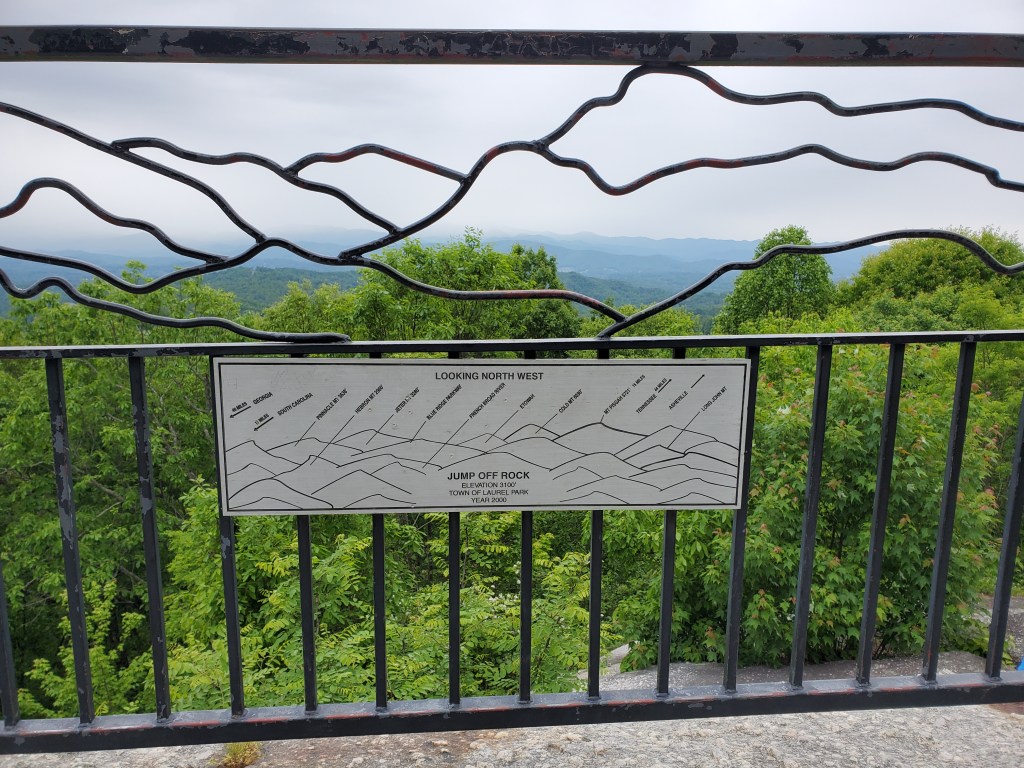
The View from Jump Off Rock 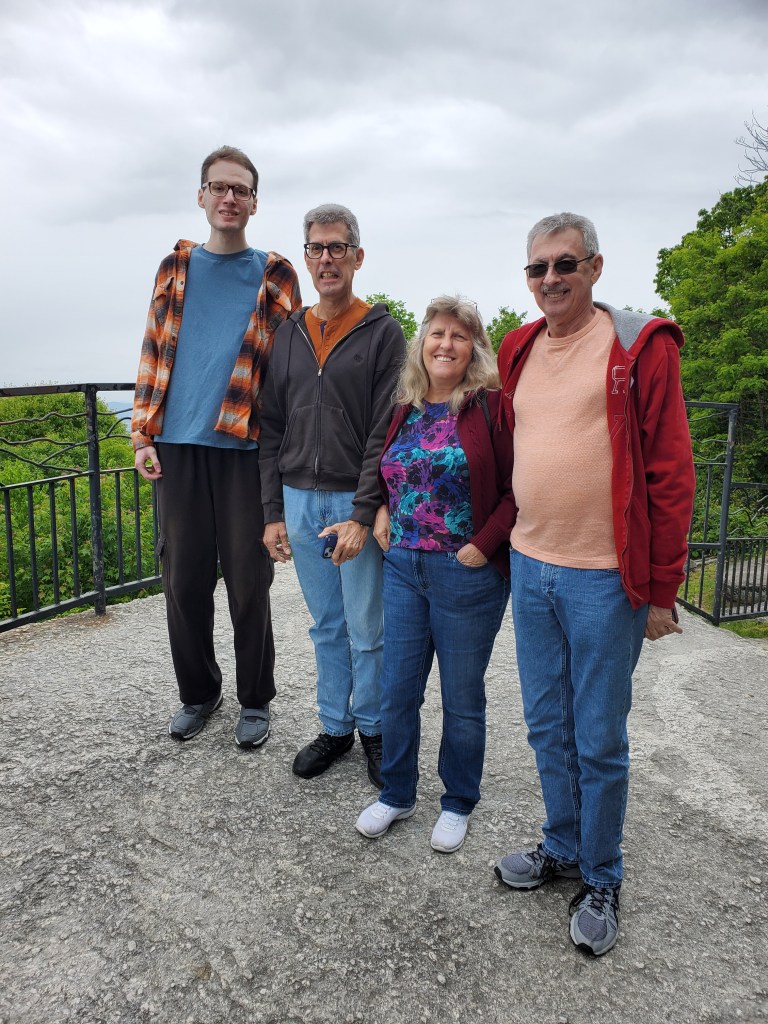
Daniel, Richard, Gloria, and Phil gather on Jump Off Rock The place and the day felt right and peaceful; we all thought Jane would approve. Phil then gave Richard some tips on using the gps on his iPhone and then he and Gloria drove down the mountain to their motel while Richard, Daniel, and I had our picnic lunch. A sign detailing Laurel Park’s history revealed the park had been donated to the town by a couple from Pinellas County Florida—where both Jane and I were born. A literal sign from the universe that I’d found the right spot? I like to think so.
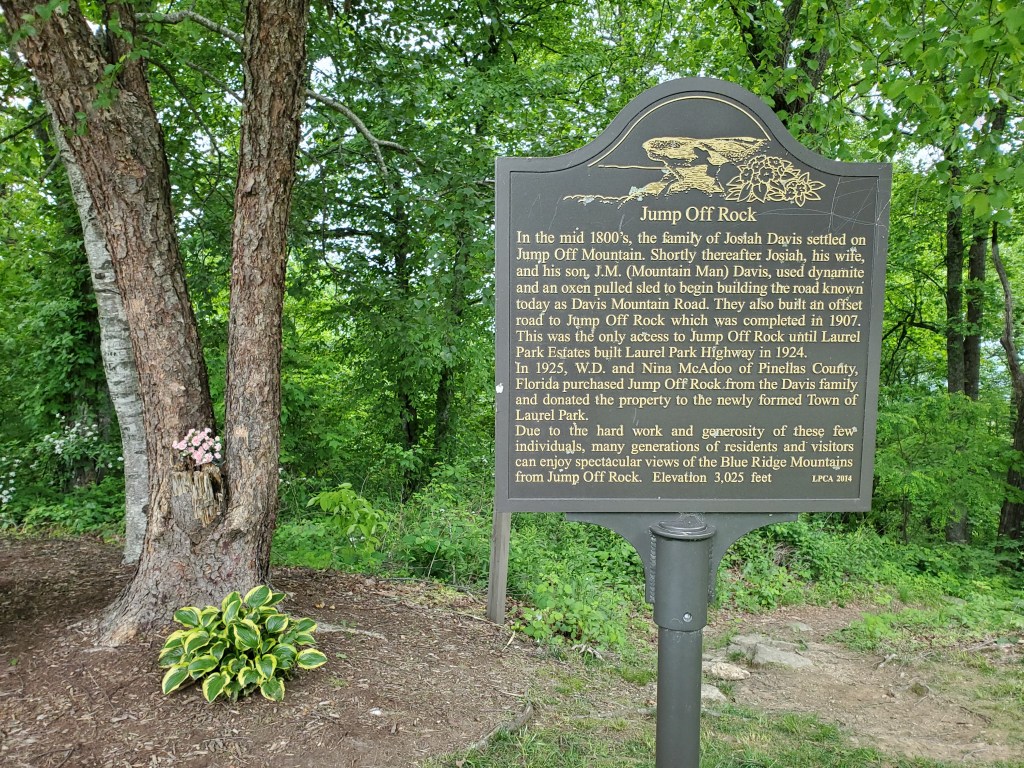
The Pinellas County connection The rain began again as soon as we finished our lunch, so I drove us around to other of Jane’s venues in Hendersonville. First, the house at 927 Greenville Highway where Jane’s studio had been, a property now the worse for wear and lacking the gazebo that our dad and I built down by the stream one summer, and then the Belk’s department store at the now desolate Blue Ridge Mall where Jane had once worked selling fine china and then later cosmetics, and often proving her own best customer.
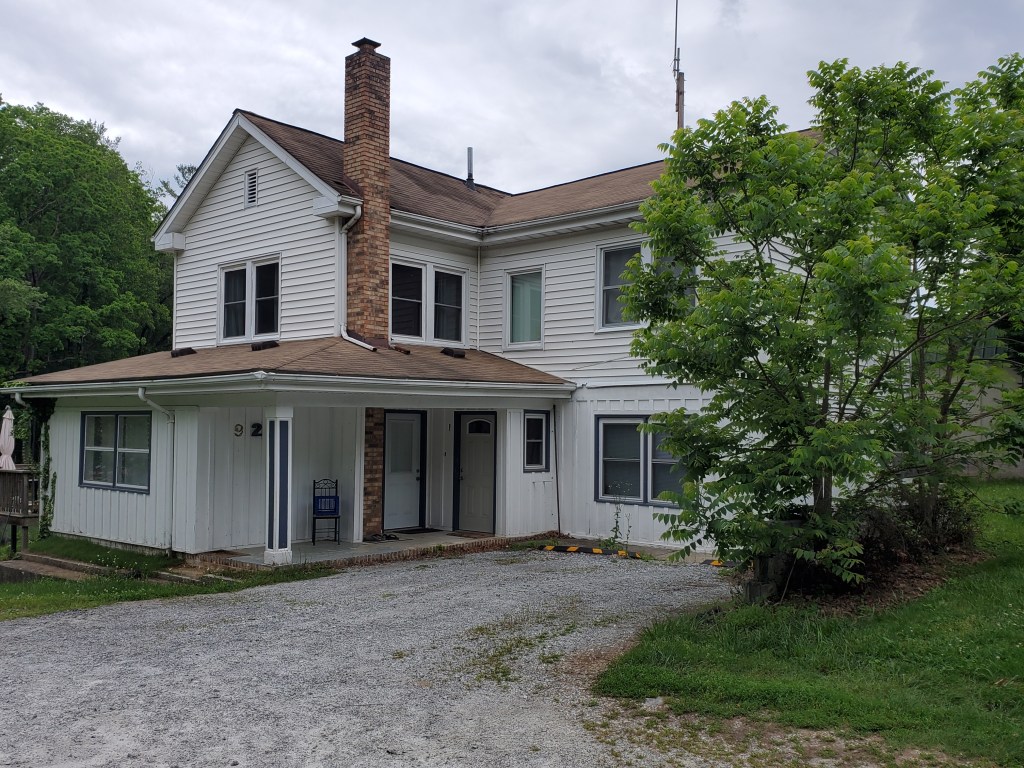
927 Greenville Hwy, Hendersonville, once the Murphy home 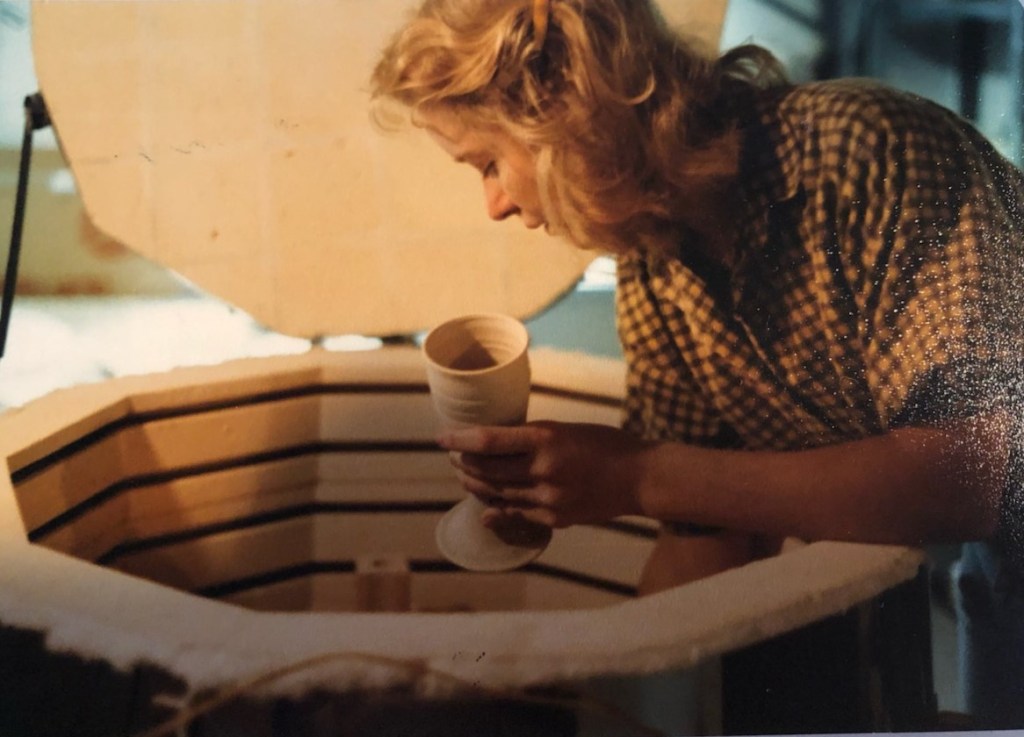
Jane, aka “Blonde Wind” potter, loads the kiln at her 927 studio c. 1988 We met up again with the Lupis for an early dinner at Flat Rock’s Campfire Grill (brook trout for me), and returned to Mill Spring tired but pleased by a day well spent.
The next morning came with more rain, and we decided to forego any unnecessary driving. We spent a quiet morning together, leaving the cozy cabin only once when the rain let up for a brief walk around the very hilly development.
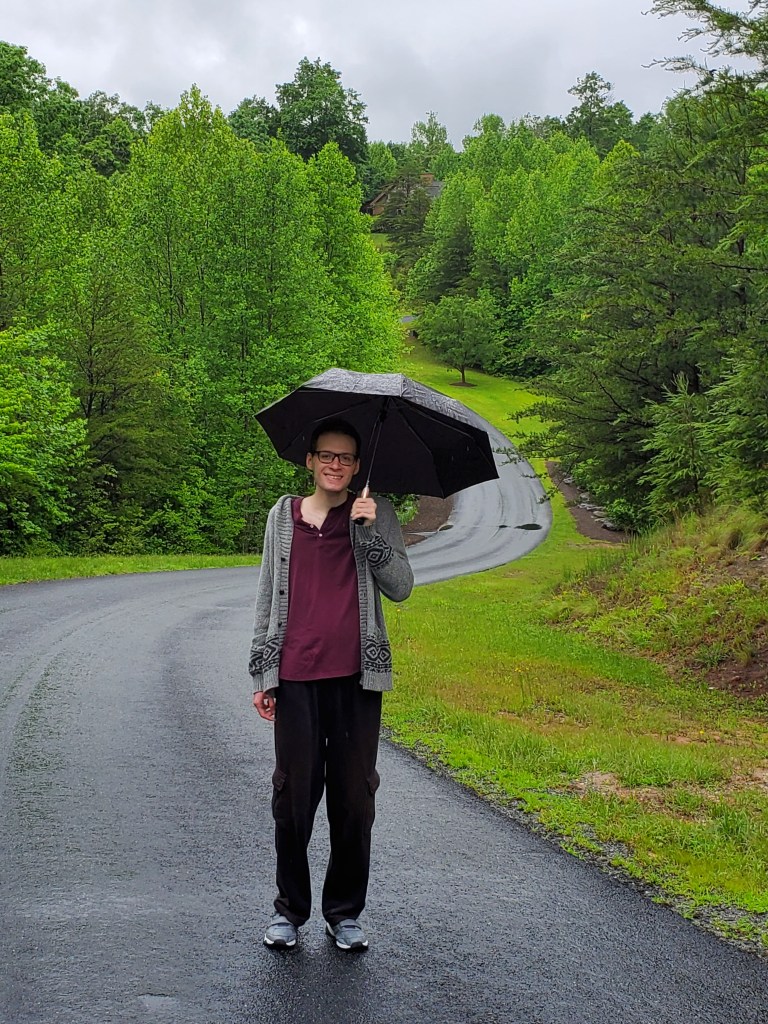
Daniel out for a walk with me The only excitement came from a message that the sheriff had been called to the Lupi house in Safety Harbor for a wellness check; Richard’s neighbors, unaware of the Lupis’ upcoming travel, saw no sign of occupancy and panicked. Once sorting that out and successfully getting Richard’s rental car synced with his iPhone, he navigated us back to Hendersonville for a final and very tasty dinner downtown at Mezzaluna. Seeing a map of Italy behind Richard and Daniel, I pitched the idea of the Lupis taking a “roots trip” to Sicily, a distinct future possibility.
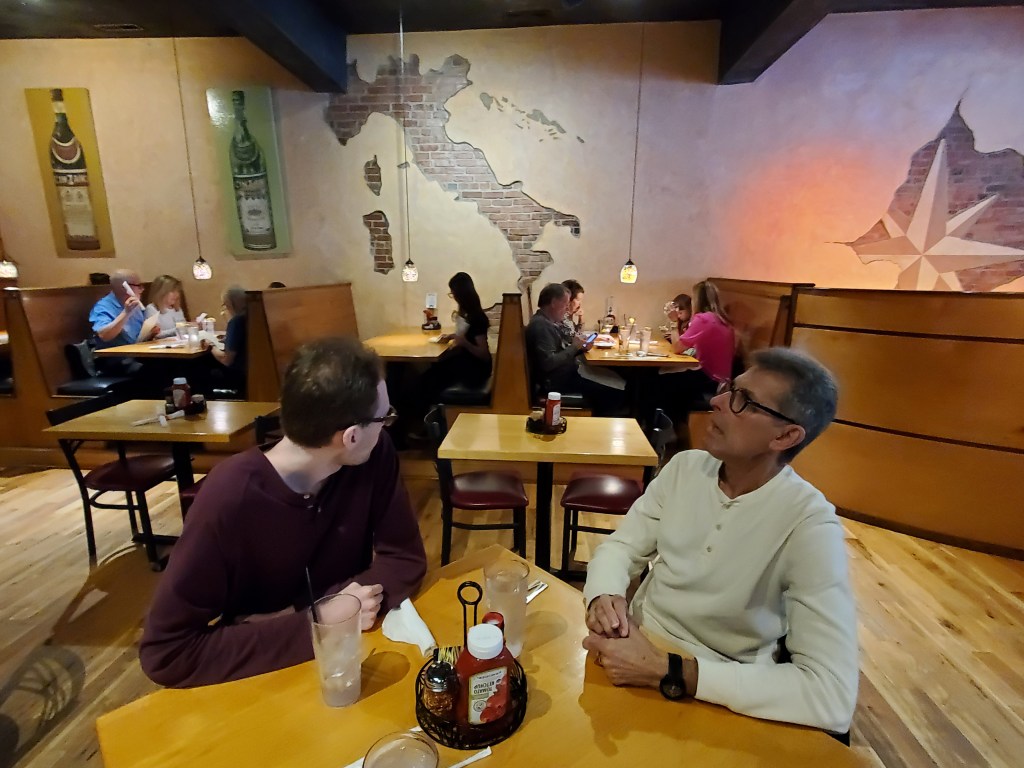
At Mezzaluna, downtown Hendersonville NC 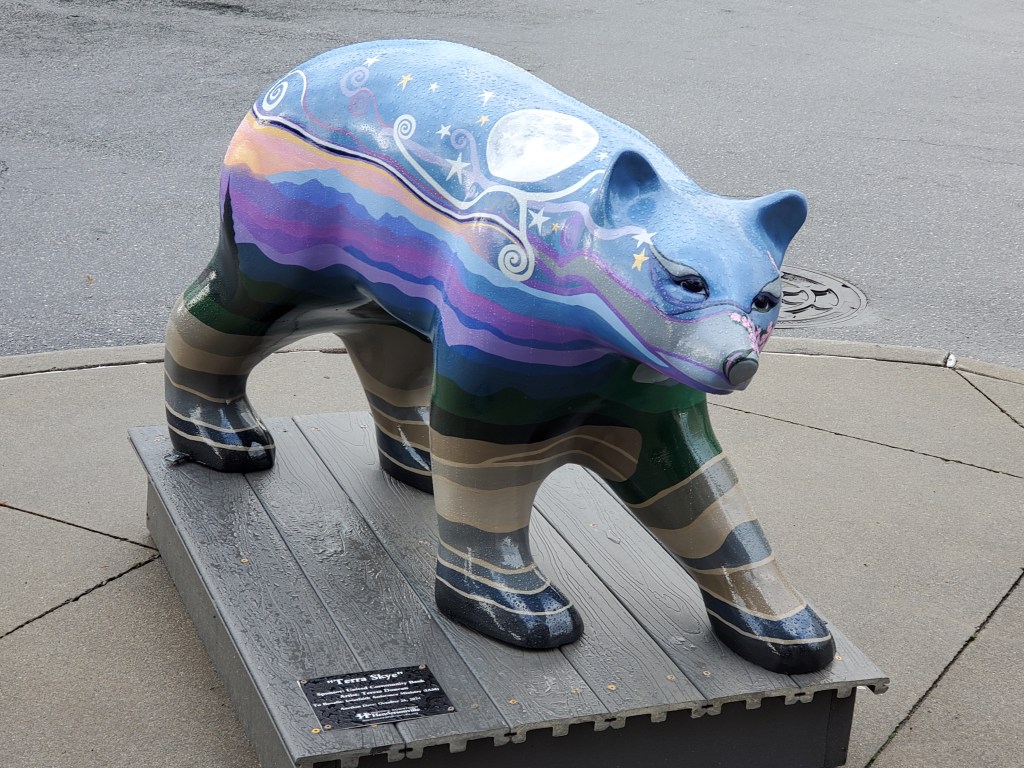
Bears on every corner in Hendersonville NC That night we packed up and got ready to leave in the morning, the guys to drive home to Florida, and me to move on to what was once my old Kentucky home, Danville. Two graduations and one funeral down, one graduation to go.
Today, one month to the day that we set Jane free to ride the winds over the mountains, we ordered a paver for her there in Laurel Park. I think she’d like that.
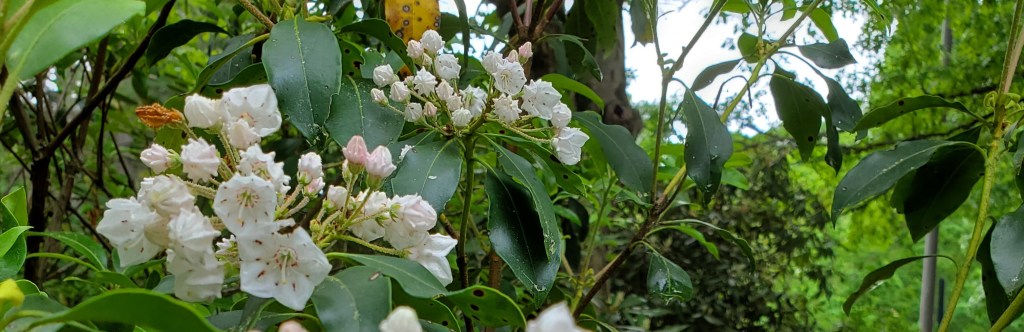
Mountain Laurel on the Blue Ridge Parkway -
Three Graduations and a Funeral, Part 2, 6-11 May 2024: Olivia’s Graduation
11 June 2024
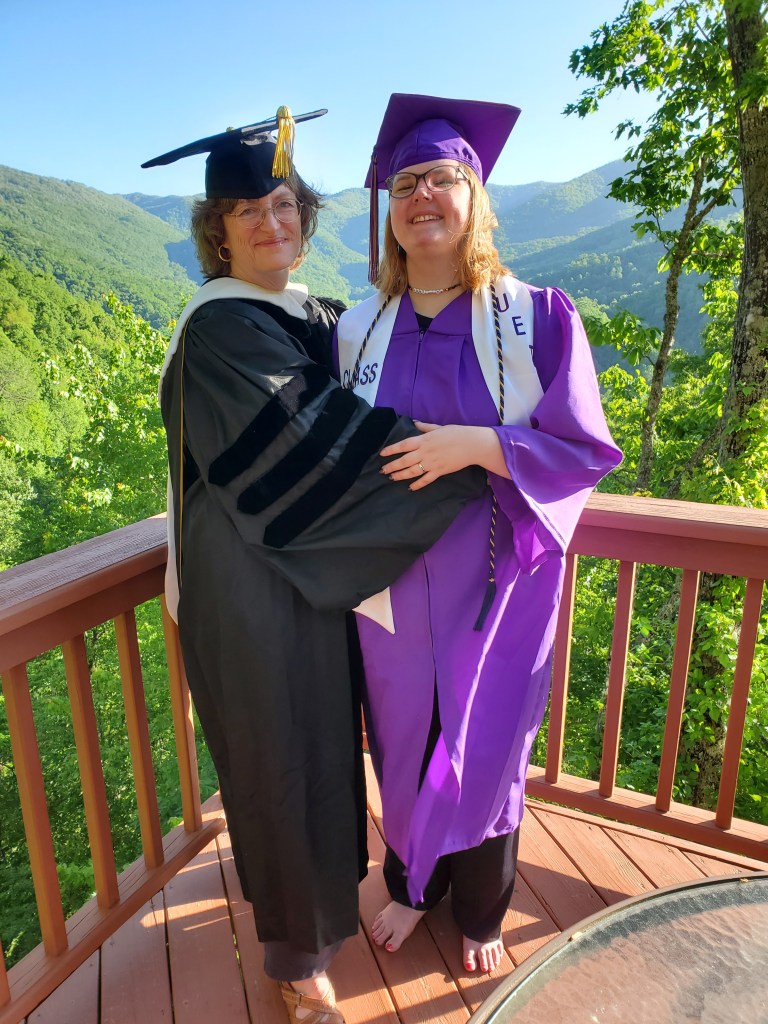
Furman U Class of ’74 celebrates Western Carolina U Class of ’24 Is’t possible I take up my 3G&1F tale a full month after granddaughter Olivia’s graduation? Tempus fugit.
After the Furman 50th reunion/graduation commotion, the quiet intermezzo former roommate Leta and Larry provided me was most welcome, a chance to get acquainted with and admire lives full of civic responsibility and family. When she is not attending ceremonies for the many new citizens naturalized in Charlotte—70 a day, from 40 different countries, 5 days a week—and then expediting their voter registration, doting “Grandmommy Leta,” retired operations project manager for Sompo Japan Insurance, knits and crochets, inspired by the arrival of grandson Grayson. Clever autodidact that she is, she managed to knit a strawberry hat for the lad as only her second project.
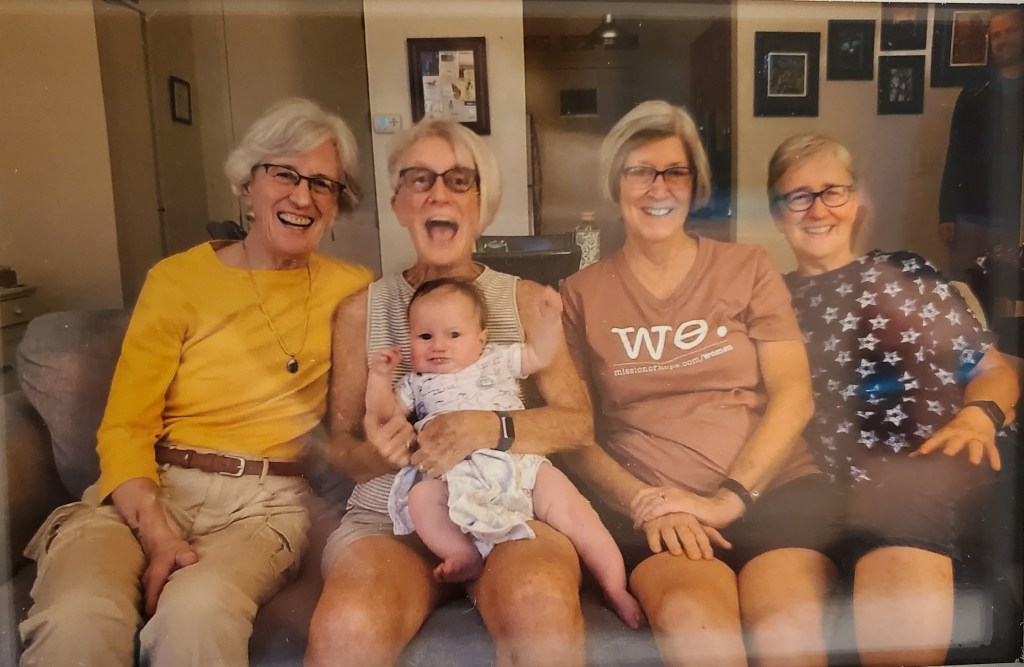
The Preston Sisters celebrate the newest grandbaby, Leta’s Grayson “Grand Dude Larry,” retired Charlotte-Mecklenburg Schools (CMS) history teacher and soccer coach, spent part of the day organizing another of his Civil Rights tours for the Charlotte Teachers Institute. Starting with the somberly stunning Monument for Peace and Justice in Montgomery (aka the Lynching Museum), Larry’s seminars lead CMS teachers through Selma, Jackson, the Mississippi Delta, and Birmingham to experience essential American history to pass along to their students. Wish I could attend.
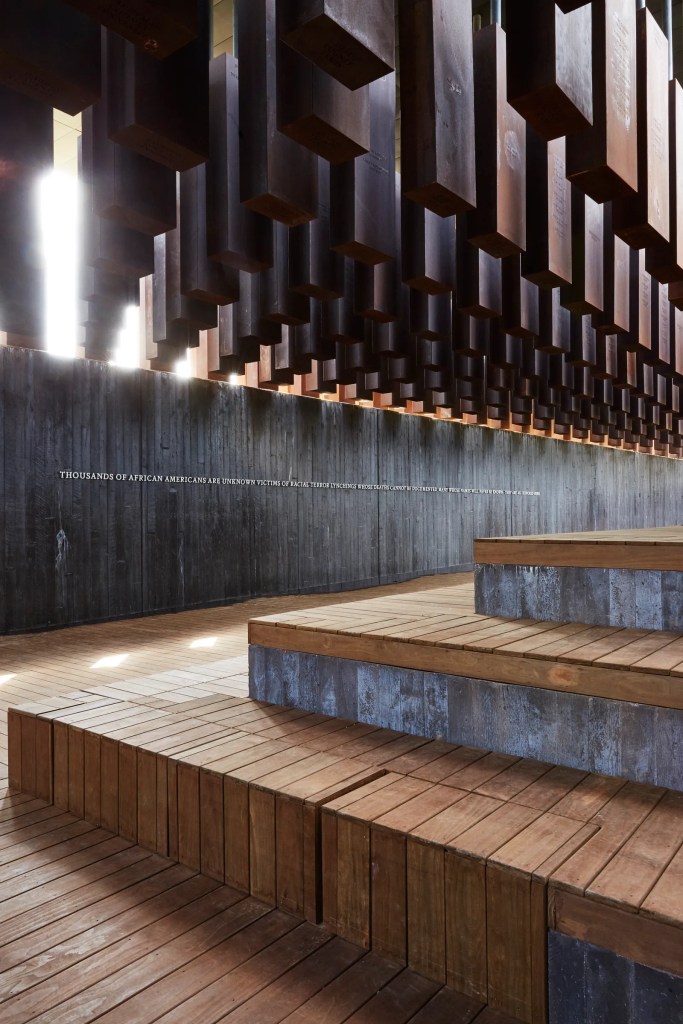
Montgomery’s Monument to our difficult past (MASS Design Group, 2017) Leta let me ride along to UPTOWN Charlotte (correcting my use of “downtown” to describe those high-rises) as she ran her mailing and delivering errands on behalf of our newest citizens.
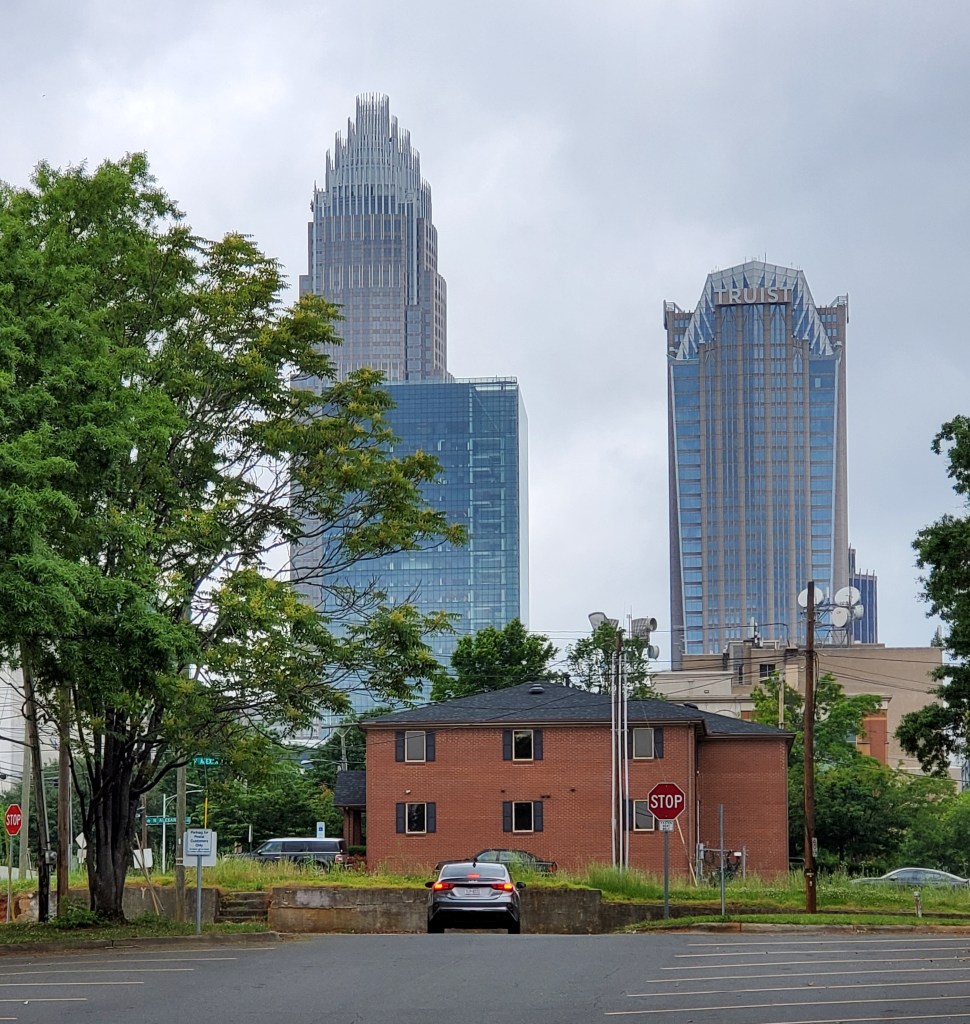

Second stop on the voter registration trail When Larry wasn’t hammering out details of his coming trip, he was cooking us breakfast, lunch, and dinner. That evening I treated them to The Fall Guy with Ryan Gosling and Emily Blunt, an enjoyable romp of cinematic intertexuality and action not nearly sufficient to the hospitality they showed me.
Following Leta’s blueberry muffins and a group search in my AAA atlas for my upcoming destinations of Cullowhee and Whittier NC, Leta gifted me her knitted spring green pot holder and I headed 93 miles northeast for a visit to my good friend Cameron and a classic Carolina lunch of egg salad and pimento cheese. What followed was delightfully low-key: we ran errands together, compared age-related bothers, visited the Delicious Bakery where one can buy layer cakes by the slice (wonderful innovation), had a fine Thai dinner out, and watched the new Tracker series with the handsome Justin Harley of This Is Us fame in the lead.

Cameron’s Sullivan’s Lake, Greensboro NC 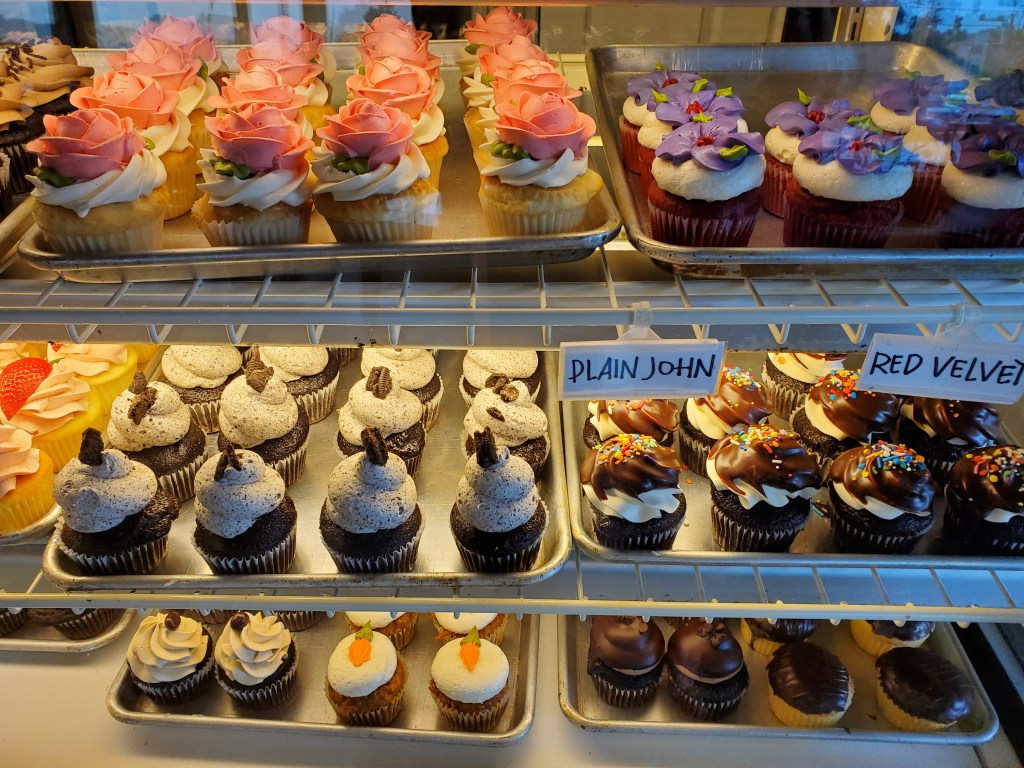
Delicious Bakery treats in Greensboro 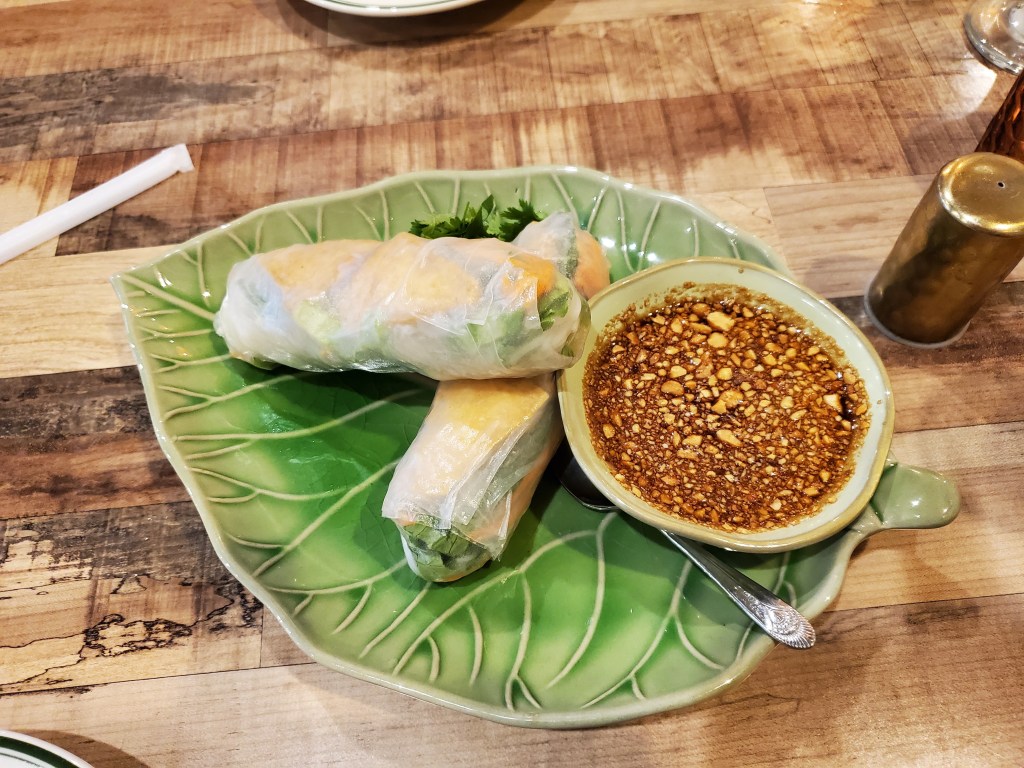
Thai spring rolls for dinner That relaxed pace continued the next day, and I very much enjoyed an extended version of the wide-ranging chats Cameron and I have each Thursday; she shared her Skeptics Credo, and I confessed that getting out of a bathtub was not as easy as it used to be. We sat for a while in her church’s garden near her late husband Russell’s memorial stone and discussed finalities.
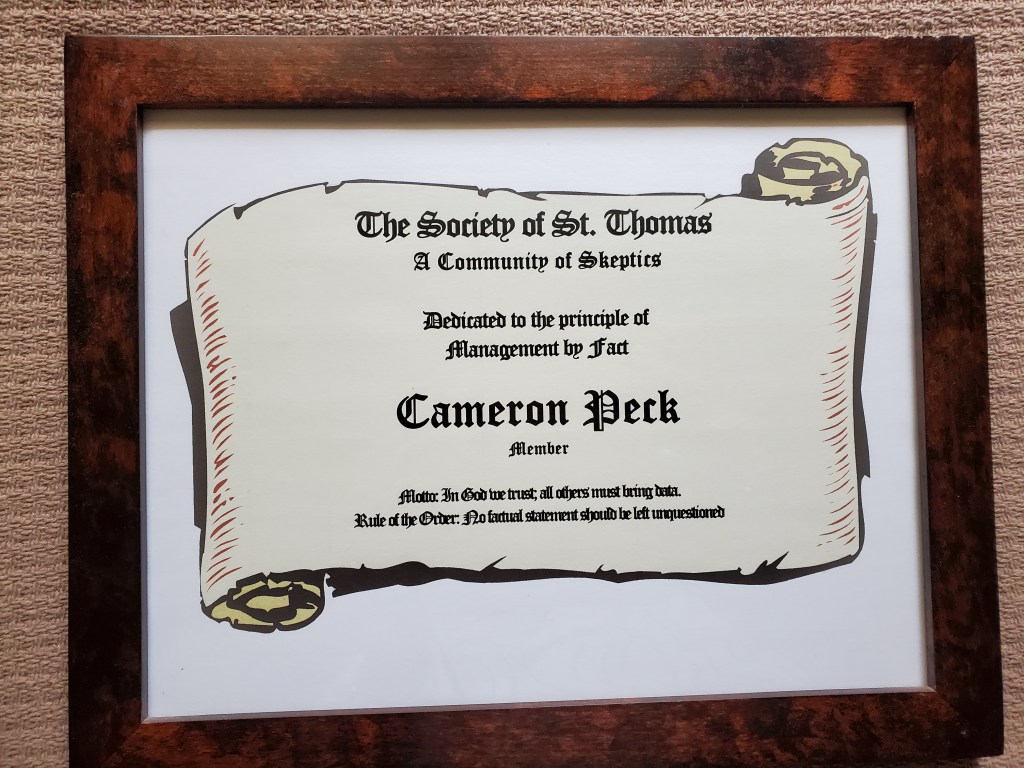
Later that night while watching the New York Times’s “Best of Late Night” post on my computer, I noticed it paired with a guide to cremation costs. Pegged by algorithms. Jeez.
The next morning after a fine swim with Cameron at the downtown Greensboro Y, this restored traveler drove 227 miles west to 165 Sunset Ridge in a gated community of Whittier NC and a lovely mountainside Airbnb that proud parents Susan and Mark had rented to house all of us celebrating their daughter Olivia’s graduation from Western Carolina.
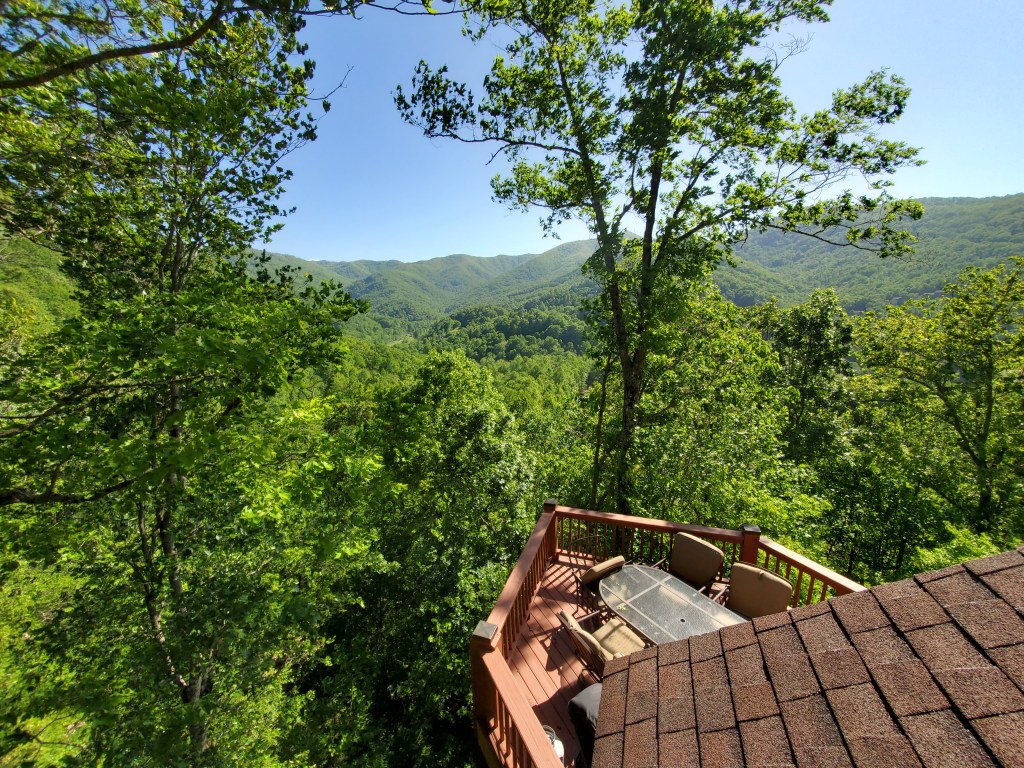
View from the third floor of our Whittier mountain home Susan and Mark did a spectacular job of organizing and provisioning our party of 8 over three days: middle eastern night (falafel, tzatziki, tabouli, and nan) was followed by enchilada night, and then by lasagna night, with Mark’s wisecracking brother Paul pouring a bountiful supply of wine.
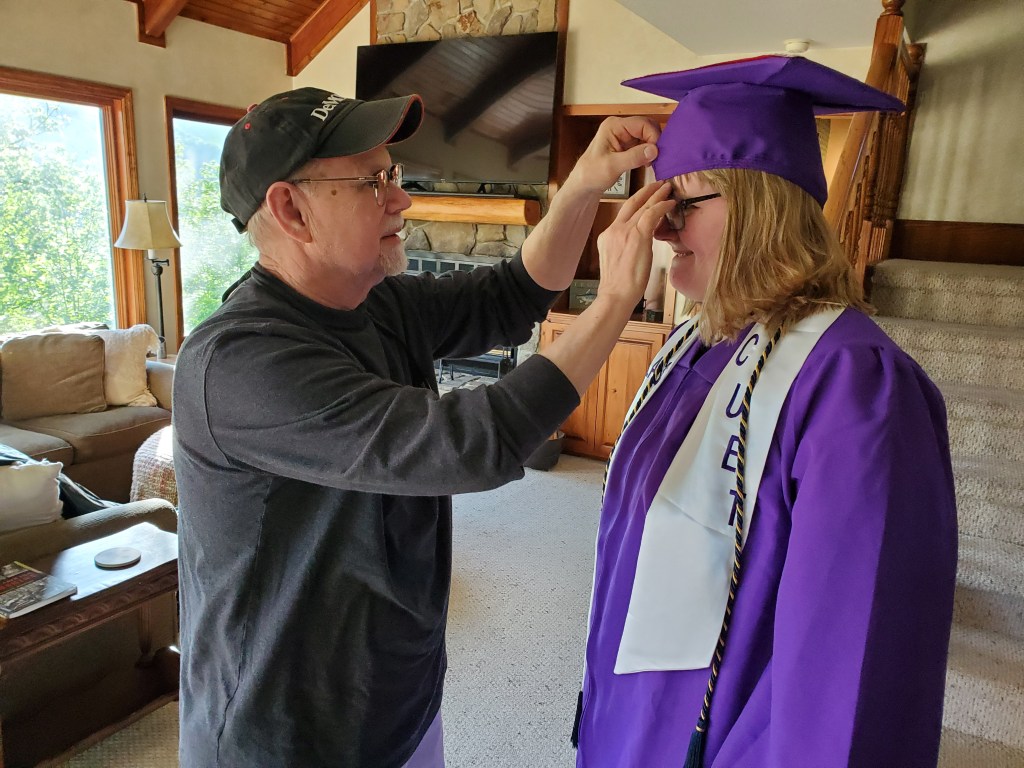
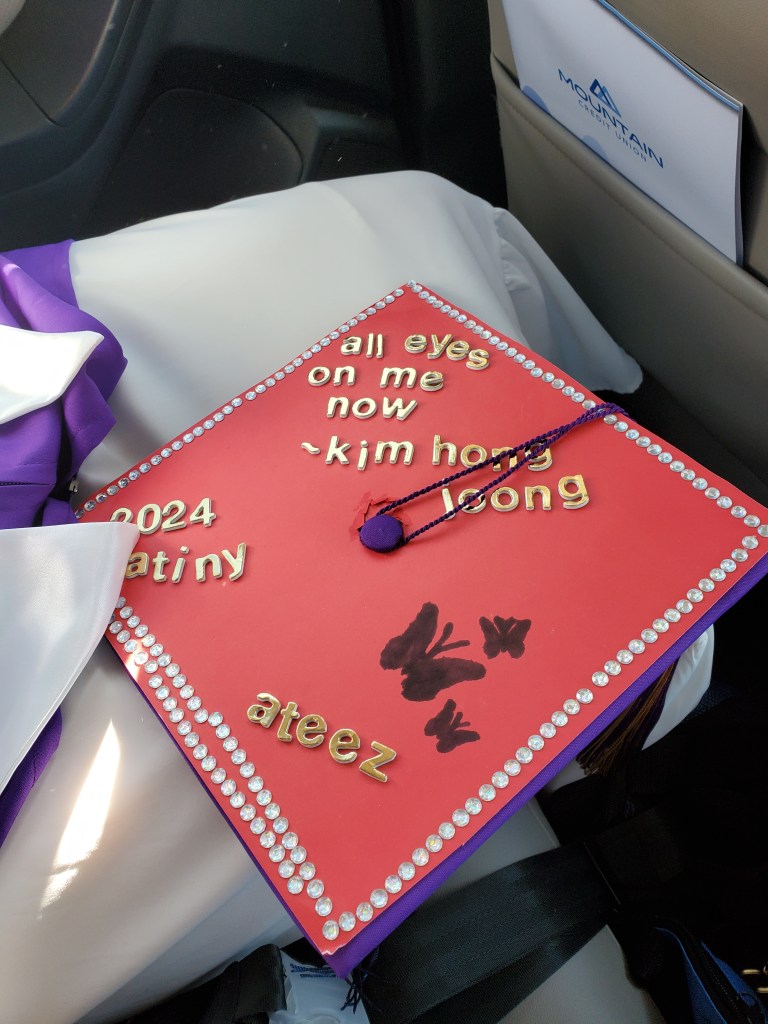
Proud Dad Mark adjusts the graduate’s mortarboard 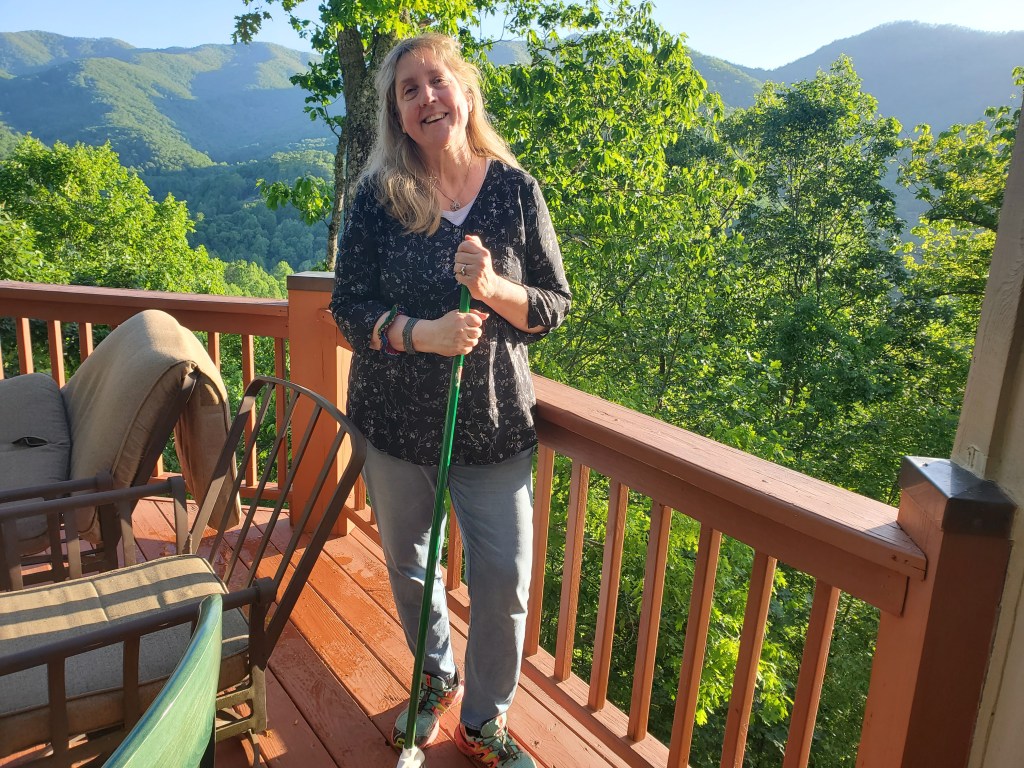
Proud Mom Susan prepares the deck for dinner I shared a bedroom and immediately bonded with Mark’s sister Gina, retired English and forensics teacher, and found being folded into the family along with granddaughters Olivia and Isabel and their lovely cousin Brooke a real treat: family stories were a gas.
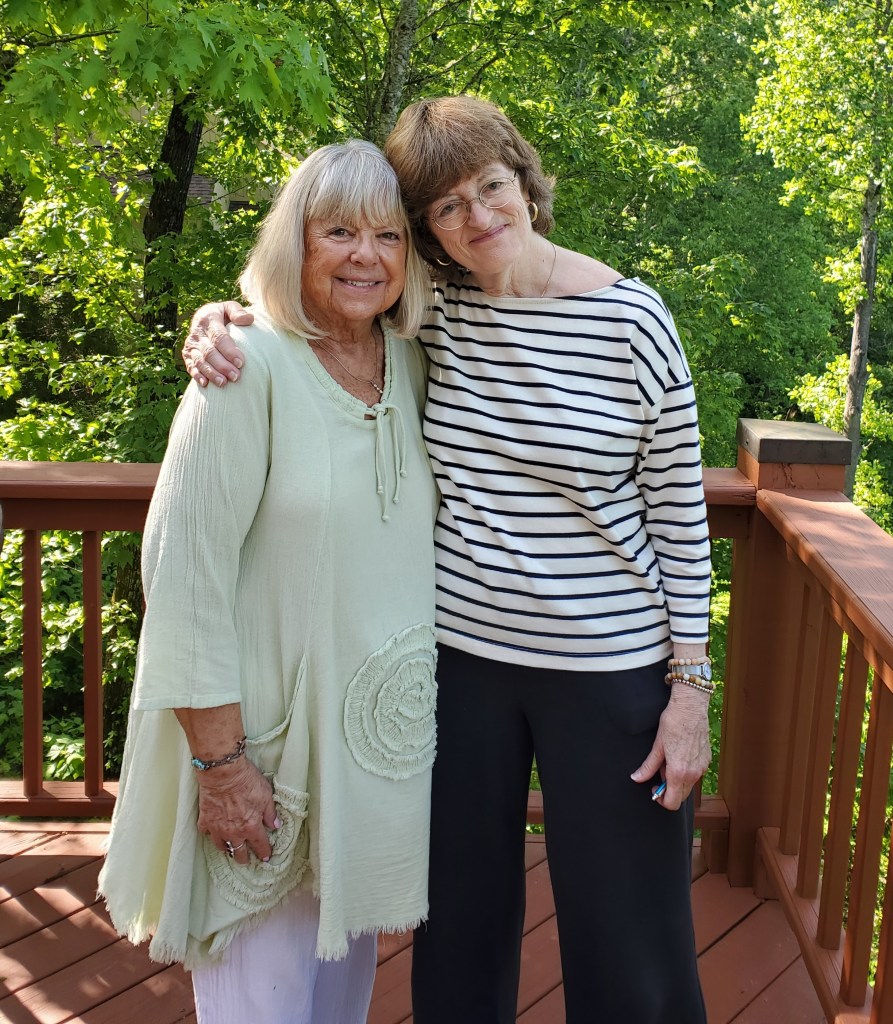
Gina and Georgy, the English teachers 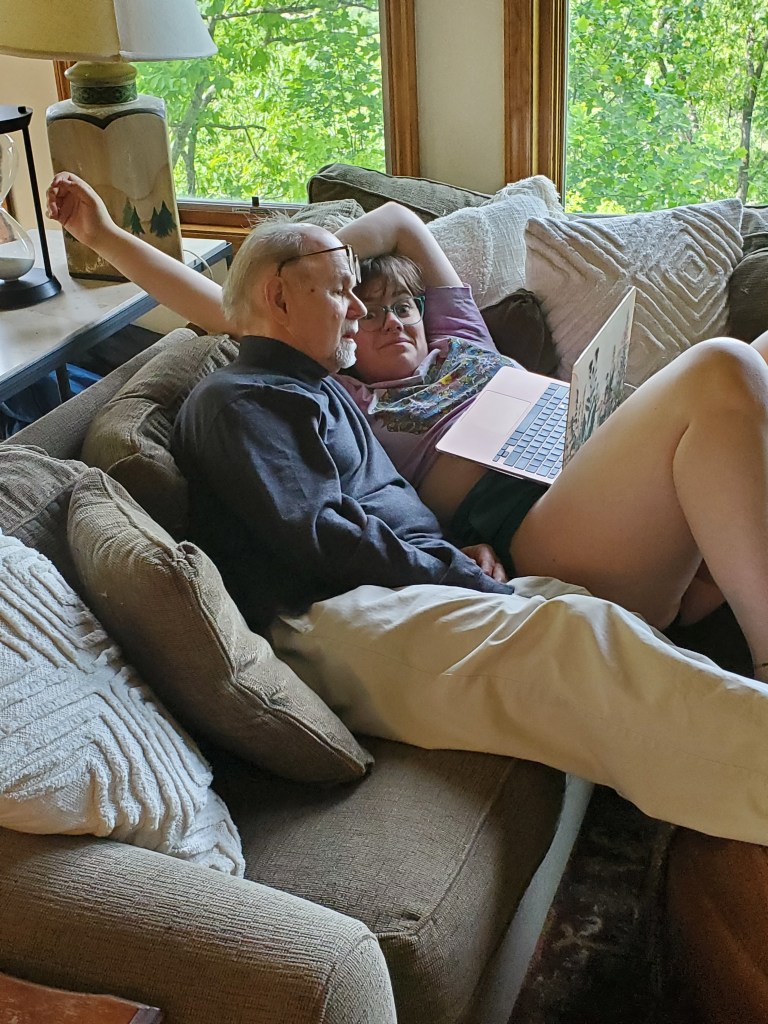
Dad Mark and Daughter Isabel Even the cosmos chipped in: on the Friday night before graduation day, 10 May 2024, that rare solar storm gave me my very first glimpse of the Northern Lights—from a valley in Whittier NC! We drove down in the bed of Paul’s brand new and weirdly silent fire-engine-red electric truck. Though the phenomenon was ghostly to the naked eye, the girls’ iPhones revealed a spectacular show of colors we would have otherwise missed, a fine astronomical launch for the nearly graduated Olivia.

Whittier NC, 10 May 2024, photo by Brooke Smith Graduation day was lovely, and Olivia ended up in the front row of the vast auditorium where we could clearly see her. Inevitably nostalgic about so many graduations both marched in and attended (the WCU auditorium was about the same size as the Bayfront Center in St. Pete where I once addressed the Boca Ciega High School Class of 1970), I kept wondering what lies ahead for the Class of 2024. “What’s to come is still unsure,” as Feste sings in Twelfth Night.

Susan and Mark with the new grad Olivia 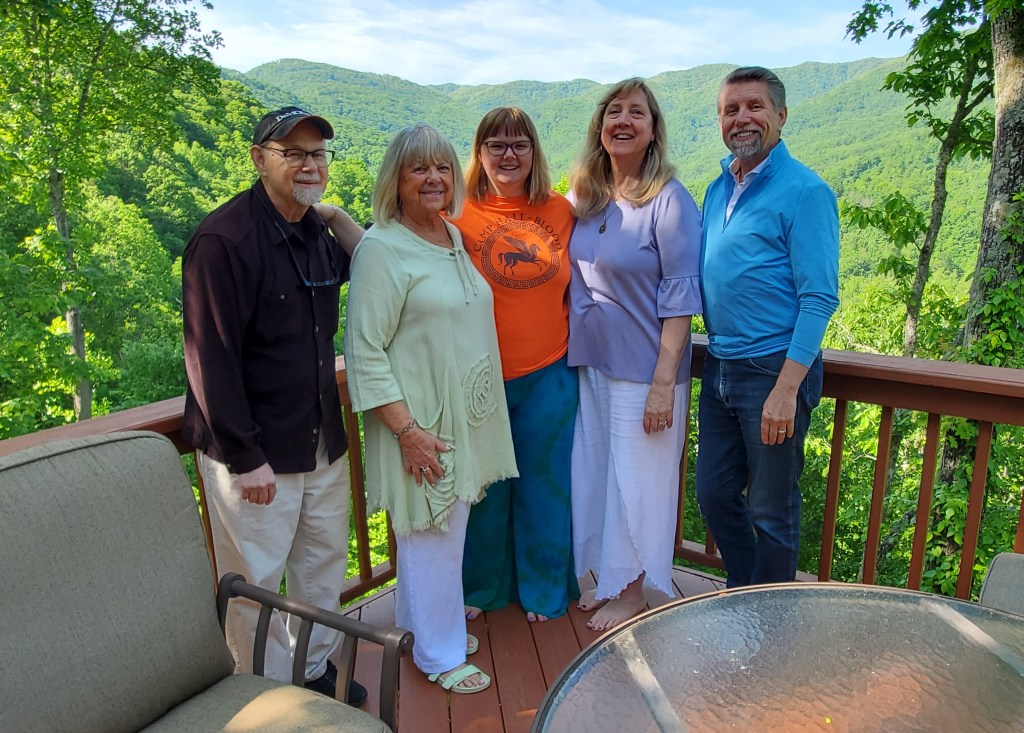
Mark, Gina, Olivia, Susan, and Paul: 4 Steinkes and an Andrew We lunched in Sylva (on a good Cuban sandwich; who’d have thunk it?), took photos back on campus, and returned to our temporary mountain home for dinner and The Last of the Mohicans (or, as my mother Virginia always called it, “The Last of the Moccasins”). That film was a nod to my next day’s assignment: checking out Chimney Rock as a possible site for fulfilling my late sister’s wish to return her ashes to the mountains, and then driving on to my rendezvous with her husband Richard and son Daniel at our own Airbnb in Mill Spring NC.
A fine and memorable interlude, this graduation. Godspeed, Class of ’24!
-
Norm erosion
9 June 2024
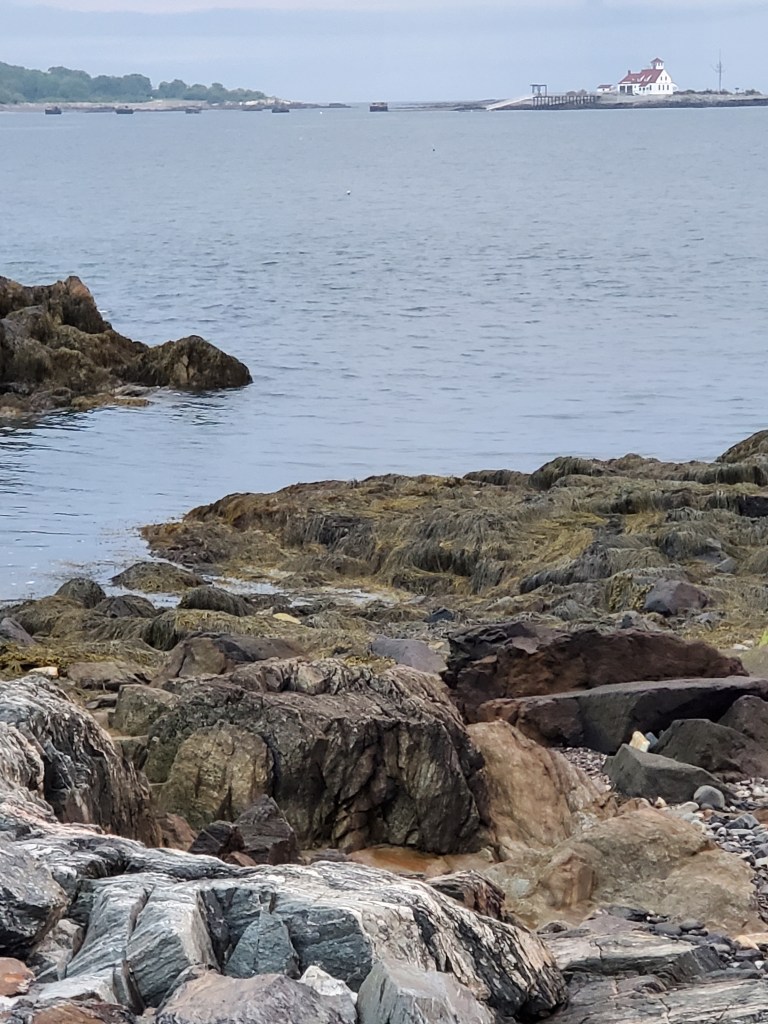
Wood Island Lifesaving Station (1908), Kittery ME, viewed from New Castle NH With meteorological summer entering its third week, the nights continue to grow longer, the grass grows faster, and the time for seasonal repairs and cleaning is at hand. This past week I also attended the New Hampshire Library Association Trustees conference in Concord, heard internationally known digital services librarian and consultant Nick Tanzi’s keynote address, “How Libraries Will Find Their Way in the Age of AI (Artificial Intelligence),” and had my first evening picnic of the season back at New Castle Common.
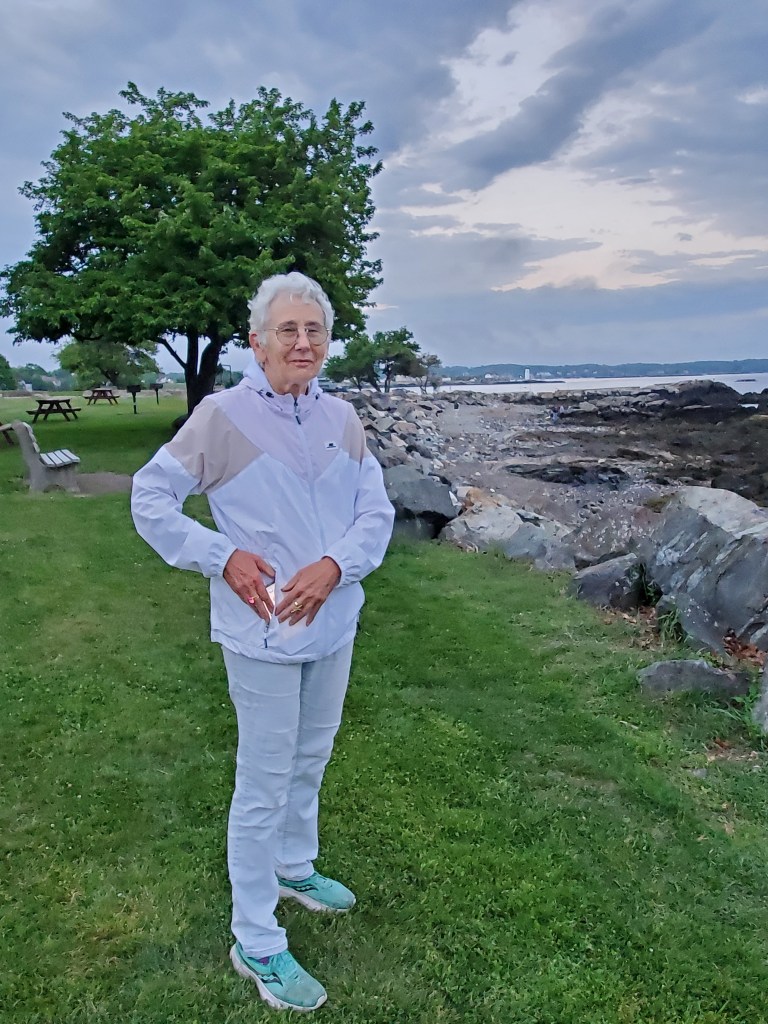
Fellow picnicker Carol on the New Castle Common Tech expert Tanzi’s brief account of how information technology has changed since the world wide web opened to the public in 1991 was at first both amusing (how quaint the morning show hosts’ discussion of what “@” meant) and reassuring: look how quickly we all adapted to online life. But then came perhaps the most memorable takeaway from Tanzi’s presentation, a quotation from French cultural theorist Paul Virilio: “When you invent the ship, you invent the shipwreck.” Tanzi’s advice about how to avoid the shipwreck included: When posing a question to AI, be precise and add “Do you understand? If you don’t know the answer, say that.” If you don’t follow that advice, AI will make up answers to what it THINKS you asked.
Advice aside, the speed and current refinement of AI capable of generating completely convincing fakes is both disruptive and dangerous, especially in our era of disinformation and “alternative facts.” Policies and policy reviews are a necessity, not only because of intellectual property issues, but also because (1) technology carries our biases; (2) algorithms use probabilistic math, that is, when AI scours the web for information, it prefers the most popular to the most accurate; and (3) cyber security is a fiduciary duty, while understanding and policy lag far behind technology. How far we’ve come from what feels “normal”!
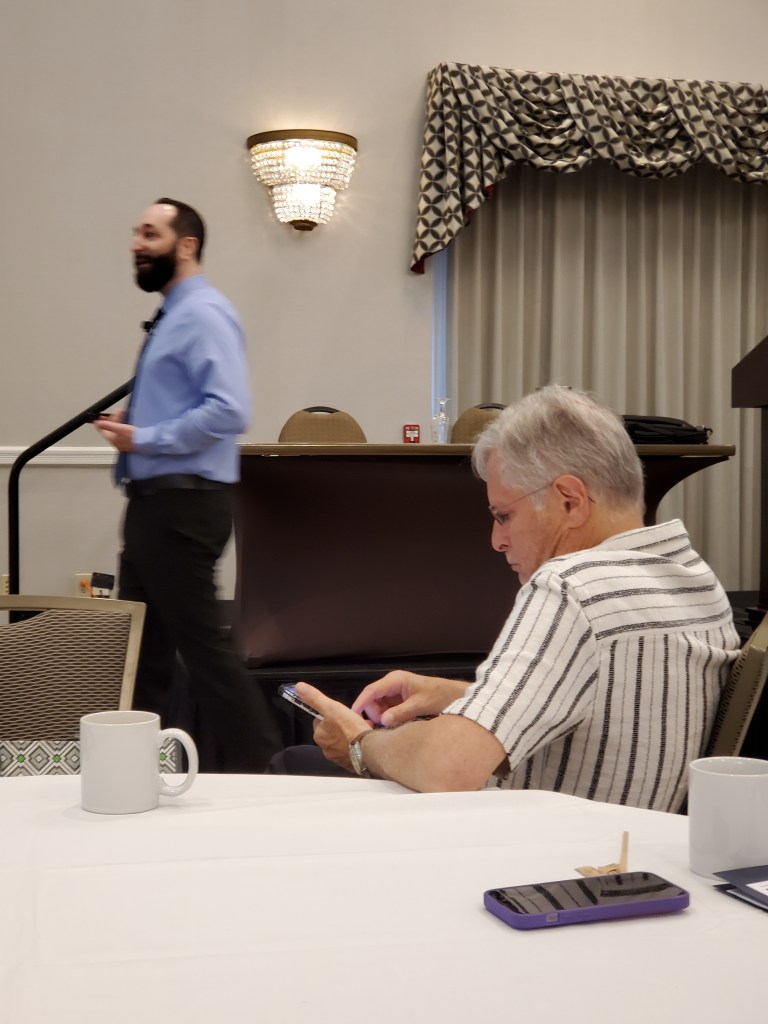
Decorum be damned: as speaker Nick Tanzi presents advice to librarians about AI, the audience member right in front of him scrolls through his phone On the way to the conference my three fellow conferees were already commenting on what I’ve learned to call “norm erosion,” only one example being what is considered acceptable dress or behavior, as in Senator Fetterman’s signature gym shorts and hoodies worn on the Senate floor, or teen girls’ “school clothes” that reveal much more than they conceal. In the day’s final conference session, when Placework architects Liz Nguyen and Josh Lacasse, designers of the lovely Madbury Public Library, spoke of “The 22nd Century Library,” I encountered another example of norm erosion—or at least evolution.
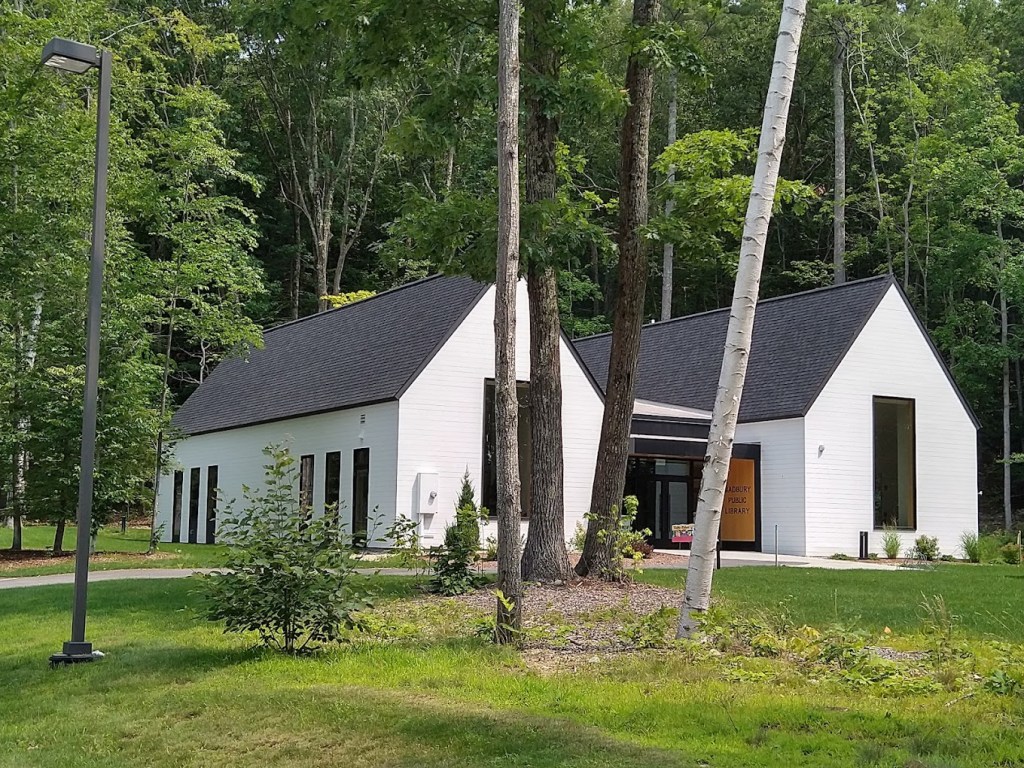
Madbury Public Library, photo by Rick Behun Liz and Josh began by showing images of the past’s “temples for books” like the Boston Public Library’s gorgeous reading room and some of the many Carnegie libraries dotting—and for me enhancing the New Hampshire landscape.

McKim’s magnificent reading room at the Boston Public Library, completed 1895 Their presentation then moved on to contemporary libraries in Austin, Chicago, and Calgary designed for the library’s ever-expanding societal functions, serving as community centers with tech access; multiple meeting rooms for teens, hobbyists, and seniors; sports facilities; and cafés.
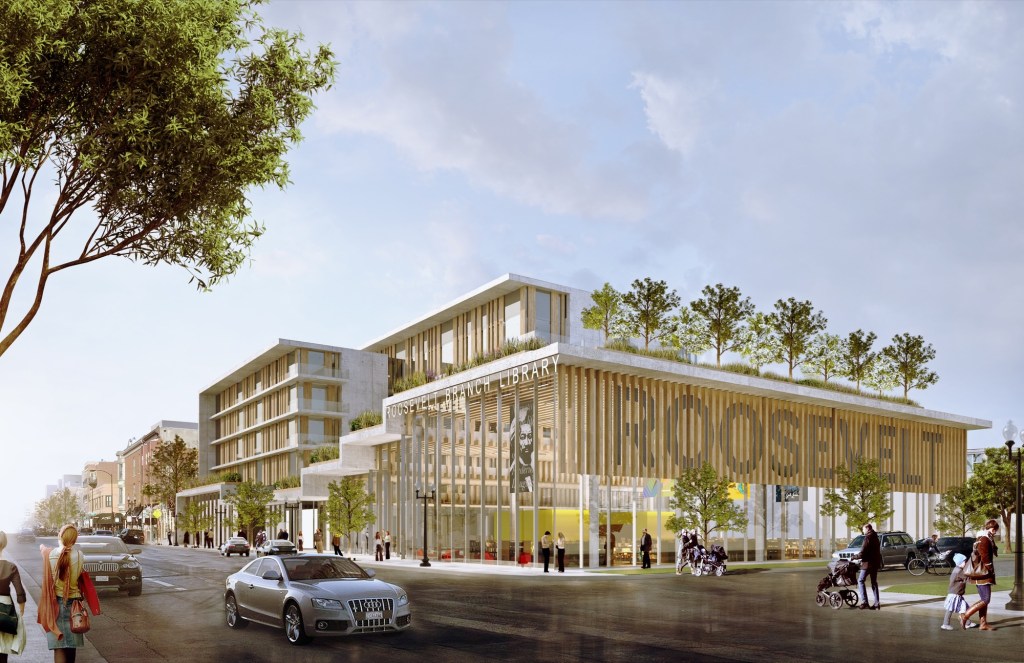
Taylor Street Branch Apartments & Roosevelt Branch Library, Chicago, Skidmore, Owings, and Merrill, 2019 It struck me that libraries, like my David’s Redford High School in Detroit which we re-visited many years back, are having to shoulder so many more societal functions than the ones we boomers attended. On our visit to Redford, we entered through a metal detector; medical, psychiatric, and other social services were all available on site. But even such adaptation proved insufficient; Redford High ceased operations in 2007.
Another example of norm erosion: Currently the Portland Museum of Art’s expansion plans—which include razing a columned adjoining structure built in 1830 and renovated a century later by architect John Calvin Stevens—are “tearing the community apart.” According to Mark Shanahan of The Boston Globe (6 June 2024):
“In its application to the city, the museum claimed that changes to the front of the building — it opened as a theater before becoming a Baptist church, the Chamber of Commerce, and, finally, the Children’s Museum — had diminished its historical significance. But it was another assertion that angered some here: The museum argued that the building should be razed because it was “erected during the Jim Crow era” and the white columns of its Colonial Revival style “carry unfortunate legacies of the past into the future.” In other words, said David Chase, an architectural historian and former curator of the National Building Museum, the structure is a brick-and-mortar embodiment of racism.”
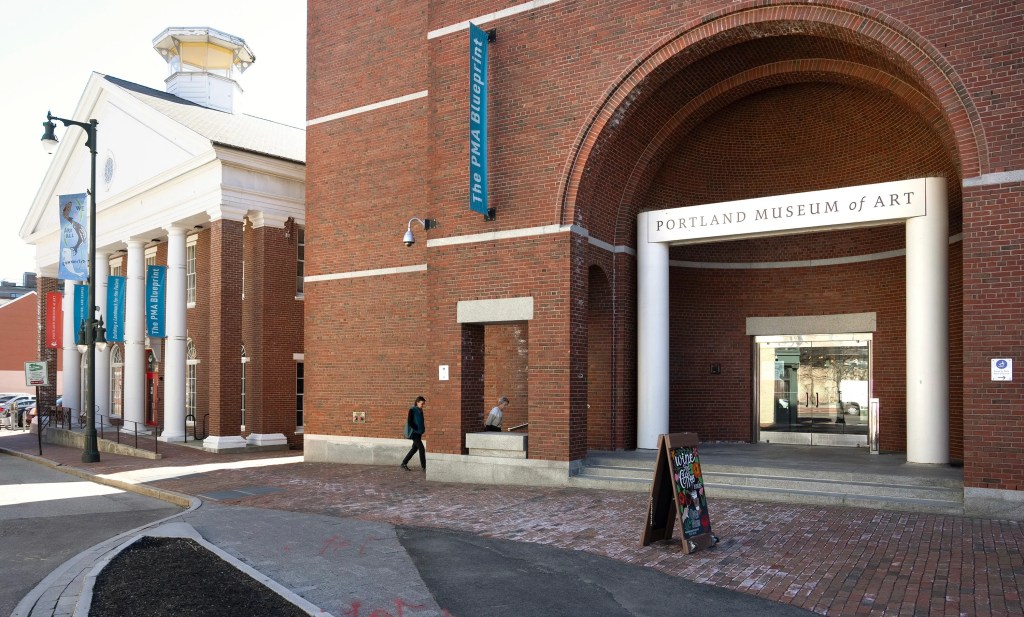
Portland Museum of Art and the former Children’s Museum next door, now proposed for demolition Yikes. If all Greek Revival buildings emulating “the glory that was Greece / And the grandeur that was Rome” are embodiments of racism, then I agree with Chris Newell, an educator and enrolled member of the Passamaquoddy Tribe of Indian Township in northern Maine, who believes opponents of the museum’s plan [to raze the columned building] are being selective in the history they are preserving. But I would NOT go so far as to agree with Newall that the proposed addition’s inclusion of a distinctive curved roof line “that will cradle the morning sun on the summer solstice” is a tribute to the Native Americans who lived on the Portland peninsula for thousands of years before the Revolutionary War. Newell’s take:
“Museums are a colonial artifact. Preserving history and art in museums is something that comes with colonization,” said Newell. “Rather than pay attention to just the last 204 years — the length of time Maine has been in existence — why not add the 12,000 years of existence on that landscape of the Wabanaki peoples?”
Oy. I don’t believe that referencing the solstice belongs exclusively to the Wabanaki, nor that Greek and Roman columns exclusively signify the Jim Crow era. How will we, symbol-making homo sapiens sapiens, ever equitably address and learn from our past while at the same time navigating the prevailing winds of the future?
Hoping for more ships than shipwrecks, in my next post I return, Dear Reader, to recording my most recent past: attending our granddaughter’s graduation.
-
Three Graduations and a Funeral, part 1, 1-5 May 2024: Class of 1974 Reunion
4 June 2024

Furman University Bell Tower, May 2024 As I compose this account of my 3440-mile Southern Sojourn of last month, I am of course considering what happened then in light of what’s happening now. Last evening I watched a mother snapping turtle make her way up from the woods to our lower yard, where after a couple of false starts at digging, she finally chose a spot at the driveway’s edge and labored there for the next several hours. I had seen a turtle on the move across Town Hall Road a couple days before, and felt guilty about not crossing her myself. But she was large and those turtles can bite and claw quickly, so I did not interfere. Ms. Turtle’s presence in our yard confirmed that this is procreation time for turtles: I remember several occasions when the egg laying happened on my mother’s birthday, 17 June.
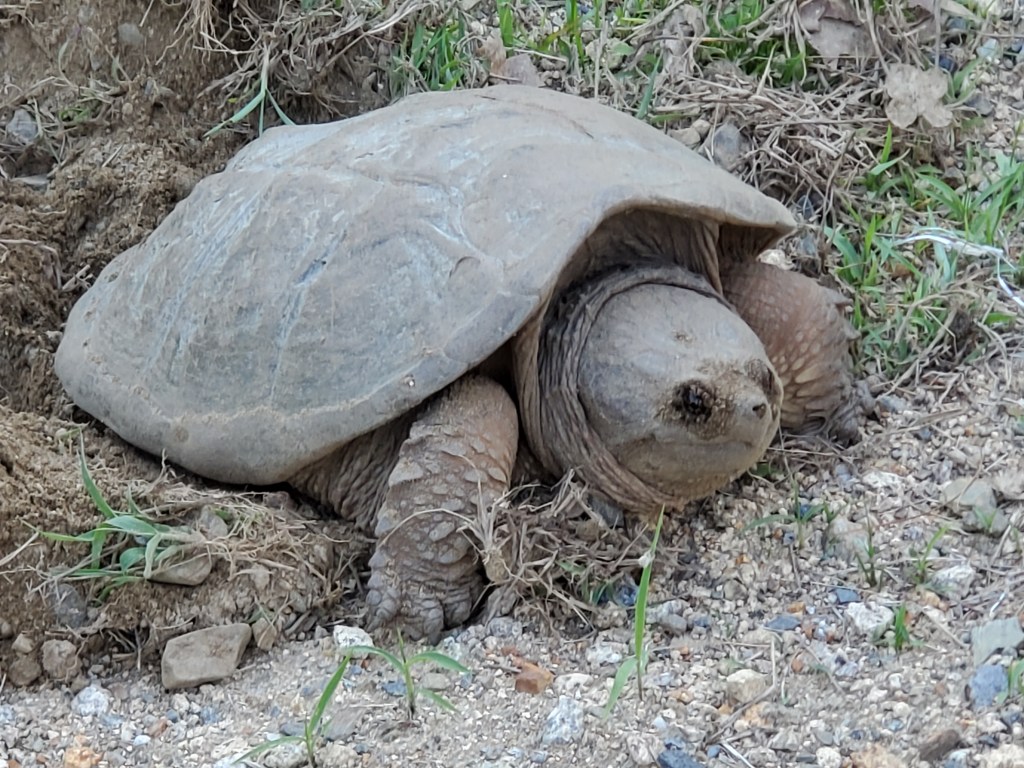
Mama Turtle at Gnawwood, 3 June 2024 I was happy to see Nature performing more or less on schedule, and to be reminded of who’s been digging up parts of our yard. Unfortunately for this laboring turtle, this morning I found she wasn’t the only one doing the digging: her nest had been breached and many eggs punctured or scattered. So it goes. But when I tuned in to Boston Public Radio after noon, what I heard was a discussion of Republican attempts to take control of human reproductive rights, not just abortion, but also contraception. Ms. Turtle’s brood’s bad luck was some predator’s sustenance, but wresting reproductive choices away from American women? That’s not Nature; that’s Atwood’s 1985 The Handmaid’s Tale. So, my account of the first two big events of my Big Trip, a celebration of two graduations 50 years apart, inevitably invites comparison between the world as I knew it in 1974 and what is happening now in 2024. More on that in subsequent posts.
On May Day I got a later start than I had planned, first because I needed to jump online to order one of the limited number of non-resident parking passes for New Castle Common (which I did), and second because I was 45 minutes on the road before I realized I was not wearing the earrings central to several of the outfits I had planned for the next three weeks. Vanity outweighed prudence: I went home to collect them and departed for the second time closer to noon. Making my way across New Hampshire headed for Buffalo, I wasn’t even out of NH when I passed a slower car on the two-lane road and suddenly saw the flashing lights of a police car gaining on me from behind. I pulled over of course; the conversation went like this:
Officer Dexter: Do you know why I pulled you over?
Me: I think it was because I was speeding.
Officer Dexter: Do you now how fast you were going?
Me: Probably about 72.
Officer Dexter: You were going 78. And the guy you passed WAS doing the
speed limit, which is 55. Where are you headed?
Me: New York.
Officer Dexter: I should arrest you just for that. License and registration.
On checking my record—this was, after all, only the fourth time in my life I’ve been pulled over—the wry Officer Dexter gave me only a warning, together with the information that there’d recently been two fatal crashes on that highway, and a caution: slow down! I thanked him for stopping me, said I would be more prudent, and went on my way.
I made it to Cheektowaga via the Mohawk Valley that evening, 483 miles along on my journey, and had a nice conversation with a Pennsylvania oncologist as I waited on line at Chick-fil-a, both of us confessing how much we liked Chick-fil-a; she, a 36-year cancer survivor, admitted this was her third visit in as many days. She speculated about how much someone who brought a really good New York-style bagel to Miami could make. How much info two women meeting in a line can exchange! I took my sandwich back to the Holiday Inn Express, watched a PBS program I’d never seen before, A Brief History of the Future, which among other segments showed how to 3-D print a house (!). I went to sleep feeling optimistic about what lay ahead.

Tulips outside the Chick-fil-a, Cheektowaga NY, 1 June 2024 The next day proved more taxing, partly because of a loudly screeching child at a less-than-appealing breakfast, and partly because of the cumulatively tiring effect of adding 517 miles to the previous day’s 483. The New Hampshire trees I’d left the day before had not yet leafed out, and driving south to Wytheville VA I was driving into spring. But I was also driving into the mountains both my mother and my sister were once so sorry to leave, and where my own heart was broken for the first time. I discovered my E-Z Pass transponder was not working, a concern at the start of so long a trip, and I kept thinking of things I needed to do back at home. A Wendy’s taco salad for dinner and a VERY nice and VERY reasonable night at my first Sleep Inn managed to put things to right, though a quite disagreeable, very sexist pre-code movie on IMDb, 1933’s Man’s Castle starring Spencer Tracey and Loretta Young, left me wondering about how much metaphorical distance we’ve all traveled since then.
I arrived at my first destination, Greenville, South Carolina, the next day, after having a nightmarish time negotiating the approach westward via I-77 and I-85, and encountering for the first time in decades a large Confederate flag proudly raised just past the SC border. This brought back a memory from 1975 when coming back from Travelers Rest SC one night I saw an actual flaming cross burning on a hill.
But oh, the changes in Greenville since I left! There were only two restaurants in town when my roommate Leta and I attended Furman, Iris’s Greek Restaurant downtown and the Peddler Steak House where we had treated our parents to a 1974 graduation dinner. Ellen, friend of my youth and responsible for my attending Furman University (she invited me along on her visit to campus and I was charmed by the red brick, the fountains, and the gardens) and her husband Mike, whose Greenville wedding I had attended in 1974, generously treated me to a lovely, extravagant dinner downtown at the bustling upscale Italian restaurant Ináco. We caught up on family news, hers and my late sister’s (Ellen remained a stalwart friend of Jane’s to the end), and then they returned me to the Marriott Courtyard Greenville Haywood Mall, its environs, 50 years of sprawl, completely unrecognizable to me.
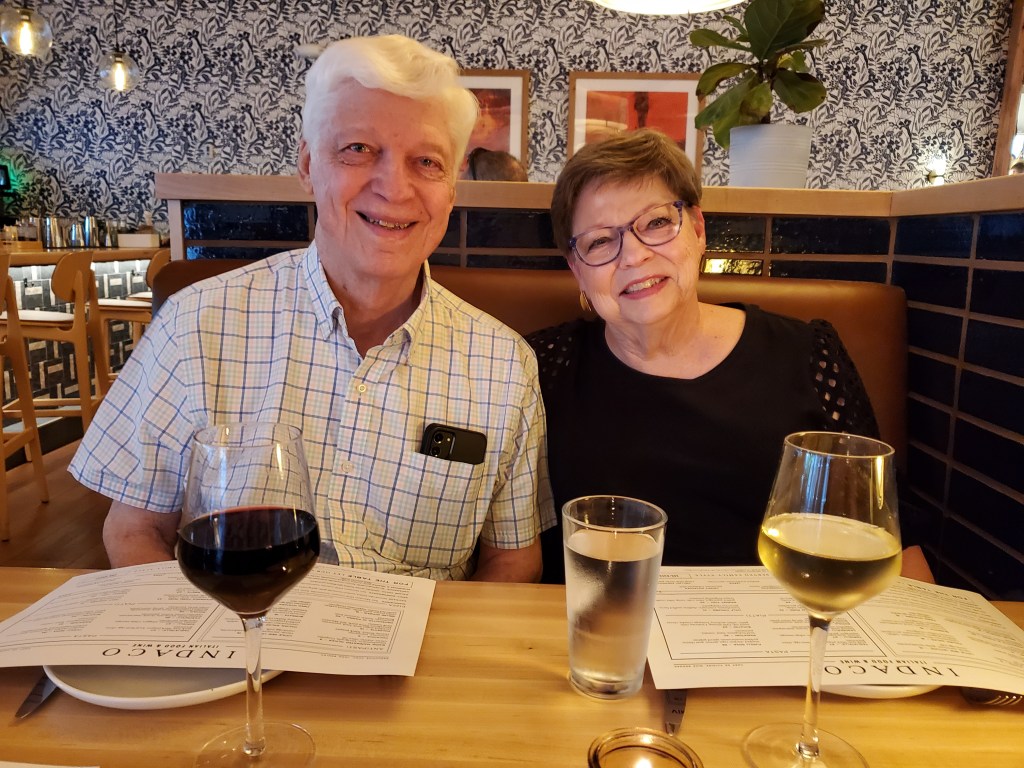
Mike and Ellen at Ináco, Greenville SC Then Graduation Day, 4 May 2024, arrived, and my first reunion with college roommate Mary Leta Preston Bosc and her husband Larry in 50 years. They had married in Charlotte on the same day in 1975 as Ellen’s Greenville wedding. Leta and I had lived together for four years, three at Furman and one more in Charlotte after we simultaneously realized that living at home as a college graduate was just NOT a workable plan, and Leta invited me to share an apartment with her in her home town. It was Leta who had persuaded me to attend our 50th reunion at graduation because Larry’s reunion the previous year had been such a gas. That morning I did some nostalgic driving around on campus and my old Greenville neighborhood before meeting up with Leta and Larry back at the Courtyard.
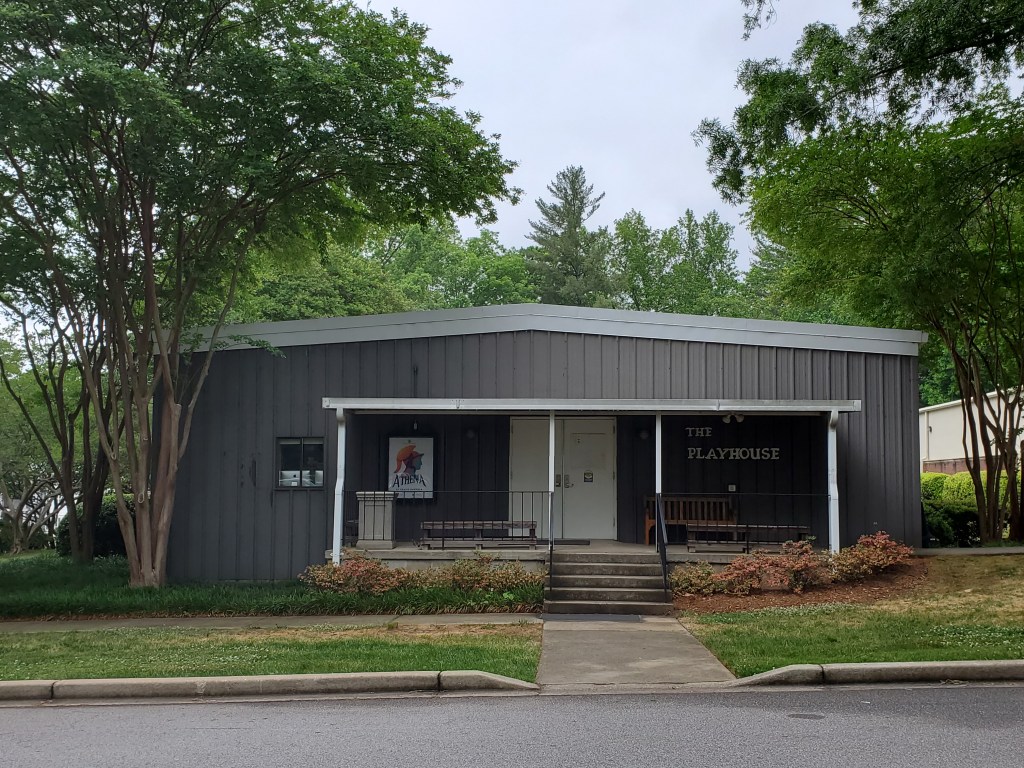
The Furman Playhouse, where my life took on a new direction: its pre-fab corrugated appearance looking unchanged since 1974 
F U’s Pearce-Horton Football Complex: didn’t exist in 1974. Compare/contrast with the Playhouse and draw conclusions about priorities. 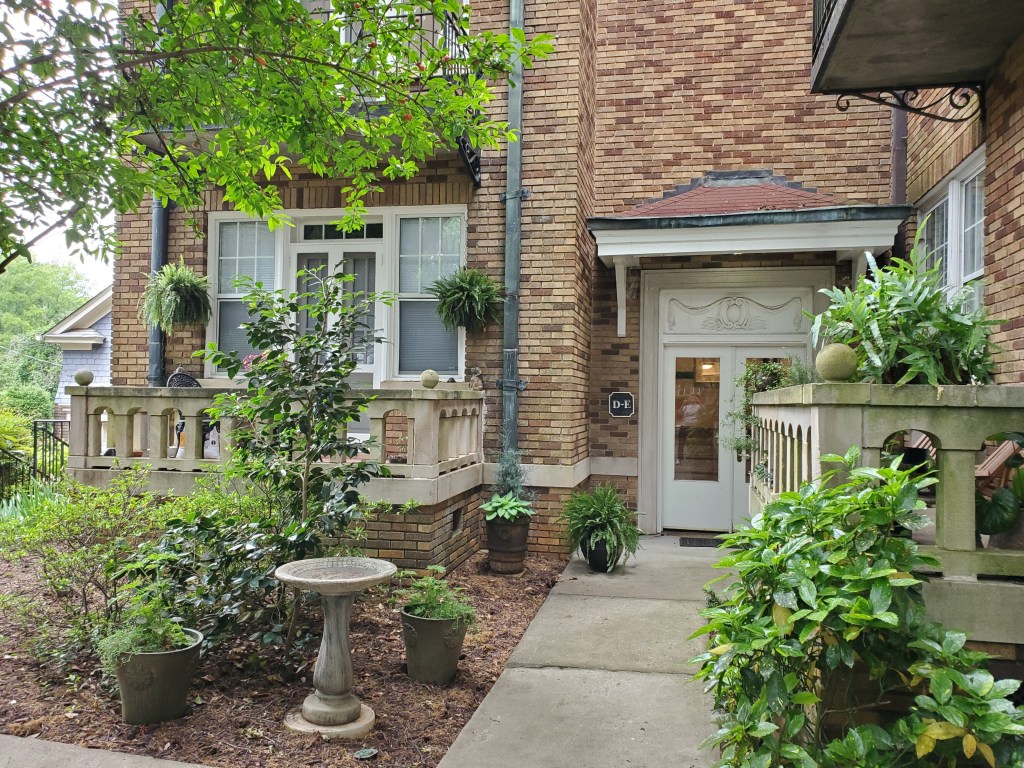
My “Virginia Apartment” home from 1975-1976, now a condo. Where I was living when I applied to Tulane’s grad school and learned I had scored a fellowship. My cat Ariel used to strand himself on the balcony above mine waiting for rescue when I returned from waiting tables at the Washington Villa Restaurant just behind the apartments. Meeting there at the Marriott, Leta, Larry, and I took off for Furman together, first to a very nice dinner laid on for us in the Football Complex by the Alumni Association, and then to a precariously orchestrated appearance at the Class of 2024’s graduation ceremony which rain had displaced from the outdoor stadium to McAlister Auditorium at the other end of campus. The logistics of getting us onstage—58 of our graduating class of 430 made it—were challenging. There was much hilarity as we donned our regalia, climbed laboriously into high-riding vans (without a step up!), waited in a very warm classroom, a hallway, and a stairwell for our brief moment on stage—and then returned to the Paladin Plaza for dessert.
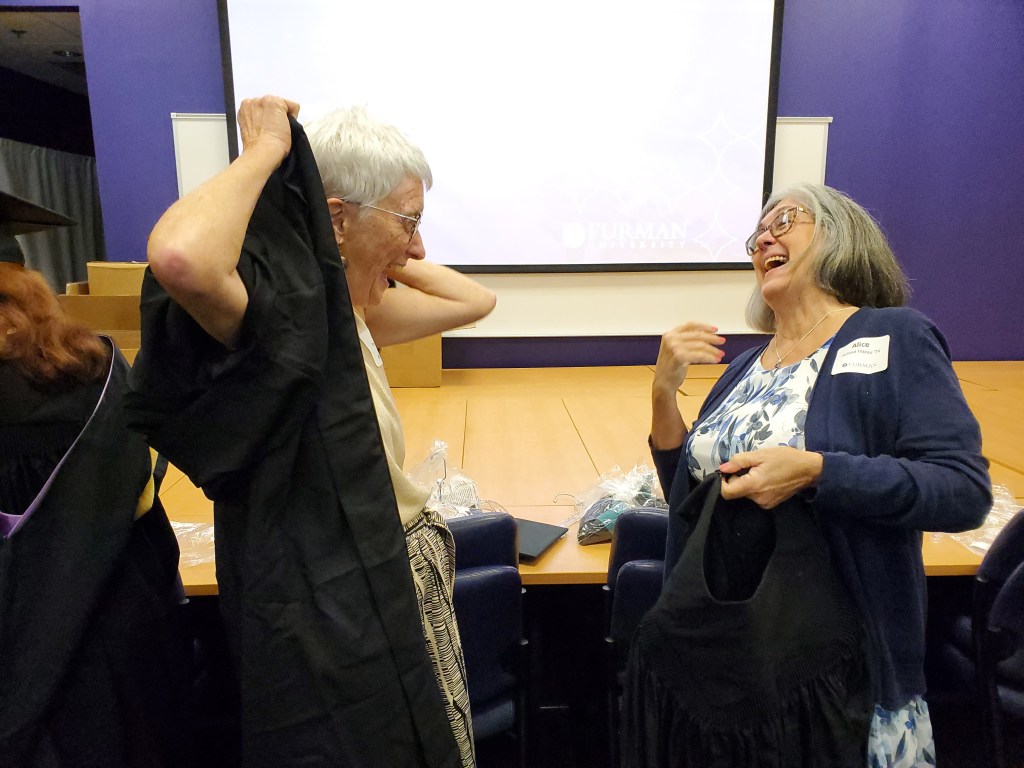
Leta and Alice robe up 
Larry enjoys the show 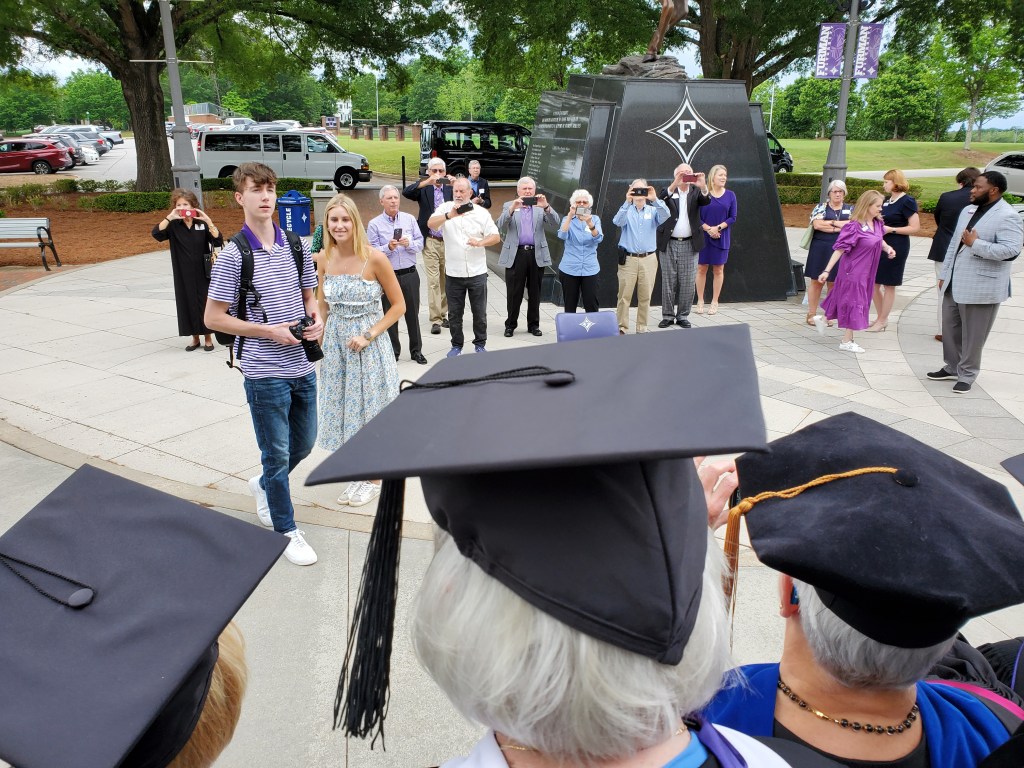
The Class of ’74 pose for photos . . . 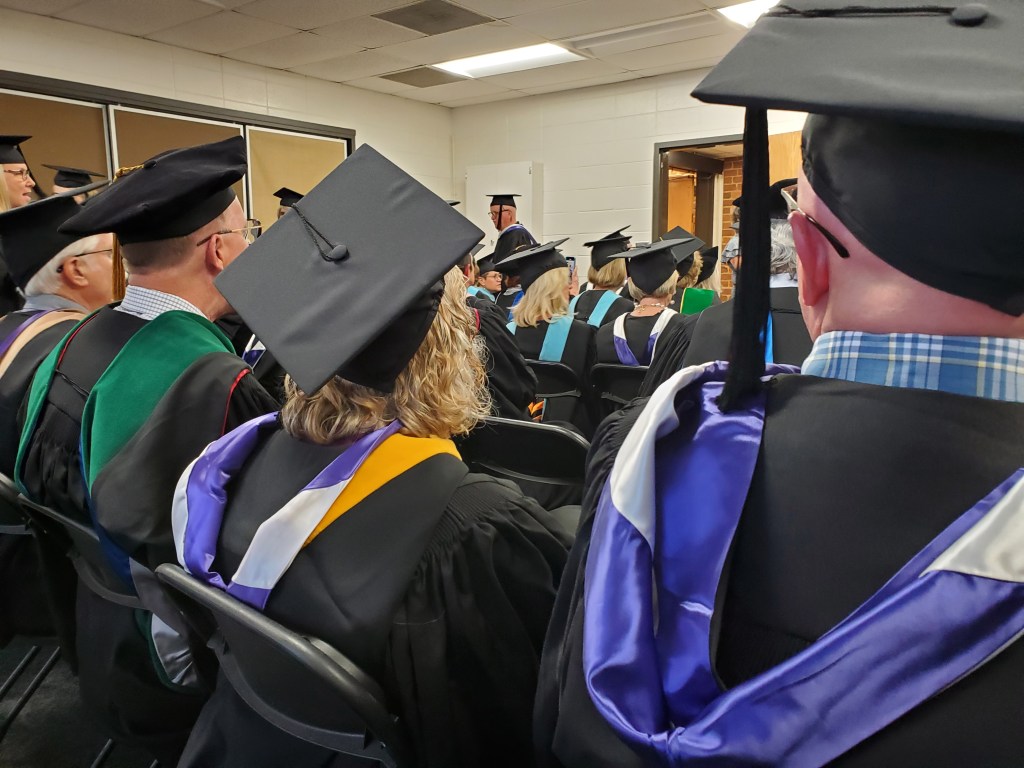
. . . spend a l-o-n-g time waiting . . . 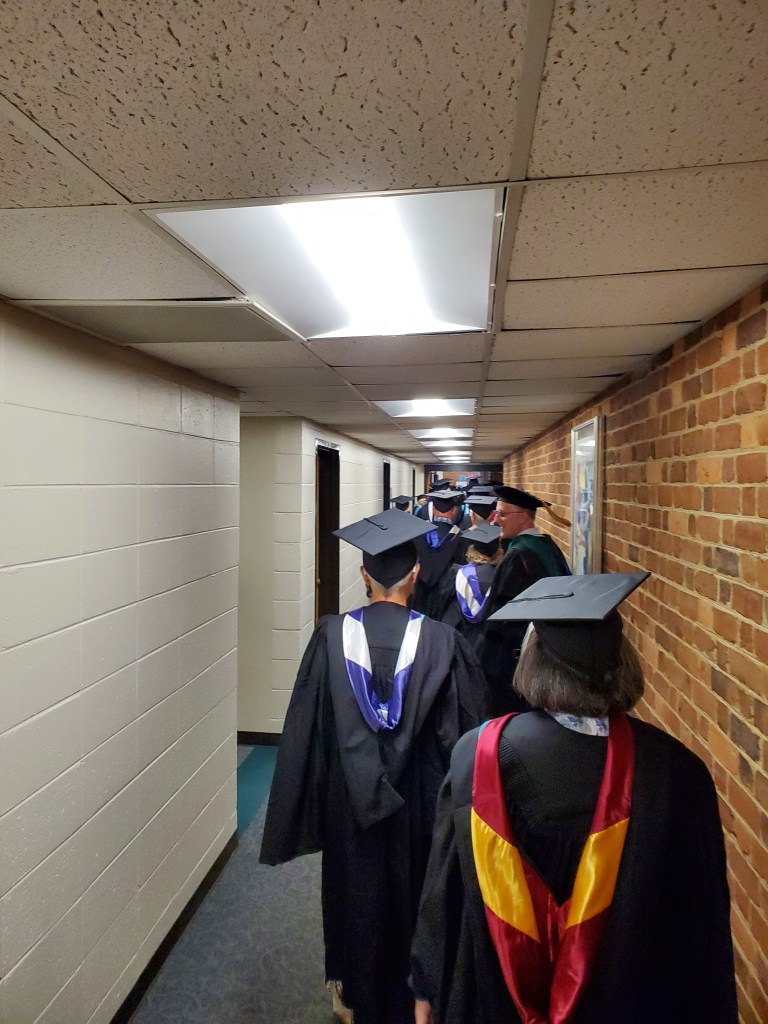
. . . and finally make our way to the stage. Over the evening I recognized very few classmates, though several recognized me. “So what happened to you, Georgeann? Did you end up an English professor?” This from a man who’d been in London and Stratford-Upon-Avon with me in the fall of 1972. Nailed it! I guess what was not obvious to me in 1972 was to others. Not until later did I scrutinize the list of 61 fellow Paladins now deceased and discover only one I knew: the beautiful and talented Anne Friddle, who cast against type (she was a blonde beauty queen) played Miss Prism to my Lady Bracknell our senior year. I would not have recognized the matron I later found when I googled her obituary.
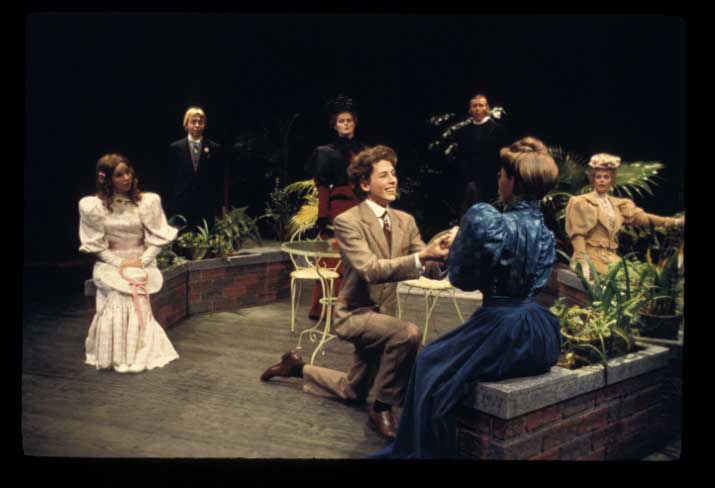
The cast of 1974’s Furman production of The Importance of Being Earnest, Anne Friddle as Miss Prism, me back center as Lady Bracknell in the Furman Playhouse. The best of times. Being re-united with Leta and Alice—we three who slept side-by-side in the Furman Dining Hall Apartment living room we adapted into a bedroom via clothes racks providing our three little single beds some privacy—was indeed a gas. How often I recall silently reciting all my lines before falling asleep, comforted by their proximity.
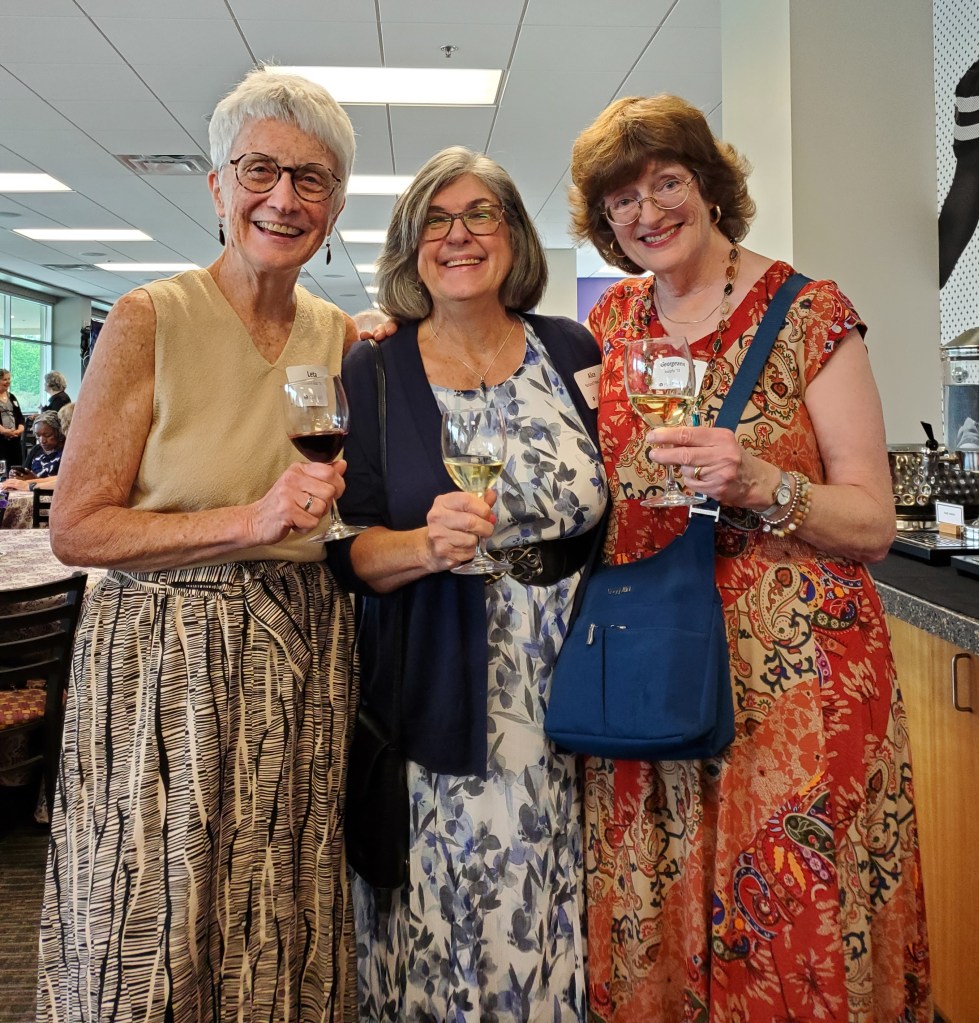
Leta, Alice, and Georgeann, roommates reunited 50 years later All of us in that apartment had gathered on the Dining Hall roof to appraise the boys who unknowingly gave us quite the show when they all met there to disrobe for a mass streaking event in the spring of 1974. No one streaked at the 2024 graduation. More’s the pity.
The long day made me request an early night for this 71-year-old graduate, and even then I overslept my alarm the next morning. Still, I was able to get myself and my stuff together quickly enough to meet Leta, Larry, Alice, Carl, Bill and his charming wife for brunch the next day at the Gray Moon: WONDERFUL biscuits and veggie omelettes, great service, and very jolly gemütlichkeit. We parted in good spirits, and with considerable help from gps, I found my labyrinthine way to Leta and Larry’s suburban Charlotte home, more reminiscing, Larry’s signature frozen gin-and-tonics, salmon pasta, the new Bob Marley movie, and a most welcome bed.
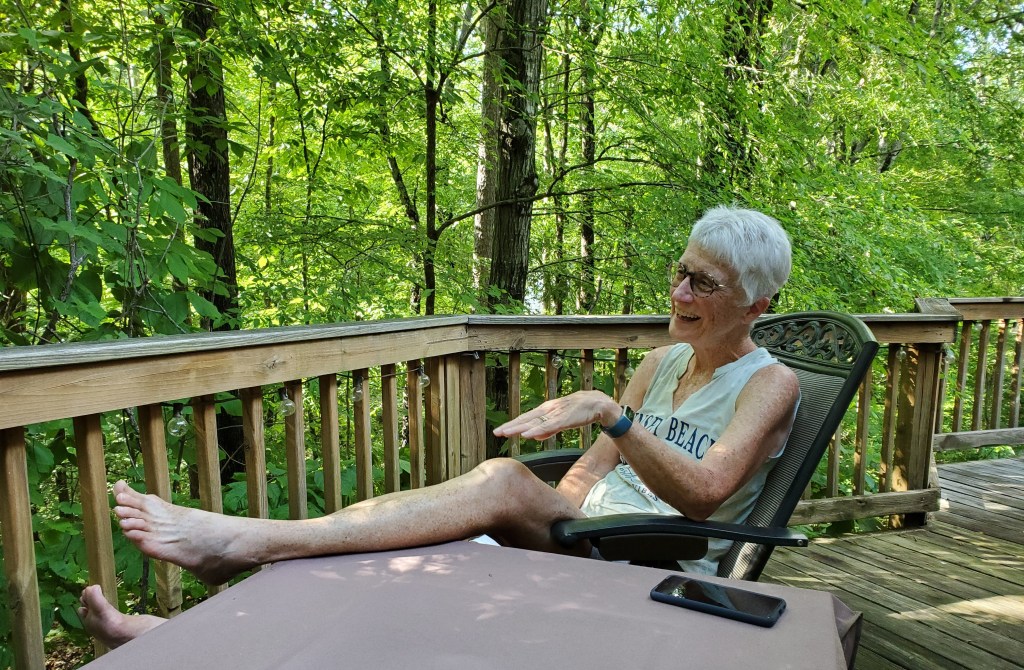
Leta on her deck awaiting Larry’s frozen G&T, lithe and lovely as ever. 
Leta on the August 1972 cover of Redbook, archived issue still available on eBay for $30. What price the past? -
Hinge Moment
31 May 2024
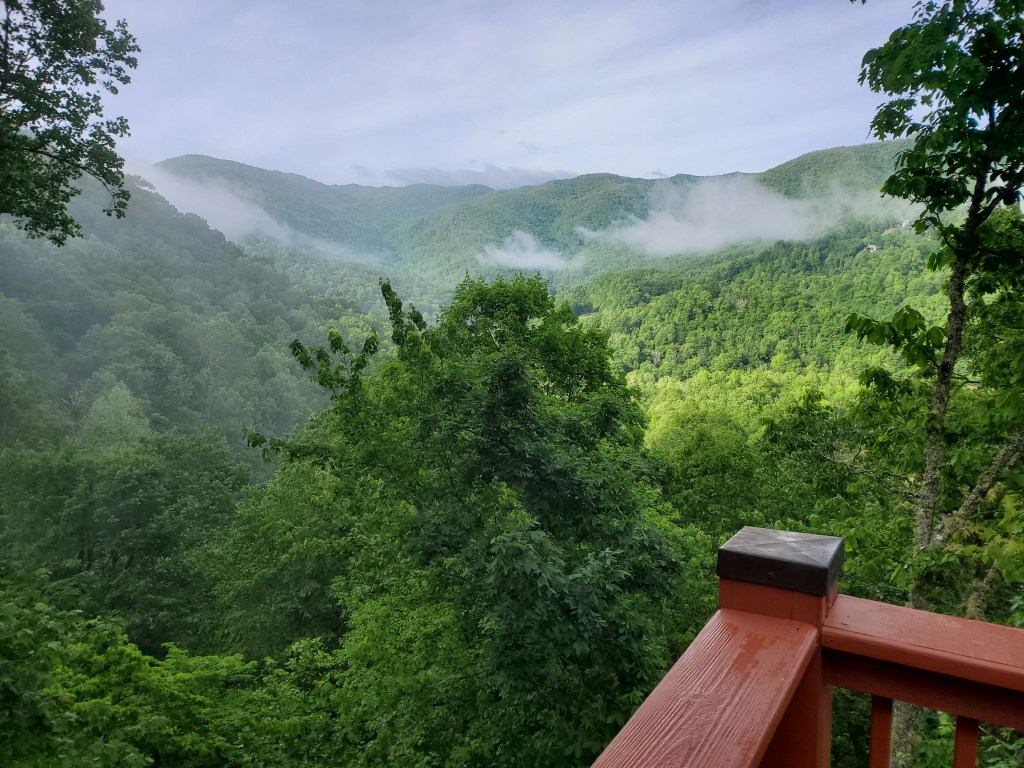
View from our Whittier NC Airbnb, site of Olivia’s WCU graduation celebration, 9-12 May 2024 In his essay collection Languages of Truth, Salman Rushdie proposed that there are “hinge moments” in history when “everything is in flux . . . [and] the future is up for grabs.” Rushdie wrote: “When one lives at a hinge moment in history, as we do, as Shakespeare did when he wrote his protean plays . . . then it becomes essential to admit that the old forms will not do, the old ideas will not do, because all must be remade, all, with our best efforts, must be rethought, reimagined, and rewritten.”
Here on 31 May 2024, the morning after the first felony conviction of a former U.S. president and the fifth anniversary of my husband David’s death, I am thinking not only of the hinge moment that will fill the 24/7 news cycle for days to come, but of what feels like a hinge moment in my own life, even leaving aside the tsunami of political and historical implications for the world’s leading democracy in peril.

Parsing that I leave to the pros, including Rushdie in his prescient collection of essays first published between 2003 and 2020, incidentally all the more personally relevant to me as I struggle to bring my own take on Shakespeare to light. Will to Live: Learning from Shakespeare How to Be—and NOT to Be may yet appear before 2024 is out (inshallah). But it’s the unpacking—literally and metaphorically—of my recent road trip encompassing Three Graduations and a Funeral (henceforth 3G+F) that preoccupies me now, perhaps a necessary and salutary distraction from the news. That justice prevailed in New York yesterday was good news; that the convicted felon is celebrated with campaign donations and obsequious support from so many in what was once the party of Lincoln is very bad news. It’s the best of times. It’s the worst of times.
But what of my time, my hinge moment? The short version: my 3440-mile odyssey brought me back in touch with family, friends, and places from very different periods of my life in a totally absorbing and elevating round of reunions. The five days following my return were similarly filled with pleasant diversions: a return to my yoga class, the satisfying launch of Madbury Library’s new book club, and back-to-back first-rate performances of two plays: the excellent revival of Tony Kushner’s Angels in America, Part 1 at the Portland Stage and the equally stunning final performance of David Greig’s adaptation of Joe Simpson’s mountaineering memoir, Touching the Void at the Apollinaire Theatre Company’s Chelsea Theatre. Co-directors Beyland and Brown and their first-rate ensemble of actors fully realized the distressing relevance of Kushner’s difficult, epic play written in 1991 and set in the mid-80’s. Compellingly realized characters wrestled with plague, societal division, and climate change (as well as an angel) all under the influence of the charismatic, corrupt, and completely amoral and self-serving Rob Cohn. Sound familiar?

Portland Stage’s Angels in America, Part 1: Millennium Approaches As for Touching the Void, direction, acting, design, and choreography working so superbly in concert produced an absolutely enthralling experience of theatre, conjuring the riveting experience of a terrifying adventure in the Peruvian Andes with an essentially bare stage and a large tarp in a small theatre located pretty much under the Route 1 overpass. For much of the play, my mouth was agape with wonder, and on the late Sunday night drive back from Chelsea, listening to jazz on GBH, I felt completely happy.
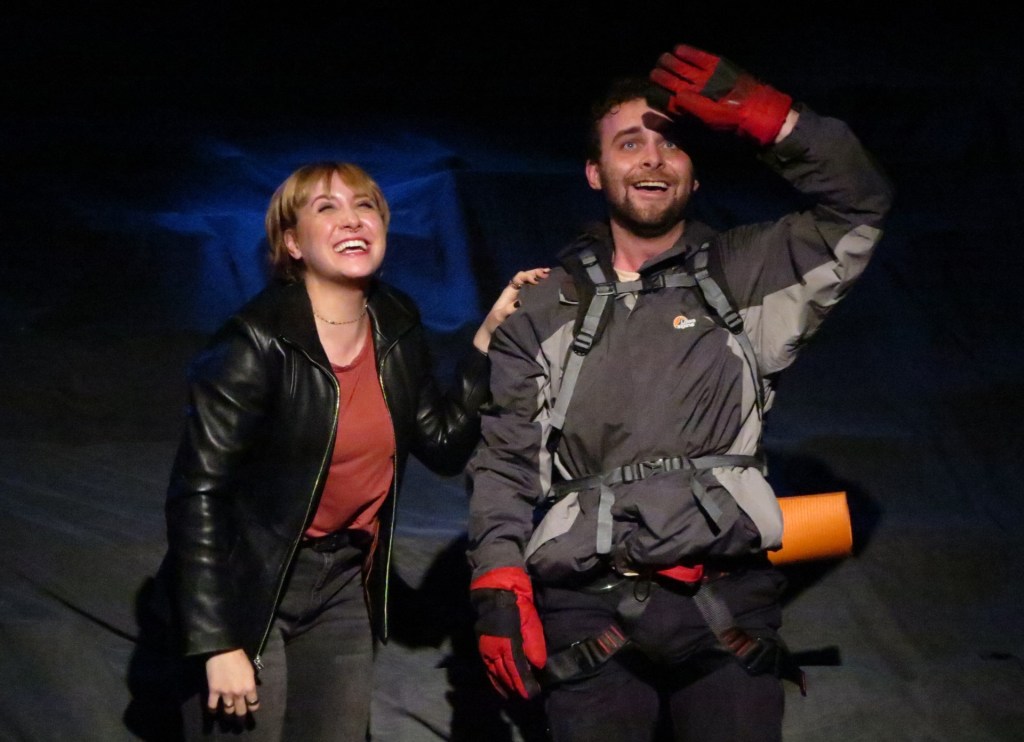
Sarah (Parker Jennings) and Joe (Patrick O’Konis), Touching the Void However, finally left to my own devices and quotidian housekeeping tasks on Monday’s grey, raining Memorial Day, that mood tipped in the opposite direction. The aches of an aging body, including the advent of yet another sign of decrepitude, a temporomandibular joint suddenly making the simple act of chewing a challenge, did nothing to elevate my spirit. Absent the all-absorbing distractions of the previous four weeks, grief for all the missing loved ones and a nascent but debilitating depression derailed addressing all that needed doing, exaggerating the growing anxieties of a “solo ager,” the label for those of us who face our latter days without any immediate family. The TMJ problem remains a problematic hinge of a different sort, and it hasn’t helped that I’ve caught myself in a couple of verifiable senior moments: apparently the last time I “replaced” the house water filter, I disposed of the old one without putting a new cartridge in the system, which in turn compromised the washing machine’s cold water filter, necessitating two bowel loosening exercises as I addressed both problems all by myself, hoping I could still perform the necessary contortions required.
I did. But then I found myself looking for a pair of scissors that were already in my hand, only to discover that I’d left the outside spigot in the on position overnight, distressing the washer into leaking. I’ve got mice to evict, hydrangea bushes to trim, and all this rain means the grass I only just finished mowing (having had to recall how to deploy the electric mower after a season’s storage) will soon need mowing again.
But. Spying the handsome young buck with his wee antlers sprouting made it hard to be mad at him for munching my daylilies. Yesterday’s weekly talk with my friend Cameron also helped re-establish my equilibrium, as did seeing my first ever Scarlet Tanager at the feeder. And my young friend Leo visited from next door sporting a new jester’s cap made by his clever mom. So, life is good.
I want to tell more about my travels, not just that I think my distance vision and patience with traffic have both diminished since I last undertook so long a road trip. Lots of good things happened, too. Dear Reader, do check back in for details of Three Graduations and a Funeral.
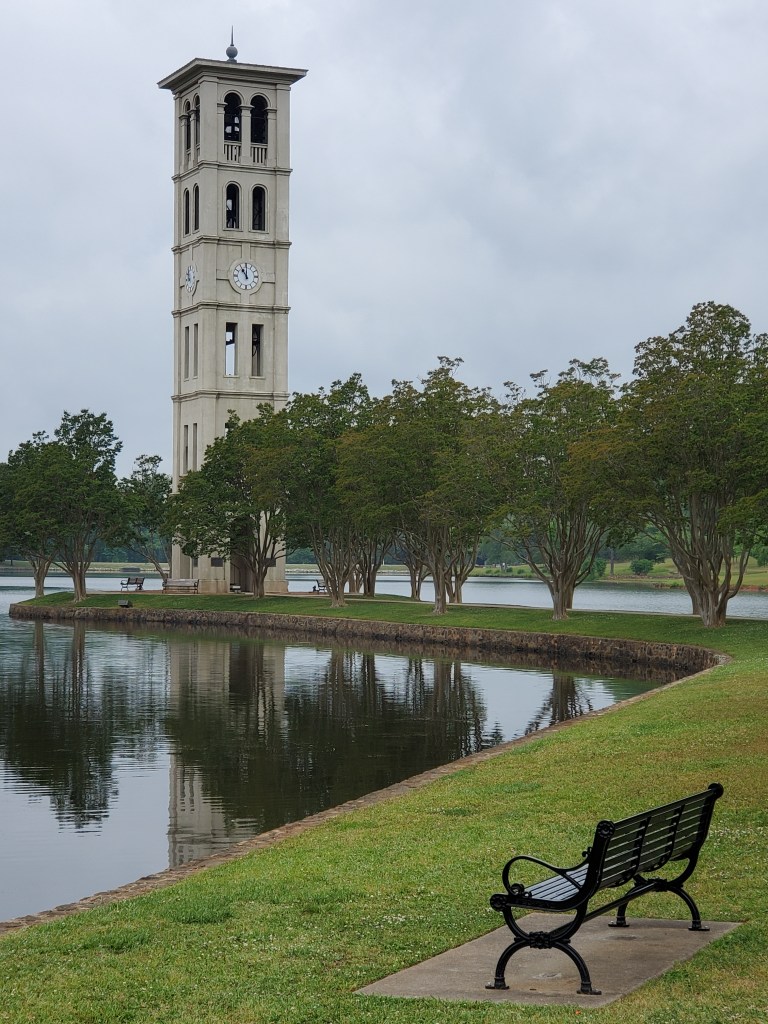
Furman University, site of the Class of 1974 50th anniversary reunion 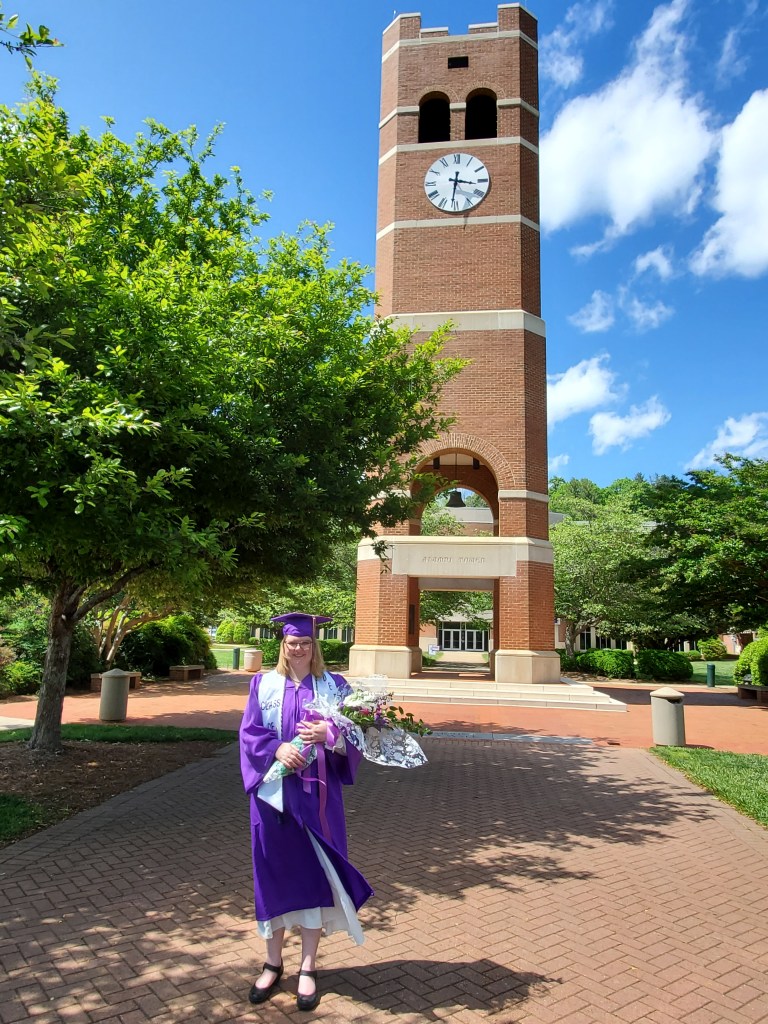
Granddaughter Olivia’s Class of 2024 graduation at Western Carolina University
-
Subscribe
Subscribed
Already have a WordPress.com account? Log in now.
 Georgeann Murphy