-
July so far: Good Trouble in the Summertime
22 July 2025
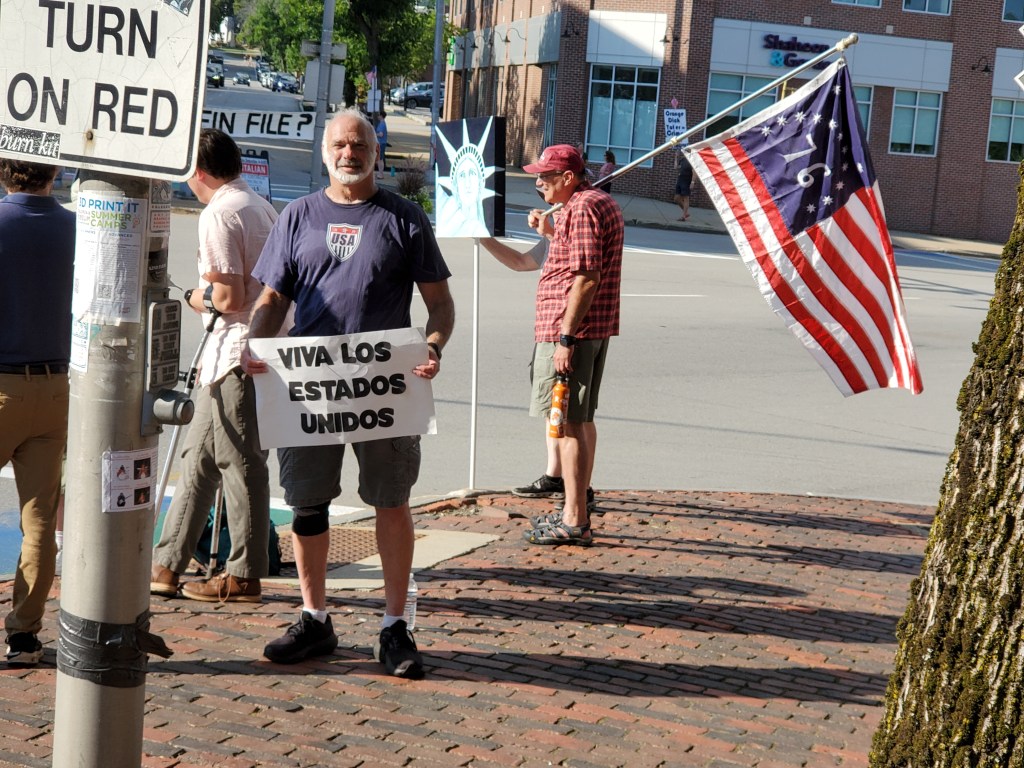
Standing united on 17 July 2025, Dover NH I’m was up this morning far earlier than accustomed for this retiree, as Levi Ellis and his painting crew arrived at 8 am to restore my shower and apse ceilings and our big deck to their original pristine state. And it’s unusually cool for mid-July in New Hampshire, a welcome reprieve from the heat of past weeks: 66o upstairs with no ac and widows open, low humidity. Brilliant blue sky. There’s the drip drip drip of the Trump/Epstein saga on recently defunded NPR, and I woke to a tick crawling on my neck. But the day is too fine for pessimism, and however sleep deprived, I’m thinking of what’s been a very fine July so far.
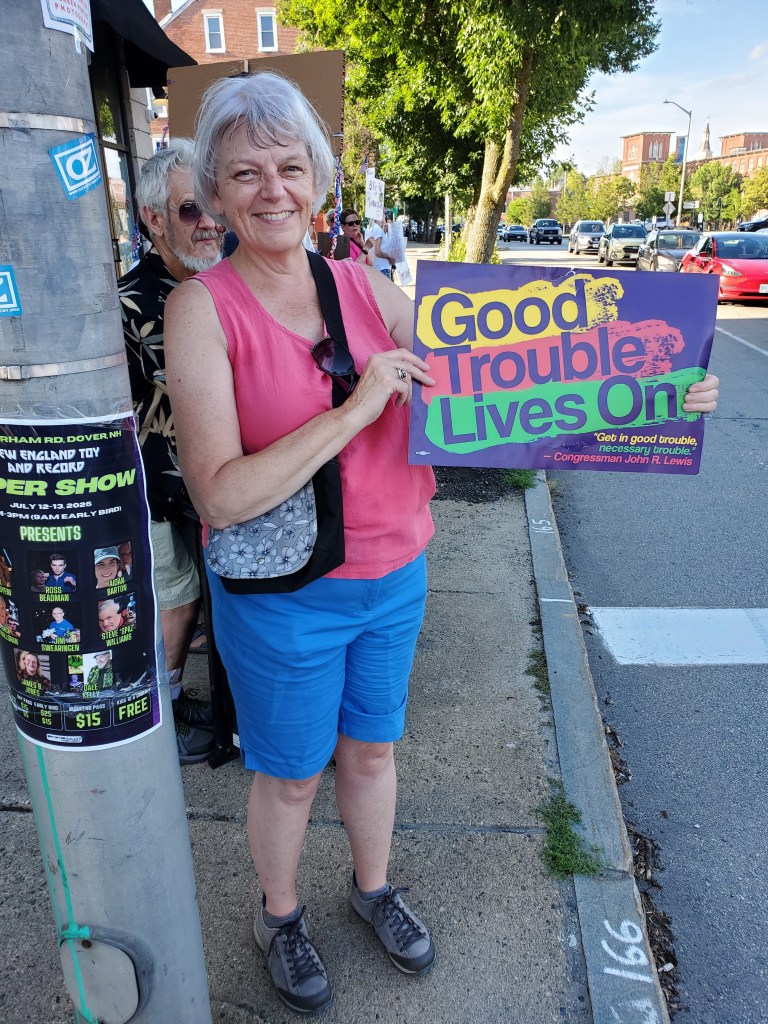
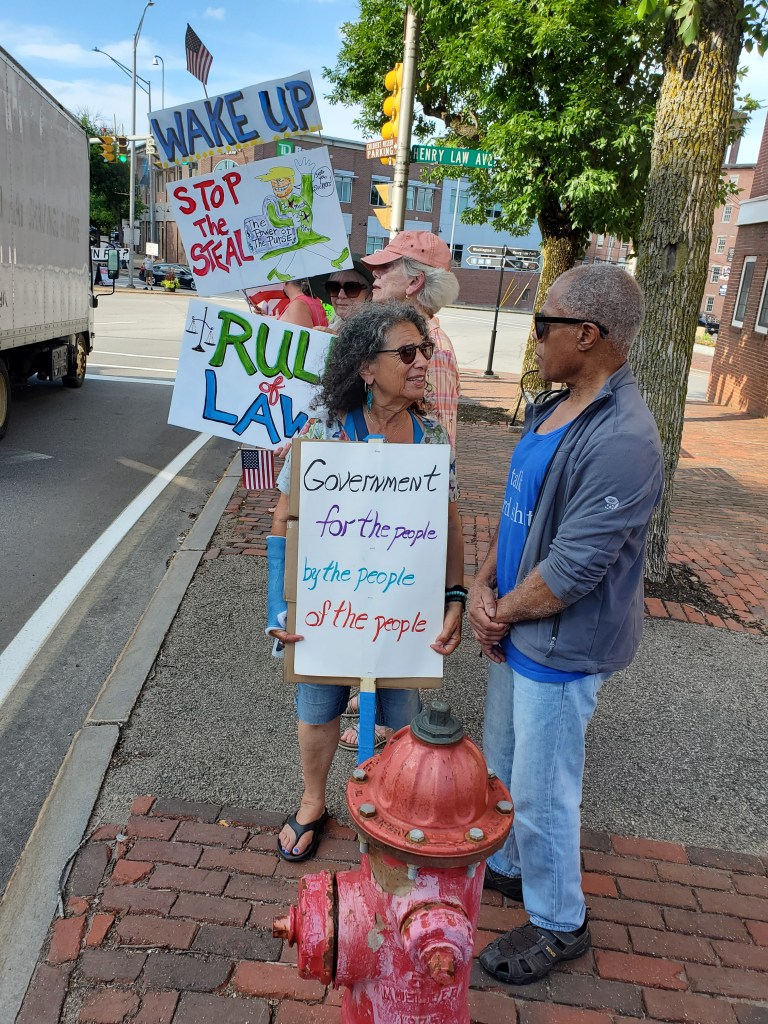
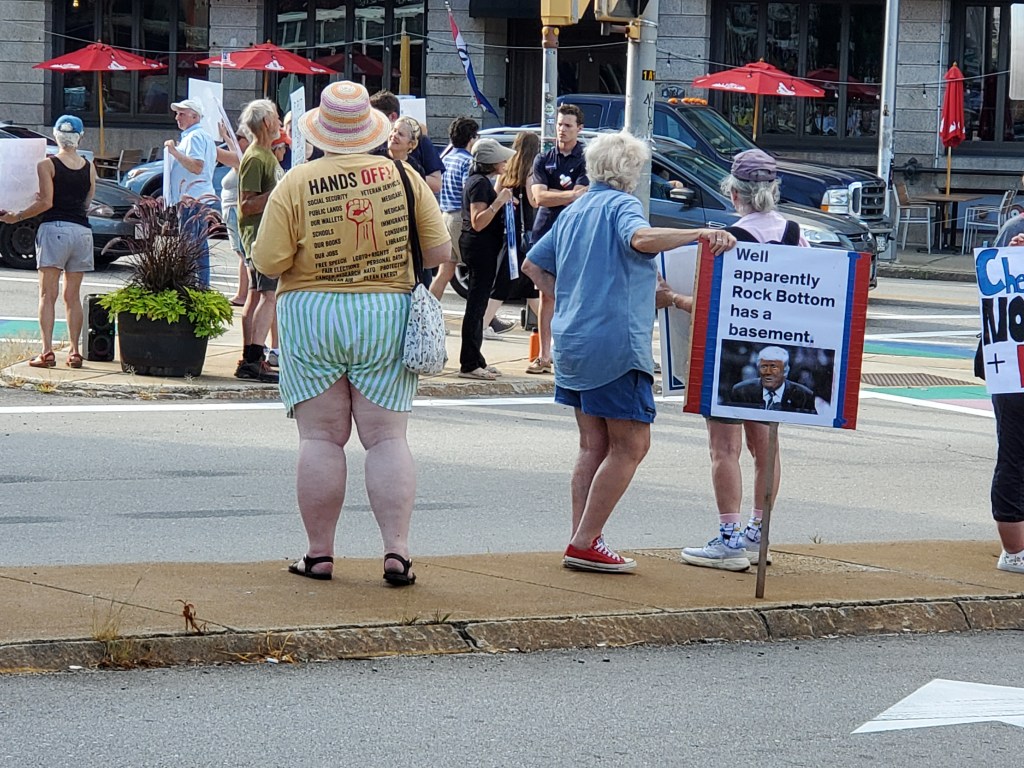
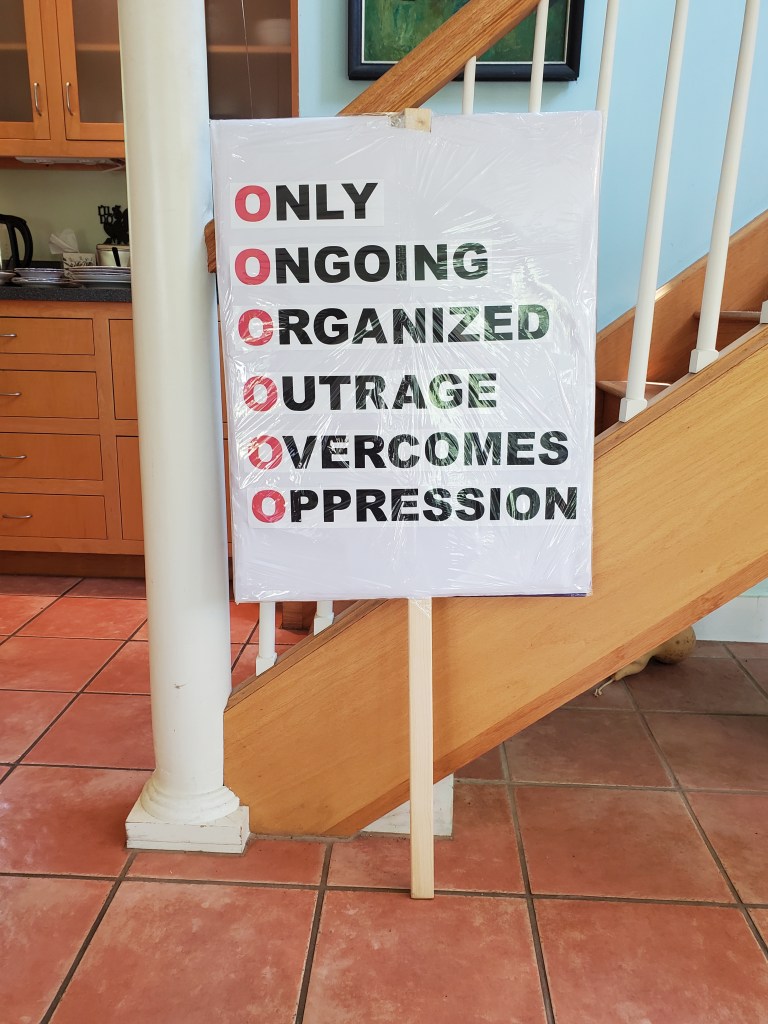
For one thing, last Thursday’s “Good Trouble” rally on 17 July, the fifth anniversary of John Lewis’s passing, I judge a success. Ninety hot minutes at the intersection of Washington and Central Ave in Dover, New Hampshire garnered some middle finger salutes, but also lots of approval honking, some even from big rig 18-wheelers. I stand by (and below) my protest sign: Only Ongoing Organized Outrage Overcomes Oppression. Maybe, just maybe the Opposition is gaining some momentum, and we shall overcome.
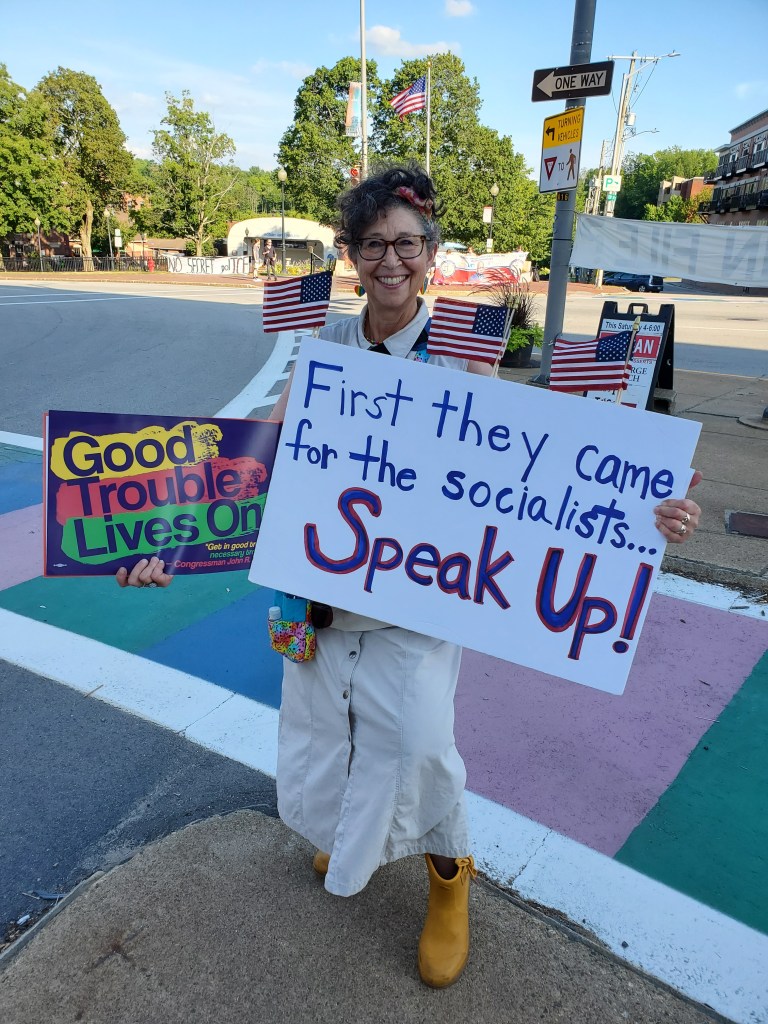
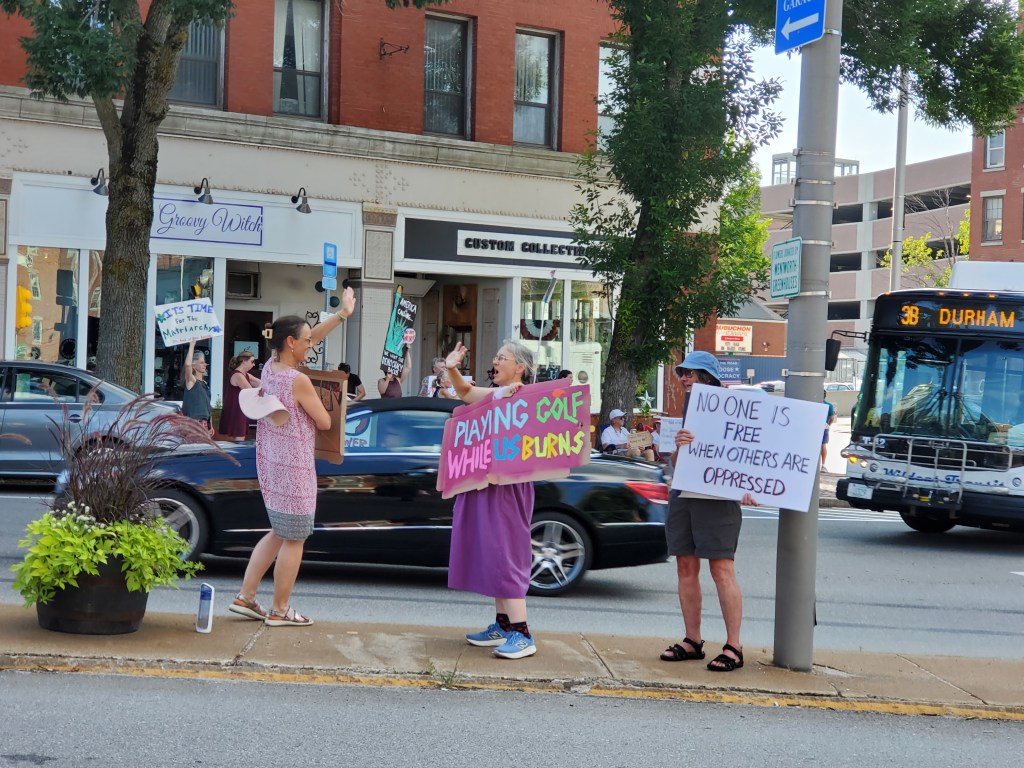

It’s the month of celebrating the birth of what my late husband always called the Un-tied States—now, it seems, as untied as ever before. But I’ve always loved the Fourth of July, forever associated with my bon vivant Uncle Kenny, his glamorous wife my Aunt Mart, and their beautiful daughters, the “Big Girls” Bevy and Bobbie, respectively four and two years older than me and always gorgeously turned out. Every summer the Murphy family made the 3-day pre-interstate drive from St. Pete to Dayton to visit the Murphy grandparents, and every Fourth we went to the Senseman home in Kettering adjoining a country club; in her terraced back yard Aunt Mart would stage a big cookout always followed by a tremendous fireworks display over the neighboring golf course. Every year one firecracker was launched with a parachute which, if found and claimed, meant a prize (of indeterminate worth), and every year, flanked by the Big Girls, my beautiful cousins, I ran through the dark, half flying because suspended by the grasp of the taller cousins, to Find The Parachute. We never did. Didn’t matter. The thrill remains.
My beloved Uncle Kenny died on the Fourth of July 1984, the evening I was in the parking lot of the Danville Manor shopping center out on the Danville, Kentucky bypass with the Centre College Chair of Humanities, Milton Reigelman, who took me to see the fireworks after my day of hunting for an apartment where I would start my first year as a just-hired assistant professor, the beginning of a new life. I toast Uncle Kenny every Fourth, and try to celebrate as often as possible the Spirit of ’76, which this year takes on a new urgency.
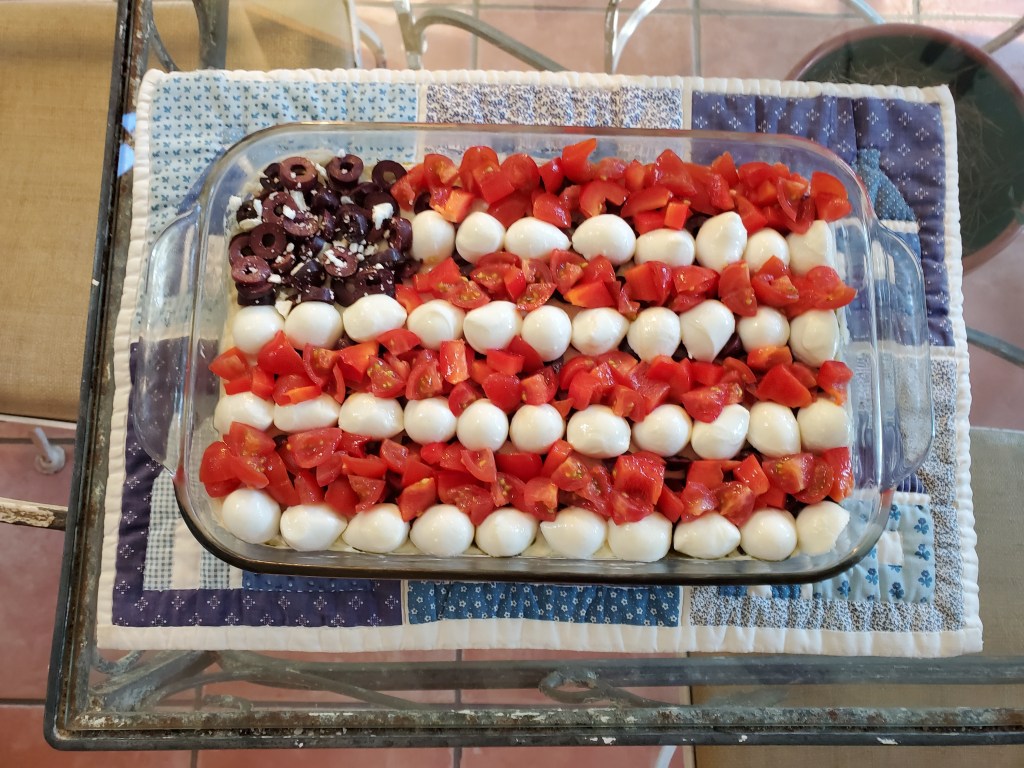
Julee’s spectacular appetizer at this year’s Fourth party 
Food and Fireworks for the Festivities 
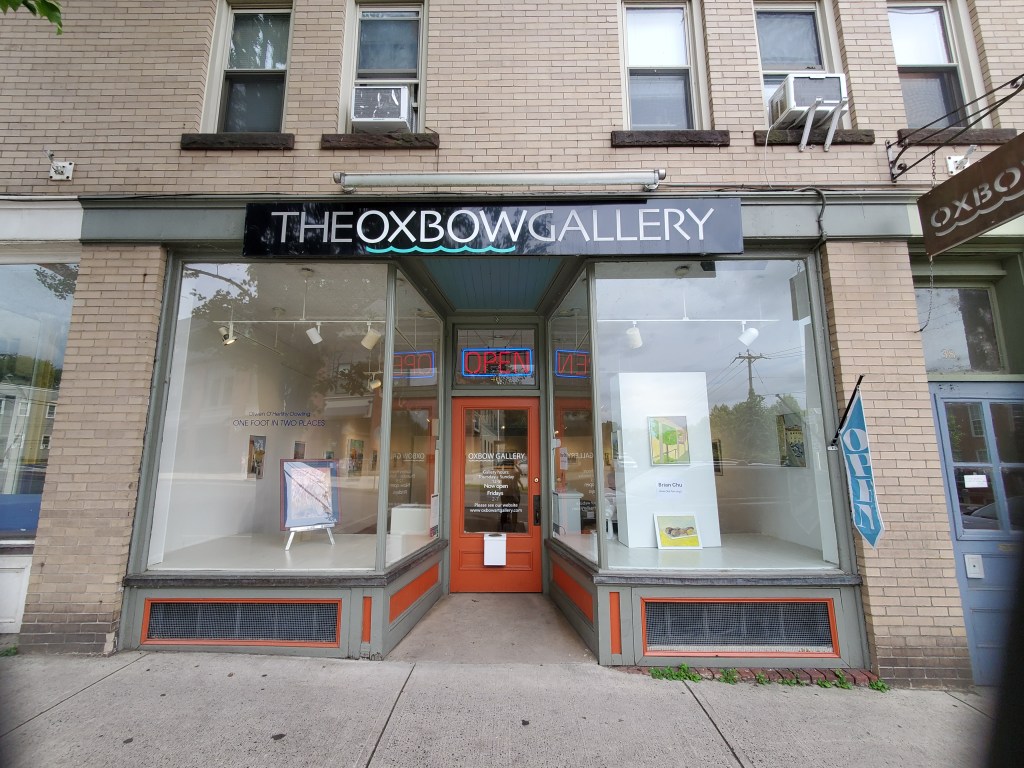
Foodie photographers Julee, Shiao-Ping, and Carol record the moment This year the serendipitous simultaneity of invitations from two different sets of friends in western Massachusetts got me the first road trip of summer. First stop: Easthampton, where good friend and colleague artist Brian Chu currently has his first show at the Oxbow Gallery, and friends of my baby professor days Ann and Sheldon now have a lovely home with their son Peter close by their daughter Rachel, son-in-law Joe, and new grandson Simon, truck aficionado and light of everyone’s life. Brian’s paintings, another of Ann’s gorgeous dinners, catchup time on the porch (with the appearance of TWO foxes), and a visit to the Smith College art museum next day were a real delight.
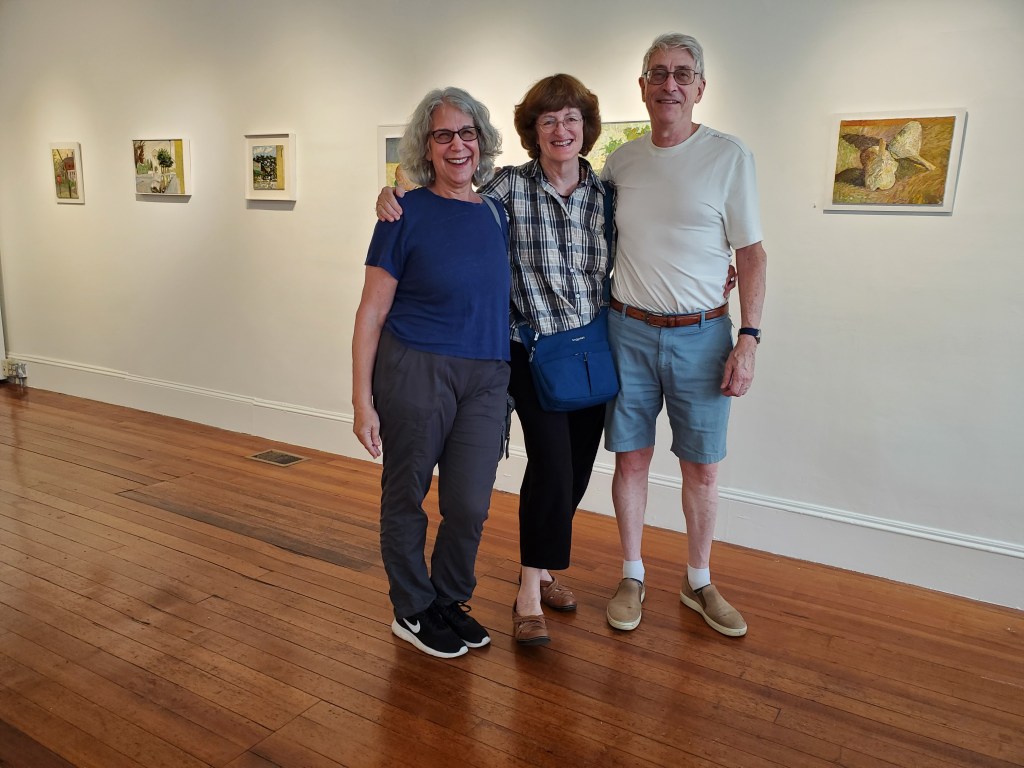
Centre College Reunion (Ann, Georgeann, and Sheldon) with Chu paintings 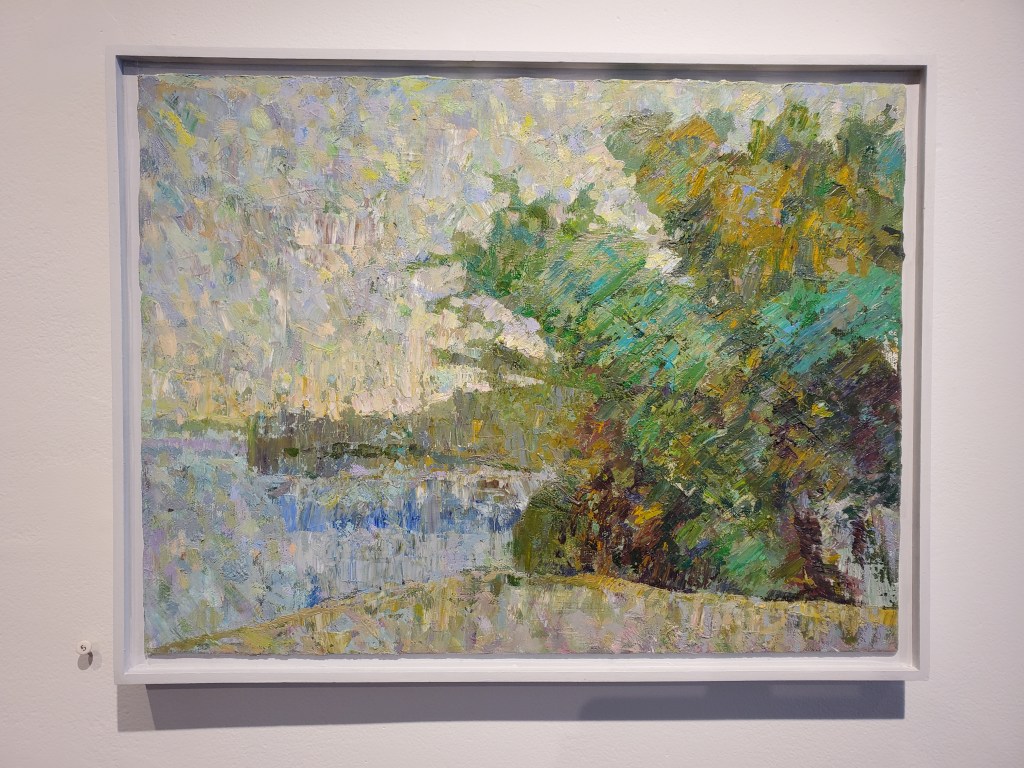
Adam’s Point, NH, Oil on canvas, Brian Chu, 2020-2025 
And then it was off to Granby, where Wendy (retired from the Mount Holyoke Art Museum and now practicing underwater seamstress), Nora (ABD art historian just returned from Rome), and resident guard dog (Gali)Leo were immersed in delayed Fourth of July party prep.
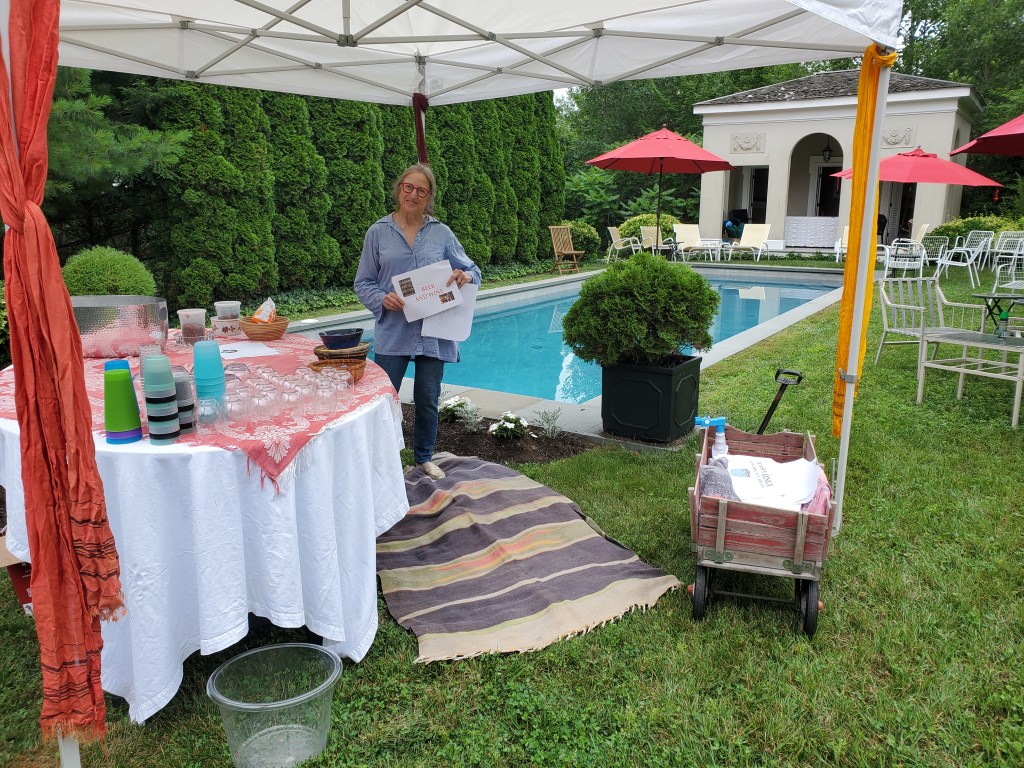
Wendy, ever the organized hostess 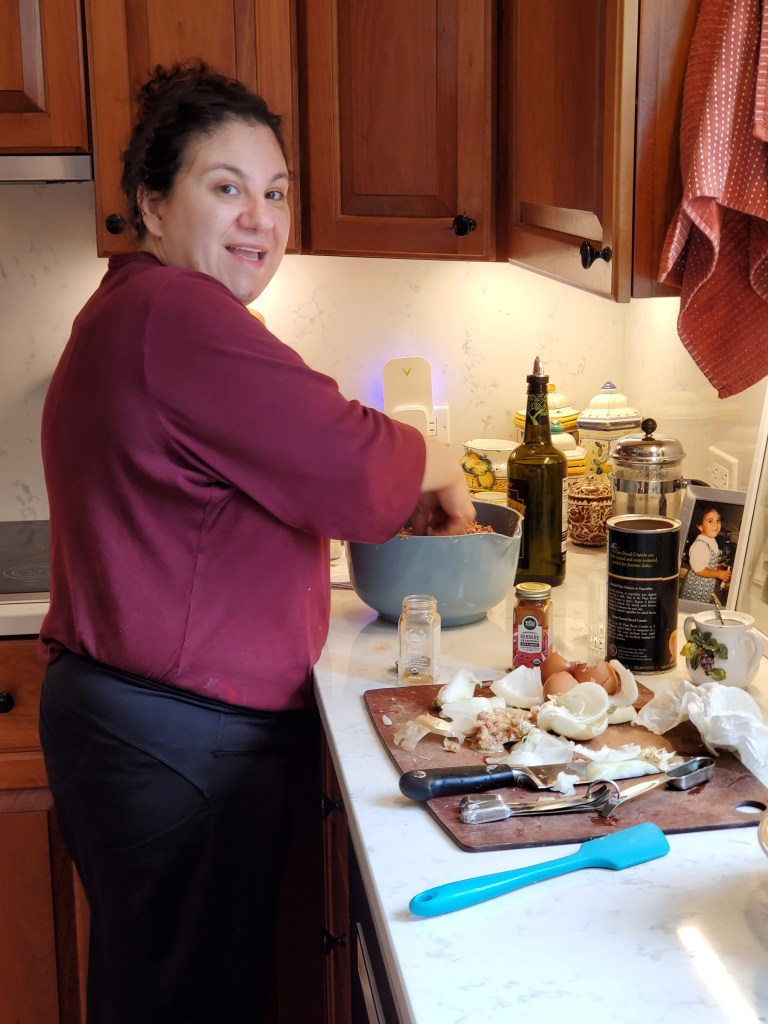
Nora, sous chef 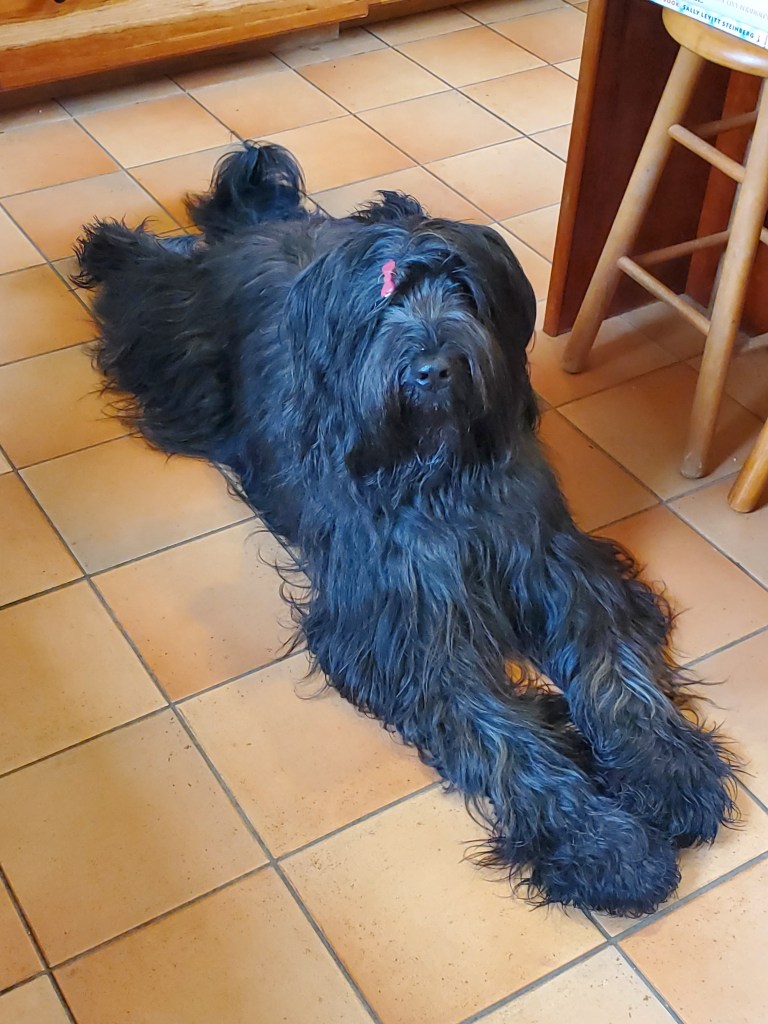
Leo, Noble Briard How delightful to be back at Bencontenta, the temple house that helped inspire David’s and my Gnawwood.
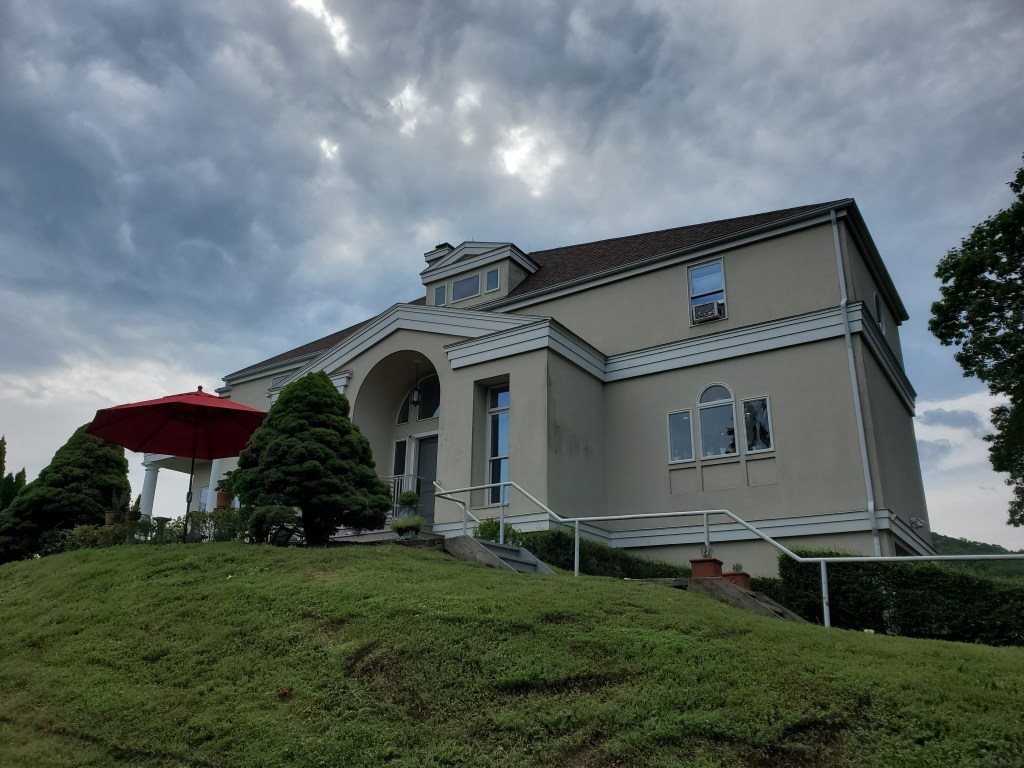
Bencontenta Back in NH for a day, I was soon off to Maine for my first visit to the venerable Ogunquit Playhouse, famed summer stock venue since 1937, to see a fine production of the 1950 musical Guys and Dolls with my stylist of 30 years, Teri, followed by a fancy dinner at MC in classically Downeast Perkins Cove. I’m happy to report that “Sit Down, You’re Rockin’ the Boat” remains a show-stopping success. And who could say no to MC’s Pavola (cold brew gelato, caramel, chocolate, and coconut crumb)?

Teri at the Ogunquit Playhouse 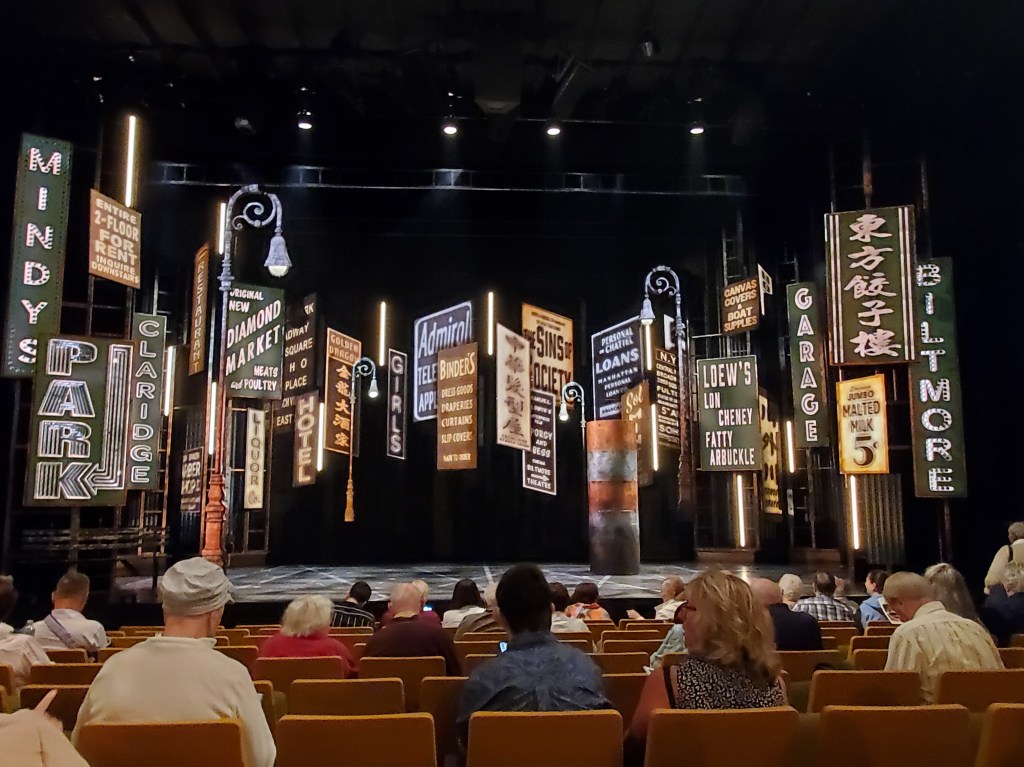
Guys and Dolls set design by Adam Koch & Steven Royal 
MC Perkins Cove Pavlova July’s been good. Beloved, gracious, and well-spoken Rotarian Ric Erickson was honored with a bench at the Madbury Public Library while he was still around to enjoy it, and the Library initiated its premier free July concert series: first the Southern NH Ukelele Group, then last Tuesday, Portsmouth’s New Horizons Band. Nothing says summer like a band concert on the lawn.
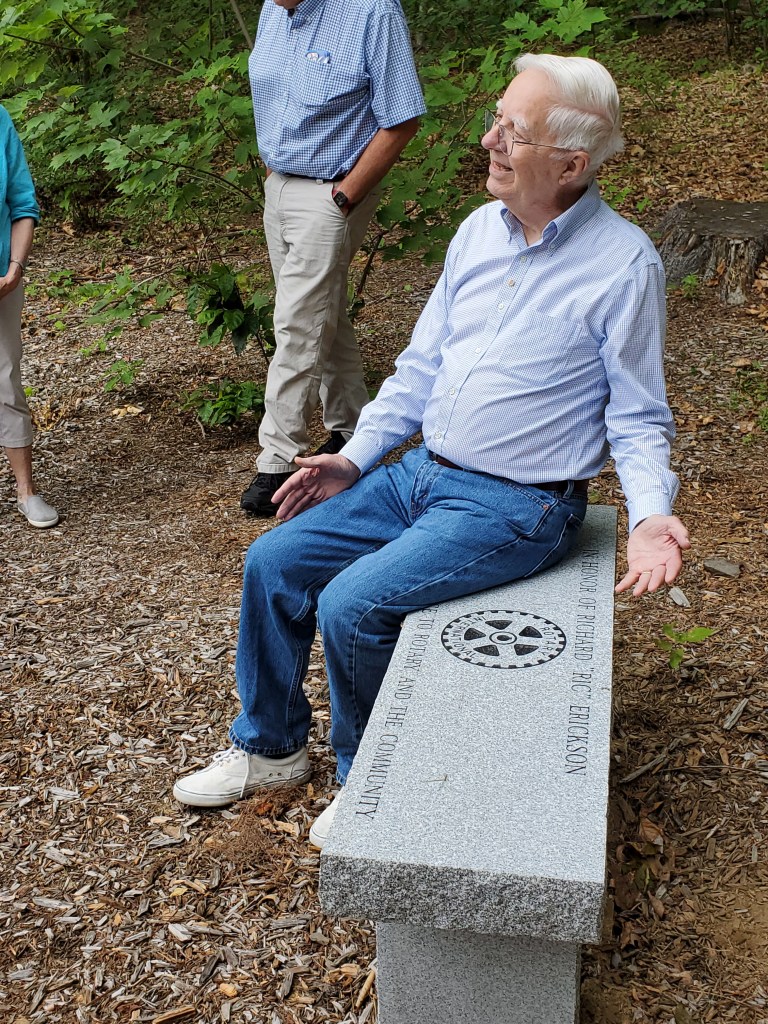
Ric relishes his tribute 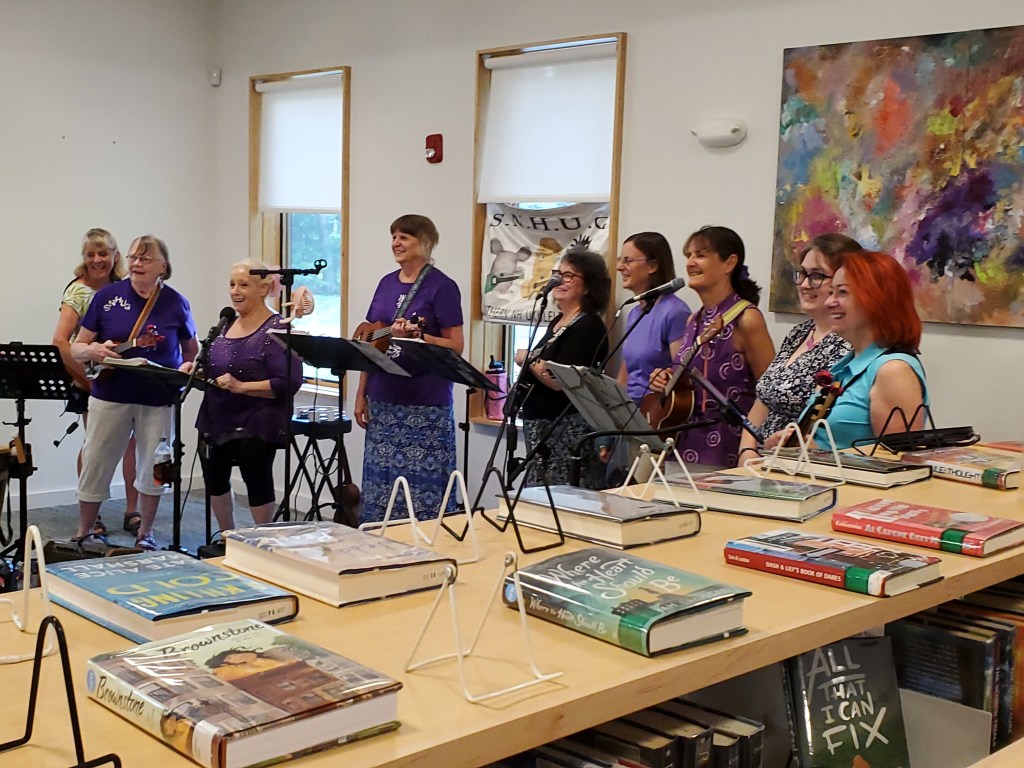
The Southern NH Ukelele Group at the Madbury Public Library, 8 July 2025 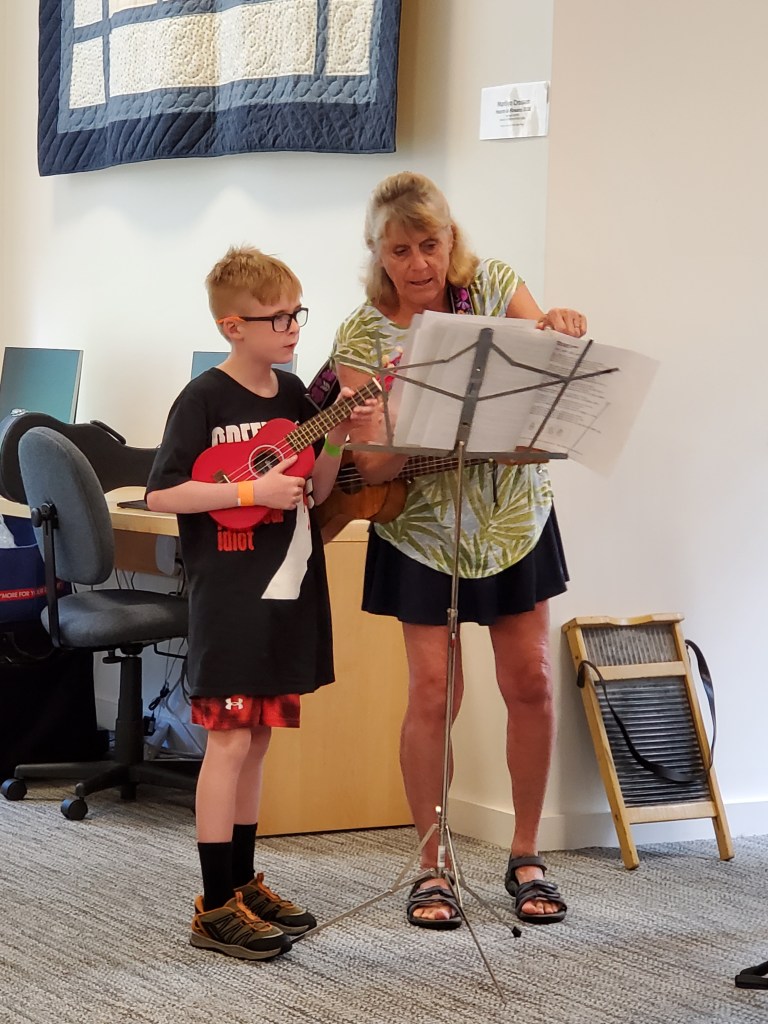
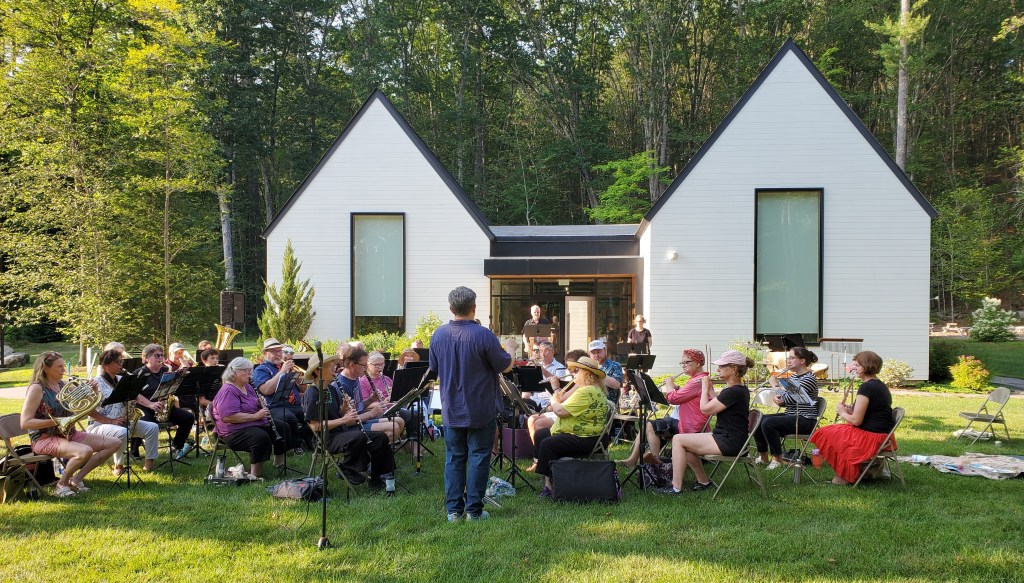
The New Horizons Band plays the Madbury Public Library, 15 July 2025 And my favorite series, The Bear, is back for a fourth season, which has me wondering why the Democrats can’t implement Chef Escoffier’s hierarchical brigade system. As Will Rogers opined: “I’m not a member of any organized political party. I am a Democrat.” But still, the Strafford County Dems, however ungainly, are organizing.
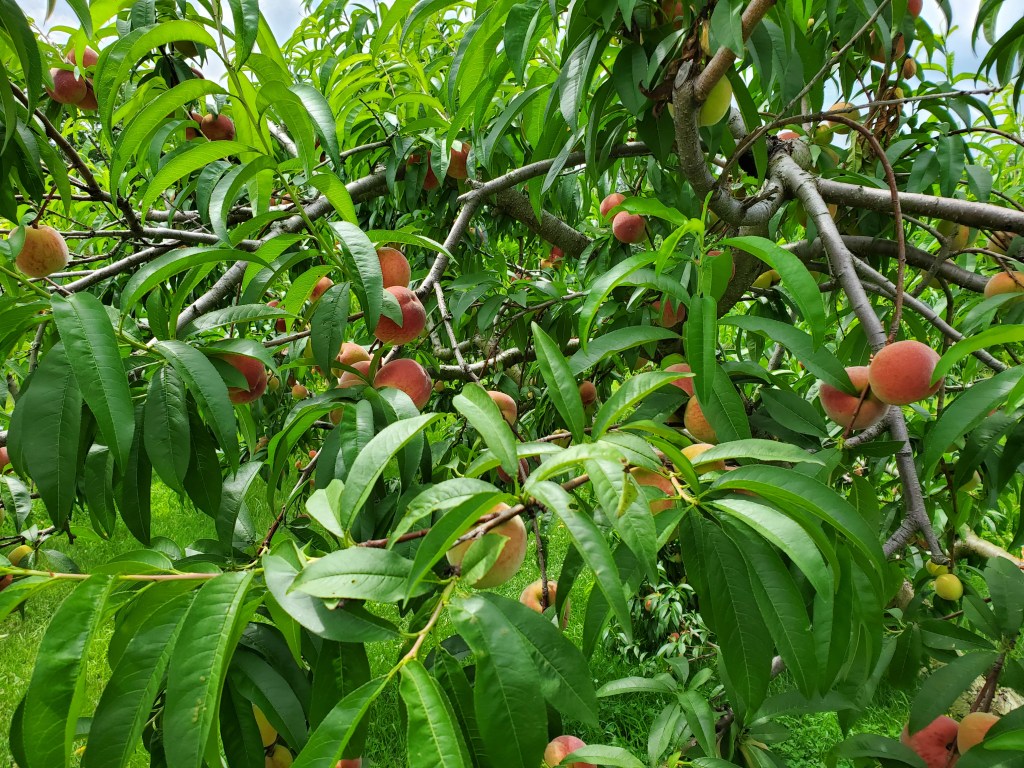
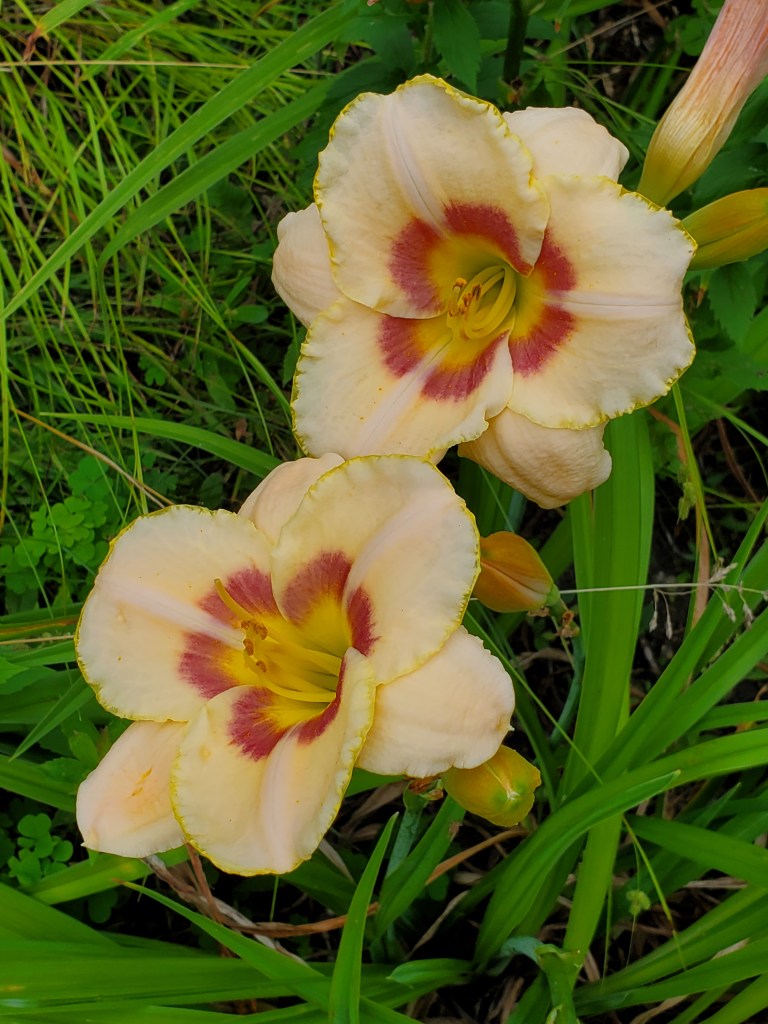
And the peach crop is in at Union Lake Orchard, the daylilies are in bloom, and fresh coats of paint inspire a fresh take on cleaning, organizing, and downsizing as the second half of 2025 is well underway.


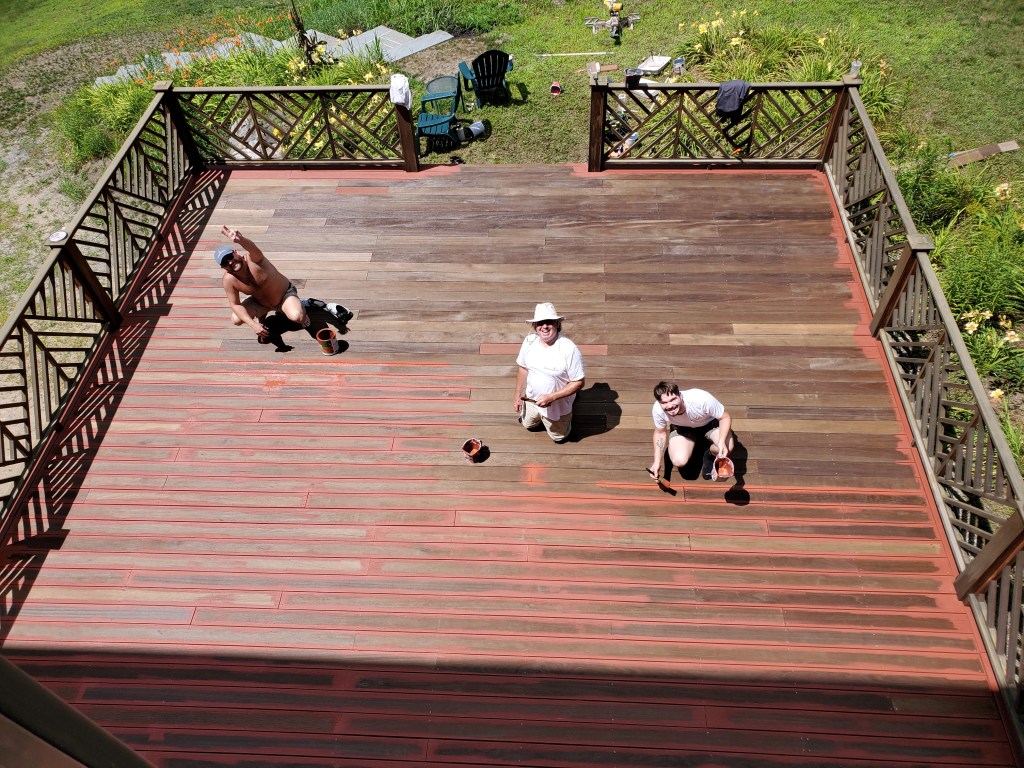
Levi, Pete, and Corey bring the deck back to life Soon I’m off to hear the UNH Sea Trek Program’s Sea Chantey Singers on the Library lawn, and I plan to enjoy it all—for summer’s lease hath all too short a date.

Perkins Cove, Maine, 13 July 2025 -
What to Us Now is the Fourth of July?
2 July 2025
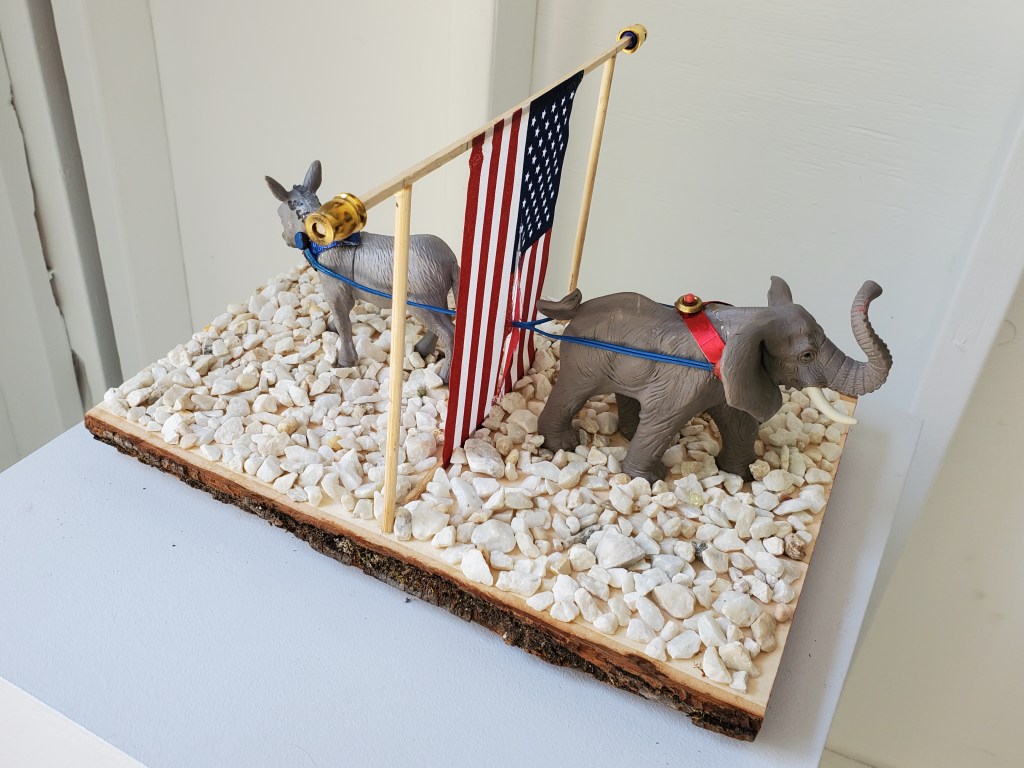
“UNITED WE STAND, DIVIDED WE FALL,” a country being torn apart by sharply divided parties, Mixed Media, 8″ tall, 13″ wide (Nancy Schön, 2025) The proximity of Independence Day and recently hearing filmmaker Ken Burns speak of his upcoming series on the American Revolution have together sent me back to re-reading “the unanimous declaration of the thirteen united States of America.” Several statements against “the present King of Great Britain” stand uncomfortably out, beginning with the prologue to a long list of offenses asserting that the King’s history “is a history of repeated injuries and usurpations, all having in direct object the establishment of an absolute Tyranny over these States. To prove this, let Facts be submitted to a candid world. [The direct quotation continues:]
- He has refused his Assent to Laws, the most wholesome and necessary for the public good.
- He has made Judges dependent on his Will alone, for the tenure of their offices, and the amount and payment of their salaries.
- He has erected a multitude of New Offices, and sent hither swarms of Officers to harass our people, and eat out their substance.
- He has kept among us, in times of peace, Standing Armies without the Consent of our legislatures.
- He has combined with others to subject us to a jurisdiction foreign to our constitution, and unacknowledged by our laws; giving his Assent to their Acts of pretended Legislation:
- For cutting off our Trade with all parts of the world:
- For imposing Taxes on us without our Consent: For depriving us in many cases, of the benefits of Trial by Jury:
- He has excited domestic insurrections amongst us . . . .”
And so, my fellow Americans, we protest—as a group on NO KINGS day, 14 June 2025, countering the Felon-in-Chief’s expensive fiasco of a birthday parade ostensibly celebrating the Army’s 250th anniversary.
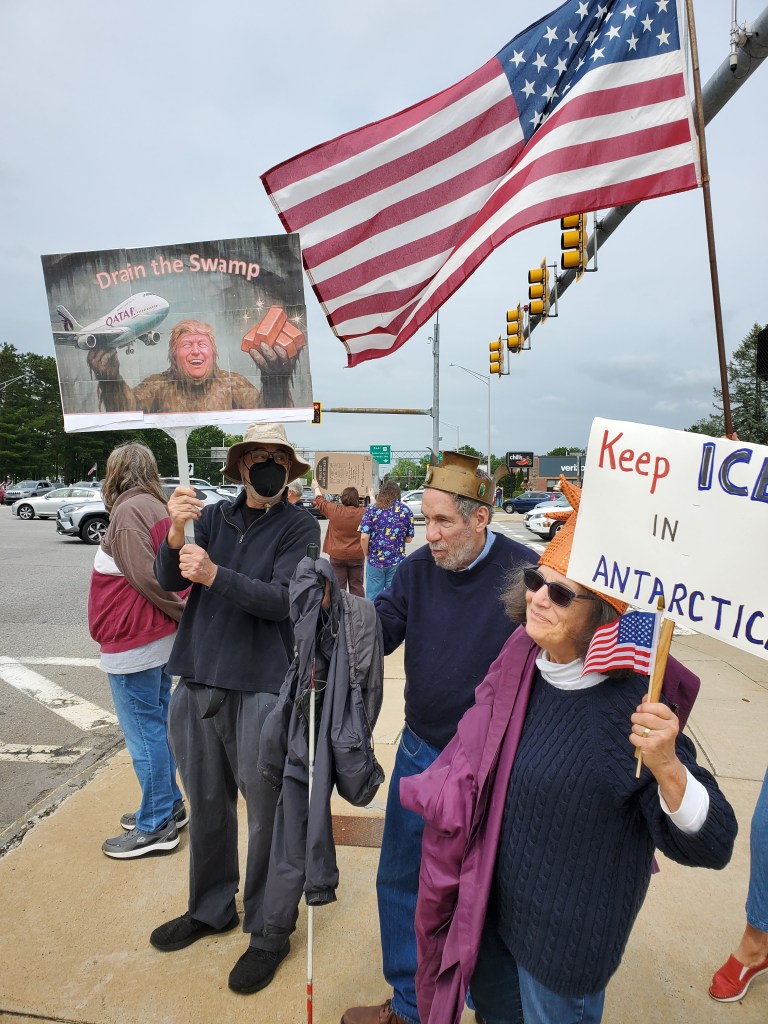
The Richmans protest at the Weeks intersection in Dover NH on 14 June 2025 
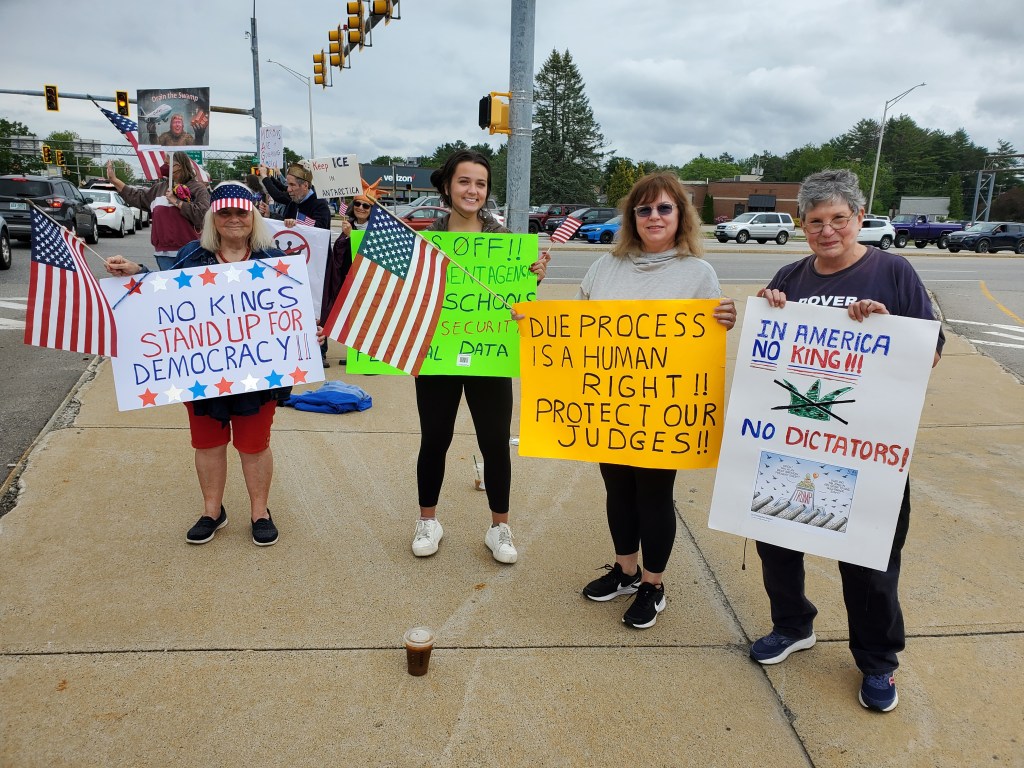
Quartet of patriots on the median And we protest with the skills we have, like 96-year-old sculptor Nancy Schön’s weekend exhibition, “My Truth” at her Newton, Massachusetts home. Creator of the beloved “Make Way for Ducklings” sculpture in the Boston Public Garden (and another one in Moscow! See schon.com), Ms. Schön, of iconic, whimsical animals fame, might seem unlikely to produce political art so vehement in its impact that it both shocked and moved me to tears. But it did. The new collection “created to express her anger at the destruction being inflicted by the Trump regine” (as her exhibit brochure proclaims) speaks eloquently for itself. And so, with the artist’s permission, I offer my own photos of her work together with her accompanying descriptions.
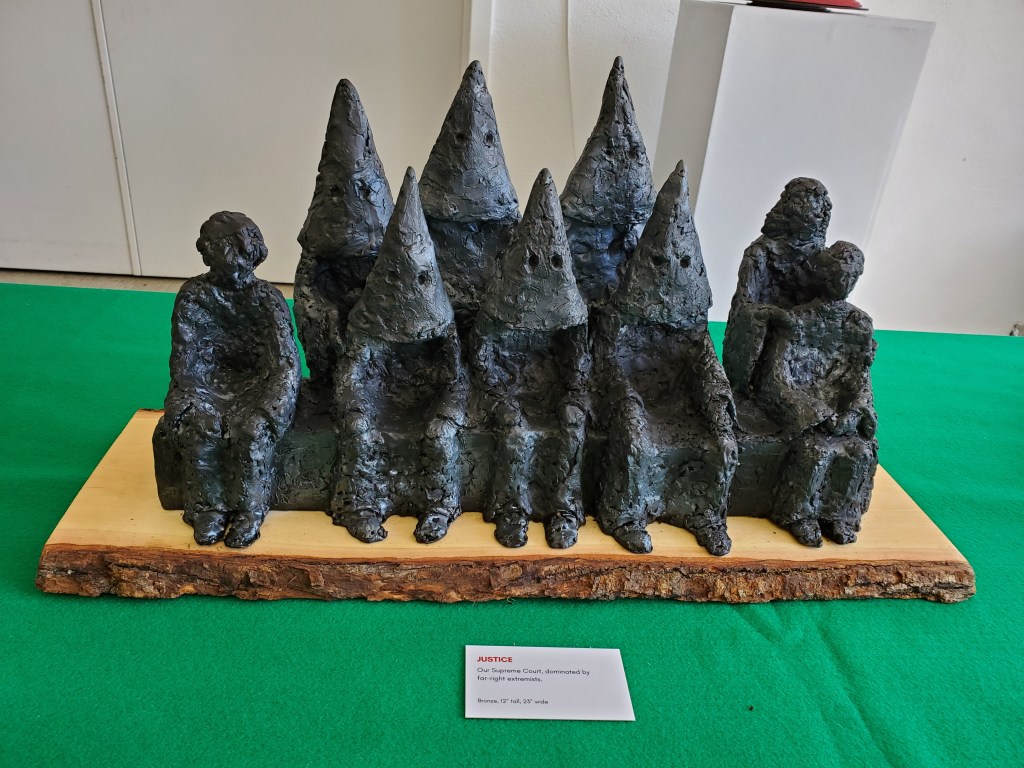
“JUSTICE,” Our Supreme Court, dominated by far-right extremists,
Bronze, 12″ tall, 23″ wide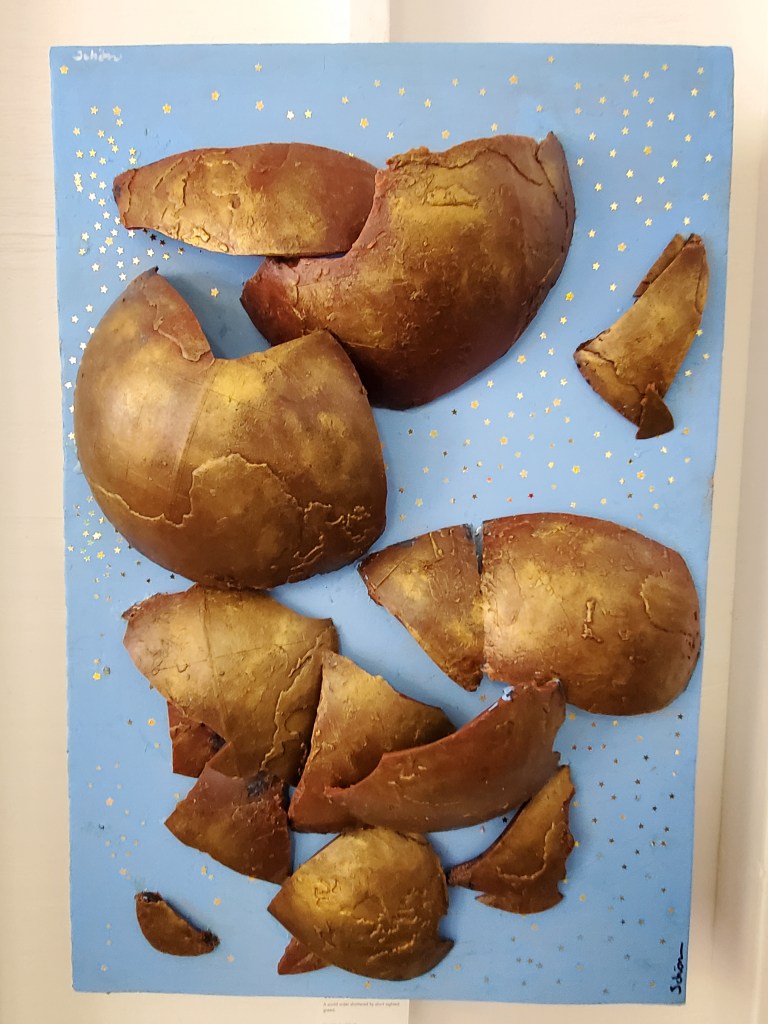
“GLOBAL BREAKDOWN,” A world order shattered by short sighted greed,
Mixed Media. 32″ tall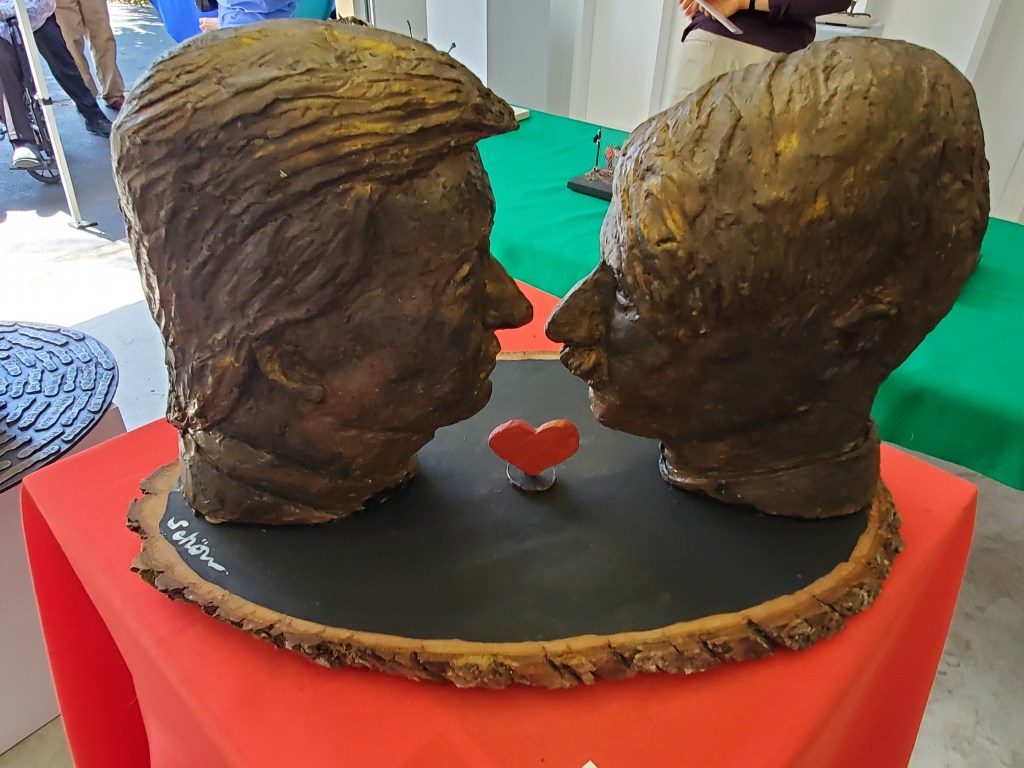
“LOVE AFFAIR,” A president who does not hide his admiration for Hitler,
Mixed Media, 9″ tall, 16″ wide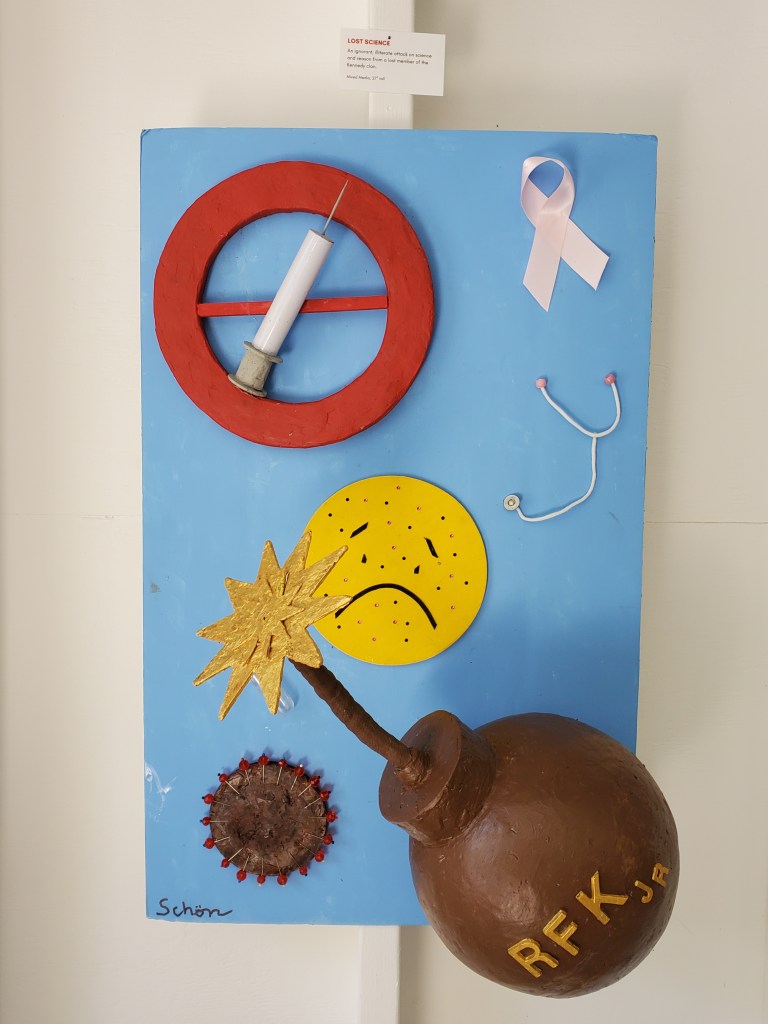
“LOST SCIENCE,” An ignorant, illiterate attack on science and reason from a lost member of the Kennedy clan, Mixed Media, 27″ tall 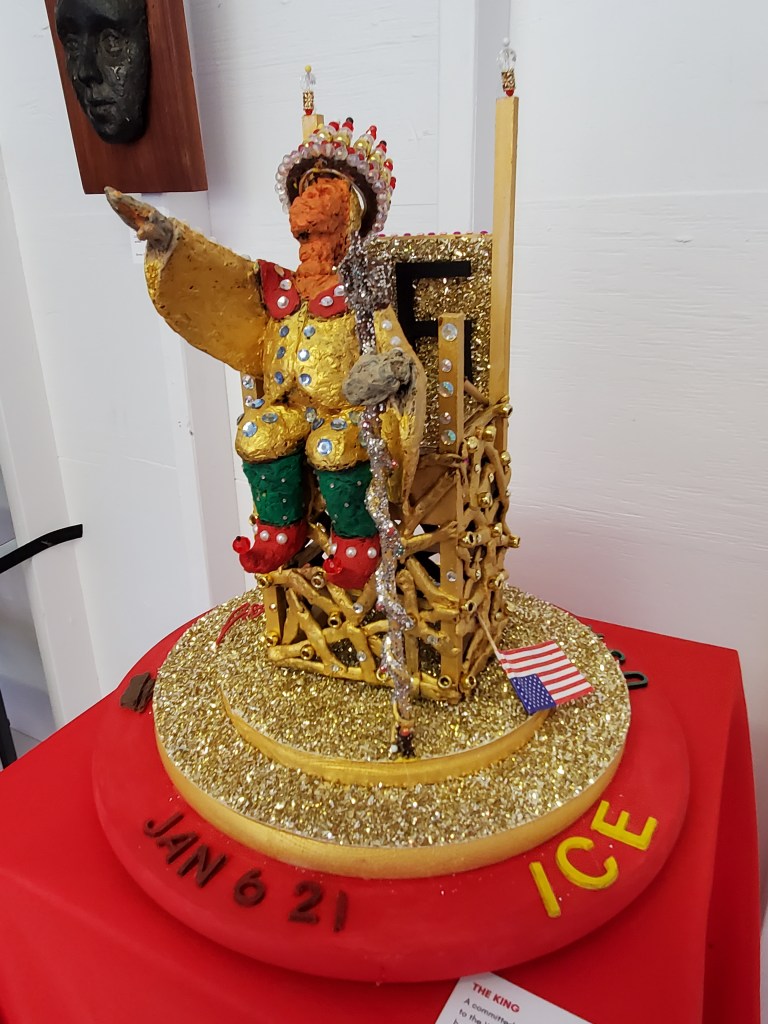
“THE KING,” A convicted felon having made it back to the White House, now attempting to become a dictator, Mixed Media, 16″ tall, 14″ wide 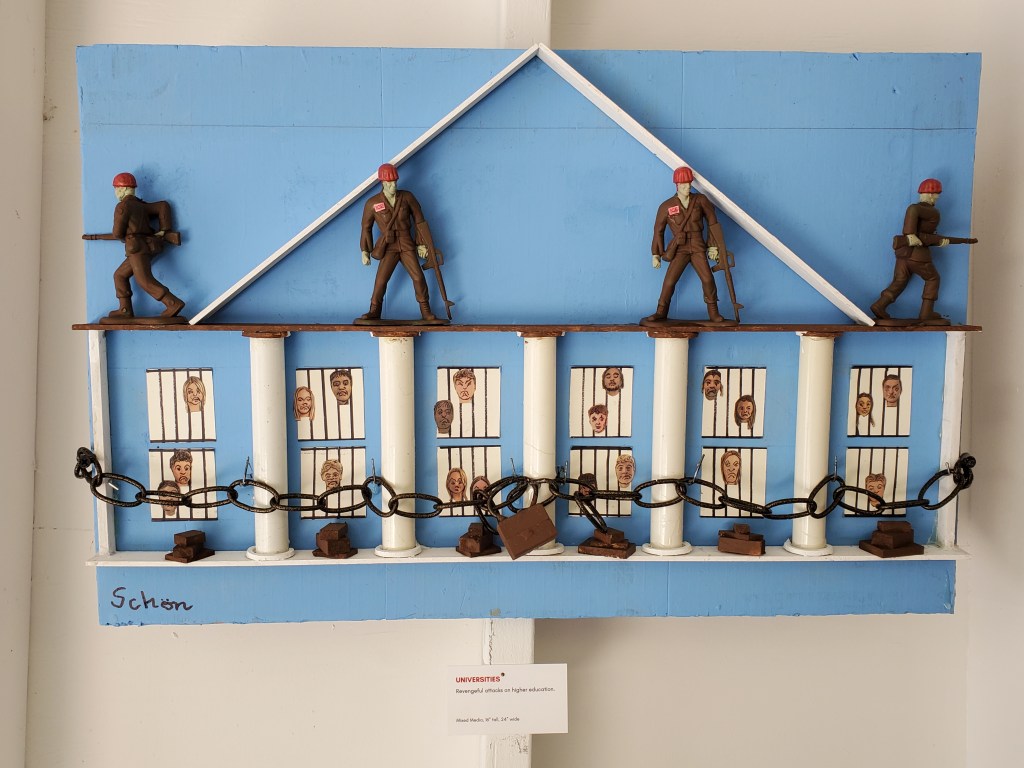
“UNIVERSITIES,” Revengeful attacks on higher education,
Mixed Media, 16″ tall, 24″ wide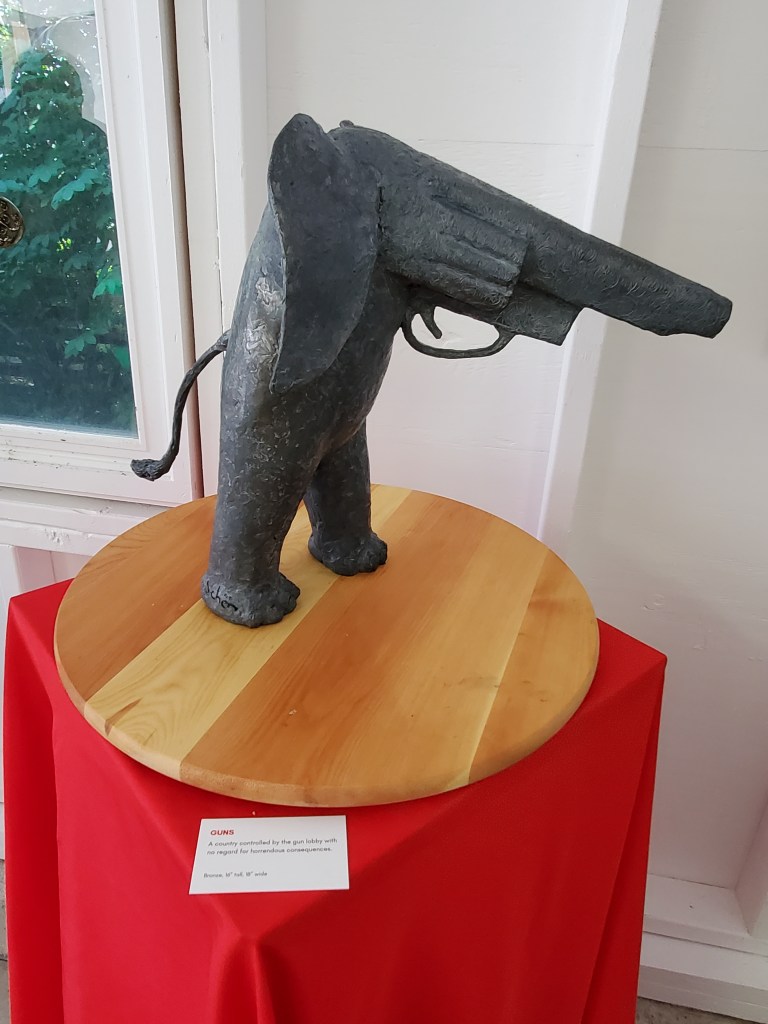
“GUNS,” A country controlled by the gun lobby with no regard for horrendous consequences, Bronze, 16″ tall, 18″ wide 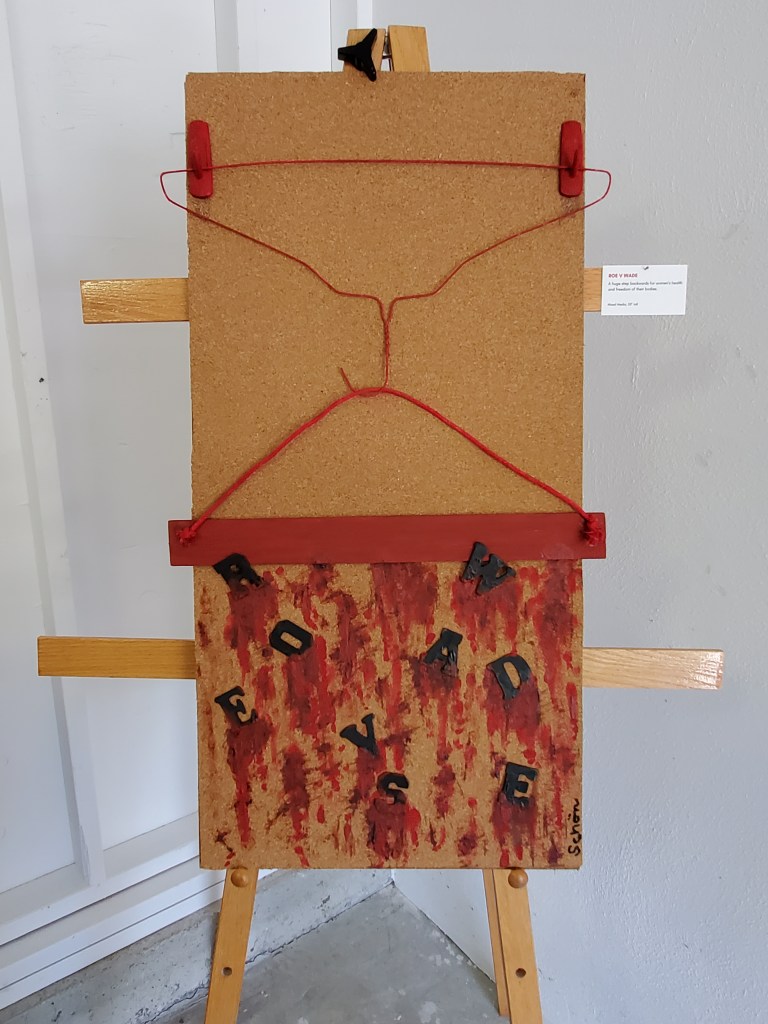
“ROE V WADE,” A huge step backwards for women’s health and freedom of their bodies, Mixed Media, 33″ tall 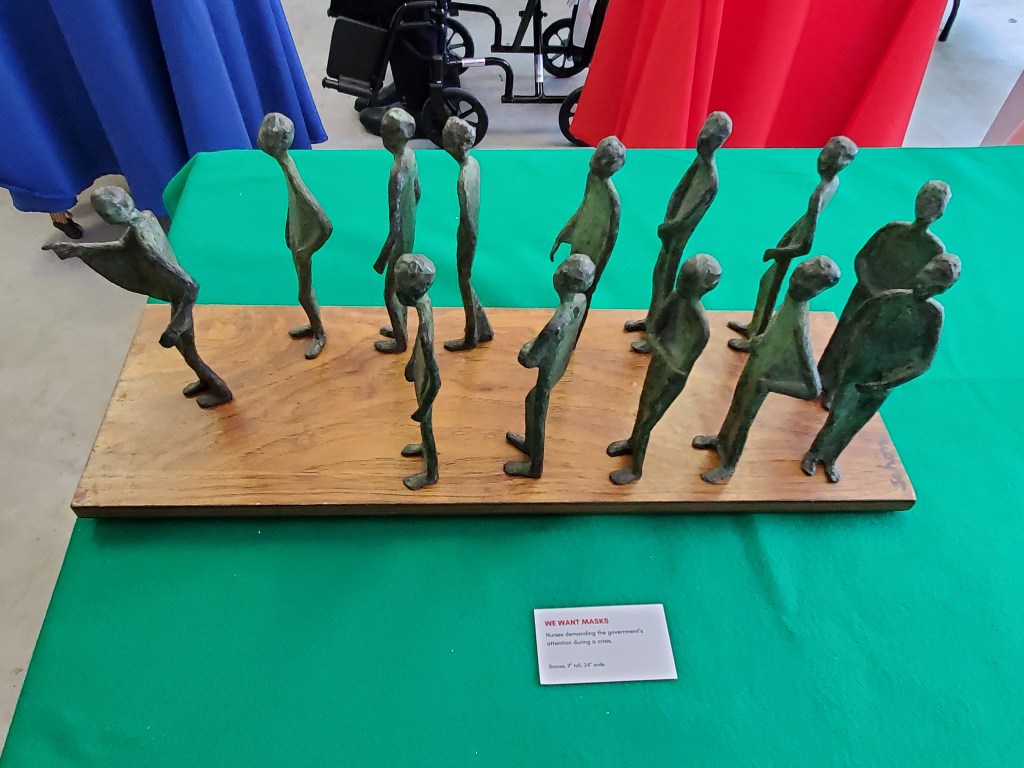
“WE WANT MASKS,” Nurses demanding the government’s attention during a crisis, Bronze, 9″ tall, 24″ wide 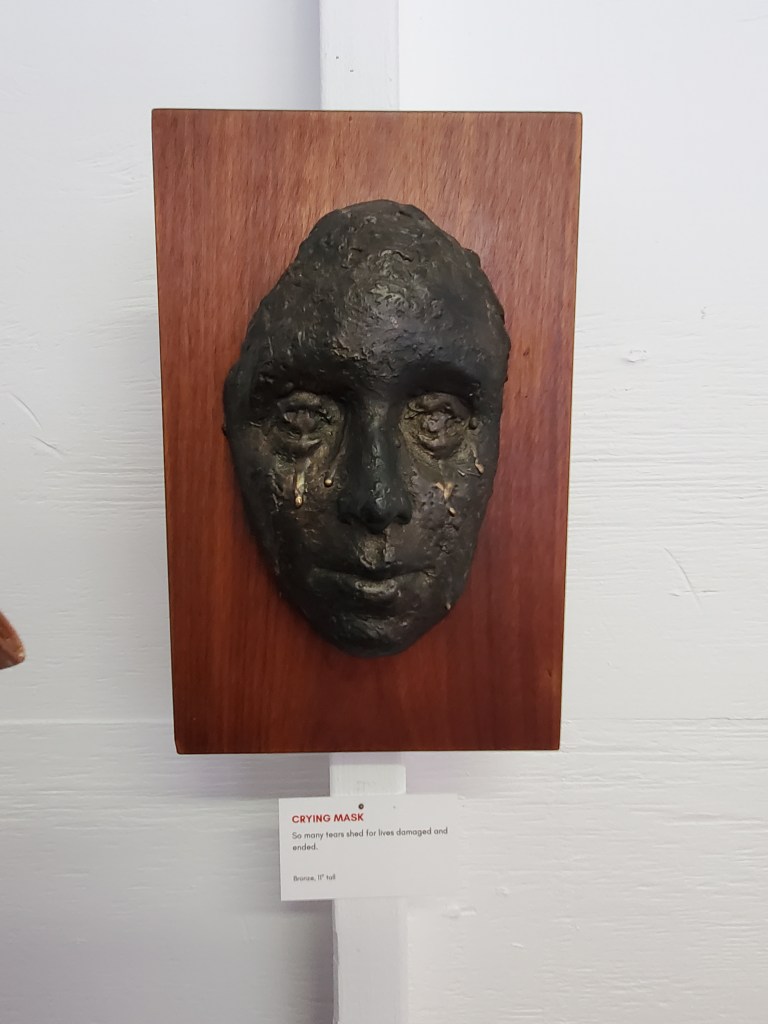
“CRYING MASK,” So many tears shed for lives damaged and ended,
Bronze, 11″ tall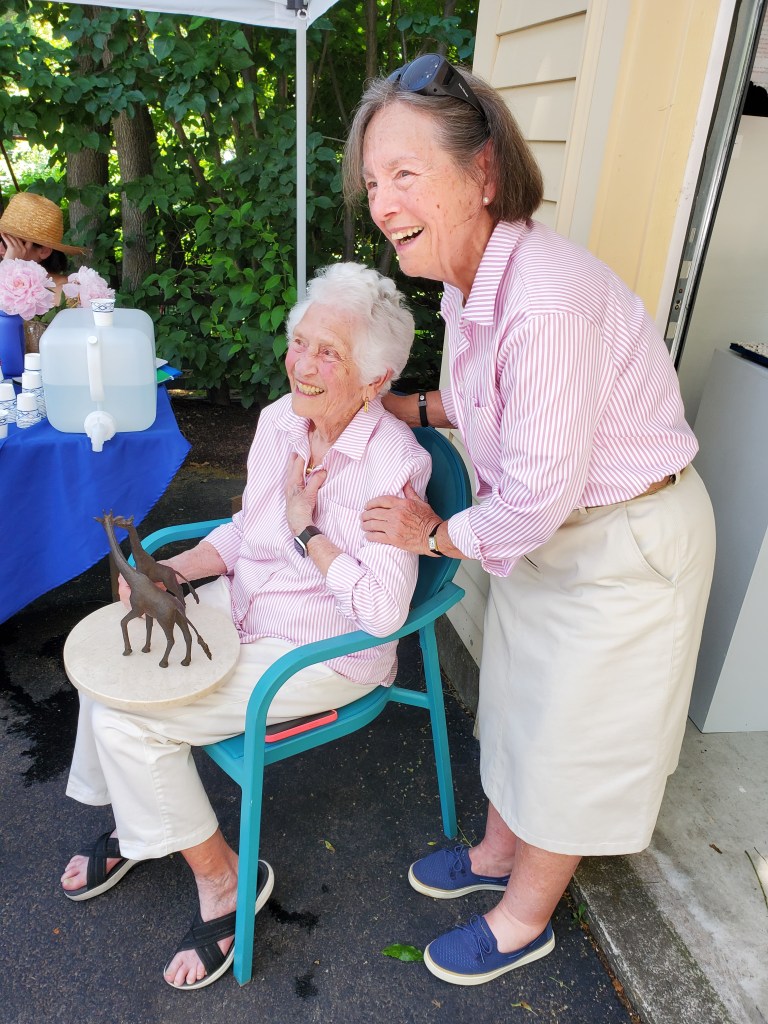
The artist Nancy Schön (seated) makes a less controversial sale, but the potency of her political art lingers Brava, Ms. Schön. Thanks for inspiring us to keep the fight for unalienable Rights begun in 1776 ongoing.
-
Respite
27 June 2025
The Wait Wait Don’t Tell Me logo on stage at Merrill Auditorium, 26 June 2025 Walking out of the Portsmouth Public Library last Tuesday was like walking into an oven, and since then, the 103o my GTI registered there in the parking lot has been confirmed as a record-breaker for the port town where proximity to the cold Atlantic waters generally means cooler-than-inland temperatures. Not so this week. Thankfully, the heat dome began to dissipate on Wednesday, and by Thursday, once-celebrated New England temperatures—warm summer days, cool nights—had returned, reminding this Floridian how exotic I once found the L L Bean and Lands End catalogs featuring models wearing shorts with sweaters! as their midsummer ensembles.
Despite this welcome respite, staying cool remains a challenge. The AC in our Madbury Public Library has been victimized by mice biting through wires I suspect are encased in soy-based insulation, so it’s doubly lucky that cooler days, at least temporarily, lie ahead. How unfair that mice have joined DOGE and the Felon-in-Chief to hobble public libraries, an uncanny conspiracy of Human and Mother Nature. And how narrow not only my thermal, but also my temporal comfort zone has become: surely not all retirees experience a 9:00 meeting at the Library as sleep deprivation. How ever did I make it to UNH from Portsmouth to teach an 8:00 Brit Lit class all those years ago? Thank goodness those days are done.
Post meeting and fueled by a restorative nap plus more than usual coffee intake, I set out last night for Portland’s Merrill Auditorium to attend a taping of NPR’s weekly news quiz show Wait Wait Don’t Tell Me (WWDTM), a long-anticipated respite from the grimness of the 24/7 new cycle: news made comic. Traffic on I-95 was not bad on a Thursday night; I made good time and negotiated a new parking garage without incident. One always wonders if unattended machines will honor a pre-purchased QR code to lift the entry gate. Hesitant to rely exclusively on my ability to retrieve the code on my phone, I always print it out. But now I’ve discovered a new impediment to my plan B: my printout worked at the garage, but the Merrill Auditorium scanners will NOT scan a QR code that’s been printed out: only the bar code on one of their in-house printed tickets or the QR code on a phone will work. One step forward, two steps back: I had to pick up a printed ticket at Will Call to get in.
But once I got through the metal detectors that are yet another sign of how much our civilization has regressed, the atmosphere in the Merrill lobby was festive. Maine Public Radio had set up a table with free public radio swag: buttons, bumper stickers, and fans, and clearly the audience—mostly older—shared a political persuasion. My seatmates, Mainers from Rockwood (classically dressed for summer in shorts, windbreaker, and a cap never removed), were happy to chat; turns out they knew well my friends’ son Sam Richman’s fine restaurant in Rockland, Sammy’s Deluxe, and were enjoying their first visit to Merrill Auditorium, interested in its 1912 construction and 1997 renovation as well as the WWTDM setup waiting on stage. We speculated not only about the technicians seated at a table right behind the performers, but also about how different the live show would be from the broadcast version to come. Man-in-shorts next to me suspected the comedians were “tipped off” as to what the topics would be, the better to prepare their jokes.
I already knew something about that because I’d heard Peter Sagal at Portsmouth’s Music Hall last April, when he devoted most of his stage time to explicating threats to our Constitution; in 2013 he’d done a four-part series for PBS called Constitution USA, travelling cross country on a customized red, white, and blue Harley-Davidson, to find out where the Constitution lives, how it works, and how it unites us as a nation (see https://www.pbs.org/tpt/constitution-usa-peter-sagal/ ). A quick-witted Harvard grad, Sagal was funny, passionate, and moving about the history we don’t know and the perils we now face, but he’d also detailed a typical WWDTM work week that leads up to the show’s taping, so I knew that much was scripted—and that much of the script went out the window in performance.
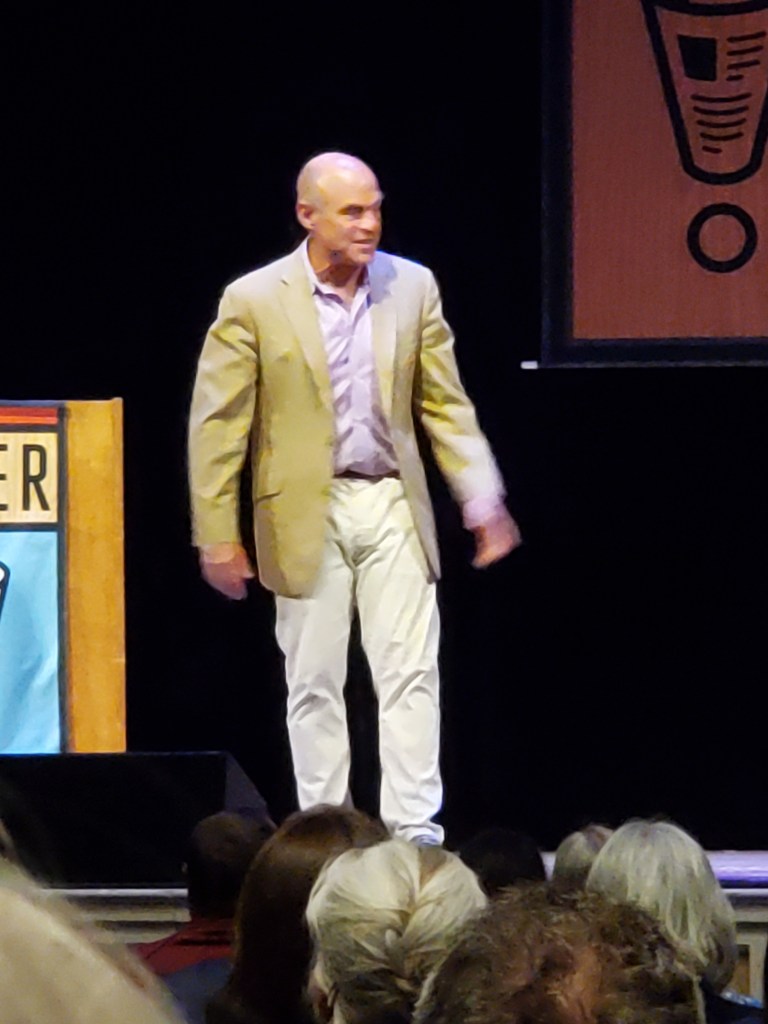
Peter Sagal addresses the Portland audience What I didn’t know was just how much was scripted and how much improvised. And I still don’t! What was immediately clear, however, was how very much more there is in the live show than in the broadcast: the Thursday night taping in Portland began shortly after 7:30 and lasted without intermission until nearly 10:00. The first thing that happened was a plea from Rick Schneider, CEO of the Maine Public Broadcasting Network: call your congressmen to protest the pending rescission of funds to public broadcasting; don’t write letters or emails, call! The audience assented with supportive applause.
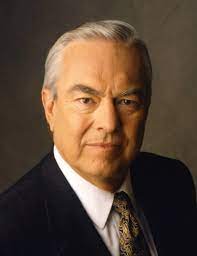
Bill Kurtis in more serious anchor mode Then the performers came out, veteran newsman and announcer Bill Kurtis, comedians Karen Chee, Paula Poundstone, and Josh Gondelman, and finally host Peter Sagal. I saw that Poundstone, dressed in a red-and-white striped suit, another of the clown costumes that are her performance hallmark, held a sheaf of papers, and she had several pre-show exchanges with the tech staff behind her. Sagal spoke directly to us in the audience, congratulating Maine on its definitive rejection of Donald Trump (great cheers ensued), and then they started the show. I saw immediately just how much longer all exchanges between Sagal and the comedians were, clearly many scripted, but also many improvised, including lots of callbacks to earlier material, including several running jokes about the “Massholes” Gondelman and Poundstone, the boyfriend Chee once had in Portland, and Poundstone’s inability to recall any of the movies in which she’d seen the celebrity guest booked to play the “Not My Job” segment, Portland native Anna Kendrick, who proved more than a match for all the professional comedians on stage. Poundstone had recognized and greeted Kendrick by name backstage, but could not place her in any movies she had seen—a delicious running gag that had a big payoff when Kendrick later recited some of her childhood performances in the Merrill Auditorium, including humming from the balcony as part of the children’s snowflake chorus in The Nutcracker, sparking Poundstone’s long delayed epiphany of recognition.

Glamorous Anna Kendrick showed off her comic chops on Thursday night All the performers wore headsets, and the jokes and back-and-forth wit was so quick and spontaneous that quips were sometimes covered by the audience’s laughter. I reckon the engineers edit that out. When either Kurtis or Sagal mis-spoke something, they simply said it again immediately and correctly, and at the show’s end, they took about five minutes to re-record a few phrases out of context. Amazing that all of that early editing had taken place while the show was going on. Then Sagal took some questions from the audience, including one from a 9-year-old who wanted Sagal to know that he went to sleep every night to WWDTM (!), and that it had been his idea, not his parents’, to come to the show. A young woman in the balcony shouted that she was born on the day the show first began, 3 January 1998. Sagal grimaced and revealed that at least one of the production staff behind him was even younger than the show. Another audience member complimented the cast and crew on supplying such much-needed laughter in our currently so vexing time. Sagal replied that the show was the thing that kept him going as well.
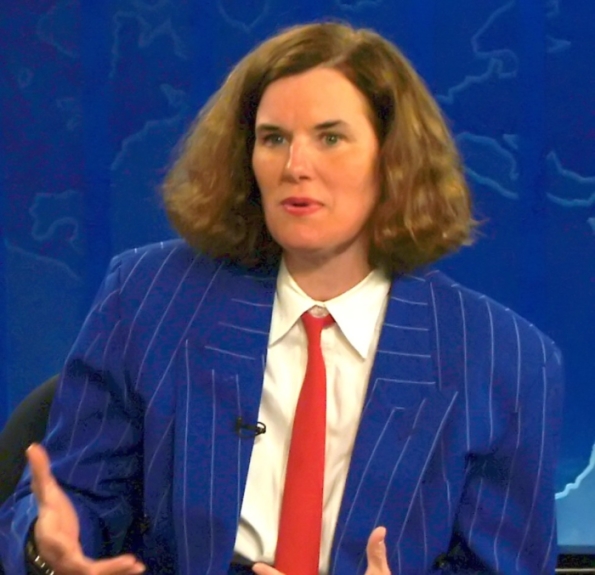
Paula Poundstone, superior improvisor and one of my very favorite clowns As the 1908 members of the sold-out audience made their way out the exits, I saw Paula Poundstone, the only performer left on stage, confer with the staff behind her for a while, and then respond with an exaggerated change of direction move I once saw Jackie Gleason make (“And away we go!”) to speak to an audience member who called to her from below at the edge of the stage. Poundstone walked downstage, and leaned over to take the woman’s question. Last thing I saw over my shoulder as I walked through the exit, Poundstone was sitting on the edge of the stage, her big black-and-white oxfords dangling, leaning into a conversation with this woman.
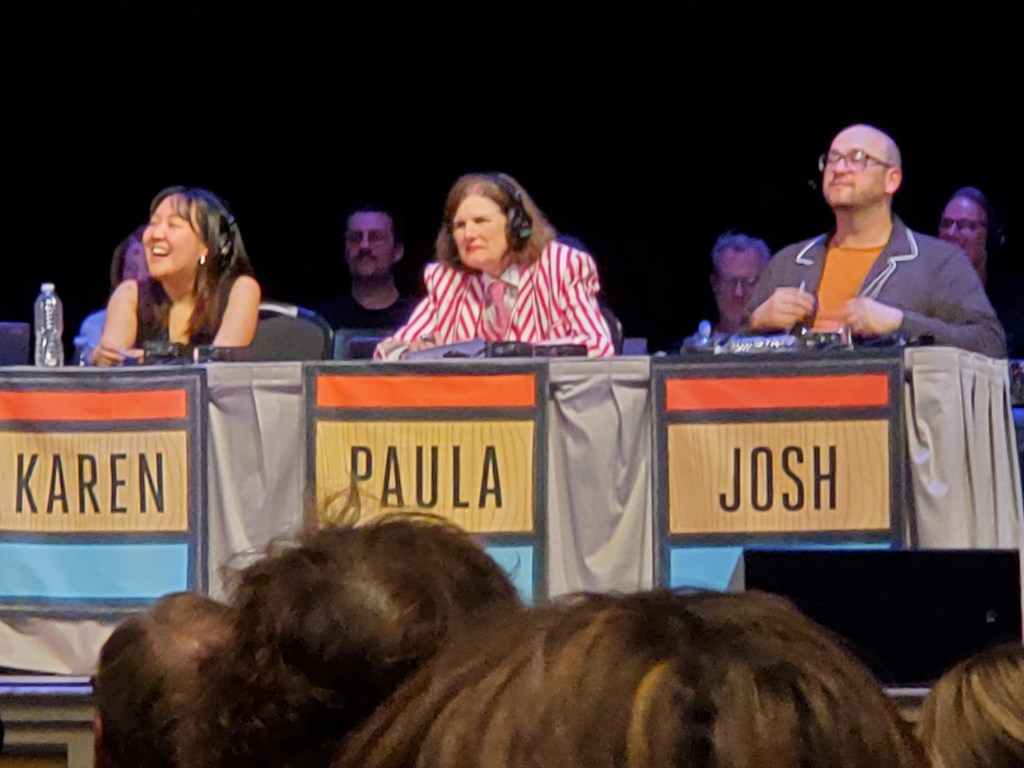
Karen Chee, Paula Poundstone, and Josh Gondelman on stage in Portland Poundstone’s a mensch. They all are. The show was great. I still feel great, buoyed by their generous art. And they’ll all do it again tonight. I’ll listen to Saturday’s broadcast and relive the delight.
Thank you, thank you to cast and crew for the respite. You are indeed a saving grace.
-
Passings
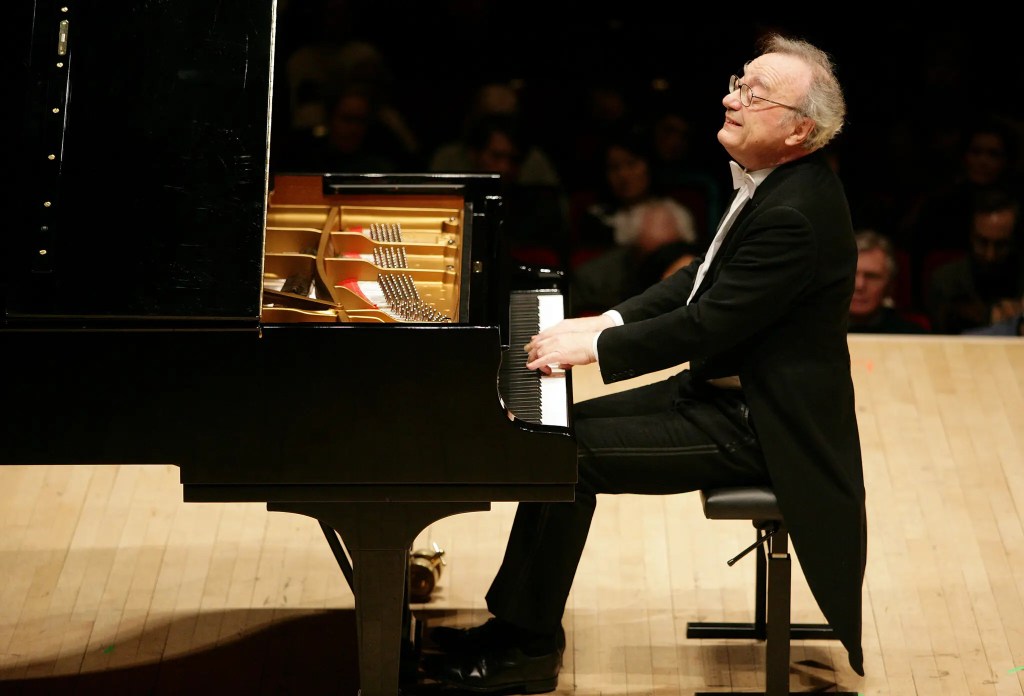
Alfred Brendel at Carnegie Hall in 2008, his final New York concert
(photo by Jennifer Taylor for the New York Times)On the evening of 8 November 1990, I took a call from one of my recently met colleagues at London’s Regents College, one David Andrew, like me an American affiliate at the College, both of us teaching and looking after students from our home institutions studying abroad for the first time, mine from Kentucky and his from New Hampshire. David was calling from the Barbican to say he had an extra ticket for Alfred Brendel’s performance of the Brahms piano concerto no. 1 on the second half of the program; if I left my Balcombe Street flat soon, I could make it there in time for the second half of the program when Brendel would play; David would meet me in the lobby of the Hall with the ticket.
It didn’t take me long to decide to go. I’d enjoyed talking with David over the previous two months as all the American affiliates struggled to understand what was going on at Regents College under the leadership of John and Gillian Payne, wealthy Brits who had bought the College when it seemed likely to fail under its previous administration; David was the only affiliate who’d been at Regents the previous year, witness to the extravagance that had brought Regents to the brink. The Paynes were not academics, had made their fortune manufacturing boxes abroad, and were under the misapprehension that we American profs reported to them, not to our home administrators. Remarkable and hilarious contretemps ensued, with David providing historical context.
Besides, Brendel and Brahms together was a Big Deal, so off I went, to sit next to David, keyboard side, second row. My, my. It turned out David knew Alfred Brendel from Brendel’s previous visit to the University of New Hampshire. David had been on the Celebrity Series committee that booked Brendel, had picked him up at Logan Airport, and driven him to his accommodations in the New England Center, then undergoing some renovations. At the hotel check-in desk, this worried Brendel, who was reassured by the clerk that the noise would not be bothersome. Brendel’s reply (reported by David complete with Austrian accent): “Yes, but I don’t have ordinary ears.” Somewhat nonplussed about what to do next, David suggested Brendel might rather stay at his Portsmouth home, complete with a Steinway model L. “Oh, could I?” was Brendel’s reply. And thus began David’s few days of happily serving as Brendel’s valet, and an acquaintance that continued when David arrived in London.
By the time my parents and sister came to London to spend Christmas 1990 with me, David and I were much more than colleagues, and David invited me to be Brendel’s date for dinner at his Hampstead flat. I went with my mother dress shopping for the occasion, and she bought me an elegant black frock with a lace collar at one of the august, massive London department stores (perhaps Selfridge’s?) for my Christmas present. And on 29 December 1990, I made my way to David’s flat, nervous about making a good impression on the Great Man, given that I was NOT, like David, a musician who could speak intelligently of the canon. I need not have feared. David had tipped Brendel that I was a Shakespeare professor, and Brendel, also a serious man of letters, charmingly directed the conversation in that direction.
The enormously talented and gracious Alfred Brendel died at age 94 in his London home on 17 June, which would have been my mother Virginia’s 102nd birthday. This Saturday, 21 June, would have been David’s and my 30th anniversary; we married five years after what I later realized was our first date there at the Barbican 35 years ago. The previous month I had taken myself out to the then best French restaurant in London, Tante Claire, for my 38th birthday in October, and while I’d had a splendid solo meal, I remember thinking as David insisted on escorting me back to my flat on that November night after the Brendel Brahms how nice it was to be making my way through the London streets, not alone, but beside this clever, handsome man. At my door, I thanked David for a lovely evening. We shook hands and parted. But, as it happens, not for long.
Rest in peace, Mr. Brendel. And thanks for the memories.
-
Memorial Days
4 June 2025
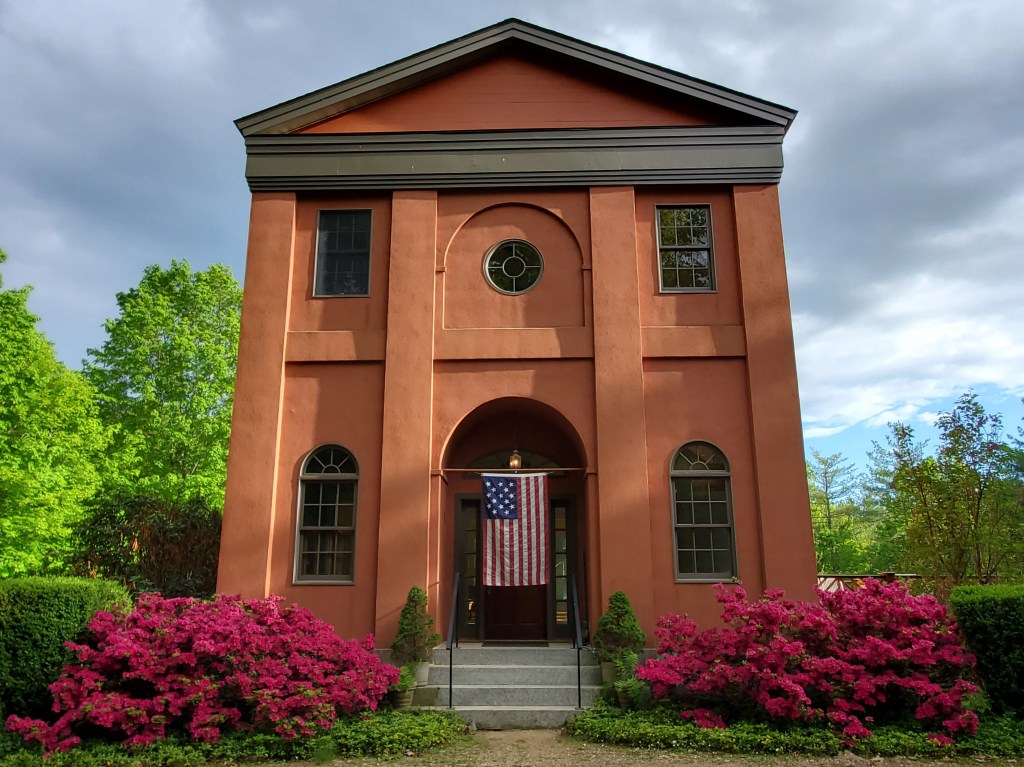
Memorial Day at Gnawwood, 26 May 2025 On this year’s designated Memorial Day, I rode my bike for the first time in I’m sure at least a year, enjoyed myself, and celebrated the fact that I did not fall off. The next day, I spoke with my former acting teacher, Pete, just after his 80th birthday, and he thanked me for sending him my Shakespeare book (and for acknowledging his contributions to same; he praised his copy as looking really good—even if you didn’t read it!). That night at the Portsmouth Library’s monthly Shakespeare discussion, I think I managed to contribute some worthwhile ideas and met three young former students of my UNH colleague Doug; all of them seemed pleased to meet me, and that felt good, too. Such small triumphs I balance against life’s absurdities: the Madbury tax assessor’s definition of a bathroom: 2 fixtures = a half bath; 3 fixtures = a bathroom. When I countered that one could not take a bath in our toilet room, which has a toilet, a bidet, and a sink, he countered with “What’s a bidet?” A bedroom, it turns out, only counts as a bedroom if it has a closet. Oy.
Basic communication seems increasingly problematic. I’m still trying to make sense of an email exchange I had with a local venue about an upcoming production in which (I think?) word choice led to an off-putting misunderstanding. And I’m not even counting the expense of time and frustration wasted when bots, phone answering systems, and online queuing land one in some infernal circle of futility. Thank goodness for the moderating influence of Nature going about her business unperturbed.

Springtime’s wild geranium 
Visiting doe seen from the deck 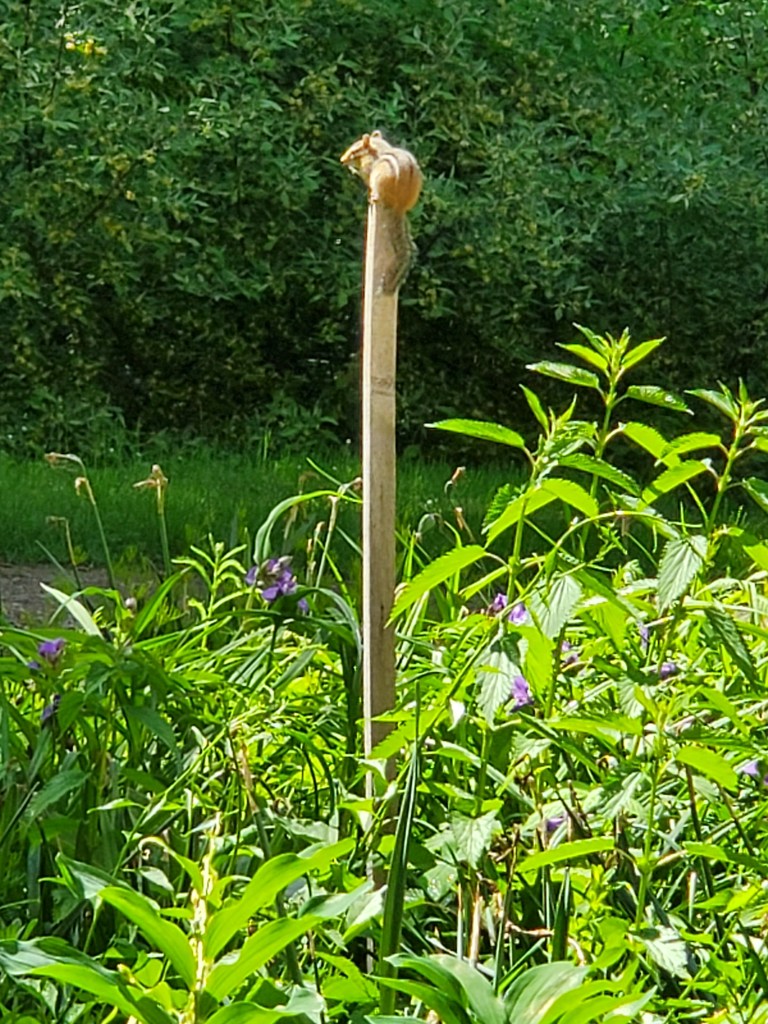
Chipmunk with aspiring mind But then things took a turn for the worse: this dentist’s daughter was felled by an infected crack in her second molar, and the pain med prescribed to tide me over before the antibiotic kicked in left me alternately sleeping and throwing up for the next 24 hours. Sleep and fasting proved the only refuge from nausea until my poor body metabolized and voided the poison intended to help it. The upside: I lost three pounds overnight. The downside: I felt even less up to facing this year’s sad anniversary of my final day with my beloved husband. On 1 June 2019, he departed our home for the last time, eighteen years from the Memorial Day weekend when we first moved into our just-built house. A year later, 1 June 2020 marked my retirement from 43 years of teaching, an end requiring a new beginning of a different sort. And this year, 1 June marks my late sister Jane’s son’s 27th birthday. So much to feel in these Memorial Days.
Being really sick, even for only a day, may have an ironically salutary upside, putting minor annoyances in perspective, however much they continue. As I struggled to clamber up the Slough of Despond’s slippery slope, I tried diverting myself with all the best tv and film I could find: the 2022 series Julia with its superb scripts and performances narrating the indomitable Ms. Child’s beginnings at WGBH; ALL of Mike Birbiglia’s comedy specials on Netflix; Naomi Watts, Bill Murray, and the uncannily talented Great Dane Bing in The Friend, a serious comedy about grief and what we owe each other; and the delightful if lightweight French rom com Jane Austen Wrecked My Life.
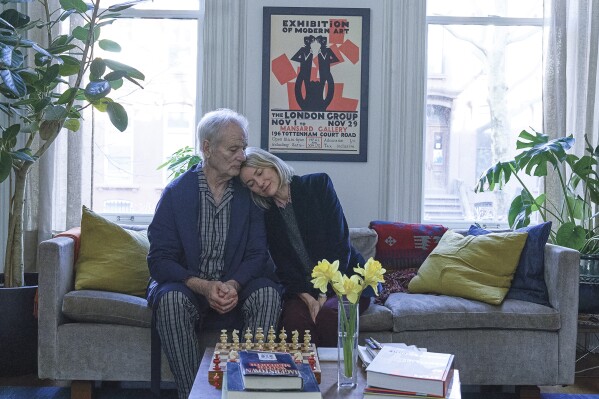
Bill Murray and Naomi Watts in The Friend Happily, better help was at hand. I had a wise and compassionate letter from my dear Americanist friend Trish, offering Ben Franklin’s allegory of the “speckled Ax,” advice about carrying on despite difficulty “obtaining good, & breaking bad Habits”—like my inertia when facing the task of a thorough, liberating weeding of possessions I don’t need or want. “A speckled Ax is best” I understand to be Franklin’s and my friend’s version of “don’t let the perfect be the enemy of the good enough.” Sound advice. Even more helpful: having the kind of friend who knows when and what kind of canny advice to offer a friend in need.
Things ARE looking up. My husband’s older brother Reed, like David, is a gifted writer and a perceptive, loving soul. His consoling response to my sad letter was tonic in perceiving and acknowledging the magnitude of all I lost when David died—which ultimately, strangely celebrates what I have still, and can never lose. Like the song says, “They can’t take that away from me.” Good to have such a big brother.
A visit to the endodontist helped, too—and not just because she’s a good doctor (like said big brother). I’d not seen her for six years, when last the crack in that molar proved problematic. And yet she recalled the trip to India I took in December of 2019, my first Christmas without David. I suspect she keeps notes on her patients: atop her technical expertise and no-nonsense communication, Dr. Forbes is a most welcome reminder of the so important human connection in our so often inhumane era.
On the loss of such ties that bind, I was recently struck by self-described mild-mannered David Brooks’s recent NYT op ed about what has pushed him over the edge: Notre Dame political scientist Patrick Daneen’s Memorial Day essay in which he avers that regular soldiers fight not for ideas, abstractions, or ideals like natural rights, but instead fight only for their comrades in arms. Brooks points out that J. D. Vance concurs, quoting Vance’s acceptance speech at the Republican National Convention: “People will not fight for abstractions, but they will fight for their home.” Brooks sees such statements pointing to “the moral rot at the core of Trumpism, which every day disgraces our country, which we are proud of and love.”
I’m reminded of the one time my sweet dad, also a mild-mannered guy, confronted my then (unsuitable, though I hadn’t yet figured that out) boyfriend over the fact that he had hung his UNC-Chapel Hill diploma over the toilet. My dad had volunteered to fight in WWII, and though his bad heart kept him out of the Army then, he was later drafted as a medical officer when I was a toddler, and for two years proudly served his country as a Captain. A student of the Civil War and ardent admirer of “Mr. Lincoln,” my dad certainly believed in abstractions like the inherent value of education. He just as certainly believed in dedication to the self-evident truths that established these United States. Alas that they are no longer self evident.
Last Sunday, I was moved to witness dedication of another sort, the dedication of artists who’ve devoted their lives to making their audience understand, collectively and powerfully, what it is to be human. Boston Ballet’s production of Jean-Christophe Maillot’s Roméo et Juliette, staged by Noelani Pantastico, Bruno Roque, and Taisha Barton-Rowledge and danced to Prokofiev’s soaring score under conductor Mischa Santora’s direction, is heartbreakingly gorgeous, the narrative and scenic design pared down to make even more devastating that tale’s essential tragedy: humanity’s capacity for senseless hatred destroying its future in the form of two charming, brave, exquisitely beautiful young lovers. Maillot’s ballet tells Shakespeare’s story from Friar Laurence’s perspective, a cleric clearly tormented by Verona’s division, desperately seizing what he thinks may be a solution, and despairing when destiny intervenes. By some strange alchemy, the collective dedication and talent of all those artists—dancers, choreographers, designers, musicians—transformed tragedy into beauty and solace—even on the sixth anniversary of my beloved husband’s departure. Perhaps Keats’s Grecian urn is right: beauty is truth, truth beauty. The ballet’s truth seems to have set me free.
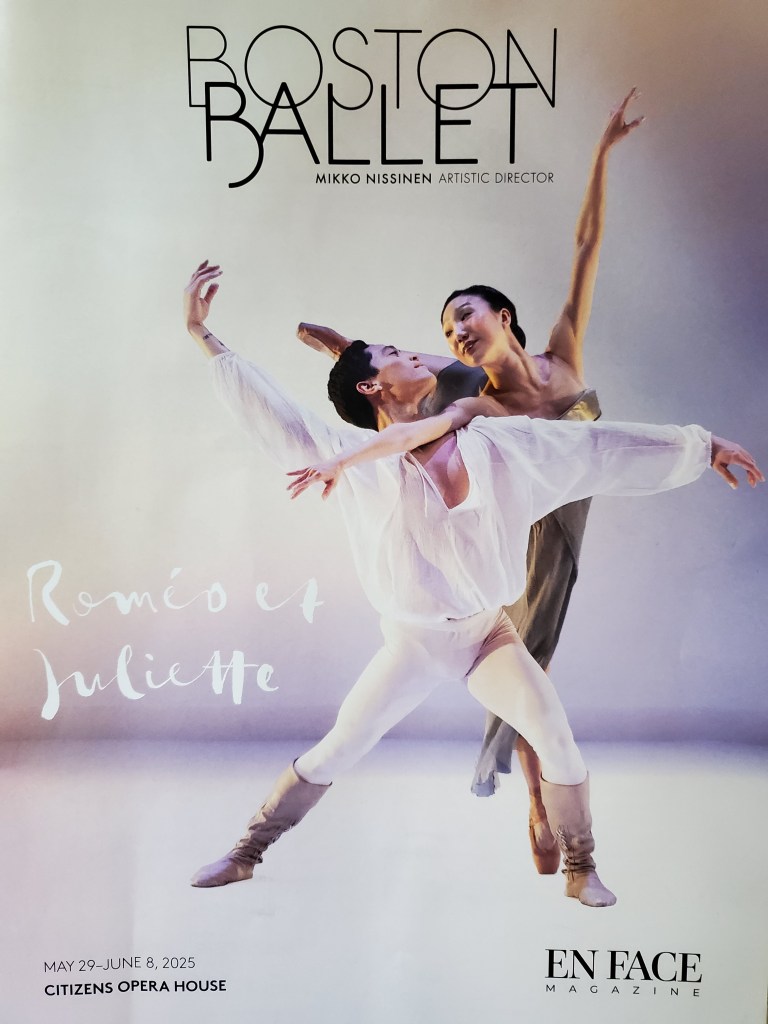
Sangmin Lee and Seo Hye Han break hearts . . . 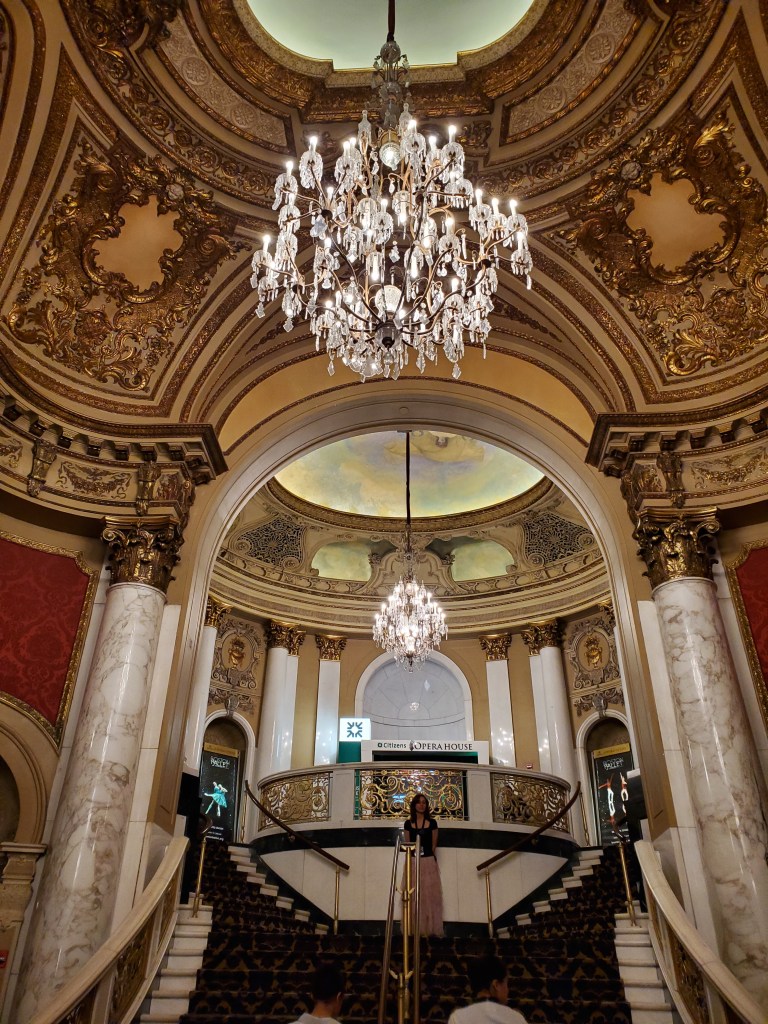
. . . at Boston’s Opera House: architecture celebrating abstraction https://www.bostonballet.org/stories/romeo-et-juliette-preview/
And now, the glorious azaleas have gone by, the rhododendrons and irises and beach roses commence their season. And me, I take up my speckled Ax, and get back to work. And back on the bike.

My Univega Metroprix: rolling since 1984 -
Folly Beach
4-9 May 2025
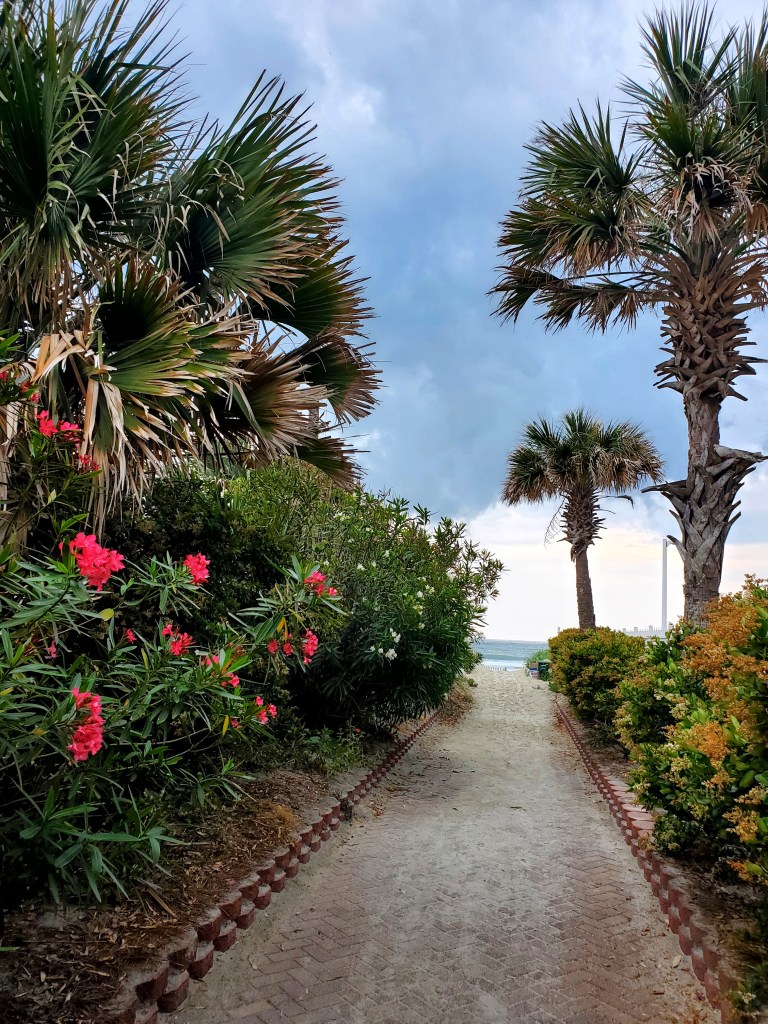
Folly Beach access With a name referencing the 17th-century meaning of “folly” (densely packed with trees and undergrowth), Folly Island’s first official mention is a land grant document from King William III to one William Rivers, dated 9 September 1696. The island was home to members of the Bohicket tribe until the increasing number of Europeans in Charleston forced them to move elsewhere. The City of Folly Beach is now home to 2400 residents and many visitors to this laid-back beach community, once among them George Gershwin, who composed Porgy and Bess while staying on Folly in the summer of 1934.
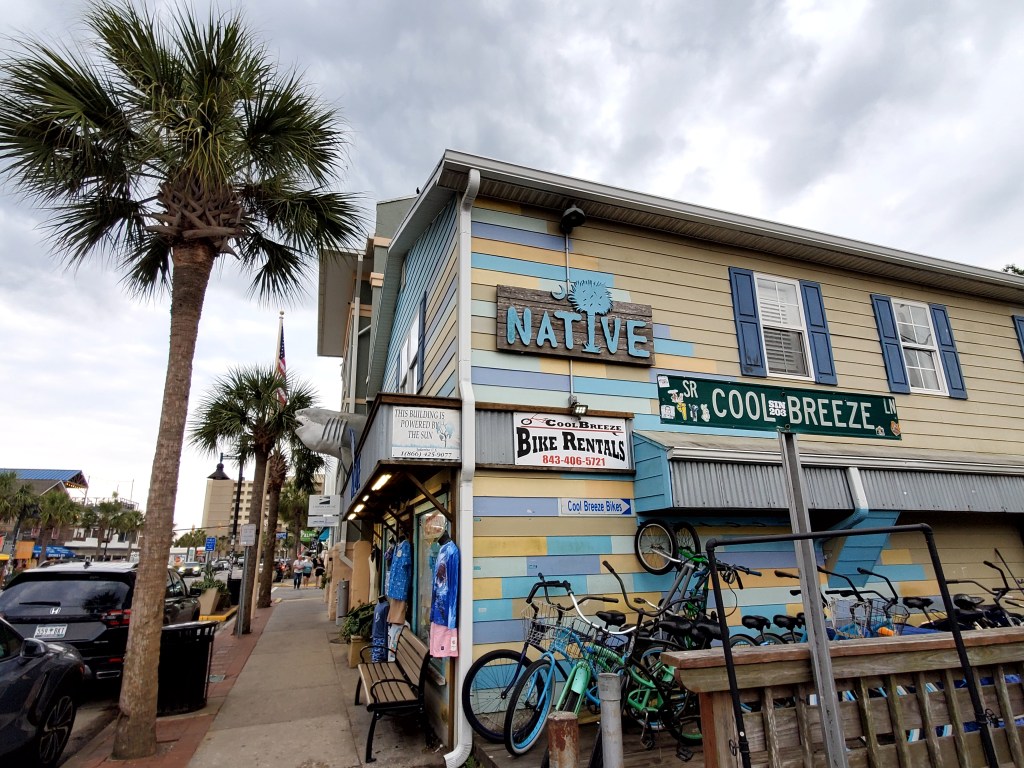
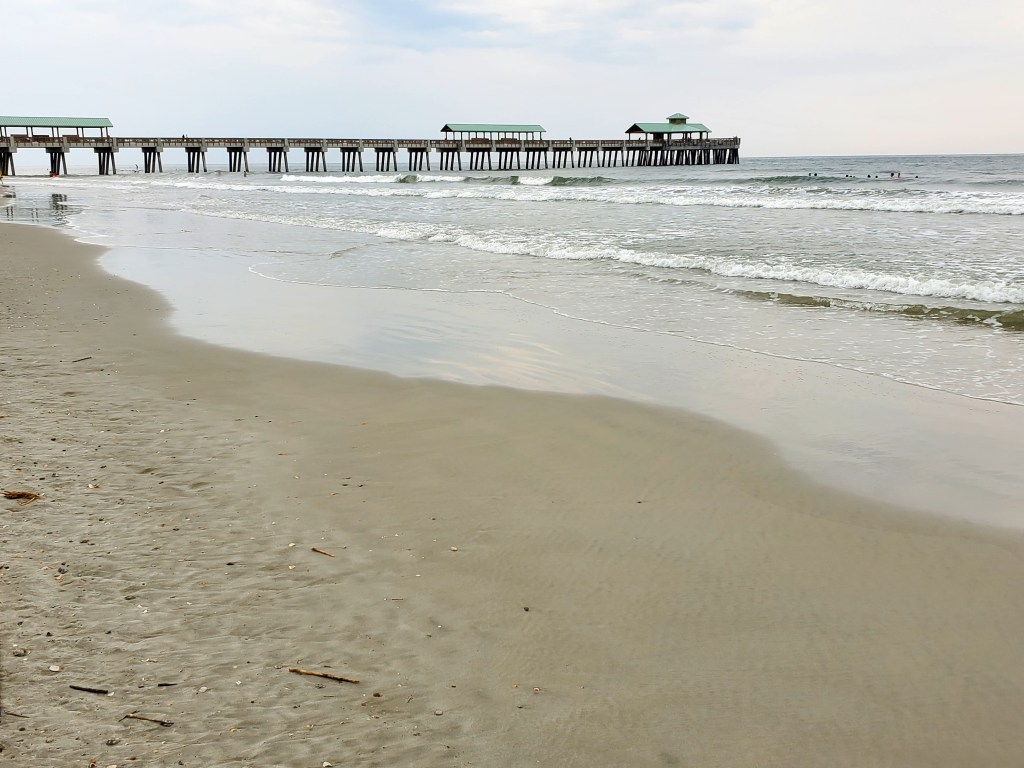
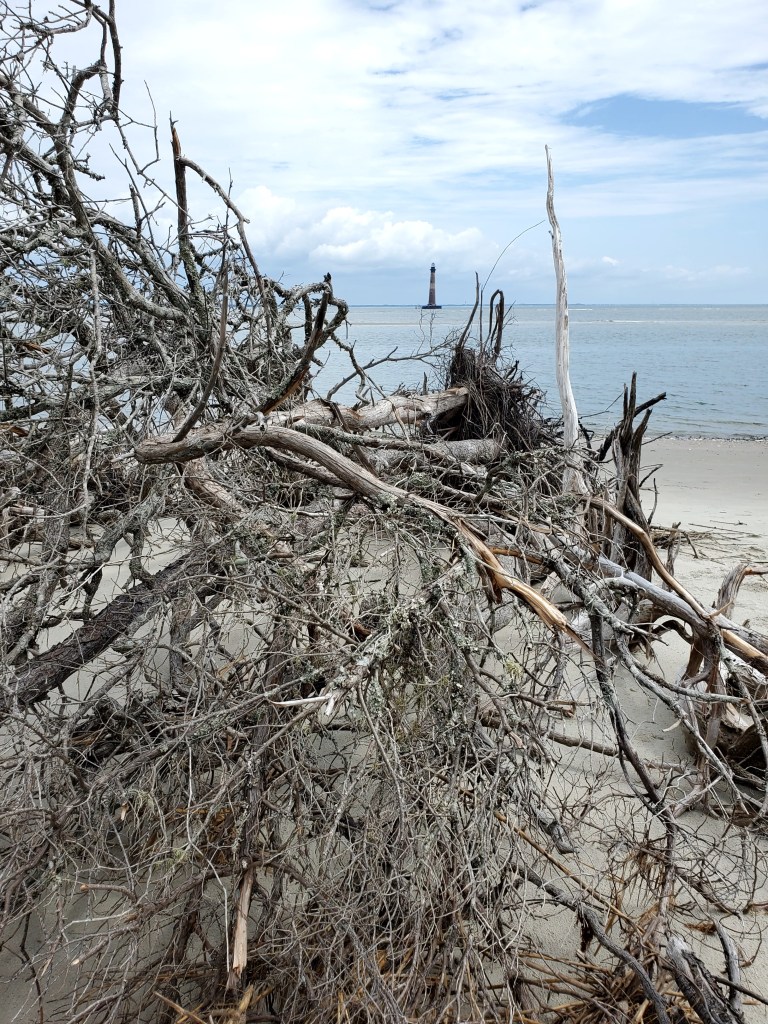
Folly Beach Pier We had only one full day on Folly Island, but the weather complied with our plans to first visit the Morris Island Lighthouse just off the northeastern tip of the Island, the southern entrance to Charleston Harbor. The sun was quite hot as we trekked the paved graffiti-filled path that leads to the dunes of the Lighthouse Inlet Heritage Preserve, but the first glimpse of the lighthouse inspired continuing, and was well rewarded by an uncanny seascape of trees long uprooted, bleached by the sun, and deposited at the island’s end by the ocean currents. The lighthouse itself is, at 161 feet, the tallest in South Carolina. Built in 1876, the tower and adjacent three-story house stood approximately 2700 feet from the water’s edge in 1880, but jetties constructed at the entrance to Charleston harbor caused a gradual erosion that displaced much of the sand on Morris Island. By 1938, it stood at the water’s edge, and today rises alone from its own little island, 1600 feet offshore.
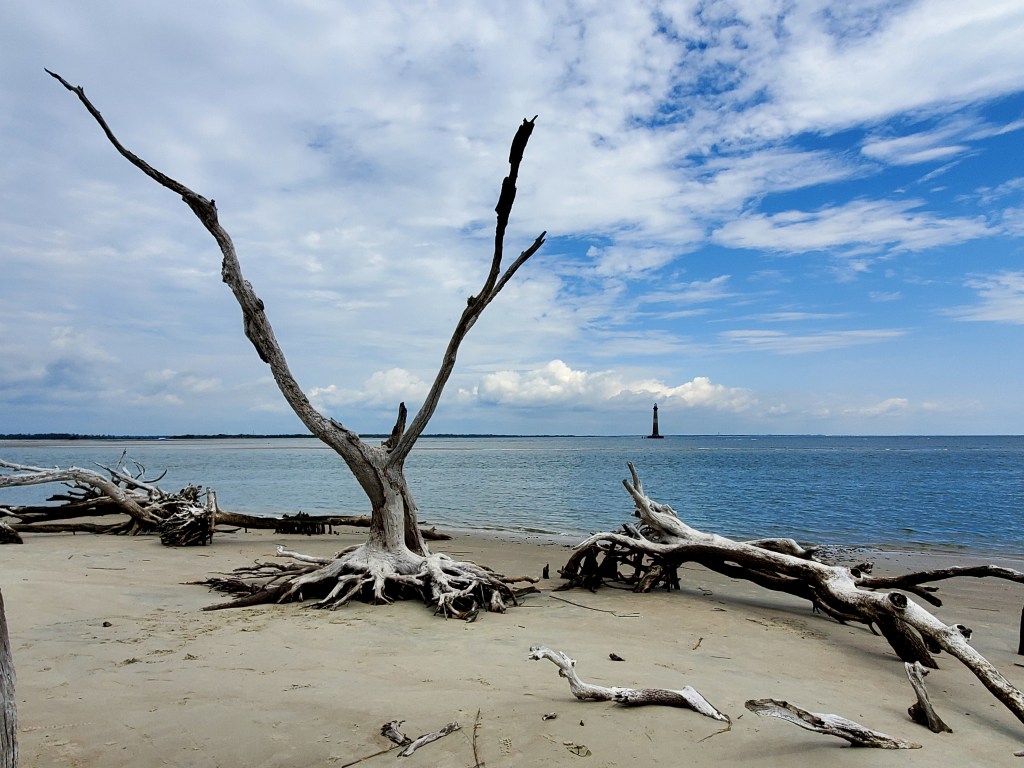
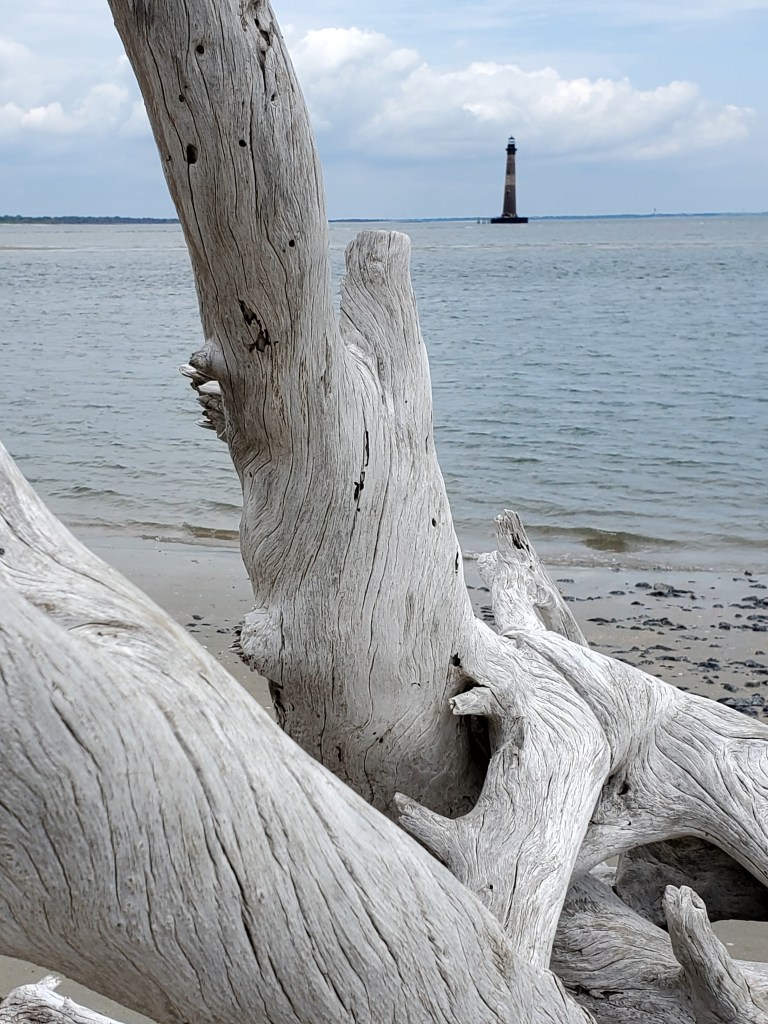

Seascapes with Morris Island Lighthouse (1876) The seascape, reminiscent of a Waiting for Godot set, the final scene of Planet of the Apes, or some other apocalyptic vision, is what most fascinated me: natural, evocative Atlantic sculpture. We took lots of pictures of this tree graveyard, and then headed to Johns Island to visit Angel Oak, our second objective of the day and well worth the drive.


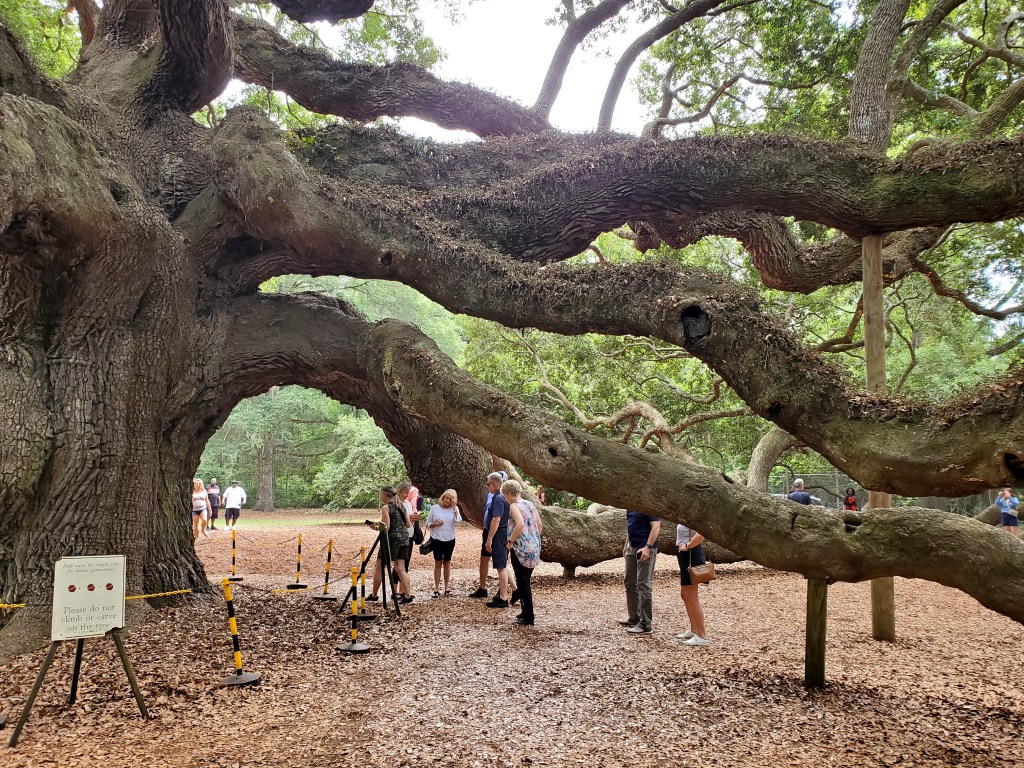
Angel Oak, Johns Island, dating to ~1625 Considered the largest live oak east of the Mississippi at an estimated 400 years old, Angel Oak stands 65 feet high with a circumference of 25.5 feet, shading an area of 17,000 square feet. With 400,000 visitors a year, the tree gets lots of special treatment: multiple supports for branches that graze the ground and, on the day we visited, workers aerating the soil around it to better allow water to nourish its roots. One sign invited a gentle hug or kiss of the tree, the better to allow it to reach its possible lifespan of 900 years. Given the prevalence of coastal hurricanes in our environmentally compromised Earth, that possibility seems unlikely. But as one of the oldest living things in North America, predating European settlement and the founding of Charleston, this Quercus virginiana does inspire reverence—and a kiss. And while its redoubtable age suggests the immortality of an angel, the tree is named not for those celestial denizens, but for the Angel family. The tree stands on land originally granted to colonist Abraham Waight in 1717, whose daughter Martha married Justus Angel in 1810. Their descendants owned the land and the Angel Oak until the mid-1900’s; the City of Charleston purchased it in 1991.
We returned to Folly Beach just as the weather broke into a downpour, and spent a cozy hour or so having a late lunch in Coconut Joe’s. The rain stopped conveniently as we finished our meal, allowing me a brief dip in the seaside pool, and an even briefer one in the turbulent Atlantic before we returned to Woody’s to retrieve Daniel’s sunglasses (left there the night before and happily returned to the bar by some good Samaritan), get a couple souvenir t-shirts, and enjoy some seafood and live music on the upper deck at Loggerhead’s.
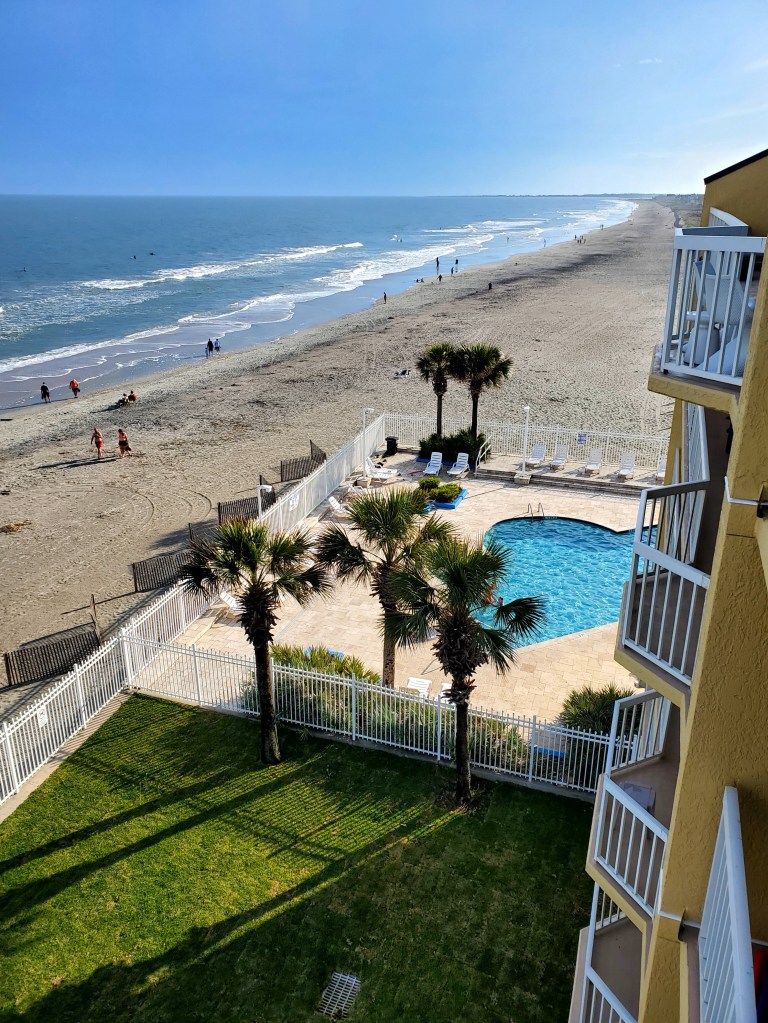
The pool At Charleston Oceanview Villas 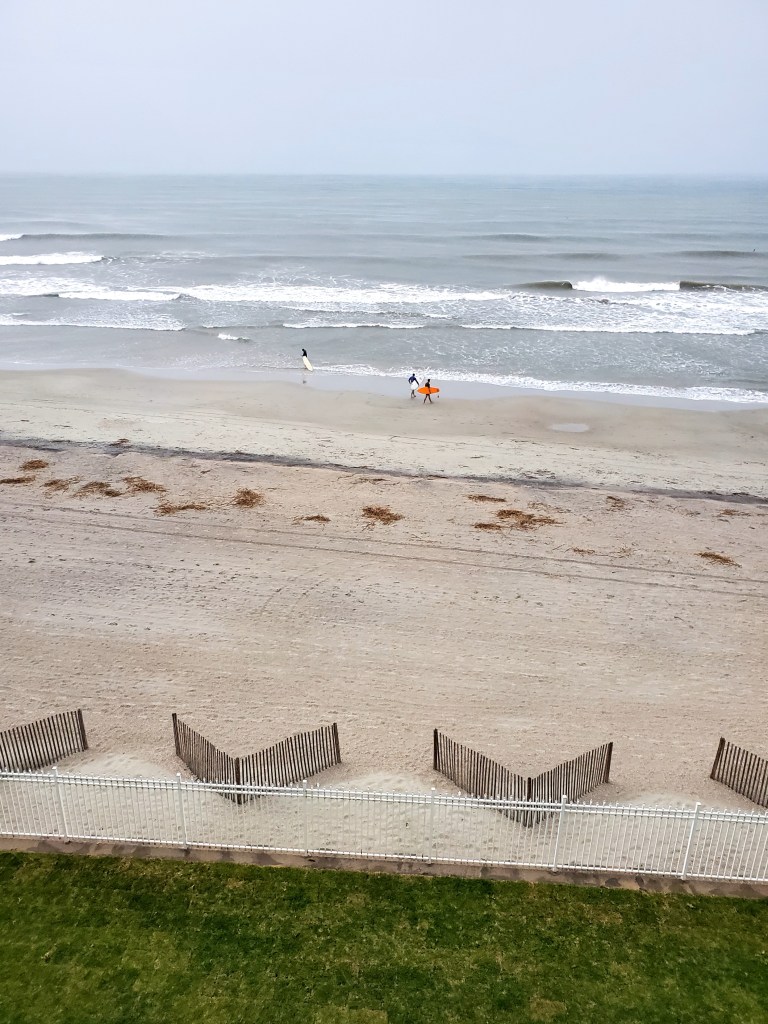
Ubiquitous Folly surfers, undeterred by any weather 
Swordfish and fried oysters at Loggerhead’s with Daniel and Richard The day concluded with a stroll to the end of Folly Pier as the sun set.
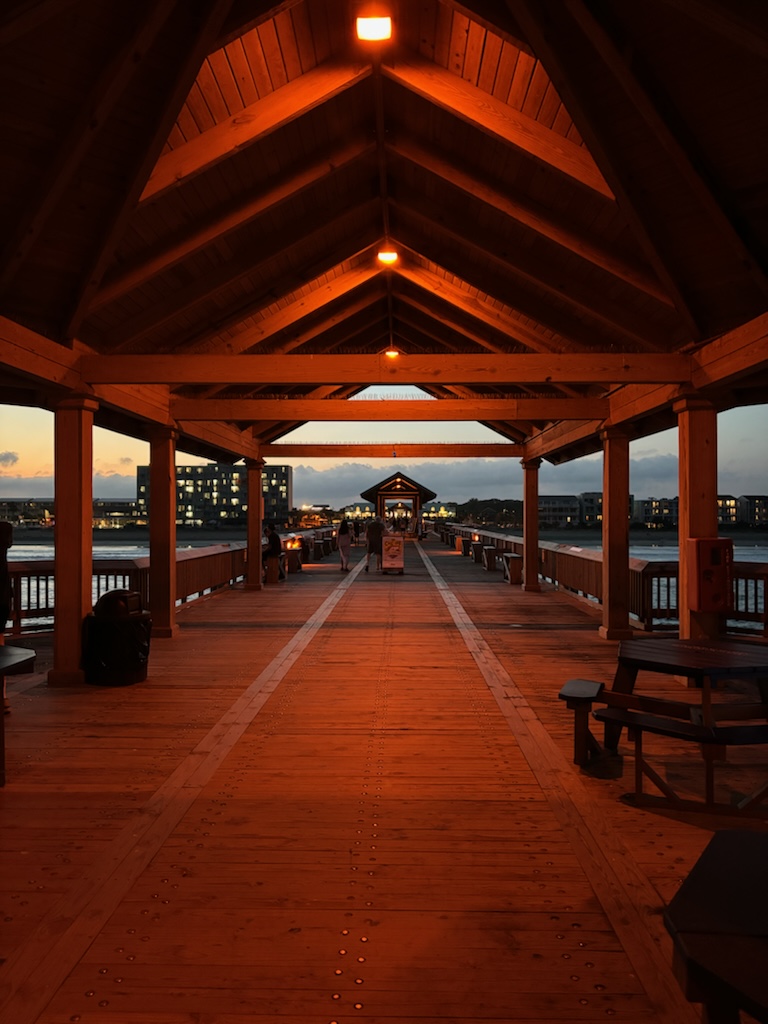
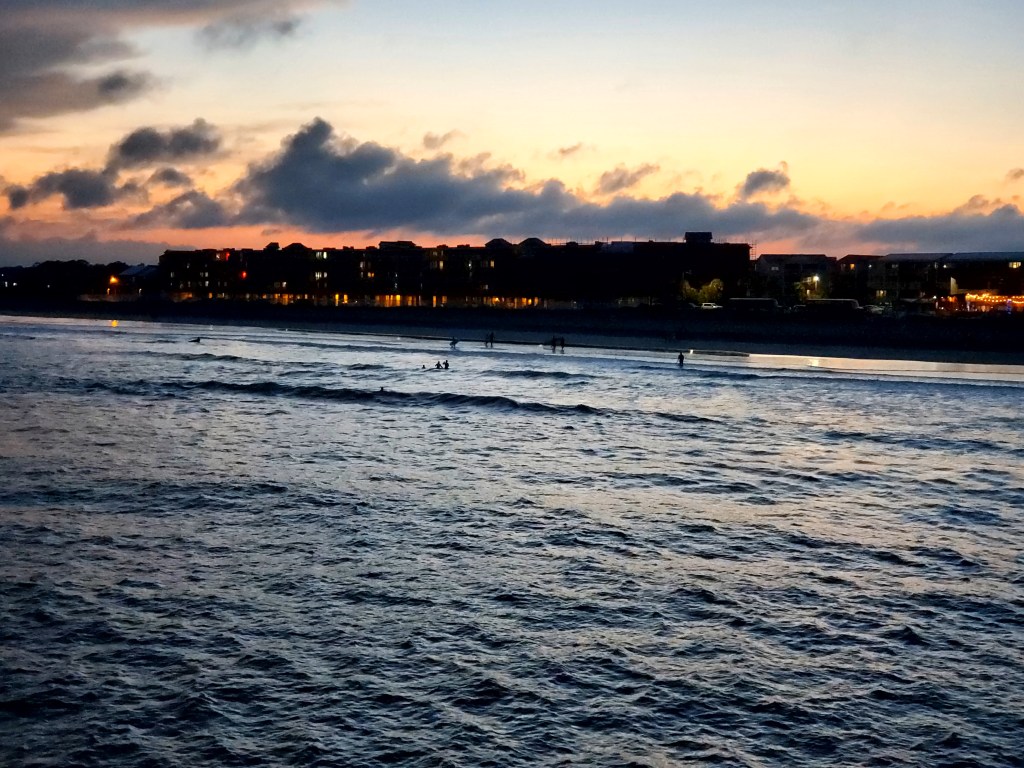
Folly Beach Pier and sunset The next morning, the boys dropped me at the Vacasa office and headed back to Safety Harbor as I made my way to the Charleston airport with Uber driver Gosh, so enthusiastic about being a citizen of this country. Mark Twain famously said “Travel is fatal to prejudice, bigotry, and narrow-mindedness.” Remembering the number of signs I saw posted in Charleston area widows prohibiting concealed weapons, I wonder if travel is the cure we all need to see our situation more clearly. That speculation and Gosh’s newly naturalized adoration of his adopted country have me still mulling over all I learned during our brief visit south. But I’m enjoying a return to the azaleas still blazing further north, and the Eastern phoebe nest I found unexpectedly sitting in the middle of my driveway yesterday: like the Angel Oak, it’s a marvel of natural creation. Nature always wins. I take comfort in that.
-
Ft. Sumter
7 May 2025
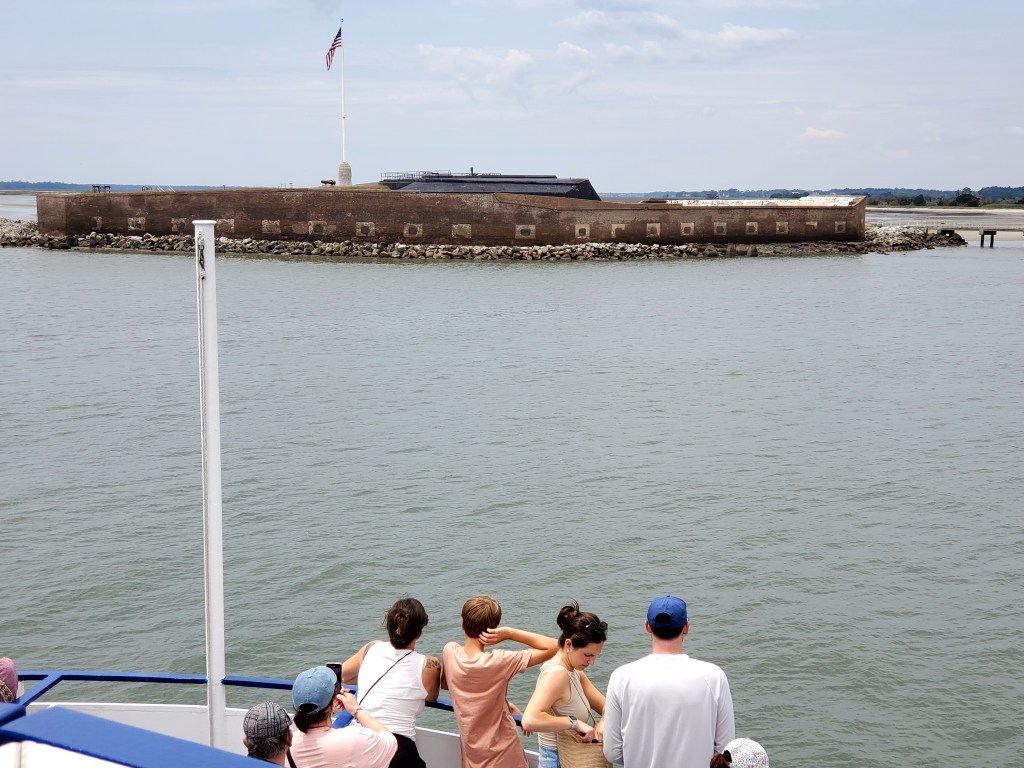
Approaching Ft. Sumter at the entrance to Charleston Harbor:
where America’s Civil War beganOn Wednesday morning we took advantage of the Hampton Inn parking policy that allowed us to leave our car in the hotel garage until we left the Holy City for Folly Beach later in the day. After breakfast on the patio, we walked the short distance from Meeting Street down Calhoun to the Ft. Sumter Visitor Center in Liberty Square, passing along the way the “Borough Houses.” Built in 1852 (a century before my birth) and occupied by Irish immigrants, 35 Calhoun was purchased in 1939 by Willis Johnson, Sr., whose sons Frank and Henry built 35½ Calhoun by hand to complete their carpentry apprenticeships. The two homes are still owned by the Johnson family, and remain the last vestige of “The Borough,” the African-American neighborhood built in 1940 for over 160 families, finally demolished in 1993 after the discovery of toxic waste deposits in the soil. As a descendant of Irish immigrants, I asked my brother-in-law to record my tangential connection with this snippet of Black Charleston history.
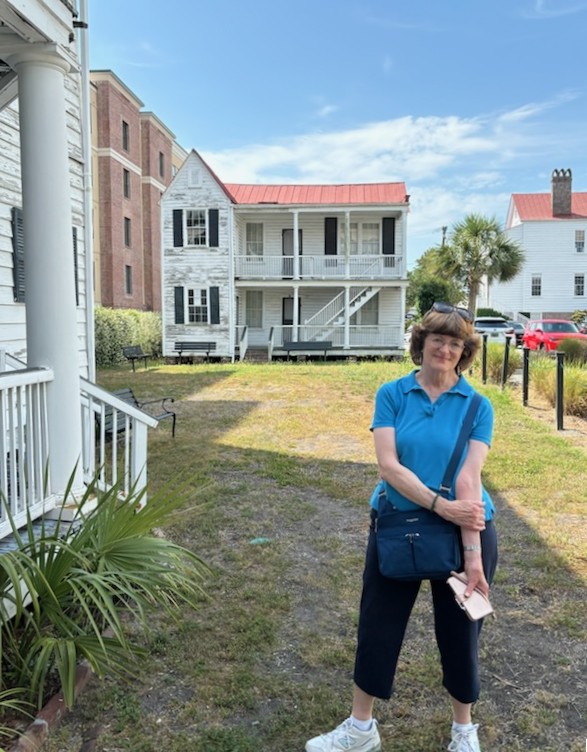
Murphy at the Borough Houses The exhibits at the handsome Ft. Sumter Visitor Center, including the replica gigantic garrison flag with its 33 stars once flown over the Fort, are very informative and, for me, revealing of how much our nation’s current divide reiterates tensions present from its founding.
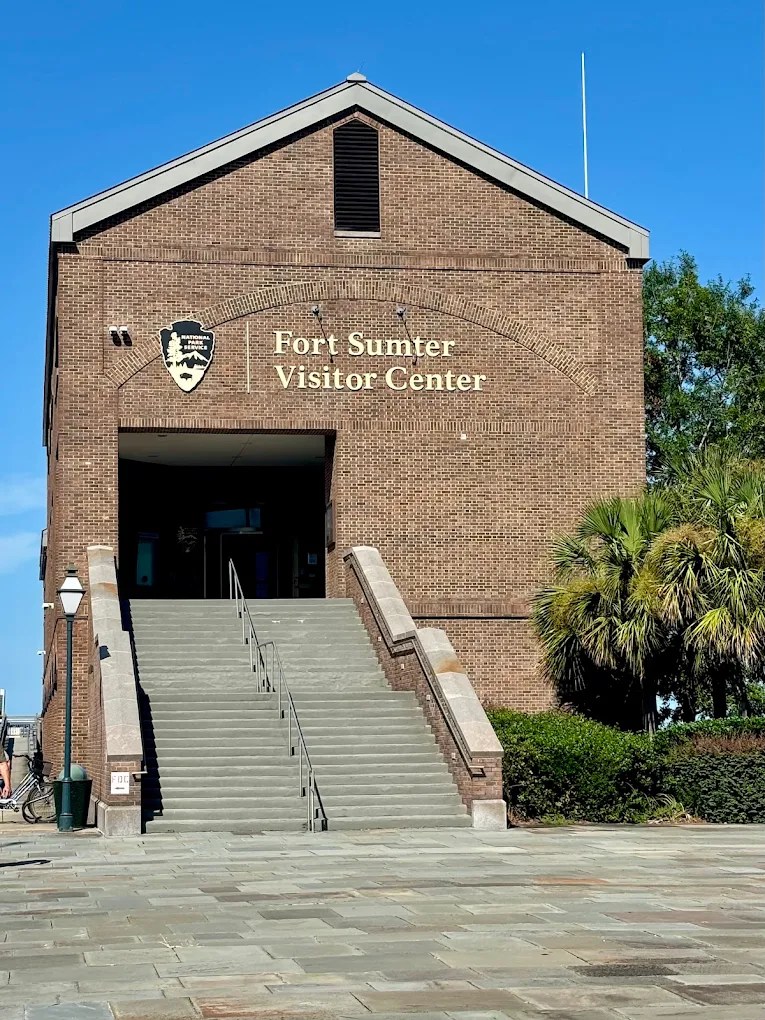
Liberty Square and the NPS Visitor Center, Charleston The closely related issues of slavery and state sovereignty were so volatile at the time of the Constitutional Convention in 1787 that any direct reference to slavery in the new document might cause a fatal rupture in the negotiations between regions and prevent a federal union. So, Enlightenment ideals about the abolition of slavery were conveniently omitted. To quote from one display, “The nation quickly learned that the Bill of Rights and the system of checks and balances between the branches of government did not guarantee individual liberties if one political party gained control of all three branches of government. The 1798-1799 Virginia and Kentucky Resolutions written by James Madison and Thomas Jefferson were manifestos of a state’s right to judge the constitutionality of federal actions. The resolutions defined the Union as a compact among the states, giving limited powers to the central government. Arguments of a broken contract, or a failed ‘compact’ that no longer protected a state’s interests, were the basis for secession movements.” The displays further emphasized how tariffs, intended to boost domestic industry, were seen as detrimental to Southern industry, highly dependent on agriculture and international trade, and led to the Nullification Crisis of 1832-33, when South Carolina argued it could nullify federal laws it deemed unconstitutional, including tariffs. As Trump’s Executive Order nullifying birthright citizenship makes its way through the courts and the Supreme Court wrestles with injunctions, I’m again reminded of Harry Truman’s words: “The only thing new in the world is the history you don’t know.”
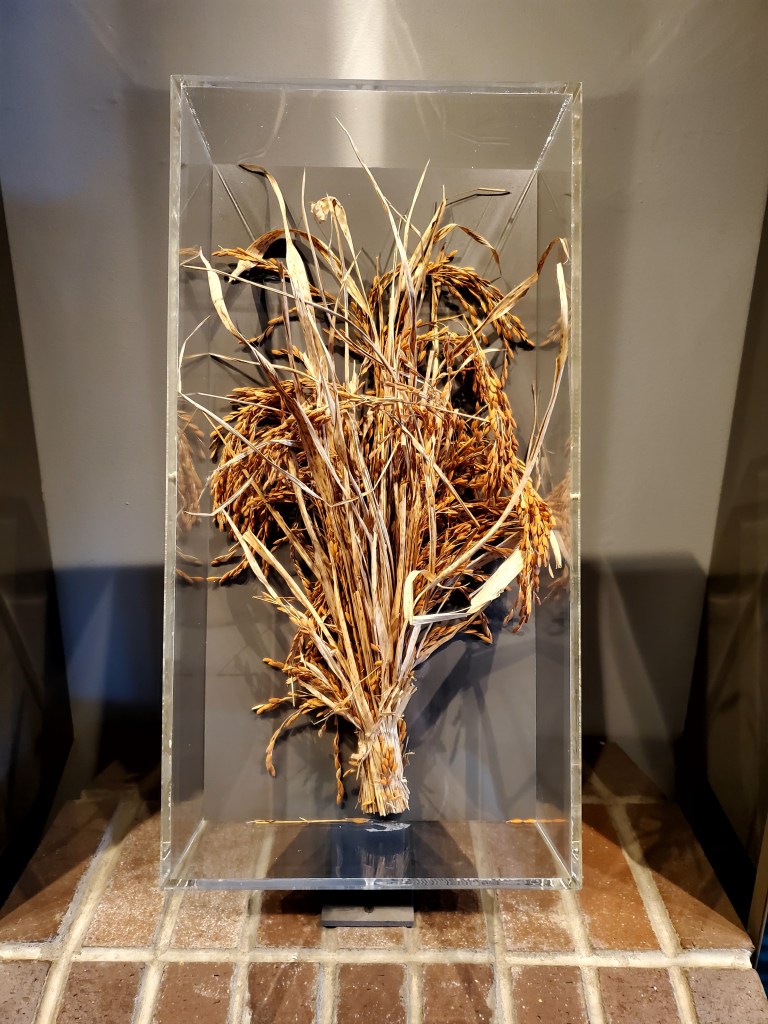
Carolina Gold rice, imported from West Africa and cultivated by the enslaved: primary source of Southern wealth 
A cargo ship approaches the 2005 Ravenel Bridge, 2.5 elegant miles spanning the Cooper River 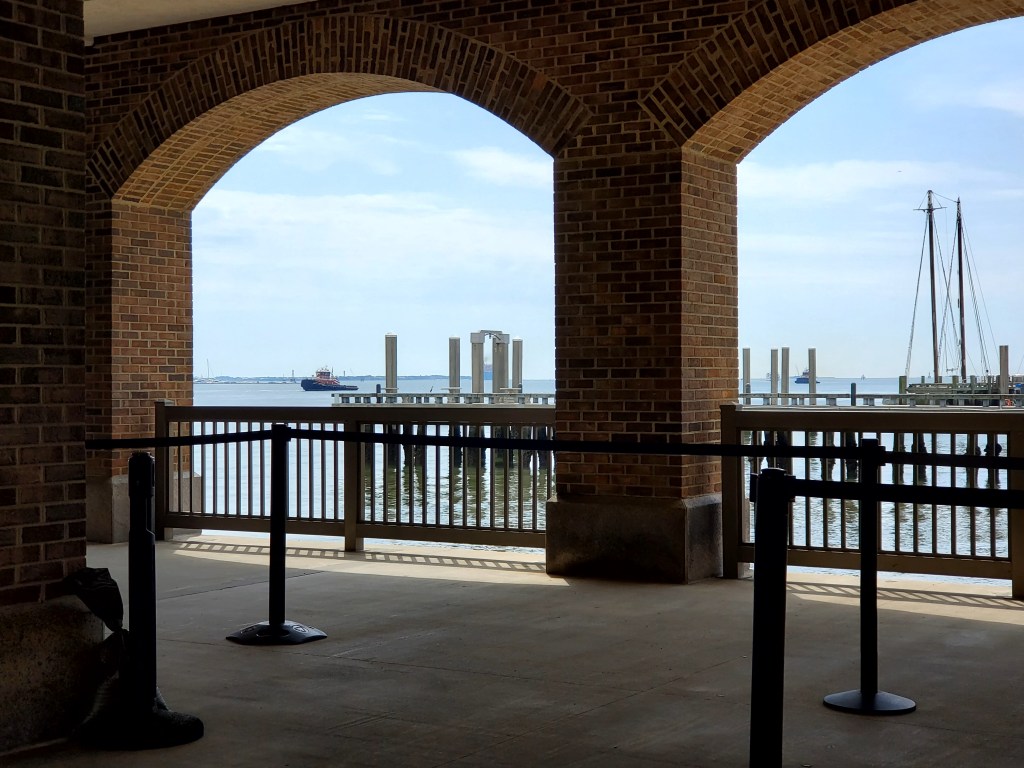
A cool place to await the Ft. Sumter ferry at the Visitor Center, complete with hilarious video about what NOT to do at the Fort
(or, How to Achieve a Darwin Award)Ft. Sumter’s construction had begun with enslaved labor in 1829, an attempt to fortify Charleston Harbor after the War of 1812 with a defensive structure named after South Carolina Revolutionary War hero Thomas Sumter, a fort designed to protect the Union. But South Carlina seceded from the Union on 20 December 1860 following Abraham Lincoln’s election as president, an act of secession soon followed by other states that led to the formation of the Confederate States of America. At the time Union-held but strategically important to the Confederacy, South Carolina demanded the fort be surrendered. Union commander Major Robert Anderson refused. Lincoln then decided to resupply Ft. Sumter, an act the Confederacy viewed as a further challenge to their sovereignty. General Beauregard of the Confederacy then sent an ultimatum to Major Anderson, demanding the Fort’s surrender. When Anderson again refused, the first shots on the Fort were fired at 4.30 am on 12 April 1861, marking the beginning of the Civil War.
Ranger Summer of the National Park Service pointed out that Ft. Sumter today is essentially a “stabilized ruin” of its former self: walls that once rose 55 feet above sea level today offer a barrier of only 9-25 feet.
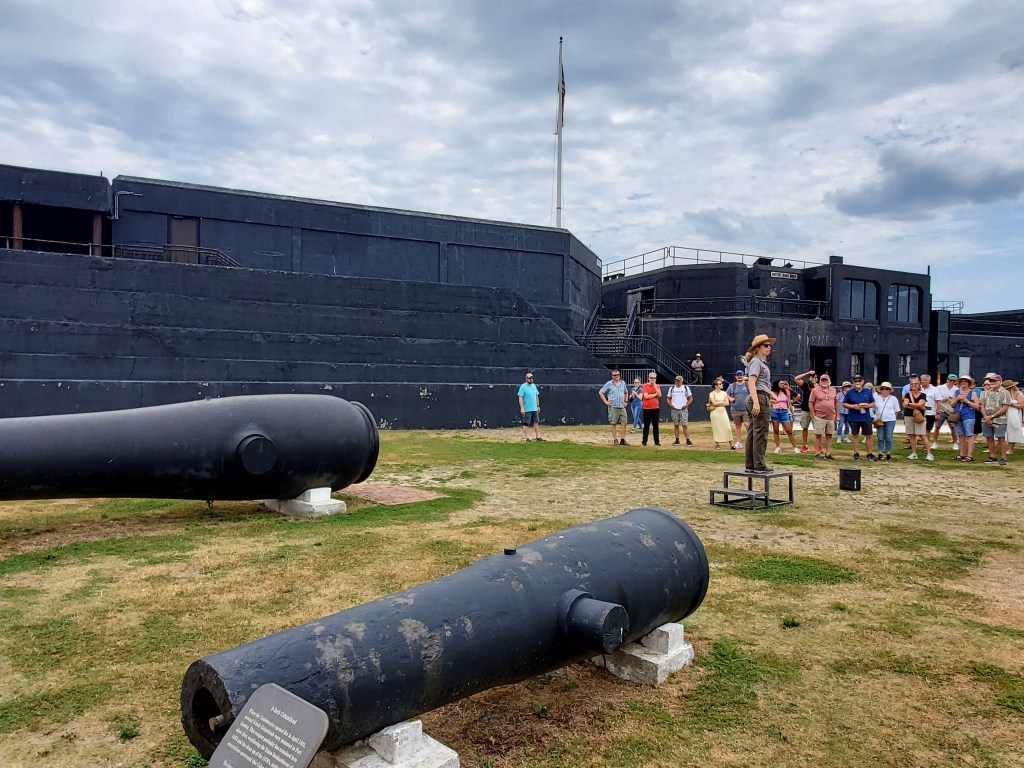
Inside Sumter: the black Acrymax coating replicates the original pitch protecting the concrete structure. 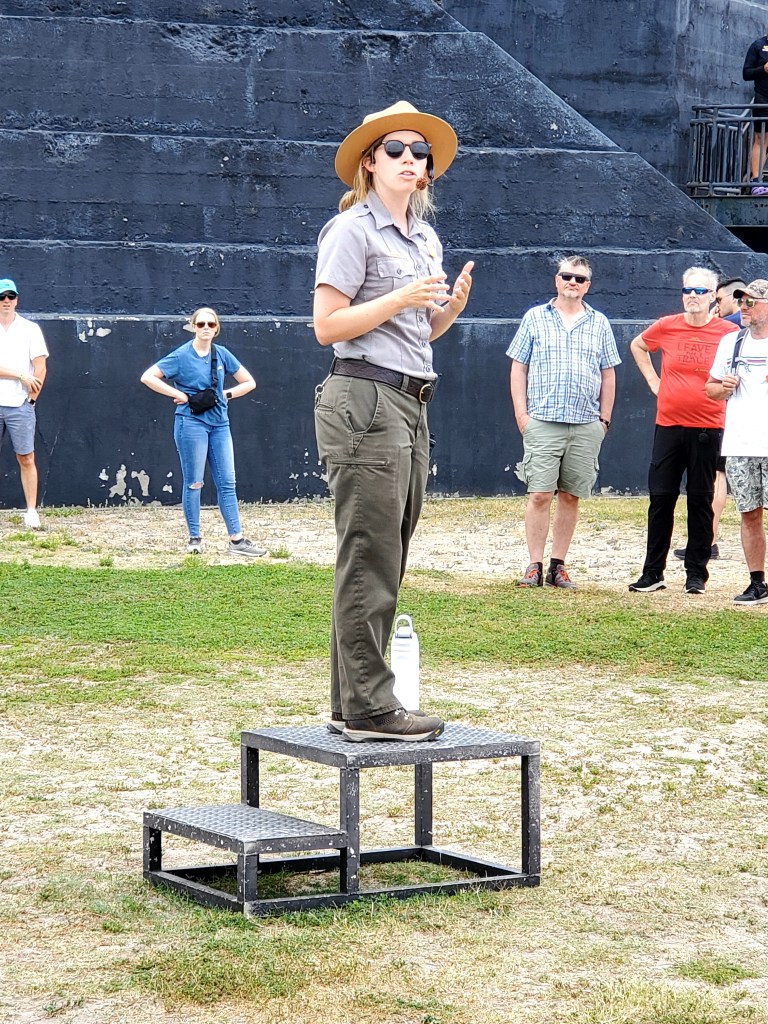
Ranger Summer, excellent National Park Service guide From Ranger Summer, we also learned that states added to the Union only get their star on the U.S. flag on the following Fourth of July, so Kansas, the 34th state to join the Union on 29 January 1861 was not yet represented on the garrison flag that flew over Ft. Sumter when it first received Confederate fire on 12 April 1861. It was also Ranger Summer who pointed out the finger prints of what was likely one of the enslaved children whose comparatively “light work” was making the Fort’s bricks, nearly invisible but enduring evidence of why our country’s most costly war was fought.
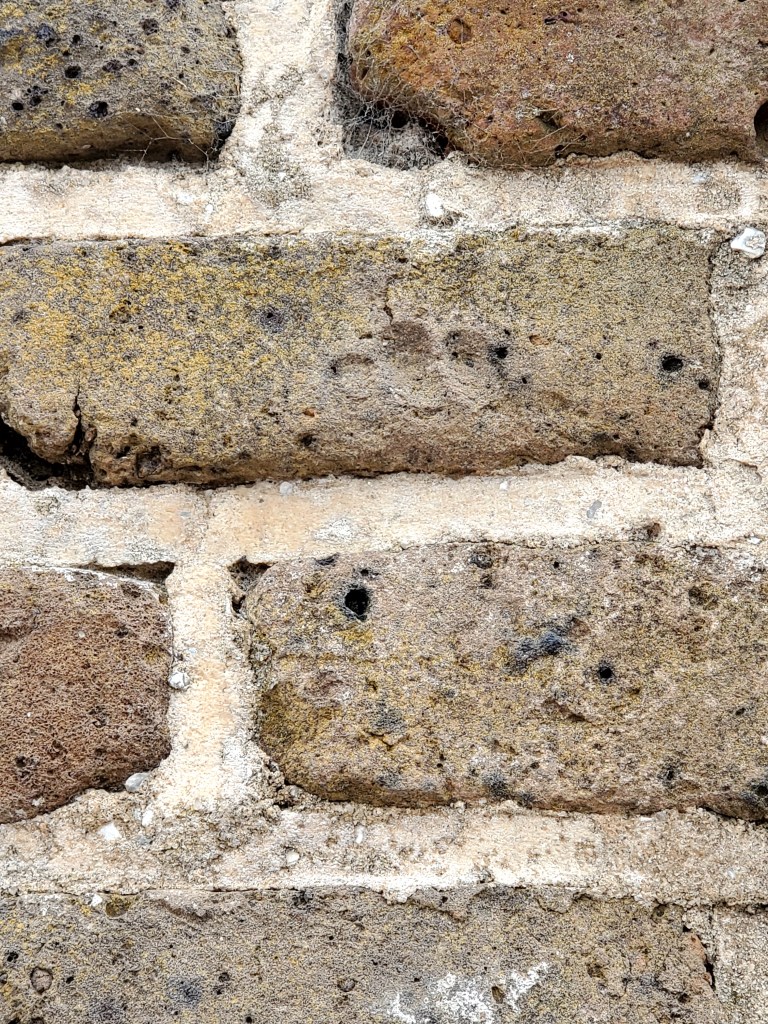
Fingerprints in the brick (second course down from the top)
likely made by an enslaved child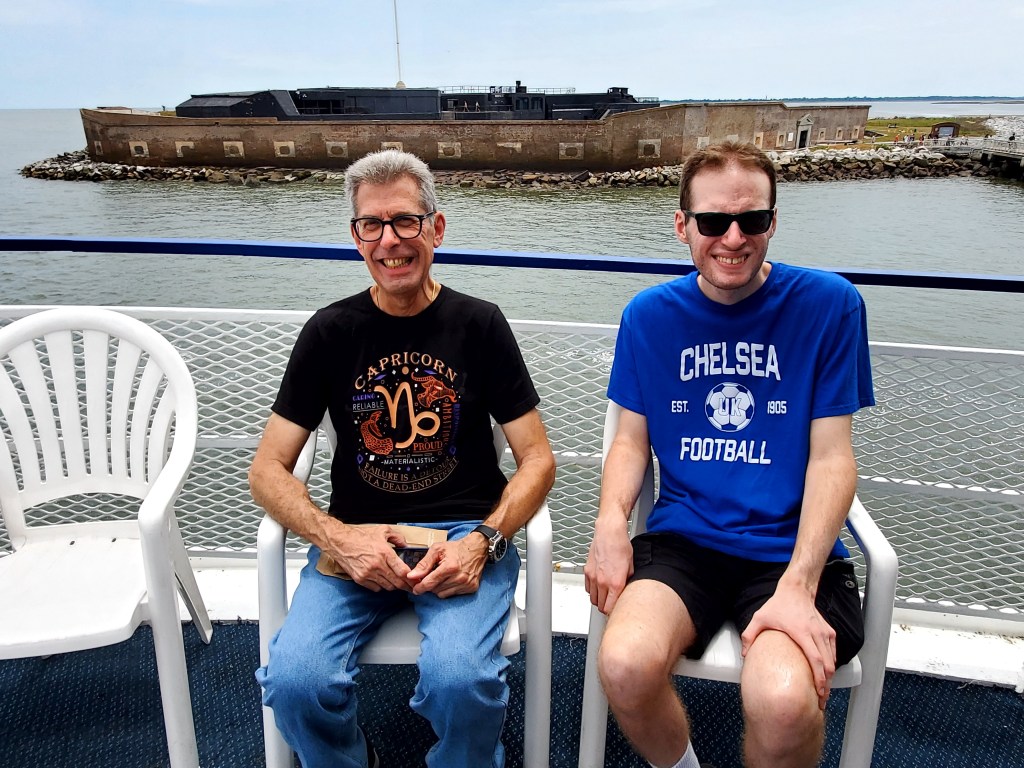
Richard and Daniel on board the returning ferry 
Ranger Summer’s characterization of Ft. Sumter as a “stabilized ruin” left me pondering the balance of stability and ruin typifying the current state of our Union. But a tip from Bill at the Visitor Center gift shop sent us to a happily distracting treat at nearby bakery/café Saffron: iced coffee and a slice of lemon torte sufficient to fuel navigation off the Charleston peninsula and onto our upmarket Airbnb on Folly Beach.
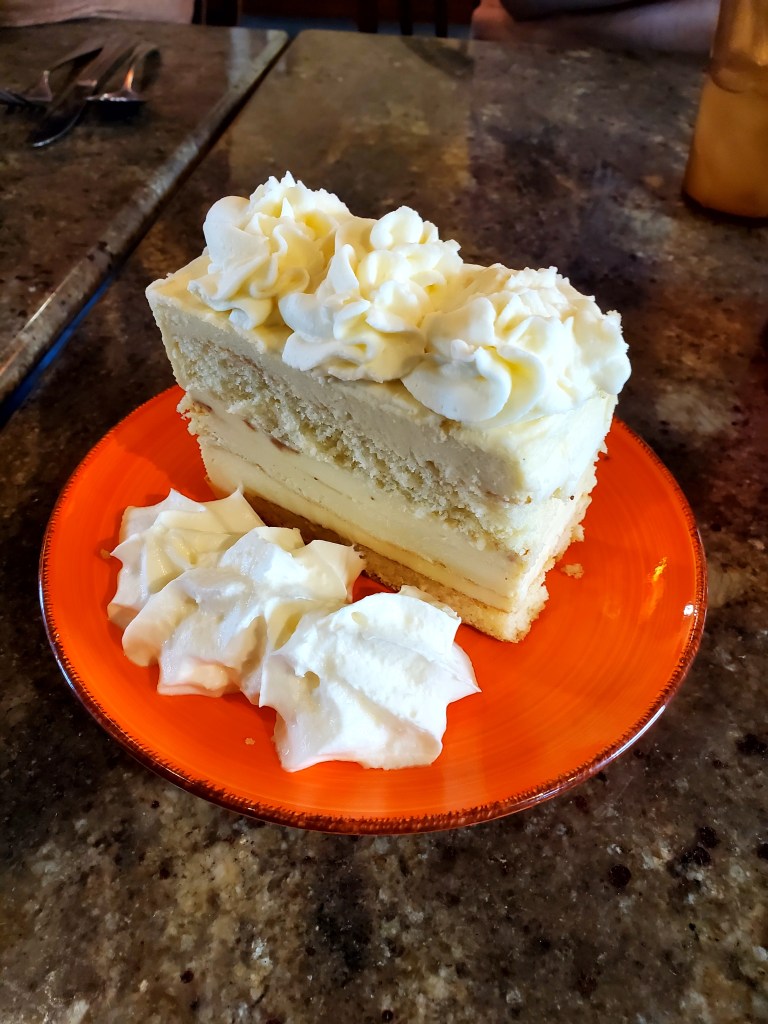
Excellent pastry at Charleston’s Saffron Bakery 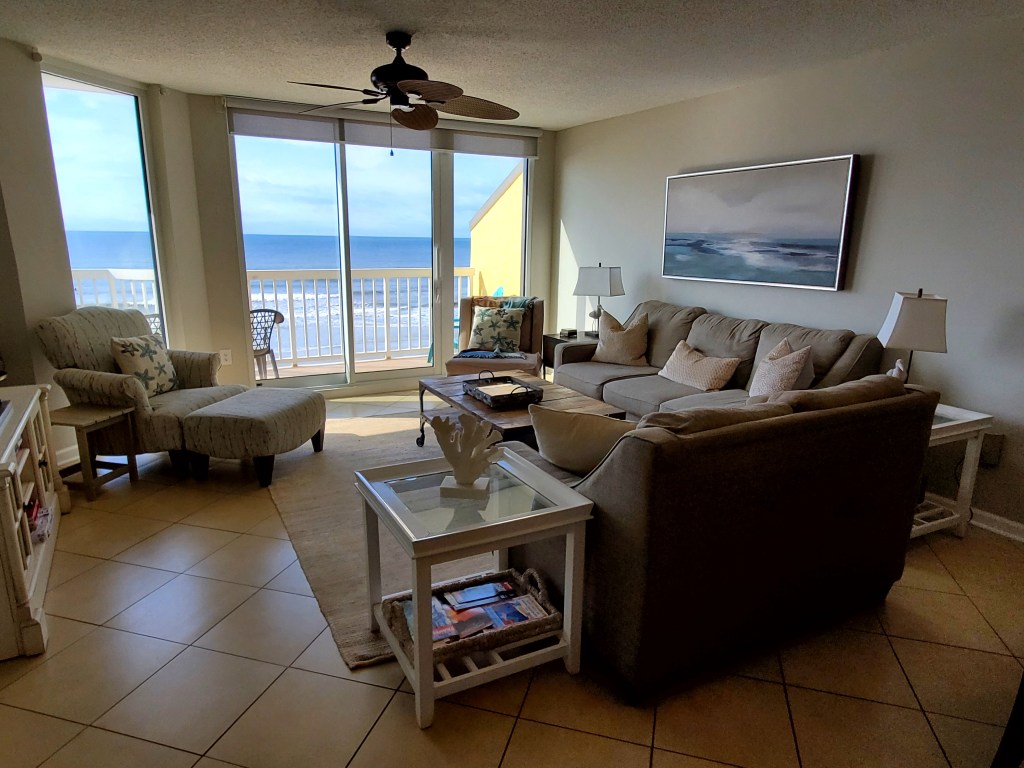
Our elegant Airbnb at Charleston Oceanview Villas 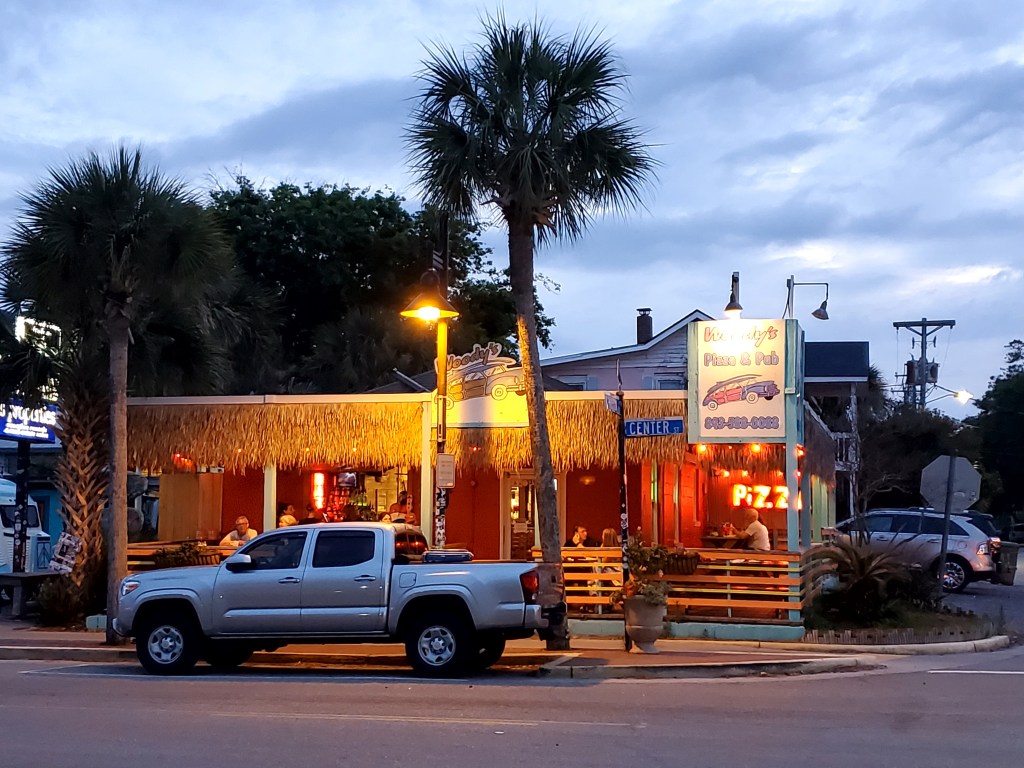
Excellent wood-fired pizza at Woody’s of Folly Beach A stroll on the beach and some wood-fired pizza at Woody’s on Center Street concluded our day to the lulling sound of the Atlantic waves.

First night at Folly Beach in view of the public Pier -
Magnolia Plantation
6 May 2025
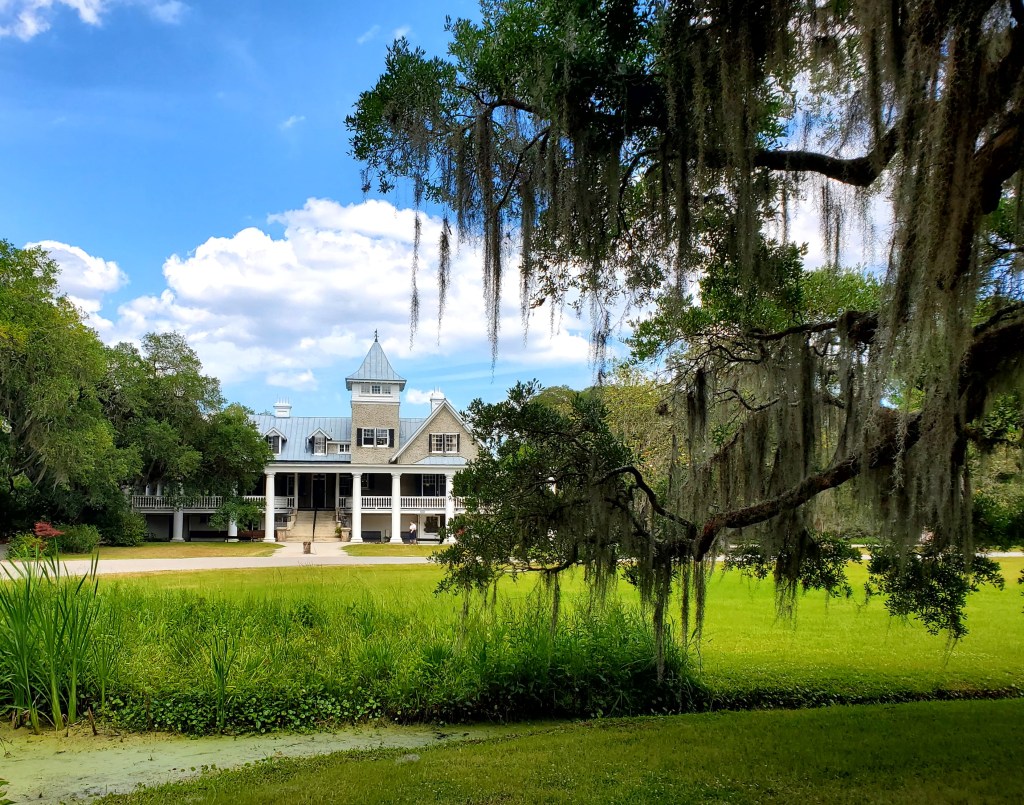
Magnolia House Plantation, 1873 On our second full day in Charleston, we set out for Magnolia Plantation and Gardens, a 30-minute drive northwest from the Charleston Visitors Center to the 390 acres of the original 1,872 along the Ashley River. One of the oldest in the South, the plantation dates to 1679, when Thomas and Ann Drayton built the first small house and formal garden on the site. Some of the enslaved people forced to work in the house and construct the extensive earthworks of dams and dikes in the fields along the Ashley River to irrigate the land for rice cultivation were brought by the Draytons from Barbados in the 1670’s. Enslaved laborers also built the stately Drayton Hall (1738) on an adjoining property. Both the original Magnolia house and the second were destroyed by fire, the latter set by Union soldiers who spared nearby Drayton Hall only because smallpox quarantine flags flew there. The third plantation house (1873) still stands, and became known for its Romantic gardens after the Rev. John Grimké Drayton inherited the house from his elder brother in the 1840’s.
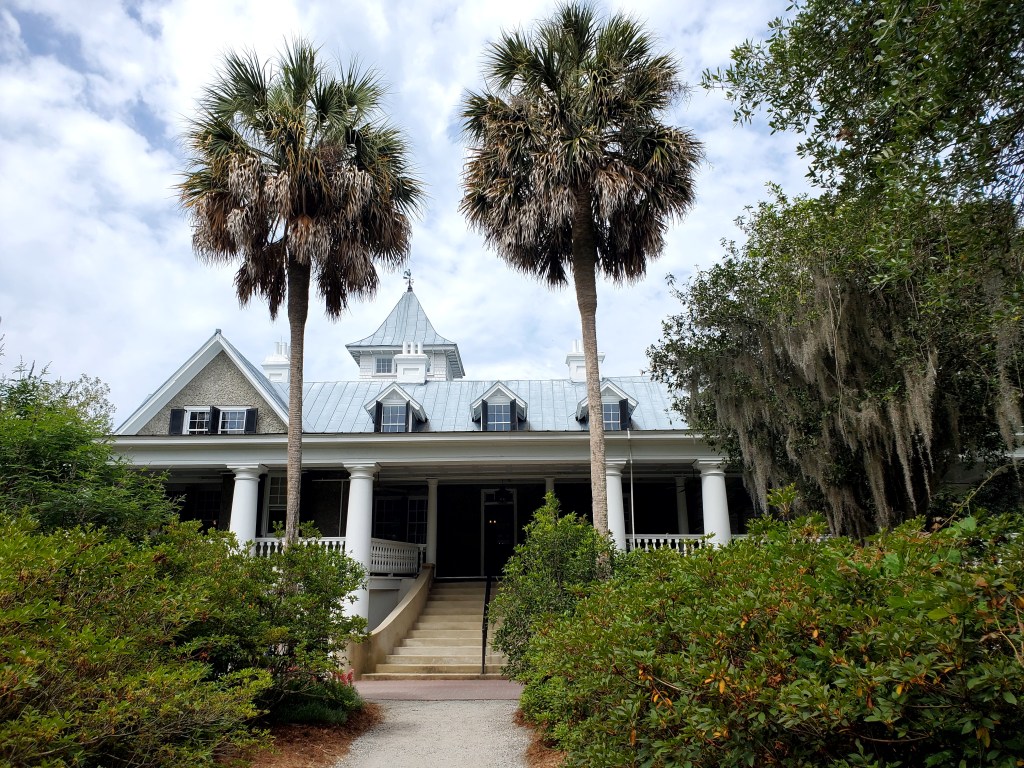
Magnolia House garden façade 
The deepest porch ever at Magnolia House 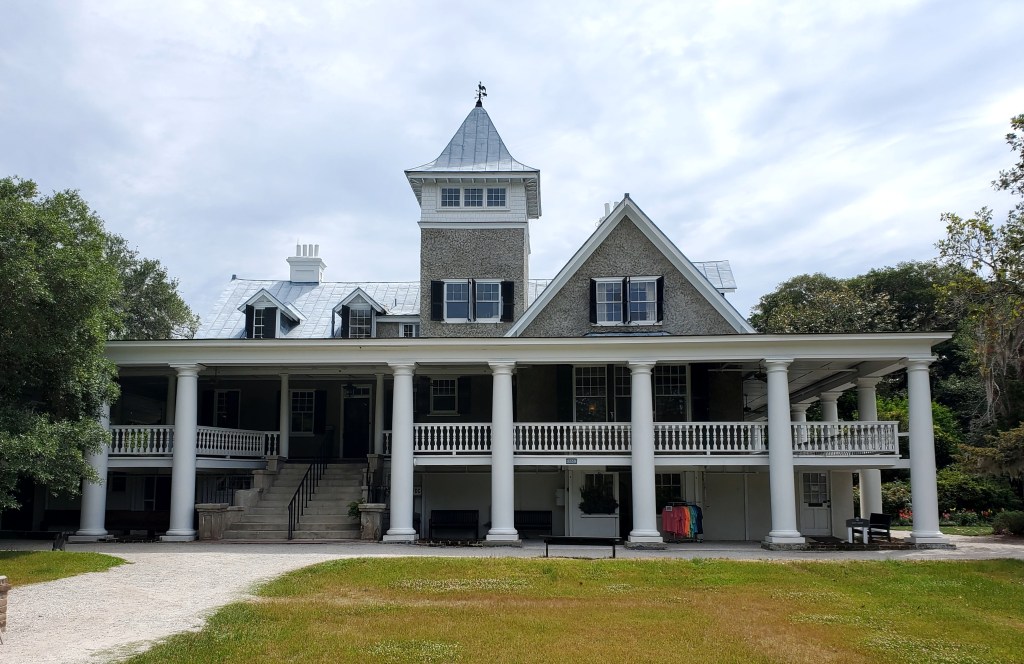
Surrounding Doric columns at Magnolia House 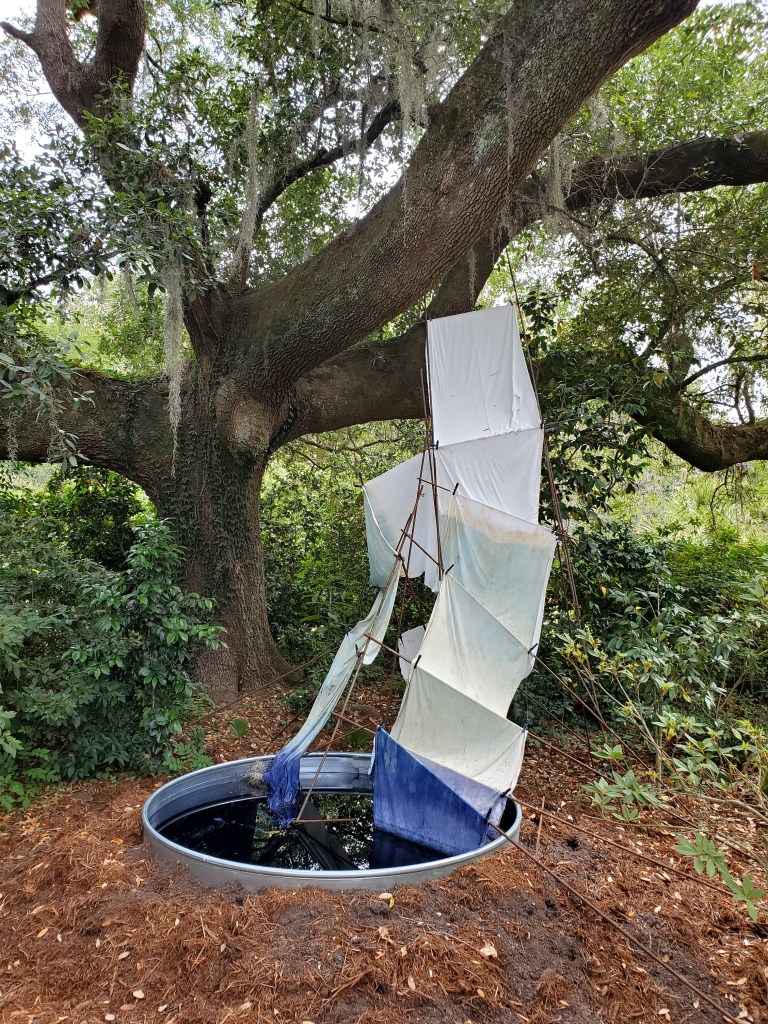
This exhibit honors Eliza Lucas Pinckney (1722-1793), who transformed agriculture in colonial South Carolina by developing indigo as one of its major cash crops. Managing three plantations (though not Magnolia) beginning at age 16, she was responsible for 1/3 of the value of the colony’s exports. 
A young miss admires Magnolia’s delphiniums 
Designed, legend has it, to placate Drayton’s bride reluctant to leave her home in Philadelphia, the gardens currently grace 25 acres of the property, in addition to the 16 acres devoted to the wide allée of live oaks approaching the house and 150 acres for a marsh and water fowl conservancy.
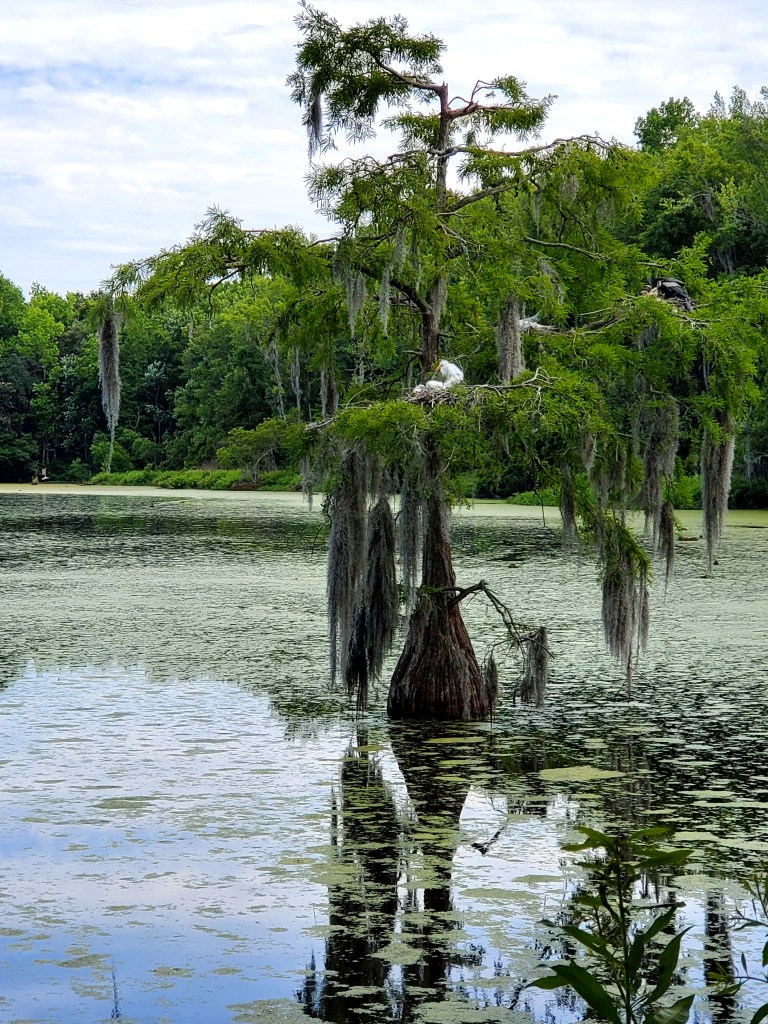
Ravenswood Lake and rookery 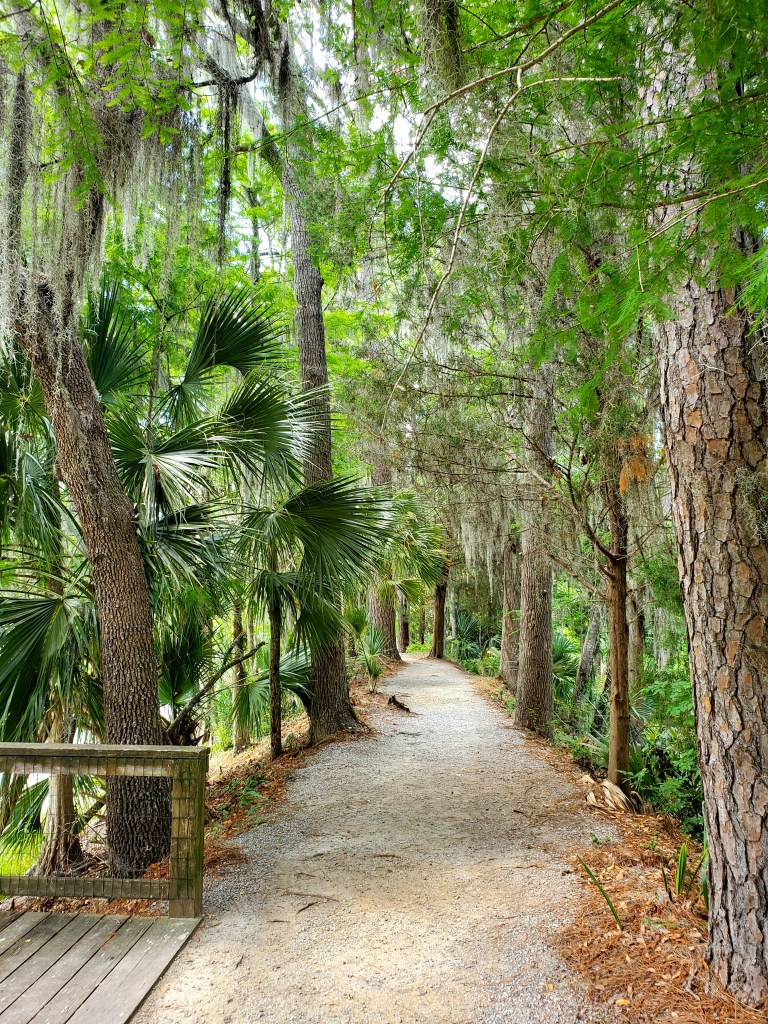
Trail at the Audubon Swamp Garden The Swamp Garden is named for James Audubon, who like Civil War photographer Matthew Brady, once visited Magnolia. Twentieth-century visitors included George Gershwin (who composed Porgy & Bess while staying in nearby Folly Beach), Henry Ford, and Eleanor Roosevelt; our guide was tickled to imagine Mrs. Roosevelt as a guest in a house that had no indoor plumbing.
The most impressive aspect of Magnolia today is, however, the “Slavery to Freedom Cabin Tour,” conducted by a passionate Irishman named John. Standing before a backdrop of the five cabins on site, four built before emancipation and the last around 1900, and clearly drawing on his own people’s inheritance of oppression, John evoked not only the visceral horrors of the Middle Passage, but the back-breaking, life-threatening work of planting and tending the rice fields of the master, as well as the brutal punishments meted out to enforce compliance with the overseers’ commands.
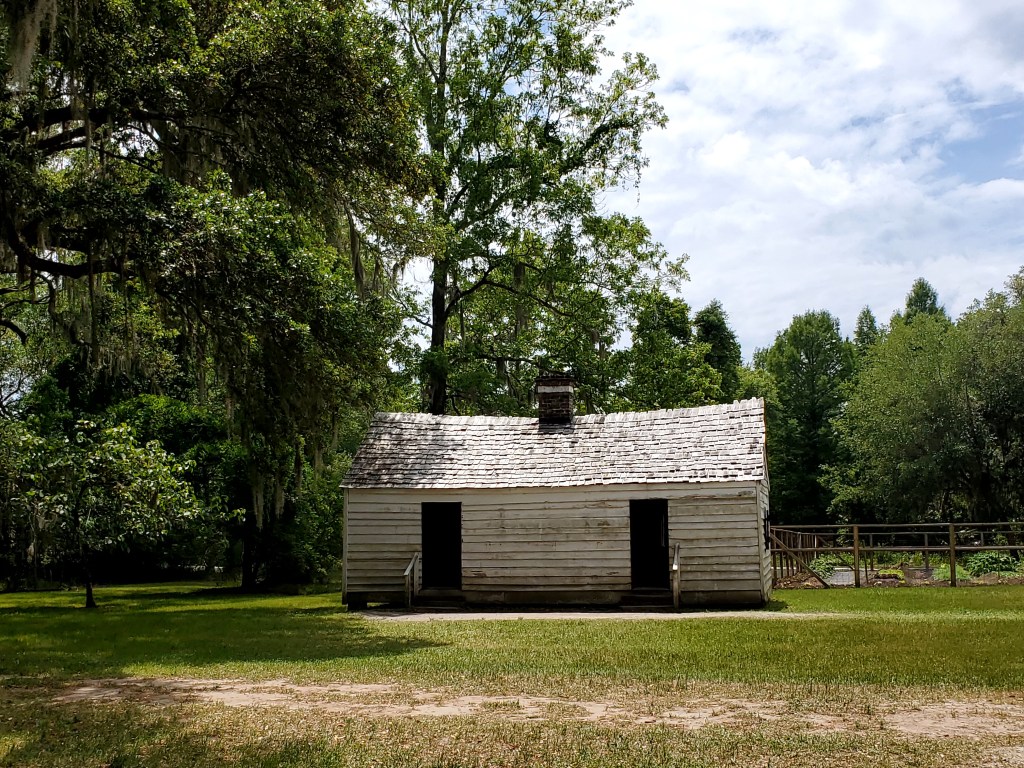
Oldest of the on-site slave cabins John spoke in the first person as one of the enslaved, then shifted to second person to further engage his rapt audience. He demonstrated the heel-drop-toe technique of planting rice, still used today in Uganda, as he learned from a native visitor.
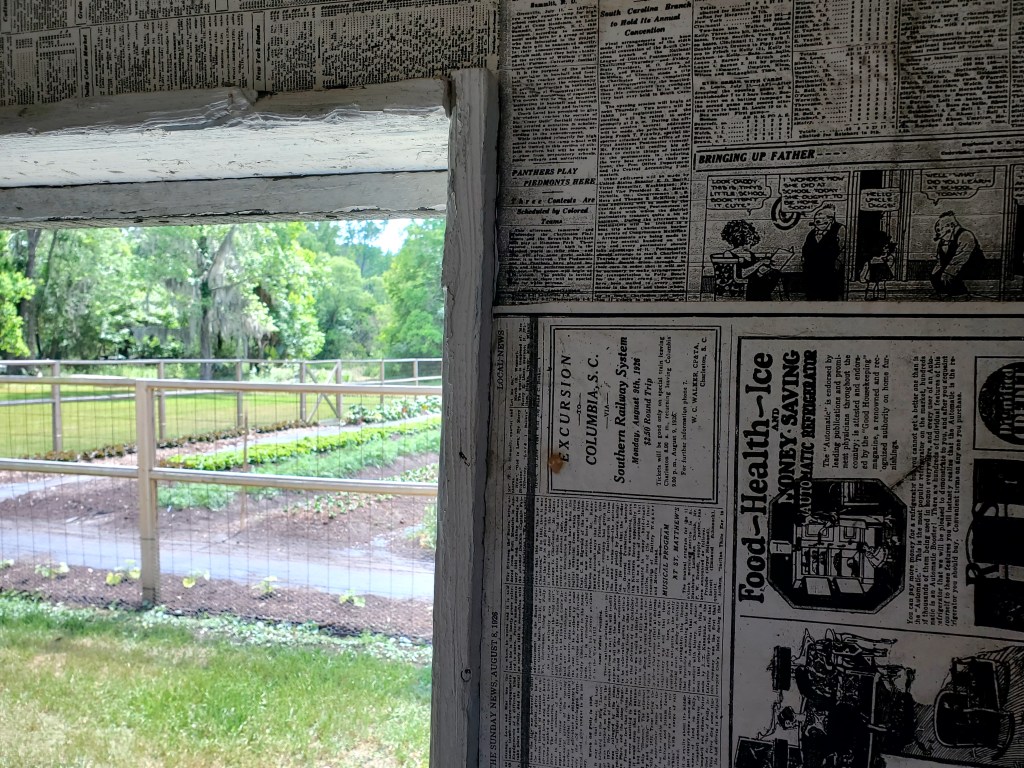
Inside a slave cabin papered for insulation with reproductions of contemporary newspapers John told, too, of the Leach family, specifically Johnnie Leach, who lived with his family in one of the on-site slave cabins from the 1940’s until 1969. Magnolia’s master gardener, “Mr. Johnnie” later lived in a modern dwelling at Magnolia until his death at age 93 in 2016. His grandson Jackson Leach continues to work the gardens at Magnolia.
That John told the true history of Magnolia so vividly and memorably proved the most enduring takeaway from our trip.
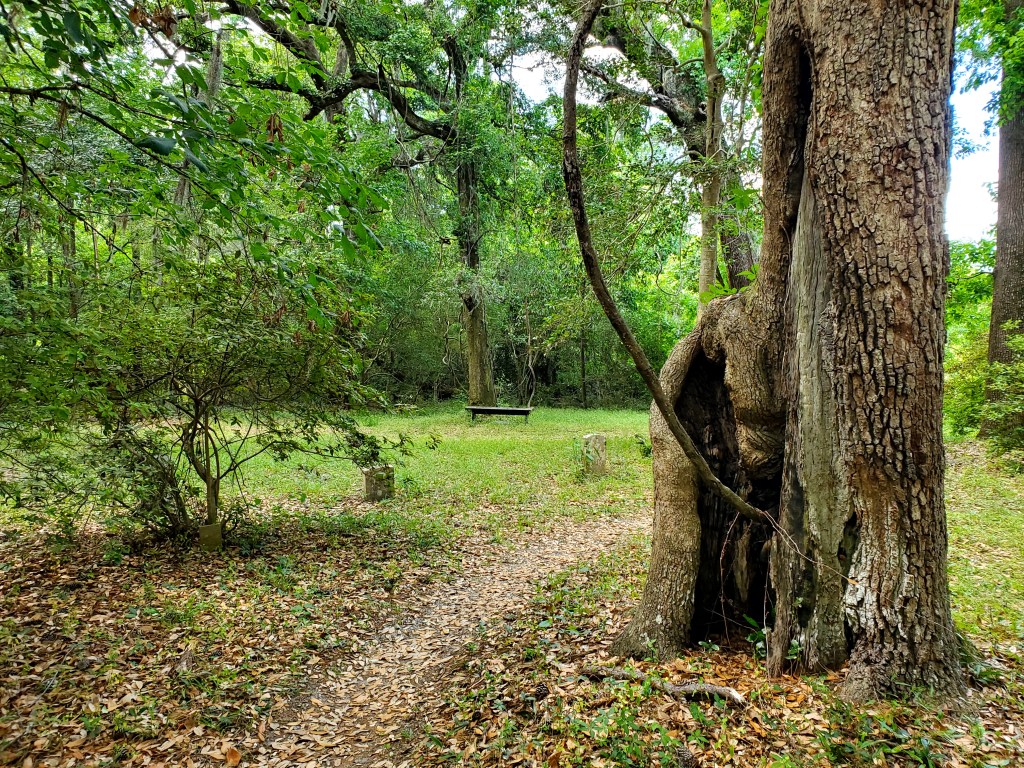
African American Cemetary at Magnolia Plantation 
One of the many eponymous magnolias in bloom It took a dip in the inviting Hampton Inn pool to accomplish the transition to that evening’s entertainment: The Charleston RiverDogs vs. the Carolina Fireflies at “the Joe,” the Joseph P. Riley, Jr. ballpark further downstream on the Ashley River.
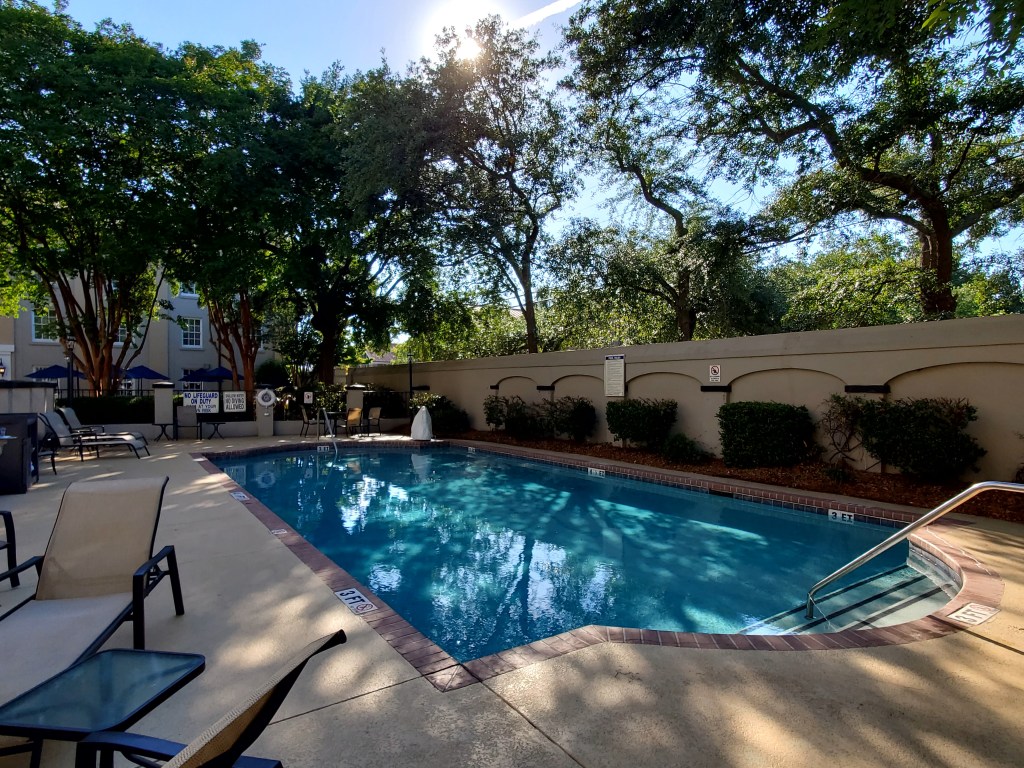
Hampton Inn pool across from the Visitors Center on John Street The RiverDogs, a Single-A affiliate of the Tampa Bay Rays, have Bill Murray as one of the principal owners, and every first and third Tuesday night is Dog Day, when all canines are invited to attend, granting even more fun to America’s pastime.
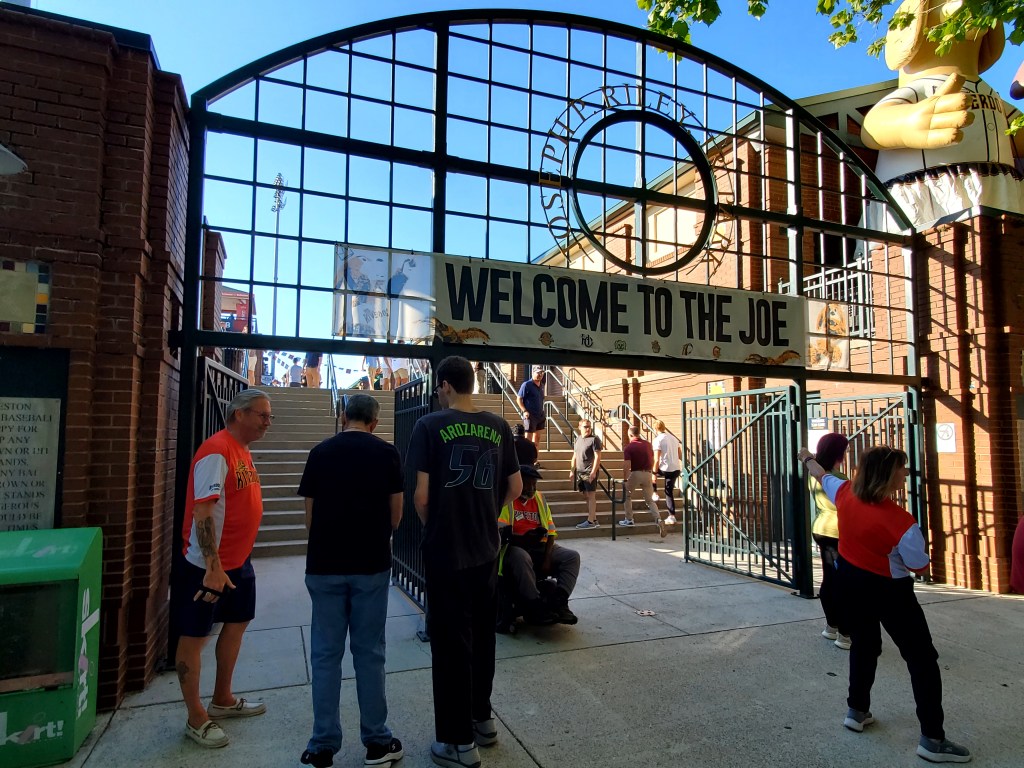
Richard and my very tall nephew Daniel at “the Joe” 
(Bill) Murray’s Mezzanine at the Joe 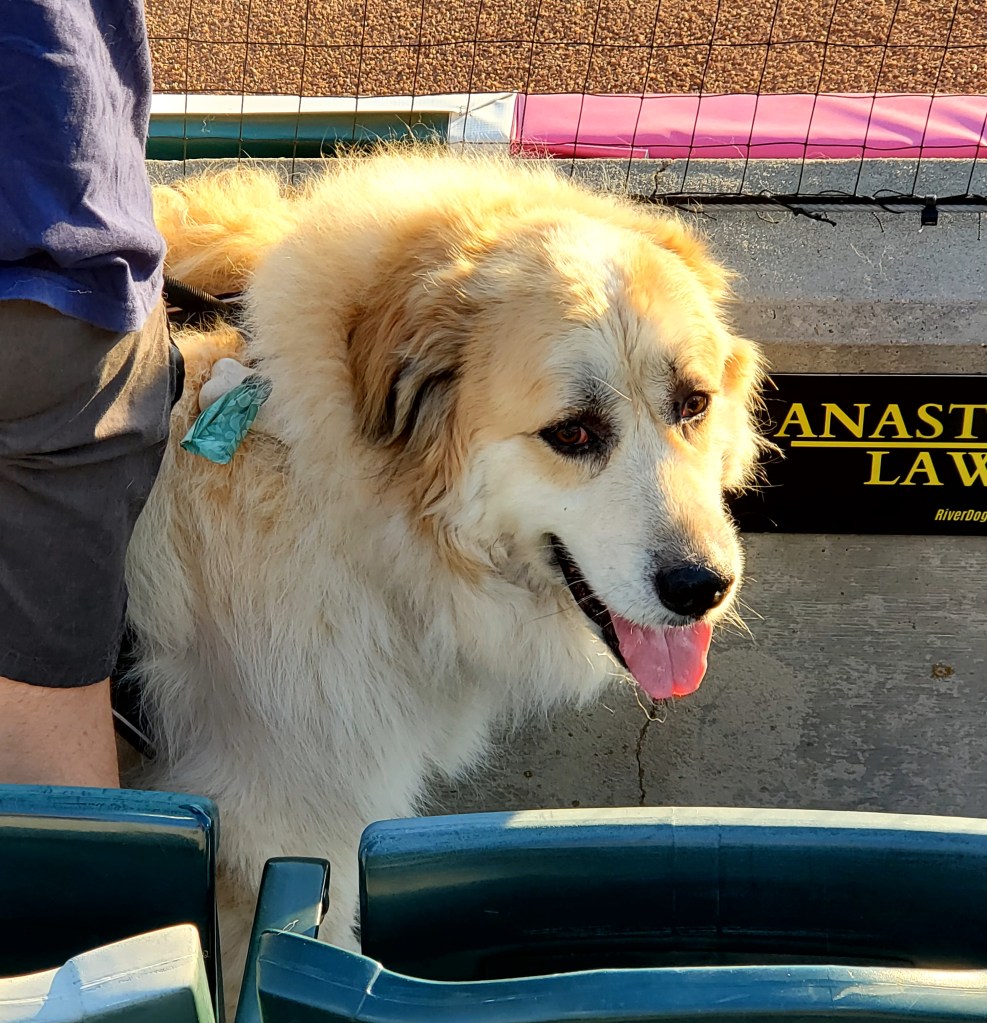
The night was fine, the RiverDogs won, we had catfish and local Overly Friendly beer for dinner, and retired back to our Hilton happy.
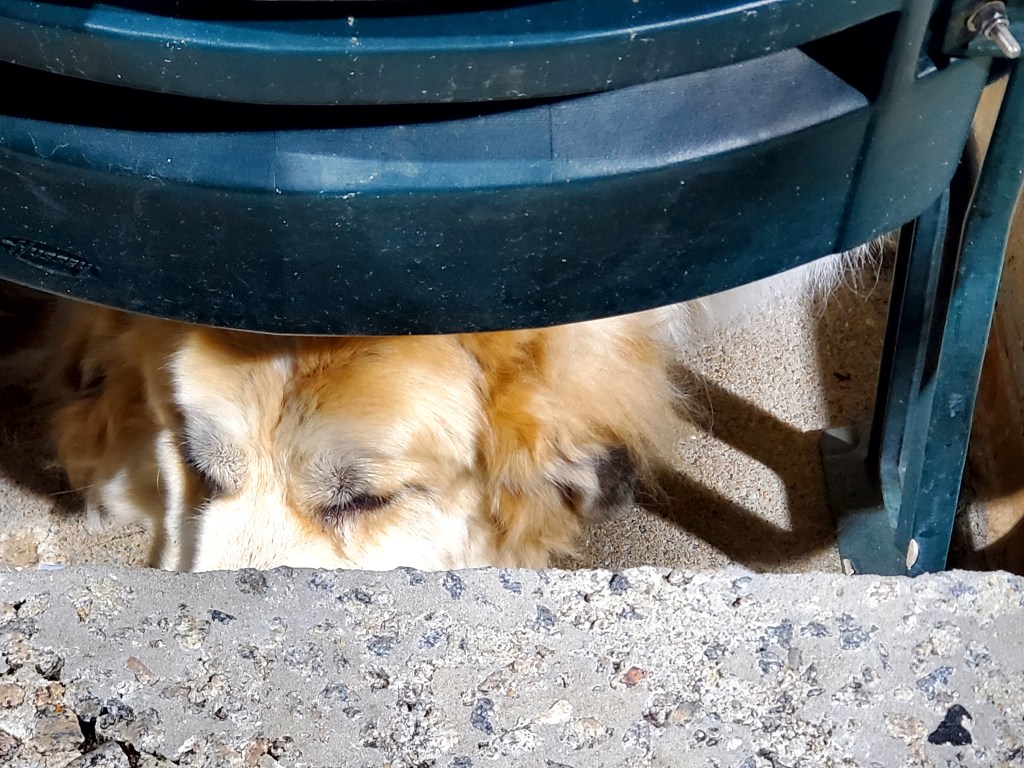
8th inning collapse after the 7th inning stretch at the Joe -
Low Country Visit/Charleston
4-5 May 2025
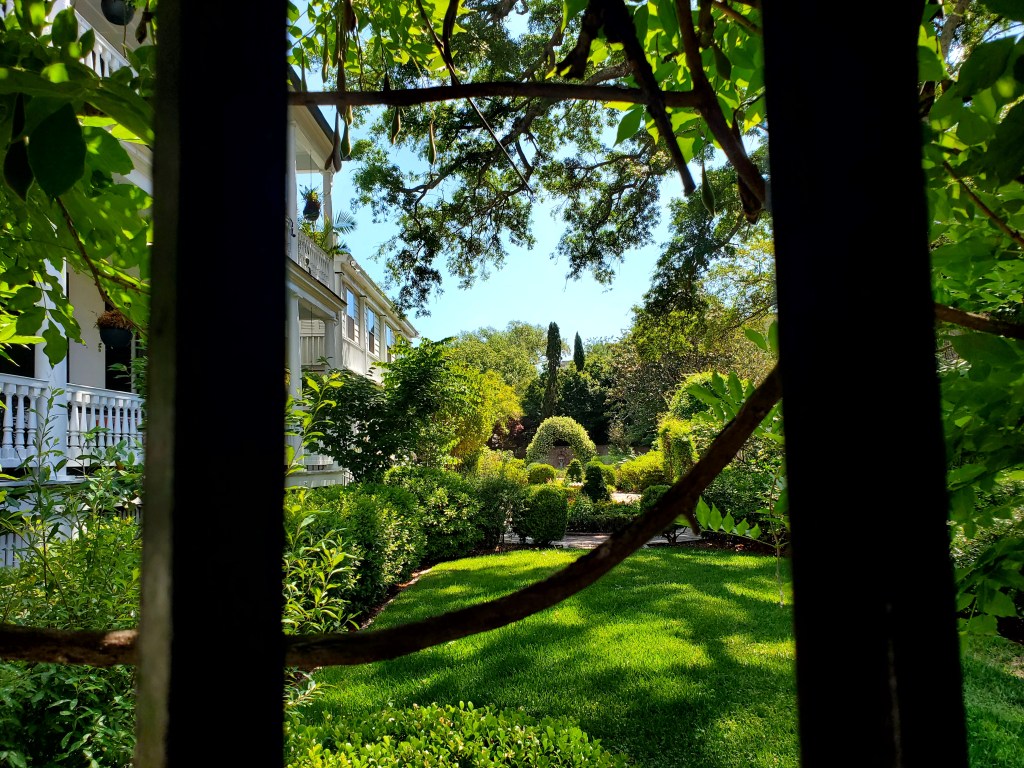
Charleston view: gorgeous side gardens viewed through the fence wrought by Peter Simmons, enslaved blacksmith who taught his more famous successor, Philip Simmons, his masterful art Gosh, the Uber driver who returned me to the Charleston Airport last Friday, born in Dubai to Pakistani parents, is a well-educated former business analyst and a naturalized citizen who believes that America is the land of opportunity. Despite losing his desk job and subsequently maintaining a brutal driving schedule five days a week to meet his self-imposed daily income goals, Gosh believes in his adopted country, and in making the best of whatever setbacks the universe hands him: he’s determined to establish a nationwide distribution business and one day give a TED talk on the success he’s made for himself and his family in the U.S. He showed me pictures of his two dogs, precursors to the children he hopes soon to have with his wife, an IT specialist who likes Shakespeare. At his request as we neared the airport, I shared my brief story of work, love, loss, and my own relationship with the universe, and gave him my card touting my Will to Live book, which he promised to share with his wife. We agreed on the old-fashioned efficacy of business cards, wished each other well, and parted.
My flights back home were eventful only in recalling the many times I’ve left loved ones behind, prompting some tears; crying on planes, I have heard, is not uncommon. Each painful parting recalls others past as one slips the surly bonds of earth. I had Magda Szabό’s The Door for company, a novel about the distance that separates even those who love ferociously, contributing, as did Gosh, to the philosophical speculation that comes unbidden in the liminal space of an airplane cabin at 30,000 feet. I returned to Madbury in the dark in the rain, grateful to be home after so rich and evocative a visit to Charleston, South Carolina and barrier island Folly Beach with my brother-in-law and nephew, our third reunion in the almost 15 months since my sister’s passing. At home, the daffodils are blown, the lilac and azaleas in bud. My takeaway from our low country encounter: an accurate retelling of history is alive and well among the guides who led us around Charleston, the Magnolia Plantation, and Ft. Sumter. Charleston’s gracious beauty and charm was never allowed to obscure the fact of its dependence on enslaved people. No “war of Northern aggression” whitewashing of facts, no arguing that the Civil War was about states rights. The war between the states was about slavery, the country’s original sin for which we continue to pay a terrible price. Hearing that truth honestly told, together with a break from the 24/7 reporting of the Felon-in-Chief’s latest atrocities and a much-anticipated family reunion, was a tonic comfort and joy.
On arrival at the Hampton Inn last Sunday afternoon, the excellence of the hotel’s location at the intersection of Meeting and John Streets was immediately apparent: once a burlap warehouse, this Hilton property is directly across from the Charleston Visitor Center (formerly a train station) on John Street and the Manigault House on Meeting.
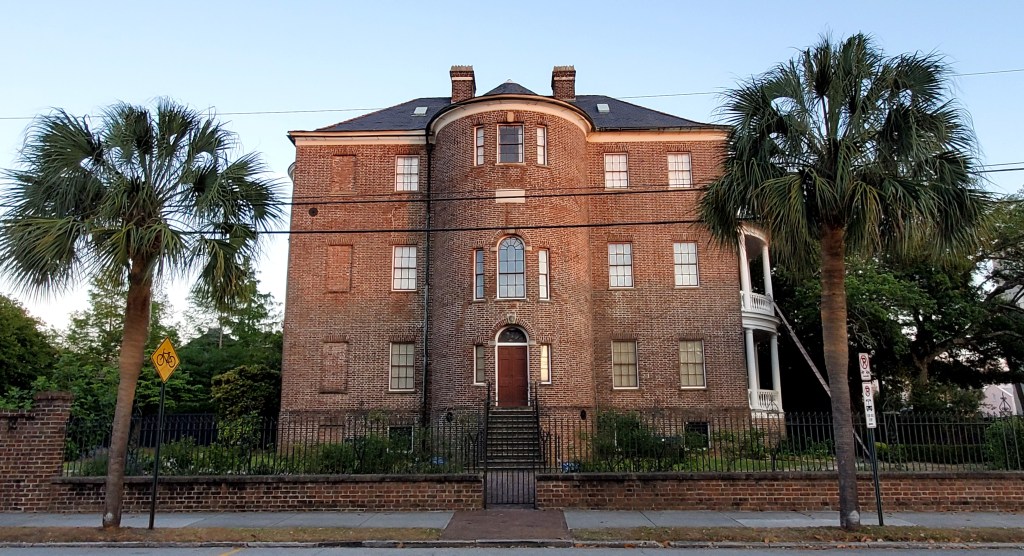
Manigault House’s public façade, Gabriel Manigault, architect (1803) Built in 1803 by enslaved laborers using primarily local materials, Joseph Manigault’s house is a remarkable example of the severe Federal architecture that inspired David’s and my Gnawwood. From its imposing symmetry, blind windows, and Adamesque detail to its high ceilings, light-filled rooms, two-story piazzas, and curving central staircase, the Manigault House is a beauty spared from demolition in the 1920’s and, acquired by the Charleston Museum in 1933, signified the beginning of the preservation movement in Charleston.
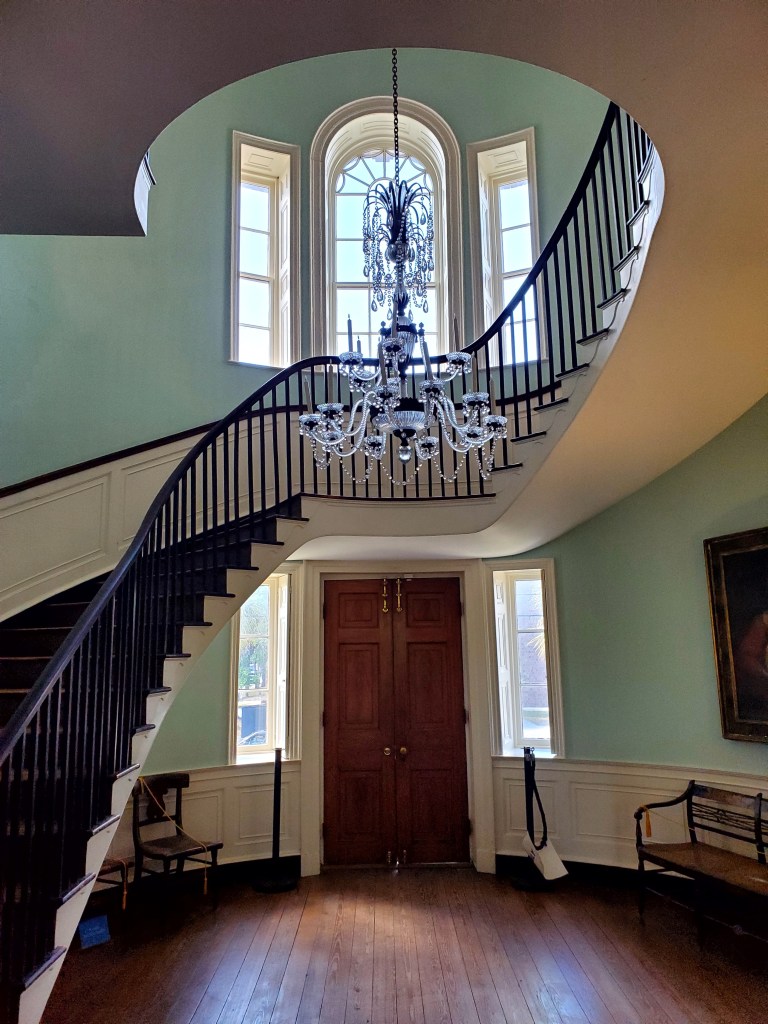
Manigault’s lyrical staircase: every 4th baluster made of iron for stability 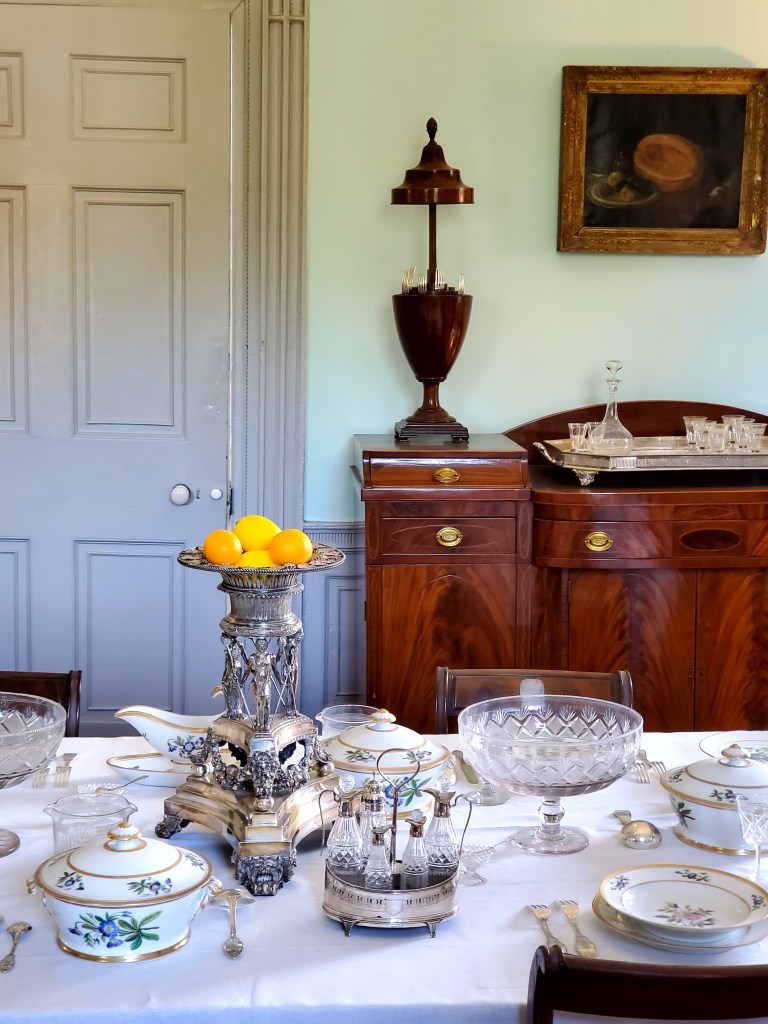
Dining room with unique fork urn 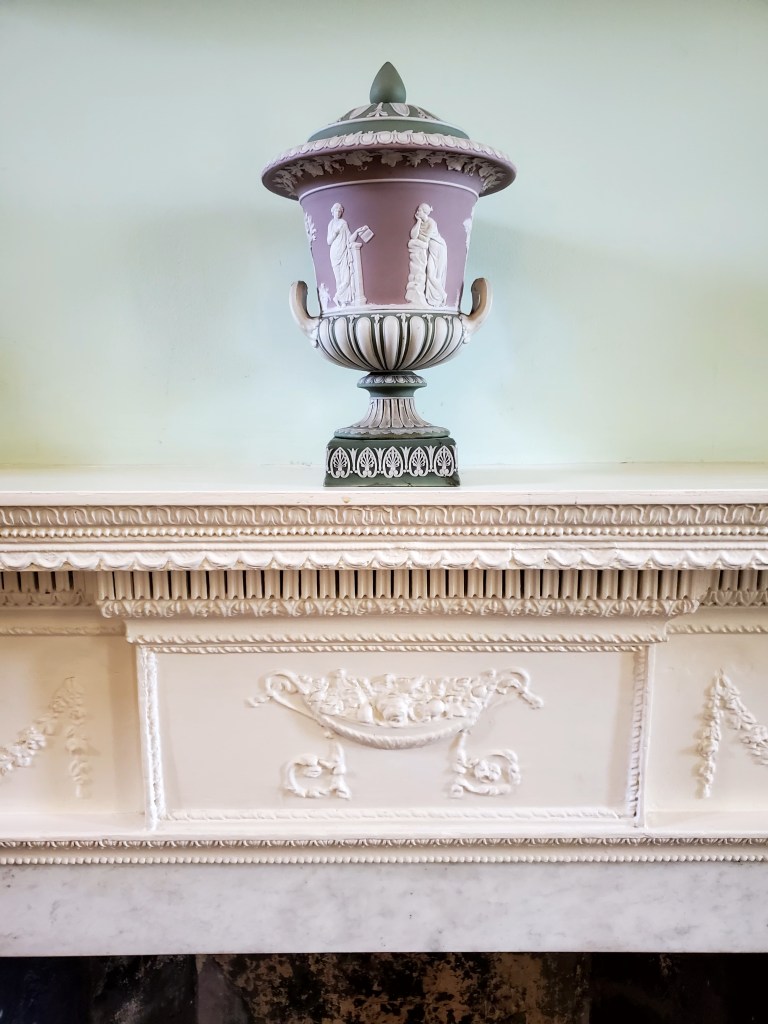
Detail in the style of neoclassical architect Robert Adam, 1728-1792 A National Historic Landmark since 1973, Manigault House’s graceful west façade is visible from the Hampton Inn pool, a boon for this tourist on a warm day. Maintaining its original iteration, however, was far more demanding; the House lacked both running water and indoor toilets. Our excellent guide let us know it took 27 enslaved servants to keep the Manigault family in comfort. A descendant of French Huguenots who settled in Charleston around 1685 and later amassed great wealth as merchants and rice planters during the 18th century, Joseph Manigault inherited several plantations from his forebears, which produced rice and other crops through the extensive use of enslaved labor. The canopy bed in the master bedroom testifies to the importance of that prized Carolina Gold rice, a variety of African rice that by 1750 made Charleston the hub of Atlantic trade (in goods and slaves) for the southern colonies, and the largest, wealthiest city south of Philadelphia.
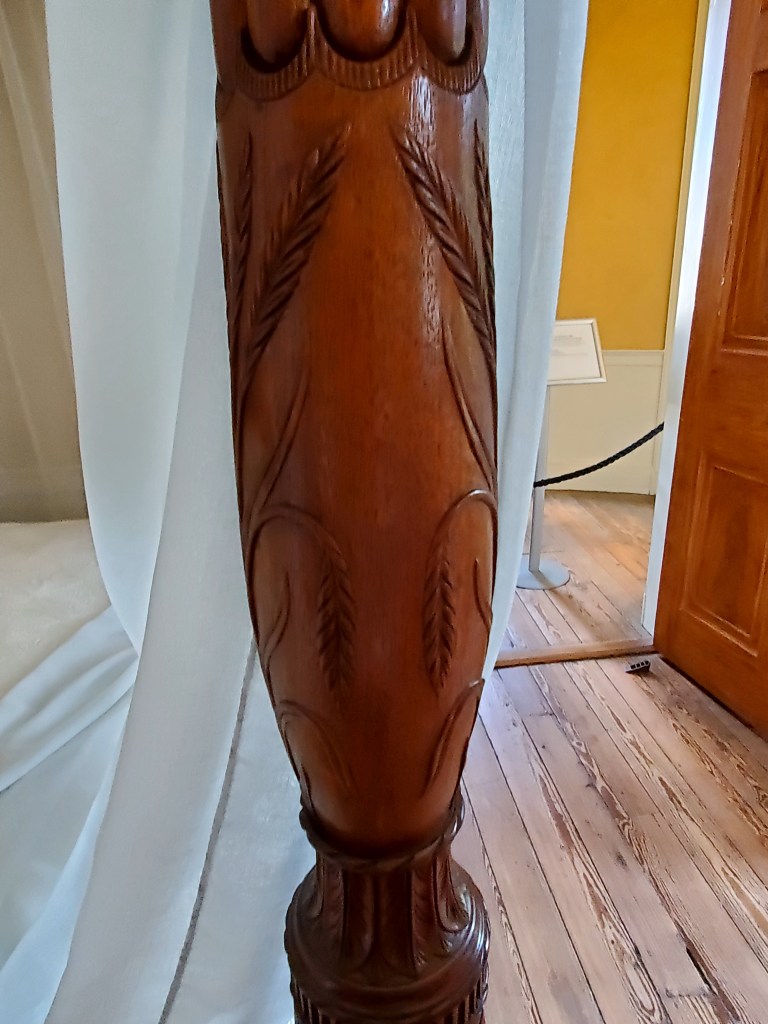
Carolina Gold Rice celebrated on a bed post 
Manigault House garden façade 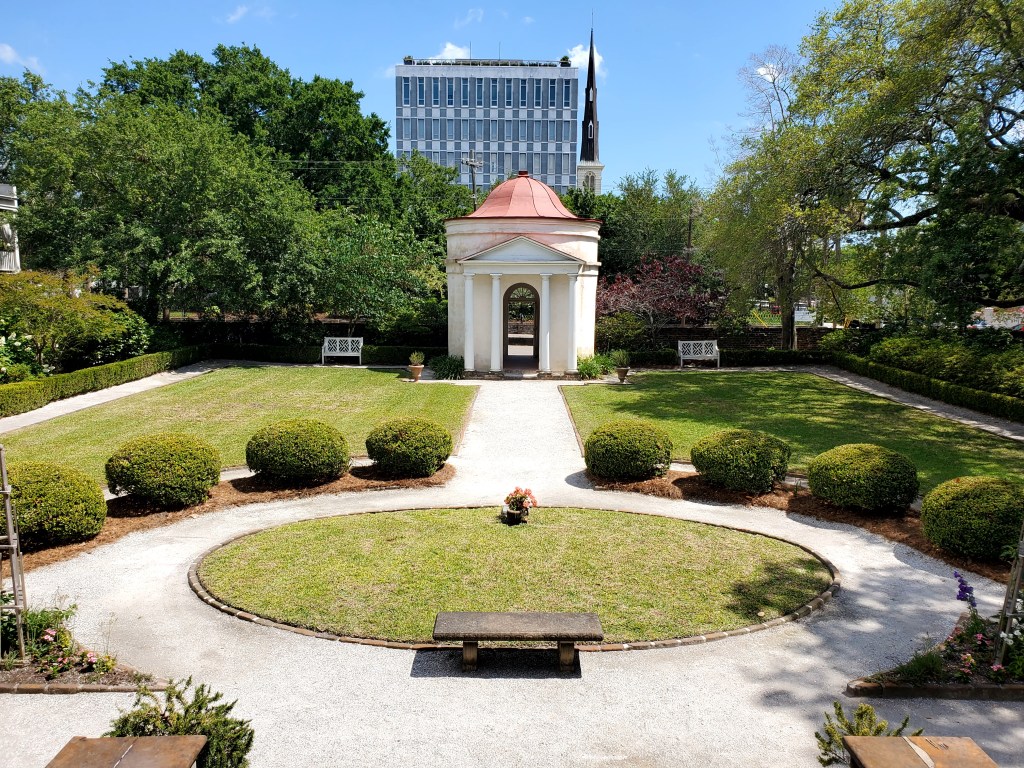
. . . and Gate House juxtaposed with 1950’s architecture We had begun our acquaintance with Charleston on Sunday afternoon at the Visitor Center, booking a walking tour for the next morning, surveying the neighborhood, and enjoying a low country dinner at Virginia’s on King (my mother Virginia would have enjoyed the crab cakes as much as I did).
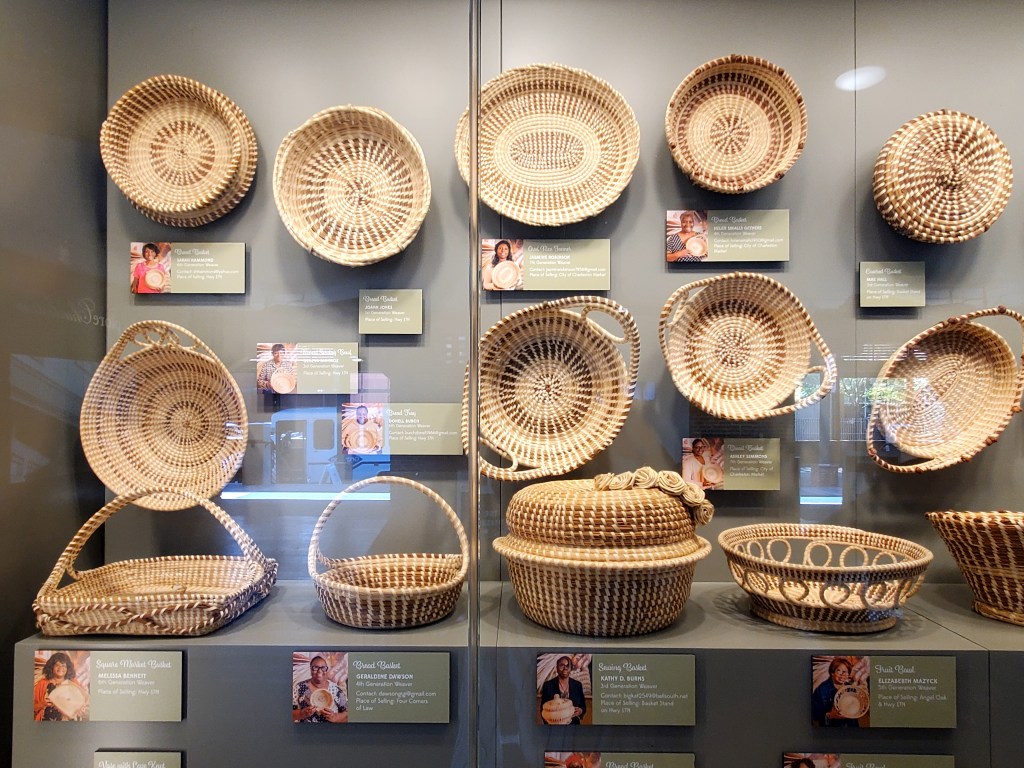
Sweetgrass baskets at the Visitors Center 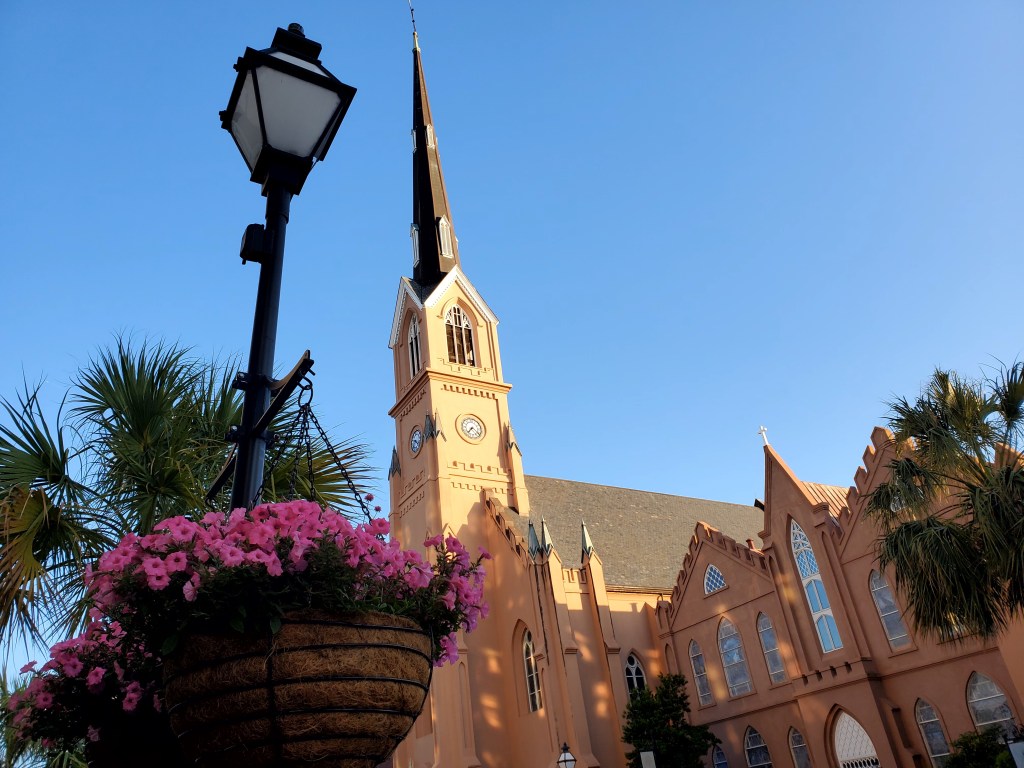
St. Matthew’s Lutheran Church 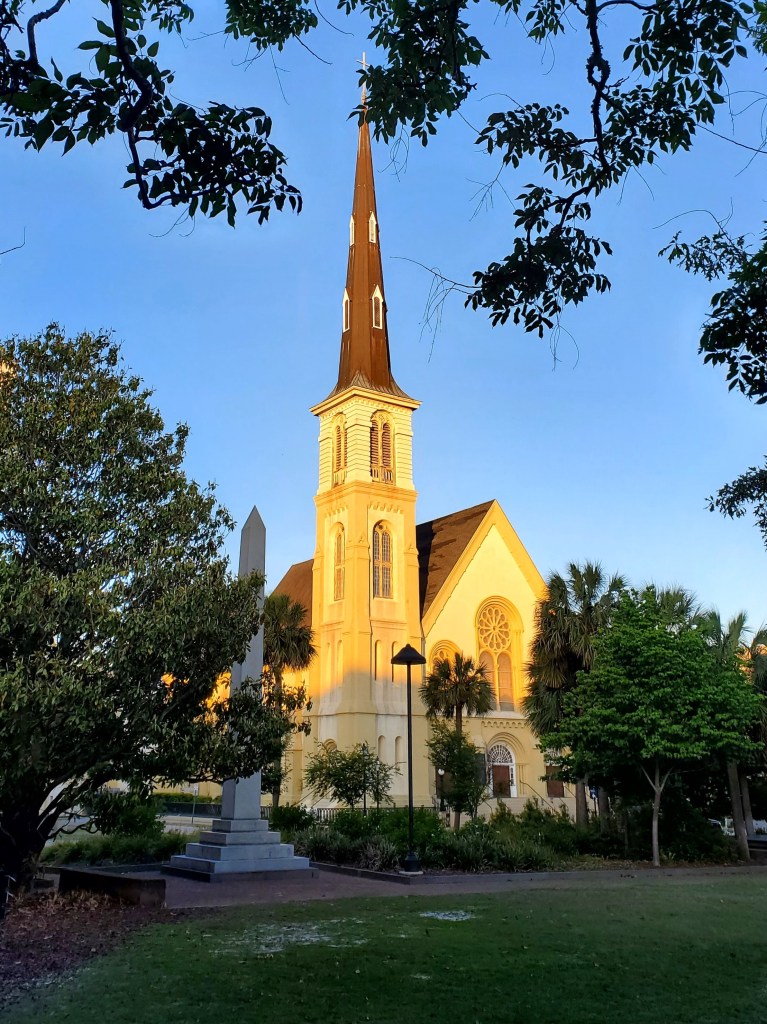
Citadel Square Baptist Church on Marion Square Monday morning, we walked the mile down Meeting Street to the spacious historic Mills House Hotel, designed by architect John E. Earle and opened in 1852, to meet our Bulldog tour guide, Fran Bennett, witty and encyclopedically knowledgeable Charlestonian whose family dates back to the 1680’s. She led our small group on a most informative and entertaining two-hour tour, from Washington Square south of Broad to the High Battery on the Cooper River, winding through the charming streets of Charleston’s southeast peninsula and finally back to the Mills House.

Tour guide Fran Bennett (photo by Richard Lupi) Ms. Bennett, clad in a batik dress of her daughter’s design, illuminated all manner of Charlestoniana with fun facts: Spanish moss is an epiphyte, neither Spanish nor moss; artifacts preserved by rat urine in their nests help date historic houses; “Charleston green” paint is cheap and abundant black paint slightly tinted with the addition of yellow paint; and the difference between a graveyard (burial ground next to a church) and a cemetery (not associated with a church). At the Four Corners of Law, representatives of ecclesiastical (St. Michael’s Anglican Church), federal (the U.S. Post Office and Courthouse), county (Charleston County Courthouse), and city (City Hall) law meet impressively at the intersection of Meeting and Broad Streets.
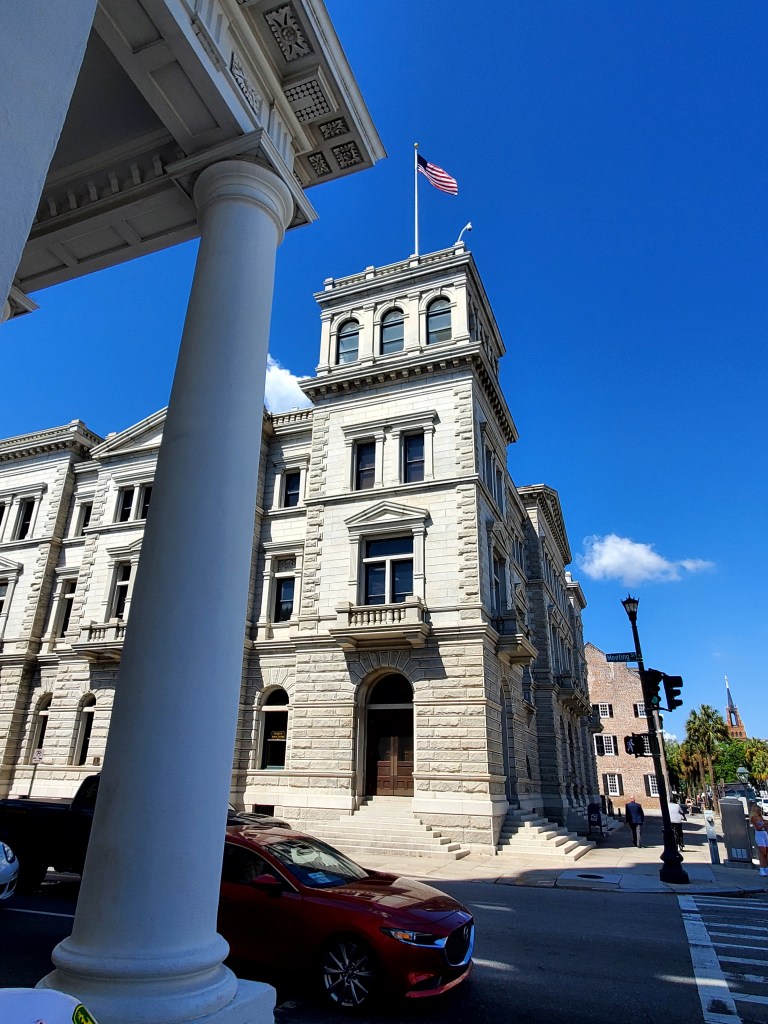
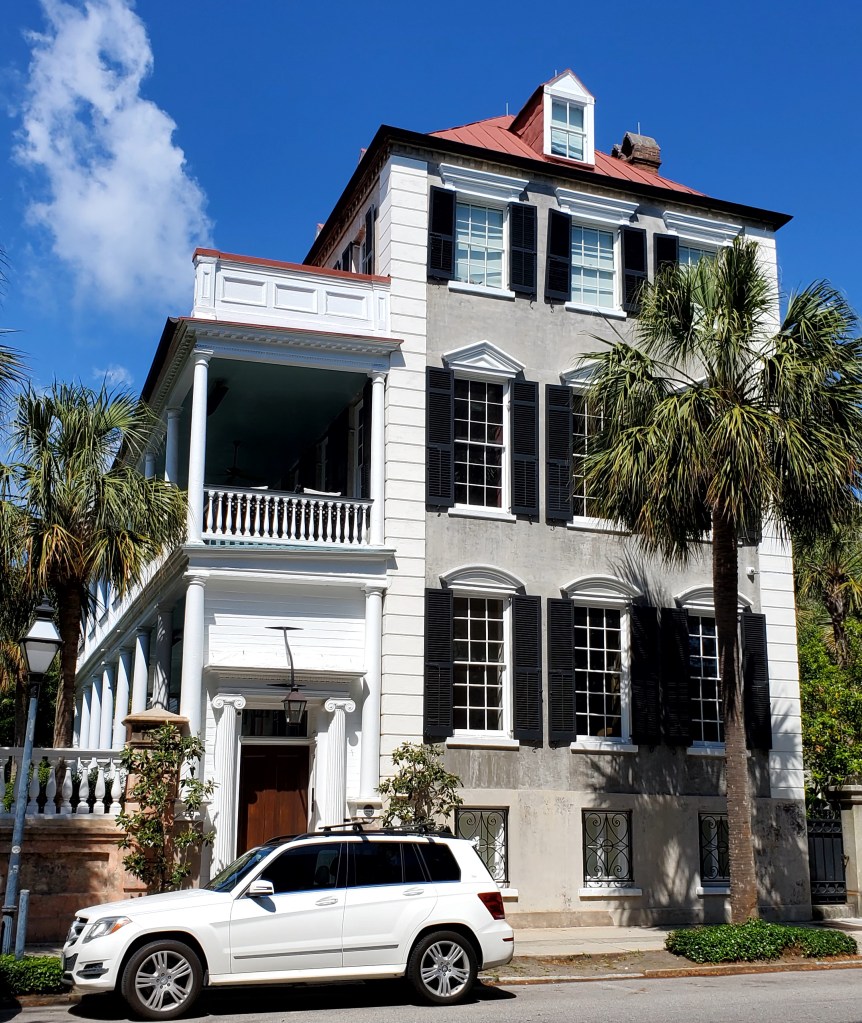
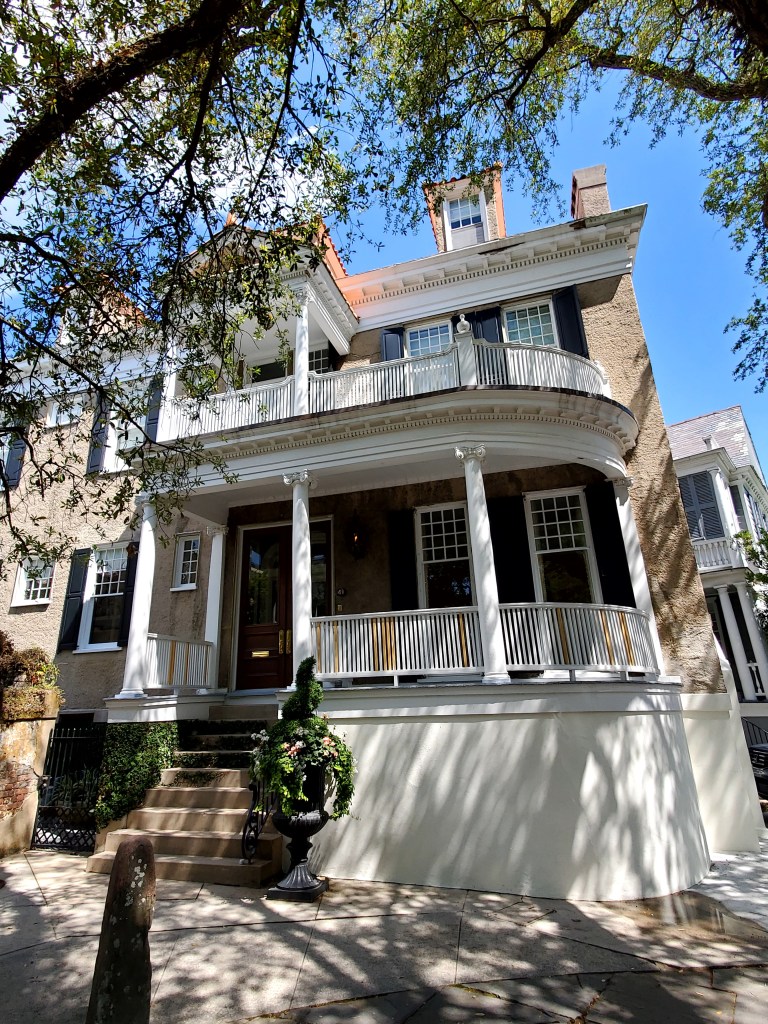
The Post Office and Courthouse (1896, John Henry Deveraux, architect) seen from the columns at St. Michael’s Anglican Church, the oldest surviving church in Charleston, built 1751-1761 Charleston is known as the Holy City because of its plethora of churches, but the feature most impressing me remains the single houses with their “piazzas,” covered sides porches that extend living space and offer cooling breezes, often overlooking pocket gardens shaded by live oaks.
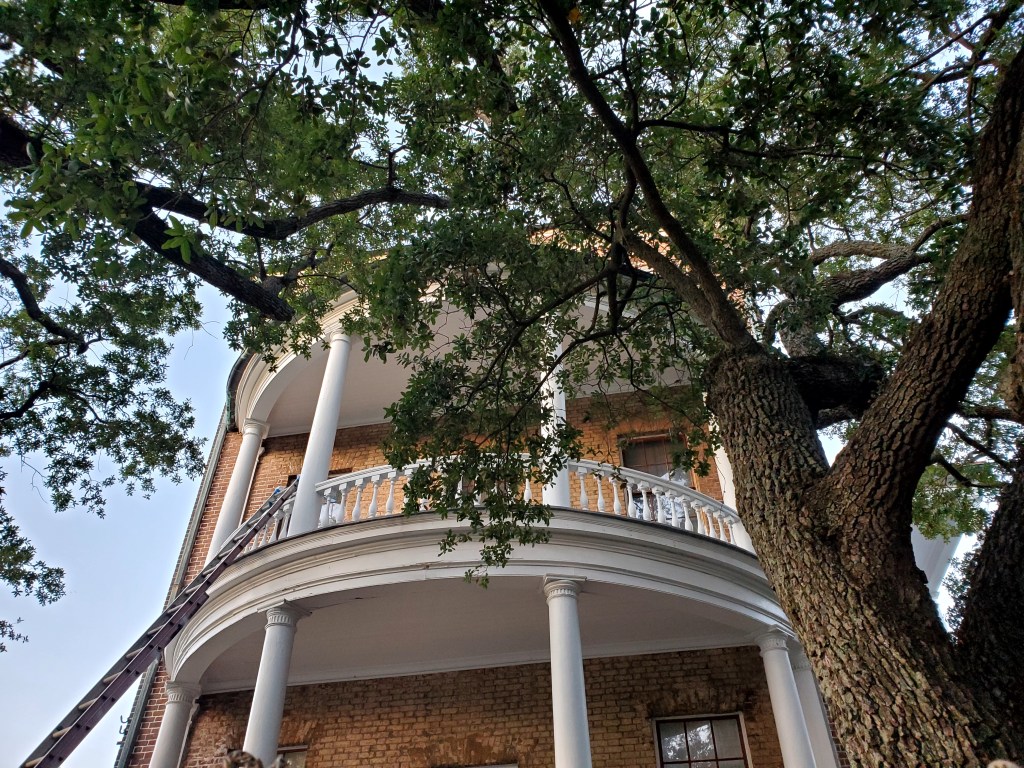
Piazzas on the Manigault House . . . and all around town 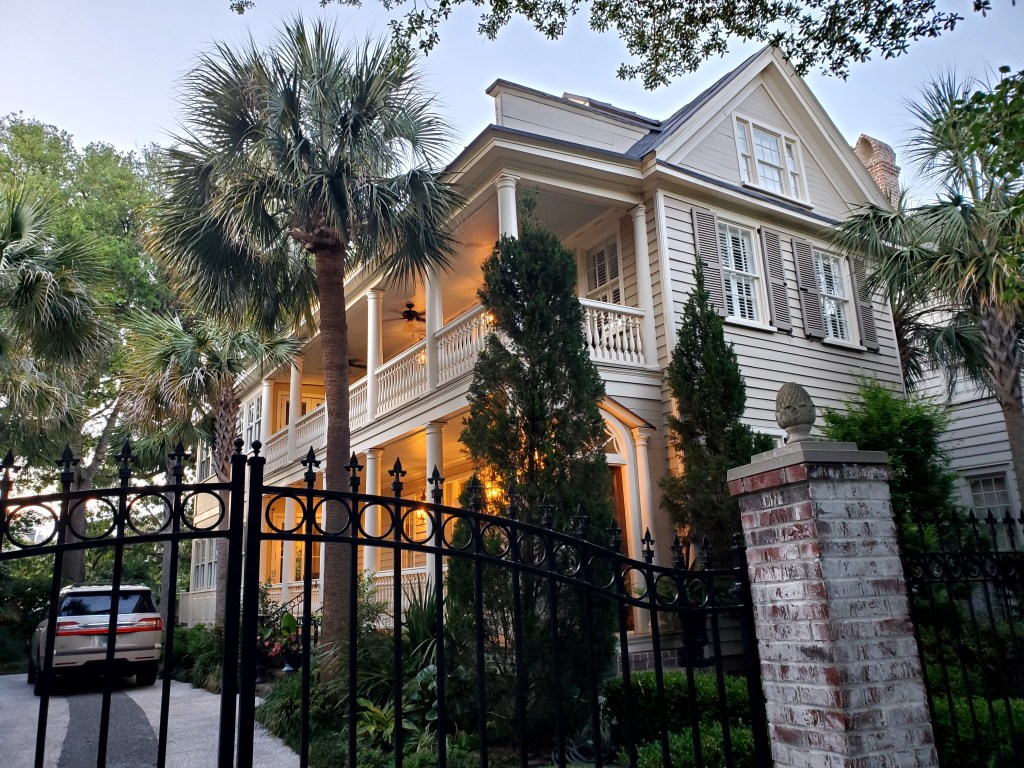
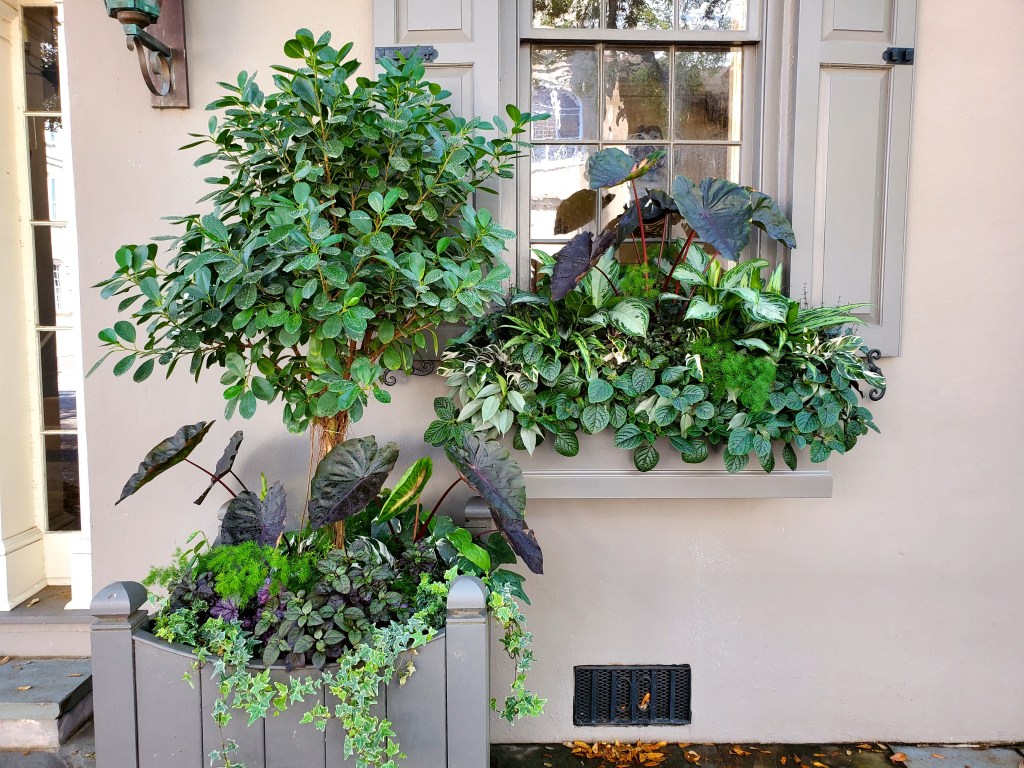
Charleston window boxes sport “thrillers, fillers, and spillers” 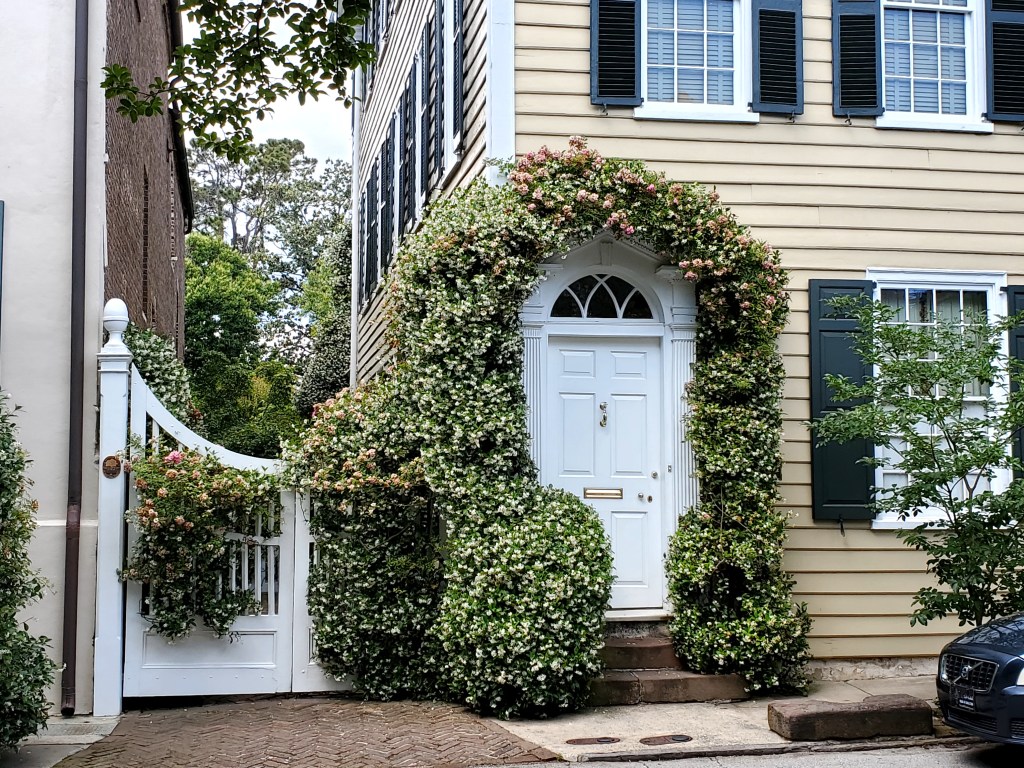
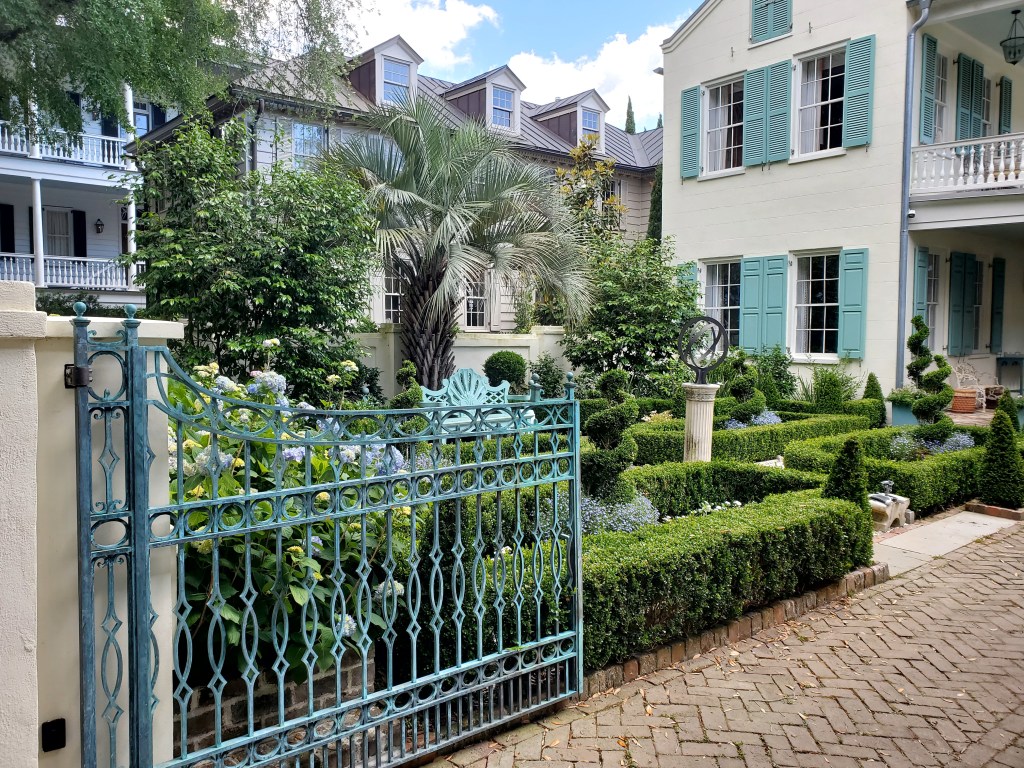
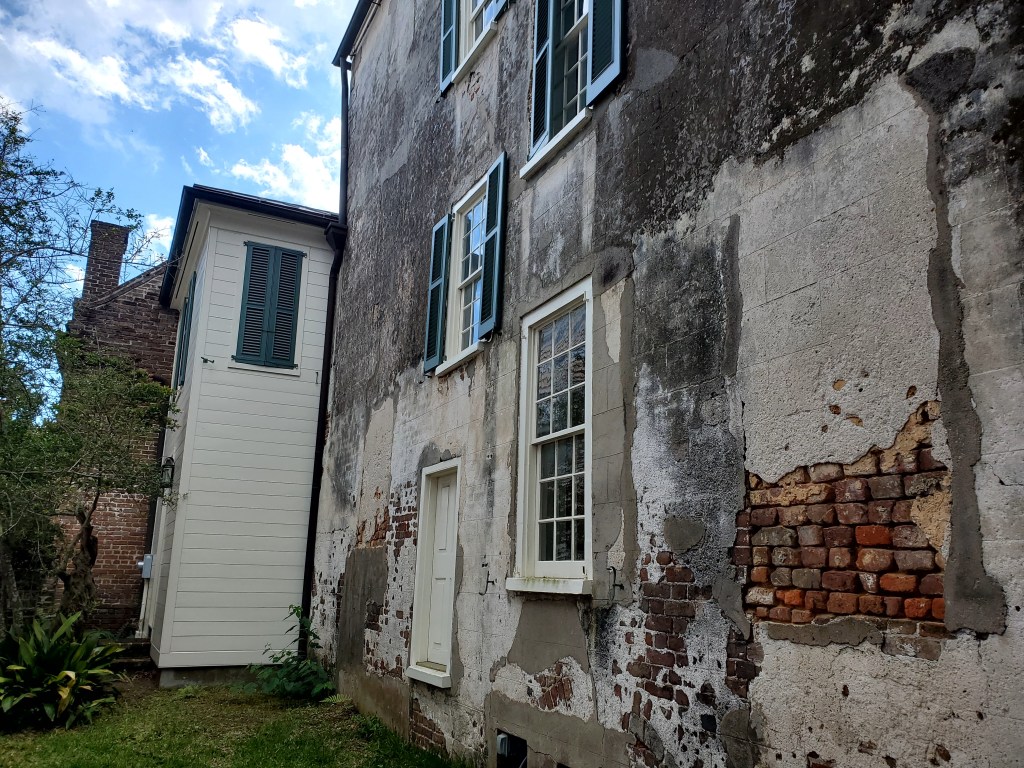
A “hyphen” joins the main building (with its brick structure revealed under the stucco) to its dependency 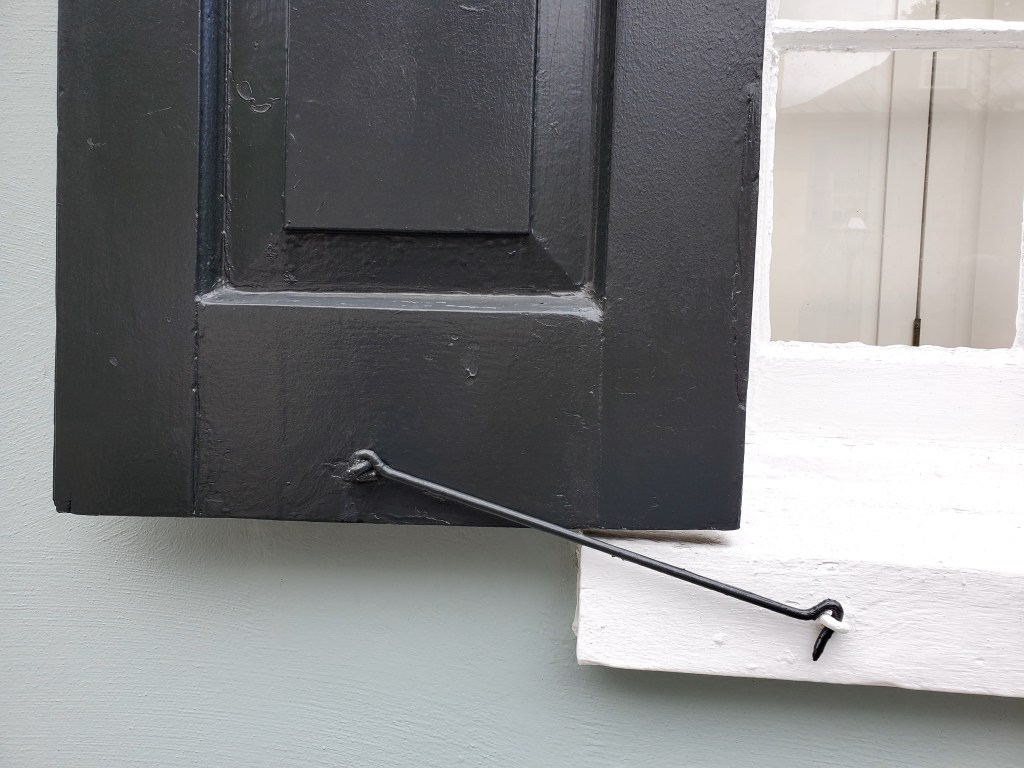
A shutter of Charleston green Post tour, we caught the free DASH (Downtown Area Shuttle) bus back to the Hampton Inn, had lunch at the Dueling Piano, and after touring the Manigault House, had a fine dinner of moules and halibut at the Rue de Jean next door. A good, full day.
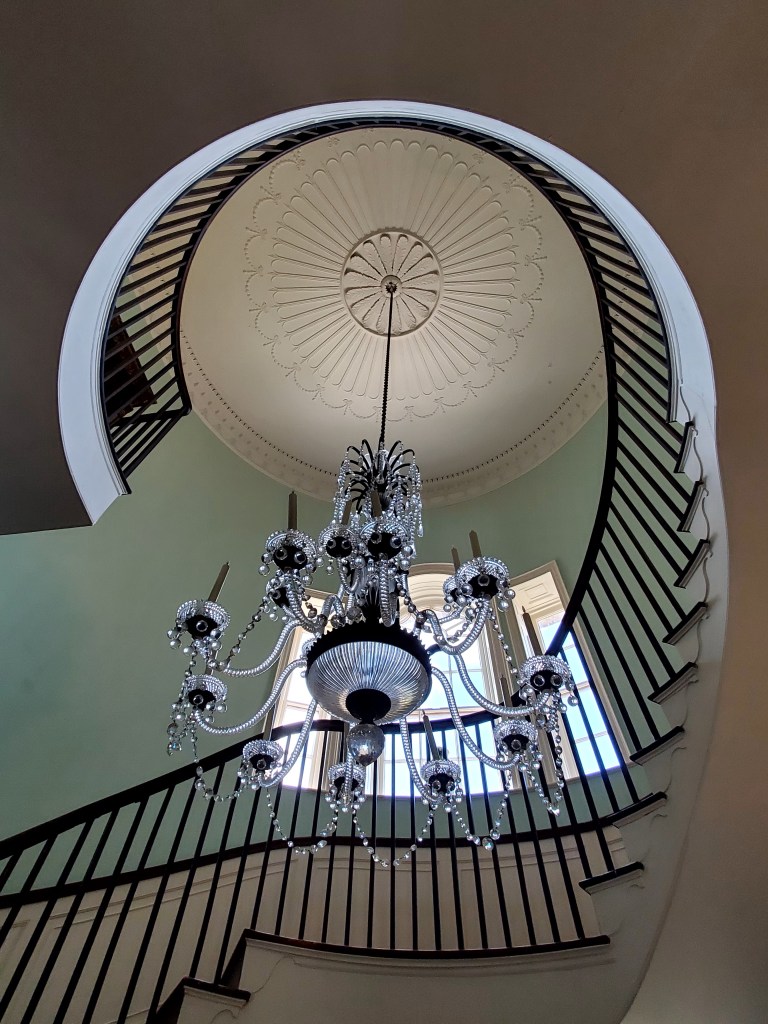
Chandelier at the Manigault House 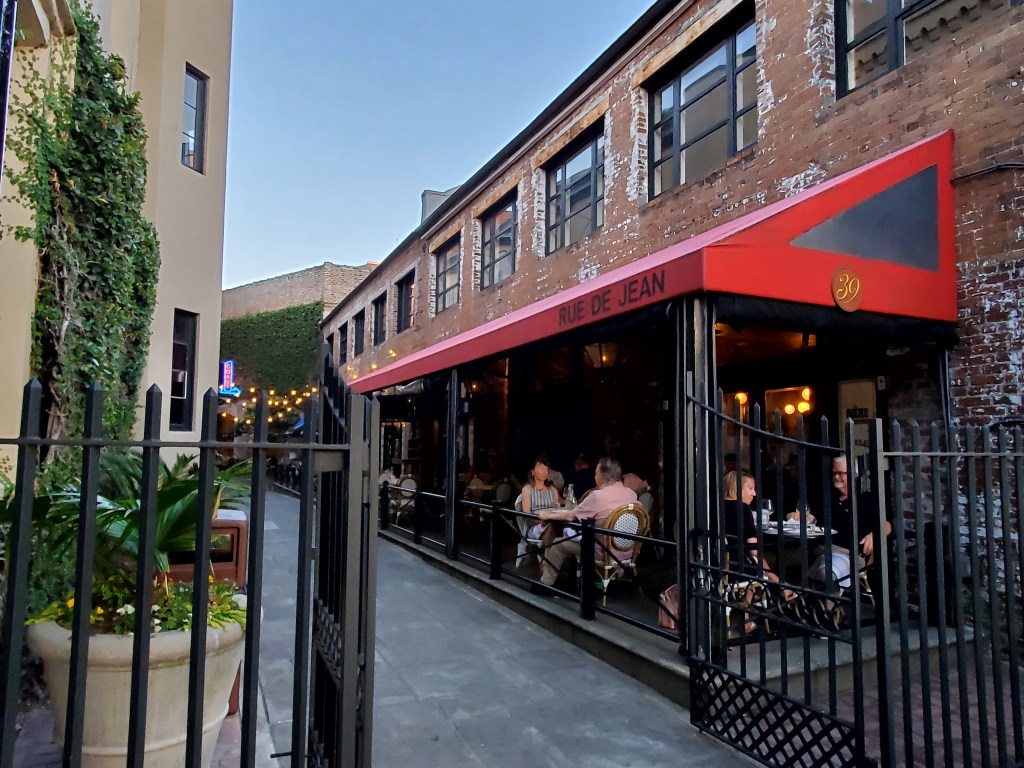
-
April 2025
3 May 2025
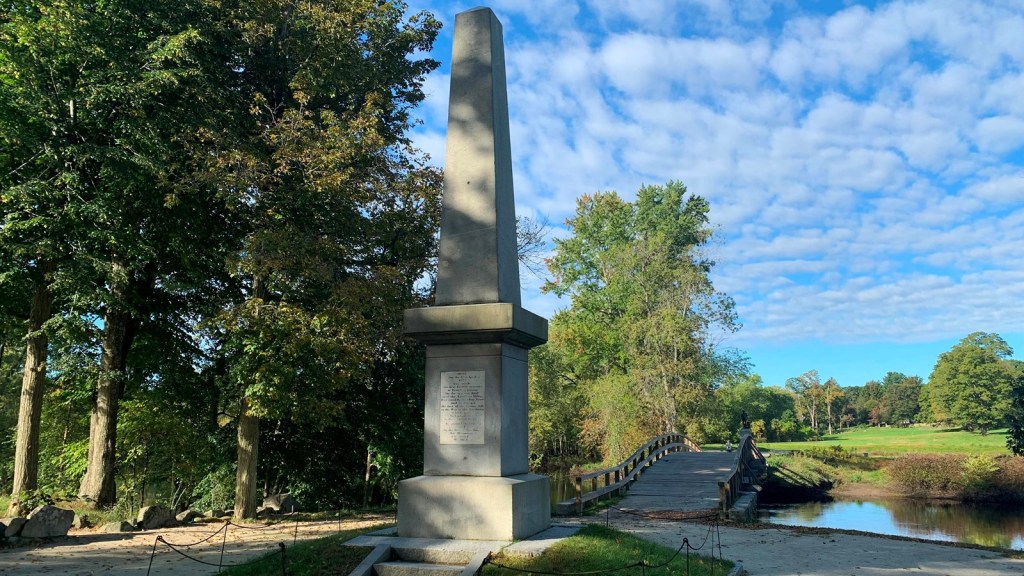
1836 Monument at the North Bridge battlefield, Concord MA (photo by NPS) April may not be the cruelest month, but this one certainly has been crowded with incident. My neighbor Leo turned 7 on the 5th, David Letterman 78 on the 12th; my dad George would have been 103 on the 22nd, also my parents’ 78th anniversary. And some would reckon the U.S. turned 250 on 19 April 2025:
By the rude bridge that arched the flood,
Their flag to April’s breeze unfurled,
Here once the embattled farmers stood
And fired the shot heard round the world.
(“Concord Hymn,” Ralph Waldo Emerson)
As the Felon-in-Chief attempts to censor art he considers unpatriotic and obliterate any history he personally deems unworthy of celebrating our 250th anniversary, George Clooney’s gotten a Best Performance Tony nomination for his role in the Broadway production of his earlier film, Good Night and Good Luck, celebrating the victory of Edward R. Murrow over Joseph McCarthy during the Red Scare of the early 1950’s.
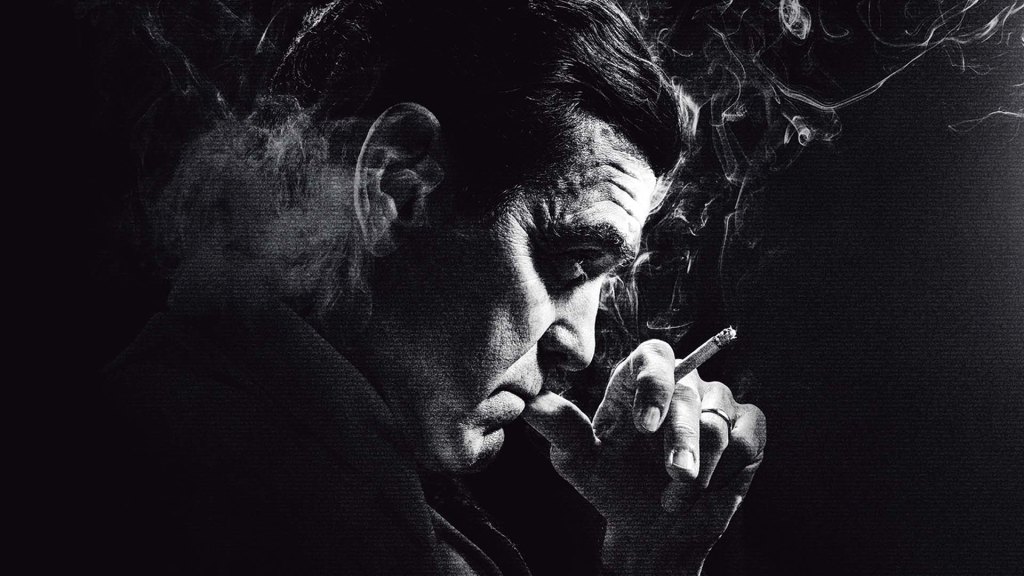
Clooney as Murrow, now on Broadway As Trump seeks to muzzle NPR and PBS and fire (notably lacking any authority to do so) members of the Corporation for Public Broadcasting, I’m tallying the ways in which the present rhymes with history: a lying would-be tyrant once again tries to extort institutions dedicated to truth, justice, and the American way, his offenses uncannily echoing those of George III, against whose troops those embattled farmers fired the shot heard round the world.
Ah, well. Having now flipped the calendar to May—my earliest daffodils are fading and the first hummingbird has arrived to sip at the feeder—I’m marveling at all this past month contained, a balancing act likely more heavy on diversion and self-care than the constant protest and resistance called for by even the likes of David Brooks. Peter Sagal, comic host of NPR’s news quiz Wait Wait Don’t Tell Me seized his bully pulpit at Portsmouth’s Music Hall on 18 April to spend a moving and educational hour speaking of our extraordinary Constitution before taking some questions about the show’s funny business, proving once again the seriousness underpinning all comedy.
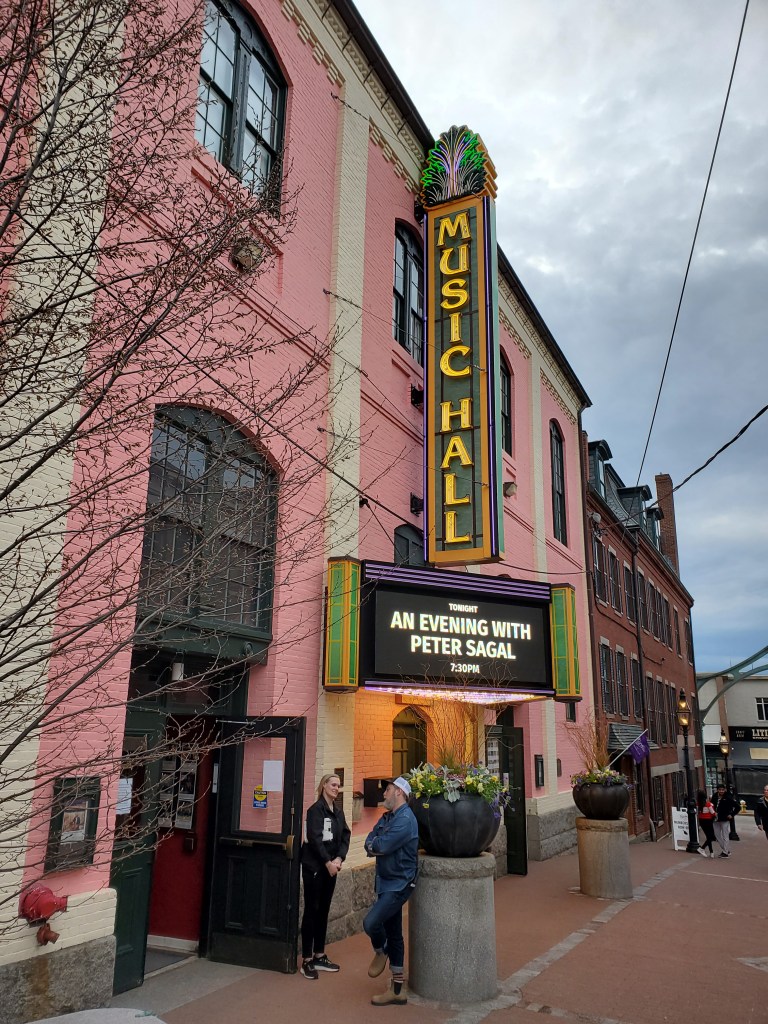
But there was much to spark joy in his talk and throughout the month: gatherings with precious friends and immersion in music and theatre reminding one of what the species at its best can do.
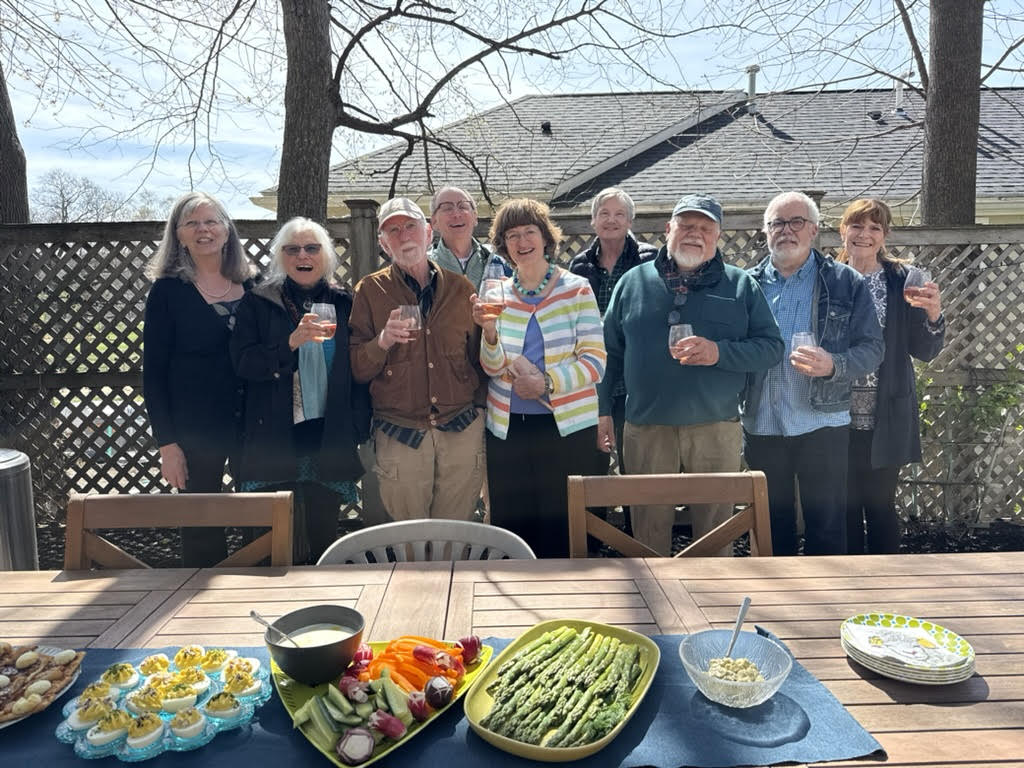
Easter at Sis and Ted’s, Newton MA 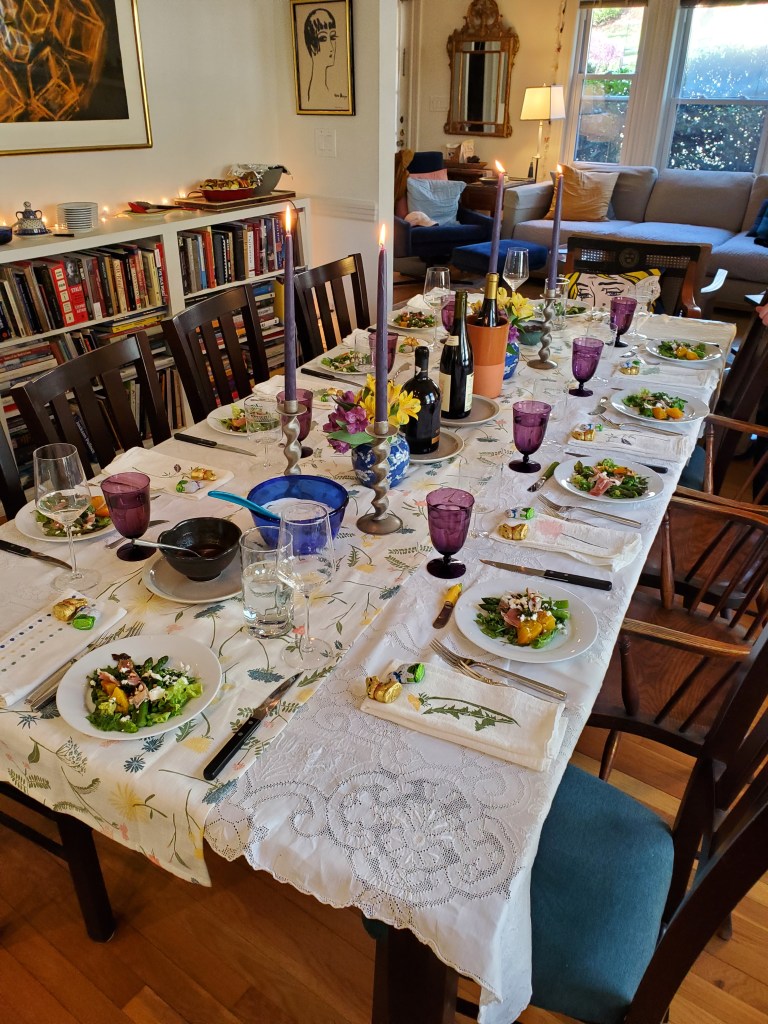

Easter Lilies at Wentworth Nursery, Dover NH Amici Music performed music completely new to me at the handsome Federal-style New Castle Congregational Church on 12 April: Margaret Herlehy on oboe, Janet Polk on bassoon, and Daniel Weiser on piano introduced me to Lalliet, Clémence de Grandval, the delightful Paul Carr, and a Poulenc trio.
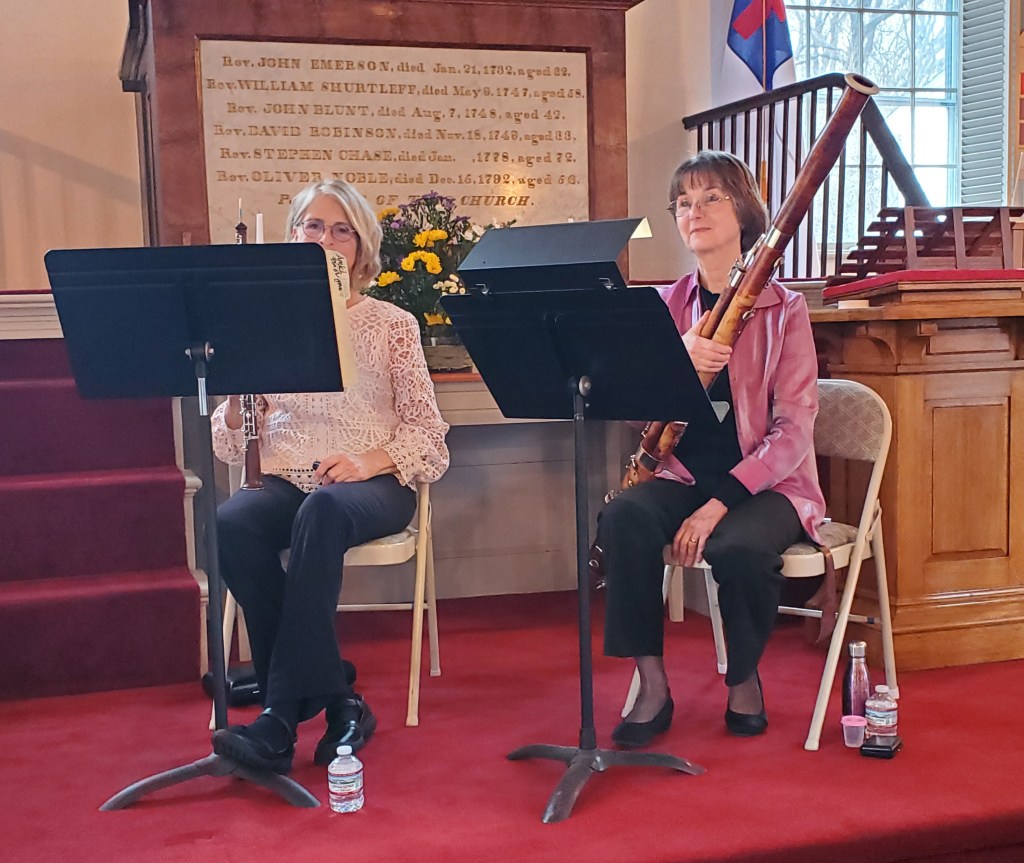
Margaret Herlehy and Janet Polk of Amici Music Also new on 19 April was the latest Portland Stage production written by John Cariani—so new, in fact, that the playwright on-the-spot changed the play’s title from that printed on the program: Not Quite Almost, or Almost Almost, Maine became The Darker the Night, the Brighter the Stars (good call, John). This charming four-hander with four young actors playing multiple roles and some gorgeous light design that included shooting stars and the Northern Lights was a boon in these dark days of the Republic. Then came world-class performances by the Handel and Haydn Society at St. John’s Episcopal Church in Portsmouth (Alexander Parris, 1807—the first brick church in New Hampshire): Purcell, Vivaldi, Bach, and Handel.
And finally, a return to Symphony Hall with friends David, Susan, and Vicky (and lots of appreciative Russians) to hear the uncannily gifted pianist Evgeny Kissin once again play an extraordinary concert: a Bach Partita, Chopin Nocturnes and Scherzo, Shostakovich’s Piano Sonata No. 2 and selected Preludes and Fugues and—as if that was insufficient, three substantial encores.
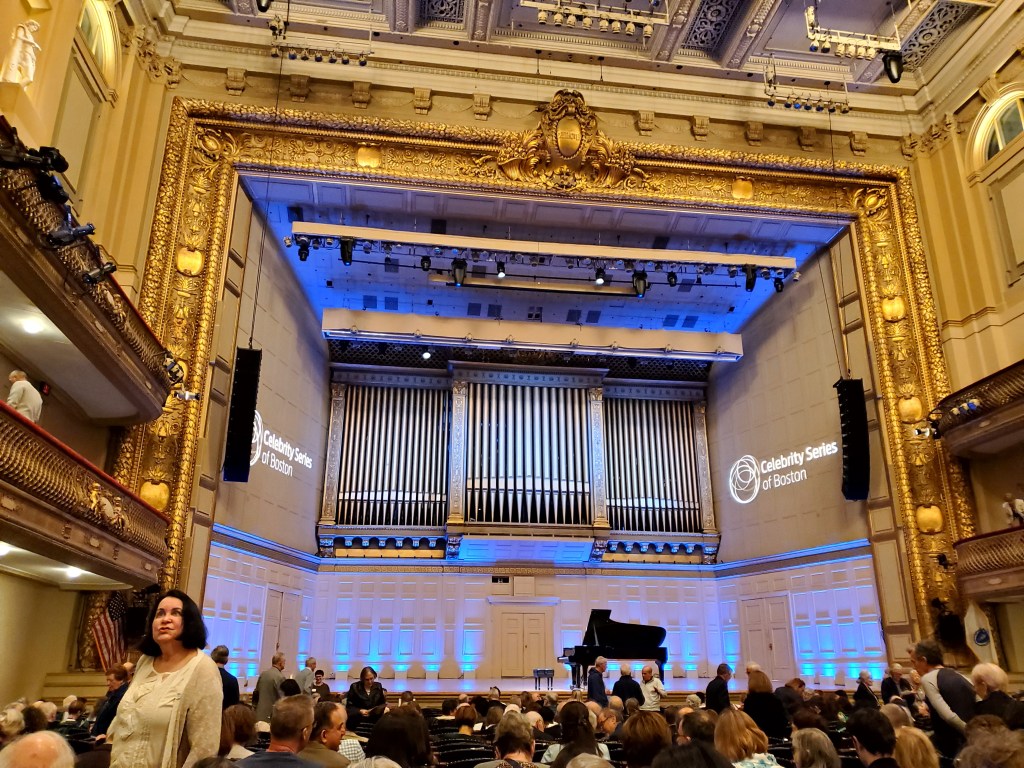
Symphony Hall, 29 April 2025, awaiting Evgeny Kissin And there were readings and discussions of Twelfth Night at both the Portsmouth Public Library and Portsmouth’s Carey Cottage (designed in 1887 by Alexander Wadsworth Longfellow for Arthur Astor Carey) to celebrate Shakespeare’s 461st birthday on 23 April.
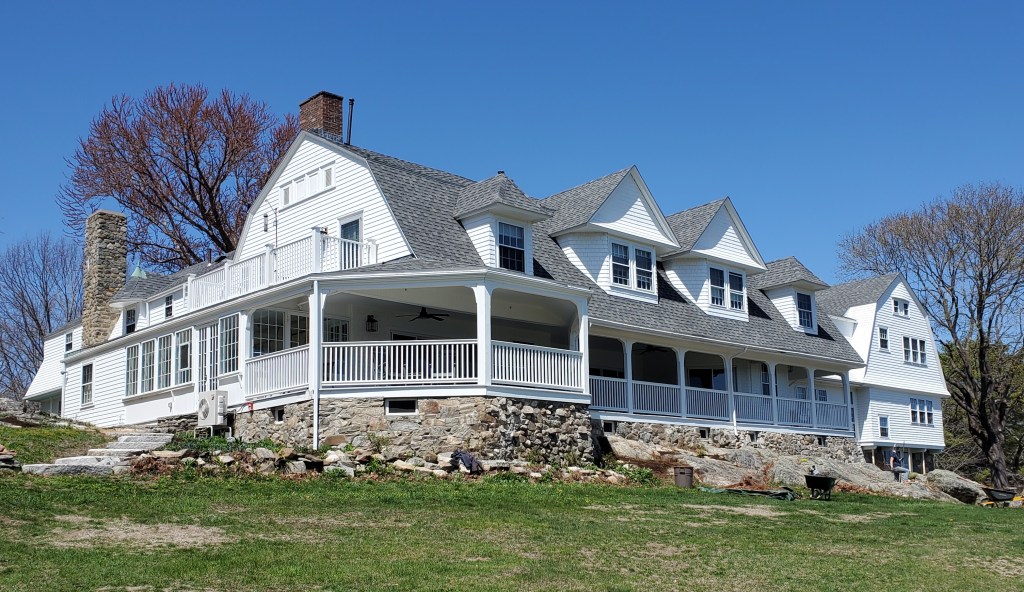
Carey Cottage, Portsmouth NH 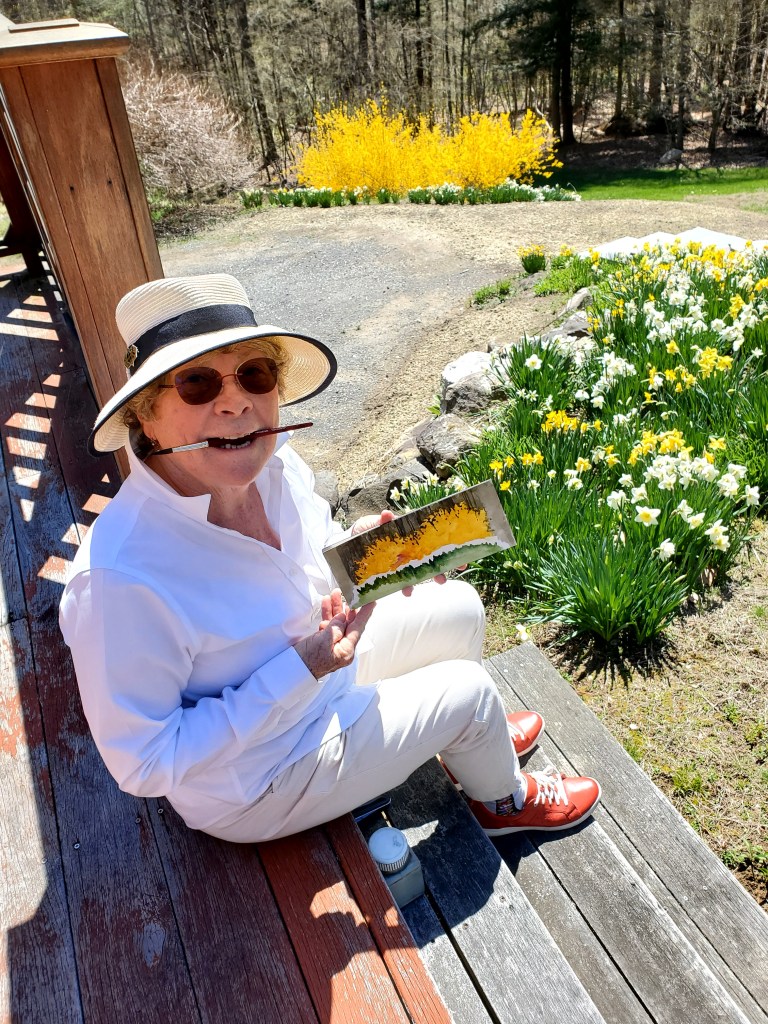
Phyllis paints my daffs and forsythia en plein air And the Madbury Public Library Book Club had a lively discussion of Kaveh Akbar’s 2024 novel Martyr!, a novel built of multiple perspectives, a “choreography of etiquette” juxtaposing Iranian-ness and Midwestern-ness, thanatos and art, humor and profundity. A paean to art that finally acknowledges its limitations, Akbar’s first novel is a fascinating read that taught me a couple new terms: the Overton Window, the range of subjects and arguments politically acceptable to the mainstream audience at a particular time, and “sonder,” the realization that each random passerby is living a life as vivid and complex as your own.
I guess it’s the sonder that I’ve been most thinking about of late as I continue the humiliation management required of the aging. For example, I spent a panicky 15-or-so minutes yesterday looking for the discharge chute of my electric mower after using it, I feared, without the chute during the first mowing of the season (OMG! Did I leave it at that place in Pembroke last fall when I had it serviced for winter storage?), only to finally realize I couldn’t find it because it was on the mower all along. Happily, others of a certain age selflessly report similar absurdities: putting on mis-matched socks, donning t-shirts inside out, or pulling off slacks at night, and then pulling them on next morning, only to discover the previous day’s underwear around one’s ankles.
But age has its compensations, especially when sharing experience. My husband David was very good at making even the most routine exchange memorable, and, trying to emulate his talent, a few weeks back I noticed my Market Basket checkout clerk’s name tag, Sylvia, and greeted her with “Who is Sylvia? What is she?” Little did I expect her to know the lyric from Two Gentlemen of Verona, even less for her to respond by singing the next few lines set by Schubert! When I exclaimed a compliment, Sylvia replied that she was raised in England, had learned that song in school, and now at age 88 (88!) was herself amazed to find she remembered it still, having not thought of it for at least 75 years.
That’s a glimmer that keeps on glimmering: with thanks to Sylvia, Schubert, and Shakespeare, all united at the Lee Circle Market Basket.
Onward, to pastures new.
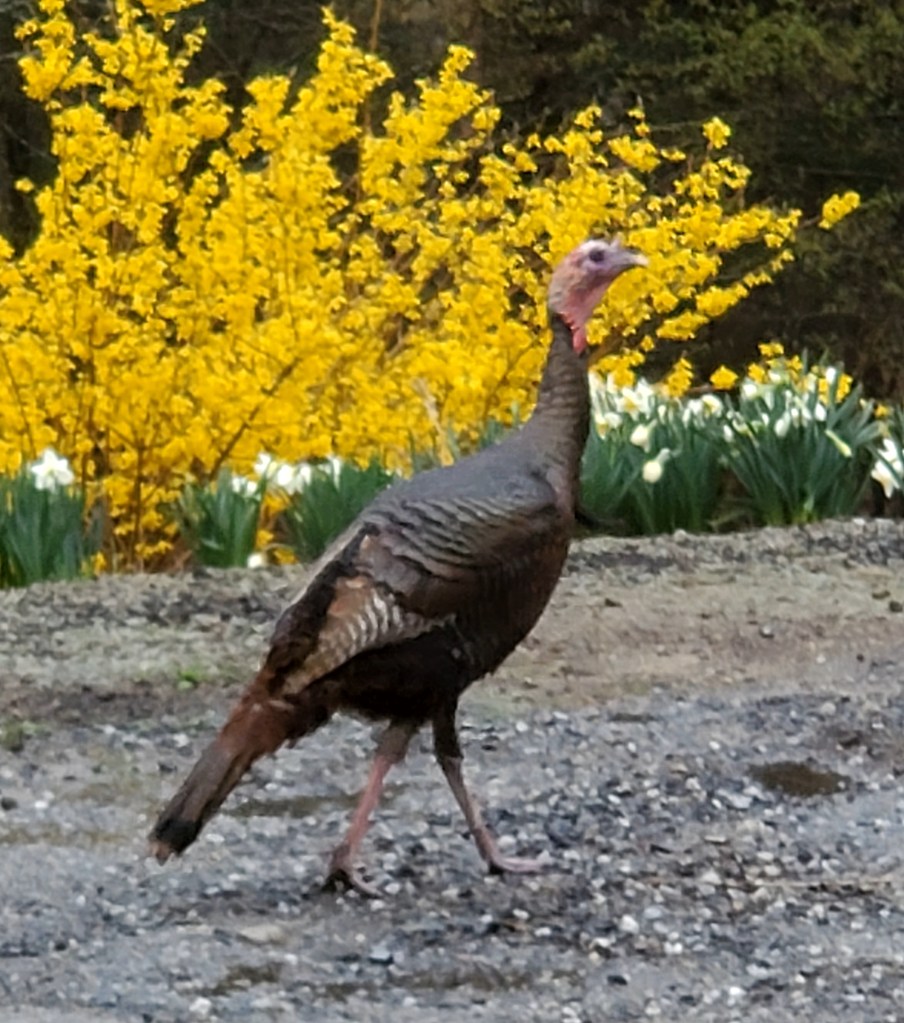
Resident Turkey Hen
-
Subscribe
Subscribed
Already have a WordPress.com account? Log in now.
 Georgeann Murphy