-
Southern Sojourn Day 15: 27 May 2022 Greensboro NC > Williamsburg VA
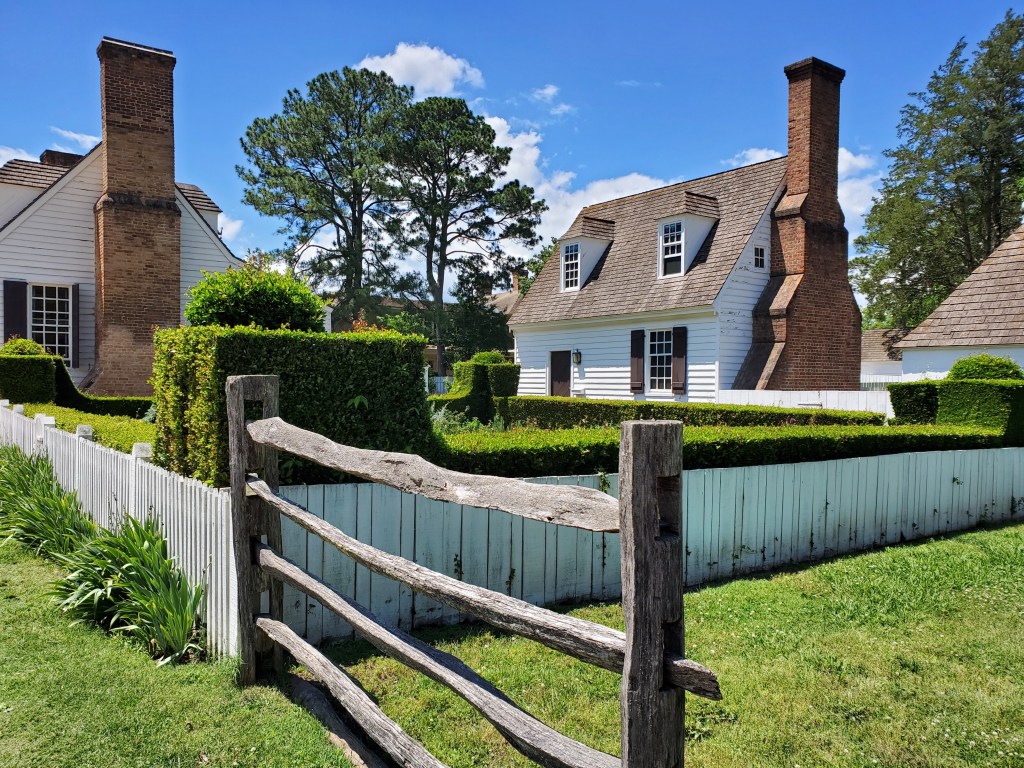
Colonial Williamsburg VA I’ve visited my friend Sandy in Williamsburg before, but previously approached from the north. This time, my path is from the south, much more rural, and at one point driving the increasingly flat and fertile terrain I get stuck at a railroad crossing as a long freight train proceeds slowly, almost to its caboose, and then backs up for another disappointing five minutes before rolling out of the way. Fine by me: it gives me a chance to text Sandy of a slightly delayed arrival. Once across the tracks, I drive along Route 5 in Charles City County, taking me past five of the James River plantations: Sherwood Forest, Westover, Shirley, Evelynton, and Berkeley. I stop at none; I had visited Westover before with David, my architectural historian husband, decades before, and I’m eager to reach Sandy. But the very word “plantation” conjures my memory of how much I have in the past enjoyed touring such sites along the Mississippi—once with my dear daddy. I had packed an elegant picnic lunch, complete with wine and some very fancy pastries from a fine New Orleans patisserie, La Bonbonniere, where German master baker Hans Fink once told me how much more sugar he had to add to his recipes to appease American tastes. Well, my dad and I enjoyed those too-sweet-for-Euro palates treats under a venerable live oak outside Houmas House in Darrow, Louisiana. For years after, I carried a voucher for a future discount at Houmas House in my wallet, a memento of that day and the tantalizing promise of a future visit. I DID go back once again with David, the other prince in my life, this time focused on the symbolism of all the Greek revival mansions along the Mississippi, temple houses that effectively made gods of their owners. That time, too, I recall with pleasure; a photo David took of me standing in Oak Alley was a favorite he kept in his UNH office.

A younger me at Oak Alley, Vacherie LA, March 1994 When we returned to Oak Alley many years later, things were quite different. David had changed, prey to the debilitating anxiety that beset him at the end of 2007. But more significantly for the Big Picture, slave quarters had become part of Oak Alley’s permanent exhibit. I quote from the website:
Located on the historic grounds, almost exactly where the original [enslaved] community stood, 6 reconstructed cabins give insight into their lives and habits. 4 of the Cabins depict a type of dwelling–a field slave’s quarters, a house slave’s quarters, a sick house and a post-emancipation residence. 2 have been converted to exhibit spaces, inviting visitors to understand slave life on a more personal level. Displays here focus on religion, punishment, how slaves at Oak Alley were clothed, and the work that consumed their daily lives.
What does it mean “to understand slave life on a more personal level”? This “correction” to a tourist attraction is part of a very belated racial reckoning I’m thinking of as I drive past the long lanes leading to the James River plantations, considering how the rise of the Black Lives Matter movement and subsequent battles over school curricula, with their ignorant pushback about Critical Race Theory and systemic racism, find our country so far from the promise I naively, briefly believed we had come close to fulfilling by electing Barack Obama: redressing America’s original sin of slavery.
The web site promoting the James River Plantations I pass is also trying to address history that was either previously ignored or completely re-written, its promotion including a dash of black history:
Charles City has been home to Indians and early settlers, planters, signers of the Declaration of Independence, Presidents, slaves, emancipators and free blacks, educators and agriculturalists. Descendants of these significant figures in American history still live in the county today.
Benjamin Harrison, signer of the Declaration of Independence, and Presidents William Henry Harrison and John Tyler were born and lived here. General Robert E. Lee spent much of his childhood here. Agriculturist Edmund Ruffin, who fired the first shot of the Civil War, practiced his innovative techniques on Charles City soil. Lott Cary, the first black American missionary to Africa and founding father of Liberia, was born here. One of the first free black communities in America was located in Charles City, as well as the third oldest organized free black church.
I’m thinking, too, of the powerful, even shocking Tracy Letts play I saw in April in New York, The Minutes, about the atavistic tribalism that underlies how we tell, revise, and even celebrate a bloody history.

(Note the American eagle mask on a carrion-consuming crow) So, once again, on Route 5, I am driving through personal and national history, headed for Williamsburg, looking for America, and eager to see my friend Sandy, a specialist in eighteenth-century literature and a tour guide in Historic Williamsburg. She will not only connect me to the turbulent times we shared as graduate students, but conduct me to places I first knew as a child introduced to all the charm of Colonial Williamsburg before “colonial” had taken on its current pejorative odor. Indeed, my parents tried their best to recreate colonial style by painting their cement block Florida ranch house in official Williamsburg paint colors. For me, then, Williamsburg was all about molasses cookies, the pervasive scent of boxwood (I thought that the smell of old brick houses), a child’s tricorn hat, and a souvenir horseshoe with my name banged into it by an employee reenacting a smithy’s life. I am about to see things through different eyes.
But first, I arrive to Sandy’s gracious welcome, her lovely condo, and a visit/generous pour of wine with a couple of neighbors. One, Martha, is a fellow retired academic who is surprised to hear that Sandy’s and my little support group of Women Against Dissertation (WAD) had united to brave the many difficulties manufactured by Tulane’s graduate faculty—with, I proudly note, uniform success: all WADees earned our PhDs and tenure. Martha apparently had an easier time of negotiating the perils of grad school, though perhaps that left her with fewer interesting war stories: trials recollected in tranquility = comedy. Sandy makes us a fine boiled dinner of shrimp, sausage, potatoes, and fresh corn, we reminisce, and I retire to her lovely guest suite.
-
Southern Sojourn Day 14: 26 May 2022 Greensboro NC
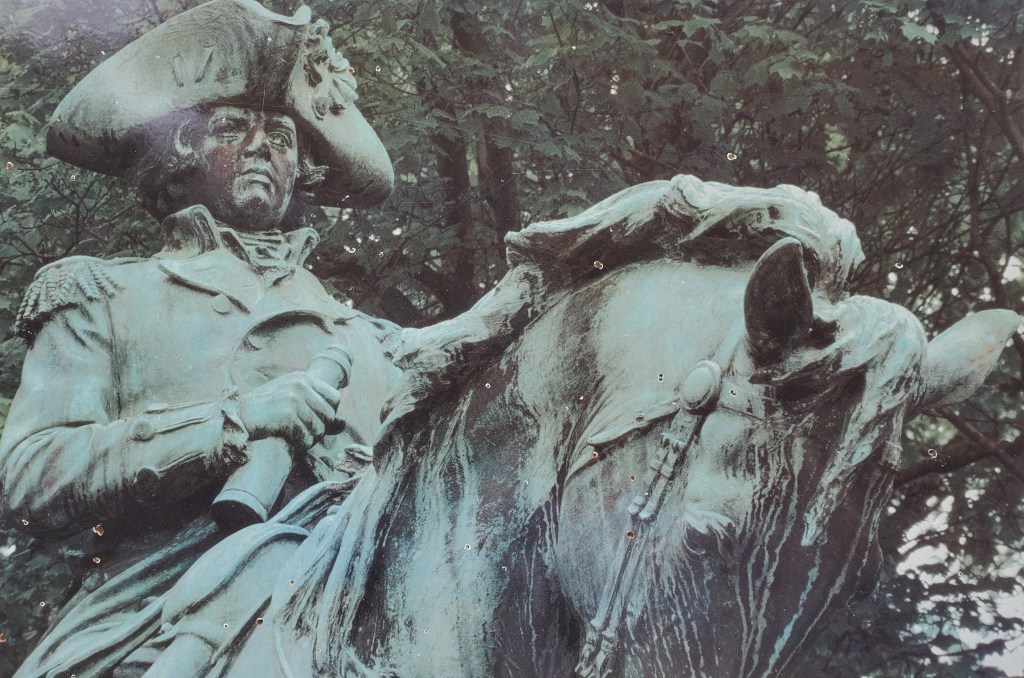
“Greene is as dangerous as Washington; I never feel secure when encamped in his neighborhood.” –Lord Cornwallis My final day in Greensboro began again with yoga, followed by a drive around three different senior living facilities, all of them massive. Provisions for aging boomers abound, it seems, particularly in the South; retirement communities are legion. Cameron is considering another move to a place that would best accommodate and provide for the final stages of life, something everyone of a certain age is either considering or in denial about. My plan, inasmuch as it IS a plan, is my determination to stay in our Madbury home, Gnawwood, which so delights and consoles me with its architectural choices all so carefully considered and rendered, the natural beauty of its setting, its store of memories, and all the visits from local critters: the deer who grace the lawn and despoil the vegetation, the snapping turtle who lays her eggs here each June, the hummingbirds who entertain with their complex social interactions just outside my kitchen window, and the more rare surprise visits—a porcupine who so tentatively approached the dining room window last evening, or the first flash of a Baltimore Oriole’s bright orange plumage at the feeder. Living at home, exclusively on the ground floor, would be possible with some rearranging of furniture, though we did design our three stories to accommodate a residential elevator. But I think my dad’s prognostication about that accurate: such a disruptive installation is something we’d never do. Of course, maintaining the house and grounds requires a good deal of time, money, and energy, and that’s just maintaining the residence; what services, what care will the body electric need? Difficult to consider. Will it be easier for those of us, like me and like Cameron, without children? Or harder? Easier, I think.
But it’s even easier not to think about what’s to come and just tick off errands on today’s to do list. We go to Lowe’s and do a drive-by selection of a nice flowering plant for Cameron’s little patio—another mandevilla, as it happens, which I’m happy to make a gift. Then to the grocery, Harris Teeter, for a bottle to carry to my next host.
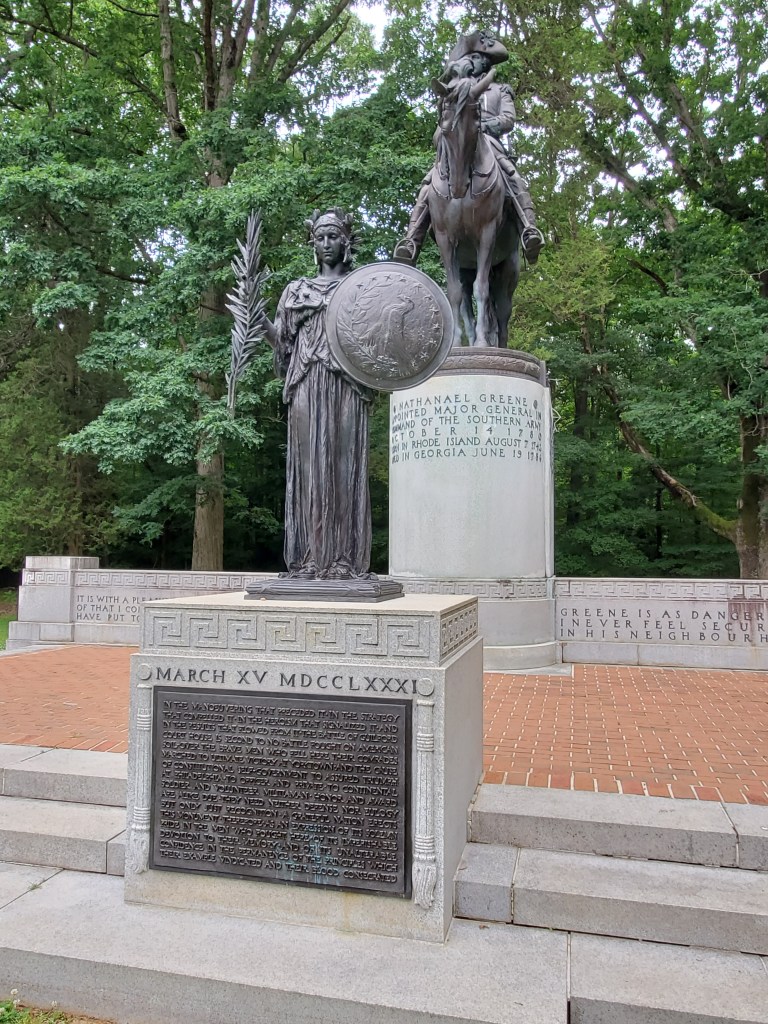
When we realize how close we are to the Guildford Courthouse Military Park, Cameron gives me an extended driving tour and a bit of history. The Park’s 250-acre landscape encompasses the core of the battlefield where the armies of General Charles, Earl Cornwallis and General Nathanael Greene met on 15 March 1781 in one of the major Southern Campaign battles of the Revolutionary War. Greensboro is uncommonly, lushly green and fecund this spring, but the town is named not for its verdant display, but for the general under whose command the ferocious Americans achieved a victory within a defeat. The Battle of Guildford Court House raged for two and a half hours before Greene ordered his troops to retreat, giving the British a tactical success, but enabling Greene’s army to remain mostly intact. Cornwallis’s victory, he knew, was pyrrhic, more than a quarter of his men killed, wounded, or captured; “I never saw such fighting since God made me. The Americans fought like demons” he wrote. Greene’s strategy changed the course of the Southern Campaign, and made possible the Americans’ shocking victory over the British and the surrender of Cornwallis at Yorktown on 19 October 1781, the last major land battle of the War.
Greensboro resident Judge David Schenck had a strong desire “to redeem the battlefield from oblivion,” his words from a December 1886 diary entry. By that time, the area was an unindustrialized rural landscape. The location of the battlefield, about an hour’s ride from the small town of Greensboro, was largely forgotten to area residents. After purchasing part of the battlefield, Schenck convinced local businessmen to join his cause and established the Guilford Battleground Company (GBC). The GBC prioritized the beautification and ornamentation of the battlefield. In 1917, stewardship of the battlefield passed to the War Department, and in 1933, under President Franklin Delano Roosevelt, transferred to the National Park Service who maintain it now.
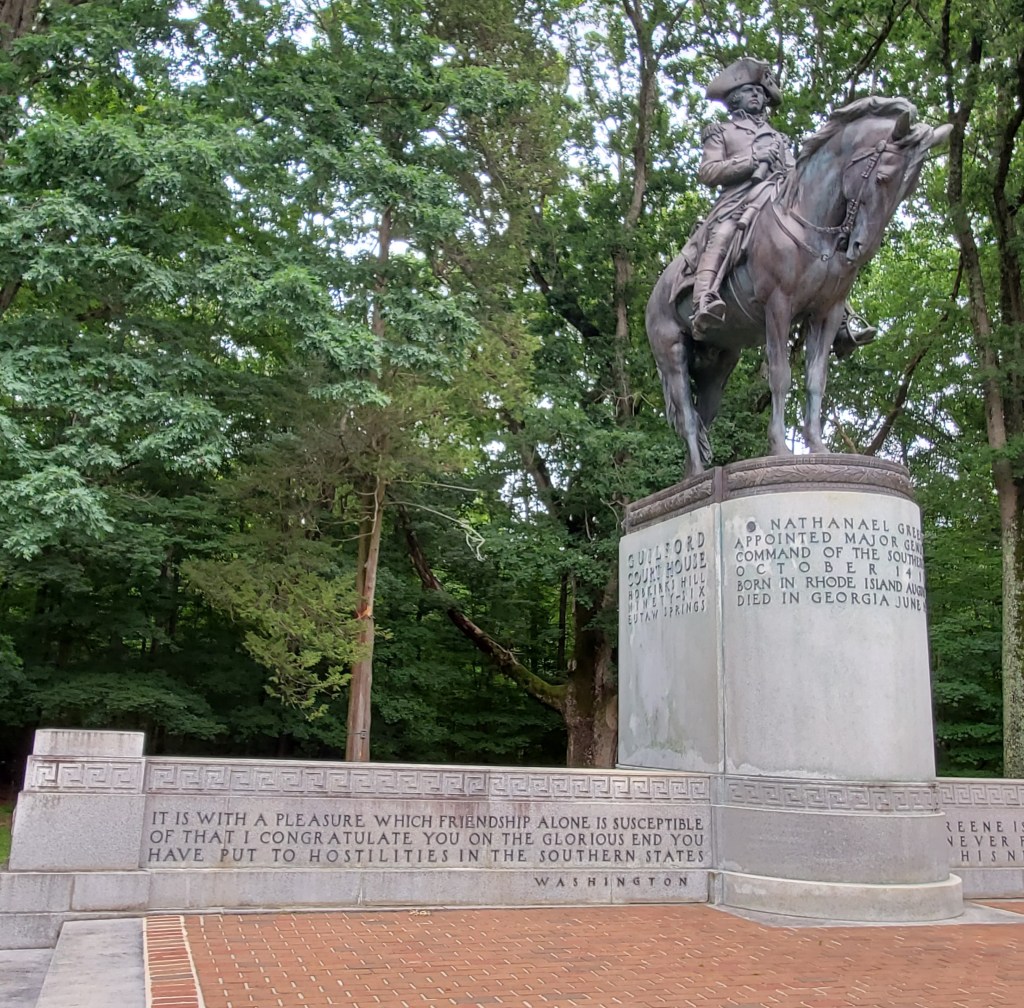
Greene Monument, Guilford Courthouse Military Park, Greensboro Battlefields are complex terrain, and this one, clearly favored by walkers, joggers, and bikers, is no exception. My dad, the Civil War buff, made Gettysburg and the story of Pickett’s Charge and the Angle Copse a vivid memory from my childhood: seeing the long grass of that blood-fed field ripple and part with the evening breeze as the sun sank over Cemetery Ridge conjured ghosts of soldiers marching through it to their destiny. Stopping now to read inscriptions on monuments to Greene–and to Schenck and other earnest nineteenth-century citizens dedicated to preserving glorious history—I return again to despondent thoughts of my country’s currently degraded condition. Would citizen soldiers today “fight like demons” to protect their homeland—as Ukrainians continue to do even as I type this, as American patriots once did? Does anyone even know our history? My colleague Lisa reported an undergraduate asking her whether in World War II we were allies with the French or the Germans. And so many Americans still under the spell of the grifter former president Trump believe the Big Lie that the 2020 election was stolen, remaining wedded to a delusion that no amount of carefully documented evidence to the contrary can dispel. Where are we headed, this Memorial Day weekend of 2022? What, indeed, are we remembering? The Guilford Courthouse Park leaves me pessimistically pensive.
But lunch at home beckons. I pack up the GTI for tomorrow’s drive into Virginia and take a walk while Cameron practices her violin, and then enjoy being treated to dinner out at Lucky 32 Southern Kitchen: “earnest food and hospitality in an upscale joint.” My “earnest food” is fried catfish and greens, served by an earnestly eager young waiter. Dessert is chocolate chip cookies taken at home while watching a tv show about the National Spelling Bee. And so, to bed.
-
Southern Sojourn Day 13: 25 May 2022 Greensboro NC
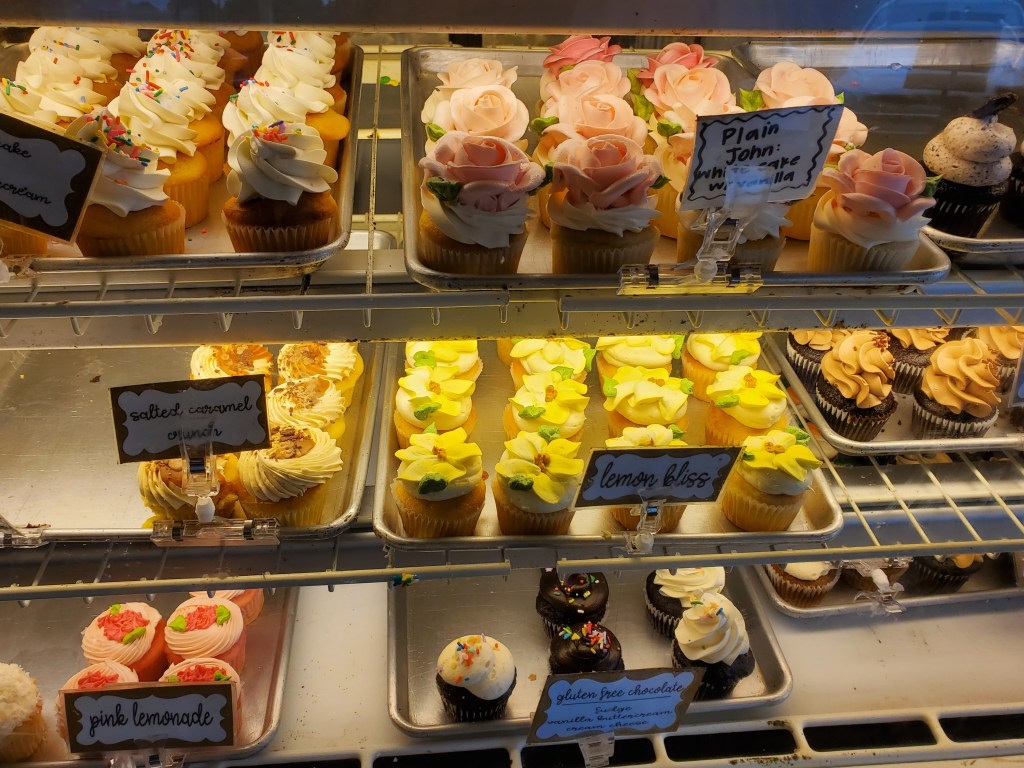
Temptation on display at the Delicious Bakery in Greensboro NC For the first time since leaving home, I take time to do my accustomed morning yoga routine on the soft living room carpet while Cameron practices her violin behind me. This feels very good, both the stretching and the company.
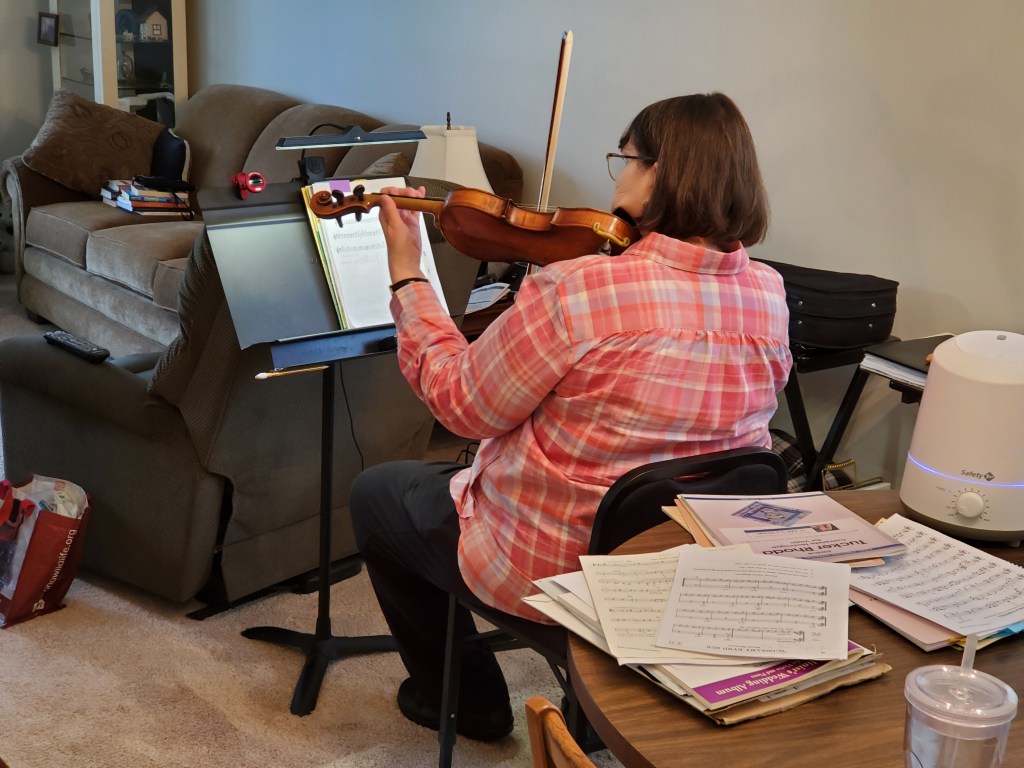
Cameron practicing Then Cameron drives us to the huge YMCA downtown, where after filling out a rather extensive visitor information sheet, I am admitted as a guest to swim in the lap pool while Cameron “hangs” in an adjacent pool and chats with her trainer, Julie, for an hour, which grants her considerable if temporary relief from pain, I think by decreasing gravity’s compression of her spinal column. I have a lap lane all to myself, and it is the first time in a very long while since I’ve been in an Olympic-sized pool. I wonder if I am up to swimming 50-metre lengths back and forth for an hour, but manage it pretty handily (with a VERY slow breast stroke) for 45 minutes before joining Cameron in the therapy pool. Neither pool is crowded, and I wonder what the average age of the few swimmers would be; except for the young life guards, the only people there are either elderly (like me, or apparently older) or kids first learning to swim. Mitigated gravity is a great thing, and I recall how the boring repetitiveness of swimming laps in the Tulane pool after spending a day cramming for my doctoral oral exam was a much-needed de-stressor, allowing time for all I’d been studying to settle into my brain while simultaneously stretching out posture cramped by being hunched for hours over a carrel desk. I enjoy watching two little boys at their instructor’s urging braving jumping into the deep end for the first time, and recall the St. Pete country club, Holiday Park, my parents joined to ensure that both their Floridian daughters would know how to swim. Swimming turned out to be a graduation requirement at Furman University years later. So glad I was given that head start.
From the pool and my first experience of a machine that extracted water from wet suits (great idea!), we stopped at a drugstore so I could replace the shampoo containers I had inadvertently left behind in the Asheville Best Western Glo, after which we got slices of cake at a bakery named Delicious (another great idea: a place that sells slices of gorgeous layer cakes), picked up another dinner from Reto’s catering: tomato chicken and broccoli, with my slice of choice, salted caramel (another first!) for dessert. We talk, Cameron and I, of ultimate things for a while after dinner—serious conversation comes so easily with this good friend.

Words and images worth remembering on the fridge And then I retire to my comfy guest bed to watch a couple episodes of the streaming series that’s recently captured my interest, Bosch. Viewing screens late into the evening is not good sleep hygiene, I know, but the plot twists and moral ambiguities that the appealing title character, a preternaturally gifted and empathetic detective, negotiates are too compelling to log out of early. I am able to read myself to sleep soon after—all that swimming helps. It’s been another low-key, restful day, a boon at the end of two weeks on the road, and I am grateful.
-
Southern Sojourn Day 12: 24 May 2022 Asheville > Greensboro NC
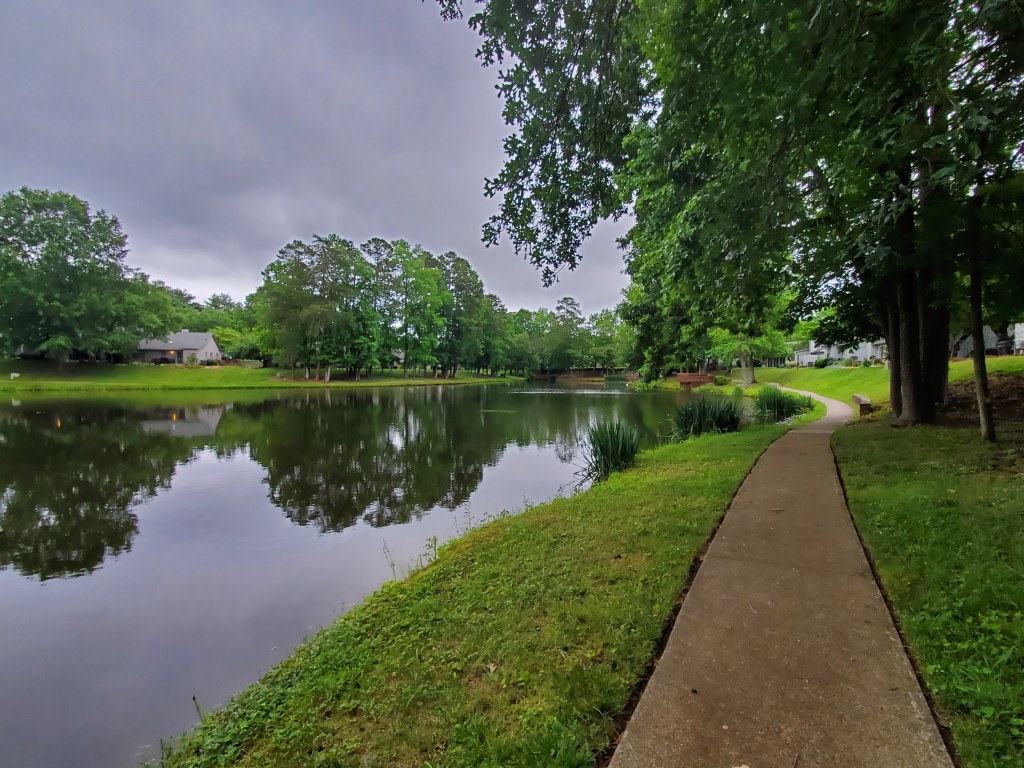
Sullivan’s Lake Townhome Community, Greensboro NC The morning is clear, and as I pack up to leave, the sun shining through the Best Western window catches an accidental prism somewhere that refracts the light into its constituent wavelengths, filling my open suitcase with Roy G. Biv’s rainbow—the mnemonic I learned from David: red, orange, yellow, green, blue, indigo, and violet. I think of the 1960 Disney film Polyanna, with Hayley Mills in the eponymous title role, getting the acidic recluse Mr. Pendergast (or is it the hypochondriac Mrs. Snow?) to string the decorative crystal drops on a lamp across a window to fill his room with rainbows. Hayley Mills and that film made a big impression on me: in the fourth grade, I got a haircut identical to Hayley Mills’s in The Parent Trap, and had a locket like the one she wore as Polyanna, when she converts the pessimism of the town’s fire-and-brimstone Rev. Ford (played by Karl Malden) by showing him her locket’s inscription: “If you look for the bad in mankind expecting to find it, you surely will. A. Lincoln.” Mr. Lincoln was my father George’s hero, and that quotation stuck with me. Now, this morning, my dad, Abraham Lincoln, Hayley Mills, and my sweet David all seem to suggest it will be a fine day. Signs and wonders.
The drive through the mountains to the Piedmont is lovely, and I stop for breakfast at a McDonald’s, the “big breakfast” of scrambled eggs, sausage patty, potato cake, and biscuit: way too many calories, but delicious, a treat I used to award myself on the occasional Sunday in graduate school days. I don’t think I’ve had it since, but it tastes VERY good. And a fellow customer, a man, holds the door open for me in a most courtly manner when I leave. Another southernism?
As I approach Greensboro—it is so much bigger than I recalled from an earlier visit, population over 300,000, with multiple highways to match—news breaks of the Robb Elementary School shooting in Uvalde, Texas: 19 children and 2 teachers dead. This is the second mass shooting since I left home on the 13th: the supermarket shooting in Buffalo happened on 14 May. I’ve not heard much news since I’ve been on the road, but this penetrates. What is WRONG with us?
When I pull into my friend Cameron’s development, she comes out to greet me as I pull into the parking spot that her directions have made crystal clear is for me. She’s using her Rollator walker, but that doesn’t impede her warm welcome—characteristic of this dear friend. Cameron and I are both widows, once married to good friends, my David and her Russell, who met when they were both studying music at the University of Michigan. David’s path branched toward art history, but Russell’s continued on to a successful career as a composer, whose works were frequently programed by the summer New Hampshire Music Festival conducted by Paul Polivnick, a great admirer of Russell’s music. Cameron and I hit it off from the moment David introduced us, and we four spent several jolly summer weekends together in New Hampshire’s lake district, close to one of the several satellite UNH campuses hosting the Festival. We’d spend hours floating in the lake chatting, then dress for dinner and the concert, after which David and I would spend the night as guests in one of the lakeside cabins Russell and Cameron rented—including one terrifying night when a ferocious lightning and thunder storm rolled through, convincing us all that if a bolt hit one of the adjacent towering firs, we’d all be goners. We survived.
Cameron is the kindest, most level-headed, and bravest person I know. Losing Russell was a cruel blow, but neither her first nor the last. A professional French horn player, she had to give that up when she lost her embouchure, and throughout her life has been afflicted by a multitude of impairments, illnesses, and chronic pain. Yet she perseveres, calmly, uncomplainingly, logically pursuing solutions to whatever problems arise, and now continues her life in music by learning to play the violin. In October 2019 she flew from Greensboro to help me manage David’s memorial event in our Madbury home, and we have a standing weekly phone call that has been a source of comfort and joy ever since.
I am so glad to see her in her comfortable, beautifully situated condo.
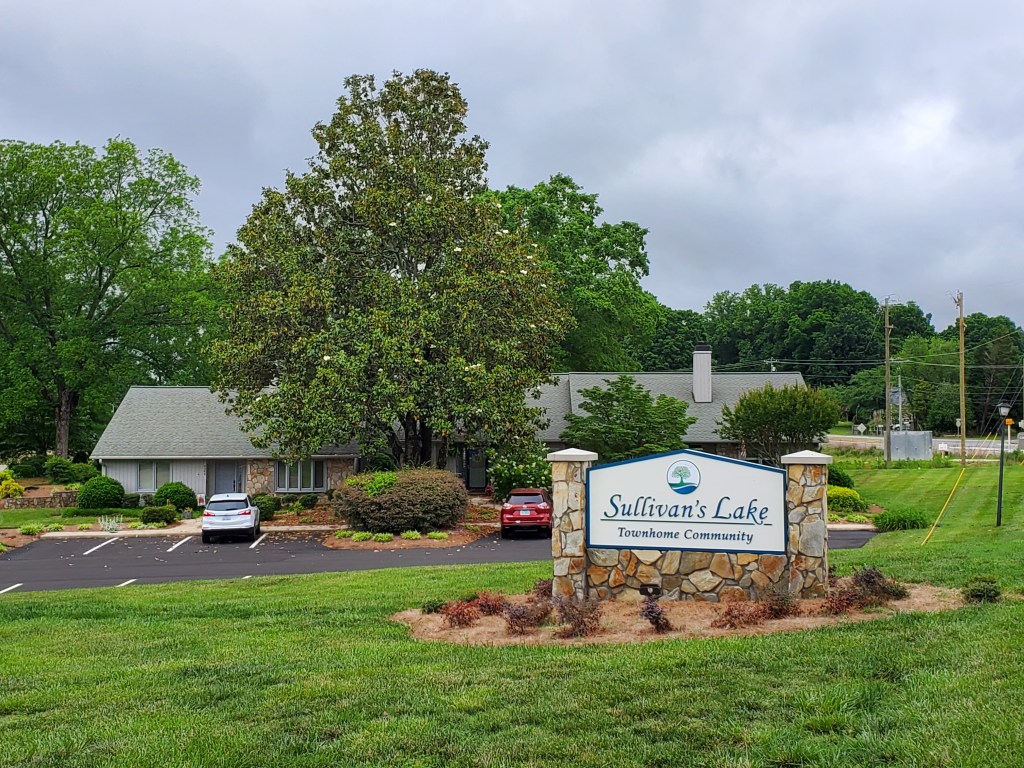
I take a little walk around the place to stretch my legs, we have a fine dinner from Reto’s Kitchen, a catering service she patronizes, and together watch the finale of a network tv show I do not know, This Is Us. I like it—but am surprised by the number of commercials, having now gotten used to the streaming services I’ve discovered ever since COVID shut us all down in 2020. Cameron’s taken great care outfitting her guest room with bedding for every guest’s comfort, layers of lovely sheets and blankets of variable thickness that can be heaped or discarded to accommodate the sleeper’s preferred temperature, and her guest bathroom is stocked with every conceivable toiletry a guest might have left behind. I feel very much at home.
-
Happy Birthday, Virginia
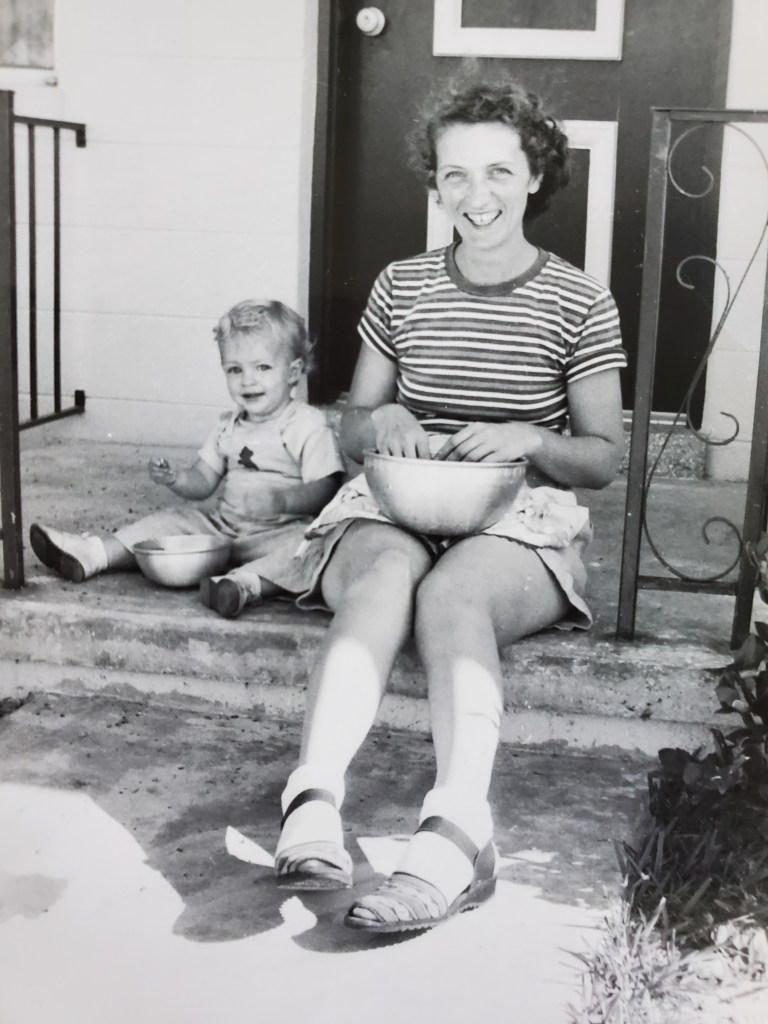
Virginia (30) and Georgy (14 mon) prepare nuts for Xmas cookies on the front porch of 7101 Date Palm Ave, S, St. Petersburg, Florida, Dec 1953 Happy Birthday # 99 to
Virginia Ruth Senseman Murphy
17 June 1923–2 January 2008
Artist, Bookkeeper, Family Historian, Seamstress
Devoted Homemaker
Beloved Friend, Daughter, Sister, Wife
Best of Mothers
-
Southern Sojourn Day 11: 23 May 2022 Asheville NC
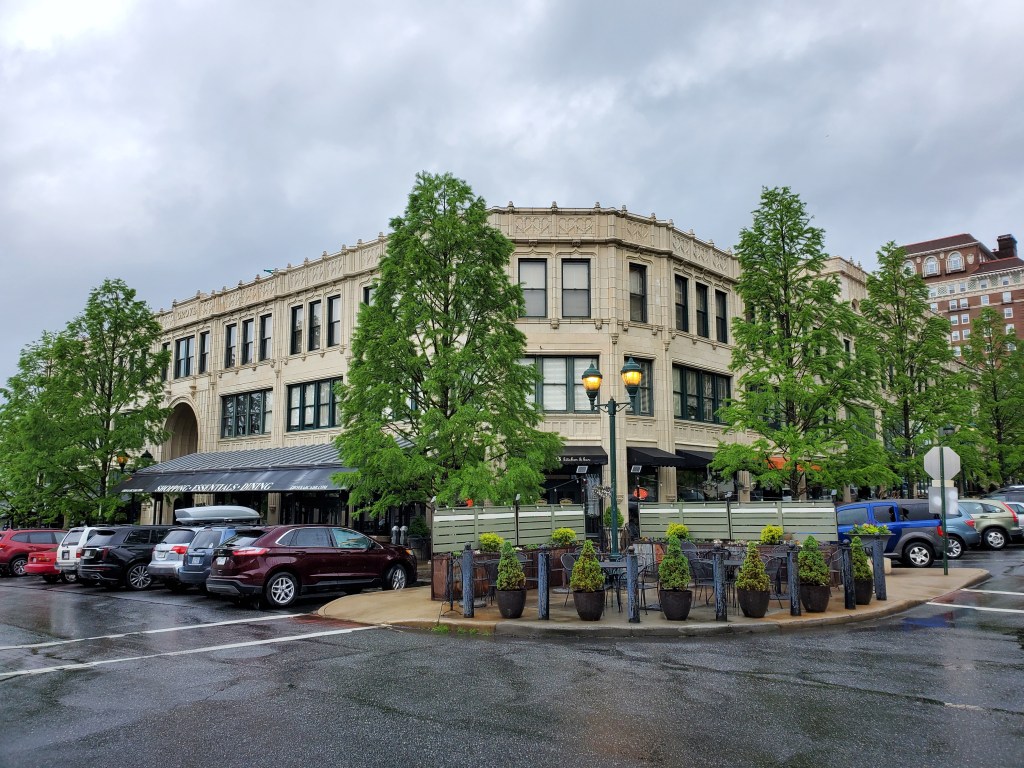
The Grove Arcade, 1929, Downtown Asheville, Charles N. Parker, architect The rain has continued into the morning, but Mark, Olivia, and I nevertheless head to downtown Asheville for breakfast at the Early Girl before I return Mark to the Beaucatcher Road bungalow where he is working on installing crown molding in the living room.
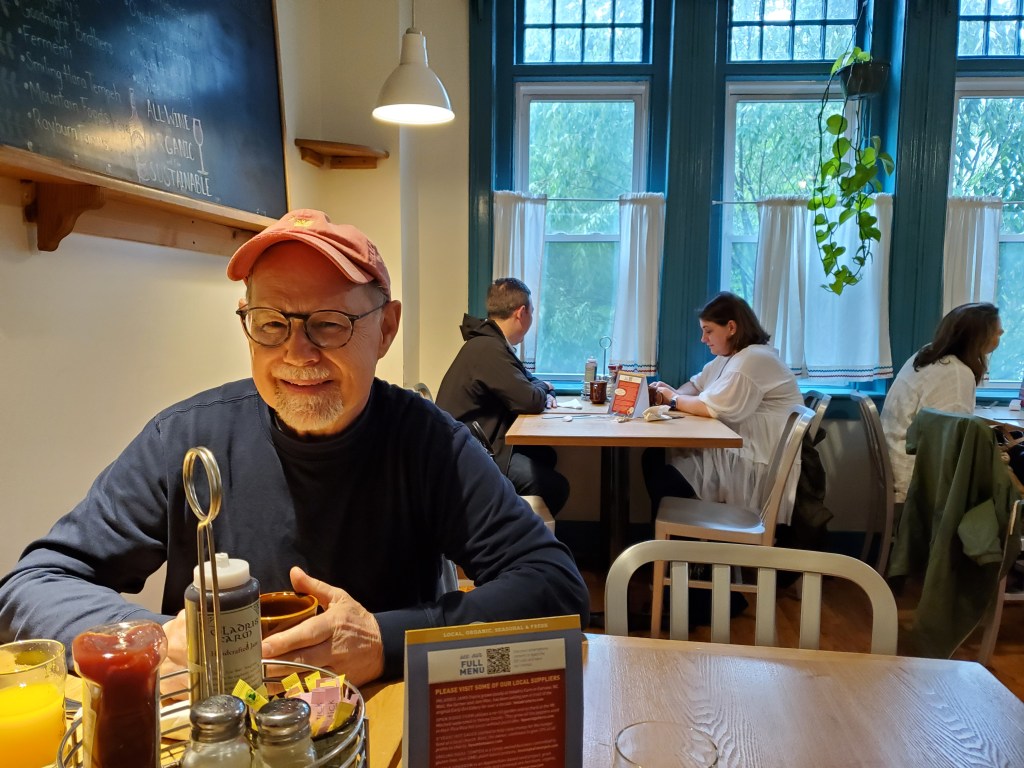
Mark at the Early Bird He and Susan are hoping to put their little cottage on the market soon, so Mark is working against the clock—and, to some extent—against “extreme nostalgia,” as so much of their family history, and all of the twins’ childhood, happened there. Mark is a talented craftsman; the house will be in its best-ever shape when they leave it for their new home.
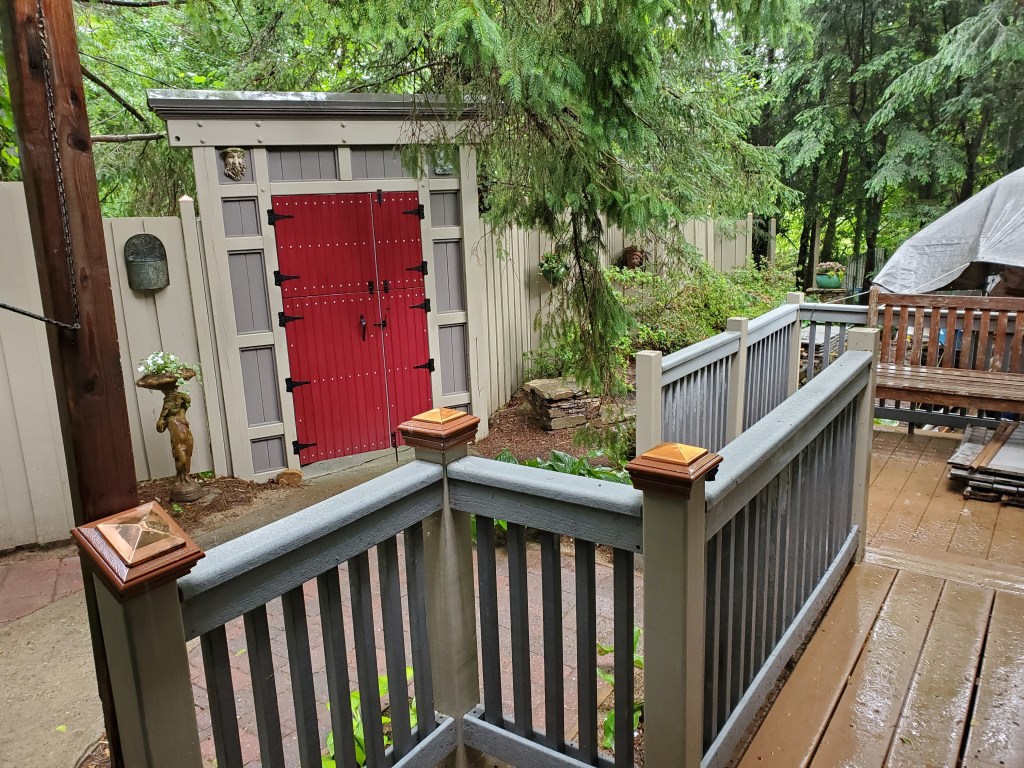
Mark’s handiwork: an elegant new entrance gate and deck Having visited periodically over the last two decades, I, too, can easily conjure up—perhaps more than those living there continuously—scenes from the past, as when the front door entrance once served as a diaper-changing venue and two adorable toddlers ruled the roost.
Once I drop Mark off, I take Olivia back downtown to her job interview at Anthropologie, bemused by Olivia’s using gps—just like me—to find the place. Ah, the younger generation and their device dependence! The rain persists, but dropping Olivia off, I find a very convenient place to park nearby, and imagine Grandpa David may have cued the parking gods from the great beyond. I fill Olivia’s interview time by walking (yes, using Google maps!) to the Grove Arcade, an historic architectural landmark conceived by pioneering Asheville developer Edwin Wily Grove in 1922, and completed in 1929, two years after his death. An elegant structure, the Arcade claims the distinction of being America’s first indoor shopping mall, the dream of that Gilded Age self-made millionaire. E. W. Grove (1850-1927) had grown up poor, running a modest little drug business in Paris, Tennessee, when in 1878 he realized that a fortune was the future for anyone who could produce a “tasteless chill tonic,” a suspension of bitter quinine in syrup that could ease, if not cure, the symptoms of malaria, a disease ravaging the South throughout the 19th century. Grove had himself lost both his youngest daughter Irma and his wife Mary to malaria. In 1889, Grove’s Chill Tonic was born, and by 1890 sold more bottles than Coca-Cola (see K. C. Cronin’s “Asheville History: The Legendary E. W. Grove).
Grove moved his business to St. Louis where he could more easily ship his product throughout the U.S., but the smog and smoke of the factory district there caused Grove chronic respiratory problems. So with his doctors’ urging in 1897, Grove, his second wife Gertrude, and their two children began spending their summers in Asheville to take the clean mountain air. In so doing, the Groves were following the lead of George Vanderbilt, who in 1888 had visited Asheville and was so charmed that he began buying up the 125,000 acres that would eventually become the self-sustaining estate, Biltmore, with a 250-room château designed by Richard Morris Hunt surrounded by formal gardens and pastoral landscaping laid out by Frederick Law Olmstead. Since 1930, when the Vanderbilts first opened it to the public, Biltmore has remained a thriving tourist attraction. My own family visited it often in the late 70’s and 80’s, and once posed before its imposing facade for the Murphy Family Christmas card.
Back to the enterprising Mr. Grove. By 1907, he had turned his attention from tonic to real estate, having himself acquired 1000 acres of land and created charming residential neighborhoods in North Asheville, now on the National Register of Historic Places. In the early 20th century, sanitariums and natural beauty were both drawing people to Asheville, but with Grove’s construction of the Grove Park Inn, completed in 1913, tourism won out, inspiring Grove’s Arcade downtown, which after many varied iterations was revitalized and reopened in 2002. On a rainy Monday, it is a good shelter.
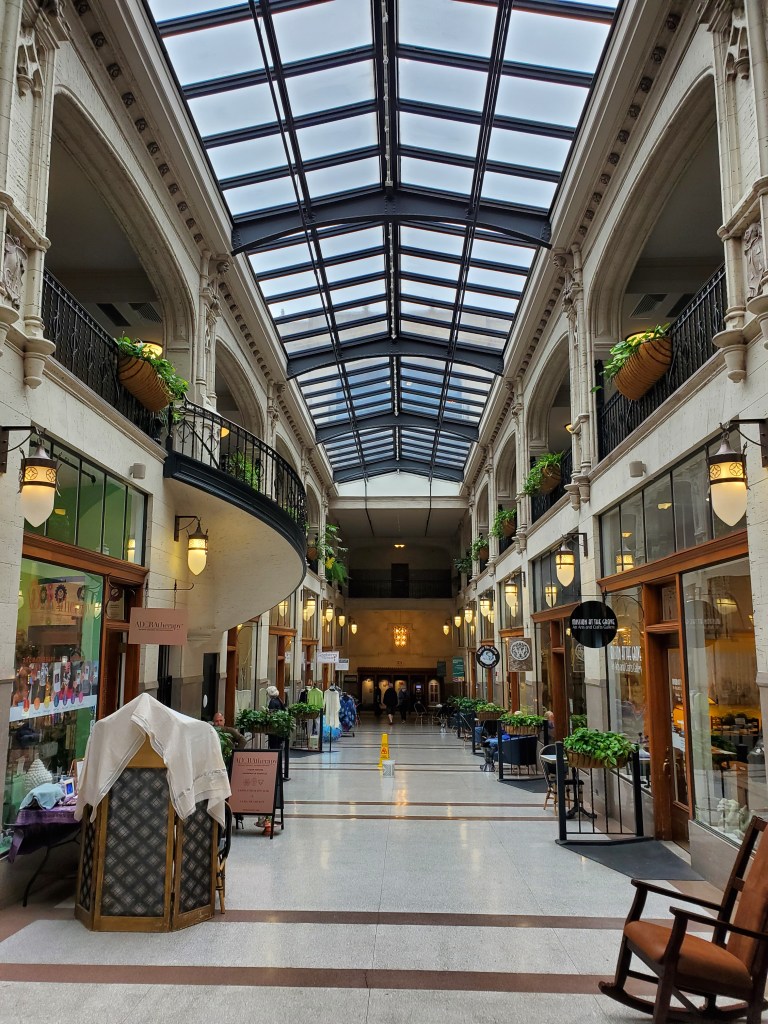
The Grove Arcade When I meet Olivia back at the lucky parking space, we return to the Best Western Glo and revive a tradition begun when she and her sister were wee ones, swimming in the motel pool, in this case a salt water pool that leaves our skin remarkably soft. Then it’s back to Beaucatcher, where Olivia and I examine some of the family photographs I’ve also brought south to their appropriate home with Susan. When she returns from her work at RiverLink, we all go out to dinner at the Copper Kettle, where again I am propelled back to the past, remembering an earlier dinner there after a flight down to Asheville disrupted by weather that delayed our arrival by a full day. David bought me a flocked scarf from a local craftswoman showing her wares there.
Is it ever possible to experience the present uninflected by memory? I think not.
The rain has let up and in the midst of goodbyes, I leave my umbrella in the family car, but Susan has it waiting for me, hanging from the mailbox, when I swing by to pick it up on my way to Ingles for peanut butter and cash for the road ahead. A stranger behind me in line volunteers his Ingles rewards number on hearing I am a visitor who doesn’t have one, and the very elderly but very kind cashier helps me get the cash back I need. Again, the kindness of strangers. I head back to the garish Glo, wondering what E. W. Grove would make of the Asheville he departed just five years shy of a century ago. Would he be wrestling the past as much as I am?
-
Southern Sojourn Day 10: 22 May 2022 Chattanooga TN > Asheville NC
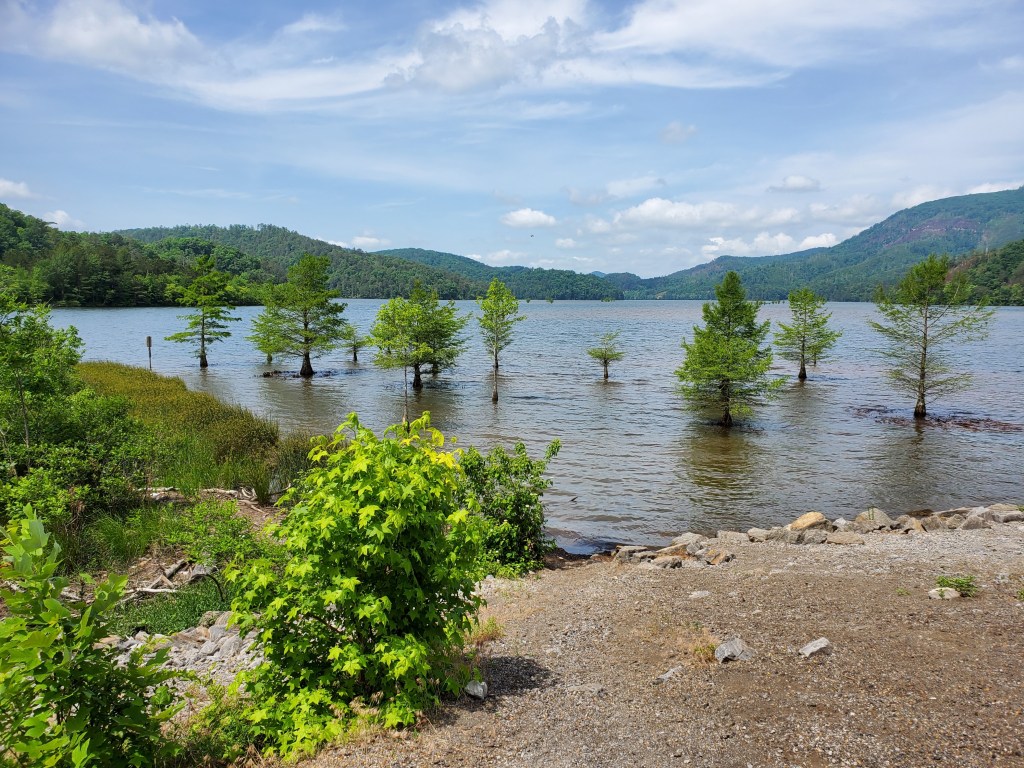
High Water on Lake Ocoee TN Pete is up before us, but Karen and I breakfast on eggs I scramble with last night’s garlic potatoes; Karen praises these, despite her having prepared those excellent potatoes the night before: ever the generous teacher, she is, heaping praise and encouragement. Over coffee, Pete confesses falling for Karen from the moment he first saw her; I am not at all surprised, knowing her beauty and my own experience of love-at-first-sight. That is a nice moment. Pete also speaks of the philosophy behind all his many years of producing, acting, and directing: put yourself in the time the play was written. When I mention my Shakespeare manuscript, he offers to read it, and Karen leaps in to volunteer that I was the smartest student he taught in his 50 years of professing. I doubt this, but Pete agrees, and I am absurdly, unreasonably chuffed by this compliment.
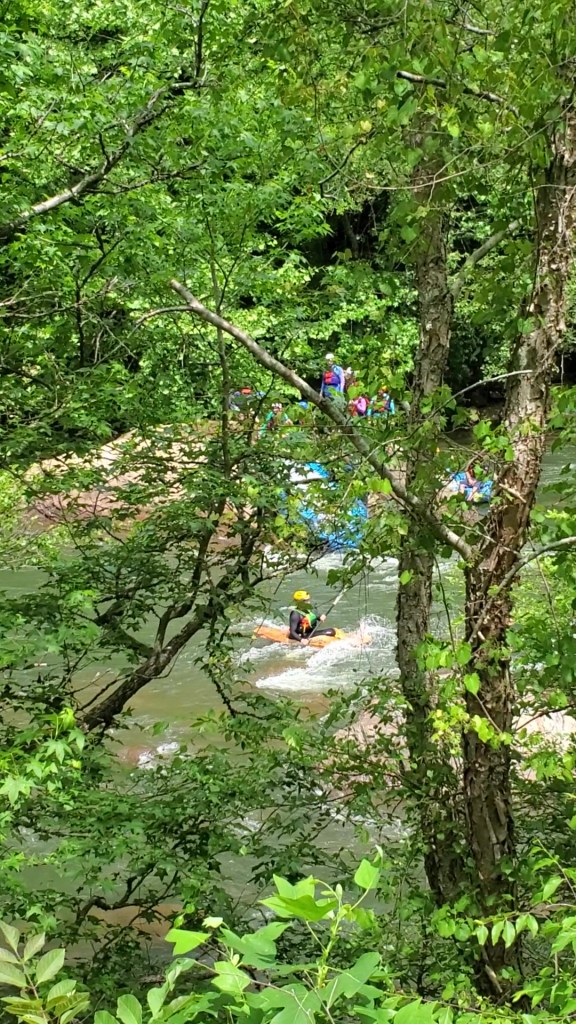
We say our goodbyes and I am off to Asheville, taking the route along the Ocoee River, both beautiful and heavily trafficked with Sunday morning recreational rafters, kayakers, and other assorted white water enthusiasts. I pull over twice, once to puzzle over trees that appear to be growing right out of the Parksville Lake Reservoir (aka Lake Ocoee, a corruption of the Cherokee word “u-wa-go-hi” meaning “wild apricot” aka passion flower).
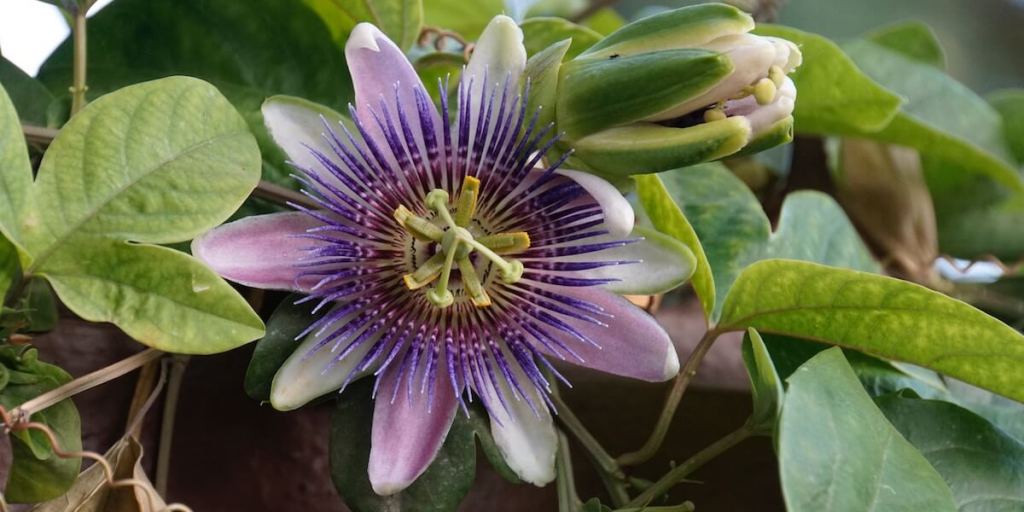
U-wa-go-hi Driving further east, I can’t resist stopping again for the vicarious pleasure of watching grownups enjoying their improvised slide, synchronizing their splashing into the river to avoid the passing kayakers.
Though the weather is fine initially, by the time I reach Asheville, it is dark and pouring rain, and I get confused taking an unaccustomed exit onto Tunnel Road to reach my Best Western Glo, whose bright, Carnaby Street vibe helps to dispel the dark day.
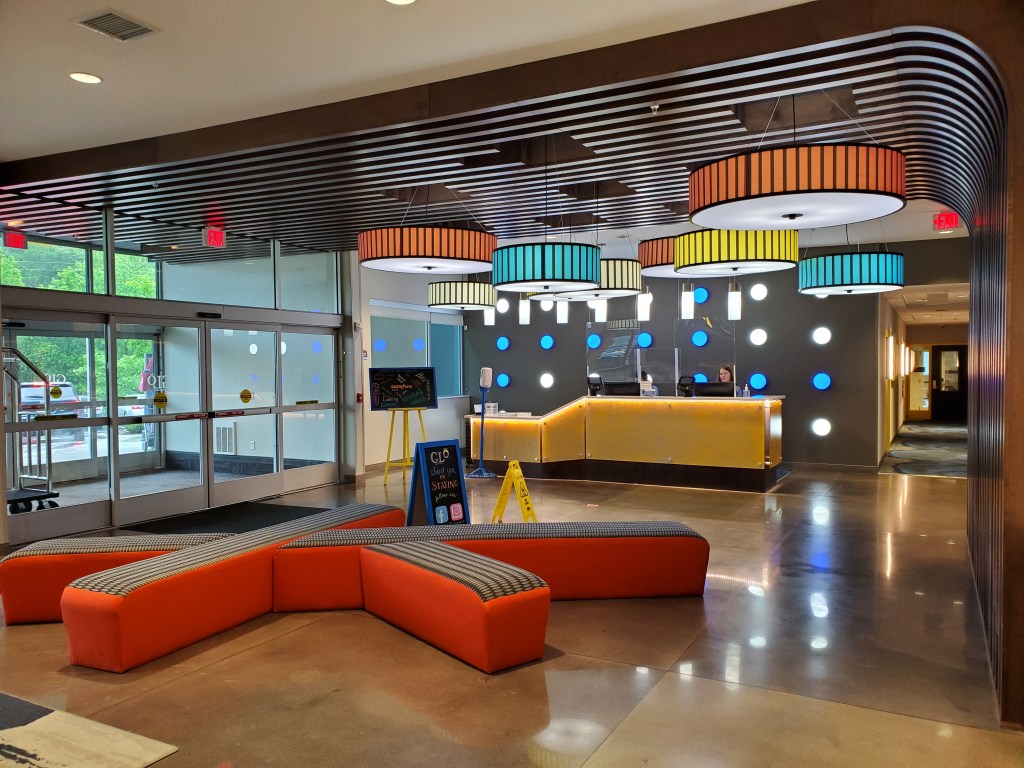
Best Western Glo Lobby, Asheville NC I’m eager to deliver to my step-daughter Susan her framed portrait, a fine piece done by Sigmund Abeles in the early 80’s, before the rainstorm intensifies; safely transporting this was, after all, the primary reason for my long drive south. Now, at the center point of my sojourn, that mission is accomplished!
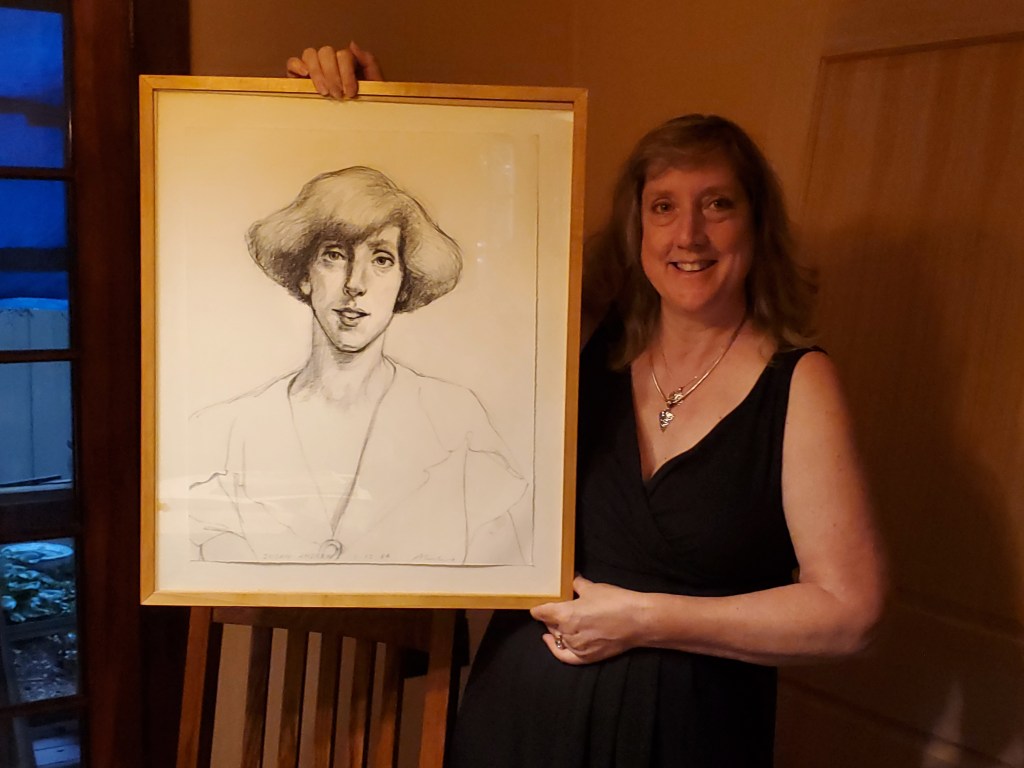
Susan with “Susan” by Sig Abeles, 1984 That safe arrival calls for a celebration downtown at the Marriott’s damp but still appealing rooftop terrace across the street from La Strada, not only a 1954 Fellini classic, but a favorite restaurant. I am struck by our granddaughter Olivia, “all grown up,” ordering a mocktail at the bar. (Cue “Sunrise, Sunset.”)
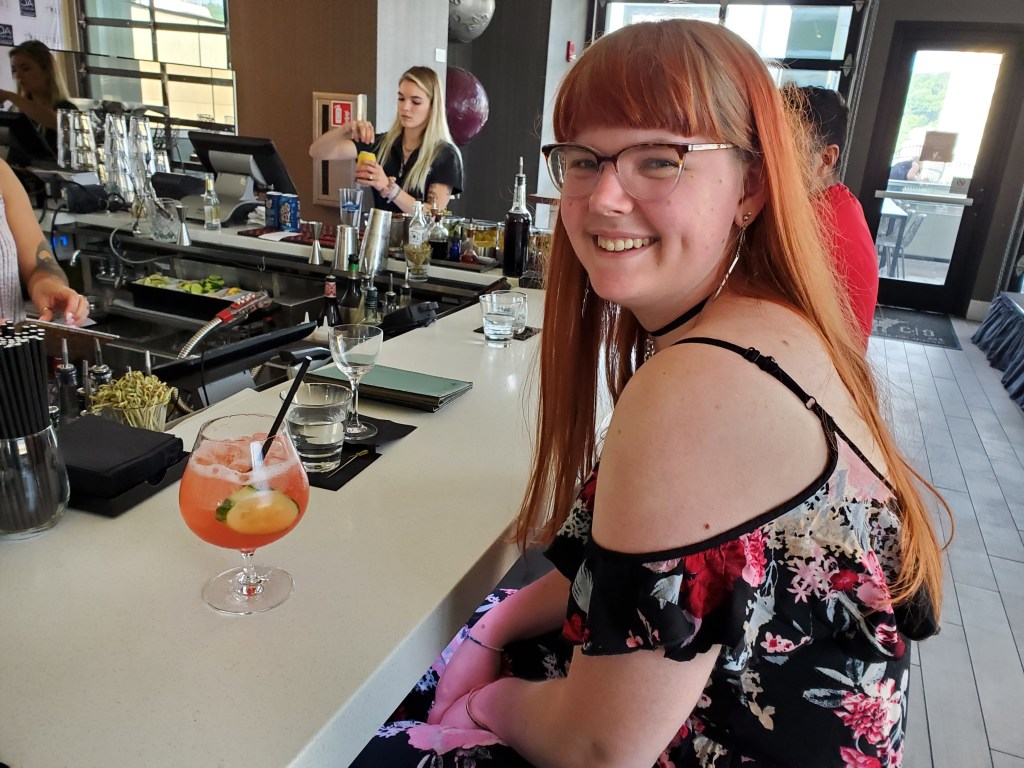
“Little” Olivia, rising Western Carolina junior, 22 May 2022 Monday morning means work for Susan and her husband Mark, she to RiverLink and its admirable mission to restore and revitalize the French Broad River, and Mark, retired physician assistant, back to work on the bungalow he’s been restoring and upgrading since first they moved there in 1995. One granddaughter, Isabel, is back in Chapel Hill following her sophomore year, but Olivia is home for the summer and has a job interview the next day. So Mark, Olivia, and I plan to have breakfast together downtown in the morning, and we make it an early night.
-
Southern Sojourn Day 9: 21 May 2022 Sewanee TN

All Saints’ Chapel, University of the South, Sewanee I write this account of a day spent largely at Sewanee, the University of the South, nearly a month past my visit to the “Domain,” and just as the second public hearing of the House Investigation of January 6 Committee has adjourned. Personal history and history being made are colliding, especially given the founding principles of the institution I visited. Sewanee’s picture-perfect Collegiate Gothic campus is a mountain-top pastoral, literally and figuratively separate from the world below. The campus is a beautiful, artificial domain indeed, but its raison d’être disturbs. I borrow from Wikipedia’s summary of its founding:
On July 4, 1857, delegates from ten Southern dioceses of the Episcopal Church in the United States were led up Monteagle Mountain by Bishop Leonidas Polk for the founding of their denominational college for the region. The goal was to create a Southern university free of Northern influences. As one of its co-founders, Bishop James Otey of Tennessee, put it: the new university will “materially aid the South to resist and repel a fanatical domination which seeks to rule over us” (Deyle, Carry Me Back: The Domestic Slave Trade in American Life, Oxford U. Press, 2006, pp. 205-07). Another of the co-founders was John Armfield, at one time co-owner of Franklin and Armfield, “the largest and most prosperous slave trading enterprise in the entire country” (Gower, “John Armfield 1797-1871” in the online Tennessee Encyclopedia).
The U.S. House Committee is currently presenting, as rationally and effectively as I believe possible, testimonies that explain why and how the violent 6 January assault on the U.S. Capitol occurred, an attack-as-expression of the not-so-cold civil war in which our country is currently engaged. On the Committee’s first day, Representative Cheney starkly rebuked fellow Republicans supporting Trump’s Big Lie: “There will come a day when Donald Trump is gone, but your dishonor will remain.” Yet I wonder how many of the former president’s supporters—even those likely few who watch or listen to the hearings—will, like Bishop Otey, find only honor in resisting and repelling “a fanatical domination which seeks to rule over us,” a group they would define as anyone with beliefs different from their own. For them, violence against such a group is not only defensible, but honorable. Facts and rules of evidence appear not to apply to anyone mesmerized by a charismatic (?) leader who vents shared hatred of the Other. The “charm” of the scofflaw Trump has always escaped me, yet so many remain devotees. Why?
And why, Dear Reader, do I add this preamble to my travel blog/diary? Because again I realize how much my Southern Sojourn is less an attempt to revisit my own past, than it is more an attempt to understand the present in which we all find ourselves.
So. Back to my account. After breakfast in the sylvan peace of their beautiful home, Pete and Karen honor my request for a tour of Sewanee, about an hour’s drive away. We enter its 13,000 mountain-top acres through the Angel Gates. Legend is a place so beautiful must be a place where angels dwell, protecting inhabitants and visitors alike. Tap the roof of your car as you leave the Domain to pick up your angel to protect you off the Domain as well; tap again on reentering to release your blithe spirit.
The place is beautiful there atop Monteagle Mountain, part of the Cumberland Plateau, and both homes and campus buildings are built of native Warren Point Sandstone, some of which was quarried right on the Domain, affording the whole place the uniform aesthetic and permanence of warm, golden stone.
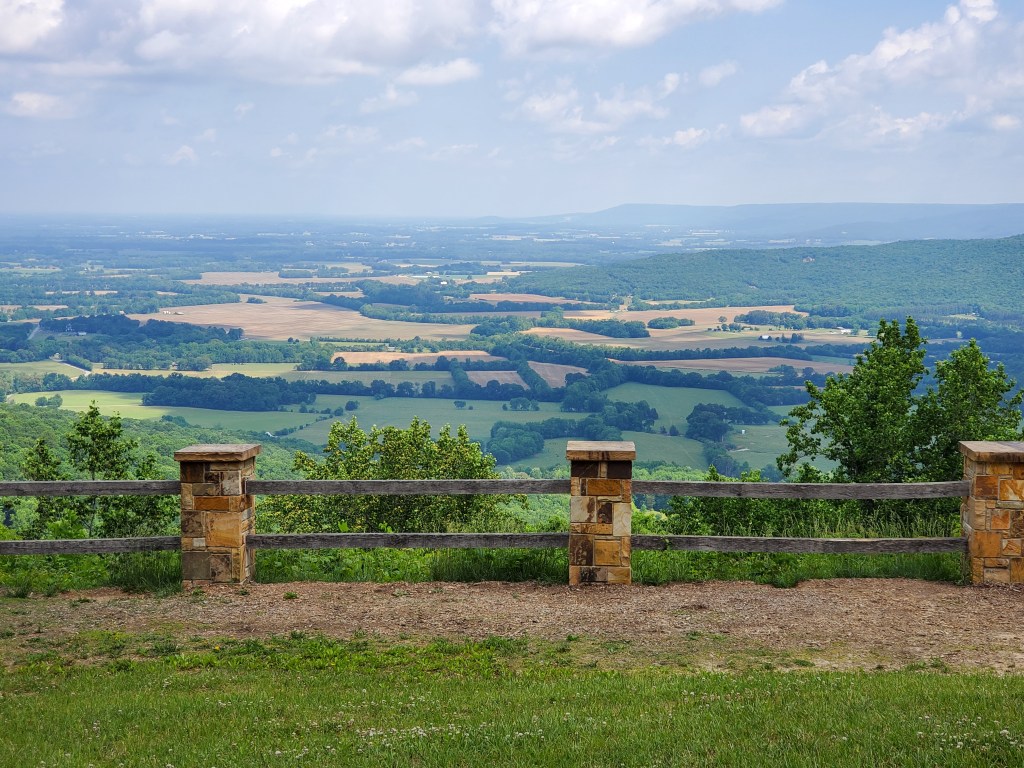
View from the Domain, part of the Cumberland Plateau We visit both the 1906 cottage Pete and Karen have updated and maintain as a cool retreat and two of the houses where they once lived campus.
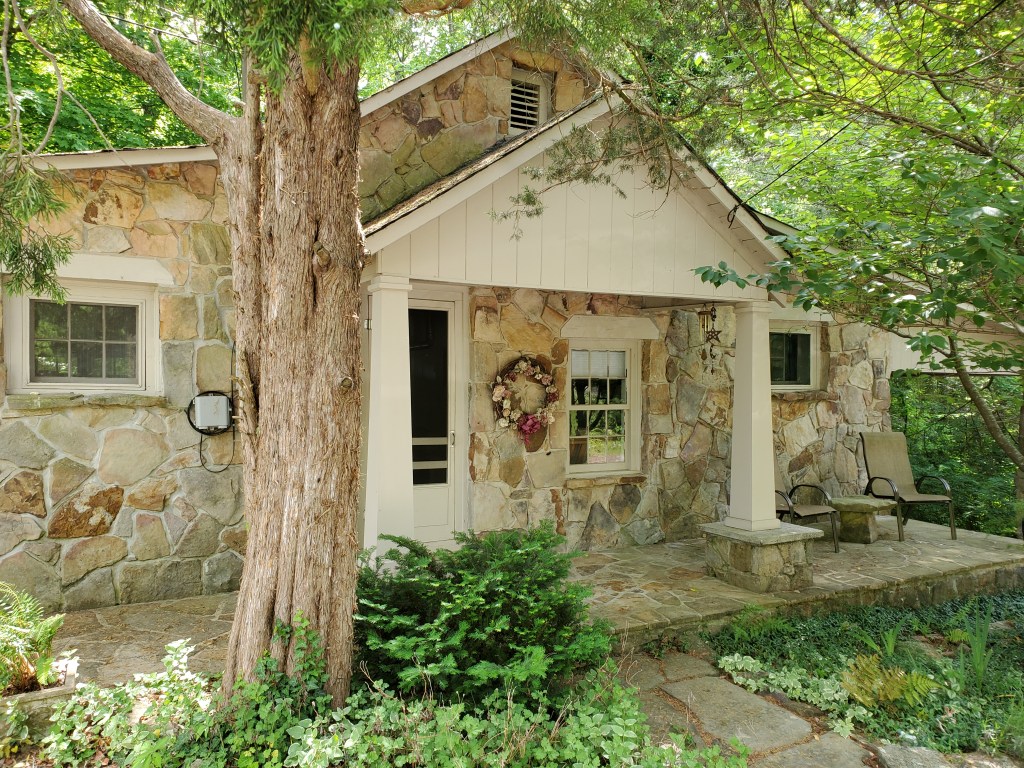
The Cottage Both the cottage and their second home sit just above a ravine garden open to the public and named Abbo’s Alley after English Professor Abbott (aka “Abbo”) Cotton Martin, who in the early 1940’s began refining the area, using students seeking work-study income, some volunteers, and even German prisoners of war from nearby Tullahoma. The bench Karen and Pete had engraved as a remembrance of their late son, Noel, offers a peaceful view of one of the several bridges across the ravine’s stream.
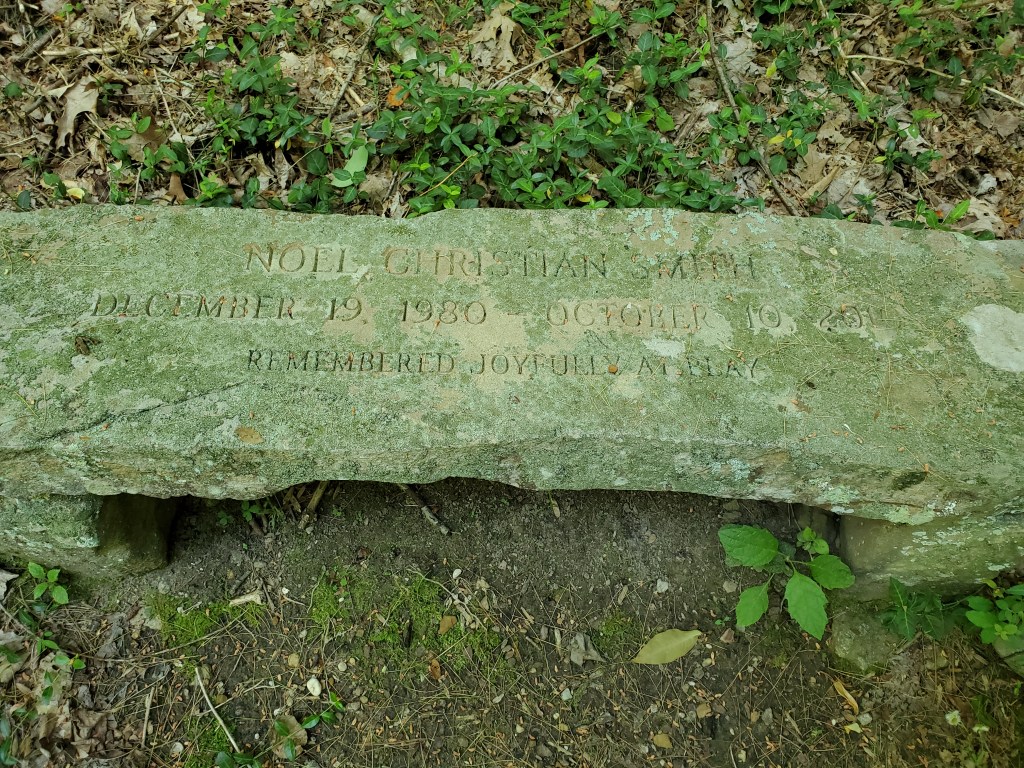
Noel’s Bench 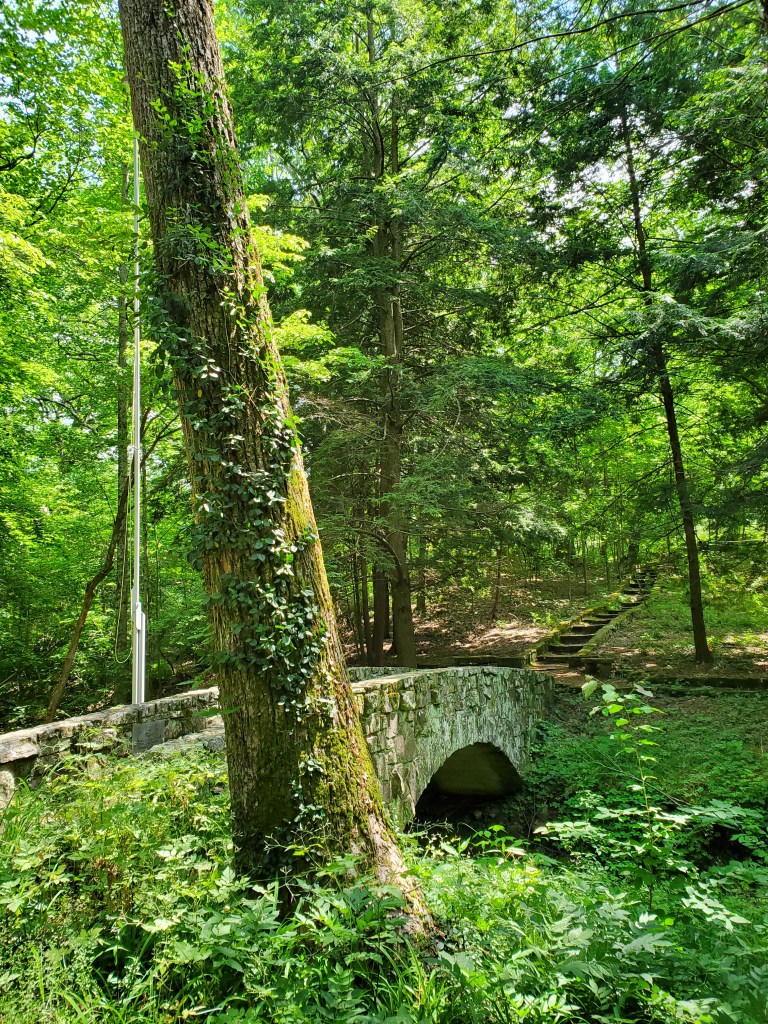
Abbo’s Alley Bridge All Saints’ Chapel, completed in the two campaigns of 1904 and 1959, stands at the center of campus, a frequent wedding venue, as the floral displays in progress when we visit demonstrate.

All Saints’ Chapel Nave, Sewanee 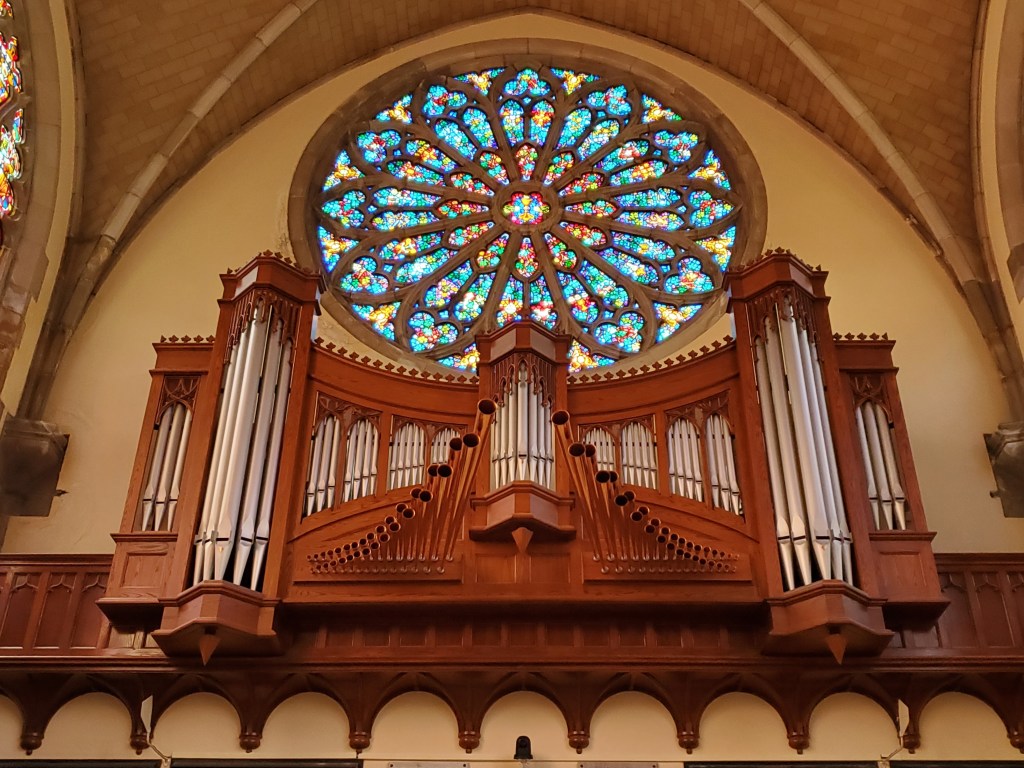
Rose Window above the All Saints’ Chapel Entrance 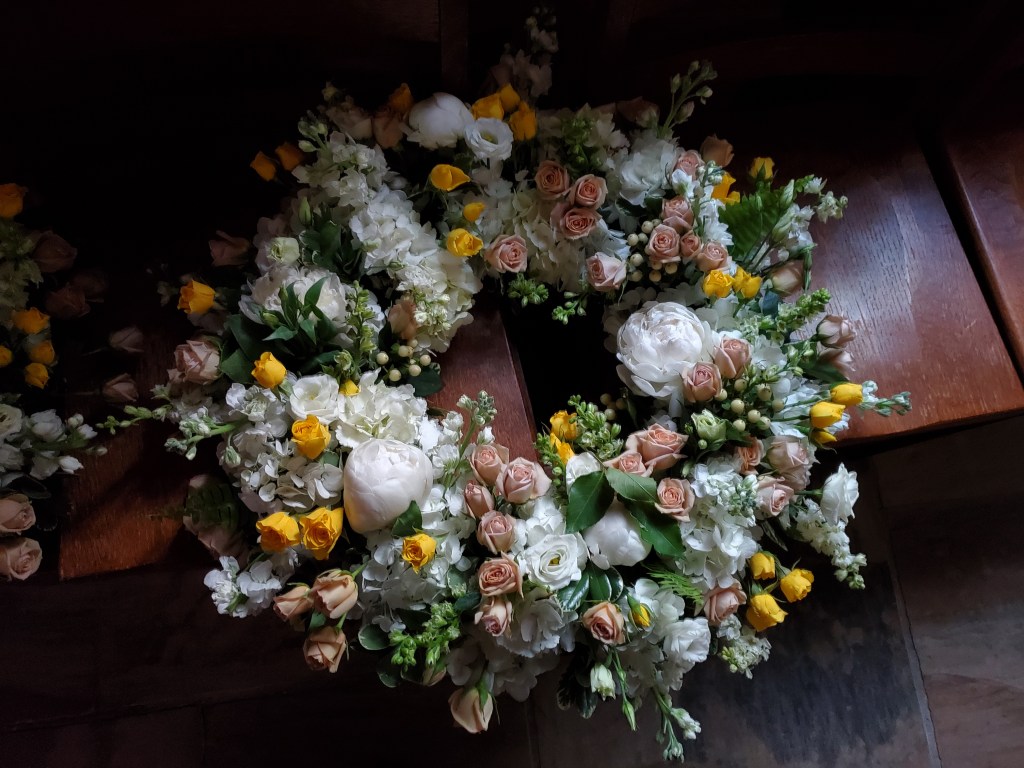
Wedding flowers waiting to be placed Its stained glass windows celebrate the secular as well as the sacred, including the 1892 establishment of The Sewanee Review, the oldest continuously published literary quarterly in the nation.
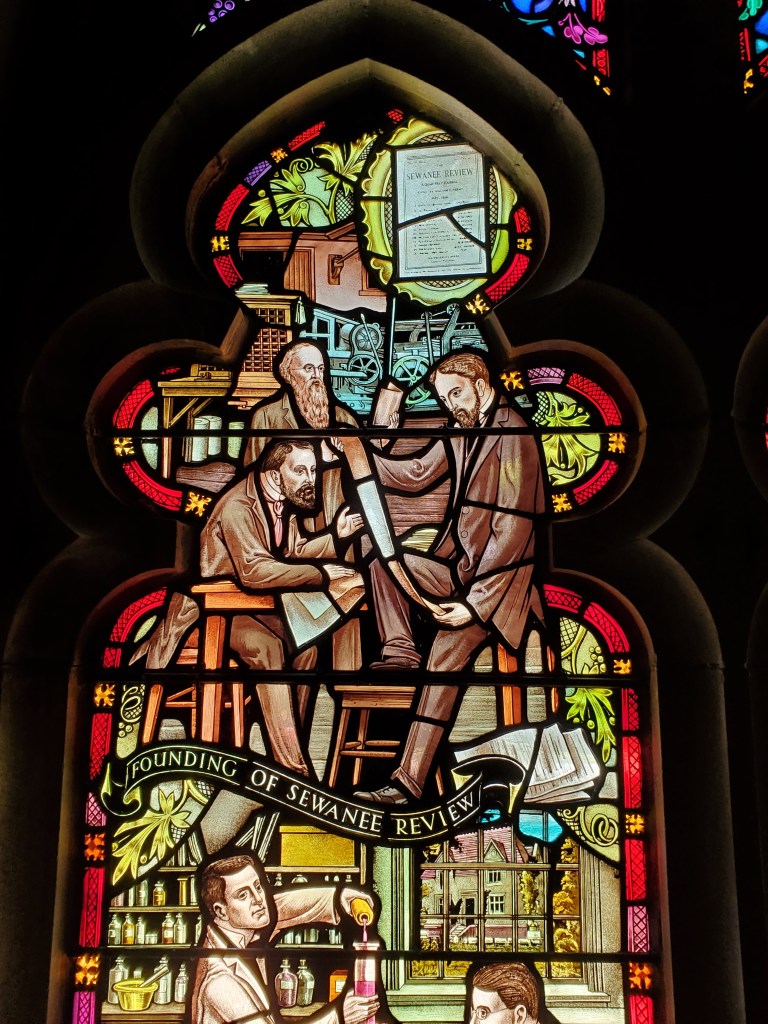
As pleased as that fact makes this secular humanist, the site I most want to see is the theatre Pete was instrumental in building with part of the Tennessee Williams bequest gifted to Sewanee as a memorial to his maternal grandfather, the Reverend Walter E. Dakin, who studied at Sewanee’s School of Theology in 1895. This generous gift, which came to the University in 1996, included the copyrights to the plays, screenplays, poems, letters, and stories written by Williams, and Pete’s self-described mission ever since then has been “to keep Tennessee Williams alive.”

Pete and Karen pose at the Tennessee Williams Center At one time Williams was the second most-frequently produced playwright after Shakespeare, and all professional productions of Williams’s plays now must secure permission from Pete, who headed the construction of the Tennessee Williams Center on campus, and wrote the text for the engraved memorial to Williams at its entrance:
Craftsmanship and vision marked Tennessee Williams as one of the most talented playwrights of the American Theatre.
He was born on March 26, 1911 in Columbus Mississippi, son of Cornelius Coffin Williams, a traveling shoe salesman, and Edwina Dakin Williams, the daughter of an Episcopal priest who graduated from The University of the South, School of Theology, Class of 1895.
He was raised in St. Louis and graduated from the University of Iowa in 1938. He died on February 24, 1983.
From the beginning of his career, Tennessee Williams wrote characters who are never at home in the world, but are fugitives, “faded and frightened and difficult and odd and lonely.”
The theatre space just past the Dakin Lobby is the ultimate black box, offering unlimited staging possibilities, and Pete is justifiably proud of his role in creating it.
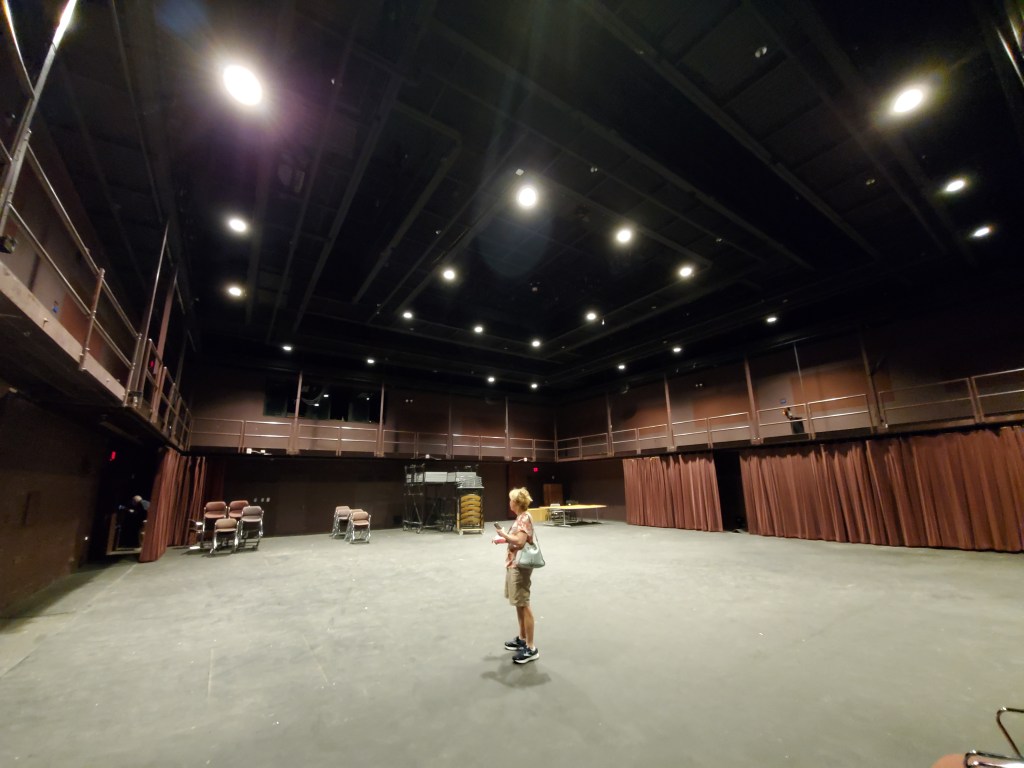
Karen back onstage at the Williams Theatre We take our Sewanee angels with us when we leave the Angel Gates. Part of their beneficence that ensues must be the superior Angel’s Envy bourbon with which we toast the winner of the Preakness, Early Voting (!), prior to a dinner of that now-familiar and most excellent combo of medium rare beef, asparagus, and potatoes cooked with garlic I help Karen, hobbled by a right arm in a pink cast following wrist surgery, prepare. My reward, in addition to an excellent meal: an extra garlic press!
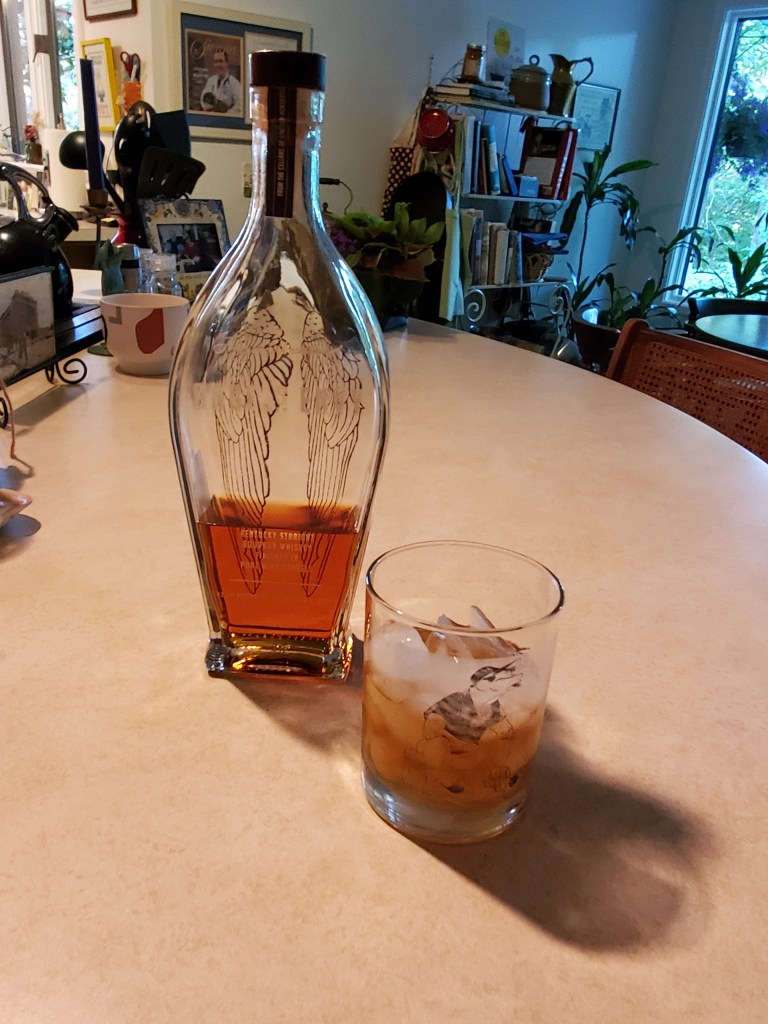
One delicious bourbon A day of revelations well spent.
-
Southern Sojourn Day 8: 20 May 2022 Danville KY > Chattanooga TN
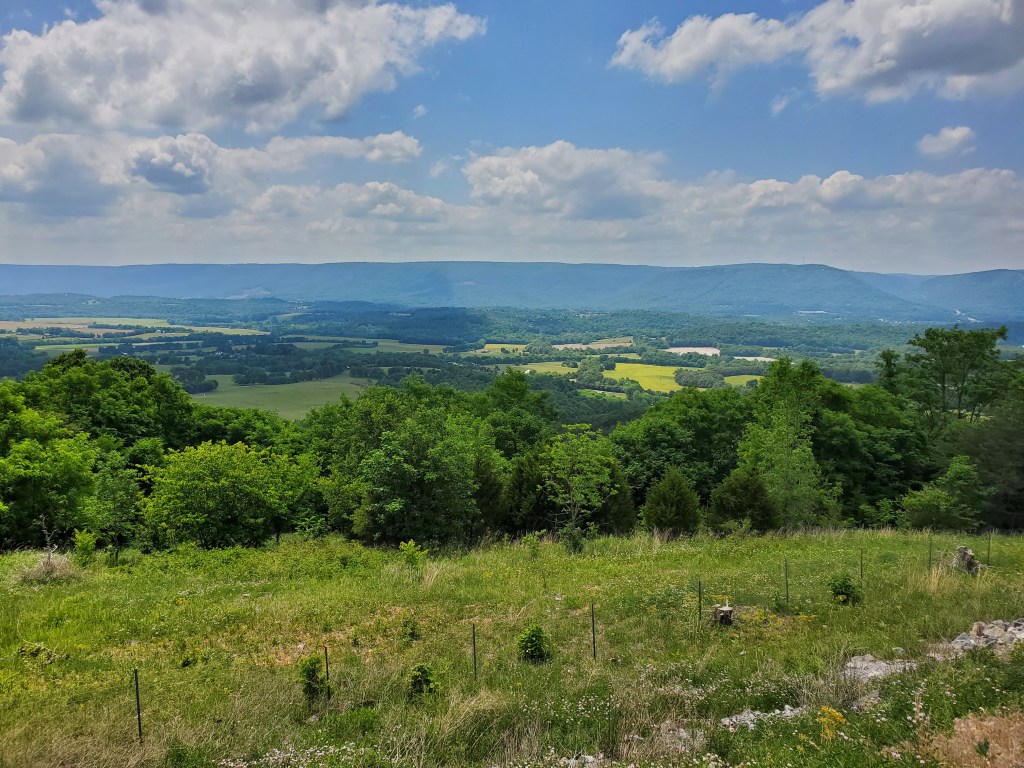
The Sequatchie Valley National Scenic Byway, Tennessee My last stop in Danville is breakfast at The Early Bird: avocado toast with poached egg—a combo unheard of in the Danville of my first acquaintance in 1984, when even fresh seafood was impossible to get and dry Boyle County necessitated planning way ahead to buy anything alcoholic.
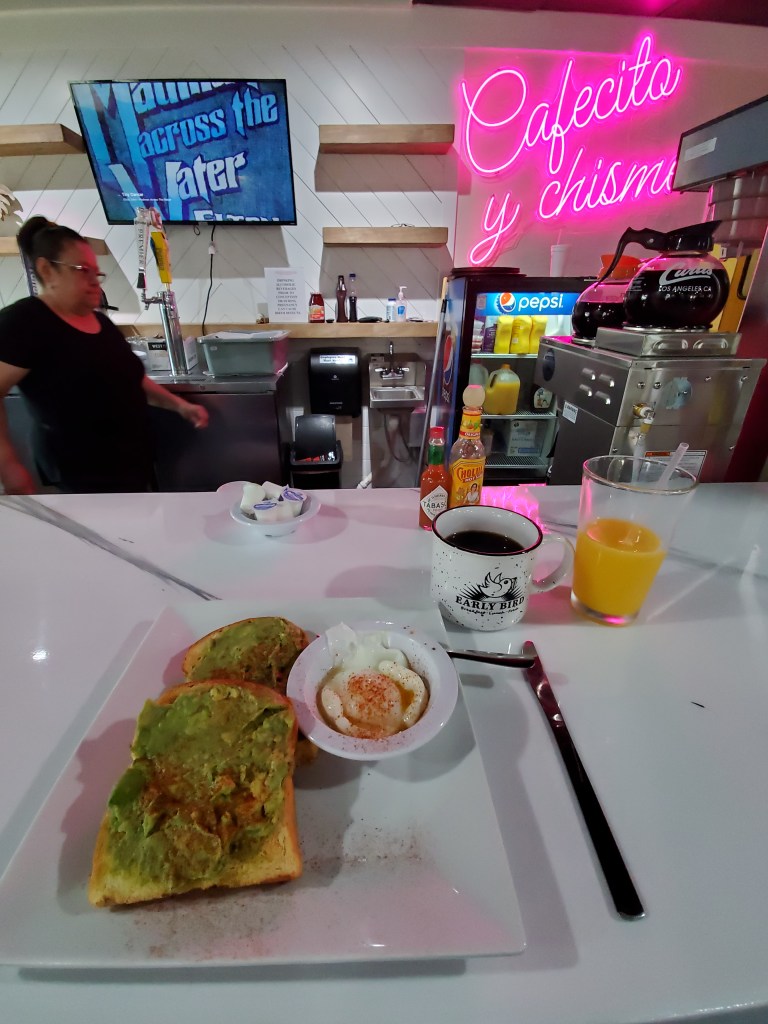
Breakfast at The Early Bird, Danville KY I head south on 127, the route I used to take to see my mom in Hendersonville NC and my then-boyfriend in New Orleans, but soon branch west on the unfamiliar route Tennessee 111 toward Chattanooga and a reunion with friends of my undergraduate days: Pete, in 1973 a new drama professor at Furman University, and Karen, a suite-mate from my senior year when nine of us women enjoyed the privilege of sharing the apartment above the campus dining hall, liberated from the strictures of life in the women’s dorm. It was the era of streaking, and I recall our stealthy examination of the boys who gathered one evening below by the dining hall loading dock to disrobe before their naked run, blithely unaware that we feminist voyeurs were on the dining hall roof watching them. (Were there nine of us girls? I remember Leta, Alice, and I slept in single beds side-by-side in a makeshift bedroom, our narrow berths divided from the rest of the room by clothes racks. One suite-mate, a biology major, had a pet hog snake that I put to very good dramatic use in our final theatre history project, an environmental staging of The Bacchae in the creek bed of the Furman arboretum. Ah, youth!)
Senior year was my “breakout” year in theatre, when, having taking his acting class the year before, I twice played the wife of Pete’s character in two Furman productions, first Sarah in J.B. and then Mary Tyrone in Long Day’s Journey into Night: a very big deal for this undergrad. In between, Pete cast me as Lady Bracknell in his production of The Importance of Being Earnest. The rehearsing, playing, and hilarity of Wilde’s brilliant Earnest—perhaps the funniest play ever written–remains to this day a signal highlight of my life, and the source of long-enduring friendships, my friend Jimmy’s (Algernon) career as a professional comedian, and the long and happy marriage of Karen (Cecily) and Pete. Quite a time, that senior year 1973-74: lots of yearning desire, requited and not, among our little crowd.
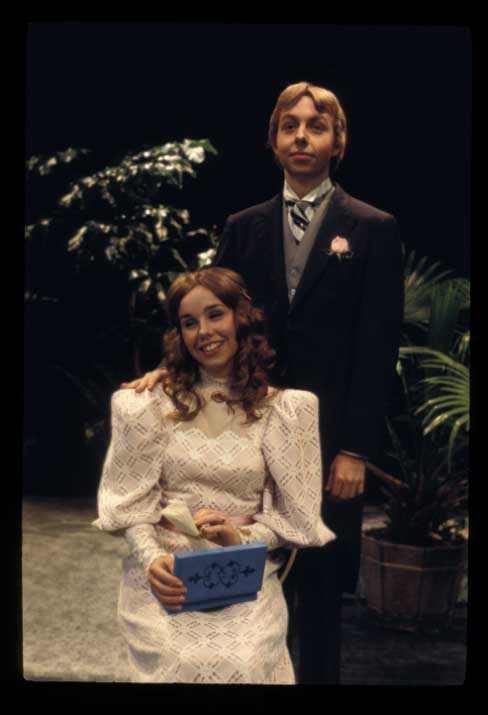
Karen as Cecily Cardew, Jimmy as Algernon, 1974 Pete left Furman to join the faculty at Sewanee, where on the 13,000-acre campus—known as “The Domain”–they raised their boys while Karen pursued her career as an intuitive, creative, dedicated elementary school teacher. Lucky the students in her charge. Karen’s now retired, and Pete, too, as of 2021—one year after I, who had been his undergraduate student, retired! I realize our seven-and-change years’ age difference means much less now than it did then. Do time and experience collapse with age as we all approach our common end? It is strange—and interesting—to be a retired professor still hoping to impress the professor from whom I learned so much.
These musings of les temps perdus keep me occupied on the drive up until I reach the great Sequatchie Valley of Tennessee, where again the lush majesty of the landscape diverts and I reprise my rendition of Paul Simon’s “American Tune.”
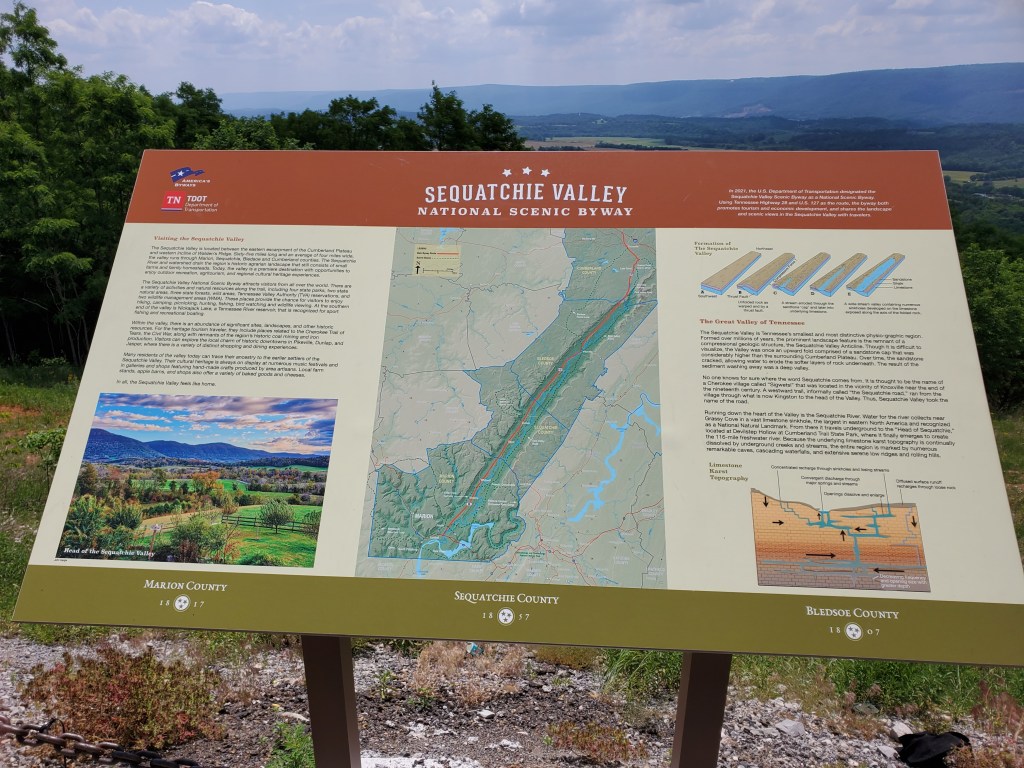
Bladder urgently requiring relief, I finally arrive at Pete and Karen’s lovely home tucked into the Tennessee mountainside and designed to make the most of its woodland setting.
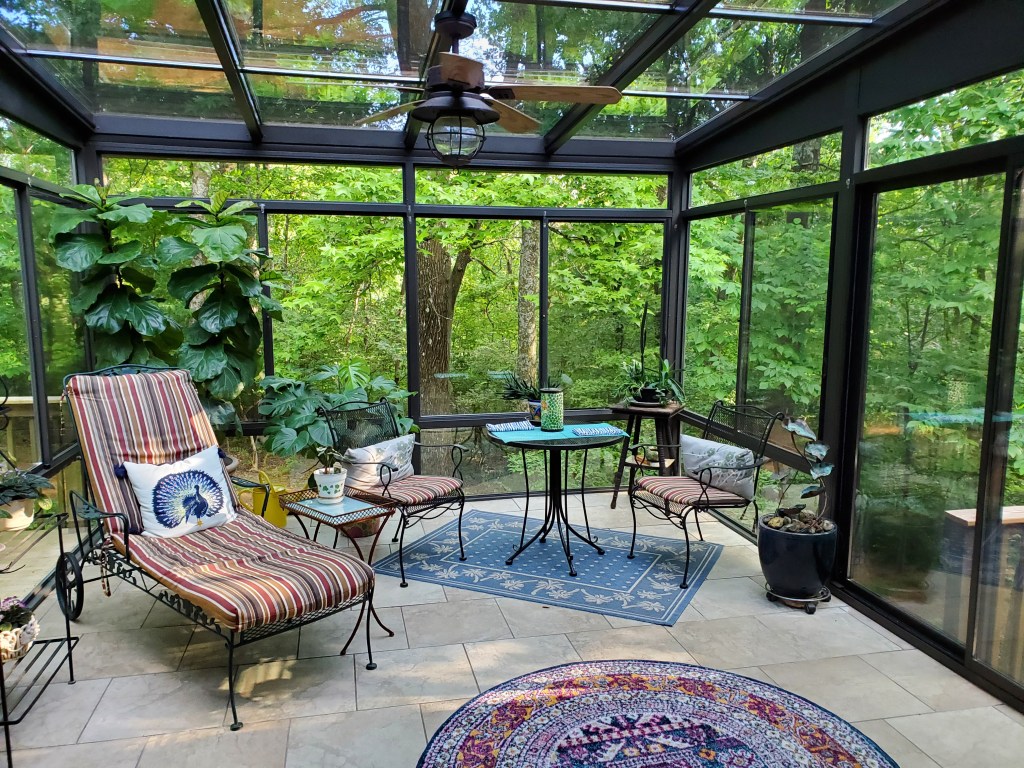
Any awkwardness I might have anticipated about being so long apart but having immediately to bolt for the loo vanished instantly on our first greeting. How good to see them both! After a tour of the house and my guest quarters in what had been their now-grown son Brian’s room, they treat me to dinner in downtown Chattanooga at the Public House, where the first course is deliciously down home: pimento cheese and fried pickles, followed by brook trout and key lime pie. Back at home we argue amiably about “lazy” directors and the (according to Pete) overrated Hamilton and The Book of Mormon before retiring, well fed, to bed.
-
Southern Sojourn Day 7: 19 May 2022 Danville KY
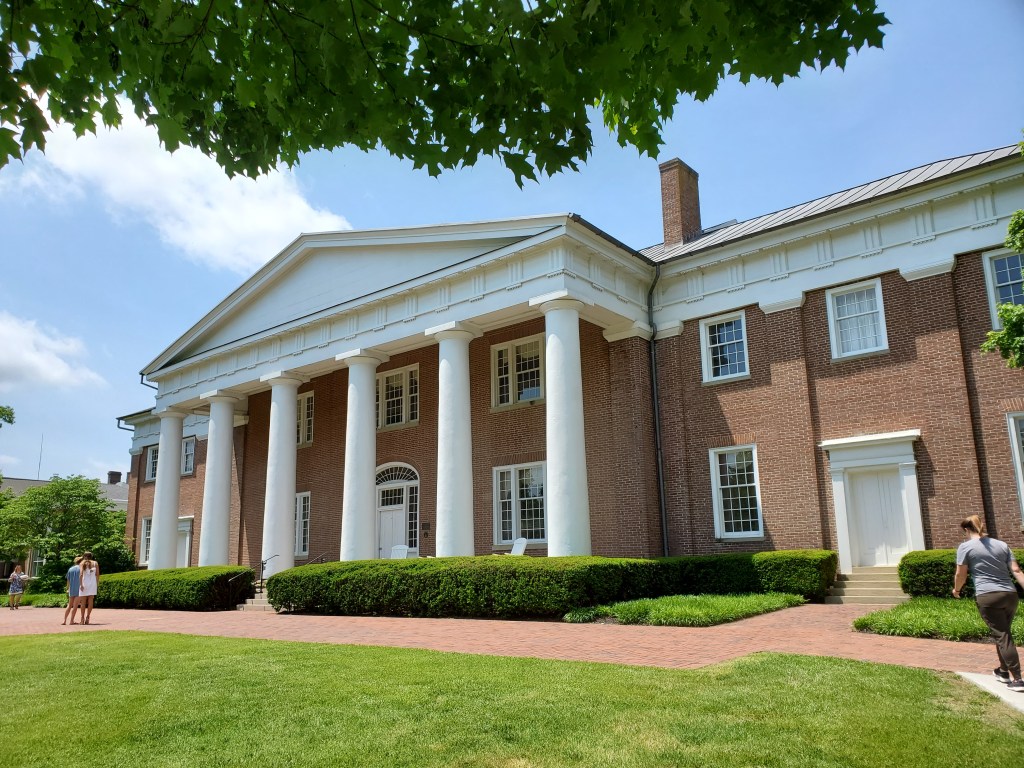
Old Centre, est. 1819, Danville KY A day of lucky little breaks and long-time friendships renewed, starting with a visit to the Constitution Square gift shop in search of postcards, a commodity increasingly hard to find. Success: I spy lots of Ephraim McDowell House cards, honoring the surgeon who performed the first abdominal surgery on Christmas morning, 1809, removing a 22.5-pound ovarian tumor from Jane Todd Crawford—without benefit of anesthetic or antisepsis. Crawford had ridden 60 miles on horseback to undergo the operation in Danville; she not only survived, but after 25 days rode back to her Green County home, and lived another 32 years. It strikes me that both doctor and patient were lucky—and heroic. Some history one is happy to leave behind.

The first post office west of the Allegheny Mountains (original building) in Constitution Square. First mail delivered on 3 November 1792 I am this morning the beneficiary of the gift shop attendant across the street from the McDowell house, the fellow who called my attention to a stack of old Centre College postcards he’d found in the attic featuring many different views of the College and Danville printed up for Centre’s 2019 bicentennial, including photos of Old Centre painted with the triumphan “C 6 H 0” score celebrating little Centre’s football team eating Harvard’s lunch in a 1921 contest played in Harvard Stadium before a crowd of 45,000. That formula (“that poisoned Harvard”) remains legend at Centre. When I inquired of the shop clerk how much he was asking for these cards, this gentleman demurred that he hadn’t yet got around to pricing them, and said: “Just put these in your purse.” The kindness of strangers.
My next stop was a CVS for Band-Aids, batteries, and q-tips. While in the check-out line I encountered another exchange unlikely to have occurred north of the Mason-Dixon line: a very polite but extended contretemps between a pharmacist pinch-hitting at the register (this CVS is yet another under-staffed establishment) and a customer trying to ascertain what, given various coupons, sales, and rewards points, she actually owed for the toilet paper she wanted to buy. Nothing, it turned out; her purchase was free, and all parted amicably, but not before this satisfied customer apologized to me for extending my wait in line. Extraordinary.
Stopping at a Kroger in search of fruit for the next leg of my trip, I discovered a lovely mandevilla for sale, the very plant whose name I could not recall the previous night when it appeared in my slide of the Villa Rufolo terrace: stroke of luck number 2. I bought it as a gift for my gracious hosts, a small tribute to their late daughter Chiara. From the grocery, I drove to my former home on Crosshill Road to photograph the place I’d been so proud to own—a simple, well-maintained little cape which I bought in 1987 for $58,000 and sold in 1995 for $71,000. How antiquated those figures now seem!
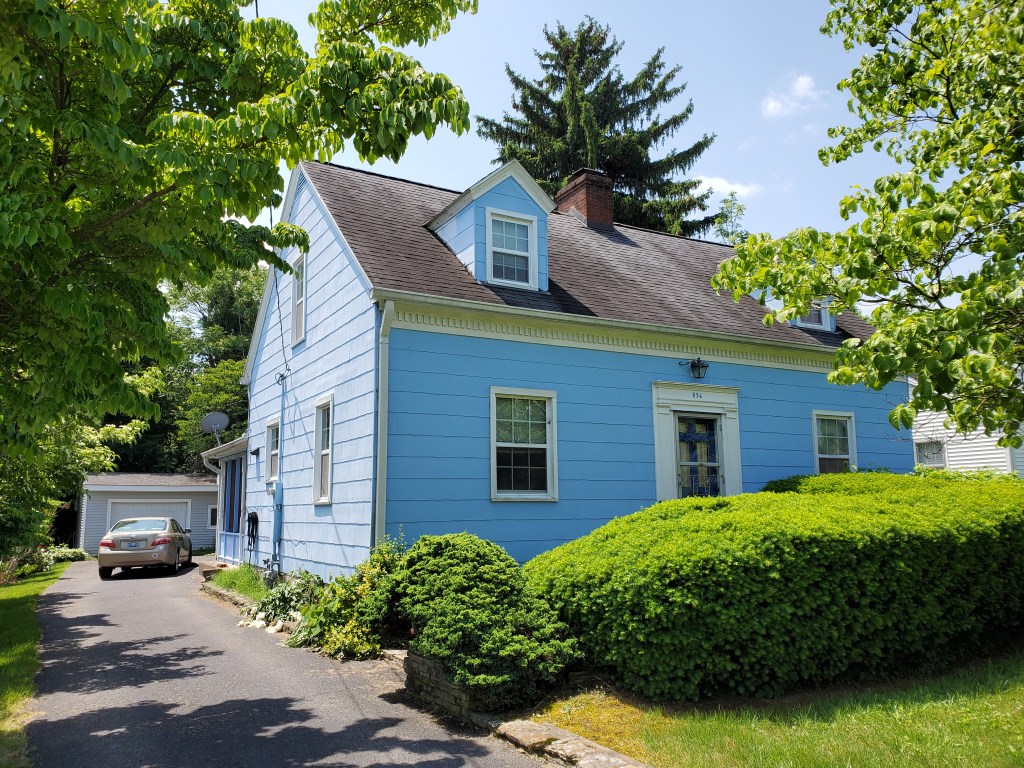
I began my tenure-track assistant professorship teaching 8 courses a year for a salary of $19,500 (including $500 for my finished dissertation), a sum which proved sufficient to buy a house three years later. In my mind’s ear I hear Archie and Edith singing “Those Were the Days.”
From my house I drive to Centre, realizing I don’t have a nice digital photo of the place, and pull into the visitor parking lot where I am greeted by a just-graduated senior who mimes rolling down my window so he can say: “Nice car!” When I agree to his assessment, he points to an identical iron-blue GTI already in the lot: HIS! Grant, the grad, is astounded: “I had to drive to Indiana to get mine, and I’ve never seen another one! Hey, could I pull my car over next to yours so my brother Garrett can take our picture?” Sure! I let Grant know I’d once taught at Centre. His response: “Well, now I REALLY need that picture!” Lucky break number 3. Grant and I, my “Eisenblau,” and his “Victoria” pose together.

l. to r.: Victoria, Georgeann, Grant, and Eisenblau Finally finishing my errands en route back to Bobbie’s, I think to stop at my Danville apartment, the first place I, the new drama prof, lived, as my Division Chair said when introducing me at the first faculty meeting, “appropriately on Broadway!” As I approached it, a car parked just in front pulled away, affording me just the parking place I needed to take the shot. Lucky break 4: batting a thousand.
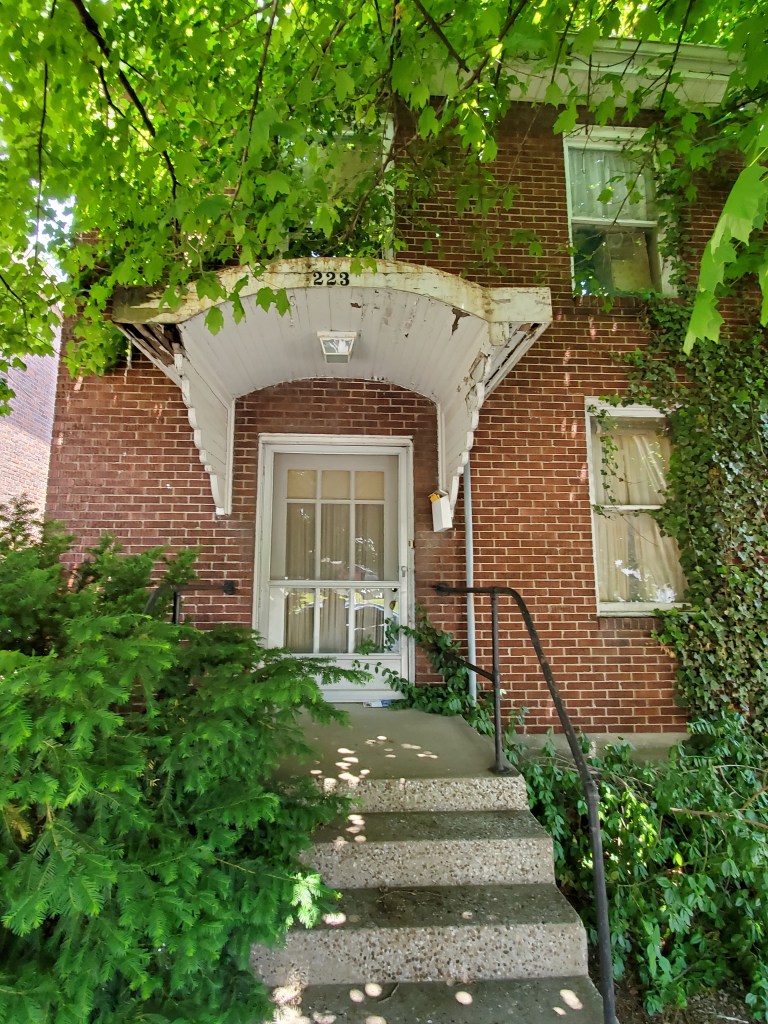
Back I go to Bobbie’s, where I once again get to accompany my friend to her appointment, and have some time with her back home afterward. We agree that professional humanists have some advantage when inevitable tragedies strike: some critical, analytical, intellectual distance from what is happening to us. I tell her again she modeled professorial life for me; she tells me she quoted me when speaking of how good friends always just pick up where they left off, and asks advice about the hair she has kept covered under a stylish cloche since losing most of it to cancer treatment. Can she go out like this? She removes the cloche, revealing a stylishly mussed cap of pure white hair. She looks like Annie Lennox! I give her thumbs up, she gives me a hug, and we part blowing kisses.
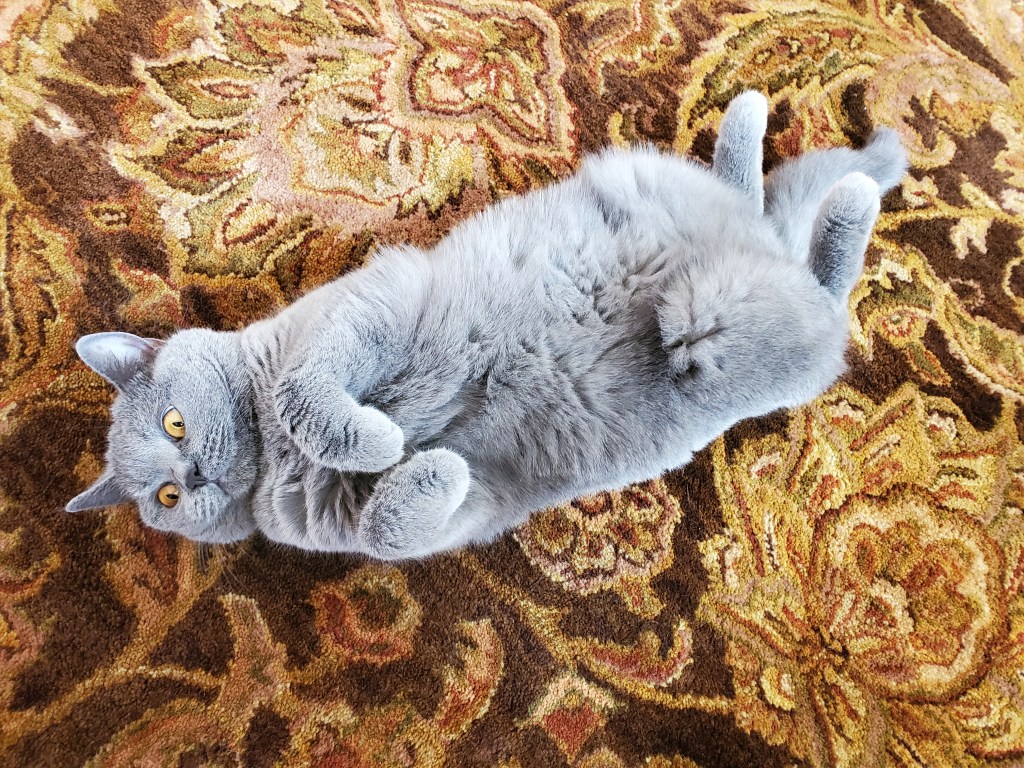
Bobbie’s kitty demands attention be paid Back at the little house, Bill comes to fulfill two requests of mine, visits to his daughter Chiara’s grave and to what has come to be wryly known as Jurassic Park, a College-owned house providing office space for retired Centre profs. Two sites devoted, in different ways, to the past. The Danville cemetery is a green and pleasant place, and Chiara has an epitaph from Dante’s Paradiso.
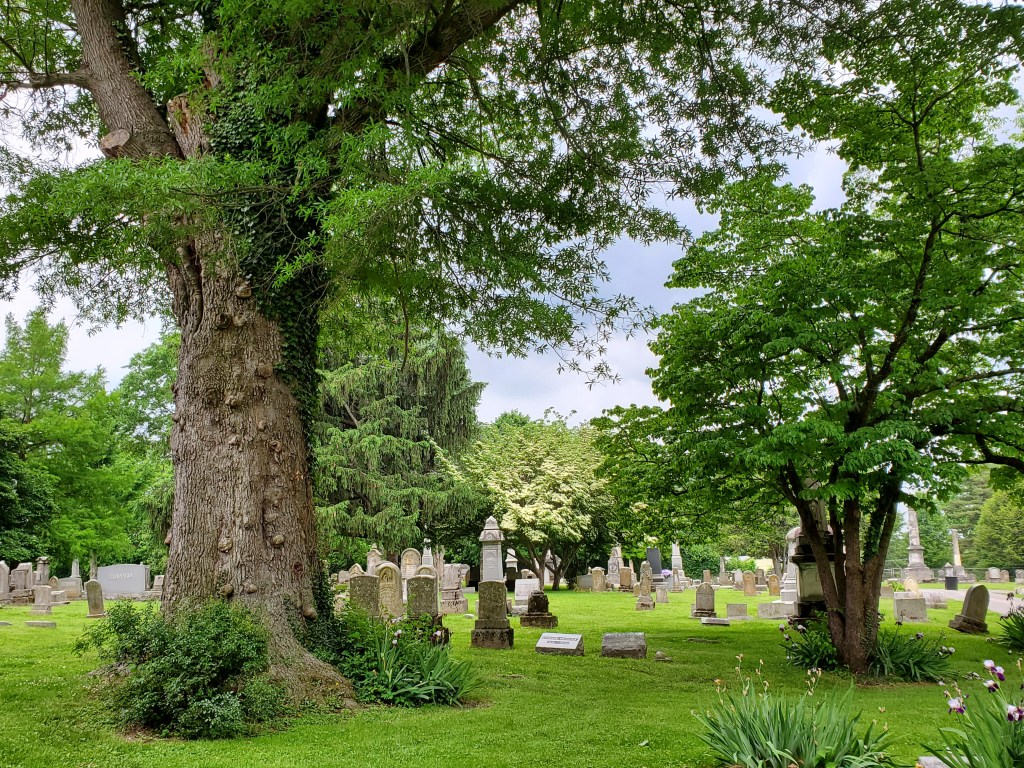
Bill grooms the site, and after is proud to show me the Jurassic Park office in which he so regularly, diligently works. It’s full of books and slides, tools of art historians like my David—also a Michigan man—of another era. One other emeritus is at work downstairs; he says he remembers me, but while I recognize his name, I don’t recognize him. Suddenly I feel the 27 years’ distance between me and Danville.
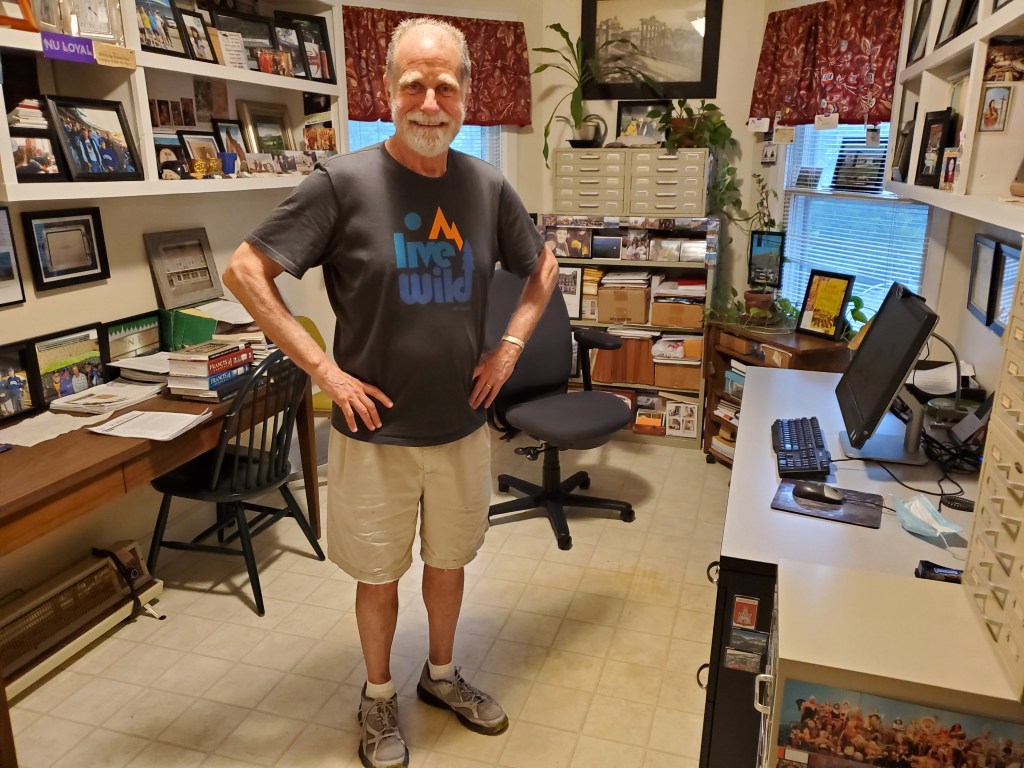
Scholar Bill in his Jurassic Park office Bill drops me at “home” to change for the dinner party Ann and Sheldon have prepared in my honor, and on joining the good company of all the friends attending, that 27 years’ distance evaporates.
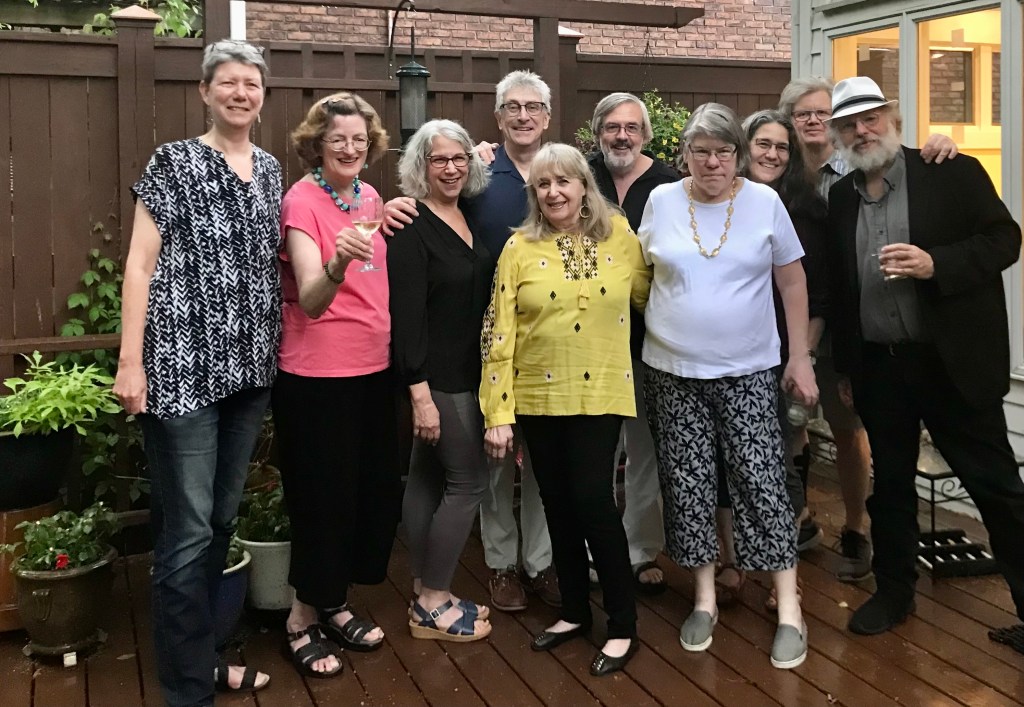
Our Gang, l. to r.
Linda, Georgeann, Ann, Sheldon, Helen W., John, Helen E., Diane, Mark, and SteveThere is, however, evidence of time’s passing: Sheldon, younger than I, is retiring, and another friend, Mark, whom Bobbie and I hired years before, is gliding the staged retirement path. Sheldon and Ann’s “baby” girl now has a baby of her own. Their house and garden are beautiful, set in a historic neighborhood of Danville close to campus. Ann’s table is grand, the meal delicious—perfectly roasted beef, minted potatoes, asparagus (a combo reminiscent of yesterday’s lunch), with chocolate cake and plenty of good Bordeaux. The conversation is lively and silly, classically tipsy academic: the topic of another colleague currently playing the professor in Uncle Vanya gives way to Schopenhauer, and then, irrationally, to the question of whether animals feel pleasure in eating—or sex, which leads to bird sex, and the size (large!) of a swan’s penis, cf. Zeus and Leda. The hilarity in turn gives way to quieter, more intimate reconnecting after dinner, when finally the ”school night” festivity breaks up.
Again, I go to bed happy.
-
Subscribe
Subscribed
Already have a WordPress.com account? Log in now.
 Georgeann Murphy