-
Excursion from Portage WI, Day 2
24 July 2022
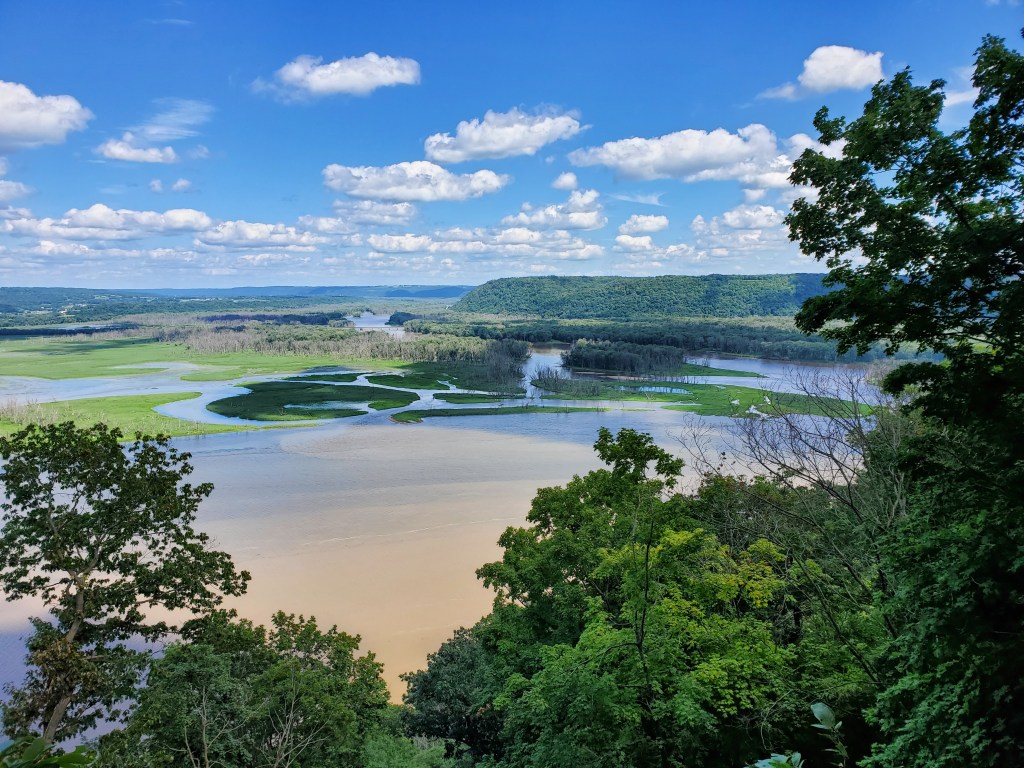
The Wisconsin River to the north meets the Mississippi in the foreground at Pikes Peak State Park near McGregor, Iowa A Sunday drive and cookout were a tradition in my family, with the usual destination a picnic table at Fort De Soto Park in Tierra Verde, Florida, just south of my hometown St. Petersburg, 1,136 acres on five interconnected keys on Tampa Bay and the Gulf of Mexico, home to mangroves, palm hammocks, live oaks, and LOTS of bird life—including seagulls capable of snatching a sandwich right out of my mother’s hand (“You dirty dog!” she exclaimed). Typically we’d cook our Sunday breakfast on one of the stationary grills provided—scrambled eggs and bacon–supplemented by a treat picked up en route, usually from Mister Donut (the cherry cake donut was my favorite).
All these years later, what my Wisconisn family had in store for me offered a very different landscape, but just as much fun (and egg salad on croissants standing in for scrambled eggs). It’s a long schlep from Portage WI to Pikes Peak State Park, Iowa, but well worth the 119-mile drive. The only Pikes Peak I knew of was in Colorado, but it turns out this Pikes Peak is named for the same Pike. In 1805, then Army lieutenant Zebulon Montgomery Pike led two expeditions under the authority of President Thomas Jefferson through the Louisiana Purchase territory, first to reconnoiter the headwaters of the Mississippi River, and next to explore the southwest to the edge of the northern Spanish settlements of New Mexico and Texas. It was on his expedition of 1806 that Pike sighted and tried with his men to climb his namesake peak in present-day Colorado before giving up the ascent in waist-deep snow. Pike’s 1810 published account of his expeditions proved so popular it was translated into several languages for European distribution. All that adventure and abundant new land!
Pikes Peak State Park features a 500-foot bluff (elevation 1130 feet) overlooking the upper Mississippi at the confluence of the Wisconsin River, providing a magnificent view, as stunning today as it must have been to the first Europeans to encounter it in 1673, French explorers Father Jacques Marquette and mapmaker Louis Jolliet, who journeyed down the Wisconsin River in two bark canoes to meet the mighty Mississippi. Once again, Nick Carraway’s musing at the end of The Great Gatsby comes to mind: they must have held their breath in the presence of this continent, “a fresh green breast of the new world.”
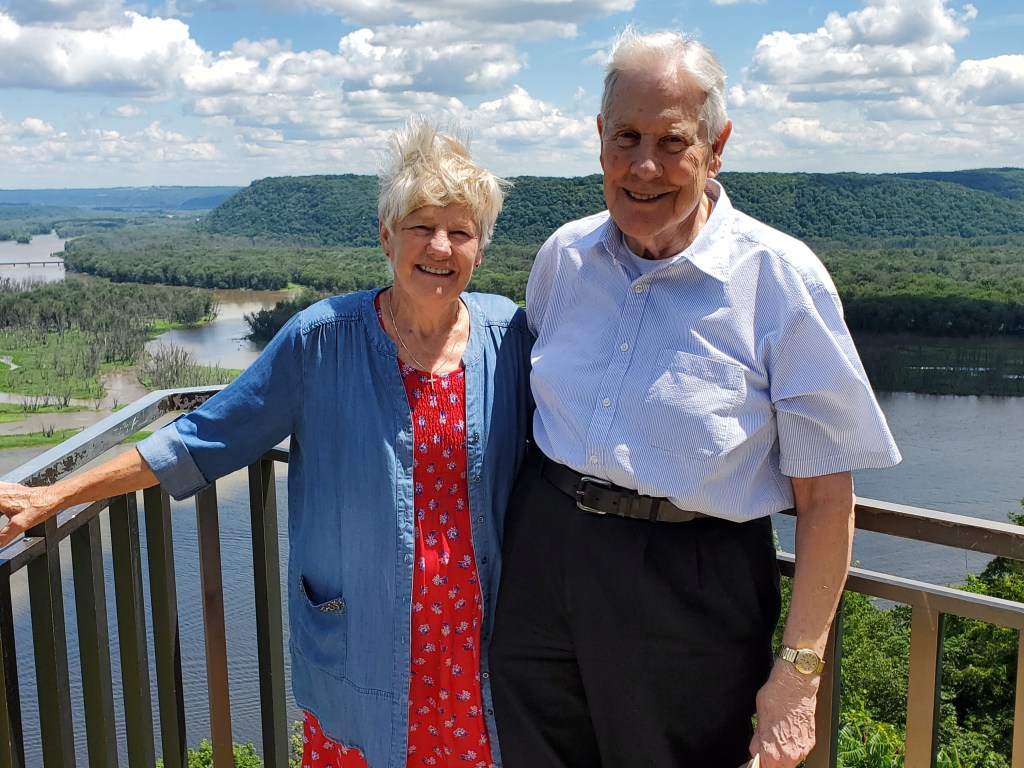
Picnic party: Jan (in her adorable red dress) and Chad . . . 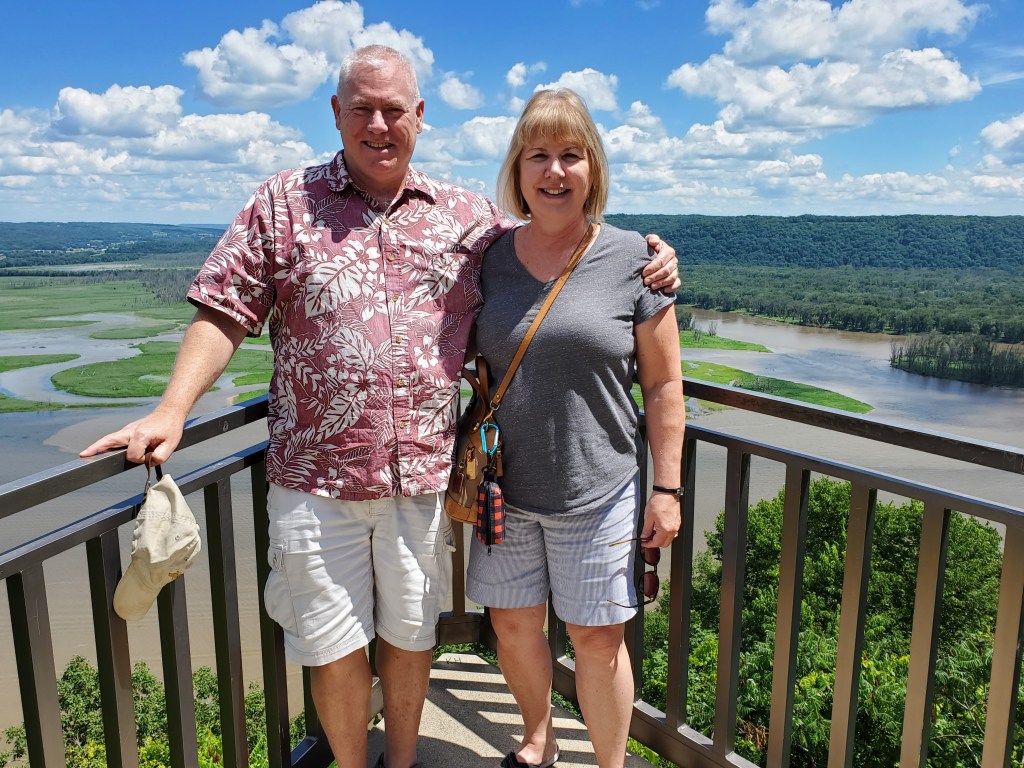
. . . Rob and Pam 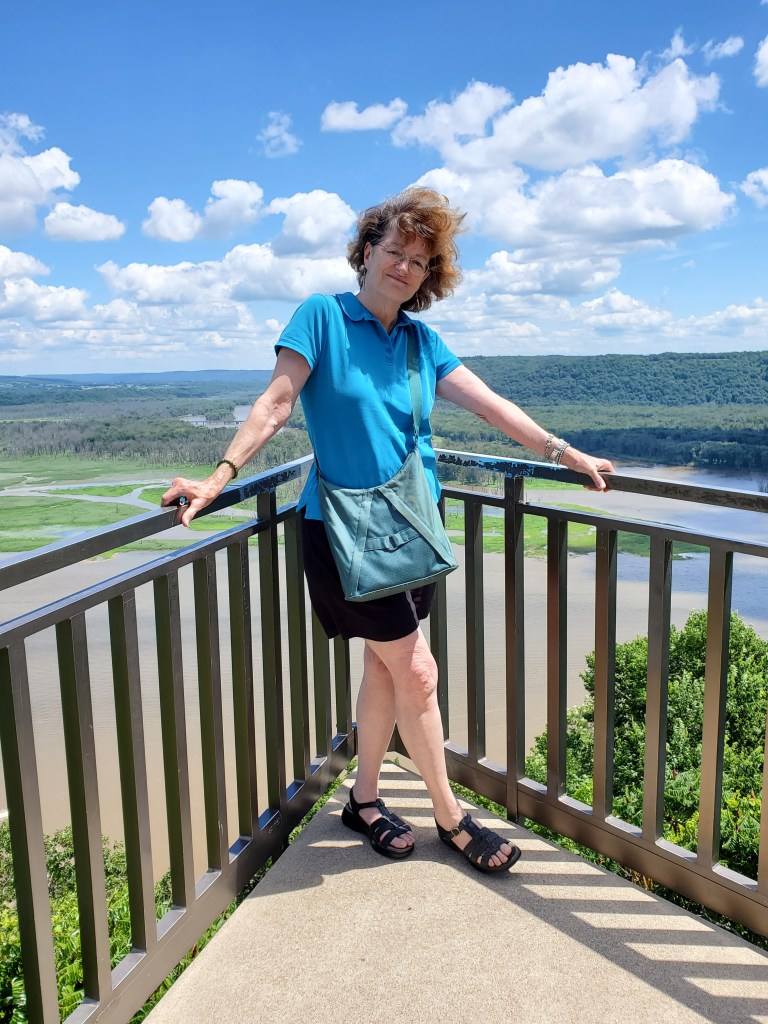
. . . et moi The wonder of the place inspired us to take turns posing before this majestic backdrop, after which we enjoyed Jan’s excellent picnic lunch.
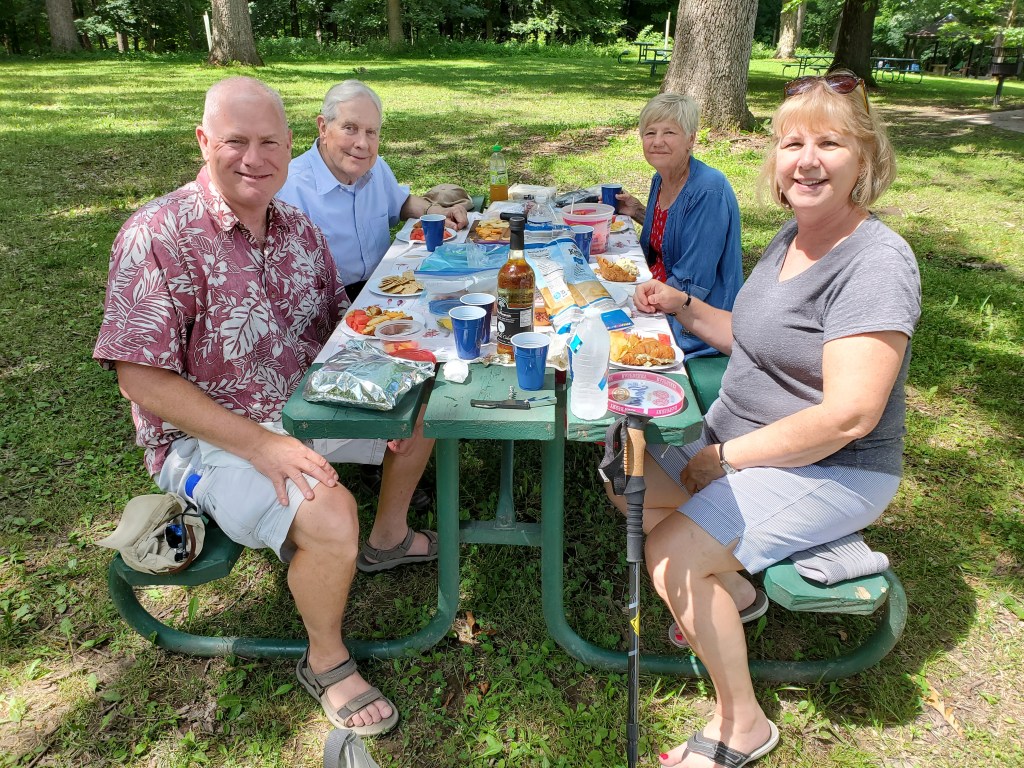
Primo Picnic Spot I was happy to have Rob accompany me on a modest hike to see a modest waterfall, and all the world’s troubles seemed quite remote–
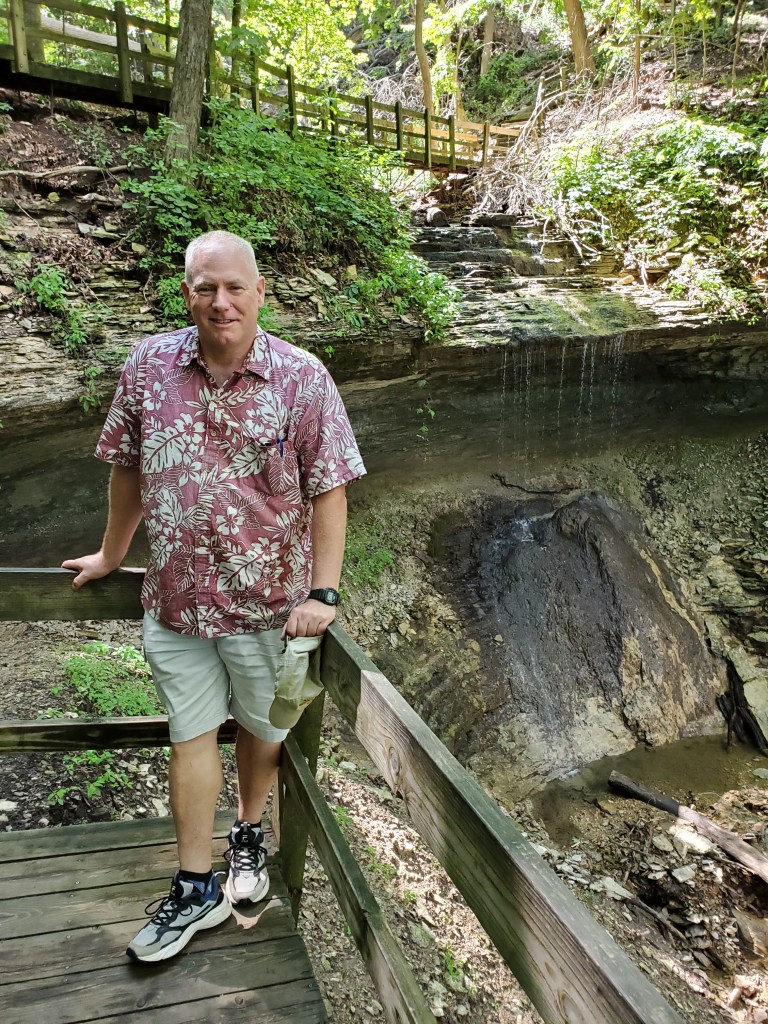
Rob at modest waterfall –remote, that is, until we encountered a fellow hiker, who brought news from the previous Friday we had (happily) missed on our day of reunion and good times together: the shockingly senseless, inexplicable early morning murder of three members of the Schmidt family, Tyler, his wife Sarah, and their 6-year-old daughter Lula, at another Iowa camp ground in the Maquoketa Caves State Park, the apparent murderer himself also dead of a self-inflicted gunshot wound. Such horror in another Iowa State Park just 80 miles to the south, leaving a 9-year-old boy, Arlo Schmidt, the lone survivor, traumatized for life and all alone.
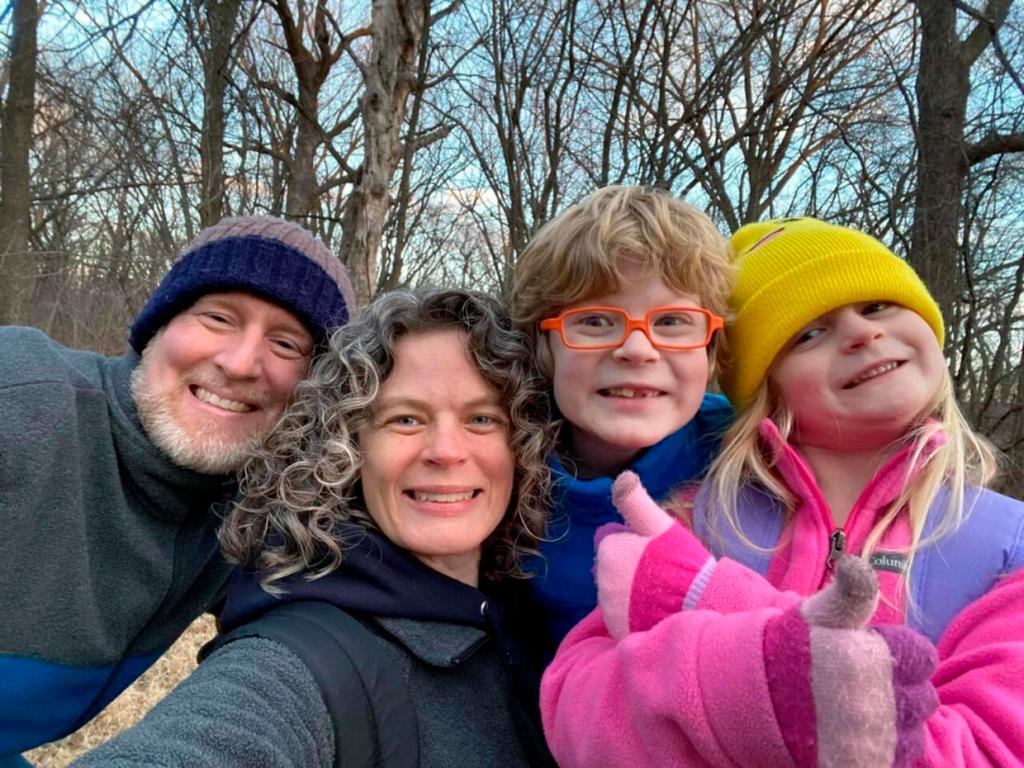
The Schmidt family, Tyler, Sarah, Arlo, and Lula On our lovely Sunday outing, I am too preoccupied by the warmth of the family around me to think much more about the family lost in yet another random shooting in America, land of the free, home of the brave—and the well-armed deranged. But as I type this, I think of the Schmidts and wonder why. Paul Simon sang it:
For we lived so well so long
Still, when I think of the road we’re traveling on
I wonder what’s gone wrong
I can’t help it, I wonder what’s gone wrong
(“American Tune,” 1975)
-
Excursions from Portage WI, Day 1
23 July 2022
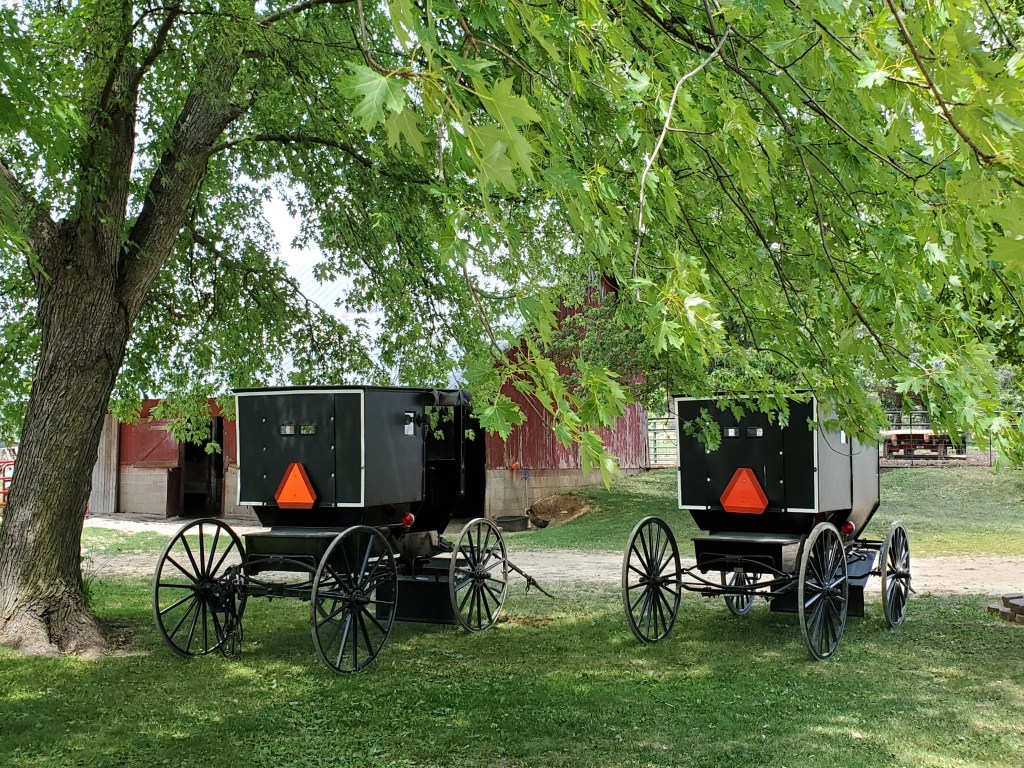
Amish buggies outside the Pleasant View Bakery, Dalton WI The Andrew family had a full range of Wisconsin attractions planned for this Saturday, and after our cereal and Pero (a non-caffeinated coffee substitute), we set out through miles of really beautiful farm land to the Amish-run Mishler’s Country Store in Dalton WI, a treasure trove of bulk spices, old-fashioned candy, fancy soaps, and hard-to-find practical items for use in the kitchen, including a set of ergonomic measuring cups in a full range of sizes (like ¾ C). The place was very busy, its parking lot serving on this morning as a registration site for some bicycling event. No electricity (so no ac), no credit cards, just simplicity on offer, a place so out-of-this-metamodern world as to feel like a theme park.
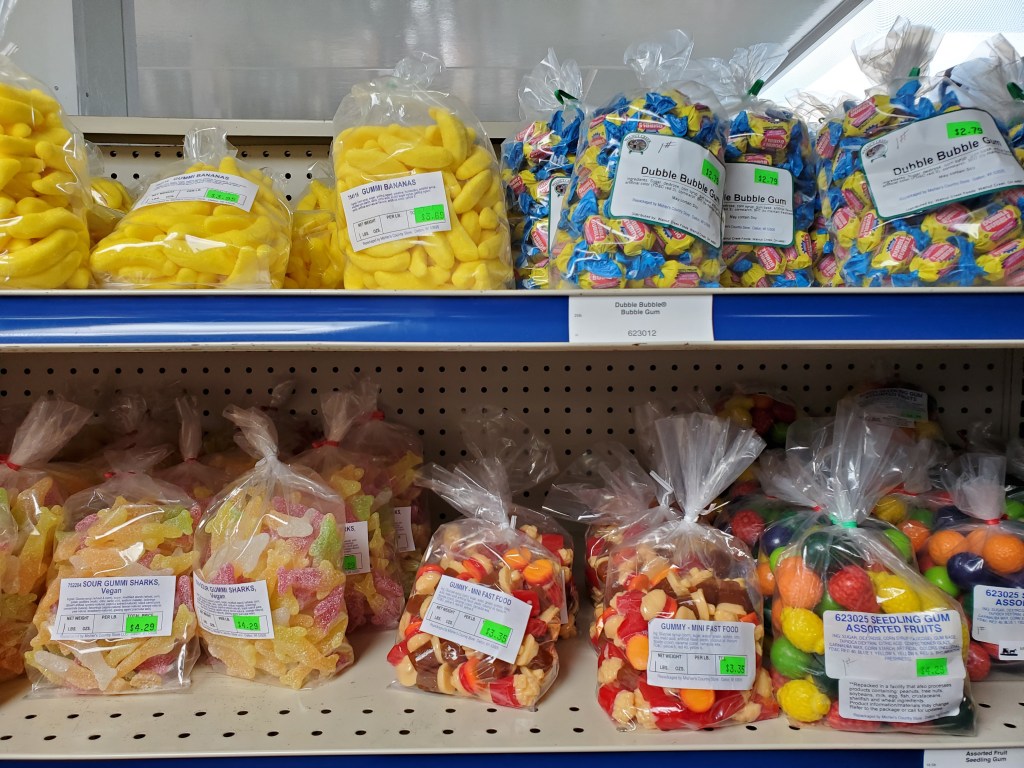
Sugar Fest at Mishler’s Country Store Once back in the car, we naturally all start talking about the 1985 Harrison Ford / Kelly McGillis film Witness, a favorite of my late husband’s and our friends in Munich, who found they could understand the Pennsylvania Dutch (or “Dietsch”) spoken in the film. I’ve Mennonite inheritance on my mother’s (the Senseman) side, but no gift for languages other than English, so I, however, could not: another degree of separation from the Amish and anyone not so typically monolingual as me and most Americans.
I found myself wondering about the way the Amish were in the world, traveling by horse-drawn carriages—and then thinking that the 1985 world of Witness now felt almost as foreign to me as the men in their broadfall trousers with suspenders and broad-brimmed straw hats and the women in their full-skirted dresses and aprons, prayer cap-covered buns at their napes, and bare feet—even when walking through the manure byproduct of their horses. In 1985 there were no social media, gps navigators, smart phones, or e-tickets, and back then in the first spring of my assistant professorship at Centre College in Kentucky, I still wrote my lectures and papers on a typewriter, as I had my dissertation the year before. Hard now to imagine all that away. So how much harder to imagine life without electricity? How do the Amish vote, I wonder—not just politically, but literally? Can they vote electronically? Maybe, as in my hometown of Madbury NH, pencils and paper and a wooden ballot box are still de rigueur. And I’m pretty sure the Amish are better off not consuming 24/7 news on screens.
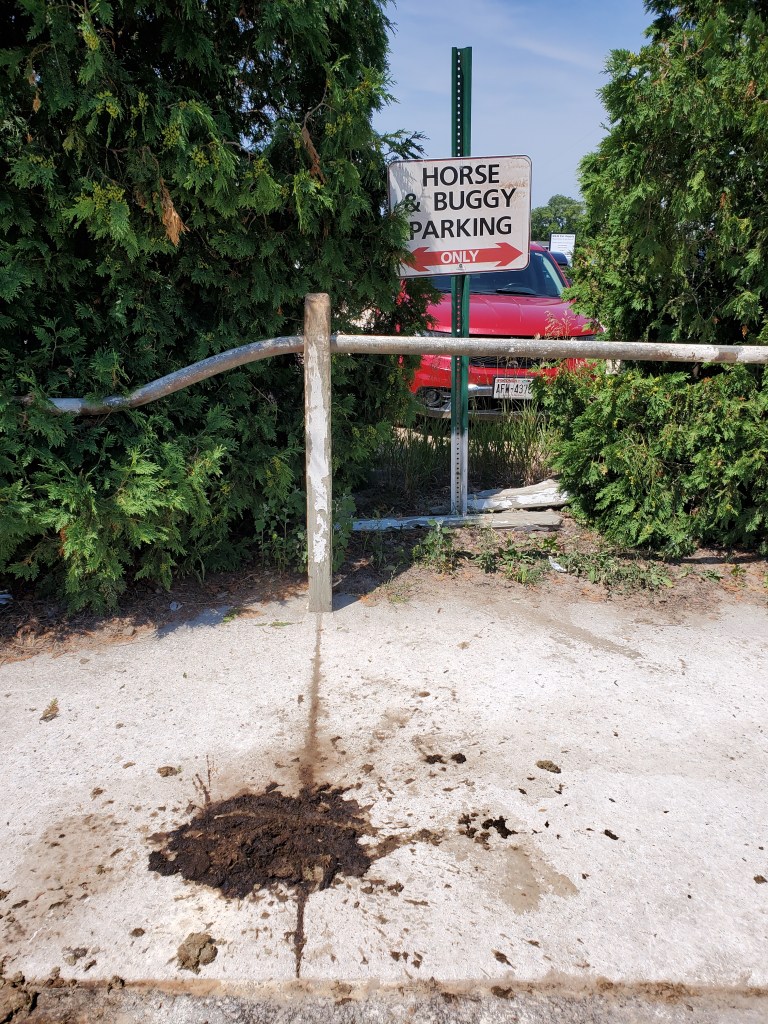
Organic emissions outside Mishler’s From Mishler’s we drove to the nearby Amish Bakery on County Road H only to find it closed (due to health concerns, alas), but relied on our cell phones and Google maps to get us to another Amish bakery, Pleasant View, on Kiefer road, and discovered it, too, doing a bustling business. The alluring aroma of fresh-baked goods in the lower level bakery below the homestead was hard to resist, even though lunch time approached, and lots of folks were taking advantage of the fine day to enjoy some donuts on the spot. Attempting restraint, I bought a Czech peach kolache and some cashew brittle for later, and tried to distract myself with photography—and happily (thanks to my niece, who pointed out there was an Amish girl behind the bread rack I was focusing on) avoided shooting the young woman doing her best to stay out of the frame, shunning the graven images, individualism, and vanity of our selfie-obsessed era. Good on the Amish.
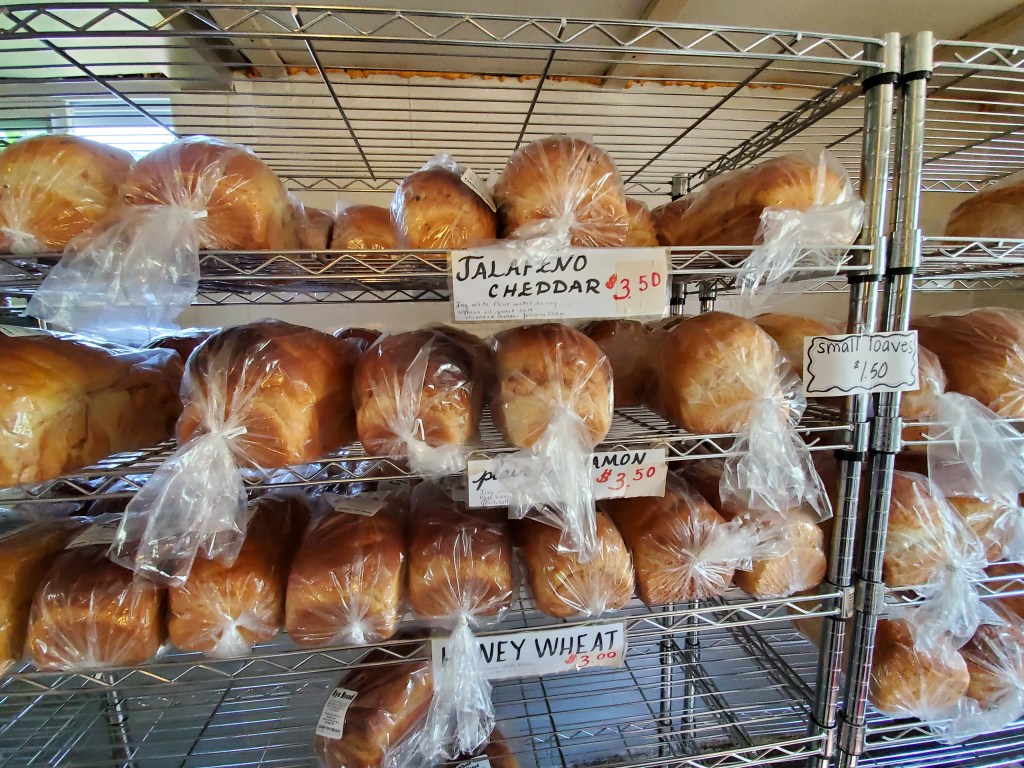
Pleasant View Bakery Bread 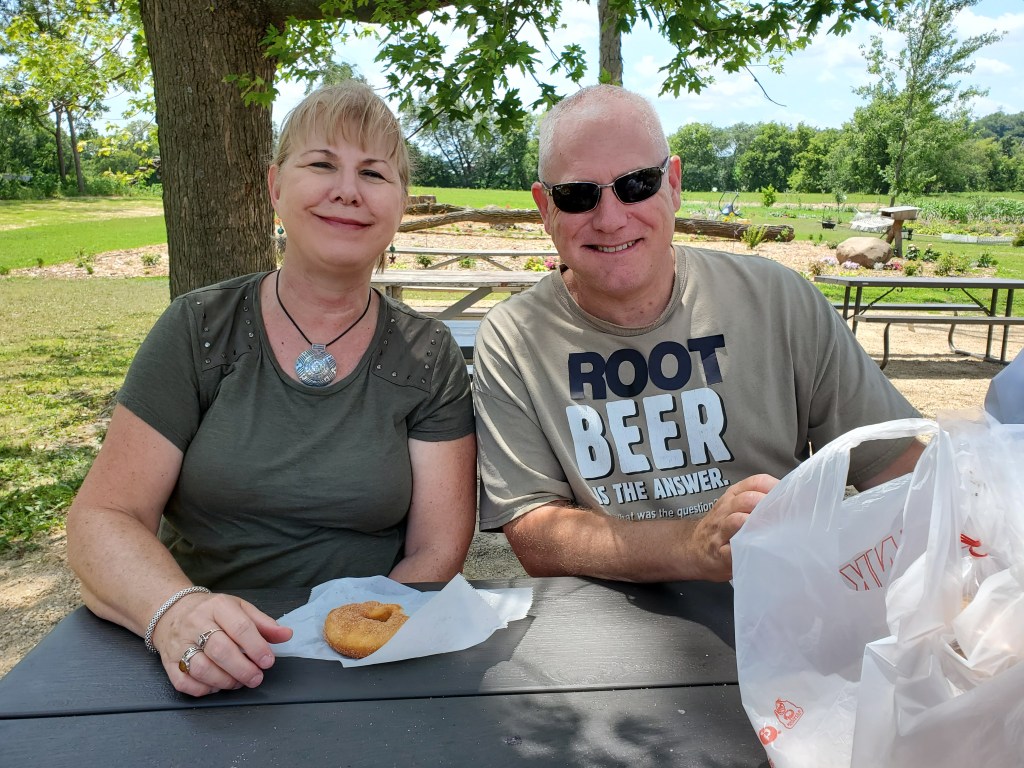
Satisfied Pleasant View customers Pam and Rob . . . 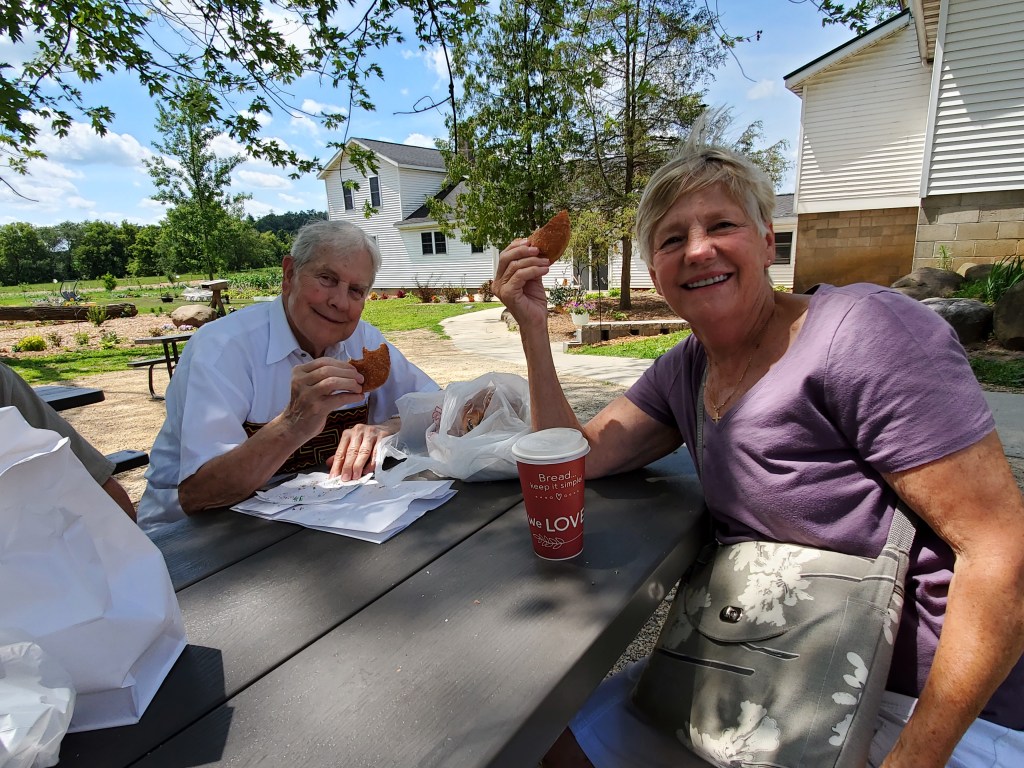
. . . and Chad and Jan Next stop, two firsts for me: both the Museum of Root Beer and the Wisconsin Dells where it is located. The museum is the brainchild of my brother-in-law’s namesake son Reed, and features interactive and educational exhibits (like the loop of historical root beer commercials) and an amazing bottled root beer collection manifesting the astonishing variety of root beer production, from the sassafras root beverages made by American indigenous peoples before the arrival of Europeans in North America, through root beer’s first commercial marketing by pharmacist Charles Elmer Hires in 1875 and well beyond. At Reed’s Museum one can taste-test a flight of root beers, enjoy “gourmet” root beer floats, and purchase an extensive selection of root beers, sodas, and related souvenirs. My favorite: one called “1919.” But I limited my sampling because lunchtime was nigh.
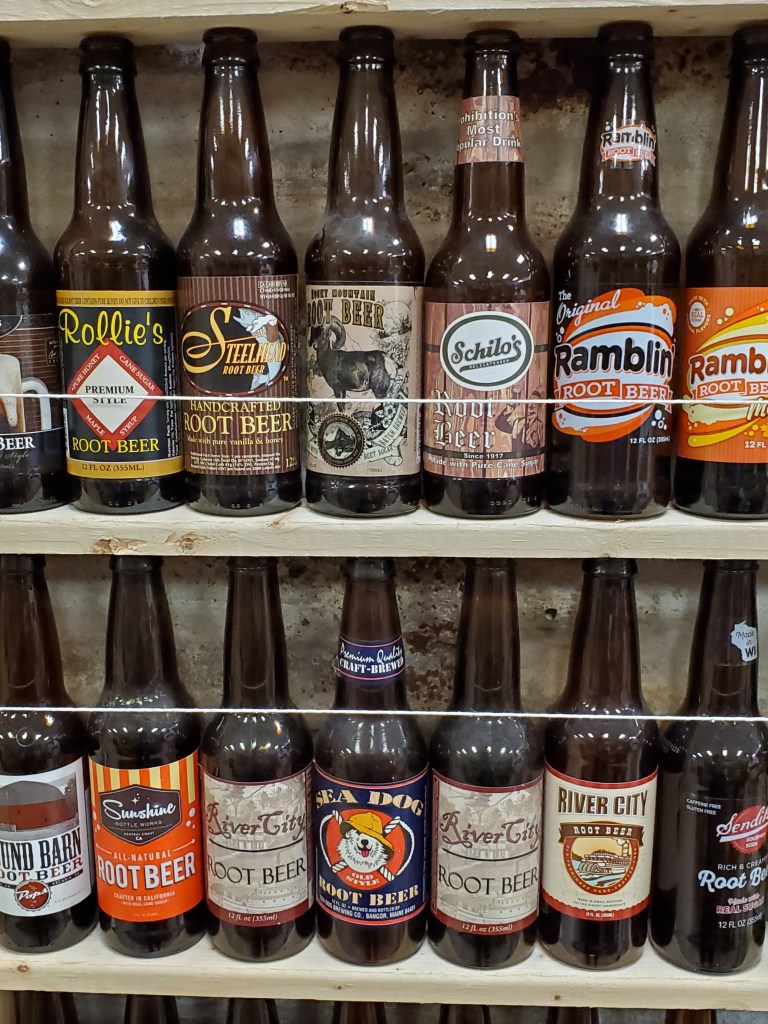
Museum of Root Beer, Wisconsin Dells We arrived at a Culver’s restaurant after driving the gauntlet of the Dells’ commercial drag, a stupefying several miles of tourist attractions—water parks, roller coasters, and other “family friendly” amusements built around–and completely obscuring–the natural beauty of the Wisconsin River’s glacier-carved sandstone formations. I’m reminded of similarly beautiful natural wonders blighted by crappy capitalism: Niagara Falls, for example. Culver’s is a welcome respite, a very successful burger chain rooted in Wisconsin featuring ButterBurgers, Frozen Custard, Wisconsin Cheese Curds, and Pretzel Bites in addition to less locally celebrated fare. I indulged in a mushroom-and-swiss ButterBurger and my semi-annual shake. The posted menu invited patrons to inquire about flavors other than those listed, and I asked about the possibility of getting my favorite: coffee. Brian, the boy behind the counter, sadly informed me they had no coffee shakes—only “expresso [sic].” I told him that would be fine, and indeed it was.
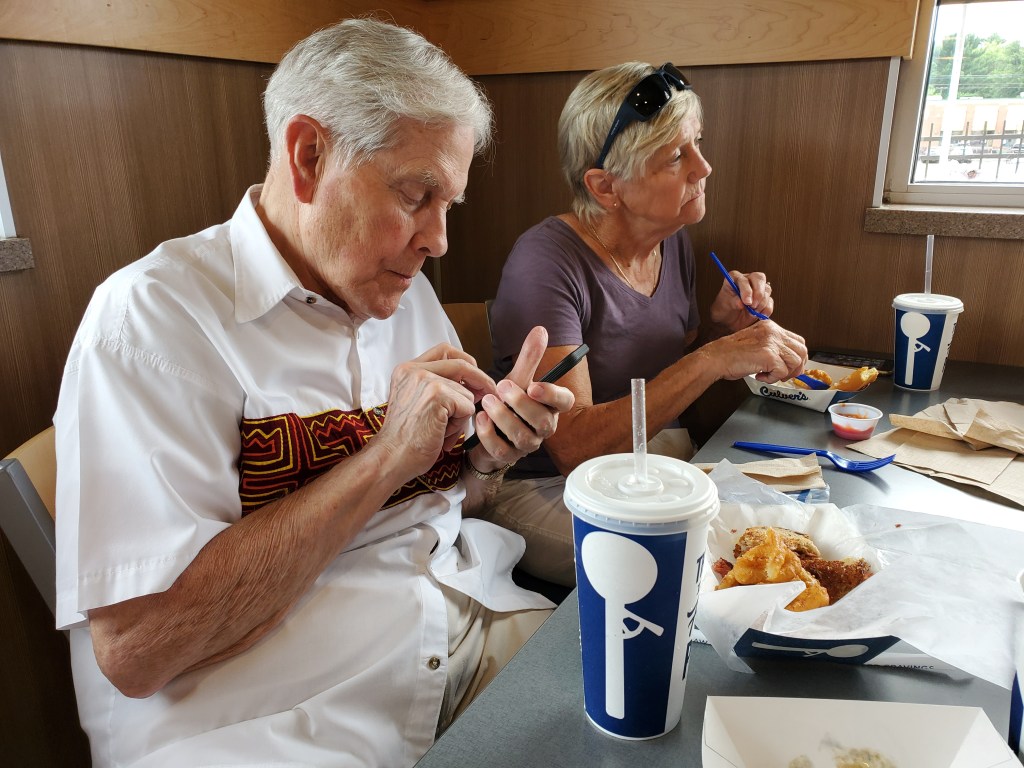
Chad keeps current over a reuben at Culver’s while Jan attends to Rob By then in our day of Wisconsin-themed adventures it was well past 3 pm, and we still had the International Crane Foundation to visit—and darkening clouds on the horizon. The cloud cover turned out to be a blessing on this very hot day, however, and we made a quick tour of the living exhibitions before the docents had to hurry us out a bit in advance of the 5 pm closing time to keep us safe from approaching lightning strikes. The Crane Foundation works worldwide to conserve cranes and the ecosystems, watersheds, and flyways on which they depend, and the Center in Baraboo WI features all 15 species of cranes, nature trails, guided tours, and a gift shop. The thunderstorm’s approach abbreviated our visit, but after a day filled with so many new sights for this novice WI visitor to see, heading home to enjoy Jan’s pasta salad dinner and the sound of the rain hitting a thirsty landscape felt quite a good idea.
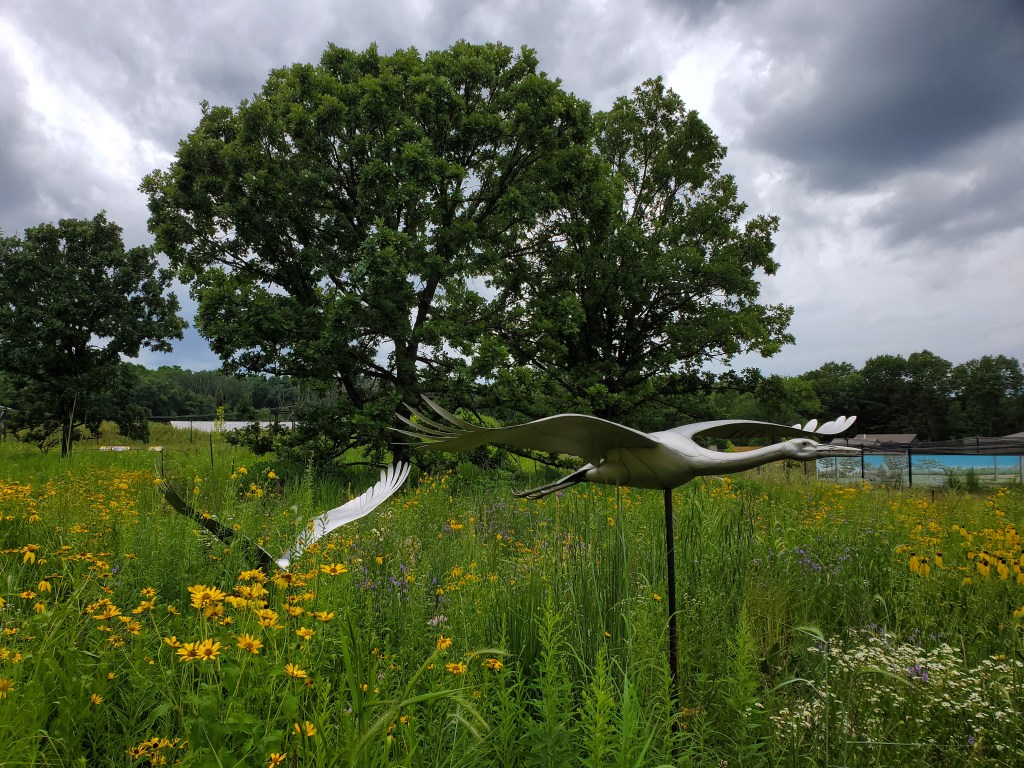
Sculpted cranes take flight at the entrance to the International Crane Foundation in Baraboo WI 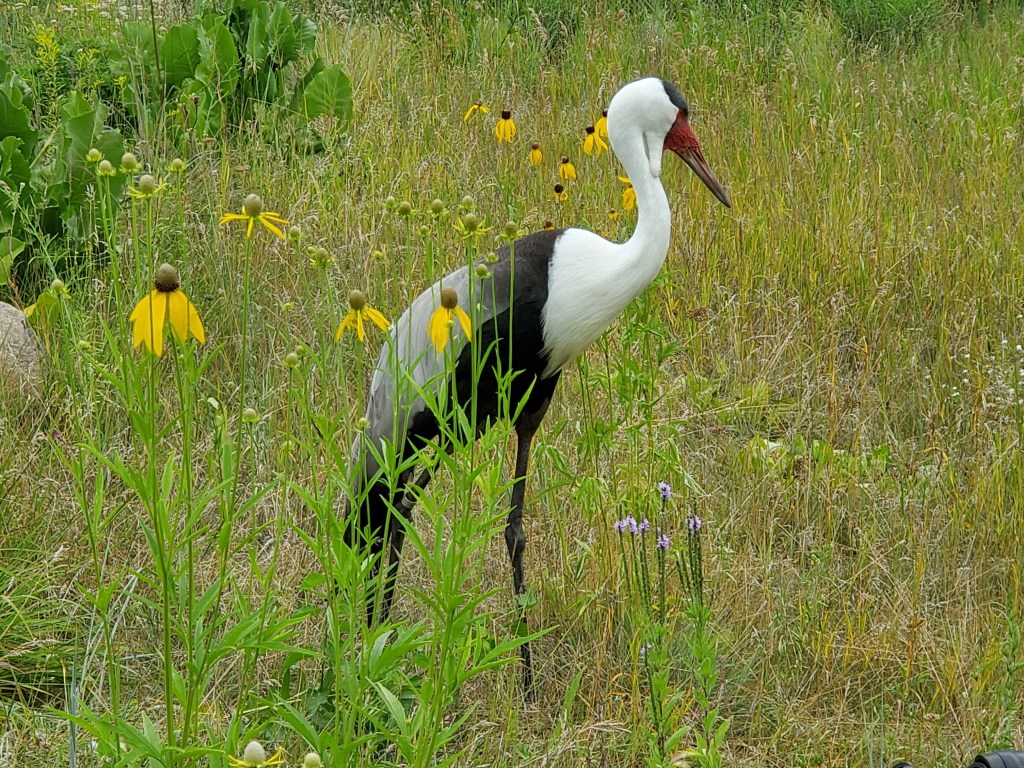
Wattled Crane 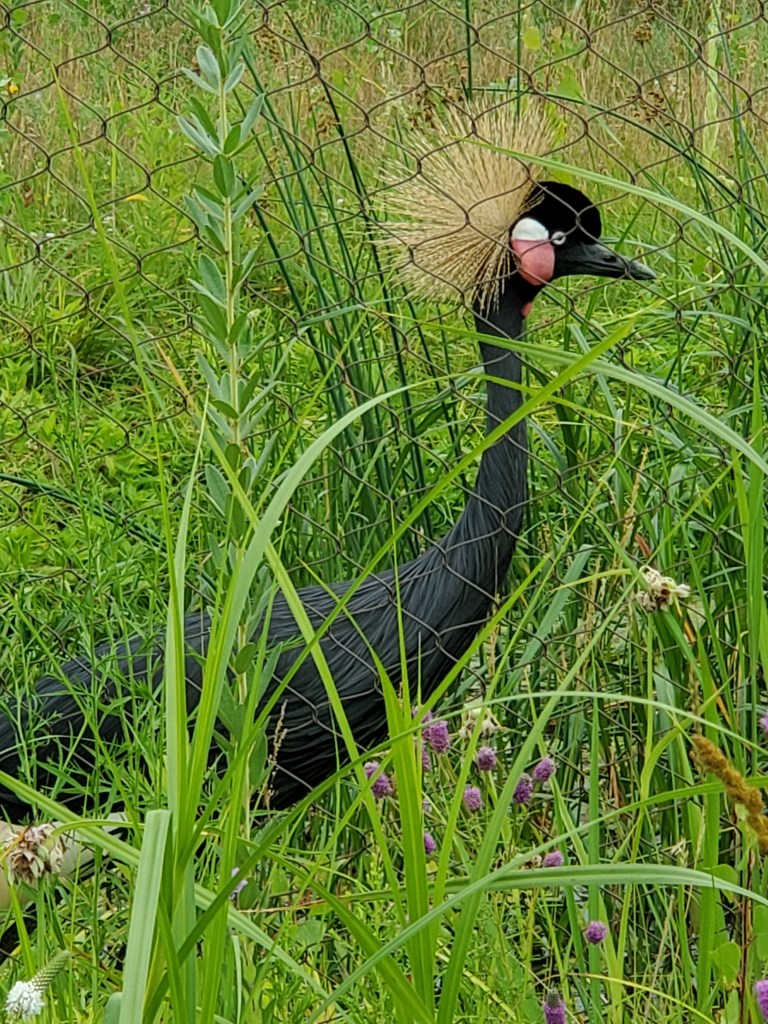
Black Crowned Crane 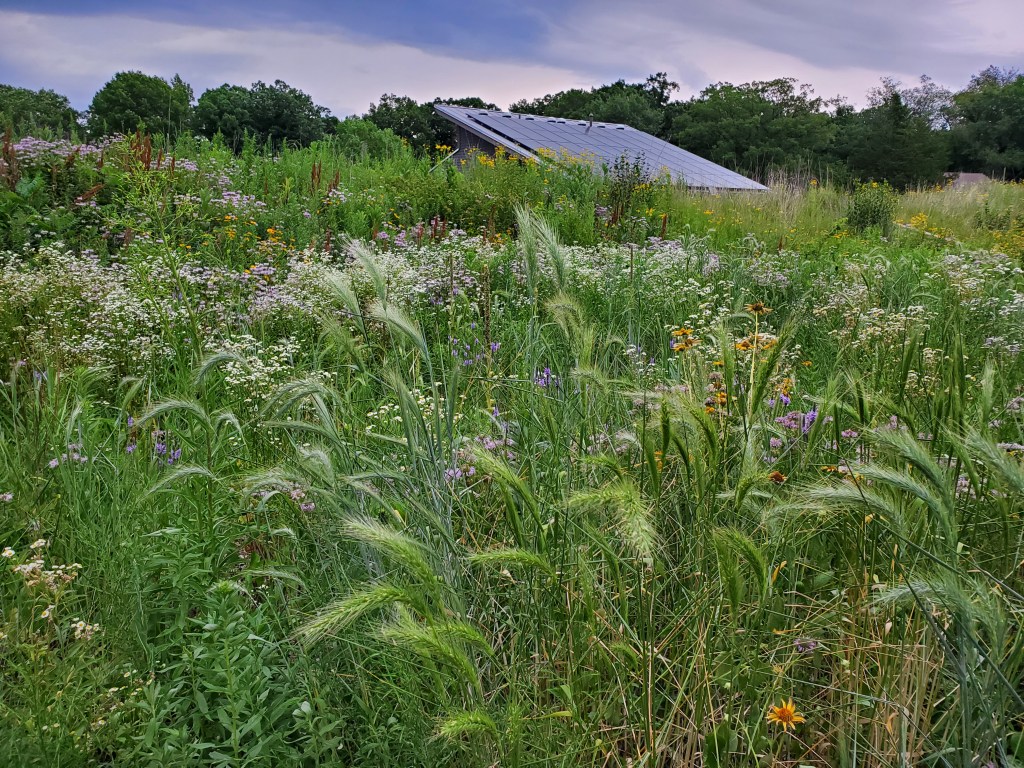
Conserving energy, grasses, and wildflowers at the Crane Foundation Back in Saddle Ridge, I played the one piece I’ve learned after taking up the piano again for the first time since sophomore year in high school, the initial piece in Schumann’s Kinderszenen, a sunny if ever-so-slightly wistful Von fremden Ländern und Menschen. My brother-in-law’s Steinway B’s action and tone are very different from my husband’s—familiar, yet surprisingly disparate, rather like the midwestern “foreign lands and people” I’ve spent the day with.
After dinner, we survey storm damage: the wind—perhaps a microburst—has taken down a massive limb from a nearby pine, temporarily blocking the road. The branches of the family tree, however, feel more strongly attached than ever.
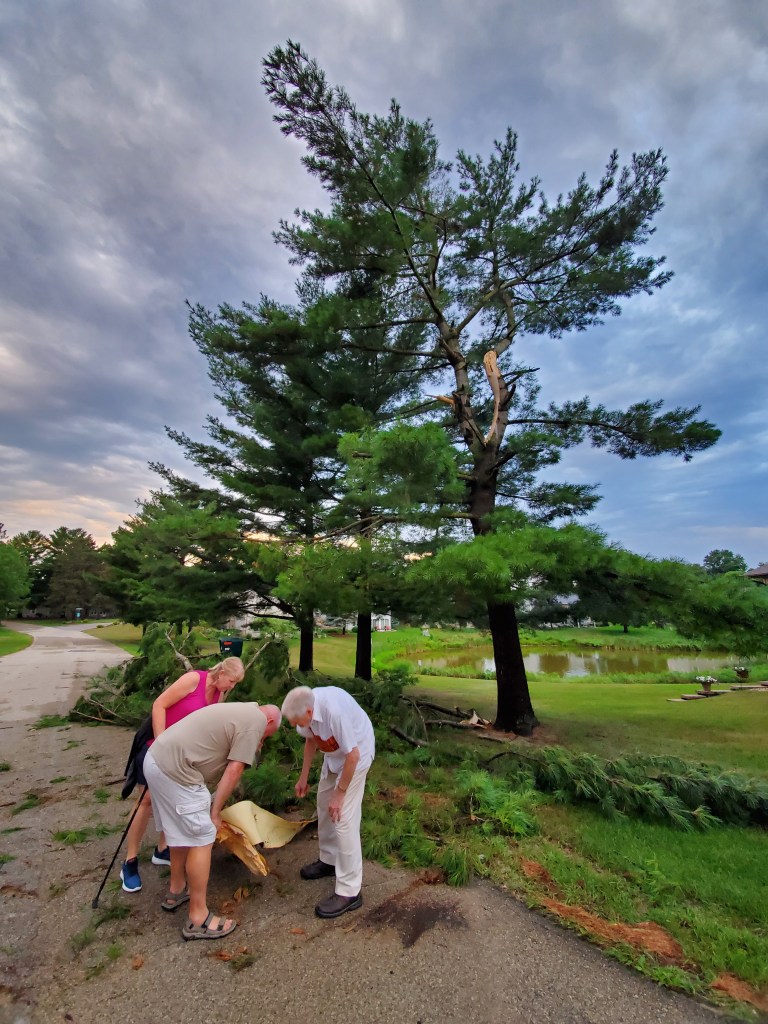
Storm Casualty at Saddle Ridge 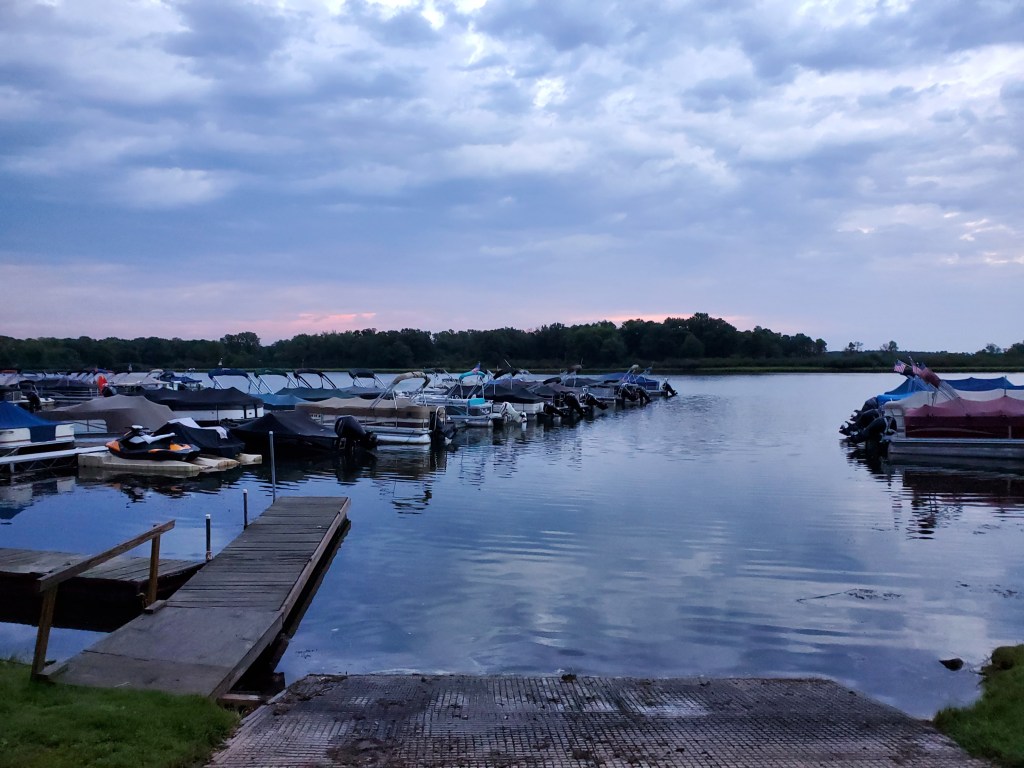
A perfect day ends with a walk to the Saddle Ridge marina 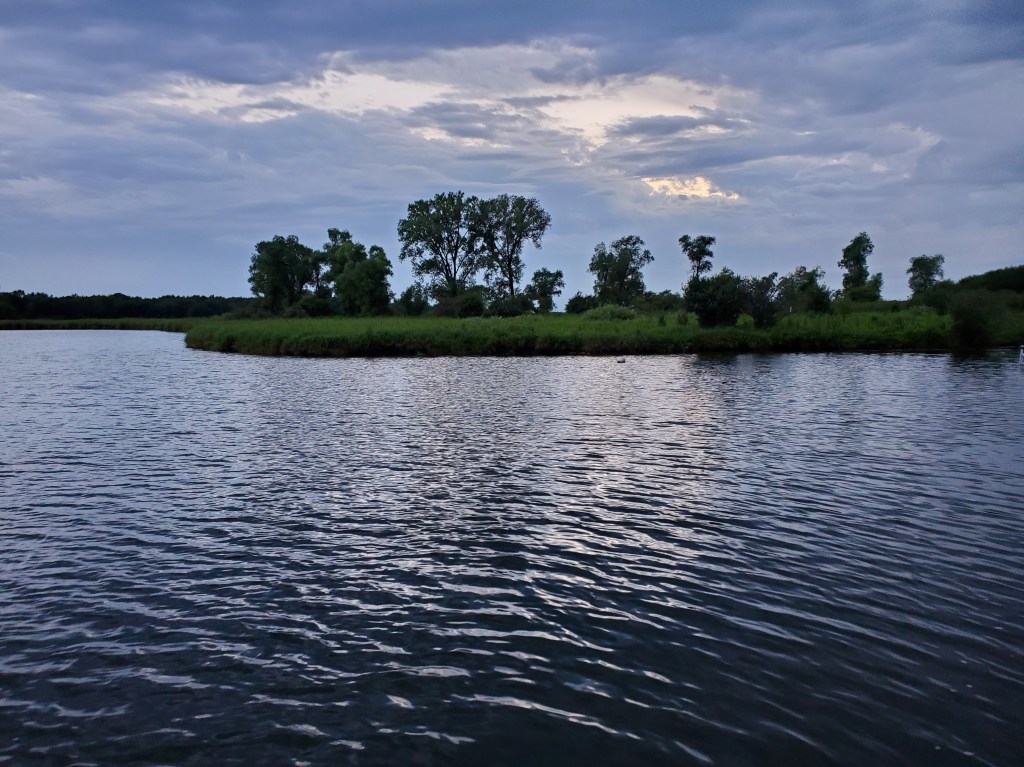
-
On [to] Wisconsin 21-22 July 2022
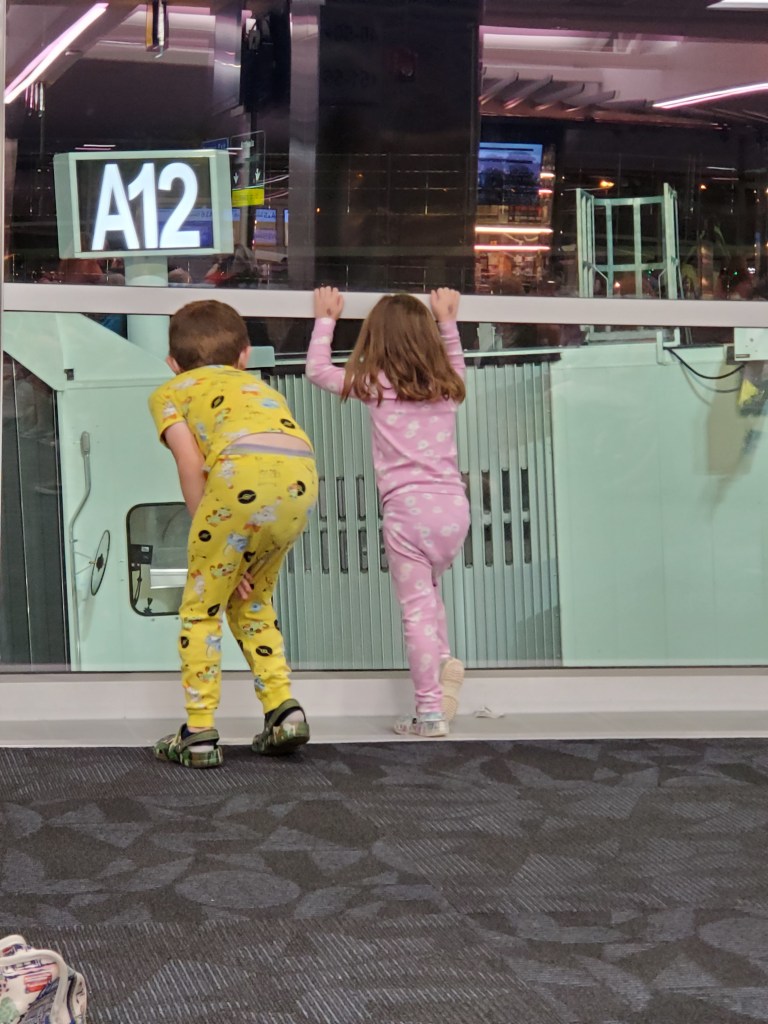
Pajama club at BWI, as two eager passengers await their late-night flight to MKE Made it to Milwaukee Thursday night, 21 July, on a late flight from Manchester via Baltimore/Washington with only two slight catches. One: the parking lot in Manchester has converted to a system that does not issue tickets encoded with your entry time, but instead somehow records that info on the credit card you use to enter the structure. Not knowing that, and fearing I would be charged the max sans ticket, I had to haul my bag down to the parking office before checking in at the Southwest counter, only to find out I actually wasn’t in trouble. Two: the hotel shuttle for the Sheraton at the Milwaukee airport (which is, in fact, run by Marriott), is marked neither “Sheraton” nor “Marriott,” but “Best Western.” Happily, the woman driving it figured out I was looking for her, and picked me up anyway.
So, I made it to a comfortable hotel room, where the televised commercials were the only other things disconcerting. I don’t know whether broadcast tv (which I no longer get) or Wisconsin (as opposed to the East Coast) is to blame, but seeing ads for Trump’s so-called “Freedom Tour” (aka “Freedom from Truth” or “Disinformation Tour”) was distressing—especially as the only other ads were political spots promoting candidates whose only mentioned qualification was endorsement by Trump, that Lying Monster of Narcissism, Defiler of the West Wing, Election Denying, Constitution Threatening, Sexual Predator. Yikes.
But the timely arrival of my family the next morning cleansed that very bad taste in my mouth, and we enjoyed very much both service (thanks, Katie!) and cuisine at Milwaukee’s excellent brunch place, Blue’s Egg.
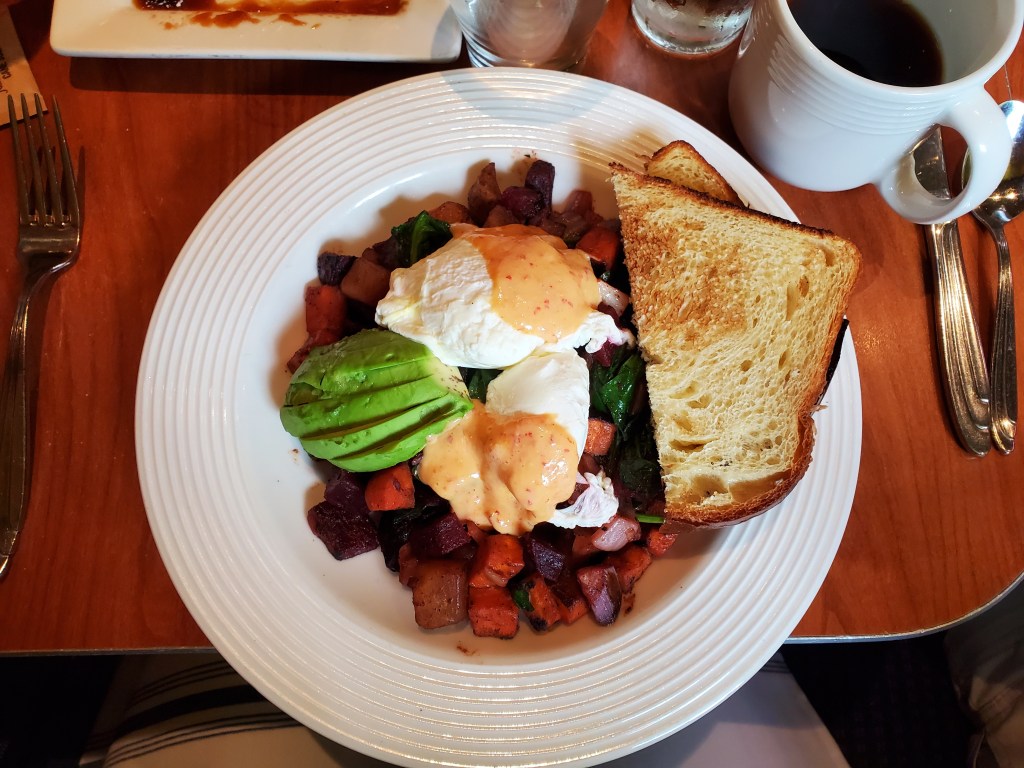
Rooted Veggie Hash at Blue’s Egg, Milwaukee, with fresh spinach, poached eggs, avocado, chili hollandaise, and challah toast On the drive west to Portage, we stopped to have a fine visit in Madison with Emy, a sister-in-law I’d not seen since my brother-in-law Neil’s memorial celebration in Chico, CA in 2019, and were treated not only to a tour of Emy’s lovely home and her refreshing mint iced tea, but a chance to catch up with her daughter, Becky, and Becky’s granddaughter, Amory, who performed a dance of her own invention to “We Don’t Talk About Bruno” from Lin-Manuel Miranda’s cinematic score to Disney’s Encanto. LOTS of energy packed into that little lassie!
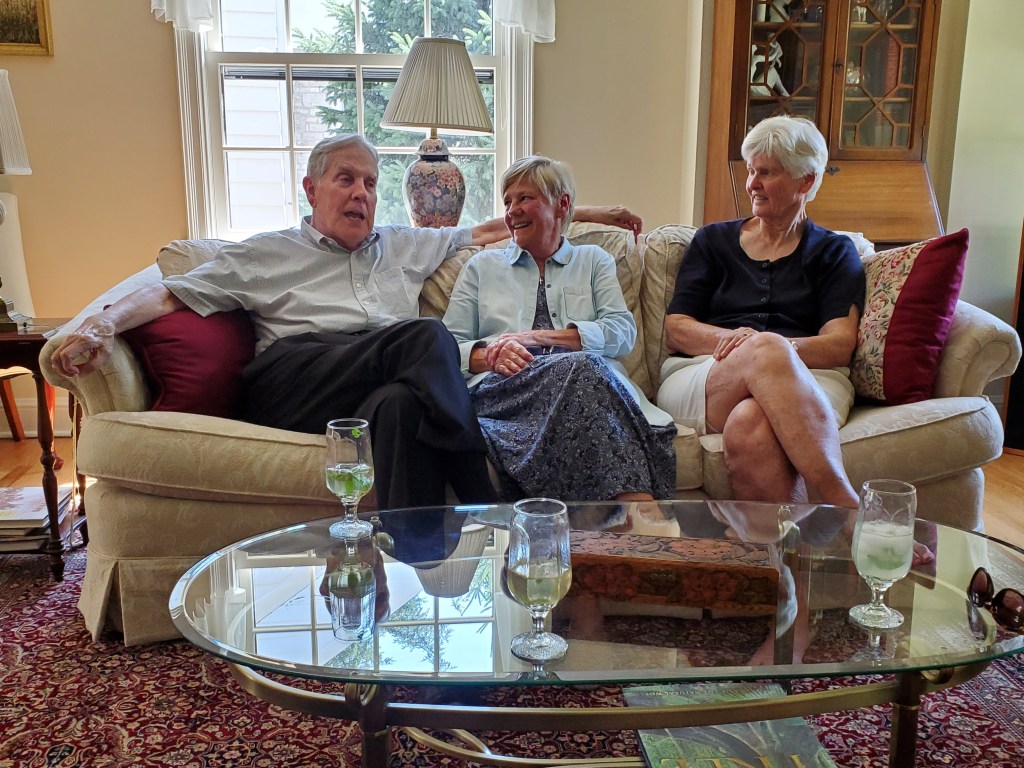
Brother-in-law Chad and sisters-in-law Jan and Emy catch up 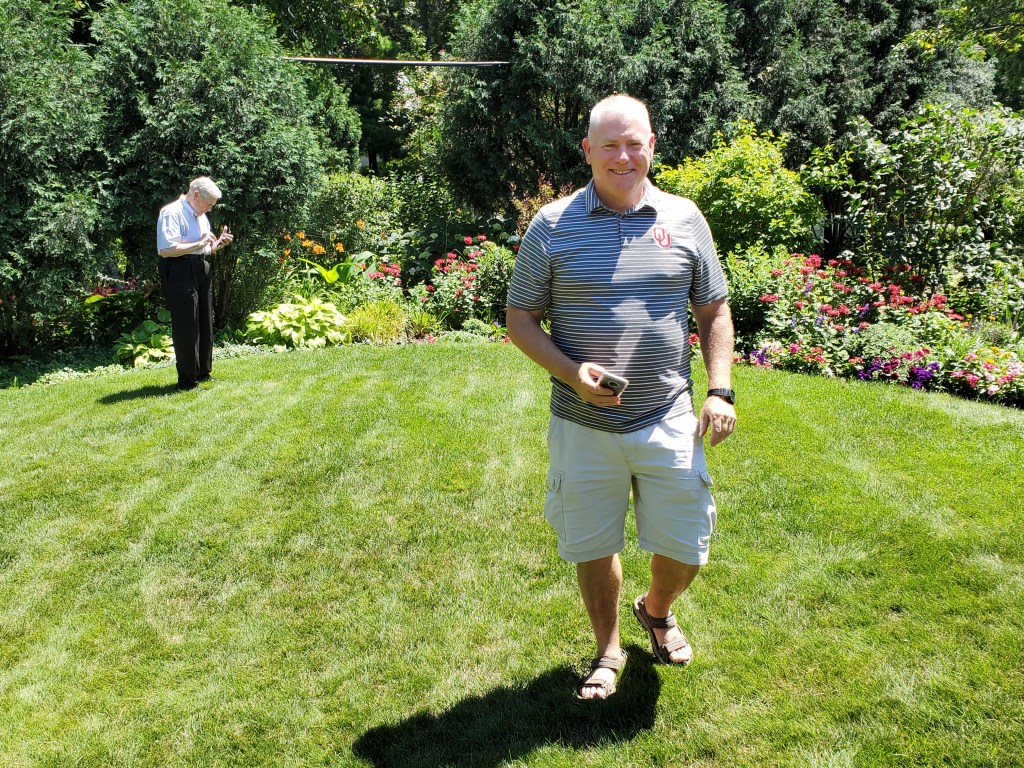
Nephew Rob and Chad inspect Emy’s well-groomed perennial border 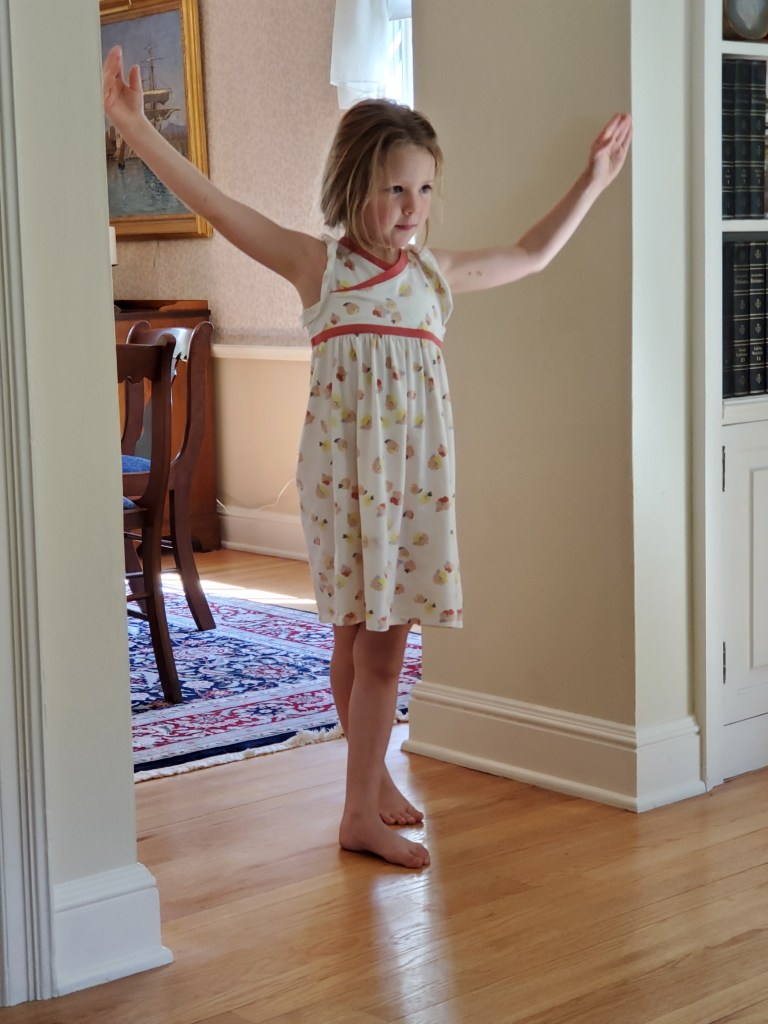
Amory’s dance to Lin-Manuel’s song From Madison, Rob drove us back to Chad and Jan’s development, Saddle Ridge, in Portage, and another lovely home—not only to them, but to a pair of sandhill cranes (+ one more hanger-on). Deceptively small-seeming from the garage entrance, this home (like my own) rides a hill, so that the downstairs gives way to very generously proportioned guest quarters and bath as well as additional living space, and two “offices,” my retired ophthalmologist brother-in-law’s and his talented seamstress wife’s spacious sewing room, outside of which the sandhill cranes gather for the corn provided them each day, sounding uncannily like the velociraptors of Jurassic Park.
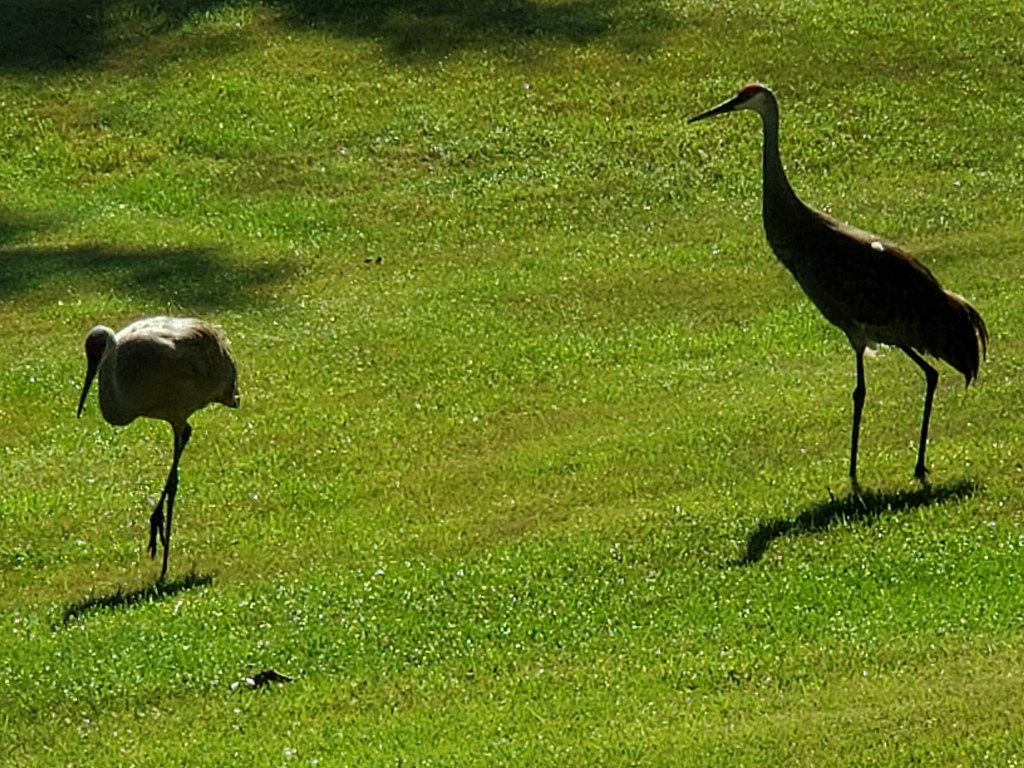
VelociraptorsSandhill CranesAfter settling in, we head to the Saddle Ridge clubhouse for a Friday night fish fry—and the unexpected heroics from my sister-in-law RN Jan, whose medical training, compassion, and grace under pressure became manifest when one of our fellow diners fainted and cracked her head on the hard floor. Jan to the rescue; at last view of her accidental patient on the gurney being carted to the ambulance, all would soon be well.
Back at home, the two birthday boys (one turned 88 the previous week, one turning 55 the following Monday) and their brides opened their presents, books for the boys and goat’s milk skin cream for the girls, after which we all headed gratefully to our beds. A good day.
-
Recombobulation
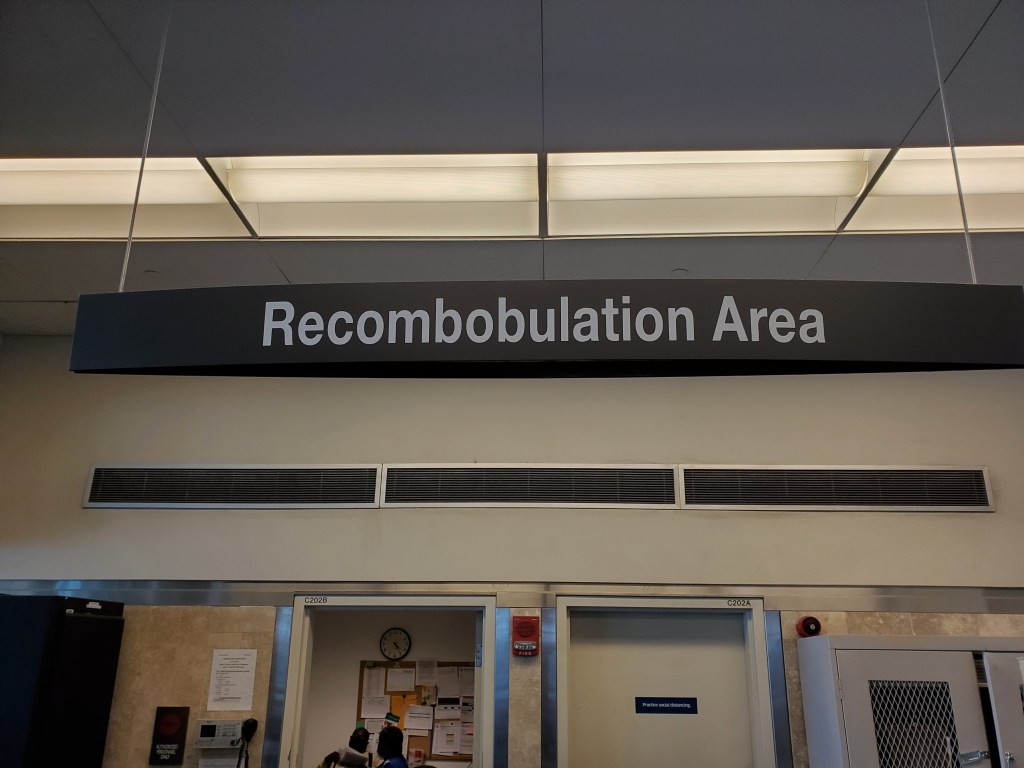
Sign just past the Milwaukee (MKE) airport TSA security screening area,
25 July 2022Returning at 2 am early Tuesday morning, 26 July, from a long weekend with family in Wisconsin, I am too travel-weary to do much more than open windows—the house closed up over the very hot five days of my absence was 87o when I walked in. I turn on the bedroom ac, shower, text of my safe arrival, and hit the hay. Waking later, mid-morning, I go about repossessing the house, moving back outside plants brought in to prevent their cooking on the west-facing deck, restoring to their accustomed squirrel-proof Wild Birds system pole bird feeders brought inside as cautionary protection from the bear who brought them down two weeks ago.
I settle in the cool downstairs apse, and have my usual summer breakfast of cereal with fruit and iced coffee. I’m immediately rewarded by the arrival of a male rose-breasted grosbeak, his formal tuxedo seemingly stained by the bright red blood of a slit throat, though his vigor at attacking the hanging suet cake belies any such trauma; this red bib is just part of his very cool outfit. I unpack, sorting the clean clothes from the soiled, noting what was never worn, and examine my souvenirs: whooping crane earrings made from cereal boxes and purchased on the sly as a gift from my niece and nephew at the International Crane Foundation, and my pragmatic purchases from the Amish-run Mishler’s Country Store in Dalton WI: one cake of Fels-Naptha laundry soap and two delightfully fragrant bars of Australian Wavertree and London Lemongrass & Lemon Myrtle soap, a small scoop for flour or sugar (made in China), and a set of measuring cups (also made in China) with ergonomic handles.
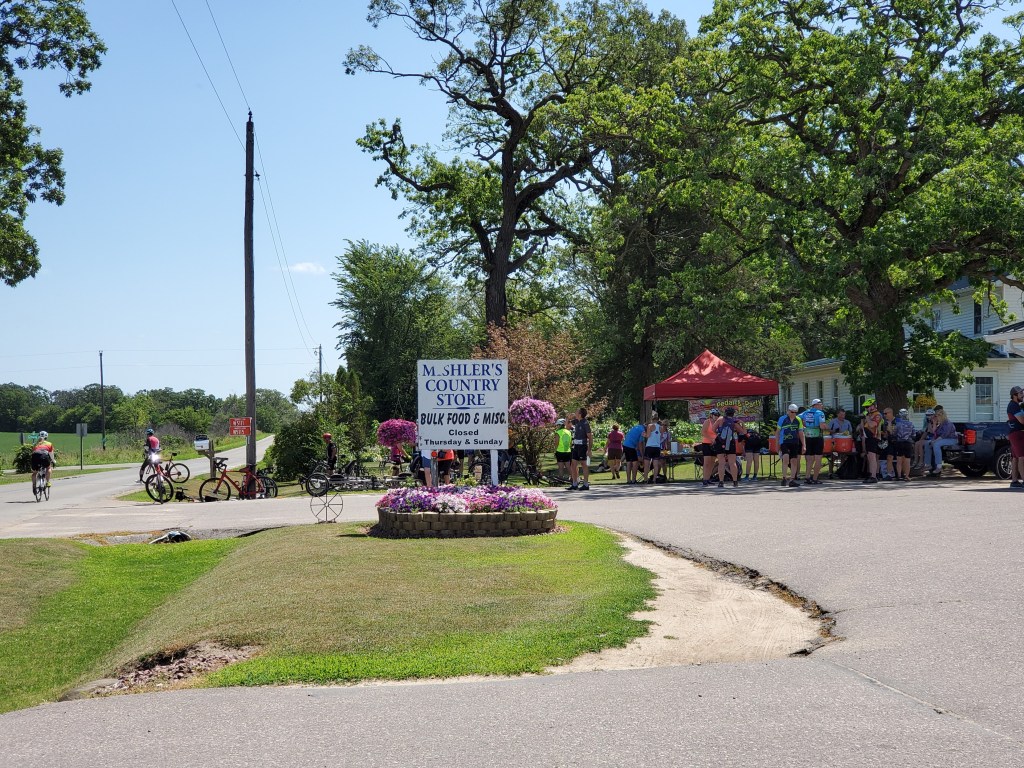
Mishler’s Country Store, managed by the Amish community of Dalton WI It is good to be safely home, especially now the air is cooler, the weather more like the vaunted New England summer before global warming became so oppressively apparent. I have missed some comforts of home: morning coffee, omnipresent NPR, streaming The Old Man on Hulu, my bidet, and getting my sugar allowance in the form of cocktails, beer, or wine rather than the ice cream and sweets favored by my late husband’s family.
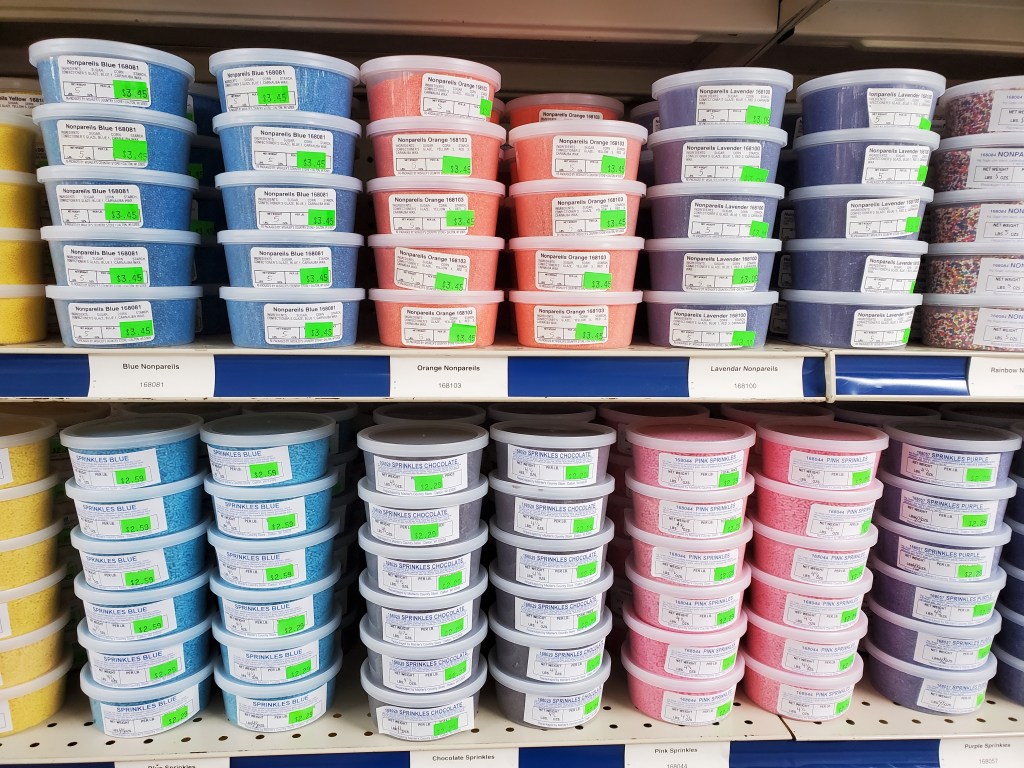
Nonpareils and Sprinkles I did NOT buy at Mishler’s But I also feel the lack of what I found in Wisconsin: the most comfortable bed ever, appointed with feather bed mattress topper and beautiful white trapunto spread and pillow covers; a spotless, beautifully furnished and efficient home layout; the company of a loving family (oh, to be in such good company now in my third year of solitary widowhood!); the generous, efficient, observant domesticity of two other women; the ongoing good-natured teasingly performative competition between two men of different generations; the relaxing pleasure of happily being not in charge, but instead following the lead of my hyper-capable and competent retired Army/Foreign Service nephew; the liberating hilarity of back-seat “chicas” struggling to buckle seat belts into receptacles exasperatingly located underneath the cheeks of the little woman in the middle; new, gently rolling landscapes of corn and crops of varying greens; new ways to be in the world; sandhill cranes; family stories: histories filled in; tales of fences mended—and not; tales of what gets talked about–and what doesn’t. Tolstoy got it wrong: all happy families are not alike, nor is each unhappy family unhappy in its own way. Somewhere in the spectrum from the Cleavers to the Simpsons, all families are unique. I am lucky to be part of this one, and to have had the time we did together.
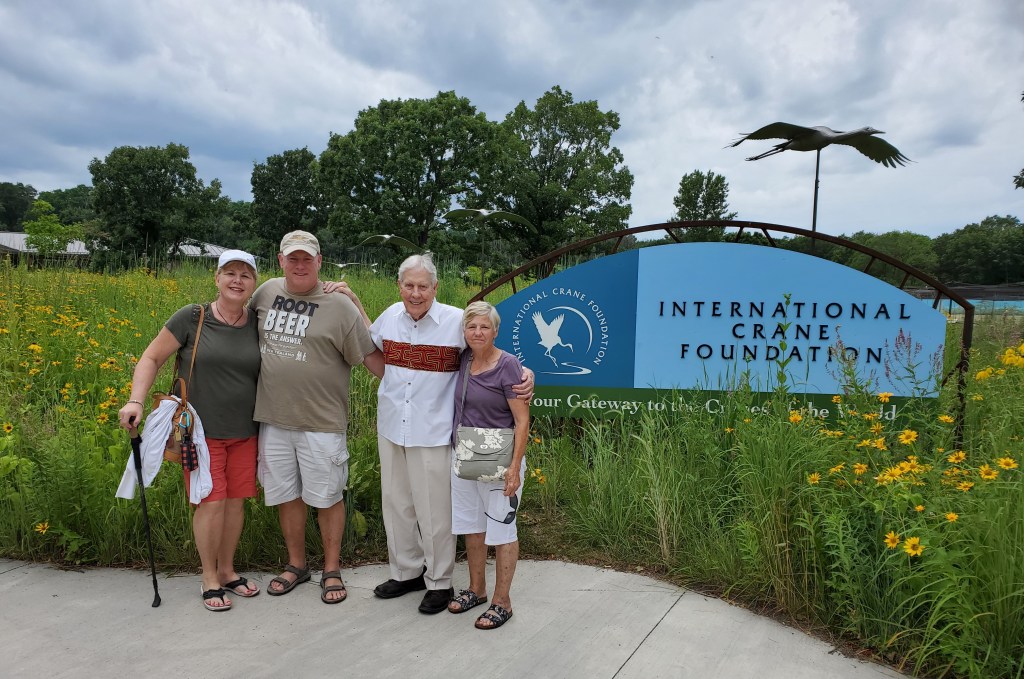
My Andrew family, left to right: Pam, Rob, Chad, and Jan, 22 July 2022 I am recombobulating and remembering all we did. I will write it down to keep it.
-
Getting rid of things

Daylily (“Primal Scream”) circle of life, 9 June 2022 F. Scott Fitzgerald, master of concluding cadences, finishes his short story “Three Hours Between Planes” (Esquire, July 1941) with this phrase embedded in his final sentence: “the second half of life is a long process of getting rid of things.”
Nearly paralyzed by the prospect of sorting through and discarding the accumulated stuff of two lifetimes, agonizing over what “sparks joy”—or might do so in the future (ah, Marie Kondo, there’s the rub!), I startled on hearing that line at the end of yesterday’s Selected Shorts broadcast. But ever since attending WGBH’s “Community Conversation: Roe Overturned” broadcast from the Boston Public Library studio on 30 June, I’ve been thinking about the remarkable haste with which the conservative super majority of the Supreme Court has gotten rid of things I believed essential to life, liberty, and the pursuit of happiness: bodily autonomy, protection from gun violence, clean air, and the separation of church and state.
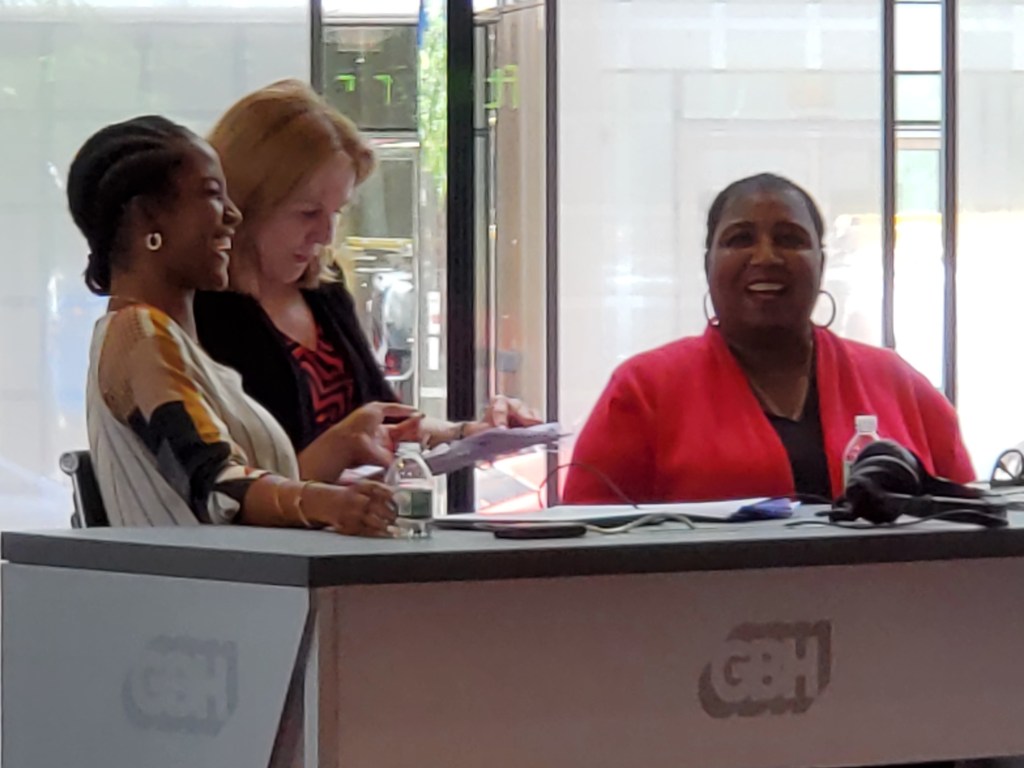
Paris Alston, Margery Eagan, and Callie Crossley after the “Roe Overturned” broadcast, 30 June 2022 
Jim Braude broadcasting on “Boston Public Radio,” 30 June 2022 Clarence Thomas’s shopping list appalls, as does the eagerness of his wife to overturn a free and fair election. The first caller into the 30 June broadcast, Daniel from Marlborough, was a veteran so horrified that rights guaranteed to half the population of his country would now be denied, rights he said he and his comrades had bled and died for, that for him, the Fourth of July was canceled. He was burning his uniform, and he invited any women needing support or protection as they protested Roe overturned to call a veteran, who would stand and fight with them for women’s health protection rights.
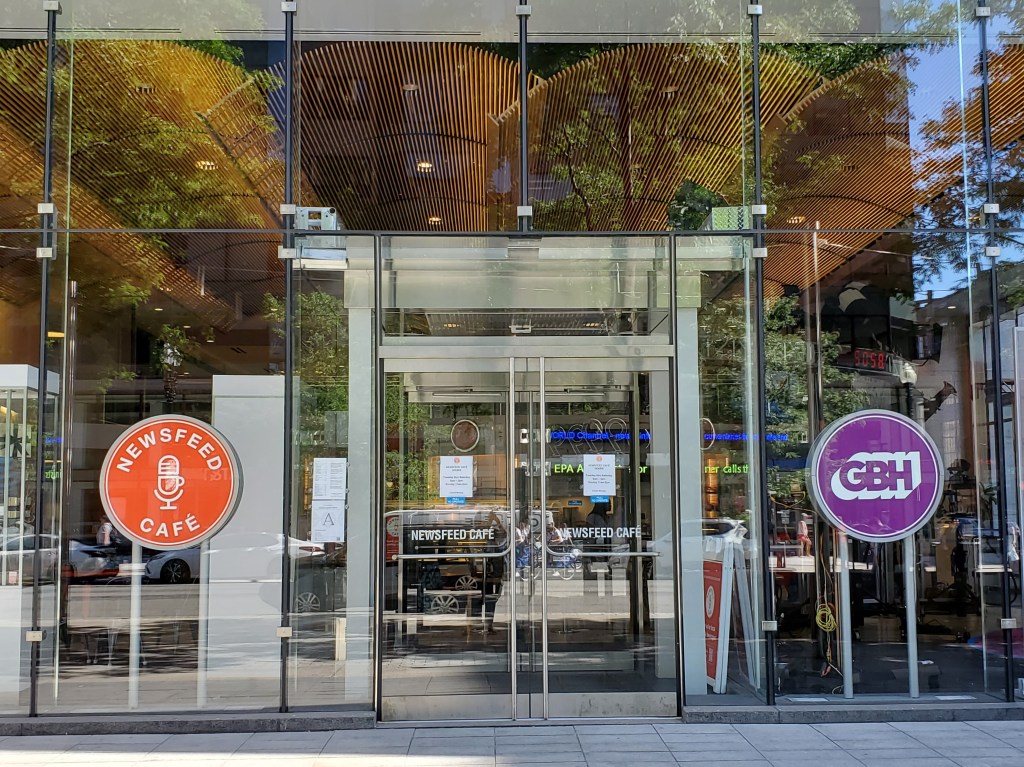
GBH Studio at the Boston Public Library I am certainly well into the second half of my life, Mr. Fitzgerald, but am loath to think my country is, too.
-
The Fourth of July
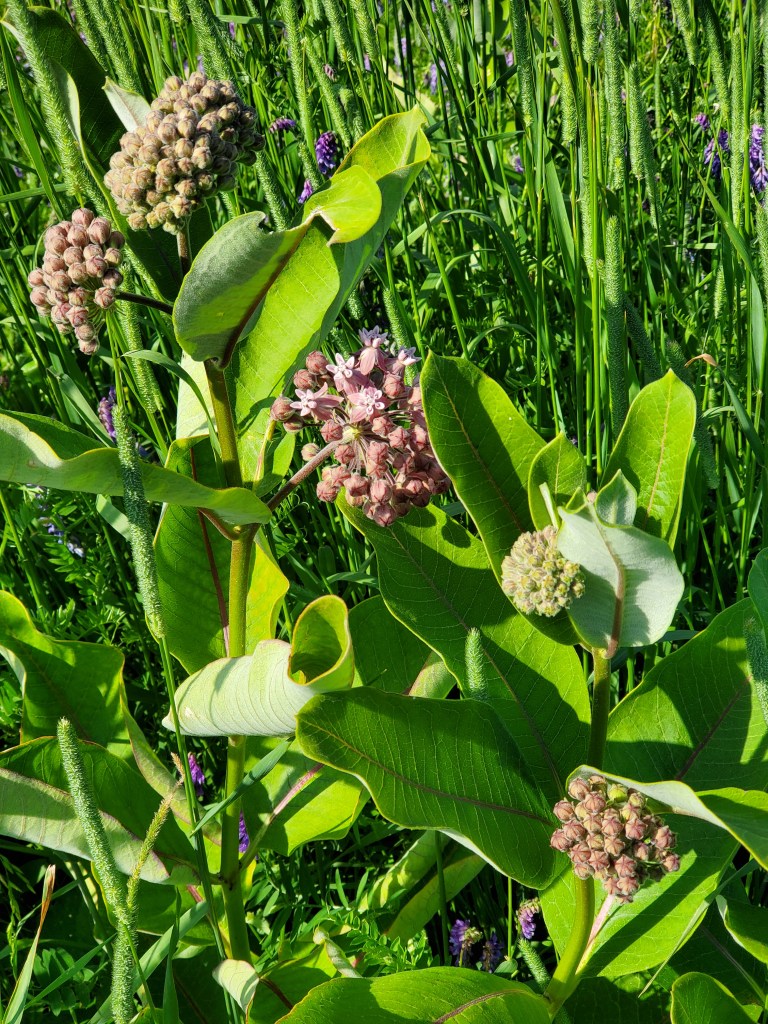
Milkweed at Wagon Hill Farm, Durham NH, 22 June 2022 It is the Fourth of July, and I am having trouble concentrating. My setup for a dinner party to begin at 6.30 is complete—beer and wine cooling, the New York Times’s Juneteenth peach-molasses chicken soon to be grilled, the salads made and strawberry-rhubarb cobbler baked. I’ve prepped the staging area for fireworks later, and loaded the cd player with Americana—Danny Barker, Tennessee Ernie Ford singing the Songs of the North my daddy always sang along with, Samuel Barber’s heartbreaking setting of selections from James Agee’s prose poem Knoxville: Summer of 1915. That last is closest to my mood: tearfully nostalgic, longing, somewhat lost in saudade, that profound melancholy yearning for what can never be again. I look forward to celebrating the company soon to arrive, if not the State Of Things.
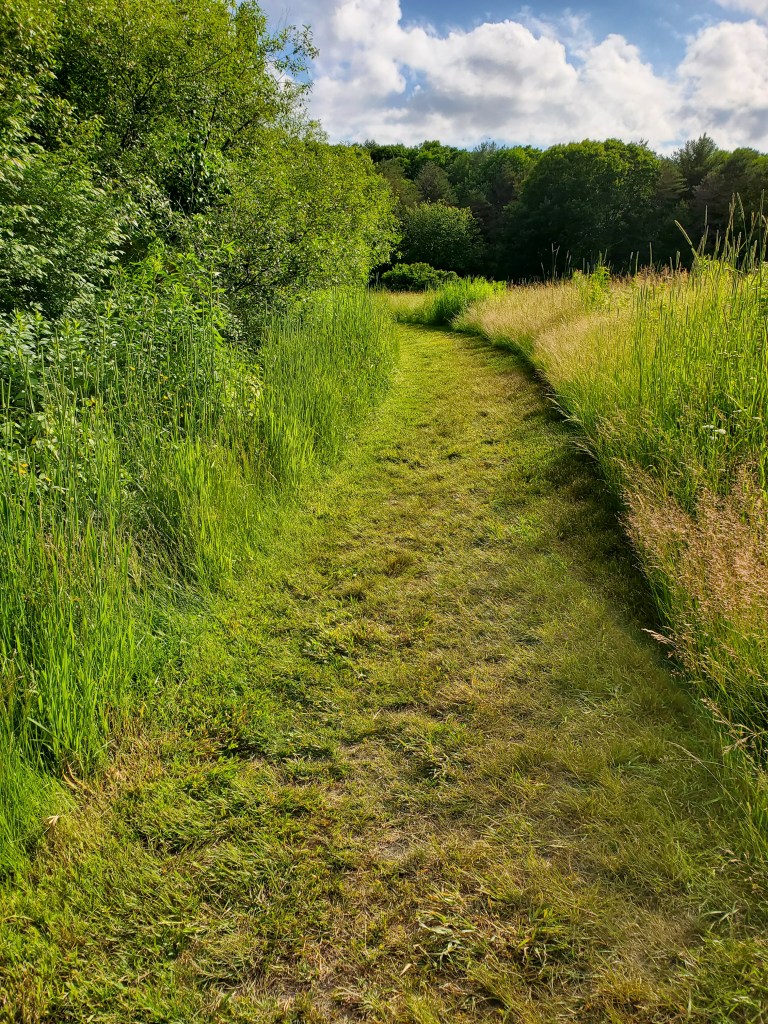
Wagon Hill trail I’ve been back at home for four days and a month, and my travels through the south, confronting the past, both personal and national, are partly responsible for this current state of mind. More forward, however, are the wrenching changes SCOTUS has imposed over the last week before the Court’s summer recess, a week historian Heather Cox Richardson notes in her 1 July posting of Letters from an American “will certainly show up in the history books.” Maybe that’s why I’ve put Tennessee Ernie Ford’s Civil War songs on the playlist: what’s been called the current cold civil war no longer seems cold or civil. And just now there’s news of another mass shooting in Chicago. Happy Independence Day.
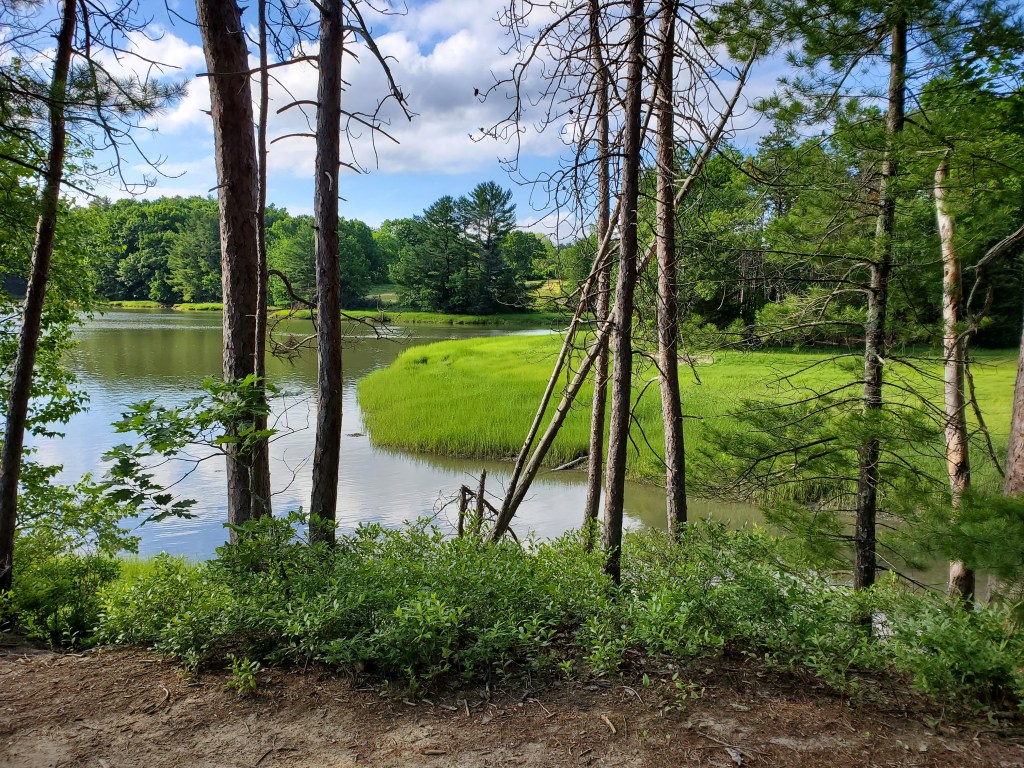
From the Wagon Hill peninsula Things have changed so much in the past three years since my husband David’s death: I long to hear his take on what the great American experiment has come to in this moment; I compose mental lists of these changes, from the macro to the micro: the pandemic, the Biden presidency, the attack on the Capitol, the Supreme Court’s taking the nation back to the Articles of Confederation; my trip to India, my retirement, the water damage to our library ceiling, my new car. I look for commonalities emerging from my most recent journey: time spent with dear friends, some grieving spouses, some grieving lost children, all concerned by the state of academia, the country, their own families. All the promise inspiring those civic-minded titans of the gilded age–Grove building the Arcade in Asheville, Schenck restoring the Guildford Courthouse Revolutionary battlefield in Greensboro, Barnes in a Philadelphia suburb devoting his wealth and energy to making art accessible, believing that an aid to democracy–feels impossibly naïve in light of the structural racism underlying the restoration of Colonial Williamsburg, qualifying our admiration for the “enlightened” Thomas Jefferson, and seemingly resulting in the resurgence of white supremacy movements like the Patriot Front who paraded through downtown Boston yesterday.
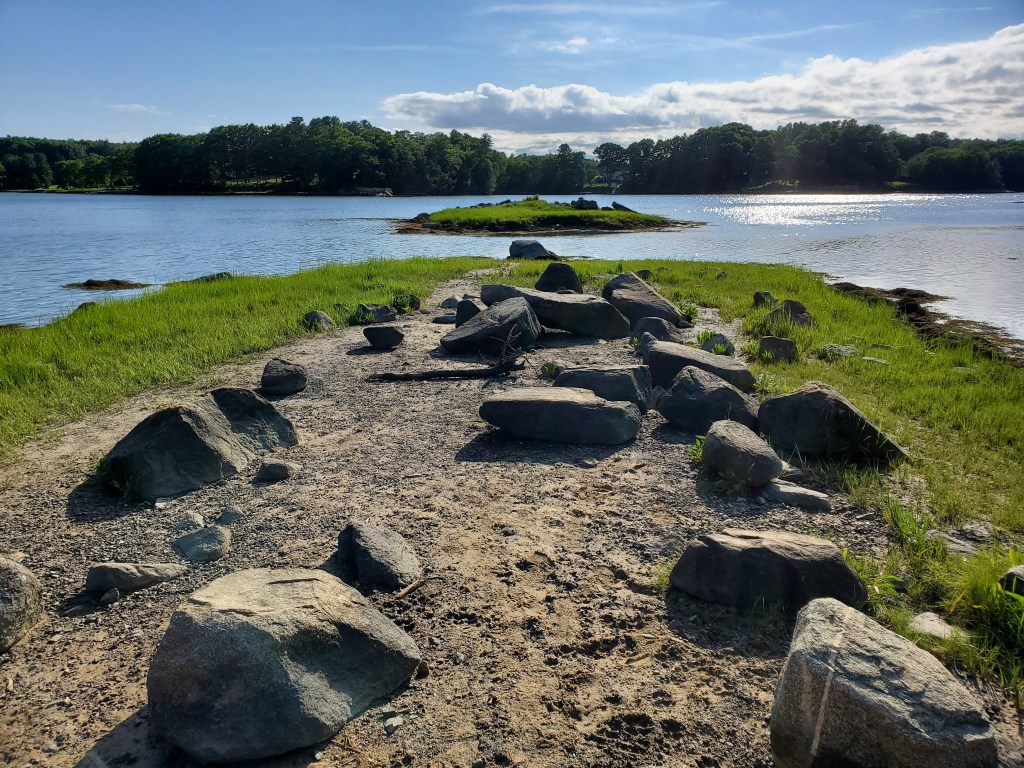
Great Bay seen from the peninsula Our country’s natural beauty is astounding, its promise equally so. My local surroundings are beautiful, as these photos from nearby Wagon Hill Farm illustrate. Here in Madbury I have a resident turkey hen, who the other morning took care to teach her two chicks how to take a dirt bath in the corner of a mulched bed a snapping turtle had earlier scooped out for her eggs.
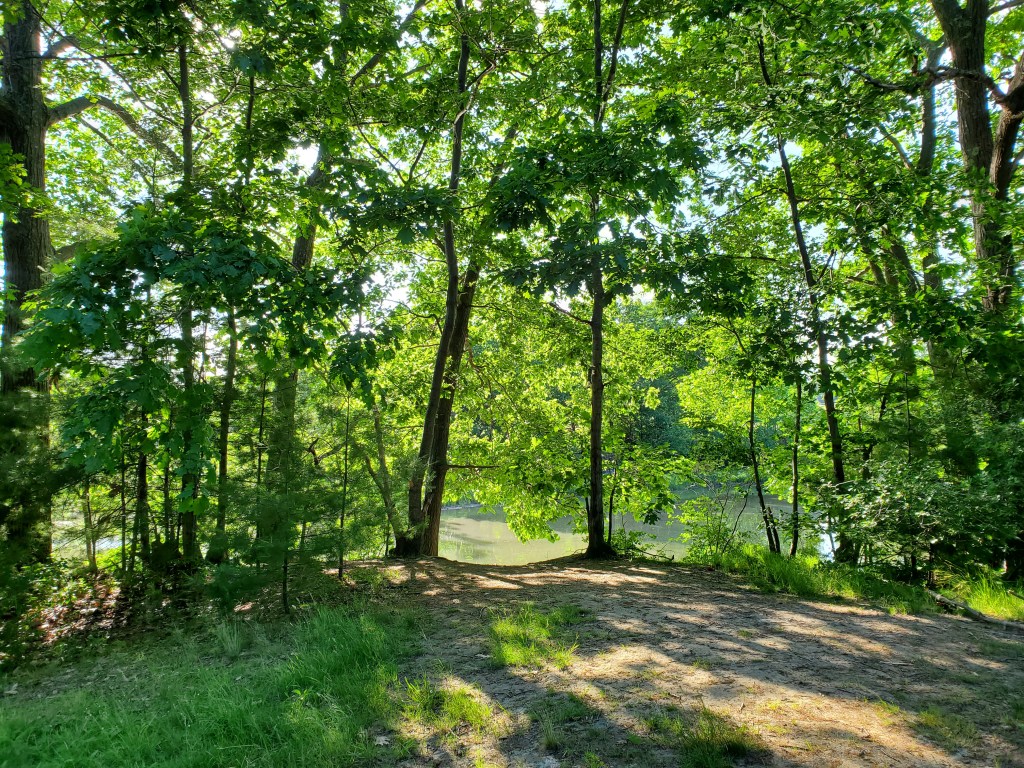
On the Wagon Hill trail, late afternoon I’m looking for profundity in the mundane—and almost, almost finding it.
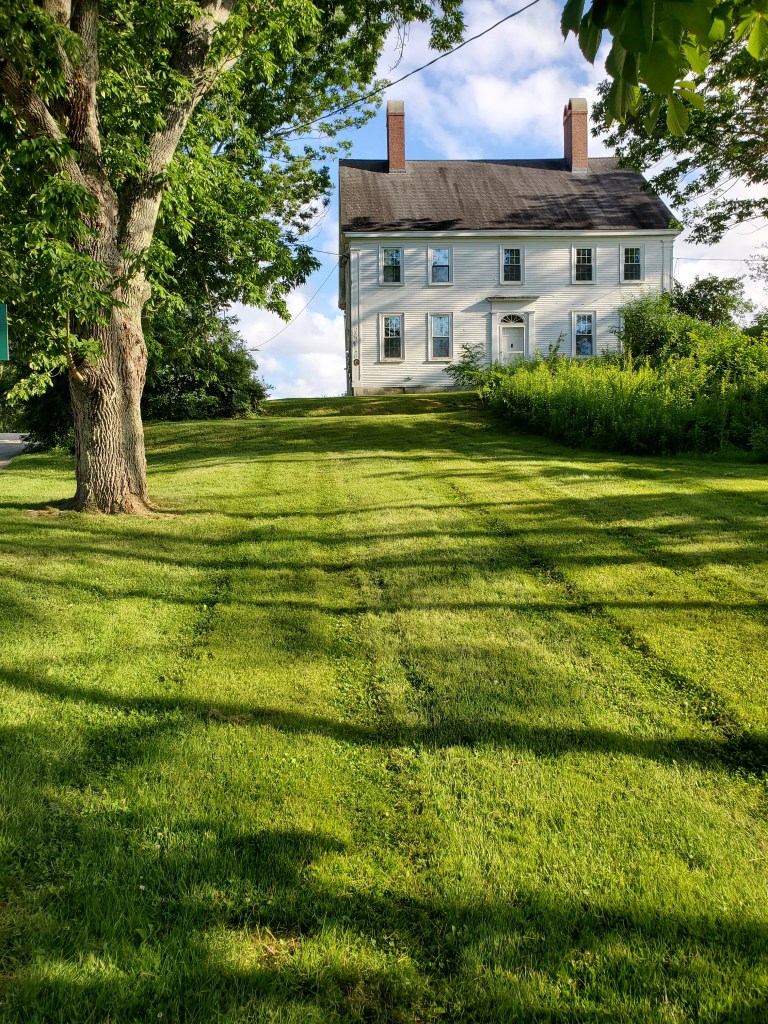
Wagon Hill Farm Homestead, Durham NH -
Southern Sojourn Day 19: 31 May 2022 Narberth PA > Madbury NH
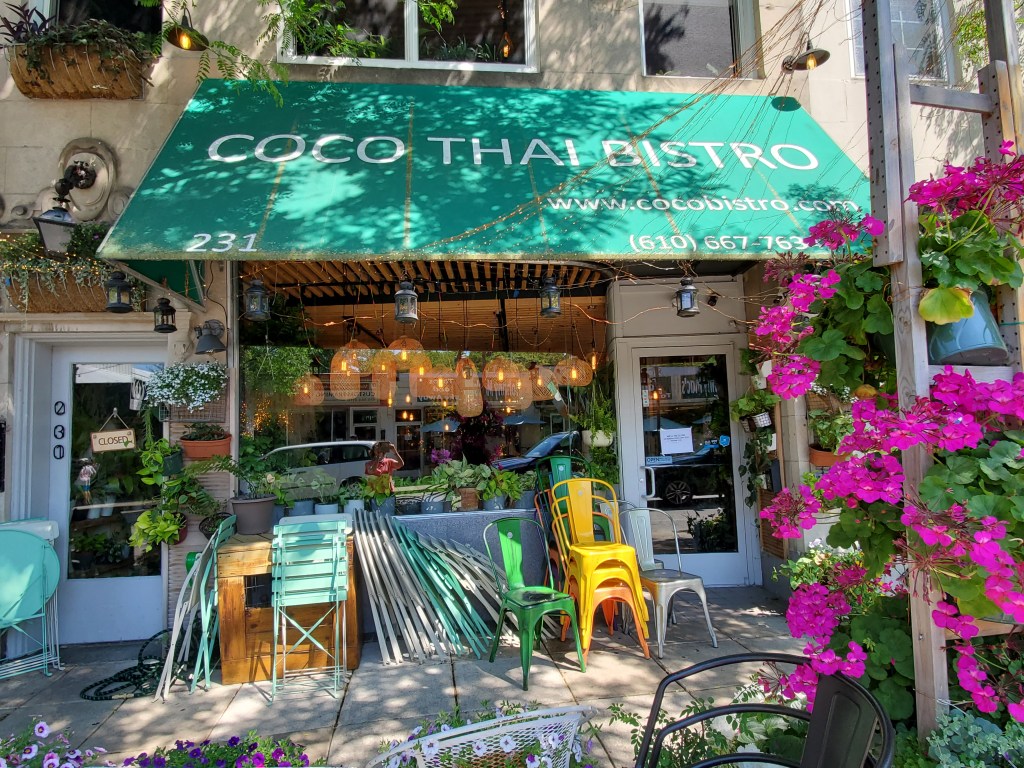
Narberth’s Thai Bistro across from the GET Café, awaiting setup My final travel day is a long one, though it begins well enough with coffee at the GET café in downtown Narberth, a short walk from Ann and Barry’s home. The café is staffed by disabled workers who work carefully, deliberately, and cheerfully to get every order right, and after a couple of attempts, they do. A fine, important opportunity for both staff and patrons to practice inclusiveness, this GET café. We take our coffee and croissant, together with uplifted spirits, to a sidewalk table across from the Thai restaurant whose proprietor clearly has a green thumb. Good for Narberth.
Back home, Connor again assists with my suitcases, and I take off, at first alarmed by a persistent thumping that I fear means a flat tire. After a few blocks, however, this abates, and I chalk the noise up to my GTI’s having been stationary, parked on the same hot pavement unmoved for two days. I fire up (curiously antiquated metaphor for electronics!) the gps, and Google gal gets me through Philadelphia and into Princeton surprisingly quickly. My intention is to retrace my original route south, and head north from Princeton to the Tappan Zee bridge, but somehow, I cannot find my way onto Route 206 north, and end up on the dreaded approach to the George Washington Bridge spanning the Hudson in a nightmarish tangle of traffic allowing for no exit. Less than ideal, this.
I cope by kicking my request for assistance up a notch from Google gal, asking right out loud for supernatural protection from David and all the ancestors gone before. That (or something else) works, and I do make it all the way home with only gas prices ($5.849 per gallon at my last stop) to complain about.
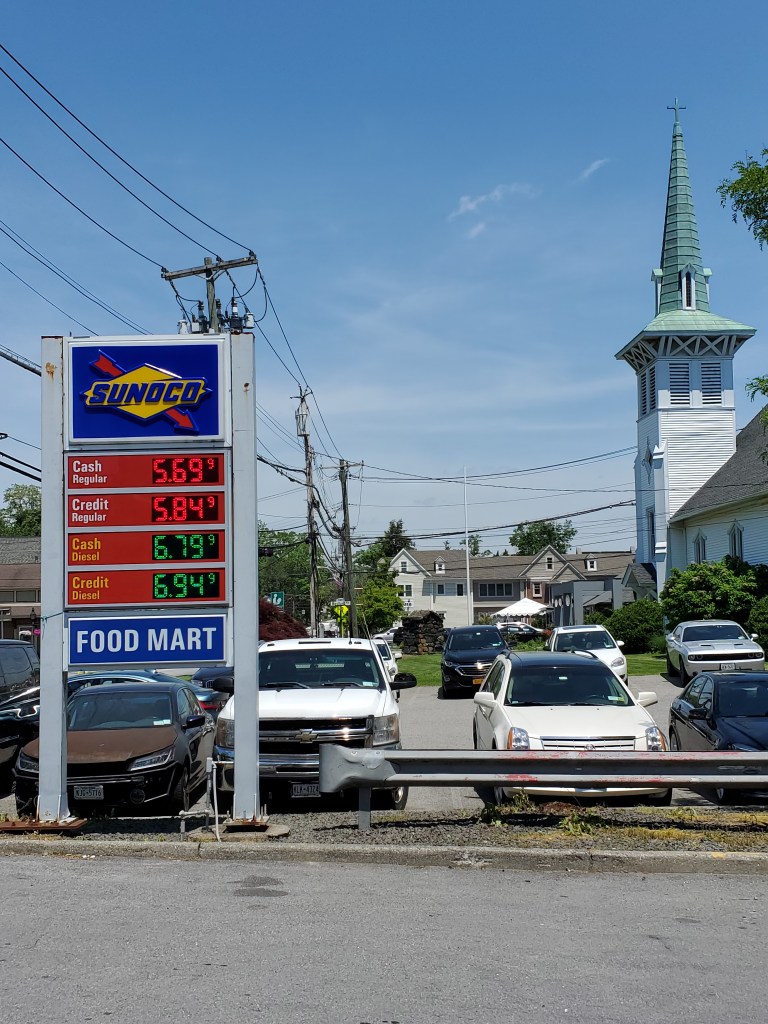
Just outside Danbury, CT, 31 May 2022 It’s a grueling 8-hour drive, the longest I’ve been behind the wheel on a single day this trip, having sworn off the 13-14-hour jaunts of my youth. Google gal does help me avoid tailbacks on both I-495 and I-95, however, diverting me toward Manchester and Routes 101 and 127, the very familiar—and easy–way home from Manchester Airport. I get back before sundown, fill the bird feeders, and with celebratory glass of wine in hand, survey the grass that needs cutting before dinner back at my grandparents’ dining table, feeling grateful.
Home again. Back to all the comforts and responsibilities of that home, back to taking up once again the burden of organizing my solo life; it is the third anniversary of my husband’s death. I will think about that, and lessons learned over the past 19 days, looking for correspondences and insights, for the next month and beyond.
-
Southern Sojourn Day 18: 30 May 2022 Narberth PA > Philadelphia PA and back
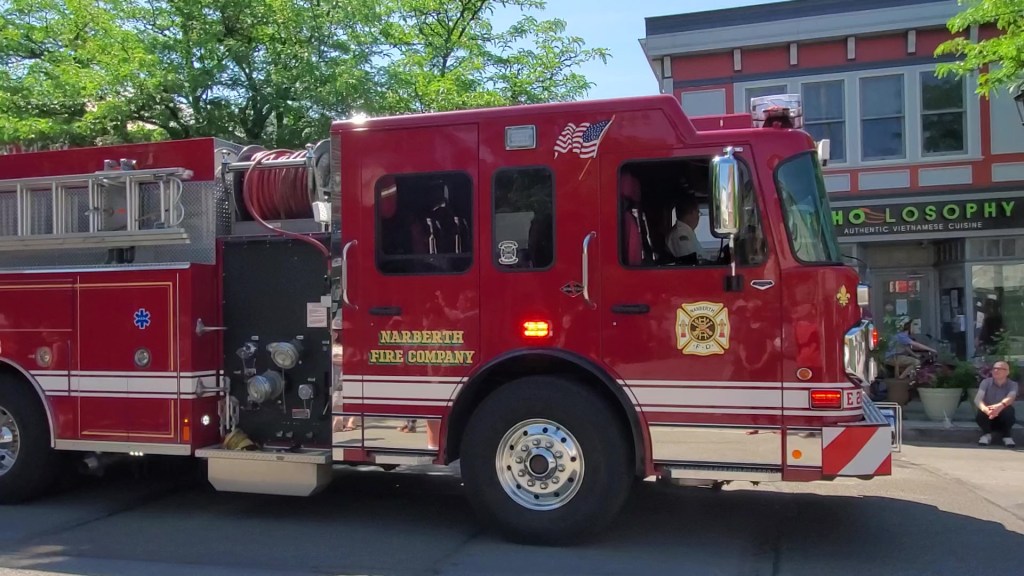
Proud Firemen Parade, Narberth PA It is Memorial Day, and as we finish our breakfast on the porch (bagels, cream cheese, smoked salmon, and fruit), the wheeze of bagpipes wafts from downtown, so we hurry to catch the parade in progress.

Traditional bagpipes and drum . . . 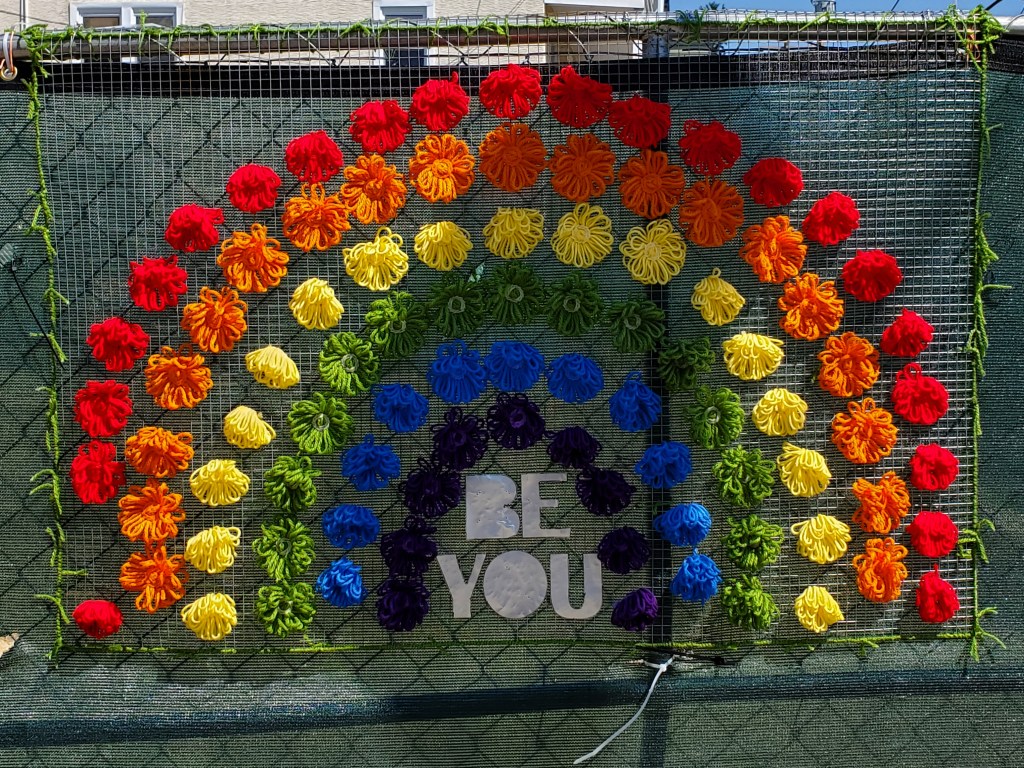
. . . and local Pride Enjoying that, and the hipster/Thornton Wilder-esque hybrid downtown, Ann proposes the next diversion, a trip to the Barnes Foundation in downtown Philadelphia.
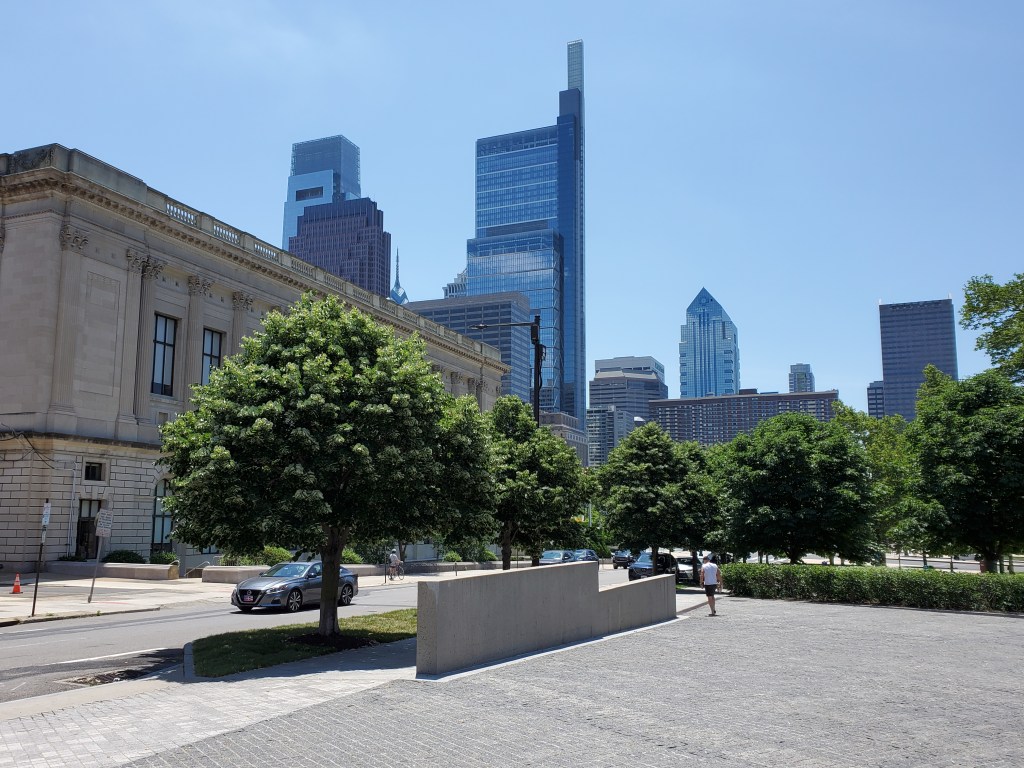
2000 Block Benjamin Franklin Parkway, Philadelphia The Barnes houses one of the world’s greatest collections of Impressionist, Post-Impressionist, and Modern Art, all displayed salon style, with Barnes’s curious accompanying collection of hardware, both paintings and fixtures arranged not chronologically but rather paired for the formal correspondences that Barnes believed could teach the uneducated viewer how to look at art.
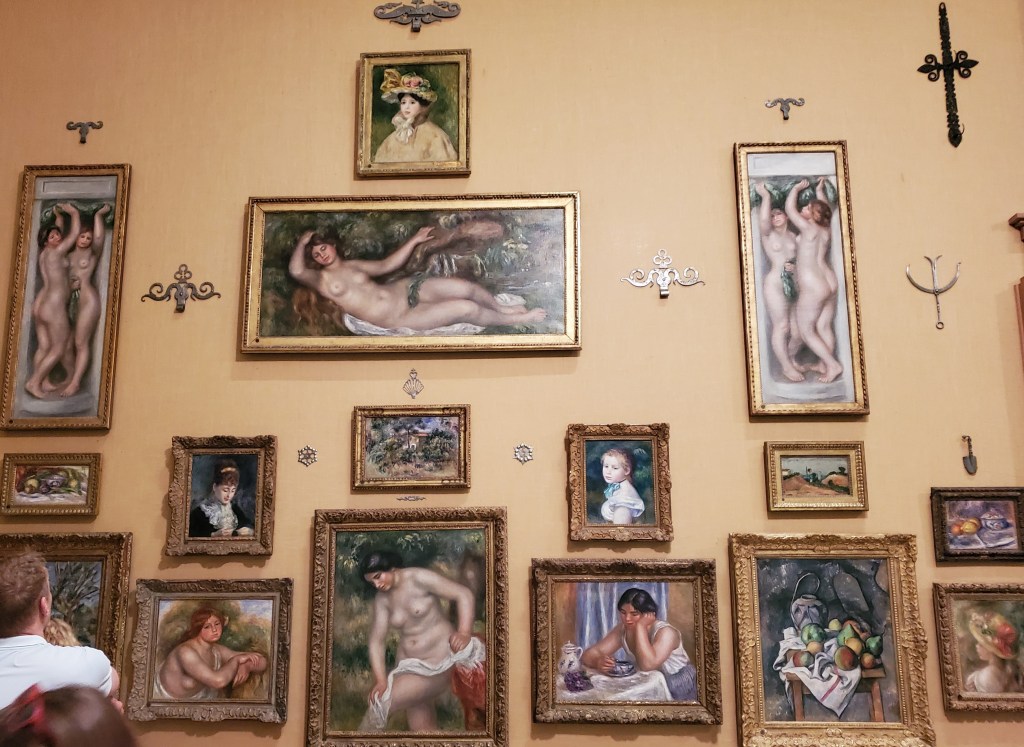
Salon-Style display at the Barnes 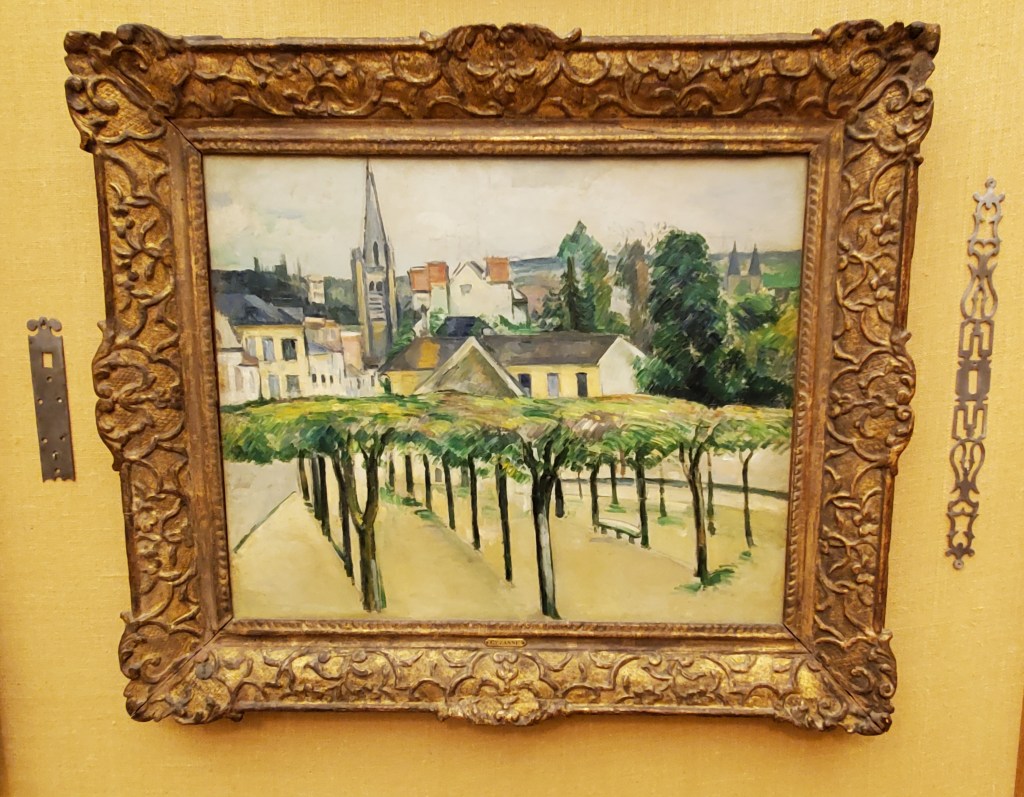
Paul Cézanne
The Church of Saint-Aspais Seen from the Place de la Préfecture at Melun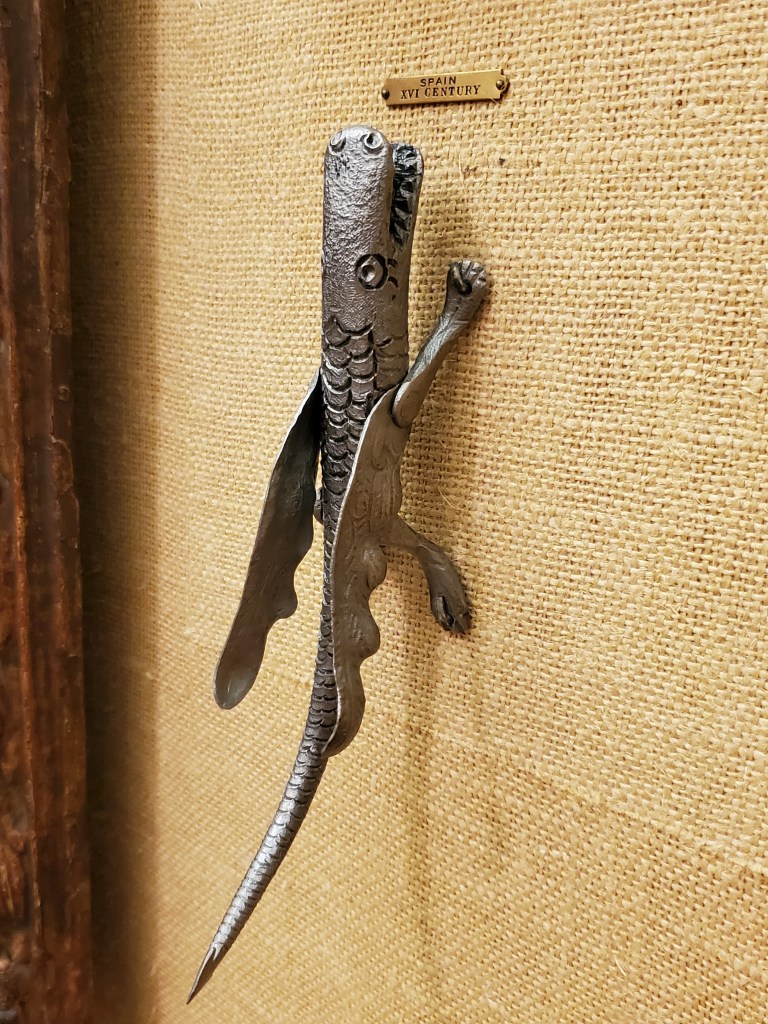
Grasshopper Gator? The Barnes was founded in 1922 by Albert Coombs Barnes (1872-1951), a chemist and business man who (like his counterpart gilded age pharmacist Edwin Wily Grove in Asheville) made his fortune by co-developing a tonic, Argyrol, an antiseptic silver compound that was used to combat gonorrhea and inflammations of the eye, ear, nose, and throat, and prevented blindness in babies born to syphilitic mothers. He sold his business, the A.C. Barnes Company, just months before the stock market crash of 1929, and devoted himself to philanthropy.
Barnes had begun collecting art as early as 1902, but became a serious collector in 1912, assisted by his Philadelphia Central High School classmate, artist William Glackens. On an art buying trip to Paris, he visited the home of siblings Gertrude and Leo Stein, and purchased his first two paintings by Matisse. Eventually, his collection grew so large that he was housing some of these priceless canvases in his employee’s homes. In 1908, Barnes organized his company as a cooperative, devoting two hours of the work day to seminars for his employees, who read philosophers William James, Georges Santayana, and John Dewey, the latter of whom he had met in a seminar at Colombia University in 1917. Dewey became a close friend and collaborator for more than three decades. Barnes conceived of his Foundation as more school than museum, believing like Dewey (and like the undergraduate research program I used to coordinate) that learning should be experiential. The Foundation classes included experiencing original art works, participating in class discussion, reading about philosophy and the traditions of art, as well as looking objectively at the artists’ use of light, line, color, and space. Barnes believed that students would not only learn about art from these experiences, but that they would also develop their own critical thinking skills, enabling them to become more productive members of a democratic society. He had much in common with Centre College’s now-defunct Humanities Program, it seems. Oh, Mr. Barnes! How much we need your influence in these latter days!
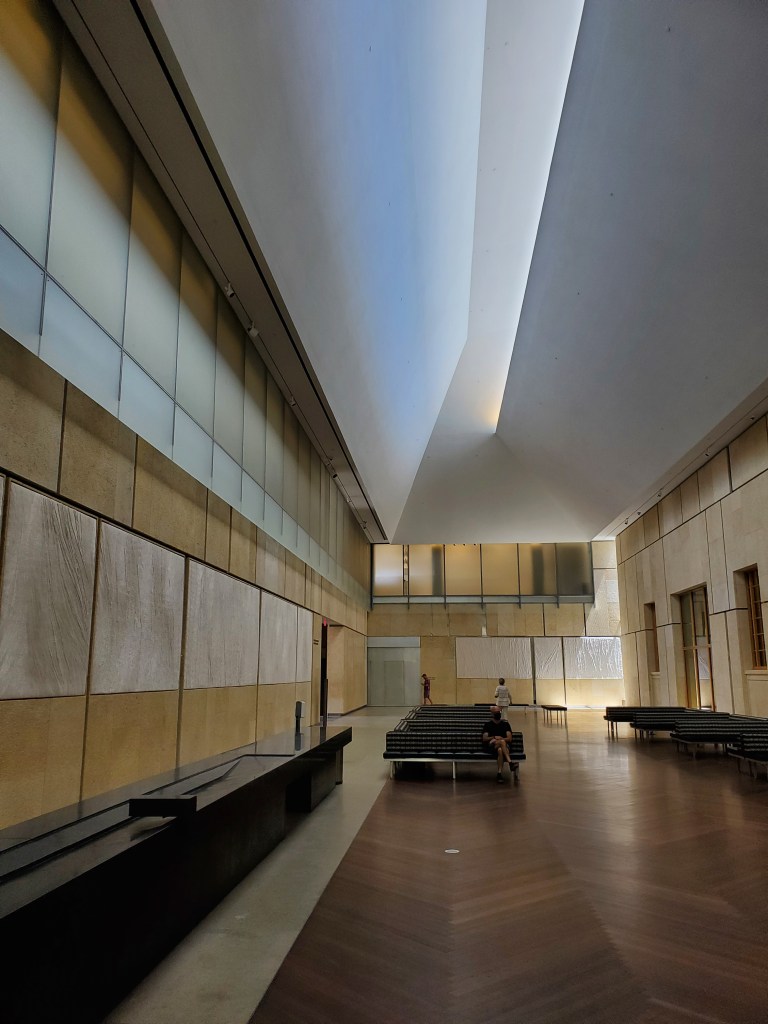
Tod Williams and Billie Tsien, architects, 2012 I am made wistful thinking of how far from such democratically inspired philanthropy we have fallen in our era of Zuckerberg and Musk. And as the young docent presents to us her gallery talk, I am reminded of the previous night’s conversation and Barry’s conviction that there is no will that can’t be broken. I learn from Wikipedia that Barnes created detailed terms of operation in an indenture of trust to be honored in perpetuity after his death. These included limiting public admission to two days a week, so the school could use the art collection primarily for student study, and prohibiting the loan of works in the collection, colored reproductions of its works, touring the collection, and presenting touring exhibitions of other art. Matisse is said to have hailed the school as the only sane place in America to view art.
After Barnes’s death, however, decades of legal battles ensued, and (as Barry had said) Barnes’s bequest to Lincoln University, the nation’s first historically black college and university, was broken. Despite legal challenges to moving the Barnes collection from its original home in Merion to Philadelphia, construction for the new building began in fall 2009, and the gorgeous new building opened in May 2012 with galleries designed to replicate the scale, proportion, and configuration of the original galleries in Merion. Truly, I can see why the building won the 2013 AIA Institute Honor Award for Architecture, the 2013 Building Stone Institute Tucker Award, and the Barnes Foundation the 2012 Apollo Award for Museum Opening of the Year.

Leaving the Barnes
OLIN, landscape architectI am certain Barnes would have approved of the scan-and-click technology that dispenses with gallery labels and in their place presents the viewer equipped with a smart phone detailed information about every piece in the collection. There’s so much to see and absorb–a head-exploding trove, in fact. After a couple of hours, Ann and I share tea and a savory brioche in the café, and head for home via the Smith Memorial Arch, a Civil War monument in Fairmount Park with an acoustically remarkable “whispering bench,” conducting the quietest utterance from one end of its curving walls to the other without electronic intervention. We also drive by the original Barnes Foundation in Merion. Now leased along with its adjoining arboretum by Saint Joseph’s University for $100 a year, it retains its original educational purpose.
It’s been a full day. We have another delicious dinner—shrimp and rice, salad, and more blonde brownies—on the porch, and Ann gives me three books to pack up and take home with me the next day, part of the ongoing informal book exchange that has become standard among all my academic friends with TOO MANY BOOKS!
I think Barnes would approve of that, too.
-
Southern Sojourn Day 17: 29 May 2022 Williamsburg VA > Narberth PA

At home in Narberth PA Driving from Sandy’s through heavy traffic ‘round the District I am more than ever grateful for Google assistance with navigation—certainly a godsend for a solo driver in a strange land. In the late afternoon, I arrive in Narberth, a suburb of Philadelphia on the historic Pennsylvania Main Line with a population of 4,304, one of Philly’s most desirable neighborhoods, a cozy half square mile borough well known for a charming downtown, good schools, and low crime. Niche, the website that rates schools, companies, and neighborhoods, gives Narberth an A+ rating. And indeed, as I arrive on the Sunday before Memorial Day, the home I pull up to is a three-story Queen Anne in a neighborhood lifted straight out of Our Town.
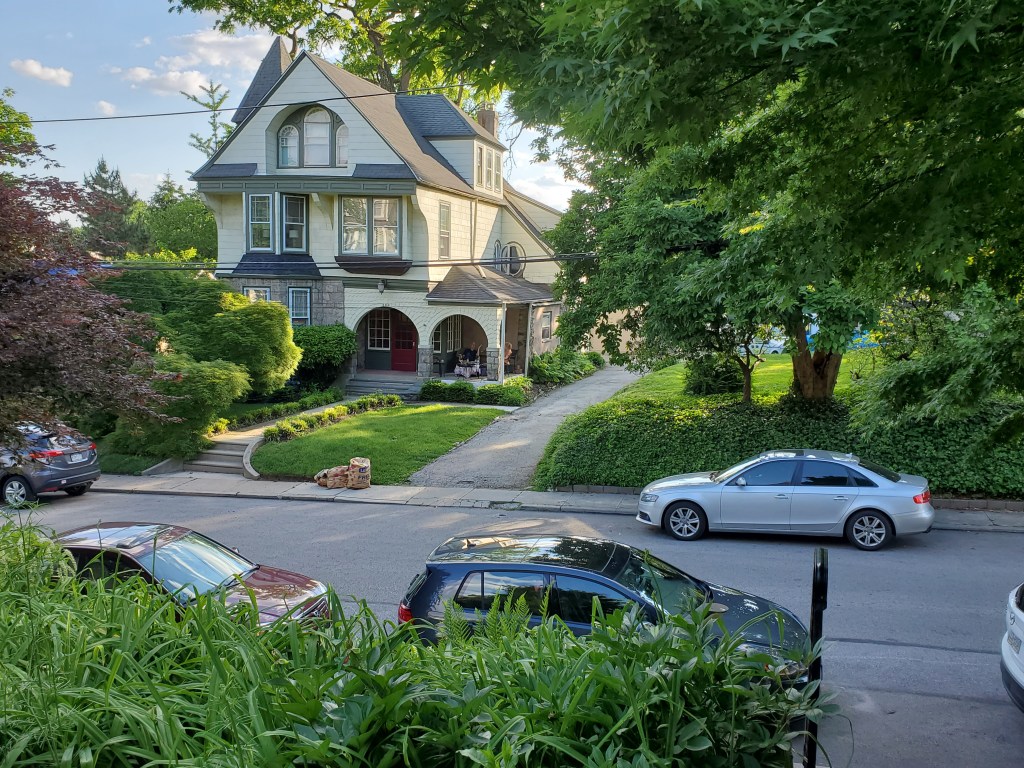
View from the porch, my GTI and the house across the street in leafy Narberth Connor, Barry and Ann’s son, is the first to see me and after introducing himself offers to carry my bags up the rather daunting three flights of steps to my guest room at the top of the house—a service for which I am VERY grateful. Barry and Ann have just returned from visiting relatives in Barry’s native Ireland, and Barry is on the phone with his brother there when Ann greets me. She and Barry are part of my Tulane grad school gang, and though both also got PhDs in English there, Barry went on to the Tulane Law School, and remains a professor at Temple University’s Beasley School of Law. Ann also teaches at Temple, writing, literature, and most recently business ethics, and both spent several enjoyable years working in Tokyo, where Barry was Director of the Law Program at Temple University Japan. We three met up for the first time in years in New York City in early April, saw the new Letts play, and had a long, lovely dinner of reminiscing after. Now I’m taking them up on their invitation to make a visit at the end of my southern sojourn on my way back to New Hampshire.
The heat in Narberth is the reverse of what I’d expected: it was actually cooler in usually steamy Greensboro, North Carolina than farther north, but I’m grateful for a reason to have the dinner Ann’s prepared out on the generous porch of an earlier era.
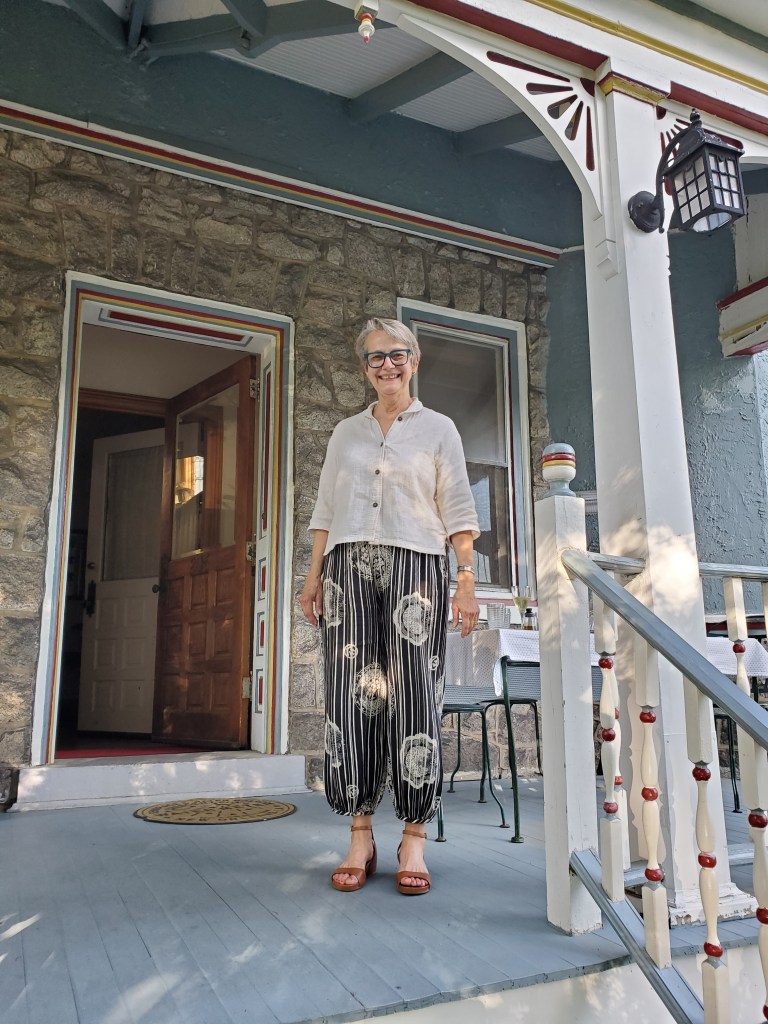
Ever-elegant Ann of Ponchatoula LA on her PA front porch 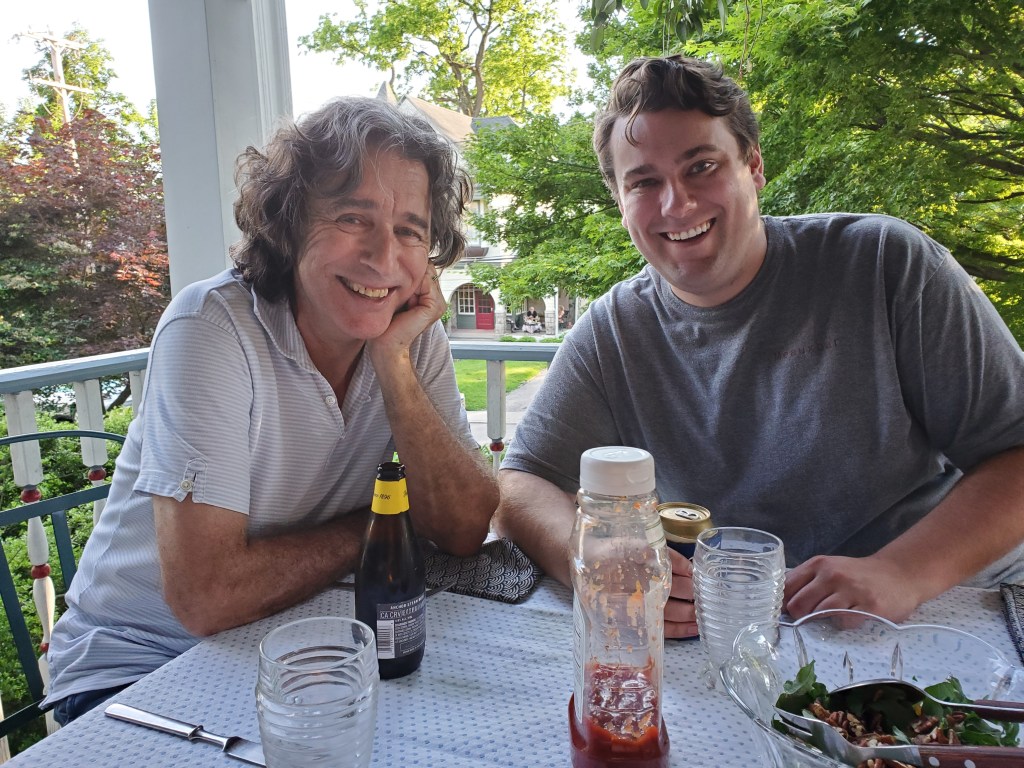
Barry and son Connor on a perfect spring evening Indeed, our situation reminds me of evenings on the porch of my grandparents’ Tudor revival home on Springbrook Boulevard in Dayton, Ohio, where after dinner in summer the neighborhood kids would eventually drift home from pickup games of Red Rover on the front yard and settle onto their respective porches as the fireflies came out and some of the adults told stories while others enjoyed their evening smoke.
Ann’s meal is delicious, crab cakes, rice, salad, and blonde brownies, and in the gloaming, in addition to grad school tales, Barry speaks of what the law can and can’t do (“There is no will that can’t be broken”) and how he makes good use of his legal and literary training, sometimes teaching poetry forensically, instructing students to look for evidence of what the poet was thinking. I keep thinking of the old tv series Paper Chase, with patrician John Houseman as Professor Kingsfield intoning at each episode’s beginning: “You teach yourselves the law, but I train your minds. You come here with a skull full of MUSH, and—if you survive—you leave thinking like a lawyer.” I doubt Barry intimidates the way Kingsfield did, but I’m sure his students DO learn to think better than they did before they took his class.
Both Barry and Ann were sorry to leave Japan, I’m interested to learn, and plan to return in the fall of 2023. We speak of another tv show I’ve stumbled onto, Old Enough, a long-running reality show from Japan that follows very young children going on errands all by themselves for the very first time as a camera crew follows along: stunningly daring parental behavior it seems to me, not only not a helicopter parent, but never a parent at all. Ann tells of her more careful hybrid American/Japanese parenting, shadowing Connor in a metro car behind the one he was riding, just to be sure all was well.
It is so good to re-connect with these admirable friends. When they ask if my guest room is all right and I answer that it is not only fine, but strikes me as Parisian, the idea of comparing Narberth to Paris gets a big laugh.
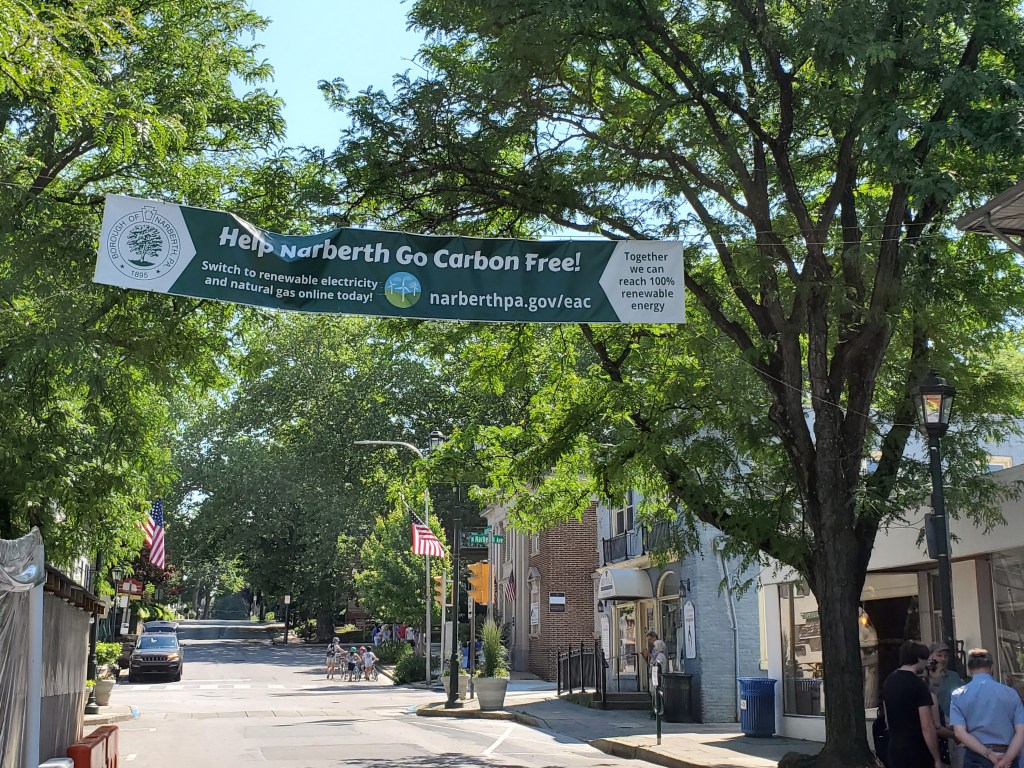
Not Paris . . . Yet when I retire to it, the impression of my room persists, and I drift off in my garret with its charming roof-top views from an earlier time: all turrets and leafy green tree tops.

. . . but a garret with a view nonetheless 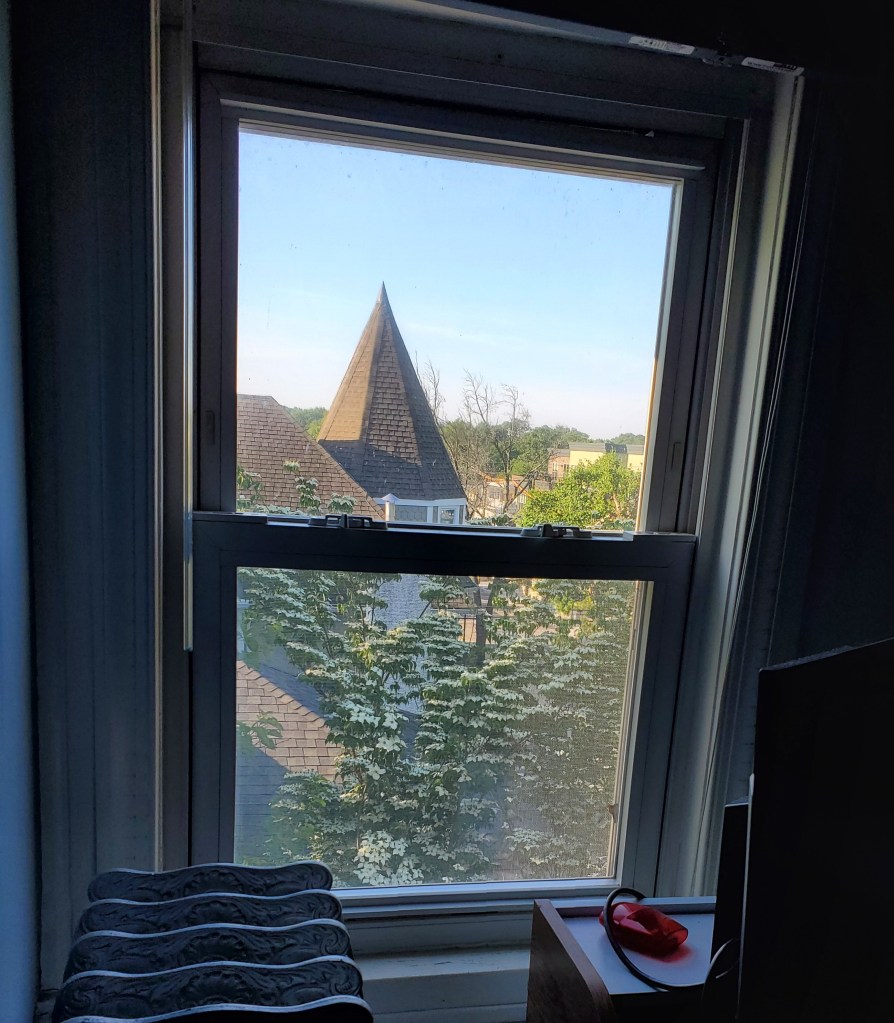
The view -
Southern Sojourn Day 16: 28 May 2022 Colonial Williamsburg > Jamestown
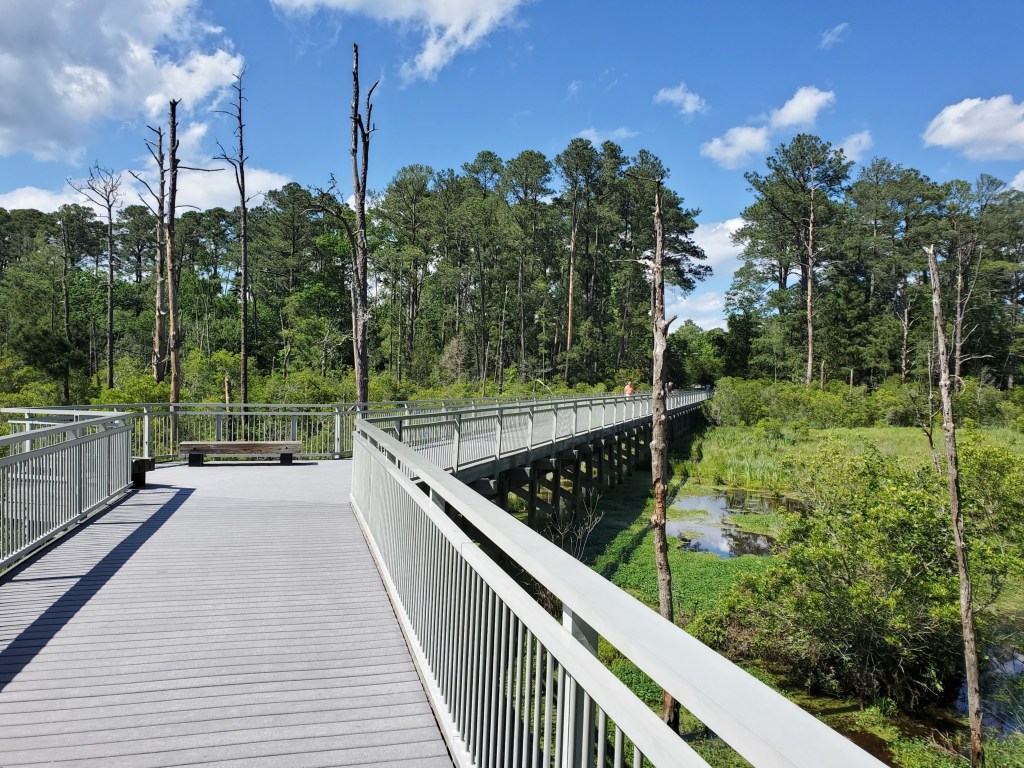
Bridge across the swamp to the Jamestown Rediscovery archaeological dig After breakfast, Sandy drives me to Colonial Williamsburg—CW to the cognoscenti—where she is In Her Element, and gives me a private tour emphasizing two ongoing archaeological excavations. The first, “Custis Square,” is uncovering the physical evidence left behind by (1) John Custis IV, father-in-law to Martha Washington, whose first husband, Daniel Parke Custis, was John’s son; (2) his family; and (3) the enslaved people who lived on that land between 1714 and 1749. Custis was (according to the explanatory sign) “a scientifically curious gardener who mixed local plants with English imports to create a formal garden described in 1734 as ‘[i]nferior to few if any in Vir[gini]a.’” What today seems an open field was once gardens that featured shaped topiary, lead statuary, and gravel-lined walks tended and maintained by enslaved men and women; Custis owned more than 200 slaves, as well as several other Virginia plantations totaling thousands of acres. Custis Square was his townhome. Custis, it seems, was something of a difficult (Custis=cussed?) man, whose infamous arguments with his wife Frances Parke required intervention in the form of written “Articles of Agreement.” He was slow to approve his son Daniel’s marriage to Martha (née Dandridge and later Washington’s wife), and is widely believed to have fathered by his enslaved woman, Alice, a son named Jack who was in Curtis’s will emancipated and promised a house and land–which he unfortunately did not live long enough to receive.
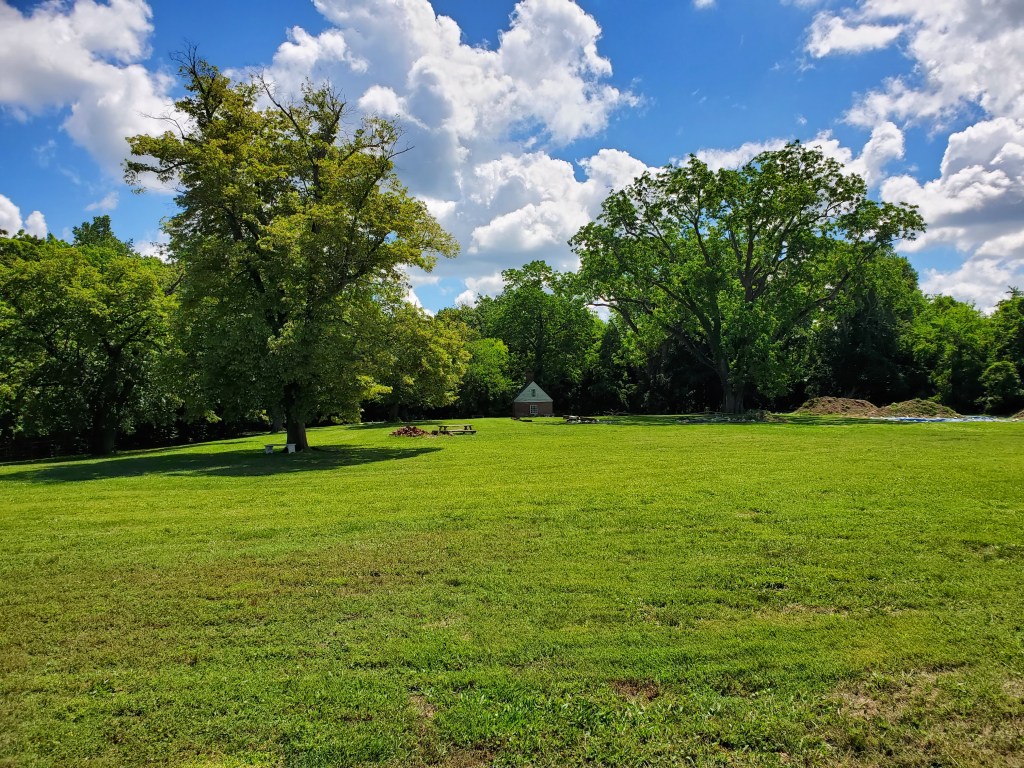
Custis Square, Colonial Williamsburg The second excavation Sandy interprets for me is the site of the Historic First Baptist Church–Nassau Street, founded in secret and defiance of local law in 1776, by one of the nation’s oldest African-American congregations, and hidden under a parking lot for decades. The Church’s “Freedom Bell,” cast in 1886 to mark the Williamsburg Church’s 100th anniversary, was refurbished to be rung at the opening of the National Museum of African American History and Culture in Washington, D.C. on 24 September 2016, when 99-year-old Ruth Odom Bonner, daughter of Mississippi slave Elijah Odom, joined the Obamas onstage to ring that emblem of African-American resilience.
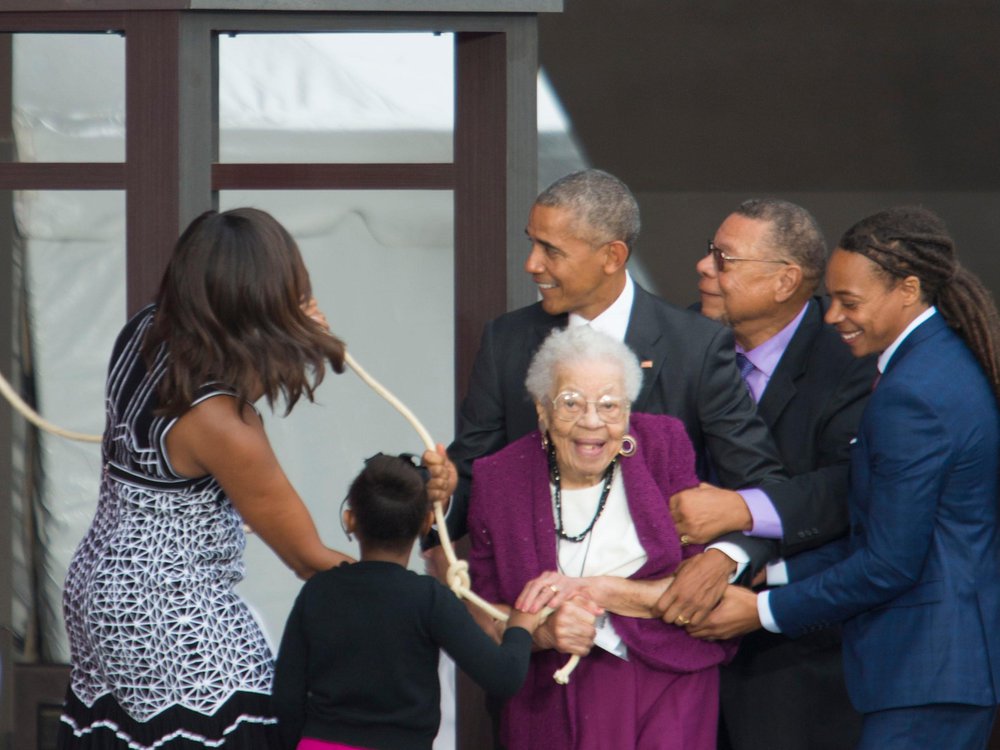
Ruth Odom Bonner, her family, and the Obamas ring the Freedom Bell
(photo by Leah L Jones for the NMAAHC)As Sandy explains what has gone on and what is yet to come at the excavation, a young man stops to listen, and when Sandy invites him to join us, introduces himself as Alex Daniels, a rising senior history major at William & Mary who has worked extensively in its archives and is writing his capstone thesis on the foundation of Colonial Williamsburg as the displacement of the at-the-time majority black community, dismissed by the CW founders as “undesirable elements” from which CW should be “liberated.” The ironies of such language expressed in documents young Alex has found speak volumes, the gobsmacking collusion of both Rockefellers and William and Mary educators.
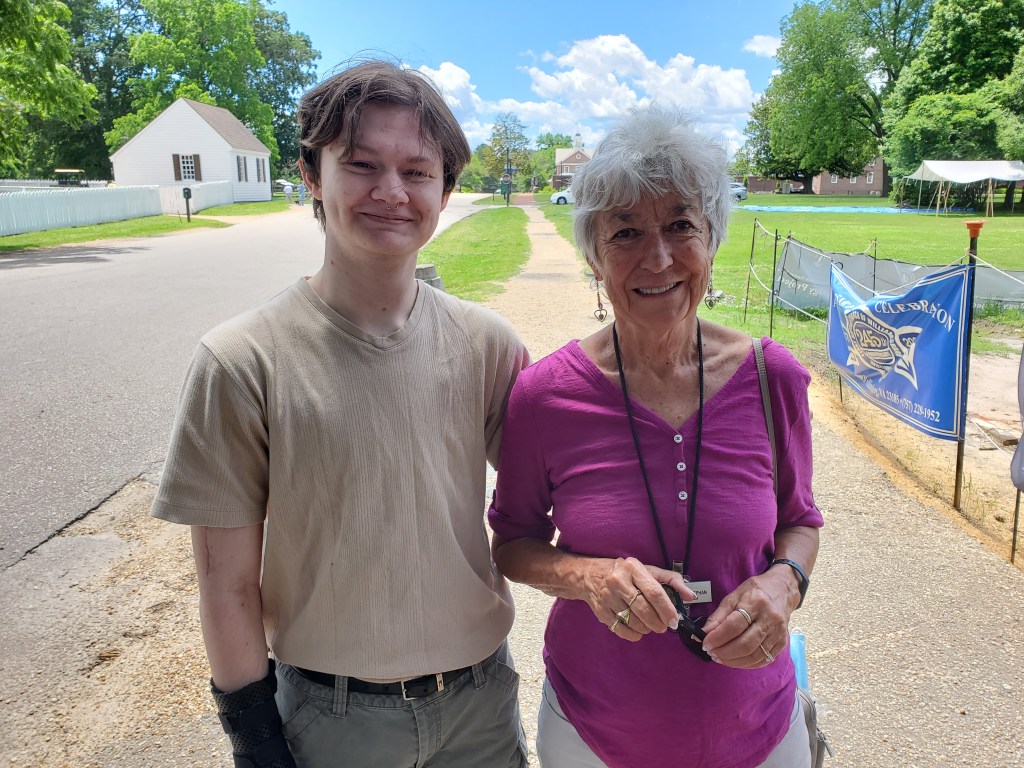
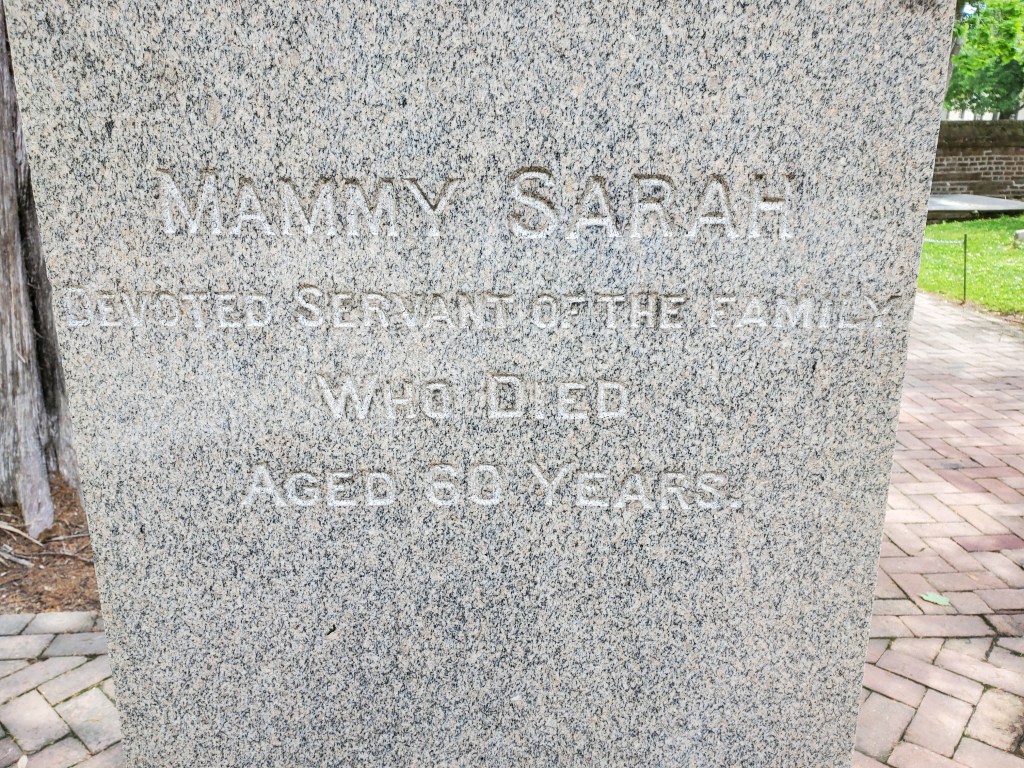
Alex and Sandy at the Historic First Baptist Church site We go on to spend hours in the 1715 Bruton Parish Church cemetery, its monument to “Mammy Sarah” juxtaposed to the company of this bright, articulate young man eager to out past injustices.
With his arm in a cast from a skating accident, Alex is bursting to expound on his research—and, most flatteringly, to ask advice of us. That advice: his capstone beggars many dissertations, and should go straight to publication! Alex’s bright academic future cheers both Sandy and me—me especially, now two years into retirement and away from the thrilling conversations I once had with UNH’s very best undergrads about their research in fields I often knew nothing of. I miss those chats and those kids, and Alex, in many ways, immediately becomes a highlight of my road trip, a scintillating ray of youthful hope in our country’s dark days.
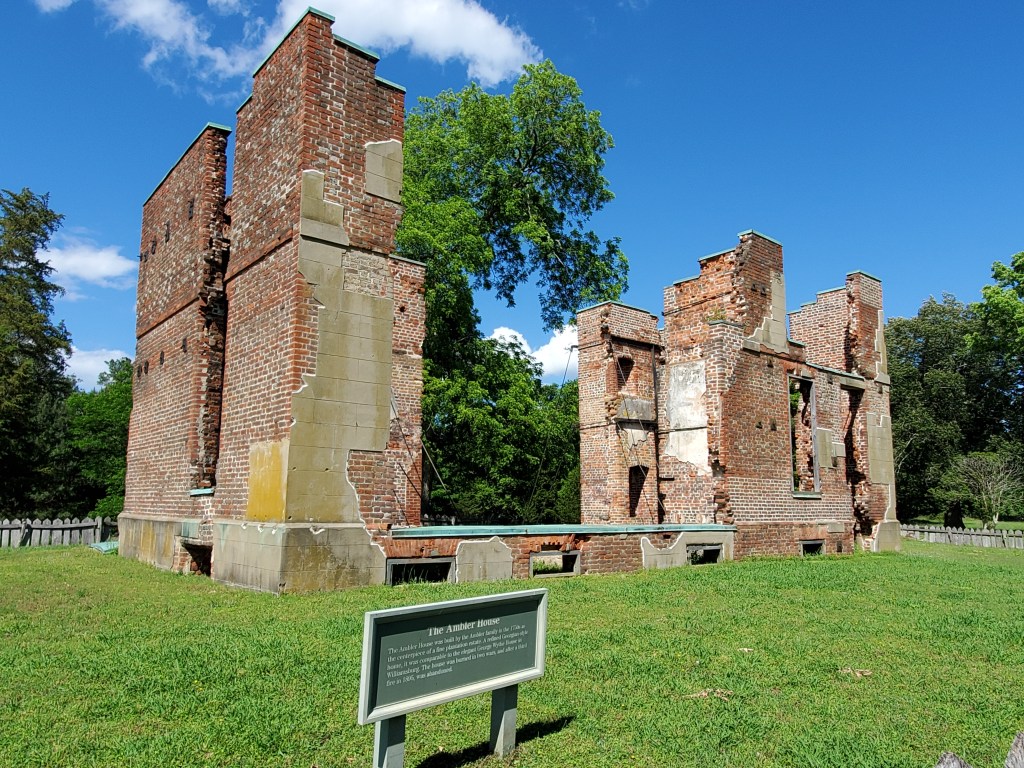
By the time we part with Alex at the Church, I’m hungry, so we share a sandwich at the CW Cheese Shop before driving on the Colonial Parkway to the Jamestown Rediscovery archaeological dig, baking in the bright sun next to the James River. Once arrived, you approach by foot on a bridge crossing a swamp best viewed from above, the first evocation of the terrible trials that befell those Virginia Company settlers who landed on Jamestown Island in May 1607 to establish the first North American English colony 60 miles from the mouth of the Chesapeake Bay. First, the malaria-infested swamp water laced with arsenic (!), then the starving time, cannibalism, and sporadic attacks from the native Powhatan tribe. We walk past the Ambler Mansion (c. 1750) ruins, thrice burned, first in the Revolutionary War, again in the Civil War, and finally abandoned after a third fire in 1895, further testament to hard times and a veneer of civilization as thin as the remaining stone facing on the brick foundation.
We watch a handsome Native American with a gift for presentation explain the construction of buckskin apparel—and the necessity of cooperation and codes of behavior strictly enforced within a tribe, as banishment from one’s people in so harsh an environment meant certain death. A lesson for our Balkanized nation?
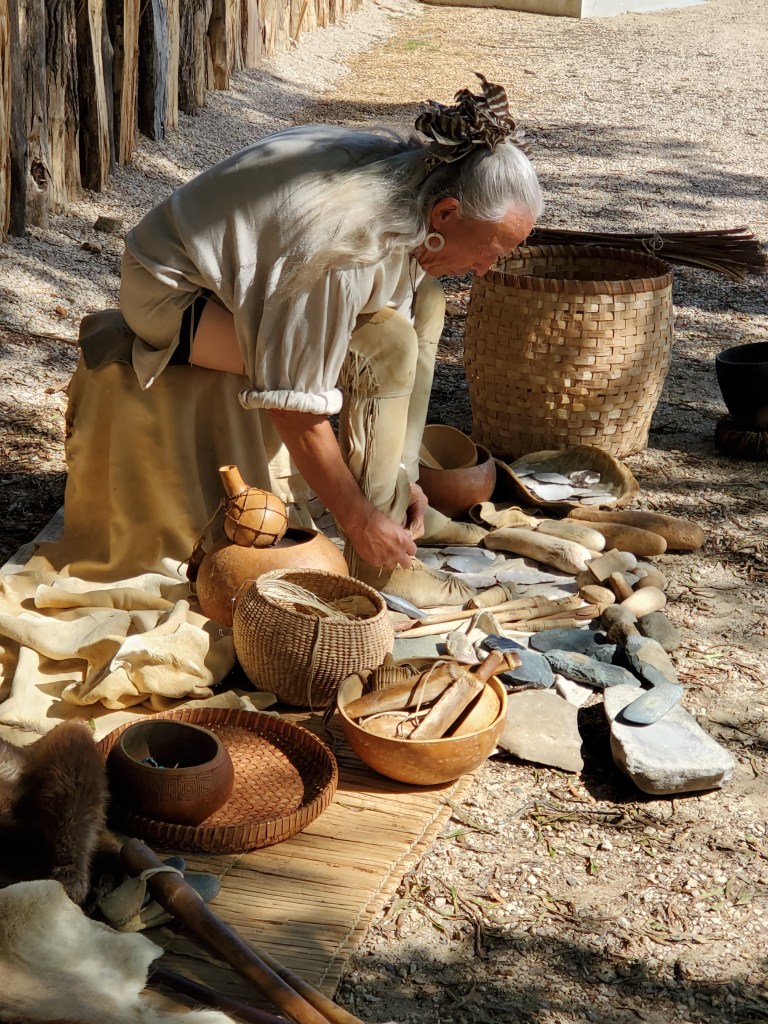
A lesson in buckskin couture 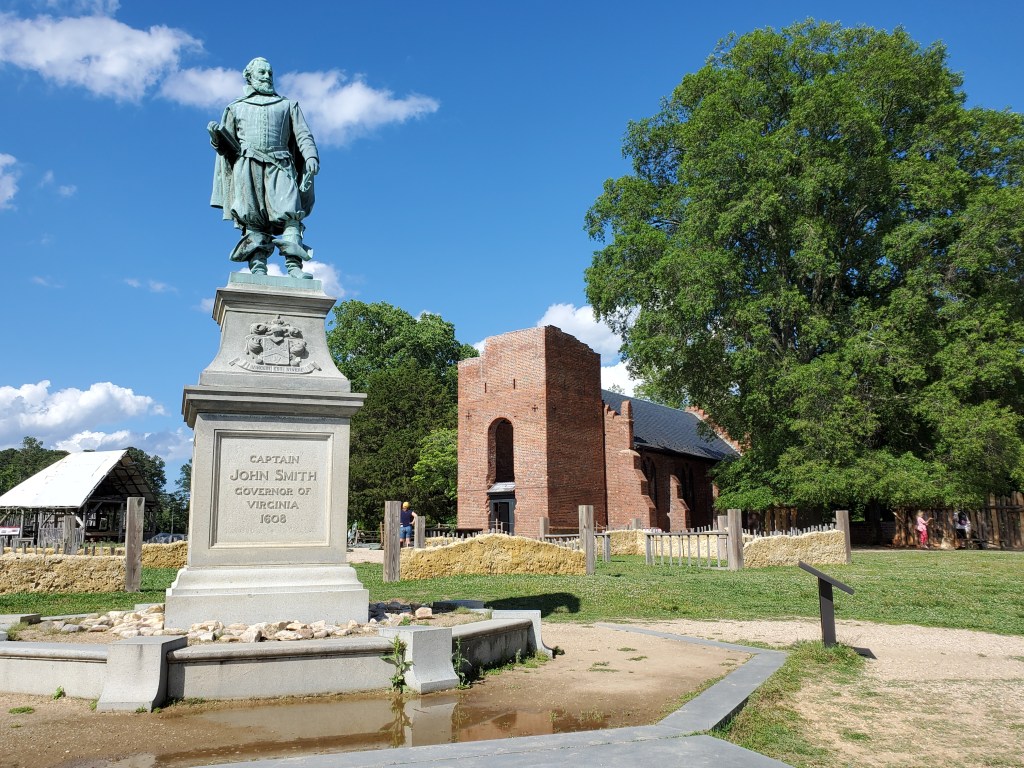
Captain John Smith addresses the James River, in front of the 1608 church where Pocahontas married John Rolfe on 5 April 1614 We make a quick tour of the archaeological museum just before closing time, and head back to “civilization” for a wonderful feast at Greek restaurant Keφi, a cold pikilia platter with taramasalata, melitzanosalata, and tzatziki on a bed of arugula with kalamata olives, dolmades, and grilled pita, keftedes and kalamari with skordalia accompanied by a delicious Honey Golden Ale, and finally a slice of delicious orange semolina cake, portokalopita, for dessert.
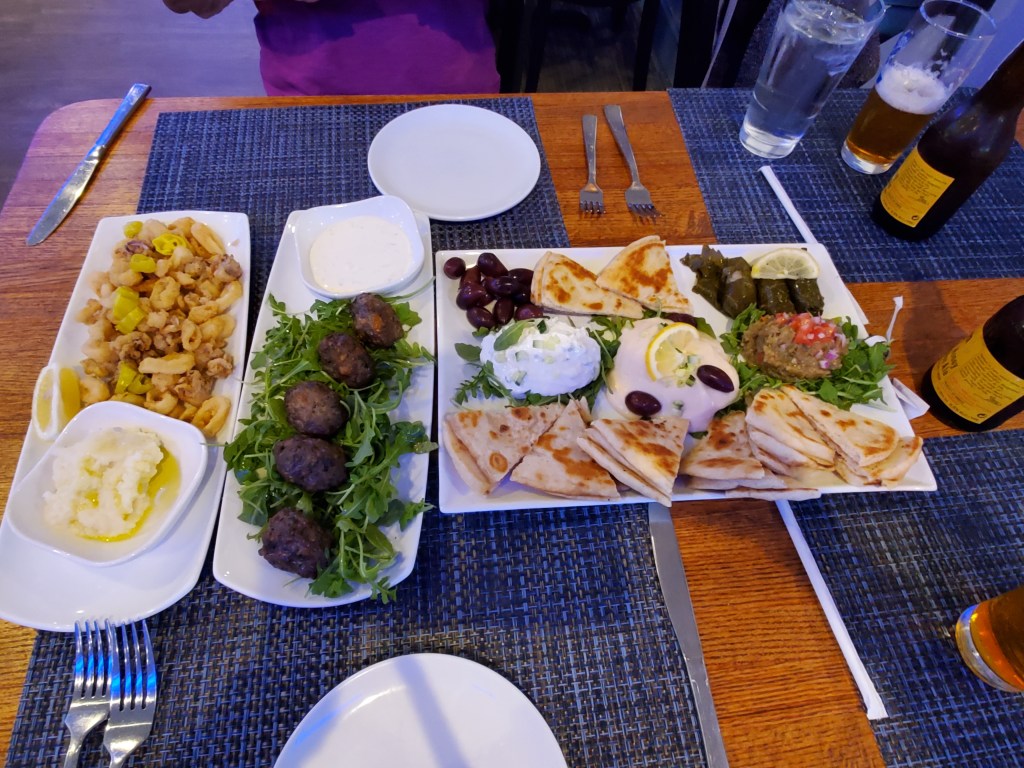
Greek feast at Keφi after historic Jamestown: back to the classics Back home we speak of missing our late, loving husbands, Alan and David, and the company of men in general, and confess how long it took each of us to appreciate the autoeroticism of fancy underwear. Sandy, despite her seemingly unassailable good health and youthful looks, is, like Cameron, considering a move from her lovely home with its many steps. Ever reasonable, she’s concluded if you want to age in place, you will be stuck at home if you can’t negotiate steps. In an unrelated act of generosity, she makes a gift to me: a set of “yoga toes,” the better to straighten and stretch our bunions.
And so, to bed.
-
Subscribe
Subscribed
Already have a WordPress.com account? Log in now.
 Georgeann Murphy