-
GEM Centennial Day
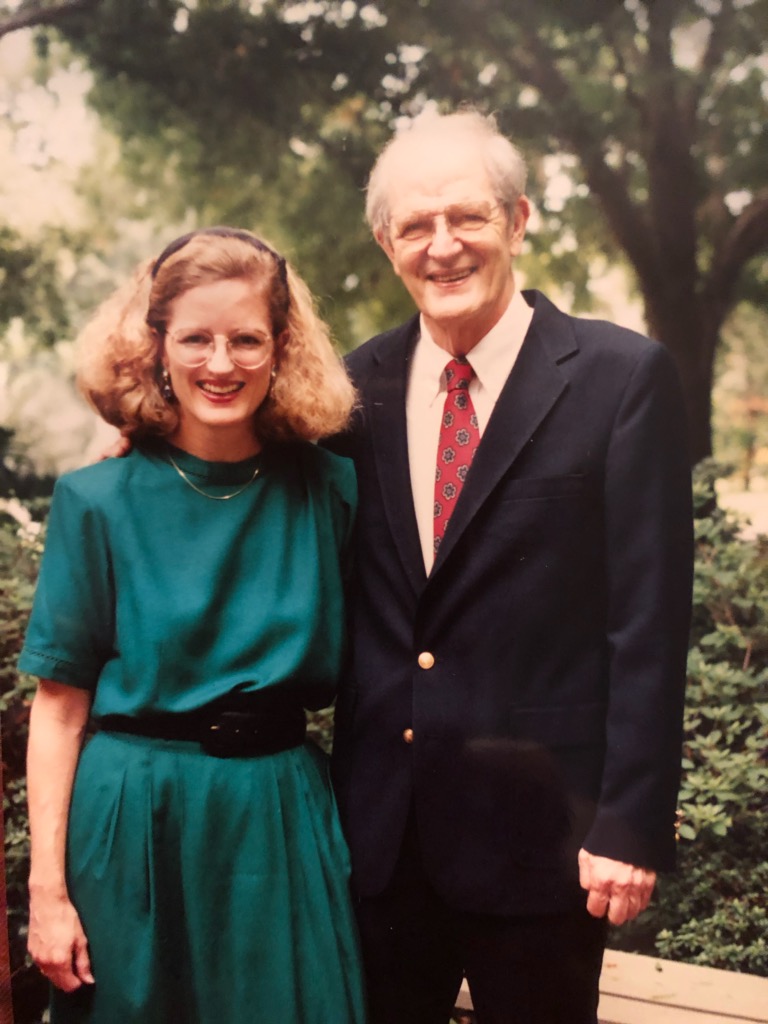
George Edward Murphy, DDS
22 April 1922-25 April 2002
Best of dads, dentists, friends, sons, husbands, grandfathers, U.S. Army veterans,
Beloved by all lucky enough to know you.
Rest in peace on this your centennial birthday.
-
The past is the present, isn’t it? It’s the future, too.

How do you, Dear Reader, respond to the seashore? Matthew Arnold heard there “the eternal note of sadness”—like my mother and paternal grandfather as I recall. For Arnold, “the turbid ebb and flow / Of human misery” evoked a thought all too resonant for our present time:
. . . we are here as on a darkling plain,
Swept with confused alarms of struggle and flight,
Where ignorant armies clash by night.
But for me, the seaside has long been a comfort, the paradox of those recurrent waves, eternally the same and yet with each breaking swell unique, linking past to present, not sounding sadness, but rather establishing one’s place in time and space. Today’s post title is Mary Tyrone’s line from Long Day’s Journey Into Night, O’Neill’s great play pulled from the lives of his own tormented family, and a role I acted (at age 21, how absurd!) as an undergraduate senior. I had seen Laurence Olivier play James Tyrone to Constance Cummings’s Mary in London’s National Theatre production during the fall of 1972—three times, in fact, so taken was I with the play and those performances. After the third time, I felt compelled to wait at the stage door—as no one else did—to tell the cast that production had, I believed, changed my life.
At first a backstage manager thought I just wanted an autograph, collected my program, and brought it back signed, expecting me to leave then. But I felt compelled to thank the cast and lingered. I suspect this fellow must have alerted the actors that some star-struck American might ambush them as they left the theatre, as I don’t recall seeing them depart through that door. But then, a long black limousine drew up to the curb, and I knew this must be for Lord Olivier. It was now or never. So, when he appeared, I rushed up to him to blather my thanks for the autograph and his performance, which I had returned and returned to see again and again.
In response, Lord Olivier took my right hand in his, and patting it with his other hand, thanked me for waiting so long in the cold to tell him that, asked what brought me to London, was I studying the theatre, and hoped I was enjoying London. After what felt like five minutes, he apologized that he really must go, thanked me again, let go my hand, and disappeared into the back of the limo. I, gobsmacked, regarded my right hand with awe, and hyperventilated my way back across Waterloo bridge to share my story with my roommates in our Bloomsbury student quarters.
Returning to campus in the new semester, I for the first time added theatre classes to my English major, was cast in LDJ, and many years later earned my doctorate by specializing in Renaissance literature, Shakespeare, and drama as a genre. That landed me a tenure-track position split between the English and drama programs at Centre College of Kentucky, tenure, and a year’s appointment as director of Centre’s new London program. Back to London, where my life had first diverged from what I thought it would be, back to London, where I met my future husband, another professor, and again took the road less traveled by. And that has made all the difference.
This morning in a just-before-waking dream of an extended conversation with a very sympathetic Lord Olivier, we sat side by side on a couch. When I rose for a moment to study something across the room and left my purse behind, he gallantly tucked it behind a cushion so no one would snatch it. My first thought on being fully awake: “The past is the present. It’s the future, too.”
-
Easter Morning
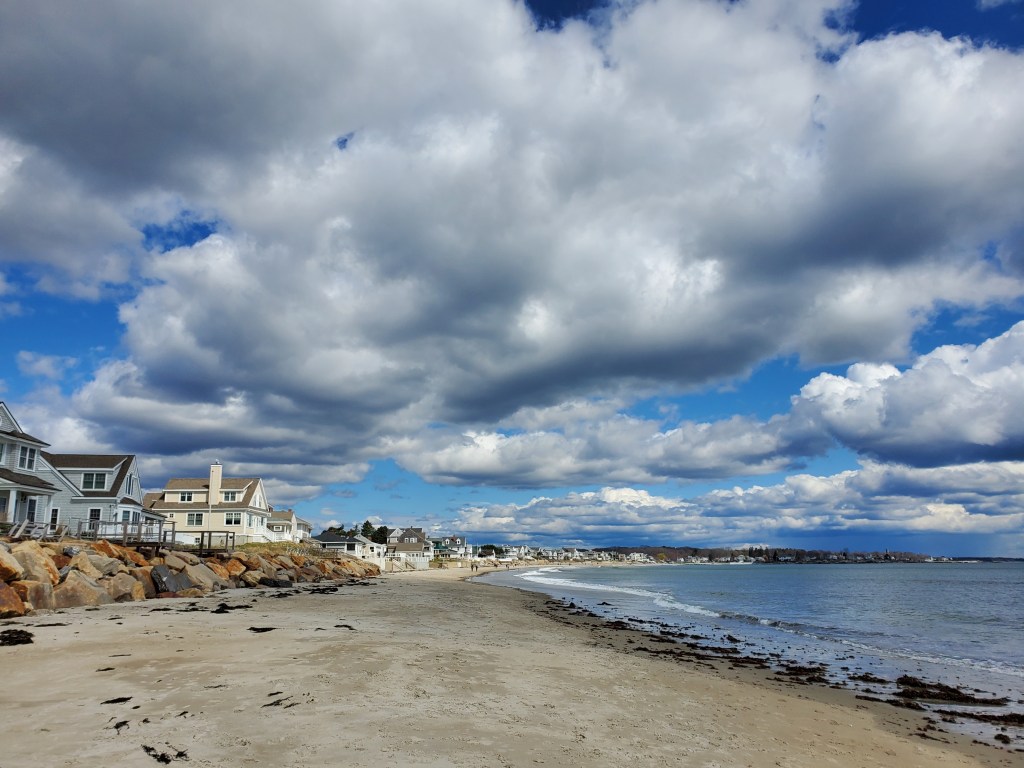
Wallis Sands, New Hampshire, 17 April 2022 -
Ashamed to be well
A visit to New York City

One World Trade Center soars 1776 symbolic feet above the memorial pools whose voids commemorate the absent presence of the North and South Towers. To visit on a bright spring day is to recall the blue sky of 9/11/2001, cleaved by images too shocking to acknowledge real, grieve the losses, marvel at the juxtaposition of horror and hubris, and wonder at one’s own good fortune. I lunched extravagantly with a friend at an Oculus restaurant, and dined that night at the East Village Ukrainian Restaurant, trying for solidarity but feeling pathetically inadequate. That morning we had taken the subway to Brooklyn to stroll across the Brooklyn Bridge, admire the Manhattan skyline, and join the hoard of selfie takers. Eight days later, gas, gunfire, terror, and blood changed the connotation of “Brooklyn subway,” and again left me wondering at my good life.
Hanna is a character in 2021 Nobel Prize winner Abdulrazak Gurnah’s 2011 novel, THE LAST GIFT, a tale of family secrets, late revelations, and the legacy of colonialism. Having renamed herself “Anna,” she writes to her brother Jamal as she processes what she has learned of her parents’ past: “My mind is crowded with my little thoughts when our world is full of so many unspeakable anguishes. Sometimes knowing about such things makes me ashamed to be well” (p. 278).
I know how she feels.
-
Sweet are the uses of adversity
And this our life, exempt from public haunt,
Finds tongues in trees, books in the running brooks,
Sermons in stones, and good in everything. (AYLI, 2.1.12-17)
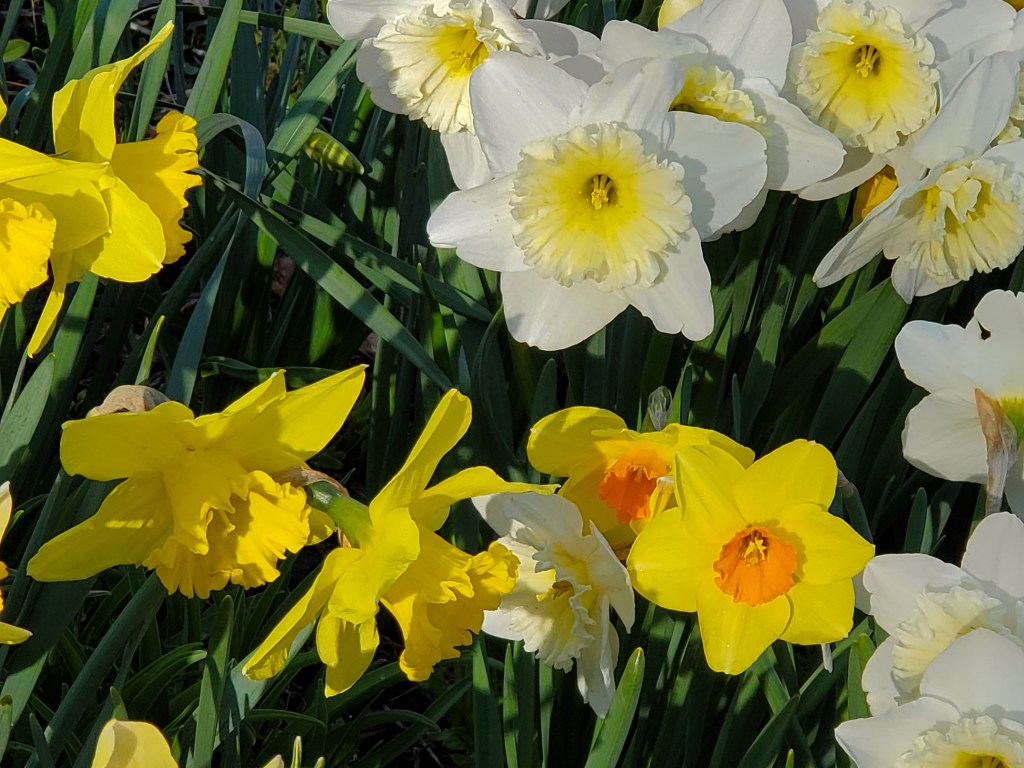
This Good Friday seems a good day to address a dear friend’s question about the meaning of daffodils–and also to shape the wherefore of this new blog. Anthropologist Leslie Alvin White proposed symbols as the basis of human behavior, and certainly it is a truth universally acknowledged that humans make, deploy, interpret–and mistake!–symbols. Daffodils, those brave vernal trumpets, undaunted by late frosts and hungry deer, manifest rebirth, spring, and new beginnings. For lives shaped by literature, as mine has been, they recall the “jocund company” that flashed on Wordsworth’s inward eye, filling his heart with the remembered pleasure of their breezy, fluttering dance.
Communion with nature is a balm my family, immediate and extended, share, and many more have rediscovered in our current time of plague. The quotation that heads this post comes from Shakespeare’s AS YOU LIKE IT, when Duke Senior encourages his brothers in exile from a corrupt court to appreciate how much better is their life in the Forest of Arden; his counsel to find salutary meaning in nature provided our granddaughters’ nursery a painted motto to help them grow and find the good in everything. My parents, Virginia, planter of trees, and George, rose gardener and guide to the natural wonders of our National Parks, continue to nurture me–as do their ashes the daffodils that return each year in my garden. As, this year, does my darling departed husband, David.
Finding adversity useful, even sweet, is today’s lesson, Dear Reader. Maybe it took my contracting COVID to begin this blog, a new venture the daffodils help launch. I hope you find this, and them, useful. And sweet!
-
wand’ring steps and slow

Spring has not yet arrived at 43 degrees north latitude to the extent this host of golden daffodils from 2021 displays. Still, this blogger, untutored in a medium so many others have mastered, in this her maiden post hopes their cheering presence will shed some grace on this enterprise. Harvard’s Arthur Brooks touts the “crystallized intelligence” of us older citizens, less “fluid” than our juniors, but wiser. Reader, we’ll see. Here’s to connecting as we make our solitary way.
-
Subscribe
Subscribed
Already have a WordPress.com account? Log in now.
 Georgeann Murphy