-
New York City
17-22 June 2026
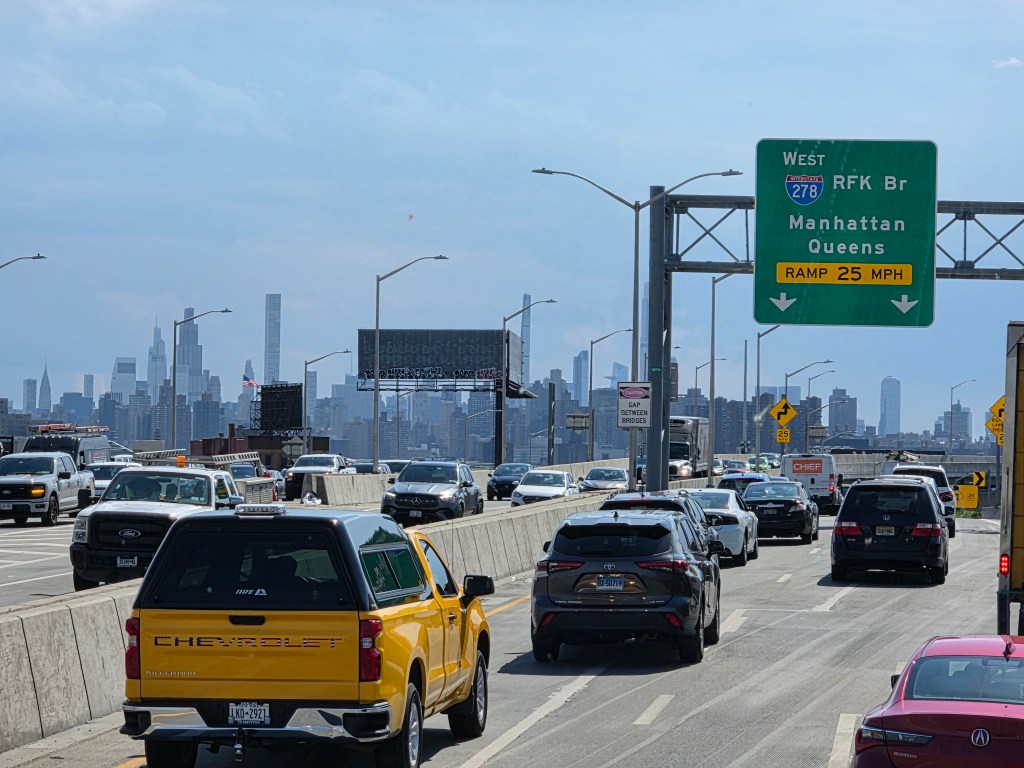
The fabled City comes into view My very first glimpse of New York City came from a bus window in the winter of 1971 as I traveled with classmates in my Furman University Intro to Theatre class to stay at the Hotel Great Northern near Carnegie Hall, eat my first gefilte fish at a deli across the street, attend a taping of The Dick Cavett Show (Danny Kaye was the guest—I got Cavett’s autograph after), and see some wonderful theatre, including Claire Bloom starring in both A Doll’s House and Hedda Gabler and the original production of Hair. The over-the-knee stockings I thought fashionable enough for the City fell down around my ankles as I stood in front of the Empire State Building; I don’t recall how I coped with that. I do remember that later in the 70’s, my friend Jimmy, aware of my champagne tastes and limited budget, tweaked me with a gift book titled New York on $500 A Day.
Well, times have changed: that amount doesn’t cut it in New York City today. Like the culture, much is different, for better and for worse. Times Square is much less dangerously squalid, though much more congested. You can’t buy a blue tablecloth at Macy’s or Bloomingdale’s, where the selection is limited to three or four floral patterns, and the salesclerk at Macy’s smirked when I asked where the tablecloths were. (Does no one use a tablecloth anymore?) And the Oyster Bar at the Plaza no longer exists, site of a rendezvous with my future husband for a glamorously romantic date in November 1994—after flying respectively from Kentucky and New Hampshire, we walked into the Palm Court from separate entrances at exactly the same moment. A cherished cinematic moment.
Getting around in New York, especially for this senior wondering if she’s still up to finding her way, is, however, so much easier these days. An OMNY pass (only $1.50 a ride for seniors!) and smartphone with Citymapper app loaded are all you need: no fumbling with cash or credit cards in subway stations. And since these days EVERYONE’s gaze —not just a disoriented tourist’s—is constantly on a phone, it’s possible to pass as a local.
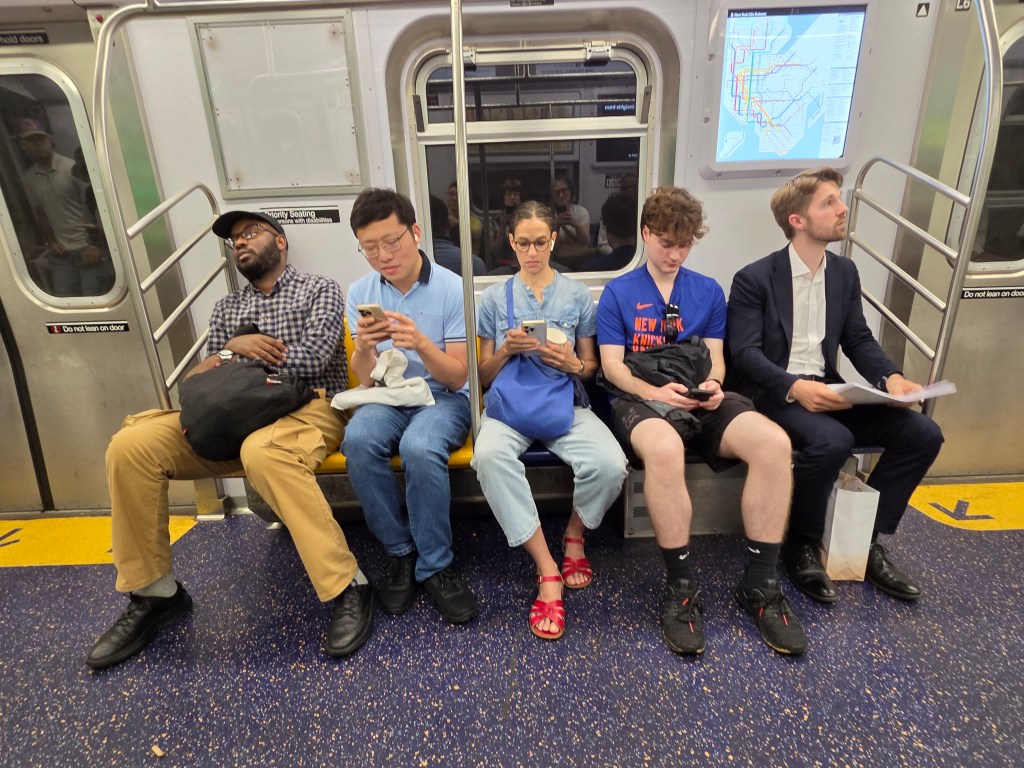

Besides, people seem friendlier. I didn’t hear a harsh word spoken the whole five days I was in town. One stranger asked politely if I had the time, and thanked me when I told him. And when at intermission I complimented the woman seated next to me in the Winter Garden theatre on her summer-y linen ensemble, she volunteered that she got it on sale from J. Jill for only $40!
My first full day back in New York was the day of the Knick’s victory parade in lower Manhattan (I stayed well north in Midtown), and World Cup fans were everywhere, sporting their team’s kits, making overheard conversations—such a delight in the City—even more international than usual. So lovely to see so many happy, hairy men greeting both men and women with kisses on each cheek. The town seemed awash in goodwill, a refreshing breeze and tonic change from the bitterly ironic, algae-slimed pool of despair tainting so many of our days in these Un-tied States. Hundreds of yogis in Bryant Park! A messenger boy on a bike careening down Broadway sans helmet while taking a selfie! A pretty blond girl yakking on her phone, dressed in gauzy white linen and a T-shirt whose rhinestones read “Blow Me,” striding across a subway grate à la Marilyn Monroe. Some sidewalks still smell of urine. But the homeless woman camped out on W 37th fed the pigeons every morning. Ah, New York!
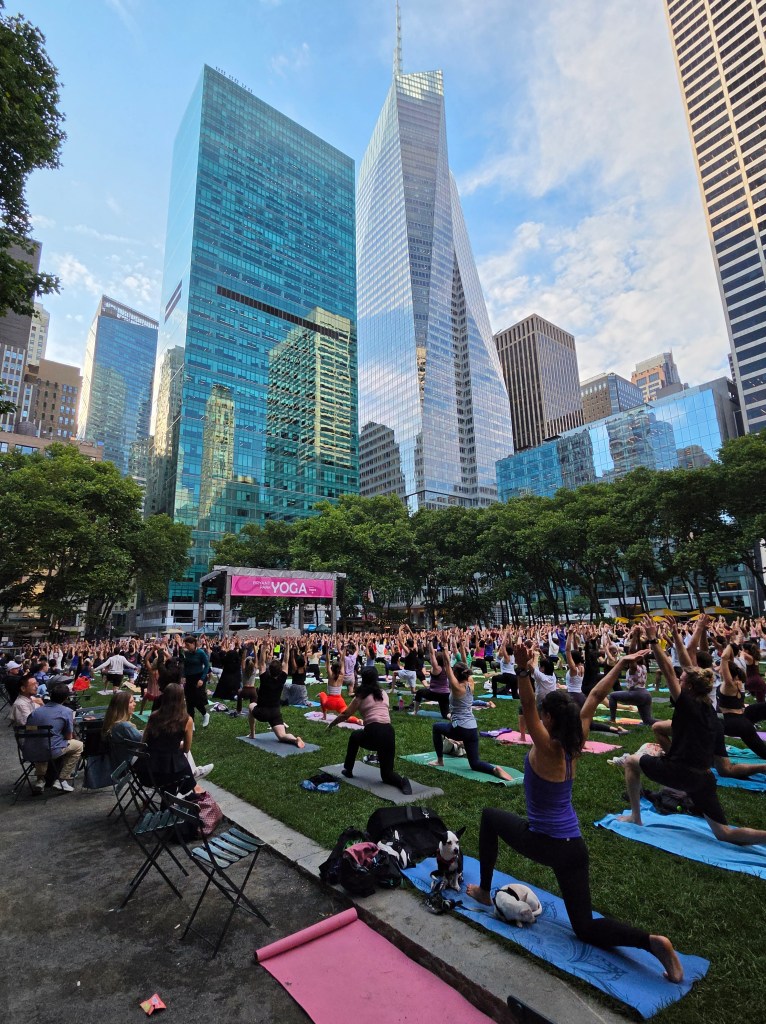
Yogis in Bryant Park, 17 June 2026 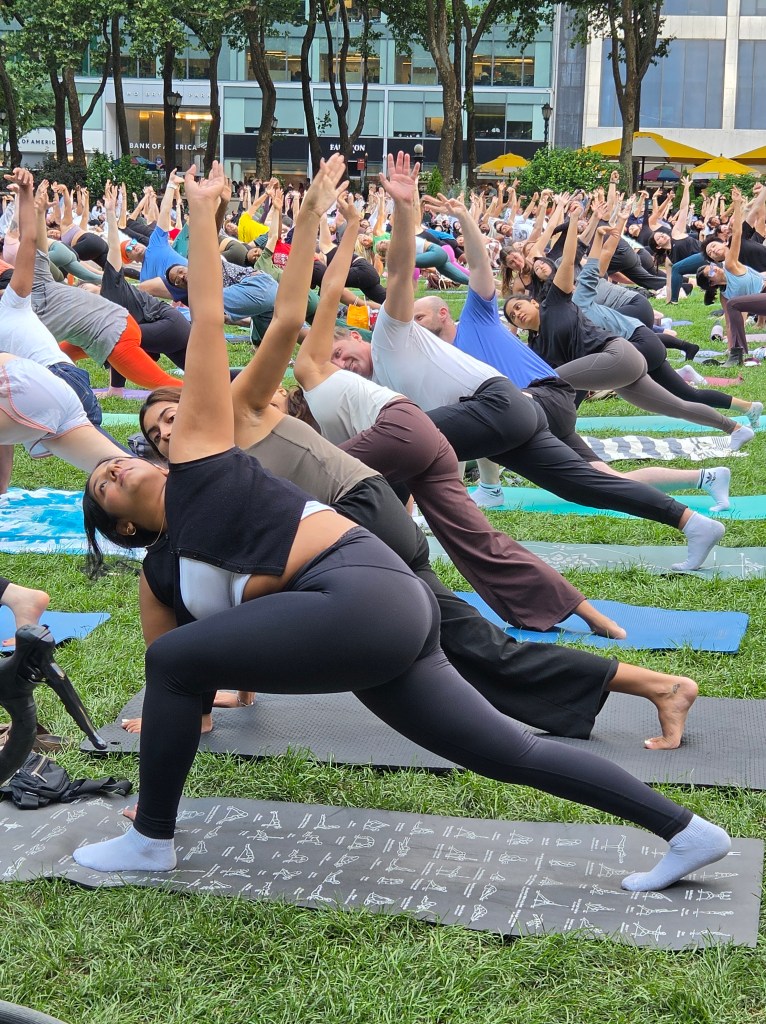
I had a grand time. Saw three superior productions; two intriguing museum shows; visited two good friends; walked that wonderful urban park, the High Line; and got my urban chops back.
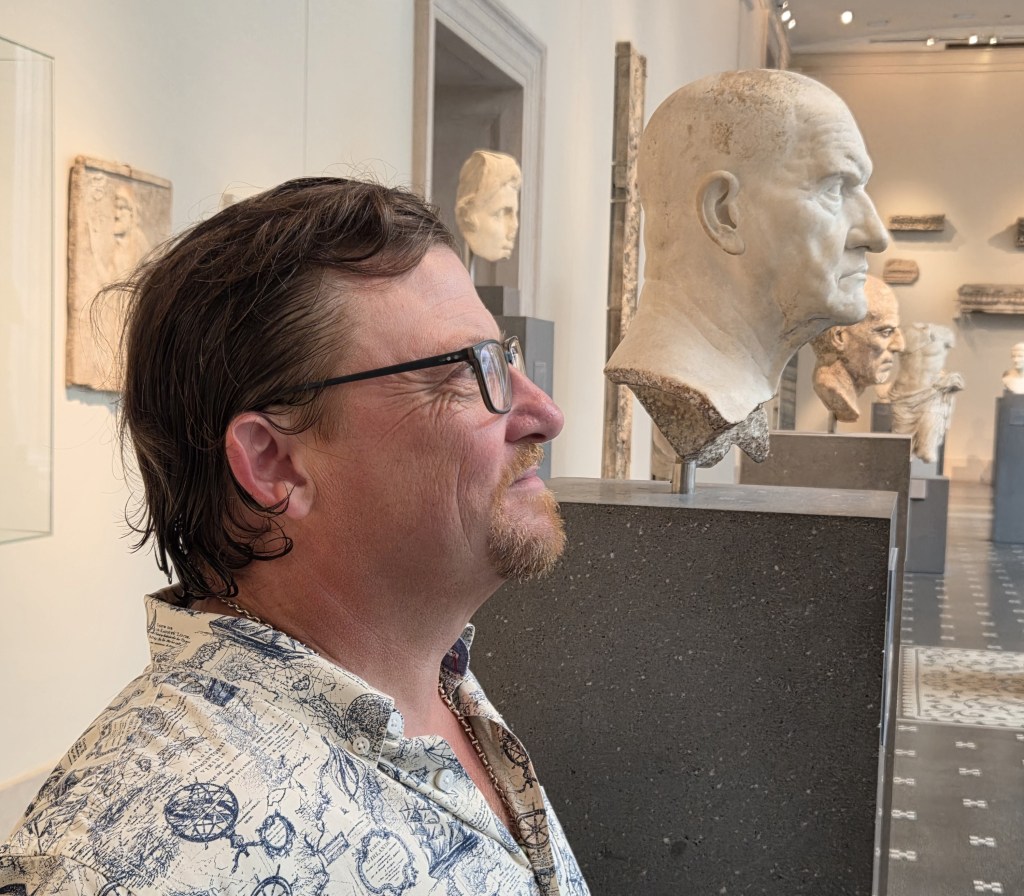
My friend Glenn in the Met, posing with the Roman man who, he says, so resembles his dad 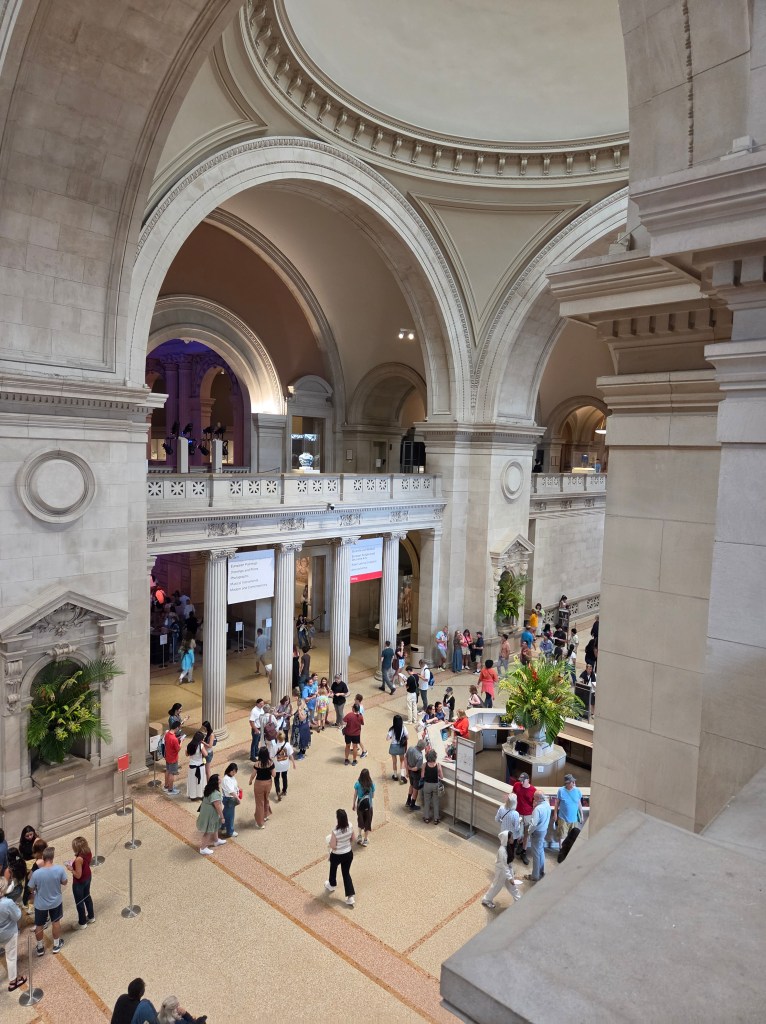
The Met’s Great Hall, seen from the balcony café where we lunched. 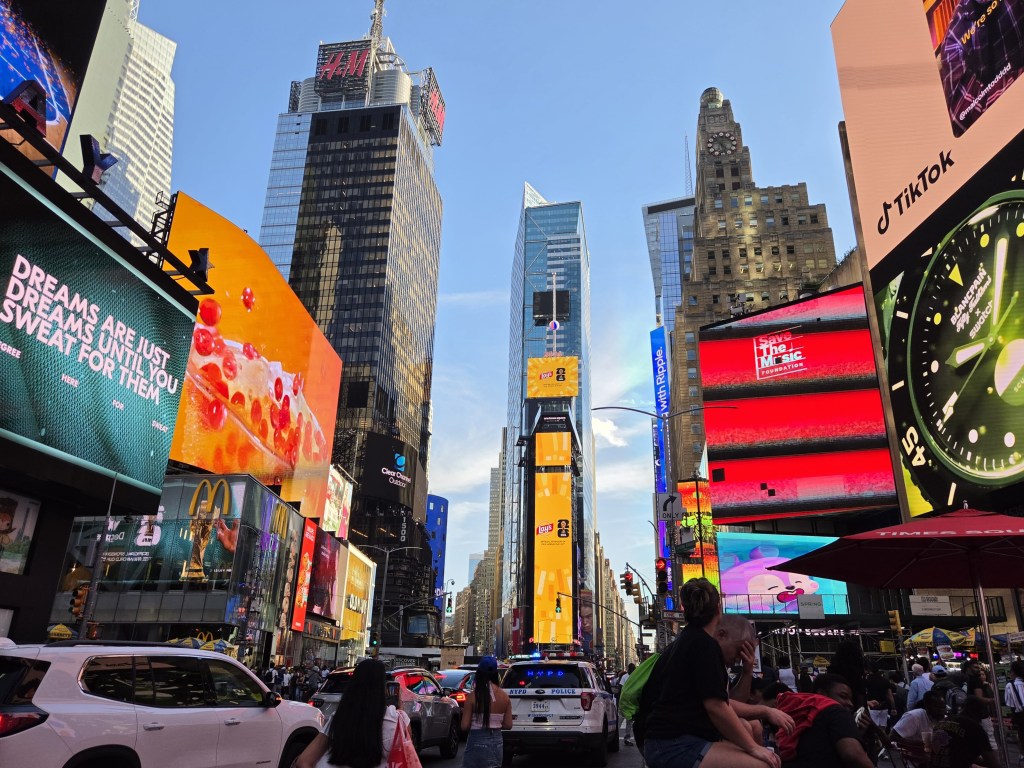
Times Square, 18 June 2026 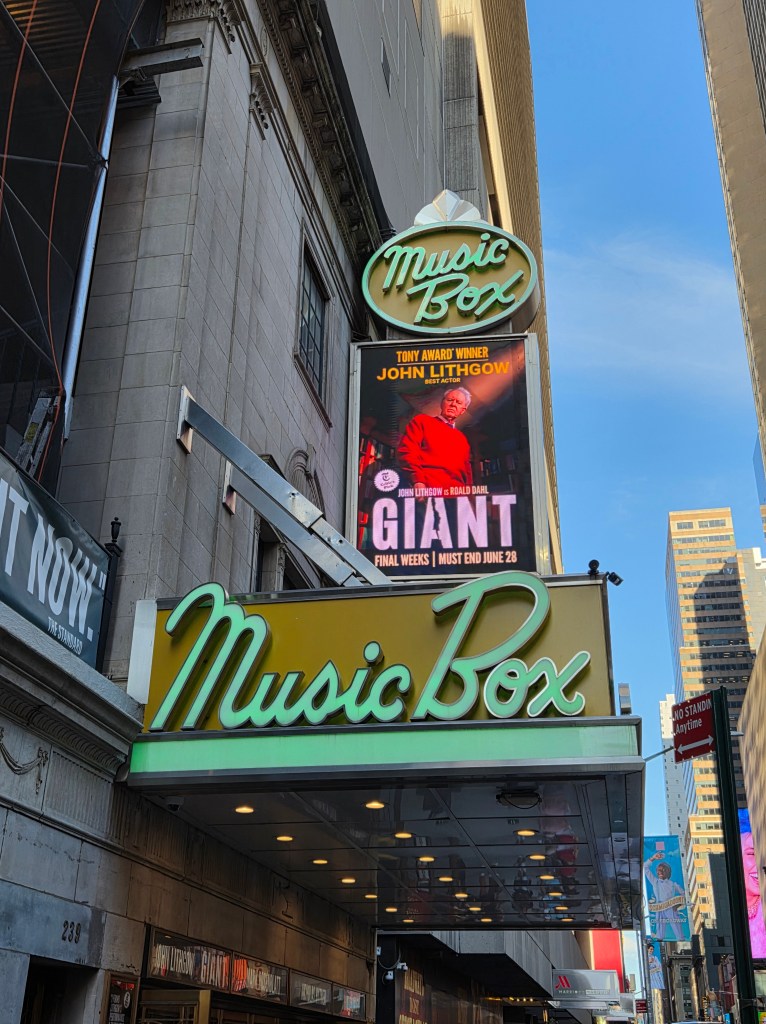
Lithgow acted his final monolog, a verbatim transcript of Roald Dahl’s incendiary phone conversation with a reporter, only feet away from my seat. Great actor, important play. 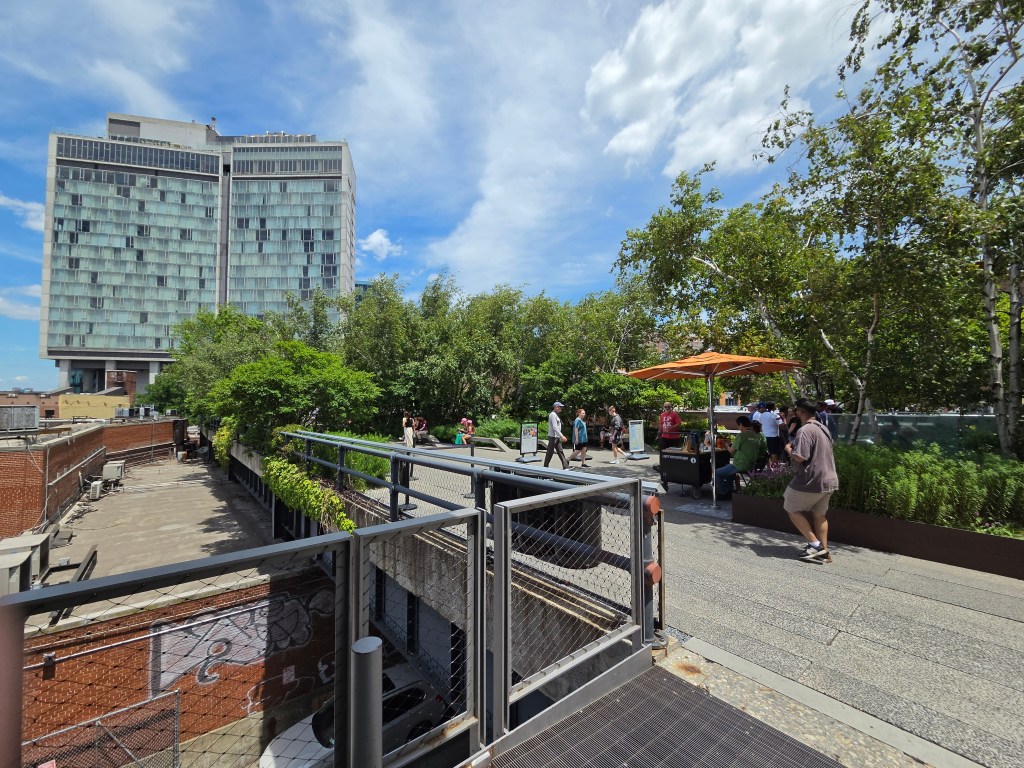
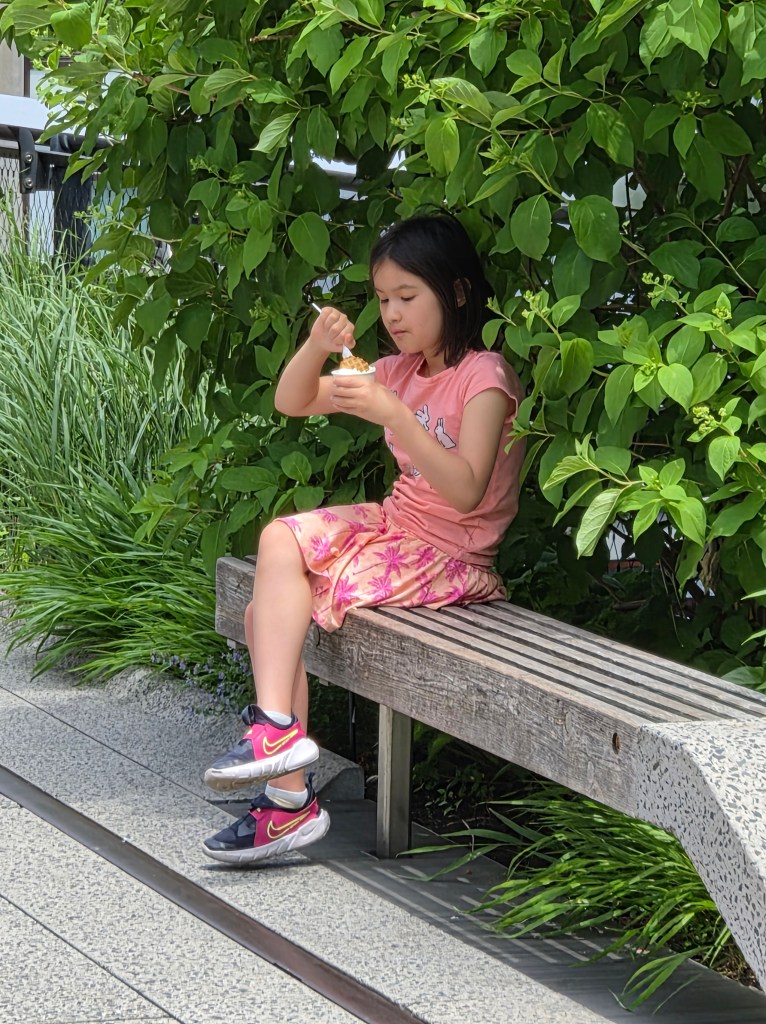
Walking the High Line, starting at the Gansevoort entrance 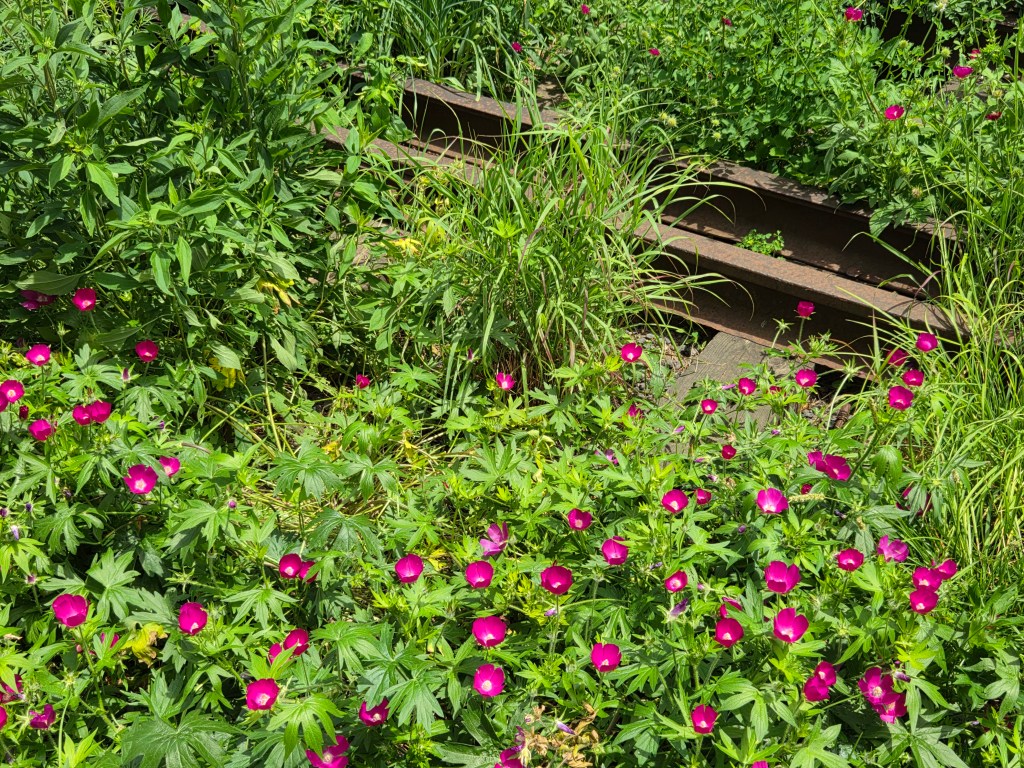
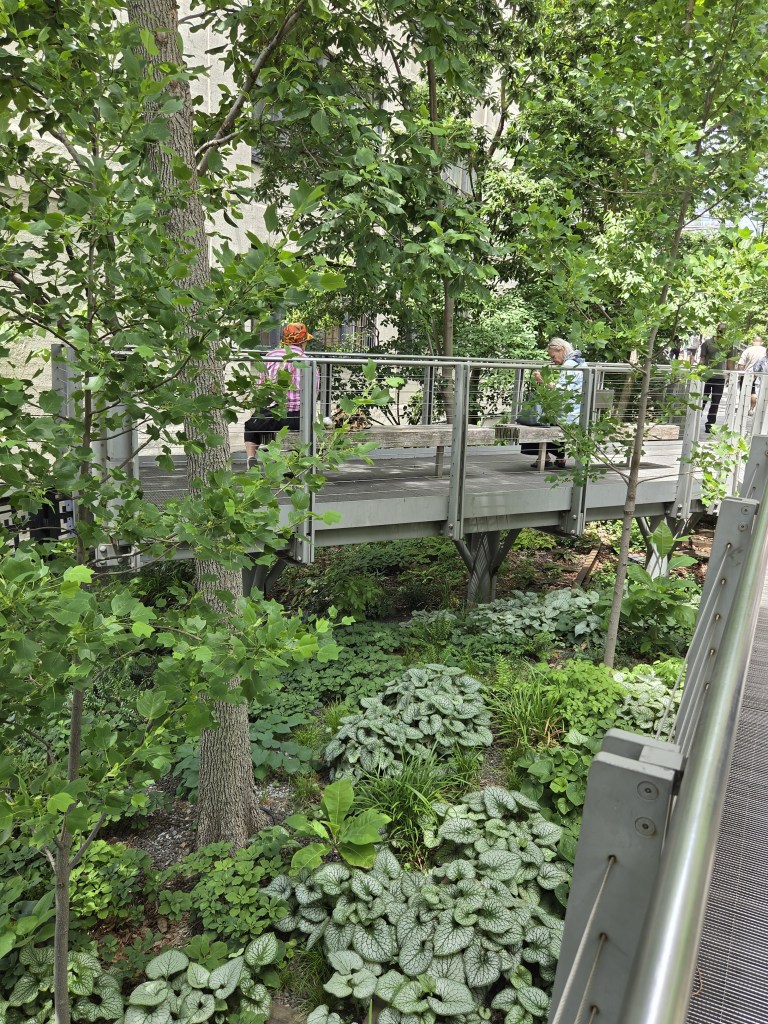
Original rail bed reclaimed by flowers 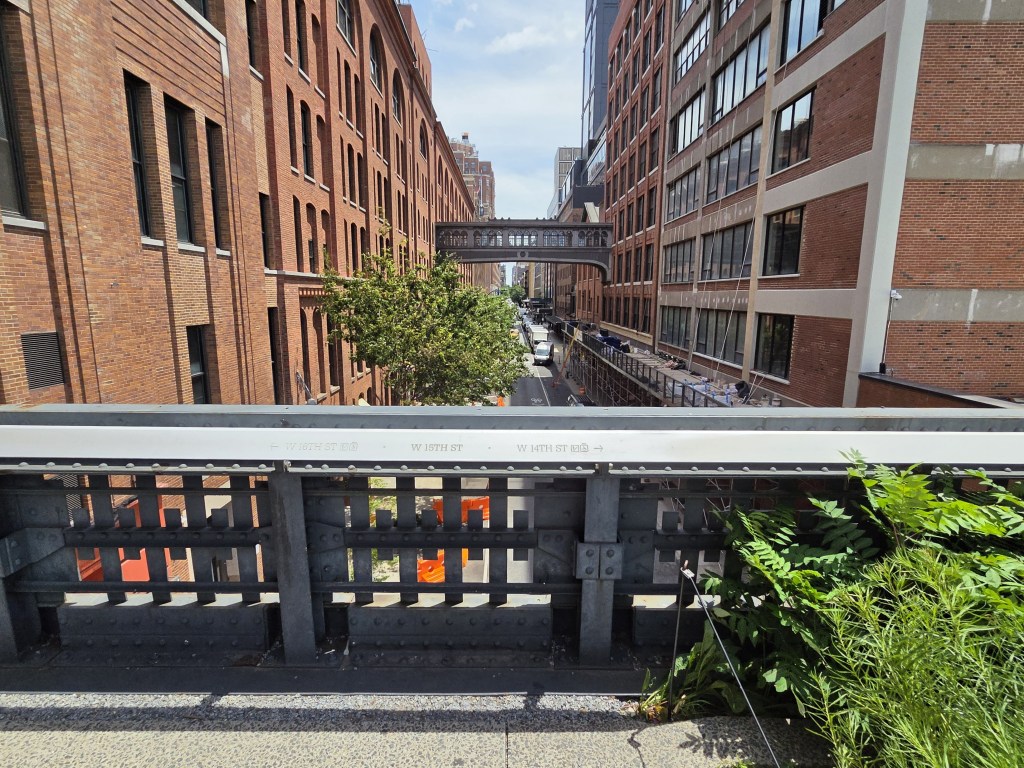
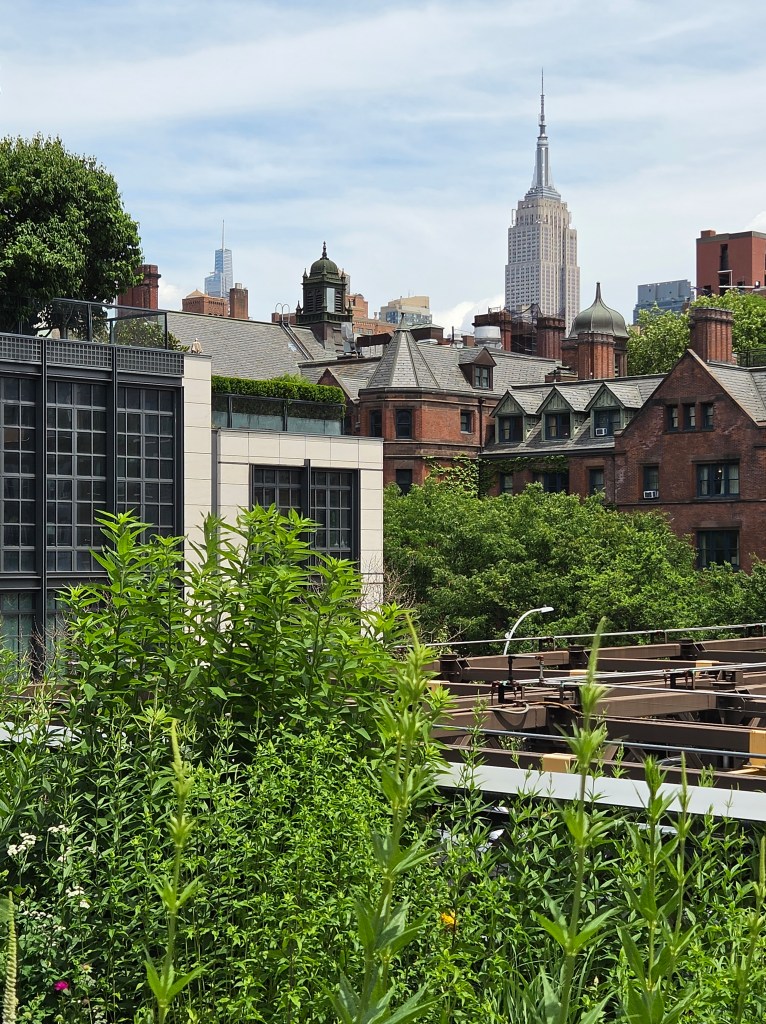
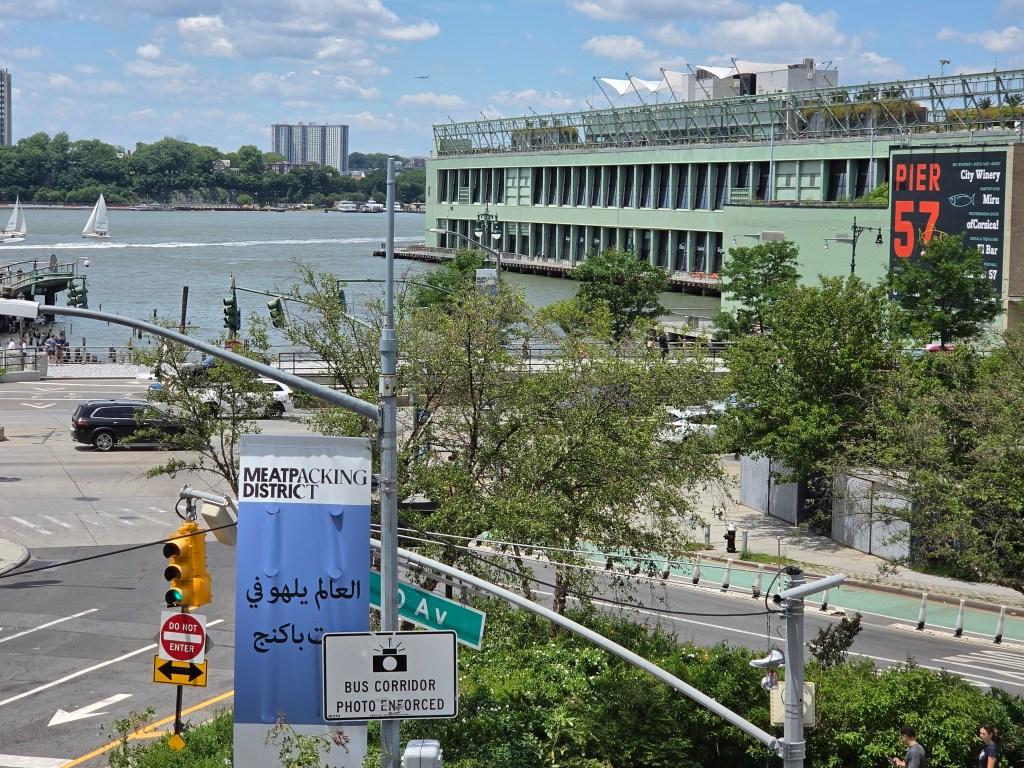
Good day for a sail on the Hudson 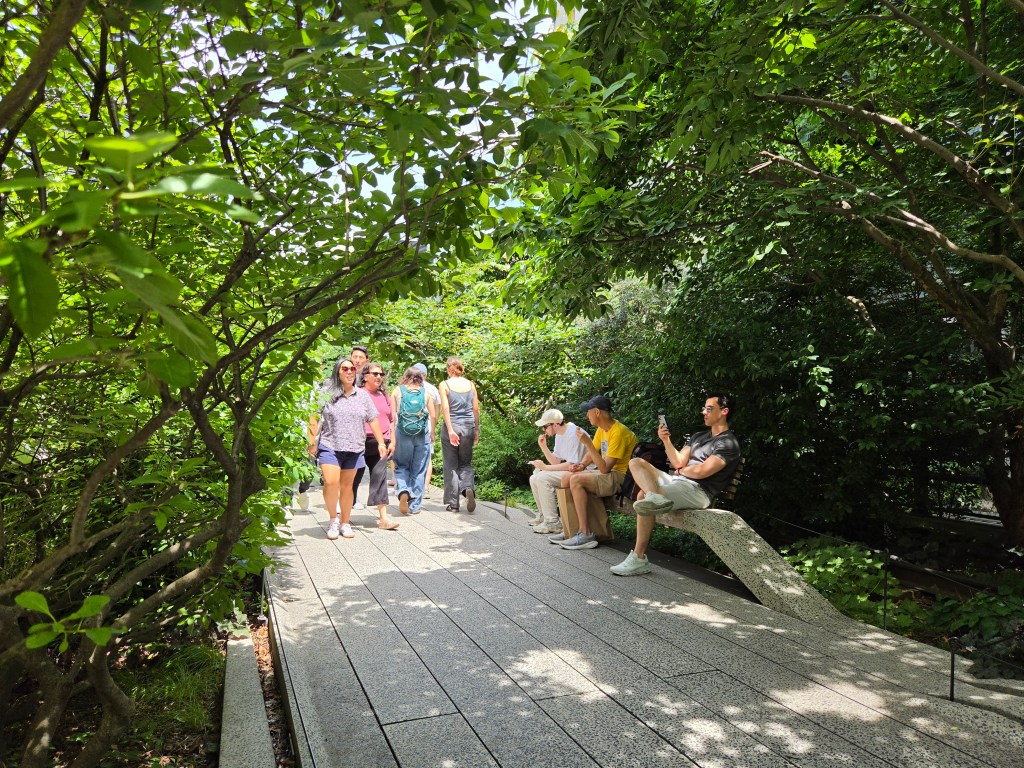
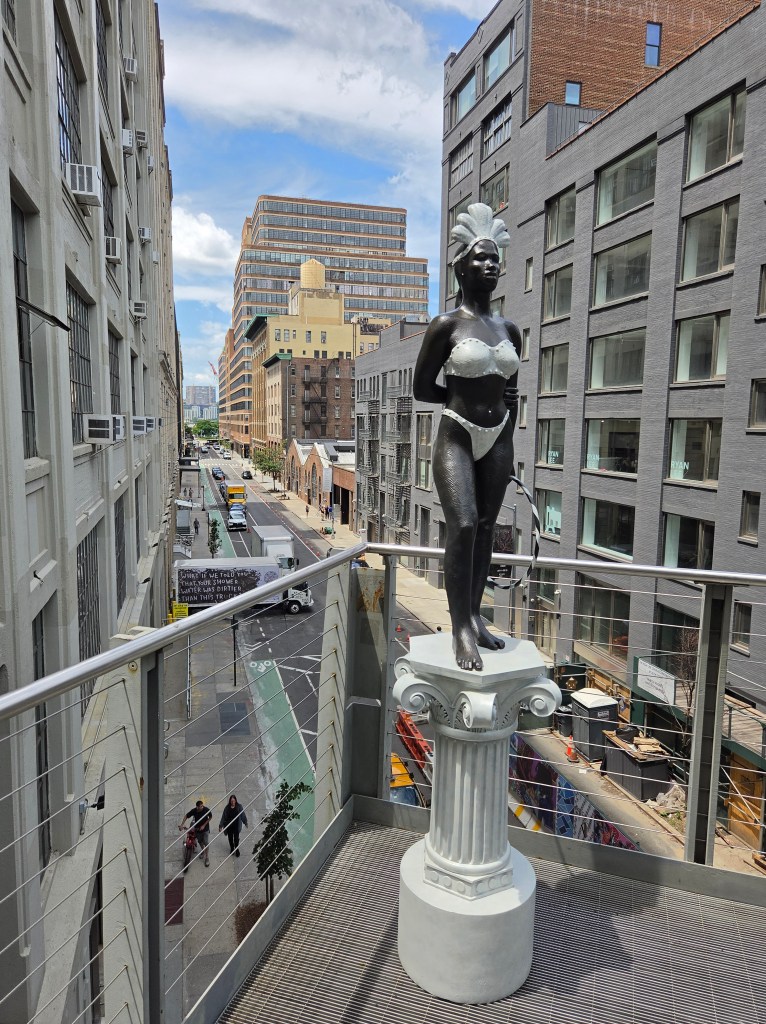
Derek Fordjour’s Archetype II: Servility, 2026 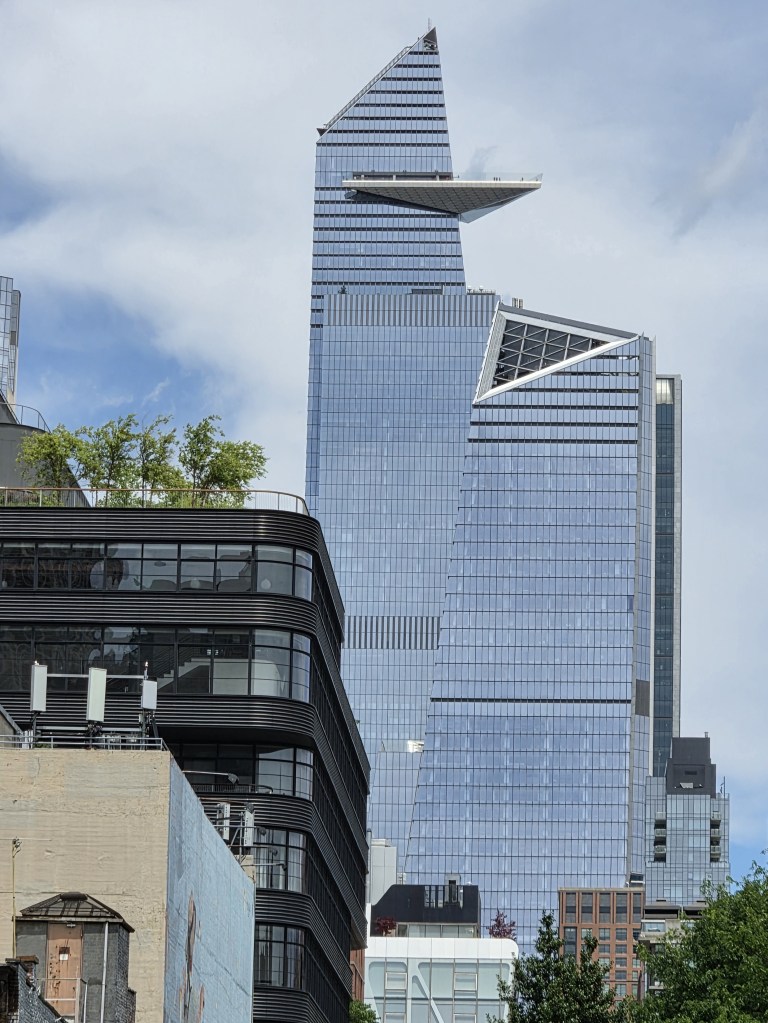
30 Hudson Yards (Kohn Pedersen Fox, 2019) features the Edge, the highest outdoor skydeck in the Western Hemisphere 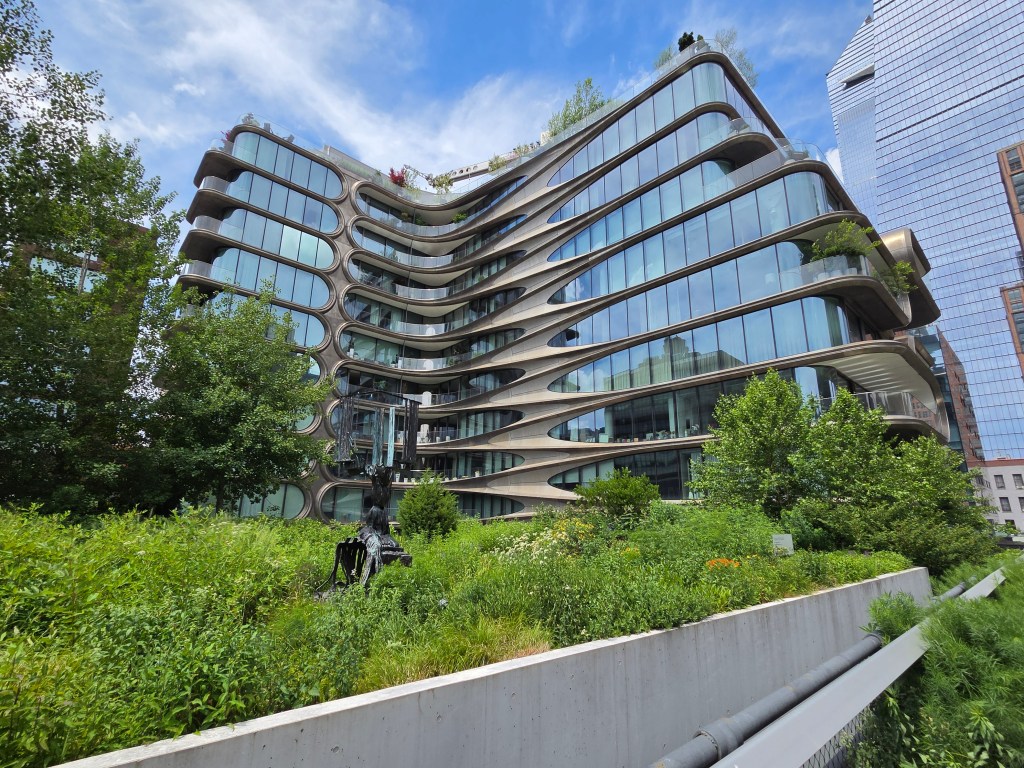
Luxury apartments, part of the Meat Packing District revitalized by the High Line 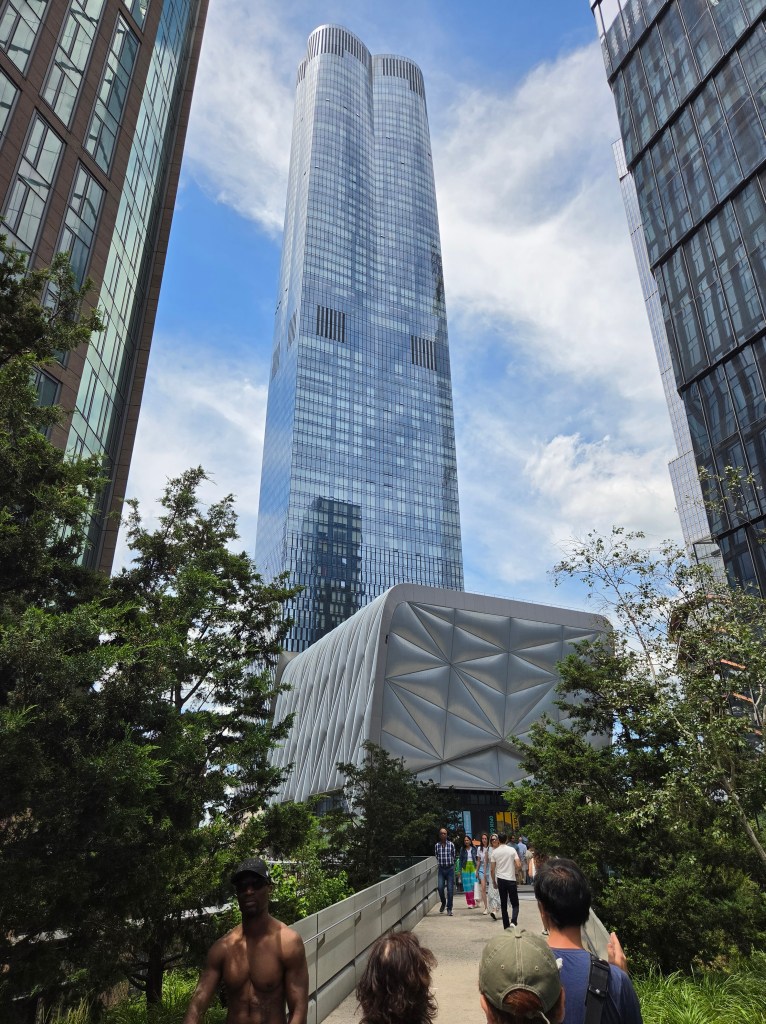
15 Hudson Yards: the quatrefoil skyscraper at the north end of the High Line 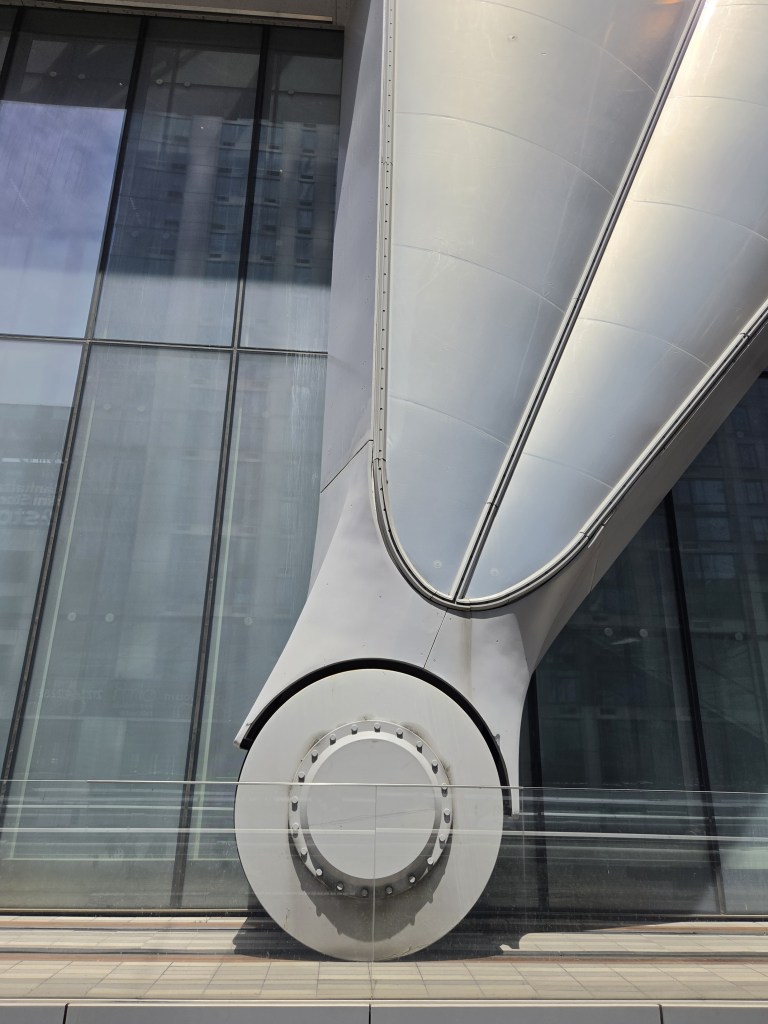
Detail of the telescoping Shed, cultural center and performing arts venue 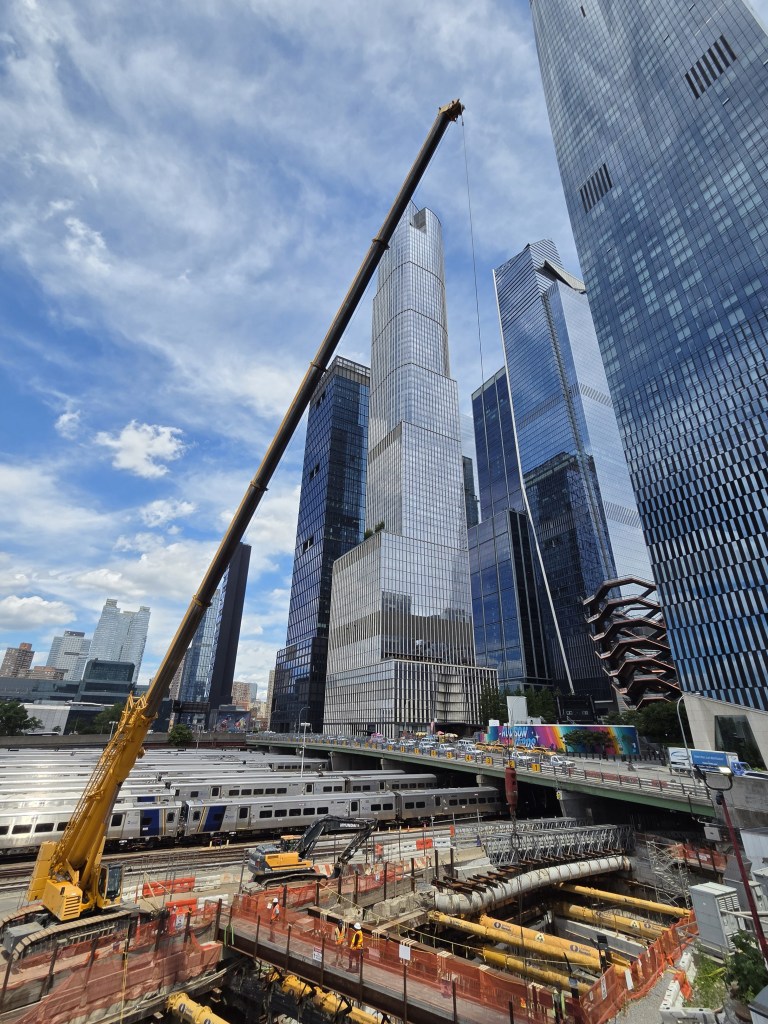
Angles at Hudson Yards 
. . . where substructure work continues 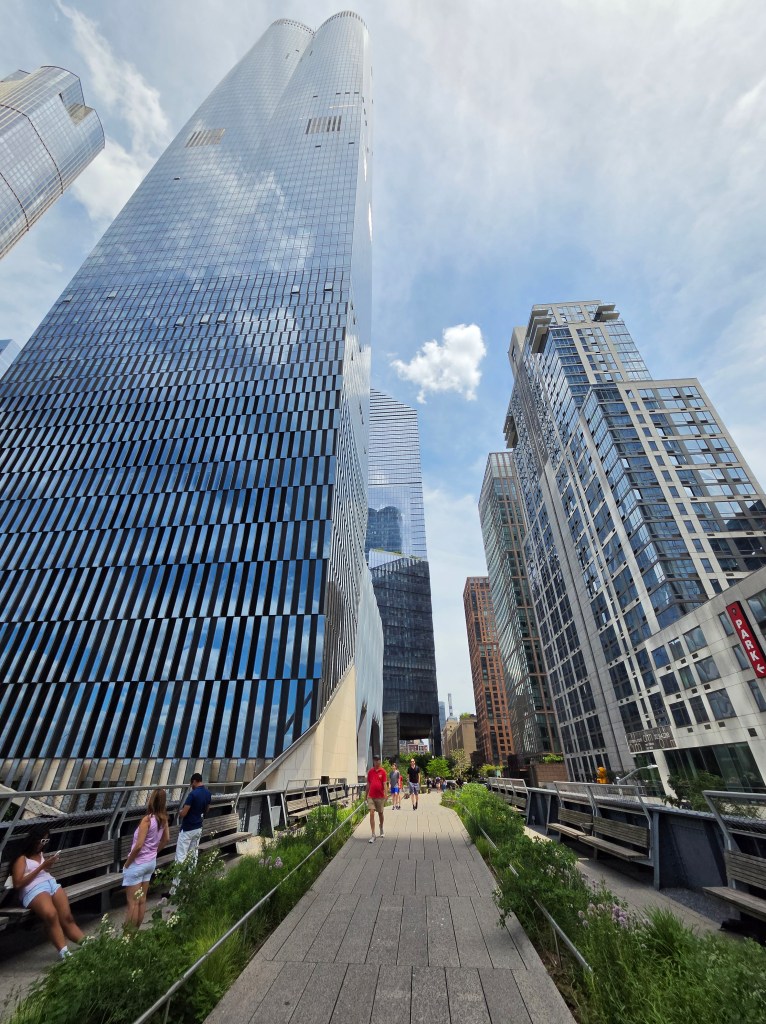
Soaring skyscrapers at the High Line’s northern end 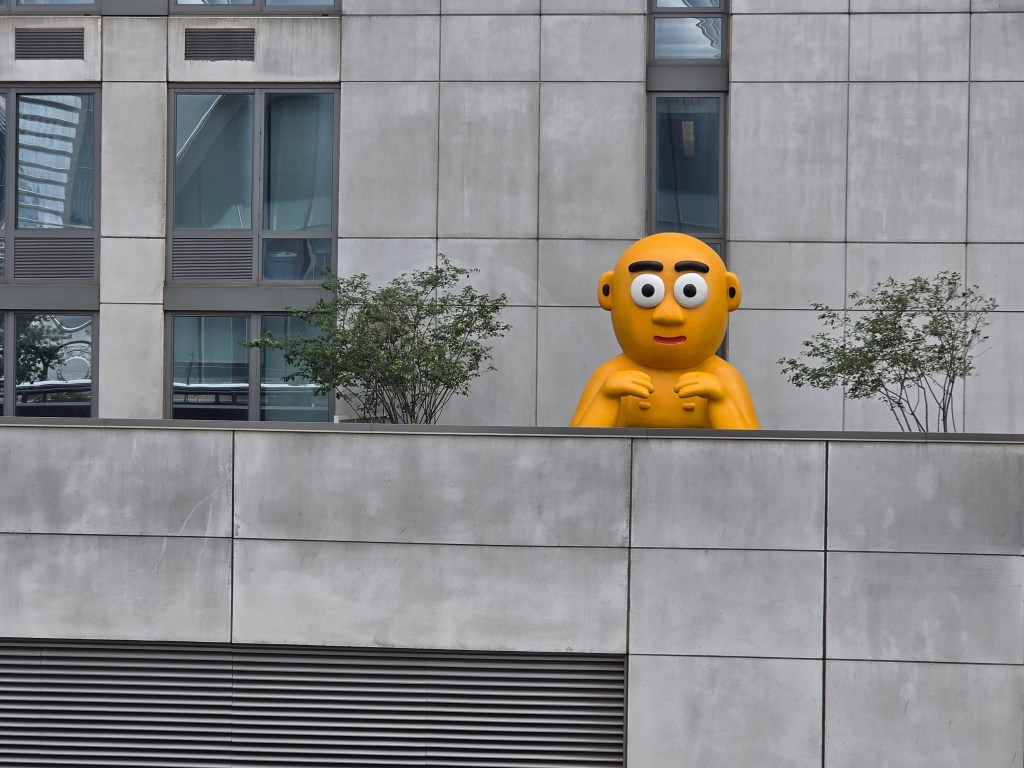
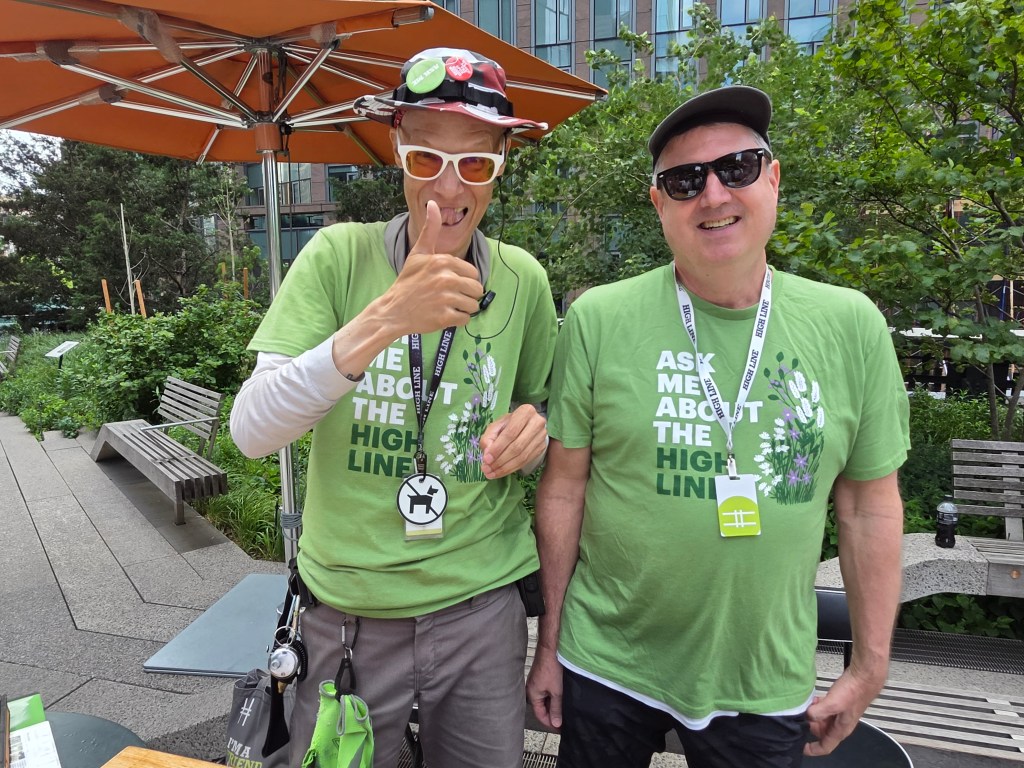
. . . and charming, well-informed guides 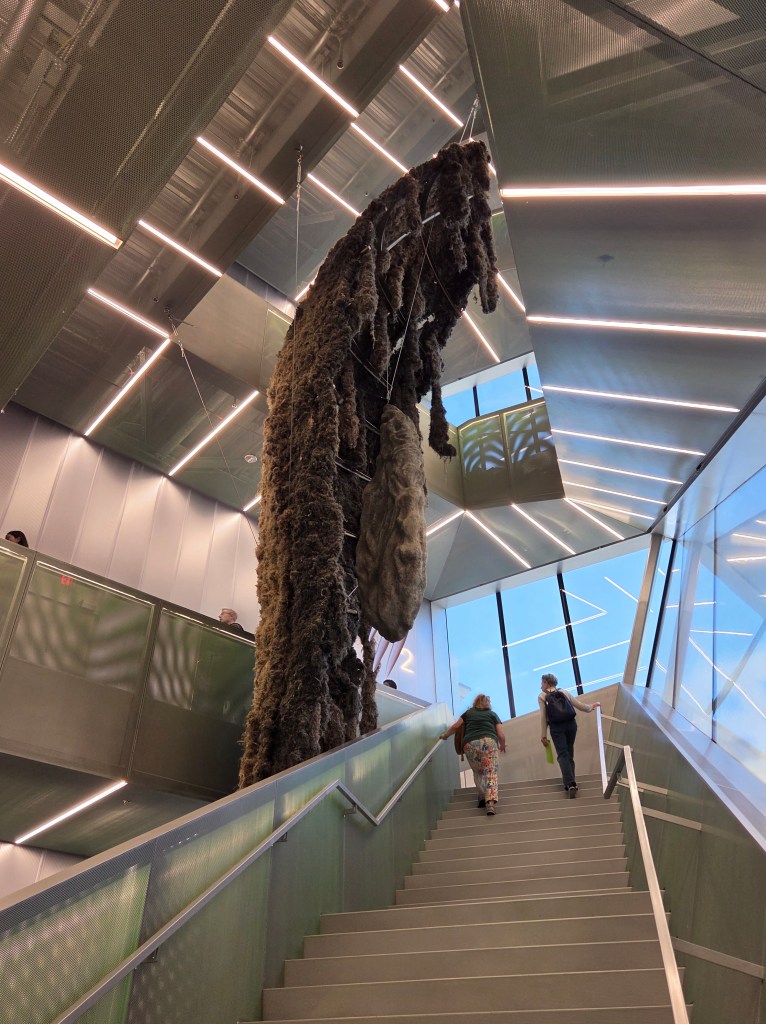
Central Atrium Staircase at the New Museum in the Bowery, with Klára Hosnedlavá’s 4-story soft sculpture Shelter (2026) 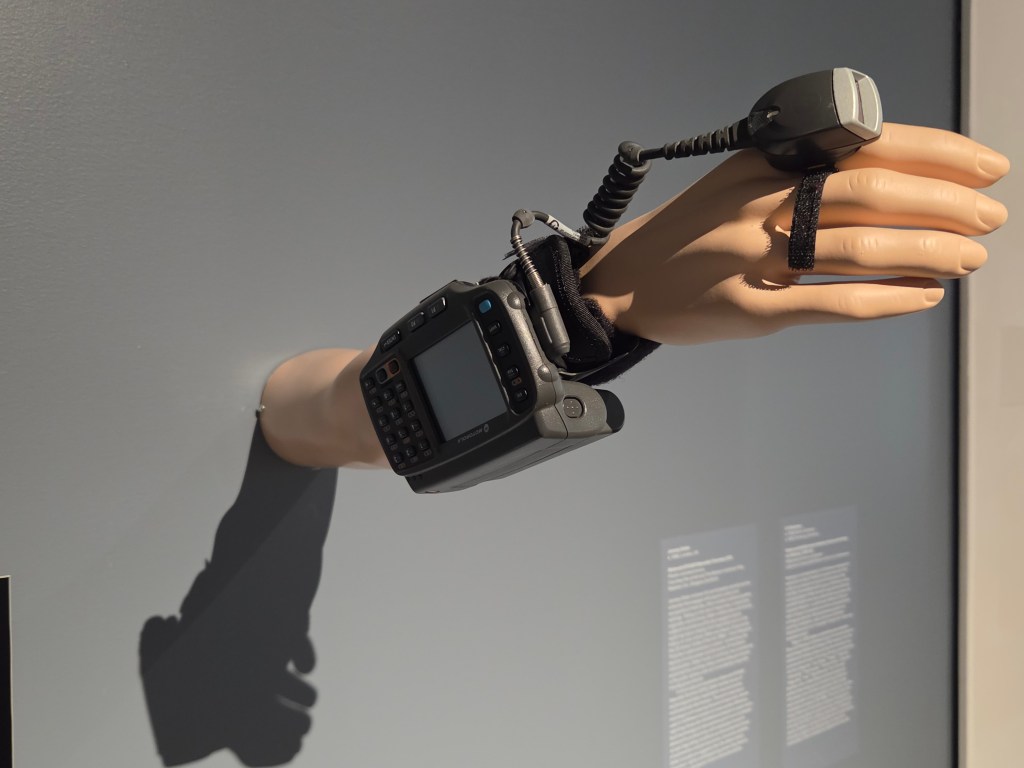
Jeremy Deller’s Motorola WT4000 Wearable Terminal, 2013, part of the “New Humans: Memories of the Future” show at the New Museum. The work replicates the kind of electronic device used in fulfillment centers to track worker efficiency. 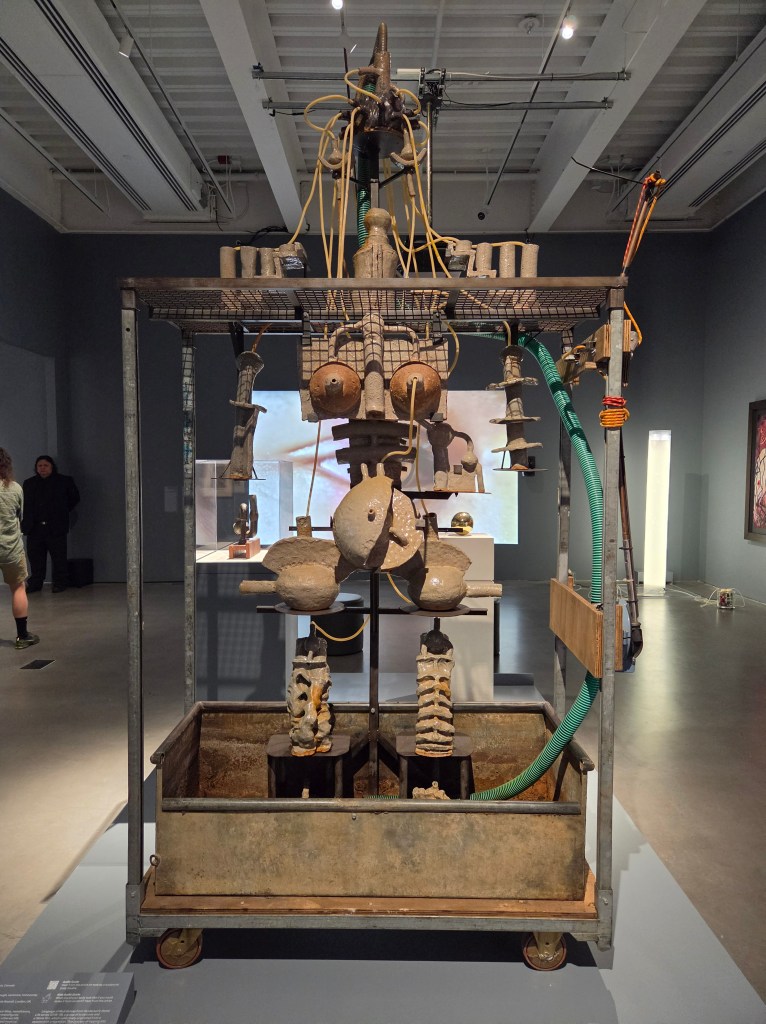
Language of Mud, Tamara Henderson, 2018 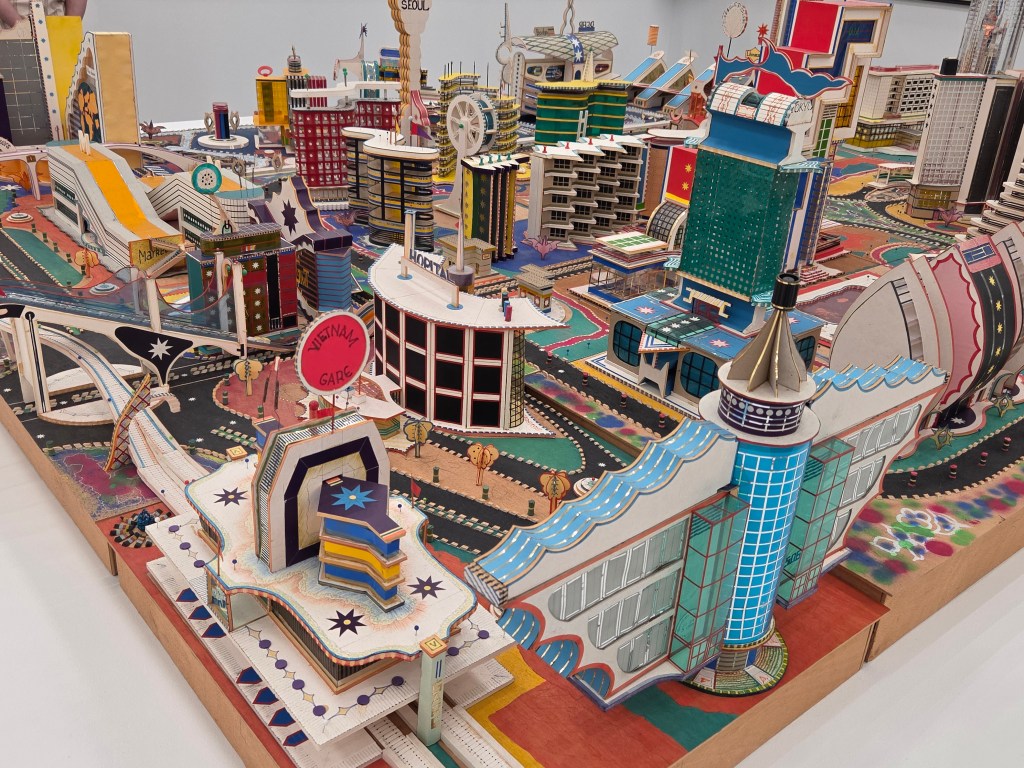
Detail of Ville fantôme (Ghost town), Bodys Isek Kingelez, 1996 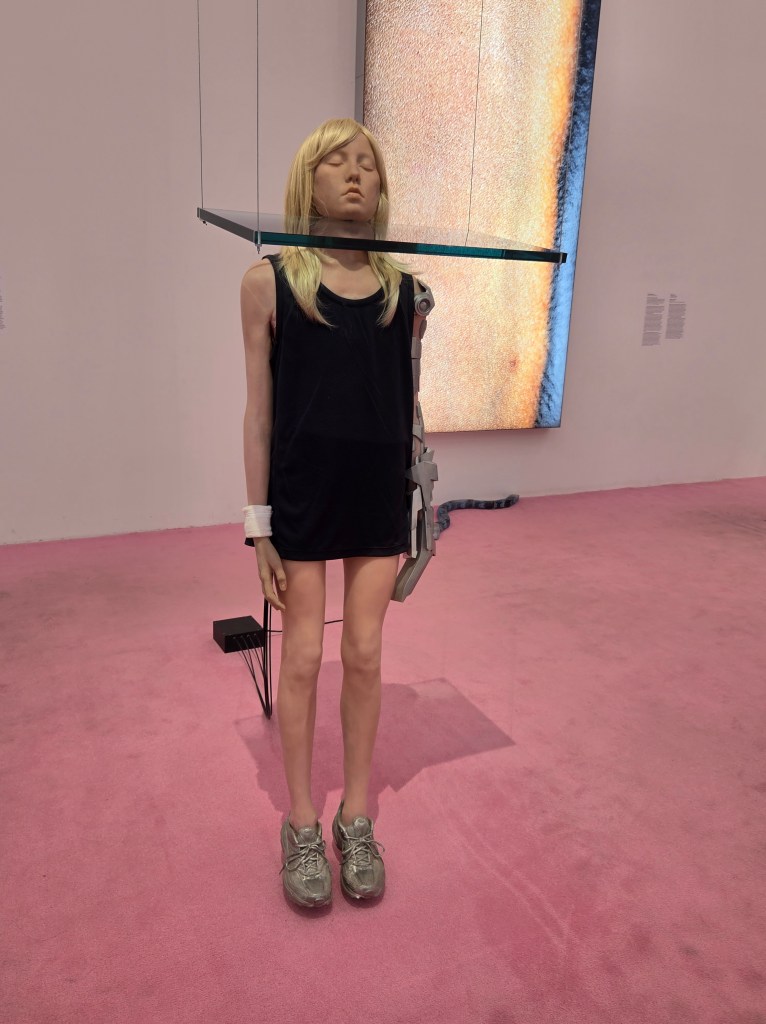
Andro Wekua’s disturbing Untitled, from Some Pheasants in Singularity, 2014. A lifelike mannequin of a teenager appears to be suspended several inches above the ground by its chin. Wires protrude from the figure’s back, connecting it to a black box, and the fingers on its right hand rhythmically twitch while its left arm disappears into a futuristic metal cast. 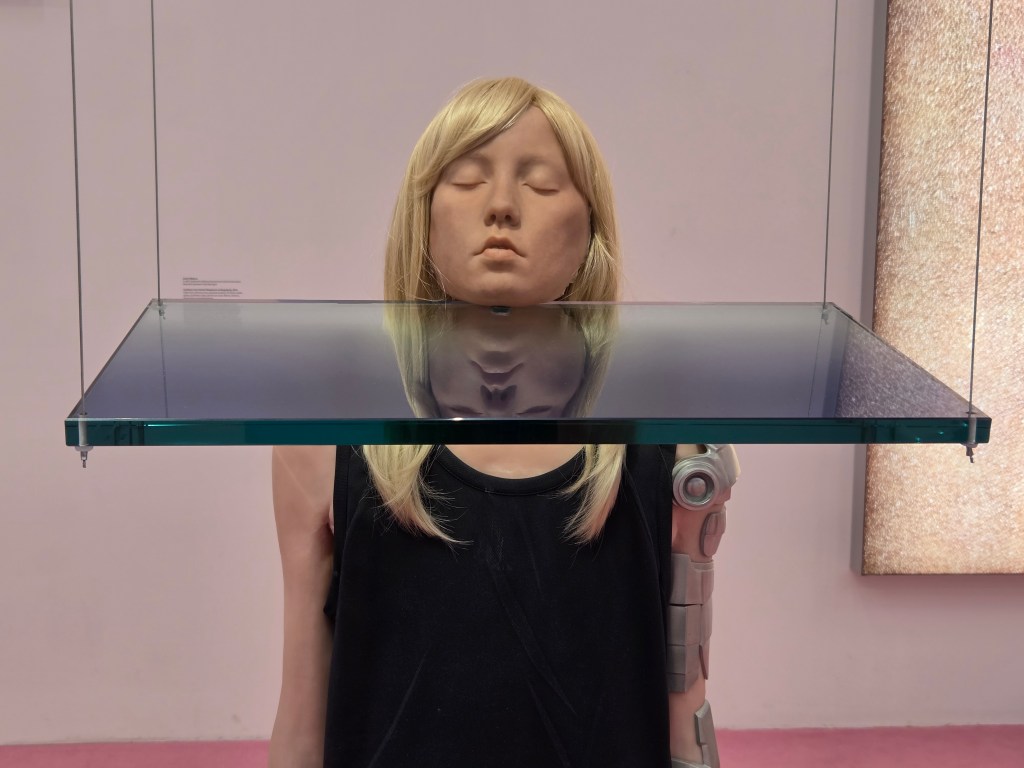
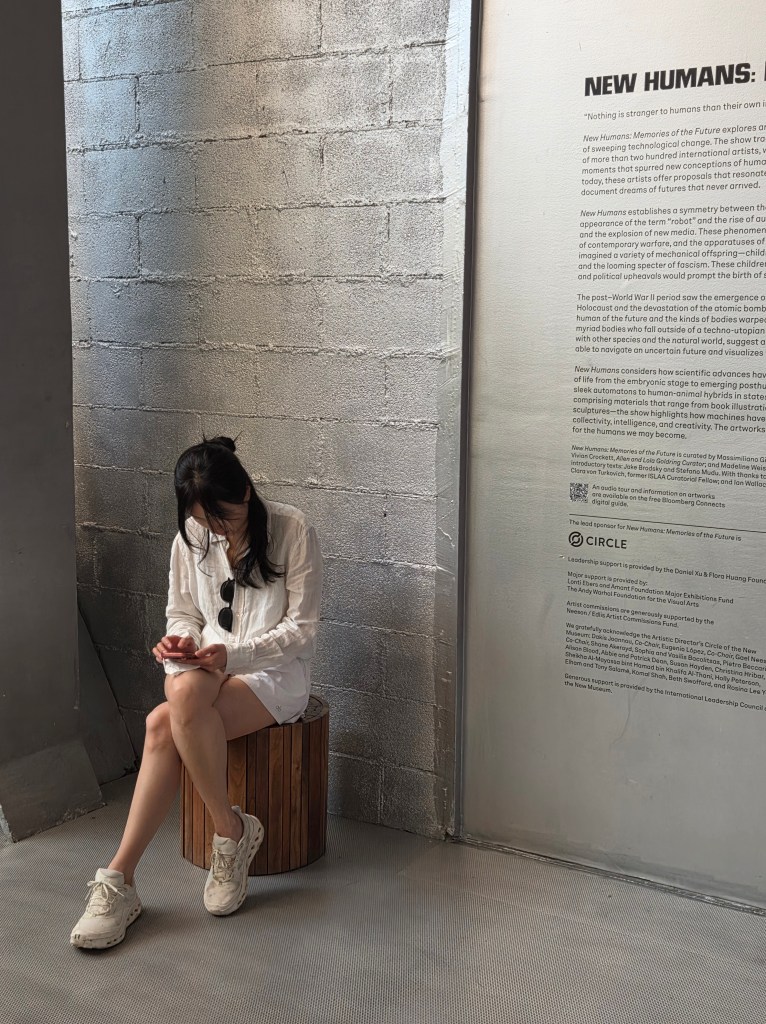
Real girl, not suspended, on the phone at the New Museum 
The august Plaza Hotel upstaged by the City’s new skyline of needle-like skyscrapers 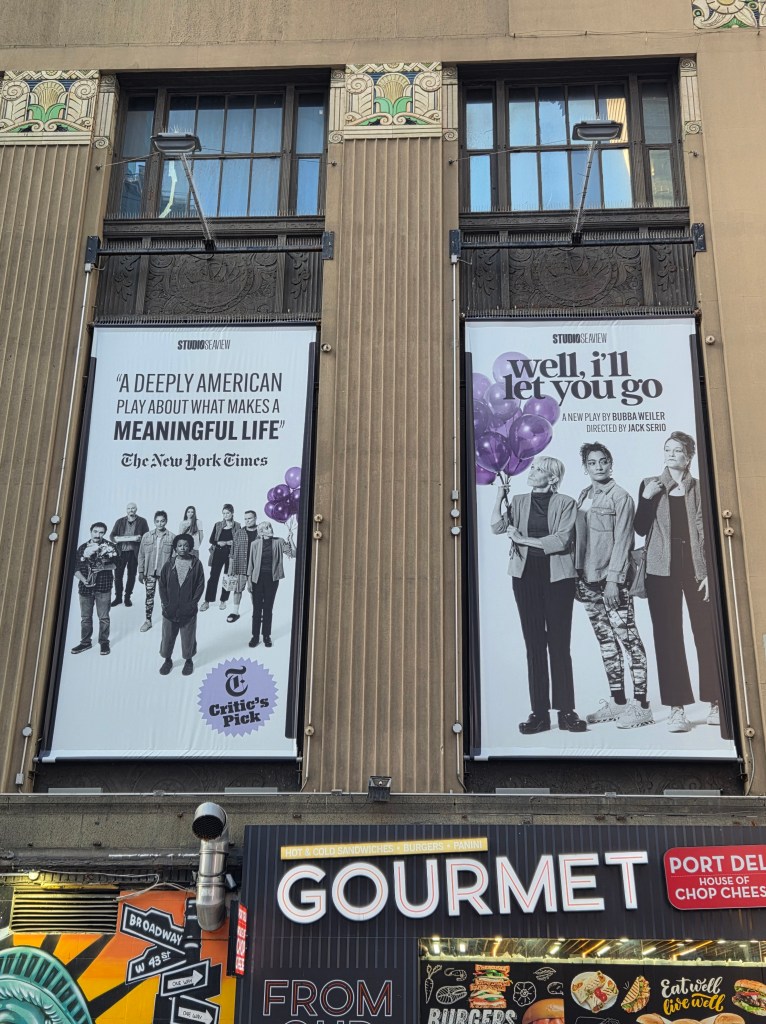
Bubba Weiler’s moving new play, a study in grief, human nature, and what makes life bearable, as well as the power of brilliantly acted theatre 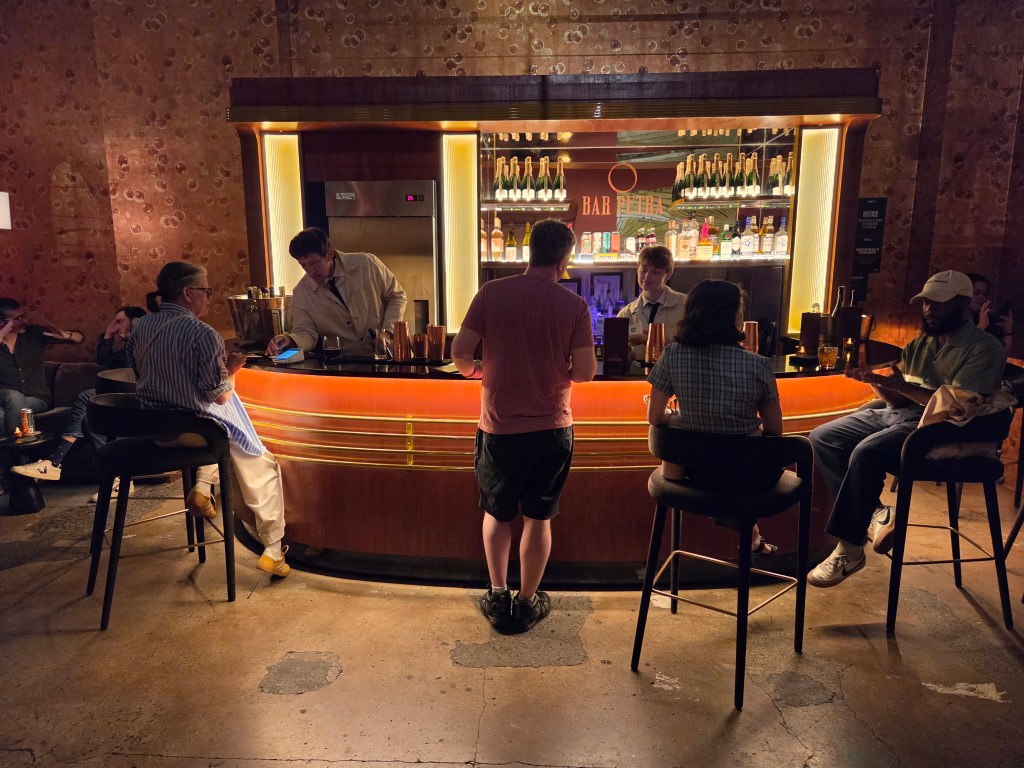
The welcoming Petra Bar in the StudioSeaview theatre off Broadway 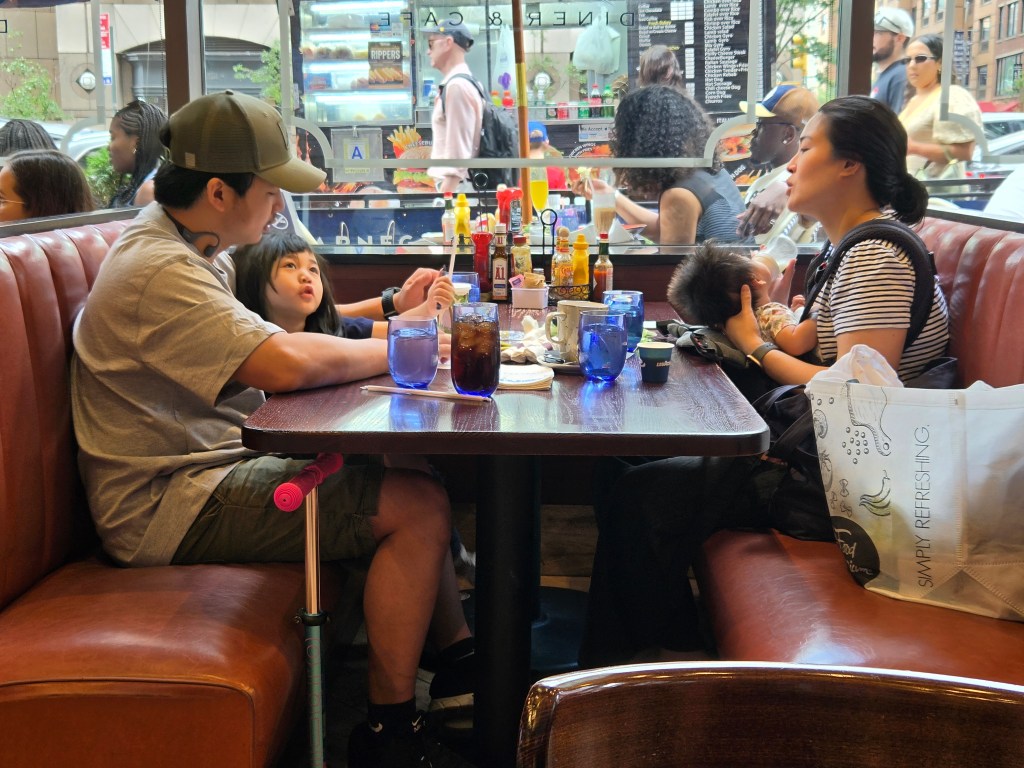
Family brunch at the Carnegie Diner at the corner of 50th and 8th Avenue 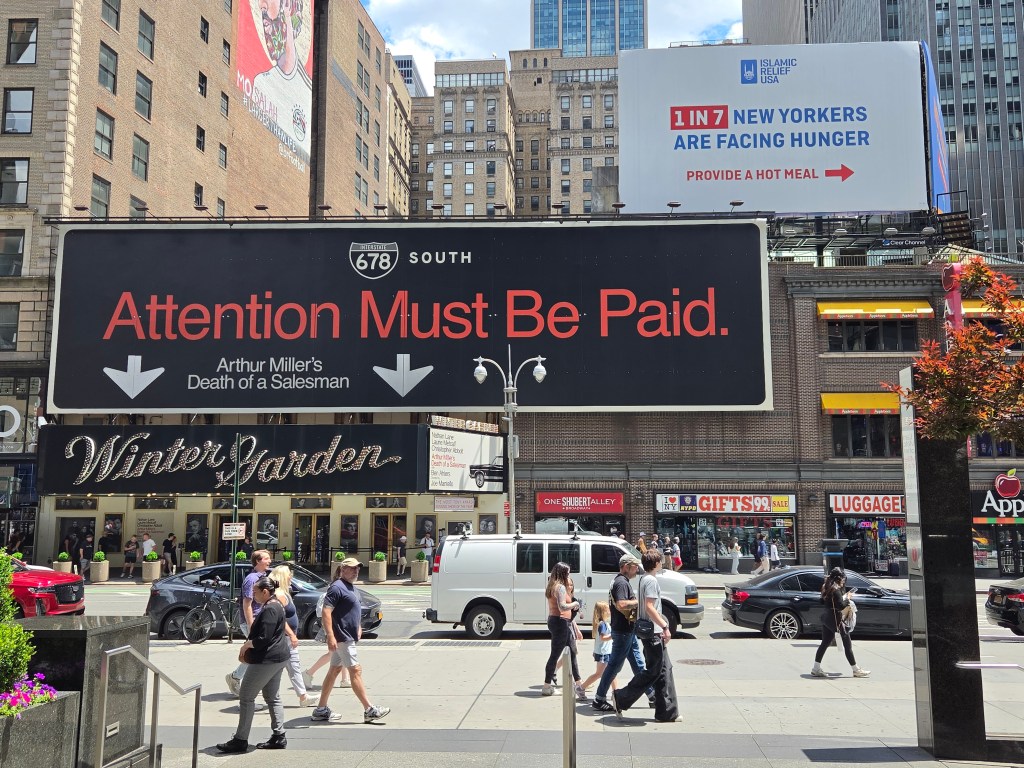
Miller’s famous line given new resonance in 2026 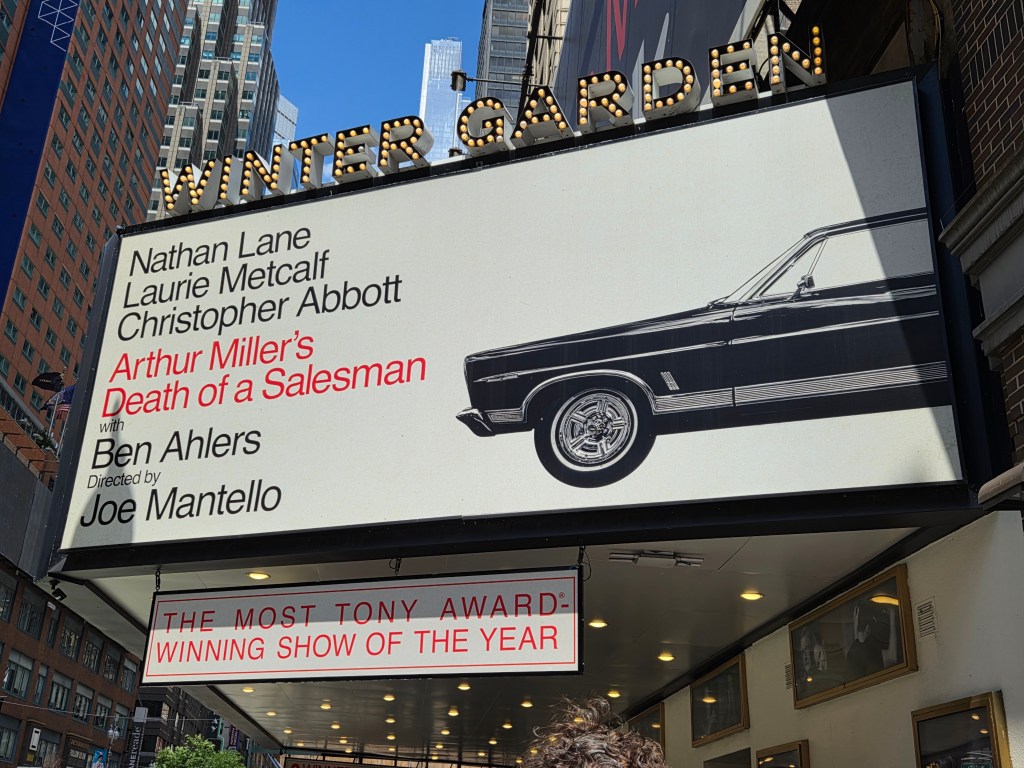
Brilliant production, brilliant cast. Biff’s confession destroyed me. On the ride to Port Authority, my Uber driver Pema told me he had a cousin in New Hampshire, where a four-bedroom house cost only $450,000. So much cheaper than New York, he sighed. Yes, I agreed.
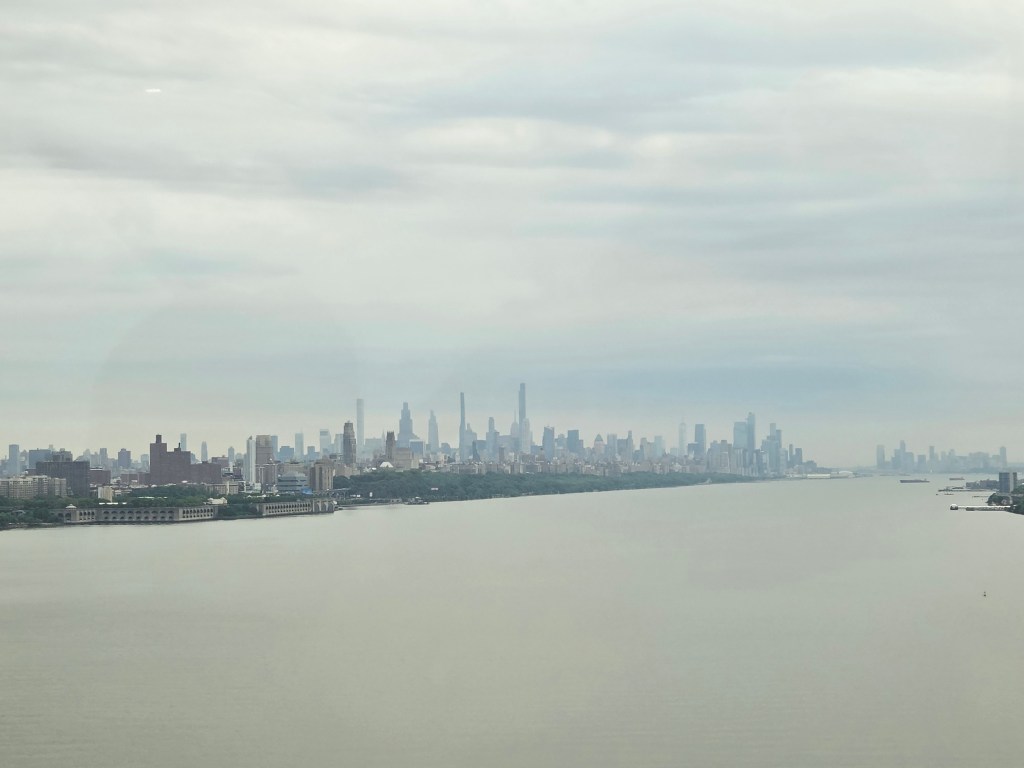
Looking down the Hudson at a skyline rather different from what we saw in October 1998 when David flew us down the river at 500 feet, self-reporting and significantly lower than the Twin Towers we passed. Sigh. And then, after six hours uneventful hours reading Alice Munroe stories on the C&J coach headed north, I arrived back at our home and a drippy, dusky evening. Walking once around the house, my custom after time away, I heard some clicking sounds coming from the stand of trees in front of the house. Birds? Frogs? Then, as I started to walk down the driveway to collect my mail, I heard a huffing sound to my right. And then a growl. Oh. The black bear, the one who’d twice deconstructed my bird feeders and was only briefly deterred a third time when I yelled at her from the deck, was just to my right—and judging from the warning she gave, possibly accompanied by cubs.
I apologized, loudly, for the intrusion, backed swiftly away clapping my hands, and retreated down the hill and back inside through the garage. Safely home. After my adventures in the big city, I had returned to the frontier.
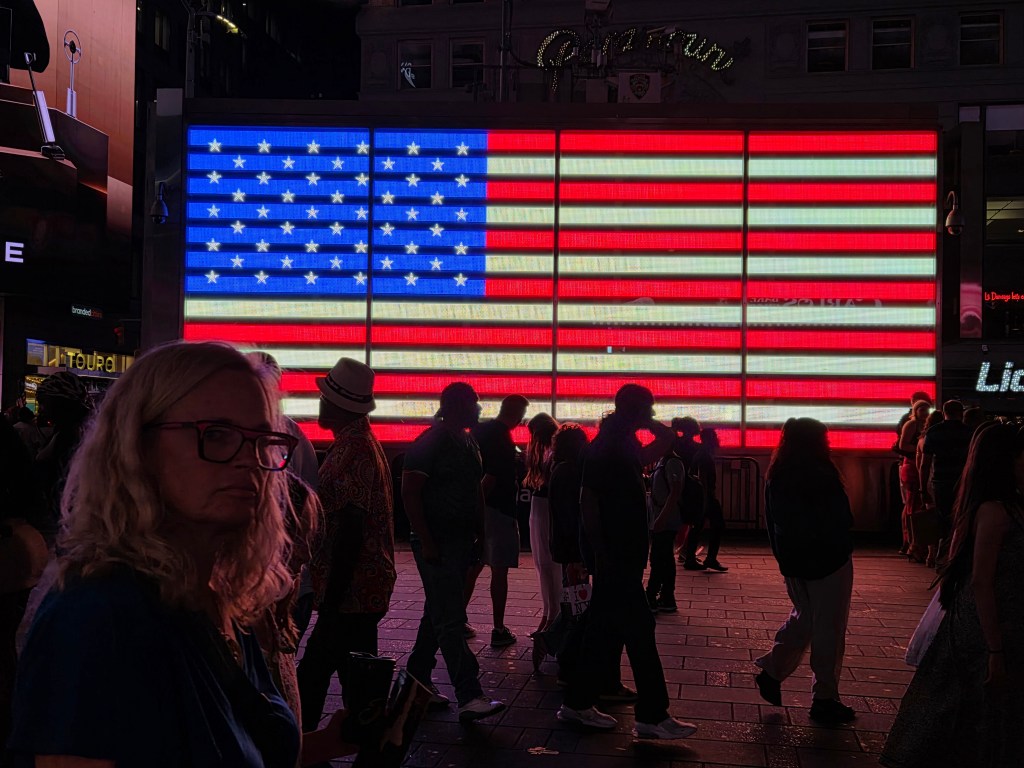
Time Square by night, the 250th Fourth of July approaching. -
Anniversaires
5 June 2026
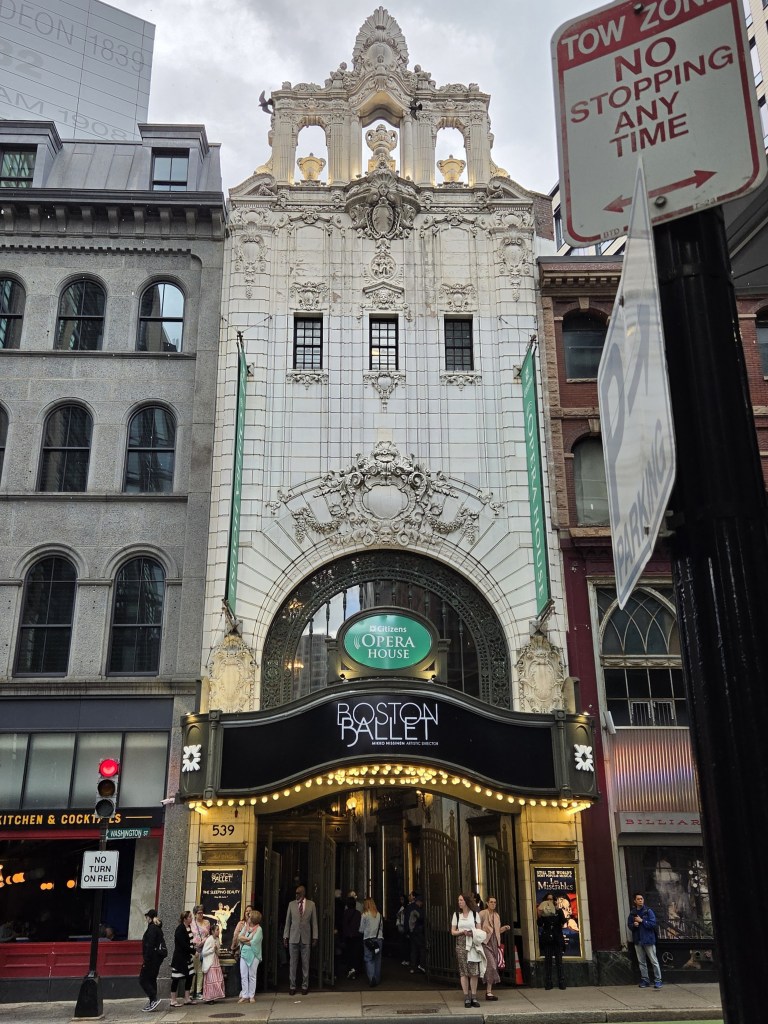
Thomas W. Lamb’s 1928 masterpiece, now Citizens Bank Opera House
and home to Boston BalletFeeling anxious and untethered, Dear Reader? You are not alone; daily experience is not what it used to be. In our PC (Post Colbert) era, so much that was customary is no more, and adapting to the ongoing speed and breadth of change a constant challenge. I loved hearing the legendarily innovative Sir Paul McCartney, a surprise guest on Colbert’s last Late Show, complain about updates on his iPhone: he bought it, he learned how to use it, why should he have to keep learning how to use it all over again? Me, I continue to struggle with my new car AND my new phone; the two do not always play nicely together. Last Friday I was pretty sure I had figured out, definitively, how to get both to communicate. Android Auto came on as it should, as did the radio station I’d programmed; hurrah for me. Then, before I could pull out of my parking space, a pop-up appeared on the car screen, obscuring the map that had been there moments before. I touched it to make it go away, and that turned off the radio.
Exasperated, I exclaimed, “Oh, f*** me!” To which my CAR replied: “I don’t respond to harsh language.” What the hell? I bought this car, and now it’s chiding me for responding to its maddening technical gotchas with profanity? Maybe I should be grateful it didn’t take my “request” literally. Welcome to the robot apocalypse.
With the 250th Fourth of July approaching, and a series of personal anniversaries involving Memorial Days past continually conjuring and then usurping attempts to stay in the present moment, I’ve been thinking a lot about why we cling to these life markers, metaphorical hash marks on the door jambs we passed through long ago, and strategies to keep the less-than-tonic aspects of nostalgia at bay. One answer was a dinner party to celebrate the 25th anniversary of our move into our then brand-new home over Memorial Day weekend 2001, the planning, cooking, and good company distracting from the sadness of my darling husband’s not being at table to join the toast. David departed this dimension around midnight on 31 May 2019. Exactly seven years later, I went to the ballet.
Pausing before a display in the Citizens Bank Opera House, originally the B. F. Keith Memorial Theatre, theatre architect Thomas W. Lamb’s 1928 masterpiece, I felt grateful for the $38-million dollar restoration that brought so magnificent a building back to life in 2004. One explanatory sentence glossed the principle behind the restoration: “The gold leafing was purposefully applied to appear less bright, as if the theatre and all its ornamentation had simply aged, gracefully, over three quarters of a century.”
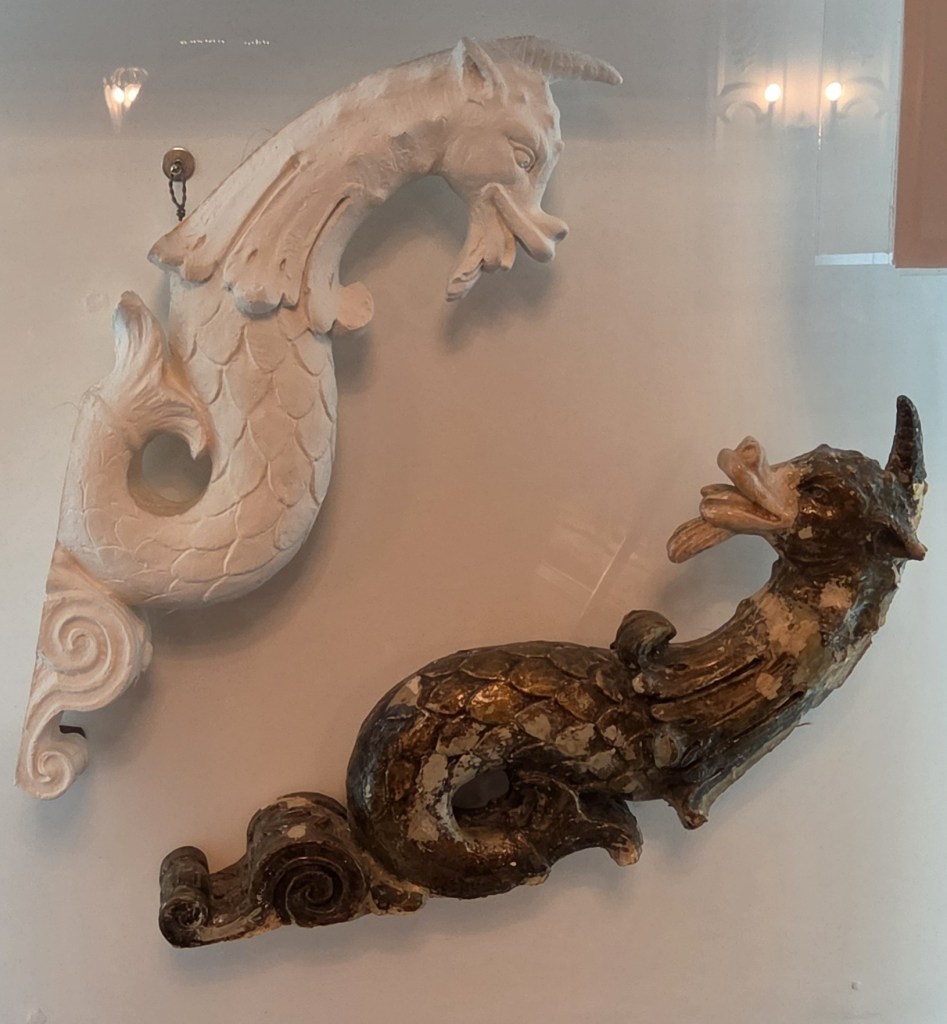
Lamb’s decorative plaster dragons, the lower one restored and aging gracefully, the upper one a replacement cast waiting to be tastefully gilded Contrast that with what The Guardian (31 Aug 2025) called the “extreme goldening of the Oval Office.”
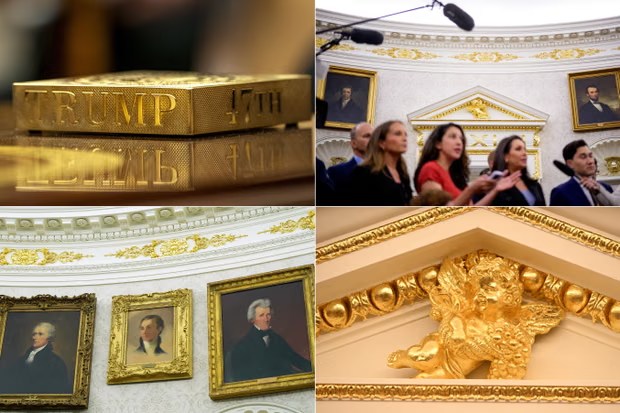
The gilding (guilting?) of the Oval Office: coasters, tympanum, cherub, and new painting (composite photo by Getty/Rex/AP) 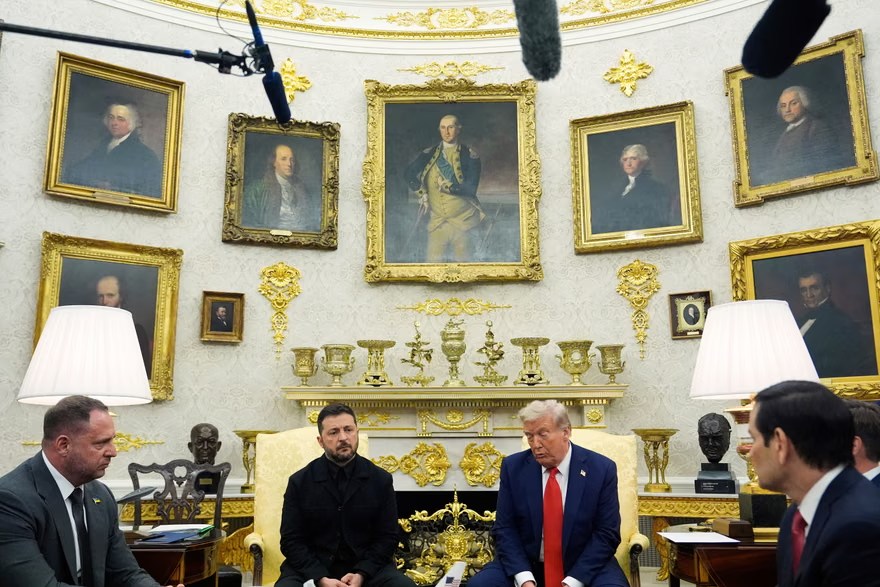
Zelenskyy with FIC at a press conference, August 2025
(Photo by Julia Demaree Nikhinson/AP)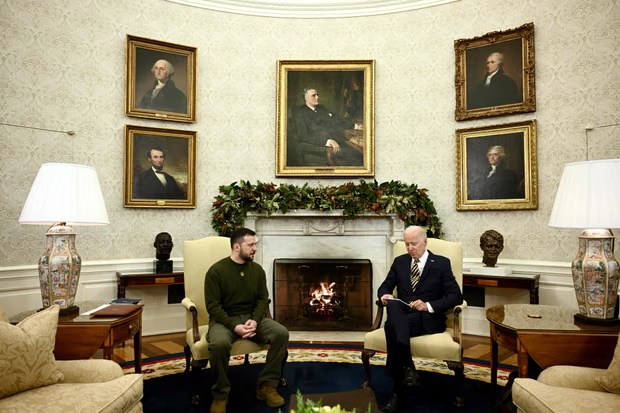
Contrast Zelenskyy with Biden in the Oval Office 2022
(photo by Brendan Smialwoski/AFTOh, I thought, best to head for my seat and avoid that particular rabbit hole of distress.
That was the right move. A chatty young lady named Leah seated next to me provided pre-show and entr’acte entertainment, speaking Russian to her mom and English to me, detailing her affection for ballet (she’d seen Swan Lake and The Nutcracker before), her stellar performance on a recent math exam (“I’m proud of my A+!”), and the excellence of our orchestra seats (“I’ve never been this close before!). The lushness of both production and Tchaikovsky’s Sleeping Beauty score kept me, like Leah, raptly focused, enchanted by consummate artists at work on stage, backstage, and in the pit.
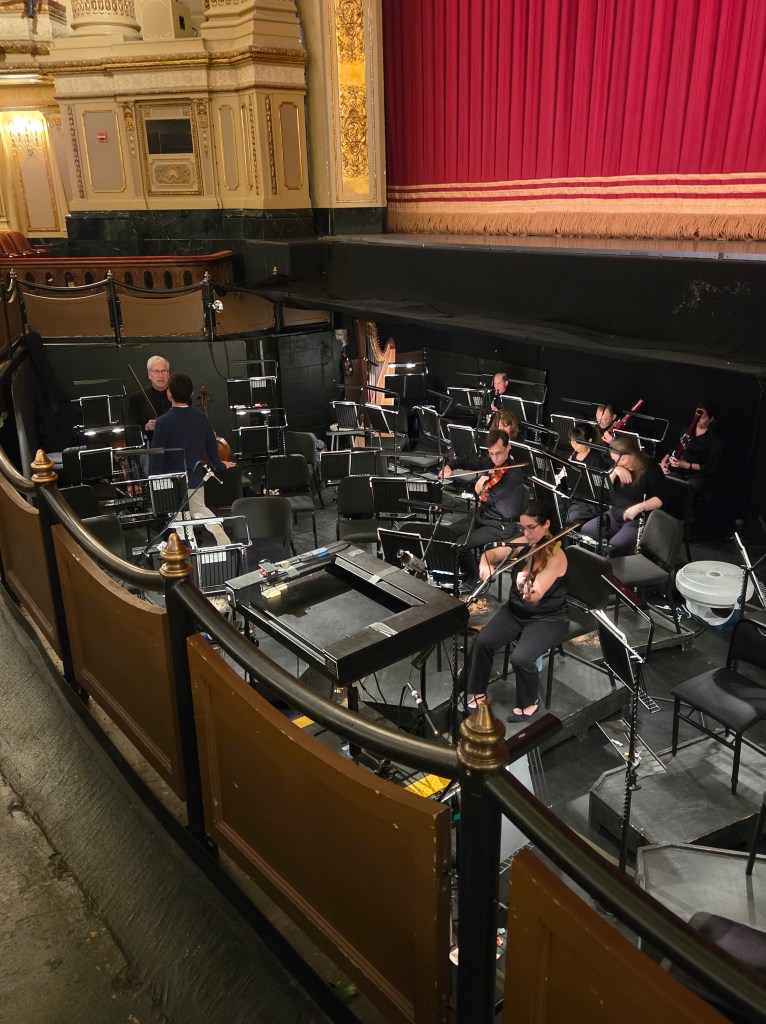
Pre-show practice in the pit 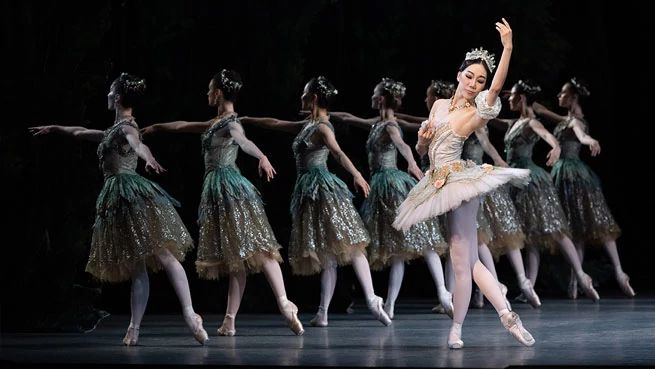
Ji Young Chae and the artists of Boston Ballet (photo by Liza Voll) I’ve been moved to tears at the ballet before, but the gorgeous mutual adoration of Aurora and her Prince, so exquisitely rendered in dance by Ji Young Chae and Jeffrey Cirio, had a special poignancy for me on the seventh anniversary of my own Prince’s departure. As the orchestra began Tchaikovsky’s “Grand valse villageoise,” the lyrics from the animated 1959 Disney Sleeping Beauty came immediately and unbidden to mind:
I know you, I walked with you once upon a dream
I know you, the gleam in your eyes is so familiar a gleam
And I know it’s true that visions are seldom all they seem
But if I know you, I know what you’ll do
You’ll love me at once, the way you did once upon a dream.Yeah. That’s pretty much the way it was. Never underestimate the influence of romance on a young girl.
A gentle rain had begun by the performance’s end, but umbrella in hand, I decided to stroll the Common to collect myself and allow the parking garage traffic to clear.
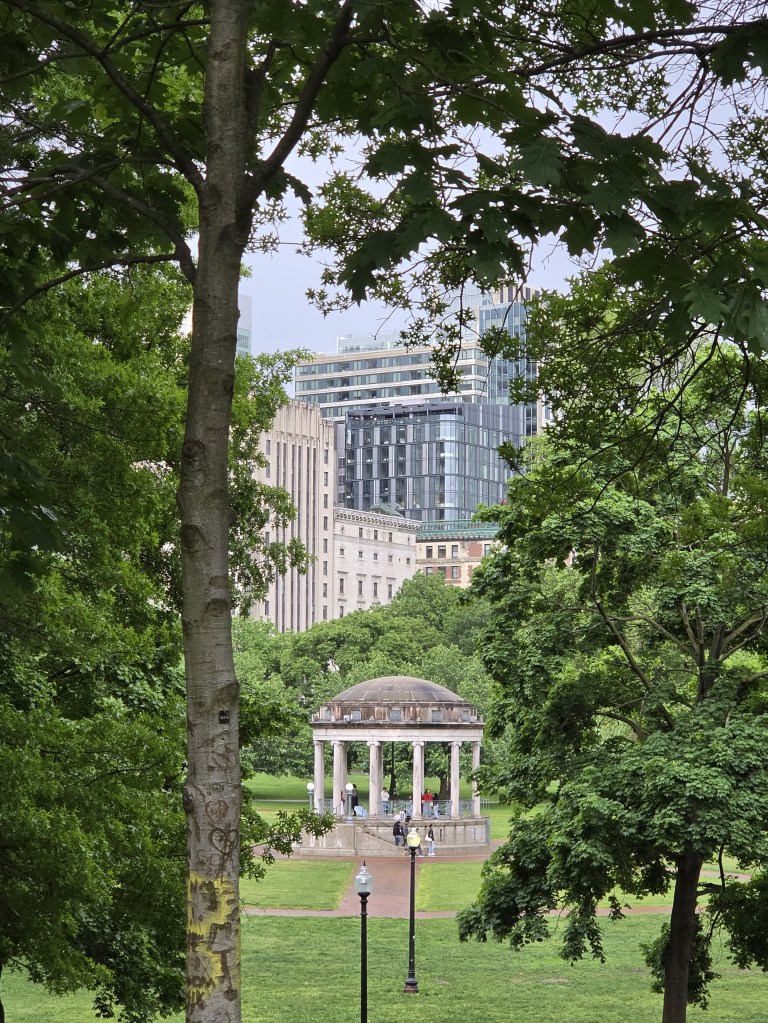
The Parkman Bandstand, 1912 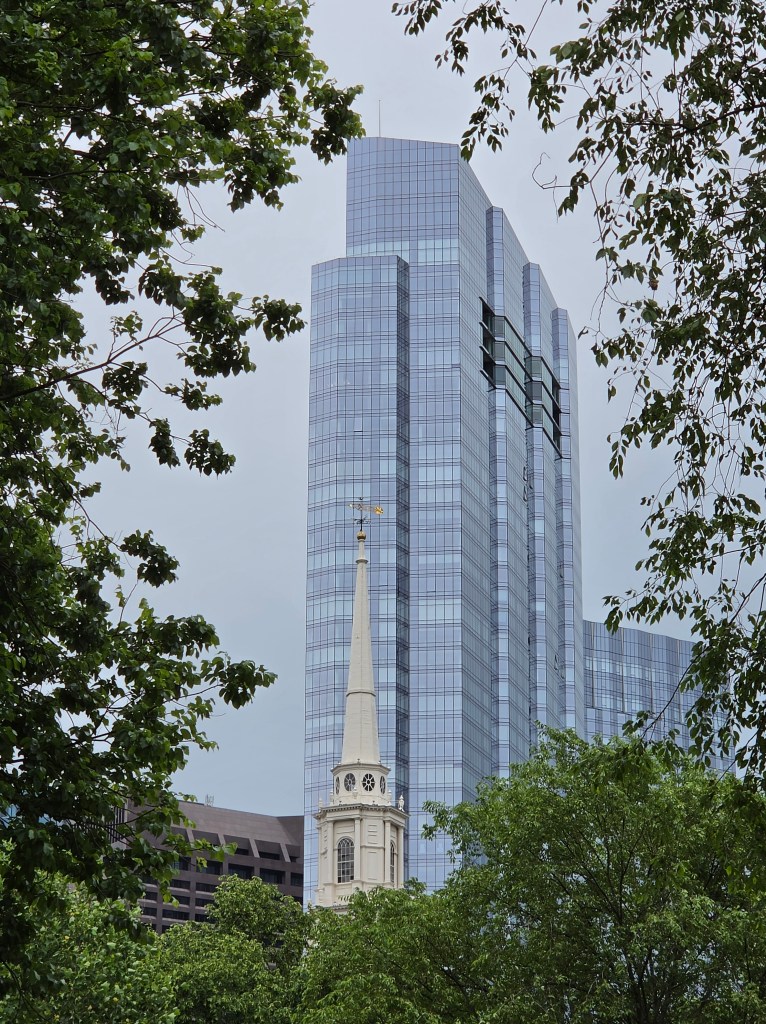
The Park Street Church, 1809, at 217 feet once the tallest building in the early 19th-century U.S., now upstaged by the Millennium Tower, 2016, at 60 stories/684 feet, one of Boston’s highest I was happy to realize it wasn’t just lyrics heard as a seven-year-old that I remembered: I wanted to revisit the Shaw Memorial, and recalled just where it was, directly across from Charles Bulfinch’s State House.
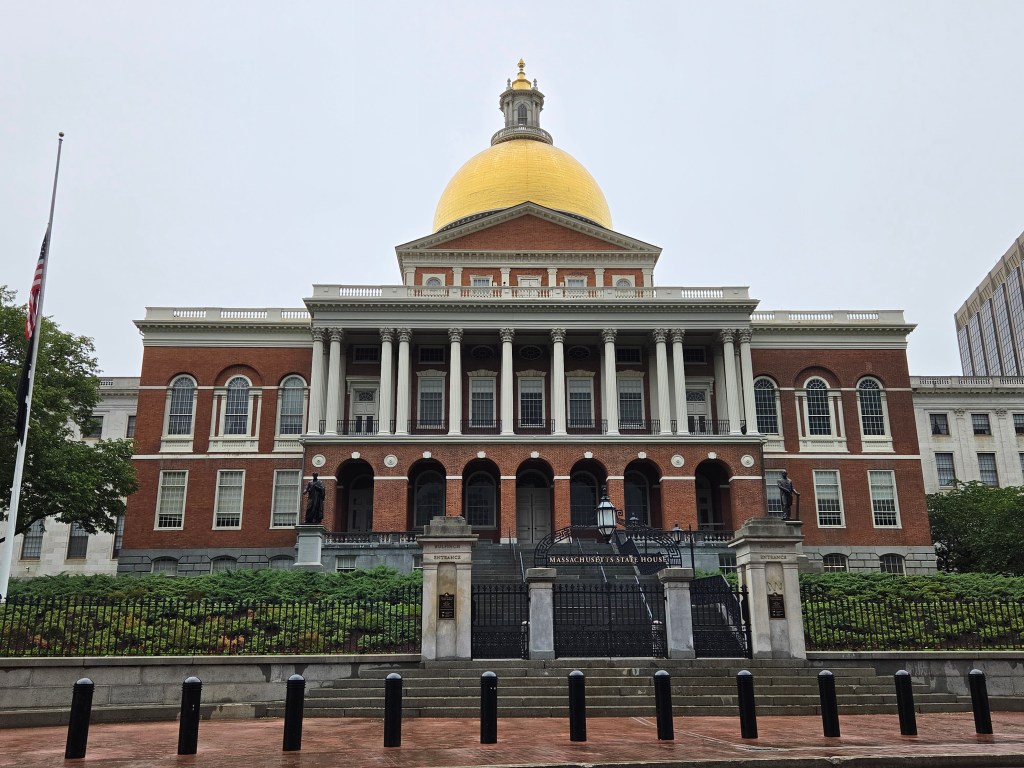
Massachusetts State House, Charles Bulfinch, architect, 1798 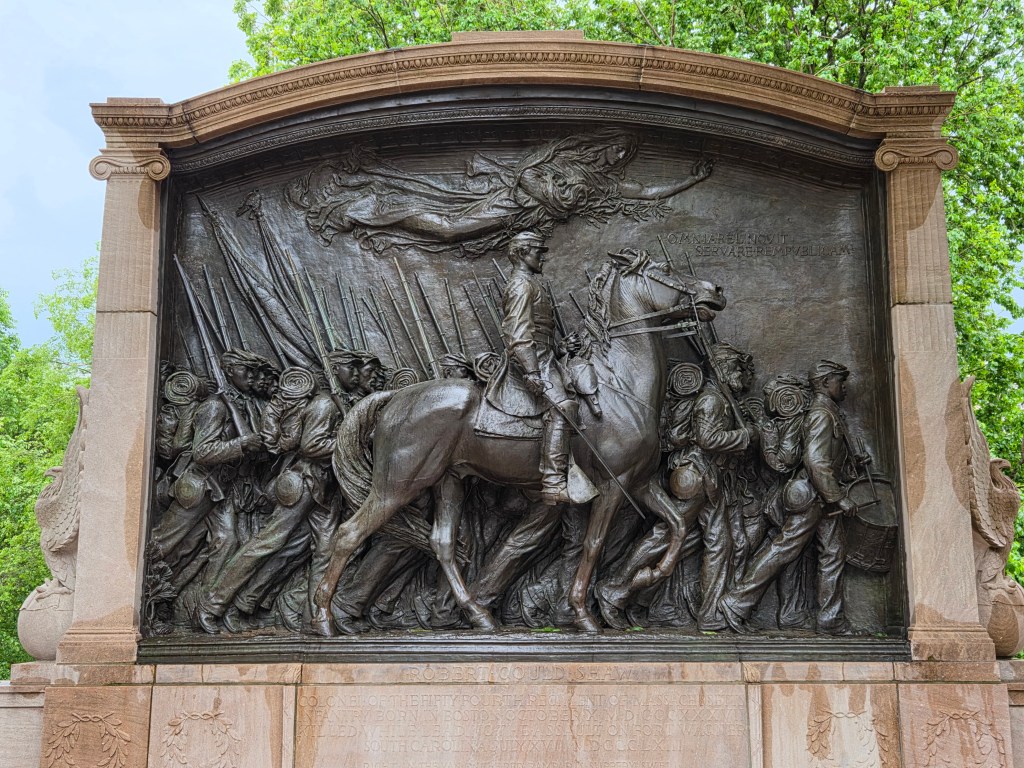
Robert Gould Shaw and the Massachusetts 54th Regiment Memorial,
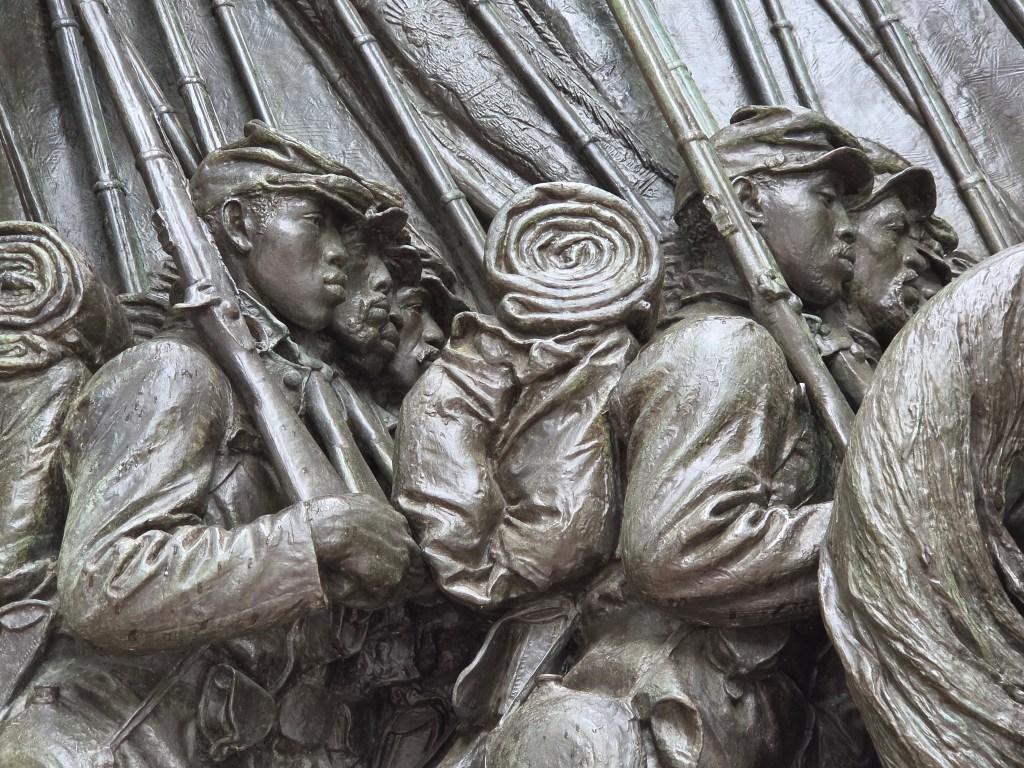
bronze relief by Augustus Saint-Gaundens, 1897This, of course, evoked more memories of the first time David brought me there, as well as our visit to Saint-Gaudens’s studio in Cornish, NH. But what the sculpture memorializes—the courage of Robert Gould Shaw and the 54th Massachusetts Volunteer Infantry of African American soldiers, so many of whom gave the last full measure of devotion to the Union—diverted my nostalgia in another sad direction.
With the 250th Fourth of July celebrations only a month away, the Felon-in-Chief (FIC) proposes celebrating with a cage match, the UFC (Ultimate Fighting Championship) Freedom 250, on the south lawn of the White House (!) on 14 June, the FIC’s 80th birthday (!!). And his MAGA minions have proposed his portrait on a $250-dollar bill (!!!). Celebrating the felon who would be king—what could be further from what the Founders envisioned on that July fourth in 1776?
I was back down the rabbit hole. Time to go home. Heading back to the parking garage, I passed The Embrace memorial to Coretta Scott King and MLK, Jr., who met in Boston in 1952. The Embrace, according to an adjacent sign in the Freedom Plaza, “reflects the power of collective action, the role of women in the freedom movement, and the forging of solidarity out of mutual empathy and vulnerability.”
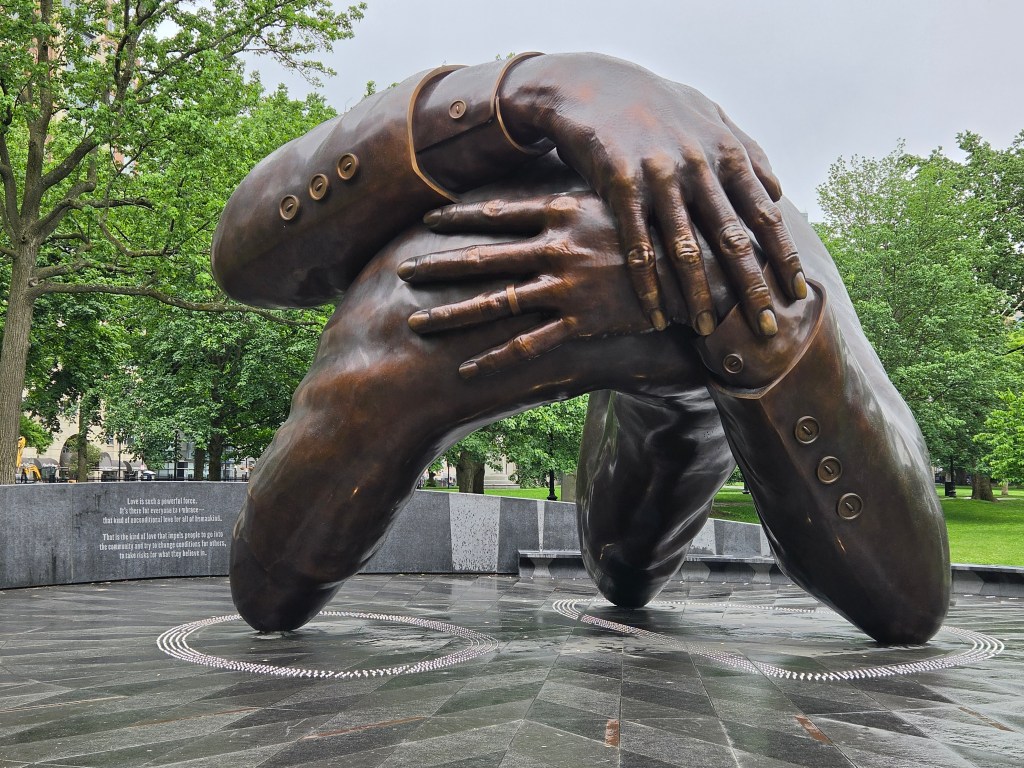
The Embrace, unveiled on Boston Common, January 2023 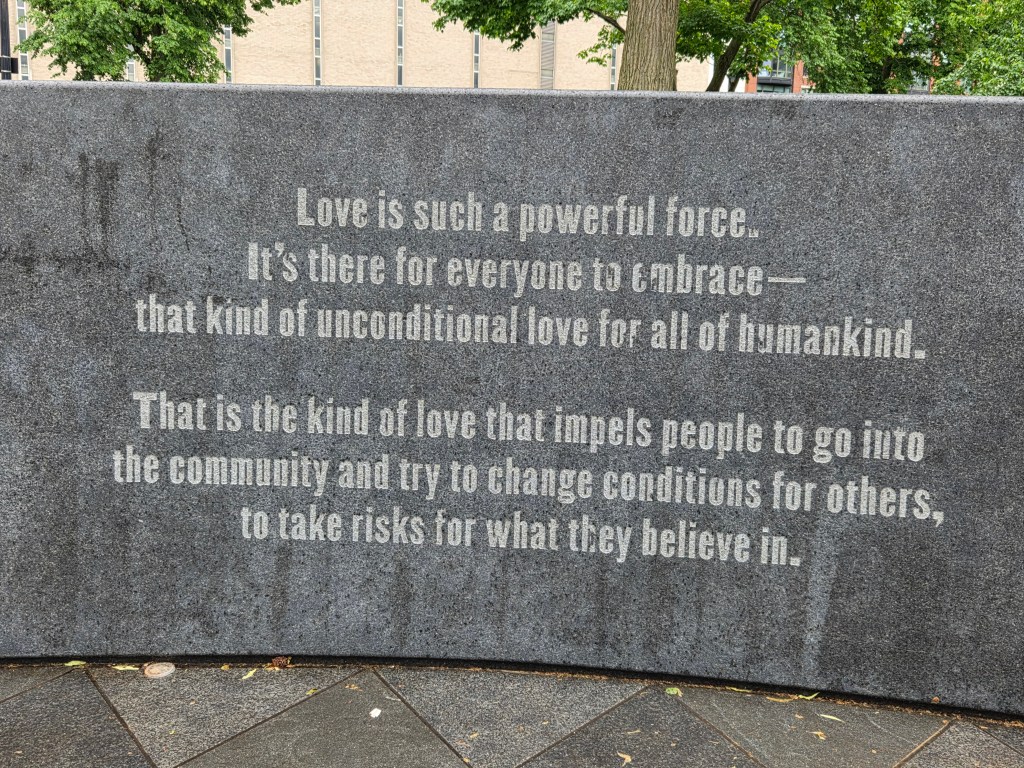
The takeaway engraved behind The Embrace Designed by Hank Willis Thomas, the sculpture depicts the couple’s intertwined arms and commemorates the famous hug they shared after Dr. King won the Nobel Peace Prize in 1964. Right there in American’s oldest public park, Ladies and Gentlemen! A monument to empathy and self-sacrifice. Whatever you think of the sculpture (I’m not a fan), it’s pretty much the opposite of a cage match on the Felon-in-Chief’s birthday.
Back in the garage, I was luckily diverted from my return to the rabbit hole by a new problem to solve: my small VW GTI was pinned in a corner spot with a large truck to my left, a supporting pillar to my right, and an even bigger truck with a long bed parked perpendicular to my space. If I backed straight out, I would hit it. Attention must be paid! Getting my car out of that space took about 15 sweaty minutes, inching forward, backward, forward, backward, adjusting the exit angle ever so slightly with each maneuver. Finally, with side mirrors folded in and a prayer, I eased out of the spot with nary a scratch. And there were no more problems exiting Boston. But when I returned home, I saw that for the second time in three weeks, a bear had deconstructed my elaborate bird feeder system.
Strangely, I didn’t feel all that bad. Somehow my sad gloom had dissipated. And then I remembered our late Dean Palmer’s answer when I asked him how he managed to carry on after losing first his wife and then his only child, all the while suffering increasingly debilitating Parkinson’s. The answer (from a man who navigated bombers over Germany in WW2): “Life is all problems. The trick is to stay interested in solving the problems.”
Right. The next day, 1 June, the seventh anniversary of David’s departure from our home for the final time and the sixth anniversary of my retirement from 43 years as a professor, I had a lovely walk on a new-to-me trail with good friends.

Dragonfly observed on the Leighton Forest trail, 1 June 2026 I then went out and bought new support poles for the bird feeders, and booked tickets online for me and another friend to see The Producers at the Ogunquit Playhouse come August. The day after, I installed the new poles, went to yoga class, got a haircut, and made plans to meet up with another old friend in New York City to see the Raphael show at the Met before it closes. And I mowed the lawn. Staying interested in solving problems.
So, Dear Reader, here’s to hope and happy anniversaries, the past in the present.
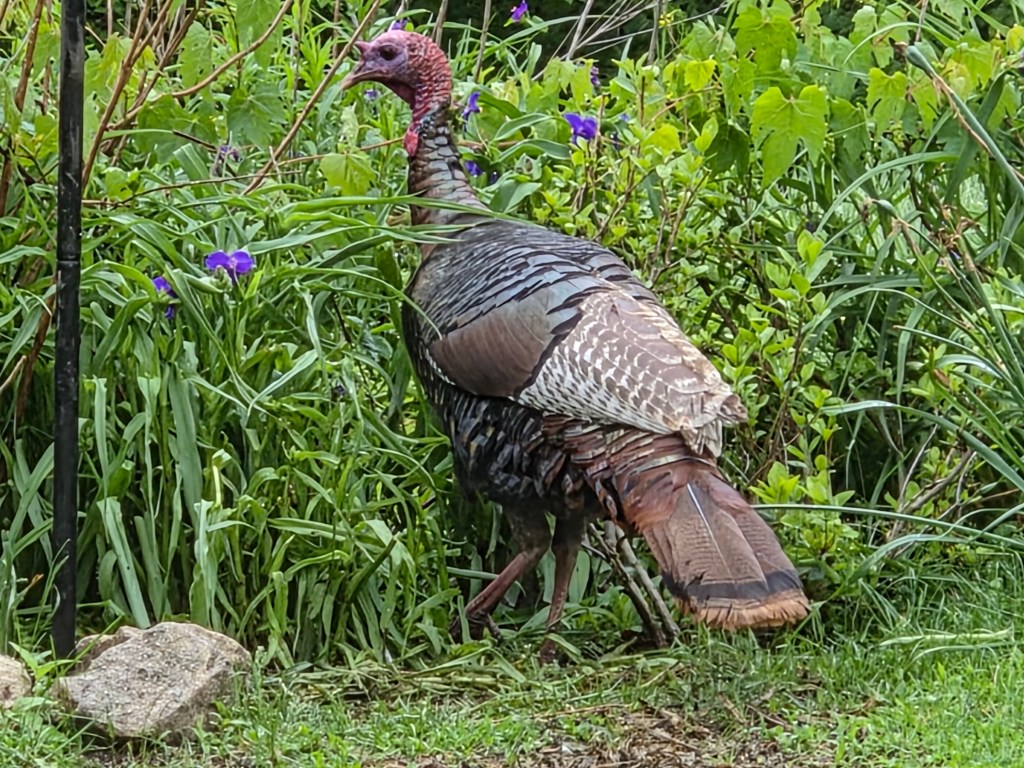
Spiderwort in bloom with turkey hen, happy to find the bird feeders restored 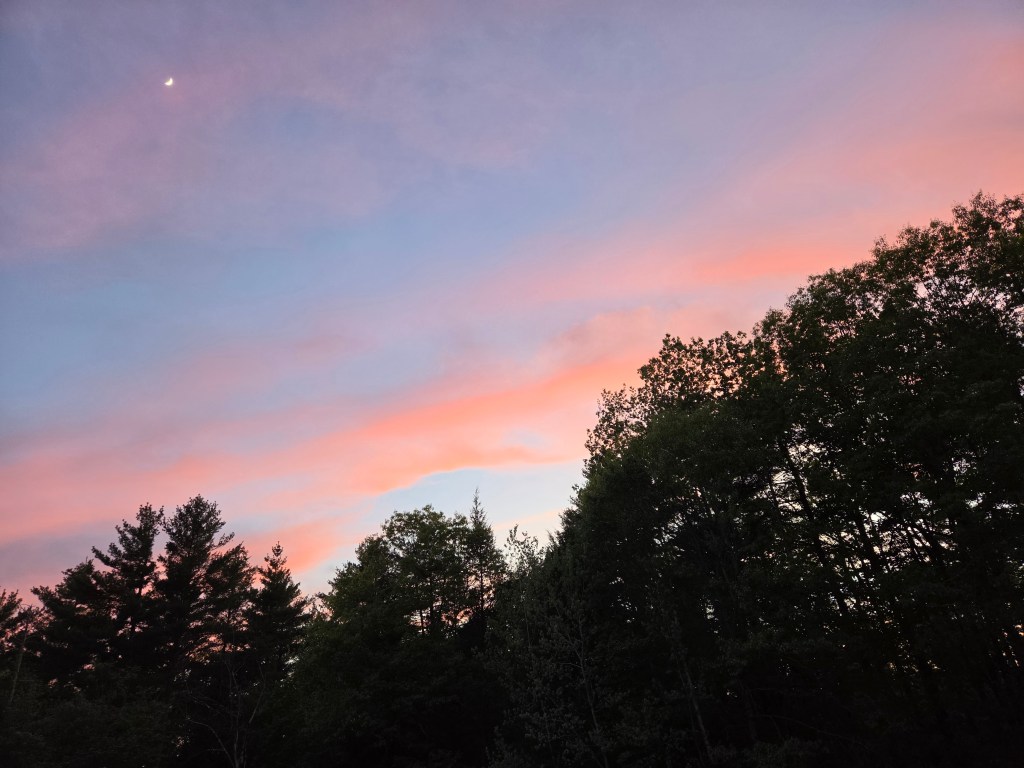
Sunset with waxing crescent moon from the deck, 21 May 2026 -
Into the woods
14 May 2026
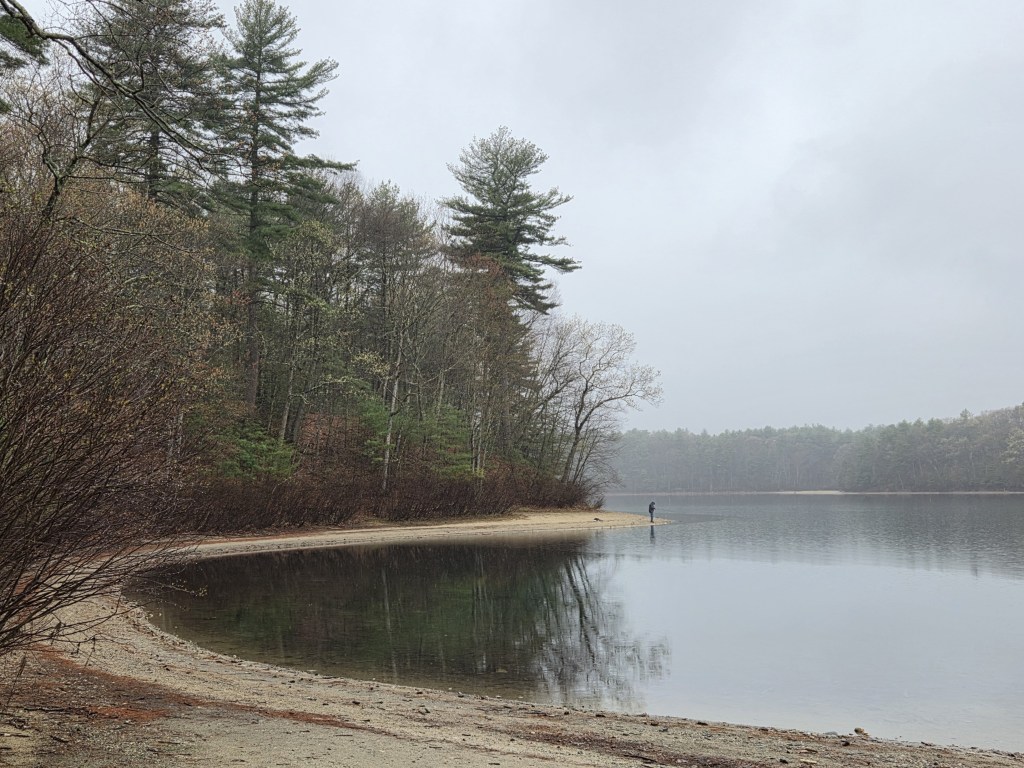
Walden Pond, 30 April 2026 We went to the woods last April, specifically Walden Pond, because we wished to revisit what it meant to Thoreau and what it might mean to us now. Katherine, one of our core Madbury Library Book Club quartet, had last November gifted us with illustrated copies of Autumnal Tints, Henry David Thoreau’s poetic and philosophical essay first posthumously published in The Atlantic Monthly in October 1862, a detailed guide to the colors of a New England autumn urging the reader to play close attention to the deeper meaning of the season’s transformation. Henry David’s exhortation prompted me then to suggest a spring field trip to Walden Pond, which I’d not visited since my Americanist husband had taken me there on one of my early visits to him in New Hampshire, part of a courtship campaign that ultimately succeeded (happily for both of us). On learning that Walden Pond, a State Reservation managed by the Massachusetts Department of Conservation and Recreation, draws 600,000 visitors a year, often filling the parking lot and closing the park early in the day, we chose the last day of April for our visit to avoid the crowd.
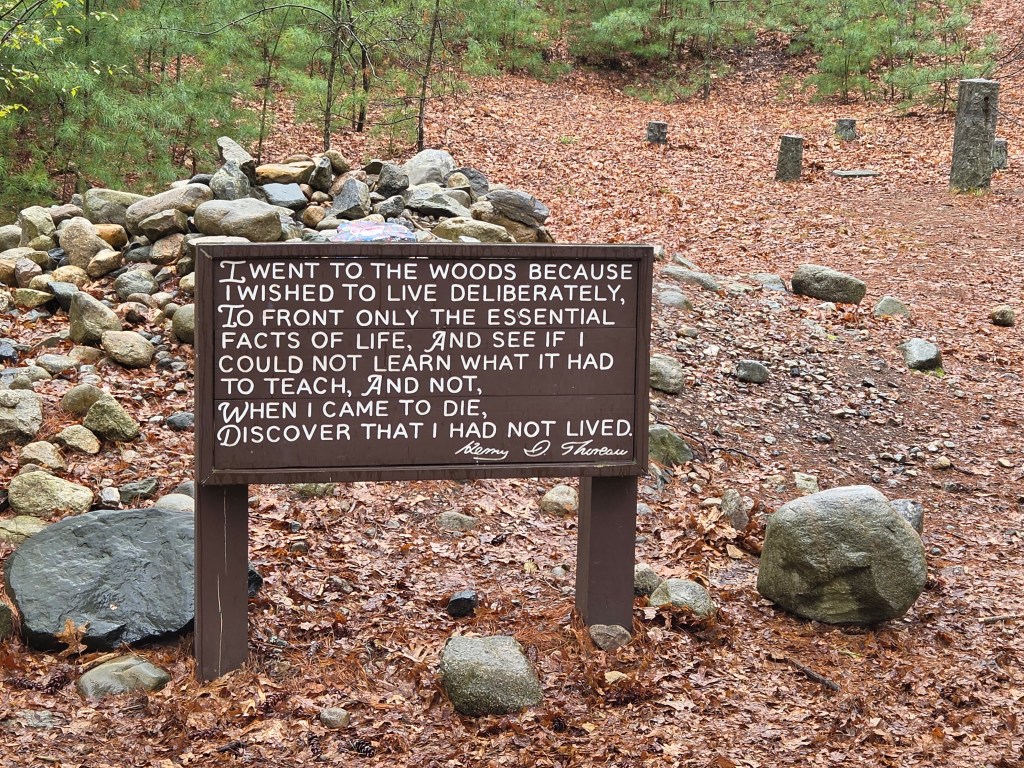
Site of Thoreau’s Cabin, 1845-47 As it happened, a rainy day kept most folks away: when we arrived around 10.30, we were the only car in a parking lot so empty that the ranger staffing the handsome Visitor Center (built mostly from native lumber) waived the $30 parking fee normally charged out-of-state visitors.
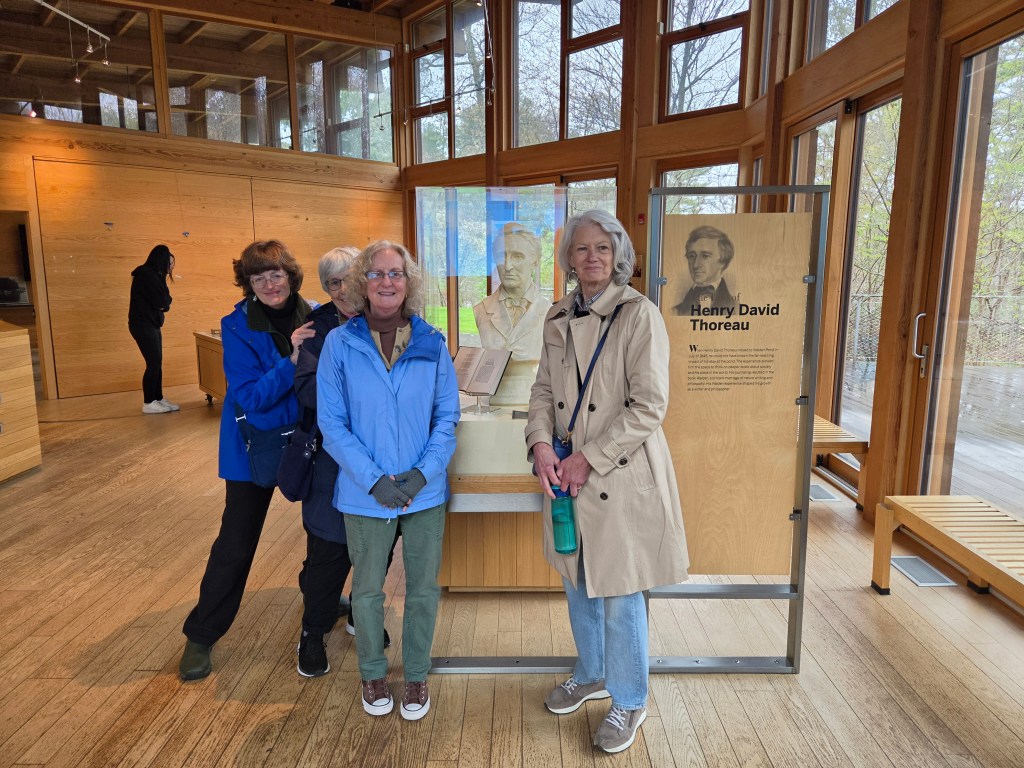
Georgeann, Diane, Katherine, and Susan visit Walden Pond We watched the excellent orientation film, like the recent PBS series, another evocative Ken Burns production, this one narrated by the late Robert Redford. That and the misty grey weather added to a sweetly melancholy nostalgia I felt thinking of all that has been lost since Thoreau’s deliberately chosen tenure by the Pond.
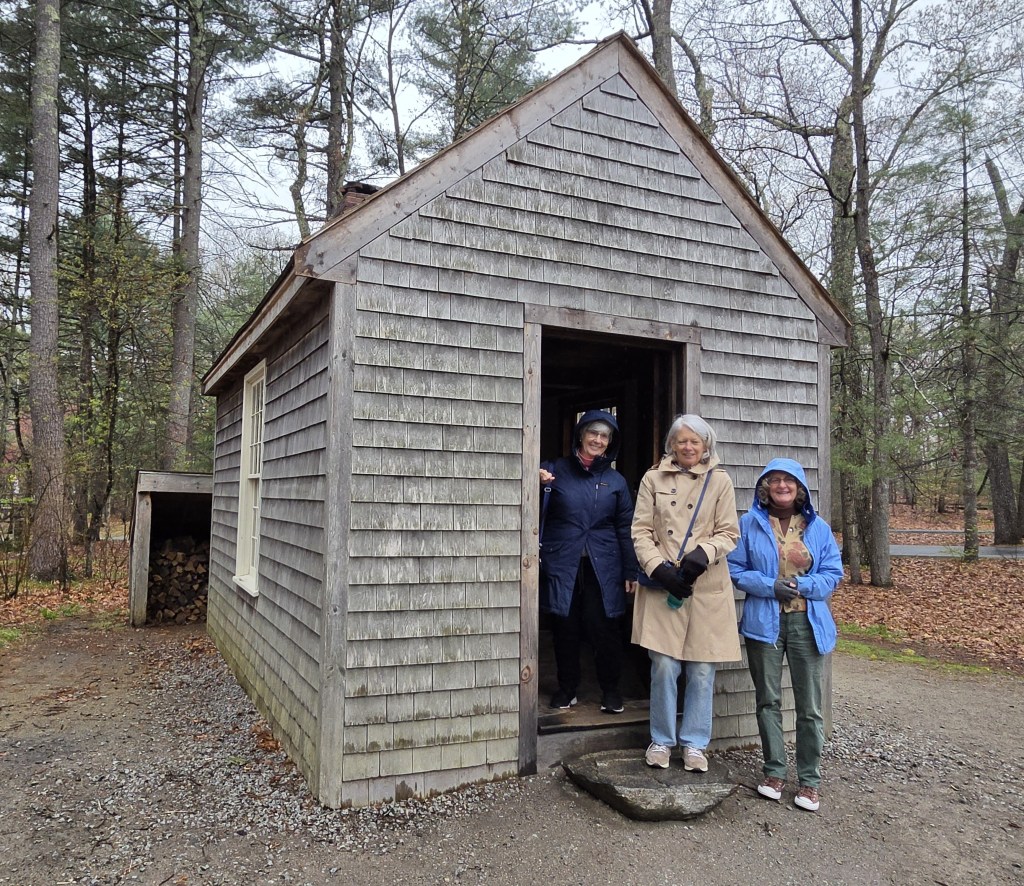
Replica of Thoreau’s hut 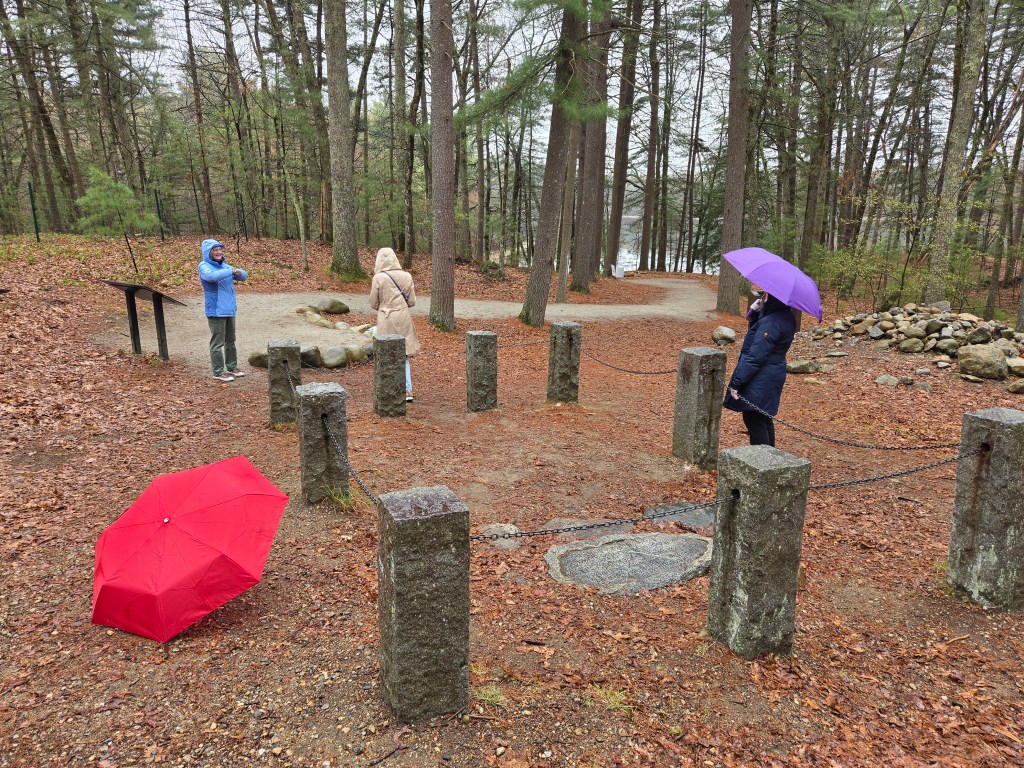
Original site of Thoreau’s cabin In the weeks since, our visit to Walden and the Old Manse on Concord, home to the Rev. William Emerson (1743-1776), Revolutionary firebrand and from his window, eyewitness to the Battle of Concord on 19 April 1775, as well as the grandfather of American Transcendentalist Ralph Waldo Emerson, has for me often flashed “upon that inward eye / Which is the bliss of solitude.”
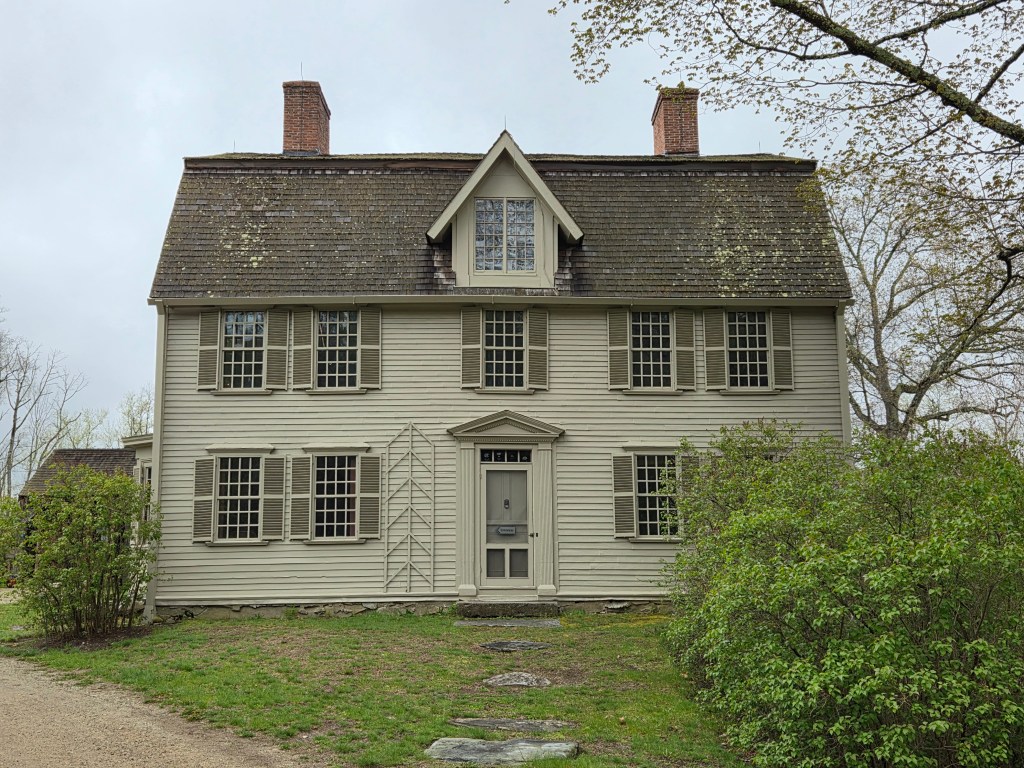
The Old Manse, home of the Rev. William Emerson, built 1770 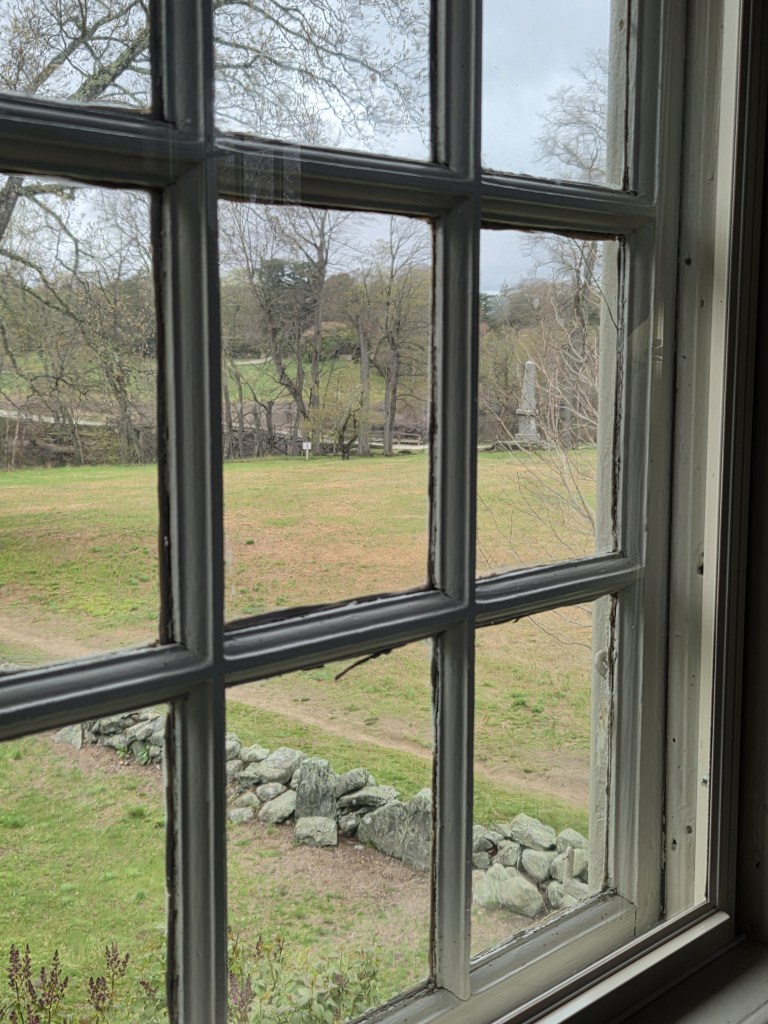
View of the North Bridge from the Old Manse 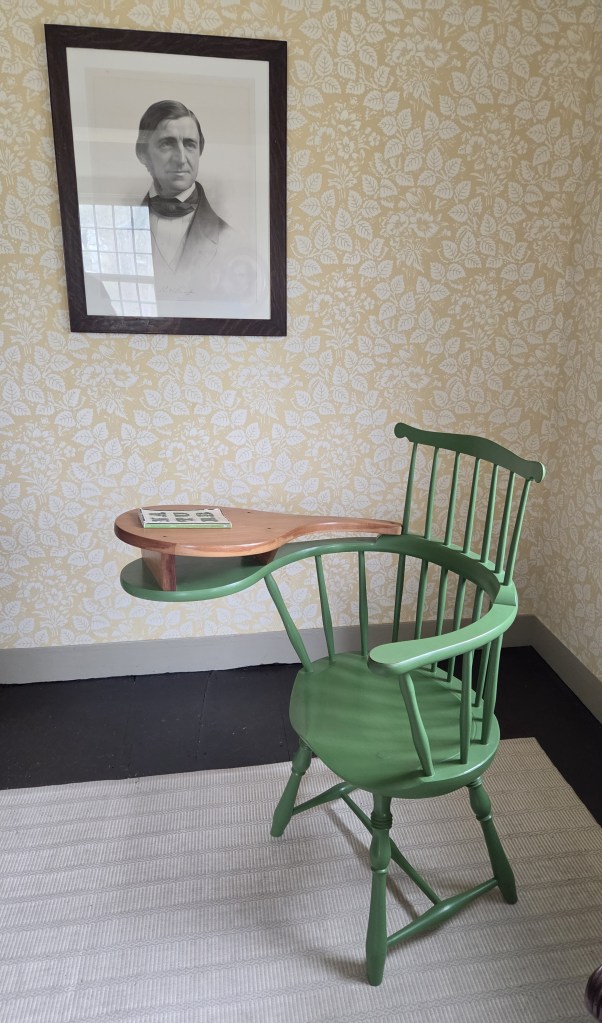
Ralph Waldo Emerson’s writing chair, which he would take outside to compose, with a copy of his essay Nature 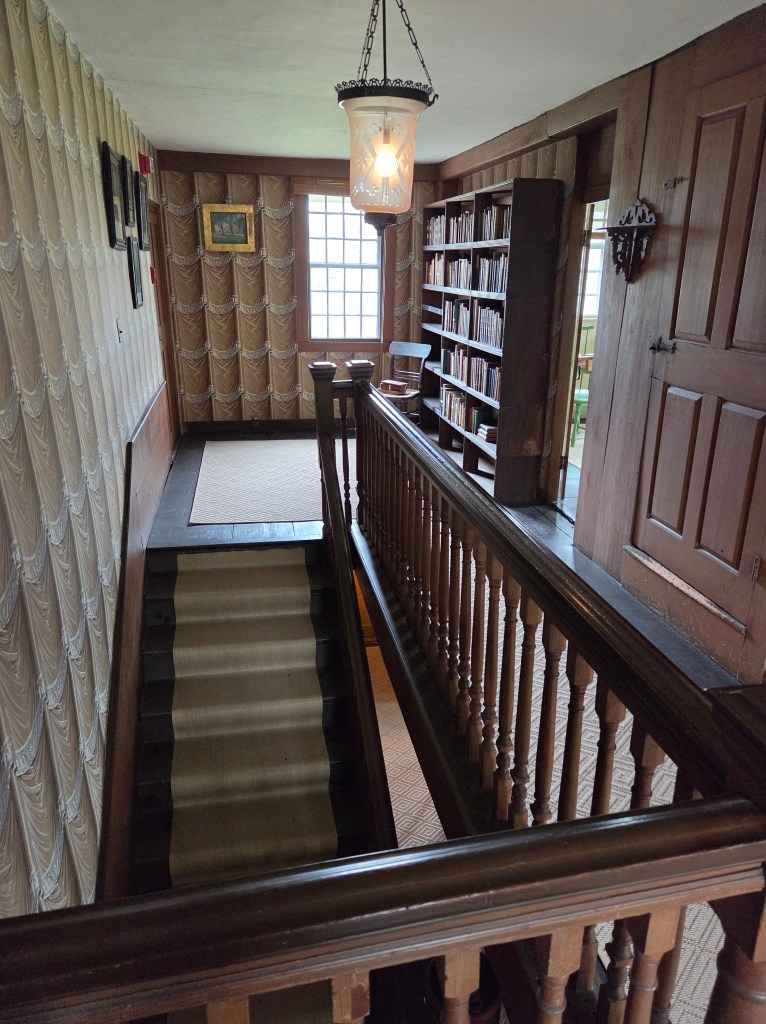
Old Manse’s central staircase. Ralph Waldo Emerson and Nathaniel Hawthorne also lived in this very literary house I know I am not alone in experiencing the bewildering juxtaposition of past and present, both personal and historical, I think characteristic of Boomers by virtue of their age prone to reminiscence and at the same time baffled, alternately enraged and rendered despondent, by the desecration of truths we once believed self-evident. More than midway along the journey of our life, we find ourselves within a forest dark, for the straightforward pathway has been lost (pace Dante via Longfellow). What comfort, then, from the Northern Pine-Oak Forest of Walden Pond, and all it has come to represent?
A few days before we went to the woods (negotiating heavy traffic on 95 and 495, hazards with which Henry David did NOT have to contend) on 25 April, alleged assassin Cole Allen released his manifesto as a timed email moments before he stormed the security checkpoint at the Washington Hilton during the White House Correspondents Dinner. His “Apology and Explanation” is very disturbing, however accurate its initial reasoning: “I am a citizen of the United States of America. What my representatives do reflects on me.” Surely opening fire on an assembly with the stated goal of taking out as many of the assembled Administration as possible (with apologies for any collateral damage) is not the nonviolent resistance, the “civil disobedience” that Thoreau advocated, inspiring later peaceful protests as disparate as those of Mahatma Ghandi and Martin Luther King, Jr.—both of them, we must remember, an assassin’s victim. But! What happened at the North Bridge so close to the Old Manse WAS violent, as was the revolution we are exhorted to celebrate on its 250th anniversary.
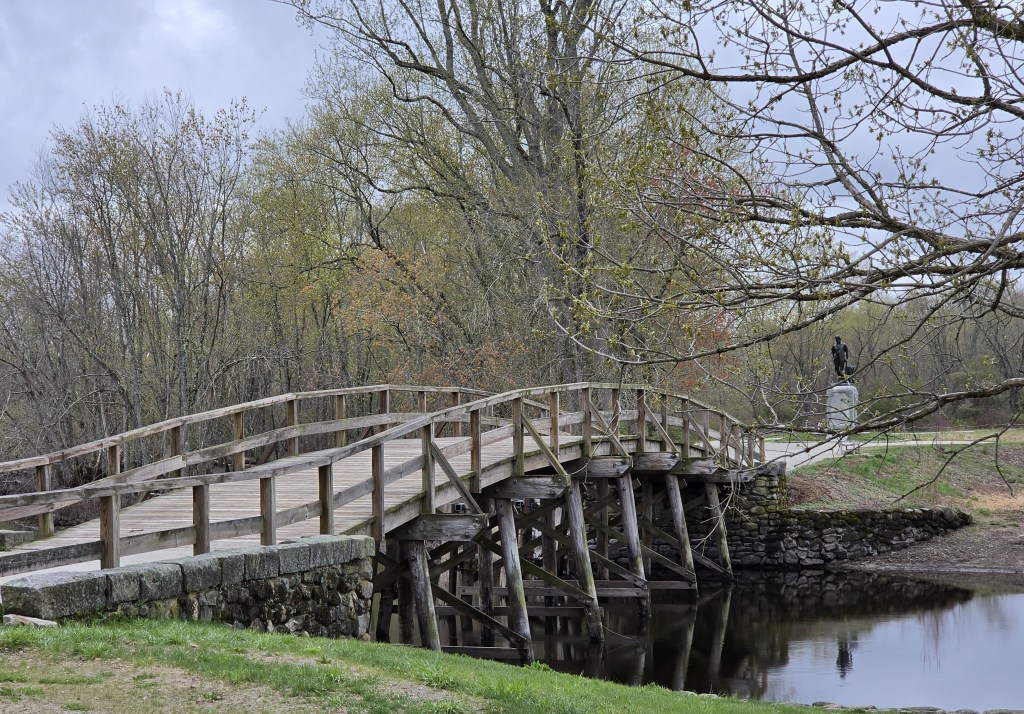
North Bridge (“the rude bridge that arched the flood”) with Minute Man statue 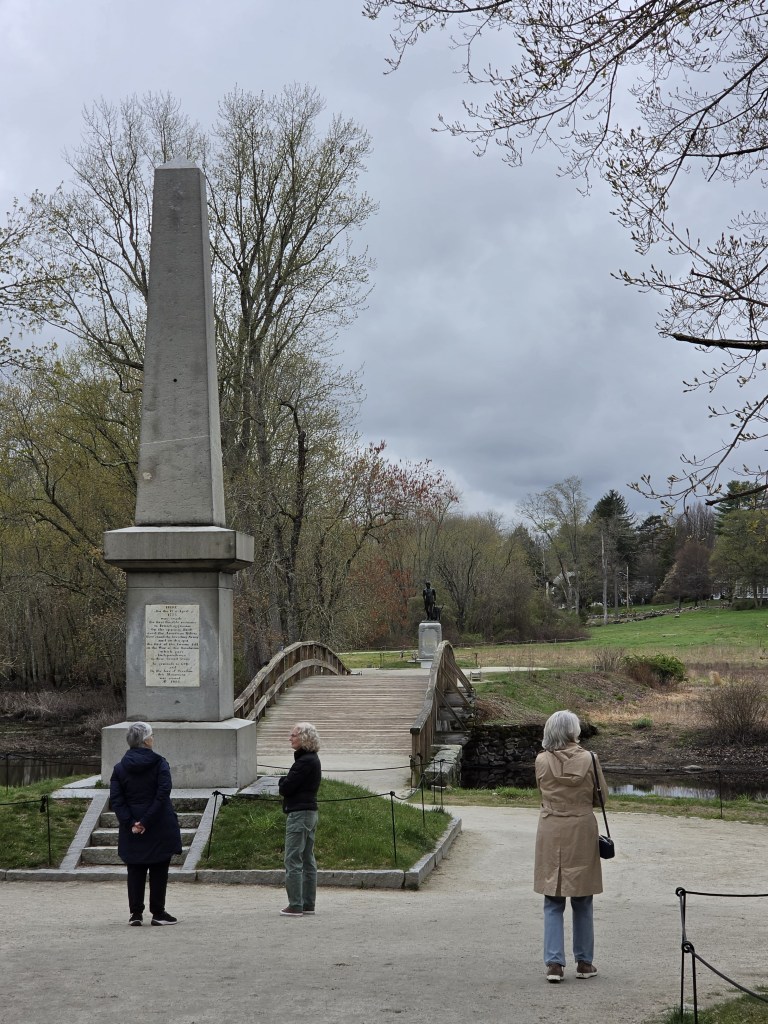
Site of “the shot heard round the world” 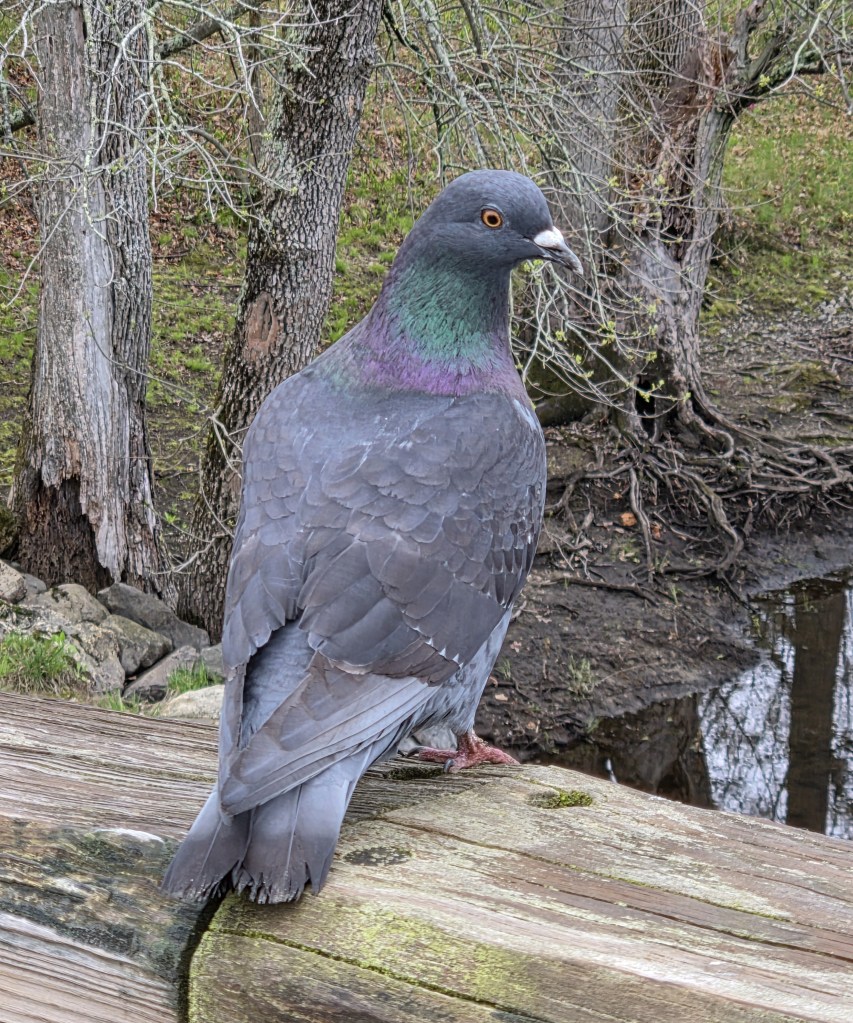
North Bridge Pigeon hoping for a handout Our first American Pope, Leo XIV, Robert Francis Prevost, born in Chicago, is also the first Augustinian pope in history, a friar who has lived vows of poverty, chastity, and obedience, focusing on community and the teachings of St. Augustine, which he studied in seminary and at Villanova University, including the definition of a just war conducted to restore peace, remedy injustice, and authorized by a legitimate authority, never motivated by cruelty or greed. And yet, on 14 April Vice President J.D. Vance, first confirmed as a Catholic in 2019, cautioned this pope to “be careful” when discussing theology and public policy. The time is out of joint. Or, “That does not compute” (Robby the Robot, Lost in Space, 1965-1968).
April may not be the cruelest month, but this April may be the most weird. While Vance attempted to school the Pope, King Charles III in his first state visit as a monarch addressed Congress on 28 April, and schooled that assembly on their own history, “a tale of two Georges,” Magna Carta, and limiting executive power, a statement that received a hypocritical standing ovation from the assembly, clapping FOR curbing the “capricious and tyrannical actions” of a monarch.
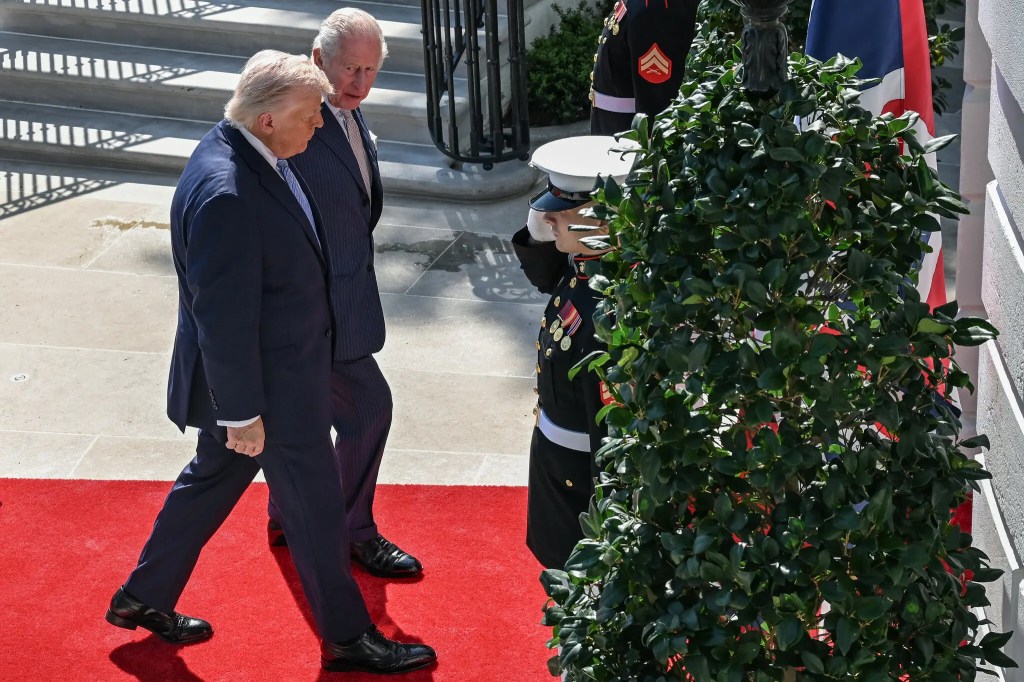
The King and the Man Who Would Be King prior to Charles III’s address to Congress, 28 April 2026 (photo by Kenny Holston for the NYT) 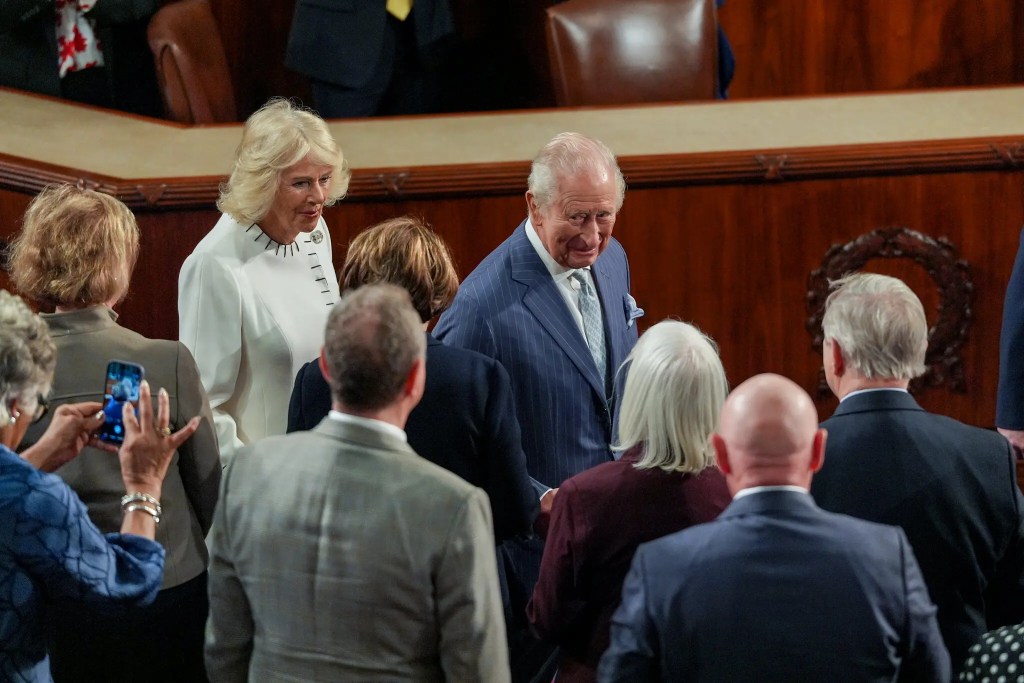
Queen Camilla and King Charles arrive at the joint session of Congress
(photo by Salwan Georges for the NYT)A life-long environmental advocate, the King went on to urge global action to treat Nature as a “precious and irreplaceable asset.” More clapping. To quote the Scrivener in Richard III, so aware of political hypocrisy: “Who is so gross / That cannot see this palpable device?” Or this from another more recent poet: “Send in the clowns / Don’t bother. They’re here.”
Michael Jochum, author of Not Just a Drummer: Reflections on Art, Politics, Dogs, and the Human Condition, a series of essays published on social media, captured my combined admiration and distress on hearing King Charles’s wittily eloquent stealth critique of our current politics, the experience of “witnessing a speaker who understands not only the power of language, but the responsibility that come with it. . . . Listening to Trump after Charles is like following a symphony with a kazoo solo. One man builds an argument; the other builds a grievance. . . . Somewhere along the way, we traded eloquence for noise, clarity for chaos, and principle for performance.”
Schooled by a rock/jazz/nu metal drummer! Who’d have thunk it? Jochum’s own command of language sends me back to Ralph Waldo Emerson’s 1836 essay Nature, composed there at the Old Manse: “Throw a stone into the stream and the ripples that propagate themselves are the beautiful type of all influence.” I can’t help but think of how language is the stone that makes the ripples of influence I was feeling that damp day at Walden Pond as we walked and talked and tried to think our way back to Thoreau’s time there, suddenly ripped from the moment by the sound of the T, Boston’s light rail transit system, roaring by.
And it is language that again has me straddling past and present. At the Portsmouth Public Library, this month’s Shakespeare play to discuss will be Love’s Labour’s Lost, a play all about the limits and abuses of language—as I argued well over 40 years ago when I wrote my dissertation on that play. And a real old-style dissertation it is, tracing anti-rhetorical tradition and genre theory from the classics to the still debated date of that play’s composition. Writing it was not, however, a labor lost: doing so initiated all the good fortune I’ve since enjoyed. But oh! Re-reading it now! Soooooo many footnotes! Even when writing it, I suffered Berowne’s indictment of academe:
Study is like the heaven’s glorious sun,
That will not be deep searched with saucy looks.
Small have continual plodders ever won,
Save base authority from others’ books. (LLL, 1.1.84-87)
Reviewing what I once knew, mostly now forgot and frankly irrelevant, spurred me to a happier experience, however: streaming the Royal Shakespeare Company’s brilliant 2015 production of Love’s Labour’s Lost (directed by Christopher Luscombe and set in 1914 at Charlecote Park).
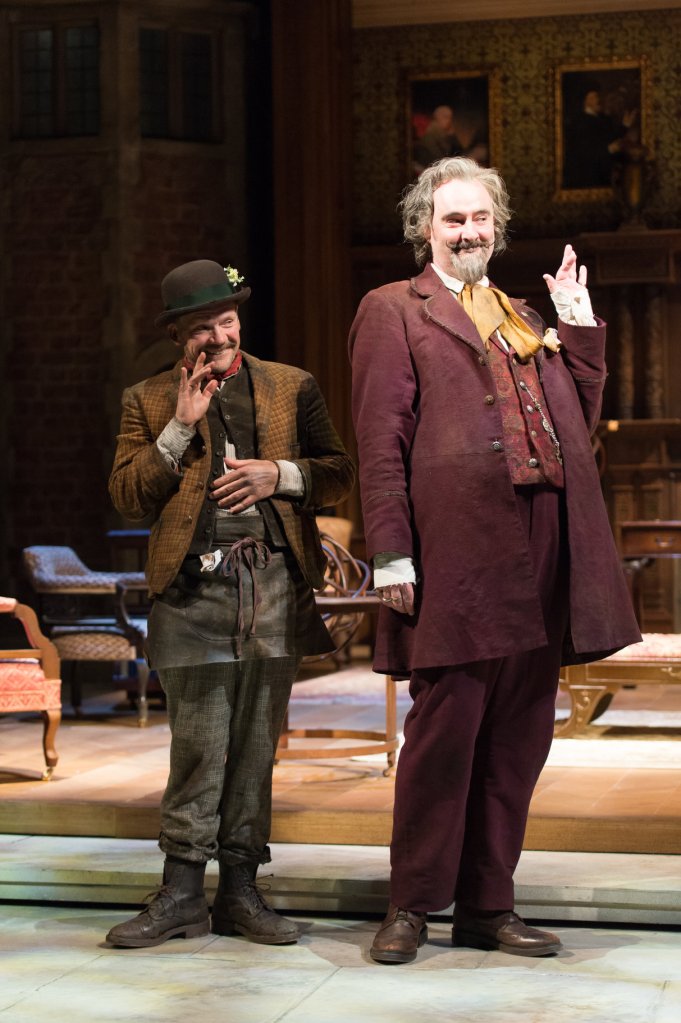
Nick Haverson as Costard and John Hodgkinson as Don Armado in the RSC’s 2015 production of Love’s Labour’s Lost directed by Christopher Luscombe For $2.99 on Amazon Prime—a resource to me beyond imagining in 1984 when I was dissertating—I could re-live the thrill of the best possible production of a play so clearly meant for the stage and not the page, and the many times I had that experience in person there in Stratford-upon-Avon. And, as lagniappe, just two days ago on Morning Edition (12 May 2026), I heard the results of the University of London study establishing that biological aging can be slowed by arts engagement—even to the same extent as physical activity helps maintain genetic function over time. And the effects of that engagement are equally salutary not only for those who produce art, but also for those who partake by visiting concerts, theatres, or museums! Hurrah for epigenetics! Ground-breaking research, not base authority from others’ books.
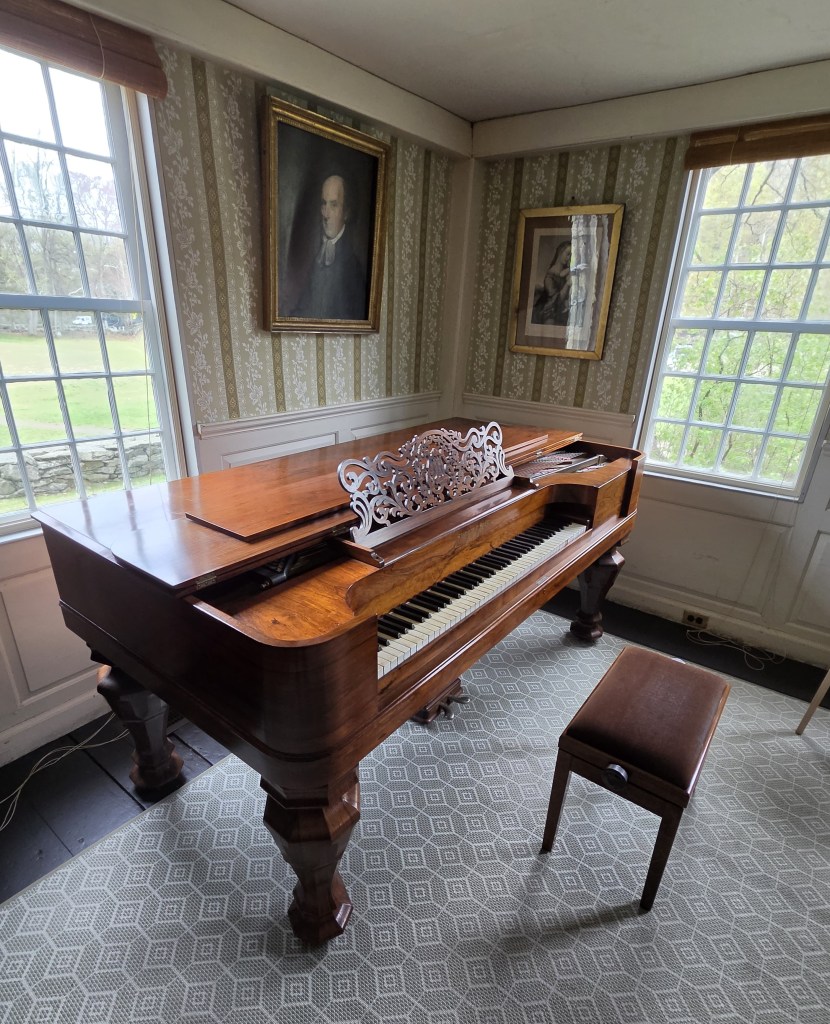
The 1864 Steinway Square Grand Piano in the North Parlor of the Old Manse, the study used by both Ralph Waldo Emerson and Nathaniel Hawthorne. Making music has always been salutary. And so, Dear Reader, as I get the final Euflexxa shot to my right knee next week (my P.A. calls Euflexxa the Ozempic of orthopedics) and attend my monthly Death Cafés, I am buoyed by the thought that going to the ballet, seeing brilliant theatre (and that RSC production qualifies), or even (I daresay) writing this blog, is slowing the rate of my decrepitude. So I keep writing to my representatives to reverse the perilous course of their pathway to autocracy, advocating for and attending to the arts, and taking walks in the woods. Emerson wrote in his Nature, that “In the woods, we return to reason and faith.” You got that right, Ralph Waldo: there I feel that nothing can befall me in life—no disgrace, no calamity, which Nature cannot repair.
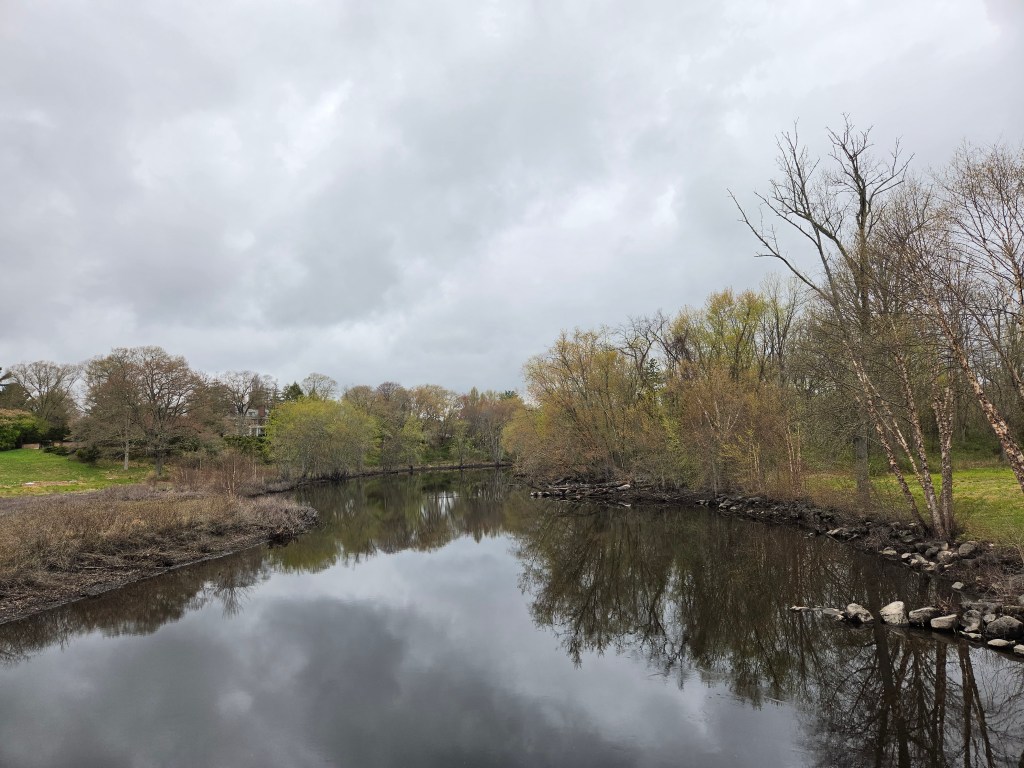
The Concord River from the old North Bridge 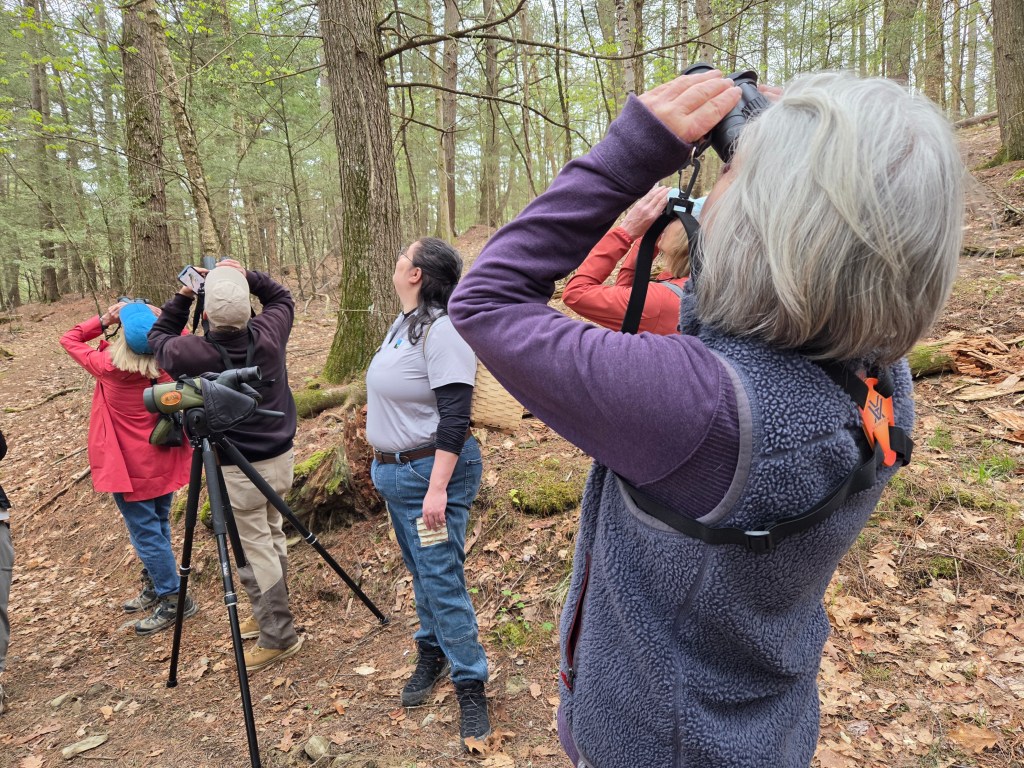
Susan and the Society for the Protection of New Hampshire Forests birding on Saturday morning, 9 May 2026. Emerson would approve. -
Mother’s Day
11 May 2026
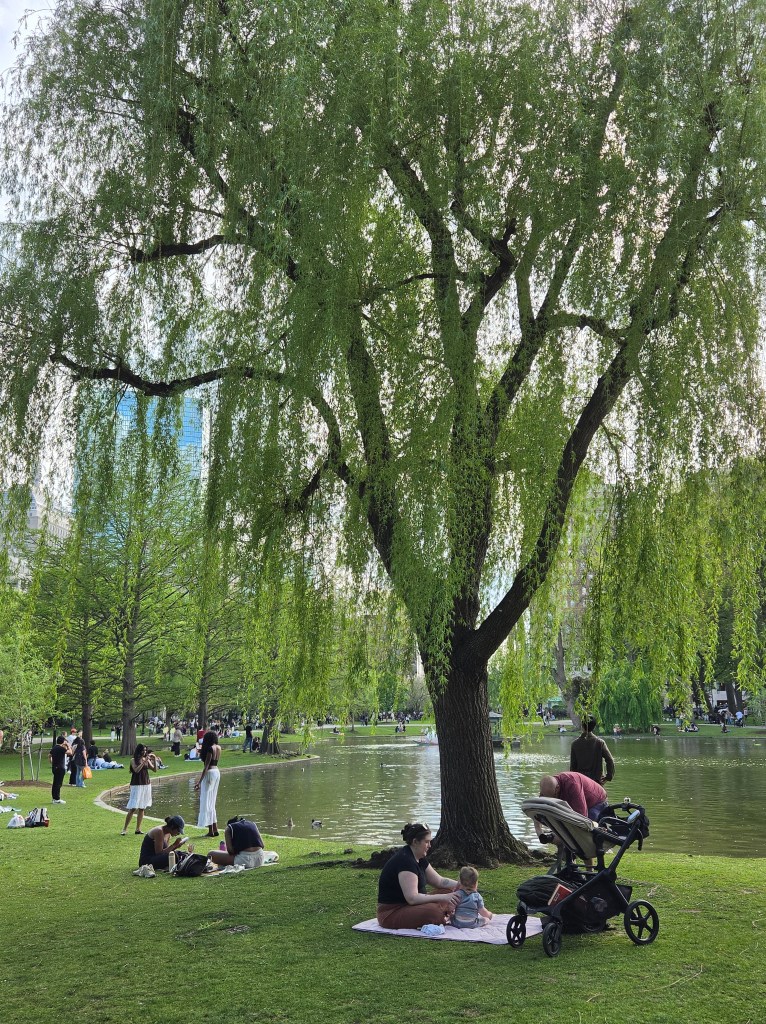
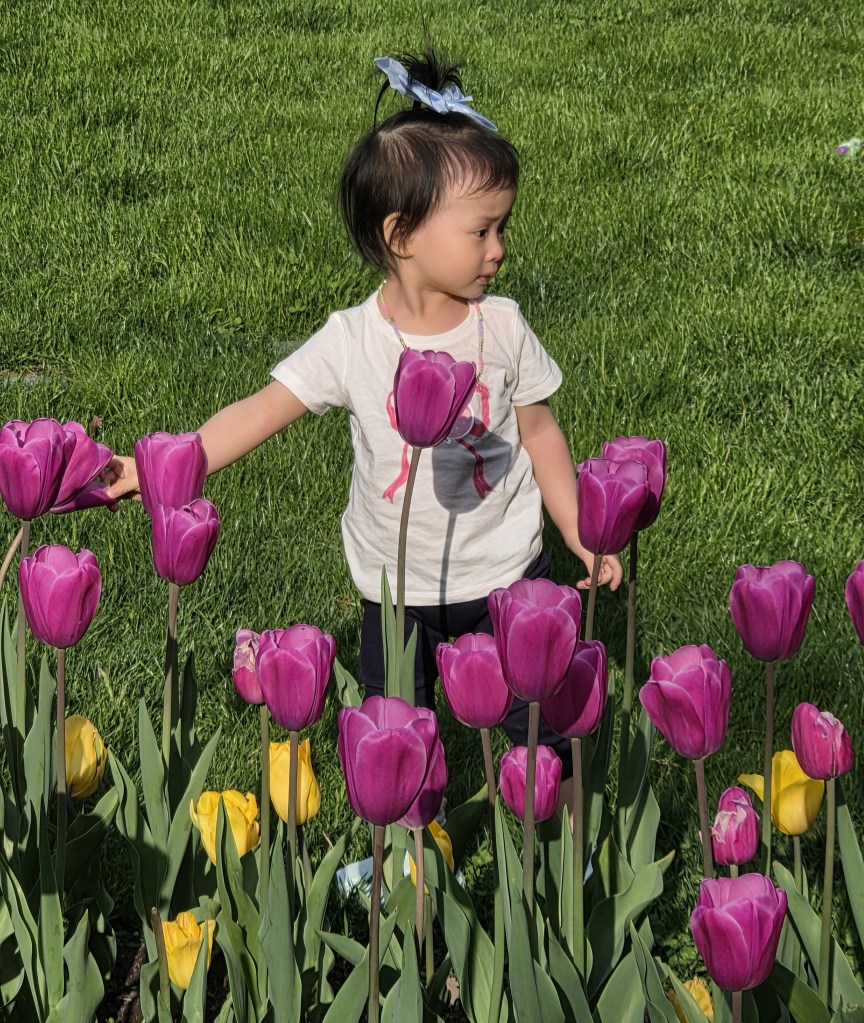
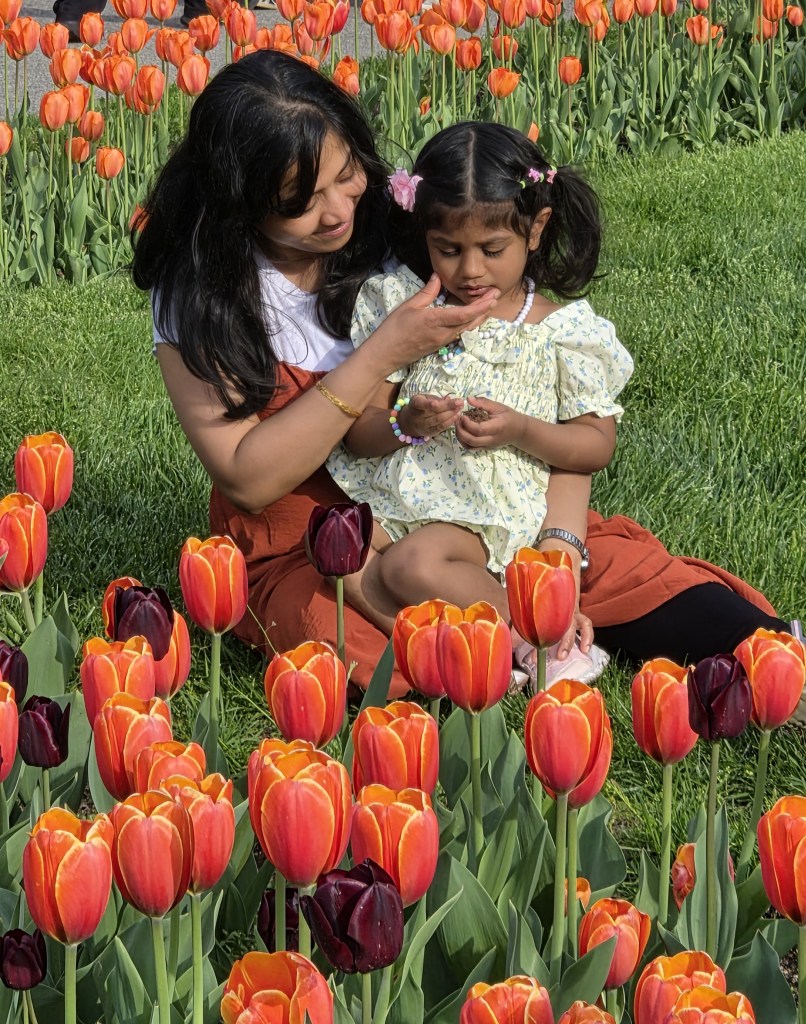
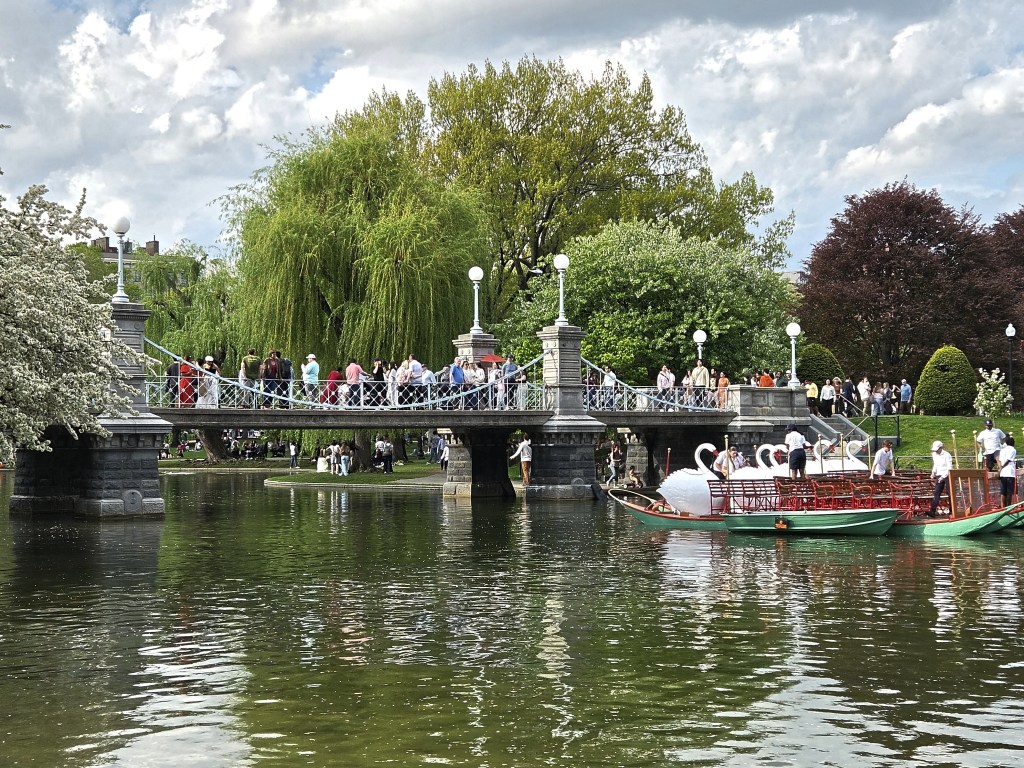
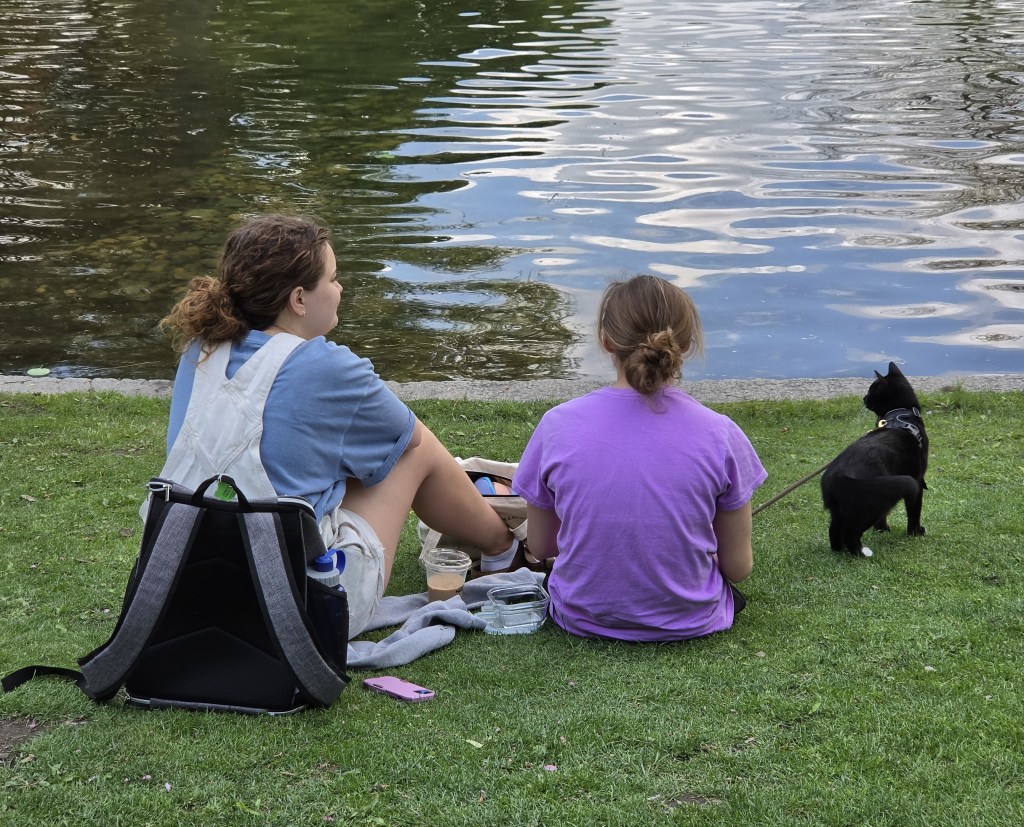
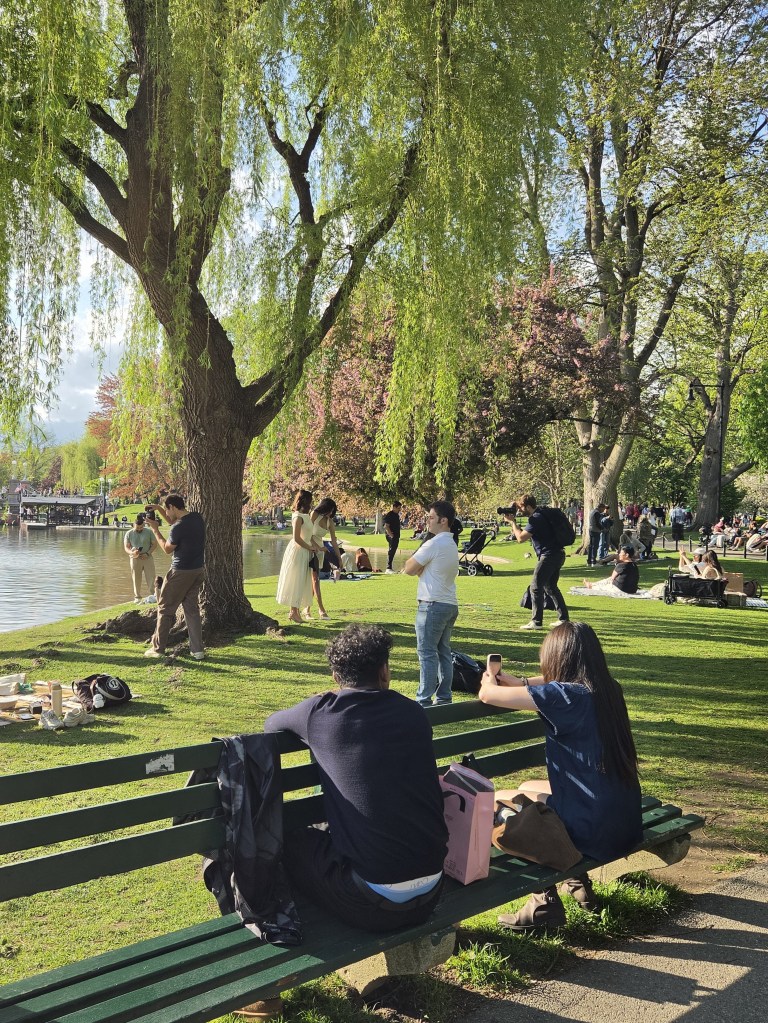
Boston’s Public Garden on Mother’s Day 2026 A life crowded with so much pleasant incident of late prompts me to jump accounting for those less recent experiences to focus here on yesterday, spent first taking in Boston Ballet’s “Spring Experience” and then watching folks recreate in the Public Garden. Mother’s Day proved a great time for enjoying fair weather and flowers in the park.
The Ballet’s wonderful program proved too much, however, for the dutiful mom and her youngest daughter seated next to me at the Opera House. Lia Cirio’s abstract After with its striking tableaux and origami seashell got the better of a squirmy girl; mom and daughter left after After.
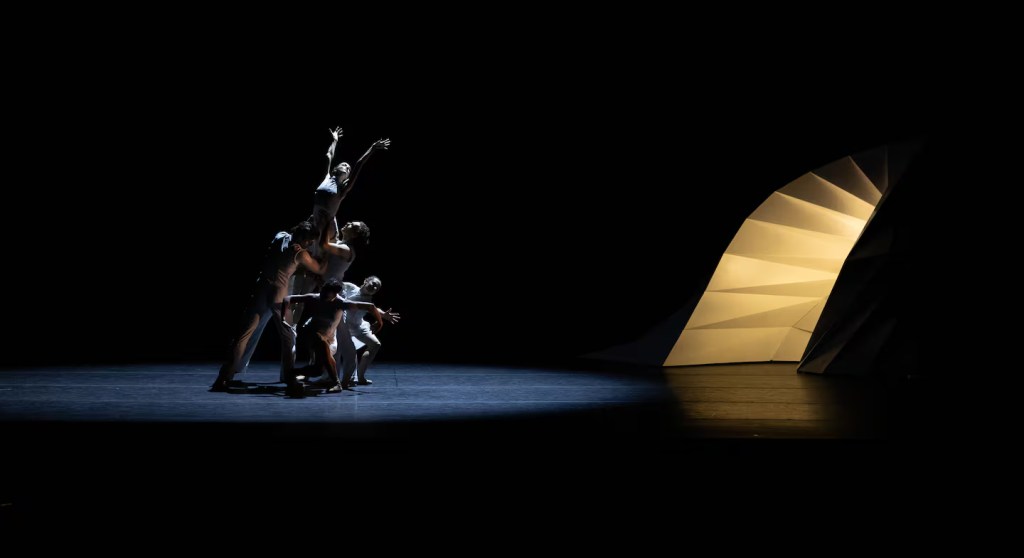
Boston Ballet performs Lia Cirio’s After (Rosalie O’Connor photo) The mom, a fellow subscriber, mentioned she hoped for more patience with Sleeping Beauty at month’s end. I’ll confess that After challenged me as well, but the long program that followed engaged me completely, especially the pas de deux that begins William Forsythe’s Herman Schmerman, a witty battle of the sexes in yellow skirts danced to perfection by Madoka Sugai and Tyson Ali Clark. I’d love to see that again right now. Jerome Robbins’s hour-long Dances at a Gathering also delivered, not only in the technical finesse of the company, but also with guest pianist Nan Ni’s stupendous performance of the knuckle-busting all Chopin score.
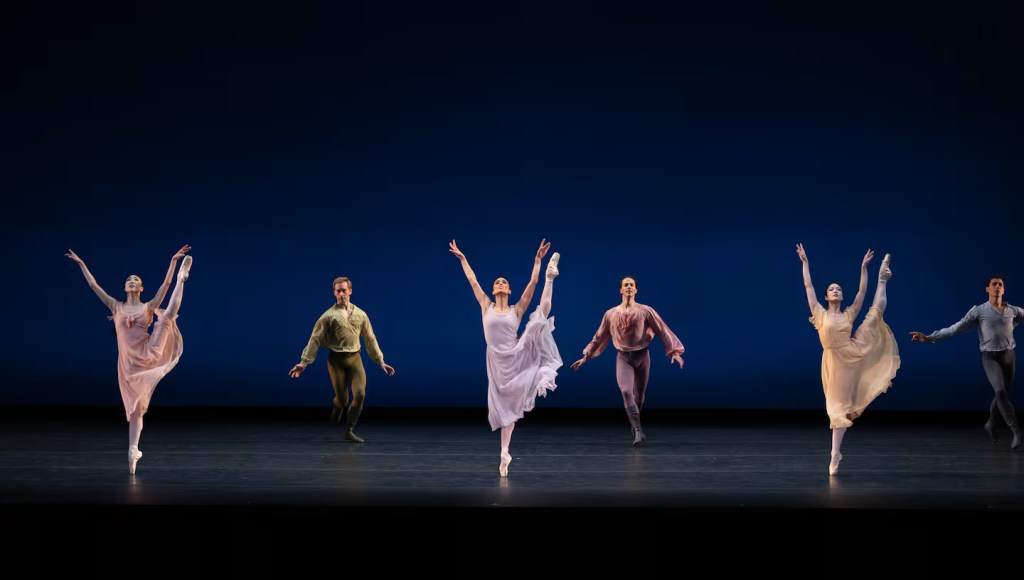
Boston Ballet in Jerome Robbins’s Dances at a Gathering (Rosalie O’Connor photo) I had come to the Opera House looking for solace and distraction from 24/7 news of wrecking balls taken (sometimes literally) to democracy. Mission accomplished.
Then it was time to stretch my legs en route to the Public Garden with a turn around the Common, the oldest public park in America (est. 1634). Perched on a tree leaning over the pond—one irresistible to climbing kids once I vacated it—I deployed my smart phone to connect with my brother-in-law Richard and share the complexities of Mother’s Day for members of what Kate Spencer has dubbed the “Dead Moms Club.”
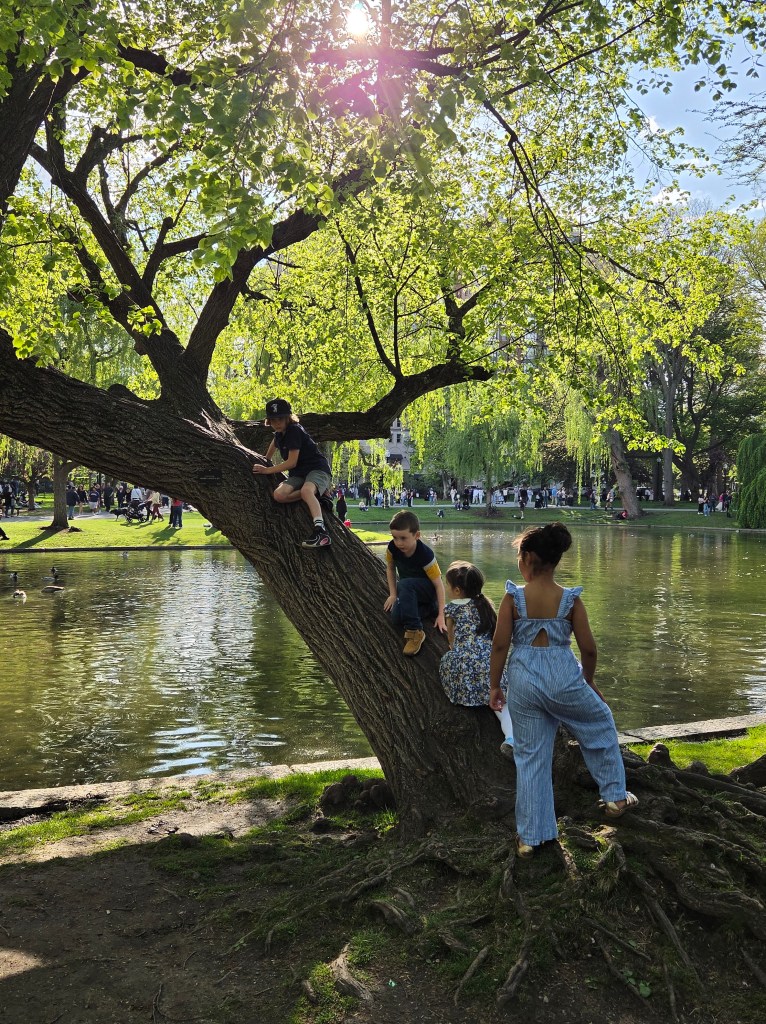
My perch usurped by monkey kids It’s 18 years since my mom Virginia passed, only 2 since my sister Jane, Richard’s wife and Daniel’s mom, left, and the only constant is the absent presence of both. Relationships remain dynamic, even with the departed. Richard and I agreed on the persistence of grief, the perniciousness of a broken health care system and predatory insurance companies, and the salutary comfort of music and good deeds. We shared photos. And then I strolled, taking in the many moms and kids, sweet couples, proud grads, and soooo many photographers.

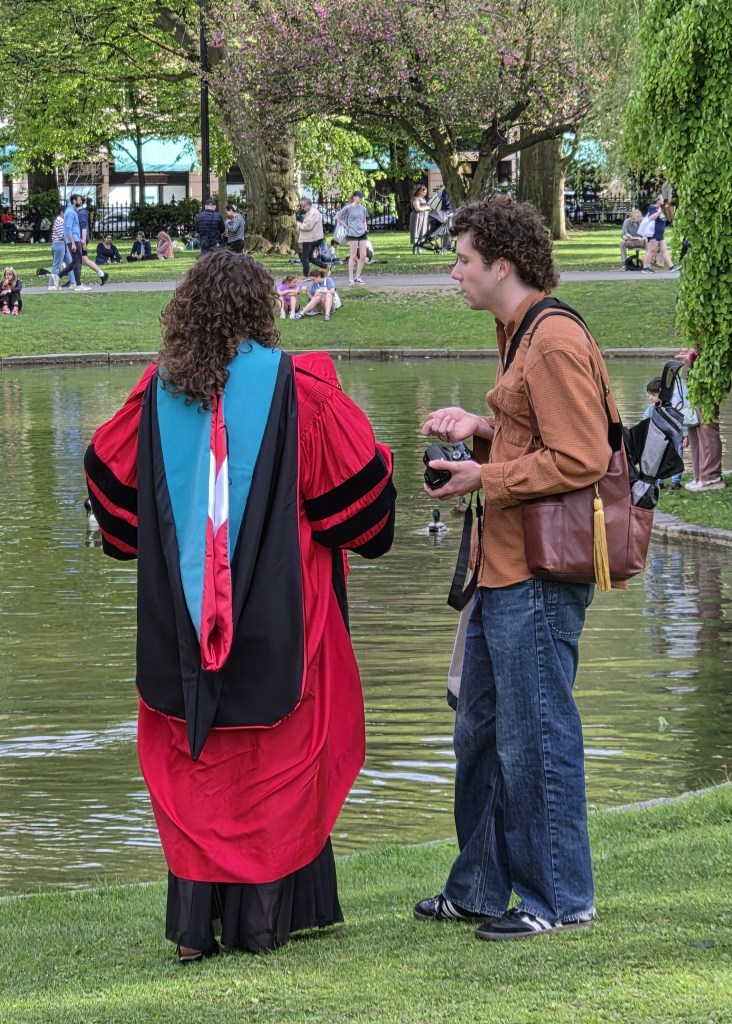
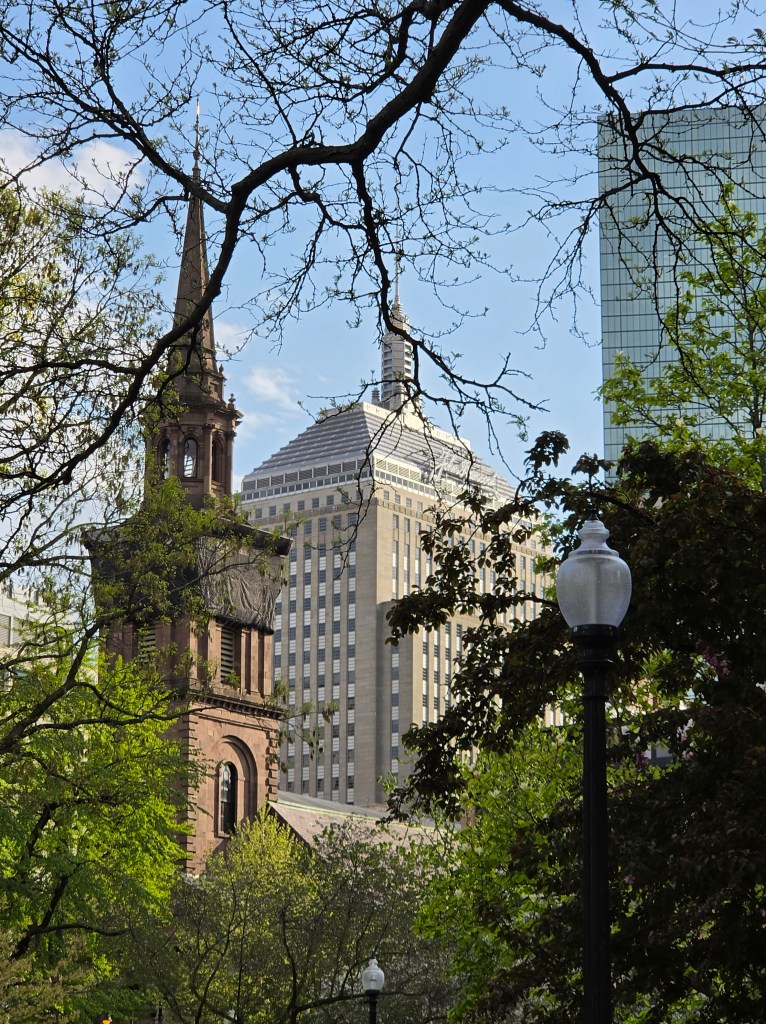
l to r: Arlington Street Church (1860), the Old John Hancock (now Berkeley) Building (1947), and John Hancock Tower (1976). N.B.: A.I. misidentified every building in this photo. Beware Google Photos “intelligence”! On my way back to the parking garage (with the Opera House crowd now happily discharged) I passed the Burying Ground, a memento mori juxtaposing all the new beginnings of Spring and the day.
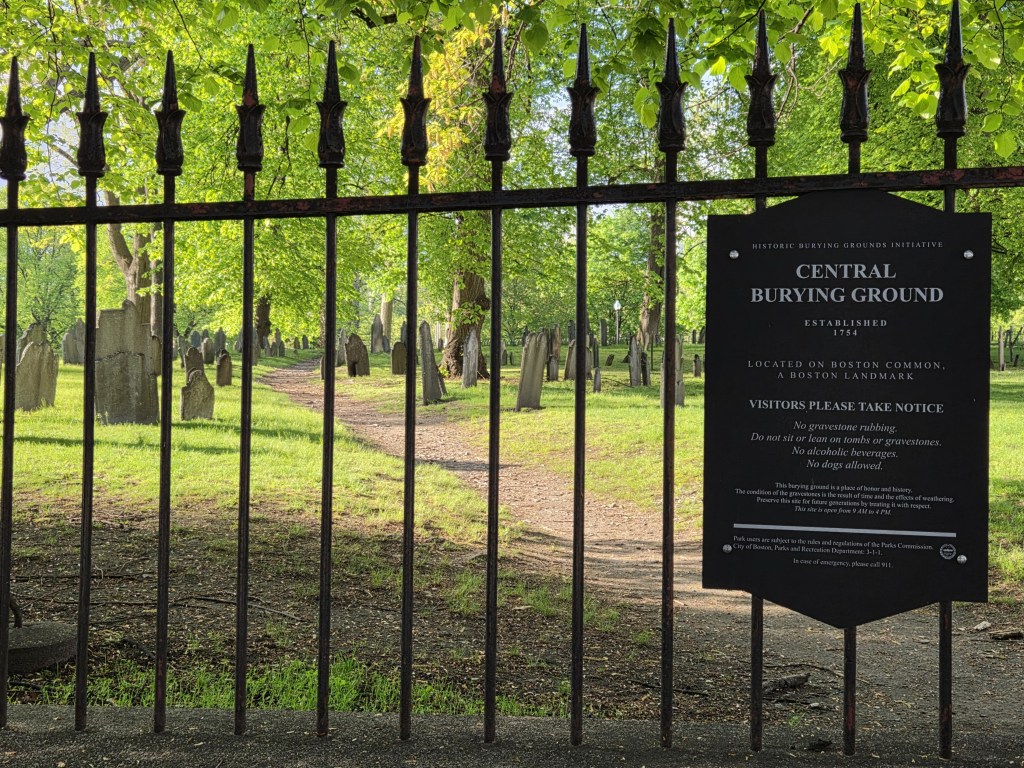
And there at the corner of Tremont and Boylston overlooking the Common, I noticed the mosaic seal of the Grand Lodge of Masons in Massachusetts, with beavers representing the industriousness, community, and collaborative nature of builders, aligning with the foundational principles of Masonry, adopted (I subsequently learned) from the coat of arms of the Premier Grand Lodge of England. Given that our home, Gnawwood, was named for our tutelary beavers, I was pleased to see them celebrated flanking the core guiding principle of the Masons: “Follow Reason.”
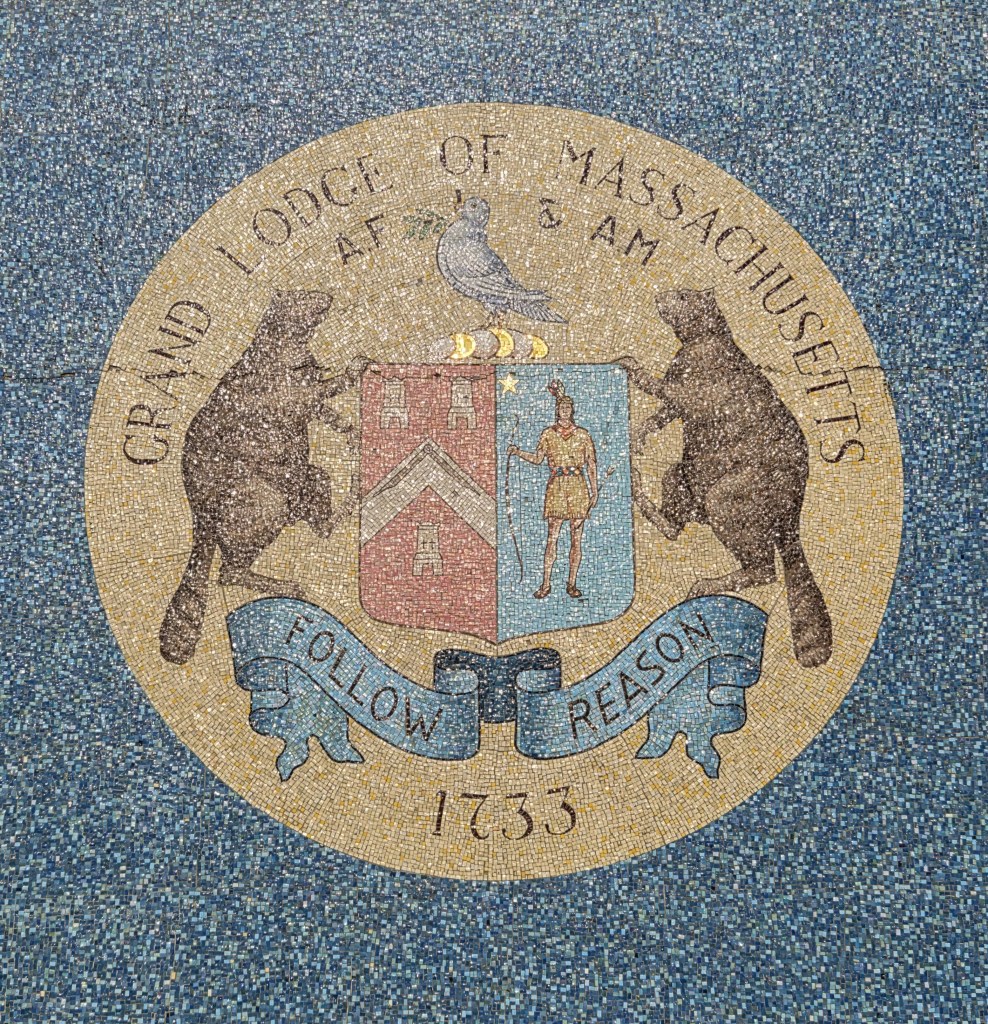
“Follow Reason.” Words of wisdom from 1733 for this, our plastic moment.
Point taken. Happy Spring!

Tulips at the Public Garden, Boston AFTER, Arlington Street Church, beavers, Boston, Boston Ballet, Boston Common, Central Burying Ground, DANCES AT A GATHERING, Grand Masonic Lodge of Massachusetts, HERMAN SCHMERMAN, Jerome Robbins, John Hancock Tower, Lisa Cirio, Madoka Sugai, moms and kids, Mother’s Day, Old John Hancock Building, Public Garden, tulips, Tyson Ali Clark, William Forsythe -
Hope
7 April 2026
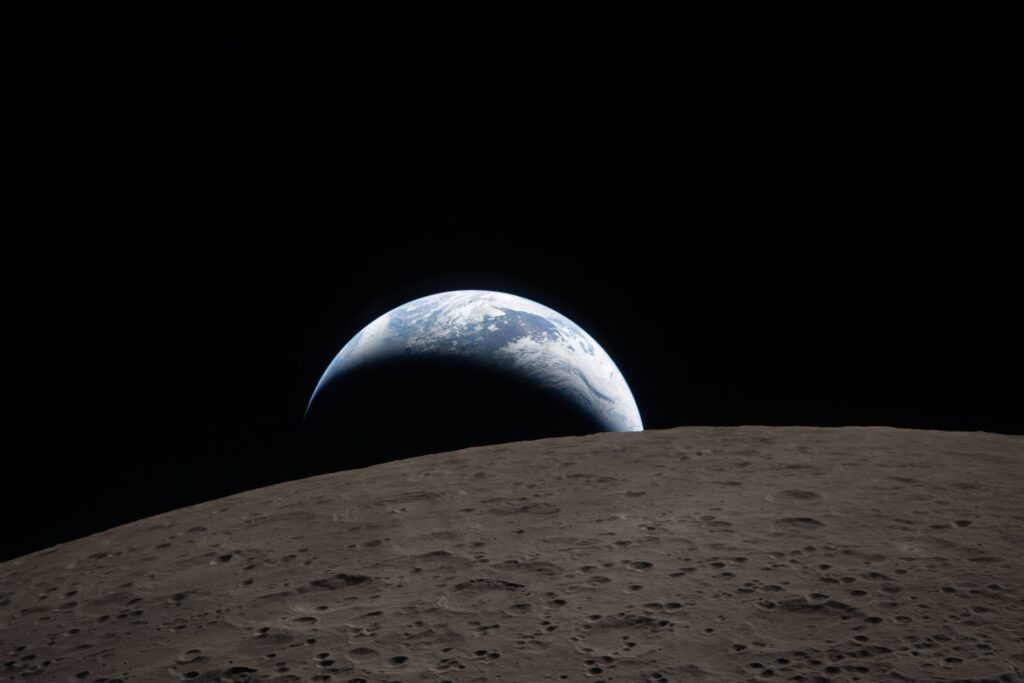
Earth Rise as seen by the Artemis II crew on 6 April 2026 Waking to snowfall this morning—belated April Fooling from Mother Nature—surprised me out of the incipient MADD-ness (Mixed Anxiety-Depressive Disorder) that has too often characterized my first waking moments of late.
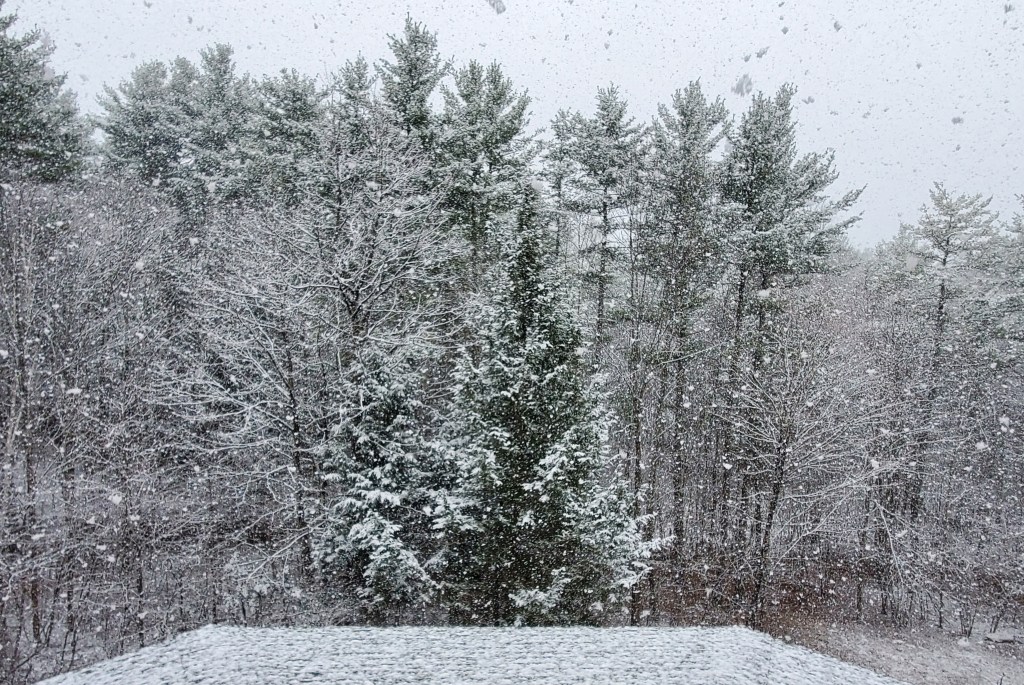
Snow falling in the view to the south, Madbury NH, 7 April 2026 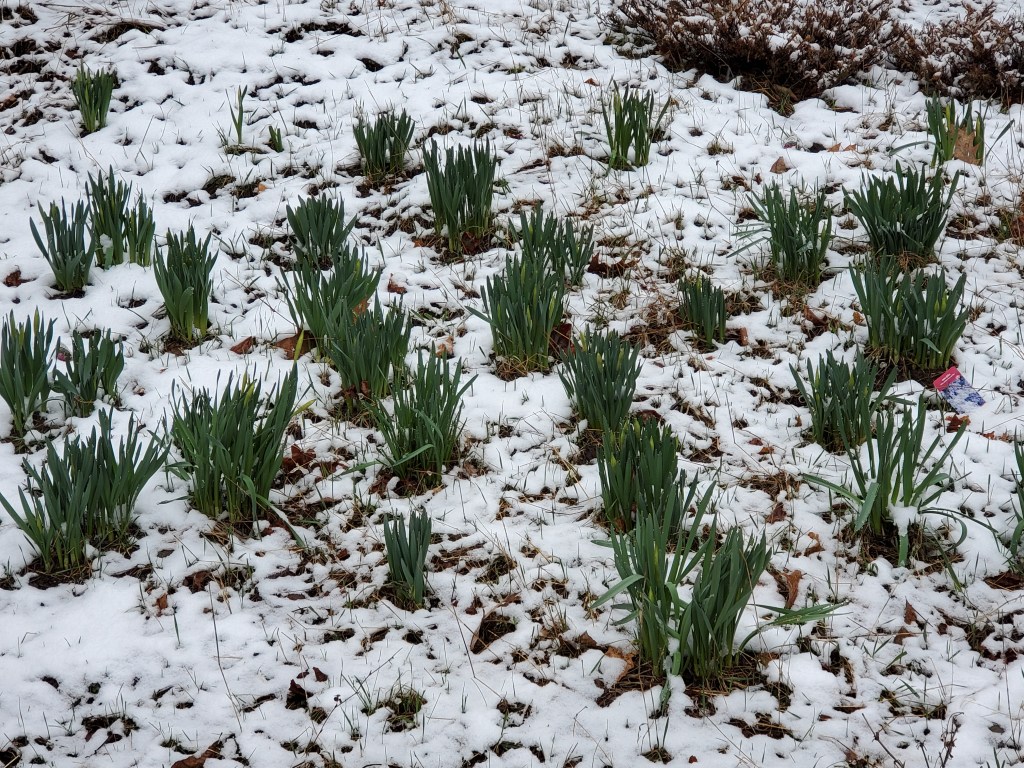
Daffodils braving the chill Accustomed to feeling overwhelmed by worries personal (the whips and scorns of time) and public (a world subject to the Felon-in-Chief’s latest indecency, obscenely venting mortal threats on Easter Sunday, no less), I suddenly remembered that the day before I had felt hopeful all day—such a rare occurrence. And so I decided to catalog all that contributed to that mood, and extrapolate from doing so a salutary formula, yearning to be able to retrieve hope at will. Here’s what happened, Dear Reader.
First, there was Easter Sunday, initially heralded by a rafter of turkeys, including one handsome Tom taking the place of the Easter Bunny.
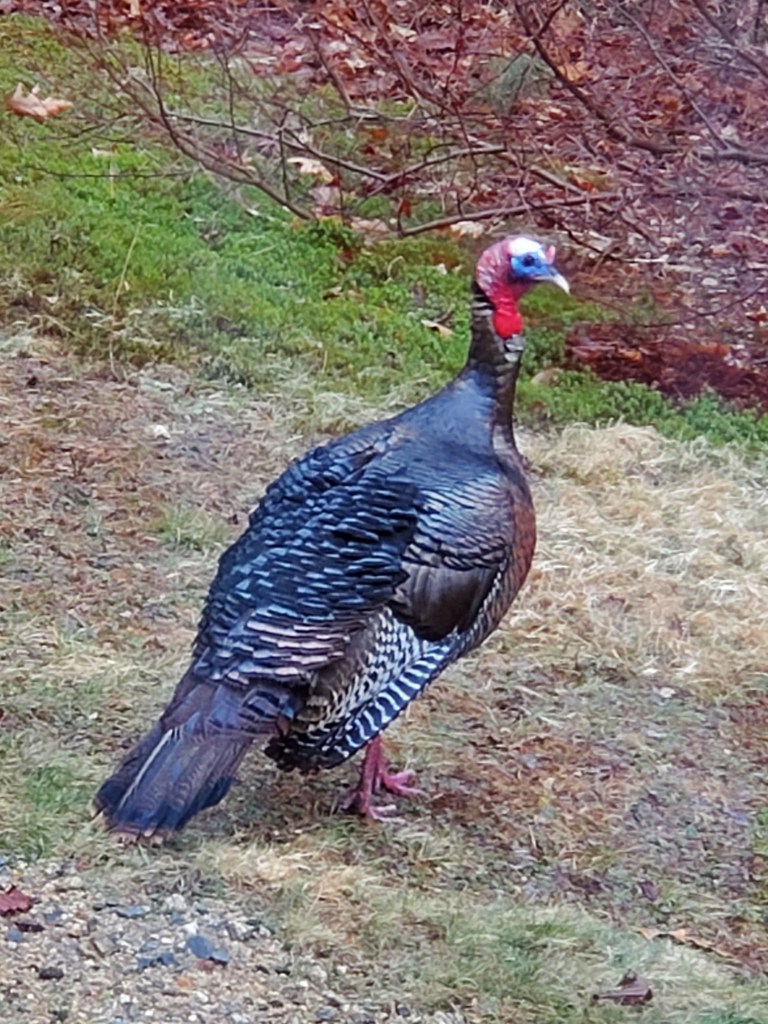
Then came the comforting company of long-standing friends celebrating with a communal feast all the season’s hopeful renewals, sacred and secular. We all contributed—my now traditional offering was once again deviled eggs—and enjoyed both new acquaintances and catching up with the old, a gathering bracketed by the long drive separating Madbury NH from Newton MA where the daffodils are already in bloom.
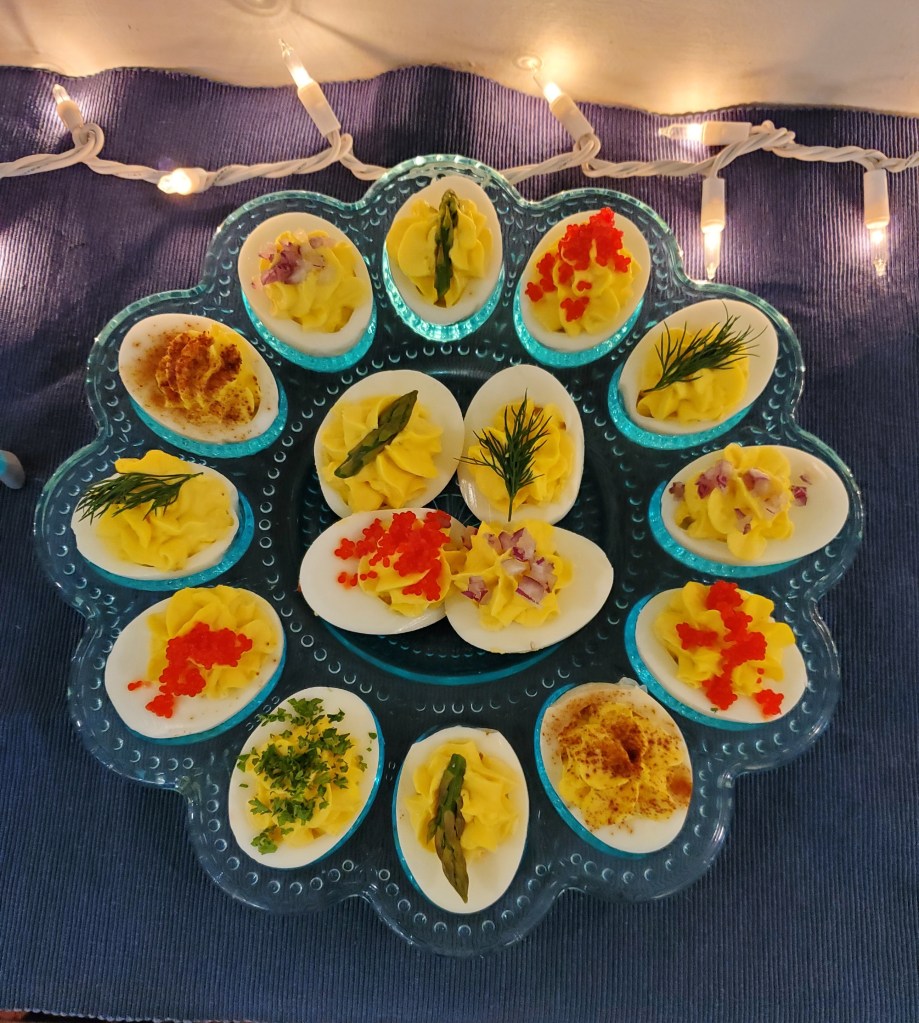
Savory Easter eggs The schlep to and fro was nevertheless made delightful by convivial chat and a spectacular sunset painting the louring sky a luminous tangerine on the way north. My spontaneous recitation of opening lines from Richard III as we crossed the Tobin Bridge (“And all the clouds that loured upon our house / In the deep bosom of the ocean buried”) made my friends laugh, and made me feel less obsolete for having them in my head.
And then came Easter Monday, Angel Monday, recalling the arrival of the three Marys at the empty tomb where Jesus had been laid, only to be confronted by angels asking them whom they seek. The little four-line elaboration of the Easter Introit, the Quem Quaeritis trope (c. 923-934) marked the beginning of medieval liturgical drama:
Angel: Whom do you seek in the sepulcher, O followers of Christ?
Marys: Jesus of Nazareth, the crucified, O heavenly ones.
Angel: He is not here; he has risen as he foretold;
go announce that he has risen from the sepulcher.
Marys: Alleluia! The Lord has risen!
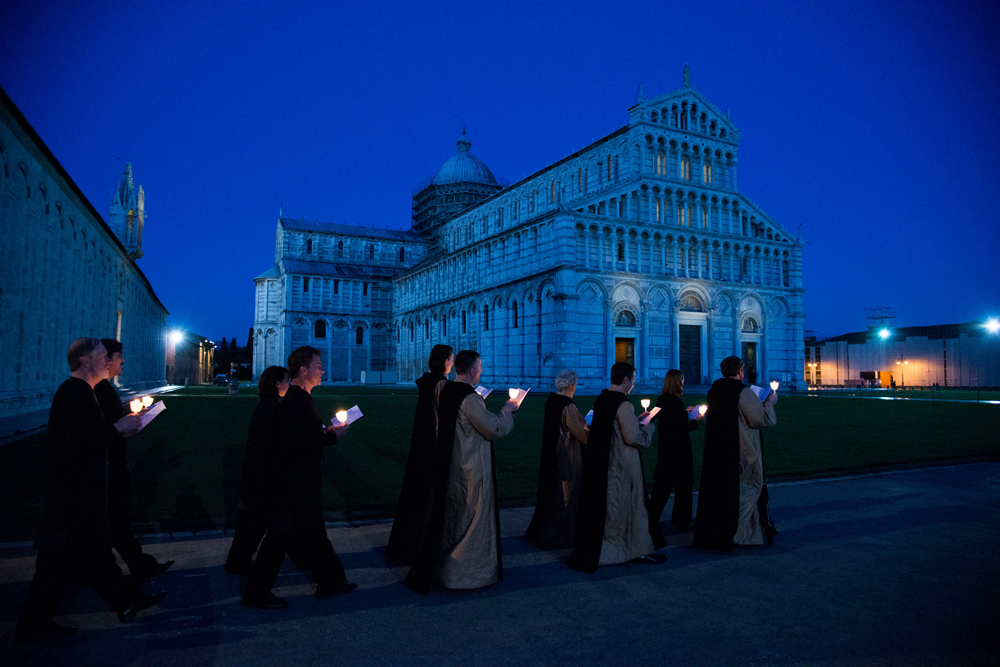
Elements Theatre Company approaching Pisa Cathedral to perform the
Quem Quaeritis trope in May 2016Without that impulse to turn liturgy into drama, a development that later collided with the Renaissance recovery of classical texts, including the Latin plays of Plautus and Terence that my boy Will would have translated at the King Edward VI school in Stratford-upon-Avon, I never would have had those opening lines of Richard III in my noggin to tickle my friends. Connection, to each other, to the past, to what one has learned over a lifetime, is the dispeller of despair, progenitor of hope. Connecting with my art historian friends was key, for our Easter dinner had united these disciplinary colleagues, and it had been Mara the medievalist who reminded me that Easter Monday was also known as Monday of the Angel. Joan Didion was right: we tell ourselves stories in order to live. And stories connect us both to each other and to our past, giving the present a consoling context.
Serendipitously, another former colleague, art historian Anne Leader, had recently sent me a link to her “Meditations on the Death of Jesus,” part of her “Art History with Anne Leader” blog on Substack and an occasional piece offering both a lesson and a spiritual invitation which she had first prepared for the annual prayer vigil of the First Presbyterian Church of Auburn, Alabama back when we were all cloistered by COVID in the spring of 2020. The thirteen devotional texts Anne chose are moving, and her glossing of the art that illustrates them (much of which I’d traveled to visit over the years) again filled me with hope: fine scholars continue to connect us to the humanity we crave, and they find evermore accessible ways to do so.
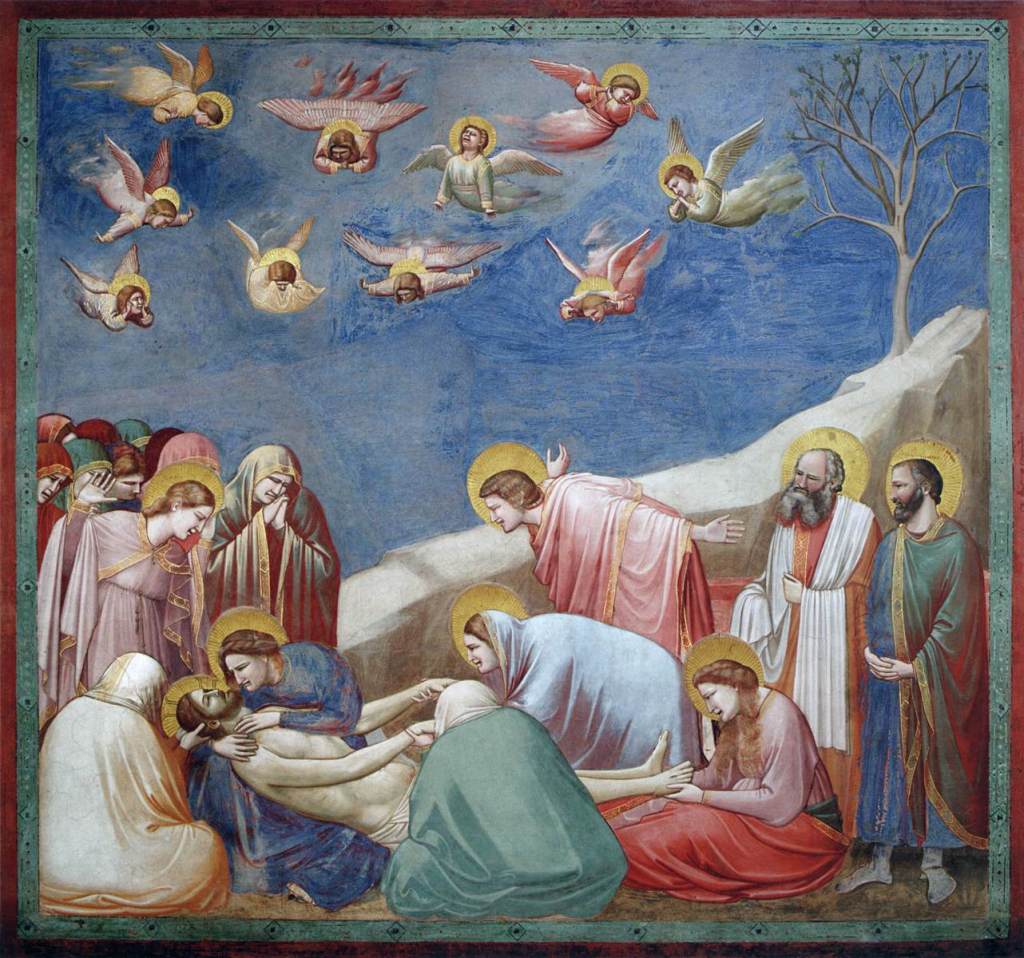
Giotto’s moving Lamentation (1303-05), part of his masterful fresco cycle depicting the lives of Mary and Jesus in the Cappella Scrovegni, Padua: now easily available to all online Technology that has so often filled me with dread now seemed inviting and even inspiring.
And so, while waiting at Wentworth Douglass Hospital in Dover for a post-op checkup with the wonderful APRN Royce, who had helped me through a hernia operation back in December (one of the many replacements and repairs that 70+-year-old flesh is heir to), I decided to fire up my phone to check on the Artemis II crew. Suddenly, as I sat in the waiting room, there they were, right there on my phone, broadcasting live as they approached the far side of the moon, boldly going (in Star Trek parlance) where no man has gone before.
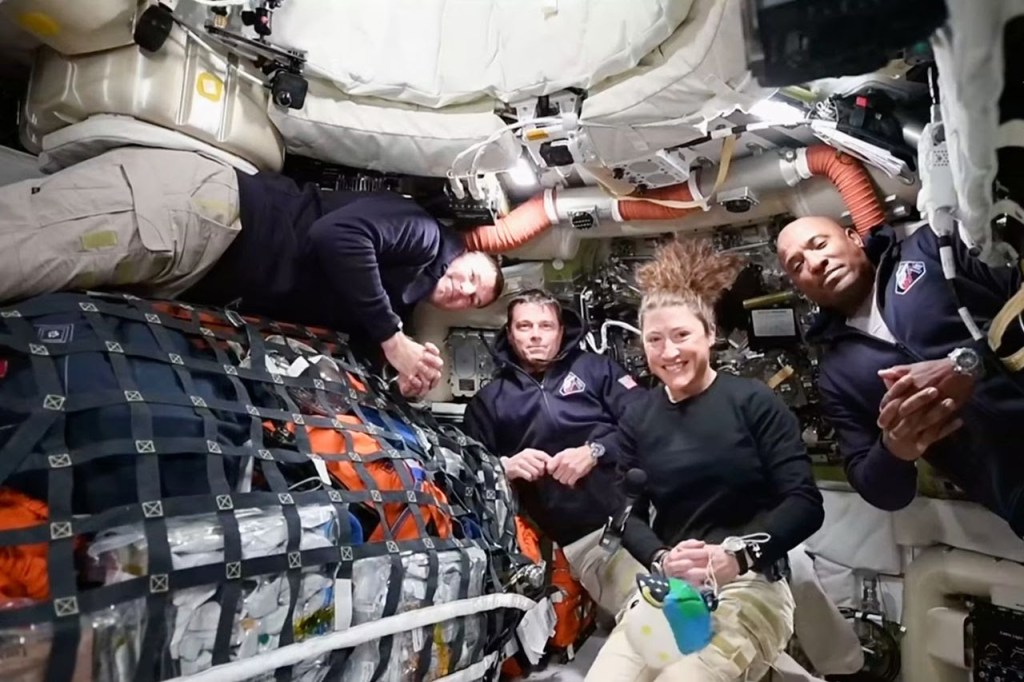
The Artemis II crew, l. to r. Mission Specialist Jeremy Hansen, Commander Reid Wiseman, Mission Specialist Christina Koch, and Pilot Victor Glover 
Total solar eclipse viewed from spacecraft Orion on 6 April 2026 But this intrepid voyager was not just a man, but a diverse crew, including a Canadian, an African American, and a woman—the Felon-in-Chief’s DEI nightmare. My mind was blown. How was it possible that they were broadcasting, live, to me, as they cruised toward the undiscovered country, 252,756 miles from Earth, and I sat in the hospital waiting to see if my hernia was indeed fully repaired?
I carried my phone into the exam room to show Royce. He not only marveled along with me at our connection to the Artemis crew, but also pronounced me entirely healed; robotic laparoscopic surgery is another technological miracle. Lifted as I was by this good news and by the humility of these brave, brilliant astronauts, I extended my checkup by asking Royce if he’d had a good holiday. A real conversation ensued: I shared a tip about how best to peel hard boiled eggs (steam them for 15 minutes and then plunge them into ice water) and told him of my reunion with friends of 30+ years; he told me a similar tale of invaluable old friends and went on to speak of uplifting video clips he’d recently seen illustrating the wise humanism of the former First Couple (Barack: world leaders can also be stupid; Michelle: rich and famous is not something devoutly to be wished).
I left the hospital feeling better than I’d felt in a long time—so much so that I went on connecting, linking by email my former colleague at Centre College and good friend Bill Levin with his fellow Renaissance scholar Anne Leader, and jumping out of my culinary rut with a new pasta primavera recipe from the New York Times. Feels good thus exiting the Slough of Despond.
And so, Dear Reader, reminded that even an April snowfall can be beautiful, I conclude this belated paschal message with the reminder that E. M. Forster’s epigraph to Howard’s End, which I once put on a poster advertising a new Humanities course, remains accurate and compelling: “Only connect.” Connect with your friends, connect with the past, value what the arts have to teach, share your expertise, marvel at and celebrate the best that humans can achieve when they cooperate.
There may well be hope for us after all.
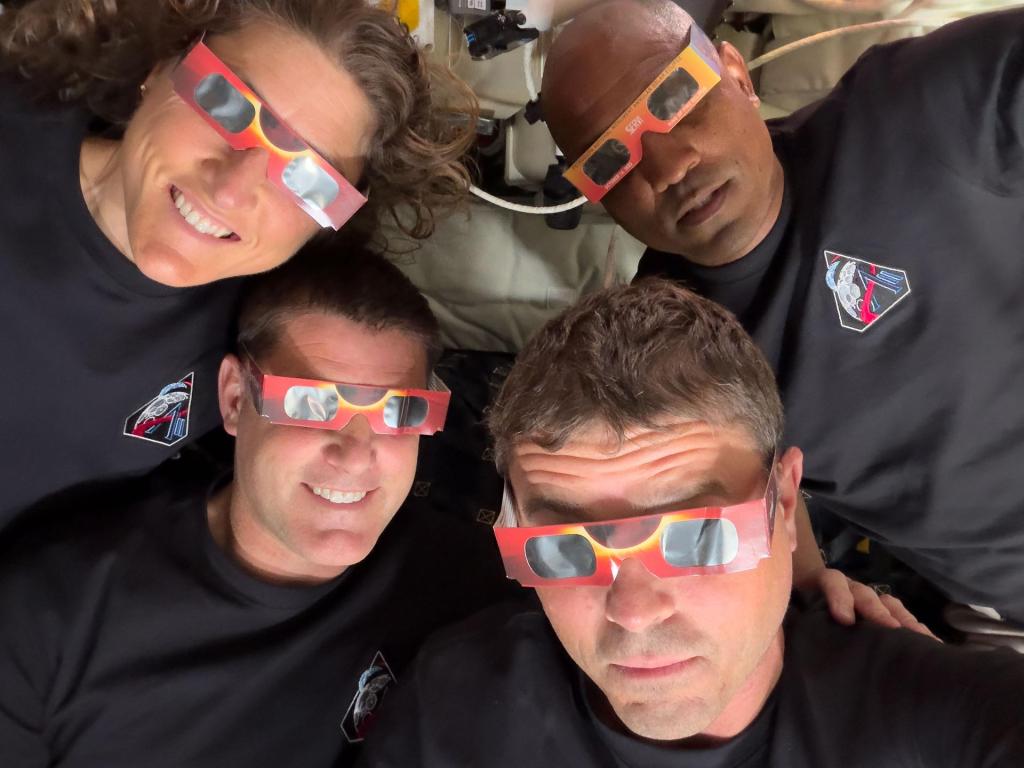
Astronauts Koch (top left), Hansen (bottom left), Wiseman (bottom right), and Glover (top right) sporting their eclipse glasses 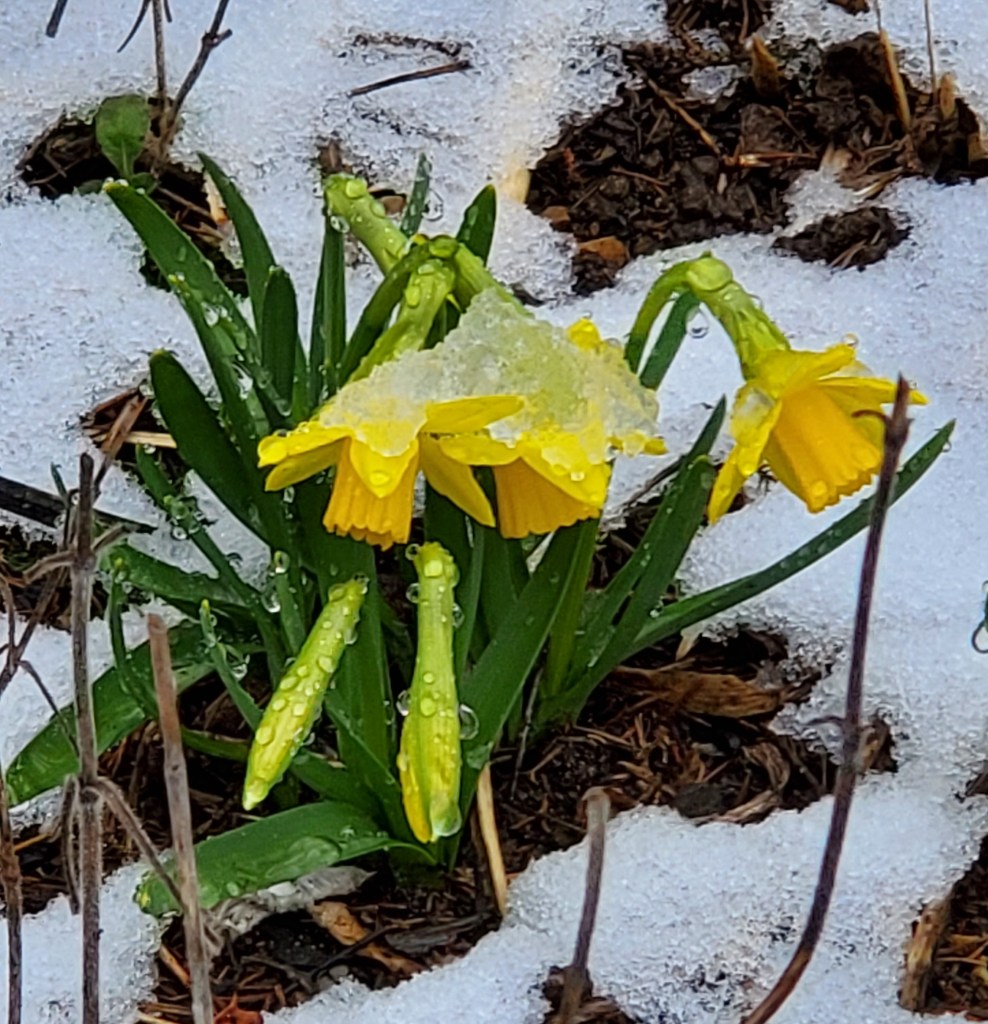
-
Bridging the Gap with Living Art
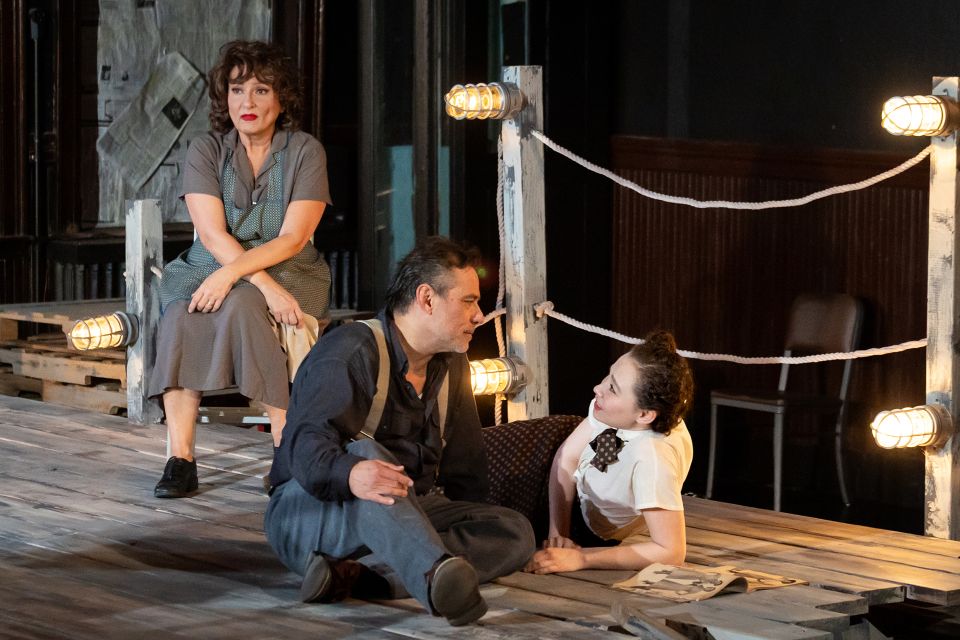
Beatrice (Sehnaz Dirik), Eddie (Jorge Rubio), and Catherine (Naomi Kim) in Apollinaire Theatre Company’s production of Arthur Miller’s
A View from the Bridge (photo by Darlene DeVita)In his 1960 introduction to the Viking Compass edition of his 1955 play A View from the Bridge, Arthur Miller wrote of how rarely a play gets a second chance: it “makes its mark right off or it vanishes into oblivion.” He goes on, however, to examine the success of both that play and The Crucible following their initial failure to find large audiences for their original Broadway productions. After a couple of years, Miller writes, Crucible was produced again off Broadway and ran two years–without a line changed from the original. With McCarthy dead, Miller asserts, the play’s humanity could finally be enjoyed as drama and not as an unaesthetic special plea. With Bridge, however, Miller revised his original one-act drama, which then under Peter Brook’s direction ran with great success as a two-act play first in London and then in Paris. Miller attributes that transformation in part to the demands of different production exigencies: British actors could not reproduce the Brooklyn argot the characters speak, but, accustomed to playing Shakespeare, they could most certainly incorporate into a seemingly realistic play the mythic, larger-than-life quality the play demanded.
Miller’s take on the relationship between play and the time and place in which it is produced got me thinking about the work of art and its context-dependent reception. The serendipitous tension between naturalism and epic theatre that Brook’s production of A View from the Bridge achieved in London in 1956 London was equally successful in David R. Gammons’s production of that play at Chelsea’s Apollinaire Theatre, whose final performance I was privileged to see on 22 March.
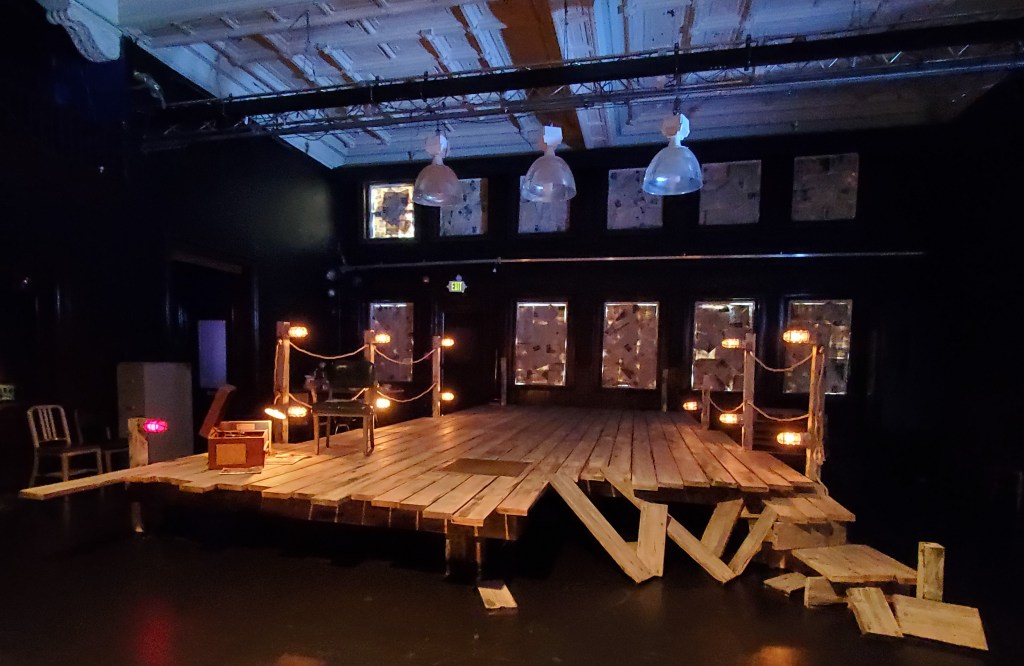
Scenic design for A View from the Bridge by Joseph Lark-Riley Joseph Lark-Riley’s handsome set conflated the eponymous bridge with the Carbone family living space, ironically highlighting the conflicts that finally cannot be “bridged” without catastrophe: the old world code of culture rooted in honor and vengeance challenged by a new order of American possibility via the Red Hook docks; the protectiveness of a father figure challenged by forbidden desire; the law rendered impotent before the complexity of human nature.
All the characters in Gammons’s production were stylized, larger than life, half real and half mythic: the strong, dark Marco (Rohan Misra), the gamine innocent Catherine (Naomi Kim), the passionate and frustrated wife Beatrice (Sehnaz Dirik), the unsettlingly charismatic Rodolpho (Andrew Molano Sotomayor), and the tormented, tragically deluded Eddie (Jorge Rubio). Rodolpho’s dangerous charm, his threat to Eddie’s understanding of himself, his family and community, was powerfully evoked by the longshoremen Eddie, Louis (David J. Kim), and Mike (Andre Meservey) performing as an alienating trio grotesquely barking stylized laugher while ghoulishly uplit from below. The family mimed dining noisily from bowls, seated around a non-existent table, juxtaposing the real and the imagined. And the plight of the plot’s illegal immigrants, together with Eddie Carbone’s fatal, unresolved attraction to both his niece Catherine and the handsome Rodolpho, bridged the gap between the play’s reception in 1956 London and its revival in 2026 Chelsea, MA. Resonating with contemporary fears of I.C.E. and the toxic masculinity of the Trump era (watch Pete Hegseth thump his chest), Arthur Miller’s play retains its power and relevance 21 years past Miller’s death and 70 years since its composition. The play’s narrator, the lawyer Alfieri (a cool but compassionate Dev Luthra), enjoins us, however ambivalently, to “settle for half,” to make do with less. “I am inclined to notice the ruins in things” he says, “perhaps because I was born in Italy.”
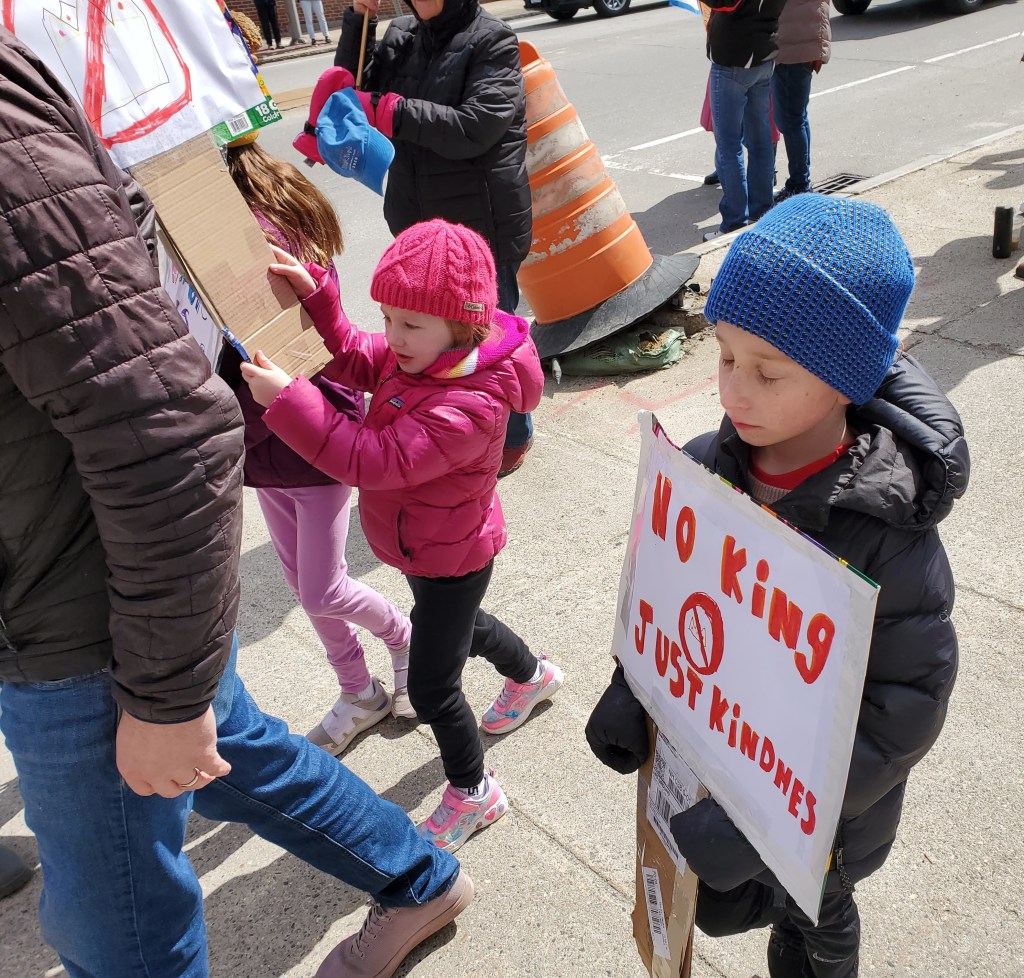
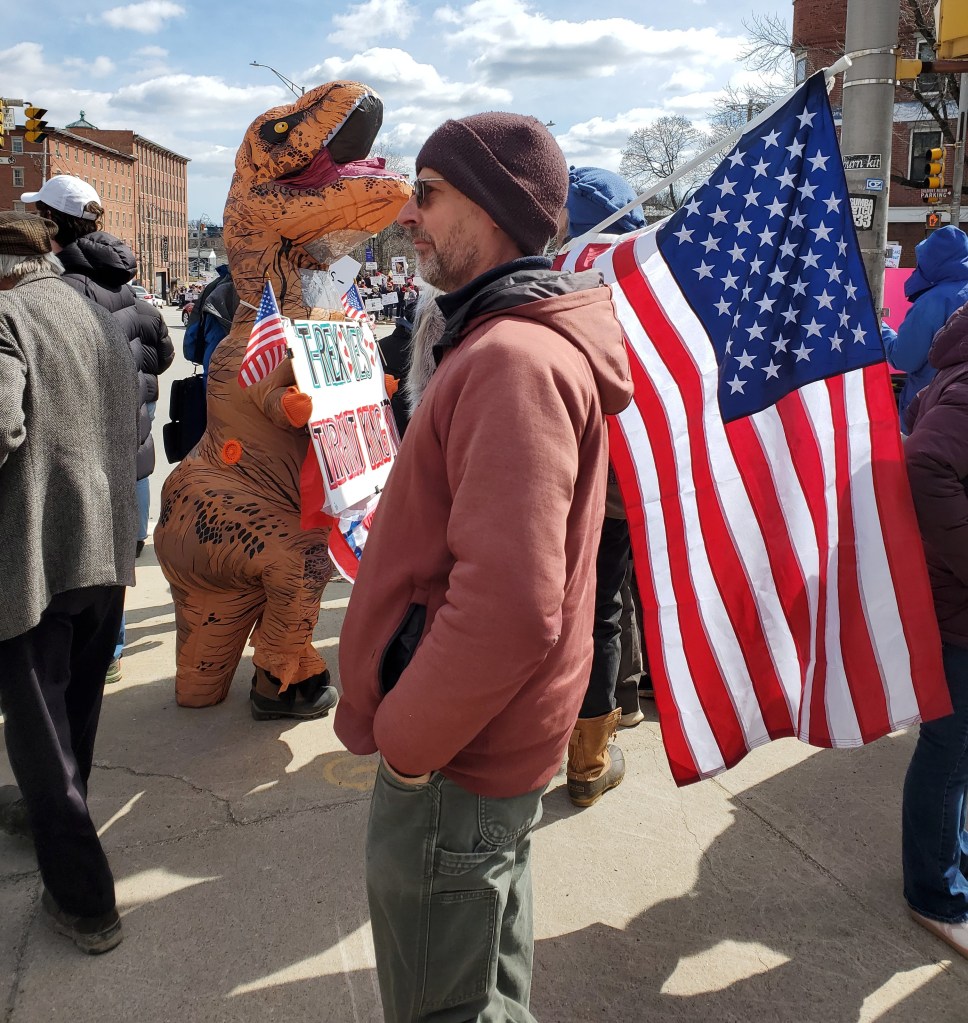
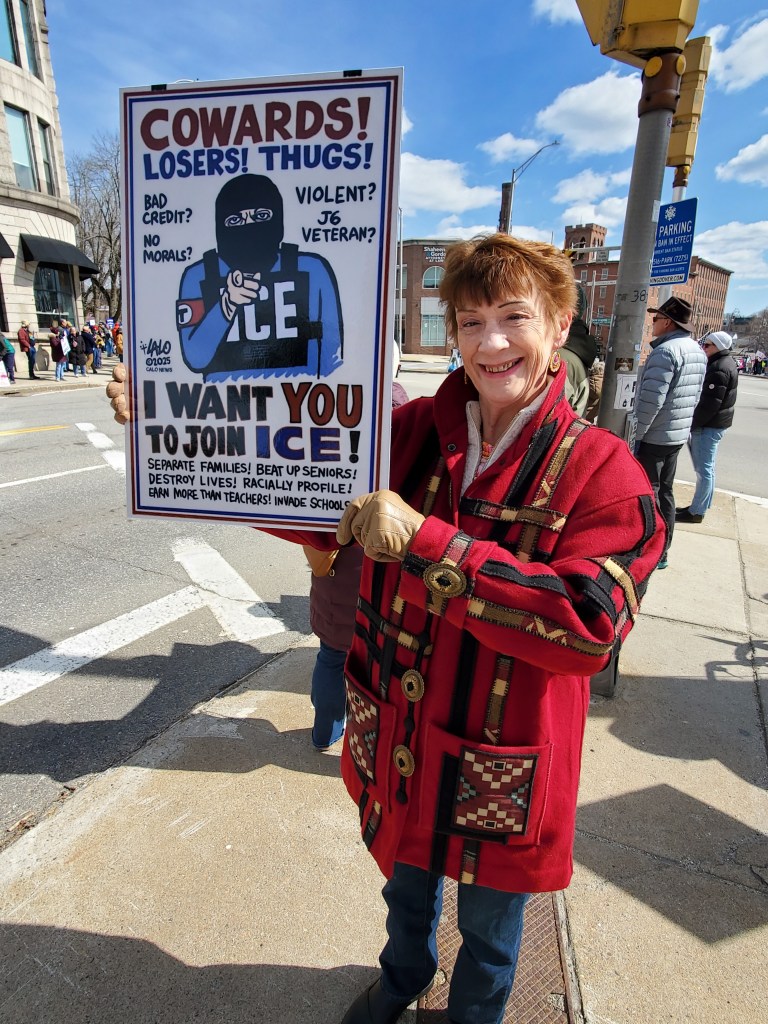
Well, the serendipity of my seeing this excellent production within a week of Saturday’s No Kings rallies—8 million people, 3,300 events, the largest single-day nonviolent protest in modern American history—made me consider what bridges connect us with Miller’s art and the degradations of the Felon-in-Chief. Plenty of my fellow citizens have noticed the ongoing ruination of the American experiment, from demolishing the East Wing of the people’s house to murdering citizens asserting their Constitutional rights, and these people have something to say, apparently unwilling, unlike Alfieri, to settle for the current status quo. Like other Granite Staters braving the cold while waving signs on the median in Dover’s Lower Square on Saturday, I witnessed many more gestures of support (honks, raised fists, peace signs, flags flown through moon roofs) from passersby than middle fingers. One apparent neo-Nazi with his German shepherd dissed us protestors as “retards,” boasting his superior German genes (really?). But he was alone. The other company was uplifting, and many of their signs witty (my favorite: “Cholesterol! Why hast thou forsaken us?).

Then yesterday I returned to Boston for Boston Ballet’s final performance of two ballets, one Sir Frederick Ashton’s revered 1964 reduction of Shakespeare’s A Midsummer Night’s Dream reimagined as his one-act The Dream, and the other a world premiere work by My’Kal Stromile, The Leisurely Installation of a New Window.
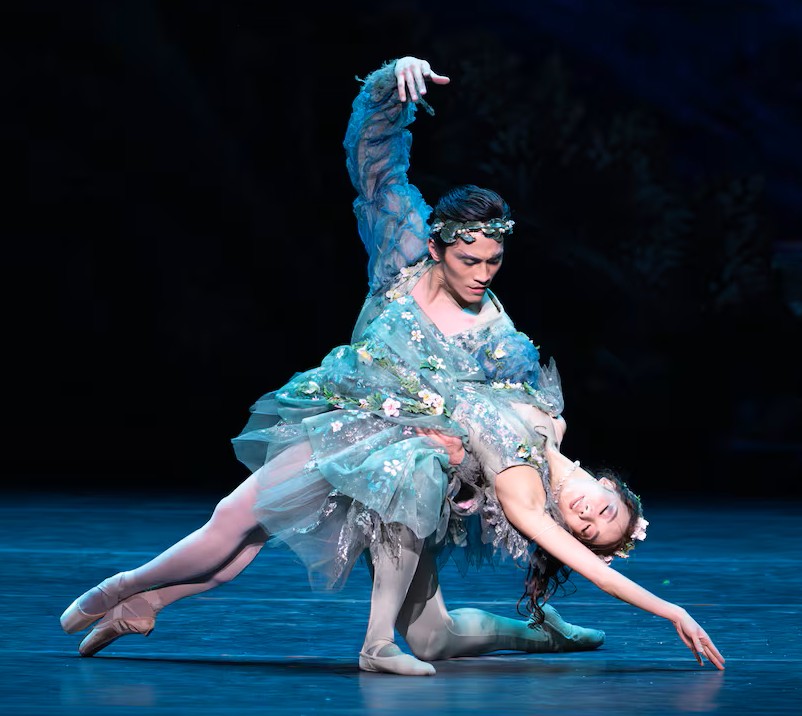
Oberon (Jeffrey Cirio) and Titania (Chisako Oga) in Boston Ballet’s The Dream (photo by Brooke Trisolini) The Dream’s romantic, enchanted woodland set (complete with obligatory ground fog), ethereal fairy costuming, and beautiful dancing leavened by broad humor and a spectacular Puck could not have been more delightful, though I confess my long acquaintance with Shakespeare’s script made me miss the depths lost by Ashton’s cutting both the first and fifth act of that play. The play, not the ballet, is finally about the saving grace of art, most particularly the living art of theatre, and the enduring boon of imagination, themes less apparent without the framing plot of Athenian cruelty transformed to loving acceptance.
At the ballet I was still thinking about the longevity of Miller’s art, and the relevance of his View from the Bridge as well as the previous day’s No Kings protests when Stromile’s The Leisurely Installation of a New Window began, a ballet in three movements adapting Hegel’s dialectical method of progress through contradiction (thesis-antithesis-synthesis) into a meditation on how systems have to be lived in before they can be questioned and shifted from inherited structures to new possibilities. Featuring a Seeker often studying a book and thus honoring tradition, the ballet adds the People, and the Reformers who create patterns that repeat, loosen, and change. Two male dancers perform a pas de deux while engaging the book; meanwhile a trio upstage forms and reforms. Commissioned as a celebration of the ballet at a pivotal 250th moment in America, Stromile’s Installation of a New Window, set to a challenging score by music director Mischa Santora with electric guitar solos by Reeves Gabrels, a member of the rock band The Cure and former Bowie collaborator, left me wondering what future can be glimpsed through a new window, framing what’s to come.
So, Dear Reader. Here’s to new windows, reformers, bridges kept intact, and the living, performing arts.
-
Winter Experience; Reprise and Reprieve
10 March 2026
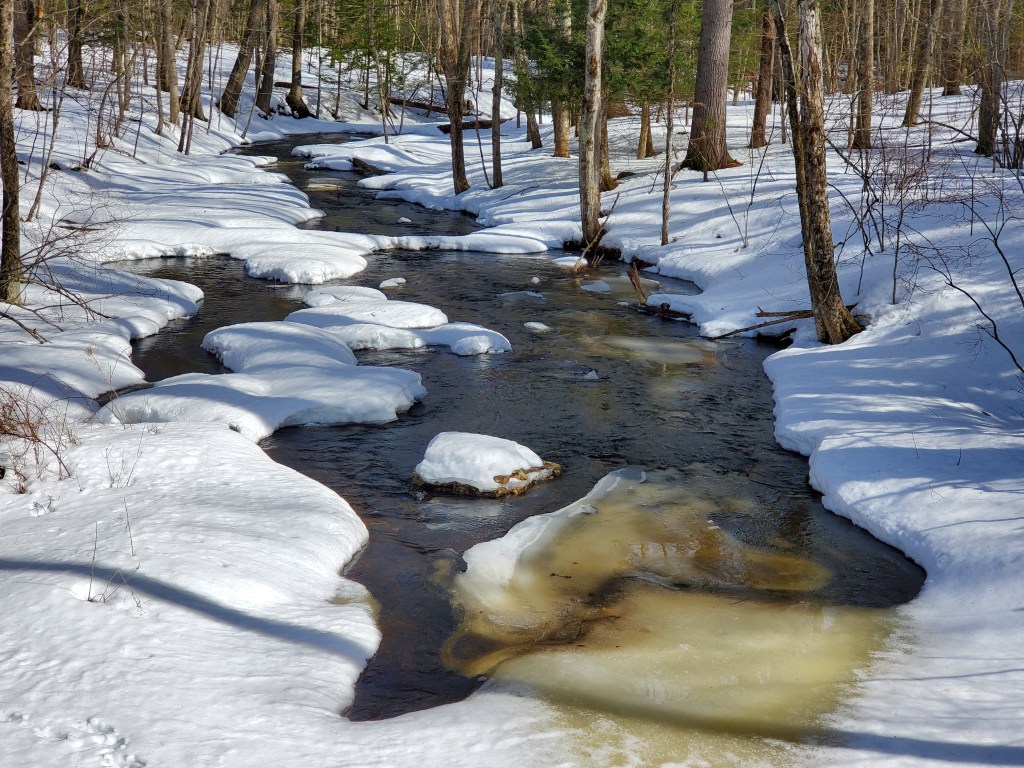
The Bellamy River flows downstream, ice bonds loosened Winter’s ice bonds cracked wide open for me last Sunday. Thanks to Boston Ballet and now sprung forward to Daylight Saving Time, I am no longer frustrated by my unfulfilled quest for what my wise friend and artist Carol terms the meditative, “existential break” of art, a reprieve from a very long winter of discontent. The runup to this spiritual breakthrough had been disappointing as I gadded about seeking some salutary revelation, or at least reassurance from someone or something. Last Thursday that search took me to Portsmouth’s Music Hall for an evening with Gavin Newsom, himself gadding about promoting his new book, Young Man in a Hurry.
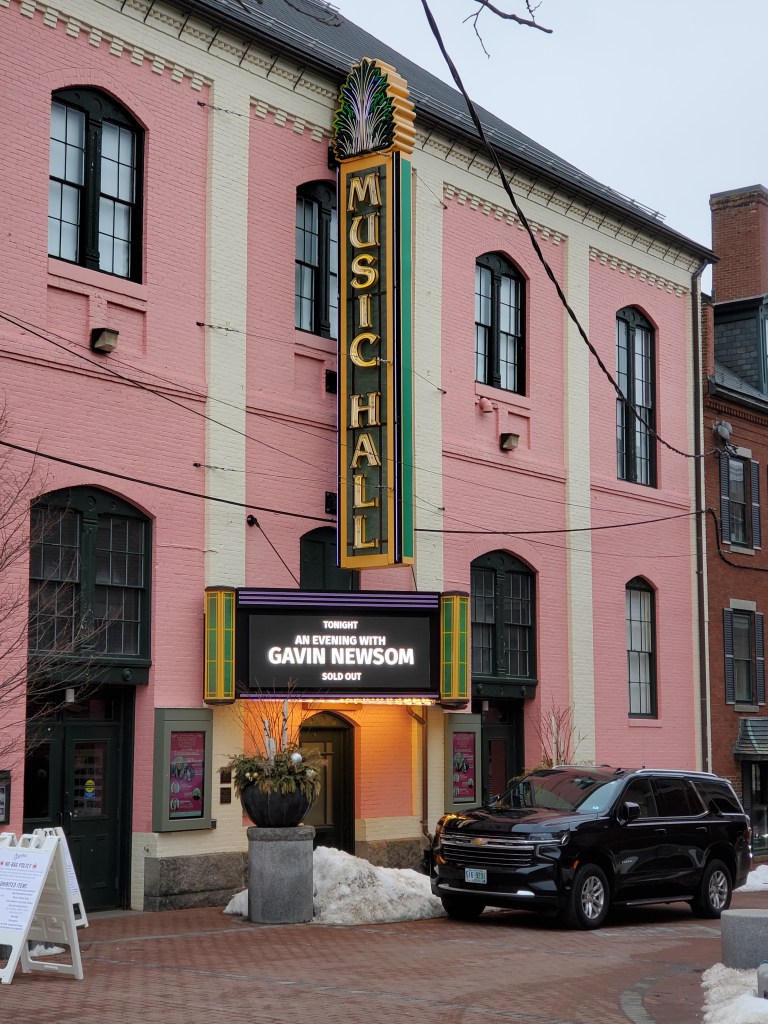
The largely partisan audience was of course jazzed by the just-announced firing of the much-detested Homeland Security Secretary Kristi Noem, a woman blinded by self-promotion and completely oblivious to the iniquities her ignorance perpetuated. And Governor Newsom was both articulate and vehement about the necessity of fighting executive overreach with tough legislative action—“fighting fire with fire.”
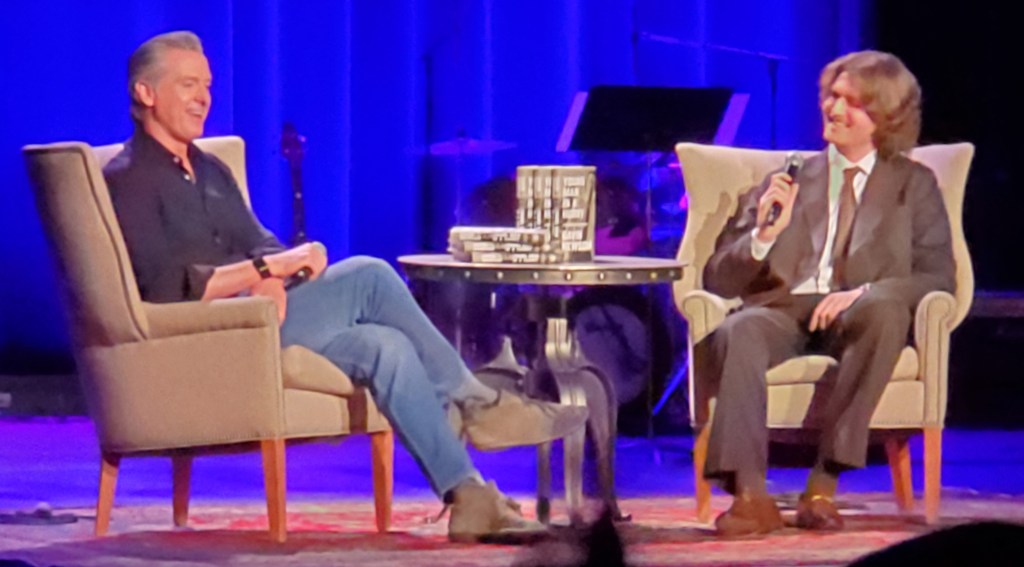
Gov. Newsom with host podcaster Jack Cocchiarella at Portsmouth’s Music Hall, 5 March 2026 Newsom’s focus, however, was certainly promotion of his book as prelude to presidential candidacy. And he never addressed the fear that roils my friends of late: tampering with or even prohibition of the next election. My heart was no less heavy when I left the Hall.
So, I hoped for more of a lift from Joshua Harmon’s new play We Had A World now at the Huntington’s intimate Wimberly Theatre in Boston’s Calderwood Pavilion. I’d heard Harmon speak of the play’s genesis, a request from his grandmother to tell their family story sparing none of the recriminations and bitterness; Harmon himself called it “my crazy, personal, super-specific play about my nana.”
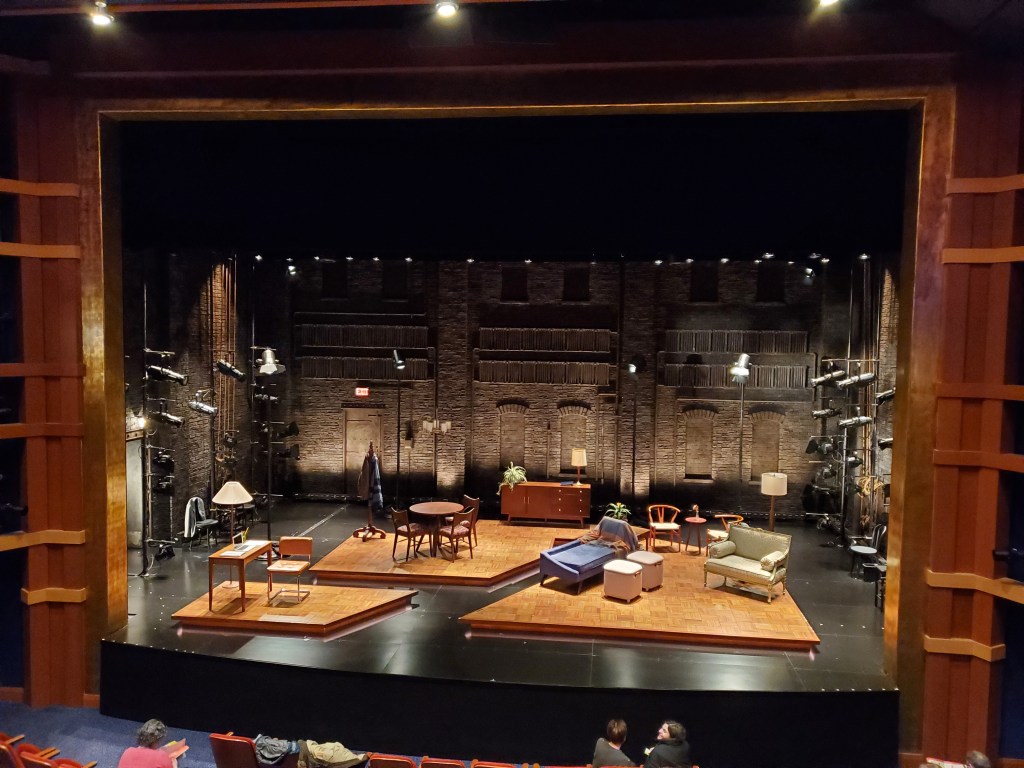
Courtney O’Neill’s handsome set for the Huntington’s We Had A World A playwright’s autobiographical play about his particular family romance and an indomitable matriarch of course conjures Tennessee Williams’s devastating memory play The Glass Menagerie, and unfortunately We Had A World suffers from the comparison. Well-acted and occasionally amusing but episodic and finally, for me, unengaging, I missed the moving, transporting vision of the personal made universal, and stayed stuck in bleak winter mode.
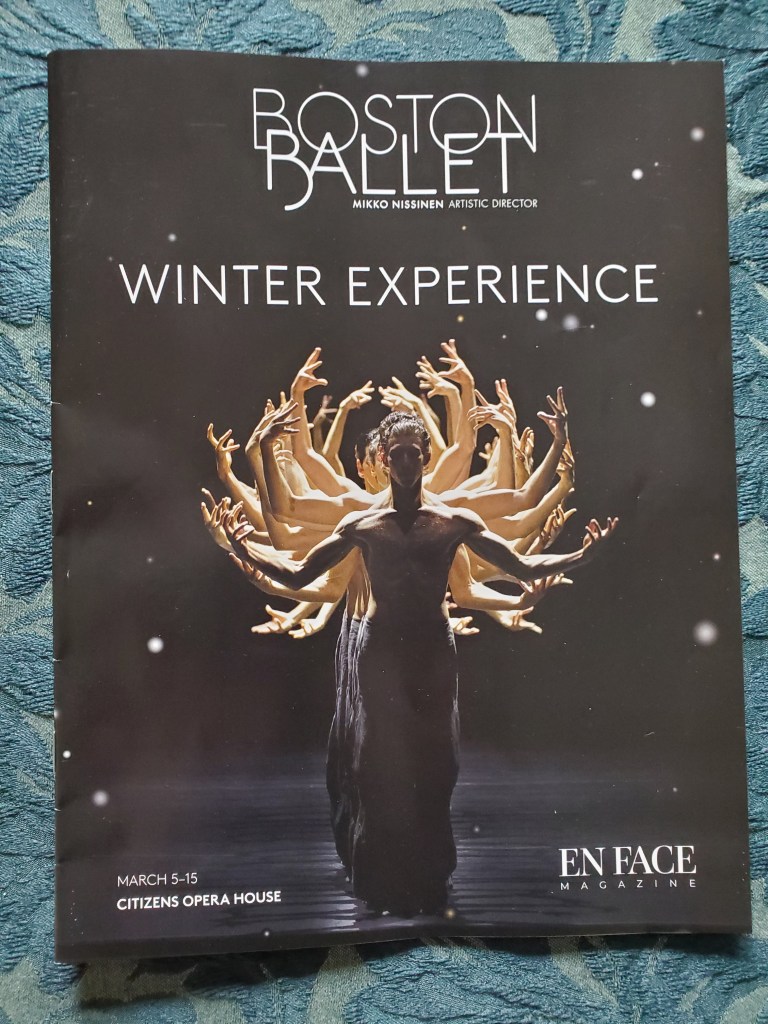
But the next day, the artists of Boston Ballet came through for me with their “Winter Experience.”
Stravinsky has said that the “violent Russian spring” that seemed to begin in an hour was like the whole earth cracking . . . “the most wonderful event of every year of my childhood.” Together with Nijinsky’s choreography first presented in Paris by Diaghilev’s Ballets Russes on 29 May 1913, Le Sacre de Printemps/The Rite of Spring shocked its audience into shouting, hissing pandemonium. Jorma Elo’s Sacre, last performed by Boston Ballet in 2009, with Stravinsky’s score presented in a new arrangement for reduced orchestra by former Boston Ballet assistant conductor Alyssa Wang under music direction by Mischa Santora, no longer shocks, but it does command. Nijinsky’s choreography challenged classical form with feet turned in, knees slightly bent, and arms held in “prehistoric posture.” Globe critic Jeffrey Gantz nailed the perfect correspondence of Elo’s choreography and Stravinsky’s score: body parts move in isolation from one another like Stravinsky’s instrumental lines. “Dancers crawl backward, stiff-legged, as if de-evolving.” The story’s controlling overlord of the community pushes his victim’s head down or chops at her throat as the stomping pulse of the music evokes a cross between Jurassic Park and nature red in tooth and claw: the violent, ruthless competition of the natural world. Yet the doomed victim of this savage community in Elo’s version ends the struggle with a satisfying gesture of feminist defiance.
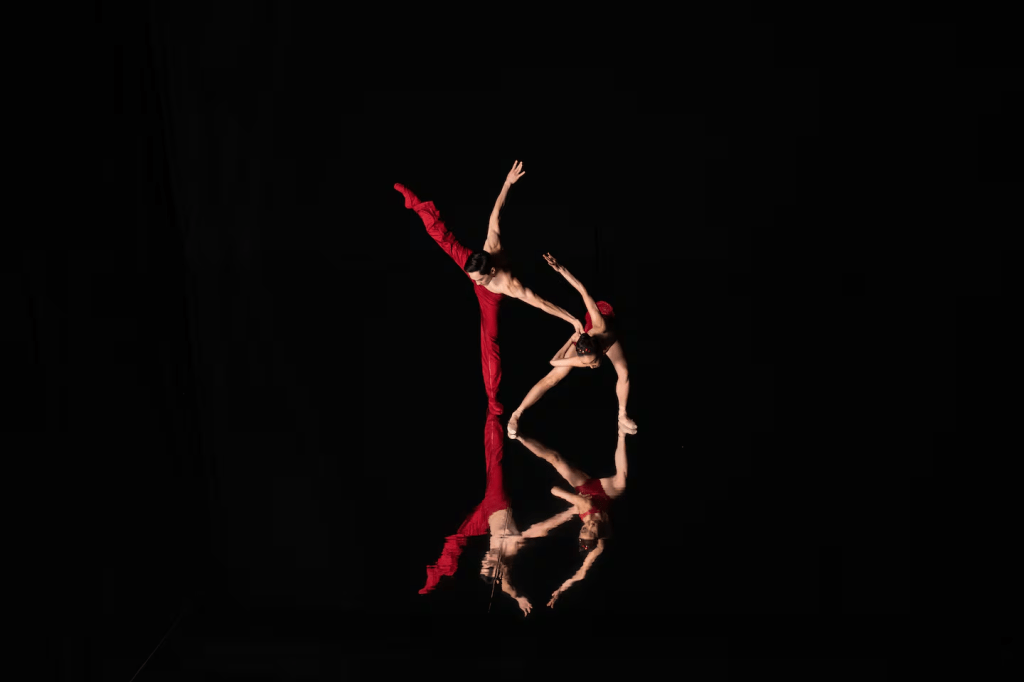
Jeffrey Cirio and Ji Young Chae in Elo’s Sacre du Printemps, photo by Brooke Trisolini Okay. I was on the road to recovery. And then after intermission a stunningly cohesive vision of group dynamics arrived with Crystal Pite’s The Season’s Canon, premiered with the Paris Opera Ballet in 2016 and first performed by Boston Ballet in October 2024 to Max Richter’s “Recomposed: Vivaldi’s The Four Seasons Selections.” Beginning with an ephemeral evocation of spring arriving via a virtual nebula, the reflected light backdrop design of Jay Gower Taylor and Tom Visser, the audience’s first vision of the 54 dancers grouped upstage right is an elemental undulating mass, more ocean swell than community.
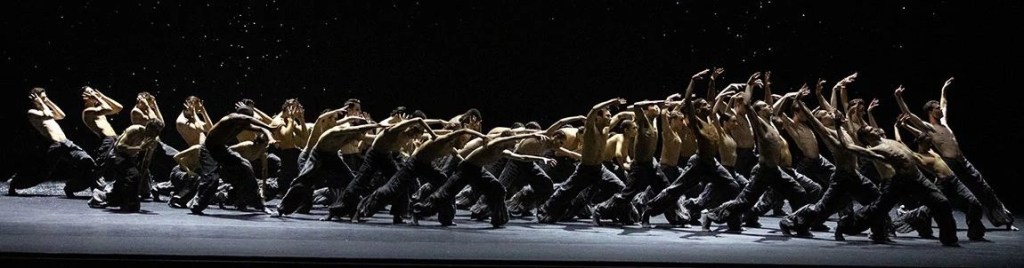
Boston Ballet in Crystal Pite’s The Seasons’ Canon 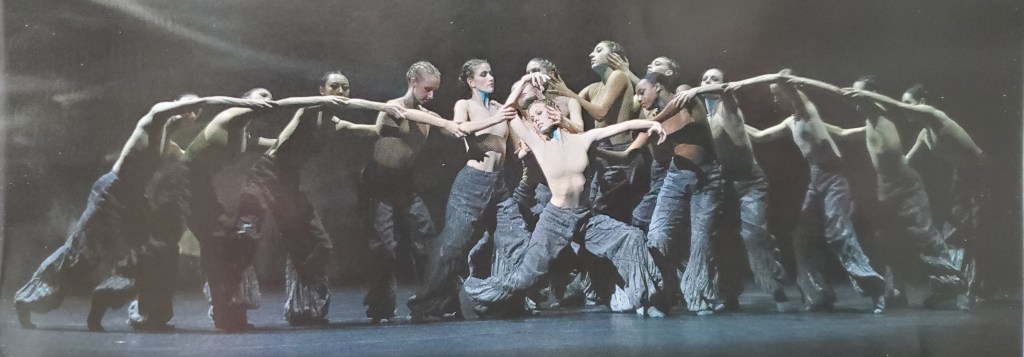
Haley Schwan and ensemble, photos by Rosalie O’Connor The men bare-chested and the women in flesh-colored tops, everyone in loose gray trousers, they perform murmurations more commonly observed in a flock of starlings. Individuals peep up, and are then subsumed by the group; there are chain-reaction and falling domino effects. The beauty of the collective, individuals moving as one, is the dominant and, I found, affirming theme, one awe-inspiring coup de théâtre after another. The snow that falls in the last movement, Winter, is as beautiful as that always stunning Nutcracker scene. But here, unrestricted by narrative, one experiences that beauty in the context of enduring seasonal cycles and the interdependence of humanity and nature. For me, this vision set to music both familiar and new did finally crack open the ice bonds of this challenging winter. If Winter comes, can Spring be far behind?
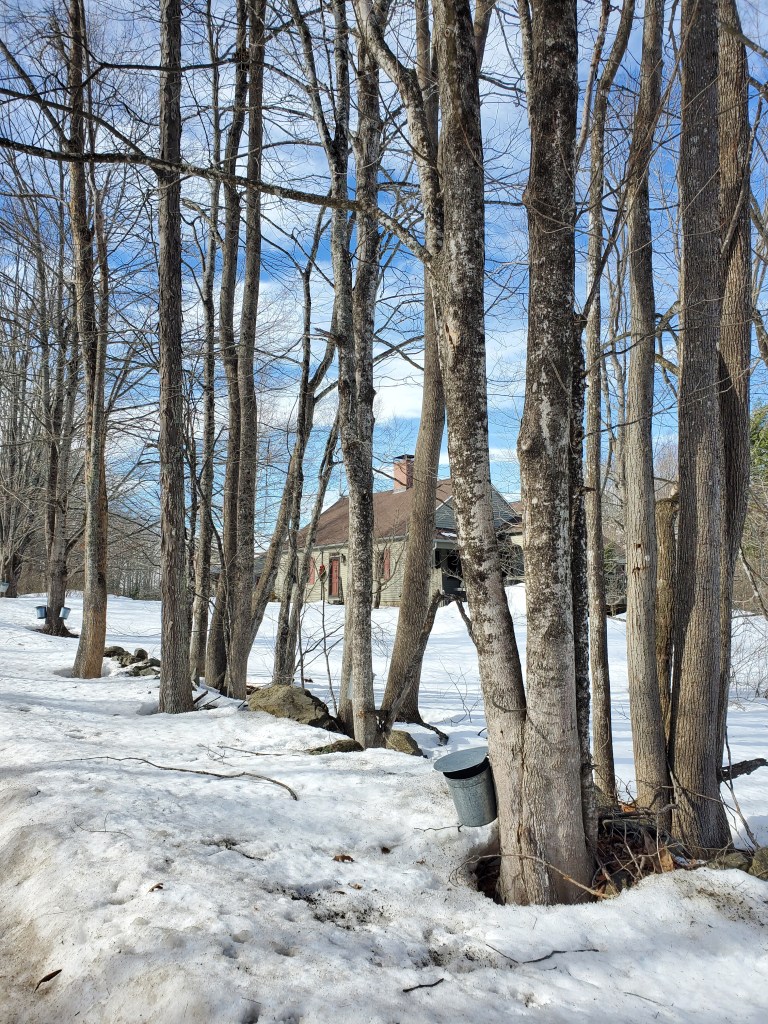
As it happens, not far at all. In fact, the ice bonds HAVE literally cracked. The maples along Nute Road are being tapped.
The temperature right now in Madbury is 74o, and I spied the first daffodils to break ground this morning, the force that through the green fuse drives the flower.
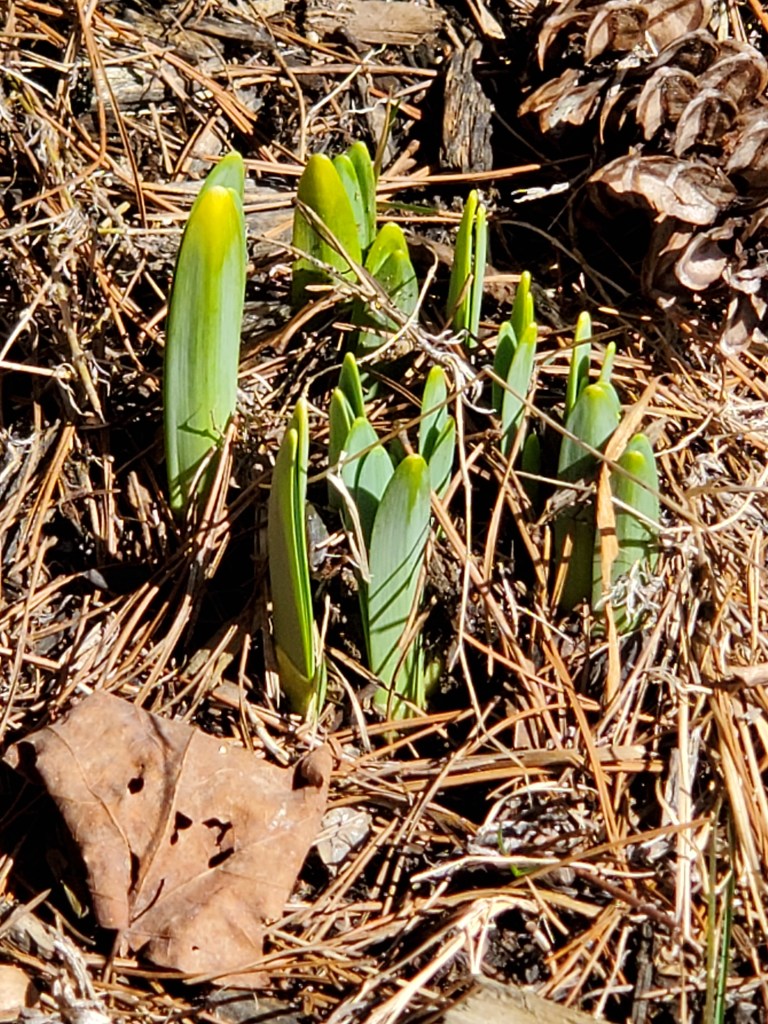
First daffs, 10 March 2026 Even shut in the cold, dark garage since last November, a pot of chrysanthemums has sprouted anew.

Dark and cold did not thwart these mums And lines from The Wanderer, the Old English poem preserved in the Exeter Book (c. 960-990) I labored to translate my first year of graduate school come back to me:
“So this middle-earth each of all days declines and falls; therefore a man cannot become wise before he has a portion of winters in the kingdom of the world.”
Spring is nigh. We are wiser for the winters passed. What’s next?
-
Snow Dazed
3 March 2026
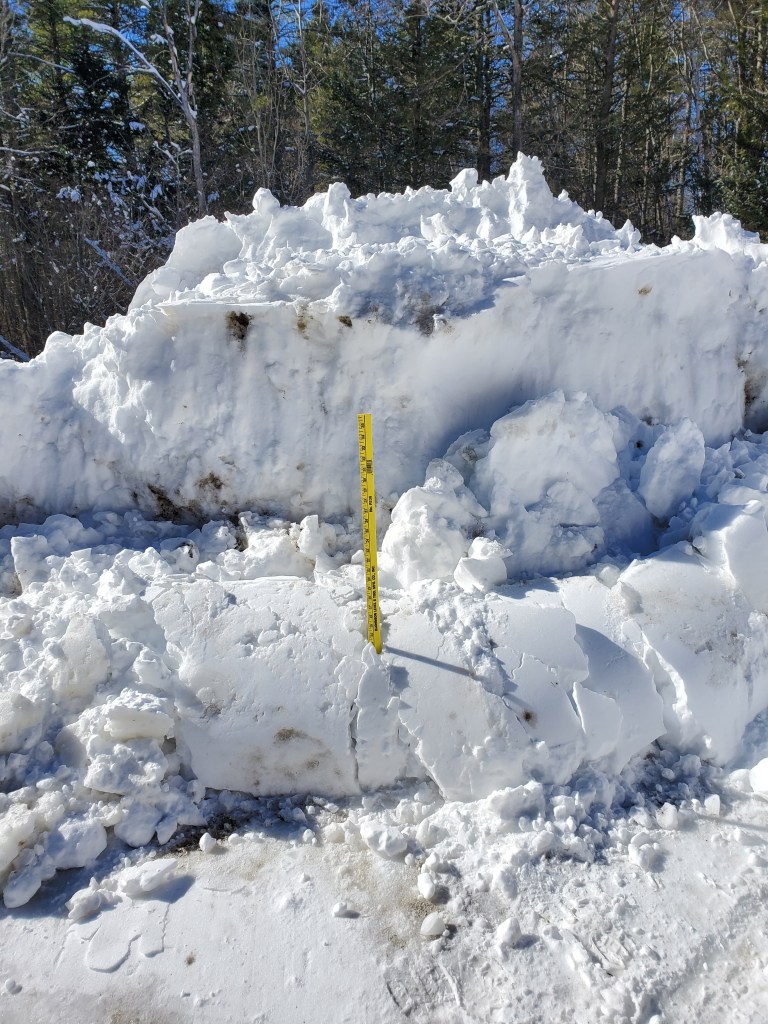
Yardstick measuring plowed snow, 24 Feb 2026, Madbury NH The snow is falling AGAIN as I tap this out, Dear Reader, and much as this Florida cracker appreciates its beauty—somehow still a novelty after over 27 years in New Hampshire—enough is enough.
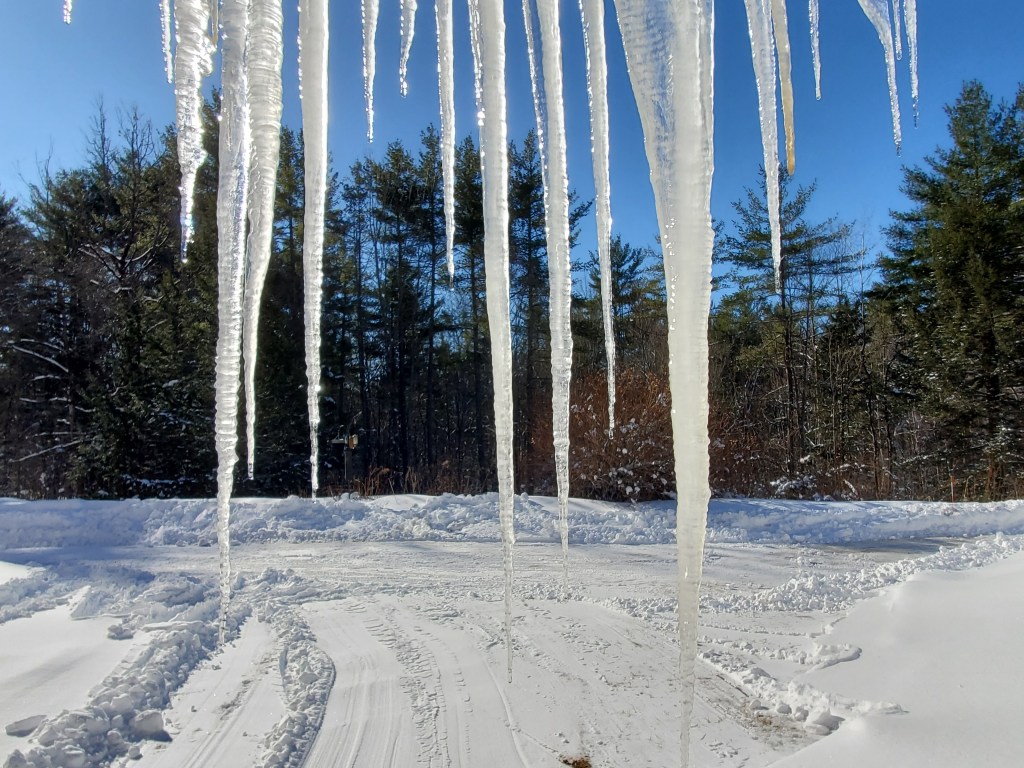
Hazardous garage exit Propane and plowing are pricey but necessary expenses these many days. And this past month has been a challenge in other ways, both on the home front and the world stage, where thanks to our Felon-in-Chief, we now find ourselves embroiled in yet another open-ended war in the Middle East, unconstitutional from its inception and untethered from any consistent rationale.
That’s the big stuff. But much smaller stuff still preoccupies. In the 23 days since a crash rocked my equanimity, I’ve recouped the insurance payment and bought a new car, the same model as my beloved but now totaled VW GTI, but with five more years of high tech features to reckon with. I spent 36 minutes beside Jimmy the salesman in the passenger seat asking basic questions about how things work; even he had to look up how to tune the radio, buttons and knobs having been replaced by screens with multiple layers of access. I now feel only slightly less anxious about driving this computer on wheels than when I exited Rochester Volkswagen in “Opal” (named for the color VW styles “white”) five days ago. I’ll adapt, and the heated steering wheel IS very nice, but the learning curve is and will continue to be steep.

Opal, almost as white as the snow I’ve also become stuck once again in the tar baby that is the 99-year land lease of commercial property in Ft. Myers that my maternal grandfather C. C. Senseman left his two children, my mother Virginia and my uncle Kenny, now both long gone, and the lease then inherited by their children, two of whom are also now departed, my beautiful blonde cousin Beverly and my equally beautiful blonde sister Jane. The 1967 lease was re-assigned in 2006 to an unscrupulous new renter, whose scofflaw lawyer brother has ever since taken advantage of what was always a bad deal for us joint landowners, Grandpa Senseman’s descendants. Consistently delinquent in paying the very modest rent for this property (atop one parcel of which sits the strip club Babe’s), this scoundrel has now stopped paying rent all together, having spontaneously decided to contest the rent due, an amount and payment schedule established in 1967 which he has paid, however tardily, for the last 20+ years. Jarndyce v. Jarndyce of Dickens’s Bleak House has nothing on a legal quagmire that has tormented four generations of my family with no resolution in sight.
The malfeasance of this unscupulous shyster of course pales in comparison with the high crimes and misdemeanors to which the Felon-in-Chief subjects my country and the world, but the fact that such damaging corruption continues uncurbed on so many levels is dispiriting. One looks for compensation in small victories: the Supreme Court disallows Trump tariffs; our Republican New Hampshire Governor Ayotte has to bow to the will of her protesting constituents and say no to the transformation of a Merrimack warehouse into an ICE detention center. And I managed to get my one-year-old microwave, unexpectedly rendered useless by a power failure during the latest blizzard, reprogrammed and operating once more. And just this morning, after a l-o-n-g campaign battling the New York Times’s inaptly termed “customer service” bots, I finally managed contact, however digital, with a human named Michel who was able to resolve a delivery cockup persisting since 26 January.
While such victories help sustain spirits, so does a friend’s success: on 22 February, Exeter’s Water Street Bookstore hosted Linda Rhodes’s launching her book, Breaking the Barnyard Barrier: A Woman Veterinarian Paves the Way, about her experience as a pioneering large animal veterinarian in the Wasatch Mountains of late 1970’s Utah.
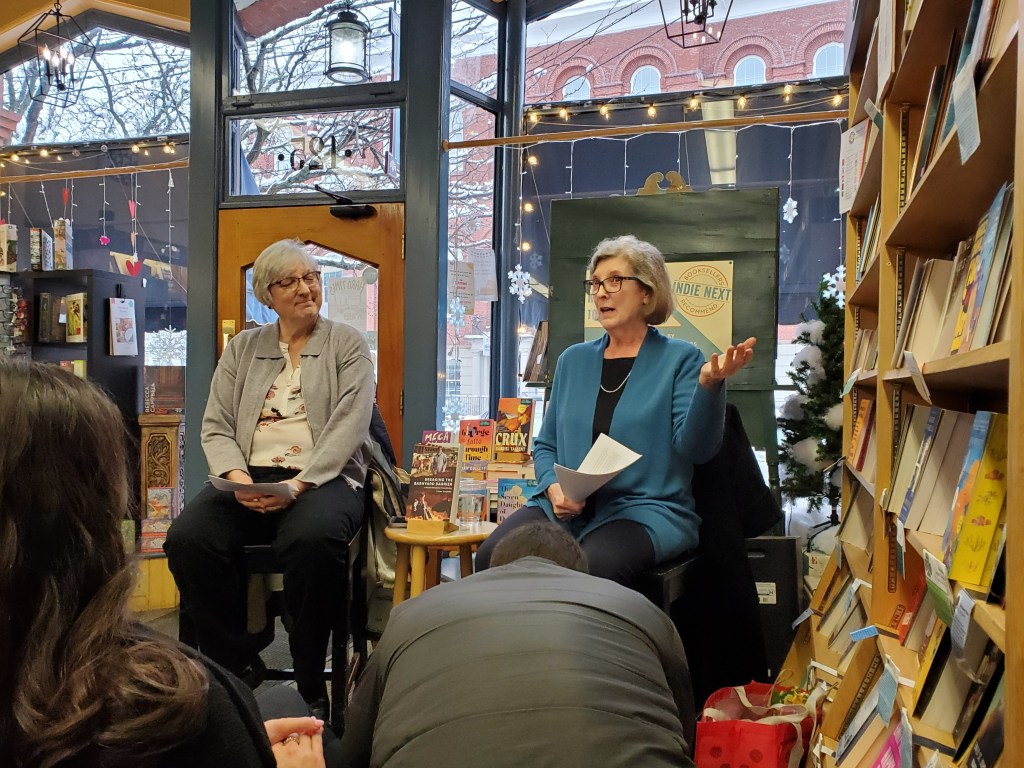
Dr. Rhodes (r) regales us with a harrowing tale of a wounded and very angry bull A feminist triumph is always uplifting. And so, as I have so often found, is art, most recently a couple of fine films. As Ralph Fiennes, playing the choral master in The Choral, quoted Goethe, “A man should hear a little music, read a little poetry, and see a fine picture every day of his life, in order that worldly cares may not obliterate the sense of the beautiful which God has implanted in the human soul.” H is for Hawk, the film rendering of Helen Mcdonald’s 2014 memoir, also helped to dispel my worldly cares last Sunday, at least for a few hours. Claire Foy, Brendan Gleeson, and Lindsay Duncan—and the number of goshawks playing “Mabel”—are well worth your time.
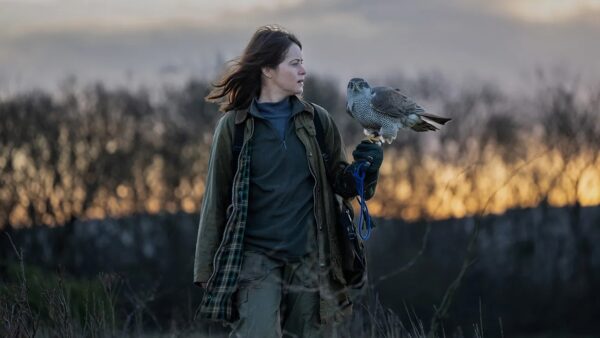
Claire Foy and Mabel in H is for Hawk And then there’s the reassurance of nature. I’m keeping mealworms mixed in with birdseed to coax the return of a bluebird who has made a few visits to my feeders of late. I haven’t spied the pileated woodpecker nearby, but I heard his cry the other day competing with my growling stomach’s borborygmus as I sat with my binoculars quietly searching. And I had a lovely albeit slightly illicit snowshoe adventure the other day navigating a former snowmobile trail now forbidden trespassers by an owner who has changed her mind about allowing machines on her property.
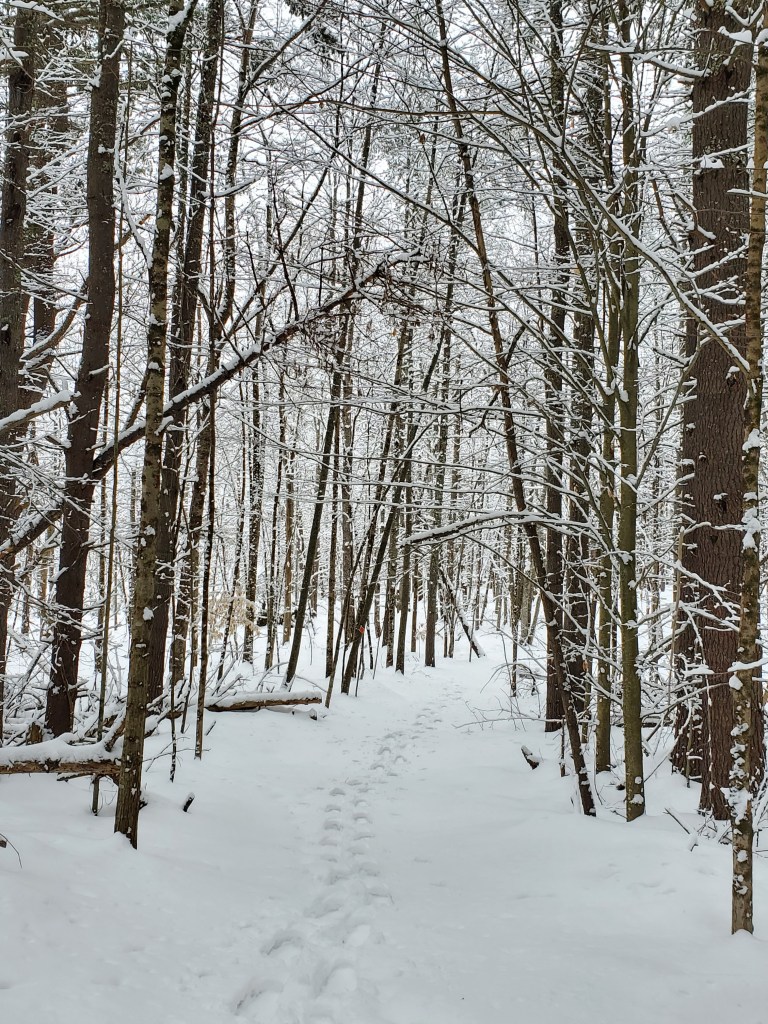
Turn-around point The snow was powdery but very deep, so that each snowshoed step could sink as much as 6-7 inches, requiring a lot of extraction effort. Okay, good for cardio, I thought. And I managed to find ways around the several places where little tributaries of still flowing water that ultimately becomes the Oyster River threatened to sink my progress. At one point I did, however, almost get stuck, and discretion, the better part of valor, kicked in. I was alone, no one knew where I was, and I’d just watched William H. Macy get clocked by a falling branch in the film Train Dreams I’d watched the night before. I re-traced my steps instead of forging on, and arrived safely back home, my hair plastered to my doubly capped head. The image reflected in the mirror gave me a welcome glimpse of my mother Virginia, who would have been happy for my safe return.
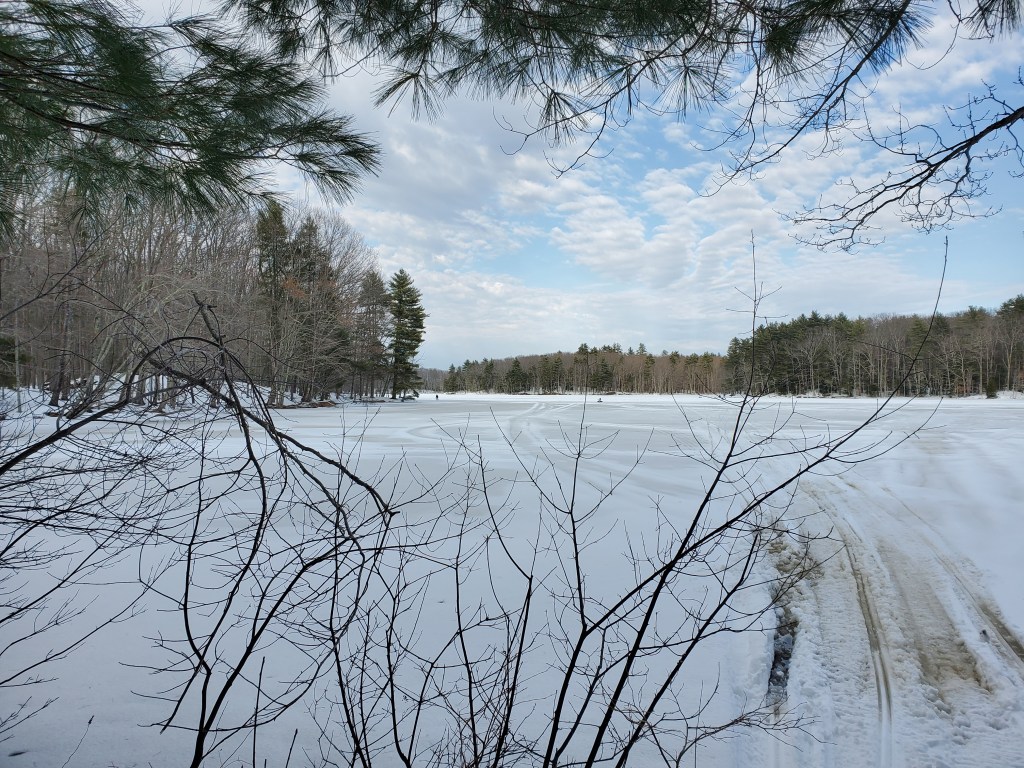
Madbury reservoir, accessed by a safer trail As for the astronomical, I missed this morning’s blood moon eclipse. I was at the window at 6.00 am, but the moon had already dipped below the tree line to the west, obscuring the setting sphere.
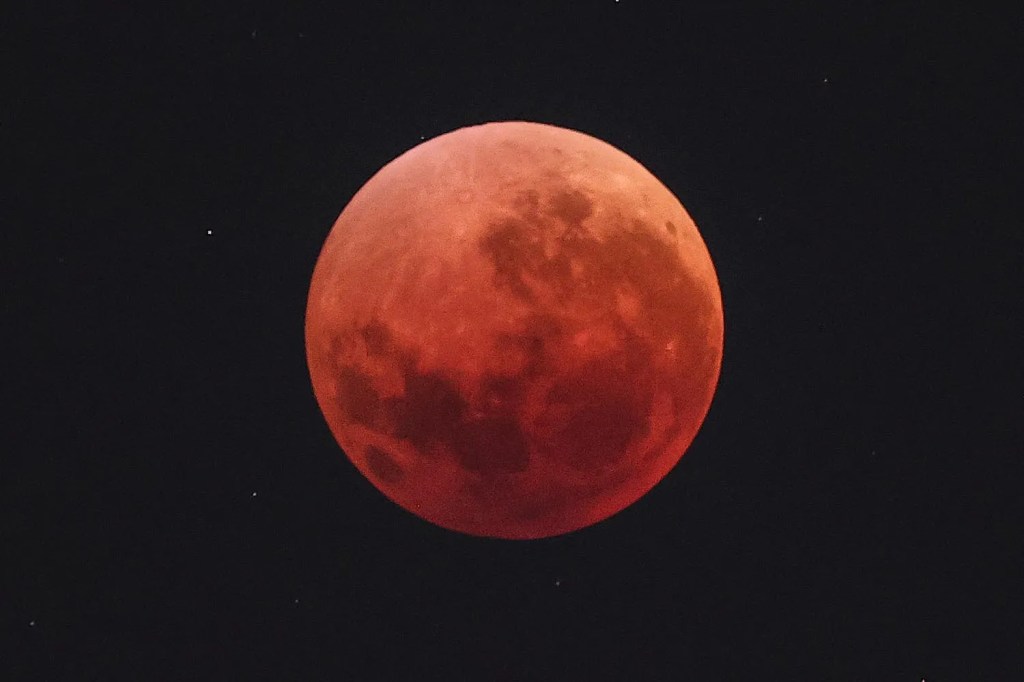
David Gray’s photography of a previous Blood Mood in Sydney (AFP via Getty) Maybe I’ll catch the next one in 2029. We’ll see how much blood there is under the bridge by then.
In the meantime, Dear Reader, hear a little music, read a little poetry, and see a fine picture every day.
-
Intersection
17 February 2026
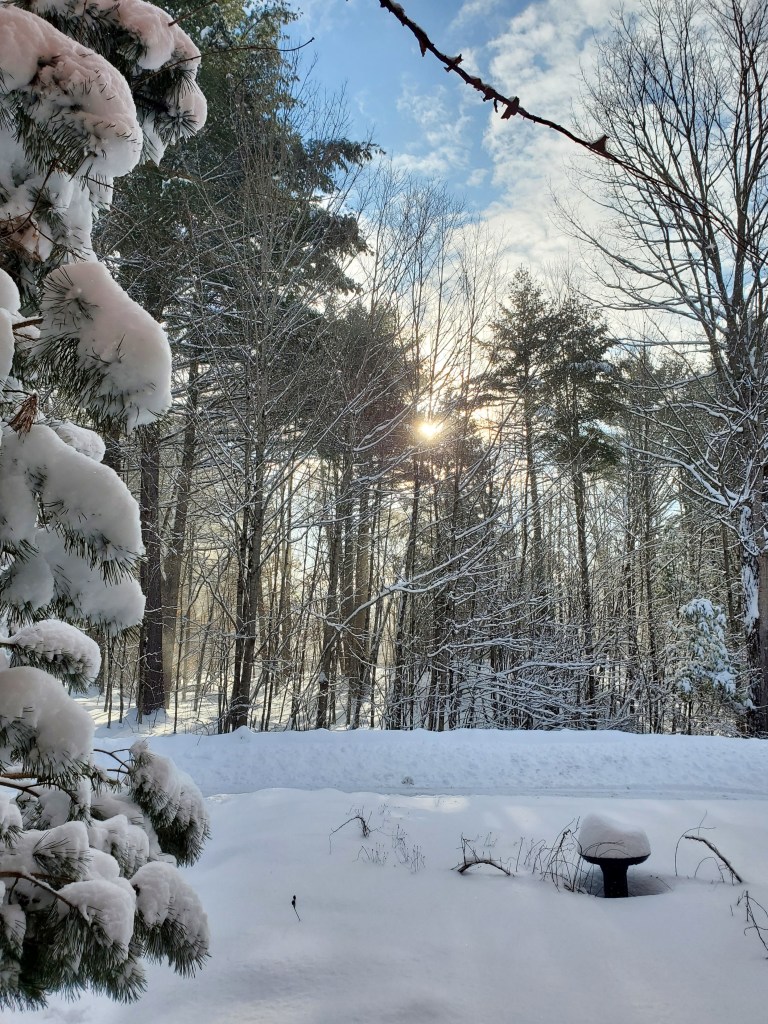
Morning snow, 11 February 2026 Today, Tuesday, 17 February 2026, marks the beginning of Ramadan, the celebration of Mardi Gras, and the Lunar New Year of the Horse, as well as the second anniversary of my sister Jane’s passing, and the birth of our twin granddaughters, now 24 years old. Is’t possible? What to make of such intersections, global and personal, past and present—especially given my shaken and stirred response to my car’s being totaled at the busy intersection of Madbury Road and Route 4 in Durham, NH a week ago Sunday? Dear Reader, that is the question. Seeing Hamnet for the second time one week post crash afforded me opportunity for a really good cry, but that has not settled the unsettled.
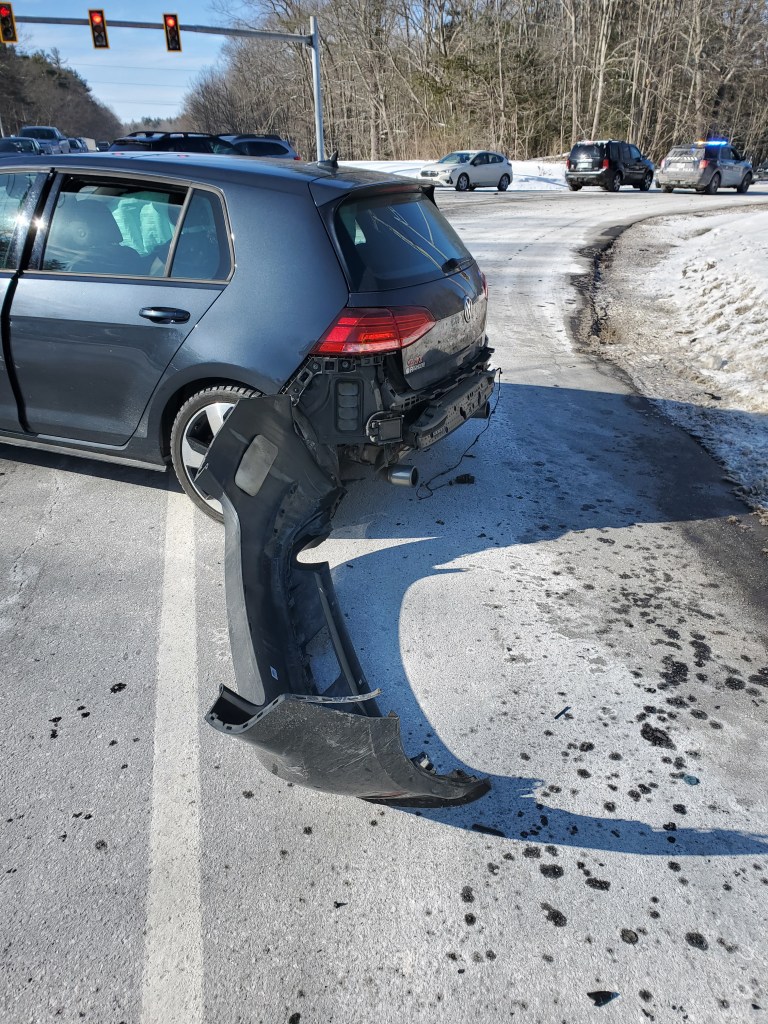
Accident scene, 8 Feb 2026 I’m off to a yoga class soon, to be followed by two different book club discussions later on, one on Shakespeare’s early play Two Gentlemen of Verona, exploring and exploding past comic conventions, and the other on Kiran Desai’s epic novel, The Inheritance of Loss, rendering the collision of private lives and public events arising from the effects of colonialism on those who leave India and those who remain. I’m grateful for such salutary distractions, physical and intellectual, and for the insights art affords. I’m grateful for the restorative company of dear friends joining over a delightful meal to speak, deeply, of all manner of things, celebrate Valentine’s Day, and toast our host’s cozy new home together. And I’m grateful that no one was seriously hurt when my car was hit, that emergency services and insurance company have been so helpful, and that the hours of daylight grow appreciably longer with each passing day. But what’s to come?
My friend SP, student of lunar cycles, has declared this Year of the Horse marks the beginning of a new one. Could be worse, could be better, but it will be different. I’m choosing to think things will get better, that perhaps the U.S. has reached a tipping point, that we’re finally waking up to take action against oppression and the psychic damage wrought by epistemic uncertainty.
I’ve certainly found myself in a new personal era of late, noticing more and more signs that I’m neither ascending nor even maintaining level flight, but am rather on the glide path down. I’m spending a lot of time—perhaps too much—thinking about offloading stuff and attending Death Cafés. What am I contributing? WordPress, host of this blog, reports my site had 442 visitors in January, so Dear Reader, I’m wondering what YOU are thinking? Have these messages in a bottle reached you? Do you also find yourself at the intersection of hüzün, the Turkish word I’ve just learned signifying melancholy and longing/spiritual yearning, and hope? I recently noticed that some Google bot describes this blog as “witty, entertaining, and thoroughly engaged with all manner of subjects . . . .” What does one make of a such a snippet, a compliment manufactured by an A.I. algorithm?
I don’t know. But I do remain curious. And I propose reviving a 16th century word now largely obsolete but I think useful in this new cycle: “respair,” meaning the return of hope after a period of despair, from the Latin respirare, to breathe again. Deep breath, Everyone! And like Jess Jackson, who departed this dimension earlier this morning, Keep Hope Alive!
Happy new year!

I am curious Squirrel, peeping into the bathroom, 15 Feb 2026 -
Distraction Confounded
29 January 2026

The Oyster River, seen from the Durham NH landing As the snow storm approached last Saturday, 24 January, I found myself in a rare if brief mood, focused and pleasantly anticipating both the coming snow and a lovely little tea party in New Castle to honor two friends with January birthdays, one 87 and one 89. Humans are hard-wired for certainty, leaping to embrace it, and even foolishly creating it when obscured by ambiguity or complexity. As I once heard Senator Ted Kennedy say: “For every complex problem there’s a simple solution. And it’s wrong!”
Winter Storm Fern was certainly coming; I saw it on the radar. And Walker Percy’s “hurricane theory” would, I knew, obtain. Disasters replace abstract anxiety with immediate purpose: survival and community solidarity. We feel alive and connected, no longer passive participants in daily routine. The unusually cold temperatures—it was 3o that morning, -16o with wind chill—meant the wetlands trail bordering our property would be frozen solid, with insulating snow keeping it perfect for snowshoeing later on. And the birthday party, laid on by a designer with exquisite taste, would, I knew, be lovely. The humiliation and frustration I had felt on Wednesday morning on hearing the inane, self-aggrandizing, and insulting ramblings of our Felon-in-Chief (FIC) addressing global leaders at the World Economic Forum temporarily ceded mental space to hospitality and gemütlichkeit (I recall the FIC telling this august group assembled in Davos, Switzerland that but for the U.S., they’d all be speaking German. This to a highly educated audience in Switzerland). Our New Castle hostess had suggested we keep politics out of her house, and we complied, even though we’d heard there’d been yet another shooting in Minneapolis.
And then I came home and watched the videos of an ICU nurse for the Veteran’s Administration help shield a fellow protestor when an ICE agent pushed her to the ground. For his brave compassion, true to his training and ethical service as a nurse, he was then surrounded by ICE agents, pushed face down to the ground, and summarily executed, his last act to help the helpless. Yet more blood on the hands of our abominable leader. A tipping point? I am not sanguine. I write to my representatives and senators and I protest, but I’m more scared than optimistic.
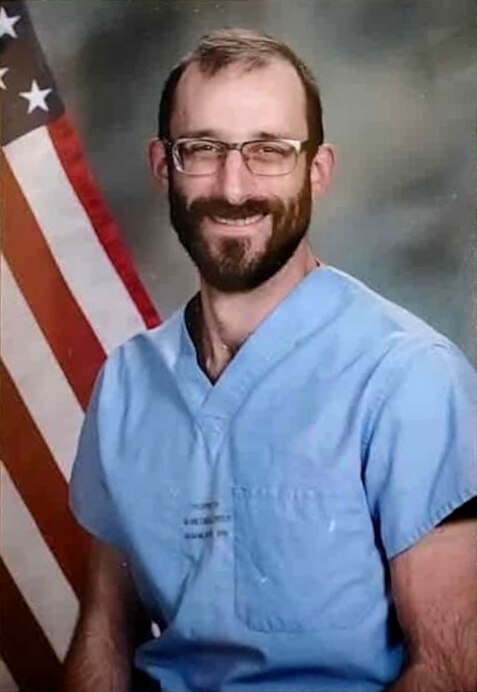
Alex Pretti, RN official portrait by US Dept. of Veterans Affairs Vladimir Iliyich Lenin is rumored (incorrectly) to have said “There are decades where nothing happens, and there are weeks where decades happen.” January has felt like that, and it’s taking a toll on my emotional equilibrium: tears sprang to my eyes on hearing the calm and reassuring baritone of Robert Redford in a broadcast clip explaining why he created the Sundance Film Festival, first established by him in Salt Lake City in 1978 as the Utah/US Film Festival. Redford, Sundance himself, is gone, and his festival is leaving Park City, Utah for Boulder, Colorado next year, having outgrown its home for the past 45 years. I miss Robert Redford. I miss talent, generosity, and decency.
I try to stay in motion, seeking solace and direction in art, and certainly I’m not alone. The Winslow Homer exhibition at Boston’s MFA was mobbed on the Monday morning I joined the claustrophobic crush of mostly seniors (too many taking pictures) crowding the exhibition “Of Light and Air,” its title taken from Henry James’s review: “Mr. Homer has the great merit that he naturally sees everything at one with its envelope of light and air. He sees not in lines, but masses. Things come already modeled to his eye.”
Homer’s famously luminous but delicate watercolors with their all-too-fugitive colors were well served by the MFA (if not the online images I reproduce here); a video featuring artist James Prosek attempting to duplicate Homer’s technique and conservator Judith C. Walsh guiding Prosek and us through Homer’s studio on Prouts Neck in Scarborough, Maine (now managed by the Portland Museum of Art) provided helpful insight into Homer’s artistry.
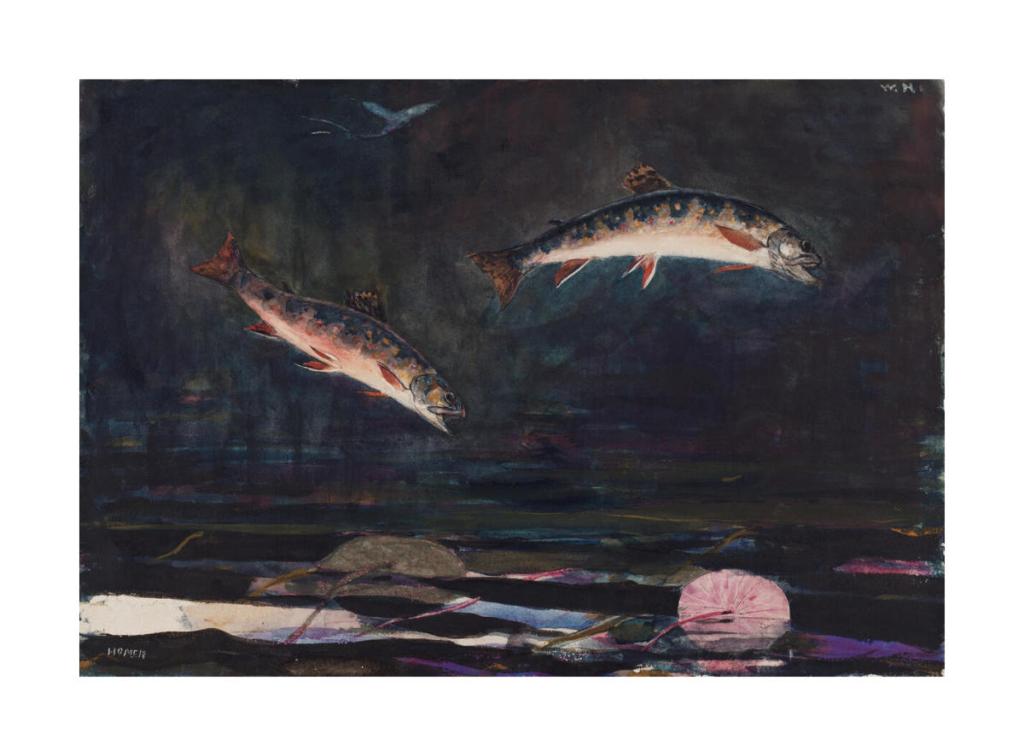
Leaping Trout, Winslow Homer (1889) 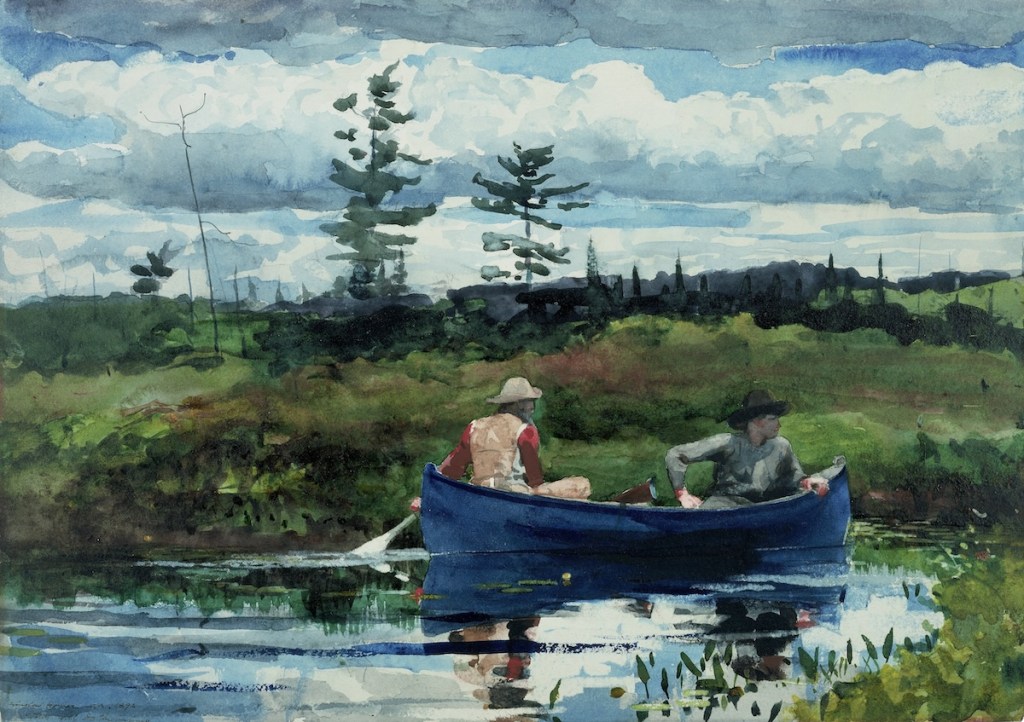
The Blue Boat, Winslow Homer (1892) All museums are suffering in our unenlightened era, however, and the MFA, confronting a widening structural deficit, has announced it will lay off 6.3% of its staff as part of a sweeping restructuring plan. So, I suppose we must forgive both the congestion of the Homer show and the commodification of his work.
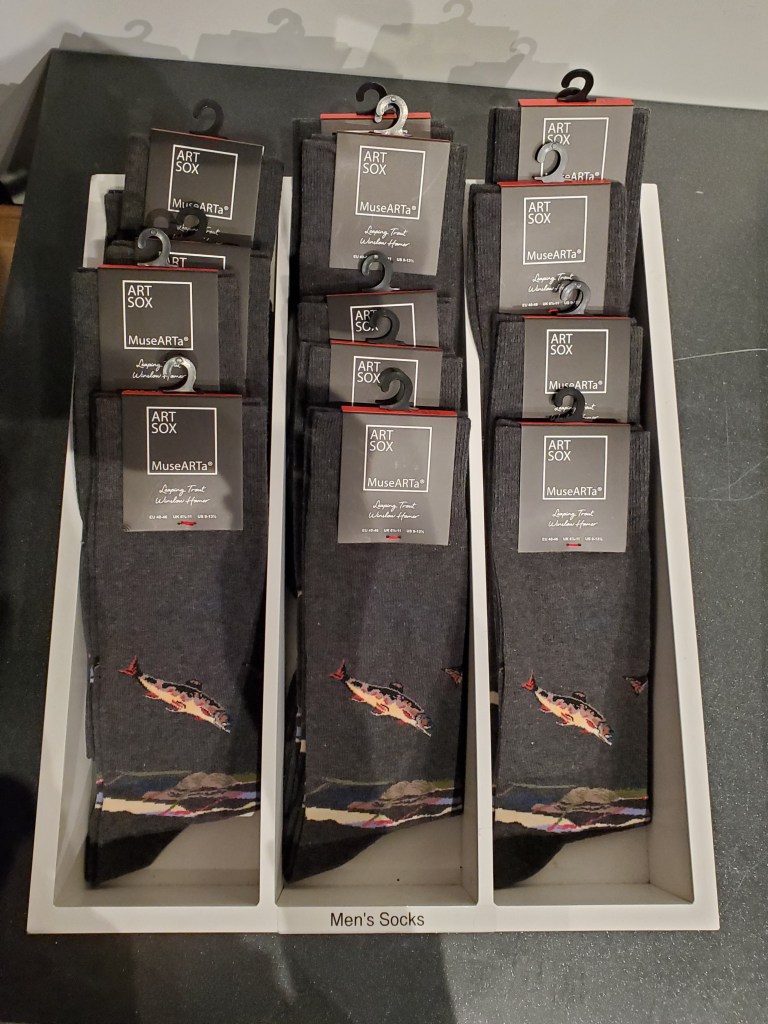
Leaping Trout as Art Sox 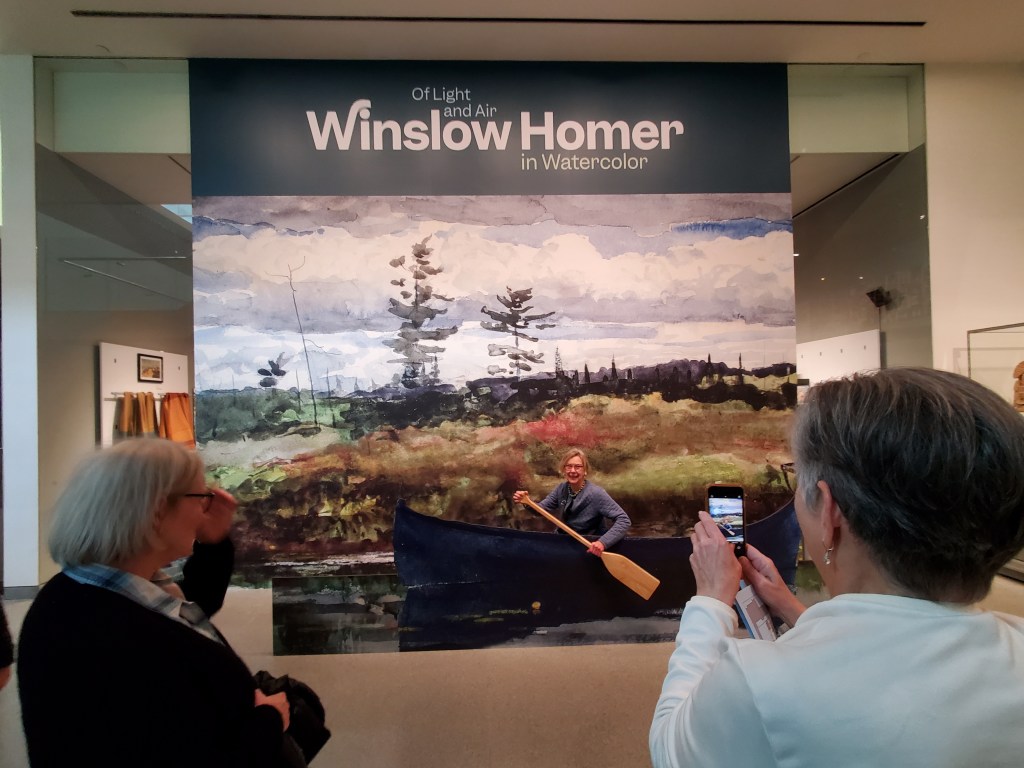
The Blue Boat as photo op From the Homer show, I made my way through the MFA to the Lynch and Servison galleries and the “Boston on the Eve of Revolution and the New Nation” show, and found myself once again sadly misty-eyed. What, I wondered, would Thomas Jefferson make of us now? What has become of the sacred honor those Founders pledged along with their land and their lives in this the 250th anniversary of their great experiment?
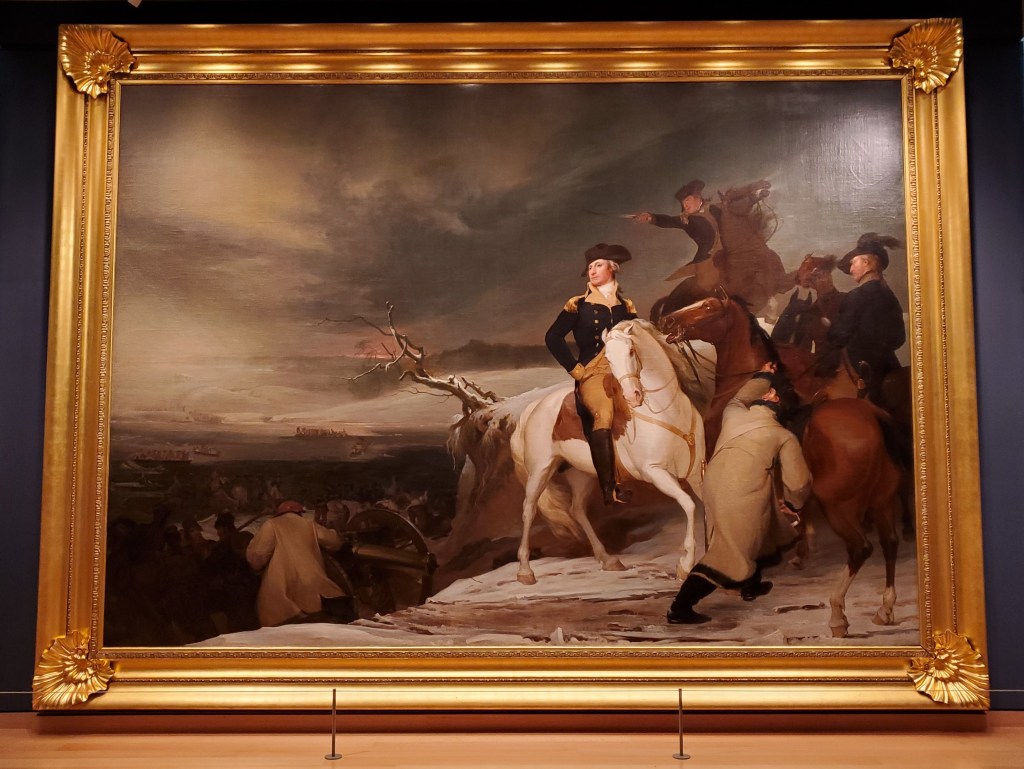
Thomas Sully’s monumental oil (12 x 17 feet) The Passage of the Delaware (1819) 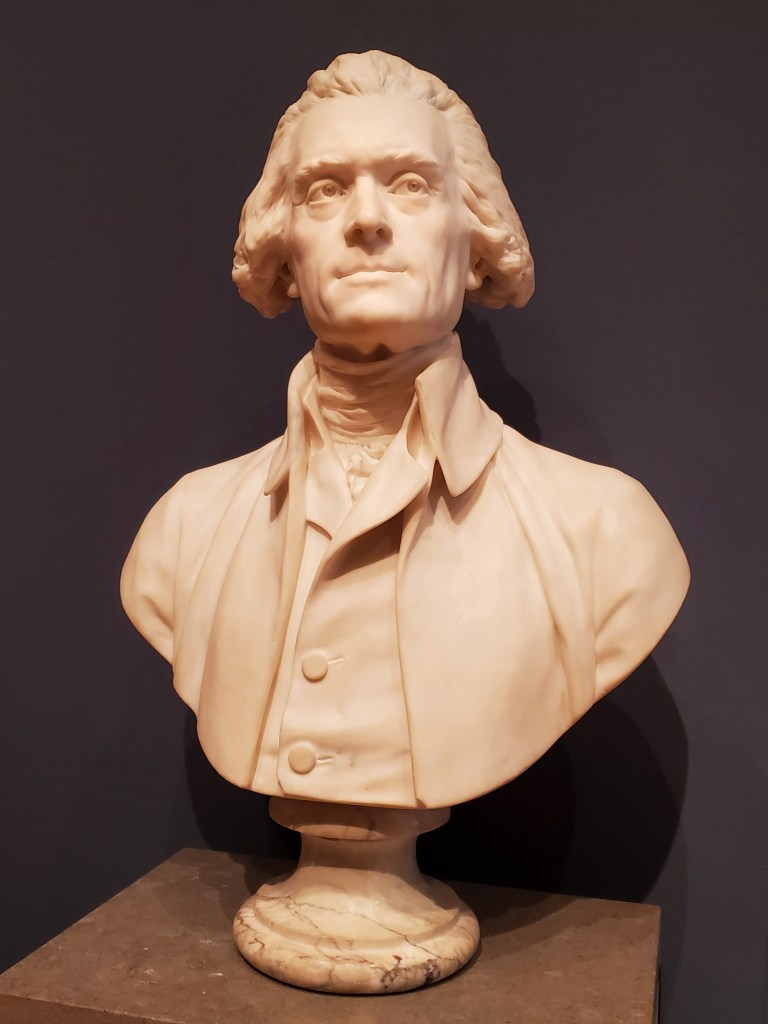
Thomas Jefferson (age 46), Jean-Antoine Houdon (1789) So I beat on, a boat against the current, borne back ceaselessly into the past.
The personal past exerts a gravitational force, too, even as I pursue distraction. Case in point: I saw The Last Class, Elliott Kirschner’s 2025 documentary about Robert Reich’s final semester at UC Berkeley teaching his “Wealth and Poverty” class and so ending his 42-year teaching career while wrestling with his own aging and his students inheriting a world out of balance. Over my own 43 years in college and university classrooms, I certainly witnessed many of the changes Reich did, and worried as much about the morphing “idea of a university,” the title of a humanities course team-taught by my late husband. The next morning I dreamed I was part of a protest on the Berkeley campus while wearing a clown costume (!) and digging in my bag for makeup to refresh my red, white, and blue face paint (!), being late for class, and then sitting in a little school desk to take my GRE exam, from which I was summarily expelled as a protestor (!!!). I awoke worried that I had no cold cream to take off my grease paint.
Another attempt at salutary distraction was confounded by the final (and superb) 18 January performance of Tina Satter’s play Is This A Room by the Apollinaire Theatre Company at Chelsea Theatre Works just outside Boston, a thrilling verbatim transcription of the FBI’s interrogation of young Air Force linguist Reality Winner in June 2017.
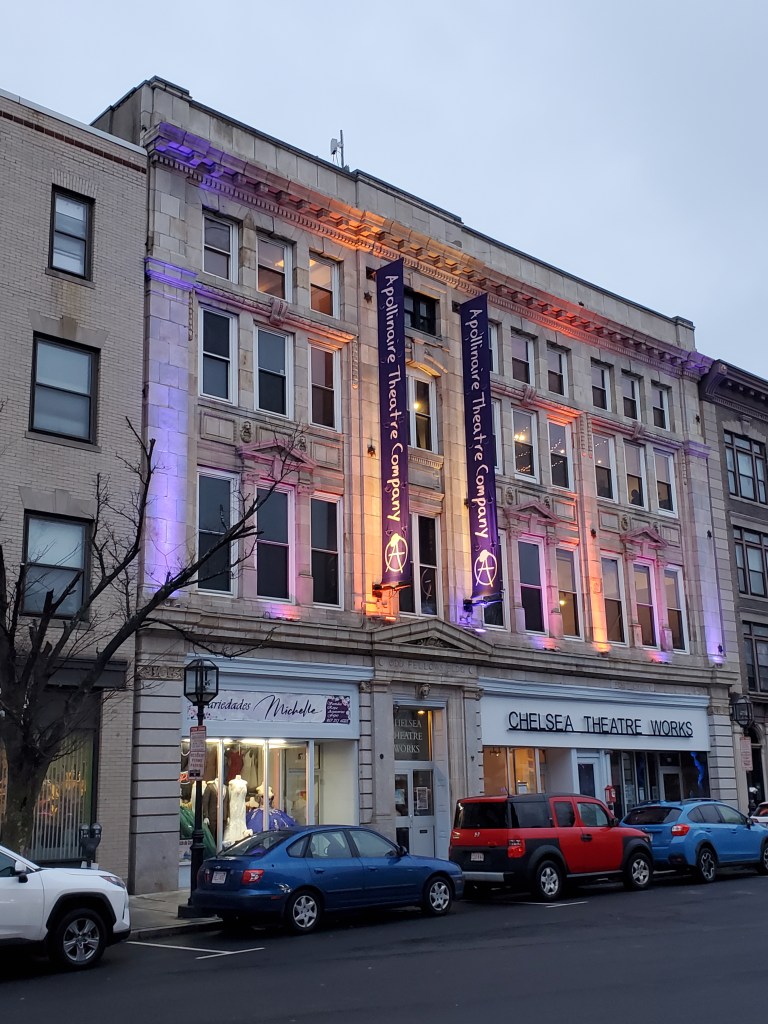

In May 2017, Winner printed and mailed a classified NSA report to the news outlet The Intercept, which published the document. The report described efforts of Russian military intelligence to interfere with US election systems in 2016. Winner was subsequently arrested the same day she was interrogated and denied bail while awaiting trial. In 2018, she accepted a plea agreement and received a 63-month federal sentence, at the time the longest sentence ever imposed for leaks to the media. In 2021, Winner began three years of supervised release. The transcript/play, with Parker Jennings so engagingly portraying Winner, includes Winner’s confessing that having Fox News playing 24/7 in her workspace helped prompt her action.
Yesterday, 28 January, the FBI raided the Fulton County, Georgia Election Office, seizing original 2020 voting records, authorized by the Felon-in-Chief’s Justice Department to continue investigating his false claims of election fraud. And CNN reports that Minnesota Secretary of State, Steve Simon, has declined to hand over voter data demanded by Attorney General Pam Bondi because doing so would violate state and federal privacy laws. “Literally hours after the second, let’s not forget second, killing of an American citizen in the city of Minneapolis by ICE agents … there’s this term sheet,” he said, “this ransom note” (https://www.cnn.com/2026/01/27/politics/pam-bondi-voter-rolls-minnesota-ice). Extortion replaces the law of the land.
Even my two book clubs have inadvertently conspired to keep the roiling of our republic top of mind. Our Madbury Public Library group tackled Maggie O’Farrell’s Hamnet as well as Chloé Zhao’s film last week, and the Shakespeare discussion at the Portsmouth Public Library took up Hamlet the following Tuesday. O’Farrell’s novel is an almost too evocative representation of grief and Hamlet a tale of revenge in a poisonous court ruled by a murderous, fatally obsessed king. Oh, NO KINGS, please!
Where, oh where lies relief? Well, there is Canadian Prime Minister Mark Carney’s principled and pragmatic speech to the World Economic Forum in Davos on 20 January. The date recalls not only a painful inauguration day (and by association the FIC’s attack on the Capitol), but also the loss of my sister Jane, born on 20 January in 1958. But Carney’s rational erudition (he quotes Thucydides, not Hannibal Lecter) and pellucid, persuasive rhetoric are a balm of reason. I recommend you read his plea for middle powers to “live in truth.” And then take peaceful political action. And make plans to go spend money in Canada, as I have.
Also, get a few bulbs growing indoors.
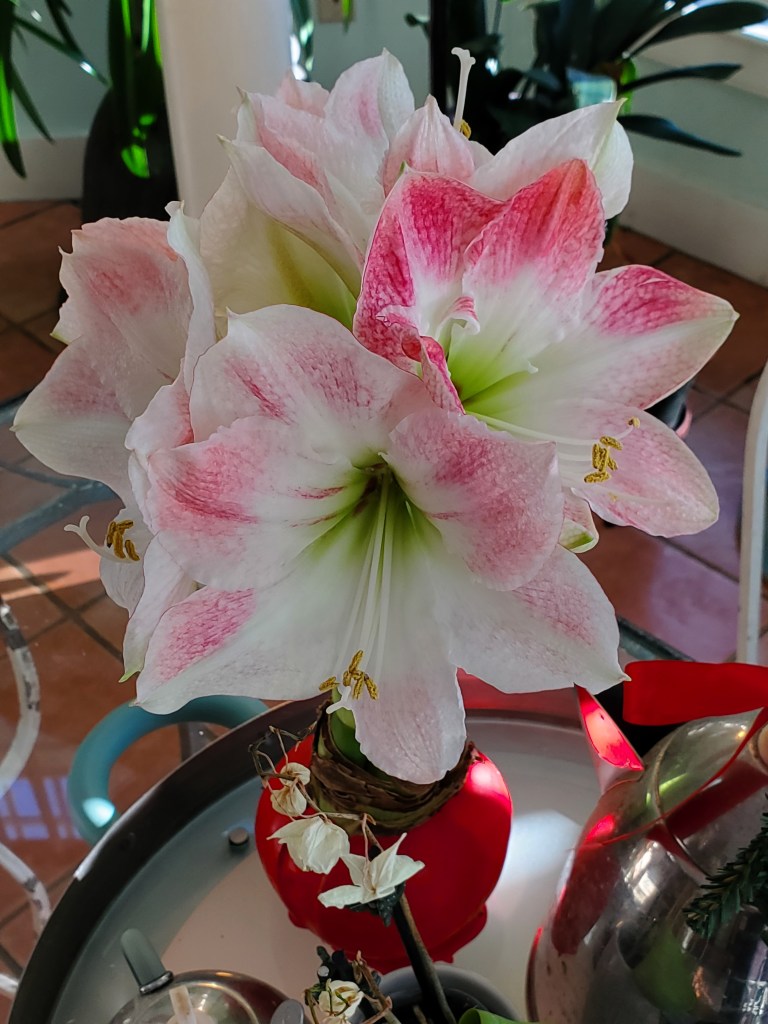
One wax-coated amaryllis bulb produces 2 buds, one with 6 blossoms and another on the way: “the force that through the green fuse drives the flower” And then, go spend some time outside, however cold it might be.
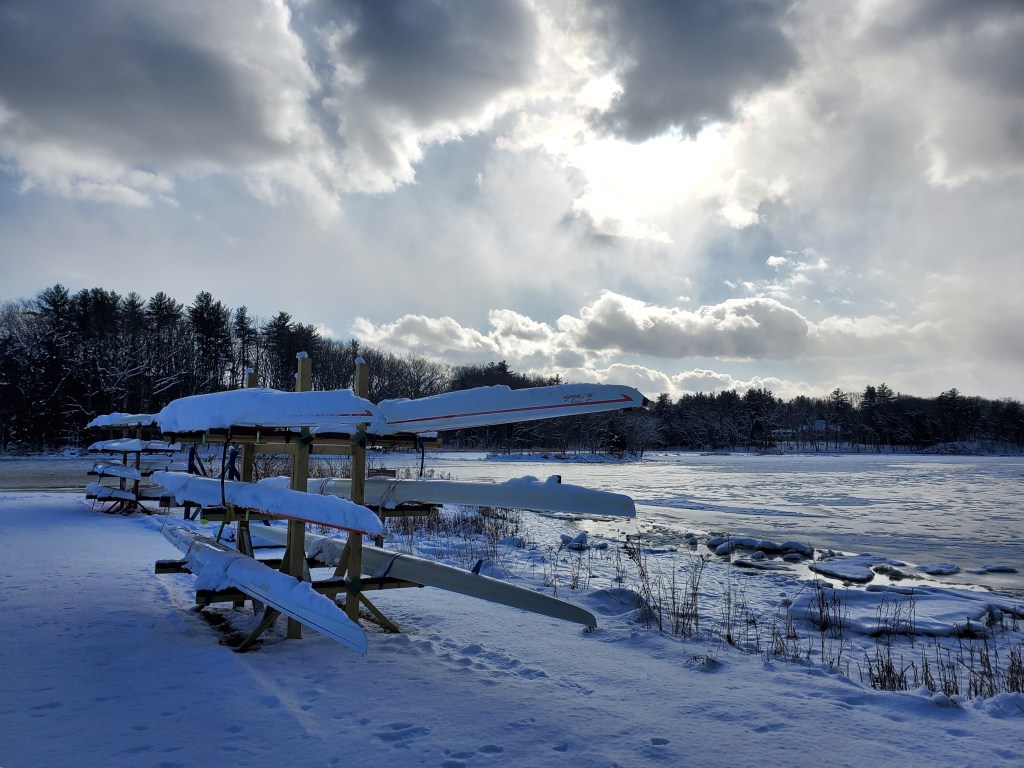
Sculler’s Shells at the Durham landing Nature helps us live in truth, as Duke Senior, in exile in the Forest of Arden knows:
. . . Are not these woods
More free from peril than the envious court?
Here feel we not the penalty of Adam,
The seasons’ difference, as the icy fang
And churlish chiding of the winter’s wind,
Which when it bites and blows upon my body
Even till I shrink with cold, I smile and say,
“This is no flattery; these are counselors
That feelingly persuade me what I am.” (As You Like It, 2.1.3-11)
As the historical sign at the Durham landing suggests, this, too, will pass.
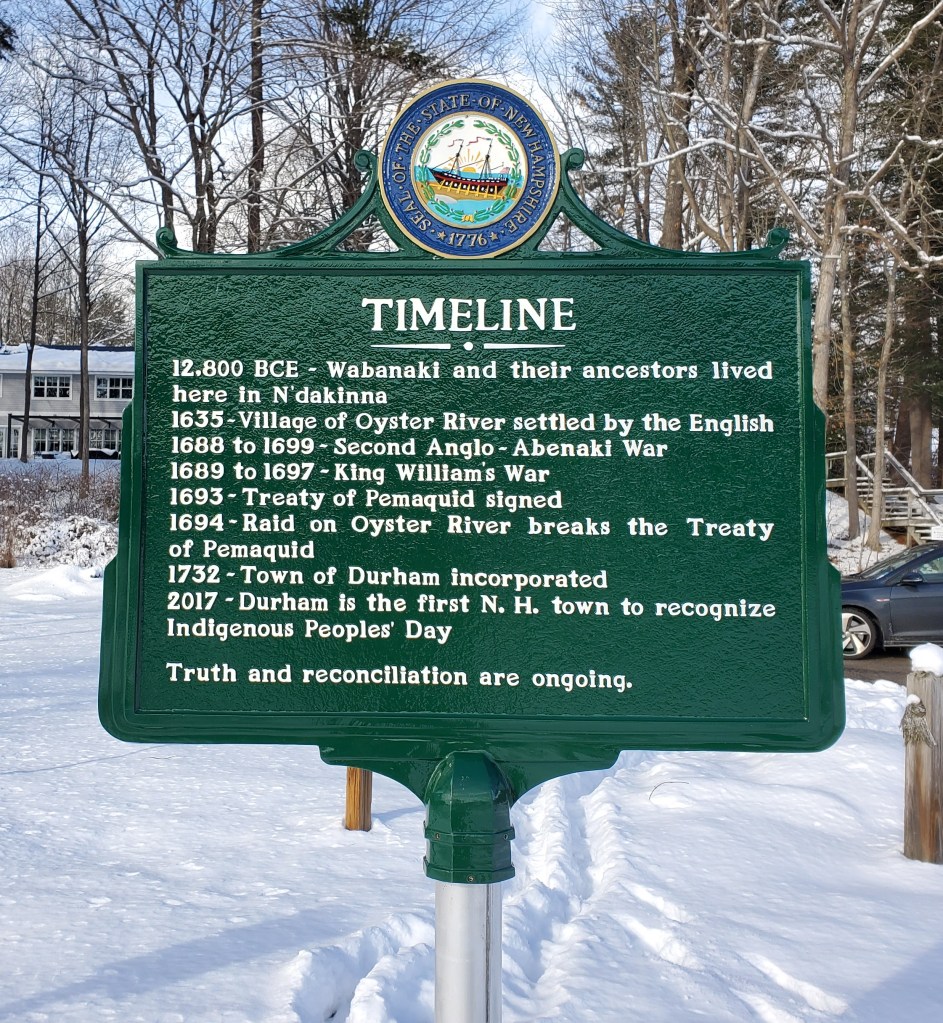
Truth and reconciliation are ongoing.
-
Subscribe
Subscribed
Already have a WordPress.com account? Log in now.
 Georgeann Murphy