
On the first Thursday of February 2023 I caught the C&J coach back down to NYC, excited, as ever, about going and in nearly the same measure, anxious enough that I had to write to my late husband David to settle myself, a trick I’ve found has worked pretty well over the last several years since his passing. Previous journeys to the City always bleed into my experience of the current one, as when I recall so vividly being on a bus—no luxury coach then!—in February 1971 traveling with Furman U. classmates in my Intro to Theatre course north from South Carolina to NYC for the first time, and spotting the skyline from the highway, the alabaster city gleaming. I led a cheer! We stayed at the Hotel Great Northern, quite a seedy place right next to Carnegie Hall, and the first thing I did was cross the street to visit a fabled real deli where, determined to experience all manner of fare exotic only to me, I ordered gefilte fish (!). We saw several wonderful productions that February–Hair, Claire Bloom playing the lead in both A Doll’s House and Hedda Gabler, Peter Brook’s A Midsummer Night’s Dream—and I, a big fan of Dick Cavett, had written ahead for a ticket to his show. His guest that night was Danny Kaye (I mostly remember Kaye’s red hair), and afterward I got the petite Cavett’s autograph on a grease-stained doughnut bag before he could escape the studio mostly unnoticed in his fisherman’s cap. In an attempt at sophisticated fashion, I later tried wearing some warm over-the-knee stockings that were supposed to stay up without assistance from garters; how embarrassing when they fell down around my ankles as I stood on 5th Avenue admiring the Empire State Building.
Almost exactly 52 years later I arrived at Port Authority right on time, and wheeled my small suitcase to the SpringHill Suites at W 37th and 5th with assurance, as it’s right next to the boutique hotel Pulse (formerly known as the Strand) where I so often stayed with David, a destination easily reached before. The only surprise came after I left my suitcase in the room and went back to 37th and 6th to grab a quick dinner: a meal at Chik-fil-A currently costs a shocking $17.73! I first encountered this chain in the Carolinas in the 70’s (pickle slices used to be the only adornment on the seasoned fillets), and when this very first Chik-fil-A in NYC opened in 2015, I recall having to walk around a long line of New Yorkers apparently lured by so novel a southern import–exotic to them, just as gefilte fish had been to me in 1971. Thirteen years later, the thrill is gone: only the price and the kale crunch salad substituting for fries were remarkable. I texted my friend T.R. to confirm her arrival and plans to meet in the morning, and turned in too late, wired by Big City vibes.
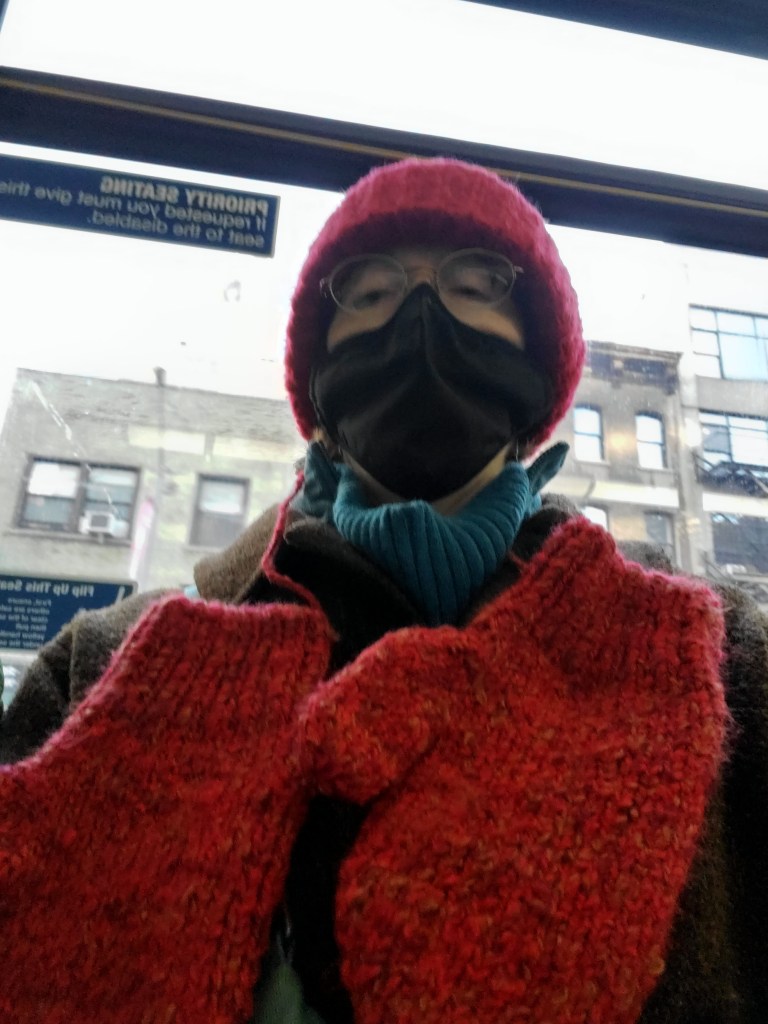
For the same reason, I was too excited to sleep well, and though I wasn’t to meet T. R. until 11, I had to get up by 8 to get the complimentary breakfast (the usual powdered eggs, watery juice, and tough ersatz bagels) that Marriott provided. Finished with that by 9, I went back to sleep for a bit, waking with bowels loosened by nerves—could I as a 70-year-old manage negotiating the subway with my untried senior Metro Card and then walk the rest of the way to the Whitney on that bitterly cold and ferociously windy winter’s day? Yes, I told myself aloud, another of my self-soothing measures. And then came the nose bleed. Stress had produced that result twice before in my life: in Rome in the mid-80’s the morning that I and my very difficult boyfriend were to drive my little sister, who had briefly traveled with us from Milan, to the airport for her flight home; the blood suddenly painting my chest as I showered added yet another worry to that vexed time. And it happened again the morning of my husband’s funeral, as guests gathered downstairs at our home and I tried in the upstairs bathroom to compose myself to play host and emcee. Can stress trigger nose bleeds? Apparently yes.
Stuffing my nose with cotton balls, I texted T.R., whom I was to meet downstairs to instead come on up to my room. This bought me an additional half hour, by which time the bleed had ceased and we set out. Once figuring out how to add value to the Metro Card I already had (the options presented on the screen of the vending machine say nothing about adding value), we set out for the Whitney via subway, revising plans as we went. No way we could walk the High Line back from Gansevoort to 34th in that howling gale.
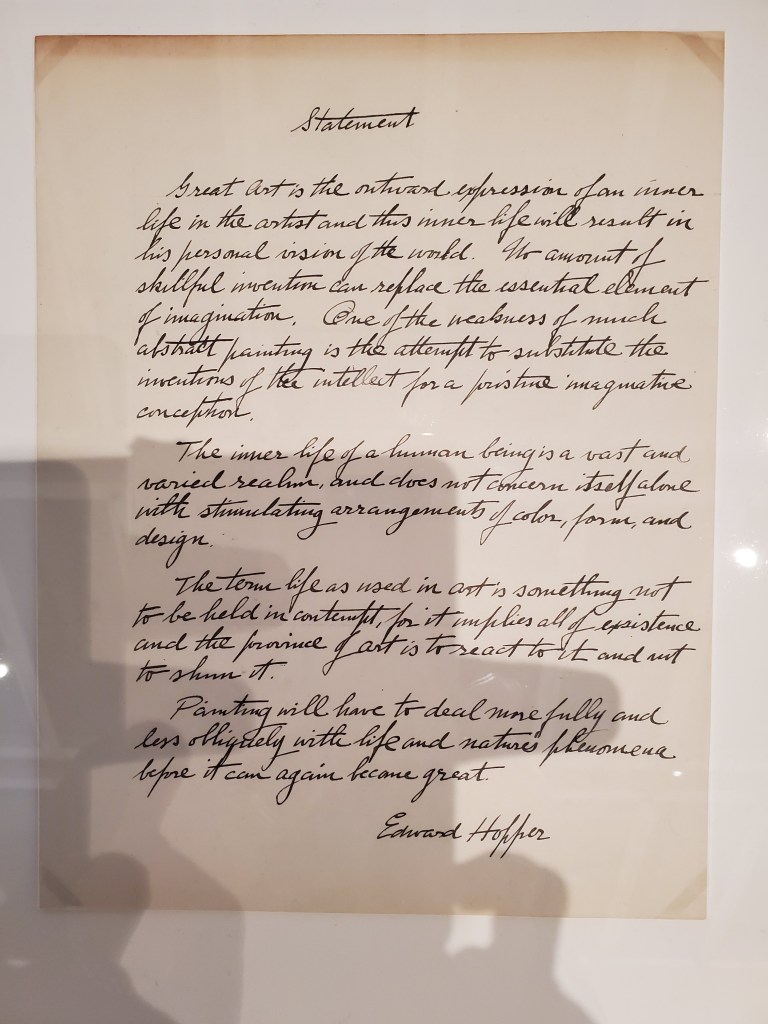
Once inside the Whitney, I could finally calm down: after so long experience with art museums, even new ones feel familiar, and I’d been to the Whitney before. On the advice of a helpful docent, we joined an over-populated tour of the Edward Hopper exhibit with a guide who clearly knew his stuff and enjoyed sharing it. Just as clearly, he was NOT, however, an art historian, and after half an hour or so, I could hear the ghost of my Americanist art historian husband complaining about the narrative fancies the guide was spinning. But I did learn that Hopper, like my Grandpa George, had begun his career as a commercial artist after training in NYC, though Grandpa George studied at the Art Students League, while Hopper was at about the same time attending what would become the Parsons School of Design.
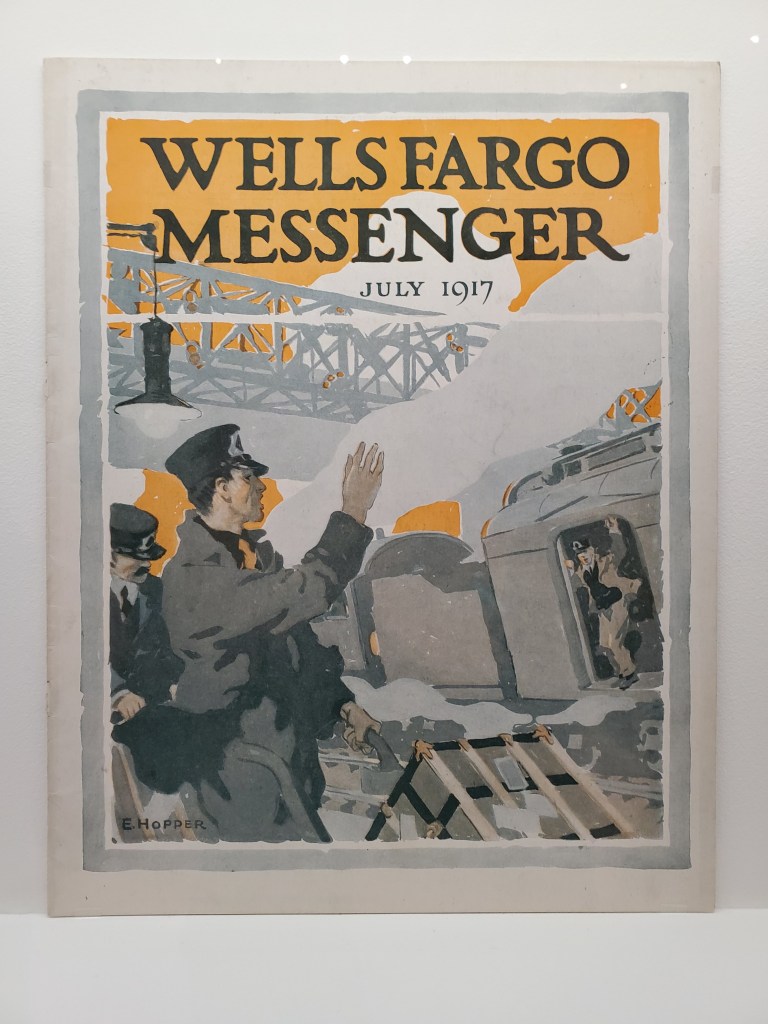
I kept thinking of our NYC visit on Thanksgiving Day, when David broke the land speed record driving us down to the City in his GTI “Schwarzkopf” in 4 hours and 20 minutes; no traffic, it turns out, on Turkey Day. We’d had our turkey dinner at a diner right across from the Art Student League as I tried to imagine George Anthony Murphy’s time there in the early twentieth century.
Still at the Whitney and finally impatient with the slow pace of our Hopper guide, we broke away from the group and finished the tour on our own until fortified by a coffee at the obligatory museum café, we made our way back uptown via bus. Note to self: the same Metro Card that worked on the subway must be flipped and turned ‘round to work on the bus. Who knew? For the rest of the weekend, Hopper’s aesthetic informed my every view.
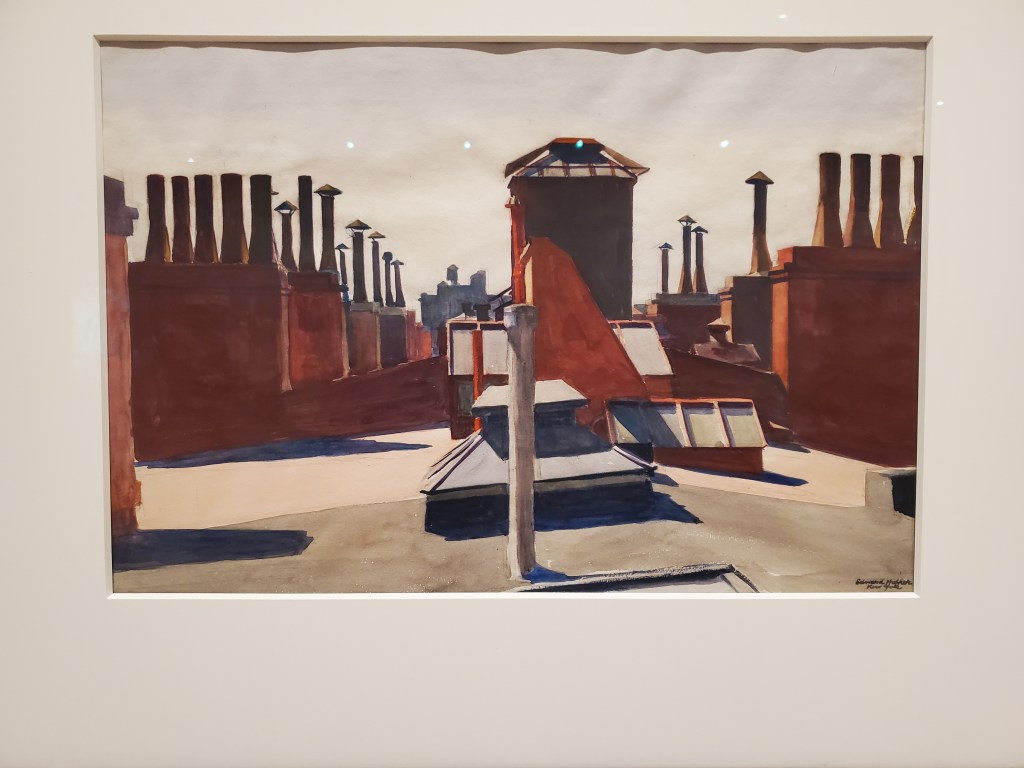
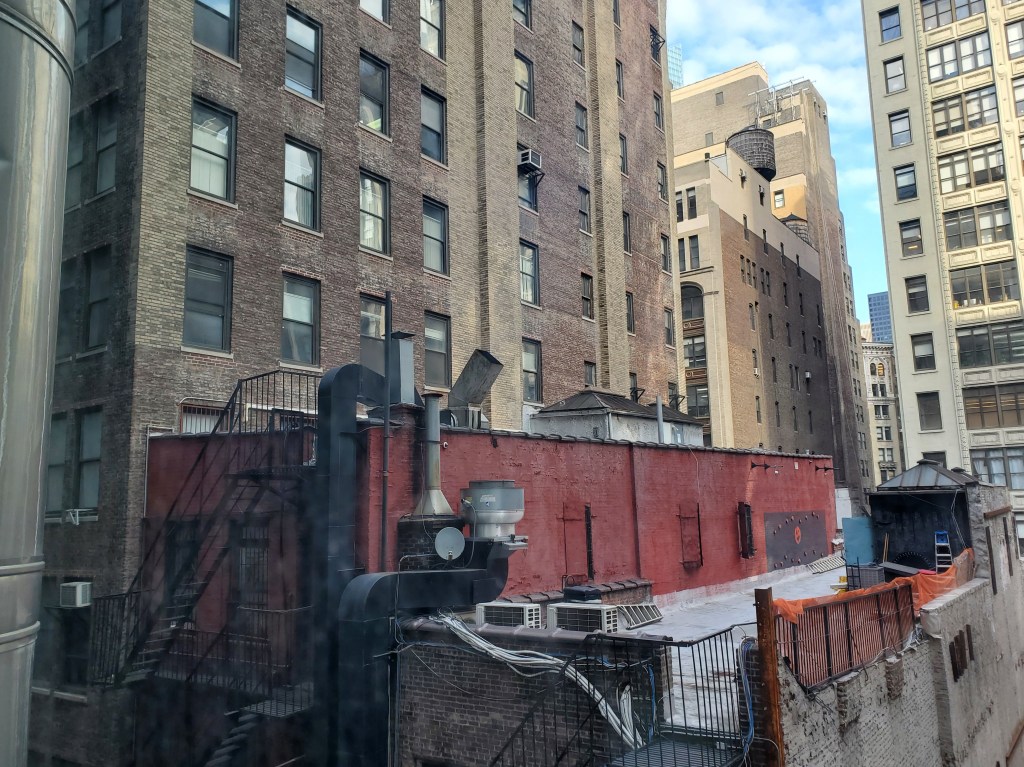
Out of the weather and safely back at my hotel, T. R. and I split to rest a bit before again setting out for an early dinner with two other grad school pals, friends since the first year of our Tulane Ph.D. program in 1976. T. R. had discovered her cell phone would no longer hold a charge, and sans watch, she and I had to agree in person all plans to meet—or use the LAND LINE and OPERATOR at her hotel’s SWITCH BOARD?? So analog/twentieth century! Still, the morning had gone well—a triumph over age, adversity, and weather. We congratulated each other (she is exactly one year older; we share a birthday) as we made our way once more through the 12o of polar vortex with gusts of 40 mph, skirting the theater district crowds to Barbetta, the oldest restaurant in New York still owned by its founding family Maioglio, to meet our friends already there. T. R. had initiated our Restaurant Week rendezvous with Ann and Barry, who came up from Pennsylvania to stay with family in Brooklyn, and our NYC reunion, like that of last April 2022, reassuringly confirmed that we could pick up right where we left off in the grad school Before Times, back when our little cohort would take each other out for birthdays and celebrate together significant achievements like passing a doctoral qualifying exam. Everyone at our table of four was still teaching but me, and I silently wondered at the difference that made—and how apparent the scar from my Mohs surgery six weeks earlier was. No one commented: politesse or myopia?
Barbetta, established in 1906, is a venerable, high style restaurant, with waiters in tuxedos—like the oldest restaurants in the French Quarter we all knew. But current customers were both informally dressed and bundled against the cold, so staff were much better turned out than their patrons in an all-too-common collision of past and present. Efficient service (a hallmark of long-established practice) got us our three prix fixe courses in plenty of time to make it to the theatre. Anticipating disorientation after a long day in the cold on unfamiliar streets, I had written out directions about which way to walk once we exited to 46th Street. These proved useful, overriding my habitual inclination to turn exactly the wrong way.
We all had very fine seats for the revival of Stephen Adly Guirgis’s 2015 Pulitzer Prize Winner, Between Riverside and Crazy at the Hayes Theatre, and even before the play began, I was relishing my return to professional theatre with Walt Spangler’s hyper-realistic set on the turntable so close at hand. Realism was the watchword, and after a morning spent with Hopper and Hopper’s disavowal of abstraction, I was fully on board with an old-fashioned, straightforward, well-made play.
As Terry Teachout observed in his Wall Street Journal review, “If August Wilson had tried his hand at comedy, I bet it would have played a lot like this.” The story of ex-cop Pops Washington’s struggle to hold on to one of the last great rent-stabilized apartments on Riverside Drive unearths old wounds, chicanery from just about everyone, laughs, AND sentiment. Wonderfully accomplished ensemble performances made watching from seats so close to the action all the more fun. Such a treat.
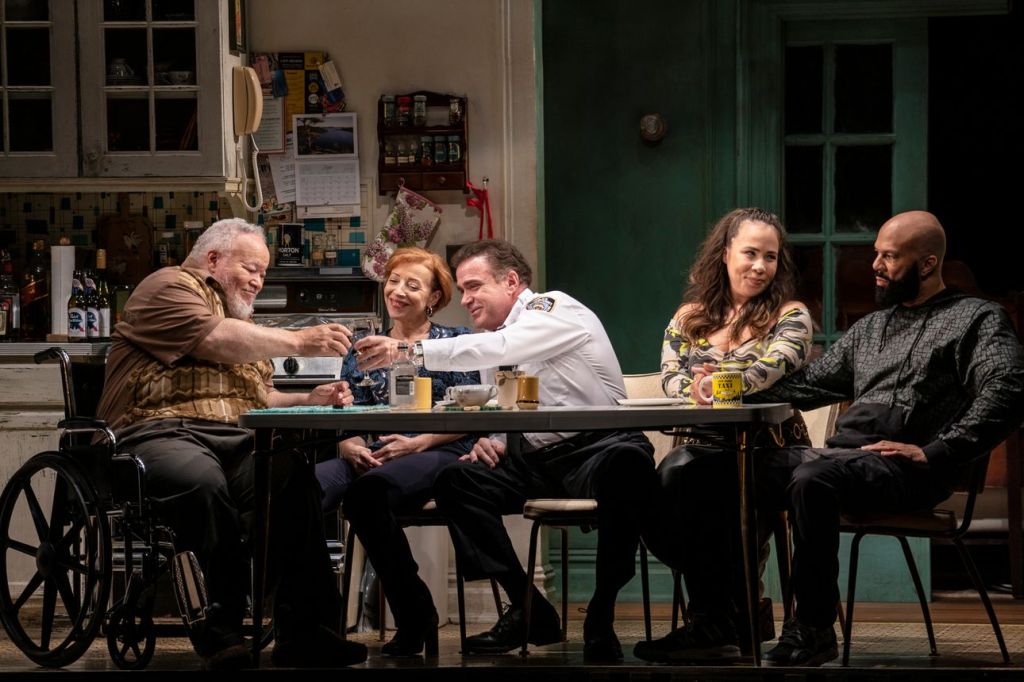
l. to r.: Stephen McKinley Henderson, Elizabeth Canavan, Gary Perez, Rosal Colόn, and Common (photo by Joan Marcus)
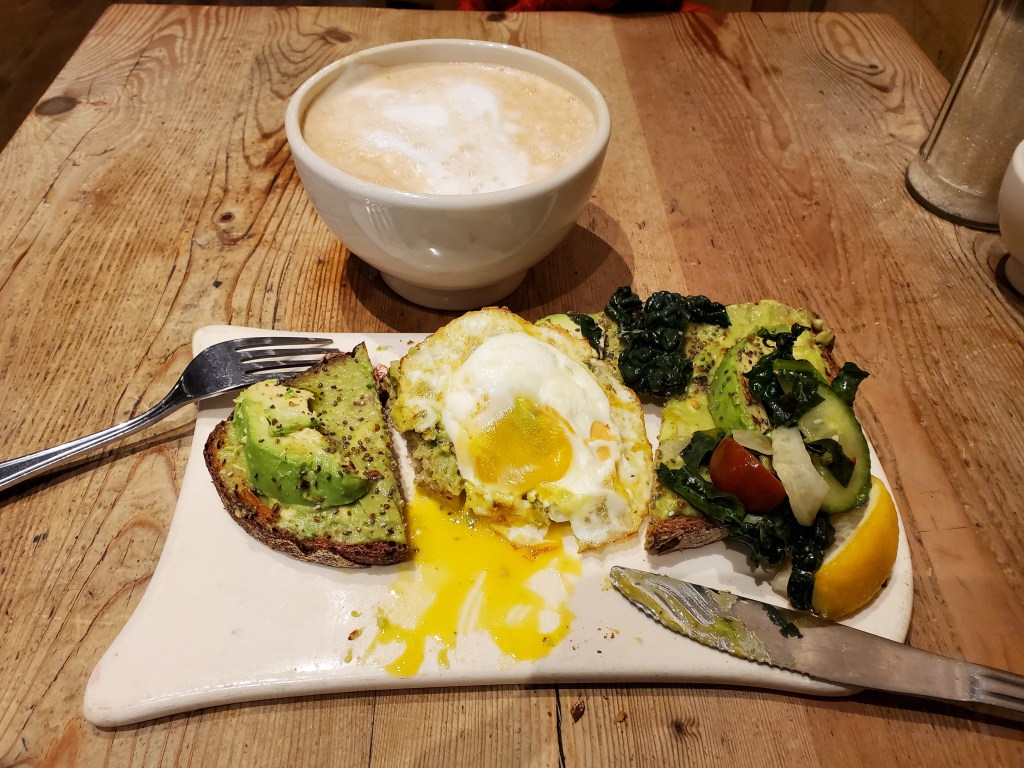
Saturday came in less windy but even colder, so again T. R. and I downsized our plans. Ann and Barry had had to return to PA, so we took the morning off, and I opted to sleep through the less-than-satisfactory “breakfast” at the Fairfield in favor of what Le Pain Quotidien across from Bryant Park—there seems to be one of these every few blocks—had on offer. Avocado toast with egg and—again!—kale and a large café au lait hit the spot, though I take some exception to serving a runny egg on a plank.
I met T.R. at her hotel, the Dylan (with its in-room digital clock curiously erratic, leaving poor T. R. to rely on the tv to tell time), and we walked past the Krispy Kreme (yet another example of low rent southern food become faddish in the Big Apple) to join the queue of ticket holders at the Longacre waiting to see what may well be Tom Stoppard’s last play, Leopoldstadt, named for the old Jewish quarter of Vienna, where the epic play begins at Christmastime, 1899, and proceeds through six decades to 1955.
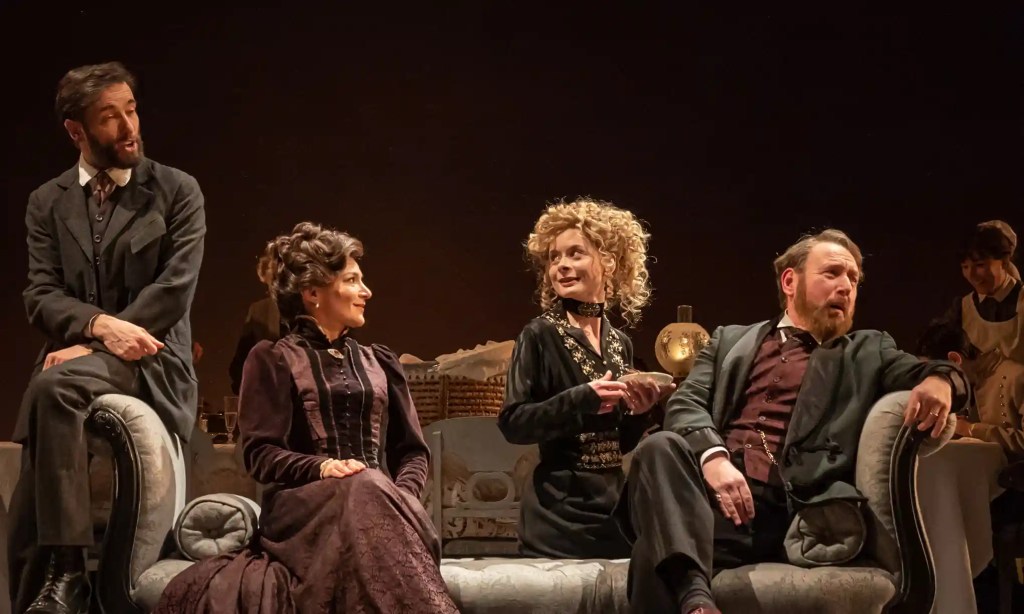
l. to r.: Ed Stoppard, Alexis Zegerman, Faye Castelow, and Adrian Scarborough in the 2020 production at the Wyndham theatre, London (photo by Marc Brenner)
With a cast of over 20 playing roles across three generations, Stoppard’s reckoning with his own survivor’s guilt felt more pronounced than the ideological debate and intellectual wit that are his signature. Born Tomáš Sträussler in 1937 Czechoslovakia to non-observant Jews, Stoppard fled with his family to Singapore on 15 March 1939, the day the Nazis invaded Czechoslovakia. Before the Japanese occupation of Singapore, Stoppard, his mother, and brother fled to India, while his father remained in Singapore as a British army volunteer, where he died trying to flee Singapore in 1942. In 1945, his mother married British army major Kenneth Stoppard who gave Stoppard and his brother his surname and moved the family to England in 1946, making his 9-year-old stepson “an honorary Englishman.” Not until 1993 did Stoppard learn that both his parents were Jewish; Stoppard’s mother had told him that only his father was a Jew. Many of his blood relations — including all four grandparents, a great-grandparent, and three of his mother’s sisters — perished in Nazi death camps, a revelation akin to Leo’s in the play’s final moments.
Leopoldstadt is a search for the “order underneath,” in the play’s mathematician Ludwig’s phrase, a metaphor made literal by the production’s recurrent game of cat’s cradle, the child’s pastime that begins with a string looped in a pattern like a cradle and then transferred to a second player’s (or in the play, generation’s) hands to form another complex pattern. Leopoldstadt explores Jewish identify from institutionalized racism in 1899 Vienna through the Holocaust, ending with a 1955 recitation of family members who died at Auschwitz. To aid an audience struggling to keep so many characters straight over decade-leaping mise en scène, a family tree projected on a downstage scrim repeatedly bookends scenes, and becomes a literal paper prop handed to Leo, the Stoppard surrogate in the play’s final scene.
Something, however, kept me from engaging the emotional power of the play, despite the weeping audible all around me at play’s end. Indeed, the man seated to my left was so overcome he was still sitting, head in hands, sobbing as we exited the theatre. Was the reason our literal distance from the stage? We were seated near the last rows of the orchestra under the balcony. Was it the difficulty of following so many characters’ relations, even though I had read the script on the C&J traveling south? Or was it what sometimes seemed simplistic history lessons rather than dialog that kept me disengaged? I was reminded of my response to the 2003 production of Long Day’s Journey Into Night, which despite the a-list cast (Brian Dennehy, Vanessa Redgrave, and Philip Seymour Hoffman) failed to move me until Hoffman searingly inhabited Jamie in that autobiographical play’s last scene. Leopoldstadt is, of course, a play very different from Riverside and Crazy, but I had no trouble believing in those characters, and I missed that theatre magic in the Stoppard. At dinner after at Harta, a Mediterranean place inside the Grayson Hotel (I had a delicious burrata accompanied by the ubiquitous kale), T. R. and I didn’t even talk about the play—a sign that something didn’t connect.
Nevertheless, Leopoldstadt was a good preface to Sunday morning’s Free Tours by Foot food tour of the Lower East Side. The weather had at last warmed, and our group met at Yonah Shimmel’s Knish Bakery and then walked and noshed our way from to Katz’s to Kossar’s, on to the Pickle Guys, then to Essex Street Dumplings, and finally to the Doughnut Plant on Grand.
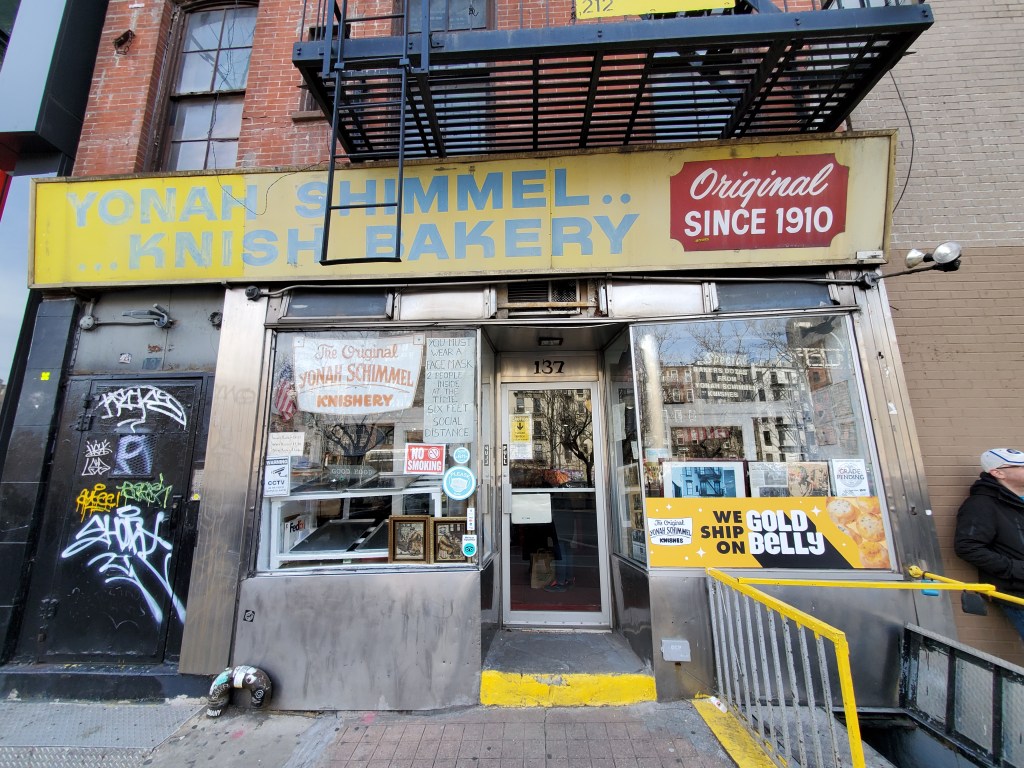
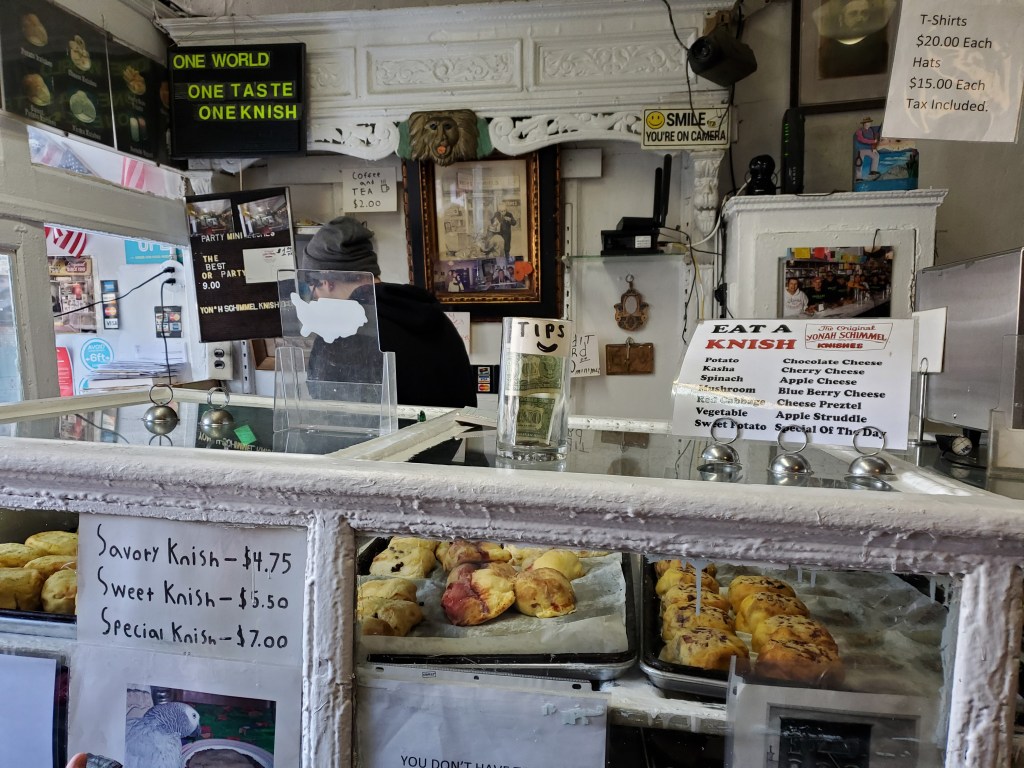
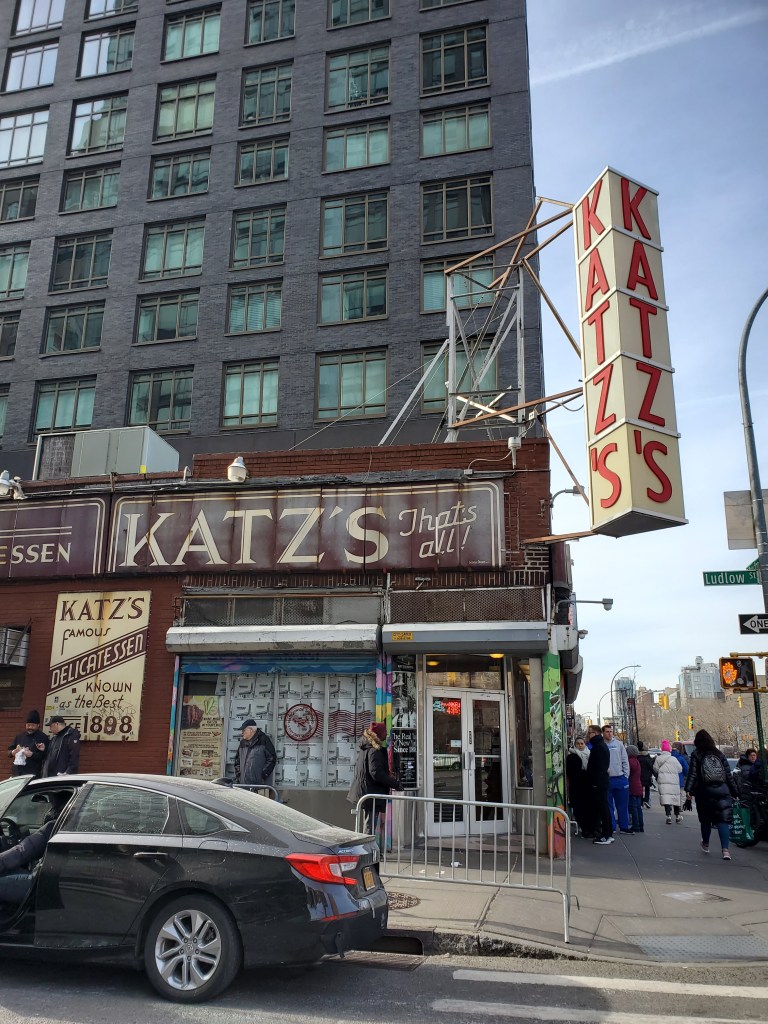
I doubt I will ever again make a meal of knish, half bagel with salmon spread, horseradish pickle, sesame pancake, and chocolate hazelnut doughnut (and that only because they had run out of their signature crème brûlèe version).
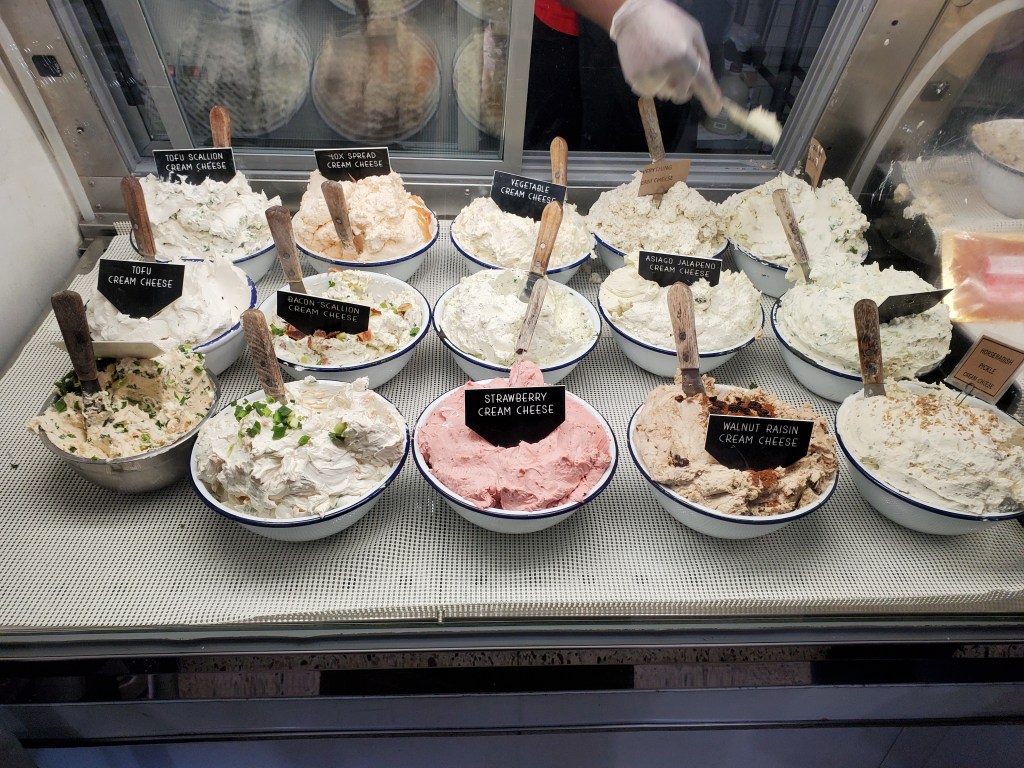
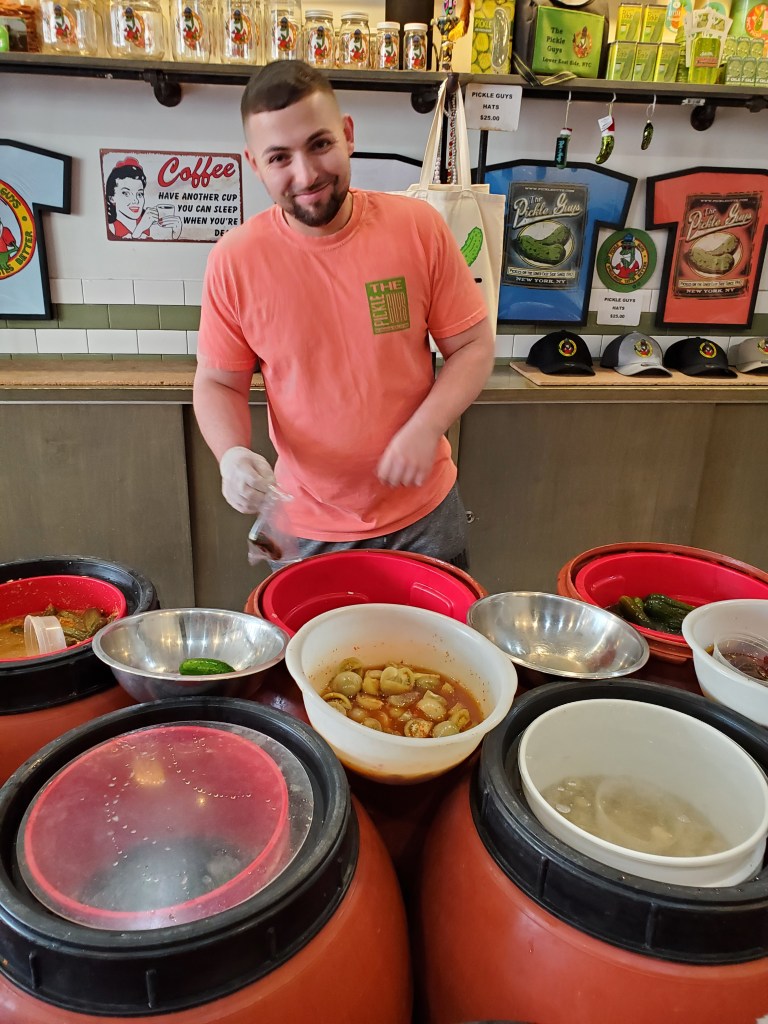
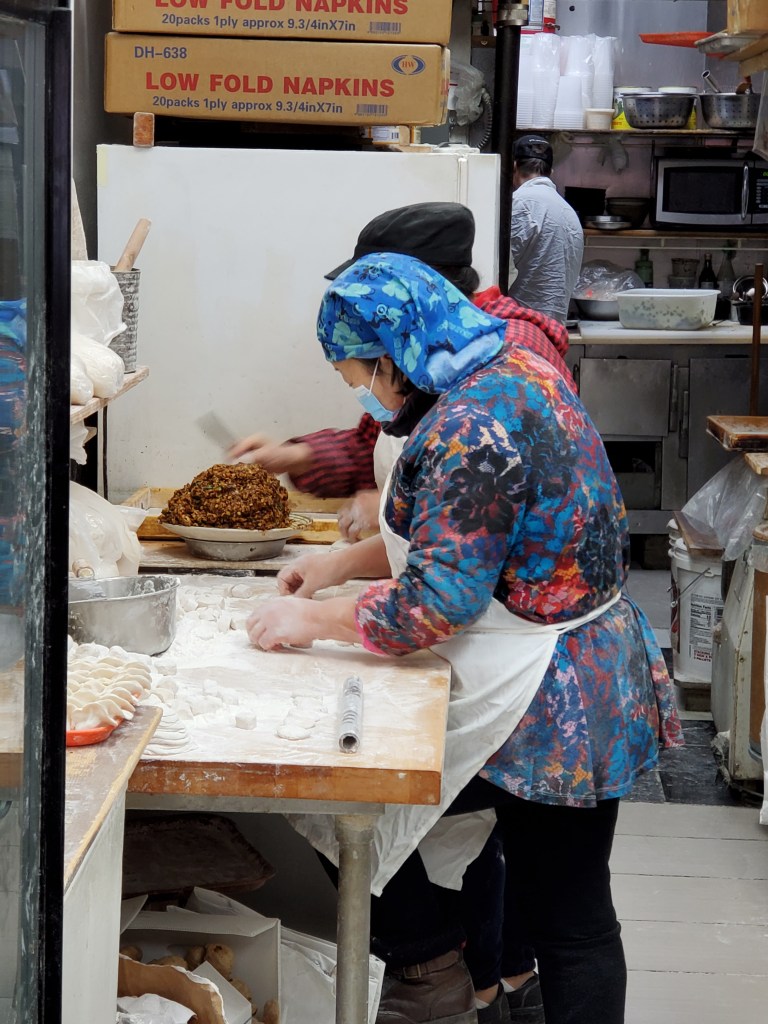
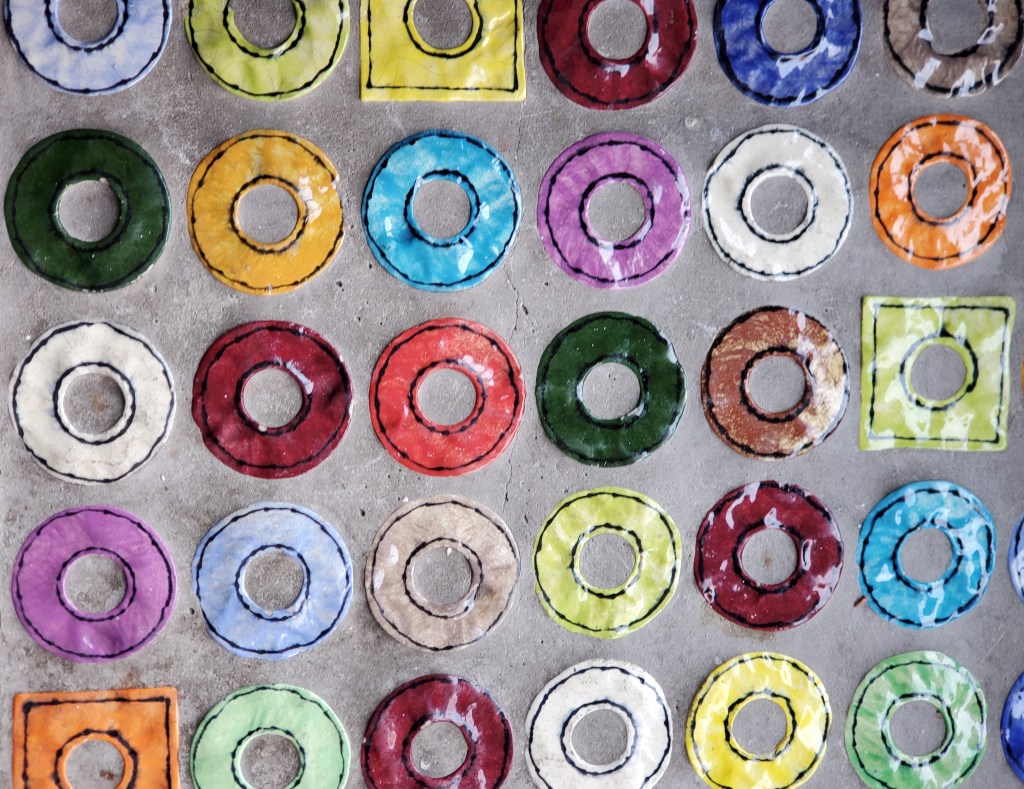
Our guide, Kathleen Dougherty, was terrific, making clear these Lower East Side finger foods’ origins in immigrant pushcarts serving tenements without kitchens, food to sustain the hard lives of the folks who lived there and needed filling, inexpensive, portable food. What at one time had been more than 1500 Jewish delis in NYC has now dwindled to 20, so no time like the present for an iconic experience in decline.
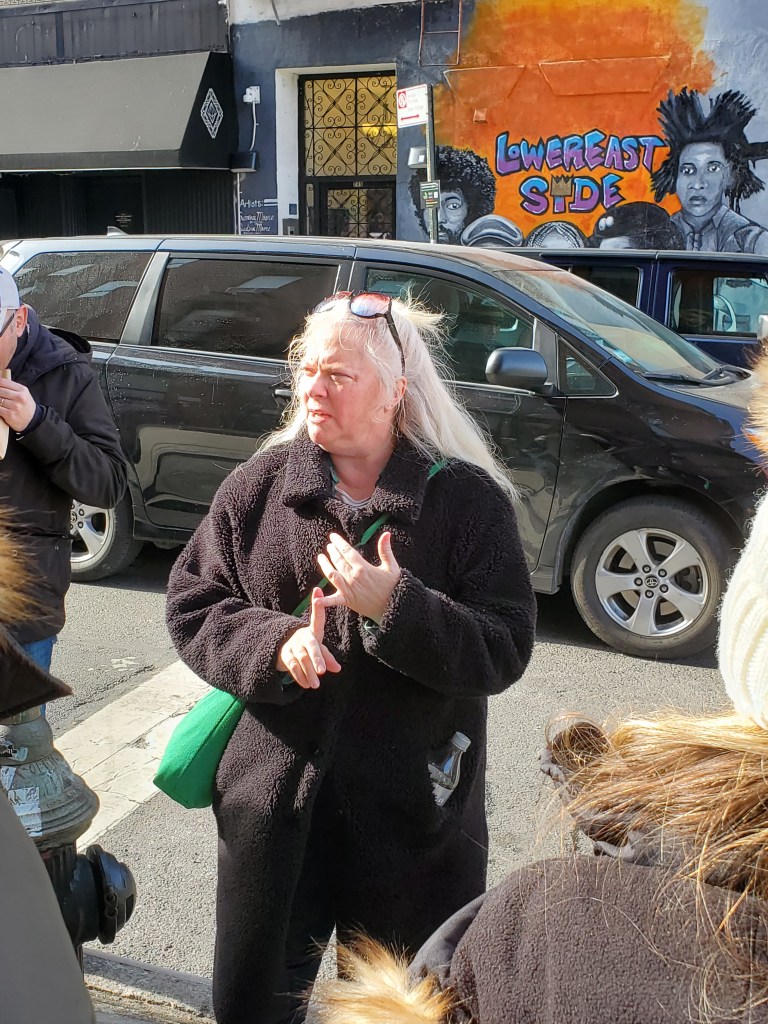
An eclectic walking brunch with a gifted guide was just the thing to follow Leopoldstadt, and the company of curious fellow tourists was enlightening and fun. This was my first Free Tour by Foot, and I will look for others from now on. HIGHLY RECOMMENDED!
We didn’t need much more to eat after such browsing, and so that evening we settled on Dig, a locally farm-sourced restaurant chain offering healthy bowls with grain, protein, and two sides for a reasonable $14.24 (once more unto the kale). We parted to pack for our separate morning departures, and returned to our hotels pleased with another day well spent.
The next morning I mailed postcards and then made my way back to Port Authority, ready to pass the long ride north with a collection of Edith Pearlman short stories, Binocular Vision, her excellent craftsmanship so apparent in that so difficult genre; I’m sorry it took her New York Times obituary for me to discover Pearlman. The coach was late getting to Port Authority, and as I stood waiting with the other so-readily-identifiable New Hampshire passengers at Gate 2, a young girl, perhaps 12 or 13 (she barely came up to shoulder height) approached and asked me if I was waiting for the bus to New Jersey. “I’ve never taken the bus before,” she said, and showed me her ticket. I could make nothing of what was printed there, but instinctively put my hand on her puffy-coat back as I tried to decipher it, snapping into compassionate teacher mode, I suppose. I let her know our bus was headed for New Hampshire, not New Jersey, and that she should walk further down the terminal to the information desk for the help I couldn’t give her. She thanked me politely, and started off in the direction I pointed. A few paces on, however, she turned back and said, “You’re really pretty!” before continuing on her way.
Was she an angel, granting me a mitzvah as a going-back-home blessing? Perhaps I’d seen It’s a Wonderful Life too recently, but that’s what this brief encounter felt like, yet another memory to recall the next time I return to New York City.



 Georgeann Murphy
Leave a reply to SP Wang Cancel reply