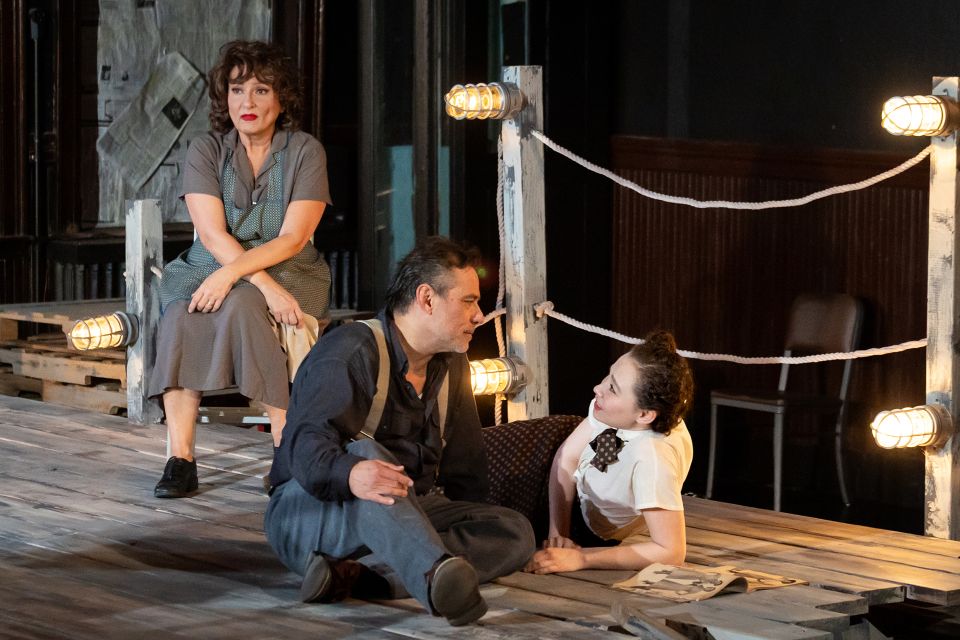
A View from the Bridge (photo by Darlene DeVita)
In his 1960 introduction to the Viking Compass edition of his 1955 play A View from the Bridge, Arthur Miller wrote of how rarely a play gets a second chance: it “makes its mark right off or it vanishes into oblivion.” He goes on, however, to examine the success of both that play and The Crucible following their initial failure to find large audiences for their original Broadway productions. After a couple of years, Miller writes, Crucible was produced again off Broadway and ran two years–without a line changed from the original. With McCarthy dead, Miller asserts, the play’s humanity could finally be enjoyed as drama and not as an unaesthetic special plea. With Bridge, however, Miller revised his original one-act drama, which then under Peter Brook’s direction ran with great success as a two-act play first in London and then in Paris. Miller attributes that transformation in part to the demands of different production exigencies: British actors could not reproduce the Brooklyn argot the characters speak, but, accustomed to playing Shakespeare, they could most certainly incorporate into a seemingly realistic play the mythic, larger-than-life quality the play demanded.
Miller’s take on the relationship between play and the time and place in which it is produced got me thinking about the work of art and its context-dependent reception. The serendipitous tension between naturalism and epic theatre that Brook’s production of A View from the Bridge achieved in London in 1956 London was equally successful in David R. Gammons’s production of that play at Chelsea’s Apollinaire Theatre, whose final performance I was privileged to see on 22 March.
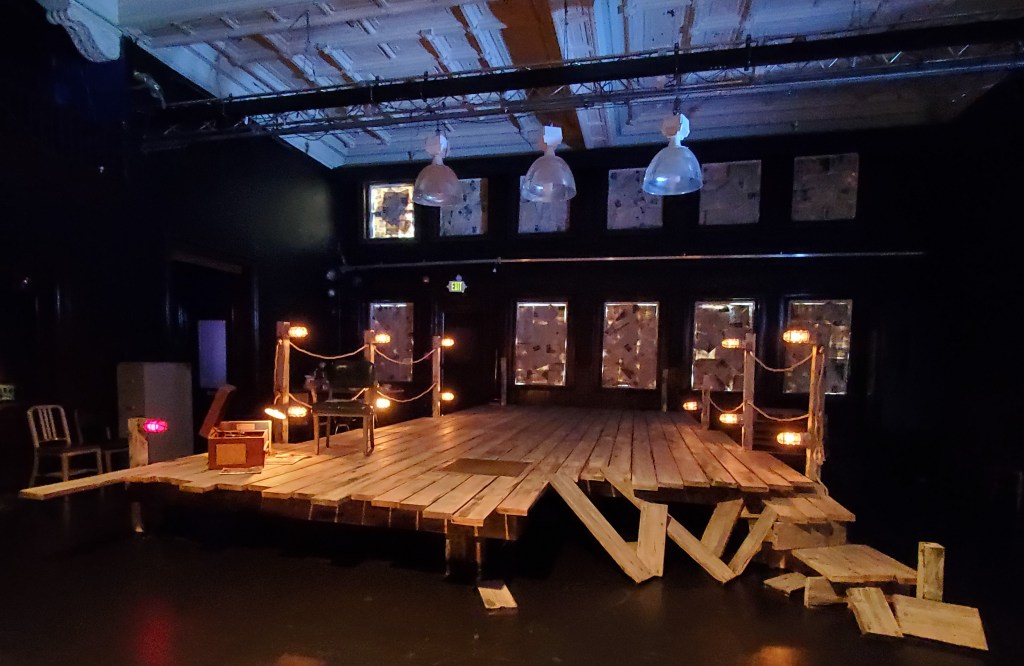
Joseph Lark-Riley’s handsome set conflated the eponymous bridge with the Carbone family living space, ironically highlighting the conflicts that finally cannot be “bridged” without catastrophe: the old world code of culture rooted in honor and vengeance challenged by a new order of American possibility via the Red Hook docks; the protectiveness of a father figure challenged by forbidden desire; the law rendered impotent before the complexity of human nature.
All the characters in Gammons’s production were stylized, larger than life, half real and half mythic: the strong, dark Marco (Rohan Misra), the gamine innocent Catherine (Naomi Kim), the passionate and frustrated wife Beatrice (Sehnaz Dirik), the unsettlingly charismatic Rodolpho (Andrew Molano Sotomayor), and the tormented, tragically deluded Eddie (Jorge Rubio). Rodolpho’s dangerous charm, his threat to Eddie’s understanding of himself, his family and community, was powerfully evoked by the longshoremen Eddie, Louis (David J. Kim), and Mike (Andre Meservey) performing as an alienating trio grotesquely barking stylized laugher while ghoulishly uplit from below. The family mimed dining noisily from bowls, seated around a non-existent table, juxtaposing the real and the imagined. And the plight of the plot’s illegal immigrants, together with Eddie Carbone’s fatal, unresolved attraction to both his niece Catherine and the handsome Rodolpho, bridged the gap between the play’s reception in 1956 London and its revival in 2026 Chelsea, MA. Resonating with contemporary fears of I.C.E. and the toxic masculinity of the Trump era (watch Pete Hegseth thump his chest), Arthur Miller’s play retains its power and relevance 21 years past Miller’s death and 70 years since its composition. The play’s narrator, the lawyer Alfieri (a cool but compassionate Dev Luthra), enjoins us, however ambivalently, to “settle for half,” to make do with less. “I am inclined to notice the ruins in things” he says, “perhaps because I was born in Italy.”
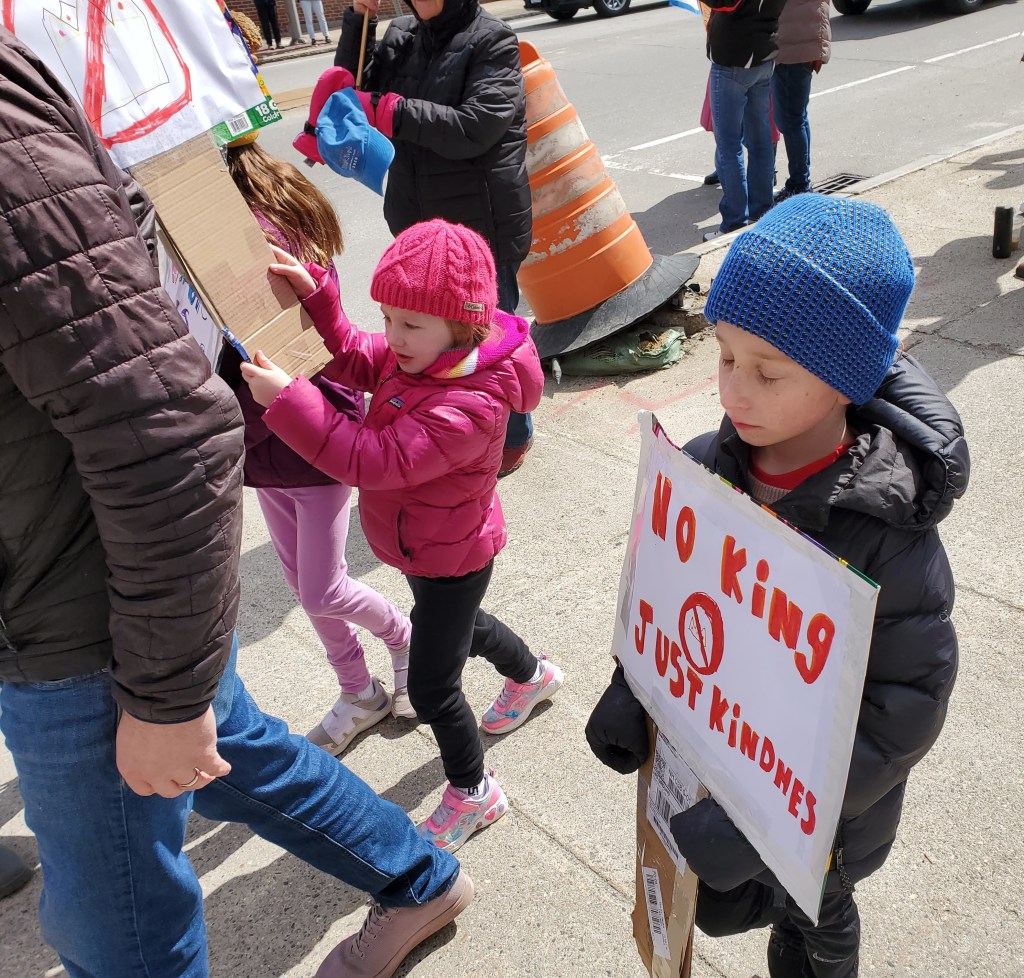
Well, the serendipity of my seeing this excellent production within a week of Saturday’s No Kings rallies—8 million people, 3,300 events, the largest single-day nonviolent protest in modern American history—made me consider what bridges connect us with Miller’s art and the degradations of the Felon-in-Chief. Plenty of my fellow citizens have noticed the ongoing ruination of the American experiment, from demolishing the East Wing of the people’s house to murdering citizens asserting their Constitutional rights, and these people have something to say, apparently unwilling, unlike Alfieri, to settle for the current status quo. Like other Granite Staters braving the cold while waving signs on the median in Dover’s Lower Square on Saturday, I witnessed many more gestures of support (honks, raised fists, peace signs, flags flown through moon roofs) from passersby than middle fingers. One apparent neo-Nazi with his German shepherd dissed us protestors as “retards,” boasting his superior German genes (really?). But he was alone. The other company was uplifting, and many of their signs witty (my favorite: “Cholesterol! Why hast thou forsaken us?).



Then yesterday I returned to Boston for Boston Ballet’s final performance of two ballets, one Sir Frederick Ashton’s revered 1964 reduction of Shakespeare’s A Midsummer Night’s Dream reimagined as his one-act The Dream, and the other a world premiere work by My’Kal Stromile, The Leisurely Installation of a New Window.
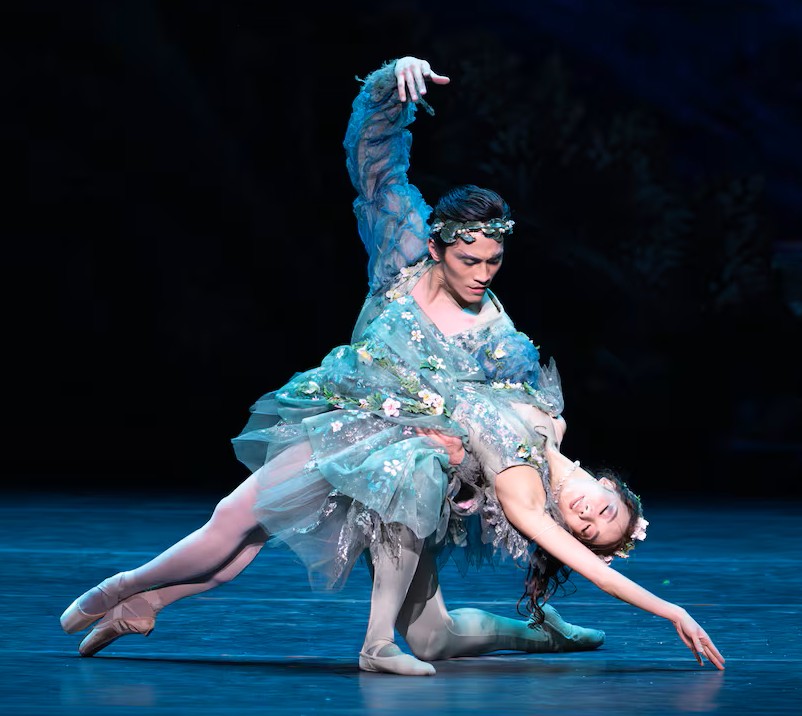
The Dream’s romantic, enchanted woodland set (complete with obligatory ground fog), ethereal fairy costuming, and beautiful dancing leavened by broad humor and a spectacular Puck could not have been more delightful, though I confess my long acquaintance with Shakespeare’s script made me miss the depths lost by Ashton’s cutting both the first and fifth act of that play. The play, not the ballet, is finally about the saving grace of art, most particularly the living art of theatre, and the enduring boon of imagination, themes less apparent without the framing plot of Athenian cruelty transformed to loving acceptance.
At the ballet I was still thinking about the longevity of Miller’s art, and the relevance of his View from the Bridge as well as the previous day’s No Kings protests when Stromile’s The Leisurely Installation of a New Window began, a ballet in three movements adapting Hegel’s dialectical method of progress through contradiction (thesis-antithesis-synthesis) into a meditation on how systems have to be lived in before they can be questioned and shifted from inherited structures to new possibilities. Featuring a Seeker often studying a book and thus honoring tradition, the ballet adds the People, and the Reformers who create patterns that repeat, loosen, and change. Two male dancers perform a pas de deux while engaging the book; meanwhile a trio upstage forms and reforms. Commissioned as a celebration of the ballet at a pivotal 250th moment in America, Stromile’s Installation of a New Window, set to a challenging score by music director Mischa Santora with electric guitar solos by Reeves Gabrels, a member of the rock band The Cure and former Bowie collaborator, left me wondering what future can be glimpsed through a new window, framing what’s to come.
So, Dear Reader. Here’s to new windows, reformers, bridges kept intact, and the living, performing arts.
 Georgeann Murphy
Leave a comment