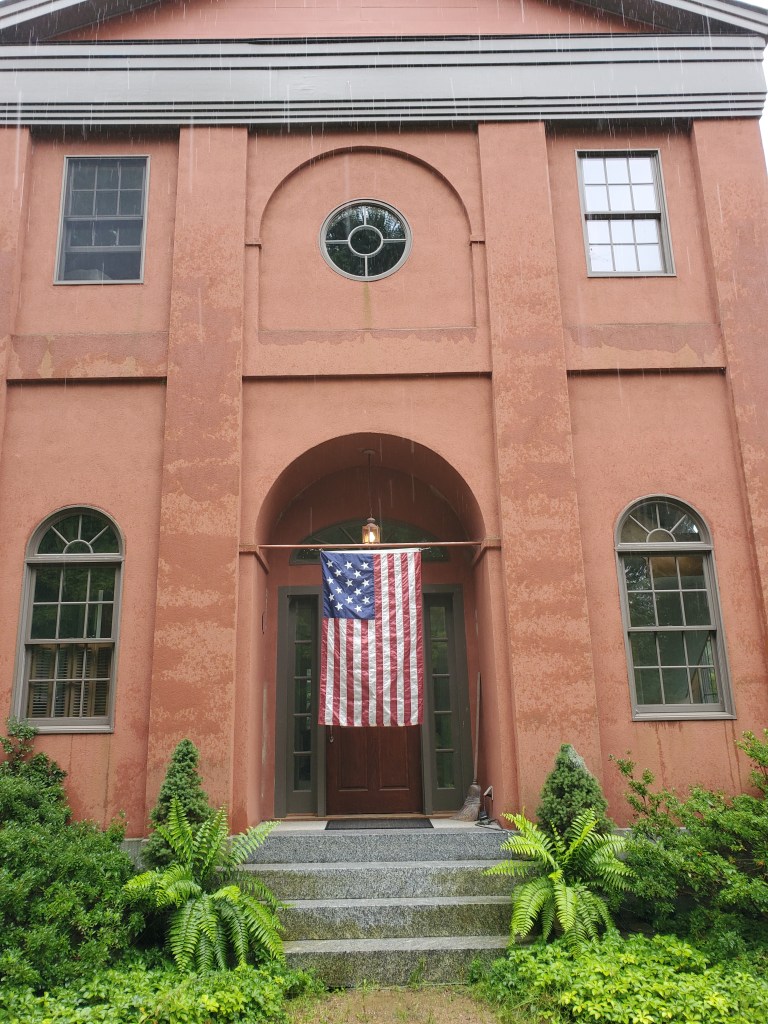
When Francis Scott Key first saw “by the dawn’s early light” a huge garrison flag, the original star spangled banner, flying over Ft. McHenry in Baltimore, Maryland on 14 September 1814, he knew that the British bombardment of the Fort had failed to prompt an American surrender. The British fleet withdrew, and the successful defense of Baltimore, then America’s third-largest city, marked a turning point in the War of 1812. Three months later, on 24 December 1814, the Treaty of Ghent ended the war. The flag’s 15 stars and 15 stripes represented the 15 states then in the Union, the thirteen original colonies plus Vermont (joined 1791) and Kentucky (1792).
I’ve flown a reproduction of this flag on the porch at Gnawwood today to honor the Federal influence on our home’s architecture and the workers of America—and to celebrate the third fall that this retired prof is NOT returning to the classroom. Time passing and the new school year have made me thoughtful about the many changes in academia observed over my 43 years of teaching. And so I refer you, Dear Reader, to Bret Stephens’s opinion piece published in the New York Times (in print on 31 August, online on 30 August (https://www.nytimes.com/2022/08/30/opinion/history-sweet-aha-academia.html): “This is the Other Way That History Ends.”
Stephens is responding to the backlash unleashed on James H. Sweet, professor of history at the University of Wisconsin, Madison, and president of the American Historical Association, for earlier this month publishing a column in that organization’s news magazine titled “Is History History?” Stephens regrets that the (unmerited in his opinion) brouhaha has obscured important things Sweet had to say. To quote Stephens:
“Sweet was warning that historians risked doing an injustice both to their own profession as well as to the past itself by falling victim to “the allure of political relevance.
. . . . Above all, historians should make us understand the ways in which the past was distinct. This shouldn’t prevent us from making moral judgments about it. But we can make better judgments, informed by the knowledge that our forebears rarely acted with the benefit (or burden) of our assumptions, expectations, experiences and values. There’s a lesson in humility in that, as well as a reminder that we are only actors in time whose most cherished ideas may eventually seem strange, and sometimes abhorrent, to our descendants.
. . . .If people are wondering how history ends, maybe this is how: when a scholarly discipline tries to turn itself into something it isn’t, making itself increasingly irrelevant in its desperate bid for relevancy.”
As someone who has too often heard Shakespeare called to task for living in the late sixteenth and early seventeen centuries, and myself an “actor in time,” I can only agree. Most of us know very little of history, and what we do know is necessarily filtered through our own metamodern perception. Here’s to the corrections Sweet and Stephens offer.
Happy Labor Day.
 Georgeann Murphy
Leave a comment