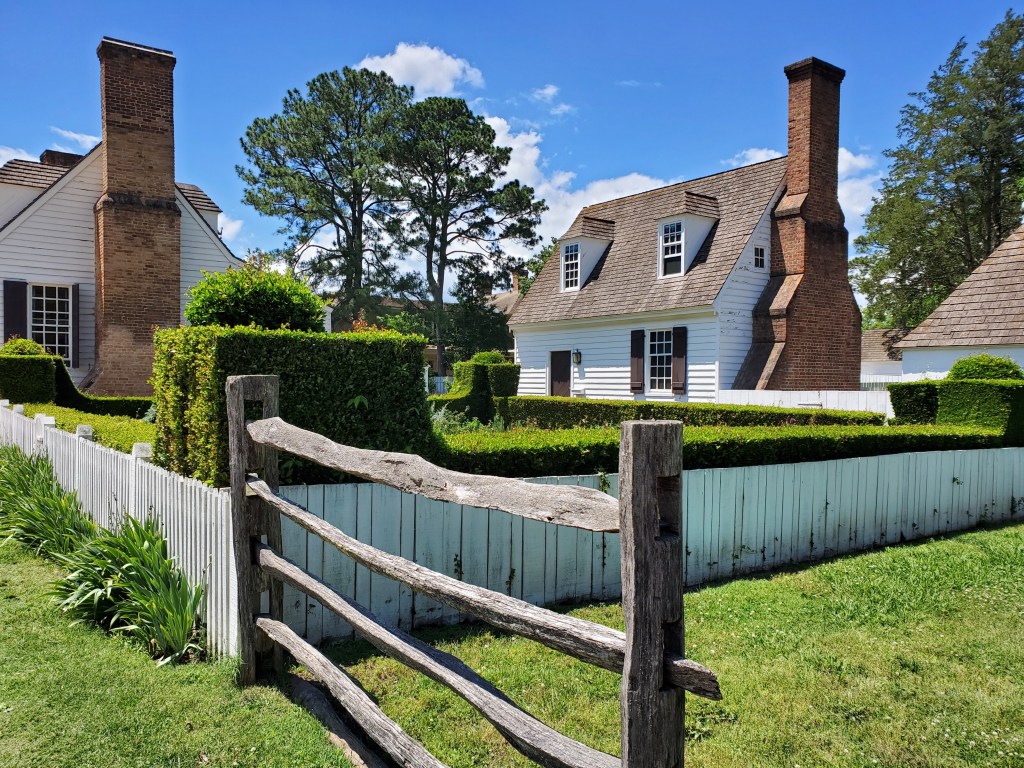
I’ve visited my friend Sandy in Williamsburg before, but previously approached from the north. This time, my path is from the south, much more rural, and at one point driving the increasingly flat and fertile terrain I get stuck at a railroad crossing as a long freight train proceeds slowly, almost to its caboose, and then backs up for another disappointing five minutes before rolling out of the way. Fine by me: it gives me a chance to text Sandy of a slightly delayed arrival. Once across the tracks, I drive along Route 5 in Charles City County, taking me past five of the James River plantations: Sherwood Forest, Westover, Shirley, Evelynton, and Berkeley. I stop at none; I had visited Westover before with David, my architectural historian husband, decades before, and I’m eager to reach Sandy. But the very word “plantation” conjures my memory of how much I have in the past enjoyed touring such sites along the Mississippi—once with my dear daddy. I had packed an elegant picnic lunch, complete with wine and some very fancy pastries from a fine New Orleans patisserie, La Bonbonniere, where German master baker Hans Fink once told me how much more sugar he had to add to his recipes to appease American tastes. Well, my dad and I enjoyed those too-sweet-for-Euro palates treats under a venerable live oak outside Houmas House in Darrow, Louisiana. For years after, I carried a voucher for a future discount at Houmas House in my wallet, a memento of that day and the tantalizing promise of a future visit. I DID go back once again with David, the other prince in my life, this time focused on the symbolism of all the Greek revival mansions along the Mississippi, temple houses that effectively made gods of their owners. That time, too, I recall with pleasure; a photo David took of me standing in Oak Alley was a favorite he kept in his UNH office.

When we returned to Oak Alley many years later, things were quite different. David had changed, prey to the debilitating anxiety that beset him at the end of 2007. But more significantly for the Big Picture, slave quarters had become part of Oak Alley’s permanent exhibit. I quote from the website:
Located on the historic grounds, almost exactly where the original [enslaved] community stood, 6 reconstructed cabins give insight into their lives and habits. 4 of the Cabins depict a type of dwelling–a field slave’s quarters, a house slave’s quarters, a sick house and a post-emancipation residence. 2 have been converted to exhibit spaces, inviting visitors to understand slave life on a more personal level. Displays here focus on religion, punishment, how slaves at Oak Alley were clothed, and the work that consumed their daily lives.
What does it mean “to understand slave life on a more personal level”? This “correction” to a tourist attraction is part of a very belated racial reckoning I’m thinking of as I drive past the long lanes leading to the James River plantations, considering how the rise of the Black Lives Matter movement and subsequent battles over school curricula, with their ignorant pushback about Critical Race Theory and systemic racism, find our country so far from the promise I naively, briefly believed we had come close to fulfilling by electing Barack Obama: redressing America’s original sin of slavery.
The web site promoting the James River Plantations I pass is also trying to address history that was either previously ignored or completely re-written, its promotion including a dash of black history:
Charles City has been home to Indians and early settlers, planters, signers of the Declaration of Independence, Presidents, slaves, emancipators and free blacks, educators and agriculturalists. Descendants of these significant figures in American history still live in the county today.
Benjamin Harrison, signer of the Declaration of Independence, and Presidents William Henry Harrison and John Tyler were born and lived here. General Robert E. Lee spent much of his childhood here. Agriculturist Edmund Ruffin, who fired the first shot of the Civil War, practiced his innovative techniques on Charles City soil. Lott Cary, the first black American missionary to Africa and founding father of Liberia, was born here. One of the first free black communities in America was located in Charles City, as well as the third oldest organized free black church.
I’m thinking, too, of the powerful, even shocking Tracy Letts play I saw in April in New York, The Minutes, about the atavistic tribalism that underlies how we tell, revise, and even celebrate a bloody history.

So, once again, on Route 5, I am driving through personal and national history, headed for Williamsburg, looking for America, and eager to see my friend Sandy, a specialist in eighteenth-century literature and a tour guide in Historic Williamsburg. She will not only connect me to the turbulent times we shared as graduate students, but conduct me to places I first knew as a child introduced to all the charm of Colonial Williamsburg before “colonial” had taken on its current pejorative odor. Indeed, my parents tried their best to recreate colonial style by painting their cement block Florida ranch house in official Williamsburg paint colors. For me, then, Williamsburg was all about molasses cookies, the pervasive scent of boxwood (I thought that the smell of old brick houses), a child’s tricorn hat, and a souvenir horseshoe with my name banged into it by an employee reenacting a smithy’s life. I am about to see things through different eyes.
But first, I arrive to Sandy’s gracious welcome, her lovely condo, and a visit/generous pour of wine with a couple of neighbors. One, Martha, is a fellow retired academic who is surprised to hear that Sandy’s and my little support group of Women Against Dissertation (WAD) had united to brave the many difficulties manufactured by Tulane’s graduate faculty—with, I proudly note, uniform success: all WADees earned our PhDs and tenure. Martha apparently had an easier time of negotiating the perils of grad school, though perhaps that left her with fewer interesting war stories: trials recollected in tranquility = comedy. Sandy makes us a fine boiled dinner of shrimp, sausage, potatoes, and fresh corn, we reminisce, and I retire to her lovely guest suite.
 Georgeann Murphy
Leave a comment