My final day in Greensboro began again with yoga, followed by a drive around three different senior living facilities, all of them massive. Provisions for aging boomers abound, it seems, particularly in the South; retirement communities are legion. Cameron is considering another move to a place that would best accommodate and provide for the final stages of life, something everyone of a certain age is either considering or in denial about. My plan, inasmuch as it IS a plan, is my determination to stay in our Madbury home, Gnawwood, which so delights and consoles me with its architectural choices all so carefully considered and rendered, the natural beauty of its setting, its store of memories, and all the visits from local critters: the deer who grace the lawn and despoil the vegetation, the snapping turtle who lays her eggs here each June, the hummingbirds who entertain with their complex social interactions just outside my kitchen window, and the more rare surprise visits—a porcupine who so tentatively approached the dining room window last evening, or the first flash of a Baltimore Oriole’s bright orange plumage at the feeder. Living at home, exclusively on the ground floor, would be possible with some rearranging of furniture, though we did design our three stories to accommodate a residential elevator. But I think my dad’s prognostication about that accurate: such a disruptive installation is something we’d never do. Of course, maintaining the house and grounds requires a good deal of time, money, and energy, and that’s just maintaining the residence; what services, what care will the body electric need? Difficult to consider. Will it be easier for those of us, like me and like Cameron, without children? Or harder? Easier, I think.
But it’s even easier not to think about what’s to come and just tick off errands on today’s to do list. We go to Lowe’s and do a drive-by selection of a nice flowering plant for Cameron’s little patio—another mandevilla, as it happens, which I’m happy to make a gift. Then to the grocery, Harris Teeter, for a bottle to carry to my next host.
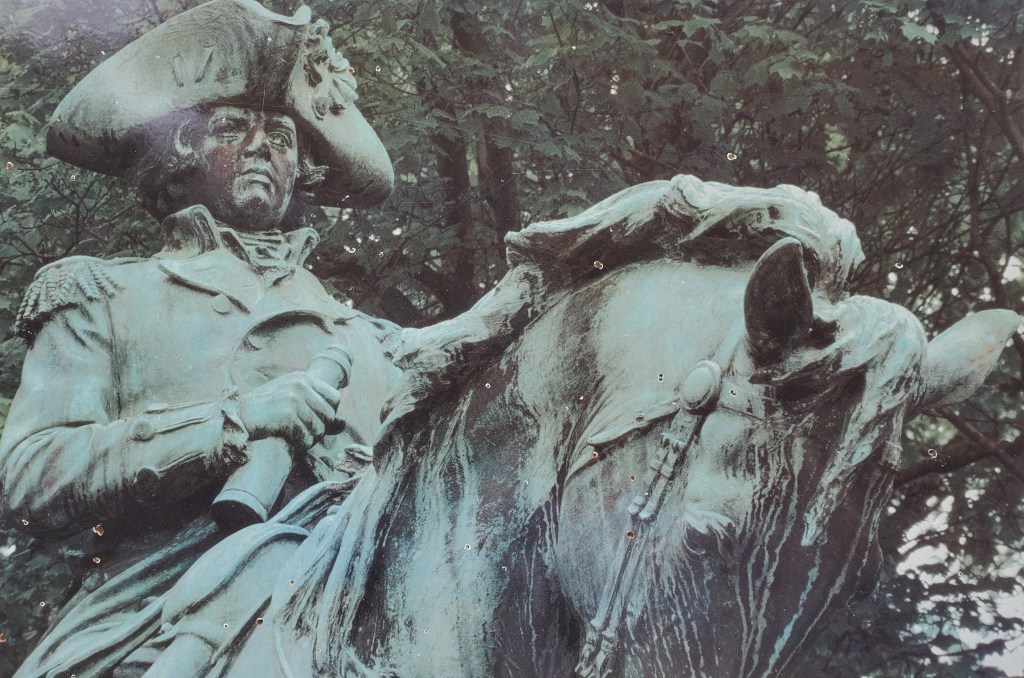
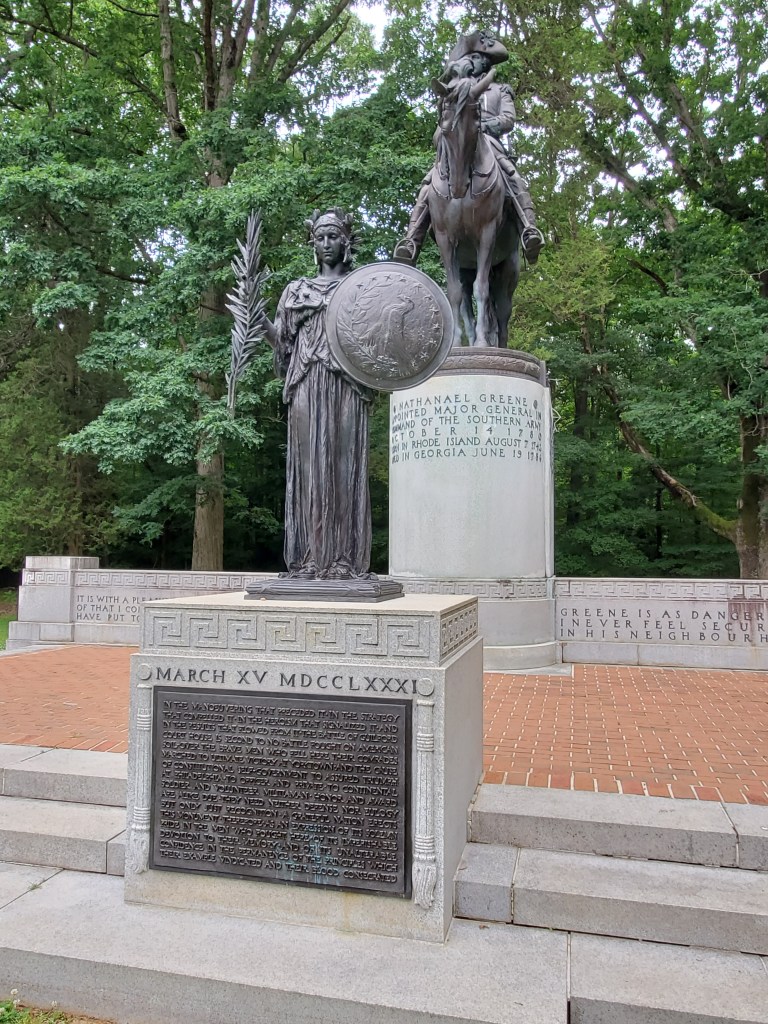
When we realize how close we are to the Guildford Courthouse Military Park, Cameron gives me an extended driving tour and a bit of history. The Park’s 250-acre landscape encompasses the core of the battlefield where the armies of General Charles, Earl Cornwallis and General Nathanael Greene met on 15 March 1781 in one of the major Southern Campaign battles of the Revolutionary War. Greensboro is uncommonly, lushly green and fecund this spring, but the town is named not for its verdant display, but for the general under whose command the ferocious Americans achieved a victory within a defeat. The Battle of Guildford Court House raged for two and a half hours before Greene ordered his troops to retreat, giving the British a tactical success, but enabling Greene’s army to remain mostly intact. Cornwallis’s victory, he knew, was pyrrhic, more than a quarter of his men killed, wounded, or captured; “I never saw such fighting since God made me. The Americans fought like demons” he wrote. Greene’s strategy changed the course of the Southern Campaign, and made possible the Americans’ shocking victory over the British and the surrender of Cornwallis at Yorktown on 19 October 1781, the last major land battle of the War.
Greensboro resident Judge David Schenck had a strong desire “to redeem the battlefield from oblivion,” his words from a December 1886 diary entry. By that time, the area was an unindustrialized rural landscape. The location of the battlefield, about an hour’s ride from the small town of Greensboro, was largely forgotten to area residents. After purchasing part of the battlefield, Schenck convinced local businessmen to join his cause and established the Guilford Battleground Company (GBC). The GBC prioritized the beautification and ornamentation of the battlefield. In 1917, stewardship of the battlefield passed to the War Department, and in 1933, under President Franklin Delano Roosevelt, transferred to the National Park Service who maintain it now.
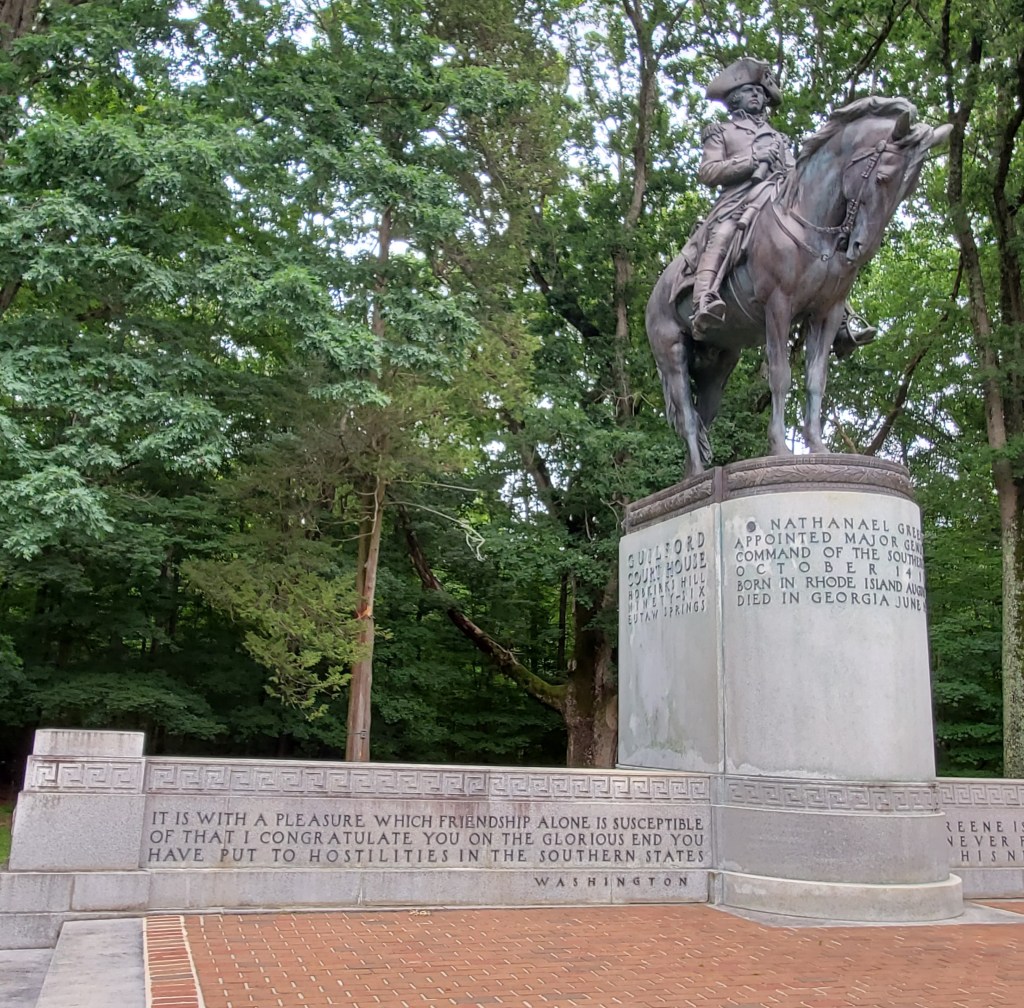
Battlefields are complex terrain, and this one, clearly favored by walkers, joggers, and bikers, is no exception. My dad, the Civil War buff, made Gettysburg and the story of Pickett’s Charge and the Angle Copse a vivid memory from my childhood: seeing the long grass of that blood-fed field ripple and part with the evening breeze as the sun sank over Cemetery Ridge conjured ghosts of soldiers marching through it to their destiny. Stopping now to read inscriptions on monuments to Greene–and to Schenck and other earnest nineteenth-century citizens dedicated to preserving glorious history—I return again to despondent thoughts of my country’s currently degraded condition. Would citizen soldiers today “fight like demons” to protect their homeland—as Ukrainians continue to do even as I type this, as American patriots once did? Does anyone even know our history? My colleague Lisa reported an undergraduate asking her whether in World War II we were allies with the French or the Germans. And so many Americans still under the spell of the grifter former president Trump believe the Big Lie that the 2020 election was stolen, remaining wedded to a delusion that no amount of carefully documented evidence to the contrary can dispel. Where are we headed, this Memorial Day weekend of 2022? What, indeed, are we remembering? The Guilford Courthouse Park leaves me pessimistically pensive.
But lunch at home beckons. I pack up the GTI for tomorrow’s drive into Virginia and take a walk while Cameron practices her violin, and then enjoy being treated to dinner out at Lucky 32 Southern Kitchen: “earnest food and hospitality in an upscale joint.” My “earnest food” is fried catfish and greens, served by an earnestly eager young waiter. Dessert is chocolate chip cookies taken at home while watching a tv show about the National Spelling Bee. And so, to bed.
 Georgeann Murphy
Leave a comment