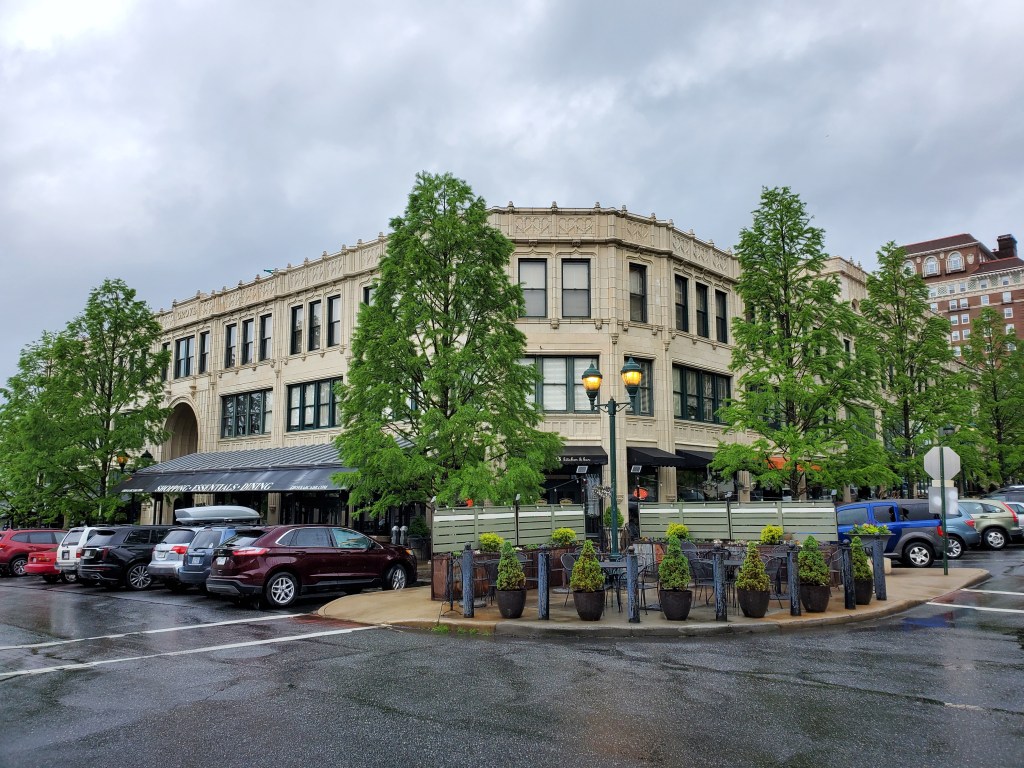
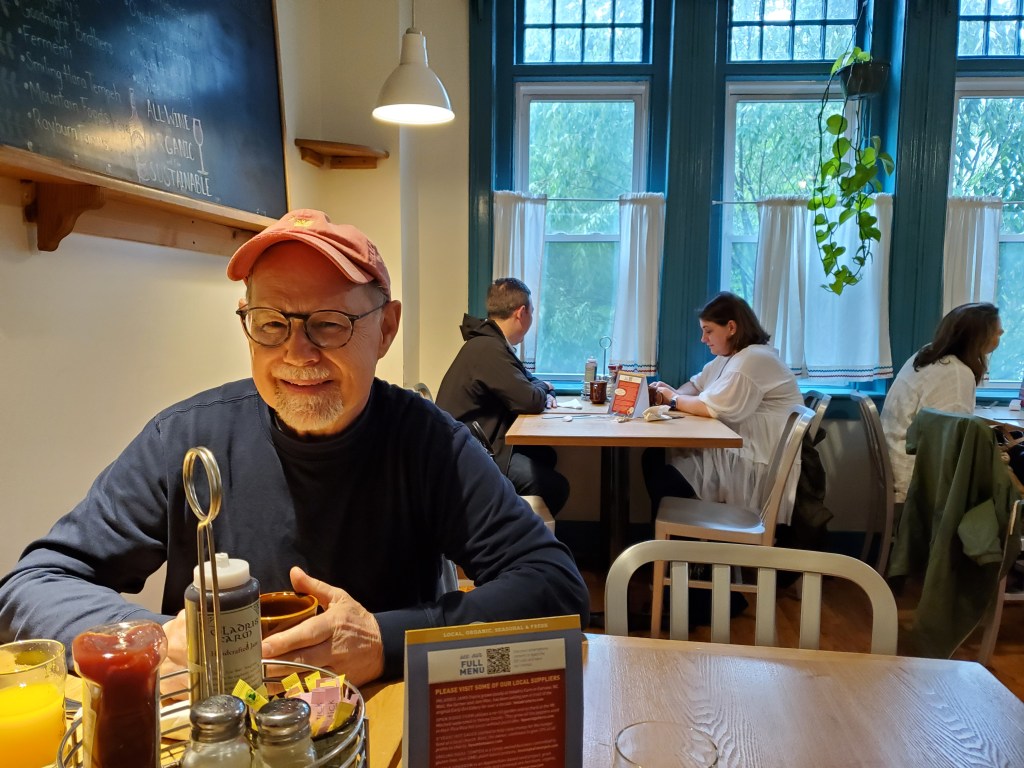
The rain has continued into the morning, but Mark, Olivia, and I nevertheless head to downtown Asheville for breakfast at the Early Girl before I return Mark to the Beaucatcher Road bungalow where he is working on installing crown molding in the living room.
He and Susan are hoping to put their little cottage on the market soon, so Mark is working against the clock—and, to some extent—against “extreme nostalgia,” as so much of their family history, and all of the twins’ childhood, happened there. Mark is a talented craftsman; the house will be in its best-ever shape when they leave it for their new home.
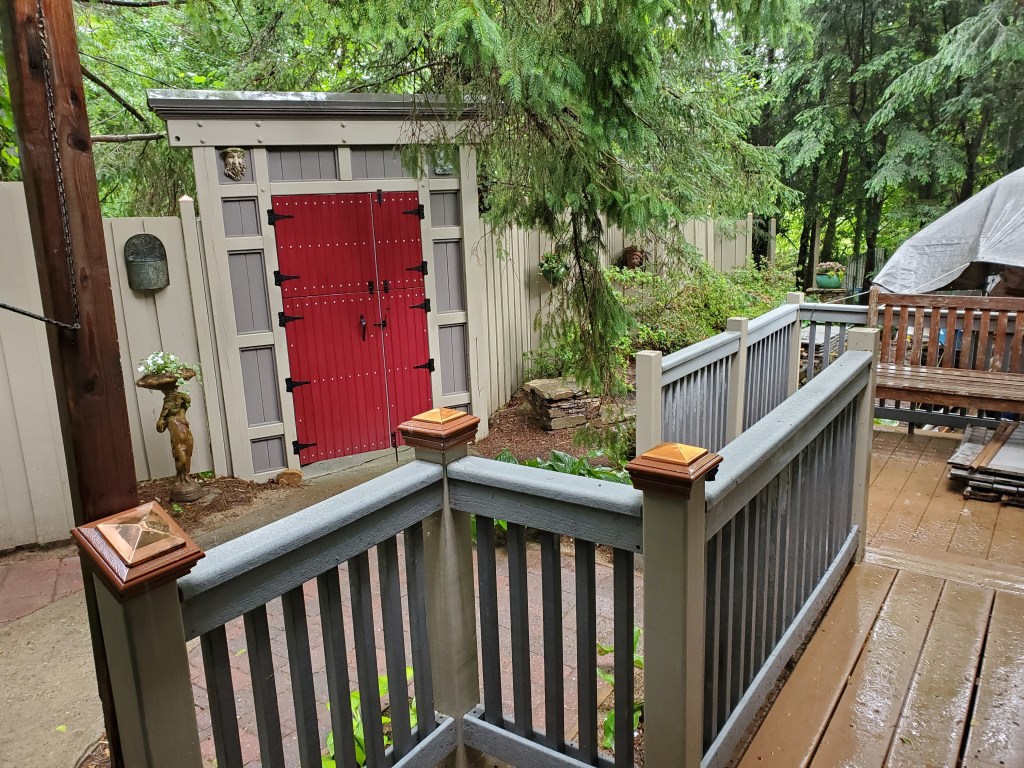
Having visited periodically over the last two decades, I, too, can easily conjure up—perhaps more than those living there continuously—scenes from the past, as when the front door entrance once served as a diaper-changing venue and two adorable toddlers ruled the roost.
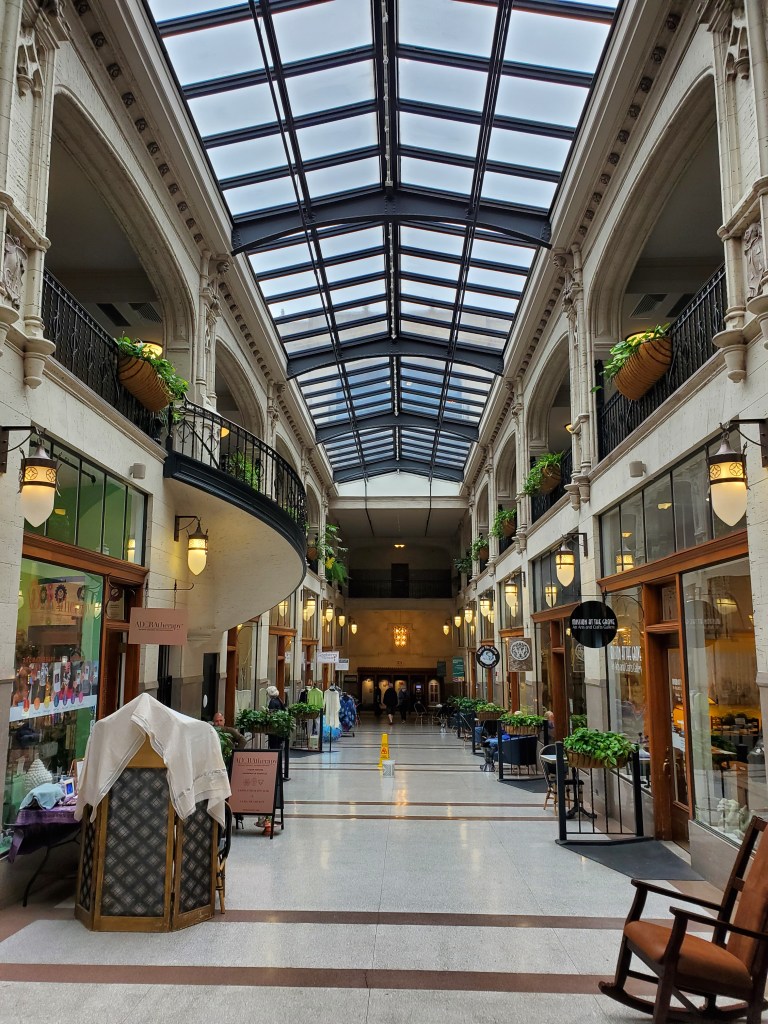
Once I drop Mark off, I take Olivia back downtown to her job interview at Anthropologie, bemused by Olivia’s using gps—just like me—to find the place. Ah, the younger generation and their device dependence! The rain persists, but dropping Olivia off, I find a very convenient place to park nearby, and imagine Grandpa David may have cued the parking gods from the great beyond. I fill Olivia’s interview time by walking (yes, using Google maps!) to the Grove Arcade, an historic architectural landmark conceived by pioneering Asheville developer Edwin Wily Grove in 1922, and completed in 1929, two years after his death. An elegant structure, the Arcade claims the distinction of being America’s first indoor shopping mall, the dream of that Gilded Age self-made millionaire. E. W. Grove (1850-1927) had grown up poor, running a modest little drug business in Paris, Tennessee, when in 1878 he realized that a fortune was the future for anyone who could produce a “tasteless chill tonic,” a suspension of bitter quinine in syrup that could ease, if not cure, the symptoms of malaria, a disease ravaging the South throughout the 19th century. Grove had himself lost both his youngest daughter Irma and his wife Mary to malaria. In 1889, Grove’s Chill Tonic was born, and by 1890 sold more bottles than Coca-Cola (see K. C. Cronin’s “Asheville History: The Legendary E. W. Grove).
Grove moved his business to St. Louis where he could more easily ship his product throughout the U.S., but the smog and smoke of the factory district there caused Grove chronic respiratory problems. So with his doctors’ urging in 1897, Grove, his second wife Gertrude, and their two children began spending their summers in Asheville to take the clean mountain air. In so doing, the Groves were following the lead of George Vanderbilt, who in 1888 had visited Asheville and was so charmed that he began buying up the 125,000 acres that would eventually become the self-sustaining estate, Biltmore, with a 250-room château designed by Richard Morris Hunt surrounded by formal gardens and pastoral landscaping laid out by Frederick Law Olmstead. Since 1930, when the Vanderbilts first opened it to the public, Biltmore has remained a thriving tourist attraction. My own family visited it often in the late 70’s and 80’s, and once posed before its imposing facade for the Murphy Family Christmas card.
Back to the enterprising Mr. Grove. By 1907, he had turned his attention from tonic to real estate, having himself acquired 1000 acres of land and created charming residential neighborhoods in North Asheville, now on the National Register of Historic Places. In the early 20th century, sanitariums and natural beauty were both drawing people to Asheville, but with Grove’s construction of the Grove Park Inn, completed in 1913, tourism won out, inspiring Grove’s Arcade downtown, which after many varied iterations was revitalized and reopened in 2002. On a rainy Monday, it is a good shelter.
When I meet Olivia back at the lucky parking space, we return to the Best Western Glo and revive a tradition begun when she and her sister were wee ones, swimming in the motel pool, in this case a salt water pool that leaves our skin remarkably soft. Then it’s back to Beaucatcher, where Olivia and I examine some of the family photographs I’ve also brought south to their appropriate home with Susan. When she returns from her work at RiverLink, we all go out to dinner at the Copper Kettle, where again I am propelled back to the past, remembering an earlier dinner there after a flight down to Asheville disrupted by weather that delayed our arrival by a full day. David bought me a flocked scarf from a local craftswoman showing her wares there.
Is it ever possible to experience the present uninflected by memory? I think not.
The rain has let up and in the midst of goodbyes, I leave my umbrella in the family car, but Susan has it waiting for me, hanging from the mailbox, when I swing by to pick it up on my way to Ingles for peanut butter and cash for the road ahead. A stranger behind me in line volunteers his Ingles rewards number on hearing I am a visitor who doesn’t have one, and the very elderly but very kind cashier helps me get the cash back I need. Again, the kindness of strangers. I head back to the garish Glo, wondering what E. W. Grove would make of the Asheville he departed just five years shy of a century ago. Would he be wrestling the past as much as I am?
 Georgeann Murphy
Leave a comment