
I write this account of a day spent largely at Sewanee, the University of the South, nearly a month past my visit to the “Domain,” and just as the second public hearing of the House Investigation of January 6 Committee has adjourned. Personal history and history being made are colliding, especially given the founding principles of the institution I visited. Sewanee’s picture-perfect Collegiate Gothic campus is a mountain-top pastoral, literally and figuratively separate from the world below. The campus is a beautiful, artificial domain indeed, but its raison d’être disturbs. I borrow from Wikipedia’s summary of its founding:
On July 4, 1857, delegates from ten Southern dioceses of the Episcopal Church in the United States were led up Monteagle Mountain by Bishop Leonidas Polk for the founding of their denominational college for the region. The goal was to create a Southern university free of Northern influences. As one of its co-founders, Bishop James Otey of Tennessee, put it: the new university will “materially aid the South to resist and repel a fanatical domination which seeks to rule over us” (Deyle, Carry Me Back: The Domestic Slave Trade in American Life, Oxford U. Press, 2006, pp. 205-07). Another of the co-founders was John Armfield, at one time co-owner of Franklin and Armfield, “the largest and most prosperous slave trading enterprise in the entire country” (Gower, “John Armfield 1797-1871” in the online Tennessee Encyclopedia).
The U.S. House Committee is currently presenting, as rationally and effectively as I believe possible, testimonies that explain why and how the violent 6 January assault on the U.S. Capitol occurred, an attack-as-expression of the not-so-cold civil war in which our country is currently engaged. On the Committee’s first day, Representative Cheney starkly rebuked fellow Republicans supporting Trump’s Big Lie: “There will come a day when Donald Trump is gone, but your dishonor will remain.” Yet I wonder how many of the former president’s supporters—even those likely few who watch or listen to the hearings—will, like Bishop Otey, find only honor in resisting and repelling “a fanatical domination which seeks to rule over us,” a group they would define as anyone with beliefs different from their own. For them, violence against such a group is not only defensible, but honorable. Facts and rules of evidence appear not to apply to anyone mesmerized by a charismatic (?) leader who vents shared hatred of the Other. The “charm” of the scofflaw Trump has always escaped me, yet so many remain devotees. Why?
And why, Dear Reader, do I add this preamble to my travel blog/diary? Because again I realize how much my Southern Sojourn is less an attempt to revisit my own past, than it is more an attempt to understand the present in which we all find ourselves.
So. Back to my account. After breakfast in the sylvan peace of their beautiful home, Pete and Karen honor my request for a tour of Sewanee, about an hour’s drive away. We enter its 13,000 mountain-top acres through the Angel Gates. Legend is a place so beautiful must be a place where angels dwell, protecting inhabitants and visitors alike. Tap the roof of your car as you leave the Domain to pick up your angel to protect you off the Domain as well; tap again on reentering to release your blithe spirit.
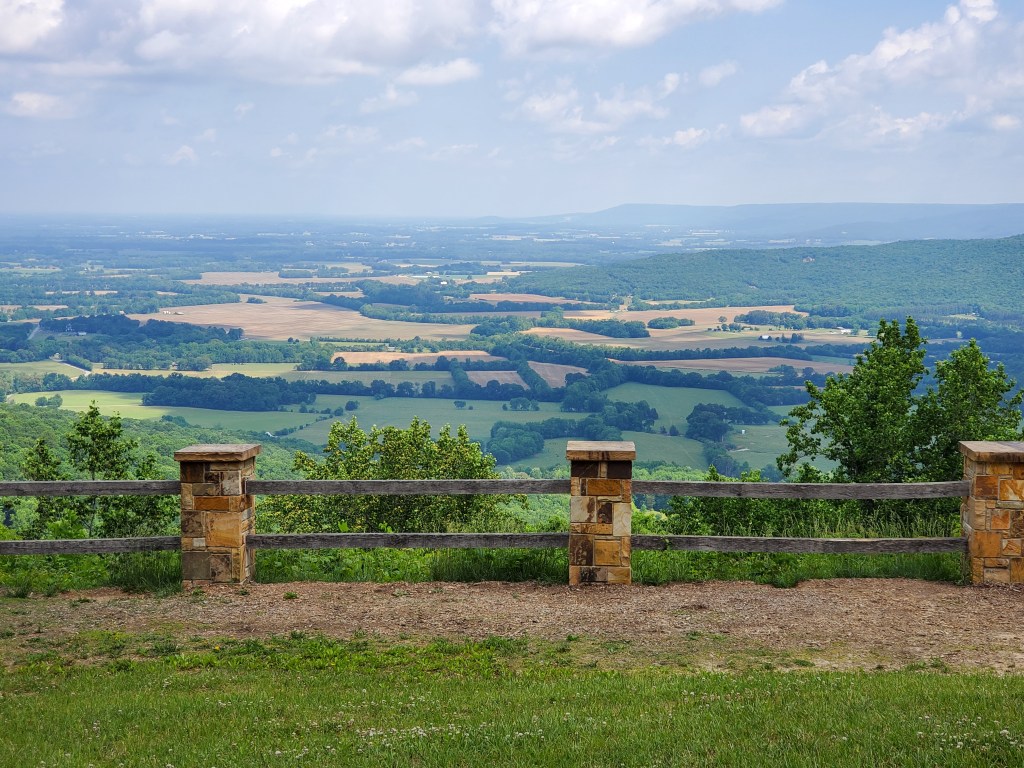
The place is beautiful there atop Monteagle Mountain, part of the Cumberland Plateau, and both homes and campus buildings are built of native Warren Point Sandstone, some of which was quarried right on the Domain, affording the whole place the uniform aesthetic and permanence of warm, golden stone.
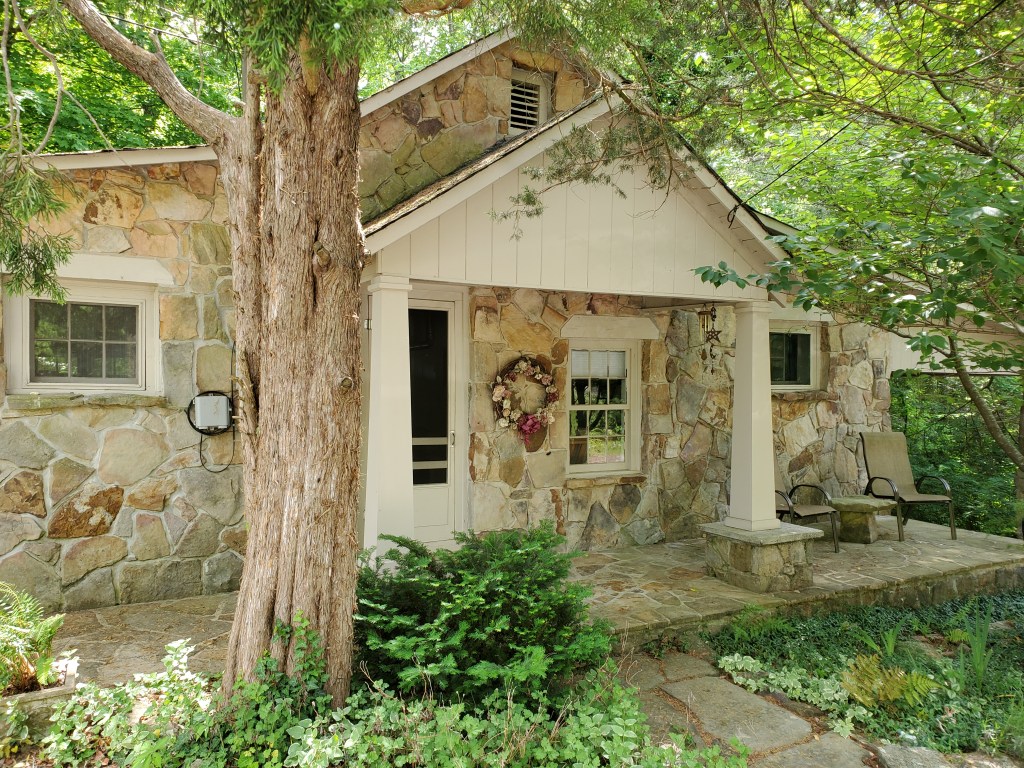
We visit both the 1906 cottage Pete and Karen have updated and maintain as a cool retreat and two of the houses where they once lived campus.
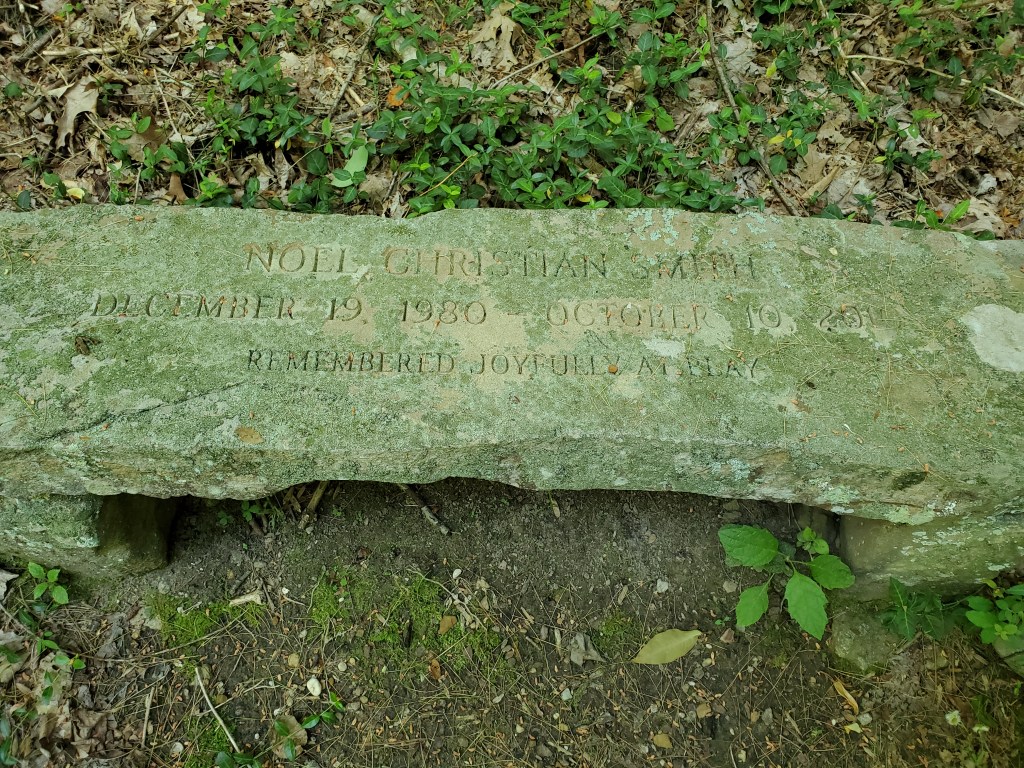
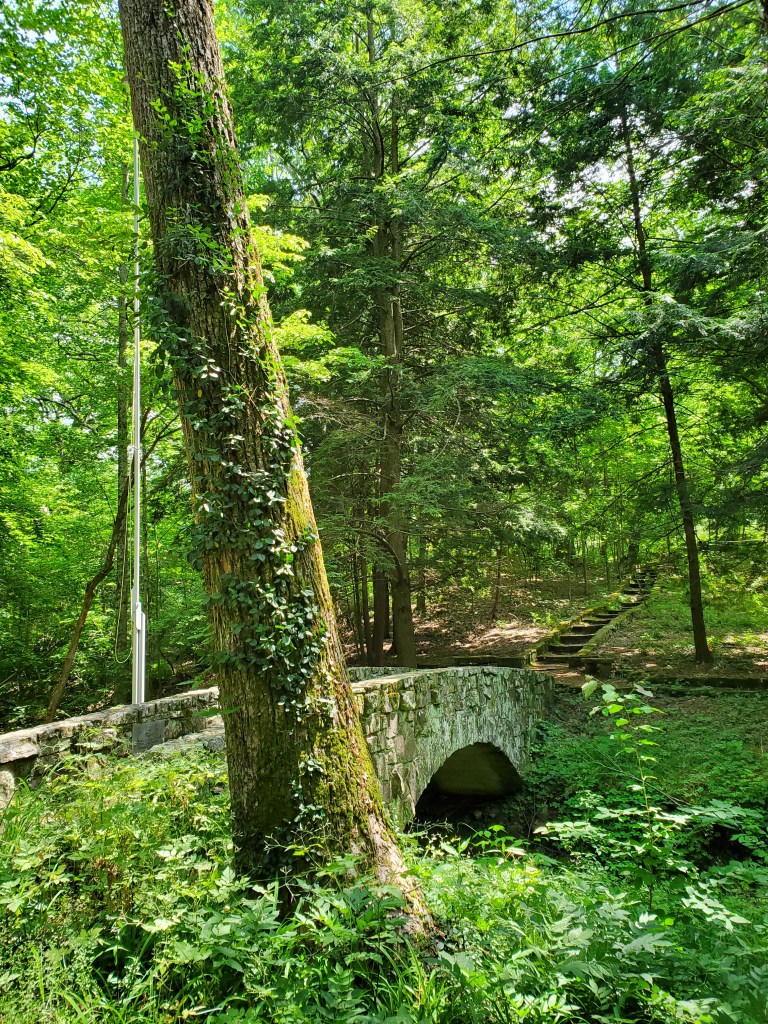
Both the cottage and their second home sit just above a ravine garden open to the public and named Abbo’s Alley after English Professor Abbott (aka “Abbo”) Cotton Martin, who in the early 1940’s began refining the area, using students seeking work-study income, some volunteers, and even German prisoners of war from nearby Tullahoma. The bench Karen and Pete had engraved as a remembrance of their late son, Noel, offers a peaceful view of one of the several bridges across the ravine’s stream.
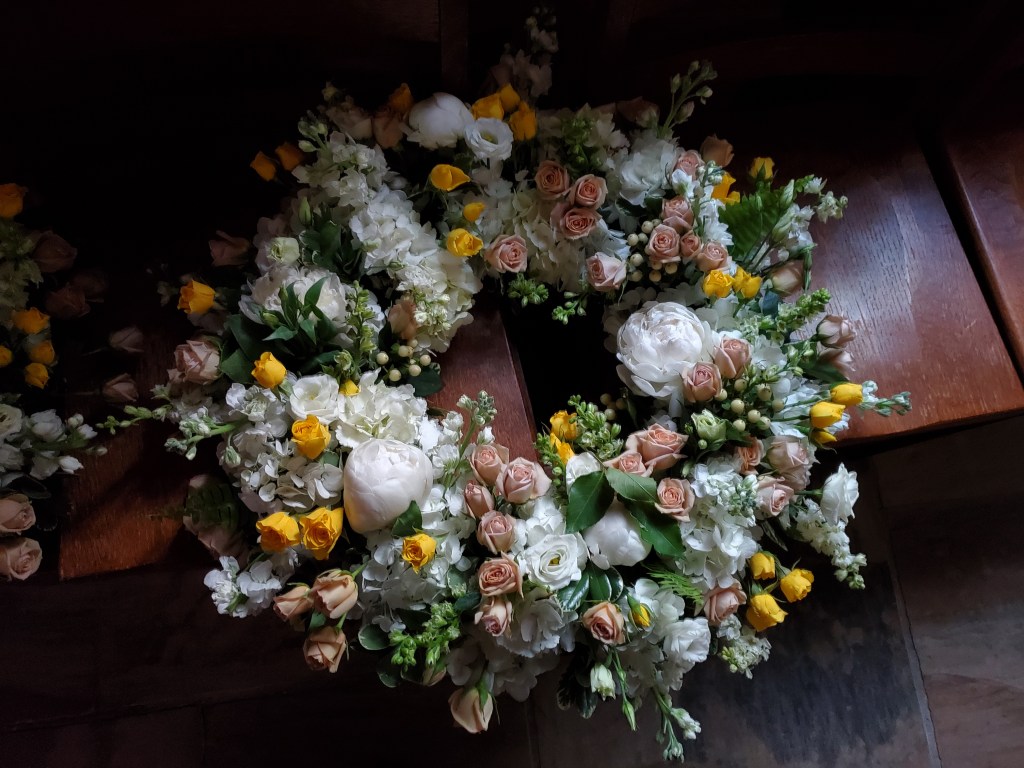
All Saints’ Chapel, completed in the two campaigns of 1904 and 1959, stands at the center of campus, a frequent wedding venue, as the floral displays in progress when we visit demonstrate.

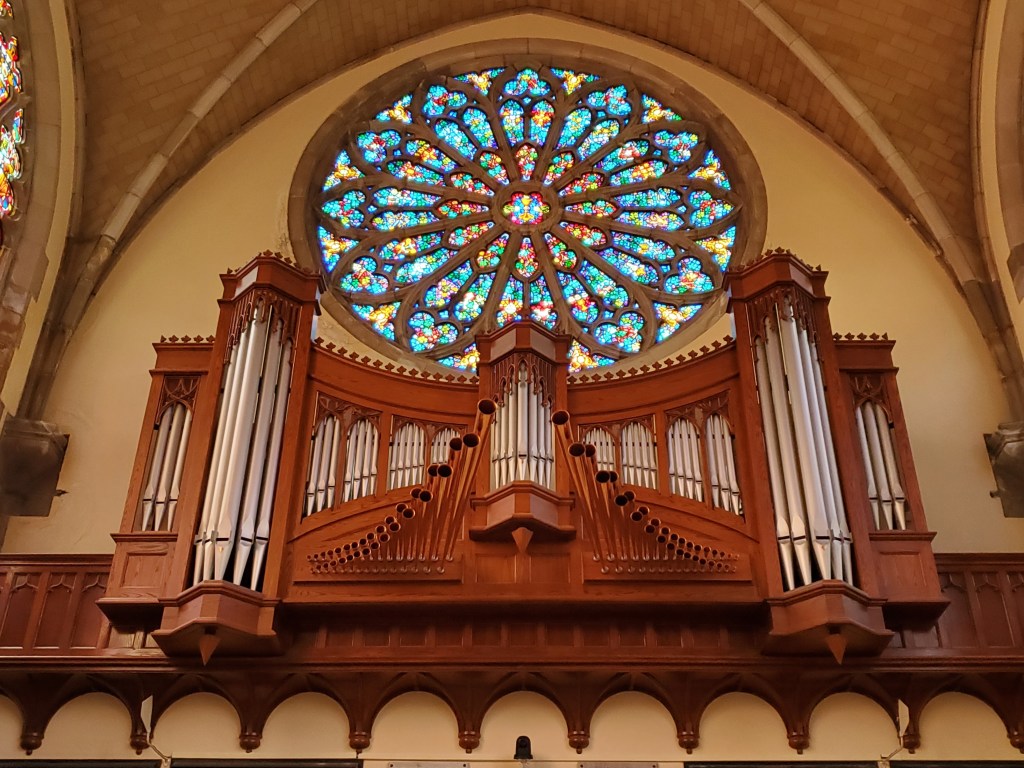
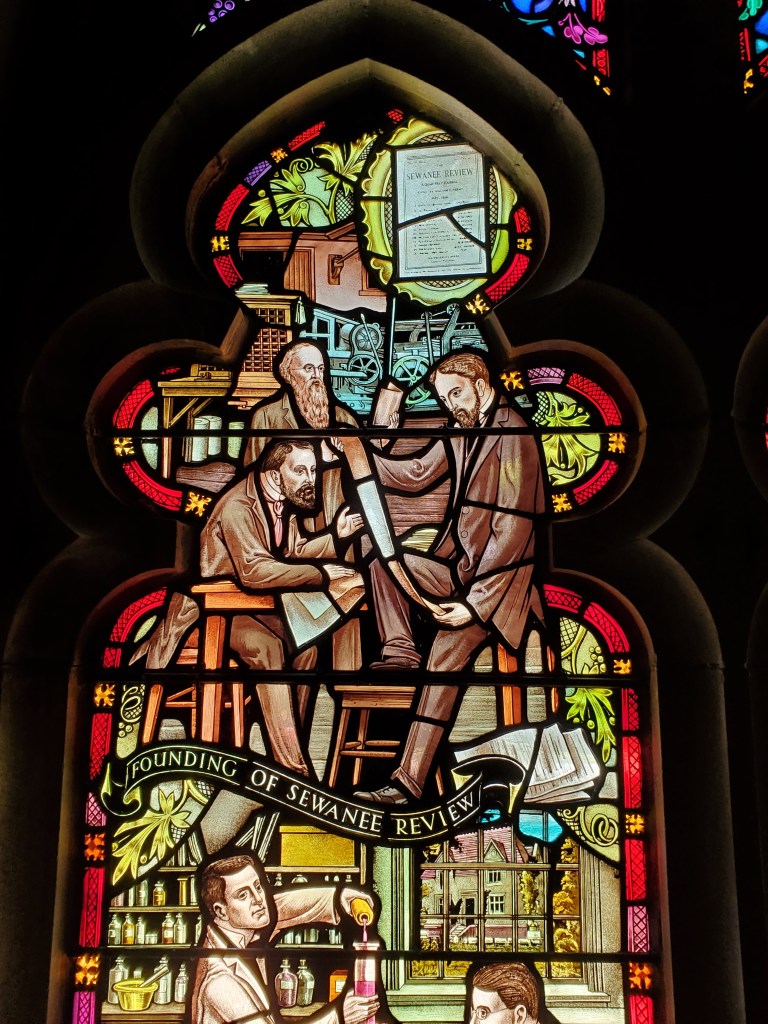
Its stained glass windows celebrate the secular as well as the sacred, including the 1892 establishment of The Sewanee Review, the oldest continuously published literary quarterly in the nation.
As pleased as that fact makes this secular humanist, the site I most want to see is the theatre Pete was instrumental in building with part of the Tennessee Williams bequest gifted to Sewanee as a memorial to his maternal grandfather, the Reverend Walter E. Dakin, who studied at Sewanee’s School of Theology in 1895. This generous gift, which came to the University in 1996, included the copyrights to the plays, screenplays, poems, letters, and stories written by Williams, and Pete’s self-described mission ever since then has been “to keep Tennessee Williams alive.”

At one time Williams was the second most-frequently produced playwright after Shakespeare, and all professional productions of Williams’s plays now must secure permission from Pete, who headed the construction of the Tennessee Williams Center on campus, and wrote the text for the engraved memorial to Williams at its entrance:
Craftsmanship and vision marked Tennessee Williams as one of the most talented playwrights of the American Theatre.
He was born on March 26, 1911 in Columbus Mississippi, son of Cornelius Coffin Williams, a traveling shoe salesman, and Edwina Dakin Williams, the daughter of an Episcopal priest who graduated from The University of the South, School of Theology, Class of 1895.
He was raised in St. Louis and graduated from the University of Iowa in 1938. He died on February 24, 1983.
From the beginning of his career, Tennessee Williams wrote characters who are never at home in the world, but are fugitives, “faded and frightened and difficult and odd and lonely.”
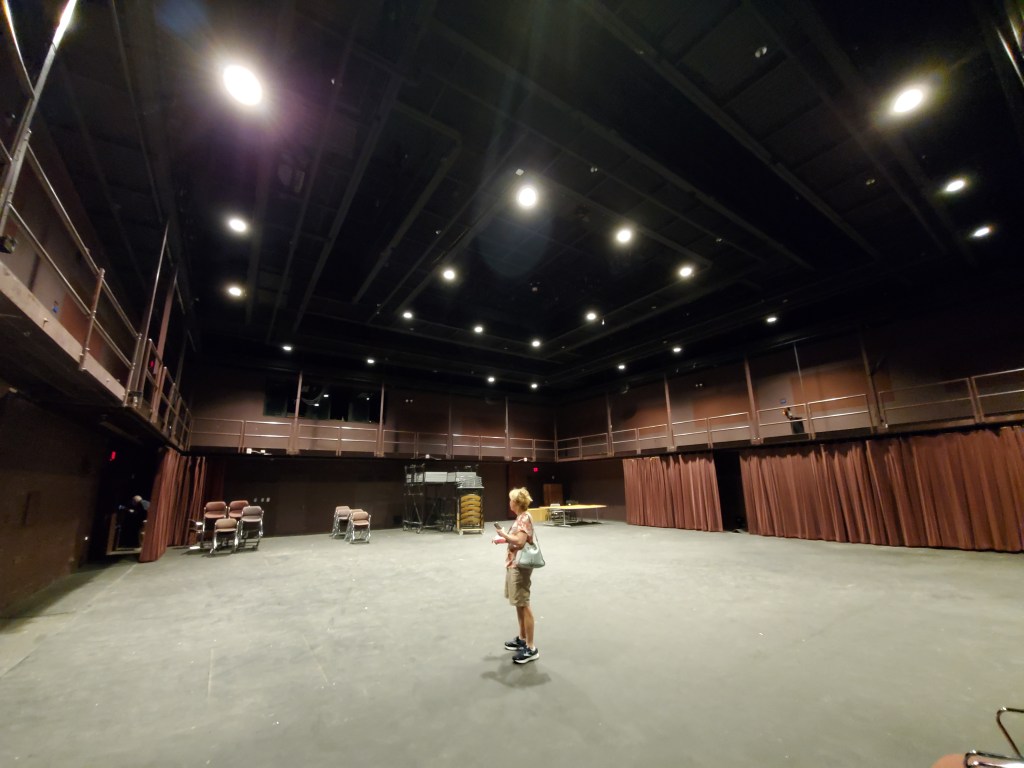
The theatre space just past the Dakin Lobby is the ultimate black box, offering unlimited staging possibilities, and Pete is justifiably proud of his role in creating it.
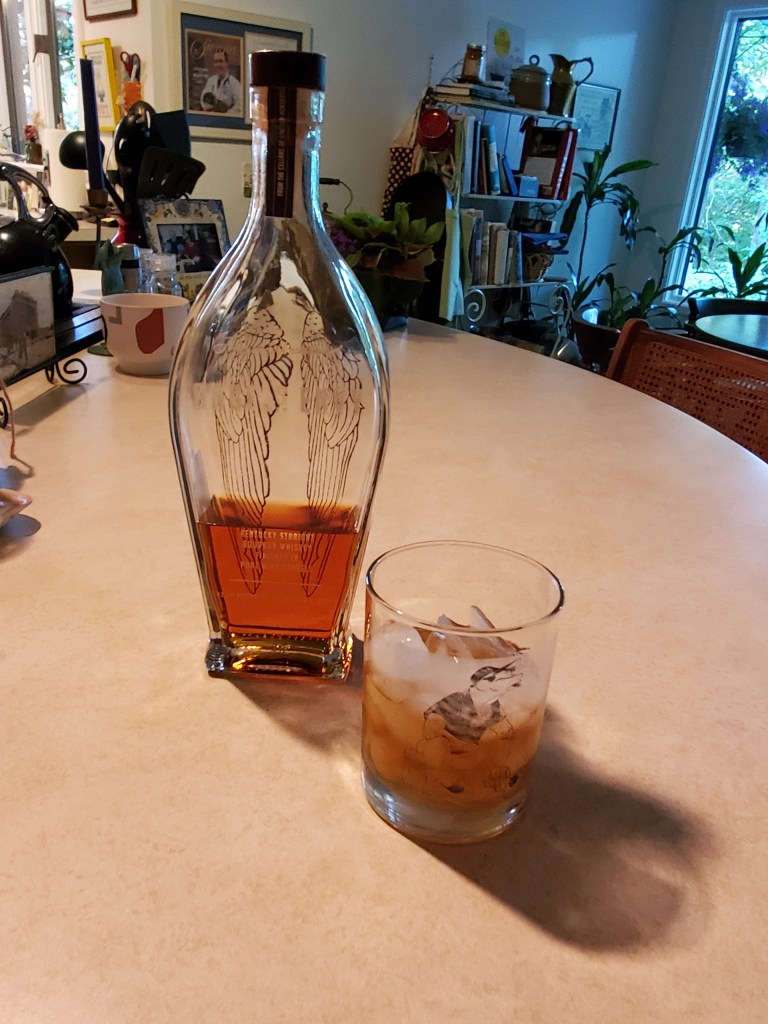
We take our Sewanee angels with us when we leave the Angel Gates. Part of their beneficence that ensues must be the superior Angel’s Envy bourbon with which we toast the winner of the Preakness, Early Voting (!), prior to a dinner of that now-familiar and most excellent combo of medium rare beef, asparagus, and potatoes cooked with garlic I help Karen, hobbled by a right arm in a pink cast following wrist surgery, prepare. My reward, in addition to an excellent meal: an extra garlic press!
A day of revelations well spent.
 Georgeann Murphy
Leave a comment